PART 2: Rex Was Returned to the Shelter Four Times—After the Fourth, He Stopped Looking at Anyone
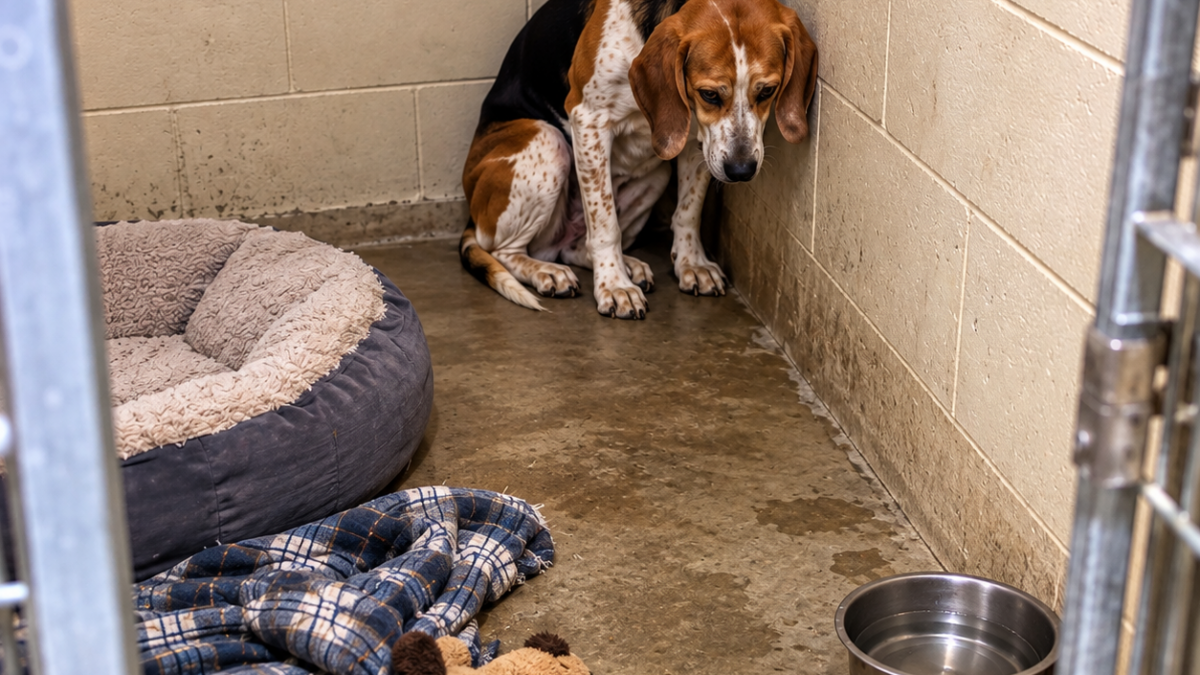
PART 2
The first thing Rex did when we arrived at my house was refuse to enter.
I had expected hesitation.
I hadn’t expected complete stillness.
He stood on the walkway with all four feet planted.
My front door was open.
The porch light glowed behind me.
Inside, I had prepared everything.
A bed.
Food.
Water.
Two blankets.
A basket of toys I had bought despite knowing he might ignore every single one.
I had even moved my shoes into a closet because Rex’s file included several cheerful notes about his interest in footwear.
“Come on,” I said softly.
Nothing.
Rex looked at the doorway.
Then at my car.
Then back toward the street.
It took me a moment to understand.
He wasn’t afraid of the house.
He was afraid of what entering a house meant.
Four times before, a doorway had promised something.
Four times, eventually, that promise had ended.
I sat down on the porch step.
“All right.”
Rex looked at me.
“We can be weird out here.”
His ears moved.
For twenty minutes we sat under the porch light.
A neighbor walked past with a small terrier.
Rex watched.
A truck drove by.
He watched that too.
Then, without warning, he walked past me.
Across the porch.
Through the door.
Into the living room.
He smelled the couch.
The coffee table.
The curtains.
The wall.
The rug.
He walked through the kitchen.
Returned to the living room.
Then went back to the front door and sat beside it.
That became his place for the first three nights.
Not the dog bed.
Not the blanket beside my couch.
The front door.
I understood why.
Rex expected to leave.
The first morning, I picked up my keys to go to work.
Rex immediately stood.
His body went rigid.
I clipped on his leash because he was coming to the shelter with me until I figured out a routine.
The moment the leash attached, his tail dropped.
He walked to the car slowly.
At work, he went directly toward Kennel 18.
I stopped.
“No.”
Rex pulled once.
Not hard.
Toward the kennel.
My throat tightened.
He thought I had changed my mind overnight.
I crouched.
“You’re not staying here.”
Rex looked from me to the kennel.
One of my coworkers, Jasmine, saw us.
Her expression softened.
“Oh, buddy.”
I led him into the staff office instead.
He spent the day behind my desk.
That evening, he came home again.
The second morning, the same thing happened.
Keys.
Leash.
Tail down.
Shelter.
Kennel.
No.
The third morning, Rex refused to get into my car.
I called Daniel.
“I’m going to be late.”
“Rex?”
“Yes.”
“Take your time.”
I sat beside Rex in the driveway.
“You think I’m taking you back.”
He stared at the ground.
“I’m not.”
Of course words alone meant nothing.
People had probably said many reassuring things to Rex.
Then left.
So I stopped trying to convince him with language.
I went back inside.
Changed out of my uniform.
Called a coworker to cover my first hour.
Then I made breakfast.
Rex stood in the kitchen doorway.
I scrambled two eggs.
One for me.
A little plain egg for him.
We ate.
Then I picked up my keys again.
No leash.
I walked outside.
Got into the car.
Sat there for thirty seconds.
Then came back inside.
Rex stared at me.
I did it again.
Keys.
Car.
Return.
Again.
By the fifth time, Rex looked confused.
Good.
Confusion was better than fear.
For the next week, I practiced leaving.
Thirty seconds.
One minute.
Three minutes.
Five.
I would return without making a big event of it.
Sometimes Rex waited beside the door.
Sometimes at the window.
Eventually he began staying on the rug.
I installed a small camera so I could watch him.
The first time I left for twenty minutes, Rex stood by the door for nineteen of them.
The second time, fifteen.
Then twelve.
Then nine.
The day I watched him lie down while I was gone, I cried in the grocery store parking lot.
A stranger walking past my car probably assumed I had received terrible news.
In a way, I had received wonderful news.
Rex had rested while I was absent.
To most people, that meant nothing.
To me, it meant he was beginning to believe I might return.
Then the honeymoon ended.
Three weeks after I brought Rex home, his real personality began coming back.
I was thrilled.
For approximately forty-eight hours.
Then I understood why four families had felt overwhelmed.
Rex was not simply energetic.
Rex was powered by some secret internal engine nobody had remembered to turn off.
A thirty-minute walk?
Warm-up.
An hour at the park?
Interesting beginning.
Fetch?
He would chase the ball twice and then become distracted by a smell from three counties away.
He followed his nose everywhere.
Under bushes.
Around trees.
Across lawns.
Into one humiliating encounter with a decorative plastic deer.
One Saturday, I walked him six miles.
When we returned home, I collapsed onto the couch.
Rex stood in front of me holding a rope toy.
His tail wagged.
“No.”
He dropped it on my chest.
“Rex.”
Tail.
“No.”
He picked it up and pushed it into my face.
I laughed despite myself.
“You’re insane.”
Rex sneezed.
Then ran one full circle around the living room.
That was the first time I saw his old joy return.
I was too happy to be annoyed.
Then he jumped onto the couch, stepped directly on my stomach, and stole my throw pillow.
“Okay. Maybe slightly annoyed.”
I called a canine behavior consultant named Dr. Lena Foster.
Lena had worked with hounds for nearly fifteen years.
She came to my house, watched Rex for forty minutes, and said something that changed everything.
“There’s nothing wrong with this dog.”
I stared at her.
“Could you tell my knees that?”
She smiled.
“He’s under-stimulated.”
“I walked him six miles yesterday.”
“Walking isn’t the same as working.”
“What does that mean?”
She pointed toward Rex.
“He’s a foxhound.”
“I’m aware.”
“His brain is built around scent, movement, problem solving, and doing things with a group. You can tire his legs and still leave his mind wide awake.”
Rex smelled her bag.
Lena removed a small tin.
Inside was a piece of cotton carrying a particular scent.
She hid it behind a chair.
Then released Rex.
“Find it.”
Rex froze.
His nose moved.
For ten seconds, I saw something different happen.
His entire body became focused.
Not frantic.
Focused.
He searched the room.
Chair.
Table.
Couch.
Corner.
Then he found the tin.
Lena rewarded him.
Rex’s tail exploded.
Again.
Different hiding place.
Rex found it faster.
By the fourth attempt, he was vibrating with excitement.
Lena looked at me.
“That.”
“What?”
“That’s the dog you need to live with.”
Rex stared at her, waiting.
“Give him a job.”
So I did.
We started nose-work classes.
Food puzzles.
Structured trail walks.
Short training sessions.
Hide-and-find games in the backyard.
I replaced one long exhausting walk with two purposeful walks and scent work.
Within a month, Rex changed.
The energy remained.
But it had direction.
He slept more deeply.
He paced less.
He stopped stealing random objects as often.
Mostly.
My left shoe continued disappearing.
One evening, after a scent game, Rex climbed onto the couch.
He circled twice.
Then lay with his back against my leg.
I looked down.
“You know they called you too much?”
His eyes closed.
I rubbed his ear.
“They were wrong.”
Then I corrected myself.
“No. That isn’t fair.”
Rex opened one eye.
“You were too much for the homes that didn’t fit you.”
His eye closed again.
“That’s different.”
I began reviewing Rex’s old records more carefully.
Not because I was looking for someone to blame.
I wanted to understand patterns.
The first return was simple.
A young couple had chosen him because he looked beautiful in the adoption photo.
They both worked full time.
They lived in a small apartment.
They expected two short walks a day to be enough.
It wasn’t.
The second family had three small children and no experience with hounds.
Rex stole food.
Jumped.
Bayed loudly.
They became overwhelmed.
The third family actually tried.
They hired a trainer.
Increased exercise.
Kept him nearly a year.
But then one parent changed jobs.
Schedules collapsed.
Rex spent longer hours alone.
Eventually they admitted they couldn’t meet his needs.
Their return form contained one sentence I appreciated:
**Rex is a wonderful dog. We are not the right home.**
That was painful.
But honest.
Then I reached the fourth file.
Grant Hale.
Age forty-two.
Contractor.
Fenced property.
Experienced with dogs.
On paper, he had looked ideal.
Grant had told us he ran several mornings a week and wanted a dog who could keep up.
Rex had gone home with him at age six.
He stayed eight months.
Then Grant returned him.
I remembered that day.
Grant had entered the lobby holding Rex on a short leash.
Rex was thinner than before but not dangerously so.
His coat looked dull.
Grant was irritated before anyone spoke.
“I’m done.”
Our intake coordinator asked what had happened.
Grant said Rex had become “unpredictable.”
“Has he bitten anyone?” she asked.
I remembered the pause.
“No.”
“Attempted to?”
“He gets worked up.”
“What does that mean?”
“He barks. Jumps around. Acts crazy.”
“Any specific incident?”
Grant sighed.
“I don’t have all day.”
At the time, I had been focused on Rex.
I hadn’t thought much about the man.
Now I read the formal return form.
**Reason for return: aggression, destructive behavior, excessive activity.**
Under bite history:
**No confirmed bite.**
Under medical incident:
**None reported.**
I stared at the contradiction.
Aggression.
No bite.
No incident.
I pulled the training notes.
Grant had been given three free follow-up sessions after adoption.
He attended one.
The trainer’s notes read:
**Rex demonstrates high arousal associated with insufficient exercise and limited scent enrichment. No aggression observed. Owner advised to increase structured activity and reduce long periods of confinement.**
I read it twice.
Long periods of confinement.
I looked at Rex.
He was asleep beside my desk.
I closed the file.
Maybe Grant had simply failed.
People fail.
Not everyone who fails a dog is cruel.
Sometimes people overestimate what they can handle.
Sometimes life changes.
Sometimes they become tired.
That could have been the end of it.
Six months later, Rex became mildly famous.
It happened accidentally.
Brookside Shelter ran a weekly social media series called Second Chances.
Jasmine wrote a short post about Rex.
She didn’t name his previous adopters.
She didn’t criticize anyone.
The post simply said that Rex had been returned four times, had shut down after the last return, and had eventually gone home with a shelter employee who learned that his energy needed structure rather than punishment.
She included a photograph of Rex at nose-work class.
He stood beside a row of cardboard boxes wearing a blue harness.
His ears were flying.
His mouth was open.
His eyes were bright.
The caption said:
**Sometimes the dog isn’t “too much.” Sometimes we just haven’t discovered what makes him feel understood.**
The post took off.
First a few hundred shares.
Then thousands.
A local news station asked to visit.
I almost refused.
Daniel persuaded me.
“If it helps people choose dogs based on lifestyle instead of appearance, it’s worth it.”
So we filmed a short segment.
Rex found three hidden scent tins.
The reporter laughed when he ignored her to inspect a trash can.
The piece aired Friday night.
Saturday morning, the shelter’s page received a comment.
Then another.
Then a long public post.
From Grant Hale.
I recognized the name immediately.
His post said the shelter was hiding Rex’s “dangerous history.”
He claimed Rex had lunged at him.
Claimed staff ignored his warnings.
Claimed I had adopted Rex despite “knowing he had attacked someone.”
I read the post three times.
My hands went cold.
Jasmine called.
“Emma.”
“I saw it.”
“Daniel’s contacting counsel.”
“He’s lying.”
“I know.”
“He told us there was no bite.”
“I know.”
“He signed it.”
“I know.”
I paced my kitchen.
Rex followed.
The post spread almost as quickly as the original story.
Some people defended the shelter.
Others asked questions.
A few wrote that a dog with alleged aggression should never have been placed.
Someone tagged county animal control.
By Monday morning, an official inquiry had been opened.
Not because they automatically believed Grant.
Because they had to review the claim.
That distinction did not make me feel better.
Officer Maria Jensen met me at the shelter.
She was calm.
Professional.
Almost painfully neutral.
“We’re not here to take Rex.”
I stiffened.
“I didn’t ask.”
“You were thinking it.”
I was.
Maria opened a folder.
“Mr. Hale states that Rex attempted to bite him on at least two occasions and made contact once.”
“He told us there was no bite.”
“Your intake form says no confirmed bite.”
“He said no.”
“Do you have documentation beyond the form?”
Daniel answered.
“We’re checking archived material.”
Maria nodded.
“I’ll need everything.”
“What happens if he keeps saying Rex bit him?”
“We determine what the evidence supports.”
I looked at Rex through the office window.
He was asleep beneath Jasmine’s desk.
“What if there’s no evidence?”
“Then there’s no substantiated bite.”
“And if he produces something?”
“We evaluate it.”
I hated neutrality.
I understood why it existed.
I still hated it.
The next day, Grant sent animal control photographs.
One showed a small red mark on his forearm.
No date visible.
No context.
Another showed a torn sleeve.
He claimed both came from Rex.
Maria asked whether there had been medical treatment.
Grant said no.
Any witness?
No.
Veterinary report?
No.
Contemporaneous written complaint?
He said he had verbally reported everything to the shelter.
That was the problem.
Memory versus memory.
Until Daniel called me into his office.
“I found something.”
“What?”
“Front desk archive.”
Brookside had installed lobby cameras with audio after an incident involving an angry visitor two years earlier.
Footage was normally overwritten after several months, but clips associated with formal surrender records were sometimes exported and attached to digital case files.
Rex’s return had one.
We watched.
Grant entered.
Rex beside him.
Same scene I remembered.
Our coordinator, Ashley, asked:
“Has Rex bitten you or anyone else?”
Grant answered clearly.
“No.”
Ashley asked:
“Has he attempted to bite?”
Grant rubbed his forehead.
“Not really. He barks and throws himself around when he’s excited.”
“Any snapping?”
“Once at the air when I grabbed his collar.”
“Did he make contact?”
“No.”
“Any injuries?”
“No.”
Then Grant said the sentence that changed the entire situation.
“I just need you to take him today.”
Ashley explained that owner returns usually required appointments unless urgent.
Grant replied:
“I don’t care. I can’t keep dealing with him.”
I sat staring at the screen.
Daniel exhaled.
“That’s pretty clear.”
We sent the clip to Maria.
I expected the complaint to disappear immediately.
It didn’t.
Grant changed his story.
He now claimed the bite happened after that recorded conversation but before he left the building.
Impossible.
Rex had been transferred to staff within minutes.
The lobby video covered almost the entire period.
No bite.
Grant then said maybe he had confused the date.
Maria remained neutral.
I began to admire neutrality.
Then another person contacted the shelter.
Her name was Sarah Kim.
She had seen the television story.
Sarah had been Rex’s dog walker while he lived with Grant.
She asked to speak privately.
Daniel, Maria, and I met her at the shelter.
Sarah was in her late twenties.
She carried a folder and looked nervous.
“I don’t want trouble.”
Maria said, “Just tell us what you know.”
Sarah looked at me.
“I liked Rex.”
My throat tightened.
“He liked everybody.”
She smiled sadly.
“I walked him four days a week for about five months.”
“Four days?” I asked.
“Grant was gone a lot.”
That surprised me.
Grant’s adoption application had said he worked locally and expected Rex to be alone no longer than four hours most days.
Sarah continued.
“At first everything was fine. Rex had a lot of energy, but he wasn’t mean.”
“Did you ever see aggression?”
“No.”
“Any bite?”
“Never.”
She opened the folder.
“I have messages.”
Maria’s posture changed slightly.
“What kind?”
“Grant used to text me about schedules.”
Sarah slid printed screenshots across the table.
Most were ordinary.
**Can you take Rex at noon?**
**Running late. Give him dinner too.**
Then the tone changed.
**I don’t know how you tire this dog out.**
Sarah replied:
**He really needs more activity on days I’m not there. Nose games would probably help too.**
Grant:
**I didn’t adopt a dog to build my schedule around him.**
Another exchange.
Sarah:
**Rex has been really restless after long days alone. Could you use daycare on Thursdays?**
Grant:
**Too expensive. He can stay in the yard.**
Then the final messages.
Two days before Rex was returned.
Grant:
**I’m moving next month. New place won’t take him.**
Sarah:
**Please tell the shelter now. They’ll help you make a plan.**
Grant:
**They said the owner-return schedule is backed up. I need him gone sooner.**
Sarah:
**Don’t dump him somewhere. I can help find a foster.**
Grant:
**I’m not dumping him. I’ll tell them he’s unmanageable. They’ll take him.**
My entire body went still.
Sarah continued.
“I told him that wasn’t fair.”
She showed the next message.
**Don’t label him aggressive if he isn’t. That can follow him.**
Grant replied:
**He barks and jumps. Close enough.**
I stopped reading.
Daniel swore quietly.
Maria took the pages.
“Do you still have the original messages?”
“Yes.”
“On your phone?”
“Yes.”
“Will you provide them?”
Sarah nodded.
“I should have said something earlier.”
I looked at her.
“You didn’t know what happened after.”
“I saw the story about him being returned four times.”
She swallowed.
“And then I saw how shut down he looked in the shelter photo.”
Her eyes filled.
“I knew.”
I reached across the table.
“You came now.”
It was the same thing my sister had once told me in another context.
Sometimes arriving late is still arriving.
The investigation changed quickly after that.
Maria interviewed Grant again.
He denied sending the messages.
Then Sarah provided the original thread.
Grant said his words were being taken out of context.
Then his attorney became involved.
The public post disappeared.
But screenshots remained.
The county hearing was scheduled six weeks later.
Grant had filed a formal dangerous-dog complaint.
The shelter had filed a response.
Brookside’s legal counsel also sent Grant a notice regarding false public claims that had damaged the shelter’s reputation.
Suddenly, Rex’s future felt attached to a room full of strangers and paper.
I hated that.
At home, Rex had no idea.
His biggest concern was whether the frozen food puzzle in the kitchen contained peanut butter.
I sat on the floor one night while he worked on it.
“You know what’s ridiculous?”
Rex ignored me.
“You’ve spent your whole life being judged by people who didn’t understand you.”
Lick.
Push.
Paw.
“And now we have an actual hearing about whether somebody misunderstood you.”
Rex pushed the toy under the couch.
He looked at me.
I retrieved it.
“You’re welcome.”
His tail wagged.
I sat beside him.
The truth was more complicated than my anger wanted it to be.
Rex wasn’t perfect.
He barked loudly.
He jumped when overexcited.
He had once chewed a section of my laundry-room door after I misjudged how long I could leave him.
He had pulled me into a bush after smelling a rabbit.
He stole food.
He chased squirrels.
He had opinions about vacuum cleaners.
He was a lot.
But “a lot” was not the same as dangerous.
The difference mattered.
Lena prepared an independent behavior assessment.
She tested Rex around unfamiliar adults.
Other dogs.
Food.
Handling.
Novel objects.
Loud noises.
Rex showed excitement.
Mild anxiety in a few situations.
No aggression.
Her written assessment concluded:
**Rex is a high-energy, scent-driven hound who benefits from predictable routines, adequate physical activity, scent enrichment, and low-conflict handling. No evidence was observed supporting classification as a dangerous dog.**
I read that last sentence several times.
The night before the hearing, I barely slept.
At three in the morning, Rex climbed onto my bed.
He wasn’t usually allowed.
I was too tired to argue.
He curled against my legs.
Then, after a minute, moved closer and rested his head near my hip.
I touched his ear.
“You know I’m staying, right?”
His tail tapped the mattress.
Once.
My eyes burned.
“That’s all I ever wanted you to understand.”
The hearing took place in a county administrative room.
Not a dramatic courtroom.
Fluorescent lights.
Plastic chairs.
A seal on the wall.
Two long tables.
Grant sat with his attorney.
I sat beside Brookside’s counsel, Daniel, and Maria.
Sarah waited outside until called.
Grant never looked at me.
The hearing officer began with the complaint.
Grant testified first.
He described Rex as uncontrollable.
He said the dog frequently became overexcited.
That part was true.
He said Rex barked.
True.
Jumped.
True.
Pulled hard on leash.
Very true.
Then he said Rex had bitten him.
The room changed.
Brookside’s attorney asked:
“When did this occur?”
Grant gave a date.
“Before or after you returned Rex to Brookside?”
“Before.”
“Approximately how long?”
“A week.”
“Did you seek treatment?”
“No.”
“Take a dated photograph?”
“I took a picture.”
“Did you notify the shelter when you returned Rex?”
“I told them he was aggressive.”
The attorney played the intake recording.
Ashley’s voice filled the room.
**Has Rex bitten you or anyone else?**
Grant:
**No.**
The hearing officer looked at Grant.
His attorney shifted.
Brookside’s counsel continued.
“Was that your voice?”
“Yes.”
“Were you asked clearly whether Rex had bitten anyone?”
Grant looked irritated.
“I was stressed.”
“That isn’t my question.”
“Yes.”
“Did you answer no?”
“Yes.”
“Why?”
Grant paused.
“I didn’t want him labeled.”
I almost laughed from disbelief.
The man who later publicly labeled Rex dangerous was now claiming he had concealed a bite to protect him.
Counsel asked:
“Then why did you later post publicly that Brookside knowingly concealed a bite history?”
Grant’s attorney objected to the characterization.
The hearing officer allowed the question to be reframed.
Grant gave a long answer.
It explained nothing.
Then Sarah testified.
She was nervous at first.
Her voice shook.
But she told the truth.
She described Rex’s daily walks.
His energy.
His behavior.
The fact that she never saw a bite or genuine aggression.
Then the messages appeared on a screen.
**I’m moving next month. New place won’t take him.**
Another.
**I’ll tell them he’s unmanageable. They’ll take him.**
Then:
**He barks and jumps. Close enough.**
Nobody spoke for several seconds.
Grant stared at the table.
His attorney whispered something to him.
Sarah continued.
“I told him not to call Rex aggressive.”
“Why?” counsel asked.
“Because I worked with dogs.”
She swallowed.
“And because words like that matter.”
She looked at Grant.
“He knew Rex wasn’t dangerous.”
That sentence landed harder than anything else.
Next came Lena.
She explained hound behavior.
Activity needs.
Scent drive.
Over-arousal.
The difference between excitement and aggression.
The hearing officer asked:
“Could a person unfamiliar with the breed interpret this dog’s behavior as excessive?”
“Absolutely.”
“Could they interpret baying, jumping, or pulling as threatening?”
“Possibly.”
“Does that make the dog dangerous?”
“No.”
Then came my turn.
I had spent seven years speaking to adopters.
I had testified in shelter-related cases before.
Still, my hands shook.
Brookside’s counsel asked about Rex’s history.
I described his first three homes.
The reasons for return.
His fourth return.
His behavior afterward.
“What did Rex do when Mr. Hale brought him back?”
I looked at Grant.
Then away.
“He went to the back corner of Kennel 18.”
“What happened when you approached?”
“Nothing.”
“Did he growl?”
“No.”
“Lunge?”
“No.”
“Bark?”
“No.”
“What did he do?”
I swallowed.
“He stopped looking at people.”
The room became very quiet.
I explained the days sitting beside him.
The first glance.
The first step.
The day he rested his head on my knee.
His move into my home.
His separation anxiety.
His exercise needs.
The changes after scent work.
“What is Rex like today?”
I thought about it.
“Still loud.”
A few people smiled.
“Still energetic.”
Another pause.
“Still capable of stealing bread from a counter if you make irresponsible decisions.”
Even the hearing officer smiled.
Then I looked at Rex’s assessment on the table.
“But he trusts me.”
Counsel asked:
“Has Rex ever bitten you?”
“No.”
“Attempted to?”
“No.”
“Anyone else in your care?”
“No.”
“Do you believe he was returned because he was dangerous?”
“No.”
“Why do you believe he was returned?”
I looked at Grant.
This time, he looked at me.
“Because he was inconvenient.”
Grant’s face tightened.
I continued.
“And because it was easier to change the story about Rex than to admit the home wasn’t right for him.”
The hearing officer called a short recess.
I walked outside.
My legs felt weak.
Daniel followed.
“You okay?”
“No.”
“Good testimony.”
“I feel sick.”
“That too.”
I leaned against the hallway wall.
“What if it isn’t enough?”
Daniel looked at me.
“Emma.”
“What?”
“You have the intake recording.”
“I know.”
“Messages.”
“I know.”
“Trainer notes.”
“I know.”
“Behavior evaluation.”
“I know.”
He smiled.
“And seven years of being the most stubborn person I’ve ever employed.”
“That isn’t evidence.”
“It should be.”
I laughed.
The first genuine laugh I had managed all day.
When we returned, the hearing officer spoke for approximately ten minutes.
I remember almost none of the legal phrasing.
I remember the conclusions.
The evidence did not substantiate a bite.
The available record did not support classifying Rex as dangerous.
The complaint was dismissed.
Grant’s later allegations were inconsistent with his recorded statements at surrender and with contemporaneous communications provided by Sarah.
Rex would remain with me.
I closed my eyes.
Beside me, Daniel whispered, “Breathe.”
I hadn’t realized I was holding it.
Grant’s attorney gathered his documents.
The hearing officer added that knowingly inaccurate statements submitted in animal-control proceedings could be referred for further administrative review.
Grant looked up.
For the first time that day, he appeared worried.
But I wasn’t looking at him anymore.
I was thinking about Rex.
At home.
Probably sleeping upside down on my couch despite the expensive bed three feet away.
I wanted to leave.
Then Grant approached me in the hallway.
His attorney was several yards behind him.
“Emma.”
I stopped.
Daniel stopped too.
Grant glanced at him.
“I’m not starting anything.”
“Then don’t.”
Grant looked at me.
“You made me look terrible in there.”
I stared at him.
“I didn’t write your messages.”
His face hardened.
“You think you understand everything.”
“No.”
I shook my head.
“I understand one thing.”
“What?”
“You could have returned Rex and said the truth.”
Grant said nothing.
“You could have said, ‘I can’t handle him anymore.’”
His jaw moved.
“You could have said, ‘I’m moving somewhere that won’t take him.’”
Still nothing.
“You could have said you made a mistake.”
I felt my anger rise.
Then settle.
“But instead, you decided something was wrong with Rex because admitting you weren’t the right home felt worse.”
“You don’t know what my life was like.”
“You’re right.”
I lowered my voice.
“And Rex didn’t either.”
Grant glanced away.
“He’s a dog.”
There it was.
The same mistake.
Again.
I looked at him.
“Yes.”
Then I said the sentence I had been carrying for weeks.
“And you were the human.”
Grant’s expression changed.
I walked away.
That was the only revenge I wanted in that hallway.
The rest came from records.
Brookside’s legal counsel negotiated a resolution over Grant’s public claims.
I was not part of every detail.
I didn’t need to be.
Grant issued a written retraction stating that he did not have verified evidence of a bite and that his earlier public statements had overstated what occurred.
He covered a portion of the shelter’s documented legal expenses.
His dangerous-dog complaint remained dismissed.
Most importantly, Brookside and several partner shelters placed a restriction on future adoptions to him after determining that his surrender paperwork and later claims had been materially inconsistent.
Nobody announced that publicly.
No crowd cheered.
No dramatic judge pointed a finger.
But months later, I learned Grant had tried to adopt another high-energy dog from a partner organization.
The application was declined.
When Jasmine told me, she waited for a reaction.
I felt one.
Then I looked at Rex sleeping under my desk.
“I hope he learns from it.”
“That’s all?”
“What do you want me to do? Dance?”
“Maybe a little.”
I smiled.
“No.”
Then Rex woke, stretched, and stole Jasmine’s glove.
She pointed at him.
“You see? Dangerous.”
I laughed.
“Extremely.”
The online story changed after Grant’s retraction.
The local reporter who had originally featured Rex did a follow-up.
This time, the story wasn’t about a supposedly dangerous dog.
It was about how easily normal canine behavior could be mislabeled when people chose animals based on appearance instead of lifestyle.
Lena spoke about hounds.
Daniel spoke about adoption counseling.
Sarah agreed to be interviewed without attacking Grant personally.
I almost declined.
Then the reporter asked something useful.
“What did you learn from Rex?”
I looked at him.
We were filming in the shelter’s fenced enrichment yard.
Rex had his nose buried near a log.
I said, “That ‘too much’ isn’t a diagnosis.”
The reporter smiled.
“What is it?”
“Usually a mismatch.”
I thought about all four homes.
“Sometimes a very painful one.”
After the segment aired, something unexpected happened.
People began calling Brookside before adopting.
Not to ask:
“Which dog is cutest?”
But:
“Which dog fits my schedule?”
“I live in an apartment. Who would do well there?”
“I hike every weekend. Do you have an active dog?”
“I’m retired and want someone quiet.”
Daniel created a new intake-and-matching form.
Activity level.
Time alone.
Training experience.
Noise tolerance.
Yard.
Children.
Other animals.
Preferred exercise.
We added free follow-up training sessions to more adoptions.
We created a return-support phone line.
Not every return could be prevented.
Sometimes circumstances really changed.
But fewer dogs came back because somebody had chosen a lifestyle they didn’t understand.
Daniel jokingly called it the Rex Questionnaire.
The name stuck.
Rex himself became increasingly confident.
A year after I adopted him, we entered a beginner scent-work trial.
I did it for fun.
I had no expectations.
Rex found the first scent quickly.
The second even faster.
During the third search, he became distracted by a sandwich someone was eating beyond the barrier.
Classic Rex.
We finished anyway.
When the judge handed us a qualifying ribbon, I almost cried.
Rex tried to eat it.
“Absolutely not.”
He looked offended.
I framed it.
Not because the ribbon mattered.
Because Rex had spent years being described by what he couldn’t do.
Couldn’t settle.
Couldn’t stop moving.
Couldn’t fit.
Couldn’t be easy.
That ribbon represented something else.
He could focus.
He could learn.
He could work.
He could succeed.
He had simply needed someone to ask the right questions.
We continued scent work.
Rex never became a national champion.
Thank God.
I didn’t have the budget for that kind of hobby.
But he became good.
Really good.
More importantly, he loved it.
The moment I brought out his blue harness, his entire body changed.
Tail high.
Eyes bright.
Feet dancing.
There was my dog.
Not the one from Kennel 18.
The one who had existed before all those returns taught him to expect goodbye.
Some wounds didn’t disappear completely.
That surprised me.
I thought love would erase everything.
It didn’t.
Love doesn’t work that way.
Two years after adoption, Rex still watched me closely when I packed a suitcase.
The first time I traveled overnight for a family wedding, my friend Jasmine stayed at my house.
I packed Friday morning.
Rex saw the bag.
He stopped eating.
My heart sank.
I sat beside him.
“I’m coming back.”
Words again.
Useless without proof.
So I left.
Jasmine sent updates.
Rex paced for an hour.
Then settled.
He slept beside my bedroom door.
I came home Sunday afternoon.
When my key turned, Rex erupted.
Baying.
Running.
Tail striking furniture.
He launched himself into me so hard I sat down unexpectedly on the entryway floor.
“Rex!”
He licked my face.
I laughed.
“You’re crushing me.”
He didn’t care.
After several minutes, he stopped.
Then he did something small.
He walked away.
Picked up his toy.
Came back.
That mattered.
He celebrated my return.
Then believed I was staying.
The next time I packed, he still watched.
But he ate dinner.
The time after that, he lay beside the suitcase.
Eventually, luggage became luggage.
Not abandonment.
Keys became keys.
Not goodbye.
Cars became transportation.
Not return trips to Kennel 18.
One Saturday, three years after I adopted Rex, Daniel called.
“I need a favor.”
“I’m off.”
“I know.”
“That’s why phones have voicemail.”
“There’s a dog here.”
I sighed.
“There are many dogs there.”
“This one was returned this morning.”
I went quiet.
Daniel continued.
“Four years old. Shepherd mix. Second return.”
“Why are you calling me?”
“He’s shut down.”
I looked toward Rex.
He was lying in a patch of sunlight.
“Daniel.”
“I don’t need you.”
“Good.”
“I need Rex.”
I laughed once.
“You’re using my dog now?”
“Bring your consultant.”
An hour later, Rex and I entered Brookside.
Kennel smells still affected him.
His ears lowered slightly.
He stayed close to me.
But he walked.
He no longer pulled toward Kennel 18.
The returned shepherd was in Kennel 11.
His name was Milo.
He lay against the back wall.
Wouldn’t approach staff.
Wouldn’t take treats.
Daniel stood beside me.
“Familiar?”
“Too familiar.”
We didn’t put Rex inside.
Lena had taught us better than that.
Instead, we took Milo to a quiet outdoor run and gave him space.
Rex entered the adjacent run.
For ten minutes, Milo barely looked.
Rex smelled the fence.
Walked the perimeter.
Lay down.
Milo watched.
Eventually Milo stood.
One step.
Then another.
He approached the shared fence.
Rex lifted his head.
No barking.
No excitement.
Just quiet.
Milo smelled through the barrier.
Rex smelled back.
Then both dogs lay down.
I covered my mouth.
Daniel looked at me.
“Don’t.”
“What?”
“You’re going to cry.”
“I’m not.”
“You absolutely are.”
“I have allergies.”
“In February?”
“Seasonal.”
The next week, Rex returned.
And the next.
Milo began walking with staff.
Then accepting treats.
Then playing.
A month later, he was adopted by a retired couple with shepherd experience.
They had met him three times before signing anything.
They attended training.
They called with questions.
Milo stayed.
Daniel officially started a program pairing stable volunteer dogs with shut-down shelter dogs during controlled enrichment sessions.
Rex became one of the first.
Not because he was perfect.
Because he understood.
At least that was how I liked to think about it.
There were days when he simply lay near a frightened dog and did nothing.
Those were often the most useful days.
I remembered sitting in Kennel 18.
Doing nothing.
Waiting.
Trust doesn’t always need a speech.
Sometimes it needs a witness who doesn’t leave.
Years passed.
Rex turned ten.
Then eleven.
His muzzle became whiter.
The endless energy softened.
Not disappeared.
Softened.
Our six-mile adventures became four miles.
Then three.
Scent work remained his favorite.
He developed arthritis in one hip.
We adjusted medication.
Added rugs.
Bought a ramp for the car.
Rex hated the ramp at first.
Then discovered the ramp could be climbed faster if cheese waited at the top.
A scientific breakthrough.
At eleven, Rex attended Brookside’s annual adoption event.
A large banner hung across the entrance:
**FIND THE DOG WHO FITS YOUR LIFE.**
I smiled when I saw it.
Years earlier, we would have written:
**FIND YOUR BEST FRIEND.**
There was nothing wrong with that sentiment.
But friendship worked better after compatibility.
Near the center of the event stood a board showing several successful adoptions.
Rex’s photograph was there.
Underneath:
**RETURNED FOUR TIMES. HOME FOR FOUR YEARS.**
A woman stopped.
“Is that him?”
Rex sat beside me.
“Yes.”
She crouched.
“Can I pet him?”
“Sure.”
Rex leaned into her immediately.
She laughed.
“He doesn’t seem difficult.”
I smiled.
“He’s eleven.”
“So?”
“You’re meeting the edited version.”
Rex looked offended.
I scratched his neck.
“He was a full-time project when he was seven.”
The woman told me she was considering a young coonhound.
“I work from home.”
“Good.”
“And I run.”
“Also good.”
“Big fenced yard.”
“Good.”
“I’ve been reading about scent work.”
I stared at her.
“You may actually know what you’re doing.”
She laughed.
“I learned from your shelter’s website.”
That hit me.
A week later, she adopted the coonhound.
Two years later, they were still together.
Sometimes the most satisfying revenge is not watching the wrong person fail.
It is watching the lesson prevent the same mistake somewhere else.
Grant faded from my life.
I heard small updates occasionally.
He completed the administrative requirements associated with the complaint review.
His written retraction remained online for a while.
Then disappeared into the endless pile of old internet posts.
I stopped checking.
Anger had helped me during the hearing.
It gave me energy.
But I didn’t want to feed it forever.
Rex had already lost too many years to other people’s choices.
I wasn’t going to spend his remaining years thinking about Grant.
Then, one afternoon, six years after that fourth return, I saw him.
Grant.
At Brookside.
I had come in with Rex for a senior-dog enrichment session.
Grant stood near the front desk.
Older.
More gray in his hair.
He was speaking quietly with Daniel.
I stopped.
Rex stopped beside me.
Grant saw us.
His face changed.
Daniel noticed.
“Emma.”
I didn’t move.
Grant looked down at Rex.
Rex stared at him.
No growl.
No bark.
No dramatic reaction.
He smelled the air once.
Then looked up at me.
That was all.
Grant swallowed.
“I’m not here to adopt.”
I said nothing.
“I’m dropping off supplies.”
I looked at the bags near his feet.
Blankets.
Dog food.
Cleaning supplies.
Daniel said softly, “He’s been donating occasionally.”
That surprised me.
Grant put his hands into his pockets.
“He looks good.”
“He is.”
“How old?”
“Thirteen.”
Grant nodded.
“Wow.”
Rex leaned against my leg.
Grant stared at him for several seconds.
Then said, “I was wrong about him.”
The sentence came quietly.
No audience.
No camera.
No attorney.
No hearing officer.
Just us.
I could have said:
Yes.
You were.
I could have reminded him of everything.
Kennel 18.
The false complaint.
Sarah.
The hearing.
The public retraction.
Instead, I asked:
“About what?”
Grant looked uncomfortable.
“Thinking he was the problem.”
I waited.
He rubbed the back of his neck.
“I wanted a running dog.”
I remembered the application.
“You got one.”
“Yeah.”
He gave a short, embarrassed laugh.
“I just didn’t realize that meant every day.”
“Dogs are inconvenient that way.”
He nodded.
“I moved. Work got bad. Everything felt like too much.”
I looked down at Rex.
“I know.”
Grant glanced at me.
“I should’ve just said that.”
“Yes.”
“I shouldn’t have called him aggressive.”
“No.”
“I definitely shouldn’t have filed that complaint.”
“No.”
He looked at Rex again.
“I was angry because the story made me feel like a bad person.”
I didn’t answer.
Grant sighed.
“The stupid part is nobody named me.”
“That’s true.”
“I named myself.”
Also true.
For a moment, I saw something I hadn’t seen years earlier.
Not a villain.
Not a monster.
A man embarrassed by his own failure who had chosen defensiveness instead of honesty.
That didn’t excuse what he did.
But understanding and excusing are different things.
Grant asked, “Can I pet him?”
Every protective instinct in me rose immediately.
Then I looked at Rex.
Rex was calm.
I loosened the leash.
“Let him decide.”
Grant crouched.
Held out his hand.
Rex smelled it.
For several seconds, nothing happened.
Then Rex walked away.
Straight back to me.
He sat against my leg.
Grant’s face fell slightly.
I felt no triumph.
Just clarity.
Rex had made his choice.
Grant stood.
“Fair enough.”
I touched Rex’s head.
“Yeah.”
Grant picked up his empty supply bag.
Before leaving, he stopped.
“Emma.”
“Yes?”
“I’m sorry.”
I looked at him.
“I’m not the one you needed to apologize to.”
His eyes moved toward Rex.
“I know.”
Then he left.
Daniel waited until the door closed.
“That was mature.”
“Don’t sound surprised.”
“I’m deeply surprised.”
I shoved his shoulder.
Rex barked.
Daniel pointed.
“Dangerous.”
We both laughed.
At thirteen, Rex couldn’t run six miles anymore.
He couldn’t run one.
His walks became slow loops around my neighborhood.
We spent more time smelling than moving.
Which, honestly, was probably what Rex had wanted all along.
A hundred feet could take fifteen minutes.
Hydrant.
Bush.
Mailbox.
Another bush.
A leaf apparently containing important information.
I stopped rushing him.
I had spent his younger years trying to tire him.
His older years taught me to linger.
One evening, we sat on my front porch.
Rex rested beside my chair.
His face was white now.
One ear lay turned inside out.
I fixed it.
He sighed.
I looked at him.
“You know what I remember?”
His eyes moved toward me.
“The first day.”
Tail tap.
“You wouldn’t look at me.”
Another tap.
“I thought I needed to convince you that people could be trusted.”
I scratched his chest.
“Turns out I just needed to keep showing up.”
Rex closed his eyes.
That became the lesson I carried into everything.
Trust is not a speech.
Not an adoption certificate.
Not a promise made while emotions are high.
Trust is breakfast tomorrow.
And the next day.
It is returning after work.
Keeping the same bedtime.
Showing up to the appointment.
Going for the walk when it rains.
Calling the trainer when you don’t know what to do.
Admitting when you need help.
Trust is boring.
Repetitive.
Unremarkable.
Until you meet someone who has learned not to expect it.
Then consistency becomes extraordinary.
Rex reached fourteen.
His hearing faded.
His sight became cloudy.
But his nose remained ridiculous.
I could hide a tiny treat beneath three blankets and a towel.
He found it.
Every time.
Lena came by one afternoon with scent tins.
“You’re making a senior citizen work.”
“He enjoys it.”
Rex searched the living room.
Slow.
Methodical.
He found the tin behind a chair.
His tail wagged.
Lena crouched.
“Still got it.”
Rex accepted his reward.
I smiled.
“He always had it.”
That sentence applied to more than his nose.
He always had joy.
Always had loyalty.
Always had intelligence.
Always had affection.
Even in Kennel 18.
We just couldn’t see it because despair had covered everything.
One winter, Brookside renovated the old kennel wing.
Daniel called.
“We’re replacing Kennel 18.”
I went quiet.
“You okay?”
“Yeah.”
“Want the plaque?”
“What plaque?”
“The number.”
I laughed.
“What would I do with a kennel number?”
“Knowing you? Frame it.”
“I’m not that sentimental.”
Daniel said nothing.
“Fine.”
I took the number.
18.
Black plastic.
Scratched at the edges.
It sat in my kitchen drawer for three months.
Then I framed it.
Underneath I placed a photograph.
Rex in his blue scent-work harness.
Eyes bright.
Tail up.
Under the photograph I wrote:
**THE CORNER WAS NEVER THE END OF THE STORY.**
I kept it in my hallway.
People asked about it.
I told them.
Some cried.
Some laughed.
Some looked at Rex sleeping nearby and couldn’t imagine him ever being hopeless.
That was my favorite reaction.
Because hopelessness should be difficult to recognize once someone has healed.
At fourteen and a half, Rex developed heart problems.
Medication helped.
For a while.
He slept more.
His appetite changed.
I knew where the road was going.
I refused to think about it.
Then one morning, I found him standing beside the front door.
He wasn’t asking to go outside.
He simply stood there.
Looking.
I remembered his first nights in my house.
Sleeping beside that door.
Waiting to leave.
I knelt.
“What are you doing?”
Rex looked at me.
His tail moved weakly.
I opened the door.
We went outside.
The morning was cool.
He walked to the porch step and lay down.
I sat beside him.
For nearly an hour, we watched people leave for work.
Cars.
Bicycles.
A school bus.
The neighbor’s terrier barked from across the street.
Rex ignored him.
I rubbed his shoulder.
“You used to think every car ride ended at the shelter.”
His ear moved.
“Remember?”
I smiled.
“You probably don’t.”
Maybe he did.
Maybe dogs remember in ways we don’t understand.
The next few weeks were mostly good.
Then fewer were.
Lena and our veterinarian helped me measure quality of life.
Comfort.
Food.
Mobility.
Interest.
Rest.
Joy.
I hated the list.
I needed it.
Eventually the answer became clear.
Rex had spent too much of his life having decisions made for convenience.
I refused to let my fear make his final days harder.
His last afternoon was at home.
No kennel.
No unfamiliar room.
No stainless-steel table.
His bed beside the living-room window.
The blanket he had stolen from my couch years earlier.
Jasmine came.
Daniel came.
Lena came.
I told them not to make it crowded.
They sat quietly.
Rex received pieces of chicken.
He still cared about chicken.
Good.
I lay beside him.
His head rested on my arm.
Jasmine cried openly.
Daniel pretended to inspect the bookshelf.
Lena rubbed Rex’s paw.
I whispered:
“You know what?”
Rex looked at me.
“You made it.”
My voice cracked.
“Four families brought you back.”
I touched his ear.
“But you made it.”
His eyes stayed on mine.
“And you were never too much.”
I cried then.
Couldn’t stop.
“You hear me?”
Rex breathed slowly.
“You were never too much.”
His tail moved against the blanket.
One soft thump.
Then another.
I pressed my forehead against his.
“You were just waiting for somebody who knew how to stay.”
Rex left this world with his head in my arms.
The house afterward was unbearable.
No toenails on the floor.
No baying at delivery trucks.
No nose pushing open bathroom doors.
No missing shoes.
No hound stretched across ninety percent of my couch.
I still woke early for walks.
Then remembered.
For weeks, I couldn’t remove his bowl.
So I didn’t.
There is no prize for grieving quickly.
Two months later, I returned to work after taking several weeks of reduced hours.
Daniel met me in the lobby.
“You sure?”
“No.”
“Good answer.”
I walked past the old kennel wing.
Kennel 18 was gone.
The renovated space had larger rooms.
Better sound control.
More enrichment.
On one wall hung a small sign:
**THE REX ROOM**
I stopped.
“Daniel.”
He suddenly became interested in paperwork.
“What did you do?”
“Donors voted.”
“You named a room after my dog?”
“Technically, the community did.”
I stared at the sign.
Below the name:
**For dogs who need time, understanding, and the right match—not judgment.**
I cried in the hallway.
Daniel handed me a tissue.
“I knew this would happen.”
“I hate you.”
“No, you don’t.”
Inside the Rex Room sat a young hound mix.
Long ears.
Brown eyes.
Too much energy.
The staff note said:
**Returned once. Family underestimated activity needs.**
I stood outside.
The dog bounced against the door.
Barked.
Spun in a circle.
Dropped into a play bow.
I laughed through tears.
“Oh, no.”
Daniel appeared behind me.
“Absolutely not.”
“I didn’t say anything.”
“I know your face.”
“I’m just looking.”
“You said that about Rex.”
“I did not.”
“Emotionally, you did.”
The dog barked again.
I sat outside the door.
He stopped.
Looked at me.
Then sat.
Daniel sighed.
“Emma.”
“I’m not adopting him.”
“Good.”
“I’m evaluating.”
“That is how it starts.”
I smiled.
The dog moved closer.
I thought of Rex.
Four returns.
A corner.
A lowered head.
One glance.
Then another.
A lifetime built one ordinary day at a time.
I did not adopt that hound.
A young woman named Grace did.
But before she signed the paperwork, I spent two hours talking with her.
Not selling the dog.
Preparing her.
“Hounds can be loud.”
“I know.”
“They follow their noses.”
“I know.”
“They need activity.”
“I run and hike.”
“They may ignore you if the smell is better.”
She laughed.
“I’ve met him.”
“What happens if he’s harder than you expect?”
“I call you.”
“What happens if training isn’t going well?”
“I call the trainer.”
“What happens if your schedule changes?”
“I get help before it becomes a crisis.”
I stared at her.
She smiled.
“I read the Rex page.”
Of course she had.
The hound went home.
His name became Cooper.
Three months later, Grace sent a photo.
Cooper asleep upside down on her couch.
Six months.
Cooper hiking.
One year.
Cooper wearing a birthday hat and looking personally offended.
Two years.
Still home.
I printed that one.
Placed it beside Rex’s framed kennel number.
That was the legacy I wanted.
Not that everyone who returned a dog was bad.
That wasn’t true.
Sometimes returning an animal is the responsible choice.
Sometimes people become ill.
Lose housing.
Face circumstances nobody planned.
The lesson was simpler.
Be honest.
Choose carefully.
Ask for help early.
Don’t turn incompatibility into a character flaw.
And never tell a dog he is broken simply because you chose the wrong life for him.
Rex was returned four times.
The first family thought he was too active.
The second thought he was too wild.
The third knew they could no longer give him enough.
The fourth needed him gone and nearly turned his inconvenience into a permanent label.
Then he came back to me.
For years, people called me the person who saved Rex.
I never liked that.
I gave him structure.
Training.
Scent work.
A bed.
Medical care.
Consistency.
Yes.
But Rex gave me something too.
He changed the way I understood shelter work.
Before him, I thought adoption success began with finding someone willing to say yes.
After Rex, I understood that the better question was whether they understood what they were saying yes to.
That changed Brookside.
It changed our counseling.
Our training support.
Our matching process.
Our return policy.
It changed hundreds of adoptions after him.
Grant’s attempt to label Rex dangerous backfired too.
The evidence cleared Rex.
The false story was corrected.
Grant had to retract what he said and accept the consequences of having submitted inconsistent claims.
But that was never the most satisfying part.
The satisfying part was that Rex’s name became attached to a program designed to stop the same mistake from happening again.
A lie almost became his final label.
Instead, his story became a lesson.
That is the kind of revenge I can live with.
Not destroying a person.
Building something their mistake could no longer hurt.
Today, when someone walks into Brookside and says:
“I want that dog.”
We ask:
“Tell us about your life.”
If they say:
“I want a calm dog.”
We don’t hand them a young foxhound because his photograph is beautiful.
If they say:
“I run ten miles every weekend and love training.”
We start looking at the active kennels.
If they work twelve-hour shifts and want a puppy, we have a longer conversation.
Sometimes people become annoyed.
That’s okay.
Better an annoyed person in the lobby than a heartbroken dog returning months later.
And every new employee hears about Rex.
They see his photograph.
Young Rex.
Bright eyes.
Long ears.
Blue harness.
I always tell them the same part last.
“The fourth time he came back, he sat in the corner and stopped looking at people.”
New staff usually become quiet.
Then I point at another photograph.
Rex at thirteen.
Gray face.
Head in my lap.
Eyes soft.
I say:
“That was the same dog.”
Not fixed.
Not replaced.
Not magically transformed.
The same dog.
He just finally knew where he belonged.
I used to believe the saddest thing I had ever seen was Rex sitting in Kennel 18 with his head lowered.
I was wrong.
The saddest thing would have been if that became his ending.
It didn’t.
He got seven more years.
Seven years of trails.
Scent boxes.
Stolen shoes.
Chicken.
Road trips.
Rainy mornings.
Bad behavior.
Good behavior.
Arthritis.
Birthdays.
Friends.
Work.
Rest.
Home.
Seven years of never being returned.
Sometimes, when the shelter is quiet at the end of the day, I sit in the Rex Room.
I don’t do it often.
Just sometimes.
A frightened dog may be sleeping inside.
Or a dog too energetic for the family who chose him.
Or an older dog whose owner died.
I sit outside.
I don’t always talk.
Rex taught me that too.
Some animals don’t need promises.
They need evidence.
So I sit.
Five minutes.
Ten.
Twenty.
And if the dog eventually looks at me, I smile.
Not too much.
No pressure.
Just enough.
Because once, a seven-year-old foxhound looked at me after believing the world had forgotten him.
It began with one glance.
Then one step.
Then a head resting on my knee.
Then one lick on my hand.
Then a doorway.
A home.
A life.
Rex had four families who decided they couldn’t stay.
I became the fifth.
There was never a sixth.
::







