PART 2: I Thought the Dog Was Playing With a Rope by the Highway—Six Hours Later, I Learned What He Was Really Doing
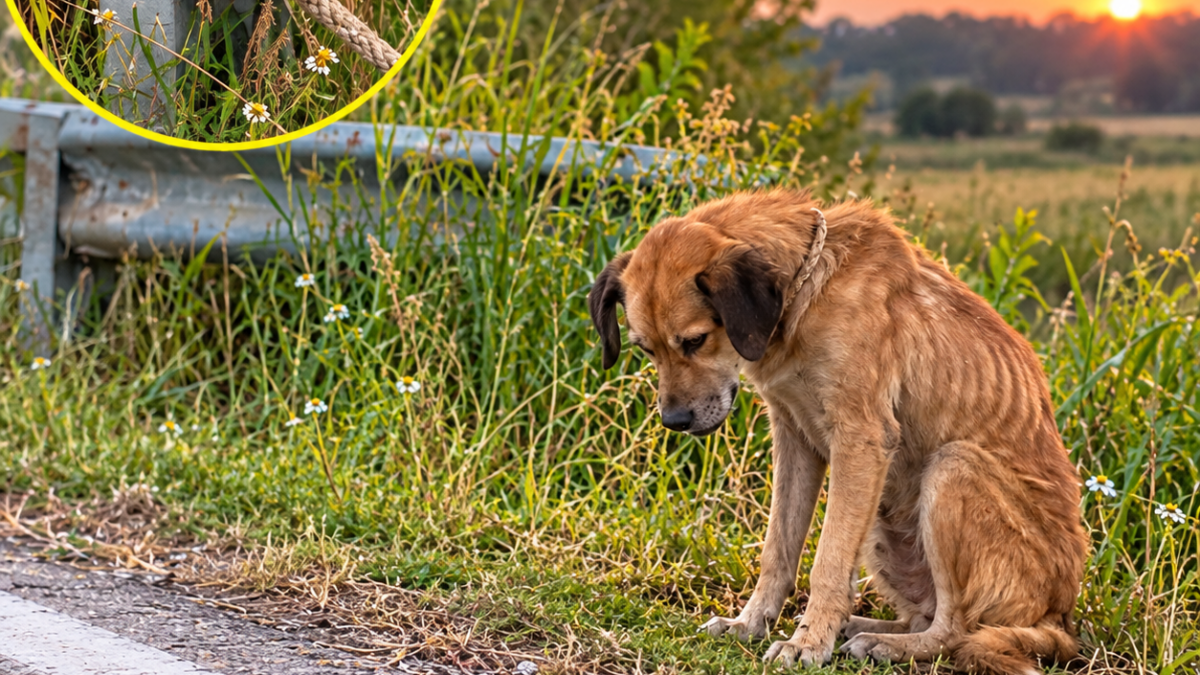
PART 2
For several seconds, I couldn’t move.
The world around me seemed strangely quiet.
Cars passed on the road behind us, tires humming against pavement, but the sound felt distant.
The golden dog lifted his head.
Barely.
His eyes found mine.
There was no barking.
No panic.
Just exhaustion.
“Okay,” I whispered.
I didn’t know whether I was talking to him, the brown dog, or myself.
“Okay. I’m here.”
I knelt beside the golden dog.
The rope was attached to a wide collar.
It had been threaded around part of the guardrail system and then dragged through the grass.
The knot near the dog’s collar was tight.
Too tight for my fingers.
I tried anyway.
Nothing.
The brown dog came closer.
He lowered his nose to the golden dog’s face.
The golden dog gave the smallest movement of his tail.
That nearly broke me.
“You waited for him,” I whispered.
The brown dog looked at me.
I pulled out my phone.
My hands were shaking badly enough that I almost dropped it.
I called 911 first.
The dispatcher transferred me to county animal services after confirming there was no immediate danger from traffic.
A woman answered.
“County Animal Services.”
“I found two dogs beside Route 16.”
“All right. Are they injured?”
“I don’t know. One is tied up. The other has been trying to pull the rope loose all day.”
There was silence.
“What do you mean all day?”
“I saw him this morning.”
My voice faltered.
“I thought he was playing.”
The shame in that sentence hit harder when I said it aloud.
“I drove past.”
The woman’s voice softened.
“You came back.”
“Six hours later.”
“And now you’re there.”
I looked down at the brown dog.
He had collapsed beside his friend.
“Yes.”
“Stay with them. We’re sending someone.”
“Please hurry.”
“We will.”
I hung up.
Then I remembered the bottle of water in my car.
I ran back to get it.
When I returned, the brown dog tried to stand.
“Easy.”
I poured water into the plastic lid from an old food container I kept in the trunk.
It wasn’t much of a bowl, but it worked.
The brown dog approached first.
He smelled the water.
Then he turned his head toward the golden dog.
I moved the container closer to him.
The golden dog raised his head and drank.
Slowly.
The brown dog watched.
Only after his friend stopped did he drink himself.
I stared at him.
“You’ve done this before.”
Of course he couldn’t answer.
But something about his behavior made it obvious.
This wasn’t random.
He wasn’t simply a loose dog that had found another animal.
He was attached to that dog in every way except the rope.
I poured more water.
The golden dog drank again.
Then I touched his shoulder.
His body was warm.
Too warm, maybe.
I didn’t know enough to be sure.
The brown dog leaned against my arm.
Not affection exactly.
More like exhaustion had finally convinced him to trust someone else with the responsibility.
“I’ve got him,” I whispered.
His eyes closed.
“You can rest.”
That was the first time I cried.
Not loudly.
Just tears running down my face while I sat in the grass beside two dogs I hadn’t known existed six hours earlier.
A white county truck pulled onto the shoulder twenty-three minutes later.
I know because I checked the time repeatedly.
It felt like hours.
A woman in dark blue scrubs climbed out.
Behind her came a man wearing an animal services uniform.
The woman introduced herself as Dr. Hannah Lewis.
The officer was Miguel Torres.
Hannah took one look at the scene and crouched immediately.
“Which one was tied?”
I pointed toward the golden dog.
“And this one?”
“Free.”
Miguel looked at the brown dog.
“He stayed?”
“All day.”
I swallowed.
“Maybe longer.”
Miguel crouched beside the rope.
“This wasn’t accidental.”
“I know.”
He studied the knot.
“Someone tied this.”
My stomach turned.
Hannah began checking the golden dog.
“Male. Adult. Probably six or seven. Dehydrated. Weak, but responsive.”
“What about the other one?”
“Let me get through him first.”
The brown dog pressed closer to me when Miguel approached.
“It’s okay.”
I scratched his neck.
“He’s helping.”
Miguel gave me a small smile.
“He picked you.”
“I think he just ran out of options.”
“Sometimes that’s how picking works.”
Miguel used a cutter to remove the rope.
The second the tension released, the golden dog flinched.
The brown dog stood.
He placed himself between Miguel and his friend.
Not aggressively.
Protectively.
Miguel stopped.
“Hey, man.”
The brown dog stared at him.
“He’s been doing this a while,” I said.
Miguel lowered the cutter.
“I see that.”
Hannah moved slowly around the brown dog.
She held out the back of her hand.
He smelled it.
Then allowed her closer.
“Good boy.”
The phrase seemed to affect him.
His ears shifted.
Hannah examined him quickly.
“He’s dehydrated too.”
“Why would he stay?”
She looked at me.
“Because dogs don’t calculate loyalty the way people do.”
That sentence stayed with me.
We got the golden dog onto a stretcher.
The brown dog followed.
When Miguel tried to guide him toward the second compartment of the transport truck, he refused.
He planted all four paws.
Hannah laughed softly.
“Put them together if it’s safe.”
Miguel opened the larger rear section.
The brown dog climbed in immediately.
He lay beside the golden dog.
His head rested against his friend’s front leg.
I stood on the roadside watching.
Miguel closed the door gently.
“You coming to the shelter?”
“Can I?”
“You found them.”
That was enough for me.
I followed the county truck to the emergency veterinary clinic.
On the drive, one thought kept repeating in my head.
I left them there.
I knew it wasn’t rational.
I didn’t know what I had been looking at that morning.
But guilt doesn’t care much about logic.
At the clinic, I sat in a plastic chair while Hannah and the staff worked.
I called my sister and told her I’d be late.
“Are you okay?”
“I don’t know.”
“What happened?”
I explained.
There was a pause.
Then she said, “Emily, you stopped.”
“Eventually.”
“But you stopped.”
I closed my eyes.
“I should have stopped this morning.”
“You didn’t know.”
“I should have looked.”
My sister was quiet.
“You can punish yourself later if you still want to. Right now, those dogs need somebody.”
She was right.
So I stayed.
Two hours later, Hannah came into the waiting room.
Both dogs were stable.
The golden dog had been without adequate water for a long time, but there was no immediate organ failure.
The rope had caused irritation around his collar area, but nothing that required major surgery.
The brown dog was physically stronger, though exhausted.
“He wore himself out,” Hannah said.
“From pulling?”
“Probably pulling, chewing, pacing, and searching for water.”
I looked through the glass toward the treatment area.
“Did he damage his mouth?”
“Minor abrasions. Nothing severe.”
I exhaled.
“Do they have chips?”
“We found one in the golden dog.”
My heart jumped.
“So you know who owns him?”
“Not yet. Registration is old.”
“What about the brown dog?”
“No chip.”
I hesitated.
“Can I see them?”
Hannah smiled.
“Briefly.”
The golden dog lay on a thick blanket.
An IV line ran to his front leg.
The brown dog occupied another blanket directly beside him.
When I entered, the brown dog lifted his head.
His tail hit the floor once.
Then again.
That tiny sound affected me more than it should have.
“Hi.”
I sat on the floor.
“What are we calling you?”
Hannah leaned against the doorway.
“We need temporary names.”
I looked at the brown dog.
“Scout.”
“Why Scout?”
“He looked like he was trying to solve a problem.”
“Fair.”
“And him?”
I looked at the golden dog.
He had opened his eyes.
“Charlie.”
Hannah smiled.
“Scout and Charlie.”
Charlie’s tail moved.
Scout immediately checked him.
I reached out.
Scout allowed me to touch his neck.
Then he lowered his head into my lap.
I froze.
Hannah whispered, “Don’t move.”
“I wasn’t planning to.”
For nearly twenty minutes, I sat on the floor with Scout’s head against my leg.
When I finally left, it was almost ten at night.
I told myself I would check on them the next day.
That was all.
Check.
Nothing more.
I had a job.
A condo.
No fenced yard.
No plan to suddenly become responsible for two dogs.
By noon the next day, I had called the clinic three times.
On the third call, the receptionist laughed.
“Emily, Hannah said to tell you they’re both doing well.”
“I’m not being annoying?”
“Yes.”
“Oh.”
“But in a nice way.”
I visited after work.
Scout greeted me before I was fully through the door.
Charlie stood too.
Slowly.
But he stood.
“That’s new,” Hannah said.
Charlie walked toward me.
Scout stayed beside him.
I crouched.
Charlie smelled my hand.
Then he rested his forehead against my chest.
I closed my eyes.
“You don’t even know me.”
Hannah stood behind me.
“Maybe he knows enough.”
Over the next three days, the dogs improved.
Charlie began eating normally.
Scout regained his energy.
That turned out to be a problem.
A funny one.
He stole Hannah’s pen.
Then a roll of gauze.
Then Miguel’s glove.
The same dog who had looked half-dead beside the highway transformed into a mischievous, energetic animal with no respect for personal property.
Charlie was calmer.
He preferred lying near people.
If Scout left the room, Charlie watched the door until he returned.
If Charlie went outside for a walk, Scout became restless.
Whatever their history was, they were bonded.
Deeply.
On Friday, Miguel called.
“We got a partial hit on Charlie’s microchip.”
I was standing in the supply room at work.
“What does that mean?”
“The chip was registered seven years ago to a woman named Margaret Ellis.”
“Can you contact her?”
“We did.”
My pulse quickened.
“And?”
“She’s eighty-two.”
I waited.
“She says Charlie was her husband’s dog.”
“Was?”
“Her husband died three years ago.”
My heart sank.
“What happened to Charlie?”
“Margaret moved into assisted living last year. She gave Charlie to her nephew.”
I already didn’t like where this was going.
“What’s the nephew’s name?”
“Derek Sloan.”
“And Scout?”
“She doesn’t know him.”
Miguel paused.
“She was very upset when I told her where Charlie had been found.”
“What did her nephew tell her?”
“That Charlie had been adopted by a family with land.”
I leaned against the shelf.
“He lied.”
“Looks that way.”
“Can you prove he left them?”
“Not yet.”
I looked at the boxes around me.
“What happens now?”
“Investigation.”
That word changed the story.
Until then, my world had been simple.
Two dogs needed help.
Now there was a person.
A name.
A decision.
Someone had looked at Charlie and Scout and decided that leaving them beside a road was acceptable.
I wanted to know why.
More importantly, I wanted them to answer for it.
Miguel warned me not to contact Derek.
I promised.
Then I immediately searched his name online.
I didn’t message him.
Technically, I kept my promise.
Derek Sloan was forty-four.
He ran a landscaping business.
His public social media showed trucks, lawns, fishing photos, barbecues, and a German Shepherd puppy from two years earlier.
I stared at that picture.
A new dog.
While Charlie had supposedly gone to a family.
I felt my jaw tighten.
Then I saw a photograph that made me sit upright.
It had been posted eight months earlier.
Derek stood beside a backyard firepit.
In the background, lying near a fence, was Scout.
Same black ears.
Same white patch on his chest.
Same narrow face.
Scout had belonged there too.
I called Miguel.
“Scout was his.”
“How do you know?”
“There’s a photo.”
“Send it.”
I did.
Twenty minutes later, Miguel called back.
“Good catch.”
My anger became colder.
“So he lied about Charlie and abandoned both?”
“We’re still establishing facts.”
“That’s lawyer language.”
“It’s investigator language.”
“Same family.”
He laughed once.
Then became serious.
“Emily, do not contact him.”
“I won’t.”
“Seriously.”
“I said I won’t.”
What I didn’t say was that I had started taking screenshots.
Every photograph.
Every date.
Every public post showing Scout.
Several showed Charlie too.
Derek had owned both dogs for at least ten months.
One caption from the previous Christmas read:
**The old man and the troublemaker waiting for turkey.**
Charlie was the old man.
Scout was the troublemaker.
They had been family.
Then something changed.
On Sunday, I visited Margaret Ellis.
Miguel had asked whether she was comfortable speaking with me.
She said yes.
Margaret lived in a small assisted-living apartment twenty minutes from the clinic.
She was tiny.
Silver hair.
Blue sweater.
Sharp eyes.
The moment I introduced myself, she took my hands.
“You’re the woman who stopped.”
My throat tightened.
“Eventually.”
She squeezed my fingers.
“Sit.”
A framed photograph of Charlie sat on her table.
He was younger.
His golden coat darker.
Beside him stood an older man wearing suspenders.
“My husband, Henry,” Margaret said.
“He loved that dog.”
Charlie had been Henry’s constant companion through the last four years of his life.
When Henry became ill, Charlie slept beside his recliner.
When Henry died, Charlie spent weeks waiting near the front door.
“I kept him,” Margaret said. “Of course I kept him.”
Then Margaret’s health declined.
After a fall, her doctor told her she could no longer live alone.
The assisted-living facility allowed small pets, but Charlie was above the weight limit.
Margaret had been devastated.
Her nephew Derek offered to take him.
“He told me Charlie would have a yard,” she said.
“He did have a yard?”
“For a while.”
She nodded.
“I visited twice.”
“Did you see Scout?”
Her face softened.
“Yes. Derek said he found Scout wandering near one of his job sites.”
I frowned.
“So Scout was a stray?”
“Maybe. Derek brought him home because his daughter liked him.”
“What happened to the daughter?”
“She lives with her mother. Derek divorced years ago.”
Margaret looked toward Charlie’s photograph.
“He promised me.”
Her voice cracked.
I reached across the table.
“He’s safe now.”
Tears filled her eyes.
“Can I see him?”
“Yes.”
That reunion happened three days later.
The shelter allowed Margaret to visit after Charlie’s medical condition stabilized.
I went because she asked me.
The moment Charlie entered the visitation room, he stopped.
Margaret sat in a chair.
For a second, neither moved.
Then Margaret said one word.
“Charlie.”
His entire body changed.
His ears rose.
His tail began moving.
Not slowly.
Wildly.
He crossed the room faster than I had seen him move since the rescue.
Margaret bent forward.
Charlie pressed himself against her knees.
She buried both hands in his fur.
“My boy.”
Scout stood near the doorway.
He watched.
Then, after a minute, he approached Margaret too.
She touched his face.
“And you stayed with him.”
Scout licked her hand.
Margaret cried harder.
I looked away because I felt like I was intruding on something private.
Later, she told us she couldn’t physically take Charlie back.
That was the hardest part.
“I love him enough not to pretend I can care for him,” she said.
But she wanted him somewhere she could visit.
I promised I would help.
I still thought I meant by finding a home.
The investigation continued.
Miguel and another officer interviewed Derek.
He denied abandoning the dogs.
His first explanation was that both had escaped from his yard.
Problem.
There was no missing-dog report.
No shelter notification.
No social media post asking for help.
Nothing.
Then investigators obtained footage from a small gas station less than a mile from the place where I found the dogs.
The cameras had captured Derek’s work truck entering the highway that morning.
Two dogs were visible in the truck bed behind a secured barrier.
Charlie.
Scout.
Thirty-five minutes later, the same truck returned.
No dogs.
Miguel showed me still photographs.
I stared at them.
“You have him.”
“We have strong evidence he transported them.”
“But not the tying.”
“Not yet.”
I hated those two words.
Not yet.
Then came the rope.
The rope itself was a heavy marine-style utility line, not common household cord.
Derek’s landscaping company used the same type for securing equipment.
Investigators photographed coils in his open work trailer during a lawful business inspection related to a separate county permit issue.
Same brand.
Same distinctive red flecks woven through the fibers.
Again, not proof by itself.
But another piece.
Then Margaret remembered something.
Derek had called her two days before the dogs disappeared.
“He asked whether Charlie still had papers.”
“What papers?” Miguel asked.
“Veterinary records. Ownership records. I told him I didn’t know.”
“Did he say why?”
“No.”
That bothered Miguel.
It bothered me too.
A week later, we learned why.
Derek’s landlord had given him notice that large dogs were no longer permitted on the rental property.
His lease renewal required removal of both dogs.
He had thirty days.
Instead of taking them to a shelter, contacting Margaret, or finding a legitimate placement, he apparently chose a roadside.
Why?
The county shelter intake fee was forty dollars per dog for owner surrender.
Forty dollars.
I stared at Miguel when he told me.
“That’s it?”
“That’s it.”
“He did all this over eighty dollars?”
“Could be partly that. Could be that surrender appointments were backed up.”
“How long?”
“About ten days.”
I laughed.
Not because anything was funny.
“He couldn’t wait ten days.”
Miguel shrugged sadly.
“Some people don’t plan beyond inconvenience.”
I thought of Scout pulling that rope for six hours.
Maybe more.
His mouth sore.
His body exhausted.
Refusing to leave.
And then I thought about eighty dollars.
The scale of the betrayal made me sick.
The story reached the local news after someone at the rescue organization posted a photograph of Scout lying beside Charlie.
The caption didn’t name Derek.
It simply told the basic story.
A dog had been found trying to free his companion beside County Route 16.
People shared it.
Then shared it again.
Within forty-eight hours, thousands of comments appeared.
Most focused on Scout.
His loyalty.
His refusal to leave.
I hated that my first instinct that morning had been to laugh.
So when a reporter named Kayla Monroe asked whether I would speak, I hesitated.
Then I agreed.
On camera, she asked the question I had been avoiding.
“What do you wish you had done differently?”
I looked at Scout.
He sat beside my chair.
Charlie lay at my feet.
“I wish I had stopped the first time.”
Kayla waited.
“I thought I understood what I was seeing.”
My voice shook.
“I didn’t.”
“What would you tell people watching this?”
I looked at the camera.
“Pay attention when something feels wrong.”
That was all.
No grand speech.
No accusations.
The segment aired that evening.
The next morning, my office phone rang.
“Emily Carter?”
“Yes?”
A man’s voice.
“You’re the woman with my dogs.”
My stomach dropped.
“Who is this?”
“You know who.”
Derek.
I stood.
“How did you get this number?”
“It’s public.”
I should have hung up.
Instead, I said, “You need to speak with animal services.”
“I already have.”
“Then speak with them again.”
“You’re making this look like something it wasn’t.”
I gripped the desk.
“I’m not making anything.”
“You were on television.”
“They asked me what I saw.”
“You don’t know what happened.”
“I know what I found.”
His voice sharpened.
“Those dogs ran off.”
I closed my eyes.
“You should tell the investigator.”
“I did.”
“Good.”
“You think you’re some hero?”
That hit something raw.
“No.”
The answer came easily.
“I’m the woman who drove past them once.”
Silence.
Then he said, “Scout was always stupid about that old dog.”
My eyes opened.
“What?”
“He followed Charlie everywhere.”
I felt cold.
“He wouldn’t leave him.”
Derek exhaled.
“You don’t know dogs.”
I almost laughed.
“No, Derek.”
I looked through the glass wall of my office.
My coworkers moved around outside, unaware.
“I think that’s the one thing I’m starting to understand.”
Then I hung up.
I called Miguel immediately.
He was not pleased.
“You talked to him?”
“He called me.”
“What did he say?”
I repeated everything.
Especially one sentence.
*Scout was always stupid about that old dog.*
Miguel went quiet.
“Interesting.”
“Why?”
“He just confirmed the bond.”
“So?”
“So his earlier statement claimed Scout and Charlie didn’t usually stay together and could have run in different directions.”
I sat down.
“Another lie.”
“Another inconsistency.”
I began to understand how accountability really works.
Not like movies.
No dramatic confession.
No single piece of evidence falling from the sky.
Just contradictions.
Documents.
Cameras.
Receipts.
Dates.
Words people forget they already said.
Derek had assumed two dogs couldn’t tell anyone what happened.
He was right.
But he had forgotten everything else could.
The gas station camera could.
The rope could.
His social media could.
His lease could.
Margaret could.
And Scout’s loyalty, strangely enough, could.
Because Scout made his story impossible.
Derek claimed the dogs ran away separately.
Yet Scout stayed beside Charlie long enough for me to see him twice in the same location six hours apart.
He never left the area.
He didn’t run home.
He didn’t wander.
He stayed.
The next legal hearing concerned custody.
Derek’s attorney argued that the dogs remained his property and should eventually be returned if no criminal conviction occurred.
I nearly lost my mind when Miguel told me.
“Returned?”
“His lawyer is preserving options.”
“He left them beside a highway.”
“Allegedly.”
I glared at him.
He smiled faintly.
“I know.”
Margaret also entered the case.
She had records showing Charlie had originally belonged to her and Henry.
She argued that Derek received Charlie only under an agreement to provide care.
Once he stopped providing that care, any claim he had should end.
The rescue organization wanted permanent custody of Scout so he could be adopted.
I attended the hearing.
Not because anyone required me to.
Because I couldn’t stay away.
Derek sat across the room.
He looked ordinary.
That disturbed me.
For weeks, I had imagined someone visibly cruel.
Hard face.
Cold eyes.
Something that would explain the decision.
Instead, Derek looked like thousands of men I had passed in grocery stores.
Khaki pants.
Button-down shirt.
Wedding ring absent but pale mark still visible.
Nothing monstrous.
Just a person who had made a deeply selfish choice.
The judge reviewed the evidence.
Photographs.
Medical reports.
Timeline.
Margaret testified.
When asked whether she would ever have agreed to Charlie being left outdoors beside a highway, she looked directly at Derek.
“Never.”
One word.
Clear.
Derek stared at the table.
Then the judge reviewed the gas station footage.
Derek’s attorney tried to suggest the dogs may have jumped from the vehicle later.
Miguel provided photographs showing the rear containment gate remained secured.
The argument weakened.
Temporary custody remained with the rescue.
Derek was prohibited from retrieving either dog while the investigation continued.
Outside the courthouse, reporters waited.
I tried to leave through a side hallway.
Derek followed me.
“Happy?”
I stopped.
He stood ten feet away.
“No.”
“You got what you wanted.”
“What do you think I wanted?”
“My dogs taken.”
I stared at him.
“Scout spent most of a day trying to pull Charlie free.”
His face hardened.
“Charlie couldn’t stay at my place.”
“So you call Margaret.”
“She couldn’t take him.”
“You call a shelter.”
“They were full.”
“You call another.”
“You think life works like that?”
I took one step toward him.
“Actually, yes.”
My voice stayed low.
“When the alternative is leaving two animals beside a highway, yes, Derek. You keep making phone calls.”
He rolled his eyes.
That gesture almost made me lose my temper.
Instead, I remembered Miguel’s advice.
No threats.
No drama.
Nothing Derek’s attorney could use.
So I said, “You had choices.”
His face changed.
“You have no idea what I was dealing with.”
“You’re right.”
I glanced toward the courthouse doors.
“But Scout did.”
Then I walked away.
That sentence became important to me later.
Scout had no idea what rent was.
No idea about leases.
No idea about deadlines.
No idea how inconvenient Charlie had become.
He just knew his friend was tied up.
So he stayed.
Three weeks after the hearing, I brought both dogs to Margaret’s assisted-living facility for a supervised visit.
The staff had seen the news story.
Half the building appeared in the lobby.
Charlie loved it.
He moved from person to person collecting affection like a politician collecting votes.
Scout was suspicious at first.
Then someone produced cheese.
His principles disappeared.
Margaret sat in her chair smiling.
I sat beside her.
“You know,” she said, “Henry always believed Charlie understood everything.”
“Maybe he did.”
“No.”
She looked toward him.
“Not words. People.”
I watched Charlie rest his head on an elderly man’s knee.
Scout lay beside him.
Margaret touched my hand.
“Are you taking them?”
I nearly choked.
“What?”
“Don’t pretend.”
“I live in a condo.”
“You’ve mentioned that four times.”
“It matters.”
“Does your building allow dogs?”
“One.”
Margaret smiled.
“There’s your problem.”
“Exactly.”
“So move.”
I laughed.
She did not.
“You’re serious.”
“Very.”
“I have a job.”
“So do millions of people with dogs.”
“I’ve never owned one.”
“You own three pairs of running shoes you never use. People adapt.”
I looked at her.
“How do you know about my shoes?”
“You talk when you’re nervous.”
I shook my head.
“I can’t just rearrange my entire life.”
Margaret looked toward Charlie.
“Sometimes life has already rearranged itself. You’re just the last person to notice.”
I hated how good that sentence was.
For the next month, I told everyone I was not adopting the dogs.
My sister laughed every time.
Hannah laughed.
Miguel laughed.
My boss laughed.
Even my mother laughed over the phone.
Then my landlord sent notice that my lease renewal would increase by nearly twenty percent.
I stared at the email.
That night, I searched for rental houses with fenced yards.
Just to see.
That is the lie people tell themselves right before making major decisions.
Just looking.
I found a small blue house fifteen minutes from work.
Two bedrooms.
Fenced backyard.
Old maple tree.
Pet friendly.
I toured it Saturday.
The property manager pointed out the yard.
“Good for dogs.”
“I don’t have dogs.”
She looked at me.
“Thinking about dogs?”
“Something like that.”
I signed the lease Monday.
Scout and Charlie moved in three weeks later.
Technically, the rescue remained their legal custodian until the case ended.
I became their foster.
That distinction lasted approximately twelve minutes emotionally.
Charlie walked through the front door, smelled every room, and selected the rug beside the couch.
Scout ran into the backyard.
Came back.
Ran into the kitchen.
Backyard.
Bedroom.
Hallway.
Kitchen.
Backyard.
I watched him.
“You had six hours of determination beside a highway and apparently saved all the chaos for later.”
He stole one of my socks.
Charlie sighed.
I understood the sigh.
The first night, I put two dog beds in the living room.
Scout used his for five minutes.
Charlie slept on his.
At two in the morning, I woke to scratching.
Scout stood outside my bedroom.
“What?”
He walked away.
I followed.
Charlie was having trouble getting comfortable.
Scout stood beside him.
I adjusted Charlie’s blanket.
He settled.
Scout immediately lay down.
I stared.
“You woke me up for him?”
Scout closed his eyes.
I laughed softly.
“All right.”
That became our life.
Scout monitored Charlie.
Charlie tolerated Scout.
I fed them before work.
Came home at lunch when possible.
Hired a dog walker.
Learned that Scout hated vacuum cleaners.
Learned Charlie loved bananas.
Learned both understood the sound of a cheese wrapper from three rooms away.
I also learned that coming home to someone changes the shape of an entire day.
Before them, work followed me home.
I opened my laptop after dinner.
Answered emails.
Reviewed reports.
Now, when I opened the front door, Scout arrived carrying something he wasn’t supposed to have.
Charlie followed more slowly.
Whatever disaster had occurred at work suddenly seemed less urgent.
On Fridays, we visited Margaret.
Charlie knew the route.
Three blocks from the facility, he began whining.
Scout eventually learned it too.
Margaret kept treats in a drawer.
The staff pretended not to notice.
Derek’s case moved slowly.
Much slower than public attention.
The internet found new stories.
News crews stopped calling.
That was fine.
Real consequences rarely match viral timelines.
Investigators continued working.
Then a witness appeared.
A man named Jonah Price owned a small landscaping supply yard near the highway.
He had seen the news story months earlier but didn’t immediately make the connection.
Then he remembered Derek’s truck.
Jonah told investigators that on the morning I found the dogs, Derek had stopped at his yard around seven-thirty.
Charlie and Scout were in the truck.
Jonah asked where he was taking them.
Derek allegedly answered:
“Somewhere they won’t be my problem anymore.”
Miguel called me after the interview.
I sat at my kitchen table.
Scout was under my chair.
Charlie slept nearby.
“He said that?”
“That’s the statement.”
“Will Jonah testify?”
“Yes.”
I looked down.
Scout’s paw rested against my shoe.
Somewhere they won’t be my problem anymore.
I thought about the rope.
Scout pulling.
Charlie waiting.
Six hours beneath the sun.
Then I thought about my life before them.
I had believed dogs were another responsibility.
Another schedule.
Another expense.
Another complication.
Now Scout’s water bowl sat beside my refrigerator.
Charlie’s medication organizer occupied half a kitchen drawer.
My vacuum had surrendered to fur.
And I couldn’t imagine calling any of it a problem.
The criminal case was filed shortly afterward.
Several counts related to abandonment and neglect.
A charge connected to leaving animals in unsafe roadside conditions.
Additional municipal violations.
I won’t pretend I understood every statute.
I understood enough.
Derek faced real consequences.
He also faced something he cared about almost as much.
His landscaping company held contracts with several residential communities and commercial properties.
The publicity caused clients to reconsider.
One large property manager ended its contract.
Another required ethics review.
Derek blamed me publicly.
He posted a long statement online claiming I had exaggerated everything for attention.
I read it once.
Then twice.
My sister told me to stop.
“He’s trying to make you angry.”
“He’s lying.”
“Everybody already knows that.”
“He says Scout was aggressive.”
My sister paused.
“Scout stole my bra last weekend.”
“That’s not the same thing.”
“I know.”
She softened.
“Emily, don’t let him drag you into being part of his defense.”
I blocked Derek.
Best decision I made that week.
A month before trial, Derek’s attorney contacted prosecutors about a plea agreement.
Miguel warned me not to expect cinematic justice.
“No dramatic courtroom collapse?”
“Probably not.”
“No confession?”
“Probably not.”
“No judge giving a fifteen-minute speech?”
“Definitely not.”
“What do I get?”
“Accountability.”
I looked at him.
“Not as catchy.”
“No.”
“But more useful.”
The agreement required Derek to accept responsibility for several offenses.
He received probation.
Substantial fines and restitution.
Mandatory animal-welfare education.
A prohibition on owning or keeping dogs for a specified period.
He was required to cover a significant portion of the veterinary and shelter costs.
He also had to complete community service unrelated to animal handling.
His attempt to regain Charlie and Scout ended permanently.
The court recognized Charlie’s transfer from Margaret as conditional upon proper care and accepted the rescue organization’s placement arrangement.
Scout was legally surrendered.
The dogs were free.
When Miguel called, I was at work.
I walked into an empty conference room.
“Say that again.”
“They’re cleared for permanent adoption.”
I sat down.
“Both?”
“Both.”
“And Derek?”
“Cannot reclaim them.”
I covered my mouth.
Miguel waited.
Then he said, “You okay?”
“No.”
I laughed while crying.
“But yes.”
The adoption paperwork happened on a Friday.
Margaret came.
Hannah came.
Miguel came.
My sister came with a cake despite being told this was not a birthday party.
Scout tried to eat the corner of the adoption folder.
Charlie slept through half the process.
When I signed the final page, the rescue coordinator smiled.
“Congratulations.”
I looked at the two dogs.
“Who exactly adopted who?”
Nobody answered.
Probably because everyone knew.
Margaret asked for one thing.
“Keep Charlie’s name.”
“Of course.”
“What about Scout?”
I smiled.
“He earned his.”
Margaret hugged me.
Then she held my face between both hands.
“Henry would be so happy.”
I had never met Henry.
But somehow that mattered.
Life became ordinary.
That was the best part.
Not every day contained drama.
Most didn’t.
There were walks.
Vet visits.
Mud.
Shed fur.
Scout barking at delivery drivers.
Charlie falling asleep in inconvenient places.
Weekend trips.
Margaret visits.
Burned dinners because I forgot food was in the oven while chasing Scout through the backyard.
The extraordinary story became an ordinary life.
Exactly what both dogs deserved.
Charlie aged faster than Scout.
We never knew his exact age.
Maybe nine when I found him.
Maybe ten.
Within two years, his muzzle turned almost entirely white.
His hips became stiff.
Scout adjusted without anyone teaching him.
He walked slower beside Charlie.
Stopped pulling on the leash when Charlie needed rest.
Waited at the bottom of stairs.
If Charlie fell behind in the yard, Scout returned for him.
Some habits never leave.
One winter morning, I watched Scout carry a stick across the yard.
Charlie stood on the porch.
Scout reached the gate.
Then stopped.
He looked back.
Charlie had not followed.
Scout dropped the stick.
Returned to the porch.
Lay beside him.
I stood at the kitchen window crying into my coffee.
I thought about County Route 16.
The rope between Scout’s teeth.
How hard he had pulled.
I had originally described it as determination.
Years later, I understood it better.
Scout’s defining quality wasn’t strength.
It was refusal.
He refused to leave Charlie alone.
There is a difference.
Strength says, “I can keep going.”
Loyalty says, “I won’t go without you.”
Margaret died three years after I found the dogs.
She was eighty-five.
Her decline happened gradually.
Then quickly.
During her final weeks, her facility allowed Charlie special visiting access.
He lay beside her bed.
Scout stayed near the door.
The last time I saw her awake, Margaret reached toward Charlie.
Her hand rested on his head.
“He looks like Henry now,” she whispered.
“What do you mean?”
“Old.”
I laughed.
Charlie opened one eye.
Margaret smiled.
Then she looked at me.
“Thank you.”
I shook my head.
“You gave him to me.”
“No.”
She breathed slowly.
“I gave him to Derek.”
Her eyes filled.
“You brought him back.”
I didn’t know what to say.
So I held her hand.
After she died, Charlie spent two days waiting near my front door.
I knew that behavior.
Margaret had told me he did the same after Henry.
Scout knew too.
He stayed with Charlie.
Of course he did.
I sat beside them on the floor.
For an hour, none of us moved.
Grief became something the three of us understood together.
The next morning, Charlie finally ate breakfast.
Scout watched.
Then ate his own.
Another year passed.
Charlie’s health declined.
Kidneys.
Arthritis.
A heart murmur.
Nothing dramatic.
Just age collecting its debts.
Hannah, who had become our regular veterinarian, was honest.
“We can manage a lot.”
“For how long?”
She looked at Charlie.
“No one can answer that.”
I hated that.
But I knew better than to demand certainty from medicine.
So we managed.
Medication.
Diet.
Shorter walks.
A ramp beside the back steps.
Scout learned not to jump over Charlie.
Mostly.
One afternoon, I took them to the same roadside where I had found them.
I had avoided it for years.
Then the county announced road improvements.
The old guardrail would be replaced.
For some reason, I needed to go back before it disappeared.
We parked safely at a turnout.
Scout jumped out first.
Charlie followed slowly.
The grass was shorter now.
The tree still stood.
I walked toward it.
Scout stopped.
His entire body changed.
Ears up.
Tail still.
He smelled the ground.
Then the guardrail.
Charlie stood beside him.
I felt sick.
They remembered.
Maybe not the exact story the way humans remember.
But something.
Something lived in their bodies.
I crouched.
“You don’t have to be here.”
Scout looked at me.
Charlie walked toward the tree.
He smelled the trunk.
Then turned around.
Walked back toward the car.
Scout followed.
No hesitation.
I stood there alone for a moment.
Then I smiled.
“All right.”
I followed them.
That was the perfect ending to that place.
They did not stay.
They chose home.
Charlie lived another eleven months.
His final day was gentle.
That is the word I choose.
Gentle.
He stopped wanting food.
Then water.
He slept most of the morning.
Scout refused to leave his side.
Hannah came to the house.
I sat on the floor.
Charlie’s head rested in my lap.
Scout lay against his back.
I had imagined this moment for years and dreaded it every time.
When it arrived, there was no dramatic speech.
Only love.
I stroked Charlie’s ear.
“You’re okay.”
Scout watched me.
I looked at him.
“You’re okay too.”
Charlie’s breathing slowed.
I thought about Henry.
Margaret.
The rope.
The tree.
The road.
All the people Charlie had loved.
“You were never forgotten,” I whispered.
That was the last thing I told him.
Afterward, Scout stayed beside Charlie for nearly an hour.
We did not rush him.
Hannah sat with us.
At one point, Scout rested his chin across Charlie’s front leg exactly the way he had in the county truck years earlier.
The image destroyed me.
Eventually, Scout stood.
He smelled Charlie’s face.
Then walked to me.
He pressed his head against my chest.
I wrapped my arms around him.
“I know.”
For weeks, Scout searched.
Not constantly.
But enough.
He checked Charlie’s bed.
Paused at the food bowls.
Waited at the back door.
The first time I took him for a walk alone, he stopped halfway down the driveway.
Looked behind us.
I cried right there on the sidewalk.
“Just us now.”
Scout walked back to me.
I touched his head.
“We can do this.”
It was the first promise I made to him that I wasn’t sure I could keep.
We did.
Slowly.
Scout changed after Charlie died.
He became more attached to me.
He slept outside my bedroom.
Eventually inside.
He stopped stealing socks for almost two months.
That worried me more than anything.
Then one morning I found him carrying my running shoe through the kitchen.
I laughed so hard I startled him.
“There you are.”
His tail wagged.
Life moved forward.
Not past Charlie.
Forward with him somehow still inside it.
A year after Charlie died, the rescue organization created a small assistance fund using donations connected to the original news story.
It helped bonded animals stay together during adoption.
They named it the **Scout & Charlie Bonded Pair Fund**.
When they told me, I cried again.
Apparently, crying became one of my hobbies after forty.
The fund covered medical expenses, temporary foster care, and adoption fees when two animals needed to remain together.
The first pair it helped were elderly beagles named Max and Lucy.
Their owner had died.
Most adopters wanted one.
The fund allowed a foster family to keep both until a retired couple adopted them together.
I met them at an event.
Scout smelled both dogs.
Then lay beside them.
The rescue director laughed.
“He approves.”
“He has standards.”
Over the next few years, the fund helped dozens of pairs.
Cats.
Dogs.
Once a dog and a goat, which I still don’t fully understand.
People often asked me whether that made what happened worthwhile.
No.
I never said that.
Cruelty does not become good because something good grows afterward.
What Derek did was still wrong.
Charlie’s suffering was still real.
Scout’s exhaustion was still real.
But pain does not get exclusive ownership of what comes next.
That is different.
Derek completed his probation.
His animal ownership restriction eventually expired.
The court record remained.
His landscaping business survived, though smaller.
One day, years later, I saw him at a hardware store.
Scout was with me.
The store allowed dogs.
I turned an aisle and saw Derek near the garden section.
He saw me.
Then Scout.
Everything stopped.
Scout stood beside my leg.
Derek looked older.
So did I.
For a moment, I expected anger.
Mine.
His.
Something.
Instead, Derek stared at Scout.
“Is that him?”
“Yes.”
He swallowed.
“How old now?”
“About ten, we think.”
Derek nodded.
Then said, “Charlie?”
I looked at him.
“He died last year.”
His face changed.
I couldn’t tell whether it was guilt.
Sadness.
Or simply surprise.
“I’m sorry.”
I said nothing.
Then he looked at Scout again.
“He really stayed with him?”
I almost laughed at the absurdity.
“You know he did.”
Derek looked down.
“I didn’t think he would.”
There it was.
The sentence I had carried for years without knowing I needed to hear it.
I didn’t think he would.
I understood then.
Derek had counted on Scout leaving.
He probably assumed a loose dog would wander.
Find a house.
Find food.
Disappear.
He had no plan for loyalty.
Scout ruined that plan simply by being who he was.
I stepped closer.
Not angry.
Not afraid.
“You underestimated him.”
Derek nodded.
“I did.”
I could have said many things.
Cruel things.
Satisfying things.
I had imagined versions of this conversation for years.
In those imaginary scenes, I always delivered some perfect sentence that made Derek feel everything I wanted him to feel.
Reality was quieter.
So I said, “He deserved better.”
Derek looked at me.
“I know.”
That was enough.
Not forgiveness.
Not friendship.
Not absolution.
Just acknowledgment.
I walked away.
Scout followed.
At the end of the aisle, I looked down.
“You didn’t even growl.”
Scout sneezed.
“Very mature.”
He tried to steal a package of gardening gloves.
“There you are.”
That was the last time I saw Derek.
And strangely, I was glad.
Because accountability had already happened.
The courts handled what they could.
Life handled the rest.
He had to live knowing the dog he abandoned became known precisely because he refused to abandon someone else.
There was a kind of justice in that no judge could order.
Scout became thirteen.
Then fourteen.
No one was sure exactly.
His black ears turned gray.
His running became walking.
Then slow walking.
He developed arthritis.
A harmless fatty lump appeared near his shoulder.
His hearing declined.
But his sense for food remained supernatural.
Every Friday, I still made scrambled eggs.
Scout received a small portion.
It became our ritual.
One morning, I dropped a dish towel.
He picked it up.
For a second, he looked young.
I chased him around the kitchen.
Slowly, because neither of us moved like we used to.
When I caught him, I sat on the floor laughing.
Scout leaned into me.
I buried my face in his neck.
“You changed everything.”
His tail tapped the tile.
It was true.
Before Scout, my life was efficient.
Work.
Home.
Bills.
Deadlines.
Repeat.
I had friends.
Family.
A career.
But I moved through my days as though finishing them was the same as living them.
Scout disrupted that.
He made me move.
Notice.
Stop.
He turned a roadside moment into an entirely different life.
I eventually left corporate operations.
Not immediately.
But five years after the rescue, I reduced my hours and started volunteering with the shelter.
Then I joined its board.
My specialty was logistics.
Of course it was.
Food inventory.
Foster coordination.
Medical transport.
The boring systems that keep good intentions from collapsing.
People joked that Scout recruited me.
They weren’t wrong.
The shelter’s bonded-pair program became one of the strongest in the region.
We started partnering with senior living communities so older owners could plan for pets before emergencies happened.
That idea came from Margaret.
I wanted fewer Charlies.
Not fewer dogs named Charlie.
Fewer animals whose futures depended entirely on one promise made during a crisis.
We created planning packets.
Backup caregiver forms.
Emergency contacts.
Temporary foster agreements.
Nothing glamorous.
But useful.
The first year, forty-three pet owners signed plans.
The second year, more than a hundred.
One woman told me, “Now I can sleep.”
That sentence meant everything.
Scout continued attending events until crowds became too tiring.
Then he retired from public life.
Mostly.
He still went to the office sometimes.
Everyone loved him.
He slept behind my desk while I worked.
New volunteers heard the story.
Some didn’t believe he was the same dog.
“That dog pulled a rope for hours?”
They would look at Scout snoring.
“Yes.”
“Him?”
“Yes.”
Scout would fart.
The legend suffered.
By fifteen, his body was failing.
His mind remained bright.
That was both gift and cruelty.
He still wanted to follow me everywhere.
His legs couldn’t always agree.
I installed rugs so he wouldn’t slip.
A ramp for the porch.
Raised bowls.
Nightlights because his vision was worsening.
I had once thought pet care was a burden.
Now I understood something different.
Love often looks like inconvenience from the outside.
Medication schedules.
Laundry.
Interrupted sleep.
Money.
Time.
But when the inconvenience belongs to someone you love, it becomes simply what Tuesday looks like.
Scout had taught me that beside the highway.
He had every reason to leave.
Heat.
Thirst.
Exhaustion.
Fear.
He stayed anyway.
My turn came years later.
One September morning, Scout could not stand.
I helped him.
He managed three steps.
Then sat.
His eyes looked embarrassed.
“Oh, buddy.”
I knelt.
“Nothing to apologize for.”
Hannah came that afternoon.
She had more gray hair than when we met.
So did I.
She examined Scout.
Her face told me before her words did.
“His quality of life is changing.”
“I know.”
“We can adjust medication.”
“For how long?”
“Maybe days. Maybe weeks.”
I stared at him.
He was sleeping beside Charlie’s old collar.
I kept it in a shadow box normally, but had taken it out earlier that year for a memorial event.
Scout had smelled it for several minutes.
Then lay beside it.
“I don’t want him hurting.”
“I know.”
She touched my arm.
“You’ll know.”
I hated that phrase.
But she was right.
Three weeks later, I knew.
Scout stopped stealing.
That sounds silly.
It wasn’t.
He stopped taking socks.
Stopped carrying towels.
Stopped following me to the kitchen.
He still watched me.
But his body had become too tired to participate in the life his mind wanted.
One evening, I sat beside him on the porch.
Autumn wind moved through the maple leaves.
Scout rested his head against my foot.
I looked at the road beyond the yard.
Not County Route 16.
Just our quiet street.
“You stayed for Charlie.”
His ear moved.
“All those years.”
I swallowed.
“And then you stayed for me.”
His eyes lifted.
I cried.
“Don’t do that.”
Of course he didn’t know what I meant.
“I’m supposed to be the one taking care of you.”
Scout breathed slowly.
I touched his face.
“I think I understand now.”
The next morning, I called Hannah.
My sister came.
Miguel came too.
He had retired from animal services the year before.
When he entered, Scout’s tail moved.
Miguel sat beside him.
“Still causing trouble?”
Scout looked deeply innocent.
We all laughed.
That helped.
Before Hannah arrived, I did something I had been thinking about for days.
I put Scout in the car.
My sister came with us.
We drove to County Route 16.
The guardrail had been replaced years earlier.
The tree remained.
Scout couldn’t walk far.
So I carried him.
He weighed less than he once had.
I placed a blanket beneath the tree.
Scout lay down.
For a while, we sat in silence.
Cars passed.
Nobody knew.
To them, we were just a woman and an old dog beside a country road.
I looked toward the place where Charlie had once been tied.
“I’m sorry I didn’t stop the first time.”
I had said those words before.
Many times.
But that day, they felt different.
Scout rested his head against my leg.
“I spent years wishing I could change that morning.”
My voice cracked.
“But if I had stopped then, maybe the story would only be different by six hours.”
I scratched his ear.
“Maybe that matters.”
It did.
Of course it did.
“But you’re the one who stayed.”
I looked toward the tree.
“You’re the reason Charlie wasn’t alone.”
Scout closed his eyes.
“You did enough.”
That was what I needed him to know.
More accurately, it was what I needed myself to know.
“You can stop pulling now.”
My sister began crying.
I smiled through mine.
“The rope’s gone.”
Scout’s breathing remained slow.
“Charlie’s safe.”
I touched his forehead.
“You got him home.”
We stayed thirty minutes.
Then I carried him back to the car.
Scout never looked behind us.
He died at home that afternoon.
His head rested in my lap.
My hand was on his chest.
Hannah sat beside us.
My sister held my shoulder.
Miguel stood near the window.
Before Scout went, I told him the truth.
“You were the bravest thing I almost drove past.”
His tail moved once.
Then he was gone.
For months, I kept expecting to see him carrying something.
A sock.
A glove.
A towel.
The house felt impossible without him.
I had lived alone before Scout.
But returning to loneliness after learning companionship is different.
Silence has context.
One afternoon, I opened a closet and found an old sneaker.
The side was torn.
Scout had stolen it years earlier.
I sat on the floor holding the shoe and laughed until I cried.
Then I brought it to the shelter.
They placed it in a display near the bonded-pair program office.
Not because it was important.
Because it was Scout.
Underneath was a small card:
**SCOUT**
**He stayed.**
**And because he stayed, someone else survived.**
The rescue eventually renamed the program.
Officially, it became the **Scout & Charlie Stay Together Initiative**.
I argued against the long name.
I lost.
The program continued growing.
Hundreds of bonded animals have remained together because of it.
Owners with health problems receive planning support.
Foster homes receive financial help.
Older pets receive medical assistance.
And every year, on the anniversary of the day I found Scout and Charlie, volunteers place a thick piece of rope on a table near the entrance.
Not the original rope.
That was evidence and eventually disposed of according to procedure.
Just a symbol.
People ask why.
We tell them.
Not because we want them to remember what someone did wrong.
Because we want them to remember what one dog did right.
There is a difference.
People still ask whether I hate Derek.
I don’t.
I did for a while.
Anger was easy.
It gave me somewhere to put everything I felt.
But hatred keeps a person tied to the worst thing someone else did.
I have no interest in spending the rest of my life holding that rope.
Derek faced the court.
He lost the dogs.
He lost contracts.
He paid restitution.
He lived with public knowledge of his choices.
And eventually, he admitted to me that he had underestimated Scout.
That was enough.
The better revenge was never Derek’s suffering.
It was Scout’s life.
Charlie’s life.
Margaret getting to hold Charlie again.
A blue house with a fenced yard.
Friday eggs.
Stolen socks.
Thousands of dollars raised for bonded pets.
Families learning to make emergency plans.
Dogs who never had to lose each other because someone remembered Scout.
That is the kind of justice I believe in now.
The kind that builds something where somebody else tried to discard something.
I still drive County Route 16 occasionally.
My work no longer requires it.
I choose to.
The road is still boring.
Straight.
Flat.
Ordinary.
Most people pass that tree without seeing anything unusual.
Sometimes I stop at the turnout.
I sit for a few minutes.
Not every time.
But sometimes.
I think of the woman I was that morning.
Late.
Distracted.
Living according to notifications and deadlines.
I remember seeing a brown dog pulling a rope.
I remember smiling.
Then driving on.
For years, that memory embarrassed me.
Now I treat it differently.
It reminds me how easy it is to misunderstand what we see when we are in a hurry.
A person crying may not need advice.
An elderly neighbor standing by the mailbox may not simply be enjoying the weather.
A dog pulling a rope may not be playing.
Sometimes the world is asking us to look twice.
That is what Scout taught me.
Look twice.
Stop.
Walk into the grass.
Follow the rope.
Because you may discover that someone has been fighting a battle you completely misunderstood.
And sometimes, the smallest thing you can do—pulling over, making a call, bringing water, staying a little longer—changes far more than one afternoon.
I used to think the story began when I stopped my car.
It didn’t.
It began hours earlier.
Maybe days earlier.
It began when Charlie was left beneath that tree.
And then Scout had a choice.
No fence kept him there.
No rope held him.
He could have run.
He could have searched for food.
He could have found a house.
He could have saved himself.
Instead, he put the rope between his teeth.
And pulled.
Again.
Again.
Again.
Until his legs shook.
Until his mouth hurt.
Until his body had almost nothing left.
Then, when he couldn’t pull anymore, he stayed.
That is the part I will carry for the rest of my life.
Not the person who abandoned them.
Not the court case.
Not the news story.
Not even the guilt of driving past.
I remember Scout beside the highway.
Exhausted.
Still watching Charlie.
Waiting for one more chance to help.
People like to say animals don’t understand loyalty the way humans do.
Maybe that’s true.
Maybe they understand it better.
Scout never gave a speech.
Never made a promise.
Never explained why Charlie mattered.
He simply refused to leave.
And in the end, that refusal became his entire legacy.
Charlie got home.
Scout got a family.
Margaret got one last chapter with the dog she thought she had lost forever.
Dozens of bonded animals stayed together.
Hundreds of owners made plans for the pets they loved.
And one woman who was always in too much of a hurry learned to stop.
All because a brown dog by the side of a road held a rope between his teeth and would not let go.
For years, I believed I rescued Scout that day.
I know better now.
Scout had already spent hours rescuing someone else.
I merely noticed before it was too late.
And he spent the rest of his life teaching me what his struggle beside that highway had meant from the beginning:
Sometimes love doesn’t look gentle.
Sometimes it looks exhausted.
Dirty.
Stubborn.
Almost defeated.
Sometimes love is lying beside someone when you have nowhere else to go.
And sometimes love is holding on to a rope long after the world expects you to let go.
Scout held on.
Until help came.
And because he did, none of us were ever the same again.







