PART 2: I Found the HOA President Living in My Mountain House—So I Closed the Only Road He Used to Get There
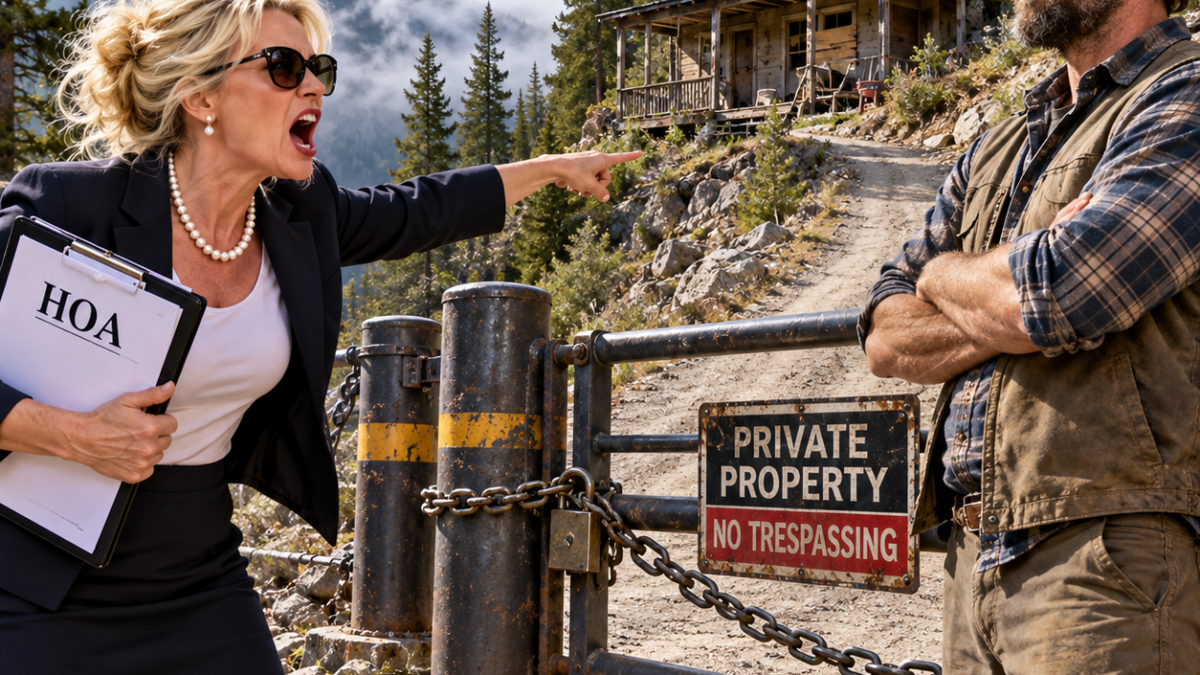
PART 2
I drove back to Denver without turning on the radio.
For two hours, the same images kept replaying in my head.
The laminated MENDOZA label over my family name.
The curtains.
The smoke.
That woman moving around my mother’s kitchen.
Donald standing in the doorway with his hands folded at his waist like he was receiving a delivery.
But the detail that bothered me most was what he had said.
**I was wondering when you’d show up.**
He hadn’t been surprised.
He knew who I was.
He knew I still existed.
That mattered.
If Donald truly believed the cabin had been abandoned, my arrival should have confused him.
Instead, he had been waiting.
I reached Denver after dark, parked in my apartment garage, and sat behind the wheel for another ten minutes.
My first impulse was to call the sheriff immediately.
My second was to drive back with a crowbar.
Neither survived the ten-minute drive from the garage to my apartment elevator.
Donald had prepared.
That much was obvious.
He had HOA paperwork.
He had a wife who could confirm whatever version of events he told.
He had eighteen months—at least, judging from how comfortable the house looked—to manufacture a story in which he was the responsible community leader and I was the neglectful absentee owner who had suddenly appeared angry and unstable.
I had a deed.
That should have been enough.
Legally, maybe it was.
Strategically, I wasn’t sure.
I opened my laptop.
The first thing I searched was my email.
**Eagle Ridge Estates.**
Twenty-three messages appeared.
I stared at the number.
Twenty-three.
The oldest was eighteen months old.
**VIOLATION NOTICE — LANDSCAPING MAINTENANCE.**
I remembered seeing it.
Barely.
At the time, I had been buried in a deadline for a national retail client. I opened the email, saw something about grass height, thought *I’ll deal with this later*, and archived it.
The next message came three weeks later.
Fence maintenance.
Then:
**REQUEST FOR PROPERTY INSPECTION.**
Then:
**SECOND NOTICE.**
Then:
**COMMUNITY ASSESSMENT DELINQUENCY.**
I frowned.
My parents had joined Eagle Ridge because the association maintained snow removal on certain common roads and managed shared water infrastructure, but our parcel had unusual boundaries. Dad had argued with the board more than once about what the HOA could and couldn’t control.
I opened the governing documents.
Section 7.4.2.
The section Donald quoted.
**Abandoned or Unsecured Property.**
The language allowed the association to take limited emergency measures to prevent damage where a property had been demonstrably abandoned or posed an immediate hazard.
But there were conditions.
Written notice.
Certified mail.
Sixty-day opportunity to respond.
Hearing.
Board vote recorded in meeting minutes.
Limited entry for preservation—not occupancy by the HOA president.
I read the section three times.
Then I searched my email for the words **hearing**, **certified**, and **abandoned**.
Nothing.
The final message from fourteen months earlier said:
**Due to continued nonresponse, Eagle Ridge Estates has initiated emergency preservation procedures pursuant to Section 7.4.2.**
No hearing date.
No vote.
No certified-mail tracking.
No explanation.
Just a declaration.
I opened USPS Informed Delivery records.
My Denver address had been registered for years.
No certified letters from Eagle Ridge.
Not one.
At 11:40 that night, I pulled up county property records.
My name remained on the deed.
No foreclosure.
No lien transferring possession.
No recorded claim.
No sale.
No court action.
The house was mine.
That should have made me feel better.
It didn’t.
Because if the legal record was so obvious, Donald knew it too.
He wasn’t confused about ownership.
He was counting on something else.
I made coffee.
Then I opened my tax records.
That was when the first genuinely strange thing appeared.
The current county tax statement listed my Denver mailing address.
The previous year’s statement listed the mountain house.
I stared at the screen.
I had never changed that address.
I checked the year before.
Denver.
Then suddenly, sixteen months earlier:
Mountain property.
Then back to Denver after the county’s annual address-verification update.
Somebody had changed my mailing address.
Maybe clerical error.
Maybe not.
I checked payment history.
Taxes had been paid on time.
That was odd too.
I opened my bank account.
My automatic tax payment had failed sixteen months earlier because an old routing instruction had been invalidated when I switched banks.
I had never noticed.
The amounts weren’t large enough to trigger my normal account monitoring.
Yet the county showed payment.
I called the treasurer’s office the next morning as soon as they opened.
The clerk took my parcel number.
“Yes, sir. Paid in full.”
“From what account?”
“I can’t give you bank information.”
“I’m the property owner.”
“I can tell you payment was made electronically.”
“Was it from the same account as previous years?”
She checked.
“No.”
My hand tightened around the phone.
“Can you tell me the payer name?”
Another pause.
“It appears to have been submitted by Eagle Ridge Property Management.”
I closed my eyes.
Donald wasn’t just living there.
Someone connected to the HOA had been paying my property taxes.
“Why?”
“I couldn’t tell you.”
“Can I get records?”
“Yes. Written request.”
I thanked her.
Then I sat very still.
An ordinary squatter hides.
Donald was doing the opposite.
He was building documentation.
Taxes.
Utilities, probably.
Maintenance.
HOA notices.
Mail.
Occupancy.
A paper trail that allowed him to say:
**I stepped in because Daniel Howard abandoned the property.**
Colorado’s adverse-possession laws weren’t going to hand him ownership after eighteen months, and I doubted that was the plan.
He didn’t need to own the cabin.
He needed enough ambiguity to make removing him slow, expensive, and unpleasant.
If I fought him, he wanted a dispute.
If I gave up, he got a house.
That night I built a spreadsheet.
Column A: Date.
Column B: HOA allegation.
Column C: Required procedure.
Column D: Evidence procedure occurred.
Column E: Donald’s action.
The first three rows looked ordinary.
By row ten, the pattern appeared.
Repeated notices.
Escalating language.
Almost no proof of procedural compliance.
By midnight, Column D was nearly empty.
Donald had created volume, not validity.
That was a mistake.
People assume more paperwork means more truth.
Data analysts know better.
Bad information multiplied a hundred times is still bad information.
***
Monday morning, I called the county recorder.
No lien.
No foreclosure.
No transfer.
No HOA claim affecting title.
Then I asked about recorded board actions.
Nothing tied to my parcel.
I called the electric company.
The account had been switched eighteen months earlier.
“Who authorized that?”
“I can’t release customer information.”
“I own the property.”
“We can investigate possible fraudulent service transfer.”
“When did my name come off?”
She gave me the date.
Two days after the first “emergency preservation” email.
Gas service told the same story.
Water was private through Eagle Ridge, which meant the HOA controlled the records.
That one would be harder.
I printed everything.
Then I looked at the problem the way I would look at a corrupted dataset.
What variables predicted targeting?
Absence.
Low response rate.
Remote ownership.
Older owners.
Inheritance.
Vacation homes.
I pulled the county assessor list for every parcel inside Eagle Ridge.
Sixty-seven homes.
Twelve had mailing addresses outside the development.
Absentee owners.
I searched each address against county court records and public HOA references.
Five had serious enforcement actions in the previous three years.
Five of twelve.
Then I checked the fifty-five owner-occupied homes.
Far fewer formal actions.
That difference was too large to ignore.
Maybe absentee owners genuinely maintained property worse.
Maybe.
But five of twelve was a flag.
I searched the names.
That’s how I found Stephanie Patel.
Former Eagle Ridge board member.
Three years earlier, she had submitted a county complaint alleging financial irregularities and governance violations.
Complaint dismissed.
Insufficient documentation.
I found a phone number.
When I called, she answered on the fourth ring.
“Stephanie Patel?”
“Yes.”
“My name is Daniel Howard. I own a property in Eagle Ridge.”
Silence.
Then:
“Which one?”
“Northwest ridge. Howard cabin.”
Another silence.
Longer.
“Donald’s in it, isn’t he?”
I stood up without realizing I had moved.
“How do you know?”
She exhaled.
“Oh, God.”
“Stephanie.”
“I wondered which one he’d pick next.”
“Next?”
“Not over the phone.”
We agreed to meet Tuesday evening at a coffee shop in Colorado Springs.
I spent the next twenty-four hours wondering what the word *next* meant.
***
Stephanie arrived carrying a manila folder thick enough to have its own gravity.
She was in her early sixties, silver threaded through dark hair, reading glasses hanging from a cord around her neck.
She sat opposite me.
“You look like your father.”
“You knew him?”
“Enough to know he disliked Donald before the rest of us understood why.”
That didn’t surprise me.
My father had a talent for distrusting people quickly and explaining his reasons slowly.
Stephanie pushed the folder across the table.
“I kept everything.”
Inside were meeting minutes.
Financial summaries.
Violation records.
Handwritten notes.
Correspondence.
“What happened?”
She wrapped both hands around her coffee.
“I became treasurer five years ago.”
“And?”
“Numbers stopped making sense.”
Now she had my attention.
“Reserve fund?”
She nodded.
“Road-maintenance allocation. Snow contracts. Tree removal. Emergency repairs. Money going out without enough supporting invoices.”
“How much?”
“I couldn’t prove enough.”
“That wasn’t my question.”
“Thirty-five thousand disappeared from reserves over about two years.”
“Disappear how?”
“Some had paperwork. Some didn’t. Some went to vendors connected to board members.”
“Donald?”
“His brother owned one maintenance company.”
I opened the folder.
A reserve balance had dropped from roughly $47,000 to $12,000.
“Capital projects?”
“None big enough.”
“You raised it?”
“At a meeting.”
“What happened?”
She gave a humorless smile.
“Donald thanked me for being diligent.”
I knew immediately that wasn’t the end.
“Two months later, I was accused of hostile conduct.”
“By who?”
“Anonymous homeowner complaints.”
“Did you see them?”
“No.”
“Were you removed?”
“Yes.”
“Proper vote?”
“They held the vote at a meeting I was never notified about.”
She turned another page.
“I filed a complaint. County said the evidence wasn’t enough to establish criminal conduct.”
“So you kept collecting.”
“I’m stubborn.”
“Useful quality.”
She smiled slightly.
Then I showed her my spreadsheet.
Absentee owners.
Five serious enforcement cases out of twelve.
Owner-occupied homes.
Only two comparable cases out of fifty-five.
Her smile disappeared.
“I tracked something similar.”
She pulled a handwritten sheet.
Same pattern.
Absentee properties attracted enforcement at a wildly higher rate.
I asked:
“Do you know why?”
“I have a theory.”
“I want facts first.”
That earned me a sharper look.
“Your father definitely raised you.”
“My job raised me.”
She handed me another document.
Property record.
Owner: Eleanor Vance.
Seventy-eight years old.
Primary address: Florida.
Her Eagle Ridge cabin had been labeled abandoned two years earlier.
“Same section?”
“7.4.2.”
“What happened?”
“HOA entered. Claimed preservation.”
“And?”
“Eleanor died last spring. Her daughter came out to settle the estate.”
Stephanie paused.
“There were tenants living inside.”
“Tenants?”
“People who said they were renting through an HOA property-management arrangement.”
My stomach tightened.
“Who authorized that?”
“That was the fight.”
“What happened?”
“Family hired an attorney. Months of arguments. Donald claimed the HOA had incurred preservation costs and had authority to recover them through temporary occupancy.”
“That clause doesn’t say that.”
“I know.”
“Did the family win?”
“They settled.”
“Why?”
“Eleanor’s daughter lived in Florida. Her brother was in New York. Legal fees climbed. They sold.”
“To who?”
“Not Donald. Investor from Colorado Springs.”
“So he didn’t get the property.”
“No.”
“Then what did he get?”
Stephanie looked at me.
“Control. Access. Maybe rent. I never found the full accounting.”
She slid over the supposed board authorization.
The date was March 15.
Then she handed me the attendance log.
The actual March meeting occurred March 22.
I stared at both.
“Backdated.”
“That’s what I thought.”
“Could there have been a special meeting?”
“No notice.”
“Written consent?”
“None I found.”
I leaned back.
Now I understood Donald’s method better.
It wasn’t a brilliant conspiracy.
It was simpler.
Find people unlikely to fight.
Create violation history.
Declare emergency.
Enter property.
Generate paperwork afterward.
If challenged, bury the owner in procedure.
Most people would choose money over principle eventually.
Especially if they lived a thousand miles away.
“Why my house?” I asked.
Stephanie thought.
“You hadn’t been there.”
“That’s not enough.”
“No.”
“My father had disputes with Donald?”
“A few.”
“Personal?”
“Maybe.”
She hesitated.
“What?”
“Donald filed bankruptcy seven years ago.”
“That alone means nothing.”
“I know.”
“How much?”
“More than three hundred thousand in unsecured debt.”
I waited.
“Two years later he became president.”
“So?”
“Three years after that, new truck. Trips. His wife started posting from a mountain cabin nobody could find under their names.”
My cabin.
My mouth went dry.
“Do you have screenshots?”
Stephanie opened the folder again.
Of course she did.
There was Diana Mendoza smiling beside a fireplace.
My fireplace.
Another photograph on the deck.
My deck.
Caption:
**Finally getting away to our mountain place.**
Posted nine months earlier.
I felt anger hit so hard my hands shook.
For months, strangers had been showing off my parents’ house as theirs.
Stephanie touched my wrist.
“Don’t confront him alone.”
I looked up.
“He’s sleeping in my father’s bedroom.”
“I know.”
“He threw away family photographs.”
“Daniel.”
“I should call the sheriff tonight.”
“You can.”
“Why do I hear a but?”
“Because Donald survives by controlling the story.”
I hated that she was right.
I closed the folder.
“What would make the story uncontrollable?”
Stephanie shook her head.
“I don’t know.”
But on the drive back to Denver, I did.
Or at least I remembered something.
The road.
***
My father had complained about that road my entire childhood.
It was narrow.
Private.
Expensive to maintain.
Every winter, he paid a local guy named Walt to plow it because county trucks stopped at the paved road below.
I had always assumed Eagle Ridge held access rights.
Why wouldn’t they?
The house appeared on subdivision maps.
But assumptions had gotten me into this situation.
At midnight, I downloaded the recorded plat.
Then the deed.
Then the easement documents.
I enlarged the survey.
The road from the county line to my cabin followed a strip entirely inside my parcel.
There was an easement allowing *me* access from the county road across a tiny corner of an adjoining tract.
But once the road crossed onto my acreage, there was no HOA right-of-way.
No common-area designation.
No blanket access right in favor of Eagle Ridge.
The last half mile was mine.
I opened satellite imagery.
Donald had to cross it every single time he entered or left.
Eighteen months.
No permission.
The next morning I called a real-estate lawyer.
Judith Watson.
A colleague described her with unusual respect.
“She doesn’t enjoy drama.”
“Good.”
“She enjoys winning.”
“Better.”
Her office was in downtown Denver.
Sharp eyes.
Short sentences.
Legal pad already half full by the time I finished.
I gave her the deed.
Survey.
Emails.
Tax records.
Utility dates.
Stephanie’s documents.
Photos of Donald inside my house.
She read in silence.
Finally:
“You should have called me Saturday.”
“I know.”
“You should not go back alone.”
“I know.”
“You should definitely not change locks while they’re physically inside.”
“I wasn’t planning to.”
“You were thinking about it.”
“I was thinking about several things.”
“That’s why I’m saying it.”
Fair.
“What do I have?”
“A strong ownership record. Potential civil claims for trespass and conversion. Potential fraud or forgery issues depending on what documents were created. The criminal side belongs to law enforcement and prosecutors.”
“The road?”
She examined the survey again.
Then the deed.
Then another recorded map.
Her eyebrows lifted.
“That’s useful.”
“How useful?”
“Very.”
“Can I gate it?”
“Possibly, but we verify first.”
“What do you mean possibly?”
“I mean I don’t give property owners expensive advice based on one map.”
She ordered a title report.
Checked easements.
Reviewed HOA declarations.
Two days later, she called.
“The road is yours.”
“No HOA easement?”
“None recorded over the portion we discussed.”
“Can I close it?”
“You can secure your private road subject to emergency access, any applicable local requirements, and existing lawful easement rights. We’ll make sure the gate complies.”
“And Mendoza?”
“He has no independent right to use it.”
“What happens if I put up a gate?”
Judith paused.
“Be precise about your goal.”
“I want my property secured.”
“Good answer.”
“My other goal?”
“Keep it to yourself.”
I smiled for the first time in days.
“What if Donald is still in the house when the gate goes up?”
“We do not trap anybody. The gate gets lawful emergency-access provisions. You do not physically prevent someone from leaving. You notify him that future access is prohibited.”
“So the title is less dramatic than the reality.”
“Reality usually is.”
“What does it accomplish?”
“Every future entry becomes simpler to document as intentional trespass. It also prevents him from casually moving in and out as though the road belongs to the HOA.”
I leaned back.
“Can we install cameras?”
“Yes.”
“No-trespassing signs?”
“Yes.”
“Written revocation of permission he never had?”
“Absolutely.”
I thought of my father.
One road means one choice.
Come in or stay out.
“What else?”
Judith looked at the evidence.
“We keep building.”
***
The following Saturday, I drove back up the mountain.
This time I parked a quarter mile away and walked through the trees.
The Camry sat in my driveway.
Smoke rose from the chimney.
Diana moved behind the kitchen window.
Donald’s truck was gone.
I photographed the vehicle.
Mailbox.
Lockbox.
Windows.
License plate.
Everything timestamped.
Then I walked the perimeter.
Not onto the porch.
Not into the yard.
Observe.
Document.
Leave.
On the way back, I stopped where the private road narrowed between two pines.
That was the natural gate location.
Anyone approaching would have to stop.
Anyone leaving could still use a manual emergency release.
The point wasn’t imprisonment.
It was control of access.
My control.
I called Judith.
“This is the spot.”
“I want the contractor to pull any required permit.”
“Already asked.”
“Emergency access?”
“Knox-compatible system if required.”
“Camera?”
“Cloud backup.”
“Signage?”
“PRIVATE ROAD. NO TRESPASSING. ACCESS BY OWNER AUTHORIZATION ONLY.”
She was quiet.
“Good.”
“That sounds almost like approval.”
“Don’t get used to it.”
Installation was scheduled for the next Saturday.
Seven days.
During those seven days, I did what data people do when life becomes unbearable.
I made folders.
**TITLE.**
**HOA PROCEDURE.**
**TAX RECORDS.**
**UTILITY RECORDS.**
**PHOTOS.**
**STEPHANIE.**
**ELEANOR VANCE.**
**MENDOZA OCCUPANCY.**
I built a master timeline.
Date of first violation.
Date tax address changed.
Date utility transfer occurred.
Date “emergency preservation” began.
Diana’s social-media photographs.
Tax payments.
Missing hearing.
Backdated Vance resolution.
Patterns among absentee owners.
Donald had wanted bureaucracy.
I was giving him bureaucracy organized by someone who enjoyed spreadsheets.
***
The gate went up at noon Saturday.
Black steel.
Electronic keypad.
Solar camera.
Manual emergency mechanism.
Large reflective signs.
I stood there after the contractors left.
For the first time since seeing Donald in my doorway, I felt the property physically acknowledge who owned it.
I did not lock the gate immediately.
Judith had advised a staged process.
Document installation.
Send written notice.
Allow exit.
Then restrict reentry.
At 2:14 p.m., I emailed Donald.
**Mr. Mendoza,**
**The access road serving the Howard property is privately owned and is not HOA common property. Any permission, implied or otherwise, for you or your household to use that road is revoked effective immediately. The newly installed gate is an owner security measure. It does not prevent lawful exit or emergency access. You are not authorized to enter the property or road after departure.**
I attached the deed and survey.
Copied Judith.
Thirty-six minutes later, Donald replied.
**Your gate is an unauthorized structure installed on Eagle Ridge common access property. Remove immediately.**
I smiled.
He had answered too quickly.
No title search.
No legal review.
Just authority by assertion.
Monday morning, I received a formal violation.
Section 3.2.
Unapproved structure.
$150 per day.
Judith read it.
“He doubled down.”
“Useful?”
“Very.”
I answered once.
Recorded deed reference.
Survey.
Statement denying HOA jurisdiction.
Future communication through counsel.
Two days later, another violation arrived.
This time the gate offended “community aesthetics.”
I held the letter beside the photograph of Donald living in my house.
The man had occupied my property for eighteen months and was fining me for the appearance of the gate I installed to keep him from returning.
That level of confidence almost deserved admiration.
Almost.
***
The camera recorded Donald five days later.
9:03 a.m.
His Camry approached from the cabin side.
That meant he was leaving.
He stopped before the gate.
Walked to the sign.
Read it.
Looked directly at the camera.
Then photographed everything.
The gate released for outbound movement as designed.
He drove away.
He did not return that afternoon.
Or evening.
The next morning, Diana’s car left.
Two hours later, Donald returned from the county road.
He entered the code he had apparently obtained from an HOA maintenance worker.
Wrong.
Tried another.
Wrong.
Then he pressed the call button.
My phone rang.
I recorded.
“Daniel.”
“Donald.”
“You need to open this.”
“No.”
“My wife has personal property inside.”
“You were notified that access permission was revoked.”
“You cannot lock me out of HOA-managed property.”
“It isn’t HOA-managed property.”
“This is obstruction.”
“The outbound gate remains functional. You chose to leave after receiving notice.”
“I have rights.”
“Send them to Judith.”
His voice hardened.
“You think putting up a gate changes the law?”
“No.”
“Then open it.”
“No.”
Silence.
“You’re making a mistake.”
“Send that through counsel too.”
I ended the call.
My hands were shaking.
Not from fear exactly.
From adrenaline.
It is easy to imagine yourself remaining calm during confrontation.
Much harder when a man who has occupied your parents’ house is ten miles away demanding you give him the code.
Ten minutes later, Donald turned around.
He did not enter.
That was important.
The gate worked.
Not by trapping him.
By forcing him to acknowledge a boundary.
***
That afternoon, Judith called.
“We’re ready.”
“For what?”
“Sheriff.”
I went to her office.
Our evidence file contained 127 indexed items.
Forty-three photographs.
Six gate videos.
Tax records.
Utility records.
Property documents.
HOA bylaws.
Email notices.
No certified-mail proof.
Stephanie’s statements.
Eleanor Vance documents.
The backdated resolution.
Diana’s photographs.
Donald’s gate violations.
The phone call.
Judith divided our options.
First: criminal complaint.
Second: civil action.
Third: regulatory complaint concerning HOA governance and possible misuse of association authority.
“Which first?”
“Criminal complaint tomorrow.”
My stomach tightened.
“What if the sheriff says it’s civil?”
“Then we ask them to document that position and move to the next path.”
“What if Donald changes his story?”
“He will.”
“What if the board manufactures a vote?”
“That’s why our timeline matters.”
“What if he destroys records?”
“We’ve preserved enough external copies to make destruction worse for him.”
I nodded.
Judith watched me.
“What?”
“You look disappointed.”
“I don’t feel victorious.”
“You shouldn’t.”
“Why?”
“Nothing is resolved.”
Fair.
She closed the binder.
“Go home. Sleep.”
“I won’t.”
“Try.”
I didn’t.
I spent half the night imagining Donald moving my father’s remaining belongings.
Burning documents.
Leaving.
Returning.
Calling board allies.
Maybe I had waited too long.
At 1:20 a.m., I drafted a three-paragraph post for a local community group exposing everything.
My finger hovered over POST.
Then I remembered Judith.
Public statements become evidence too.
I deleted it.
That decision later mattered more than I knew.
***
At 10:30 Wednesday morning, Judith and I sat across from Deputy Raymond Ortiz at the El Paso County Sheriff’s substation.
Ortiz was mid-forties.
Quiet.
Methodical.
He did not react dramatically to anything.
That reassured me.
Judith began with ownership.
Deed.
Title.
Survey.
Then the HOA process.
Then the occupancy evidence.
Ortiz stopped her.
“Mr. Howard, when did you last personally authorize Mr. Mendoza to enter?”
“Never.”
“Did your parents?”
“Not that I know of. Dad disliked him.”
“Any lease?”
“No.”
“Property-management agreement?”
“No.”
“Written permission?”
“No.”
He looked at Judith.
“What authority does Mendoza claim?”
“HOA abandoned-property procedure.”
Ortiz read Section 7.4.2.
“This says preservation.”
“Yes.”
“It doesn’t say residence.”
“No.”
“Did the board obtain a court order?”
“No.”
“Foreclosure?”
“No.”
“Lien?”
“No recorded lien affecting possession.”
He turned to the timeline.
“And Mr. Mendoza is HOA president?”
“Yes.”
Ortiz spent forty-five minutes reviewing.
Then:
“This is enough for me to make contact and investigate the trespass complaint. I’m not promising arrest before I speak to him.”
“I understand.”
“If property was removed, we’ll need inventory and valuation.”
“I have old photographs.”
“Good.”
He stood.
“Let’s go see who answers the door.”
My mouth went dry.
This was what I had wanted.
Now that it was happening, I wanted another week.
Evidence is comfortable.
Action is not.
We drove separately up the mountain.
My car.
Judith’s.
Ortiz’s cruiser.
The gate camera showed no Donald vehicle entering from below.
But his Camry was visible on an interior camera near the cabin.
“How did he get back?” Judith asked.
I checked footage.
Then saw it.
The previous evening, the gate had opened for an ambulance responding to another property higher on the ridge through a neighboring emergency route configuration.
Donald had followed several minutes later before the system reset.
Tailgating emergency access.
Another bad decision.
Ortiz watched the clip.
“Save that.”
“Already cloud-backed.”
He almost smiled.
“Of course it is.”
I opened the gate.
We drove the dirt road.
Every curve brought back childhood memories.
Dad’s truck sliding in snow.
Mom telling him to slow down.
Me sitting in the back complaining there was no cell service.
Then the house appeared.
My house.
Donald’s Camry.
Ortiz parked first.
He walked to the door.
Knocked.
Thirty seconds.
Nothing.
Again.
Movement behind the curtain.
Then the door opened.
Donald wore slacks and a button-down shirt.
No HOA polo.
His face stayed controlled until he saw me.
Then Judith.
Then Ortiz.
“Officer.”
“Donald Mendoza?”
“Yes.”
“I’m Deputy Ortiz. I’m investigating a complaint concerning this property.”
Donald gave me one glance.
“I see.”
Ortiz asked:
“Do you live here?”
“I’m overseeing the property under authority of Eagle Ridge Estates.”
“That wasn’t my question.”
Donald paused.
“My wife and I have stayed here periodically to preserve it.”
“How periodically?”
“I’d have to check.”
“Do you have a lease?”
“No.”
“Court order?”
“The HOA acted under governing documents.”
“Deed?”
“No.”
“Written authorization from Mr. Howard?”
“The property was abandoned.”
Ortiz turned slightly.
“Mr. Howard is standing right there.”
Donald’s jaw tightened.
“That doesn’t change the condition the property was in.”
“It changes whether you have permission.”
“This is a civil HOA matter.”
“Maybe parts of it are.”
Ortiz remained calm.
“I’m asking you to show me any legal instrument granting you possession.”
Donald looked toward Judith.
“You’re his attorney?”
“Yes.”
“This is harassment.”
Judith said nothing.
Ortiz repeated:
“Do you have documentation granting possession?”
Donald finally stepped away from the doorway.
“I have HOA records inside.”
Ortiz looked at me.
“Do you consent to me entering with you to review documents?”
“Yes.”
Donald immediately said:
“I don’t consent.”
Ortiz looked at him.
“You just told me this isn’t your property.”
That silence was the first moment I saw Donald lose control of the conversation.
Not dramatically.
A pause.
A small shift.
The machinery stalled.
Diana appeared in the hallway.
She looked from Ortiz to me.
Then away.
I saw my father’s armchair behind her.
At least that survived.
The living room did not.
Family photographs gone.
New television.
Their sofa.
Their lamps.
The house smelled unfamiliar.
Ortiz stayed near the doorway while establishing the situation.
He made calls.
Checked records.
Spoke with a supervisor.
Nothing happened as fast as I imagined.
No immediate handcuffs.
No dramatic confession.
For almost an hour, we stood in and around the front room while Donald insisted he acted in good faith.
He showed a resolution authorizing emergency access.
Judith read it.
Her eyes met mine.
The date.
It had been recorded in HOA files after the date it supposedly passed.
Another backdated document.
Ortiz photographed it.
Then he asked Donald:
“Who signed this?”
“Board members.”
“Were you present?”
“Yes.”
“Where are the meeting minutes?”
“Association office.”
“Who keeps the originals?”
“I do.”
That answer mattered.
Then Ortiz asked about tax payments.
Donald said:
“The HOA paid expenses to preserve the property.”
“Why would the HOA pay private property tax?”
“To prevent loss.”
“Was there a tax sale pending?”
Donald hesitated.
“No.”
“Delinquency notice?”
“I don’t recall.”
Ortiz looked at him for a long moment.
Then:
“Mr. Mendoza, at this point I have enough information to require you to leave the property pending further investigation.”
Donald’s face flushed.
“You don’t have that authority.”
Ortiz’s expression changed for the first time.
“Sir, I’m giving you a lawful instruction based on a complaint by the recorded property owner, who is present, and your inability to produce any legal right of possession. You can leave voluntarily while this is investigated, or we can take the next step.”
Diana whispered:
“Donald.”
He ignored her.
“This is outrageous.”
Ortiz remained still.
“Your choice.”
Donald looked at me.
Not angry.
Not exactly.
Disbelief.
He had spent eighteen months creating a reality.
My arrival threatened it.
But even then, I don’t think he believed reality could actually win.
“Fine.”
He turned.
“We’ll leave under protest.”
Ortiz nodded.
“Take essential personal property. Other disputed contents stay until ownership is documented.”
Donald walked upstairs.
Diana followed.
Twenty minutes later, they came down carrying suitcases.
On the way out, Donald stopped beside me.
“This is not over.”
“I know.”
“Eagle Ridge will bury you in litigation.”
“Talk to Judith.”
“You think she can protect you?”
I looked at the road.
“No.”
Then I looked back.
“The deed does most of that.”
His face hardened.
He walked away.
At the gate, his Camry left.
For the first time in eighteen months, Donald Mendoza was outside my property.
And for the first time since Dad died, I slept in the mountain house.
Not comfortably.
But alone.
***
The emotional part came after everyone left.
That surprised me.
During the confrontation, I had tasks.
Answer Ortiz.
Photograph documents.
Listen to Judith.
Check rooms.
Preserve evidence.
Then the cruiser disappeared down the road.
Judith left after making me promise not to throw anything away.
The house became quiet.
I stood in the living room.
My father’s chair was still there.
Different upholstery cover.
But his.
I sat.
The cushions felt wrong.
I looked at the mantel.
Empty nail holes.
There had been photographs there.
My parents on their wedding day.
Me at age nine with skis twice my height.
Mom holding a burned Thanksgiving turkey and laughing.
Gone.
I went upstairs.
My parents’ bedroom had become Donald and Diana’s.
Their clothes in the closet.
Their toiletries in the bathroom.
A framed photograph of them on the dresser.
I picked it up.
Then put it down carefully.
I had never understood violation as a physical sensation before.
The house had not been damaged like a burglary.
That would have been easier.
Burglars leave.
These people had settled.
They had chosen drawers.
Changed sheets.
Moved furniture.
Built routines.
They had lived inside my memories until my memories looked like clutter.
In the garage, I found plastic storage bins.
Some labeled.
**HOWARD — PERSONAL.**
I opened one.
My mother’s Christmas decorations.
Another.
Old dishes.
Another.
Books.
Then one containing framed photographs.
I sat on the concrete floor.
Not everything was gone.
I found the wedding picture.
The ski photograph.
The Christmas before Mom got sick.
I held them like evidence until I realized I was crying.
That night, I put those three photographs back on the mantel.
Nothing else.
Not yet.
***
By evening, Eagle Ridge knew.
Stephanie texted:
**Community board is exploding.**
Diana had posted that her husband had been “forcibly removed from property entrusted to the HOA.”
Residents asked questions.
**Why were you living there?**
**Was the owner dead?**
**Did the board approve occupancy?**
**Were you paying rent?**
Then somebody asked about the reserve fund.
Threads split.
Old grievances surfaced.
Fines.
Closed meetings.
Contracts.
Stephanie called at 9:30.
“Donald’s losing them.”
“Good.”
“You sound tired.”
“I’m sitting in my parents’ house.”
Silence.
“How bad?”
“Some things are gone.”
“I’m sorry.”
“Furniture I can replace.”
“I know.”
“No. I mean I’m trying to believe that.”
She understood.
Three days later, residents collected enough signatures to force an emergency HOA meeting.
I attended.
I sat in the back.
Donald had been formally arrested in the meantime after investigators reviewed additional evidence, then released pending proceedings.
He arrived with an attorney.
Diana sat beside him.
Donald tried to speak first.
“I acted in good faith to protect an abandoned property that threatened community standards.”
A woman interrupted:
“You protected it by sleeping there?”
Applause.
His attorney whispered something.
Donald continued.
“The association incurred substantial expenses—”
Another voice:
“Where’s the reserve money?”
Then another:
“Why did your brother get twenty-three thousand dollars?”
That one surprised him.
I saw it.
Stephanie must have shared records.
The meeting became less about my cabin and more about everything Donald had controlled.
Residents moved three motions.
Remove Donald from the board.
Independent audit.
Full cooperation with law enforcement and civil investigations.
The removal vote was unanimous among those voting.
Donald stood before the result finished being read.
Diana followed.
Nobody stopped them.
Stephanie found me afterward.
“You did it.”
“No.”
She looked at me.
“You absolutely did.”
“I opened one door.”
“Closed one road.”
I smiled despite myself.
“The homeowners did the rest.”
She nodded.
“That’s the difference.”
“What?”
“People had been complaining for years. Nobody had a fact big enough to make everyone look at the smaller facts.”
My house had become that fact.
Once residents realized their president was secretly living in someone else’s property, every other unexplained thing became worth reexamining.
Donald had survived because each complaint stayed isolated.
One fine.
One missing invoice.
One angry owner.
One weird meeting.
Patterns only become visible when somebody puts the rows together.
***
The independent audit took six weeks.
It confirmed much of what Stephanie suspected.
Reserve discrepancies.
Approximately $47,000 unaccounted for or unsupported.
Twenty-three thousand paid to a maintenance company owned by Donald’s brother.
Incomplete invoices.
No competitive bid.
Meeting minutes that did not match actual dates.
Enforcement records missing votes.
Absentee homeowners targeted far more often than resident owners.
Not every irregularity was criminal.
That distinction mattered.
Poor governance is not automatically fraud.
Conflict of interest is not automatically theft.
But some records were serious enough for prosecutors and regulators to keep digging.
My case moved on separate tracks.
Criminal investigation.
Civil claims.
HOA regulatory issues.
Judith warned me repeatedly:
“Do not confuse allegation with outcome.”
“I know.”
“You keep saying Donald committed fraud.”
“Privately.”
“Still stop.”
“Fine.”
“Let the evidence earn the word.”
That became a rule.
I hated it.
It was useful.
My missing property inventory took days.
My father’s desk was gone.
Mom’s china set.
Several pieces of furniture.
Tools.
An antique rifle that had been lawfully transferred and stored before Dad died was missing too, which triggered additional reporting.
Some belongings had been moved to a storage facility.
Others had apparently been donated.
A few sold during what Donald described in emails as “property preservation disposal.”
That phrase almost made me throw the laptop.
Judith stopped me.
“Words are helping you.”
“He sold my mother’s things.”
“I know.”
“Then why does he get to call it disposal?”
“He can call it anything. Receipts decide.”
We obtained records.
Furniture consignment.
Donation center.
Storage fees.
Donald had documented far more than a normal thief would.
Because he never thought of himself as a thief.
He believed process converted taking into authority.
That arrogance became evidence.
***
Three months after his removal from the board, Donald’s attorney approached prosecutors about resolution.
The final criminal disposition was less dramatic than I wanted.
Donald pleaded guilty to reduced charges involving criminal trespass and fraud-related conduct.
Other allegations were dismissed as part of the agreement.
He received supervised probation.
Community service.
Restitution.
No prison.
Diana resolved a lesser accessory-related count and received probation and a fine.
When Judith told me, I was furious.
“That’s it?”
“Daniel.”
“He lived in my house for eighteen months.”
“I know.”
“He removed my parents’ belongings.”
“I know.”
“He targeted Eleanor Vance.”
“That case has separate evidentiary issues.”
“He forged—”
“Allegedly. And the forgery count is being dismissed.”
I stood.
“So he walks.”
“He has already been arrested, prosecuted, removed from office, ordered to pay restitution, subjected to civil claims, and publicly exposed.”
“No prison.”
“No.”
“That doesn’t feel like enough.”
Judith waited.
Then:
“Enough for what?”
I looked at her.
“What does that mean?”
“Enough to restore your house?”
“No.”
“Enough to bring your father back?”
I said nothing.
“Enough to erase eighteen months?”
“No.”
“Then stop asking a sentence to do something no sentence can do.”
I hated that too.
She continued.
“The legal system can impose consequences. It cannot repair memory.”
I sat down.
After a while, she pushed the civil settlement proposal toward me.
$127,000.
Replacement value for documented property.
Fair-market occupancy value.
Legal expenses.
Travel.
Security improvements.
Other damages.
“They’ll pay?”
“Their attorney says yes.”
“Why?”
“They do not want discovery.”
That caught my attention.
“Meaning?”
“Meaning if we proceed, we get broader records, depositions, finances.”
“And they don’t want that.”
“Apparently not.”
I read the proposal.
Then:
“I want an apology.”
Judith stared.
“A sincere one?”
“No.”
“Then why?”
“Public record.”
“You already have public records.”
“I want Eagle Ridge’s website to say they were wrong about my property.”
“That is unusual.”
“So?”
“They may refuse.”
“Then we proceed.”
Judith sighed.
“You’ve discovered litigation revenge.”
“I’m not asking for humiliation.”
“Yes, you are.”
“Documented correction.”
“Lawyer wording for humiliation.”
“Will you ask?”
“Yes.”
They accepted.
Two paragraphs.
Formal.
Sterile.
Donald and Diana acknowledged they had occupied the Howard property without valid authorization and apologized for harm caused.
It stayed on the HOA website for twelve months.
The first time I read it, I expected satisfaction.
I felt almost nothing.
Judith had been right.
Forced apologies are records, not healing.
Still, records matter.
Donald understood that better than anyone.
Now his record belonged to someone else.
***
Eagle Ridge’s own civil action followed.
The association sought repayment for unsupported expenditures.
Donald’s brother’s company was banned from future contracts.
New rules required competitive bids above defined thresholds.
Annual independent audits.
Board term limits.
Meeting minutes posted promptly.
Recorded votes for major enforcement actions.
Mandatory owner notice using trackable delivery when legal rights could be affected.
Most importantly, the abandoned-property procedure was rewritten.
No HOA officer could personally occupy, rent, or use a property under preservation authority.
That sentence should never have been necessary.
Now it was.
Stephanie joined the reform committee but refused to become president.
“Why?”
“I already learned that lesson.”
The new board asked me to serve.
Twice.
I declined.
Not because I thought all HOAs were evil.
That would have been lazy.
Systems reflect incentives.
Good rules help.
Bad rules invite abuse.
But after months spent proving Donald had confused authority with ownership, the last thing I wanted was his chair.
I preferred my spreadsheets from a safe distance.
***
Eleanor Vance stayed with me.
I never met her.
She died before I knew her name.
But her story looked too much like mine.
Remote owner.
Notices.
“Abandonment.”
Emergency access.
People inside her house.
Her children exhausted by litigation.
Settlement.
Sale.
Stephanie gave Eleanor’s daughter my number.
We spoke once.
Her name was Rachel.
“I wish we’d fought harder,” she told me.
“You were grieving.”
“So were you.”
“I had different circumstances.”
“We thought Donald had the HOA behind him.”
“He did.”
“We thought that meant he was right.”
“That’s what he counted on.”
Rachel went quiet.
“Mom kept telling us something was wrong.”
I closed my eyes.
“How long?”
“Months.”
“Did she know people were staying there?”
“She suspected.”
“Did you believe her?”
A long pause.
“Not enough.”
The regret in those two words felt heavier than anything Donald had done.
I said:
“You didn’t create this.”
“No.”
“But we left.”
“You were trying to settle an estate from across the country.”
“I still wish we’d stayed.”
I understood.
Before hanging up, I told her Eleanor’s property records and the backdated resolution had helped expose the pattern.
“She mattered.”
Rachel began crying.
“So did your mother,” she said.
I didn’t understand.
Then she explained that Eleanor had remembered seeing my mother at an Eagle Ridge picnic years earlier.
They had spoken once.
Two women I barely connected had become part of the same story decades later.
Life does that sometimes.
Not in magical ways.
In paper trails.
Names.
Memories.
Small intersections nobody notices until afterward.
***
Renovating the house took four months.
I could have sold it.
Several people suggested that.
Even Judith.
“Fresh start.”
“No.”
“Financially, the market is strong.”
“No.”
“You sure?”
“No.”
That made her laugh.
But I kept it.
First came floors.
Then paint.
Then kitchen repairs.
I restored Mom’s white cabinets instead of replacing them.
A contractor suggested modern gray.
I almost fired him.
Dad’s leather chair went to an upholsterer.
It returned smelling wrong and looking too clean, but the frame was still his.
I bought furniture slowly.
Not to recreate the past.
That would have been impossible.
I found some missing photographs in storage.
Others from family digital archives.
I rebuilt the mantel.
Wedding day.
Ski lesson.
Christmas.
Mom laughing.
Dad squinting at the camera because he hated photographs.
The first night after renovations, I lit the fireplace.
No television.
No laptop.
Just fire.
I sat in Dad’s chair.
Outside, snow started falling.
For months I had thought getting the house back would mean undoing Donald.
It didn’t.
His eighteen months existed.
His furniture had been here.
His mail had arrived.
His wife had used Mom’s kitchen.
No court could erase that.
What I could do was add new time.
One evening.
Then another.
Then a weekend.
Then winter.
Memory is territorial too.
You reclaim places by living in them.
***
The gate stayed.
At first, everyone assumed I would remove it once the case ended.
I considered it.
Then remembered how much the road mattered.
My father had understood its privacy instinctively.
I understood it legally now.
The gate wasn’t designed to trap anyone.
It never had been.
It marked a fact Donald had spent eighteen months pretending didn’t exist.
This road belonged to someone.
Permission mattered.
The new Eagle Ridge board requested emergency access coordination.
I agreed.
Fire department.
Medical response.
Utility emergencies.
Written procedure.
Proper codes.
No ambiguity.
One Saturday, Stephanie came up with two homeowners I had met during the reform meetings.
We grilled burgers on the deck.
Sun dropped behind the mountains.
For once, nobody brought a binder.
Eventually Stephanie raised her glass.
“You know what annoys me?”
“Long list.”
“I spent two years collecting evidence.”
“You did.”
“County dismissed me.”
“They did.”
“I warned people.”
“Yes.”
“Nothing.”
I waited.
“Then you show up, put in one gate, and Donald collapses.”
“That’s not what happened.”
“It feels like it.”
“You built half the case.”
She shook her head.
“You had something I didn’t.”
“The deed?”
“The road.”
I looked toward the trees where the dirt access disappeared downhill.
She was right.
The road changed the problem.
Without it, Donald could keep drifting between competing narratives.
Abandoned-property policy.
Preservation.
HOA authority.
Good faith.
But he had no answer to one simple fact.
Every time he reached the cabin, he crossed privately owned land without permission.
The detail was boring.
A line on a survey.
That was why he overlooked it.
People who abuse systems often focus on the loud authority.
Titles.
Rules.
Letters.
Votes.
They forget the quiet authority hidden in maps, signatures, dates, and boundaries.
“I almost missed it too,” I said.
Stephanie smiled.
“But you didn’t.”
“Because Dad complained about that road for thirty years.”
“So your father won the case.”
“He would enjoy that version.”
We laughed.
***
A year after everything ended, I drove up on the anniversary of the morning I found Donald in the house.
Same season.
Same pine smell.
Same thin mountain air.
I stopped at the gate.
For a moment, I saw myself standing there twelve months earlier.
Angry.
Confused.
Humiliated.
I had thought justice would feel like defeating Donald.
It didn’t.
The best part came later.
Ordinary ownership.
Unlocking the gate.
Driving the road.
Parking in my driveway.
Opening my own door without wondering who would answer.
That morning, I found a package on the porch.
For one terrible second, my chest tightened.
Old reflex.
Then I saw the return address.
Rachel Vance.
Inside was a photograph.
Two women at an Eagle Ridge summer picnic.
One was Eleanor.
The other was my mother.
They were younger.
Laughing.
On the back Rachel had written:
**Found this in Mom’s things. Thought it belonged up there.**
I stood on the porch for a long time.
Then I carried it inside.
It went on the mantel.
Between my parents’ wedding photograph and the picture of me skiing.
Not because Eleanor was family.
Because the house had become part of her story too.
And she deserved to be remembered in the place that helped expose what had happened to hers.
***
Donald disappeared from Eagle Ridge social life.
He still owned a house elsewhere in the community for a while, though he and Diana rarely stayed there.
Eventually they sold.
No farewell party.
No dramatic confrontation.
A moving truck arrived one weekday morning.
Stephanie texted me a photograph.
I deleted it after looking once.
I didn’t need evidence anymore.
That chapter was finished.
The new HOA board asked me a third time to join.
I sent a polite refusal.
Then a less polite private message to Stephanie:
**If you nominate me again, I’m installing a second gate.**
She replied:
**Abuse of property rights. Typical.**
That was the kind of HOA conflict I could tolerate.
***
I returned to Denver during the week but spent more weekends on the mountain.
Then some weekdays.
My employer eventually noticed.
My director called during a video meeting.
“Is that snow behind you?”
“Yes.”
“You’re at the cabin again?”
“It has internet now.”
“You installed fiber?”
“Wireless relay.”
“You’re becoming your father.”
“Take that back.”
He laughed.
Work became part of the house.
Laptop at the kitchen table.
Coffee on the deck.
Data models with mountains outside.
For years, I had avoided the cabin because every room reminded me of someone I had lost.
Then Donald occupied it.
Strangely, fighting for the house forced me to stop treating grief as a reason to stay away.
My parents built the place to be lived in.
Not preserved like a museum.
Not abandoned because looking at Dad’s chair hurt.
Maybe that was the only accusation Donald accidentally got right.
I had neglected the house.
Not legally.
Not enough to surrender it.
But emotionally.
I let fourteen months pass because returning meant admitting Dad was gone.
That didn’t justify anything Donald did.
But it explained something about me.
One night, I sat by the fireplace and finally said aloud:
“I’m sorry, Dad.”
Not because I caused the invasion.
Because I had treated his last gift like a storage unit for grief.
Then I stayed through Monday morning.
That was new.
***
Eagle Ridge improved.
Not perfectly.
That mattered too.
Six months after Donald left, residents argued about snowplow contracts for three hours.
One board member resigned over a dispute involving fence materials.
Someone complained about a neighbor’s holiday lights.
Normal HOA nonsense returned.
Stephanie called.
“We may have overestimated democracy.”
“Missing Donald?”
“Absolutely not.”
“Then congratulations. Dysfunction without corruption.”
“That should be our slogan.”
The annual audit posted online.
Reserve balance recovering.
Vendor disclosures clear.
Meeting notices timely.
No mystery property takeovers.
That was enough.
Systems do not become good because one bad person leaves.
They become harder to abuse when ordinary people keep checking them.
Stephanie understood that.
So did the residents who had once stayed silent because a $100 fine wasn’t worth a fight.
They had learned small procedural shortcuts create room for larger ones.
***
One autumn afternoon, Deputy Ortiz stopped by.
Not on official business.
He was hiking nearby and recognized the road.
He stood beside the gate.
“Still here.”
“Gate or me?”
“Both.”
I opened it.
He drove up.
We drank coffee on the deck.
“I’ve thought about your case,” he said.
“That healthy?”
“No.”
“What part?”
“The paperwork.”
“Thrilling.”
He smiled.
“Most trespass complaints are simple. Person where they shouldn’t be. Warning. Refusal. Done.”
“Mine wasn’t.”
“No.”
“Why?”
“Because Mendoza wrapped the behavior in authority.”
That was exactly it.
Uniforms would have made it easier to see.
Donald used bylaws.
Letterhead.
Votes.
Titles.
He made taking look administrative.
Ortiz continued:
“People assume if something comes from an association, a bank, a company, a government office, somebody must have checked whether it’s valid.”
“Usually nobody does.”
“Until someone like you.”
“Or Stephanie.”
He nodded.
“You know what actually convinced me?”
“What?”
“Tax payments.”
I frowned.
“I thought that helped his good-faith argument.”
“At first.”
“Then?”
“Why would an HOA president personally involve the association in paying taxes on a property if he genuinely expected the owner to return after a normal preservation intervention?”
Good question.
“It showed long-term intent?”
“It showed this wasn’t emergency entry.”
I had focused so much on the altered address that I had underestimated the payment itself.
Another pattern.
Another boring detail.
Ortiz finished his coffee.
Before leaving, he looked at the house.
“Looks different.”
“It is.”
“Better?”
I thought.
“Mine.”
He nodded.
“Good answer.”
***
That winter, I found Dad’s old handwritten maintenance notebook.
It had been shoved behind a shelf in the garage.
Donald apparently never noticed it.
Dad recorded everything.
Propane deliveries.
Roof patches.
Snow totals.
Water-pressure problems.
Gate ideas.
On one page from almost twenty years earlier:
**Need proper gate at lower road someday. Too easy for people to wander up.**
I laughed alone in the garage.
“Could’ve done it yourself.”
Below that:
**Daniel says gate would ruin view. Daniel is 18 and knows everything.**
I laughed harder.
Teenage me had apparently opposed the very gate that later helped save the property.
I framed that page.
It hangs beside the $150-a-day HOA gate violation Donald sent.
Visitors think it is funny.
I do too.
Mostly.
***
The civil settlement money did not feel like winnings.
I used part to finish renovations.
Part paid legal costs.
Part restored the road.
I donated a portion to a Colorado legal-aid organization that helps older homeowners with housing disputes.
Judith accused me of developing sentiment.
“Dangerous.”
“Tax deductible.”
“Better.”
Rachel Vance contributed too after hearing about it.
We named nothing after anyone.
No foundations.
No plaques.
Just money doing work.
That felt right.
***
Two years after I found Donald in the cabin, Eagle Ridge held its annual meeting at the community lodge.
Stephanie convinced me to attend.
“I’m not joining the board.”
“Nobody asked.”
“That sounds suspicious.”
“Just come.”
The room looked ordinary.
Coffee.
Folding chairs.
Budget packets.
No tension.
A new president named Marcus Lee opened the meeting.
First item:
Reserve audit.
Second:
Snow contract.
Third:
Amendment confirming protections for absentee owners.
Trackable notices.
Independent verification before any property is labeled abandoned.
Court review before physical possession beyond true emergency protection.
Residents voted overwhelmingly yes.
I sat in the back.
Stephanie leaned toward me.
“Worth coming?”
“Maybe.”
Then Marcus said:
“One final matter. The board formally rescinds all fines previously issued to the Howard property regarding the private road gate.”
I whispered:
“Those were never valid.”
Stephanie whispered back:
“Let them have the gesture.”
Marcus continued:
“And the association acknowledges the road as private Howard property, subject only to recorded emergency arrangements.”
Applause.
I hated that part.
Not because I disagreed.
Because people turned around and looked at me.
I raised one hand.
Please stop.
They laughed.
Afterward, Marcus shook my hand.
“We should’ve done this years ago.”
“You weren’t president years ago.”
“No.”
“That’s the point.”
He nodded.
Then:
“We still want you on the boundary committee.”
“No.”
“Had to try.”
I left before anybody invented another committee.
***
On the drive up to the cabin that night, snow began falling.
Large flakes.
Slow.
The kind my father loved because they meant fresh powder without much wind.
I reached the gate.
Stopped.
Got out.
For no practical reason, I opened it manually.
Cold steel under my glove.
Dad had wanted a gate twenty years earlier.
I had told him it would ruin the view.
Now it framed the road.
I closed it behind the truck.
At the house, I lit the fireplace.
Made soup.
Mom’s recipe.
Badly.
I put music on.
Snow thickened outside.
Then I walked to the mantel.
Parents’ wedding.
Ski photo.
Christmas.
Eleanor and Mom.
The house had history again.
Not the same history.
A continued one.
That distinction mattered.
I once thought restoring the cabin meant making it look exactly like it did before Donald.
Eventually, I realized that would have made him too important.
The house had survived forty years before him.
It would survive decades after.
His eighteen months were not the definition of the place.
Just one ugly chapter.
***
Sometimes people in Eagle Ridge still call the access point “Daniel’s gate.”
I hate that.
The actual contractor invoice calls it **Howard Private Road Security Gate**.
Dad would have called it expensive.
Mom would have planted flowers beside it.
I planted two aspens.
One on each side.
They were small at first.
Thin trunks.
Almost ridiculous beside the black steel.
By the third autumn, their leaves turned gold.
I stood beneath them one evening after locking the gate.
The mountain was quiet.
No Camry.
No HOA notices taped to anything.
No stranger’s name on my mailbox.
Just HOWARD.
I never replaced the mailbox label with anything fancy.
Black marker.
Dad’s style.
Good enough.
***
The strangest lesson was that I never actually “beat” Donald in one dramatic moment.
The gate mattered.
The sheriff mattered.
The audit mattered.
The plea mattered.
The settlement mattered.
But none alone ended it.
What ended Donald’s control was accumulation.
One email he thought nobody would read carefully.
One missing certified letter.
One tax-address change.
One payment that made no sense.
One backdated resolution.
One former board member who kept her notes.
One family that gave up but left records behind.
One road line on a survey.
Donald believed his advantage was that nobody paid attention long enough to connect those things.
For years, he was right.
Then I came home.
Not because I was braver than Eleanor Vance’s family.
Not because I was smarter than Stephanie.
I simply arrived at the right moment with the right combination of ownership, evidence, professional stubbornness, and anger I managed not to waste.
That last part almost failed several times.
If I had shoved past Donald on day one, maybe he could have painted me as violent.
If I had destroyed his belongings, I would have complicated my own case.
If I had locked a gate in a way that physically endangered anyone, I would have handed him an argument.
If I had posted everything online before law enforcement saw the evidence, I might have turned facts into a public shouting match.
Waiting felt passive.
It wasn’t.
Sometimes waiting is work.
***
On the third anniversary of Dad’s death, I took the day off.
I drove up before sunrise.
At the lower road, I stopped the truck.
Opened the gate.
Then, instead of getting back in immediately, I stood beside it.
Cold air.
Pine.
Dawn beginning behind the ridge.
I remembered Dad saying:
“One road means one choice. Come in or stay out.”
As a kid, I thought he meant weather.
Then I thought he meant privacy.
Now I understood the deeper part.
Boundaries only matter when people recognize them.
Sometimes recognition comes naturally.
Sometimes it requires a deed.
A survey.
A camera.
A lawyer.
A sheriff.
And occasionally a steel gate.
I drove up.
At the cabin, I made coffee and carried it onto the deck.
The sun climbed.
Light moved across the peaks.
For years after my parents died, I avoided mornings like that because beauty felt disloyal somehow.
How could the mountains look identical when they were gone?
Eventually I learned the landscape’s indifference was a comfort.
It stayed.
The house stayed.
I stayed.
Not unchanged.
Just present.
I went inside.
Dad’s leather chair sat beside the fireplace.
I lowered myself into it.
The framed family photographs caught morning light.
Eleanor and Mom smiled from the mantel.
Somewhere below the ridge, the gate stood closed across the only road.
I had once thought of it as the thing that blocked Donald Mendoza’s way out.
That wasn’t really what it became.
It was the thing that finally marked my way back in.
Back into the house.
Back into my family’s memories.
Back into a place I had been avoiding long before Donald ever found it.
I opened my laptop for work.
Then closed it again.
For one more hour, I sat by the window.
No spreadsheets.
No case files.
No HOA documents.
Just the mountains my father loved and the quiet house my parents built.
Donald Mendoza had spent eighteen months acting as though possession could turn somebody else’s home into his.
It took me much longer to understand the opposite was also true.
A deed proved I owned the house.
The fight proved I had the right to return.
But neither made it feel like home again.
That happened slowly, after the lawyers left, after the cameras stopped mattering, after I put the photographs back and started creating new memories beside the old ones.
Outside, wind moved through the pines.
The gate camera sent a motion alert to my phone.
I checked it.
A deer.
I laughed, dismissed the notification, and set the phone facedown.
Then I poured another cup of coffee and watched the morning settle over my mountain house.
My house.
And this time, nobody was standing at the door telling me otherwise.
[END OF STORY]








