PART 2: I Found a Blind Old Alabai Tied to a Tree—Then the Vet Receipt Beneath Her Bowl Changed Everything
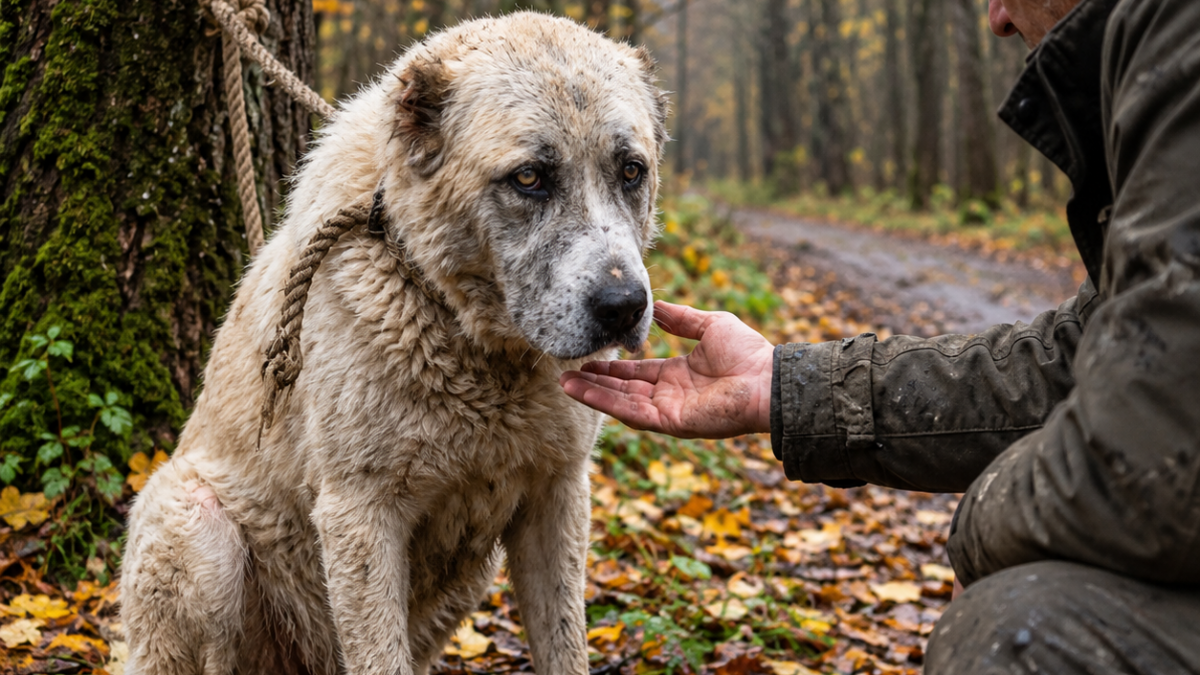
PART 2
The animal-control truck arrived thirty-five minutes later.
By then, darkness had completely swallowed the forest.
The Alabai was still beside the tree.
Free.
But unwilling to leave.
Officer Dana Brooks stepped out of the truck carrying a flashlight and a thick jacket.
She was a small woman, maybe five foot three, which made the contrast between her and the enormous dog almost funny.
Almost.
“That’s her?”
I nodded.
“She won’t move.”
Dana looked at the severed rope.
“You cut it?”
“Yes.”
“Good.”
Then she noticed the paper in my hand.
“What’s that?”
I gave her the receipt.
She read the note.
Her expression changed.
“Where did you find this?”
“Under the leaves.”
“You touch anything else around the tree?”
“Only the bowl, rope, and dog-food bag.”
Dana nodded.
“That’s fine. You weren’t processing a crime scene. You were helping a dog.”
She photographed everything anyway.
Tree.
Rope.
Bowl.
Bag.
Receipt.
Tire impressions in the muddy shoulder.
Then she approached the dog.
“Hey, sweetheart.”
The Alabai’s head turned.
Her ears lifted slightly.
Dana stopped.
“You’re right. She’s completely blind or close to it.”
“I think she’s waiting for whoever left her.”
Dana didn’t answer immediately.
A vehicle passed on the road.
The dog’s entire body changed again.
She stood.
Turned toward the engine.
Tail moving weakly.
When the sound disappeared, she sat.
Dana exhaled.
“Yeah.”
That one word said enough.
We tried to move her.
She refused.
Not aggressively.
She simply planted herself.
Dana clipped a wide slip lead around her neck and applied gentle pressure.
The dog leaned backward.
I tapped the metal water bowl.
Her head turned toward the sound.
“Come on.”
One step.
Then she stopped.
I tapped again.
Another step.
Dana looked at me.
“Keep talking.”
So I did.
“That’s it. You’re okay. One more.”
The old dog followed my voice more than the leash.
Five steps.
Ten.
Halfway to the truck, she suddenly turned back toward the tree.
I felt the lead tighten.
She wanted to return.
“She’s going back.”
“I know.”
We stopped.
She stood facing the tree.
Or rather, facing where she believed it was.
Waiting.
Dana said quietly, “Sometimes they stay where they were left because that’s the last place they knew their person was.”
I hated that sentence.
“We can’t leave her.”
“We aren’t.”
I walked back toward her.
I put my hand close to her nose.
She smelled me.
Then I moved my hand toward the truck.
“Come on, girl.”
She followed.
At the truck, we encountered the next problem.
She was too weak to jump.
And far too large for either of us to lift safely by ourselves.
Dana unfolded a ramp.
The metal surface made a hollow sound.
The dog immediately backed away.
“Okay,” Dana said. “Not that.”
We laid my old wool blanket over the ramp.
I tapped it with my palm.
The dog sniffed.
One paw.
Then another.
Halfway up, her rear legs trembled.
Dana supported her hips.
I kept talking.
“You’re doing fine.”
She finally reached the compartment.
The moment she was inside, she turned around.
Her nose searched the air.
I climbed onto the edge.
“I’m here.”
She touched my sleeve.
Then lay down.
Dana looked at me.
“You coming to the emergency clinic?”
I hadn’t planned to.
I had been driving home.
Dinner was still in my refrigerator.
My phone battery was almost gone.
I had work in the morning.
“Yes.”
Dana smiled.
“I figured.”
The emergency veterinarian was Dr. Maya Patel.
She examined the Alabai slowly.
The dog tolerated it better than I expected.
Whenever someone touched her without warning, she startled.
But when Dr. Patel let her smell her hand first, the dog relaxed.
“How old?” I asked.
“Hard to know yet.”
She checked the teeth.
“Probably thirteen. Maybe fourteen.”
My heart sank.
Dr. Patel looked at the eyes.
“Severe cataracts. There may also be retinal degeneration.”
“Can she see anything?”
“Possibly changes in light. Maybe shadows. But functionally, I’d consider her blind.”
“Can it be fixed?”
“Not necessarily. And before we talk about surgery, we need to know what the retina is doing and whether she’s healthy enough for any procedure.”
I nodded.
“What else?”
“She’s dehydrated. Underweight for her frame. Significant arthritis in both hips. Her coat needs care, but I don’t see any immediate medical emergency that can’t be stabilized.”
“So she’s not…”
I stopped.
Dr. Patel knew what I meant.
“No.”
She smiled faintly.
“Old doesn’t mean finished.”
I looked at the dog.
She had lowered her head onto the blanket.
“Good.”
Dr. Patel ran a microchip scanner over her shoulders.
Beep.
Dana straightened.
“There we go.”
A number appeared.
The receptionist searched the database.
I watched her face.
“Registered.”
Dana stepped closer.
“Dog’s name?”
The receptionist looked at the screen.
“Zoya.”
I looked down.
“Zoya?”
The dog’s ears moved.
I said it again.
“Zoya.”
Her head lifted.
Dana and Dr. Patel both looked at me.
No question.
That was her name.
“Owner?” Dana asked.
The receptionist read silently for a second.
Then turned the monitor slightly away from me.
Privacy.
I understood.
“Registered to Richard Halpern,” she told Dana. “Local address.”
I felt something inside me harden.
“There.”
Dana gave me a look.
“We have a name. We do not yet have an explanation.”
“She was tied to a tree.”
“Yes.”
“With his dog registered to him.”
“Yes.”
“The receipt says she saw a vet three days ago.”
“Yes.”
Dana folded her arms.
“Which means we investigate carefully.”
I knew she was right.
I didn’t enjoy it.
Dr. Patel looked at the receipt.
“Brightwood Veterinary Center.”
“You know them?” Dana asked.
“Very well.”
“Can you call?”
“Not about a client’s records without proper authorization.”
Dana nodded.
“I can.”
She stepped into the hallway.
I stayed beside Zoya.
The IV fluids had started.
She hated the catheter at first.
Then she became too tired to care.
I sat on the floor.
“Zoya.”
Her ear moved.
“You’ve had a terrible week.”
She shifted.
Her head rested against my shoe.
I froze.
Then slowly put my hand on the floor beside her.
Not touching.
Just there.
She found it.
Her nose touched my fingers.
Then she lowered her chin across my wrist.
I sat like that for almost forty minutes.
At some point, Dana returned.
She stopped in the doorway.
“Well.”
“What?”
“She likes you.”
“She doesn’t know me.”
“Maybe that’s why.”
Dana sat in the chair.
“Brightwood confirmed the receipt number is theirs.”
I looked up.
“And?”
“They’re preserving the file and security video.”
“Security video?”
“Lobby and parking lot.”
My pulse increased.
“Was Richard there?”
“They haven’t told me yet.”
“Why not?”
“Because they’re sending it directly to us.”
I sighed.
“You really enjoy making me wait.”
“No. I enjoy cases that don’t collapse because someone got impatient.”
Fair.
Dana continued.
“I called the number on the microchip.”
My stomach tightened.
“What did he say?”
“He didn’t answer.”
“Voicemail?”
“Yes.”
“What did you leave?”
“That county animal control needs to speak with him regarding a dog registered in his name.”
“You didn’t say she was found?”
“No.”
I looked at Zoya.
“What happens if he calls and says she ran away?”
“We compare the story to the evidence.”
“And if he says someone stole her?”
“Same.”
“And if he says he tied her there?”
Dana gave me a tired smile.
“Then my evening gets easier.”
Richard Halpern called at 9:42 the next morning.
I wasn’t there.
Dana told me later.
His first statement was that Zoya had been staying with a friend.
That immediately created a problem.
Because Dana hadn’t told him where she had been found.
She asked for the friend’s name.
Richard hesitated.
Then said a man named Paul had taken Zoya temporarily because Richard was moving.
Last name?
Richard didn’t know.
Phone number?
He’d lost it.
Address?
Somewhere outside town.
Dana asked when he last personally saw Zoya.
“About a week ago.”
That was his first version.
Then Dana asked if he had taken Zoya to Brightwood Veterinary Center three days earlier.
Silence.
Long silence.
He changed the story.
Yes, he had seen her.
He had picked her up from Paul to take her to the appointment.
Then returned her.
Dana asked for Paul’s information again.
Richard said he would find it.
He never did.
By noon, Brightwood’s records arrived.
I learned only what Dana was permitted to share.
Richard Halpern had personally brought Zoya to the clinic.
The veterinarian had examined her.
The notes described advanced vision loss, chronic arthritis, and weight decline.
But also something important:
Zoya still had good appetite, normal interest in people, stable heart and lungs, and acceptable quality of life with support.
The veterinarian had discussed several options.
Pain management.
Bloodwork.
Eye specialist referral.
Senior-dog accommodations.
A follow-up appointment.
Richard declined the eye referral.
Declined bloodwork.
Accepted only the basic exam.
He told the veterinarian he was “considering options.”
Three days later, I found Zoya tied to a tree.
I stared at Dana.
“He knew she could keep living.”
“Based on the note, yes.”
“He knew she wasn’t dying.”
“Correct.”
“Then he took her to the forest.”
“We haven’t proven who took her yet.”
I almost exploded.
Dana raised a hand.
“Listen.”
I stopped.
“The clinic has parking-lot footage.”
“And?”
“Richard’s pickup is clearly visible.”
“At the appointment.”
“Yes.”
“Not the forest.”
“No.”
“Then what are we missing?”
“County forestry maintains two cameras on that road because people have used the area for illegal dumping.”
I stared at her.
“You’re kidding.”
“No.”
“Do they cover the tree?”
“Not directly.”
My hope dropped.
“But one covers the road.”
I sat forward.
Dana continued.
“We’ve requested the footage.”
That afternoon, I visited Zoya at the clinic.
She was standing.
Barely.
But standing.
Dr. Patel had put thick nonslip mats beneath her.
“She’s eaten,” she said.
“How much?”
“Enough.”
“Drank?”
“Yes.”
“Pain?”
“Better.”
Zoya heard my voice.
Her head turned.
Then her tail moved.
Two slow sweeps.
I walked closer.
“Hi, girl.”
She smelled my hand.
Then pushed her huge head against my thigh.
Dr. Patel smiled.
“You may have a problem.”
“What problem?”
“She knows you.”
I crouched.
Zoya leaned into me.
“What’s going to happen to her?”
“For now, animal control has a protective hold.”
“And after?”
“That depends on ownership and the case.”
I hated hearing ownership.
As if someone who tied an elderly blind dog to a tree could still possess a claim over her.
But law is not emotion.
I knew that.
The next call came at 7:15 the following morning.
Dana.
“We have the road footage.”
I sat up in bed.
“And?”
“Dark blue Ford pickup enters the forest road at 6:14 p.m. the evening before you found Zoya.”
“Richard’s?”
“Registration matches.”
My heart started pounding.
“Leaves?”
“6:28.”
“Dog?”
“The camera angle can’t see the truck bed clearly going in.”
“Coming out?”
“Empty passenger seat. No animal visible in the bed, though visibility isn’t perfect.”
“Fourteen minutes.”
“Yes.”
“Can you tell where he stopped?”
“No.”
“But the road dead-ends eventually.”
“Yes.”
“How many exits?”
“None between the camera and where you found her.”
I got out of bed.
“So it’s him.”
Dana stayed careful.
“It is strong evidence his vehicle entered the road.”
“Dana.”
“And left fourteen minutes later.”
“Dana.”
She sighed.
“Yes. It is very bad for his story.”
Richard gave his second formal statement that afternoon.
Paul disappeared from the story entirely.
Now Richard said he’d taken Zoya for “one last walk” in the woods because she had always loved that road.
According to him, his truck developed an electrical problem.
He tied Zoya to the tree so she wouldn’t wander into traffic while he drove to get help.
I asked Dana the obvious question.
“How did he drive away in a truck with an electrical problem?”
She smiled without humor.
“Exactly.”
Richard revised that too.
Not a complete breakdown.
Warning light.
He wanted to get phone service.
Why leave the dog?
She was too difficult to load again.
Why leave food and water?
Because he intended to return.
Why hadn’t he returned?
He said he became ill that evening.
Why hadn’t he called anyone?
No answer.
Why tear the identifying portion off the veterinary receipt?
He denied doing it.
Why had the receipt been beside the dog?
He didn’t know.
Why had the rope been knotted securely around the tree?
For safety.
Why had Zoya remained there overnight and into the next evening?
No answer.
The story collapsed slowly.
Not with a confession.
With details.
Every new explanation created another question.
Then forestry provided a second piece of footage.
Richard’s truck passed the camera again the following morning.
Not toward Zoya.
On the main road.
Driving to work.
He had been close enough to return.
He didn’t.
Dana told me, “We’re moving forward with an abandonment case.”
I should have felt victorious.
Instead, I looked at Zoya lying in the clinic and felt tired.
Because no charge changed the thing she was still doing.
Waiting.
Every deep engine sound from the parking lot made her raise her head.
Every male voice in the hallway made her ears turn.
Once, a pickup stopped directly outside.
Zoya struggled to stand.
I helped steady her.
She faced the door.
Tail moving.
Then a stranger walked in.
Zoya’s tail slowed.
She lay back down.
I sat beside her.
“He’s not coming, is he?”
Dr. Patel was behind me.
“No.”
I rubbed Zoya’s neck.
“Maybe that’s better.”
Dr. Patel didn’t answer.
A few days later, animal control asked if I would consider fostering her.
I laughed.
Not because it was funny.
Because I lived in a modest one-story house with a narrow hallway, two rugs, and exactly zero experience caring for a blind hundred-pound senior dog.
“I found her.”
“That wasn’t the question,” Dana said.
“I work full-time.”
“We can arrange support.”
“She can barely walk.”
“She walks better now.”
“I don’t know anything about Alabais.”
“You know her.”
That was unfair.
Effective.
But unfair.
“I need to think.”
Dana looked toward the kennel.
“She’s medically cleared tomorrow.”
“What if I say no?”
“We place her with an approved senior foster.”
“Where?”
“Possibly two counties away.”
I looked at Zoya.
She was asleep.
For the first time since I found her, she wasn’t facing a door.
“What do I need?”
Dana smiled.
“You already decided.”
“I asked a question.”
“You need rugs, baby gates near hazards, a consistent layout, raised bowls, medications, a harness, and patience.”
I went shopping.
Zoya came home on a Thursday.
Getting her into my house took forty-seven minutes.
She stood at the threshold, smelling unfamiliar air.
I didn’t pull.
Didn’t push.
I tapped the floor.
“Step.”
One paw inside.
Pause.
Another.
The hallway runner gave her traction.
She moved three feet.
Stopped.
Her nose worked constantly.
I had learned from Dr. Patel that blind dogs often build a mental map through smell, texture, sound, and memory.
So I changed nothing after she arrived.
The water bowl stayed beside the kitchen entrance.
Her bed stayed against the living-room wall.
A textured mat marked the back door.
A second marked the front.
I tied a tiny bell to the back-door handle—not to lead her constantly, but to give her one more consistent sound.
For the first two nights, Zoya slept near the front door.
Not on the orthopedic bed.
On the rug.
Facing outside.
At 2:30 the first morning, a diesel truck passed.
Zoya stood.
She went to the door.
Waited.
I sat on the floor behind her.
She didn’t acknowledge me.
Five minutes.
Ten.
Eventually she lay down again.
The second night was the same.
Third night too.
By the fourth, I started recognizing the pattern.
She wasn’t waiting for a random person.
She knew an engine.
Richard’s pickup was diesel.
I didn’t know whether she could distinguish one diesel engine from another.
But each time she heard one, hope returned to her body.
That was difficult to watch.
On the sixth night, a truck slowed near my mailbox.
Zoya stood.
Tail moving.
The truck continued.
She remained at the door.
I sat beside her.
“Zoya.”
Her head turned toward me.
“He’s not coming.”
I knew she couldn’t understand the sentence.
So I did the only useful thing.
I stayed.
After a while, she lowered her body until her shoulder rested against mine.
The following morning, she slept past the first truck.
That felt like progress.
Her recovery was not dramatic.
There was no montage where she transformed into a young dog.
She was old.
Her hips remained stiff.
Her eyes remained blind.
But comfort changed her.
Pain medication helped her stand.
Regular meals put weight back over her ribs.
Grooming restored the pale cream color beneath the mud.
Her coat was magnificent once clean.
Thick.
Dense.
Almost silver around her face.
She learned my house by bumping into things.
The coffee table offended her personally.
After the third collision, I moved it.
That was the only major furniture change I made.
She memorized the distance from her bed to the water.
From water to back door.
From back door to the small patch of grass she preferred.
I taught her words.
“Step.”
“Stop.”
“Left.”
“Right.”
“Easy.”
“Door.”
She learned faster than I expected.
The first time she found the backyard on her own, I stood behind her crying like an idiot.
She walked onto the grass.
Stopped.
Lifted her face toward the wind.
Then slowly lay down.
She stayed there for forty minutes.
I sat on the steps.
No leash tension.
No rope.
No tree.
Just an old dog in autumn sunlight.
The investigation continued.
I tried not to let it enter the house.
Then a woman named Natalie called the shelter.
Dana asked permission before giving her my number.
“She says she knows Zoya.”
“Who is she?”
“Richard’s daughter.”
That surprised me.
“Does Richard know?”
“Probably not.”
“Why is she calling?”
“She saw a local article about an abandoned blind Alabai.”
The county had released limited information.
No owner name.
No exact location.
Just a request for witnesses.
Natalie recognized Zoya from the photograph.
She called me that evening.
Her first words were:
“Is she alive?”
“Yes.”
Natalie started crying.
I waited.
“I thought she was gone.”
“What do you mean?”
“My father told me she passed away.”
I closed my eyes.
“When?”
“Almost two months ago.”
Zoya had been with Richard three days before I found her.
“Did he say how?”
“He said she stopped eating.”
I looked across my living room.
Zoya was currently eating from a slow feeder with the concentration of an animal who considered dinner a sacred responsibility.
“She eats.”
Natalie laughed through tears.
“She always ate.”
“How long did you know her?”
“Since I was fourteen.”
“How old are you?”
“Twenty-seven.”
Thirteen years.
Zoya’s entire life.
“She was yours?”
“Dad’s technically. But she grew up with us.”
Natalie explained.
Richard had owned a five-acre property outside town for years.
Zoya lived there.
Not chained.
Not isolated.
She had free access to a fenced yard, a large heated shed, and the house.
She guarded the property, but she was also family.
“She slept outside my bedroom when I was in high school,” Natalie said.
I looked at Zoya.
“Did she always have vision problems?”
“No. It started maybe two years ago.”
“What happened?”
“Dad said the vet thought it was cataracts.”
“Why wasn’t it treated?”
Silence.
“I don’t know.”
Natalie had moved to Seattle for work.
She visited twice a year.
The last time she saw Zoya was nine months earlier.
“She could still see shapes then.”
“Did you know your father was moving?”
“Yes.”
“Where?”
“An apartment in town.”
My stomach tightened.
“Does it allow large dogs?”
Natalie became quiet.
“I asked him that.”
“And?”
“He said he had arranged something.”
“What?”
“He wouldn’t tell me.”
There it was.
A motive.
Not proof.
But motive.
Richard had sold the rural property.
His new apartment did not allow a giant livestock-guardian breed.
Zoya was old.
Blind.
Arthritic.
Hard to place.
Natalie asked, “Can I see her?”
I hesitated.
Not because I blamed Natalie.
Because Zoya was still waiting for people from her past.
A familiar voice might reopen everything.
Then I realized that was selfish.
Zoya had thirteen years with Natalie.
I didn’t own those memories.
“We’ll do it slowly.”
Natalie flew in three weeks later.
We met in my backyard.
I kept Zoya on a loose harness.
Natalie stood outside the gate at first.
She didn’t call.
Her hands were shaking.
I opened the gate.
She entered.
Zoya smelled the air.
Her head lifted.
Natalie whispered one word.
“Zozo.”
Zoya froze.
I had never heard the nickname.
Natalie said it again.
“Zozo.”
Zoya moved.
Fast.
Not fast for a young dog.
Fast for Zoya.
She pulled toward the voice.
Natalie dropped to her knees.
Zoya found her.
The sound that came from the dog was unlike anything I had heard before.
Low.
Soft.
Almost a cry.
She pushed her enormous head against Natalie’s chest.
Natalie wrapped both arms around her.
“I’m sorry.”
Zoya’s tail hit the grass.
Again.
Again.
I stepped away.
Some reunions do not belong to the rescuer.
They belong to the life that existed before.
Natalie buried her face in Zoya’s fur.
“I thought you were gone.”
Zoya licked her chin.
For the next hour, Natalie told me stories.
Zoya stealing hamburger buns from a cookout.
Zoya refusing to come inside during snowstorms.
Zoya once standing between teenage Natalie and a man who walked too close to their fence.
Zoya sleeping beside Richard’s chair every evening.
That last one mattered.
“She loved him,” Natalie said.
“I know.”
“You sound surprised.”
“I don’t know what I sound like.”
Natalie looked at Zoya.
“Dad wasn’t always…”
She stopped.
“A person who would do this?”
“Yes.”
I didn’t answer.
“He loved her too.”
That was harder.
People like clean stories.
Good people.
Bad people.
Loyal dog.
Cruel owner.
Reality is rarely that tidy.
Richard may have loved Zoya for twelve years.
He still tied her to a tree in the thirteenth.
Those truths could exist together.
One did not erase the other.
Natalie eventually asked the question I had been expecting.
“Can I take her?”
My stomach tightened.
Then she added quickly, “I don’t mean today.”
I relaxed.
“My apartment allows dogs, but I’m across the country. Long flight. Stairs. I don’t know if that would be fair.”
I looked at Zoya.
She was lying with her head across Natalie’s lap.
“What do you want?”
Natalie cried again.
“I want the last thing I do for her to be the right thing.”
That answer stayed with me.
We decided Zoya would remain with me through the legal case.
After that, we would reassess.
Natalie visited every two months.
Zoya recognized her every time.
But something changed after the first visit.
When Natalie left, Zoya walked to the gate.
Listened.
Then returned to me.
She did not wait there for hours.
She had begun learning something crucial.
People could leave without abandoning her.
Richard’s attorney filed a petition for Zoya’s return.
That surprised everyone.
Even Natalie.
Especially Natalie.
“Why?” she asked.
Dana had an answer.
“Because if he admits he intentionally abandoned her, the criminal case becomes simple.”
“So he wants the dog back to prove he didn’t abandon her?”
“That appears to be part of the argument.”
I felt sick.
Zoya was becoming a piece of evidence in a story about herself.
Richard claimed he still considered her his dog.
He said the forest incident had been misunderstood.
He intended to return.
The dog had been recovered before he could.
He wanted to resume responsibility.
I stared at Dana.
“You cannot be serious.”
“I am telling you what his attorney filed.”
“He told his daughter she passed away.”
“We have that statement.”
“He lied about Paul.”
“We have that too.”
“He lied about the truck.”
“Yes.”
“And there’s video.”
“Yes.”
“So why do we need a hearing?”
“Because legal process is not punishment. It’s how we make sure the outcome survives challenge.”
I hated that she was always right in the most irritating way possible.
The hearing was scheduled for December.
By then, Zoya had been with me almost two months.
Winter arrived.
I discovered she loved snow.
Natalie had warned me.
I didn’t believe her.
The first snowfall covered my yard with three inches.
I opened the back door.
Zoya stepped out.
Stopped.
Her nose worked.
Then her entire body changed.
She walked farther.
Sniffed.
Pushed her muzzle into the snow.
Pulled it back covered in white.
Then did it again.
I laughed.
“You are fourteen.”
She ignored me.
For ten minutes, she wandered in slow circles.
Tail up.
At one point she attempted something close to a trot.
Her back legs protested.
She slowed.
But the joy remained.
I took a video for Natalie.
Her reply came immediately.
SHE STILL DOES IT.
Then another message.
Dad used to complain she wouldn’t come inside when it snowed.
That line hurt.
Because it reminded me again:
There had been good years.
A whole history I couldn’t see.
Zoya’s abandonment was not the only thing Richard had ever done.
It was simply the thing he had to answer for now.
The hearing took place in a small county courtroom.
I sat with Dana.
Natalie sat behind us.
Richard sat across the room.
I recognized him from the clinic footage Dana had shown me as part of the case preparation.
He looked older in person.
Sixty, maybe.
Gray hair.
Heavy shoulders.
Expensive winter coat.
Nothing about him looked monstrous.
Then again, monsters are mostly a storytelling convenience.
Richard looked like a tired man who had made a terrible decision and spent weeks constructing explanations around it.
His attorney argued first.
Richard had owned Zoya since she was a puppy.
He had provided years of care.
He had taken her to the veterinarian when her condition worsened.
He had not intended to abandon her.
The forest stop, according to the attorney, had been temporary.
The food and water were proof of concern.
I nearly laughed at that.
Dana touched my arm.
I stayed quiet.
Then the county presented evidence.
The veterinary appointment.
The doctor’s notes.
Richard had been told Zoya was old and blind but stable.
Supportive care was available.
The doctor’s written recommendation included arthritis medication, blood testing, and eye consultation.
Richard declined most of it.
Then the forest-camera video.
His truck entering.
Fourteen minutes.
His truck leaving.
No return.
Then his phone-location records.
That was new to me.
His attorney had fought them.
The county obtained a limited warrant for the relevant time period.
After leaving the forest road, Richard drove directly to his new apartment.
He stayed there all evening.
The next morning, he drove to a hardware store.
Then breakfast.
Then work.
He never returned to the forest.
Never called animal control.
Never called the sheriff.
Never contacted a rescue.
Never reported Zoya missing.
Never asked whether anyone had found her.
The judge asked Richard directly, “When did you intend to return?”
Richard looked at his attorney.
“Later that night.”
“You went home.”
“I wasn’t feeling well.”
“Why not call someone?”
“I thought she’d be okay.”
The courtroom became silent.
The judge looked at him.
“A blind, elderly dog tied beside a forest road?”
Richard shifted.
“I left food.”
I closed my eyes.
There it was.
That was the sentence.
The sentence that seemed to reduce everything to a calculation.
Food left.
Therefore care.
As if a bag of kibble could replace a person.
The county attorney continued.
“Mr. Halpern, when your daughter asked what had happened to Zoya, what did you tell her?”
Richard’s face changed.
His attorney objected.
The judge allowed the question because it addressed intent and his later conduct.
Richard looked toward Natalie for the first time.
She sat completely still.
He said, “I told her Zoya was gone.”
“Gone?”
“Yes.”
“Did you tell her Zoya had passed away?”
Richard hesitated.
“Yes.”
“When?”
“Before the forest incident.”
“Why?”
He looked down.
“I didn’t want her involved.”
“Why not?”
No answer.
“Because you had already decided you could no longer keep the dog?”
Richard’s attorney objected.
The question was rephrased.
“Had you decided before the veterinary appointment that Zoya could not move with you to the new apartment?”
Richard said quietly, “Yes.”
The room changed.
Not dramatically.
But the story had finally reached the decision beneath all the other decisions.
The county attorney asked, “What arrangements had you made?”
“I called someone.”
“Who?”
“I don’t remember.”
“A rescue?”
“Maybe.”
“Which?”
“I don’t know.”
“Did you contact Oak County Animal Shelter?”
“No.”
“Pine Hill Senior Dog Rescue?”
“No.”
“Central Asian Shepherd Rescue?”
“No.”
“Your veterinarian offered a resource sheet. Did you call the organizations on it?”
Richard looked at the table.
“No.”
“Why?”
“I was overwhelmed.”
That answer was probably true.
It also wasn’t enough.
Then Natalie testified.
I had worried she might break.
She didn’t.
She described growing up with Zoya.
Her father’s care for the dog during good years.
The vision decline.
The move.
The lie.
She did not exaggerate.
That made it stronger.
“Do you believe your father hated Zoya?” Richard’s attorney asked.
Natalie looked surprised.
“No.”
“Do you believe he had loved her?”
“Yes.”
“Then isn’t it possible he panicked?”
Natalie swallowed.
“Yes.”
The attorney seemed satisfied.
Then Natalie continued.
“But panic explains why someone makes a bad decision. It doesn’t turn the bad decision into a good one.”
The judge looked at her.
Richard did too.
Natalie’s eyes filled.
“My father had options.”
Her voice shook.
“He didn’t call me because he knew I would stop him.”
That sentence landed harder than anything else.
Richard looked away.
The hearing lasted another hour.
The judge ruled that Richard’s ownership claim would not be restored while the abandonment proceeding continued.
Zoya would remain under county custody in my foster care.
It wasn’t final.
But she wasn’t going back.
Outside the courtroom, Natalie hugged me.
Richard came out several minutes later.
He stopped when he saw us.
Dana moved closer.
Not threatening.
Just present.
Richard looked at Natalie.
“I didn’t know what else to do.”
She stared at him.
“You could’ve called me.”
“I didn’t want to ruin your life with an old dog.”
“She was part of my life.”
“You live three thousand miles away.”
“I would’ve figured it out.”
Richard rubbed his face.
“You say that now.”
“No.”
Natalie’s voice became quiet.
“I said it then.”
He had no answer.
Then something strange happened.
He looked at me.
“How is she?”
I wanted to say something cruel.
I had imagined this moment.
A perfect sentence.
Something that would make him feel everything Zoya had felt.
Instead, I said the truth.
“She still listens for trucks.”
His face changed.
I regretted it immediately.
Not because it was false.
Because it hurt him.
For a moment, I saw that.
Then I remembered Zoya at the tree.
Waiting.
Richard closed his eyes.
“Does she…”
He stopped.
“What?”
“Does she still like snow?”
The question caught me off guard.
“Yes.”
A small broken smile appeared.
“She always did.”
Natalie began crying.
Richard looked at his daughter.
Then walked away.
I stood there feeling none of the satisfaction I expected.
Dana said, “You okay?”
“I don’t know.”
“That’s normal.”
“I wanted him to be easier to hate.”
Dana sighed.
“They rarely are.”
The criminal case did not go to a dramatic trial.
Richard’s attorney negotiated.
The evidence was too strong.
Richard eventually entered a guilty plea to an animal-abandonment offense under the applicable county law.
The judge ordered fines, restitution for Zoya’s emergency veterinary treatment, probation, community service, and a temporary prohibition on owning or being solely responsible for animals.
People online argued when the sentence became public.
Too harsh.
Too light.
I stopped reading comments.
None of them had sat with Zoya at two in the morning while she listened for a diesel engine.
The sentence wasn’t mine to design.
What mattered to me was that Richard couldn’t legally reclaim her.
The county transferred permanent ownership.
I received the call at work.
Dana said, “She’s free.”
I laughed.
“She was already free.”
“You know what I mean.”
I did.
The adoption paperwork arrived the next day.
I signed it at my kitchen table.
Zoya was asleep ten feet away.
I said, “Apparently you’re mine now.”
Her ear moved.
“Very emotional reaction.”
Tail.
“That’s better.”
Natalie joined by video call.
When I signed the final page, she cried.
“I should be sad.”
“Why?”
“Because she’s officially someone else’s dog.”
I looked at Zoya.
“I don’t think dogs understand paperwork.”
“No.”
“She still has you.”
Natalie nodded.
“Can I keep visiting?”
“You don’t need permission anymore.”
That became our arrangement.
Natalie was family.
Not former family.
Not previous owner’s daughter.
Family.
She visited at Christmas.
Zoya recognized her in seconds.
For the first time, when Natalie left, Zoya did not walk to the gate.
She stayed beside me on the porch.
Natalie noticed.
It hurt her.
I could see that.
Then she smiled.
“Good.”
“What?”
“She knows this is home.”
That winter was the happiest I ever saw Zoya.
She developed routines.
Breakfast at six thirty.
Medication hidden in chicken.
Ten-minute walk on the flat path behind my house.
Nap.
Backyard.
Dinner.
Then what I called evening patrol.
Even blind, arthritic, and elderly, Zoya insisted on walking the perimeter of my fenced yard.
Slowly.
Nose working.
Listening.
She had spent her life guarding property.
Some jobs become identity.
I never stopped her.
I simply walked beside her.
“Fence.”
She turned.
“Step.”
She lifted her paw.
“Left.”
She adjusted.
At the back corner, she always stopped.
Wind moved through the trees.
She lifted her face.
I wondered what information lived in that air for her.
Neighbors.
Deer.
Rain.
Wood smoke.
Cars.
The world wasn’t dark to Zoya.
It was simply built from different things.
By spring, she no longer reacted to every truck.
Some still caught her attention.
But the desperate waiting faded.
One afternoon, a diesel pickup stopped in front of my house.
I saw Zoya’s ears rise.
Her body became still.
My stomach tightened.
The driver stepped out.
A delivery man.
Zoya listened.
Then lay back down.
I sat beside her.
“You figured it out.”
She rested her head across my foot.
That moment meant more to me than the court decision.
She was no longer expecting Richard to return.
That did not mean she had forgotten him.
I never wanted that.
Her first thirteen years mattered.
Good and bad.
Memory was not betrayal.
But waiting was over.
A few months later, Natalie sent me a box.
Inside were photographs.
Zoya as a puppy.
Enormous paws.
Floppy ears.
Zoya at three, standing in snow almost to her chest.
Zoya beside teenage Natalie.
Zoya lying beneath Richard’s chair.
That photograph stopped me.
Richard looked younger.
Relaxed.
One hand rested on Zoya’s head.
She looked completely safe.
On the back, Natalie had written:
Christmas, 2015.
I sat at the table for a long time.
I could have thrown it away.
I didn’t.
I framed it.
When Natalie visited next, she saw it.
“You put Dad’s picture up.”
“It’s Zoya’s picture.”
She looked at me.
Then nodded.
“Yeah.”
I wasn’t going to erase thirteen years because of one terrible ending.
Zoya deserved her whole life.
Not the version easiest for me to judge.
Natalie’s relationship with Richard became complicated.
She didn’t cut him off completely.
She didn’t pretend nothing happened either.
They went to counseling.
I knew only what she chose to tell me.
“He keeps saying he panicked,” she said once.
“Maybe he did.”
“That doesn’t make me less angry.”
“It shouldn’t.”
“He asked if he could see Zoya.”
I looked at her.
“What did you say?”
“No.”
I was relieved.
Then ashamed of the relief.
Natalie continued.
“Not yet.”
“Why not?”
“Because I don’t know if it’s for her or for him.”
That was a good question.
Months passed.
Richard completed his court requirements.
He paid restitution.
He volunteered with a county roadside cleanup program.
He wasn’t permitted to work directly with animals as part of his sentence.
Then he wrote me a letter.
He sent it through Dana.
She asked whether I wanted it.
I almost said no.
Then I read it.
It was short.
He didn’t ask for forgiveness.
That helped.
He wrote that he had spent months trying to explain his decision to himself.
Money.
Move.
Rules.
Zoya’s size.
Blindness.
His own health.
He said every explanation sounded smaller once written down.
Then:
“I told myself leaving food and water meant I wasn’t abandoning her. I know now that I was trying to make myself feel less guilty before I drove away.”
I stopped.
That was the first honest sentence I had heard from him.
He continued.
“She trusted me because I had given her reasons to trust me for almost thirteen years. That made what I did worse, not better.”
I read that line twice.
At the end he wrote:
“I don’t expect to see her. Please tell Natalie I understand why she said no. If Zoya still likes the old red blanket, Natalie has it.”
I called Natalie.
“Red blanket?”
She laughed through tears.
“She still has it?”
“Apparently.”
Zoya’s old blanket arrived a week later.
Red wool.
Faded.
One corner chewed.
I placed it on the living-room floor.
Zoya was asleep.
Then her nose moved.
She stood.
Walked toward it.
Sniffed.
Her entire body went still.
For a moment, I wondered if I had made a mistake.
Then she turned in a slow circle.
Lay down on the blanket.
And sighed.
Not cried.
Not waited.
Sighed.
Like something familiar had come home without asking her to go backward.
She slept on that blanket for the rest of her life.
By fifteen, Zoya’s arthritis had progressed.
We added another medication.
Shortened walks.
Raised her bowls higher.
I installed a ramp even though my back step was only six inches.
She accepted the ramp immediately, which was unusual because Zoya believed most household improvements were suspicious.
Her hearing remained excellent.
That mattered because it gave her freedom.
She knew my footsteps.
Natalie’s voice.
The microwave.
The treat cabinet.
The refrigerator door.
My car.
One day, I came home early.
Before I reached the porch, I heard a deep bark.
Zoya almost never barked.
I opened the door.
She stood in the hallway.
Tail moving.
“You knew it was me?”
Another bark.
I laughed.
“Very intimidating.”
She walked toward me.
Her head bumped my hip.
I wrapped my arms around her neck.
The dog I first met tied to a tree had become stubborn, demanding, opinionated, and occasionally rude.
I loved every bit of it.
She hated baths.
Loved snow.
Despised bananas.
Loved cheese.
Refused to sleep on the expensive orthopedic bed if the red blanket was somewhere else.
She would wake me at five forty-five by standing beside my bedroom door and breathing loudly.
If I ignored her, she sneezed.
If I continued ignoring her, she barked once.
No one who saw that version of Zoya would have called her helpless.
Blind?
Yes.
Old?
Definitely.
Helpless?
Never.
The story about her spread through the local rescue community.
I resisted making her a symbol.
Then Dr. Patel asked whether I would help with a workshop for people considering blind senior dogs.
“I don’t know anything,” I told her.
“You’ve been living with one for a year.”
“That mostly taught me where not to put furniture.”
“Exactly.”
We held the first workshop at Brightwood.
Seven people came.
One couple was considering a blind eleven-year-old mastiff at a shelter.
They were terrified.
“What if he can’t learn our house?”
“He can.”
“What if he bumps into things?”
“He will.”
“What if he gets scared?”
“He might.”
The woman looked discouraged.
I smiled.
“You aren’t trying to create a world where nothing ever goes wrong.”
“What are we trying to do?”
“Create a world where being wrong about one step doesn’t become a disaster.”
I talked about rugs.
Sound cues.
Consistent bowls.
Blocked stairs.
Scent.
Patience.
But mostly, I talked about dignity.
Don’t move the dog every time she hesitates.
Don’t carry an animal who can walk simply because watching slow movement makes you uncomfortable.
Offer help.
Don’t turn help into control.
The couple adopted the mastiff.
Three months later, they sent a video.
He navigated from bedroom to backyard without assistance.
I showed it to Zoya.
She slept through the entire thing.
Fame never interested her.
Natalie began volunteering with a senior-dog rescue in Seattle.
She said Zoya had ruined her.
“I can’t walk past old dogs anymore.”
“That sounds expensive.”
“It is.”
She fostered a twelve-year-old shepherd named Gus.
Then adopted him.
When she told me, I laughed.
“Your apartment allows him?”
“I moved.”
“For a dog?”
She paused.
“Yes.”
“Your father is going to enjoy the irony.”
“He already does.”
Richard and Natalie had begun speaking again.
Slowly.
Carefully.
He apologized without asking her to stop being angry.
That mattered.
She did not trust him with animals.
That also mattered.
Forgiveness, if it came at all, wasn’t the same as pretending consequences had expired.
One summer afternoon, Natalie asked me the question again.
“Would you ever consider letting Dad see Zoya?”
By then, almost two years had passed.
I looked at Zoya.
She was asleep on the red blanket.
“What does the vet think?”
“She says it won’t physically harm her.”
“That’s not what I asked.”
Natalie nodded.
“I know.”
“Why does he want to?”
“To apologize.”
“To Zoya?”
“Yes.”
I almost laughed.
Dogs don’t need verbal apologies.
They need changed behavior.
Then I thought about Richard’s letter.
His court requirements.
His acceptance that he might never see her.
I said, “Neutral place.”
Natalie exhaled.
“Okay.”
“And if Zoya is uncomfortable, it’s over.”
“Yes.”
“Five minutes if that’s what she chooses.”
“Understood.”
We met in a fenced garden behind Brightwood Veterinary Center.
Dr. Patel was nearby.
Dana knew.
Nobody made it a spectacle.
Richard entered alone.
No attorney.
No cameras.
No public redemption story.
He stood twenty feet away.
Zoya was beside me.
For a moment, she did nothing.
Then the wind changed.
Her head lifted.
Nose working.
Richard’s face crumpled.
“Zo.”
Zoya froze.
Natalie covered her mouth.
Richard said it again.
“Zoya.”
The old dog stood.
My chest tightened.
She walked toward him.
Slowly.
One step.
Another.
She reached him.
Sniffed his pants.
His hands stayed at his sides.
Good.
He didn’t grab her.
Didn’t kneel suddenly.
He waited.
Zoya moved closer.
Her nose touched his hand.
Then her tail moved.
Once.
Richard began crying.
I did not expect to feel sorry for him.
I did.
That did not erase anything.
Compassion is not acquittal.
He lowered himself carefully.
Zoya pushed her head against his chest.
Richard whispered, “I’m sorry.”
She licked his chin.
Natalie sobbed quietly.
I looked away.
For five minutes, Zoya leaned against the man who had raised her.
The man who had also left her.
Dogs are not courts.
They do not distribute affection according to sentencing guidelines.
Zoya loved him.
That was obvious.
It did not mean she should return to him.
It did not mean what he did had been acceptable.
It meant thirteen years could not be reduced to one road.
After a while, Zoya stepped away.
She sniffed the air.
Then walked toward me.
Not because I called.
I hadn’t.
She found my leg.
Stopped beside me.
Richard saw.
Something changed in his face.
He nodded.
“She picked.”
I said, “She knows where home is.”
He wiped his eyes.
“Good.”
That was the only time Richard saw her again.
I never regretted allowing it.
Not because he deserved closure.
Because Zoya deserved to experience a familiar voice without being asked to leave with it.
She could remember him.
Love him, in whatever way dogs remember love.
Then come home with me.
That felt like freedom.
Zoya turned sixteen in early winter.
We did not know her exact birthday, so Natalie chose the date from the earliest puppy vaccination record.
December 4.
It snowed.
Of course it did.
Natalie flew in.
Dana came after work.
Dr. Patel stopped by.
No party decorations.
Zoya hated things tied around her neck, so there was no birthday hat.
She got chicken.
Cheese.
A new red blanket that she ignored in favor of the old one.
At sunset, she went into the yard.
Snow covered the ground.
Her back legs were weak now.
I stayed close.
She pushed her nose into the snow.
Snorted.
Natalie laughed.
“Sixteen years and no dignity.”
Zoya did it again.
We all laughed.
I took one photograph.
Zoya in snow.
White face against white ground.
Natalie kneeling beside her.
That became my favorite picture.
The decline started three months later.
Small things.
Longer sleep.
Less interest in walking the fence.
Leaving part of breakfast.
Dr. Patel ran blood work.
Kidney disease.
Moderate.
Then progressive.
We adjusted food.
Medication.
Fluids.
For several months, Zoya did well.
Summer came.
She slept beneath the shade tree in my yard.
Not tied.
Never tied.
Sometimes that image was so obvious I wondered whether I had unconsciously built my life around reversing the first one.
Tree.
Dog.
But now:
No rope.
Water nearby.
Gate open to the house.
Me sitting ten feet away.
Choice.
One afternoon, Zoya stood beneath that tree listening to a truck pass.
Her ears lifted.
Then lowered.
No waiting.
She walked back to the porch.
I cried.
Old habits had finally become only memories.
By fall, getting up became harder.
I used a support harness for her back end.
She hated it.
Every time I slid it beneath her, she made an offended sound.
“I know.”
She huffed.
“You weigh ninety-seven pounds.”
Huff.
“My spine has limits.”
Tail.
“Thank you for your understanding.”
Natalie visited more often.
She knew.
We all did.
Richard sent one message through her.
No request.
Just:
Tell her I still remember the snow.
Natalie asked if I wanted to hear it.
I said yes.
I looked at Zoya.
“Richard remembers the snow.”
Her ear moved.
Maybe coincidence.
Maybe not.
It didn’t matter.
In November, Zoya stopped walking the yard perimeter.
She would go outside.
Stand.
Smell the air.
Then return.
A job held for fourteen years had finally ended.
I told her she was retired.
She accepted retirement easily as long as meals continued.
Then one Wednesday morning, she refused breakfast.
Not delayed.
Refused.
Even chicken.
I called Dr. Patel.
She came that afternoon.
Zoya lay on the red blanket.
Dr. Patel examined her.
Listened to her heart.
Touched her abdomen.
Checked hydration.
Then sat with me in the kitchen.
“We can hospitalize.”
My throat tightened.
“For what?”
“IV fluids. Additional bloodwork. Medication.”
“How much time?”
“I don’t know.”
“Would it make her feel good?”
“Possibly for a while.”
“How long?”
“Days. Maybe weeks if she responds well.”
I looked toward the living room.
Zoya was asleep.
“Would she have to stay there?”
“At least overnight.”
I knew the answer before I asked.
“What would you do?”
Dr. Patel closed her eyes briefly.
“If she were mine?”
“Yes.”
“I would keep her home.”
I nodded.
It still hurt.
Knowing the correct decision does not make the decision kind to the person making it.
It only makes it kind to the animal.
Natalie flew in the next morning.
Zoya recognized her voice.
Tail.
Small.
But there.
Natalie lay beside her.
“Hi, Zozo.”
Zoya pushed her nose toward her.
For two days, she surprised us.
Ate chicken.
Drank.
Walked outside.
Lay in sunlight.
I almost convinced myself we had more time.
Then Saturday morning, she couldn’t stand even with the support harness.
She tried.
Her legs trembled.
I said, “Stop.”
She tried again.
“Zoya.”
Her head turned.
“No.”
I lowered myself beside her.
“You’re allowed.”
Allowed what?
To be tired.
To stop guarding.
To stop waiting.
To stop proving how strong an Alabai could be.
She rested her head in my lap.
I called Dr. Patel.
Dana came.
Natalie stayed.
We moved Zoya’s bed near the open back door.
Cold November air entered.
She loved cold air.
The red blanket lay beneath her.
Her old collar sat on the table.
I had removed it months earlier because her neck had become sensitive.
The severed piece of forest rope was not there.
I had thrown it away after the case ended.
I didn’t need it.
That object had already taken enough space in her story.
Zoya’s final afternoon was quiet.
Natalie read from an old photo album.
Not because Zoya understood the words.
Because voices had become part of how she knew people.
“Here’s the year you stole Dad’s turkey sandwich.”
Zoya’s ear moved.
I laughed.
“I’m on her side.”
“She ate the wrapper.”
“Less defensible.”
Another photograph.
“You in the truck.”
I looked over.
Zoya’s head lifted slightly.
Natalie paused.
“You loved that truck.”
I didn’t flinch anymore at the memory.
Neither did Zoya.
Maybe memory softens when it no longer controls what happens next.
At five, snow began falling.
Only a few flakes.
Natalie saw them through the window.
“You’ve got to be kidding.”
I smiled.
“Of course.”
We opened the door wider.
Cold air entered.
Zoya lifted her nose.
Smelled winter.
Her tail moved once.
Dr. Patel arrived before sunset.
She sat on the floor.
No white coat.
No clinic smell beyond what she naturally carried.
Zoya knew her voice.
“Hi, beautiful.”
Tail again.
Dr. Patel explained every step.
I had heard it before.
I needed to hear it again.
Natalie sat on one side.
I sat on the other.
My hand rested against Zoya’s neck.
The place where the thick rope had once pulled against her collar.
I thought about the first night.
Forest.
Tree.
Empty bowl.
Clouded eyes.
That weak little tail wag when she smelled a stranger.
I had thought the saddest thing about Zoya was that she trusted people even after someone abandoned her.
Years later, I understood it differently.
Trust was not stupidity.
Her willingness to trust again was strength.
Richard had broken a promise.
Zoya had not allowed his failure to become her entire understanding of humanity.
She trusted Dana.
Dr. Patel.
Natalie again.
Me.
Neighbors.
Volunteers.
She learned a new house while blind.
A new yard.
New words.
New routes.
She met the man who left her and still chose to come back home with me.
That wasn’t weakness.
That was freedom.
Dr. Patel gave the calming medication.
Zoya’s body relaxed.
Her breathing became deep.
Natalie whispered, “You don’t have to guard anything anymore.”
I pressed my forehead against Zoya’s.
“And you don’t have to wait.”
Her breathing slowed.
Snow gathered lightly on the grass outside.
For one second, I remembered her beside that forest road, lifting her head toward every engine.
Then I looked at her now.
No road.
No rope.
No waiting.
Home.
The final medication was given only after she was deeply asleep.
Her breathing softened.
One breath.
Another.
Then stillness.
Dr. Patel listened.
Waited.
Finally she touched my arm.
“She passed peacefully.”
Natalie bent over Zoya and cried into her fur.
I kept my hand on her neck.
The room was silent except for the wind.
Dana stood by the doorway with tears on her face.
No one rushed us.
I don’t know how long we stayed.
Long enough for the room to become dark.
Long enough for snow to cover the first step outside.
Eventually Natalie said, “Sixteen.”
I nodded.
“She got there.”
More than two years after someone decided her age, blindness, and size made her too difficult.
She got there.
Afterward, the house felt wrong.
No breathing beside my bed.
No nails tapping against the hallway runner.
No enormous body blocking the kitchen.
No bowl to refill.
For weeks, I woke at six thirty because my body expected breakfast duty.
Then I remembered.
The red blanket stayed in the living room for months.
I could not move it.
Natalie told me that was okay.
I told her the same thing about Zoya’s photographs.
Grief does not need efficient housekeeping.
The final piece of Zoya’s story arrived the following spring.
Brightwood Veterinary Center called.
Dr. Patel asked me to come in.
When I arrived, Dana and Natalie were already there by video.
On the wall near reception was a small framed photograph.
Zoya in snow.
My photograph.
Beneath it, a plaque:
THE ZOYA FUND
Supporting emergency care and placement for blind and senior large-breed dogs.
I stared.
“What is this?”
Dr. Patel smiled.
“Court restitution covered only part of her medical bills.”
“I know.”
“Natalie donated the remainder of the amount her father repaid her.”
I looked at the screen.
Natalie shrugged.
“Seemed appropriate.”
Dana added, “The county senior-dog coalition matched it.”
I couldn’t speak.
Dr. Patel continued.
“The fund will help people who think they have no options.”
That sentence mattered.
Because I had spent years thinking about the forest as a story of cruelty.
Over time, I understood another part.
Desperation becomes dangerous when people believe there is no door except the worst one.
Richard had doors.
He didn’t use them.
The next person might.
Transportation.
Temporary foster care.
Pain medication.
Senior placement.
Emergency boarding.
Counseling before surrender.
The Zoya Fund would make those doors easier to see.
The first dog helped was a twelve-year-old Great Pyrenees named Winston.
His owner had entered the hospital unexpectedly.
The man’s daughter lived in another state and couldn’t arrive for four days.
Instead of Winston being surrendered permanently, the fund paid for emergency boarding and medication.
Four days later, his daughter came.
He went home with her.
Simple.
No forest.
No rope.
No court.
Just help.
When Dr. Patel told me, I sat in my car afterward and cried.
Not because Winston reminded me of Zoya.
Because he didn’t have to become another Zoya.
That felt like the better kind of justice.
Richard never became part of the fund publicly.
He asked Natalie whether he could contribute.
She called me.
“What do you think?”
I thought about it for a long time.
“Anonymous.”
She agreed.
He made a donation.
No plaque.
No redemption announcement.
No story about a changed man.
Just money helping the next old dog find another option.
That was enough.
I never became friends with Richard.
I didn’t need to.
Forgiveness was not a requirement for my life to continue.
Hatred wasn’t either.
Zoya had taught me that too.
For a long time, I had thought the most satisfying ending would be Richard suffering as much as Zoya had.
But the longer I lived with her, the less important he became.
Her revenge, if I had to use that word, was not his punishment.
It was her life.
Someone left her beside a road as though the final chapter had already been decided.
Then she got two more winters.
Two more summers.
Snow.
Cheese.
Natalie’s voice.
A warm house.
A backyard she could navigate without sight.
A red blanket.
A person who came home every evening.
She had stopped listening for the truck long before she stopped listening for me.
That was enough.
I still drive the forest road occasionally.
The first time after Zoya passed, I nearly turned around.
Then I kept going.
The tree was still there.
Of course it was.
Trees don’t know what humans attach to them.
I pulled over.
Walked to the spot.
The ground had changed.
Leaves covered everything.
No bowl.
No food bag.
No rope.
Just forest.
I put one hand against the trunk.
For a second, I could see her.
Huge body curled beside it.
Clouded eyes.
White muzzle.
Waiting for an engine that had already chosen not to return.
Then I replaced that image with another.
Zoya in my yard on her sixteenth birthday.
Snow on her nose.
Natalie laughing.
Tail moving.
No rope around her neck.
Nothing holding her to any place except her own desire to stay.
I stood there until a truck approached in the distance.
Its engine grew louder.
Years earlier, Zoya would have lifted her head.
Waited.
Hoped.
I listened as it passed.
Then the sound faded into the trees.
For once, no one was waiting for it to come back.
I got into my car and drove home.
[END OF STORY]







