PART 2: I Came Back to My Family’s Lakeside Ranch and Found 27 HOA Homes on It—Then the Developer Threatened to Bury Me in Court
PART 2
October 18, 2018.
I stared at the date until the numbers seemed to blur.
“My father died in 2016.”
Marilyn nodded.
I looked again at the signature.
It said Robert Sanders in the sweeping, slightly uneven handwriting I had watched my father use on checks, cattle records, tax forms, and birthday cards my entire life.
But something about it was wrong.
Not wrong enough for a stranger to notice.
Wrong enough for his son.
“He couldn’t have signed this.”
“I know.”
The way she said it made me look up.
“You know?”
Marilyn pulled another sheet from the file.
“I checked the death records after you called.”
I could feel my jaw tighten.
“Then why is this in the county system?”
“That’s what worries me.”
She pointed near the bottom of the quitclaim deed.
A notary seal appeared beside the signature.
PAUL WHITFIELD.
I didn’t recognize the name.
Marilyn did.
“Mr. Whitfield died in April of 2018.”
I stared at her.
“What?”
“He died six months before this document was supposedly notarized.”
For several seconds, neither of us spoke.
A fluorescent light hummed above us.
Somewhere outside the records room, a copier started and stopped.
I finally sat down.
“So a dead man signed my land away,” I said slowly, “and another dead man notarized it.”
“That appears to be what the record says.”
“Eighty acres.”
“Yes.”
“Twenty-seven houses.”
She nodded.
I pushed the paper away from me because I suddenly couldn’t stand touching it.
“Who filed it?”
“The transfer lists Sullivan Development Group as the receiving party.”
I had already seen the name on construction signs along the county highway. Sullivan had subdivisions scattered all over that part of Texas—gated neighborhoods, lake developments, retirement communities with names like Cedar Ridge and Magnolia Preserve.
They advertised heavily.
Luxury without compromise.
Texas living redefined.
Family communities built on trust.
I almost laughed when that last slogan came back to me.
Instead, I asked, “Who owns Sullivan Development?”
“Garrett Sullivan.”
“Can you make me certified copies of everything?”
Marilyn hesitated.
“I can provide anything that’s public record.”
“I want the deed. Surveys. Recording history. Every transfer connected to these eighty acres.”
She studied me.
“You’re going to need a lawyer.”
“I know.”
“And Mr. Sanders?”
I stopped at the door.
“Be careful.”
“Why?”
Her eyes went toward the stack of records.
“I’ve worked here nineteen years. Your file isn’t the first Sullivan document that has made me uncomfortable.”
That was all she would say.
It was enough.
I left the courthouse with a folder thick enough to ruin several lives.
The first life I wanted answers from belonged to the woman running Lakewood Estates.
The HOA office occupied one of the original model homes near the development entrance. I parked outside and walked in carrying the quitclaim deed.
A receptionist looked up.
“Can I help you?”
“I need to speak with the HOA president.”
“Do you have an appointment?”
“No.”
“May I ask what this concerns?”
“Eighty acres of stolen land.”
Her expression changed.
Five minutes later, Denise Barker walked into the lobby.
She was probably in her early fifties, perfectly composed, with the practiced expression of someone accustomed to telling homeowners what color they could paint their shutters.
“Mr. Sanders?”
“You know who I am?”
A beat too long passed before she answered.
“Your name was mentioned by security.”
“Of course.”
She led me into her office.
Before she could sit, I placed the certified copy of the quitclaim deed on her desk.
“My father supposedly signed this two years after he died.”
Her eyes dropped to the document.
I watched her face closely.
There was no confusion.
No surprise.
Just calculation.
She recovered quickly.
“I’m not qualified to interpret legal documents.”
“You don’t need a law degree to understand a death certificate.”
“I’m sorry you feel there’s a problem.”
“I don’t feel there’s a problem. Someone forged my father’s signature and built twenty-seven homes on my property.”
Her mouth tightened.
“Mr. Sanders, the HOA did not develop Lakewood Estates. Sullivan Development did. Every homeowner here purchased through licensed title companies and lenders. If you’re alleging fraud, you need to speak with an attorney.”
“I intend to.”
“Then I suggest you do that rather than coming into my office and frightening residents.”
“Have residents asked questions about ownership before?”
Her eyes flicked toward me.
“Excuse me?”
“Property lines. The Sanders Ranch. Joseph Martinez. Any of those names ever come up?”
“I think this conversation is over.”
That answered more than words would have.
I picked up the deed.
As I reached the door, Denise said, “Mr. Sanders.”
I turned.
Her voice had softened.
“You’ve been gone a very long time.”
There it was.
Not sympathy.
An accusation disguised as an observation.
I held her gaze.
“Being gone doesn’t transfer title.”
Then I left.
From the parking lot, I called Sullivan Development.
The receptionist transferred me three times.
Eventually, a man from their legal department came on.
“This is Sullivan Development counsel.”
“My name is Randy Sanders.”
“I’m aware.”
That stopped me.
“Then you know why I’m calling.”
“Mr. Sullivan will not discuss pending property matters directly.”
“Pending? I discovered this three hours ago.”
“We advise you to direct correspondence through counsel.”
“Tell Garrett Sullivan I have the deed with my dead father’s signature.”
Silence.
Then the lawyer said, “Have a good afternoon, Mr. Sanders.”
The line went dead.
I sat in my truck staring at the phone.
They weren’t surprised.
That realization changed the entire shape of the problem.
I had spent the morning wondering whether some chain-of-title error had spiraled out of control.
By late afternoon, I no longer believed that.
Someone had known exactly what they were doing.
And they had expected that if I ever came back, I would be forced to fight them on ground they had spent years preparing.
That evening, I returned to the ranch perimeter with every survey I could obtain.
Engineering had trained me to distrust assumptions.
Measurements did not care who had the better attorney.
Coordinates did not care who wore a nicer suit.
I spread the survey maps across the hood of my truck as the daylight faded.
The original ranch totaled 240 acres.
The disputed Lakewood section covered roughly eighty.
Which meant approximately 160 acres remained clearly recorded under my ownership.
I traced the subdivision entrance.
Then I traced Lakewood Drive.
My finger stopped.
I looked again.
The neighborhood’s only paved route to the county highway crossed nearly half a mile of the portion that was still unquestionably mine.
I checked the plat.
Then the easement index.
Then the right-of-way records.
Nothing.
I drove to a point where the road crossed the old Sanders boundary and got out.
Cars rolled past me in both directions.
A pickup.
A minivan.
A teenager in a Jeep.
A landscaping truck.
Every one of them crossed land Sullivan had never claimed to own.
I photographed the markers.
I photographed the roadway.
I photographed the recorded boundary coordinates.
Then I called a former coworker who had survived a nasty commercial boundary dispute.
“You need Teresa Price,” he told me.
“Who’s that?”
“A property attorney in Austin.”
“Good?”
“Relentless.”
The next morning, I was sitting in Teresa’s office.
She was in her early forties, sharp-eyed, with two legal pads already half full by the time I finished talking.
She didn’t interrupt much.
That made me trust her more.
I laid out the deed, death certificates, surveys, photographs, and county records.
Teresa picked up the quitclaim deed.
“This is either one of the sloppiest real-estate frauds I’ve ever seen,” she said, “or someone believed nobody would ever challenge it.”
“My father had been dead two years.”
“That part is sloppy.”
She tapped the recording information.
“This part isn’t.”
“What do you mean?”
“The document is in the county database. It appears in the chain of title. Buyers, lenders, and title companies relying on the record would see something that looks legitimate.”
“So they built protection around the forgery.”
“Exactly.”
She leaned back.
“First thing we do is preserve everything. No accusations we can’t prove. No threats. No dramatic confrontations.”
“I already confronted the HOA president.”
“How dramatic?”
“I told her dead people can’t transfer land.”
Teresa stared at me.
“That’s legally sound.”
I almost smiled.
Then she became serious again.
“We need a forensic document examiner. We need the recording history. We need the surveyor who created the Lakewood plat. We need every communication between Sullivan and anyone connected to your property.”
“And the road?”
She looked at the map.
“You noticed that too.”
“There’s no easement.”
“None recorded that I can find.”
“So I can close it.”
“Maybe.”
That wasn’t the answer I wanted.
“Maybe?”
“You own land, Randy. You do not own the right to create unnecessary danger for innocent families just because their developer may have committed fraud. Courts care about access, emergency services, reliance interests, implied rights, possible easements by necessity—there are several issues Sullivan’s lawyers will raise.”
“So the road is useless.”
“I didn’t say that.”
She rotated the survey toward me.
“I said we use it carefully.”
Over the next three days, Teresa turned my anger into evidence.
She brought in Dr. Rebecca Hollis, a forensic document examiner who had testified in civil and criminal cases across the Southwest.
I gave her genuine samples of my father’s signature—tax returns, banking documents, equipment financing papers, old ranch leases.
Three days later, she called us into her office.
The questioned signature and authentic samples were projected side by side on a screen.
“To a layperson, they’re similar,” she said. “That’s intentional. But the formation patterns are inconsistent.”
She pointed to the capital R.
Then the final s in Sanders.
Then the pressure transitions in the middle letters.
“Your father had specific muscular habits when writing. Whoever created the questioned signature copied its appearance, not its movement.”
“So it’s forged?”
“In my professional opinion, yes.”
She handed Teresa a preliminary report.
Then she added something that made Teresa sit forward.
“There is also a materials issue.”
“What kind?”
“The ink characteristics are inconsistent with the claimed date.”
“How inconsistent?”
“My testing indicates the formulation was not commercially distributed until after the date on this document.”
I stared at her.
“After?”
“Yes.”
Teresa slowly closed the report.
“So someone may have created a fake signature, backdated the document, and filed it as though it existed earlier.”
Dr. Hollis nodded.
“That is consistent with what I found.”
It was the first proof we had that did not depend on my word against Sullivan’s.
I should have felt relieved.
Instead, I felt sick.
Because a forged signature meant someone had sat at a desk somewhere and practiced my father’s name.
They had studied how he wrote.
They had turned a dead man into a tool.
That night I drove to Joseph Martinez’s old cottage.
His daughter, Elena, had boxed his belongings after the funeral but had not had the heart to clear everything out.
“You can go through whatever you need,” she told me.
“I should have called him more.”
She looked at me.
“He never blamed you, Randy.”
“I blamed myself.”
“That’s different.”
The cottage smelled like coffee, old wood, and the menthol ointment Joseph had used on his knees.
I opened cabinets.
Desk drawers.
Storage boxes.
Joseph kept everything.
Receipts for fence wire from 2009.
Vaccination records for cattle we hadn’t owned in fifteen years.
Fuel logs.
Tax bills.
Then, beneath a stack of old almanacs, I found a folder with one word written across it.
SULLIVAN.
I sat on the floor.
The first letter was dated 2017.
It was polite.
Sullivan Development wanted to buy acreage near Miller Lake.
Joseph had written NO across the top.
The second letter offered more money.
The third warned that development around the property would eventually reduce the ranch’s usefulness.
Then the tone changed.
One letter read:
Mr. Martinez,
Your employer is deceased. His heir has shown no interest in maintaining the property. Continued refusal to cooperate will create unnecessary legal and financial complications.
I read that sentence three times.
The next letter was worse.
Joseph had handwritten a note beside it.
Told him no again. Says Randy won’t come back.
My throat tightened.
Joseph had spent years protecting my land while I avoided it.
I had told myself I was leaving the ranch with someone responsible.
What I had actually done was leave an old man alone to fight a developer with millions of dollars.
Beneath the letters was a copy of the 1987 survey.
I laid it beside Sullivan’s 2019 development survey.
The manipulation was obvious.
The original Sanders boundary extended beyond Miller Creek to the shoreline.
Sullivan’s survey treated the creek as though it were the boundary.
That one change carved away almost exactly eighty acres.
Teresa tracked the surveyor.
Raymond Keeler.
His professional license had been revoked in 2021 after unrelated findings involving falsified boundary work.
When Teresa told me, I leaned back in the chair.
“So everybody involved in this thing is either dead, crooked, or Sullivan.”
“We still have to prove Sullivan directed it.”
“He benefited.”
“Benefit isn’t enough.”
“He sent Joseph threats.”
“Pressure to sell land isn’t proof he forged a deed.”
She was right.
I hated that she was right.
Then she found the county digitization contract.
Bernett County had hired an outside company in 2019 to scan and integrate older property records into a new digital system.
The company was called Lonear Data Solutions.
Teresa placed the incorporation documents on her desk.
“Look at the managing director.”
Garrett Sullivan.
For a moment, I thought I had misread it.
“His company digitized the county property records?”
“A company controlled by him.”
“When?”
“The same year the questionable deed became part of the accessible digital chain.”
“How does a developer get that contract?”
“That’s a question somebody at the county will eventually have to answer.”
She pulled out additional business records.
“Lonear was formed months before the contract and dissolved less than a year after the work ended.”
My skin prickled.
The picture was becoming too deliberate to dismiss.
Sullivan had pressured Joseph.
A compromised survey had redrawn the boundary.
A quitclaim deed carried two impossible signatures.
And Sullivan’s own affiliated company had obtained access to the system where those documents appeared.
Teresa leaned forward.
“We’re filing.”
I nodded.
Then I looked at the road map.
“And the gate?”
She was quiet for several seconds.
“Before you do anything, I want a formal survey staking the undisputed boundary. I want confirmation from the county that there is no recorded easement. And I want emergency access procedures prepared.”
“That sounds like you think I can close it.”
“I think Sullivan believes he has years to exhaust you.”
She tapped Lakewood Drive.
“This is the one thing he needs every day.”
The survey crew finished two days later.
The boundary markers landed exactly where I expected.
Lakewood Drive crossed my undisputed acreage.
No recorded easement appeared.
No right-of-way agreement.
No signed license from my father.
No signed license from me.
Nothing from Joseph.
Teresa and I sat across from each other after reviewing the final report.
“If we do this,” she said, “the residents will hate you.”
“For how long?”
“Maybe permanently.”
“They bought stolen land.”
“They bought homes.”
That distinction mattered.
I thought about the woman loading groceries.
The kids playing football.
The nurse who might live behind that gate.
None of them had forged my father’s name.
None had bribed a surveyor.
None had created shell companies.
But every normal day inside Lakewood Estates allowed Sullivan to continue acting as though the entire development was legitimate.
“What would you do?” I asked.
Teresa shook her head.
“I’m your lawyer. I don’t get to make the moral decision.”
“I’m asking anyway.”
She studied the map.
“I’d make sure ambulances could get through.”
That was her answer.
At 4:30 on a Tuesday morning, a contractor from San Antonio arrived.
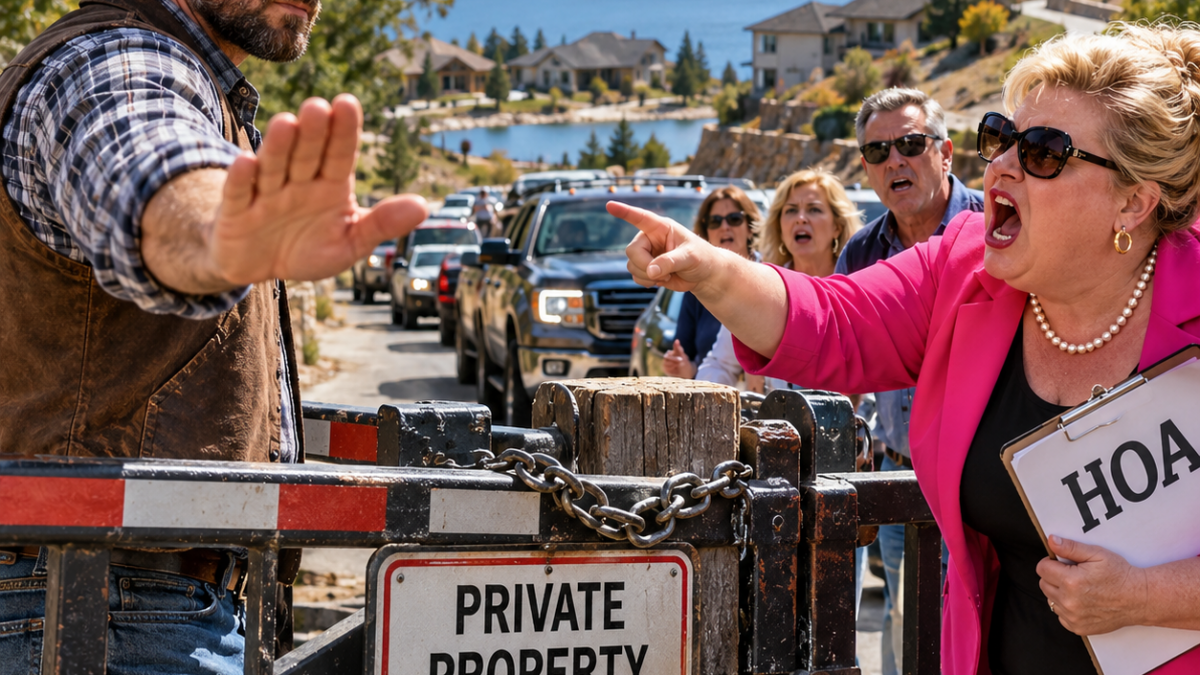
By 5:15, a steel gate stood across Lakewood Drive at the surveyed boundary.
It wasn’t decorative.
Two reinforced posts were sunk into concrete.
A heavy crossbar locked between them.
Beside it, I installed a sign:
PRIVATE PROPERTY
NO PUBLIC THROUGH ACCESS
EMERGENCY ACCESS AUTHORIZED
CONTACT LANDOWNER OR COUNSEL
Teresa insisted on the emergency language.
I gave the sheriff’s department, fire department, and ambulance service the access code before sunrise.
Then I parked my truck nearby.
At 6:22, the first car arrived.
Silver sedan.
Woman in hospital scrubs.
She braked hard.
For ten seconds she simply stared.
Then she got out.
“What the hell is this?”
I walked toward her.
“Ma’am, I’m sorry. The road crosses private land and there’s an active title dispute.”
“I have a shift in forty minutes.”
“I understand.”
“No, you don’t. Open the gate.”
“I can’t allow regular traffic right now.”
She looked at me like I had lost my mind.
Within twenty minutes, eight cars were backed up.
Then fifteen.
Horns started.
People got out.
Someone shouted, “Call the sheriff!”
Someone else shouted something about suing me.
A man in a pickup tried to drive around the gate through the drainage ditch.
His front axle dropped into mud, and the truck stopped with its rear wheels spinning.
That did not improve the mood.
At 7:18, a sheriff’s cruiser arrived.
The deputy approached me with one hand resting near his belt.
“Randy Sanders?”
“Yes.”
“We’ve got about twenty calls saying you blocked the only road serving this neighborhood.”
I handed him a packet Teresa had prepared.
Deed.
Survey.
Boundary confirmation.
No-easement search.
Attorney letter.
Emergency-access protocol.
He read slowly.
Another deputy arrived.
Then a sergeant.
The three of them talked beside their vehicles while residents crowded near the gate.
Finally, the sergeant walked over.
“This is a civil property matter,” he said.
A woman yelled, “So you’re just going to let him imprison us?”
“Nobody’s imprisoned,” the sergeant replied. “Emergency access is available. We cannot order a private landowner to open a disputed private roadway without court authority.”
“You expect us to walk to work?”
“I expect your HOA and developer to contact counsel immediately.”
That was when a black Mercedes appeared on the Lakewood side.
The crowd parted.
Garrett Sullivan stepped out.
I recognized him from advertisements.
Tall.
Silver hair.
Expensive dark suit.
The kind of man whose posture suggested doors usually opened before he touched them.
He walked directly toward me.
“You’re Sanders.”
“You’re Sullivan.”
His eyes moved over the gate.
“This is coming down.”
“No.”
He gave a small smile.
It contained no humor.
“You clearly have no idea how much this will cost you.”
“Actually, I’ve been getting familiar with costs.”
“I have six law firms available to me.”
“Congratulations.”
“I can keep you in court until your grandchildren are old enough to inherit the legal bills.”
“I don’t have grandchildren.”
“Then I suppose the bills stop with you.”
The residents had gone quiet.
He wanted an audience.
Fine.
I stepped closer.
“My father died in 2016.”
Sullivan’s expression didn’t change.
“Paul Whitfield died in April 2018.”
Still nothing.
“Raymond Keeler lost his surveyor’s license.”
A faint tightening around his mouth.
Then I said, “And I know what Lonear Data Solutions was.”
That landed.
Barely.
But I saw it.
His pupils shifted.
His jaw stopped moving.
For the first time since he arrived, Garrett Sullivan looked at me instead of through me.
“You should be very careful about making defamatory accusations.”
“I didn’t accuse you of anything.”
“You just implied—”
“I listed facts.”
He leaned closer.
“You think a gate makes you powerful?”
“No.”
I looked past him at the neighborhood.
“I think paperwork does.”
For several seconds we stood there.
Then he turned away.
As he reached his Mercedes, he pulled out his phone.
He was speaking before the door closed.
An hour later, most residents had gone back home.
A man remained near the gate.
Mid-fifties.
Khakis.
Polo shirt.
Tired face.
“Mr. Sanders?”
“Yes.”
“I’m Eugene Bennett.”
He held out his hand.
“I’m pastor at the community church.”
I shook it.
He glanced at the gate.
“My wife and I bought here five years ago.”
“I’m sorry.”
“That sounds strange coming from the man who locked the road.”
“I didn’t lock your road. I stopped the use of mine.”
His eyes stayed on me.
“I understand the distinction legally.”
“And morally?”
“I’m still working on that.”
I respected the answer.
He took a breath.
“There are people in there who had no idea.”
“I know.”
“We have an eighty-two-year-old widow receiving dialysis three times a week.”
“Medical transport is authorized.”
“Children?”
“I’m working with my attorney on school-bus access.”
He nodded slowly.
“Then you’ve thought about this.”
“For three nights, I barely slept.”
“Some people believe you’re doing this to punish us.”
“I’m doing it because Sullivan believes time is on his side. If I behave like nothing happened while his lawyers drag this out, he keeps control of land he never had the right to take.”
Pastor Bennett looked toward the houses.
“What happens to us?”
“I don’t know yet.”
That was the hardest answer to give because it was true.
He pressed his lips together.
“I hope when you fight him, you remember we’re not him.”
“I do.”
He nodded.
“Good.”
Two days later, Teresa called me at seven in the morning.
“Sullivan filed for an emergency temporary restraining order.”
“When?”
“Late yesterday.”
“What does he want?”
“The gate removed immediately.”
“Of course.”
“Hearing is at ten.”
I was already reaching for my keys.
The Bernett County courtroom was smaller than I expected.
Sullivan sat with three attorneys.
Teresa sat beside me with one binder and one yellow pad.
“Why do they have three lawyers?”
“Because four would look insecure.”
I glanced at her.
She didn’t smile.
Judge Helen Cartwright entered.
Everyone stood.
Sullivan’s lead attorney spoke first.
He described the blocked road as a humanitarian crisis.
Children prevented from attending school.
Employees unable to work.
Residents denied reasonable access.
Emergency risk.
Economic damage.
He was good.
Better than good.
By the time he sat down, I almost sounded guilty to myself.
Judge Cartwright looked toward our table.
“Ms. Price?”
Teresa stood.
“Your Honor, the residents are experiencing a crisis. But my client did not create the underlying condition.”
She handed a folder to the clerk.
“The developer constructed twenty-seven residences on property obtained through a deed supposedly signed by Robert Sanders in October 2018.”
She paused.
“Robert Sanders died in 2016.”
The judge looked up.
Teresa continued.
“The notary whose seal appears on the document died six months before the supposed notarization. The signature has been examined by a forensic document specialist who concluded it is not authentic. We also have substantial questions regarding the survey used to create the development.”
Sullivan’s attorney rose.
“Unproven allegations, Your Honor.”
Judge Cartwright raised a hand.
“I’ll decide what weight to give them.”
Teresa placed another document before the court.
“My client has provided unrestricted emergency-vehicle access. He is willing to provide school-bus access and medically necessary transportation while the dispute proceeds.”
The judge looked at me.
“Mr. Sanders, are you willing to comply with an order formalizing those accommodations?”
“Yes, Your Honor.”
“And are you willing to maintain twenty-four-hour emergency access?”
“Yes.”
Sullivan’s lawyer stood again.
“Your Honor, people cannot be expected to ask permission every time they need groceries.”
“No,” Judge Cartwright said. “They cannot.”
My stomach tightened.
Then she turned a page.
“But neither can this court ignore evidence that the roadway crosses property for which no recorded easement has been presented.”
Sullivan shifted.
The judge studied the forensic report.
Then the death certificates.
Then the surveys.
When she finally spoke, her voice had changed.
“Mr. Sullivan’s motion describes a dispute between a hostile landowner and an innocent developer.”
She looked toward Sullivan.
“The documents before me suggest that characterization may be incomplete.”
His attorney stood.
“Your Honor—”
“I’m not finished.”
He sat.
“I am denying the request for an order compelling unrestricted general traffic at this stage.”
Sullivan abruptly rose.
“This is extortion.”
The courtroom froze.
His attorney grabbed his sleeve.
Judge Cartwright’s expression hardened.
“Mr. Sullivan, sit down.”
“He’s holding families hostage to force me—”
“Sit. Down.”
He did.
“This is a court of law,” she said. “Not a sales office.”
Nobody moved.
She looked at me.
“Mr. Sanders, emergency vehicles, school transportation, medical transport, and other access specifically ordered by this court will be permitted. Your attorney will coordinate procedures.”
“Yes, Your Honor.”
“This order is temporary. It is not a final ruling on title or easement rights.”
“I understand.”
Then she looked toward Sullivan.
“And given the evidence submitted today, I strongly suggest all parties preserve every document, digital record, email, financial record, and communication related to the Sanders property.”
Sullivan’s face changed.
It was subtle.
But after watching him at the gate, I recognized it.
Fear.
Outside the courthouse, Teresa exhaled.
“That went about as well as it could have.”
“So we won.”
“We survived one hearing.”
“Same thing.”
“No.”
She stopped walking.
“Do not start thinking this is over.”
I looked back at the courthouse.
“You saw his face.”
“I did.”
“He’s scared.”
“Scared wealthy men with lawyers can be more dangerous than confident ones.”
She was right again.
That afternoon, Marilyn called.
“Randy, can you come here?”
Her voice sounded different.
“What happened?”
“I pulled the original paper file.”
“I thought we already had it.”
“We had the digital record.”
I was standing before she finished.
“I’ll be there.”
The hard-copy folder was yellowed along the edges.
Marilyn placed it on the same table where she had shown me the quitclaim deed.
“A complete filing should contain six pages.”
She separated them.
“One, two, three, four.”
Then she stopped.
“Where are five and six?”
“Exactly.”
The signature page was missing.
So was the notary certification.
I stared at her.
“But I saw both in the database.”
“So did I.”
She turned her monitor toward me.
The scanned digital record contained six pages.
The physical file contained four.
“How is that possible?”
“It shouldn’t be.”
She pulled out another set of papers.
“Our IT department keeps access logs.”
I read the highlighted entry.
March 15, 2019.
2:14 a.m.
Manual document correction.
Sanders Ranch Trust transfer.
The user account belonged to a temporary contractor assigned to the digitization project.
Lonear Data Solutions.
For several seconds, I couldn’t speak.
Marilyn whispered, “Those two pages weren’t scanned from this file.”
“They were inserted.”
“That’s what it looks like.”
“Can you prove whose account did it?”
“The contractor credentials trace to Lonear.”
“Can you identify the person?”
“Not yet.”
I called Teresa from the parking lot.
She listened without interrupting.
When I finished, there was silence.
Then she said, “Don’t email those logs to me.”
“Why?”
“Make certified copies. Preserve chain of custody. Marilyn needs to keep the originals secured. Nobody edits anything. Nobody logs into that record unnecessarily.”
“What are you thinking?”
“I’m thinking this is no longer just a dirty real-estate transaction.”
The FBI became involved days later.
Two agents met us in Teresa’s office.
Special Agent Diana Reeves did most of the talking.
Her partner, Marcus Webb, took notes.
Reeves looked through the access records.
“If somebody intentionally entered a county computer system and altered official records to facilitate a fraud scheme, there are potential federal offenses.”
“Potential?”
She looked at me.
“I don’t make promises about charges.”
Teresa nodded approvingly.
Reeves continued.
“We need the original server logs, procurement records, contractor access records, financial records, emails, and witness testimony.”
“Marilyn will cooperate.”
“We’ll speak to her directly.”
I leaned forward.
“How long does this take?”
Reeves closed the folder.
“As long as the evidence takes.”
That answer frustrated me.
But it was the right one.
For the next several weeks, my life became a routine of records, gates, attorneys, and angry strangers.
Some Lakewood residents screamed at me when they saw me.
One man called me a thief.
That one almost made me laugh.
Another taped a sign inside his windshield:
SANDERS IS DESTROYING OUR COMMUNITY.
The nurse from the first morning stopped shouting at me after her hospital helped coordinate a carpool meeting point outside the boundary, but she still refused to make eye contact.
Pastor Bennett became the unofficial go-between.
He never pretended to agree with everything I did.
That was why I trusted him.
One afternoon he met me beside the gate.
“People are scared.”
“So am I.”
“They think their mortgages could become worthless.”
“They might have title claims against Sullivan.”
“They don’t understand title claims. They understand monthly payments.”
That stayed with me.
I had spent weeks thinking in acres, deeds, surveys, and forged signatures.
They were thinking about kitchens they had remodeled.
College funds.
Retirement savings.
Bedrooms where their children slept.
Sullivan had not only stolen from me.
He had sold the consequences of his theft to twenty-seven families.
Then the buyout offer arrived.
A courier delivered it to my hotel room on a Friday evening.
Sullivan Development offered $4.8 million for my remaining 160 acres.
Cash.
Fast closing.
Confidential settlement.
Mutual release.
I stared at the number.
I had never seen that many zeros attached to anything I owned.
I called Teresa.
“He offered triple market value.”
“He’s trying to buy the road.”
“And my lawsuit.”
“And your silence.”
I sat on the edge of the bed.
“Four point eight million is a lot of silence.”
“Yes.”
“What happens if I take it?”
“That depends on the agreement.”
“You know what I mean.”
Teresa waited.
I looked at the envelope.
I could end the stress.
Sell.
Go back to San Antonio.
Let expensive people fight other expensive people.
I pictured my father’s porch.
Joseph’s handwritten notes.
NO.
NO AGAIN.
Randy won’t come back.
I closed the offer.
“Reject it.”
“You sure?”
“One sentence.”
“What sentence?”
“Not for sale.”
Teresa laughed once.
“I can make that legally elegant.”
“I don’t want elegant.”
The next discovery did not come from the FBI.
It came from the homeowners.
Pastor Bennett called me Saturday morning.
“You should come to the community center.”
“Why?”
“We started looking at our HOA finances.”
“What did you find?”
“That depends on how good you are with bank statements.”
The community center felt different when I walked inside.
The first time I had entered Lakewood Estates, I had been the outsider.
Now a dozen homeowners sat around folding tables covered in documents.
Some looked embarrassed to see me.
Others looked angry.
Not at me this time.
Pastor Bennett pushed a statement across the table.
“Every homeowner pays four hundred fifty dollars a month.”
I did the math.
“More than twelve thousand a month.”
“Over a hundred forty-five thousand a year.”
“What’s it supposed to cover?”
“Road maintenance, landscaping, common areas, insurance, dock maintenance, management.”
A woman named Caroline opened another folder.
“The account balance almost never exceeds twelve thousand.”
“Where does the rest go?”
She pointed to recurring transfers.
LWE MANAGEMENT SERVICES LLC.
Pastor Bennett handed me state registration records.
Owner: Garrett Sullivan.
I looked around the room.
“How long has this been happening?”
“Years,” someone said.
Another resident leaned forward.
“When we questioned expenses, Denise told us the management contract was proprietary.”
“Did anyone see the contract?”
Heads shook.
One man slapped his palm on the table.
“That bastard sold us houses on stolen land and then charged us every month for the privilege.”
No one responded.
There wasn’t much to add.
Teresa forwarded the records to Agent Reeves.
The FBI subpoenaed more.
Then, while searching Joseph’s storage barn for additional correspondence, I found an envelope.
My name was written across the front in his handwriting.
RANDY.
I sat on an overturned feed bucket before opening it.
The letter inside was short.
Randy,
If you’re reading this, it means I’m gone and you finally came home.
I’m sorry I couldn’t protect the ranch better.
Sullivan tried everything. He offered money. He threatened lawsuits. He sent men asking me to sign papers giving them access. I never signed anything.
Your father never signed anything either.
If they have documents saying otherwise, they are false.
I kept what I could. Look in the Sullivan folder.
Your father built this place with his hands.
Don’t let somebody take it with a pen.
Joseph
I read it twice.
Then a third time.
I had spent years telling myself I stayed away because losing my father hurt too much.
Standing in that barn, I finally admitted the uglier part.
Staying away had been easier.
Joseph had done the hard thing.
He had remained.
He answered letters.
Turned away salesmen.
Paid taxes.
Fixed fences.
Recorded threats.
Protected land that was not even his.
I folded the letter carefully.
“I’m sorry,” I said aloud.
There was nobody there to hear me.
A week later, Denise Barker’s attorney contacted federal investigators.
She wanted to cooperate.
According to Agent Reeves, Denise had originally believed her exposure was limited to HOA management decisions.
Then investigators showed her the financial transfers.
And the emails.
And the dates.
She realized Sullivan might sacrifice everyone around him to save himself.
So she started producing records.
Four years of messages.
Instructions from Sullivan not to discuss title questions.
Directions to refer complaints to his legal department.
Requests that residents be discouraged from searching county files independently.
Notes about Joseph.
And one email sent only months before I returned.
Agent Reeves did not give me a copy immediately, but Teresa later read the relevant line to me.
Don’t worry about the Sanders property. By the time anyone figures out what happened, our possession will be established. We just need to run out the clock.
I sat very still.
All those weeks I had worried that I was imagining the strategy.
I wasn’t.
He had written it himself.
The grand jury returned an indictment soon after.
Wire fraud.
Computer-related fraud.
Conspiracy.
Money laundering and financial offenses tied to the larger scheme.
At 4:17 one afternoon, Teresa called.
“There’s a warrant.”
I was standing on my father’s old dock.
“For Sullivan?”
“Yes.”
“When?”
“I can’t tell you operational details.”
“When will I know?”
“When everybody else knows.”
The next morning, local television answered the question.
Federal agents entered Sullivan Development’s Austin headquarters at 8:47.
Twelve minutes later, Garrett Sullivan came out in handcuffs.
I watched from the ranch kitchen.
He wore a dark suit.
His silver hair was perfect.
For the first few steps, he looked annoyed.
Then he saw the cameras.
Something in his face collapsed.
Not dramatically.
His shoulders simply lowered.
For the first time, the man looked his age.
I turned off the television.
The arrest should have felt like victory.
It didn’t.
A criminal case had started.
My land still contained twenty-seven houses.
Families still lived with uncertain titles.
The road dispute remained.
The ranch was still wounded.
Sullivan’s lawyers approached prosecutors about negotiations, but the evidence kept expanding.
Raymond Keeler, the disgraced surveyor, began cooperating.
He admitted Sullivan had paid him through an intermediary to create a survey using Miller Creek rather than the recorded shoreline boundary.
Investigators traced payments.
Lonear employee records identified a technician who had used the contractor credentials connected to the 2:14 a.m. record alteration.
That technician eventually testified that he had been instructed to “correct incomplete scans” using files supplied by a supervisor.
The supplied pages included the forged signature and dead notary’s certification.
The supervisor’s communications led back toward Sullivan.
No single discovery destroyed him.
That was what surprised me most.
Justice did not arrive like lightning.
It accumulated.
An email.
A bank transfer.
A survey coordinate.
A dead man’s signature.
A login record.
A frightened employee deciding prison was worse than loyalty.
A county clerk who noticed four paper pages had somehow become six digital pages.
Piece by piece, the version of reality Sullivan had manufactured came apart.
His federal trial began months later.
I attended every day.
The prosecution started with paperwork.
That seemed almost anticlimactic until I understood the strategy.
They wanted the jury to see the legitimate ranch records before seeing the fraudulent ones.
My grandfather’s survey.
My father’s deed.
Tax payments.
County maps.
Then came the quitclaim deed.
Dr. Hollis testified about the forged signature.
The prosecutor displayed genuine examples beside the questioned writing.
She explained pressure, stroke sequence, formation patterns.
Then the ink evidence.
Sullivan’s attorney attacked her methodology.
He suggested contamination.
Storage issues.
Alternative explanations.
She did not become defensive.
“That would not explain the handwriting inconsistencies,” she said.
Marilyn testified next.
She looked nervous walking to the witness stand.
But when asked about records, she became precise.
The physical Sanders file contained four pages.
The digital version contained six.
The added pages were the only pages carrying the disputed signature and notary certification.
The modification occurred during the Lonear digitization project.
The jury listened closely.
Then the prosecutor asked, “Who controlled Lonear Data Solutions?”
Marilyn looked toward Sullivan.
“Corporate records identified Garrett Sullivan as managing director.”
Sullivan did not look at her.
Raymond Keeler testified on the fourth day.
I had imagined hating him.
Instead, he looked pathetic.
Gray skin.
Shaking hands.
A man who had sold his profession one dishonest job at a time until there was nothing left to sell.
He admitted receiving money connected to Sullivan’s development.
He admitted shifting the boundary.
Sullivan’s lawyer attacked him mercilessly.
“You’re testifying to reduce your own punishment, correct?”
“Yes.”
“So you have every reason to tell prosecutors what they want to hear.”
“I have a reason to finally tell the truth.”
“That wasn’t my question.”
Keeler swallowed.
“Yes. I hope cooperation helps me.”
It was ugly testimony.
But honest ugliness carries weight.
Then Denise Barker took the stand.
Sullivan looked at her for the first time all week.
She avoided his eyes.
The prosecutor displayed emails.
Instructions.
Financial transfers.
Warnings.
One message concerned Joseph.
Old man is becoming a problem. Keep residents away from him and direct any land questions to us.
Another concerned me.
If the son ever shows up, legal will handle him.
I felt Teresa’s hand touch my arm.
“Don’t react,” she whispered.
I hadn’t realized I had started to stand.
Then came the email about running out the clock.
The prosecutor read it aloud.
Sullivan’s attorney objected.
The objection was overruled.
The jury saw the email.
Sender.
Date.
Account.
Metadata.
Context.
Sullivan’s own words.
By then, the defense strategy had changed.
They no longer argued nothing improper happened.
They argued Sullivan had relied on professionals.
A surveyor handled boundaries.
Contractors handled scanning.
Attorneys handled title.
HOA managers handled residents.
Sullivan, they suggested, was a businessman surrounded by dishonest subordinates.
Nobody seemed eager to accept that explanation.
The moment that affected me most had nothing to do with forensic science.
Teresa had given prosecutors Joseph’s letter.
After authentication issues were addressed, portions became part of the evidence surrounding his refusal to transfer rights.
The prosecutor read:
Sullivan tried everything. He offered money. He threatened lawsuits. He sent men asking me to sign papers giving them access. I never signed anything.
The courtroom went silent.
I stared at my hands.
For years, Joseph had probably wondered whether saving those letters mattered.
Whether anybody would ever read his notes.
Whether I would ever come home.
Now twelve jurors were listening to his words.
I wished he could have seen it.
The defense presented its case.
Experts challenged the ink analysis.
Former Sullivan employees described him as demanding but hands-off.
A title professional testified that large developments routinely relied on layers of contractors.
The defense attorney was skilled enough to create uncertainty around individual pieces of evidence.
But every time he pulled one thread loose, five others remained.
The jury deliberated for six hours.
I spent most of that time walking courthouse hallways.
Pastor Bennett came.
So did several Lakewood homeowners.
The nurse from the gate sat across from me.
Her name was Sarah Collins.
We had barely spoken since that morning.
Finally, she said, “I hated you.”
“I know.”
“I still think closing the road was brutal.”
“I know that too.”
She rubbed her palms together.
“But if you hadn’t…”
She didn’t finish.
“You didn’t know,” I said.
“We should have.”
“How?”
She looked toward the courtroom doors.
“I don’t know.”
“That’s why people like Sullivan get away with things. They make ordinary people feel stupid for trusting systems ordinary people are supposed to be able to trust.”
She nodded.
“I’m sorry I called you a bastard.”
I looked at her.
“You called me worse than that.”
For the first time, she laughed.
The courtroom doors opened.
The jury had returned.
We filed inside.
The foreman stood.
Guilty.
The first count landed strangely.
Then another.
Guilty.
Another.
Guilty.
By the final count, I had stopped hearing individual words.
I looked at Sullivan.
He remained still.
His attorneys whispered around him.
He stared straight ahead.
The man who had threatened to bury me in litigation had finally run out of paper that could save him.
Sentencing came weeks later.
The judge imposed a lengthy federal prison term—twelve years—along with restitution and financial penalties totaling millions of dollars across the victims and fraud claims.
The final restitution structure was complicated.
It always is.
There were lenders.
Homeowners.
Legal claims.
Liquidated company assets.
Insurance disputes.
Title claims.
My own property damages.
Nobody simply handed me a giant check and made everything disappear.
Real consequences are messier than that.
But Sullivan lost control of his companies.
Assets were sold.
Accounts were seized or redirected under court orders.
Homeowners received compensation through settlements and restitution processes.
Civil cases resolved around the criminal findings.
Most importantly, the fraudulent documents no longer controlled the Sanders Ranch.
The eighty disputed acres were restored to my ownership subject to negotiated resolutions with the innocent homeowners who had purchased homes there.
That created the hardest decision of the entire ordeal.
Legally winning land back was one thing.
Standing in front of a family and telling them their kitchen sat on it was another.
Teresa and I developed options.
Some homeowners wanted to leave.
They accepted compensation through the various settlements and sold their interests.
Some homes on partially completed or unsuitable lots were eventually removed during restoration.
Other families desperately wanted to stay.
Pastor Bennett was one of them.
“My wife planted those magnolias when our granddaughter was born,” he told me.
We were standing in his backyard.
“I understand the land underneath them is yours.”
I looked toward the lake.
“I’m not interested in evicting you.”
His shoulders dropped.
“But we need legitimate boundaries and legitimate ownership.”
“That sounds fair.”
We negotiated purchases for several occupied lots at reasonable values, taking into account what the residents had already lost because of Sullivan.
It was not charity.
It was not revenge.
It was the first honest transaction some of those properties had ever seen.
The old Lakewood Estates HOA collapsed almost immediately.
Residents voted to dissolve it and replace it with a smaller neighborhood association.
Denise Barker resigned before the vote.
She later reached her own agreement with prosecutors.
I never spoke to her again.
Pastor Bennett somehow ended up president of the new association.
When I heard, I called him.
“I thought you hated HOA presidents.”
“I do.”
“So why did you accept?”
“Because apparently punishment for complaining about leadership is becoming leadership.”
“That sounds biblical.”
“It isn’t.”
The road remained the final issue.
Once the title disputes stabilized, Teresa asked what I wanted to do.
“You can negotiate a market-rate easement.”
“How much?”
“Potentially substantial.”
“Enough to recover legal costs?”
“Possibly.”
I thought about it.
For months, that road had been leverage.
It had forced Sullivan into open conflict.
It had prevented him from quietly continuing as though nothing was wrong.
It had also become a symbol of everything the residents feared about me.
I drove out to the gate one Sunday morning.
Pastor Bennett met me.
“So?” he asked.
“So what?”
“I heard you’re deciding the easement.”
“You people gossip.”
“We call it community information.”
I leaned against the gate.
“What would you consider fair?”
“That is a dangerous question to ask a pastor.”
“Why?”
“Because I’ll say one dollar.”
I looked at him.
He smiled.
I started laughing.
Then I said, “Fine.”
His smile vanished.
“What?”
“One dollar per year.”
“You’re serious?”
“Permanent legal access. Recorded properly. Residents and guests. Emergency services. Deliveries. Normal traffic.”
He stared.
“What’s the catch?”
“No commercial expansion using my road. No new phases of development without a separate agreement.”
“Reasonable.”
“And annual contributions to a fund protecting Miller Lake water quality.”
“How much?”
“Enough to maintain shoreline testing and runoff controls. We’ll calculate it based on actual costs, transparently.”
He extended his hand.
“You have a deal.”
Teresa called me irresponsible when I told her.
Then she drafted the agreement.
Every remaining household signed.
The gate came down on a Sunday.
I expected something dramatic.
A crowd.
Speeches.
Maybe applause.
Instead, a contractor removed the crossbar.
A minivan drove through.
Then a pickup.
Then Sarah Collins in her silver sedan.
She slowed beside me and rolled down the window.
“No more gate?”
“No more gate.”
“You going to miss making everybody mad?”
“I’ll find another hobby.”
She smiled.
“Good.”
Then she drove toward the highway.
I stood there watching cars cross my land.
The difference was a piece of paper.
But this time it was an honest one.
A year after Sullivan’s sentencing, I moved back permanently.
The ranch looked different.
It always would.
You cannot build twenty-seven houses near a lake and pretend they never existed.
Some lots returned to pasture.
Some houses remained under new ownership arrangements.
The shoreline restoration took months.
We removed unauthorized structures from sensitive areas.
We repaired fencing.
Reopened drainage channels.
Replanted native grass.
I restored the old barn roof myself even though every contractor who saw me on the ladder told me I was too old to be proving anything.
Maybe they were right.
One afternoon, I found Joseph’s old hammer behind a workbench.
The wooden handle was dark from decades of use.
I sat there holding it.
Then I drove to the small cemetery outside town where he was buried beside his wife.
I brought flowers.
I felt ridiculous carrying them at first.
Joseph would have teased me.
His headstone was simple.
JOSEPH MARTINEZ
1952–2023
I stood there for a while.
“You held the line,” I finally said.
Wind moved through the grass.
“I should’ve been here.”
Nothing answered.
Of course nothing answered.
But I kept talking.
“You tried to tell me in every way except actually calling and saying, ‘Get your ass home.’”
I laughed once.
Then my voice broke.
“I’m sorry.”
I put the flowers down.
“And thank you.”
At the ranch entrance, where the original wooden gate had stood before Sullivan replaced it, I installed a small bronze plaque.
It read:
JOSEPH MARTINEZ
THE MAN WHO NEVER SIGNED
Pastor Bennett suggested the wording.
I couldn’t improve it.
Months later, he came by while I was fishing from the dock.
He brought two beers and sat beside me.
For a while, we watched the water.
Then he said, “Can I ask you something?”
“You usually do.”
“Do you regret closing the road?”
I kept my eyes on the lake.
“Some days.”
“Which days?”
“The morning Sarah couldn’t get to work. The day that widow missed an appointment before we fixed the medical-access schedule. Every time a kid had to walk farther because adults had created a mess they didn’t understand.”
He nodded.
“And other days?”
“I remember Sullivan standing there telling me he’d bury me.”
“What do you think now?”
I reeled in my line.
“I think if I’d walked away, he would have learned he was right.”
Pastor Bennett was quiet.
“I used to think you closed that gate because you were angry.”
“I was angry.”
“That wasn’t the whole reason.”
“No.”
He took a drink.
“I think that’s why people eventually forgave you.”
“I’m not sure everybody did.”
“They don’t have to.”
That surprised me.
He looked toward the neighborhood.
“Forgiveness isn’t the same as agreement.”
Children were shouting somewhere beyond the trees.
A dog barked.
A lawn mower started.
Ordinary sounds.
A year earlier, I would have heard trespassers.
Now I heard neighbors.
The sun lowered over Miller Lake, turning the water copper.
My father used to sit in almost the same place with his coffee every morning.
For eight years, I had stayed away because I thought returning would make the grief worse.
Instead, distance had preserved it.
Coming home changed it.
I still missed him.
I still wished I had returned before Joseph died.
There are mistakes you cannot repair just because you eventually become brave enough to face them.
But the ranch was still here.
Not untouched.
Not exactly the way my father left it.
Maybe that was never possible.
Land changes.
Families change.
Communities appear where pastures used to be.
People die.
Other people move in.
The important thing was that nobody could erase what came before by forging a signature and waiting for everyone to forget.
A breeze moved across the lake.
I looked up toward the entrance road.
Cars passed through freely now, crossing an easement recorded with real signatures, real dates, and living witnesses.
Beside the road, Joseph’s plaque caught the last light of the evening.
For the first time in eight years, I didn’t feel like a visitor on my father’s land.
I set the fishing rod beside me, leaned back in the old chair, and stayed until the sun disappeared behind the trees.
I was home.
[END OF STORY]








