PART 2: HOA Turned My Yard Into Their Parking Lot—Then Learned I Owned the Only Road to Every House Behind Me
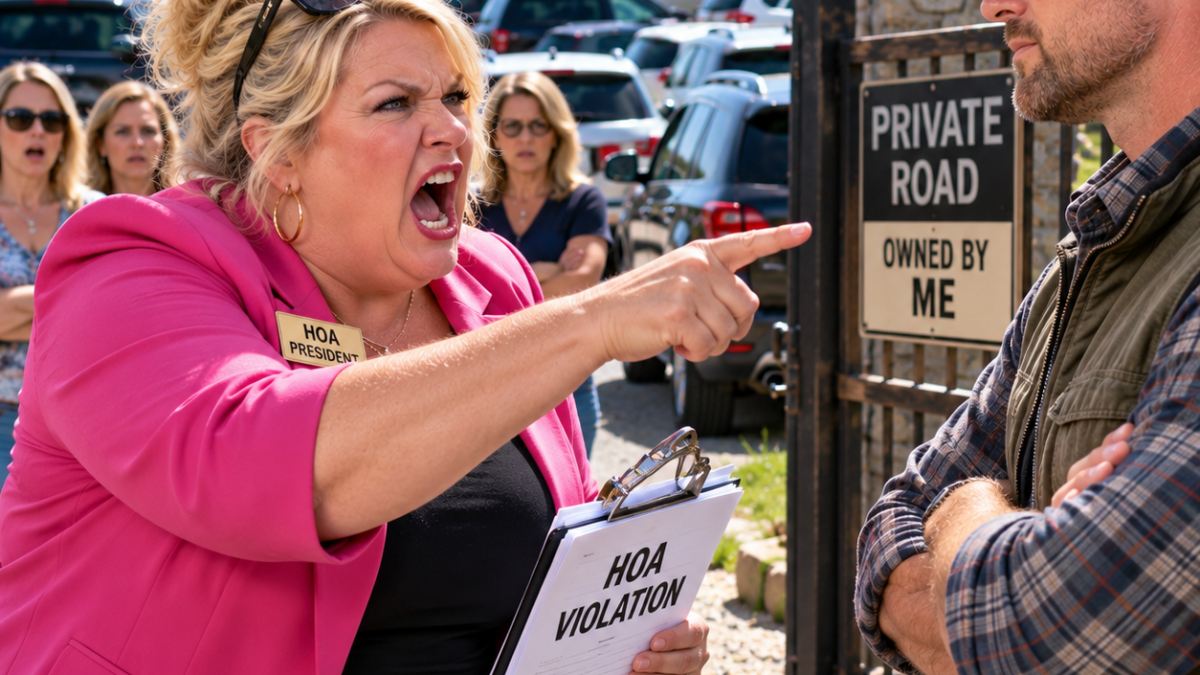
I woke up Saturday morning to find a silver Lexus buried halfway into my front lawn, three more cars rolling over my flower beds, and the HOA president calmly directing volunteers to turn my private property into parking for a neighborhood party she had never bothered to ask me about.
She called me selfish when I told her to move every car, laughed when I reminded her I owned the only paved road leading to every house in Ridge View Estates, and had no idea that by the end of the weekend I would uncover a fake property map, a missing reserve fund, and one clause in our access agreement that could bring her entire little kingdom to a dead stop.
The first thing I noticed was the tire track.
It ran across the edge of my lawn in a dark, ugly curve, flattening the grass I’d reseeded barely three weeks earlier.
The second thing I noticed was the silver Lexus parked at the end of that track.
Half on the grass.
Half across the gravel shoulder.
At six forty-five on a Saturday morning.
I was standing on my front porch with a mug of coffee when another SUV came up the hill, slowed near my mailbox, turned directly onto my lawn, and parked beside the Lexus.
Then came a minivan.
Then a pickup.
By the time I set my coffee down, people were unloading folding tables.
That was when I knew this wasn’t somebody taking a wrong turn.
I had bought the property three years earlier because most buyers saw problems and I saw leverage.
The house itself was nothing special at first.
Two-story farmhouse-style place built in the late seventies, peeling siding, outdated plumbing, roof nearing the end of its life.
I spent a year fixing it.
New roof.
New wiring.
Rebuilt porch.
Redid the kitchen myself except for the gas line.
But the reason I bought the property wasn’t the house.
It was the road.
Ridge View Estates had been built uphill from me years earlier on land that had once belonged to a timber company. The only practical paved route into the subdivision curved across the lower edge of my parcel before climbing through a narrow cut between two wooded slopes.
The developer had never purchased the roadbed outright.
Instead, the previous owner of my property had granted Ridge View a limited access agreement.
Everybody called it an easement because that was easier, but the recorded documents were more specific.
Residents could travel across the private road to reach their homes.
Emergency vehicles could use it.
Delivery vehicles could use it.
The HOA was responsible for contributing to surface maintenance.
That was it.
No events.
No parking.
No structures.
No commercial use.
No storage.
No expansion of use without written permission from the landowner.
Most importantly, the agreement contained a misuse clause that allowed access privileges to be suspended or renegotiated if the HOA materially exceeded the permitted use or damaged the property.
When I bought the house, I renewed the arrangement because I had no interest in making two hundred families drive through a ditch just to prove a point.
For three years, the system worked.
Until Deborah Whitmore became HOA president.
Deborah had lived near the top of Ridge View for six years.
Platinum-blonde bob.
Expensive sunglasses.
Perfectly ironed blouses.
She had the kind of smile that only appeared when someone else was being told no.
Under her, HOA meetings became longer, fines became more frequent, and every ordinary disagreement somehow became a question of “community harmony.”
I mostly stayed out of it.
Technically, my home sat outside the Ridge View HOA boundary.
I owned the road they used, but I wasn’t a member.
That irritated Deborah from the beginning.
She had once told me it was “awkward” that the entrance to Ridge View passed through property outside HOA control.
I told her awkwardness wasn’t a title defect.
She didn’t laugh.
Now, standing on my porch while people parked on my grass, I suspected we had finally reached the part where awkwardness became entitlement.
A white Range Rover rolled in behind the minivan.
It didn’t stop on the gravel.
It turned through my side yard.
Directly through a flower bed.
I watched two tires flatten a row of hostas.
The driver’s window lowered.
A woman’s voice shouted, “Could you move your truck? You’re blocking the community parking area.”
I looked behind me.
My pickup sat where it always sat, beside my garage.
Then the Range Rover door opened.
Deborah stepped out.
She wore white slacks, a coral blouse, dark sunglasses, and heels completely unsuitable for grass.
Clipboard in hand.
Of course.
I walked down the porch steps.
“What community parking area?”
She pointed around us.
“This.”
“My yard?”
She removed her sunglasses.
“Preston, don’t start.”
That was always a promising sentence.
“I’m not starting anything. I’m asking why there are cars on my lawn.”
“The Ridge View Spring Social is today.”
“And?”
“You were sent notice.”
“Notice isn’t permission.”
“It was in the community email.”
“I don’t read HOA emails.”
She sighed.
“You really should.”
“I’m not in your HOA.”
“You use community services.”
“No, Ridge View uses my road.”
Deborah pressed her lips together.
“Can we please not turn this into one of your property-rights lectures?”
“Can we please not turn my front yard into a parking lot?”
Behind her, a U-Haul pulled up.
Two men opened the rear door.
Inside were folding chairs, plastic tables, coolers, portable speakers, and what looked suspiciously like part of an inflatable bounce house.
I stared.
“You have got to be kidding me.”
Deborah looked at the truck.
“The lawn near your house is the flattest area by the entrance.”
“The flattest private area.”
“Only for a few hours.”
“You didn’t ask.”
“We sent notice.”
“That still isn’t permission.”
A man carrying a folding table walked between us.
“Where do you want these?”
Deborah pointed toward my side yard.
“Near the garage.”
“No.”
The man froze.
Deborah looked at me.
“Preston.”
I turned to him.
“Take it back to the truck.”
He glanced between us.
“Uh…”
Deborah stepped closer.
“Set it down.”
He set it down.
I stared at her.
She stared back.
“Move the cars,” I said.
“Don’t be ridiculous.”
“Now.”
“You’re embarrassing yourself.”
“My flower bed is under your Range Rover.”
“It’ll grow back.”
My jaw tightened.
“Move every car off my property.”
She folded her arms.
“Where are people supposed to park?”
“That sounds like a Ridge View problem.”
“We don’t have enough event parking.”
“Then don’t invite more people than you can park.”
“It’s a community gathering.”
“Not my community.”
“You live at the entrance.”
“Outside your boundary.”
She looked around at volunteers unloading tables.
“Everyone has already arrived.”
“Then they can leave.”
She laughed.
Not loudly.
Just enough to tell me she thought I wasn’t serious.
That was her first mistake.
The second happened thirty seconds later.
A little boy ran up my porch steps with muddy shoes.
He was maybe six.
Not his fault.
He was chasing another kid.
One of them bumped the small table where I’d left my coffee.
The mug fell.
Shattered against the porch boards.
The boy’s mother glanced up from her phone.
Didn’t apologize.
Didn’t even slow down.
Deborah said, “See? Families are having fun.”
I looked at the broken mug.
It had belonged to my father.
Cheap diner mug.
Blue stripe.
Nothing valuable.
Except he had used it every morning for years before he died.
Something in me went very still.
“Deborah.”
She must have heard the change in my voice.
“What?”
“You have thirty minutes to get these vehicles off my lawn.”
Her expression hardened.
“Or what?”
I looked toward the road climbing behind my house.
“You remember the access agreement you signed when you took office?”
She blinked.
“What about it?”
“Read it again.”
Her eyes narrowed.
“Are you threatening the neighborhood?”
“No.”
I pointed toward the torn grass.
“I’m notifying its president that she is currently misusing private property tied to the only legal road access her HOA has.”
“The road is an easement.”
“Limited access.”
“Same thing.”
“No.”
“People have permanent rights to use it.”
“They have rights according to the agreement.”
She waved the clipboard.
“You cannot trap residents in their homes over a party.”
“I didn’t say I would.”
“You just threatened to close the road.”
“I told you to read the contract.”
She stepped closer.
“You wouldn’t dare.”
I held her gaze.
“Move the party.”
For the first time, a little uncertainty crossed her face.
Then it vanished.
“It’s happening.”
“Fine.”
“Fine?”
“Fine.”
She smirked.
“Thank you.”
“Don’t thank me yet.”
I turned and walked back into the house.
Behind me, I heard her mutter:
“Some people have no sense of community.”
Maybe.
But I did have a sense of title.
And documentation.
I went straight to the fireproof file cabinet in my office.
The access agreement was exactly where I’d left it.
Six years old.
Signed by the previous owner, the developer, then later acknowledged by Ridge View HOA.
When Deborah became president, she had signed the annual acknowledgment page herself.
I found the clause.
Section Seven.
Subsection Four.
Material misuse.
Unauthorized expansion of use.
Obstruction.
Property damage.
The agreement provided for written termination or immediate suspension in cases of substantial misuse threatening the owner’s property or access.
I read it twice.
Then a third time.
Outside, the bounce house started inflating.
I could hear the blower from inside my office.
I called Marissa Cole.
She was my attorney for real-estate matters and one of the few people I trusted to tell me when I was wrong.
She answered on the third ring.
“Preston?”
“You busy?”
“Always.”
“HOA parked a party on my lawn.”
Silence.
“Repeat that.”
I explained.
Cars.
Tables.
Deborah.
Bounce house.
The road agreement.
The damage.
Marissa said nothing for a moment.
Then:
“You have cameras?”
“Four.”
“Get everything.”
“Can I suspend road access?”
“Don’t touch the gate yet.”
“That’s not what I asked.”
“I know.”
“Marissa.”
“Preston, the agreement gives you leverage, but don’t turn leverage into a lawsuit against yourself.”
“They’re on my property.”
“Yes.”
“They damaged it.”
“Document.”
“They’re using land outside the permitted road corridor.”
“Document.”
“They’re treating the road and yard as event space.”
“Document.”
“What about Section Seven?”
“I remember it.”
“Immediate suspension.”
“If material misuse is established.”
“So yes.”
“So maybe.”
I groaned.
“I hate lawyers.”
“You pay me to make you hate me before a judge gets the opportunity.”
“Useful.”
“Here’s what I want. Photograph the damage. Preserve video. Do not block emergency services. Do not block individual homeowners without a transition plan. Send me the original agreement.”
“Anything else?”
“Yes.”
Her tone changed.
“Check Ridge View’s public filings.”
“For what?”
“If Deborah genuinely believes your lawn is common property, either she’s delusional or they’ve been representing it that way somewhere.”
I looked through the window.
A DJ booth was being assembled near my garage.
“Why would that matter?”
“Insurance. Budgets. Zoning. Taxes. If they’re planning events on your land, somebody may have put your property into HOA maps.”
That sentence bothered me.
After we hung up, I logged into the county assessor database.
Then the city zoning portal.
Then Ridge View’s publicly filed annual association disclosures.
The first year looked normal.
Second year.
Normal.
Then two years earlier, attached to a zoning variance request, I found a schematic.
**RIDGE VIEW COMMUNITY ACCESS AND AMENITY PLAN**
The road was highlighted.
Expected.
Then I saw my front lawn.
A dotted boundary surrounded almost the entire lower portion of my property.
Label:
**SHARED GREEN SPACE / EVENT OVERFLOW**
I leaned closer.
No.
I downloaded the PDF.
Opened the original plat beside it.
The fake schematic shifted the subdivision’s visual boundary almost eighty feet into my property.
It didn’t change the legal parcel description.
But anyone looking casually could believe Ridge View controlled the lawn.
I found another filing.
Annual community asset report.
Same map.
Insurance schedule.
**Common access corridor and green-space liability coverage.**
They had insured activity on my land as if it belonged to them.
My phone rang.
Marissa.
“I found something,” we said at the same time.
“You first,” she said.
“They filed a map showing my front lot as shared green space.”
“I know.”
“How?”
“I pulled their annual disclosures.”
“Why didn’t anyone catch it?”
“Because it’s a schematic, not a deed. They didn’t legally change your property. They just kept using a false representation.”
“For budgets.”
“Yes.”
“For insurance.”
“Possibly.”
“For events.”
“Obviously.”
“Fraud?”
“Potential misrepresentation. Maybe misuse of funds. Don’t jump ahead.”
“They knew.”
“Prove that.”
I looked outside.
Deborah was directing the DJ to move his equipment farther into my side yard.
My camera caught her pointing.
“I think she just volunteered.”
—
By three in the afternoon, my lawn looked like a festival site.
Cars lined both sides of the access road.
Golf carts were parked near the ditch.
A generator sat beside my hostas.
Extension cords crossed my walkway.
Someone had dragged a grill over the gravel.
Trash was accumulating near the hedge.
I walked the perimeter with my camera.
One tire had cut a trench through the sod.
Another vehicle had cracked an irrigation head.
The generator had leaked a dark patch of oil.
Somebody had tried hiding a damaged section of grass with an outdoor rug.
That almost impressed me.
Then a man approached holding a plate piled with grilled chicken.
Blue polo.
Khaki shorts.
I recognized him from HOA emails.
Frank Weller.
Vice president.
“Preston.”
“Frank.”
He offered his hand.
I looked at the plate.
He lowered the hand.
“Listen, I wanted to say thanks for letting us use the area.”
“I didn’t.”
His smile faded.
“Sorry?”
“I told Deborah to move everybody.”
He looked toward the party.
“She said it was cleared.”
“By who?”
“The board.”
“The board doesn’t own this.”
Frank frowned.
“This is shared event space.”
“No.”
“That’s how it’s listed.”
“On a fake schematic.”
His face changed.
“What?”
I pulled the certified parcel map from the folder I’d been carrying.
“Property line.”
He looked.
Then looked around.
“This whole lawn?”
“Mine.”
“The parking?”
“Mine.”
“The DJ?”
“Mine.”
“The bounce house?”
“Very much mine.”
Frank’s face went pale.
“Deborah said the lower parcel had been incorporated into the HOA years ago.”
“She lied.”
“I don’t know if I’d use—”
“Then show me the deed.”
He stared at the map.
“I need to talk to her.”
“Do.”
I turned.
“Frank.”
He stopped.
“Tell her I’m suspending the access agreement.”
His face snapped toward me.
“You can’t.”
“Watch.”
“Preston, that’s the only road.”
“I know.”
“You’ll trap everyone.”
“No. Emergency services stay open. Deliveries get arrangements. Homeowners will get transition access.”
“Then what are you suspending?”
“The HOA’s automatic privilege to operate like this road belongs to it.”
“That’s semantics.”
“No.”
I looked toward the party.
“Today is what happens when people stop understanding semantics.”
Frank hurried away.
Within minutes, Deborah appeared.
She walked so quickly her heels sank into the soft lawn.
“What did you tell Frank?”
“The truth.”
“You’re not closing that road.”
“You already violated the access agreement.”
“This event isn’t on the road.”
“Exactly.”
She stopped.
I pointed to the tables.
“The agreement gives Ridge View permission to pass through a defined corridor.”
Then the bounce house.
“Not occupy my yard.”
Then the generator.
“Not run events.”
Then the damaged grass.
“And definitely not destroy property.”
“This is minor.”
“You also filed a false map.”
She froze.
It was brief.
Maybe half a second.
Enough.
“What map?”
I smiled without humor.
“Shared Green Space.”
Her eyes hardened.
“That was part of a conceptual planning application.”
“You’ve used it in annual disclosures.”
“It’s not a legal boundary map.”
“Good. Then stop behaving like it is.”
“We were advised that the common-use area—”
“By who?”
She didn’t answer.
“Deborah, you knew this wasn’t HOA land.”
“I knew residents used it.”
“The road.”
“The area.”
“No.”
Her voice sharpened.
“You are jeopardizing hundreds of homeowners because you’re angry about some grass.”
I stared at her.
“This stopped being about grass when you filed paperwork representing my property as yours.”
“The city rejected that variance.”
“And yet you kept using the map.”
“It was convenient.”
There it was.
Convenient.
I heard Marissa’s voice in my head.
Prove knowledge.
“Thank you,” I said.
Deborah blinked.
“For what?”
“Nothing.”
I held up my phone.
Recording.
Her face drained slightly.
“You record every conversation?”
“Only the interesting ones.”
“You cannot use that—”
“State law says otherwise in this context.”
That shut her up.
I lowered the phone.
“Party ends today.”
She folded her arms.
“No.”
“Then thirty-six hours.”
“For what?”
“After that, automatic HOA access is suspended pending a new agreement.”
“You’re bluffing.”
“You should really stop assuming that.”
She laughed.
Weakly.
“Do you think the city is going to let one man hold an entire subdivision hostage?”
“No.”
I looked toward the road.
“I think the city is going to ask why the subdivision built its entire access system around a contract its president decided she didn’t need to follow.”
Her mouth opened.
Nothing came out.
“Pack up, Deborah.”
I walked inside.
That night, I filed a trespass and property-damage report.
The deputy asked for footage.
I sent four camera angles.
Deborah directing volunteers.
Vehicles entering.
The generator.
The damaged landscaping.
A man dragging a grill.
A cooler being dumped into my flower bed.
Everything.
The next morning, the bounce house was gone.
So were the tables.
Most of the cars.
But the damage remained.
Tire ruts.
Oil.
Broken irrigation.
Flattened plants.
And one shattered blue-striped mug in a trash bag beside my porch.
I took it out.
Washed the pieces.
Then put them in a box.
I wasn’t sure why.
Maybe I wasn’t ready to throw away one more thing because somebody else decided it didn’t matter.
PART 2
Monday at nine, Deputy Callahan arrived.
County cruiser.
Mirrored sunglasses.
Clipboard.
Behind him came Ben Keller from city zoning with rolled plans under one arm.
Marissa joined by phone.
I spread the documents across my porch table.
Original plat.
Access agreement.
False schematic.
Photographs.
Damage estimates.
Callahan read the suspension notice.
“You understand you cannot create an emergency-access problem.”
“Yes.”
“Fire, ambulance, police.”
“Already exempted.”
“Residents?”
“Temporary controlled access while renegotiation happens.”
Ben unrolled the city plat.
Then placed the HOA schematic beside it.
He stared.
“They drew over your parcel.”
“Yes.”
“Who submitted this?”
“Ridge View HOA.”
“When?”
“Two years ago.”
“For the community-center variance?”
“Yes.”
Ben frowned.
“I remember this application.”
“You approved it?”
“No. Variance died.”
“Why?”
“Traffic, drainage, ownership documentation wasn’t complete.”
I pointed at the map.
“They’ve been using it anyway.”
He whistled.
“That could be a problem.”
Callahan looked at him.
“How big?”
“Depends what they represented it as.”
I showed him the insurance schedule and annual report.
Ben’s expression hardened.
“This isn’t just an illustrative concept anymore.”
He photographed everything.
Then looked at me.
“You want the city to open an audit?”
“Yes.”
Callahan asked, “Trespass charges?”
“I want the report. Prosecutor can decide what fits.”
He nodded.
Smart answer.
I wasn’t interested in manufacturing crimes because I was angry.
I wanted every consequence to survive daylight.
We walked to the gate.
The access road narrowed there between stone walls and trees.
Technically, it was the cleanest point to control traffic.
I had installed the gate before buying the house, upgrading the previous owner’s old chain system.
It had stayed open almost constantly.
That changed Monday.
Callahan posted the notice.
Ben placed a municipal investigation marker beside it.
For twenty-four hours, residents received temporary passage while written instructions were distributed.
After that, access would move to controlled permission while the agreement was renegotiated.
A silver sedan approached.
The woman driving slowed.
Read the notice.
Her window lowered.
“Can I get home?”
“Yes,” I said.
She looked terrified.
“This says access suspended.”
“HOA automatic access. Residents get temporary permission.”
“So I’m not locked out?”
“No.”
Her shoulders dropped.
“Thank you.”
I suddenly understood how Deborah was probably describing me.
Crazy landowner.
Threatening to trap families.
I made a decision.
That afternoon, every Ridge View household received a simple one-page notice.
**YOU ARE NOT BEING DENIED ACCESS TO YOUR HOME.**
I explained:
The road was private.
The HOA had violated its agreement.
Residents would continue receiving controlled temporary access while the legal dispute was resolved.
Emergency services were unaffected.
The gate was not retaliation against individual homeowners.
The dispute was between the landowner and HOA management.
At the bottom:
**Questions should be directed to the HOA board regarding its unauthorized use of private property.**
I wanted people angry.
Just not at the wrong facts.
—
At two that afternoon, Deborah arrived.
Black SUV.
Navy blazer.
Low heels.
Folder.
She slammed the door.
“This is harassment.”
I was standing near the gate with Callahan.
“How?”
“You’ve humiliated the community.”
“No.”
“You posted signs.”
“On my property.”
“You’re obstructing access.”
“Residents are being admitted.”
“You’re forcing everyone to request permission.”
“Yes.”
“They already have rights.”
“Under an agreement your board materially breached.”
She held out the folder.
“Petition.”
I didn’t take it.
“Over one hundred homeowners demand unrestricted access.”
“This isn’t a vote.”
“It demonstrates community reliance.”
“People can sign a petition asking for my kitchen. Doesn’t make it theirs.”
“We’re prepared to sue.”
“Do it.”
Her face tightened.
“Historical use creates an implied right.”
“Not when a signed agreement expressly defines the use.”
“You think you’re smarter than our lawyers?”
“No.”
I nodded toward Callahan.
“I think the contract is smarter than your lawyers.”
Callahan looked like he was trying not to react.
Deborah lowered her voice.
“You’re going to regret this.”
“Maybe.”
“You’ll be responsible when property values drop.”
“Maybe you should explain why your board built community plans around land it didn’t own.”
Her eyes narrowed.
Then another car arrived.
Black sedan.
Government plates.
A man and woman stepped out.
The man showed identification.
“Assistant District Attorney Marcus Bell.”
The woman:
“Investigator Priya Patel.”
Deborah stopped moving.
Bell looked at me.
“Preston Naylor?”
“Yes.”
“We’re following up on the zoning-fraud referral.”
Deborah turned to Callahan.
“Fraud?”
He didn’t answer.
Bell continued.
“We’d like copies of the altered parcel documentation, association communications, and original recorded access agreement.”
“I have a package ready.”
Patel glanced at Deborah.
“Ms. Whitmore?”
Deborah straightened.
“I am HOA president.”
“Good. We’ll need to speak with you separately.”
Her face lost color.
“That map was conceptual.”
Patel didn’t react.
“We’ll discuss that.”
I led them to my office.
Thirty minutes later, Bell sat across my dining table comparing the original plat to the HOA’s schematic.
“This version was used for insurance?”
“Yes.”
“Annual budget?”
“Yes.”
“Event planning?”
“Yes.”
“Anything else?”
“Community-center proposal.”
He looked toward Patel.
She was reading email screenshots.
“This email calls your lawn ‘HOA event overflow.’”
“I saw it.”
“Who wrote it?”
“Deborah.”
Bell tapped the file.
“If association funds or insurance representations were based on knowingly false ownership information, we may be looking at more than a zoning dispute.”
“Wire fraud?”
“Possibly.”
“Insurance fraud?”
“Possibly.”
“Misuse of association funds?”
“Very possibly.”
He closed the folder.
“We’ll take it from here.”
When they left, they drove directly uphill toward the HOA office.
Deborah’s SUV was already gone.
That evening, residents gathered near the gate.
Not shouting.
Talking.
One man asked to see the original plat.
I showed him.
A woman said, “Deborah told us the lawn was HOA land.”
“It isn’t.”
“Did she know?”
I thought about the recording.
“Investigators can answer intent.”
She nodded.
“Can we still get to work tomorrow?”
“Yes.”
The mood changed instantly.
People weren’t angry because I controlled the road.
They were angry because the board had put access at risk while telling them somebody else owned the responsibility.
—
Tuesday morning, a city truck parked outside the clubhouse.
Inspectors took measurements.
Two officers accompanied them.
By noon, the clubhouse door carried a notice:
**PROPERTY AND RECORDS UNDER REVIEW**
Deborah disappeared.
Frank Weller didn’t answer calls.
Then a board member named Leonard Shaw arrived at my gate.
He looked exhausted.
“Mr. Naylor.”
“Leonard.”
“We need to discuss a new access agreement.”
“That was fast.”
“The situation has changed.”
“Did the road move?”
“No.”
“Then the situation didn’t change. Your understanding did.”
He swallowed.
“We’re preparing to remove current leadership.”
“Good.”
“We’d like a clean slate.”
“Also good.”
“Can we reopen automatic access?”
“No.”
His face fell.
“Residents are angry.”
“They have temporary access.”
“The gate creates delays.”
“So did your president’s party.”
Leonard looked embarrassed.
“We didn’t know the map was false.”
“You signed annual disclosures.”
“We trusted Deborah.”
“That isn’t the same as not knowing.”
He nodded slowly.
“You’re right.”
That mattered.
Not enough to erase responsibility.
Enough to have a productive conversation.
I handed him a proposal.
He read.
Monthly road-access compensation.
HOA-funded maintenance contribution.
Quarterly inspections.
No parking.
No events.
No structures.
No staging.
No advertising the land as HOA property.
Thirty-day written notice for any event within three hundred feet of my parcel that could affect traffic.
Verified county map attached.
Electronic gate system with resident credentials.
Emergency override.
Violation procedure.
Indemnification.
Leonard read the monthly payment.
His eyebrows rose.
“This isn’t free anymore.”
“No.”
“Previous owner allowed it.”
“So did I.”
“What changed?”
I pointed uphill.
“Your board taught me free access gets mistaken for ownership.”
He couldn’t argue.
“I’ll take this to residents.”
“Take it to your attorney first.”
He looked surprised.
“You’re telling us to get counsel?”
“I want the next agreement valid enough nobody spends the next decade pretending they misunderstood it.”
He nodded.
As he turned away, an elderly woman with a cane approached from the road.
“Mr. Naylor?”
“Yes.”
“I’m Evelyn Price.”
I recognized the name.
One of the original Ridge View homeowners.
She looked toward Leonard.
Then at me.
“I wanted to say thank you.”
“For locking your gate?”
She smiled faintly.
“For not locking us out.”
“I wouldn’t.”
“Deborah told us you were trying to punish everyone.”
“I figured.”
“She said you’d always hated Ridge View.”
“I don’t hate Ridge View.”
“You hate her.”
I considered it.
“No.”
Evelyn raised an eyebrow.
“Not yet.”
She laughed.
Then her expression softened.
“We knew she pushed too hard.”
“Then why let her?”
Evelyn looked uphill.
“Because every time someone fought her, she made their life exhausting.”
That sentence stayed with me.
Fines.
Hearings.
Letters.
Inspections.
Most people didn’t surrender because Deborah was legally right.
They surrendered because peace had become cheaper than resistance.
“That’s how people like her stay in charge,” I said.
“I know.”
She tapped her cane against the pavement.
“Maybe not anymore.”
—
Three days later, two investigators from the state financial-crimes unit arrived at the HOA treasurer’s house.
That was when the case stopped being about the fake map.
Reuben Hayes, a retired firefighter who lived two lots uphill, brought the news to my porch.
He carried a battered thermos and two folding chairs.
“You hear?”
“About?”
“They’re at Kathy’s place.”
“Kathy?”
“Treasurer.”
I sat.
“What are they looking for?”
“Money.”
That was all he knew.
By evening, everyone knew more.
The fake parcel map had been used to justify spending from the HOA reserve account.
Landscaping.
“Shared green-space improvements.”
Roadside beautification.
Event preparations.
Some work had never happened.
Other work had been done somewhere else.
The first number circulating was seventy thousand dollars.
Then eighty-two.
Then nobody trusted the rumors.
I waited for official information.
Bell called the next morning.
“We’ve identified a shell vendor.”
“Whose?”
“Can’t discuss ownership yet.”
“HOA money?”
“Yes.”
“How much?”
“Significant.”
“The road dispute exposed it?”
“The false map gave us an entry point.”
I looked through the window.
Deborah had turned my lawn into a parking lot because she thought the map protected her.
Instead, it became the document that pulled investigators into her finances.
Irony doesn’t always whisper.
Sometimes it drives a Range Rover over your hostas.
—
Deborah was taken into custody that afternoon.
No sirens.
No dramatic chase.
One county vehicle.
One state investigator.
She walked from her house wearing dark glasses.
Her shoulders were stiff.
Residents watched silently.
I stood on the lower hill.
No cheering.
No phone recording.
Nothing about the moment felt victorious.
I remembered her at my lawn.
“You’re being selfish.”
For a while, I had imagined I’d enjoy seeing her lose control.
Instead, all I could think was how unnecessary it had been.
If she had asked permission.
If she had accepted no.
If she had told residents the truth about the land.
If she had managed the road agreement instead of pretending the road belonged to Ridge View.
Everything after that was her choice.
Leonard returned that evening with a woman wearing a navy windbreaker marked:
**STATE COMPLIANCE AUDITOR**
“Mara Chen,” she said.
We shook hands.
“I’ve reviewed the access dispute.”
“Condolences.”
She smiled slightly.
“And the related association filings.”
“Worse?”
“Much.”
Leonard looked miserable.
Mara opened a binder.
“Preliminary audit indicates money classified as common-area maintenance was directed to a company controlled by a relative of Ms. Whitmore.”
“Brother-in-law?”
Mara looked at me.
“You’ve heard.”
“Rumors.”
“Don’t repeat them publicly until charges are finalized.”
“I won’t.”
She continued.
“The fraudulent map was used to support several expenditures.”
“On my land?”
“Purportedly.”
“Did they actually spend money here?”
“Some.”
“Most?”
She didn’t answer directly.
“Investigators are tracing it.”
I nodded.
Leonard placed my revised road agreement on the table.
“We reviewed this.”
“And?”
“Residents voted to authorize negotiation.”
“Actual vote?”
Mara answered.
“Supervised.”
“Minutes?”
“Recorded.”
“Good.”
Leonard took out a pen.
“We’re willing to sign.”
I stopped him.
“Not until your lawyer approves.”
He stared.
“You really mean that.”
“Yes.”
“After everything their lawyers did?”
“I don’t want a revenge agreement.”
Mara’s eyes shifted toward me.
I continued.
“I want a durable one.”
Leonard nodded.
Two days later, everyone signed.
Me.
The interim HOA representative.
Independent counsel.
County acknowledgment attached to the verified boundary map.
The agreement included monthly compensation.
Maintenance cost sharing.
Strict use limitations.
Electronic access credentials.
No future claim that my land was common property.
Mara insisted on one additional step.
Every Ridge View resident received certified notice.
It stated plainly:
**The lower access road and all adjoining land outside the recorded Ridge View boundary are privately owned by Preston Naylor. The HOA possesses access rights only as defined by the current agreement.**
I read that paragraph three times.
Not because I enjoyed seeing my name.
Because nobody would be able to say they didn’t know.
—
By the following weekend, the gate reopened.
Not the old way.
Electronic controls.
Resident fobs.
Delivery protocol.
Emergency-service override.
My phone could lock or unlock the gate, but the agreement prevented arbitrary denial of lawful residential access as long as Ridge View remained compliant.
That mattered.
I didn’t want two hundred families dependent on my mood.
I wanted the HOA dependent on its contract.
Huge difference.
Evelyn became the first resident to use the new fob.
She rolled down her window.
“Feels fancy.”
“Don’t get comfortable.”
She laughed.
“Party here next Saturday?”
“Keep moving, Evelyn.”
She drove uphill grinning.
The lawn slowly recovered.
I replaced damaged irrigation.
Removed the oil-stained soil.
Replanted hostas.
The tire trenches required new sod.
Marissa pursued reimbursement through the HOA’s liability coverage and individual claims tied to the event.
The association eventually paid.
Not residents directly.
Insurance and misused funds recovered through the audit covered most costs.
I took the pieces of my father’s mug to a local pottery repair shop.
The woman behind the counter looked at them.
“Worth something?”
“No.”
“Sentimental?”
“Yes.”
She nodded.
“Then it’s worth something.”
She repaired it using visible seams rather than hiding every break.
I never drank from it again.
It sat on my kitchen shelf.
A reminder that damaged isn’t always ruined.
—
The interim Ridge View board finally addressed the problem that should have been solved years earlier.
Parking.
They submitted a proposal to build a legitimate community lot near the clubhouse.
On land the HOA actually owned.
I attended the zoning hearing out of curiosity.
The planner displayed a certified parcel map.
I almost laughed.
Someone had learned.
The proposal was modest.
Forty-eight spaces.
Drainage controls.
Lighting limits.
No overflow onto the private access parcel.
The zoning committee approved it unanimously.
Then the chair looked toward the audience.
“Mr. Naylor?”
I froze.
Marissa whispered, “You’re famous.”
“I hate this.”
“Go.”
I walked forward.
The chair said, “You’re the complainant whose documentation initiated the Ridge View investigation.”
“I just wanted cars off my grass.”
That got a few laughs.
The chair smiled.
“Nevertheless, the city reviewed its HOA zoning submission process.”
I waited.
“Going forward, association applications involving land outside confirmed HOA title must include verified ownership documentation and written consent from affected property owners.”
I blinked.
“You changed the process?”
“We clarified it.”
“Because of one fake map?”
“Because one fake map survived in municipal files long enough to be reused.”
That was fair.
The chair extended his hand.
“Thank you.”
I shook it.
“I’d prefer a parking ordinance requiring bounce houses to stay at least a mile from my house.”
More laughter.
Then I returned to my seat.
I wasn’t trying to change city policy.
That was the strange part.
All I’d wanted was a normal Saturday morning.
Coffee.
Quiet.
Grass not crushed by luxury SUVs.
Deborah’s refusal to recognize a boundary had turned a lawn dispute into municipal reform.
—
The financial case took months.
Investigators eventually traced more than seventy thousand dollars in reserve funds to a shell company linked to Deborah’s brother-in-law.
Some invoices described landscaping that never happened.
Others billed Ridge View for work performed at private residences.
A portion of the money connected to events and “green-space development” justified using the false map.
Kathy, the treasurer, claimed Deborah had provided documentation she believed was legitimate.
Her criminal exposure depended on what prosecutors could prove she knew.
The board members who had signed annual reports were interviewed.
Some cooperated.
Some hired lawyers.
Frank Weller resigned.
Leonard stayed through the transition long enough to help rebuild financial controls, then stepped down voluntarily.
Deborah faced charges tied to financial misconduct, false filings, and misuse of HOA funds.
I testified once before the grand jury.
My part was simple.
Ownership.
Road agreement.
Party.
Damage.
Map.
Nothing dramatic.
The numbers did more damage than I ever could.
Marissa told me after one hearing:
“The best revenge in financial cases is accounting.”
“That’s depressing.”
“It’s extremely satisfying if you’re an attorney.”
“Exactly my point.”
—
Ridge View held new elections.
Actual elections.
Residents showed up.
Reuben ran for board president after months of insisting he would rather fight another structure fire.
Evelyn nominated him.
He blamed me.
I denied everything.
His campaign speech lasted thirty-eight seconds.
“I will not use your money to sue people without telling you. I will not redraw property lines with a marker. I don’t care what color your patio chair is unless it’s on fire. Please vote for someone else.”
He won by a landslide.
The new treasurer was an accountant named Monica Ruiz who posted monthly financial statements online before anyone asked.
The new board adopted rules requiring:
Two signatures for major expenditures.
Independent annual audits.
Published legal fees.
No special contracts with relatives.
No closed executive spending decisions beyond narrow lawful exceptions.
No event planning on property the HOA did not own.
That last one became known unofficially as the Preston Rule.
I hated it.
Reuben loved it.
At his first meeting, somebody asked whether the road payment to me was fair.
Good question.
Monica showed the calculation.
Maintenance responsibility.
Access value.
Insurance exposure.
Comparison with alternate road construction.
A resident asked, “What’s the alternative?”
The county engineer answered.
“Build a new road through the north slope.”
“How much?”
He named a number over two million dollars.
The room went quiet.
My monthly access fee suddenly looked less offensive.
One man raised his hand.
“Did the old board know that?”
Reuben looked at him.
“They knew enough to sign the previous agreement.”
Nobody said anything else.
—
I didn’t become friends with the entire subdivision.
That’s not how real neighborhoods work.
Some people still blamed me.
One anonymous comment online called me a “road baron.”
Another said I had exploited a technicality.
I printed that one.
Framed it.
Hung it in my garage.
Reuben laughed so hard he nearly spilled beer when he saw it.
“Road Baron?”
“Apparently.”
“You need a flag.”
“I need better neighbors.”
“You have me.”
“My point exactly.”
But most residents eventually understood.
I had never blocked emergency vehicles.
Never stopped people from reaching their homes.
Never demanded ownership of their houses.
Never used the road to extort individuals.
I forced the organization to acknowledge the limits it had always agreed to.
There is a difference between power and leverage.
Power says:
I can hurt you.
Leverage says:
We both need something, so let’s write down fair rules before either side abuses the arrangement.
Deborah treated access like permanent submission.
The new board treated it like a contract.
That was the entire improvement.
—
The community parking lot opened the following spring.
Reuben invited me to the ribbon cutting.
“No.”
“Come on.”
“No.”
“There will be food.”
“Still no.”
“No bounce house.”
I looked at him.
“You learned.”
Eventually I went.
Forty-eight painted spaces.
Drainage.
Trees.
A small pavilion.
Everything on HOA land.
Evelyn stood near the entrance holding a paper plate.
She pointed toward the asphalt.
“Look.”
“What?”
“A community parking lot.”
I smiled.
“Novel concept.”
“We put it on community property.”
“Revolutionary.”
She laughed.
Reuben approached.
“Want to say a few words?”
“No.”
He handed me the microphone anyway.
People turned.
I stared at him.
“I hate you.”
“Community spirit.”
I sighed.
Then looked at the residents.
“I’ve got one thing.”
Everybody waited.
“If it’s not yours…”
Someone shouted from the back:
“Don’t park on it!”
The crowd laughed.
I handed the microphone back.
“Perfect.”
—
Deborah’s case ended later that year.
Some charges were resolved through a plea.
Others through findings related to the financial investigation.
Restitution was ordered.
She was barred from future HOA fiduciary roles under the terms of the resolution.
Her brother-in-law’s company was dismantled.
Recovered funds returned to Ridge View’s reserve account.
Insurance claims were corrected.
The city removed the misleading green-space schematic from active association references and attached a formal correction to the historical filing.
Kathy avoided the worst outcome by cooperating extensively and providing evidence showing how Deborah had routed invoices.
I didn’t attend Deborah’s final hearing.
I had nothing left to hear.
The last time I saw her in person was almost a year after the party.
I was at a hardware store buying fence stain.
She appeared at the end of the aisle.
No sunglasses.
No clipboard.
Just jeans and a dark sweater.
We both stopped.
“Preston.”
“Deborah.”
She looked uncomfortable.
I waited.
“I heard the parking lot opened.”
“It did.”
She nodded.
“That’s good.”
“It is.”
Another pause.
Then:
“I should have asked.”
Of all the apologies she could have offered, that was the only sentence that mattered.
“Yes.”
Her eyes lowered.
“I thought because the road had been used so long, the lower area was effectively part of Ridge View.”
“You had the agreement.”
“I know.”
“You signed it.”
“I know.”
“And the map?”
She looked away.
“I didn’t draw it.”
“You used it.”
“Yes.”
“Why?”
Her answer took a long time.
“Because it made things easier.”
There it was again.
Convenient.
People rarely destroy boundaries because boundaries are confusing.
They destroy them because boundaries are inconvenient.
“I hope easier was worth it,” I said.
Her face tightened.
“No.”
For a moment, I almost felt sorry for her.
Then I remembered my father’s mug.
The lawn.
The shell company.
The residents who had trusted her.
Sympathy isn’t the same as absolution.
I picked up my stain.
“Take care.”
She nodded.
I walked away.
No dramatic confrontation.
No perfect revenge line.
Just an aisle full of paint, screws, and somebody learning far too late that permission would have been cheaper than control.
—
That summer, I replaced some of the landscaping the party had destroyed.
Not exactly the same.
I moved the hostas farther from the drive.
Added stone edging.
Repaired the porch.
My father’s mug remained on the kitchen shelf.
One afternoon, Evelyn stopped at my gate.
She had a bag of tomatoes.
“Payment.”
“For what?”
“Road toll.”
“Very funny.”
I took the tomatoes.
She looked toward the electronic gate.
“You ever think about selling?”
“My house?”
“Road.”
“No.”
“Why?”
I thought about it.
“Because then I don’t control what happens here.”
She nodded.
“Fair.”
“Although after all this, I’m sure Ridge View would buy it.”
“Probably.”
“Would they?”
“Reuben proposed asking.”
I looked at her.
“When?”
“Last meeting.”
“And?”
“Residents voted no.”
That surprised me.
“Why?”
“Too expensive?”
She smiled.
“That too.”
“What else?”
“They said the current arrangement works.”
I looked at the road.
Residents passing legally under a clear contract.
HOA paying maintenance.
No confusion.
No ownership fiction.
Maybe that was progress.
Evelyn squeezed my arm.
“You know, everyone used to think you were difficult.”
“Used to?”
She laughed and headed uphill.
—
The road itself became quieter after the new parking lot opened.
No overflow cars.
No event trucks.
No golf carts wandering down my driveway.
Every major Ridge View event happened uphill.
If traffic would be heavy, the board notified me.
Not because I needed to approve what happened on their land.
Because increased road use affected mine.
That mutual respect prevented dozens of arguments.
One Saturday, Reuben called.
“Community barbecue next month.”
“Good.”
“About two hundred people.”
“Why are you telling me?”
“Traffic.”
“Look at you following the agreement.”
“Don’t make this emotional.”
“Need anything?”
“Actually.”
I waited.
“Could emergency overflow parking use your lower gravel field?”
“No.”
“Thought I’d ask.”
“See how easy that was?”
“Go to hell, Preston.”
I laughed.
They rented a church lot two miles away and ran shuttles.
Nobody died.
—
Marissa closed my legal file almost eighteen months after the original party.
We met for lunch.
She pushed a thin folder across the table.
“Final reimbursement.”
I opened it.
Landscaping.
Irrigation.
Cleaning.
Attorney fees where recoverable.
Gate upgrades.
Survey certification.
The total wasn’t enormous compared to the criminal case.
But it covered what I had lost.
“You did well,” she said.
“I wanted them off my lawn.”
“You’ve mentioned that.”
“I didn’t ask for a state financial investigation.”
“No.”
“I didn’t ask for city reform.”
“No.”
“I didn’t ask for Deborah to be charged.”
“Also no.”
I looked at her.
“So why did everything explode?”
She took a sip of water.
“Because systems often survive until one small conflict forces someone to document them.”
“That sounds like something lawyers say to feel important.”
“Correct.”
I laughed.
She pointed toward me.
“And because you own the road.”
“There it is.”
“Never waste good leverage.”
“That’s terrible moral advice.”
“Legal advice.”
“Worse.”
—
Years later, people still told the story wrong.
Some version said I chained the gate shut and trapped the entire subdivision overnight.
Didn’t happen.
Another said emergency vehicles couldn’t get in until the mayor intervened.
Completely false.
Someone online claimed I charged every homeowner fifty dollars every time they drove through.
Ridiculous.
Another version had Deborah crying at my gate while state police arrested her.
Also false.
Reality was less cinematic.
More paperwork.
More waiting.
More lawyers.
More careful distinctions.
But the real story was better because it meant something.
I didn’t win because I owned a gate.
I won because I had documents.
Because the agreement had limits.
Because I didn’t let anger push me into doing something illegal.
Because Marissa forced me to slow down when revenge felt faster.
Because Callahan documented the trespass.
Because Ben compared maps.
Because investigators followed the money.
Because residents eventually stopped believing a title like HOA President made someone infallible.
And because Deborah kept escalating when the cheapest possible solution had been available from the start.
Ask.
That’s it.
“Preston, can we use part of your lawn for overflow parking during the Spring Social?”
I might have said no.
Probably would have.
But maybe I’d have offered the lower gravel field for a fee.
Maybe I would’ve helped them find another lot.
Maybe I would’ve allowed a few volunteer vehicles near the road.
We will never know.
She skipped the question.
Once somebody skips consent because they assume the answer belongs to them, the conflict has already changed.
—
The clearest reminder came four years after the original party.
Ridge View wanted to replace a section of storm drain running near the lower road.
The pipe crossed three feet into my property.
Under the old board, somebody would probably have sent me a notice saying work was scheduled.
The new board did something radical.
They knocked.
Reuben had moved away by then.
Monica Ruiz was president.
She arrived with the engineer.
“Preston, we need temporary construction access.”
“For?”
She showed me plans.
Good plans.
County-stamped.
Survey overlay.
Temporary work area clearly marked.
Insurance certificate.
Restoration agreement.
Estimated duration.
Everything.
I almost smiled.
“What?”
Monica looked suspicious.
“Nothing.”
“You’re enjoying this.”
“A little.”
She sighed.
“We need fifteen feet for machinery.”
“How long?”
“Four days.”
“Restore grading?”
“Yes.”
“Grass?”
“Yes.”
“Fence?”
“If damaged.”
“Written?”
She held up the agreement.
I read.
Signed.
Done.
Four days later, they restored everything.
No lawsuit.
No DA.
No newspaper stories.
Just adults asking permission and keeping promises.
That was perhaps the most satisfying ending to the entire Deborah era.
Not seeing her arrested.
Not watching the fake map exposed.
Not locking the gate.
A boring drainage project.
Boring meant the system worked.
—
My father’s repaired mug eventually developed another small crack.
Not from a child.
Not from an HOA party.
Age.
I took it back to the woman who had repaired it.
She smiled when she recognized it.
“Still not drinking from it?”
“No.”
“Then how’d it crack?”
“Existing stress.”
She nodded.
“Old breaks do that.”
I watched her examine it.
“Can you fix it?”
“Yes.”
“Hide the crack?”
“No.”
“Why?”
“Because if I grind too much away trying to make it look untouched, I weaken the whole thing.”
That sentence followed me home.
Ridiculous place to learn a lesson.
Pottery shop.
But she was right.
Ridge View had tried for years to pretend Deborah’s period of leadership never happened.
The new board eventually stopped doing that.
They added a permanent summary of the financial audit to association records.
Not gossip.
Facts.
False map submitted.
Funds misallocated.
Governance failures.
Reforms adopted.
Residents joining in future years could see it.
No hiding the scar.
Learn from it.
—
One September evening, I sat on the porch with Reuben, who had come back to visit.
He had moved to Florida.
Said he hated it.
“Flat,” he complained.
“You knew that before moving.”
“Nobody tells you how flat.”
We watched cars climb the road.
Gate opened automatically.
Closed.
Quiet.
Reuben cracked a beer.
“You ever think Deborah did you a favor?”
I stared at him.
“Leave.”
“Think about it.”
“She destroyed my lawn.”
“You upgraded it.”
“She broke Dad’s mug.”
“You repaired it.”
“She cost me legal fees.”
“Reimbursed.”
“She dragged investigators into my life.”
“Exposed seventy grand missing from the reserve.”
“She made everyone hate me.”
“For like two weeks.”
He took a drink.
“Now they call you Road Baron.”
“That’s not helping.”
He laughed.
Then his expression became more thoughtful.
“She forced everybody to understand what they were depending on.”
“The road?”
“Trust.”
I looked uphill.
Ridge View’s lights appeared among trees.
“Maybe.”
He nodded toward the gate.
“You could’ve abused that.”
“What?”
“Control.”
“How?”
“Locked everyone out. Demanded ridiculous money. Made the whole neighborhood suffer because Deborah pissed you off.”
“I’d have lost in court.”
“Probably.”
“That helped.”
“But you didn’t try.”
“No.”
“Why?”
I thought about Callahan.
Marissa.
Evelyn.
The woman in the silver sedan asking whether she could get home.
“Because their homes weren’t the problem.”
Reuben nodded.
“That.”
“What?”
“That’s why they trust you now.”
I rolled my eyes.
“Don’t get sentimental.”
“You’re the one who repaired the coffee mug.”
“Go back to Florida.”
—
The electronic gate is still there.
Default closed at night.
Automatic resident access.
Emergency override.
Delivery windows.
My property remains clearly marked.
The HOA’s current map stops exactly where the county plat says it stops.
No dotted green-space fantasy.
No event overflow.
No unauthorized chairs.
No bounce houses.
And every spring, when Ridge View holds its community social, residents park in the paved lot they built on land they actually own.
Sometimes I can hear the music from my porch.
It doesn’t bother me.
One year, Monica walked down carrying a plate of barbecue.
“Peace offering.”
“For what?”
“Noise.”
“Didn’t notice.”
She handed me the plate anyway.
“Come up.”
“To the party?”
“Yes.”
I looked toward the lot.
Cars parked correctly.
Tables on HOA land.
Bounce house nowhere near my yard.
I smiled.
“Maybe later.”
She pointed at me.
“That’s progress.”
After she left, I ate the barbecue on the porch.
It was good.
Better because nobody had driven through my hostas to deliver it.
—
People like to imagine revenge as taking something from the person who wronged you.
Their money.
Their office.
Their reputation.
Their comfort.
For a while, that’s what I wanted.
When Deborah stood on my lawn calling me selfish, I wanted to slam the gate shut and let Ridge View figure out how to helicopter groceries to two hundred houses.
That would’ve felt good for maybe ten minutes.
Then somebody would miss a medical appointment.
Someone would be late for work.
A family with nothing to do with Deborah would panic.
And I would’ve become exactly what she accused me of being.
Powerful enough to ignore everybody else because I could.
So I didn’t.
I used the road to force accountability.
Not submission.
That distinction is what let me sleep at night.
Deborah had confused access with ownership.
I refused to confuse ownership with tyranny.
—
One Saturday morning many years later, I stepped onto my porch with coffee.
Different mug.
The repaired blue-striped one was safe inside.
A silver Lexus approached.
For half a second, muscle memory kicked in.
I watched it slow.
Turn.
Then stop at the gate.
The driver used a resident fob.
Gate opened.
Car continued uphill.
No tire touched my grass.
I smiled.
The lawn was green.
Hostas healthy.
Flower beds intact.
The paved access road curved through my parcel toward Ridge View exactly where it always had.
Nothing about the geography had changed.
What changed was understanding.
That road wasn’t theirs.
It wasn’t really “mine” in the childish sense either.
I owned the land.
They held contracted access.
Both statements could be true at the same time.
That was the lesson Deborah never understood until the cost became enormous.
Rights overlap.
Responsibilities do too.
The answer isn’t pretending one side has everything.
The answer is knowing where the line is and respecting the agreement that lets people live on both sides of it.
I finished my coffee.
Somewhere uphill, children were shouting near the Ridge View pool.
A delivery van approached.
Gate opened.
Van passed.
Gate closed.
Simple.
Reliable.
Boring.
Perfect.
I looked toward the exact part of the lawn where Deborah’s Range Rover had flattened the hostas years earlier.
No scar remained.
You had to know where to look.
I did.
I always would.
But I didn’t need the scar to stay angry.
I needed it to remember.
The whole disaster began because one person looked at something privately owned, decided it was useful to her community, and skipped the inconvenient step of asking.
From there came the party.
The damage.
The fake map.
The access suspension.
The investigation.
The shell company.
The missing reserve money.
The arrests.
The audit.
The election.
The new parking lot.
The municipal reform.
All of it because “No” had seemed too inconvenient for somebody who believed authority existed wherever her clipboard pointed.
Years later, Ridge View was still there.
The homes were still there.
Families came and went.
Boards changed.
Presidents changed.
The road remained.
My house remained.
My lawn remained private.
And whenever somebody new joined the HOA and asked why the association paid a monthly fee to use a road that looked like part of the neighborhood, Monica would apparently give them the shortest possible history lesson.
“Because it isn’t ours.”
That was all I had wanted anyone to understand.
The gate clicked shut behind another car.
I went inside.
And this time, nobody was parked in my flower bed.
[END OF STORY]








