PART 2: HOA Tried to Force-Sell My Family’s 70-Year Ranch After Discovering What Was Under It—They Had No Idea I Was a Federal Judge
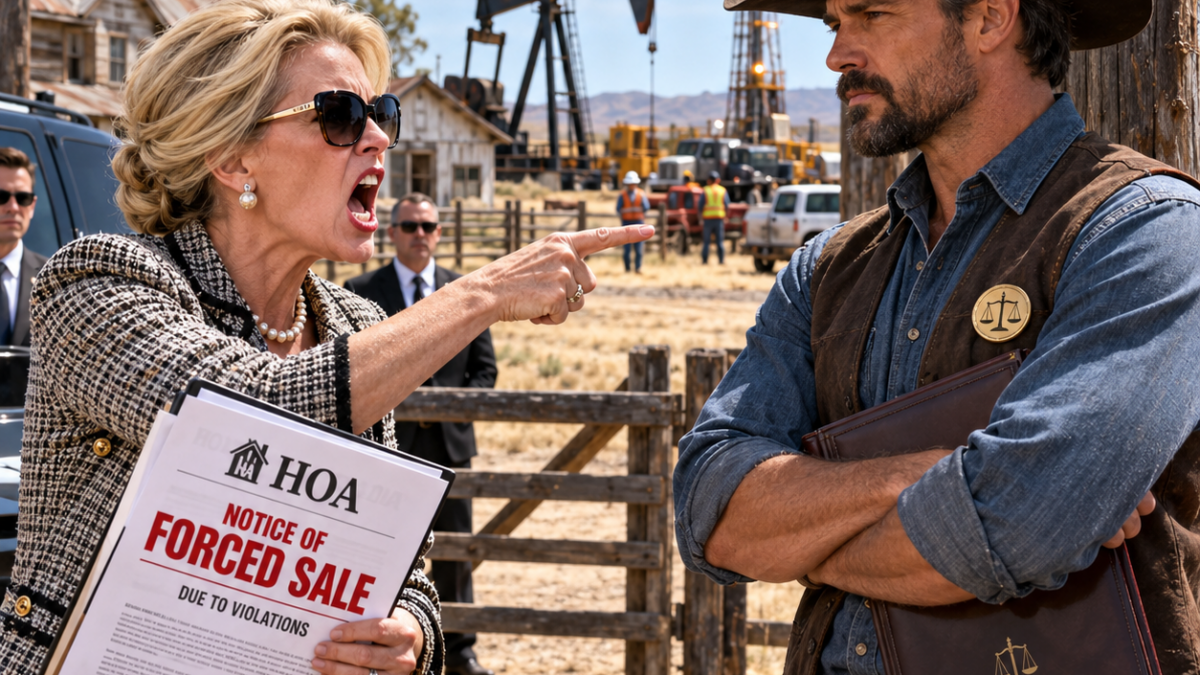
PART 2
I enlarged the satellite image.
Ridgecrest Estates had been built on former farmland and scrub around the western and northern sides of our ranch.
Rows of nearly identical homes.
Straight streets.
Pools.
Entry monuments.
White fencing.
Young trees planted at regular intervals.
At first glance, nothing seemed unusual.
Then I turned on the property-boundary layer.
That changed everything.
The HOA boundary didn’t simply stop where the subdivision stopped.
It extended outward.
Then inward.
Then around.
Sharp angles.
Narrow extensions.
Lines that made no planning sense if the purpose was merely to govern the houses inside Ridgecrest.
Our ranch sat almost completely enclosed.
Not geographically.
Administratively.
The boundary amendment appeared to have been drawn in a way that swallowed 640 acres of land my grandparents had never sold, never subdivided, and never consented to place under HOA governance.
Yet a smaller parcel to the east had been excluded.
I zoomed in.
That parcel was rough scrubland.
Little access.
No improvements.
No obvious value.
Our ranch had a road.
A well.
Old structures.
Open acreage.
And, apparently, an HOA president determined to acquire it.
I leaned back.
Maybe there was an explanation.
Maybe an annexation agreement existed somewhere.
Maybe my grandfather had signed something without discussing it with me.
Maybe a title document had changed while I was away.
A judge who assumes facts before seeing evidence doesn’t deserve the robe.
So I forced myself to slow down.
I printed the map.
Then I pulled up the county appraisal district.
No HOA covenant appeared in the obvious deed history.
I searched my grandparents’ estate records.
Nothing.
The forced-sale notice claimed assessments had accumulated for years.
Yet the estate file contained no HOA bills.
No violation notices.
No certified correspondence.
No membership documents.
No ballots.
Nothing.
There was only silence.
And then, suddenly, $127,450.
That silence bothered me more than the demand.
If Ridgecrest truly believed it had jurisdiction, why had notices not reached the ranch?
Why had nothing been sent through probate?
Why had no lien appeared in the documents reviewed after my grandparents died?
Why had a supposed debt been allowed to grow until it became large enough to threaten the property itself?
I already knew one answer.
Pressure.
People respond differently to a $200 fine than to a foreclosure notice.
A $200 fine invites questions.
A six-figure debt creates panic.
Panic makes people settle.
Panic makes people sell.
Panic makes people accept explanations they would challenge if given enough time.
I had seen the tactic in court.
Artificial deadlines.
Information asymmetry.
Escalating penalties.
Language designed to make someone feel that resistance will cost more than surrender.
I had never imagined seeing it aimed at my family.
I booked a flight to Midland the next morning.
Then I requested personal leave.
My clerk looked surprised.
“Everything okay, Judge?”
“Family property matter.”
“Need me to move Monday’s conference?”
“No. I’ll be back.”
I hoped that was true.
The next morning, the drive from Midland airport felt like traveling through two versions of my childhood at once.
I remembered empty horizon.
Now there were subdivisions.
Storage facilities.
New roads.
Construction equipment.
Signs advertising communities with names like Desert Willow, Canyon Ridge, and Sunstone Estates, all promising luxury where cattle once grazed.
Then Ridgecrest appeared.
Perfect entry monument.
Stone walls.
Landscaping designed to look effortless and expensive.
I drove through.
The houses seemed copied and pasted.
Beige stucco.
Dark roofs.
White garage doors.
Trimmed lawns.
The streets were almost unnaturally clean.
Then I turned onto Ranch Road 118.
The visual order ended immediately.
Our fence line came into view.
Weathered posts.
Tall grass.
Mesquite.
The old windmill.
The ranch house sitting low against the horizon.
My throat tightened.
I had avoided coming back because grief lived there.
That was the truth I had refused to admit.
After Grandma died, I told myself work was too busy.
After Grandpa followed her nine months later, I told myself I needed time.
Then one year became two.
Two became three.
I could issue careful opinions on complicated federal questions, but I had been unable to sit on my grandmother’s porch without imagining her there.
So I stayed away.
And Larry Rivera had mistaken grief for abandonment.
I turned into the property.
Then I saw the orange sign.
It had been driven into our soil beside the road.
**VIOLATION — PROPERTY SUBJECT TO HOA ENFORCEMENT ACTION**
I stopped the car.
For several seconds, I did nothing.
The anger that came over me was sharp enough that I had to close my eyes.
Someone had entered the property.
Someone had crossed our fence line.
Someone had planted that sign as if they were marking territory.
My grandfather had spent half his life protecting those 640 acres.
Now an organization that hadn’t existed while he was building fences had planted a bright orange declaration in his dirt.
I got out.
Heat wrapped around me.
West Texas heat doesn’t arrive gently.
It presses.
It dries your throat.
It makes distance shimmer.
I walked to the sign.
Photographed it.
Photographed the tire marks nearby.
Photographed its location relative to the fence.
Then I pulled it from the ground.
I carried it to the porch and leaned it against the wall.
Evidence.
Not decoration.
The house was worse than I remembered.
Not ruined.
Neglected.
There is a difference.
Adobe walls cracked in places.
Porch sagging.
Paint faded.
Dust thick on the windows.
The barn roof had partially collapsed.
A corral gate hung crooked.
The water trough was empty.
Grass reached my knees in some sections.
Every flaw hurt because every flaw represented an absence I had allowed.
But none of it justified $127,450.
The ranch wasn’t a suburban home with a lawn in violation of landscaping rules.
It was a ranch.
A ranch that had existed before Ridgecrest.
By late afternoon, I started knocking on doors inside the subdivision.
I did not identify myself as a judge.
I introduced myself as Victoria Reyes, owner of the old ranch.
That was all.
At the first house, a middle-aged man opened the door.
“I received an enforcement notice from your HOA. I’m trying to understand how the board treats properties outside the original subdivision.”
His expression changed.
“The board handles that.”
“Do you know if there have been other forced-sale notices?”
“I really couldn’t say.”
He started closing the door.
“Mr. Rivera’s usually fair.”
“Usually?”
“I’d recommend settling.”
The door closed.
Second house.
Same tone.
Polite.
Guarded.
Third.
A woman in gardening gloves lowered her voice.
“They don’t like disputes.”
“Who doesn’t?”
“The board.”
“Or Larry?”
Her eyes moved toward the street.
“I’ve said enough.”
Then she went inside.
At the fourth house, an older man told me something that stayed with me.
“People who fight Larry end up wishing they hadn’t.”
“How?”
He shook his head.
“I don’t know anything.”
“You just said—”
“I said I don’t know anything.”
Door closed.
This wasn’t loyalty.
It was fear.
Subtle fear.
Community fear.
The kind that never appears in meeting minutes because nobody writes down the moment they decide silence is safer than truth.
Larry Rivera hadn’t merely become HOA president.
He had made himself expensive to oppose.
Near sunset, I drove to an apartment complex on the far edge of development.
I had one name.
Rosa Martinez.
I remembered it from my grandmother’s old letters.
Rosa’s family had owned a small ranch nearby.
She and Grandma used to exchange Christmas cards.
I found her unit.
Knocked.
A woman with silver hair opened the door.
“Yes?”
“Rosa Martinez?”
“Yes.”
“I’m Victoria Reyes.”
No recognition.
“Ernesto and Maria Reyes were my grandparents.”
Her face collapsed.
Not dramatically.
Quietly.
The muscles around her eyes softened.
She touched one hand to her chest.
“Victoria.”
I nodded.
“My God.”
She opened the door wider.
“Mija, come in.”
Her apartment was small.
Clean.
Modest furniture.
Photographs everywhere.
One showed a younger Rosa standing beside a man in front of a ranch house.
Another showed cattle.
Another showed children sitting on a fence.
Another showed sunset over land that looked almost exactly like ours.
She made coffee.
When I showed her the forced-sale notice, she did not gasp.
She did not ask how this could happen.
She only closed her eyes.
“They finally came for yours.”
Those five words changed the case.
“You’ve seen this before.”
“They did it to me.”
She sat across from me.
Her hands trembled around the cup.
“My husband’s family bought our ranch in 1948. Eighty acres.”
She looked toward the photograph.
“Small. But it was everything.”
“What happened?”
“Letters.”
“From Ridgecrest?”
She nodded.
“Violation notices. Assessments. Late fees. Things I never agreed to.”
“Did you receive them?”
“Some.”
“Some?”
“Most were sent to an old address after my husband died.”
“When did you learn about the total?”
“When they told me the sale was coming.”
“How much?”
“Eighty-nine thousand dollars.”
I stared at her.
“For an eighty-acre ranch?”
She gave a broken smile.
“For weeds, old fencing, unpaid assessments, whatever they wanted to call it.”
“Did you fight?”
“With what?”
The question stopped me.
Rosa looked around the apartment.
“I had seventeen thousand dollars in savings.”
Her voice remained calm, which somehow made it more painful.
“I called two lawyers. One wanted ten thousand to start. Another told me HOA cases could go on for years.”
“So you lost the ranch.”
“They auctioned it.”
“How much?”
“One hundred twenty thousand.”
“Who bought it?”
“A company.”
“Name?”
“I don’t remember.”
“Do you have the paperwork?”
“In that cabinet.”
She pointed.
We found it.
Permian Holdings LLC.
I wrote down the name.
“When was this?”
“2022.”
“What happened after the sale?”
Rosa’s eyes hardened for the first time.
“Drilling trucks.”
I stopped writing.
“What?”
“Six months later.”
She leaned toward me.
“Big equipment. Survey crews. Then drilling.”
Something cold moved through my stomach.
“Rosa, did your husband own the mineral rights?”
“Yes.”
“Did the forced sale include them?”
“I don’t know.”
“You never signed them separately?”
“No.”
She lowered her voice.
“Your grandfather knew.”
“Knew what?”
“About what’s under the ranches.”
I didn’t speak.
Rosa looked toward the window.
“Larry came around years ago asking questions.”
“Larry Rivera?”
“Yes.”
“He wanted mineral rights.”
“From you?”
“From everyone.”
I felt the room change.
“He offered?”
“Low numbers. Cash. Said exploration companies were interested but nothing was guaranteed.”
“And your grandfather?”
“Wouldn’t even sit down with him.”
That sounded like Grandpa.
Rosa continued.
“Ernesto told my husband not to sign anything.”
“Why?”
“Because he thought Larry knew more than he was saying.”
She looked at me.
“Be careful.”
“I intend to.”
“No, mija.”
Her hand reached across the table and covered mine.
“Be careful.”
That was different.
“Larry doesn’t want the ranch because your grass is high.”
“I figured that out.”
“He wants what is underneath.”
I drove back after dark.
The ranch seemed different now.
The dirt looked the same.
The buildings looked the same.
But value is strange.
Sometimes nothing about land changes except what someone learns about it.
I sat on my grandmother’s porch with my laptop.
Internet was slow.
I searched anyway.
Midland County geological surveys.
Permian Basin drilling permits.
Oil exploration filings.
Mineral activity.
Parcel maps.
I followed one link to another.
Then I found coordinates.
A 2022 exploration permit.
The target area overlapped multiple properties around Ridgecrest.
Including ours.
Company:
Rivera Energy LLC.
My pulse changed.
I searched the company.
Registered agent address.
Same building as the HOA management office.
Same suite.
That wasn’t proof.
It was a connection.
Connections matter.
I kept going.
The next morning I went to the county clerk.
I spent hours pulling corporate registrations and deed records.
By noon, the connection became stronger.
Rivera Energy LLC.
Formed January 2022.
Sole member:
Lawrence J. Rivera.
Larry.
The man who had told me my HOA problem was “complex.”
The man threatening to force-sell my ranch.
The man who owned an energy company pursuing exploration opportunities in the exact area containing my family’s land.
I sat very still.
Then I pulled geological data.
That was when I saw the number.
Estimated recoverable reserves beneath our acreage:
Potential value between twelve and eighteen million dollars depending on production, recovery, and market conditions.
I read it twice.
My grandparents had lived simply.
Grandpa repaired old tools instead of replacing them.
Grandma reused coffee cans for nails and screws.
They argued over whether replacing the kitchen stove was “necessary yet.”
And beneath them may have been millions in oil.
Maybe they knew there was potential.
Maybe not the scale.
Larry seemed to know.
I studied the Ridgecrest incorporation records.
Formed in 2018.
Originally limited to the subdivision.
Then came 2019.
Boundary amendment.
“Adjacent properties” added for community standards enforcement.
Vague wording.
Precise map.
The expansion captured old ranches surrounding the development.
Not random ranches.
The right ranches.
I pulled forced-sale records.
Rosa Martinez.
Sold 2022.
Buyer:
Permian Holdings LLC.
I searched corporate records.
Same registered agent network connected to Rivera Energy.
Then another property.
Ortega family.
Sold 2023.
Buyer:
Permian Holdings.
Oil-related activity afterward.
Then a third.
Henderson property.
Currently facing enforcement.
I stared at the map.
This wasn’t a single aggressive HOA dispute.
It looked like a pipeline.
Step one:
Expand purported HOA jurisdiction around old ranches.
Step two:
Issue assessments and fines.
Step three:
Let them accumulate.
Step four:
Create a debt large enough to threaten foreclosure.
Step five:
Auction.
Step six:
Connected company acquires the land.
Step seven:
Develop the mineral value.
I forced myself to add one word in my notes.
**ALLEGED.**
Because a pattern is not a conviction.
But it was more than enough to justify a serious legal challenge.
I called a Midland property attorney.
Elena Vasquez.
Her website listed HOA disputes, title litigation, mineral rights.
She saw me the next morning.
Her office looked like a war room.
Files everywhere.
Three monitors.
A whiteboard covered in names, dates, arrows.
She listened while I explained.
Inherited ranch.
Forced-sale notice.
$127,450.
HOA formed decades after the property.
No known consent.
Oil-company connection.
She didn’t interrupt.
When I finished, Elena leaned back.
“Ridgecrest Estates.”
“Yes.”
“Larry Rivera.”
“Yes.”
She pointed toward the whiteboard.
“You’re not the first.”
Written in red:
ROSA MARTINEZ.
ORTEGA FAMILY.
HENDERSON FAMILY.
I looked at her.
“You represent them?”
“Rosa now. The Hendersons currently. I consulted with the Ortegas.”
“So you already know the pattern.”
“I know pieces.”
She pulled a file.
“Rosa lost eighty acres.”
“I met her.”
Elena’s eyebrows rose.
“Then you know.”
“The Ortegas?”
“One hundred twenty acres. Similar fines. Auction.”
“Same buyer.”
“Connected buyer.”
“Hendersons?”
“Two hundred acres. Foreclosure pending.”
I folded my arms.
“How many?”
“That I know about?”
“Yes.”
“Four including you.”
“How many that you don’t know about?”
Elena looked at the board.
“That question keeps me awake.”
I showed her the boundary amendment.
She nodded.
“This is the weak point.”
“Jurisdiction.”
“Exactly.”
“My grandparents never consented.”
“Then Ridgecrest can’t simply draw a line around your ranch and manufacture covenant authority.”
“That’s how I read it.”
She looked at me more carefully.
“You’re legally trained.”
“I’ve worked in law.”
“What kind?”
I smiled slightly.
“Enough.”
She didn’t press.
I hadn’t hidden my identity out of shame.
I wanted the case to survive without it.
If a federal judge could only protect her ranch by announcing she was a federal judge, then Rosa never had a chance.
I wanted the documents to matter.
Not my title.
Elena tapped the map.
“They rely on delay.”
“I noticed.”
“People get the letters late. Fees already huge.”
“Then the owners panic.”
“Exactly.”
“Why haven’t courts shut this down?”
“Because many cases never become cases.”
She pointed toward Rosa’s file.
“People sell. Settle. Sign releases.”
“Henderson?”
“Fighting.”
“Money?”
“Running out.”
I thought of Rosa’s apartment.
“What do you need?”
Elena looked at me.
“To save your ranch?”
“To stop the pattern.”
That changed her expression.
She opened another file.
“I have a board member.”
“Inside Ridgecrest?”
“Yes.”
“Name?”
“Kyle Parker.”
“What does he have?”
“Emails. Internal notes. Possibly original drafts of the 2019 boundary amendment.”
“Why hasn’t he come forward?”
“Fear.”
“Of Larry?”
“Of what Larry can do.”
She leaned forward.
“Larry’s family has been connected to oil here for generations. Contractors. Banks. County relationships. People believe crossing him creates consequences.”
“Belief or evidence?”
“Some of both.”
“When can I meet Kyle?”
“Tonight.”
The diner was twenty miles outside town.
At eight exactly, Kyle arrived.
Mid-fifties.
Baseball cap.
Nervous eyes.
He sat without ordering.
“You Victoria?”
“Yes.”
“Elena says you’re serious.”
“I am.”
“Then understand something.”
He glanced behind him.
“If Larry finds out I’ve been talking, this doesn’t end with me losing a board seat.”
“What happens?”
“I don’t know.”
“Then tell me what you do know.”
Kyle reached inside his jacket.
Flash drive.
He placed it on the table.
“I joined the board three years ago because I thought I was helping approve pool repairs.”
“And?”
“And six months later I realized I was helping Larry target land.”
I didn’t touch the drive yet.
“What is on it?”
“Emails.”
“What kind?”
“Larry and counsel.”
“Anything else?”
“Meeting notes.”
“Official?”
“Some. Some drafts.”
“Financial records?”
“Yes.”
“Boundary documents?”
His jaw tightened.
“The original map.”
“What about it?”
“Larry’s handwritten notes.”
I stared at him.
“What notes?”
“Parcel numbers. Codes.”
“What codes?”
“He used letters.”
“For?”
“Oil potential.”
That was the first time anyone connected the targeting directly to geology from inside the HOA.
“You can establish that?”
“The emails explain the code.”
I picked up the drive.
“Kyle, why didn’t you leave?”
Shame moved across his face.
“I told myself staying gave me access.”
“Did it?”
“Yes.”
“Then why come forward now?”
“Rosa.”
He looked down.
“I watched her lose the ranch.”
His hands tightened.
“I knew something was wrong. I told myself I needed more evidence.”
He swallowed.
“Then the Ortegas.”
“What changed?”
“Larry laughed.”
My skin went cold.
“When?”
“Board meeting after the auction.”
“What did he say?”
Kyle stared into his coffee.
“He said old ranchers were sitting on lottery tickets they didn’t know how to cash.”
Silence.
“And everybody laughed?”
“Not everybody.”
“Did you?”
His face tightened.
“No.”
“But you stayed.”
“Yes.”
I let the answer sit.
Witnesses don’t become more useful because you make them feel worse.
“Will you testify?”
Kyle looked terrified.
“Yes.”
“Certain?”
“No.”
I almost smiled.
“That’s a more believable answer.”
He nodded.
“If it’s necessary.”
“It may be.”
“I know.”
He stood to leave.
Then stopped.
“Larry knows you’re pulling records.”
“How?”
“County clerk.”
“He has someone there?”
“Someone mentioned it.”
“That doesn’t mean corruption.”
“No.”
Kyle looked at me.
“But it means he’s watching.”
He left.
I drove back with the flash drive in my bag.
His last warning followed me.
Larry knows.
Good.
The next stage had to be legal.
Careful.
Documented.
I retained Elena formally.
Then we built a response.
First:
Demand proof of HOA jurisdiction.
Signed annexation agreements.
Recorded covenants.
Member consent.
Anything connecting my grandparents’ deed to Ridgecrest.
Second:
Demand an itemized accounting of every fine.
Date.
Violation.
Notice.
Proof of service.
Board authorization.
Third:
Title analysis.
Independent.
No HOA involvement.
Fourth:
Regulatory complaints.
Fifth:
Emergency association meeting.
Elena looked at me.
“You really want the meeting?”
“Yes.”
“Larry will control it.”
“He’ll try.”
“Why give him a stage?”
“Because right now he owns the story.”
“And?”
“I want residents to see the documents.”
She smiled.
“Now I understand what kind of lawyer you are.”
“I didn’t say I was a lawyer.”
“You didn’t have to.”
The first response from Larry arrived five days later.
Houston law firm.
Expensive letterhead.
Three pages.
Our jurisdiction challenge was “without merit.”
Ridgecrest claimed full authority.
Foreclosure deadline accelerated.
Fourteen days.
Elena read it twice.
“He shortened the deadline.”
“Pressure.”
“Exactly.”
“Can he?”
“He can write it.”
“Different question.”
She smiled.
“Exactly.”
Then the neighborhood email went out.
Anonymous.
Subject:
**THE TRUTH ABOUT THE RANCH ROAD PROPERTY OWNER**
I read it sitting at my grandparents’ kitchen table.
It described me as absentee.
Neglectful.
An outsider.
Someone who had abandoned the ranch and now wanted to dictate how “our community” should operate.
It asked residents whether they wanted someone who didn’t live among them deciding their future.
No mention of oil.
No mention of jurisdiction.
No mention of forced sales.
No mention of Larry’s energy company.
Elena called.
“Don’t answer it.”
“I wasn’t planning to.”
“You were.”
“I considered it.”
“Don’t.”
“It makes claims I can refute.”
“That isn’t the point.”
“I know.”
“Say it.”
“He wants me arguing about whether I’m a good neighbor instead of whether he has authority over my deed.”
“Exactly.”
I closed the email.
Then a deputy sheriff named Wayne Bell came to the ranch.
Elena had contacted him.
He had grown up nearby.
His mother had known my grandparents.
Wayne was quiet.
Practical.
The kind of person who waited before speaking.
We sat at Grandma’s old table.
“I’ve watched these sales,” he said.
“Officially?”
“No.”
“Meaning?”
“Civil matters. Sheriff’s office executes certain lawful processes when ordered, but HOA disputes aren’t something I can just investigate because they feel wrong.”
“Good.”
He gave me a questioning look.
“You agree?”
“Of course.”
“I thought you’d be angry.”
“Jurisdiction matters.”
He smiled faintly.
“You really are Elena’s kind of client.”
Then he became serious.
“Three families in two years.”
“Rosa. Ortega. Henderson?”
“Henderson hasn’t lost theirs yet.”
“Good.”
“Larry’s companies show up repeatedly.”
“Connected companies.”
“Yes.”
Wayne reached into his jacket.
“I came because of something else.”
Envelope.
Old.
Cream paper.
My heart knew before my mind did.
“That looks like my grandfather’s stationery.”
“It is.”
I stared at him.
“Where did you get that?”
“My mother.”
“Why did she have it?”
“Your grandmother gave her papers to keep.”
“Why?”
“She was afraid someone might come looking.”
I opened the envelope.
Grandpa’s handwriting.
November 2019.
I read.
Then stopped.
Then started again.
He wrote that Larry Rivera had come to the ranch.
Offered $200,000 for mineral rights.
Grandpa refused.
Larry became angry.
Told him change was coming.
Told him the land might not remain useful.
Then Grandpa described one sentence.
**One way or another, Mr. Reyes, this land will change hands.**
My hands started shaking.
Not from fear.
Grief.
Because suddenly my grandfather wasn’t simply a memory.
He was in the case.
He had seen the threat.
Understood it.
Prepared for me.
At the end:
**Victoria, if you’re reading this, don’t ever sell to that man. Don’t believe anything he tells you about what we owe.**
I lowered the letter.
Wayne was looking away, giving me privacy without leaving.
“How long did your mother have this?”
“Years.”
“Why didn’t she send it?”
“She died last year.”
I closed my eyes.
“I’m sorry.”
“She told me there were papers that belonged to Maria Reyes. I didn’t know what they meant until Elena called.”
I pressed my fingertips against the letter.
Grandpa had been trying to protect the land even while preparing for a future he would never see.
The HOA formed.
The boundary expanded.
Larry offered money.
Grandpa refused.
Then, after my grandparents died, the fines began.
The sequence no longer felt random.
Wayne stood.
“The emergency meeting got approved.”
“When?”
“Yesterday.”
“Larry?”
“Opposed.”
“Kyle?”
“Voted yes.”
“Others?”
“Two joined him.”
“When?”
“Thursday.”
Three days.
I spent those days preparing the way I prepared for complex hearings.
Not dramatic speeches.
Structure.
Chronology.
Exhibits.
Foundation.
First:
1952 deed.
Second:
No covenant.
Third:
2018 HOA creation.
Fourth:
2019 boundary expansion.
Fifth:
Grandfather’s letter.
Sixth:
Geological data.
Seventh:
Rivera Energy.
Eighth:
Forced sales.
Ninth:
Connected companies.
Tenth:
Internal documents.
I asked Elena one question.
“Should I reveal my position?”
She looked at me.
“I’ve been wondering when you would.”
“You knew?”
“Victoria Reyes. Western District of Texas isn’t exactly invisible.”
“Why didn’t you say anything?”
“You didn’t.”
“Do I reveal it?”
“At the meeting?”
“Yes.”
“Only if necessary.”
“That was my thought.”
“You understand being a judge doesn’t give you special power there.”
“That’s why I’ve kept it out.”
“Good.”
“My complaint went to federal authorities yesterday.”
Elena’s eyebrows rose.
“Through counsel.”
“Yes.”
“Good.”
“I recuse myself from anything related.”
“Obviously.”
“I want that clear.”
“It will be.”
Thursday evening, nearly a hundred residents crowded into the community center.
The parking lot was full.
People stood along walls.
Wayne remained near the rear.
Not there to arrest anyone.
To keep order if needed.
Elena sat beside me.
Kyle sat with the board.
Larry entered last.
Pressed shirt.
Confident walk.
The kind of smile people use when they want everyone watching to believe they are not worried.
He called the meeting to order.
Then he gave a prepared statement.
He described me as a property owner refusing to comply.
He said Ridgecrest had made repeated attempts to resolve the matter.
He said community rules could not be abandoned simply because someone found them inconvenient.
He framed the foreclosure as reluctant.
Necessary.
Fair.
Then he turned toward me.
“Ms. Reyes requested this meeting.”
His smile became almost patronizing.
“The floor is yours.”
I stood.
A hundred faces turned.
Some skeptical.
Some curious.
Some openly hostile.
I walked to the front.
“My name is Victoria Reyes.”
I looked around.
“My grandparents, Ernesto and Maria Reyes, purchased the ranch at 4200 Ranch Road 118 in 1952.”
Elena activated the projector.
The deed appeared.
“This is the recorded deed.”
Next slide.
Title history.
“There is no Ridgecrest covenant.”
Next.
“No annexation agreement.”
Next.
“No signed consent.”
I turned toward Larry.
“Mr. Rivera, can you produce any document signed by my grandparents agreeing to place their ranch under this HOA?”
He leaned toward the microphone.
“Our counsel has reviewed the boundary authority—”
“Yes or no?”
“Property governance isn’t reduced to—”
“Do you have a signed agreement?”
His jaw tightened.
“These are complex legal issues.”
I looked at the residents.
“That means no.”
Murmurs.
Larry interrupted.
“That is not what I said.”
“Then produce it.”
Silence.
I changed slides.
2019 boundary map.
“This was filed one year after Ridgecrest was formed.”
Our ranch was circled.
“So were several neighboring ranches.”
Next slide.
Rosa’s property.
Ortega.
Henderson.
“These properties existed decades before the HOA.”
A woman spoke from the audience.
“What does this have to do with your violations?”
“Everything.”
Next slide.
Geological survey.
“I want everyone in this room to understand why these ranches matter.”
I paused.
“Oil.”
The room changed.
Somebody laughed nervously.
I continued.
“Survey data indicates substantial hydrocarbon potential beneath multiple ranches targeted by Ridgecrest enforcement.”
I clicked.
Our acreage.
“Estimated recoverable value beneath my family’s ranch alone has been placed in the range of twelve to eighteen million dollars, depending on market and production factors.”
People started whispering.
Larry stood halfway.
“This is ridiculous.”
“Sit down, Larry,” someone called.
He did not.
I changed slides.
Rivera Energy LLC.
Sole member:
Lawrence J. Rivera.
The room erupted.
Larry pointed toward the screen.
“My private business interests have nothing to do with association enforcement.”
A woman shouted.
“You own the oil company?”
He ignored her.
I faced him.
“Your company sought exploration opportunities overlapping land this HOA was attempting to force-sell.”
“That is a gross mischaracterization.”
“Then let’s continue.”
Next slide.
Rosa’s foreclosure.
Auction buyer.
Permian Holdings.
Next.
Corporate registration.
Connected address.
Next.
Ortega.
Same pattern.
Elena stood.
“My name is Elena Vasquez.”
She introduced herself as counsel.
“I represent families affected by Ridgecrest enforcement.”
Larry’s attorney, sitting near the front, immediately stood.
“I object to this becoming a public legal proceeding.”
Elena looked at him.
“You’re not in court.”
A few people laughed.
She continued.
“Rosa Martinez lost eighty acres.”
Image.
“Ortega family lost one hundred twenty.”
Image.
“Both followed large assessments and forced-sale proceedings.”
Next.
“Connected entities acquired the land.”
Then:
“Mineral-related activity followed.”
Larry’s face had lost its color.
“This is defamatory.”
Elena looked at him.
“Everything shown so far is from recorded or publicly available documents.”
Then Kyle stood.
That was the moment Larry truly changed.
“Kyle.”
Kyle ignored him.
“I’ve been on the board three years.”
His voice shook.
“I thought I was helping run a neighborhood.”
Larry’s stare sharpened.
Kyle swallowed.
“I was wrong.”
“Kyle, you need to stop.”
“No.”
The room went silent.
“I saw the emails.”
Larry stood.
“Kyle.”
“I saw the parcel lists.”
“Kyle!”
“I saw the geological codes.”
Residents started shouting.
“What codes?”
“What is he talking about?”
Kyle raised his voice.
“Larry identified ranches based on oil potential.”
Chaos.
Larry struck the table with his palm.
“This meeting is out of order!”
Kyle looked directly at him.
“You knew those properties weren’t properly annexed.”
“That is false.”
“You told us counsel would clean it up after acquisition.”
Larry froze.
Kyle’s voice steadied.
“You told us owners couldn’t fight if the fines were high enough.”
Someone near the back shouted.
“Is that true?”
Another:
“You targeted them?”
Another:
“What did you do with the auction properties?”
Larry stepped toward Kyle.
Wayne moved away from the back wall.
Not threatening.
Simply visible.
Larry stopped.
I waited until the room calmed slightly.
Then I held up Grandpa’s letter.
“One more document.”
The projector showed the scan.
“November 2019.”
I read Grandpa’s account of Larry’s visit.
The $200,000 mineral-rights offer.
Grandpa’s refusal.
Larry’s warning.
One way or another, this land will change hands.
When I finished, nobody spoke.
Larry’s attorney leaned toward him.
Whispered.
Larry shook his head.
I folded the letter.
“Mr. Rivera, you visited my grandfather before these fines existed.”
“No.”
The word came too quickly.
I looked at him.
“No?”
“I don’t recall any such conversation.”
“Did you offer to buy the mineral rights?”
“I’ve had thousands of business conversations.”
“So you may have.”
“I didn’t say that.”
“You said you don’t recall.”
His attorney stood.
“My client will not answer further questions.”
Fair enough.
That was his right.
I looked toward the residents.
Then I said the one thing I had kept to myself.
“There is something else you should know about me.”
Larry’s eyes narrowed.
“I didn’t come here as a government official.”
I paused.
“I came as Ernesto and Maria Reyes’s granddaughter.”
The room stayed silent.
“But for the last eight years, I have served as a United States district judge.”
Several people gasped.
Larry stared.
Not fear exactly.
Recognition.
He finally understood why intimidation had not worked.
I continued before anyone could turn the moment into theater.
“My position does not give me authority over this HOA.”
I looked directly at Larry.
“It does not give me the right to decide whether you committed a crime.”
His attorney was watching carefully.
“And I will not participate in any case involving these facts in my judicial capacity.”
Then I finished.
“But I have spent twenty years evaluating fraud allegations, property disputes, and abuse of legal process.”
I let the words settle.
“And I know what evidence looks like.”
Larry’s face had gone pale.
I added:
“My attorney submitted the relevant materials to appropriate federal authorities yesterday.”
Silence.
Then the room exploded.
Residents shouting.
Board members arguing.
Someone demanded Larry resign.
Another demanded the books.
Someone shouted for an independent audit.
Larry grabbed his jacket.
His attorney caught his arm.
“We’re leaving.”
Wayne stepped toward the aisle.
“Meeting’s still active.”
Larry glared at him.
“You can’t detain me.”
“Didn’t say I was.”
Wayne moved aside.
“You’re free to go.”
That distinction mattered.
Larry walked toward the door.
Then an elderly man stood in the aisle.
“Before you leave, answer one thing.”
Larry stopped.
“My daughter bought here because you told us this was a safe community.”
His voice cracked.
“Were you using our dues to take those ranches?”
Larry said nothing.
The man stepped aside.
Larry left.
That was the moment his control ended.
Not when I revealed I was a judge.
Not when Kyle spoke.
Not even when the oil-company records appeared.
It ended when a room full of people stopped being afraid of asking him questions.
The next morning, Ridgecrest’s board announced an emergency suspension of enforcement actions affecting the ranch properties.
Not permanent.
Temporary.
But enough.
The foreclosure clock stopped.
Elena called at 7:10 a.m.
“You awake?”
“I’ve been awake since five.”
“Good.”
“What happened?”
“Kyle sent the rest.”
“How much?”
“Everything.”
I sat up.
“Everything?”
“Emails. Attachments. Draft notices. Discussions with Larry’s counsel.”
“Anything direct?”
A pause.
“Yes.”
“How direct?”
“Direct enough that you need to stop asking me questions over the phone.”
I understood.
“Authorities?”
“Already contacted.”
The investigation accelerated.
Not because I was a judge.
I want that understood.
It accelerated because multiple victims existed.
Because documents existed.
Because money moved across entities.
Because interstate communications and electronic records created federal questions investigators could examine.
Because Kyle’s internal evidence converted patterns into potentially provable intent.
I stayed out.
Completely.
That frustrated people.
Residents called asking what would happen.
I said I didn’t know.
Reporters asked whether I expected charges.
I declined comment.
Neighbors asked whether Larry would be imprisoned.
I said that wasn’t my decision.
One reporter asked:
“As a federal judge, do you believe Mr. Rivera committed federal crimes?”
I answered carefully.
“I am a property owner and potential witness in this matter. I will not offer legal conclusions about a case I cannot ethically participate in.”
They wanted drama.
I gave them boundaries.
Three months later, agents arrested Larry Rivera.
I learned from the news like everyone else.
The indictment was extensive.
Mail-related fraud allegations.
Wire-related counts.
Property-related conduct.
Conspiracy theories tied to the shell-company network.
Additional allegations involving records investigators had uncovered.
Fifteen counts.
I sat at my grandparents’ kitchen table with the article open.
Julie—my sister, not my wife; she had flown in from San Antonio that week to help me sort ranch paperwork—read over my shoulder.
“So that’s it?”
“No.”
“He’s arrested.”
“That’s not a conviction.”
“You judges really ruin television.”
I almost laughed.
“I’ve been told.”
Larry eventually accepted a plea agreement.
Eight counts.
The evidence was overwhelming enough that his attorneys negotiated rather than proceed through a full trial.
I played no role.
I recused from any matter touching the investigation before anyone had to ask.
Another judge handled the proceedings.
That mattered to me more than anyone outside the judiciary probably understood.
Larry had tried to abuse a system.
I was not going to respond by bending one.
The sentence was twelve years.
Some residents cheered when they heard.
I didn’t.
I thought about Grandpa.
Rosa.
Kyle.
The Ortegas.
The years Larry had apparently believed rules were tools for people like him rather than restraints on people like him.
Accountability was enough.
The civil cases mattered more to me.
Rosa’s case came first.
Elena called.
“Victoria.”
Her voice sounded different.
“What?”
“We got it.”
I stood.
“Got what?”
“The sale voided.”
I closed my eyes.
“For Rosa?”
“Yes.”
“How?”
“Court found Ridgecrest had no valid jurisdictional basis over the ranch and serious procedural defects in the enforcement chain.”
“Property?”
“Returned.”
I sat down.
Elena kept talking.
“There are damages too.”
I barely heard her.
“Does Rosa know?”
“I’m driving there now.”
“Wait for me.”
We arrived together.
Rosa opened the apartment door.
She looked frightened.
Elena held the order.
“Rosa.”
“What happened?”
“You’re going home.”
Rosa stared.
“What?”
Elena smiled.
“The ranch.”
Rosa’s hand went to her mouth.
“No.”
“Yes.”
“No, no. They sold it.”
“The sale has been voided.”
Rosa started shaking.
I reached for her.
She sat down hard in the chair.
“My house?”
“Yes.”
“My husband’s land?”
“Yes.”
“The trees?”
I swallowed.
“Yes.”
She covered her face.
The sound that came out of her was the kind of crying that contains years.
Not loud.
Deep.
I knelt beside her.
She grabbed my hands.
“I thought I would die in this apartment.”
“You’re going home.”
“They drilled.”
“Elena will explain what happens with damages and restoration.”
“I don’t care about damages.”
“I know.”
She looked at me.
“I want my porch.”
That destroyed me.
Not millions.
Not punishment.
Not headlines.
Her porch.
That was what land means when it’s family land.
The Ortegas reached a settlement afterward.
Their recovery was substantial.
Enough to restore what they had lost and rebuild.
The Henderson foreclosure was canceled before sale.
Their family never had to leave.
My case was simpler once the title review became unavoidable.
No covenant.
No annexation agreement.
No valid consent.
No lawful basis for Ridgecrest to treat the Reyes ranch as an HOA lot.
The fines vanished.
$127,450 reduced to zero.
The forced-sale notice that had scared me in Austin became evidence of a failed scheme.
One signature.
One court order.
Nothing owed.
Nothing for sale.
Ridgecrest held new elections.
The board structure changed.
Transparency rules.
Public records.
Open meetings.
Conflict-of-interest disclosures.
Limits on enforcement.
Review procedures.
Residents who had once told me to settle now apologized.
Some.
One woman approached me after a meeting.
“Judge Reyes?”
“Victoria is fine.”
“I owe you an apology.”
“You don’t owe me anything.”
“I believed Larry.”
“A lot of people did.”
“I told my husband you were just an outsider trying to avoid rules.”
“I was an outsider.”
“You know what I mean.”
“Yes.”
Her eyes filled.
“I didn’t know about Rosa.”
“Neither did I.”
“I should have asked.”
I thought about that.
“Then ask next time.”
She nodded.
That was enough.
Kyle refused a board seat.
Residents wanted him elected.
He said no.
I understood.
He had spent years living inside fear.
People praised him as a whistleblower.
He carried guilt for how long he had waited.
Both things could be true.
We met once after everything ended.
Same diner.
Different booth.
He looked healthier.
“You hate me?”
The question surprised me.
“No.”
“I could’ve stopped Rosa.”
“Maybe.”
His face tightened.
“I could’ve spoken sooner.”
“Probably.”
He looked down.
I didn’t rescue him from that.
Truth does not require cruelty.
It also doesn’t require pretending.
Then I said:
“You also brought evidence out.”
“Too late.”
“Late isn’t the same as never.”
He nodded slowly.
“My wife wants to move.”
“Will you?”
“Maybe.”
“Where?”
“Somewhere without an HOA.”
I laughed.
“Understandable.”
He smiled.
“Did you know from the beginning you’d win?”
“No.”
“You’re a federal judge.”
“So?”
“I figured you’d know.”
I shook my head.
“Judges know better than most that outcomes are not guaranteed.”
He leaned back.
“What did you think when the first letter came?”
“That somebody had made a serious legal mistake.”
“And when did you know it was bigger?”
“Rosa.”
He nodded.
“Same.”
I returned to the ranch in late October.
The heat had broken.
Contractors repaired the barn.
New fence posts stood where rotten ones had leaned.
The windmill moved again.
That sound almost made me cry the first morning I heard it.
Creak.
Turn.
Creak.
Exactly as childhood.
I repaired the house carefully.
Not modernized.
Grandma would have hated a kitchen full of shiny steel.
Grandpa would have asked why anyone needed a refrigerator with a screen.
So we restored.
Adobe repaired.
Porch rebuilt.
Wood preserved.
Windows cleaned.
Old photographs returned to walls.
Grandpa’s hat remained where I remembered it.
Then came the question everyone asked.
Oil.
Twelve to eighteen million dollars.
Potentially.
Maybe more.
Maybe less.
Companies started calling once the case became public.
Lease offers.
Exploration proposals.
Mineral consultants.
Investors.
One executive flew from Houston.
He sat at the kitchen table.
“Judge Reyes, we’re prepared to structure a very favorable royalty arrangement.”
“No.”
“You haven’t heard the number.”
“I don’t need to.”
“With respect, we’re talking about generational wealth.”
I looked around.
“This is generational wealth.”
He smiled politely.
“I mean financial.”
“I know what you mean.”
“Your grandparents may have wanted—”
“Don’t.”
He stopped.
“Don’t tell me what my grandparents may have wanted.”
“Of course.”
I stood.
“The answer is no.”
He left.
Another company offered more.
No.
Another promised minimal surface disturbance.
No.
A friend asked if I was being emotional.
“Yes.”
She laughed.
“At least you admit it.”
“I spent my entire career telling people emotion doesn’t erase facts.”
“And?”
“The fact is I don’t need the money.”
“Twelve million?”
“I don’t need it.”
“You could create a foundation.”
“I can create a foundation without drilling my grandparents’ ranch.”
“You could preserve most of it.”
“I want all of it.”
She studied me.
“Grandpa would approve.”
“I hope so.”
One evening, I carried his letter outside.
The same cream paper.
More fragile now.
I sat in Grandma’s chair.
The sun dropped.
West Texas turned gold.
Then purple.
Then dark.
I read his words again.
Don’t sell.
Don’t believe Larry.
Protect the land.
For years, I had felt guilty.
I had inherited the ranch and stayed away.
I had let grass grow.
I had let the barn deteriorate.
I had let grief make me absent.
Larry saw absence and assumed weakness.
He was right about the first part.
Wrong about the second.
I touched the porch railing.
“I’m sorry it took me so long to come back.”
No answer.
Only wind.
“I should’ve been here.”
Creak of windmill.
“I should’ve taken better care of it.”
More wind.
I looked across the acreage.
“I did keep the important part.”
The land was still ours.
Months later, Rosa invited me to her ranch.
She had returned.
The house needed repairs.
Some areas had been disturbed.
But she was home.
She sat on her porch with coffee.
Exactly what she had wanted.
“Sit.”
I sat.
“You know,” she said, “your grandmother hated this porch.”
“What?”
“Not mine. Hers.”
I laughed.
“Why?”
“Too narrow.”
“She spent every morning on it.”
“She complained every morning.”
That sounded like Grandma.
Rosa smiled.
“Maria believed loving something meant you earned the right to complain about it.”
“Also sounds like her.”
We watched the sunrise.
Rosa said, “I thought it was gone forever.”
“I know.”
“You gave it back.”
“Elena gave you excellent representation.”
“You know what I mean.”
I shook my head.
“Larry lost because records existed.”
“And because someone looked.”
That phrase followed me.
Because someone looked.
For years, people had seen pieces.
A boundary change.
A strange fine.
A forced sale.
An LLC.
Drilling.
An old rancher suddenly living in an apartment.
Nobody saw all of it at once.
That is how systems of abuse survive.
Not always through secrecy.
Through fragmentation.
One person knows the fine.
Another knows the company.
Another knows the deed.
Another knows the geological report.
Another remembers a conversation.
Another holds an email.
Each fact alone feels incomplete.
Then someone puts them on the same table.
The picture appears.
Larry wasn’t defeated because I was smarter than everyone.
He was defeated because Rosa spoke.
Elena kept files.
Kyle copied documents.
Wayne preserved a letter.
My grandfather wrote what happened.
County records recorded deeds.
Corporate filings preserved names.
Geological surveys preserved motive.
And eventually all of those separate truths met.
That mattered to me as a judge.
Evidence is collective memory.
Documents are how truth survives powerful people.
A year after the first notice, I found the original orange violation sign in the barn.
I’d forgotten it.
Dust covered it.
**PROPERTY SUBJECT TO HOA ENFORCEMENT ACTION**
I carried it outside.
For a moment, I considered throwing it away.
Then I took it to my office in the ranch house.
I hung it on the wall.
Not as a trophy.
As a reminder.
Underneath it, I framed one sentence from Grandpa’s letter.
**Don’t ever sell to that man.**
Beside that:
The court order voiding the HOA lien.
People visiting sometimes asked why.
I would tell them.
“Because law is only useful when someone insists it applies to the powerful too.”
One Saturday, the new Ridgecrest board invited me to speak.
I declined at first.
They insisted.
Not about Larry.
About governance.
I finally agreed.
The room where Larry had once sat at the center now looked different.
Same beige walls.
Same folding chairs.
Different atmosphere.
The new president, a retired teacher named Deborah Shaw, introduced me.
I walked to the front.
People expected a dramatic speech.
I gave them something shorter.
“You don’t need to distrust everyone who volunteers for authority.”
I looked around.
“Most people serving communities are trying to help.”
Several board members relaxed.
“But trust is not oversight.”
Silence.
“Read financial reports.”
“Ask who owns vendors.”
“Understand your deed.”
“Know what powers you actually agreed to.”
“Require votes where votes are required.”
“Document enforcement.”
“And when someone tells you the answer is too complicated for you to understand, ask them to explain it more clearly.”
A few people smiled.
I continued.
“Good governance should survive questions.”
Then I sat down.
Afterward, a young father approached.
“My wife thinks I’m paranoid because I’ve started reading our bylaws.”
“What do you think?”
“I think I’m bored.”
“That’s probably healthy.”
He laughed.
“Were you ever scared?”
The question caught me.
“Yes.”
“You?”
“Yes.”
“But you’re a judge.”
“Judges are people.”
“I mean when?”
“The letter.”
“The foreclosure?”
“Yes.”
“I thought you’d know it was nonsense.”
“I suspected.”
“Isn’t that the same?”
“No.”
I looked at him.
“When someone threatens your family home, knowledge doesn’t eliminate fear.”
“What does?”
“Preparation.”
He nodded.
Then asked:
“Were you scared of Larry?”
I thought about Kyle’s warning.
Dangerous people have accidents.
Wayne’s caution.
The anonymous email.
The pressure.
“I was cautious.”
“That’s not what I asked.”
I smiled.
“You sound like me.”
He waited.
“Yes.”
I said it plainly.
“I was afraid of what a desperate man might do.”
“What kept you going?”
I almost gave him a polished answer.
Duty.
Law.
Family.
Instead I told the truth.
“Rosa.”
He frowned.
“When I met a woman who had already lost what I was being threatened with losing, the case stopped being only about me.”
That was the moment.
Before Rosa, I wanted to save my ranch.
After Rosa, I wanted the machine exposed.
That distinction changed everything.
If Larry had canceled my fines the day after I met Rosa, I would not have stopped.
Not then.
Not after seeing her apartment.
Not after learning about the Ortegas.
Not after Henderson.
Not after Grandpa’s letter.
Some fights become obligations.
Years later, I still returned to Austin for court.
Still wore the robe.
Still listened to lawyers.
Still signed orders.
But the ranch became part of my life again.
Not a burden.
Not an inherited responsibility waiting in a file.
Home.
I spent weekends there.
Sometimes alone.
Sometimes with family.
We repaired the corrals.
Brought cattle back gradually.
Restored a small garden near the house because Grandma had always grown peppers there.
One afternoon, my niece watched me fixing a fence.
“Aunt Victoria?”
“Yes?”
“Why do you do this yourself?”
“Do what?”
“The fence.”
“Because it’s broken.”
“You can hire someone.”
“I did hire someone for the north section.”
“Then hire them for this.”
I smiled.
“Your great-grandfather taught me this.”
She rolled her eyes.
“That was probably a long time ago.”
“Thank you.”
She laughed.
Then she held the next post.
I showed her how to level it.
At sunset, she looked across the property.
“Is there really millions of dollars under here?”
“Possibly.”
“Why don’t you take it?”
“Because then it would be gone.”
“The oil?”
“Partly.”
“What else?”
I looked at the horizon.
“The choice.”
She frowned.
I explained.
“Your great-grandparents spent their lives refusing to let other people decide what this land was worth to them.”
She nodded slowly.
“If I drill because someone tells me that’s what smart people do, I’m still letting someone else decide.”
“So you’ll never drill?”
“I didn’t say never.”
“You always say words like a judge.”
“Occupational hazard.”
She smiled.
“What are you saying?”
“I’m saying the land stays ours. And decisions about it stay ours.”
She seemed satisfied.
That was Grandpa’s lesson.
Ownership is not simply having your name on a deed.
Ownership is the right to say no.
No to a developer.
No to an oil company.
No to an HOA.
No to a man who believes your vulnerability is his opportunity.
Larry never understood that.
To him, every refusal was a price negotiation.
Grandpa said no.
Larry heard not enough money.
Rosa said she couldn’t pay.
Larry heard easy target.
Old ranch families fell behind.
Larry saw inventory.
He converted history into opportunity.
People into obstacles.
Land into reserves.
That is what made the story larger than an HOA dispute.
An HOA is only paperwork.
A company is paperwork.
A foreclosure is paperwork.
A shell entity is paperwork.
But paperwork has real consequences when it is used against people who do not understand it or cannot afford to challenge it.
Rosa lost mornings on her porch because of paperwork.
The Ortegas lost acreage because of paperwork.
I almost lost Grandpa’s ranch because of paperwork.
Then paperwork saved us.
Deeds.
Letters.
Emails.
Maps.
Court orders.
The same system.
Different hands.
That is why I never felt comfortable calling what happened revenge.
People in Ridgecrest did.
They joked about it.
“Larry picked the wrong ranch.”
“He tried to foreclose on a federal judge.”
“Biggest mistake of his life.”
I understood why the story sounded satisfying that way.
Powerful bully meets someone more powerful.
But that version missed the point.
If the ending only works because I happened to be a judge, it isn’t satisfying.
It’s terrifying.
Rosa wasn’t a judge.
The Ortegas weren’t judges.
The Hendersons weren’t judges.
They deserved the same legal protections.
What mattered was that once the evidence was assembled, the system recognized that.
Larry did not lose because I outranked him.
He lost because his authority over our land had never existed the way he claimed.
Because transactions left records.
Because victims had rights.
Because witnesses eventually spoke.
Because a court looked at the same evidence without caring whose name came first.
That was the ending Grandpa would have respected.
Not me standing over Larry.
The land standing after Larry was gone.
Several years later, the windmill needed repair again.
I hired a local mechanic.
He climbed down after two hours.
“Judge, you know this thing is ancient?”
“So am I.”
“You’re not ancient.”
“Careful.”
He laughed.
“I’m serious. Replacement would be easier.”
“No.”
“More efficient.”
“No.”
“Less maintenance.”
“No.”
He looked at me.
“Family thing?”
“Family thing.”
He nodded.
“Then I’ll keep it running.”
That afternoon, the windmill started turning.
Slowly.
Creak.
Creak.
Creak.
I sat on the porch.
Grandpa’s letter was inside.
The violation sign on the wall.
The court order framed beneath it.
But I didn’t think about Larry.
That surprised me.
For years, I thought he would always be part of the ranch story.
He wasn’t.
He became a chapter.
Grandpa was the story.
Grandma was the story.
Rosa.
The land.
The children learning fences.
Coffee at sunrise.
Wind across mesquite.
Larry had tried to turn the ranch into an asset he could acquire.
The best ending was that he failed to define it.
One autumn evening, Rosa visited.
She walked slowly now.
Age catching up.
I helped her onto the porch.
She brought pan dulce.
I made coffee.
We sat without speaking for a while.
Then she said:
“Ernesto would be proud.”
I looked at the horizon.
“I hope so.”
“He would.”
“You sound very certain.”
“I knew your grandfather.”
“That doesn’t make you a prophet.”
She laughed.
Then became serious.
“He was afraid, you know.”
I looked at her.
“Of Larry?”
“When Larry came.”
“Grandpa didn’t scare easily.”
“That’s why I noticed.”
She sipped coffee.
“He told my husband that something had changed.”
“What?”
“He said people used to come asking to buy the ranch.”
“And?”
“Larry came talking like he already owned the future.”
That sentence hit me.
“He already owned the future.”
“That was how Ernesto described him.”
She touched my hand.
“Your grandfather wasn’t fearless, Victoria.”
I said nothing.
“He just didn’t let fear decide.”
I looked toward the fields.
For years, I had turned Grandpa into something larger than human.
Stubborn.
Strong.
Unmovable.
Maybe that wasn’t fair.
Maybe courage had cost him something too.
“What did he say after?”
Rosa smiled.
“He said, ‘That man doesn’t know my granddaughter.’”
My throat tightened.
“He said that?”
“Yes.”
“When?”
“2019.”
“Why didn’t you tell me?”
“I forgot until now.”
I laughed through tears.
“That’s a fairly important detail.”
“I am old.”
“You use that whenever convenient.”
“Also true.”
I looked at the darkening sky.
Grandpa had known me before I knew myself.
He had trusted me before I came back.
Maybe that was why he wrote the letter.
Not because he expected a federal judge.
Because he expected his granddaughter.
When Rosa left, I stayed outside.
Stars appeared.
Thick.
Bright.
No city glow.
I thought about the first letter.
NOTICE OF FORCED SALE.
Thirty days.
$127,450.
Public auction.
At the time it felt enormous.
Final.
Official.
That is the trick intimidating paperwork plays.
It makes a claim look like a conclusion.
But a letter is only a claim.
Authority has to come from somewhere.
Jurisdiction has to come from somewhere.
Debt has to come from somewhere.
Power has to come from somewhere.
When someone refuses to show you where, start looking.
That is what I learned.
The HOA threatened to sell 640 acres it had no lawful right to control.
The president assumed I would see the official letterhead and surrender.
Instead, I asked where his authority came from.
That question led to a map.
The map led to Rosa.
Rosa led to oil.
Oil led to companies.
Companies led to forced sales.
Forced sales led to victims.
Victims led to Elena.
Elena led to Kyle.
Kyle led to emails.
Wayne led to Grandpa’s letter.
And Grandpa’s letter led back to the beginning.
Larry had wanted the land before the violations existed.
That was the thread.
Once pulled, everything else unraveled.
Eventually, people stopped asking me whether I regretted not drilling.
They started asking whether I regretted leaving the ranch unattended.
That answer was harder.
“Yes.”
I did.
I regretted the cracked walls.
The barn roof.
The rusted gate.
The years Grandma’s porch sat empty.
I regretted letting grief disguise itself as busyness.
But regret is useful only if it changes what you do next.
So I came back.
I repaired.
I stayed.
I listened to the windmill.
I learned again where the fence line ran.
I met neighbors I had never bothered to know.
I attended local meetings.
I read records I once assumed someone else was reading.
And slowly, the ranch stopped feeling inherited.
It became lived in again.
That was the true recovery.
Not the court order.
Not the cleared title.
Not the millions left underground.
The return of ordinary life.
On the seventy-fifth anniversary of my grandparents buying the ranch, our family gathered.
Cousins.
Nieces.
Nephews.
People who had only known Ernesto and Maria through stories.
We put long tables near the barn.
Food everywhere.
Someone brought a guitar.
Children ran across the grass.
My niece—the one who once asked why I didn’t drill—stood beside me.
“You’re staring.”
“I’m allowed.”
“Judge thing?”
“Old-person thing.”
She smiled.
Then looked across the property.
“So this is what you meant.”
“What?”
“When you said this was generational wealth.”
I looked at her.
She gestured.
“All of this.”
I smiled.
“Yes.”
“That was annoyingly sentimental.”
“Still true.”
She leaned against me.
“I’m glad you kept it.”
“So am I.”
Near sunset, I stood to say a few words.
Everyone expected something formal.
I kept it simple.
“Ernesto and Maria Reyes bought this ranch in 1952.”
I looked toward the house.
“They did not buy it because they believed oil was underneath.”
“They bought it because they wanted a place that was theirs.”
The family quieted.
“They worked it.”
“They raised children here.”
“They argued here.”
“They celebrated here.”
“They buried pets here.”
“They survived droughts here.”
“They grew old here.”
I paused.
“And when someone later decided the land mattered because of what could be extracted from underneath it, our family was reminded that value is not always the same thing as price.”
I raised my glass.
“This ranch is still ours.”
Everyone raised theirs.
For a second, I could hear Grandpa’s voice.
This dirt is ours, mija.
I finally understood.
He had never been talking about possession alone.
He was talking about responsibility.
You don’t inherit land like you inherit jewelry.
You inherit promises.
Memory.
Choices.
Obligations.
I had almost learned that too late.
But not quite.
Late that night, after everyone left, I walked the property alone.
Past the repaired barn.
Past the corral.
Past the well Grandpa drilled in 1958.
Past the place where the orange HOA sign had once stood.
I stopped there.
Nothing marked it now.
Just dirt.
I looked toward Ridgecrest.
Lights glowing from rows of houses.
The subdivision still existed.
Families still lived there.
Children still rode bicycles.
People still complained about landscaping.
The new board still held meetings.
That mattered too.
Ridgecrest had not been the enemy.
Larry had used Ridgecrest.
Those were different things.
I had seen courts make the same mistake when institutions became synonymous with the worst person occupying them.
Institutions can be repaired.
Rules can be rewritten.
Boards can change.
Trust can return.
Slowly.
Larry had built his influence on people believing he was the HOA.
He wasn’t.
He was one man.
Eventually the community remembered that.
I turned toward the ranch house.
Porch light on.
Warm windows.
Home.
For months, newspapers had described the story as:
**FEDERAL JUDGE DEFEATS HOA FORECLOSURE SCHEME.**
It made a good headline.
It wasn’t how I remembered it.
I remembered Rosa’s hands trembling around coffee.
Kyle staring at the diner door.
Wayne giving me Grandpa’s envelope.
Elena’s whiteboard covered with families.
Residents finally raising their voices.
Grandpa’s handwriting.
Don’t sell.
I remembered fear.
And patience.
And the moment a threat written in intimidating legal language became just another piece of evidence in a file.
That was the ending that satisfied me.
Larry wanted my family’s land because he believed its greatest value was hidden underground.
He was wrong.
The oil was never the most valuable thing beneath those 640 acres.
What mattered was deeper.
Seventy years of memory.
Sacrifice.
Promise.
A family refusing to let someone else decide when their history was worth more as a commodity than as a home.
Larry found oil.
I found my way back.
And in the end, only one of those discoveries changed my life.
I walked onto the porch.
Before going inside, I turned once more toward the darkness.
“I kept it, Abuelo.”
The wind moved across the grass.
The windmill turned.
Slowly.
Steadily.
And the land remained exactly where it belonged.
Ours.







