PART 2: HOA Tried to Ban My Deer Stand on Land They Didn’t Own—Then Their Fake Rezoning Scheme Burned Their Whole Board
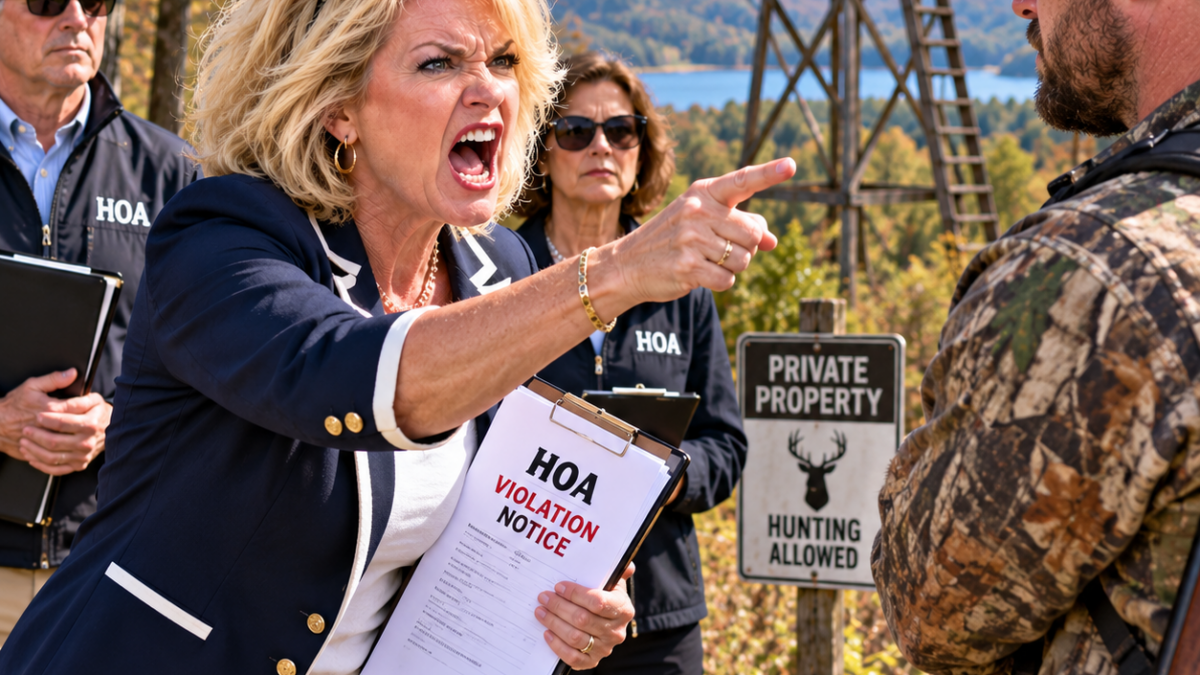
The HOA president marched onto my twenty acres and ordered me to tear down a perfectly legal deer stand, even though my deed, county map, and hunting rights all proved her subdivision ended well before my property line.
When I refused, she didn’t just send violation stickers—she started using county complaints, doctored photographs, and official-looking paperwork to make me look dangerous enough that people might stop asking whether she had any authority over me in the first place.
I thought I was fighting one angry woman with a clipboard, but the moment strangers began moving around my woods after midnight, I realized somebody wanted far more than one hunting stand gone.
The first time I saw Jelene Everly, she was standing near the western edge of my property with both hands planted on her hips, staring up at my half-finished deer stand as though I’d erected a missile silo beside a daycare.
I was thirty feet away, tightening a brace.
She didn’t wave.
Didn’t introduce herself.
Didn’t ask whether she was even on the right property.
She shouted.
“Excuse me!”
I looked down from the ladder.
“Morning.”
“What do you think you’re doing?”
That was my introduction to the president of the Spring Pines Homeowners Association.
Blonde hair tucked beneath a visor, expensive hiking shoes that had clearly never encountered actual mud, manila folder beneath one arm, and an expression that suggested everything around her was waiting for permission to exist.
“Building a deer stand.”
“I can see that.”
“Then we’re making progress.”
She didn’t appreciate that.
I climbed down.
The stand sat roughly twenty yards inside my western boundary, overlooking a shallow hollow where deer crossed between two ridges at dawn.
I’d spent the better part of a weekend building it.
Nothing ridiculous.
Strong posts.
Sturdy ladder.
Weatherproof seat.
Camouflage paint.
No utilities.
No plumbing.
No concrete foundation.
Just a legal hunting structure on twenty wooded acres I’d finally managed to buy after years of saving.
That land mattered to me.
I’d spent most of my adult life repairing other people’s cars inside a garage that smelled like oil, brake cleaner, and burnt coffee.
I wasn’t rich.
Never expected to be.
But after years of renting, noise, traffic, and watching every decent rural parcel get swallowed by subdivisions, I’d finally found twenty acres just beyond city limits.
Full hunting rights transferred with the property.
County records were clean.
No HOA.
No restrictive covenants from Spring Pines.
I’d paid an attorney to verify that before closing because the eastern tree line came within sight of the subdivision.
I wanted no surprises.
Apparently, the surprise had a visor.
“This area falls under Spring Pines,” Jelene said.
“No, it doesn’t.”
She blinked.
“Yes, it does.”
I pointed toward the trees.
“HOA boundary ends on the other side of that drainage easement.”
“Our community borders this parcel.”
“Borders isn’t owns.”
“Structures visible from Spring Pines must comply with our standards.”
“According to who?”
“The board.”
I leaned against one of the posts.
“And what does the county say?”
Her mouth tightened.
“This hunting tower creates a threatening atmosphere.”
“For whom?”
“Our residents.”
“It faces a hollow.”
“People know it’s here.”
“So?”
“Some families have children.”
I looked toward the nearest Spring Pines house, mostly hidden by trees several hundred yards away.
“The only thing threatened by this stand is a deer unlucky enough to walk through that hollow during season.”
She didn’t smile.
Instead, she opened her folder.
“Hunting structures are prohibited.”
“Inside your HOA.”
“The board interprets the rule broadly.”
“The county doesn’t.”
“I’ll be escalating this.”
“Feel free.”
“You may receive formal notice.”
“Send it to my lawyer.”
That stopped her for half a second.
“You already have an attorney?”
“I had one review the deed before I bought the land.”
Her eyes moved toward the deer stand again.
Then toward my property markers.
I saw something change.
Until that moment, I think she’d expected me to argue emotionally.
To become embarrassed.
Maybe apologize.
Instead, I’d already checked the law.
“Then we’ll see what the board says,” she replied.
“You do that.”
She turned and started walking back toward the access road.
I called after her.
“Jelene.”
She stopped.
“This is private property.”
She looked over her shoulder.
“So?”
“So next time, ask before walking onto it.”
She left without answering.
I watched her disappear between the trees and honestly believed that would be the end of it.
Two days later, I returned from the hardware store and found a bright orange sticker plastered across one of the support posts.
**NOTICE OF HOA VIOLATION**
**UNAPPROVED STRUCTURE**
**FAILURE TO REMOVE WILL RESULT IN DAILY FINES**
I stared at it.
Then laughed.
Then photographed it.
Then sent the picture to Logan Pierce, the attorney who’d reviewed my deed.
His reply came less than a minute later.
**Keep everything. Do not pay them a cent.**
The following morning, Jelene arrived again.
This time she brought backup.
Two Spring Pines board members stood beside her at the end of my driveway.
One held a clipboard.
The other looked as though he desperately wished he’d stayed home.
Jelene didn’t bother with small talk.
“We voted.”
I folded my arms.
“Congratulations.”
“You have until Friday to remove the hunting structure.”
“No.”
“Then fines begin.”
“No.”
“And the association may pursue legal action.”
I stepped off the porch.
“Let me make this simple.”
Jelene raised her chin.
“This land is mine. Your HOA doesn’t own it, doesn’t govern it, and doesn’t get to fine me for using it legally.”
She smiled thinly.
“Your property is within view of Spring Pines.”
“That’s not jurisdiction.”
“We’ll see.”
That sentence stayed with me.
Not because it sounded threatening.
Because of how calmly she said it.
Like she already had another plan.
I just didn’t know yet how far she intended to go.
PART 2
Two mornings later, my phone rang while I was opening the garage.
I almost ignored it.
Unknown number.
I was already late, and an old Silverado was waiting on my lift with a transmission leak that had somehow coated half the undercarriage.
Something made me answer.
“Quinton Granger?”
“Yes.”
“This is Patricia Wells with county zoning.”
My stomach tightened.
“What happened?”
“We received a complaint regarding an unauthorized elevated hunting structure on Parcel Forty-Seven-B.”
“Let me guess.”
She sighed before I could finish.
“Spring Pines Homeowners Association.”
I leaned against my toolbox.
“What are they claiming?”
“Unpermitted structure. Possible hunting hazard adjacent to residential property. Potential violation of height restrictions.”
“My land is agricultural-residential.”
“I know.”
“The stand isn’t thirty-five feet.”
“I know.”
“No electricity, plumbing, foundation, anything.”
“I know.”
“Then why are we talking?”
“Because when someone files a formal safety complaint, we’re required to document it.”
I closed my eyes.
“Of course.”
Patricia sounded almost apologetic.
“I can come tomorrow morning.”
“Come whenever you want.”
“Eight?”
“I’ll make coffee.”
She arrived just after sunrise in a county pickup truck.
Unlike Jelene, Patricia dressed like someone who expected to step onto rural property.
Work boots.
Jeans.
County jacket.
Measuring tape.
Clipboard with an actual government seal.
I walked her to the deer stand.
She measured the height.
Checked the placement.
Compared the GPS location to county GIS.
Examined the ladder.
Looked around the hollow.
Then wrote something.
“That bad?”
She looked at me.
“No.”
“Meaning?”
“Meaning this is legal.”
I smiled.
“Can I get that tattooed somewhere?”
She almost laughed.
“It sits well inside your property line. It’s below permit threshold, no utilities, no permanent occupied space, no zoning violation.”
“What about the threat to Spring Pines?”
She looked toward the subdivision.
Through the trees, you could barely see part of one roof.
“I’d have to use binoculars to identify this as anything other than a wooden platform.”
“That’s what I thought.”
Patricia took another photograph.
Then hesitated.
“Can I ask you something?”
“Sure.”
“Why are they this interested?”
“You should ask Jelene.”
“I did.”
“What’d she say?”
“Community safety.”
“And?”
“Property values.”
I laughed.
“Of course.”
Patricia closed her clipboard.
“There’s something you should know.”
“What?”
“If they keep filing complaints they know are baseless, the county can document abuse of the reporting process.”
“So I shouldn’t get angry?”
“You can get angry.”
She walked toward her truck.
“Just get documents while you’re angry.”
That sounded like good advice.
She left me with a written finding.
No violation.
No permit required.
Legal hunting structure.
I made three copies.
One went into my safe.
One to Logan.
One into a binder I’d started labeling:
**SPRING PINES NONSENSE**
At that point, it was mostly for amusement.
Three days later, I stopped laughing.
I came home after a long shift and saw a sign hammered into the ditch near my fence.
Not an HOA sign.
Official-looking county-style notice.
**PROPOSED REZONING HEARING**
**PARCEL 47-B**
**PETITIONING PARTY: SPRING PINES HOMEOWNERS ASSOCIATION**
**HEARING DATE: JULY 9**
I stood beside my truck staring at it.
Rezoning.
My property.
I pulled the sign from the ground.
Photographed it first.
Then drove straight to the county planning office before it closed.
The clerk found the petition.
It was real enough to have entered the administrative process.
Spring Pines requested what they called a **protective zoning overlay**.
Their argument claimed my acreage created a transitional safety conflict between rural hunting use and the residential subdivision.
The requested overlay would heavily restrict hunting structures.
Limit certain land uses.
And, depending on later approvals, allow the subdivision to push for incorporation of the affected edge into a controlled buffer zone.
Jelene’s signature appeared at the bottom.
Five other board signatures beneath hers.
I read it twice.
“They can do this?”
The clerk shifted in his chair.
“They can request it.”
“That’s not what I asked.”
“The commission can consider rezoning petitions where adjacent land uses create documented public concerns.”
“There is no documented concern.”
“They submitted one.”
He pointed.
The earlier county complaint.
Even though Patricia had cleared me, Spring Pines cited the existence of the complaint as evidence that a safety dispute existed.
I laughed once.
Cold.
“They created the complaint so they could point to the complaint.”
The clerk didn’t answer.
He didn’t need to.
“What happens if this passes?”
“Your zoning designation could change.”
“Could the HOA then claim jurisdiction?”
“Not automatically.”
“But it gets them closer.”
“Yes.”
I left with copies.
On the way home, I saw two more hearing signs posted near Spring Pines.
The presentation mattered.
They wanted residents to see my land as something already being processed.
Already becoming part of their safety problem.
I called Logan from my driveway.
He listened.
Then became very quiet.
“They’re trying forced annexation by steps.”
“Can they?”
“Direct annexation would be difficult.”
“What about rezoning?”
“That’s the opening.”
“Why?”
“If the commission establishes your parcel as a regulated buffer connected to Spring Pines’ residential interests, the HOA gains leverage.”
“To do what?”
“Demand conditions.”
“Like removing the stand.”
“Yes.”
I stared toward the trees.
“So this isn’t about one tower.”
“No.”
“It’s about making my land answer to them.”
“Exactly.”
Logan agreed to represent me.
He refused payment at first.
Called it professional curiosity.
I told him curiosity didn’t pay legal bills.
He said we’d argue later.
We started building the opposition.
County GIS maps.
Title history.
Hunting-rights documents.
Zoning rules.
Patricia’s inspection.
Statements from neighboring landowners.
A retired wildlife officer named Roy Benton agreed to testify.
He’d hunted the area for forty years.
He inspected the stand.
Called it ordinary.
Safe.
Properly positioned.
No credible danger to residential property.
The facts were on my side.
That didn’t stop Jelene.
A week before the hearing, sheriff’s deputies pulled into my driveway.
Three vehicles.
That sight does something to you even when you know you’ve done nothing wrong.
Deputy stepped out holding paperwork.
“Quinton Granger?”
“Yes.”
“We have a search warrant.”
I stared at him.
“For what?”
“Suspected unlicensed firearms modifications and hazardous hunting materials.”
For several seconds, I honestly thought I’d misunderstood.
“Say that again.”
He did.
I looked at Logan, who happened to be on speakerphone because we’d been discussing the hearing.
He heard everything.
“Do not interfere,” he said immediately. “Ask for the warrant. Document names. Let them execute it.”
I took the paper.
Anonymous tip.
Allegations of illegal modifications.
Potential dangerous materials stored near a hunting structure.
The wording sounded dramatic.
Vague.
Designed to scare a judge without saying much that could later be disproven.
The deputies searched.
House.
Shed.
Workshop.
Locked firearm storage.
Deer stand.
They found nothing unlawful.
Because there was nothing to find.
Everything I owned that required registration or documentation was compliant.
No prohibited modifications.
No explosives.
No illegal hunting materials.
Nothing remotely supporting the complaint.
The lead deputy looked increasingly uncomfortable.
When they finished, he handed me a property receipt showing nothing seized.
“Sorry about the inconvenience.”
I looked at the turned-over storage boxes inside my workshop.
“Inconvenience.”
His expression softened.
“I know.”
“Where’d the tip come from?”
“Anonymous.”
“Timing doesn’t bother you?”
He glanced toward the trees.
“What timing?”
I held up the rezoning notice.
He read it.
Then looked at the deer stand.
Then back at me.
“I don’t know who you made angry.”
“I do.”
He lowered his voice.
“This warrant moved fast.”
“What does that mean?”
“It means somebody made the complaint sound urgent.”
Then he walked toward his cruiser.
I stood in the driveway after they left.
No anger at first.
Just violation.
Strangers had opened my cabinets.
Walked through my bedroom.
Searched property I’d worked half my life to buy because someone had made an anonymous accusation.
That was when this stopped being a land-use argument.
Jelene wanted me afraid.
Maybe she wanted the neighbors afraid too.
If people believed I was dangerous, then suddenly rezoning my property sounded reasonable.
Logan arrived an hour later.
He read the warrant.
His jaw tightened.
“This is coordinated.”
“Can you prove it?”
“Not yet.”
He pointed toward the date.
“Complaint hits right before the hearing.”
“So?”
“So we ask where the call came from.”
The tip came through a prepaid number registered under a false name.
Call routed through a privacy service.
Not enough to identify the caller immediately.
Enough to make Logan suspicious.
He filed a formal complaint concerning misuse of law-enforcement reporting.
Then requested an injunction delaying any zoning action until questions surrounding the false complaint were resolved.
The story started spreading.
Not because I talked to reporters.
I didn’t.
Because rural landowners talk.
Hunters heard.
Farmers heard.
People who owned acreage outside Spring Pines heard that an HOA was trying to rezone private hunting land after filing complaints against the owner.
They started appearing at commission meetings.
Not hundreds.
Enough.
One man stood during public comment.
Vietnam veteran.
Owned fifty acres two miles north.
“If they can manufacture a safety problem on his land,” he said, “what stops another board from doing it to mine?”
Another farmer asked whether private cattle fencing would be next.
A woman who operated a horse stable asked whether Spring Pines intended to regulate manure odor outside its subdivision.
That got laughter.
Jelene answered with publicity.
Glossy flyers appeared in Spring Pines mailboxes.
**PROTECT SPRING PINES FROM ENCROACHING DANGERS**
My deer stand was on the front.
Except the photograph had been manipulated.
They enlarged the structure.
Removed most of the trees between it and the subdivision.
Composited a playground into the foreground.
From the flyer, you’d think my stand loomed directly over children on swings.
My name appeared beneath it.
**QUINTON GRANGER PROPERTY — PROPOSED HUNTING TOWER ADJACENT TO FAMILY RECREATION AREAS**
I stared at the flyer.
“Proposed?”
Logan nodded.
“It’s already built.”
“And there’s no playground there.”
“I know.”
“They fabricated the entire image.”
“I know.”
“They’re telling people I’m hunting over kids.”
“I know.”
I looked at him.
“Stop saying you know.”
He smiled thinly.
“Now you’re ready to sue.”
Defamation complaint.
We saved every version.
Flyer.
Email.
Community newsletter.
Website screenshot.
Altered photograph.
Logan labeled the binder:
**EXHIBIT A — LIES**
I told him that was unprofessional.
He changed it to:
**EXHIBIT A — MISREPRESENTATIONS**
Then wrote “LIES” beneath it in pencil.
The rezoning hearing arrived.
County meeting room packed.
Spring Pines supporters on one side.
Rural landowners on the other.
Work boots.
Camouflage hats.
HOA polos.
Polished shoes.
You could almost draw the property line down the aisle.
I sat behind Logan.
Jelene sat with the HOA board.
She looked confident.
That bothered me less than it used to.
Confidence isn’t evidence.
Logan began with the deed.
Then GIS map.
Then hunting rights.
Then zoning.
Then Patricia’s inspection.
Legal structure.
No violation.
Roy Benton testified about safety.
County officials confirmed no code issue.
Then Logan displayed the false flyer.
Original photograph beside edited photograph.
People murmured.
Then the search warrant.
Sheriff’s written confirmation that no illegal activity or prohibited items had been found.
Then Logan placed both timelines on screen.
HOA complaint.
Rezoning petition.
Anonymous law-enforcement accusation.
Public flyer.
One after another.
“This isn’t public safety,” Logan said.
“It’s pressure.”
Jelene tried to interrupt.
“Our only concern has always been protecting families—”
Commission chair stopped her.
“You’ll speak when recognized.”
Her face tightened.
Logan continued.
“Spring Pines is attempting to manufacture the conditions necessary to justify control over land it does not own.”
Then he delivered the line that turned the room completely silent.
“We have reason to believe the petition itself contains knowingly false representations submitted for the purpose of obtaining regulatory control over a private landowner.”
The commission attorney leaned toward the chair.
Whispered.
Jelene sat rigid.
After twenty minutes of deliberation, the commission returned.
Petition denied.
Not delayed.
Denied.
The chair looked directly at the Spring Pines table.
“You used county process to advance claims contradicted by our own inspections and records.”
Jelene opened her mouth.
He continued.
“That is not community protection.”
Pause.
“That is abuse of process.”
I don’t remember breathing until Logan touched my shoulder.
We’d won.
Or so I thought.
The county ethics committee opened an inquiry.
Sheriff’s office continued looking at the false tip.
Spring Pines’ nonprofit charter went under review.
Jelene’s name disappeared from the HOA website.
Residents said she’d stepped down.
I started sleeping better.
Then, three weeks later, I found survey flags.
Bright blue.
Pink.
Dozens.
Running through my eastern tree line.
They marked almost half an acre.
Thin ribbon connected several.
At the end stood a laminated sign nailed to a young pine.
**FUTURE SITE — SPRING PINES GREENWAY EXTENSION**
**COMMUNITY NATURE TRAIL & WILDLIFE OBSERVATION DECK**
Beneath that:
**APPROVED BY MUNICIPAL EASEMENT REQUEST**
I ripped nothing down.
First lesson I’d learned:
Photograph before touching.
Every stake.
Every ribbon.
Every sign.
Then county recorder’s office.
Clerk named Seth searched.
And searched.
Finally leaned back.
“No easement.”
“Pending?”
“No.”
“Municipal request?”
“No.”
“Planning?”
“No.”
“Public works?”
“No.”
“So the sign’s fake.”
“Yes.”
“Survey?”
“No authorized survey.”
I sent the photographs to Logan.
He called two hours later.
His voice was colder than mine.
“They forged government authority.”
“I figured.”
“No, Quinton. This is serious.”
“More serious than the search warrant?”
“Different serious.”
He notified the court.
County attorney.
Sheriff.
Investigator Deputy Halvorson met me at the property.
We walked the flagged line.
He photographed barcode stickers.
Bagged one marker.
“Any cameras?”
I pointed thirty feet up a pine.
Trail camera.
Night vision.
He looked up.
“Good.”
Footage showed two men entering around midnight.
High-visibility vests.
Spring Pines polos.
Blueprint.
Hammer.
One carried survey stakes.
The other drank beer.
At one point he threw a can into my woods.
That annoyed me almost as much as the fraud.
Faces clear.
Both HOA board members.
One was the treasurer.
Warrants followed.
Unauthorized entry.
Fraudulent representation of municipal authority.
Potential conspiracy.
The sheriff held a press conference.
Spring Pines residents finally saw what had been happening outside their subdivision.
Several board members resigned.
Treasurer’s wife resigned from the landscaping committee.
Vice president stepped down.
Everyone seemed ready to let the board collapse.
Everyone except Jelene.
She created a new position.
**INTERIM COMPLIANCE DIRECTOR**
No election.
No legitimate vote.
She simply mailed residents a memo saying she’d assumed unilateral authority to respond to “external threats.”
A nurse named Mallory brought me the letter.
She lived just outside Spring Pines too.
Two children.
Small house on three acres.
“This woman is losing it.”
I read the memo.
“She thinks she’s gaining power.”
Mallory looked toward my woods.
“I don’t care about hunting.”
“Okay.”
“I mean, I personally don’t hunt.”
“Fine.”
“But I care that she thinks she can decide what happens on somebody else’s land.”
“That’s the actual issue.”
She nodded.
“If you need speakers at the next commission meeting, I’m in.”
We organized.
Not anti-HOA extremists.
Ordinary people.
Teacher.
Nurse.
Veteran.
Retired biologist.
Former city planner.
Farmers.
People who believed boundaries mattered.
Then the deer stand burned.
I was repairing the equipment-shed roof when I heard popping from the western woods.
At first, I thought branches were breaking.
Then smoke rose.
Thick.
Gray.
I ran.
By the time I reached the hollow, flames had eaten through the ladder.
The base burned hot.
Chemical smell.
One support cracked.
Platform leaned.
Then collapsed.
I stood twenty yards away filming with shaking hands.
I’d spent a weekend building that stand.
That wasn’t why I felt sick.
Fire in dry woodland doesn’t care about property disputes.
Wind could’ve carried it.
Across my twenty acres.
Toward Mallory’s house.
Toward Spring Pines.
Toward anybody.
Volunteer fire department arrived.
Cut a line.
Extinguished brush.
Arson investigator arrived later.
He found accelerant.
Citronella torch fuel.
Deliberate ignition.
Somebody wanted that stand gone badly enough to light the woods on fire.
That night I sat at my kitchen table with Logan.
Neither of us spoke for a while.
Then he said,
“You done?”
I looked at him.
“With what?”
“This.”
“You asking if I’m backing off?”
“Yes.”
“No.”
“Good.”
I expected him to smile.
He didn’t.
“This has become dangerous.”
“I know.”
“Then listen.”
He leaned forward.
“We do everything through law enforcement now.”
“No confrontation.”
“None.”
“No going after Jelene yourself.”
“I wasn’t planning to.”
“Good.”
“She’s your suspect?”
“She’s everyone’s obvious suspect.”
“That’s not evidence.”
“Exactly.”
A neighbor’s security camera had caught a figure moving near my tree line around two in the morning.
Blurry.
Dark clothes.
Short stride.
Slight limp.
Jelene had a limp from an old tennis injury.
Enough to raise questions.
Not enough to prove arson.
Sheriff’s investigators interviewed her.
Searched her car under warrant.
Trunk contained a half-used can of citronella torch fuel.
Matches from a barbecue place twelve miles away.
Suspicious.
Still not enough by itself.
No arrest for the fire.
Yet.
So we attacked what we could prove.
Civil lawsuit.
Trespass.
Fraud.
Property damage.
Harassment.
Defamation.
Abuse of process.
Environmental damage.
Illegal surveillance claims tied to the false reporting.
Logan filed everything.
County commission ordered an audit of Spring Pines.
And that’s when the entire thing cracked open.
The deer stand had been the spark.
Money was the fuel.
Invoices to companies nobody recognized.
Landscaping contracts three times market rates.
“Community safety consultations” that actually reimbursed private trips.
Maintenance funds routed through shell companies.
Three vendor businesses tied to Jelene’s cousin.
One to a former boyfriend.
Another registered to a post-office box two counties away.
Residents had paid increasing dues for two years.
No major road repair.
No meaningful new amenities.
No upgraded common areas.
Just rules.
Letters.
Consultants.
And money disappearing.
A forensic review estimated more than seventy percent of one year’s discretionary spending had moved into companies connected to Jelene or people close to her.
Spring Pines residents exploded.
More than a hundred attended the emergency session.
Some shouted.
Some cried.
A man held up three years of dues statements.
“Where did my money go?”
Nobody on the remaining board answered.
A woman yelled,
“You told us dues increased because of security!”
Another:
“My streetlight hasn’t worked in eleven months!”
Another:
“You fined me four hundred dollars for my fence while paying your cousin forty thousand!”
The meeting became the revolt Jelene had spent years preventing.
Residents voted to dissolve the board pending investigation.
Neutral oversight panel appointed through the county.
Jelene didn’t attend.
A warrant was issued days later.
Three felony fraud counts.
Criminal trespass.
Filing a false public notice.
Other charges under review.
Deputies went to her home.
She ran.
Not far.
Across her backyard.
Toward a rear gate.
Deputy Halvorson caught her near a row of ornamental grass.
A neighbor filmed part of it from an upstairs window.
I didn’t watch the video.
Didn’t need to.
When Reyes called me, I was standing near the blackened remains of the deer stand.
“They got her.”
I looked at the charred posts.
“What happened?”
“Tried to leave through the back.”
“That sounds dignified.”
“Don’t enjoy it too much.”
“I won’t.”
“You rebuilding?”
I looked at the wreckage.
“Absolutely.”
The second stand was better.
Reinforced steel brackets.
Rust-resistant fasteners.
Stronger crossbeams.
Weatherproof roof.
I painted parts of it blaze orange.
Not camouflage.
People asked why.
“Visibility.”
Truth was, I was done hiding it.
The new oversight committee sent me an apology.
Every interim member signed.
They enclosed a two-thousand-dollar check toward reconstruction.
I stared at it for an hour.
Then donated it to the volunteer fire department.
They’d stopped the burn from becoming something catastrophic.
Chief called.
“You didn’t have to do that.”
“Neither did your volunteers.”
He understood.
Fall approached.
For a few weeks, the woods felt like mine again.
Then the civil court date arrived.
Logan had turned evidence collection into an art form.
Color-coded binders.
Tabs.
Timelines.
Maps.
Photographs.
Financial records.
I carried the one marked:
**FRAUDULENT EASEMENT / FINANCIAL MISCONDUCT**
The courtroom was nearly full.
Former Spring Pines residents.
Reporters.
Sheriff Halcom.
County officials.
People who had followed the story.
Jelene wasn’t there.
Her attorney said she was receiving treatment for stress-related medical issues while detained.
Judge didn’t comment.
Logan opened simply.
“This case began with a deer stand.”
He looked toward the judge.
“But it is not about a deer stand.”
Then he laid out the timeline.
Legal purchase.
Hunting rights.
County zoning.
HOA demand.
Violation sticker.
County complaint.
Legal inspection.
Rezoning petition.
False law-enforcement accusation.
Defamatory flyers.
Denied petition.
Fake municipal easement.
Midnight trespass.
Arson.
Financial records.
Shell companies.
One piece after another.
The defense objected occasionally.
Not much.
The evidence was too clean.
Trail-camera footage entered.
Fake easement sign entered.
County certification entered.
Altered flyer entered.
Survey flags.
Board emails.
Then the accountant.
He explained money flows.
Spring Pines accounts.
Vendor payments.
PO boxes.
Companies tied to Jelene.
More than forty thousand dollars to one “community beautification” company for landscaping that didn’t exist.
Seventy percent of discretionary spending routed into three connected entities.
Judge leaned forward.
“Have criminal referrals been made?”
“Yes, Your Honor.”
“To?”
“District attorney and state controller.”
The judge wrote something.
We rested before lunch.
Defense requested recess.
Fifteen minutes later, Logan leaned toward me.
“They’re going to offer money.”
“How much?”
“Doesn’t matter yet.”
“It doesn’t matter at all.”
He looked at me.
“You sure?”
“I didn’t come here for a check.”
“What do you want?”
I looked around the courtroom.
Permanent boundary protection.
Public finding.
No more opportunity for another board to try this quietly.
“Make the record matter.”
Court resumed.
Defense offered settlement.
Lump sum.
Formal apology.
Legal fees.
Release of liability for the new oversight board.
Logan stood.
“Respectfully, we decline.”
Whispers filled the room.
Jelene’s attorney looked almost offended.
Judge raised an eyebrow.
“Mr. Pierce?”
Logan buttoned his jacket.
“Your Honor, compensation alone does not address the conduct.”
He pointed toward the binders.
“This association attempted to obtain control over land it did not own, submitted false information through governmental processes, entered private property without permission, represented fabricated municipal authority, and used public agencies as instruments of pressure.”
He paused.
“We request permanent injunctive relief protecting Mr. Granger’s parcel from HOA claims, judicial review of the Spring Pines charter, and appointment of a neutral trustee pending completion of the criminal and financial investigations.”
The defense attorney rose.
“That’s extraordinary.”
Judge looked at him.
“So is the evidence.”
Silence.
The order came that afternoon.
Permanent injunction.
Spring Pines prohibited from asserting authority over my land.
Old board stripped of power.
Association charter placed under supervised re-registration.
Court-appointed trustee.
Former board members barred from leadership roles for at least ten years.
I sat there listening.
Months of anger compressed into legal language.
Dry.
Precise.
Beautiful.
Outside, reporters crowded us.
One shouted,
“What does today’s ruling mean to you?”
I didn’t want a speech.
I held up the order.
“This is what happens when you push too far.”
That quote ended up everywhere.
By Friday, the district attorney announced expanded indictments.
Jelene:
Six counts of wire fraud.
Two conspiracy counts.
Attempted land seizure under false pretenses.
Additional state charges related to falsified filings.
IRS investigation for undeclared income.
Bail denied.
Flight risk.
The two men caught planting survey stakes accepted deals.
Probation.
Restitution.
Community service.
Public apologies.
I attended the apology meeting because Mallory asked me to.
One man couldn’t get through his statement.
“I told myself it was just board business.”
People shouted.
He stopped.
Started again.
“I knew the land wasn’t ours.”
That silenced the room.
“I knew.”
His voice cracked.
“But Jelene said if we created the trail project first, the county would eventually recognize the easement.”
There it was.
Act first.
Normalize later.
Same strategy from the beginning.
The county commission changed rules.
HOA boundaries had to be formally filed and accessible.
External rezoning requests without owner consent faced automatic heightened review.
Financial statements quarterly.
False jurisdiction claims referred for investigation.
People started attending commission meetings.
Not because they loved government.
Because they’d learned silence leaves empty seats.
Mallory joined the new Spring Pines community council.
She sent me a handwritten note months later.
Inside was a photograph.
A doe walking beneath my rebuilt stand.
Her daughter had taken it from a trail.
On the back:
**Looks very threatening.**
I laughed.
Framed it.
Hunting season arrived.
First morning, I climbed the stand before dawn.
Cold enough to sting my fingers.
I sat in the dark listening.
Leaves moving.
Owl.
Distant truck.
Then quiet.
No Lexus.
No board member.
No survey crew.
No sheriff coming because someone made a fake accusation.
Just woods.
I didn’t fire a shot that morning.
Didn’t need to.
A buck crossed the hollow.
Paused.
Disappeared.
I watched.
That was enough.
People assume hunting is always about pulling a trigger.
Often it’s about sitting still long enough to remember you’re small.
Trees don’t care about HOA politics.
Deer don’t know what rezoning means.
Dawn arrives without checking bylaws.
I needed that.
But the legal story wasn’t finished.
State news picked up the case.
Investigative reporter obtained financial records.
Spring Pines became an example of HOA overreach mixed with financial corruption.
Other residents came forward.
One said Jelene had threatened foreclosure over landscaping fines.
Another claimed the board had altered meeting records.
Another had questioned vendor costs and suddenly received three violations in one month.
The pattern widened.
Logan warned me.
“Publicity brings more cases.”
“Not mine.”
“Sometimes.”
“I just want my woods.”
“I know.”
“You keep saying that.”
“Because you keep forgetting lawsuits have gravity.”
He was right.
People called.
Landowners.
HOA residents.
Hunters.
Farmers.
Some wanted advice.
Some wanted to complain.
One man drove forty miles just to shake my hand.
I hated that part.
Not the gratitude.
The attention.
I hadn’t bought twenty acres to become recognizable in a courthouse hallway.
So when the State Landowners Association invited me to speak, I declined.
Sent the ruling instead.
Sent county regulations.
Told them to use the paperwork.
Not me.
Months later, Jelene’s criminal case moved toward trial.
Then plea negotiations.
Then collapsed.
She refused the first offer.
Prosecutors added financial counts.
Her cousin’s companies became part of the evidence.
IRS joined.
Former board members cooperated.
One handed over internal messages.
In one, Jelene discussed my property.
**GRANGER WILL EVENTUALLY YIELD IF PRESSURE REMAINS CONSISTENT.**
Another:
**MAKE HUNTING ISSUE ABOUT CHILD SAFETY, NOT PROPERTY CONTROL.**
Another:
**GREENWAY CREATES BEST PATH TO PERMANENT EASTERN BUFFER.**
I read those messages in Logan’s office.
My hands didn’t shake anymore.
That’s what surprised me.
Early in the fight, every new document felt like an insult.
Now they felt like exhibits.
“You okay?” Logan asked.
“Yeah.”
“You don’t look angry.”
“I think I’m past angry.”
“What are you?”
“Tired.”
He closed the file.
“Good sign.”
Trial eventually produced a plea after the financial evidence became overwhelming.
Jelene admitted to major fraud conduct.
False filings.
Misuse of association money.
Conspiracy tied to property-control efforts.
The exact sentencing structure stretched across state and federal exposure.
Long enough that Spring Pines would move on without her.
Restitution.
Forfeiture.
Permanent restrictions.
Residents would recover some money.
Not all.
Never all.
Money had been spent.
Moved.
Hidden.
People asked me if the sentence satisfied me.
I didn’t know how to answer.
Prison didn’t rebuild the burned stand.
Didn’t erase the search warrant.
Didn’t remove the memory of deputies opening my workshop because a stranger lied.
Didn’t give Spring Pines residents back years of dues.
But accountability mattered.
The night after sentencing, Mallory called.
“You watching the news?”
“No.”
“Good.”
“Why?”
“They’re outside her house.”
“Not interested.”
Pause.
“You really aren’t?”
“No.”
That surprised her.
It surprised me too.
Revenge had sounded satisfying when the stand burned.
I imagined watching Jelene lose everything.
But by the time she did, I had something better.
My land back in my head.
That sounds strange.
Legally, it had always been mine.
But harassment changes the way you experience property.
Every engine on the road becomes suspicious.
Every reflective vest near the tree line becomes a possible trespasser.
Every official envelope raises your heart rate.
Ownership becomes vigilance.
Peace means stopping that.
Slowly, I stopped checking the trail cameras every hour.
Stopped walking the eastern boundary every evening.
Stopped photographing every tire track.
The cameras stayed.
But fear left.
That was victory.
Spring Pines reorganized.
No longer the kingdom Jelene built.
New board.
Term limits.
Published finances.
Outside audits.
Resident petition rights.
County oversight during transition.
Mallory became one of the strongest voices against unnecessary enforcement.
I teased her.
“You joined the enemy.”
She rolled her eyes.
“I’m preventing another Jelene.”
“That’s what everyone says before buying a clipboard.”
“I hate you.”
“No you don’t.”
The new board actually invited neighboring landowners to an open forum.
Not to annex us.
To talk.
Shared concerns.
Road drainage.
Wildfire access.
Wildlife crossings.
Things that genuinely crossed property lines.
I attended.
Suspiciously.
First agenda item:
“How can Spring Pines improve relations with adjacent rural parcels?”
I raised my hand.
“Stop trying to steal them.”
People laughed.
Even the board chair.
Good start.
They established a simple rule.
No HOA representative enters neighboring property without permission unless responding to an immediate emergency alongside lawful authorities.
Seems obvious.
Apparently needed writing down.
Another rule required legal review before any public filing affecting outside parcels.
Again.
Obvious.
The irony was hard to miss.
Jelene claimed my deer stand threatened community peace.
After she was gone, actual cooperation became possible.
One spring, a storm knocked trees across the access road.
Spring Pines residents came out with chainsaws.
I brought my tractor.
Roy brought equipment.
We cleared everything.
Nobody asked which side of the HOA boundary each branch landed on.
Real emergencies make fake authority look ridiculous.
The volunteer fire department used part of my restitution donation for new brush-fire equipment.
Chief showed me.
I felt better about that than any legal check.
The deer stand fire could’ve become catastrophic.
If wind had shifted, we’d be telling a different story.
That thought kept me humble.
Somebody’s obsession with control had almost burned trees that had been standing before Spring Pines existed.
The arson count remained complicated.
Circumstantial evidence linked Jelene.
Fuel in her vehicle.
Limp.
Timing.
Other conduct.
But prosecutors couldn’t establish enough for the strongest charge beyond reasonable doubt.
That frustrated people.
“Everyone knows she did it,” a neighbor said.
Maybe.
Knowing isn’t proving.
I had spent the entire case insisting facts mattered.
Couldn’t abandon that principle when uncertainty became inconvenient.
The civil case compensated the destruction.
Criminal case punished what prosecutors could prove.
That had to be enough.
Logan respected that.
“You’re becoming reasonable.”
“Don’t insult me.”
He laughed.
Years passed.
The rebuilt stand weathered.
Orange paint faded.
I replaced boards.
Added rust-proof brackets.
Installed a small solar light underneath—not shining into the woods, just enough to safely see the ladder area when needed.
Inside the platform, I screwed in a brass plaque.
**PRIVATE PROPERTY**
**NO TRESPASSING**
**NO EXCEPTIONS**
Roy saw it.
“Subtle.”
“Learned subtlety from Spring Pines.”
He laughed.
Another season, Mallory’s daughter asked if she could photograph wildlife from the stand outside hunting season.
I said yes.
That’s consent.
Simple thing.
She spent three mornings there with a camera.
Got beautiful shots.
Turkey.
Fox.
Owls.
Doe with two fawns.
Spring Pines newsletter asked permission to publish one.
Permission.
Again.
Simple.
I agreed.
They printed the photograph beside an article about preserving wildlife corridors around the subdivision.
Nobody mentioned banning the stand.
People can learn.
Even organizations.
That’s the part outrage stories usually skip.
After the villain leaves, people still need to live together.
If everyone stays angry forever, the villain still controls the neighborhood.
Spring Pines had to become something else.
It did.
Not perfect.
Never will be.
One board meeting later got heated over roof colors.
Humanity survived.
But no one forged an easement.
Progress.
The county used my case in planning training.
Logan sent me a slide from a workshop.
Title:
**JURISDICTIONAL OVERREACH AND ABUSE OF LAND-USE PROCESS: SPRING PINES CASE STUDY**
I texted:
**Needs more deer.**
He replied:
**Needs fewer clients like you.**
The state landowners group kept copies of the permanent injunction.
Other rural owners used the structure of our case when fighting improper external HOA claims.
Again, that mattered more than speeches.
A ruling lasts longer than applause.
One winter afternoon, I found the original orange violation sticker in my legal box.
I’d saved it.
**STRUCTURE NOT APPROVED BY HOA**
I held it beside the final permanent injunction.
First document represented fake authority.
Second represented actual authority telling fake authority to stop.
I framed both in the garage.
Customers ask sometimes.
“What happened?”
I say,
“Long story.”
Most don’t need the whole thing.
But occasionally someone says,
“I’ve got an HOA problem too.”
Then I ask one question.
“Are you actually in the HOA?”
You’d be amazed how often people don’t know.
Some are.
Some aren’t.
The lesson isn’t that every HOA lacks authority.
It’s that authority should match the document that creates it.
My land wasn’t Spring Pines.
That fact never changed.
Jelene tried to make perception outrun law.
She almost succeeded because perception is powerful.
Tell enough parents there’s a hunting tower near children, they worry.
Show an edited photograph, they imagine danger.
File complaints, people assume smoke means fire.
Get deputies to search a property, rumors begin.
Then rezoning can look like protection rather than conquest.
That was sophisticated.
More sophisticated than I initially gave her credit for.
Her mistake was documentation.
Manipulation leaves tracks.
Emails.
Dates.
Maps.
Money.
Footage.
Once Logan aligned the timeline, the story became obvious.
First, create fear.
Second, create administrative record.
Third, demand regulation.
Fourth, establish access.
Fifth, normalize control.
The fake greenway revealed the endgame.
If those flags had stayed a few months, residents might have begun walking the “trail.”
Then people say:
We’ve always used it.
Then Spring Pines argues community reliance.
Then lawyers argue easements.
I learned that from Logan.
Property fights aren’t always dramatic land grabs.
Sometimes someone puts a sign up.
Then waits.
That’s why I removed nothing until law enforcement photographed it.
Evidence first.
Emotion second.
That principle served me well.
The false search tip was never definitively attributed publicly.
Investigators linked communications and timing but the prepaid routing complicated proof.
Some people wanted me to say Jelene had called.
I wouldn’t.
Couldn’t prove it.
Same with the fire.
What I could say was already enough.
Her documented actions destroyed her credibility.
No need to improve the story with claims I couldn’t establish.
Truth was dramatic enough.
Late one summer, I invited Roy, Mallory, Logan, and a few neighbors for dinner.
We grilled behind the house.
Logan looked toward the stand barely visible through trees.
“You ever think about tearing it down?”
“Why?”
“I don’t know. Whole thing carries history.”
“That’s exactly why it stays.”
Mallory laughed.
“Spite stand.”
“No.”
Roy nodded.
“Absolutely spite stand.”
“It’s a hunting stand.”
“With legal symbolism.”
I gave up.
Maybe they were right.
But symbols can change.
At first it represented resistance.
Later, peace.
A place to sit before sunrise.
A place for Mallory’s daughter to photograph deer.
A structure that existed because I wanted it there.
Not because someone approved it.
Not because someone disapproved.
That’s ownership.
One fall morning, I climbed before dawn and found frost on the steps.
I sat wrapped in a jacket.
The sky lightened.
A doe moved through the hollow.
Then another.
Behind them, a young buck.
I watched through binoculars.
No shot.
Not the right one.
They disappeared.
For ten minutes I heard nothing.
Then distant laughter from Spring Pines.
Kids waiting for a school bus.
The sound carried through cold air.
Jelene had claimed the stand threatened families.
There I was.
Families living normally.
Deer moving normally.
Me sitting quietly.
Nothing threatened anybody.
Fear had been the product.
Control had been the goal.
Once control disappeared, so did the crisis.
That’s a useful thing to remember.
Not every emergency is real.
Sometimes the person selling the solution manufactured the problem.
Spring Pines residents learned that the hard way through their finances.
Dues had increased because Jelene claimed rising safety and maintenance costs.
But shell companies absorbed money.
Fake landscaping.
Fake consulting.
Private travel.
The board kept people focused on violations while funds moved elsewhere.
Noise can hide theft.
Constant outrage gives people no attention left for accounting.
After reform, quarterly financial meetings were boring.
Wonderful.
Receipts.
Vendor bids.
Bank statements.
Questions.
Nobody enjoyed them.
That’s healthy.
Government and associations should occasionally be boring.
Drama is expensive.
Mallory eventually became council chair.
Not HOA president.
They deliberately avoided concentrated titles for a while.
She lasted two years then stepped aside.
When she told me, I said,
“Power finally corrupt you?”
She said,
“School schedules.”
Much more dangerous.
Her replacement was an accountant who refused to approve any expenditure without documentation.
Jelene would’ve hated him.
Spring Pines’ dues actually dropped.
Imagine that.
When shell companies stop absorbing seventy percent of discretionary spending, budgets improve.
Some residents apologized to me years later.
Especially ones who’d believed the flyers.
One father approached me near the hardware store.
“I thought you were nuts.”
“Maybe I am.”
“No, I mean the hunting thing.”
“I know.”
“They showed us that picture.”
“The fake playground?”
“Yeah.”
He looked embarrassed.
“My wife was terrified.”
“That was the goal.”
“I said some things at meetings.”
“I don’t remember.”
I did.
But he needed an exit more than I needed an apology.
He held out his hand.
“Sorry.”
I shook it.
“Done.”
That’s another lesson.
People manipulated by a liar aren’t always your enemies.
Sometimes they’re part of the audience.
If I’d treated every Spring Pines resident like Jelene, the conflict would’ve become exactly what she wanted.
Rural landowners versus suburban families.
Hunters versus parents.
Us versus them.
Instead, once documents came out, many residents became witnesses against their own board.
Truth changed sides.
The retired planner who helped us later said something I kept.
“Bad governance survives by turning procedural disputes into identity wars.”
He was right.
Jelene framed me as dangerous hunter.
I could’ve framed everyone in Spring Pines as entitled suburban invaders.
Both stories would’ve been easy.
Neither accurate.
The actual problem was narrower.
A board president abused authority and processes to control land her association didn’t own.
Stay precise.
Win precisely.
Logan taught me that.
Whenever I wanted to put something angry in a filing, he’d ask:
“Can you prove that sentence?”
If no, delete it.
If yes, attach exhibit.
Beautiful system.
The last major financial restitution arrived years later.
Spring Pines homeowners recovered portions of misused dues through asset liquidation and insurance claims.
My civil damages covered the stand, legal costs, property damage, and part of the harassment-related losses.
I used some to improve wildfire breaks around my acreage.
Felt appropriate.
County fire department advised me.
We cleared brush.
Created access.
Real safety work.
No glossy flyer required.
The eastern half-acre where fake greenway stakes once stood grew thick again.
I kept one blue survey marker.
It’s in my garage beside the orange sticker.
Maybe I collect bad decisions.
One day, Mallory’s son saw it.
“What is that?”
“A souvenir.”
“From what?”
“People trying to steal half an acre.”
His eyes widened.
“They tried to steal your land?”
“Long story.”
“Did you fight them?”
“Legally.”
He looked disappointed.
Kids prefer sword fights.
“Was there a battle?”
“County planning meeting.”
“That’s boring.”
“You have no idea.”
I laughed.
He ran off.
Good.
Maybe his generation won’t need to understand every detail.
Maybe clear rules will just be normal.
That’s the best result of precedent.
Future people get boring lives.
Years after Jelene, a developer approached me with an offer.
My twenty acres had increased considerably in value.
Spring Pines had expanded internally, not onto my land.
Developer wanted a portion for a road connection.
Good money.
Very good.
I said no.
He increased it.
Still no.
Finally asked,
“Sentimental?”
“Partly.”
“Everyone has a price.”
“Probably.”
“What is yours?”
I looked toward the western trees.
“Higher than yours.”
He left.
No threats.
No fake petitions.
No anonymous tips.
Just negotiation.
That’s how property is supposed to work.
Ask.
Offer.
Owner decides.
Simple.
Consent makes all the difference.
One day, I may sell.
Maybe not.
If I do, it’ll be because I choose.
Not because someone makes ownership unbearable.
That’s what Jelene attempted.
Pressure until surrender.
I’m grateful she failed.
Not because I enjoy conflict.
Because success would’ve taught others the method worked.
The county’s automatic-denial rule for external rezoning without owner participation came directly from the case.
That’s stronger than my individual victory.
It changed incentives.
Boards now know trying the same tactic brings scrutiny instantly.
Documents must disclose boundaries.
Residents can inspect financial records.
False public notices trigger referral.
You make abuse expensive enough, suddenly people discover restraint.
Funny how that works.
Logan eventually stopped doing land-use cases.
Too stressful, he said.
I reminded him he took mine pro bono.
“That was my first mistake.”
“You loved it.”
“I loved winning.”
“Same thing.”
“Absolutely not.”
He moved into estate planning.
Boring wills.
Quiet trusts.
Probably happier.
We still fish sometimes.
He complains I never paid him.
I remind him the county used his brief as a model.
He says models don’t buy boats.
Fair.
I bought him a very expensive bottle of bourbon.
He called it partial restitution.
Patricia retired.
At her retirement party, somebody told the story of the “dangerous illegal hunting tower” she inspected.
She pointed at me.
“That man wasted fifteen minutes of my life.”
“Jelene filed it!”
“You made coffee.”
“Exactly.”
“Bad coffee.”
Unforgivable.
Toddler-level grudges are healthy after major disputes.
Deputy Halvorson later told me my trail-camera footage became part of training for evidence preservation.
He still teased me.
“Thirty feet up?”
“Best angle.”
“You could’ve fallen.”
“Didn’t.”
“That’s not safety.”
“Ask the HOA.”
He laughed.
Sheriff Halcom retired too.
Small counties age together.
The institutions remain.
People cycle through.
That makes accountability matter.
You don’t want safety dependent on one good official.
You want process.
Records.
Rules.
Appeals.
Transparency.
I used to hate bureaucracy.
Still mostly do.
But bureaucracy saved me when properly used.
County GIS.
Inspection report.
Court filings.
Public records.
The same kind of paperwork Jelene tried to weaponize became the thing that stopped her.
The answer to abusive process isn’t no process.
It’s honest process.
That’s a more mature conclusion than I expected to reach over a deer stand.
Maybe getting older does that.
Or maybe spending months with Logan ruined me.
The deer stand needed a major rebuild after about eight years.
Weather.
Not arson.
I considered replacing it entirely.
Instead, I salvaged what I could.
Some original steel brackets.
Plaque.
One charred section from the first stand I’d kept in the barn.
I mounted that charred wood beneath the seat.
Nobody sees it unless they climb up.
On it, I wrote the date of the fire.
Not Jelene’s name.
Just date.
Because the lesson outlasts the person.
People like making stories about villains.
Villains eventually leave.
Systems matter more.
Boundaries matter.
Evidence matters.
Community matters.
Restraint matters.
That’s what stays.
On the tenth anniversary of buying the land, I walked the entire perimeter.
Twenty acres takes time.
Western hollow.
Northern ridge.
Eastern edge by Spring Pines.
Southern creek.
Property markers still there.
Legitimate ones.
Some fences repaired.
Some replaced.
I stopped where the fake greenway sign once stood.
There was no scar left.
Trees filled in.
A young oak grew close to the spot.
I remembered the words:
**FUTURE SITE — SPRING PINES GREENWAY EXTENSION**
So confident.
So official.
So false.
I touched the oak.
Then kept walking.
At the stand, I climbed.
Sat.
The woods looked smaller than they had ten years earlier.
Maybe because I knew them now.
Or maybe because fear enlarges landscapes.
When you think someone might enter at midnight, every shadow stretches.
When you’re at peace, woods return to being woods.
A deer moved between trees.
Wind.
Birds.
From far away, a lawn mower in Spring Pines.
Normal.
I thought about the first day Jelene approached.
“What do you think you’re doing?”
Building a deer stand.
That’s all.
If she’d accepted that answer, none of the rest happens.
No county inspection.
No rezoning scandal.
No search warrant.
No defamation case.
No forged greenway.
No arson investigation.
No financial audit.
No arrests.
No court injunction.
No reform.
Her inability to hear “no” destroyed everything she’d built.
That’s the core of it.
Not hunting.
Not HOA rules.
Not property values.
Consent.
She believed her title meant she never had to accept another person’s boundary.
Physical or otherwise.
When I said the land wasn’t hers, she didn’t adjust.
She escalated.
When county said the stand was legal, she escalated.
When planning denied rezoning, she escalated.
When board members began quitting, she escalated.
She couldn’t stop because stopping would’ve required admitting the authority she imagined never existed.
Pride is expensive.
Spring Pines paid for hers.
So did I.
But eventually she paid too.
People ask if I hate her.
No.
That’s not forgiveness.
Just reality.
Hate requires maintenance.
I’ve got engines to rebuild.
Fences.
Hunting season.
Life.
She took enough time already.
I won’t volunteer more.
The brass plaque still hangs inside the stand.
**PRIVATE PROPERTY. NO TRESPASSING. NO EXCEPTIONS.**
Underneath, Mallory’s daughter once added a tiny removable sticker.
**DEER EXEMPT**
I left it.
Better rule.
One October morning, I took a thermos up before sunrise.
No weapon that day.
Just camera.
Wanted to watch.
Fog sat in the hollow.
First light turned everything silver.
A doe appeared.
Then another.
One walked directly beneath the stand.
Paused.
Looked up.
For a ridiculous second, I imagined Jelene describing the scene as a threat to public safety.
I smiled.
The deer moved on.
Sun climbed.
I poured coffee.
Steam rose.
And I felt something I hadn’t felt during the entire first year I owned the land.
Nothing.
No anger.
No vigilance.
No need to prove anything.
Just presence.
That’s peace.
Not victory music.
Not courtroom applause.
Not watching someone arrested.
Peace is when the conflict stops renting space in your head.
That’s the ending I care about.
Jelene wanted my deer stand gone because she believed anything visible from Spring Pines should answer to Spring Pines.
Instead, her attempt to control twenty acres outside her jurisdiction exposed false filings, midnight trespassing, financial corruption, shell companies, fraudulent land-use tactics, and a board that had forgotten the difference between leadership and ownership.
The stand survived.
Her authority didn’t.
The HOA survived only after being stripped down and rebuilt under rules that actually respected the people around it.
My land remained mine.
The county strengthened its protections.
Residents recovered part of what had been stolen.
And the woman who once marched into my woods waving a folder like a badge eventually learned the hardest lesson a control freak can learn:
A title does not erase a boundary.
A vote does not create ownership.
Fear does not become law because you print it on glossy paper.
And private land does not become yours just because the owner refuses to obey you.
I bought twenty acres for hunting, quiet, and enough distance from other people that I could finally hear the wind move through trees again.
For a while, Jelene almost took the quiet from me.
She never took the land.
Now, when I climb that stand and look over the hollow, I don’t see a monument to revenge.
I see a line that held.
Not a fence.
Not a wall.
A line made of deed records, evidence, neighbors willing to speak, officials willing to check facts, and one word Jelene could never accept.
No.
Sometimes that’s all a boundary needs.
And mine isn’t moving.








