PART 2: HOA Tried Billing Me for a Farm They Never Owned—Then Their Fake “Condemnation” Notice Exposed a Land-Grab Scheme
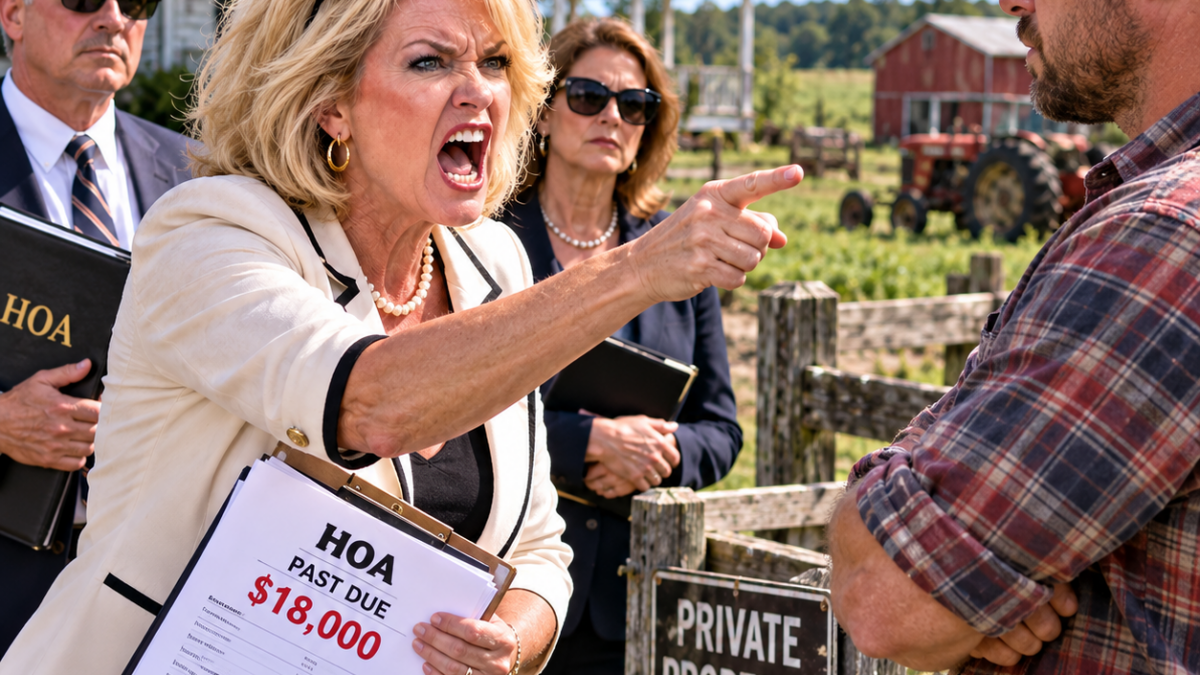
The first thing the HOA ever gave me was a glitter-pen note demanding cash for land they had never owned, never governed, and legally couldn’t even touch.
A week later, they sent a tow truck for my pickup and slapped a fake “CONDEMNED” notice across the front door of the farmhouse I had just bought outright, as if a suburban board president could somehow erase my deed with a red sticker and a clipboard.
What none of them realized was that the moment they tried turning my ten acres into their property on paper, they handed me the one thread that would eventually unravel something far bigger than a neighborhood dues dispute.
The note was duct-taped to my mailbox.
Not mailed.
Not certified.
Not even folded.
Just a piece of white printer paper covered in faded pink ink that looked suspiciously like somebody had written it with a glitter pen.
**WELCOME TO THE COMMUNITY.**
**PLEASE DROP OFF YOUR HOA DUES AT VALERIE’S HOUSE, THIRD ON THE LEFT, BEFORE FRIDAY.**
**$400. CASH ONLY.**
I stood beside the road staring at it for several seconds before I started laughing.
Maybe exhaustion had something to do with it.
I’d spent the previous week sleeping on an air mattress inside a farmhouse built sometime in the 1940s, eating sandwiches over a sink that leaked into a bucket, and discovering a new surprise every time I opened a wall.
The kitchen wiring looked like three generations of drunk electricians had taken turns improvising.
Half the porch sagged.
The old barn door hung crooked on one hinge.
The upstairs bathroom had plumbing but no functioning toilet.
An ancient windmill leaned behind the barn like it had given up sometime during the Carter administration.
But the place was mine.
Ten acres.
Paid for.
No mortgage.
No landlord.
No neighbor on the other side of an apartment wall practicing drums at midnight.
The property had come through a county foreclosure auction after sitting vacant for nearly two years.
Most buyers saw cracked siding, overgrown fields, rusted fencing, and enough deferred maintenance to scare off anyone with a functioning calculator.
I saw possibility.
I’d spent most of my adult life as an electrician, doing commercial jobs, residential rewires, service calls, remodels—anything that paid.
My back wasn’t getting younger, and neither was I.
At forty-three, I wanted land.
Space.
A workshop.
Something solid enough to fix with my own hands.
The farmhouse sat three miles outside the nearest planned subdivision.
There were no sidewalks.
No decorative streetlamps.
No stone entrance sign.
Just county road, trees, a cow pasture, a creek, and barbed wire older than I was.
Which was why the note made absolutely no sense.
I tore it off the mailbox.
Read it again.
**HOA DUES.**
Four hundred dollars.
Cash only.
That part made me laugh harder.
I stuck the note in my pocket and went back to unloading a busted riding mower from my truck.
The next afternoon, a white Lexus turned onto my gravel drive.
It came slowly at first, then accelerated like the driver was annoyed that gravel existed.
A cloud of dust rolled behind it.
The Lexus stopped twenty feet from where I was dragging the mower down a pair of ramps.
The window lowered.
Blonde bob.
Huge sunglasses.
Clipboard.
Expression like she’d just discovered someone storing garbage in a cathedral.
“Excuse me!”
I lowered the mower.
“Yeah?”
“Are you the new owner?”
“Depends who’s asking.”
Her mouth tightened.
“Valerie Whitmore. President of the Briar Hills Homeowners Association.”
She waited.
Apparently my reaction was supposed to be recognition.
I gave her none.
“Okay.”
“You’re Russell Zane?”
“That’s me.”
She opened the door and stepped onto the gravel wearing spotless white wedge sandals.
I looked at the wedges.
Then at the mud near the barn.
This conversation suddenly had entertainment value.
“You’re behind on your dues,” she said.
I blinked.
“The what?”
“Briar Hills quarterly assessments.”
“I don’t live in Briar Hills.”
“Technically, your parcel borders our community.”
“So does a cow field.”
Her eyebrows rose.
“Under the annexation standards adopted by the board, adjacent properties fall within our expanded jurisdiction.”
I leaned against the mower.
“That’s impressive.”
She nodded.
“We’ve been sending notices since the bank took possession.”
“No, I mean it’s impressive you said that whole sentence without laughing.”
Her face hardened.
“This isn’t a joke.”
“Neither is my deed.”
Valerie flipped a page on her clipboard.
“Your property is subject to quarterly dues, exterior appearance guidelines, livestock rules, parking restrictions, and architectural review.”
I looked around.
My garage was gray weathered wood.
The barn roof had two different colors of metal.
A stray orange cat had taken up residence beneath my porch and currently sat on a fence post licking one paw.
“You sure you’ve got the right farm?”
“Parcel seventy-four.”
“No.”
She stopped.
“What?”
“County parcel thirty-two.”
She looked at her paperwork.
“My records identify this as Lot Seventy-Four under the Briar Hills expansion plan.”
“Your records are wrong.”
“The county records haven’t been updated since the annexation petition was filed.”
“What annexation petition?”
“The one currently pending.”
“I checked before I bought.”
She clicked her pen.
“Records often lag behind administrative action.”
I smiled.
“Then come back when your imaginary administrative action becomes real.”
Her jaw shifted.
“You’re part of the HOA now, Mr. Zane.”
“No.”
“You don’t simply choose whether to participate.”
“Good thing I don’t have to.”
She started writing something.
“What are you doing?”
“Documenting noncompliance.”
“With what?”
“Your refusal to acknowledge governing authority.”
I laughed again.
Then pointed toward the end of the driveway.
“Valerie, there’s a creek, half a cow pasture, and about a mile of county road between me and your subdivision. This farm has been here since before Briar Hills existed. You don’t own it. Your HOA doesn’t govern it. And until you show me a county-recorded document saying otherwise, your clipboard has exactly as much authority here as that orange cat.”
The cat looked up.
Valerie didn’t.
She closed the clipboard.
“You’ll receive formal notices.”
“Can’t wait.”
“And additional fees may apply.”
“Send glitter next time.”
Her face twitched.
Then she turned, climbed into her Lexus, and backed down my driveway hard enough to spray gravel.
I watched until the dust settled.
Then I looked at the pink note still sticking out of my pocket.
I should have thrown it away.
Instead, I walked inside and put it in a folder.
That turned out to be one of the smartest things I did.
Because Valerie Whitmore had just made the mistake of assuming that a rundown foreclosure came with an owner who wouldn’t check the paperwork.
And she was about to learn otherwise.
PART 2
For the next two days, nothing happened.
That was enough time for me to convince myself Valerie had gone home, checked the county map, realized she’d made a fool of herself, and decided to leave me alone.
I should have known better.
Monday morning, I found another notice nailed to my fence post.
**FIRST REMINDER — UNPAID DUES.**
Tuesday brought another.
**ARCHITECTURAL VIOLATION — UNAPPROVED EXTERIOR COLOR.**
I stood in front of my garage reading it.
The garage wasn’t painted.
It was seventy-year-old wood weathered gray by rain and sun.
I walked around the building twice just in case somebody had secretly painted it while I slept.
Nothing.
Wednesday:
**LAWN LENGTH VIOLATION — SIX-INCH MAXIMUM.**
I looked toward the field.
Calling it a lawn would’ve been generous.
Half the acreage was waist-high grass and wild clover because the tractor I bought with the property hadn’t run since before the foreclosure.
Thursday:
**UNAUTHORIZED LIVESTOCK.**
I found the orange cat sleeping on my porch chair.
“Congratulations,” I told him. “You’ve been promoted to livestock.”
He opened one eye.
I named him Felony.
By Friday, the joke wasn’t funny anymore.
Valerie wasn’t confused.
She was manufacturing pressure.
I collected every notice.
Photographed where I’d found each one.
Recorded dates.
Put everything in the same folder as the glitter-pen note.
Then I drove to the county recorder’s office.
A clerk named Todd handled zoning records.
Lean guy.
Gray hair.
Voice like sandpaper.
I gave him my parcel number and explained Valerie’s annexation claim.
He typed.
Scrolled.
Typed again.
Then turned the monitor.
“Your boundary hasn’t changed since 1978.”
“No annexation?”
“No.”
“Pending petition?”
“No.”
“Overlay?”
“No.”
“HOA management classification?”
“No.”
“Anything connecting this parcel to Briar Hills?”
He shook his head.
“Not legally.”
I placed Valerie’s notice on the counter.
“She says there’s a petition.”
“Then she has a petition nobody filed.”
“Could the county have missed it?”
Todd gave me the expression bureaucrats reserve for people questioning their filing system.
“No.”
“Had to ask.”
He printed the recorded plat.
My ten acres were clearly separated from Briar Hills.
Not ambiguous.
Not touching.
There was a creek between the properties.
Then private agricultural land.
Then the subdivision.
I pointed at the map.
“She called my farm Lot Seventy-Four.”
Todd searched.
Lot Seventy-Four existed.
Inside Briar Hills.
Almost a mile away.
Different tax identification number.
Different owner.
Different road.
“So she’s using somebody else’s lot number.”
“Looks like it.”
“Why?”
Todd leaned back.
“Could be sloppy.”
“Tow notices and fines for imaginary HOA violations don’t feel sloppy.”
He looked at the folder.
“How many?”
I showed him.
His expression hardened.
“You should speak to the sheriff if they’re representing themselves as having legal authority over your parcel.”
“Is that criminal?”
“Depends what they do with it.”
“What if they’re using falsified maps or documents?”
“Then you’re potentially talking fraud.”
I requested certified copies.
Ownership history.
Parcel map.
Zoning classification.
Tax records.
No annexation.
No deed restrictions.
No Briar Hills covenants.
I also got a notarized county statement confirming that my land sat outside any recorded HOA jurisdiction.
By sunset, the folder was an inch thick.
I put it in the locked cabinet beside my electrical tools.
That should have ended the argument.
The next morning, a tow truck showed up.
I was halfway through rebuilding the porch steps when I heard diesel idling at the end of the driveway.
The truck didn’t pull all the way in.
It stopped near my pickup.
Driver stayed behind the wheel.
Gray F-150.
Mine.
I set down the hammer.
Walked over.
“You lost?”
The driver leaned out with a clipboard.
“Russell Zane?”
“Yes.”
“I’ve got an order to remove a gray Ford F-150 for delinquent association fees and unauthorized parking on HOA-controlled property.”
I stared at him.
Then at my truck.
Then at the farmhouse.
“You’ve got to be kidding.”
He held up the order.
“Briar Hills?”
“Yeah.”
“This isn’t Briar Hills.”
“Address says Lot Seventy-Four.”
“That’s not my lot.”
He squinted at the paper.
“Same road?”
“No.”
“Then why’d they give me this address?”
“Because they’re lying.”
He didn’t like that.
Tow operators survive by avoiding complicated ownership disputes.
I understood.
I pulled my county folder from the house.
Set the certified map against his hood.
“My land is Parcel Thirty-Two.”
He checked the sheet.
“Your order says Lot Seventy-Four.”
“Correct.”
“This parcel isn’t inside the association.”
“No.”
He looked toward my truck.
“If I hook it, you’re gonna call the cops.”
“Immediately.”
He exhaled.
“Fantastic.”
“And I’ll tell them I warned you.”
“I believe you.”
He took a photo of my county map.
Then called dispatch.
The conversation lasted less than a minute.
He climbed back into the cab.
“I’m canceling.”
“Good decision.”
He started reversing.
Then stopped.
“You should know something.”
“What?”
“This isn’t the first weird HOA tow request we’ve gotten from Briar Hills.”
That got my attention.
“How many?”
He shrugged.
“I don’t know. Couple.”
“For properties outside the neighborhood?”
“One was an RV on a county road.”
“What happened?”
“Owner threatened litigation. We backed out.”
He drove away.
I stood in the gravel listening to the diesel fade.
That changed my mood.
Before, Valerie was harassing me.
Now I knew there were others.
I drove directly back to Todd.
Told him about the tow order.
He stared at the copy I’d photographed.
“This isn’t from us.”
“I know.”
“Lot Seventy-Four isn’t your property.”
“I know.”
“If they created a false map for the tow vendor, that’s potentially civil fraud.”
“Who investigates?”
“Sheriff first.”
So I went.
Deputy Reyes sat behind a desk in a small interview room.
Mid-forties.
Dark hair pulled back.
Tired eyes that became much less tired as she read.
She looked at the pink cash-only note.
Then the fines.
Then tow order.
Then county records.
“They’ve been trying to collect money?”
“Yes.”
“Cash?”
“First note said cash only.”
“And issuing violations?”
“Yes.”
“Attempting vehicle seizure?”
“Yes.”
She leaned back.
“That starts moving beyond neighborhood drama.”
“Finally.”
“You’d be surprised how often people come in wanting us to arrest an HOA president because they don’t like a mailbox rule.”
“This isn’t a mailbox rule.”
“No.”
She tapped the certified boundary map.
“If they’re knowingly pretending to have enforcement authority over property outside their jurisdiction, and they’re using fabricated records to collect money or seize assets, that’s potentially criminal.”
“Can you stop them?”
“We can open an investigation.”
“What happens next?”
“If they’re smart, they get nervous and back off.”
I thought of Valerie.
“She isn’t going to back off.”
Reyes raised an eyebrow.
“You know her well?”
“Twenty minutes total.”
“That confident?”
“Very.”
Two days later, Valerie proved me right.
I came home from buying lumber and saw a bright red sticker stretched diagonally across my front door.
Huge black letters:
**CONDEMNED — UNSAFE STRUCTURE — VACATE IMMEDIATELY**
For half a second, my stomach dropped.
Then I looked closer.
No county seal.
No municipal case number.
No inspector’s signature.
No date.
No statutory notice.
Beneath it, another glitter-pen note.
**PER HOA CODE 18-9, DWELLINGS IN SEVERE DISREPAIR ARE SUBJECT TO CODE ENFORCEMENT. NONCOMPLIANCE WILL RESULT IN MUNICIPAL PENALTIES.**
I stood on the porch holding my lumber receipts.
A real condemnation order can change your life in one afternoon.
Insurance.
Occupancy.
Utilities.
Financing.
The idea that Valerie would imitate one because she wanted four hundred dollars made my hands shake.
I took photographs before touching anything.
Then drove straight to the county building department.
Inspector Harris met me in the lobby.
Broad shoulders.
Gray mustache.
Work shirt with COUNTY BUILDING SERVICES stitched over the pocket.
I handed him the photo.
He frowned.
“We didn’t issue this.”
“Absolutely sure?”
“We don’t use stickers like that.”
He enlarged the image on my phone.
“No inspection number.”
“No signature.”
“No clerk record.”
He shook his head.
“Only county or municipal authority can condemn a structure here.”
“Can an HOA?”
“No.”
“What if the structure’s actually unsafe?”
“They report it to us. We inspect. We issue an order if warranted.”
“My house isn’t condemned?”
He checked the parcel.
“No active violations.”
“Can you put that in writing?”
“Gladly.”
When I returned home, I left the fake sticker on the door.
Then I installed cameras.
Two trail cameras hidden among trees near the driveway.
One small security camera beneath the porch roof.
I ran power to it from an existing junction box and concealed the cable behind weathered trim.
Former electrician.
Some habits remain useful.
I didn’t tell Valerie.
That evening, I turned off most of the lights.
Waited.
Nothing.
Second evening, just after dusk, headlights appeared through the trees.
White Lexus.
My pulse jumped.
Valerie stopped near the barn.
Got out.
Clipboard under one arm.
Roll of tape in hand.
Stack of red stickers.
She looked toward the house.
Looked toward the road.
Then walked straight onto my porch.
I watched from the dark barn doorway.
She peeled off the old condemnation notice.
Replaced it with a fresh one.
Then taped another glitter note beneath it.
**FINAL WARNING. FINES ESCALATING.**
She stood there long enough to photograph her own work.
Then left.
Every second recorded.
I didn’t confront her.
Didn’t speak.
Didn’t even move until the Lexus disappeared.
Next morning, I walked into the sheriff’s office.
Deputy Reyes watched the footage twice.
At the end, she leaned back.
“You weren’t kidding.”
“No.”
“She actually came onto the property herself.”
“Yes.”
“And placed a document purporting to condemn the residence.”
“Yes.”
“After you were told by the county the structure isn’t condemned.”
“Yes.”
She nodded slowly.
“This helps.”
“Can you arrest her?”
“Not yet.”
I felt my frustration rise.
“She trespassed.”
“Yes.”
“She impersonated government authority.”
“Potentially.”
“She attempted to have my vehicle removed.”
“Yes.”
“What exactly are we waiting for?”
“Search warrant.”
That calmed me.
“Seriously?”
“Seriously.”
By the end of the week, deputies searched the Briar Hills HOA office.
Calling it an office was generous.
It was a converted pool house behind Valerie’s home.
Desk.
Printer.
Two filing cabinets.
Accounting software.
Boxes of forms.
What investigators found turned my personal dispute into something else entirely.
Doctored parcel maps.
Fake violation notices designed to resemble municipal forms.
Blank “annexation acknowledgment” sheets.
Spreadsheets.
One spreadsheet tracked what it called **OUTER PARCEL REVENUE**.
My property appeared near the bottom.
So did seventeen others.
Not Briar Hills residents.
Farmers.
Retirees.
Rural homeowners.
A disabled veteran.
All outside HOA boundaries.
Some had paid.
A retired couple near the old mill had surrendered more than two thousand dollars after receiving lien threats.
The disabled veteran had been told refusal to comply could affect eligibility for government assistance.
Complete lie.
The county prosecutor opened a case.
Valerie was arrested.
Charges included fraud, attempted extortion, and impersonation of public authority.
Her bail was set high.
Two board members resigned that day.
Another hired counsel.
The board’s attorney withdrew once the criminal allegations became public.
Briar Hills’ bank accounts were frozen.
County officials began notifying people who’d paid unauthorized fines that restitution might be available.
I should have felt finished.
I didn’t.
Because once people started calling me, the scale became personal.
A retired man named Frank drove over in an old Dodge.
He brought copies of checks.
Four hundred.
Three hundred.
Eight hundred.
He had paid more than three thousand over five years.
“They said my property was in the rural annex.”
“There is no rural annex.”
“I know that now.”
A woman named Beth showed me a letter threatening court action because her barn roof didn’t meet “community visual standards.”
Her barn sat almost two miles from Briar Hills.
Another man had sold equipment to pay supposed “emergency road assessments.”
His road was county-maintained.
Then came Thomas.
Former Marine.
Leg injury.
Walked with a cane.
Valerie’s people had sent him a letter claiming his disability benefits could be placed under review if he violated “recognized community safety codes.”
I read that sentence four times.
“They scared you with your benefits?”
Thomas looked ashamed.
“They knew exactly what to say.”
“No.”
I put the letter down.
“Don’t carry their shame for them.”
His eyes lifted.
“You didn’t pay.”
“I got lucky.”
“How?”
“I was angry before I was scared.”
He smiled faintly.
“Good trait.”
“Sometimes.”
The county ordered every improperly collected dollar returned where possible.
Damages would be determined later.
We held a bonfire the next month.
Not planned as anything official.
I invited people who’d been targeted.
Word spread.
By sunset, nearly thirty people stood behind my barn.
Farmers.
Retirees.
Couples.
Thomas.
Frank.
Beth.
Even Todd from zoning stopped by after work.
Someone brought hot dogs.
Somebody else brought marshmallows.
A guy named Mike brought a guitar and knew exactly three songs.
All of them poorly.
At the center, inside an old steel fire ring, we stacked fake notices.
Pink notes.
Red stickers.
Letters.
Bogus fines.
Tow orders.
Photocopies.
I lit one corner.
Paper curled.
Ink blackened.
A condemnation sticker folded into itself.
Frank raised a beer.
“To glitter pens.”
Everyone laughed.
Then Thomas dropped his benefits-threat letter into the flames.
“No more.”
One by one, people added theirs.
I watched the fire consume months and years of fear.
It felt good.
Not because paper burning fixes anything.
But because symbols matter when somebody used symbols to control you.
For years, Valerie’s forms had made people afraid.
Now they were fuel.
I thought that was the end.
Then the State Attorney General’s office showed up.
Two weeks after the bonfire, I was on the roof trying to repair a cracked vent pipe when a county-looking vehicle rolled beside the barn.
A man stepped out.
Brown blazer.
Leather portfolio.
No uniform.
I climbed down.
“You Russell Zane?”
“Depends. You bringing glitter stickers?”
He didn’t laugh.
Instead, he opened his jacket and showed identification.
“Jason Halbrook. State Attorney General’s Office. Fraud and Public Trust Division.”
That got my attention.
“What happened?”
“Your case expanded.”
“How far?”
“Further than we expected.”
We sat on the porch.
He opened a binder.
Preliminary audit.
Briar Hills had collected more than three hundred thousand dollars in unauthorized dues, penalties, fees, and assessments over eight years.
I stared at the figure.
“How much from people outside the HOA?”
“Roughly twenty percent we can confirm.”
“Twenty percent.”
“Seventeen victims so far.”
“Valerie did this for eight years?”
“Likely longer in some form.”
I looked toward the field.
“How did nobody catch it?”
“HOAs are private organizations. Unless residents complain with documentation or financial irregularities trigger another process, oversight can be limited.”
“So she stayed below the radar.”
“Exactly.”
“She picked people who’d rather pay.”
“Especially vulnerable ones.”
He showed me examples.
Elderly homeowner.
Blind man.
Recently widowed woman.
Absentee property owner.
Same pattern.
Official-looking notice.
Urgency.
Threat.
Small enough amount that some people paid.
Then another.
Then another.
“You said your division handles public trust.”
“Yes.”
“Why are you here instead of the local prosecutor?”
Halbrook closed one folder.
“Civil racketeering.”
I stared.
“RICO?”
He nodded.
“They created an enterprise that generated revenue by falsely asserting legal authority.”
“That sounds like organized crime.”
“In legal terms, organization matters more than leather jackets.”
I almost smiled.
He didn’t.
“We need your evidence.”
“You already have the video.”
“We need the full archive. Metadata. Originals. Every notice.”
“You’ve got it.”
Over the next week, I worked with state investigator Leanne Foster.
No-nonsense.
Short hair.
Body camera everywhere.
She handled evidence like every paper could bite.
I gave her everything.
Original pink note.
Tow records.
County documents.
Trail-camera footage.
Security camera.
Photographs.
Text metadata.
One morning she called from a restricted number.
“Can you drive to Route Sixty-One?”
“Why?”
“I need you to identify something.”
The address led to an old farmhouse that looked abandoned.
Boarded front window.
Peeling siding.
Weeds.
But behind a camouflaged fence sat two newer vehicles.
Both registered to Briar Hills board members.
Leanne handed me binoculars.
“Mailbox.”
A brass plate.
**BRIAR HILLS ENFORCEMENT OFFICE — RURAL DIVISION**
I lowered the binoculars.
“You’ve got to be kidding.”
“No business registration.”
“No county authority?”
“None.”
“No tax ID?”
“None.”
“So it’s fake.”
“Entirely.”
“What were they doing here?”
“Door-to-door citations.”
She showed me copies.
Different letterhead.
Different address.
Same threats.
“They had a fake enforcement branch?”
“Off the books.”
“A side business inside the fraud.”
“Pretty much.”
“How’d the money move?”
“Landscaping company.”
“What landscaping company?”
“Shell entity registered to one of the board members.”
I stared at the farmhouse.
“This is insane.”
“Actually, it’s methodical.”
That was worse.
State investigators raided the rural office.
Three more board members were arrested.
Bank records showed money routed through fake vendor accounts.
Briar Hills residents were furious.
The media found the story.
News vans came to my gate.
I refused interviews.
I didn’t want my farmhouse becoming television scenery.
That night, a woman called.
“Is this Russell Zane?”
“Who’s this?”
“Trish Monroe.”
Didn’t recognize it.
“I served on the Briar Hills board for seven months.”
That got my attention.
“What do you want?”
“To help.”
“Why now?”
“Because I saw the raid.”
She sounded nervous.
“I didn’t know everything Valerie was doing. But I knew something was wrong.”
“How’d you get my number?”
“County directory.”
I almost laughed.
“What do you have?”
“Meeting records.”
“What kind?”
“Originals.”
“Why weren’t they in the HOA files?”
“Because Valerie deleted them.”
I sat down.
“What was in them?”
“A vote she lost.”
“About?”
“Annexation.”
We met the next day in a library parking lot.
Trish drove an old Subaru.
Hands shaking.
She gave me a thumb drive.
“I kept backups.”
“Why?”
“Because Valerie changed minutes after meetings.”
“Changed them how?”
“If a vote didn’t go her way, she’d rewrite the summary.”
“You saw her do it?”
“Yes.”
“Did you confront her?”
“Once.”
“What happened?”
“She told everyone I had a conflict of interest and removed me from the records committee.”
Trish’s thumb drive contained audio files.
Scanned emails.
Budget drafts.
Board notes.
One email stopped me cold.
Valerie to a real-estate developer.
She described “adjacent acquisition opportunities.”
She wrote that Briar Hills could “secure access” to certain parcels through association authority, compliance pressure, and pending annexation strategies.
Then sell or transfer development rights.
One attached map included my farm.
My ten acres.
Highlighted yellow.
Next to it:
**ZANE PARCEL — HIGH VALUE IF CONSOLIDATED.**
I looked at Trish.
“They weren’t after dues.”
“No.”
“They wanted land.”
She nodded.
“Valerie talked about expansion constantly.”
“Did she ever say they’d force people out?”
“Not directly.”
“What did she say?”
Trish looked away.
“She called them resistance cases.”
I felt something cold settle in my chest.
Resistance cases.
That’s what I was.
Not a neighbor.
Not a property owner.
A resistance case.
I sent everything to Leanne.
Forty-eight hours later, Valerie’s bail was revoked.
State prosecutors filed civil forfeiture against HOA assets.
Bank account.
Office.
Vehicles.
Even the community pool was seized under the broader case because investigators alleged association property had facilitated the fraudulent enterprise.
Personal accounts tied to participating board members were frozen.
Developers received subpoenas.
Deputy Reyes called that night.
“They’re moving to dissolve Briar Hills.”
I stood in the kitchen with Felony weaving around my boots.
“Court order?”
“That’s the request.”
“What’d the judge say?”
“He called it an organized fraud operation disguised as a neighborhood association.”
I leaned against the counter.
“You still there?” she asked.
“Yeah.”
“Thought you hung up.”
“No.”
“Just absorbing that?”
“Pretty much.”
Briar Hills residents had become victims too.
That mattered.
It would’ve been easy for people outside the subdivision to hate everyone inside it.
But most Briar Hills homeowners hadn’t known.
They’d paid dues legitimately.
Followed rules.
Trusted board members.
Their association had been hijacked.
A temporary neutral oversight committee took control.
New bylaws were drafted.
No independent code-enforcement claims without verified municipal authority.
No external parcel actions.
No fines based on unpublished rules.
Financial audits.
Open records.
Residents invited me to the first meeting.
I didn’t go.
Not because I was angry.
Because I was tired.
I wanted my farmhouse back.
So I rebuilt the porch.
Repaired the attic vent.
Chased a raccoon out of the chimney.
Got the old windmill spinning.
Installed new barn lighting.
Ran proper conduit underground.
Rewired the kitchen.
Fought with the plumbing.
Lost twice.
Won the third time.
Normal problems.
Beautiful problems.
One afternoon, while welding a latch onto the barn, a dusty SUV came up my driveway.
Young couple.
Late twenties maybe.
They’d bought the neighboring ten-acre parcel.
Tanners.
“We heard what happened.”
“I’m sorry.”
The woman laughed.
“No, we wanted to say thanks.”
“For what?”
“Standing up.”
Her husband looked toward the line of trees.
“Our closing attorney said everything around here got reviewed because of the case.”
“You won’t have Briar Hills claiming your place.”
“That’s what he said.”
I shook their hands.
They stayed for coffee.
We talked about wells.
Septic.
Solar.
Tractor parts.
Where to buy fencing cheap.
Real neighbor stuff.
No compliance forms.
No dues.
No annexation.
For the first time, I thought maybe this really was ending.
Then the State Board of Real Property Oversight sent me a certified letter.
Key witness.
Statewide hearing.
Fraudulent property-control schemes.
I read it twice.
Packed every document into a banker’s box.
Drove to the capital.
I wasn’t dressed like the people inside that hearing room.
Flannel.
Jeans.
Work boots.
They wore suits.
I didn’t care.
Jason Halbrook met me near the front.
“You’re early.”
“Habit.”
“Good. There’s more.”
Of course there was.
He led me into a side room.
File boxes everywhere.
Each labeled with a different HOA.
Red tags:
**UNDER INVESTIGATION.**
I looked at him.
“How many?”
“More than two dozen potentially connected.”
“Connected to Briar Hills?”
“To the same regional network.”
“Network?”
He opened a folder.
**REGIONAL PROPERTY COMPLIANCE COUNCIL.**
Unofficial.
Unregistered.
Shared templates.
Shared consultants.
Overlapping board members.
Common shell companies.
The groups traded strategies.
How to pressure adjacent owners.
How to create apparent annexation authority.
How to manipulate zoning concerns.
How to threaten enforcement without triggering immediate court review.
My stomach turned.
“So Valerie didn’t invent this.”
“No.”
“She participated.”
“Actively.”
He showed me a spreadsheet.
Payments labeled:
**ZONE CONVERSION KICKBACK**
**ACQUISITION SUPPORT**
**COMPLIANCE INCENTIVE**
“What are these?”
“Money from developers.”
Halbrook pointed to one.
“Boards would pressure property owners.”
“How?”
“Fabricated environmental reports. Zoning notices. HOA fines. Easement claims.”
“Then?”
“If the owner became desperate enough to sell, a developer bought below market.”
“And the board got paid.”
“In some cases.”
I stared at the spreadsheet.
“That’s land theft with extra paperwork.”
“Essentially.”
“How did it survive?”
“Scattered complaints.”
He closed the file.
“That’s the genius and ugliness of the model. Each homeowner thinks they’re fighting one obnoxious board. Nobody sees the larger structure.”
“Until my tow truck.”
“Until your case produced enough documentation to connect things.”
I testified for over an hour.
Fake condemnation notice.
Tow attempt.
Trail camera.
Parcel map.
Rural enforcement office.
Everything.
One panel member asked,
“Did Valerie ever offer to buy your farm?”
“No.”
“Did anyone?”
“No.”
“Did you see evidence of attempted acquisition?”
“Yes.”
I described the developer email.
My highlighted parcel.
The phrase “high value if consolidated.”
The panel member nodded.
“Consistent.”
That word gave me chills.
Consistent.
Meaning it happened elsewhere.
Afterward, Halbrook walked me to the lobby.
“The Attorney General is preparing injunctions.”
“Against who?”
“Known participants.”
“Valerie?”
“Federal charges likely.”
“For what?”
“Wire fraud. Conspiracy. Racketeering.”
“How much time?”
“If convicted? Significant.”
“Restitution?”
“Part of the case.”
I drove home without turning on the radio.
November sky.
Gray highway.
Documents on the passenger seat.
For months, I’d been reacting.
Letter.
Tow truck.
Sticker.
Camera.
Raid.
Hearing.
Now, for the first time, I felt the fight moving away from me.
Bigger people were carrying it.
That was a relief.
Back home, I sealed my records in plastic bins and stored them in the attic.
Then I went outside and split firewood.
No strategy.
No evidence.
Just axe.
Wood.
Cold air.
Simple.
A few weeks later, a restitution check arrived.
Not huge.
Enough to cover security equipment, documentation expenses, some lost work.
I didn’t cash it immediately.
I walked the boundary.
Fence posts.
Creek.
Barn.
Field.
Woods.
Every foot mine.
Not because a court had given it back.
Because it had never belonged to anyone else.
That’s the distinction Valerie tried to erase.
Leanne called in early December.
“We’re closing the active phase.”
“What does that mean?”
“Final charges filed. Fraudulent enforcement branches dissolved. Coalition dismantled. Accounts frozen.”
“And Valerie?”
“Plea agreement.”
“She took one?”
“To avoid more exposure.”
“How much time?”
“More than ten years likely under the combined resolution.”
I was quiet.
“You okay?”
“Yeah.”
“Expected to feel happier?”
“Maybe.”
“Normal.”
“What happens to clean HOAs?”
“Audits.”
“You’re not dissolving all of them.”
“No.”
“Good.”
She paused.
“Some associations operate properly.”
“I know.”
“Others won’t be able to hide as easily now.”
“That matters.”
“It does.”
That evening, I lit a fire in the old stone pit behind the house.
The Tanners came with cider.
Frank came.
Thomas.
Beth.
A few Briar Hills residents too.
Nobody planned a celebration.
People simply showed up.
We talked about winter.
Feed prices.
Roof repairs.
Local diner rumors.
Tractor tires.
No one talked about Valerie.
That was how I knew the neighborhood was healing.
The fraud stopped being the center of every conversation.
Real life returned.
Months passed.
Court filings became headlines I skimmed rather than emergencies.
Regional Property Compliance Council dissolved.
Developers settled.
Some fought.
Several boards were cleared of major wrongdoing.
Others were restructured.
State rules changed.
Financial reporting requirements strengthened.
Boundary claims required more verification.
Agencies established clearer complaint pathways.
The story grew beyond me.
I preferred it that way.
Spring came.
Grass returned.
I got the tractor running.
Barely.
Felony the cat moved permanently into the barn.
I still had no livestock, but if Valerie were around, I would’ve requested a permit just to annoy her.
The Tanners planted fruit trees.
Thomas built a new ramp.
Frank replaced his roof.
Life.
One afternoon, Trish visited.
She hadn’t been back since handing over the thumb drive.
She stood beside my repaired porch.
“Looks different.”
“Less likely to collapse.”
“That’s good.”
I poured coffee.
She looked toward the field.
“I still feel guilty.”
“For what?”
“I was on that board.”
“You quit.”
“I should’ve said more.”
“You saved evidence.”
“Later.”
“Still matters.”
She stared into her cup.
“There were meetings where I knew the language was wrong.”
“What language?”
“Revenue zones. Acquisition targets. Resistance.”
I nodded.
“You thought it was aggressive governance?”
“I told myself it was.”
“Why?”
“Because the alternative was admitting people I worked with were criminals.”
That made sense.
Human beings don’t like detonating their own reality.
“What would you do differently?”
“Speak earlier.”
She looked at me.
“You?”
“Install cameras on day one.”
She laughed.
Good.
She needed that.
The final criminal dispositions came over the following year.
Valerie received more than ten years under the combined case after pleading to major fraud and conspiracy counts.
Additional restitution.
Asset forfeiture.
Permanent prohibition from serving in any community-association or fiduciary position.
Several board members received prison or supervised sentences depending on cooperation.
Developers paid settlements.
Shell companies dissolved.
Victims across multiple counties submitted claims.
Some received substantial restitution.
Others only part.
Nobody got time back.
That’s the part legal systems can’t restore.
Thomas couldn’t recover nights spent worrying about his benefits.
Frank couldn’t reclaim money he would’ve used elsewhere.
Trish couldn’t erase months of silence.
I couldn’t forget finding a fake condemnation notice across my door and wondering, for half a second, if somebody with real authority had decided my home was unsafe.
But justice isn’t time travel.
Sometimes justice simply closes the door so the same thing can’t walk through again.
The Briar Hills pool eventually reopened.
New board.
Real elections.
Audited accounts.
They removed the old “rural enforcement” language from every document.
Residents jokingly referred to the pool house as “the former headquarters of evil.”
I attended one community cookout there at Thomas’s invitation.
Valerie’s old office had become storage for folding chairs.
That felt appropriate.
A Briar Hills resident approached me.
Middle-aged guy.
Nervous.
“I owe you an apology.”
“We’ve never met.”
“I voted for Valerie.”
“Okay.”
“I defended her.”
“Okay.”
“I called people outside the HOA freeloaders.”
That one surprised me.
He looked embarrassed.
“She told us you people benefited from our roads, security, landscaping.”
“I didn’t.”
“I know.”
He held out his hand.
“Sorry.”
I shook it.
“Done.”
He blinked.
“That’s it?”
“I’m not running an HOA. I don’t issue apology fines.”
He laughed.
We moved on.
That interaction stayed with me.
Systems like Valerie’s don’t run only on forged documents.
They run on stories.
She told Briar Hills residents outsiders were exploiting them.
Told outsiders the HOA owned them.
Told board members expansion meant growth.
Told developers pressure was legal.
Told herself control was leadership.
Different lie for each audience.
The paperwork connected the lies.
The day I finally repaired the mailbox post, I found the original glitter-pen note in my evidence box.
I hadn’t seen it in months.
**$400. CASH ONLY.**
I laughed again.
That tiny note had started everything.
Not exactly.
The corruption had existed before me.
But it was the first thing I saw.
I framed it.
Put it in the workshop.
The Tanners saw it.
“Why keep that?”
“Reminder.”
“Of Valerie?”
“No.”
“Then what?”
I looked at the note.
“Check the paperwork.”
Simple.
People often assume serious fraud looks sophisticated.
Sometimes it does.
Shell companies.
Wire transfers.
Legal templates.
Consultants.
Encrypted spreadsheets.
Sometimes it looks like pink glitter ink taped to a mailbox.
What matters is not how professional the lie looks.
What matters is whether you test it.
Years later, I still get occasional calls from people who heard about the case.
A farmer in another county.
Retired couple.
Young family.
Their HOA sent something scary.
They want to know what to do.
I always say the same thing.
“Start with the record.”
Deed.
Plat.
County map.
Recorded covenants.
Actual law.
Not Facebook.
Not rumors.
Not what the HOA president “says.”
Facts first.
Then decide whether you’re dealing with a legitimate obligation or someone borrowing authority they don’t have.
Once, a guy called me furious because his HOA fined him for a boat.
I looked at the paperwork he emailed.
He was inside the HOA.
He’d signed the covenant.
The boat rule was clearly recorded.
He wanted me to help expose corruption.
I told him to move the boat.
He got mad.
Fine.
The lesson wasn’t “all HOAs are evil.”
The lesson was “authority has limits.”
So do property rights.
So do contracts.
Valerie’s crime wasn’t enforcing a rule people had accepted.
It was inventing authority over people who had accepted nothing.
That’s why the line mattered.
Sometimes I think about the county auction.
How close I came to not bidding.
The farmhouse looked terrible in the listing.
Broken windows.
Collapsed porch steps.
Weeds.
No appliances worth saving.
Most people saw burden.
I saw home.
Funny.
Valerie saw something else.
Future development land.
My ten acres sat between Briar Hills and a road developers wanted.
If they could absorb it, they could create access.
Expand housing.
Increase subdivision value.
Suddenly the pink dues note made more sense.
The four hundred dollars was never the prize.
Compliance was.
If I paid once, Valerie gained evidence I recognized HOA authority.
Then the fines.
Architectural review.
Condemnation threats.
Pressure.
Maybe eventually I sell.
Maybe cheap.
Maybe to the developer she already knew.
The entire scheme depended on small surrender becoming precedent.
That’s what frightened me after the dust settled.
How ordinary it was.
Not a masked man at the door.
A woman in white wedges saying, “This is a legal formality.”
That phrase stayed with me.
Legal formality.
People surrender a lot when told something is merely administrative.
Sign here.
Pay this.
We already decided.
Records will catch up.
Everyone else complied.
Just make it easier.
No.
Sometimes making it difficult is exactly what protects you.
I don’t mean screaming.
Violence.
Threats.
I mean asking for proof.
Requesting certified copies.
Making someone put the claim in writing.
Filing the police report.
Preserving evidence.
Refusing cash-only nonsense.
That’s not being difficult.
That’s citizenship.
Ownership.
Self-respect.
The farmhouse became beautiful slowly.
I never turned it into one of those perfect magazine restorations.
Didn’t want to.
I kept dents in the floor.
Old beams.
Uneven stone fireplace.
Reclaimed timber on the porch.
The windmill finally worked.
Not efficiently.
But it turned.
The barn got power.
Real conduit.
Proper grounding.
No more extension cords pretending to be permanent wiring.
I built a workbench.
Felony claimed one corner.
The Tanners had a baby.
Thomas started coming over Sundays.
Frank brought tomatoes every summer.
Trish occasionally visited.
People became neighbors.
Actual neighbors.
No board needed.
One winter, an ice storm knocked power out for three days.
I had a generator.
Ran cords to the Tanners.
Thomas had propane.
Frank had food.
Briar Hills organized their emergency plan through the reformed board.
Nobody issued violations.
Nobody charged outsiders.
People helped.
That week taught me more about community than every glossy HOA brochure ever could.
You don’t know whether a neighborhood is good because the lawns match.
You know when the lights go out.
The statewide hearings eventually ended.
Halbrook retired.
Leanne transferred divisions.
Reyes got promoted.
Todd stayed exactly where he was, guarding parcel maps like a territorial librarian.
I visited him once while updating a boundary description after replacing fencing.
He saw me.
Groaned.
“You again.”
“Miss me?”
“No.”
“Any annexation petitions?”
“Don’t start.”
He printed my document.
Then looked over his glasses.
“Your parcel is still yours.”
“Good.”
“Still no HOA.”
“Better.”
“Still Parcel Thirty-Two.”
“Beautiful.”
He shook his head.
“You’ve developed issues.”
“Documented ones.”
The state sent one final archive packet.
Case closed.
Fraudulent rural enforcement branch dissolved.
Regional coalition dismantled.
Restitution ongoing.
I placed it beside the glitter note.
Beginning and end.
Years apart.
One page demanded four hundred dollars cash.
The other documented the destruction of a multi-county fraud network.
If that doesn’t prove small lies can have expensive consequences, nothing does.
I never became comfortable with people calling me a hero.
Local newspaper did.
A state representative did once during a hearing.
Dennis—actually, I didn’t have a Dennis in this story, but a reporter tried turning me into some rural folk hero who had “taken down corruption with grit and a trail camera.”
That’s catchy.
Not accurate.
I didn’t take anyone down alone.
Todd checked records.
Reyes opened the case.
Harris confirmed the condemnation was fake.
Leanne built evidence.
Halbrook followed money.
Trish saved files.
Victims testified.
Prosecutors charged.
Judges ordered.
Juries and plea agreements resolved.
Reporters exposed.
Auditors connected jurisdictions.
I was the first piece of evidence in one line of investigation.
That’s enough.
One summer evening, I sat behind the barn near the stone fire pit.
The Tanners were there.
Thomas.
Frank.
Trish.
A few Briar Hills residents.
The sun had gone down.
Fireflies moved above the field.
Someone passed cider even though it was too warm for cider.
The conversation drifted toward the case.
Thomas said,
“You know what still makes me mad?”
“What?”
“That benefits letter.”
I nodded.
“They knew you’d be scared.”
“Exactly.”
Frank said,
“They got me with liens.”
Trish stared into the fire.
“They got me with belonging.”
We looked at her.
“What do you mean?” I asked.
She shrugged.
“I liked being on the board.”
Nothing wrong with that.
“I liked being useful.”
Still nothing wrong.
“Valerie made disagreement feel like betrayal.”
That was interesting.
“If you challenged a decision, she’d say you were hurting the community.”
Thomas laughed without humor.
“Community was her favorite weapon.”
Trish nodded.
I poked the fire.
“That’s why the word matters.”
“How?”
“Real community survives disagreement.”
Nobody spoke for a moment.
Then Frank raised his cup.
“To disagreement.”
Thomas raised his.
“To owning your own damn land.”
Trish smiled.
“To checking the map.”
I lifted mine.
“To glitter pens.”
That got the laugh.
Years later, the original Briar Hills entrance still stands.
New sign beneath it:
**RESIDENT-GOVERNED — FINANCIAL RECORDS PUBLICLY AVAILABLE**
A little wordy.
But I appreciate the sentiment.
My farm never joined.
Never will.
Not out of spite.
Because it doesn’t need to.
The farmhouse belongs to me.
Briar Hills belongs to its residents.
Boundaries can coexist with good relationships.
That’s what Valerie never understood.
She thought every neighboring property had to be under one system.
Control felt like order.
Expansion felt like success.
Resistance looked like disorder.
But diversity isn’t disorder.
Different rules on different land are normal.
That’s what property boundaries mean.
The irony is that after the fraud ended, I became friendlier with Briar Hills residents than Valerie ever was.
I attended their charity barbecue.
They helped Thomas build a shed.
Some came to my bonfires.
We shared equipment.
Nobody needed annexation.
Nobody sent cash-only notes.
The farm increased in value.
Developers still call occasionally.
I say no.
One offered almost triple what I paid.
Tempting.
Didn’t take it.
Why?
Because every time I walk the back fence at sunset, I remember why I bought it.
The silence.
Trees.
Barn.
Creek.
No mortgage.
No one above or below me.
No fluorescent lights.
No service-call phone ringing.
No clipboard.
Some things have value beyond resale.
Valerie understood land only as leverage.
I learned land can be freedom.
A few years after the case, a young county employee contacted me for training material.
They were building a seminar on fraudulent property-control claims.
Asked whether they could use my initial HOA notices.
“Even the glitter note?”
“Especially the glitter note.”
I laughed.
“Take a copy.”
The original stays with me.
I imagine a room full of county officials staring at a PowerPoint slide of Valerie’s pink handwriting while someone explains extortion indicators.
That brings me joy.
Not cruel joy.
Educational joy.
The final restitution distributions came much later.
Some victims had moved.
Some died.
Estates received checks.
Thomas recovered most of what he lost.
Frank received enough to replace the roof he’d delayed.
One elderly woman used hers for hearing aids.
That stuck with me.
Money taken through fake community fees had prevented her from buying hearing aids.
Think about that.
A fraudulent board extracted comfort, medical care, repairs, visits, savings.
It’s easy to talk about white-collar crime as numbers.
Numbers don’t show what money was supposed to become.
Groceries.
Medicine.
Fuel.
Grandkids.
Roof shingles.
Retirement.
Safety.
That’s why I stopped finding the scheme funny.
The glitter pen was funny.
The consequences weren’t.
Valerie eventually left prison older.
I heard through the news.
I didn’t seek details.
Didn’t care where she lived.
People asked whether I feared retaliation.
No.
Not because she couldn’t be angry.
Because the system she used was gone.
Her power came from position.
Documents.
Board cooperation.
Confusion.
Isolation.
Once those disappeared, she was just a person.
That’s another thing bullies don’t understand.
Borrowed authority feels permanent until the lender takes it back.
The county did.
The state did.
The courts did.
Briar Hills residents did.
After that, there was nothing left.
Felony the cat lived to an absurd age.
He spent most winters beside the wood stove.
Technically still unauthorized livestock.
I told him often.
He remained defiant.
When he died, I buried him beneath an oak near the barn.
I made a small wooden marker.
**FELONY**
**UNPERMITTED LIVESTOCK**
The Tanners laughed.
Thomas cried a little.
I did too.
Life keeps moving.
That might be the most satisfying revenge of all.
Not staying angry.
Not organizing your identity around the person who wronged you.
Just continuing.
Repairing.
Building.
Planting.
Helping.
Owning.
Valerie spent years trying to control what other people did with their homes.
Then life moved on without asking her permission.
The farmhouse outlasted her presidency.
The fences outlasted the fake maps.
The creek outlasted the annexation scheme.
The people outlasted the threats.
One autumn evening, I sat on the rebuilt porch.
Same driveway where the white Lexus first rolled in.
Different world.
Tanners’ kid rode a little dirt bike along their fence.
Thomas waved from a truck.
Windmill turned slowly.
A hawk crossed the field.
I looked toward the mailbox.
New post.
Black metal.
No duct tape.
No pink note.
Just ordinary mail.
I thought about the first conversation.
“Your property technically borders the Briar Hills community, so by annexation standards, you fall under our jurisdiction.”
She had said it confidently.
That’s what made it dangerous.
Confidence is persuasive.
Especially when combined with paperwork.
But confidence can’t change a deed.
A clipboard can’t redraw a county parcel.
A fake sticker can’t condemn a house.
A tow order can’t convert private land into HOA property.
A board vote can’t annex what the board doesn’t own.
And a lie repeated for eight years doesn’t become true.
It becomes evidence.
That’s what Valerie never understood.
Every fake notice created evidence.
Every threat.
Every modified map.
Every payment.
Every email.
Every forged minute.
Every cash request.
She thought paperwork protected her.
In the end, paperwork buried her.
I find that fitting.
The day I purchased the farmhouse, people told me I was crazy.
Too much work.
Too remote.
Too old.
Too damaged.
Maybe they were right.
The place took years.
Money.
Blood.
More swear words than I can count.
But I’d buy it again.
Even knowing everything.
Because the fight taught me what ownership means.
Not simply a name printed on a deed.
Ownership means responsibility.
You repair the roof.
Fix the fence.
Pay the taxes.
Respect legitimate laws.
And when somebody tries to claim rights over your land they never earned, you defend the boundary.
Not because you’re selfish.
Because boundaries make consent possible.
Without boundaries, sharing means nothing.
Valerie wanted forced community.
What we built afterward was voluntary.
That’s why it lasted.
The last official document I ever received about the case arrived in a plain white envelope.
No glitter.
No threats.
State seal.
One page.
The investigation involving Briar Hills and the Regional Property Compliance Council had concluded.
Fraudulent enforcement branches dissolved.
Major restitution orders entered.
Linked shell companies terminated.
Oversight reforms implemented.
At the bottom:
**No further action required from witness Russell Zane.**
I read that sentence twice.
No further action required.
I placed the letter in my evidence box.
Closed the lid.
Carried it to the attic.
Then came downstairs.
Poured coffee.
Went onto the porch.
Didn’t look back.
That evening, the Tanners came over with cider.
Thomas showed up.
Frank.
Trish.
People brought wood.
Nobody said “case closed.”
Nobody needed to.
We built a fire.
Talked about weather.
Winter.
Feed.
The diner.
Someone complained about property taxes.
Normal grievances.
Human grievances.
The stars came out.
Fire burned low.
I looked around at the people.
Some had once been targets.
Some had lived inside Briar Hills.
Some outside.
Nobody cared anymore.
They were just neighbors.
That’s the part I’d choose to remember.
Not Valerie being arrested.
Not her house searched.
Not accounts frozen.
Not developers subpoenaed.
Not even the court calling the HOA a fraud ring.
Those moments were satisfying.
But they weren’t the victory.
The victory was the quiet after.
The right people had their land.
The lies were gone.
The threats stopped.
Real records replaced forged maps.
People spoke to each other instead of through fake enforcement letters.
The farm stayed mine.
Briar Hills belonged to its actual members.
Nobody’s home was another person’s revenue target.
That’s enough.
More than enough.
And whenever somebody asks how an HOA ended up collapsing into a statewide fraud investigation, I tell them it began with the stupidest note imaginable.
Pink glitter ink.
Duct tape.
Four hundred dollars.
Cash only.
Valerie thought it looked official enough.
She thought I’d pay because arguing would be inconvenient.
She thought a foreclosed farmhouse meant a desperate owner.
She thought ten acres outside her subdivision could become hers if she repeated the word “annexation” enough times.
She thought wrong.
I didn’t pay the four hundred dollars.
I checked the map.
And once everyone else started checking too, the whole house of cards came down.








