PART 2: HOA Stormed My New Cabin Demanding My Land—They Had No Idea I Owned the Ground Under Their Entire Neighborhood
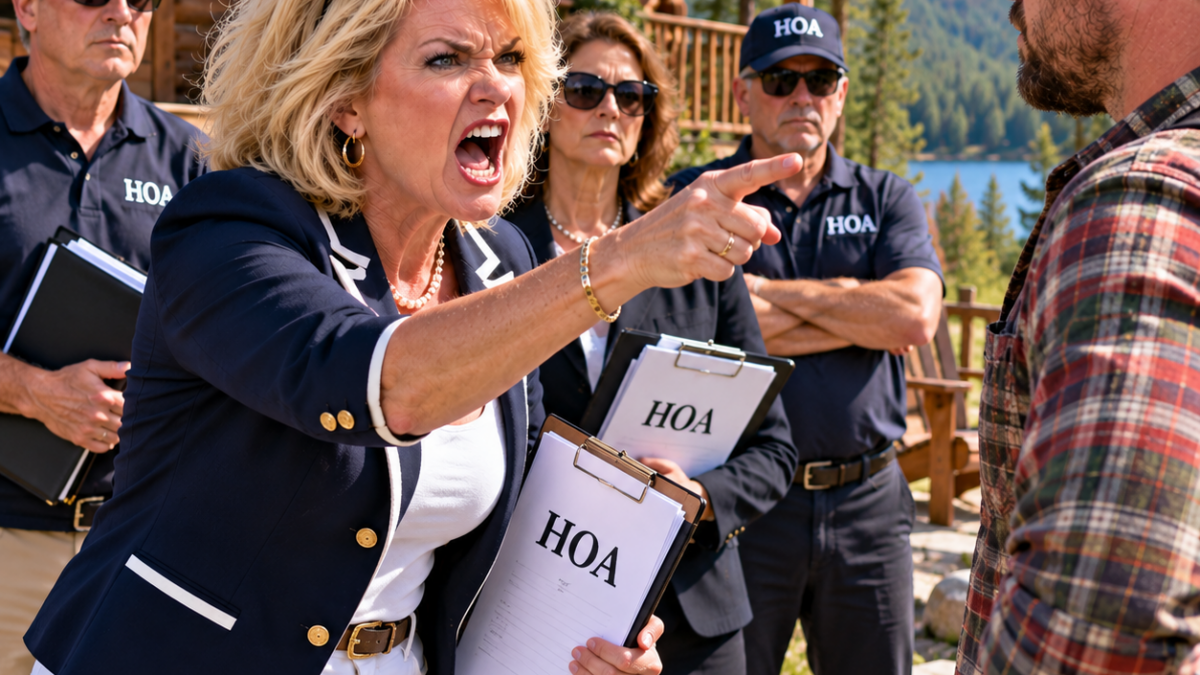
They showed up less than two hours after I finished unloading my last moving box, marched onto my property without permission, and started telling me which parts of my own cabin and driveway I was supposedly required to surrender to their HOA.
The woman leading them looked me straight in the eye and threatened fines, legal action, and removal of anything she considered “noncompliant,” all while standing on land she had absolutely no idea who legally owned.
I could have corrected her right there on the porch, but the paperwork sitting inside my kitchen made me realize it would be far more interesting to let her keep talking.
I was still wearing work boots when the first knock came.
Dust covered my jeans from carrying boxes up the gravel path, the kitchen smelled like cardboard and old cedar, and half my furniture was still wrapped in moving blankets.
I had barely been inside the cabin long enough to make coffee.
Then somebody started pounding on the front door like I owed them money.
I opened it.
Three people stood on my porch.
The woman in front had a visor pushed high on her forehead, oversized sunglasses, crossed arms, and a clipboard held so tightly against her chest you’d think it contained classified documents.
Behind her stood a man with a Bluetooth headset and a woman already taking photographs with her phone.
Nobody smiled.
Nobody introduced themselves.
The woman looked past me toward the driveway.
“You can’t park your truck on that slope.”
I stared at her.
“Good afternoon to you too.”
Her expression didn’t move.
“I’m Cheryl Danvers.”
She paused like the name should mean something.
“President of the Ridgewood Pines Homeowners Association.”
“Okay.”
“That slope is HOA common property.”
I looked over my shoulder.
My Chevy sat beside the gravel turnout, two tires barely touching grass.
“You’re talking about that?”
“Yes.”
“Interesting.”
She frowned.
“What’s interesting?”
“Nothing yet.”
She stepped closer.
“Your vehicle needs to be moved immediately.”
I leaned against the doorframe.
“Anything else?”
Apparently, that was the wrong question.
Cheryl opened the clipboard.
“Several things.”
The woman behind her took another photo.
Cheryl continued.
“The cabin roof color is not on our approved exterior palette.”
I looked up at the faded dark-green metal roof.
“The porch swing is not an approved style.”
I looked toward the cedar swing hanging from two chains.
“And there is no record of this structure being formally registered with Ridgewood Pines architectural control.”
I laughed.
Not loudly.
Enough.
Cheryl’s mouth tightened.
“This isn’t funny.”
“Lady, this cabin has been standing here for around thirty years.”
“Then it may have been constructed without proper HOA authorization.”
That one actually made me stop smiling.
Not because she scared me.
Because it told me she had absolutely no idea what she was talking about.
The cabin predated the HOA charter.
The original zoning variance had been approved in 1992.
The property had passed through three different ownership entities since then.
And six months earlier, I’d spent more hours than I care to remember sitting with lawyers, surveyors, county clerks, title officers, and a bankruptcy trustee untangling exactly who owned what across Ridgewood Pines.
Cheryl apparently had not.
“We’ll need your land-use documents,” she said, “and the swing needs to be removed.”
“No.”
Her pen stopped.
“Excuse me?”
“No.”
“You don’t get to refuse association compliance.”
“I do if I’m not subject to it.”
She tilted her head.
“You purchased property within Ridgewood Pines.”
“I purchased property near Ridgewood Pines.”
“The distinction is irrelevant.”
“It’s actually the entire point.”
The Bluetooth guy finally spoke.
“Sir, the HOA maintains this road, trail system, green space, and common slope.”
I looked at him.
“You sure?”
He hesitated.
Cheryl answered for him.
“Absolutely.”
I stepped out onto the porch.
She smiled slightly, probably assuming I was finally ready to cooperate.
Instead, I pointed toward the gravel slope beneath my truck.
“You’re standing on private property.”
Her smile vanished.
“This is common land.”
“No.”
“We have maintained it for years.”
“Maintenance isn’t ownership.”
“The board has jurisdiction.”
“Not here.”
Cheryl’s voice rose.
“Mr…?”
“O’Connell.”
“Mr. O’Connell, if you refuse to comply by Friday, formal violations and fines will be issued.”
I folded my arms.
“You really want to do this?”
Her sunglasses slid slightly down her nose.
“Is that a threat?”
“No.”
I smiled.
“It’s a spoiler.”
The photographer lowered her phone.
Bluetooth Guy suddenly found the trees interesting.
Cheryl jabbed her pen toward me.
“You’ll be hearing from us.”
“I was afraid of that.”
She spun around.
The three of them marched down the steps, across the gravel, and disappeared toward the neighborhood road with all the confidence of people who believed they’d just put the new guy in his place.
I watched until they were gone.
Then I closed the door.
Walked into the kitchen.
Opened a cardboard box labeled **CLOSING DOCUMENTS**.
Near the top sat a thick packet.
**RIDGEWOOD PINES HOLDINGS LLC — ASSET TRANSFER AND LAND RIGHTS**
My name appeared beneath the purchaser line.
I turned to the survey maps.
The same slope Cheryl had just called HOA common land was highlighted inside my parcel.
So was the upper ridge.
The old trail.
Several undeveloped lots.
Part of the community garden.
And a surprising amount of land the HOA had been treating as its own for years.
I sat down.
Picked up my coffee.
And smiled.
Cheryl thought she’d just welcomed a clueless new homeowner.
She had no idea she’d just threatened the man who legally owned the land beneath half of what her HOA called “common property.”
PART 2
I hadn’t bought Ridgewood Pines because I wanted to become anyone’s landlord.
That part needs explaining.
Six months earlier, Ridgewood Pines Holdings LLC had been one of those forgotten corporate shells nobody paid attention to until bankruptcy lawyers started sorting old title records.
The company traced back to the original land trust that helped develop the mountain subdivision decades earlier.
Over the years, houses had been sold individually.
Roads had been dedicated.
Some easements were recorded.
Others weren’t.
The timber company that originally owned the upper ridge went bankrupt in the 1990s, and its remaining parcels got split among several entities.
Then one of those entities dissolved.
Another stopped paying taxes.
Another existed only on paper.
It was a mess.
The cabin I wanted happened to sit inside that mess.
I’d originally been interested in one thing:
The cabin.
Mountain view.
Old stone fireplace.
Enough privacy to hear wind through pines instead of traffic.
I didn’t want a development.
I definitely didn’t want an HOA.
But when my attorney, Raquel Price, reviewed the title package, she called me.
“You sitting down?”
“Why?”
“You may not be buying only a cabin.”
I remember laughing.
“What, does it come with a ski resort?”
“Not quite.”
She emailed me the parcel history.
The cabin’s deed was attached to a controlling interest in Ridgewood Pines Holdings LLC.
That entity still owned several undeveloped lots, the upper ridge parcel, sections of what residents assumed were common trails, and portions of land used by the HOA without a recorded transfer.
It also held landlord rights under old ground-use agreements tied to several common-area improvements.
My first reaction was:
“No.”
Raquel laughed.
“No what?”
“No development.”
“You haven’t even heard the price.”
“I don’t want to be president of anything.”
“You wouldn’t be.”
“Landlord sounds worse.”
“Then don’t act like one.”
But the deal made sense.
The holding company was dissolving.
The trustee wanted the remaining assets sold together.
The package cost less than some luxury condos in the city.
I had savings.
I had spent years buying, improving, and occasionally reselling small properties.
This was bigger than anything I’d done.
But I understood land.
And more importantly, I understood paperwork.
So I spent six months reviewing everything.
Historic surveys.
Quitclaim deeds.
Old timber-company maps.
Zoning variances.
Utility easements.
Private access agreements.
Development plats.
County GIS overlays.
The more we studied, the stranger the situation became.
Ridgewood Pines HOA believed it owned several things it did not legally own.
Not because every board member was necessarily corrupt.
Some mistakes were probably inherited.
Old assumptions.
Lost records.
People saying “the HOA maintains it, therefore the HOA owns it.”
That’s not how title works.
The community garden was the best example.
Residents had planted tomatoes and flowers there for years.
The HOA paid for benches and compost bins.
But the ground underneath had never been deeded to the association.
Same with part of the ridge trail.
Same with the slope beside my cabin.
Same with one small lighting installation near the northern trailhead.
All of it belonged to the holding company I’d purchased.
I had planned to handle it gently.
Talk to residents.
Formalize easements where sensible.
Keep trails open.
Maybe transfer some common parcels to a resident-controlled trust later.
I had no desire to start collecting rent from people for walking through the woods.
Then Cheryl knocked on my door.
And demanded my land.
That changed the tone.
Not my goal.
The tone.
The morning after our conversation, I drove into town.
Ridgewood County Recorder’s Office occupied a narrow brick building between a bakery and an antique shop.
Inside, the clerk looked like he had been born wearing flannel.
Gray beard.
Reading glasses.
Name tag:
**MARTIN**
I showed him my identification and transfer certificate.
He stared at my last name.
“O’Connell.”
“That’s me.”
“You the O’Connell who bought the Ridgewood holdings package?”
“That would also be me.”
He let out a low whistle.
“Well.”
“What?”
“You’re going to rattle some cages.”
“Already did.”
I explained Cheryl.
The slope.
The supposed violations.
His eyebrows kept climbing.
“She told you that slope is HOA land?”
“Yes.”
“It isn’t.”
“I know.”
“She knows?”
“Apparently not.”
He leaned back.
“Or she doesn’t care.”
That possibility stayed with me.
I asked for certified copies.
Parcel boundaries.
Quitclaim deeds.
1992 upper-ridge zoning variance.
Historical survey maps.
Recorded easements.
HOA filings.
By the time Martin finished, the manila envelope was thick enough to stop a door.
He slid it across the counter.
“You planning on making friends?”
“I just moved in.”
“So no.”
I laughed.
When I got home, Cheryl had left another gift.
Pale-yellow paper taped to my front door.
**MANDATORY COMPLIANCE NOTICE**
Three pages.
Roof color.
Porch swing.
Vehicle location.
Architectural inconsistency.
Unapproved exterior materials.
Failure to register structure.
At the bottom:
**$400 FINE**
Payable within seventy-two hours.
I didn’t finish reading.
Instead, I walked to the utility pole near the driveway.
The old deed marker sat inside a weatherproof lockbox.
I opened it.
Unscrewed the protective plate.
Etched parcel number exactly where the survey said it should be.
Photographed it.
Then made three calls.
County assessor.
Sheriff.
Raquel.
She answered while I was still standing beside the pole.
“They fined you?”
“Four hundred.”
“For what?”
“Existing.”
She laughed.
“Specific.”
“Roof. Porch swing. Truck. Emotional independence.”
“I’ll draft a cease-and-desist.”
“They’re claiming land they don’t own.”
“I know.”
“Can they legally issue fines?”
Pause.
“I’ve been reading their incorporation documents.”
“That sounds dangerous.”
“They formed as a nonprofit neighborhood association.”
“Okay.”
“But they never properly registered enforcement authority under state requirements after a restructuring several years ago.”
I stopped.
“What does that mean?”
“It means even where they have contractual authority over members, their current enforcement structure may be defective.”
“So the fines?”
“Potentially unenforceable.”
“All of them?”
“We need more documents.”
“What if they’ve been collecting money anyway?”
Raquel’s voice sharpened.
“Then we stop joking.”
That afternoon, she drafted the cease-and-desist.
I installed trail cameras.
Not because I expected vandalism.
Because Cheryl had already walked onto my property twice in forty-eight hours and seemed deeply offended by the concept of boundaries.
I placed one near the tree line.
One facing the rear shed.
One covering the access trail.
Then I waited.
The next evening, around 8:40, headlights moved slowly through the trees.
White SUV.
Stopped beyond the cabin.
Two people got out wearing dark hooded sweatshirts.
One hoodie had a Ridgewood Pines emblem.
They walked behind the house.
Toward the shed.
Didn’t notice the infrared camera.
I watched live from inside.
My first instinct was to go outside.
Confront them.
Instead, I recorded.
They reached the shed.
One crouched near the lock.
A few minutes later, they left.
The following morning, the padlock was broken.
Across the side wall, sprayed in orange paint:
**NOT HOA COMPLIANT**
I stood there longer than I care to admit.
The words looked ridiculous.
The damage didn’t.
Someone had entered private land at night, broken a lock, and vandalized a building.
This wasn’t neighborhood politics anymore.
I printed still frames.
Drove to the sheriff’s office.
Deputy Mara Torres reviewed the footage.
“Can you identify them?”
“Not faces.”
She zoomed.
“HOA logo.”
“Yeah.”
She leaned back.
“Felony vandalism depending on damage value. Criminal trespass either way.”
“I want a report.”
“You want charges?”
“When we know who they are.”
She nodded.
Then looked at the deed documents.
“What’s the land dispute?”
I explained.
Her expression became tired.
“Ridgewood Pines.”
“You know them.”
“I know complaints.”
“What kind?”
“Property lines. Access disputes. Fines.”
“Anything criminal?”
“Nothing proven.”
I handed her the still image.
“Maybe we’re improving.”
She almost smiled.
Back home, another notice had been pinned to the fence.
**UNAUTHORIZED STRUCTURE MUST BE REMOVED IMMEDIATELY**
Signed:
**Cheryl Danvers, HOA President**
I photographed it.
Added it to a folder on my laptop.
**EVIDENCE — RIDGEWOOD PINES HOA**
Raquel called later.
“I pulled more records.”
“How bad?”
“Interesting.”
“That never means good.”
“The HOA has been collecting enforcement fees.”
“I know.”
“But their nonprofit filing doesn’t support some of the powers they’re claiming.”
“Meaning fraud?”
“If they knowingly represented themselves as having legal authority they didn’t possess, collected money because of that representation, and concealed where it went… yes, potentially.”
“Concealed?”
“I’m getting there.”
She paused.
“I found a bank reference tied to dues collection.”
“And?”
“The account holder is not Ridgewood Pines HOA.”
I sat down.
“Who?”
“Landscaping company.”
“What landscaping company?”
“Registered to Cheryl’s husband.”
Silence.
“Active business?”
“Hasn’t done legitimate business in more than ten years.”
That was the moment the story stopped being about me.
A power-hungry board president was annoying.
A private account holding resident money was different.
“File it.”
“With who?”
“Everybody.”
Raquel laughed once.
“I like clients who give precise instructions.”
“Attorney General.”
“Already drafting.”
That evening, I carried a folding chair and thermos up the ridge.
I sat above the so-called community garden.
Tomatoes.
Raised beds.
Faded benches.
Compost bins.
Residents clearly loved it.
I wasn’t angry at them.
But the map was clear.
The garden sat on my land.
The HOA had never obtained an easement.
Never paid rent.
Never recorded a use agreement.
I could have fenced it that night.
Didn’t.
Instead, I placed one small wooden sign.
**PRIVATE PROPERTY**
**CURRENT COMMUNITY USE UNDER TITLE REVIEW**
**NO NEW CONSTRUCTION WITHOUT OWNER CONSENT**
I attached a certified parcel copy inside a waterproof sleeve.
Then took a photo.
I wasn’t closing the garden.
I was establishing the record.
The next morning, I hand-delivered Raquel’s cease-and-desist to Cheryl.
She was watering petunias.
Of course she had petunias.
Her face changed when she saw me.
“You can’t just come onto my property.”
I almost laughed.
Instead, I held up the envelope.
“You’ve been served.”
She shut off the hose.
“What is that?”
“Legal cease-and-desist.”
She ripped it open.
Read.
Her face lost color.
I kept my voice calm.
“Effective immediately, you and anyone acting for the HOA are ordered to stop asserting ownership or enforcement authority over my parcels.”
She kept reading.
“All fines rescinded.”
Her eyes moved faster.
“No entry onto my property without consent.”
She looked up.
“This is outrageous.”
“Also, there’s an open sheriff’s report regarding vandalism.”
She froze.
“I have cameras.”
“I don’t know anything about vandalism.”
“I didn’t say you did.”
“You implied it.”
“I said I have footage.”
She gripped the letter.
“You’re trying to intimidate the entire community.”
“No.”
I stepped off her porch.
“I’m telling you where your authority ends.”
“We’ve maintained order here for twenty years.”
“You’ve maintained assumptions.”
She stared.
I added:
“And apparently a private bank account.”
That hit.
Only for half a second.
But I saw it.
Her eyes widened.
Then hardened.
“I have no idea what you’re talking about.”
“Good.”
I smiled.
“Then the Attorney General can explain it.”
I walked away.
For the first time, Cheryl didn’t have a comeback.
On the way back, Bluetooth Guy stood in his yard adjusting a flag.
He avoided looking at me.
“Morning.”
He nodded.
“Heard you’re stirring up trouble.”
“I prefer accuracy.”
He said nothing.
Two houses later, an older man approached me.
“Mr. O’Connell?”
“Jiren.”
“Bill Mercer.”
Retired park ranger.
He glanced toward Cheryl’s house.
“You really own the ridge parcel?”
“Yes.”
“And garden land?”
“Yes.”
“Trail too?”
“Parts.”
He exhaled.
“You need to hear something.”
Another neighbor joined us later.
Linda Hayes.
Plumber.
Commercial van.
She had her own story.
Two years earlier, the board threatened Bill’s fire-road access because he refused to allow an unrecorded drainage ditch across his lot.
When he demanded title authority, the HOA stopped answering.
Then workers dug the ditch anyway.
Linda had been fined for parking her plumbing van at home.
Commercial vehicle violation.
She appealed.
Never received a hearing.
Late fees doubled.
Tripled.
She refused to pay.
“I filed complaints,” she said.
“What happened?”
“Nothing.”
“State?”
“Licensing board. Consumer office.”
“Nothing?”
“Files disappeared.”
Bill leaned forward.
“Cheryl knows people.”
“Or tells people she does.”
Linda shook her head.
“Either way, everyone’s scared of her.”
“You willing to put this in writing?”
Bill answered immediately.
“Yes.”
Linda followed.
“Absolutely.”
That night, I realized something important.
Owning the land gave me leverage.
It didn’t give me the right to become Cheryl in reverse.
I could have closed trails.
Locked the garden.
Charged rent.
Threatened residents.
Legally, maybe some of it was possible.
Morally, it would have proven nothing.
So I decided on the opposite strategy.
Everything transparent.
Every document shared.
Every boundary certified.
Every decision explained.
If Ridgewood Pines was going to change, it couldn’t become my private kingdom.
The next morning, County Assessor Delaney arrived.
Tan pants.
County windbreaker.
Laser rangefinder.
No patience for drama.
“Mr. O’Connell?”
“Yes.”
“I’ve got your survey.”
“Beautiful.”
“Let’s walk.”
We spent nearly three hours tracing parcel boundaries.
The slope.
Mine.
Part of trail.
Mine.
Garden.
Mine.
A section residents believed was HOA common green space.
Also mine.
Then we reached a solar streetlight installed beside the trail.
Delaney crouched.
“Who put this here?”
“HOA.”
“Permit?”
“Not that I found.”
He inspected exposed wiring.
“That’s bad.”
“Illegal?”
“Potentially.”
“Private land too.”
“Definitely.”
He photographed everything.
At the garden, he shook his head.
“No easement.”
“No lease.”
“No recorded permission.”
“Then technically this is encroachment.”
“I don’t want to evict tomatoes.”
He looked at me.
“That may be the strangest sentence I hear today.”
“I want formalized use.”
“Then get an agreement.”
“That’s the plan.”
He made notes.
At the end, he gave me a preliminary statement.
Several HOA installations occupied land the association did not own or hold recorded rights to use.
That one paragraph was dynamite.
Raquel loved it.
The Attorney General’s office loved it more.
Their preliminary investigation opened within days.
The private account mattered.
So did fake enforcement authority.
Then investigators traced the EIN.
Landscaping company.
Cheryl’s husband.
Dues and fines flowed through it.
Two unmarked sedans entered Ridgewood Pines on a Wednesday.
I watched from the ridge.
Four investigators approached the little community-relations office beside the tennis court.
Ten minutes later, Cheryl came out in handcuffs.
Red-faced.
Shouting.
Her husband followed.
He looked stunned.
Residents appeared on porches.
Some recorded.
Some just stared.
By sunset, two board members resigned.
Another hired a lawyer.
A fourth claimed complete ignorance.
County issued an administrative hold on HOA enforcement.
No new fines.
No collection letters.
Accounts frozen.
Cheryl’s reign stopped in one afternoon.
Raquel called.
“You happy?”
“No.”
“That surprises me.”
“Why?”
“Most clients enjoy handcuffs.”
I looked toward the community.
“I want to know where the money went.”
“Good answer.”
I hired Marcus Hill.
Private forensic auditor.
He had helped me during an earlier commercial property deal.
Marcus spoke like a man permanently disappointed in spreadsheets.
I sent everything.
Three days later:
“They’re double-booking.”
“What?”
“Maintenance charges.”
“Explain.”
“Residents pay assessment for work.”
“Okay.”
“HOA reports paying a vendor.”
“Okay.”
“Vendor is dead LLC.”
“Okay.”
“Money then moves through related accounts.”
I stared at the wall.
“How much?”
“Enough.”
“Federal?”
“Potential wire fraud.”
“Can you prove it?”
“I already drafted the summary.”
We sent it to county prosecutors.
Then something else surfaced.
Fire mitigation.
Five thousand.
Six thousand.
Quarterly payments.
Five years.
Supposed contractor work.
Ridgewood Pines sat in mountain wildfire country.
Firebreak maintenance wasn’t cosmetic.
It was life safety.
I drove to the location.
Dry brush.
Deadfall.
No cleared corridor.
No maintained access road.
Nothing.
I photographed everything.
GPS.
Time stamps.
Then county emergency management.
Carly Jensen reviewed the invoices.
“These areas are supposed to be cleared every spring.”
“They weren’t.”
“We sent warnings.”
“What did the HOA say?”
“They hired a contractor.”
“They paid one.”
“Same thing.”
“No.”
I slid Marcus’s report over.
“Contractor doesn’t exist.”
Her face changed.
“If they certified mitigation was complete…”
“They did.”
She stood.
“I need the fire marshal.”
Within twenty-four hours, Ridgewood Pines looked like an inspection convention.
Forestry.
Fire marshal.
County.
State.
Officials walked trails with GPS equipment.
One fire marshal stared at the brush.
“This is a matchbox.”
Residents overheard.
Questions spread.
A mother asked what would happen during evacuation.
Nobody had a good answer.
That angered me more than the vandalism.
Fake fines hurt wallets.
Fake fire mitigation could kill people.
Special Agent Kading from the Attorney General’s office met me on my porch.
Thick folder.
Quiet voice.
“We’re looking at conspiracy to defraud, misuse of public-safety funds, falsified records, potentially environmental endangerment.”
“If a fire came through?”
He looked toward the valley.
“With this fuel load?”
He shook his head.
“Bad.”
“Residents paid for mitigation.”
“Yes.”
“Money disappeared.”
“Yes.”
“And they lied to the county.”
“Yes.”
Kading closed his folder.
“We’re convening a grand jury.”
“I’ll testify.”
“I assumed.”
The next three weeks blurred.
Subpoenas.
Searches.
Returned checks in a PO box.
More shell accounts.
Board communications.
Fire records.
Vendor fraud.
Cheryl and former board members arrested again on expanded allegations.
Her husband tied directly to fake contracts.
News headline:
**HOA FRAUD SCANDAL EXPOSES FALSE FIREBREAK CLAIMS, ENDANGERING MOUNTAIN COMMUNITY**
I avoided cameras.
Didn’t want revenge theater.
I wanted repair.
One evening, while sanding orange spray paint from my shed, Bill approached the gate.
Old Forestry Service hat.
Clipboard.
I looked at it.
“You’ve become the enemy.”
He laughed.
“We had a meeting.”
“We?”
“Residents.”
I kept sanding.
“And?”
“We want to start over.”
“Another HOA?”
“No.”
That got my attention.
“Volunteer community board.”
“Power?”
“None without resident vote.”
“Fines?”
“No.”
“Mandatory dues?”
“Only if everyone approves a specific shared project under written agreement.”
“President?”
Bill smiled.
“No kings.”
I nodded toward the clipboard.
“Then why that?”
“Notes.”
“Dangerous.”
He ignored me.
“We want your help.”
“Why?”
“You own the land.”
“That doesn’t make me mayor.”
“No.”
He looked toward the garden.
“But if we’re going to keep using trails and the garden, we want a real agreement.”
That mattered.
Not assumption.
Agreement.
“What do you want?”
“Long-term community-use lease.”
“For how much?”
Bill hesitated.
“One dollar?”
I smiled.
“Per year?”
“If you’re generous.”
“I am occasionally.”
We worked with Raquel.
Residents formed a legitimate cooperative.
Transparent.
Volunteer-run.
No enforcement police.
The community garden received a recorded land-use agreement.
One dollar annual rent.
Trail easement formalized.
Safety obligations clearly assigned.
Insurance clear.
Fire mitigation requirements written into the agreement.
Nobody could later pretend ownership.
Nobody could lose access because one president got angry.
The compliance office became a tool library.
That might have been my favorite thing.
Shelves.
Drills.
Rakes.
Ladders.
Residents donated equipment.
Linda organized plumbing tools.
Bill managed chainsaws and trail gear.
A little sign:
**BORROW IT. RETURN IT. DON’T BE A JERK.**
Perfect governance document.
The fake garden became a real garden because now the people using it had actual permission.
Funny how legitimacy improves things.
Neighbors talked.
Shared firewood.
Cleared trails.
Fixed fences.
A woman named Doreen organized weekend cleanups.
Nobody charged a convenience fee for the wood chipper.
Then grand jury day arrived.
Fire marshal testified first.
I testified second.
Timeline.
Move-in.
Cheryl’s threats.
Fake fines.
Vandalism.
Ownership documents.
Land encroachment.
Bank records.
Shell company.
Firebreak invoices.
I stuck to facts.
No speeches.
No insults.
When asked why I didn’t simply terminate community access to my land, I answered:
“Because the residents weren’t the problem.”
One juror looked up.
I continued.
“The board abused them too.”
That answer mattered to me.
Indictments followed.
Wire fraud.
Falsifying public-safety records.
Misuse of HOA funds.
Conspiracy.
Criminal trespass.
Negligent endangerment.
Cheryl eventually pleaded guilty to three major counts rather than face trial on everything.
Lifetime ban from serving in registered organizational leadership.
Her husband faced prison exposure over contract fraud.
The old HOA was dissolved by court order.
Accounts liquidated.
Illegal collections returned with interest where possible.
Raquel filed the civil recovery action.
Residents got checks.
Some small.
Some significant.
I was eligible for damages.
Vandalism.
Legal costs.
Harassment.
Encroachment.
I refused personal payout beyond direct property repair.
Instead, I asked the court to send remaining recovered community funds into an independent improvement trust.
Not controlled by me.
Not controlled by a president.
Resident trustees.
Public accounting.
First project:
Real firebreak.
Licensed crew.
County permits.
Forestry oversight.
Volunteer help.
I stood on the ridge watching machinery clear the proper corridor.
Brush removed.
Deadfall chipped.
Emergency access opened.
Actual safety.
A young couple passed with a toddler.
They had purchased one of the cabins formerly owned by a disgraced board member.
The man pointed down the trail.
“This the one that used to be restricted?”
“Parts of it.”
“Open now?”
“With rules.”
He looked nervous.
“What kind?”
“Don’t start fires. Don’t dump trash. Respect private property.”
He smiled.
“Reasonable.”
“That’s the idea.”
The little girl waved.
I waved back.
For all Cheryl’s talk about order, this place felt more orderly without fear.
Months later, the county officially recognized the new cooperative agreements.
The community improvement trust published its first financial report.
Every dollar.
Every receipt.
Marcus reviewed it for free.
He called me.
“Boring.”
“Perfect.”
“No suspicious payments.”
“Excellent.”
“No shell companies.”
“Disappointing.”
He laughed.
One cold evening, Raquel visited.
She stood on the porch with two coffees.
“Remember when this started?”
“Unfortunately.”
“You told Cheryl she was going to look stupid.”
“I was right.”
“She did worse than that.”
“Yeah.”
We sat.
Lights from Ridgewood Pines glowed between trees.
No patrol vehicle.
No compliance officer.
No threatening notices.
“You know what everyone calls you?”
“I don’t want to know.”
“The landlord.”
I groaned.
“I hate that.”
“You literally are.”
“One-dollar garden lease.”
“Still landlord.”
“Quiet.”
She laughed.
The word bothered me because landlords hold power.
And after watching Cheryl abuse power, I wanted as little symbolic authority as possible.
So eventually, I changed the structure again.
Once criminal litigation ended and property rights were secure, I offered residents a long-term path.
Certain true common-use parcels could transfer into a community land trust if they met strict conditions.
Independent governance.
No fines over private homes.
No hidden assessments.
Open books.
Recorded boundaries.
No unilateral annexation.
No secret meetings affecting property rights.
Some parcels stayed mine.
Especially undeveloped ridge land.
Others moved into the trust.
The garden eventually belonged to the community legitimately.
Not because Cheryl declared it.
Because I signed it over under conditions residents voted to accept.
That distinction meant everything.
People asked why I’d give away valuable land.
Because ownership isn’t only about holding.
It’s about choosing.
Cheryl tried to take.
I chose to transfer.
Consent changes the entire moral equation.
The slope where my truck had been parked the first day remained mine.
Purely sentimental.
I kept it undeveloped.
Sometimes visitors ask why a strip of grass beside one cabin matters so much.
I say:
“You had to be there.”
Bluetooth Guy—his real name was Kevin—eventually apologized.
He approached me during a trail cleanup.
“No headset?”
He smiled awkwardly.
“Retired it.”
“Good.”
He rubbed the back of his neck.
“I owe you an apology.”
“For what?”
“That first day.”
“You mostly stood there.”
“I knew Cheryl was aggressive.”
“That’s different from criminal.”
“I also knew some fines were bogus.”
That was harder.
“You said nothing.”
“I know.”
We stood quietly.
Finally:
“Why?”
He looked toward the trail.
“Because she always made it expensive to disagree.”
That line stayed with me.
Expensive.
Not necessarily money.
Socially.
Time.
Stress.
Access.
Approval.
People tolerate control when resistance costs more than compliance.
That’s why transparency matters.
It lowers the cost of questioning authority.
Kevin joined the cooperative’s finance committee later.
I told him I’d be watching.
He said he hoped I would.
Good answer.
Linda’s commercial van became a running joke.
The new cooperative asked if she’d park it near the community building during events because she always had tools.
Bill finally got formal fire-road access recognized.
The unauthorized drainage ditch issue got corrected.
Doreen expanded the garden.
Children planted pumpkins.
Nobody measured them for aesthetic compliance.
The firebreak saved us two summers later.
Lightning started a wildfire seven miles west.
Wind pushed smoke into the valley.
Evacuation warnings.
Residents loaded cars.
Fire crews used the cleared emergency corridor Ridgewood Pines had finally built correctly.
The fire never reached the homes.
But firefighters used our access to stage equipment.
Afterward, Chief stood beside the community building.
“If that old brush line were still here, we’d have had a different night.”
Nobody needed to ask which brush line.
People looked at each other.
Fraud can feel abstract until consequences arrive.
That night proved why the case mattered beyond money.
Cheryl’s fake mitigation invoices had gambled with families.
Actual work bought time.
Maybe saved homes.
The trust voted unanimously to increase wildfire funding the next year.
Residents approved it openly.
Nobody complained.
People support expenses when they trust the purpose.
Another lesson.
Years passed.
The old HOA scandal became local history.
New residents heard fragments.
“Wasn’t there some lady who fined people for porch swings?”
Yes.
“Didn’t the landlord own the HOA?”
Not exactly.
“Was there a fake landscaping company?”
Unfortunately.
“Didn’t somebody spray paint your shed?”
Still visible if you know where to look.
I never repainted one small section.
Orange letters faded almost completely.
But under certain light:
**NOT HOA COMPLIANT**
I left it.
A scar.
Not because I wanted anger.
Because memory is useful.
A young teenager once pointed.
“What does that mean?”
“Bad decision.”
“Whose?”
“Several people’s.”
He laughed.
I didn’t explain.
Some history can wait until adulthood.
The cabin became home.
Really home.
I replaced the roof eventually.
Same dark green.
No approval.
Kept the porch swing.
Definitely no approval.
Built a wood shed.
Added solar panels after county permitting.
Installed a better water system.
The slope remained parking.
Whenever Raquel visited, she’d park exactly where Cheryl had objected.
Out of principle.
“You’re petty.”
“Professionally.”
Residents eventually stopped calling me landlord.
Mostly.
Bill still did.
He’d wave from the trail.
“Morning, landlord!”
“Rent’s due!”
“One dollar!”
“Plus late fees!”
Then we’d laugh.
Humor means a wound closed.
Not disappeared.
Closed.
The Attorney General’s case concluded years after the first arrest.
Some defendants received reduced sentences for cooperation.
Cheryl served substantial time.
Her husband served less but lost businesses and paid restitution.
Both remained barred from managing community funds.
I didn’t attend final sentencing.
People expected me to.
I didn’t need to watch.
Raquel went.
She called later.
“You sure you don’t want details?”
“Did the residents get the restitution order?”
“Yes.”
“Did leadership bans stand?”
“Yes.”
“Then I’m good.”
“You’ve changed.”
“No.”
“Old Jiren would’ve enjoyed the sentencing.”
“Old Jiren hadn’t spent three years in litigation.”
“Fair.”
What I wanted by then wasn’t punishment.
It was permanence.
Systems corrected.
Records clean.
Boundaries recorded.
Firebreak real.
Money transparent.
The people responsible could disappear tomorrow and the protections would remain.
That’s success.
Personal revenge ends when the person leaves.
Structural accountability stays.
One autumn morning, I walked the ridge alone.
Cold air.
Leaves turning.
Community garden below.
Kids had painted small signs.
Tomatoes.
Herbs.
Pumpkins.
No HOA branding.
Just names.
I reached the old solar streetlight.
It had been removed years earlier because installation was unsafe.
A new county-approved light stood nearby.
Proper wiring.
Permit sticker.
I smiled.
Somebody had taped a small note to the pole.
**YES, THIS ONE IS ACTUALLY LEGAL.**
Probably Linda.
I left it.
At the upper trail, the new community sign stood.
Simple wood.
No threatening language.
**RIDGEWOOD PINES**
**RESPECT THE LAND.**
**RESPECT YOUR NEIGHBORS.**
**NOBODY IS ABOVE THE RULES.**
That last line came from Bill.
I had resisted it.
Sounded dramatic.
Residents loved it.
Maybe they earned a little drama.
I continued to the overlook.
From there, I could see the cabin.
The slope.
Houses.
Trail.
Garden.
Firebreak.
All the places that once existed mostly as exhibits.
Exhibit A.
Parcel B.
Unauthorized structure.
Encroachment zone.
Now they were places again.
That’s healing too.
When conflict lasts long enough, your home becomes a case file.
Every tree is a boundary marker.
Every path is evidence.
Every conversation is potential testimony.
Eventually, the law finishes.
Then you have to let the land become land again.
I sat on a rock.
Wind moved through the pines.
No cameras.
No officials.
No investigators.
Just mountain air.
I thought about Cheryl’s first words.
“You can’t park your truck on that slope.”
She said it with absolute certainty.
That’s what made it memorable.
She didn’t ask.
Didn’t verify.
Didn’t look at a map.
Power had trained her to believe certainty could replace ownership.
For years, maybe it worked.
Residents paid.
Removed things.
Changed things.
Avoided conflict.
The board grew more confident.
Then somebody new moved in.
Someone who happened to own the paperwork beneath their assumptions.
I didn’t defeat Cheryl by being louder.
The documents did.
Deed.
Survey.
Variance.
Bank records.
Tax records.
Invoices.
Fire reports.
Emails.
The truth was boring.
Boring won.
Years later, someone from a state housing association invited me to speak about HOA accountability.
I declined.
They asked for written comments instead.
I sent one page.
Three principles.
First:
**Authority should always be traceable to a recorded legal source.**
Second:
**Community money should be visible to the community.**
Third:
**No organization should be able to punish the people who question it without independent review.**
They used the page in training.
Good enough.
I never wanted a stage.
I wanted a cabin.
That’s the irony.
I bought the place to simplify my life.
Instead, I bought a development dispute, a corrupt HOA investigation, shell companies, fire-safety fraud, vandalism, audits, grand jury testimony, and a nickname I still hate.
Landlord.
But I also gained neighbors.
Bill.
Linda.
Doreen.
Kevin eventually.
Young families.
People who had lived behind closed curtains because they were afraid every disagreement would become a violation.
Once Cheryl’s board disappeared, Ridgewood Pines got louder.
Children outside.
Music.
Tools.
Dogs.
People talking across yards.
Healthy neighborhoods aren’t silent.
Silence isn’t always peace.
Sometimes it’s fear.
That might be the biggest thing I learned.
Cheryl often bragged that Ridgewood Pines was orderly.
Of course it was.
People were afraid to make choices.
Afterward, lawns became less identical.
Porches changed.
One house painted its door bright blue.
Another built a weird little free-library box shaped like a mushroom.
Kevin put up three decorative flags.
Nobody cared.
Property values didn’t collapse.
Civilization survived.
Firebreak improved.
Accounts balanced.
People volunteered more.
Freedom didn’t destroy the community.
It created one.
The last official legal document tied to the scandal arrived in a plain county envelope.
No dramatic seal.
No hand delivery.
A final confirmation that the old Ridgewood Pines HOA charter had been dissolved and replaced with the resident cooperative and land-trust structure approved by the court and county.
I read it once.
Then again.
Put it beside the original yellow fine.
Four hundred dollars.
Roof color.
Porch swing.
Truck.
The first document tried to tell me what I could do on land they didn’t own.
The last document acknowledged exactly who owned what and exactly how community rights worked.
Beginning.
End.
I keep both.
Not framed.
Just filed.
Raquel says that’s healthier.
One evening, long after everything ended, I sat on the porch swing.
The “wrong” porch swing.
Coffee in hand.
A pickup came up the road.
New residents.
Young couple.
They stopped.
The driver rolled down the window.
“Are you Jiren?”
“Depends.”
He smiled.
“Bill said you’re the guy who knows where all the property lines are.”
“That sounds like Bill.”
“We just bought Lot Twelve.”
“Congratulations.”
“We wanted to make sure the trail behind our place is community land.”
“Mostly.”
His face fell.
“Mostly?”
I laughed.
“Come by tomorrow. I’ll show you the recorded map.”
He nodded.
“Thanks.”
Then hesitated.
“Do we need permission to put up a swing set?”
I looked at his wife.
Then him.
“From me?”
“I don’t know.”
“No.”
“Cooperative?”
“Check county setback rules. Beyond that, it’s your yard.”
He smiled.
“That’s it?”
“That’s it.”
They drove away.
I sat there thinking how extraordinary normal freedom can feel after somebody spends years overcomplicating it.
That’s what Ridgewood Pines became.
Normal.
Not lawless.
Not chaotic.
Normal.
If you need a county permit, get one.
If you’re using community land, follow the shared agreement.
If you damage someone’s property, pay for it.
If community money is collected, show the books.
If you want to change something that affects everyone, vote.
Simple.
No president deciding she’s a government.
No husband hiding dues in a landscaping account.
No fake firebreak.
No vandalism squad.
No fear.
A few people still say I “took over” Ridgewood Pines.
I correct them.
I owned land.
I didn’t own people.
That’s the distinction Cheryl failed to understand.
Ownership of property gives rights over property.
It doesn’t make you king.
Being HOA president gives duties toward members.
It doesn’t make you owner.
Titles have limits.
Deeds have limits.
Community agreements have limits.
Healthy systems respect every one.
Cheryl blurred everything until her authority seemed endless.
The law redrew the lines.
One summer, Bill and I walked the fire road.
He was older.
Slower.
Still wearing the Forestry Service hat.
“You ever regret buying this place?”
“Frequently.”
He laughed.
“Seriously.”
I looked around.
Trees.
Cabins.
Garden.
Mountain slope.
“No.”
“Even with Cheryl?”
“Especially because of what came after.”
He stopped.
“You’re weird.”
“I know.”
We continued.
Bill said,
“If you hadn’t owned the holding company, what would’ve happened?”
I thought about it.
“Probably still would’ve fought the fine.”
“But the rest?”
“Someone else would’ve eventually found the fraud.”
“You sure?”
“No.”
He nodded.
“That’s what scares me.”
Me too.
Corruption doesn’t always end because systems detect it automatically.
Sometimes someone has to get annoyed enough to pull one document.
Then another.
Then another.
That’s not a comforting truth.
But it’s useful.
Transparency reduces dependence on luck.
That’s why every new Ridgewood financial statement goes online.
Every land-use agreement recorded.
Every meeting open.
Every expenditure above the threshold publicly bid.
Nobody needs a hero if the system makes hiding difficult.
That’s better than anything I personally accomplished.
The original community-relations shed still stands near the tennis court.
Once Cheryl’s command center.
Now the tool library.
I visited one Saturday.
A little boy was checking out a rake with his father.
Linda sat at a desk.
She had made cards.
“Name?”
The father answered.
“Tool?”
“Rake.”
“Return date?”
“Monday.”
I looked at Linda.
“You’ve become a bureaucrat.”
She pointed.
“Get out.”
On the wall behind her hung the old Ridgewood Pines HOA clipboard.
Someone had mounted it.
Underneath:
**IN CASE OF EMERGENCY, DO NOT GIVE THIS TO ANYONE.**
I laughed until my stomach hurt.
That’s how you know people have reclaimed a place.
They can turn the old symbol of fear into a joke.
Cheryl had wanted everything controlled.
In the end, the only thing she permanently created was a cautionary tale.
I can live with that.
The cabin is still mine.
The slope too.
The porch swing still hangs wrong.
Whatever that means.
My truck still parks where Cheryl told me it couldn’t.
Some mornings, I look at it and smile.
Petty?
Absolutely.
But harmless pettiness has its place.
The ridge trails remain open under recorded easements.
Garden belongs to the community trust.
Firebreak is inspected annually.
The cooperative has no authority over private architectural choices beyond what owners voluntarily agree to for shared safety.
People complain sometimes.
That’s democracy.
Nobody gets arrested over complaints.
That’s progress.
I never collected rent from residents for land they’d been using in good faith.
The one-dollar agreements were enough until the trust transfers happened.
I never wanted their money.
I wanted the legal fiction to stop.
Cheryl thought the biggest power in the story belonged to whoever issued the fine.
She was wrong.
The biggest power was ownership paired with restraint.
I could have become vindictive.
Closed every path.
Fenced the garden.
Raised rents.
Made everyone pay for what her board did.
I didn’t.
Because revenge that punishes innocent people is just another version of Cheryl.
The satisfying revenge was narrower.
Every lie documented.
Every fake authority exposed.
Every stolen dollar traced.
Every resident refunded.
Every unsafe fire claim corrected.
Every corrupt leader removed.
Then stop.
That’s enough.
The last time I saw Cheryl was years later.
Not in person.
A news photo.
She’d completed part of her sentence and was entering a supervised-release hearing.
Older.
No visor.
No clipboard.
I looked at the photo for maybe ten seconds.
Closed the page.
Went outside.
That surprised me.
For years, I’d imagined I’d feel something dramatic when she finally became irrelevant.
Triumph.
Anger.
Vindication.
Instead:
Nothing.
Then wind through the trees.
Linda’s van in the distance.
A kid laughing near the garden.
The sound of a hammer somewhere down the trail.
Life.
That’s the real ending.
Not Cheryl losing.
Ridgewood Pines living.
I bought a mountain cabin because I wanted quiet.
Two hours after I moved in, an HOA president stormed onto my porch and told me my truck, roof, porch swing, cabin, and land all answered to her.
She threatened fines.
She claimed common property.
She acted as though the neighborhood existed because her clipboard said so.
She had no idea I had spent six months quietly buying the holding company that owned the slope beneath her assumptions, the ridge behind her signs, the ground under her garden, and parts of the trails her HOA had treated as theirs for decades.
But even that wasn’t the twist that mattered most.
The real twist was what the paperwork exposed after she refused to stop.
Fake enforcement authority.
Trespassing.
Vandalism.
Dues routed through a defunct landscaping company.
Double-billed maintenance.
Public-safety money stolen.
Firebreaks never built.
Residents frightened into silence.
A board using community language to hide private profit.
Cheryl thought she was confronting one new homeowner.
She accidentally confronted the person who could finally prove where every boundary, every dollar, and every piece of authority actually belonged.
And once the truth came out, I could have ruled Ridgewood Pines exactly the way she tried to.
Instead, I did the one thing she never understood.
I gave people choices.
Recorded agreements.
Open books.
Real votes.
Clear boundaries.
No secret fines.
No fake authority.
No president above everyone else.
Years later, the sign at the Ridgewood Pines entrance says it better than I ever could:
**WELCOME TO RIDGEWOOD PINES.**
**RESPECT THE LAND.**
**RESPECT YOUR NEIGHBORS.**
**NOBODY’S ABOVE THE RULES.**
Every time I drive past it, I think about Cheryl standing on my porch that first afternoon.
“You can’t park your truck on that slope.”
I still park there.
And now everyone knows exactly why I can.
I thought that would be the last time I ever had to explain why my truck was parked on that slope.
I was wrong about that too.
Not because Cheryl came back.
She didn’t.
Not because another board tried to revive the old HOA.
Nobody was stupid enough to try.
The reason I kept telling the story was much simpler.
New people kept moving in.
Ridgewood Pines had changed after the scandal. Houses that had sat on the market because buyers had heard rumors about the HOA suddenly started selling again. Families arrived who knew there had been some kind of legal mess but didn’t understand exactly what had happened. They saw the garden, the trails, the tool library, the clean firebreak, and the handmade wooden sign at the entrance.
They didn’t see the years of fear underneath it.
One Saturday morning, I was replacing a broken section of railing on the cabin when a couple walked up my driveway.
Young.
Maybe early thirties.
The man held a folder.
The woman carried a sleeping baby against her chest.
“Are you Mr. O’Connell?”
“Depends who’s collecting money.”
The man laughed nervously.
“No. We’re the Parkers. We just bought the gray house near the lower trail.”
I set down my drill.
“Congratulations.”
“Thanks.”
He opened the folder.
“Our closing attorney told us you own some of the land around the trail.”
“That’s true.”
“He also told us there’s some kind of community-use agreement.”
“Also true.”
“We wanted to make sure we’re allowed to walk there.”
That question would have sounded ridiculous years earlier.
Now I appreciated it.
“You are.”
“Do we need a permit?”
“No.”
“Fee?”
“No.”
“HOA approval?”
“No HOA.”
He looked confused.
“The seller called it the Ridgewood community association.”
“Association, yes. HOA, no.”
“What’s the difference?”
I leaned against the railing.
“One can help organize a neighborhood.”
I pointed toward the old tool-library building.
“The other used to think it was a government.”
His wife laughed.
He looked at the slope beside my driveway.
“This is the famous parking spot?”
I sighed.
“Bill told you.”
“Everybody told us.”
“Wonderful.”
His wife smiled.
“She said you bought the whole neighborhood.”
“That part is exaggerated.”
“But you own the land?”
“Some of it.”
“The garden?”
“Community trust owns that now.”
“The trail?”
“Easement.”
“The slope?”
“Mine.”
The man stared at my Chevy.
“So she really tried to fine you for parking there?”
“Yes.”
He shook his head.
“That’s insane.”
“That’s how it sounds after it’s over.”
That sentence came out before I thought about it.
And it stayed with me.
Because while the fight was happening, almost none of it had felt obviously insane.
That’s the dangerous part.
Abuse rarely introduces itself by saying:
Hello, I’m abuse.
It arrives in official language.
Compliance notice.
Community standard.
Administrative requirement.
Emergency fee.
Temporary restriction.
Safety policy.
Shared responsibility.
Words that sound reasonable.
Then the boundary moves half an inch.
Then another.
Then another.
Until one day somebody is standing on your land telling you that you need permission to own what already belongs to you.
The Parkers stayed for coffee.
Their baby woke up halfway through and spent twenty minutes trying to eat the corner of one of my old survey maps.
I rescued the map.
Barely.
Before they left, the woman looked toward the ridge.
“This place feels peaceful.”
I smiled.
“It is now.”
That became the strange legacy of the whole thing.
People began describing Ridgewood Pines as peaceful.
Not disciplined.
Not controlled.
Peaceful.
Those aren’t the same thing.
Cheryl had produced obedience.
People had confused it with peace because nobody argued publicly.
But silence created through fear isn’t peace.
It’s pressure.
Real peace is when people disagree and still feel safe enough to stay in the room.
I saw that difference one night at a cooperative meeting.
The issue was stupid.
Trail lighting.
Half the residents wanted more lights.
The other half said it would ruin the dark sky and disturb wildlife.
Years earlier, Cheryl would have announced a policy.
Maybe created a committee composed entirely of people who agreed with her.
Then sent fines to anyone who objected.
The new meeting went differently.
People argued.
A lot.
Bill said additional lighting was necessary near steep sections.
A woman named Karen—not that kind of Karen, thankfully—said the whole reason she moved to the mountains was to see stars.
Linda suggested motion-activated fixtures.
Kevin wanted solar units.
Someone complained solar lighting was ugly.
A teenager suggested reflective markers.
For forty minutes, everyone talked over everyone.
I sat in the back thinking:
This is beautiful.
Messy.
Slow.
Annoying.
Beautiful.
Eventually they compromised.
Low-level, shielded motion lights at two hazardous spots.
Reflective markers elsewhere.
Six-month review.
No permanent decision until residents saw how it worked.
Nobody won completely.
Which usually means the process worked.
Afterward, Bill came over.
“You looked way too happy during that disaster.”
“It was a good meeting.”
“People yelled.”
“Exactly.”
“You need therapy.”
“Probably.”
But I meant it.
Under Cheryl, disagreement meant punishment.
Under the cooperative, disagreement meant discussion.
That’s the difference between control and governance.
The criminal cases kept moving quietly in the background.
Cheryl’s husband eventually received a prison sentence tied to the fraudulent contracts and diversion of community funds.
A former board treasurer avoided incarceration after cooperating extensively, but restitution followed him for years.
Two other board members received probation and permanent bans from fiduciary positions.
Nobody became rich from the recovered money.
That’s another misconception about lawsuits.
People imagine one huge check.
Reality is spreadsheets.
Insurance limits.
Asset sales.
Court fees.
Priority claims.
Tax implications.
Victims with different losses.
The illegally collected fines were repaid first where documentation existed.
Then improper assessments.
Then certain legal expenses.
Some people got everything back.
Others didn’t.
One afternoon, I stopped by Bill’s house and found him at the kitchen table staring at a check.
“Good news?”
He slid it toward me.
Restitution.
A little over three thousand dollars.
“That cover what they took?”
“Almost.”
“You happy?”
He rubbed his thumb over the edge.
“I don’t know.”
That surprised me.
“What were you expecting?”
He looked toward the window.
“My wife was alive when they started that drainage fight.”
I said nothing.
“She used to tell me to let it go.”
He smiled faintly.
“She hated conflict.”
Bill turned the check over.
“Three thousand dollars doesn’t give me back the evenings I spent angry instead of sitting with her.”
That hit harder than anything I’d heard in court.
Because money wasn’t always the largest theft.
Time was.
Attention.
Sleep.
Trust.
People like Cheryl don’t only take what appears in financial records.
They occupy your thoughts.
They make ordinary mornings feel like preparation for war.
They turn your mailbox into something you dread opening.
They make a knock on the door tighten your chest.
There is no restitution category for that.
Bill eventually deposited the check.
Used most of it to build a small bench overlooking the valley.
A brass plate on the back carried his wife’s name.
No mention of the HOA.
That felt right.
Linda used part of her restitution to replace the transmission in her plumbing van.
Then she drove that van directly past Cheryl’s old house every morning for about a month.
I accused her of being petty.
She said,
“I’ve earned twenty-eight days of pettiness.”
I couldn’t argue.
The old community-relations shed became busier every year.
At first, it was only tools.
Then shelves appeared.
Camping equipment.
Pressure washer.
Post-hole digger.
Leaf blower.
Tile cutter.
Someone donated a telescope.
Nobody knew why.
It became the most popular thing in the building.
Once a month, residents carried it to the ridge for stargazing.
The same ridge Cheryl once used as a symbol of controlled community property became a place where kids learned constellations.
I attended one of those nights.
Mallory’s daughter pointed upward.
“That’s Jupiter.”
“You sure?”
“Yes.”
“Looks like a dot.”
She looked offended.
“It’s a planet.”
“Still looks like a dot.”
She gave up on me and educated someone more deserving.
I sat on the grass.
Around me were families who had once been afraid to leave a trash can visible after collection day.
Now kids were running around with flashlights and blankets while parents drank hot chocolate.
No one measured noise.
No violation notices.
No one photographed an unauthorized folding chair.
It struck me then that Cheryl hadn’t protected Ridgewood Pines.
She had prevented it from becoming itself.
Control has that effect.
Everything becomes polished.
Nothing becomes alive.
The garden changed too.
When I first bought the holding company, the garden looked like a brochure.
Identical raised beds.
Matching signs.
Approved plant list.
Apparently, Cheryl had once issued warnings because someone planted sunflowers taller than the approved height.
I wish I were inventing that.
After the residents took over, the garden became chaos.
Beautiful chaos.
Sunflowers.
Tomatoes.
Peppers.
Herbs.
Pumpkins.
Wildflowers.
One elderly woman grew corn in a corner despite everybody telling her the soil was wrong.
She grew terrible corn.
Proudly.
Children painted stones.
Someone built a crooked scarecrow wearing an old Ridgewood Pines HOA polo.
That scarecrow lasted six seasons.
Every year its shirt faded a little more.
No one removed it.
By then, people could laugh at what had happened without pretending it hadn’t hurt.
That’s an important stage of recovery.
Not forgetting.
Not obsessing.
Remembering without bleeding.
The firebreak became the opposite.
Nobody joked about that.
Every spring, inspection.
Every fall, clearing.
Documents posted publicly.
Contractor name.
Insurance.
Permit numbers.
Photos before and after.
The first year after reform, the cooperative hired a legitimate forestry crew.
The crew leader finished the work and asked Bill where he should submit the invoice.
Bill said,
“Public portal.”
The man laughed.
“You serious?”
“Very.”
“Never had a neighborhood ask me to upload invoices where everybody could see them.”
“You do now.”
The contractor shrugged.
“Fine by me.”
That’s how transparency should feel.
Boring.
Simple.
Not heroic.
The second major wildfire season after the reforms was brutal.
Weeks without meaningful rain.
Red-flag warnings almost every afternoon.
One evening, smoke appeared west of the ridge.
Not ours.
Lightning strike several miles away.
But wind pushed it fast.
Phones went off.
County alert.
Prepare to evacuate.
I stepped outside.
The whole western sky had turned orange-gray.
I could smell smoke before I saw flames.
Ridgewood Pines moved quickly.
Not perfectly.
Quickly.
Parents loaded cars.
Neighbors checked elderly residents.
Bill and I opened access gates.
Volunteer firefighters staged equipment near the cleared break.
The new trail easement allowed emergency vehicles through land that had once been disputed.
Funny how useful clear agreements become when nobody has time to argue.
I stood beside the cabin watching engines move up the ridge.
For one ugly hour, we didn’t know whether the fire would jump the next valley.
Then the wind changed.
Crews contained the eastern edge.
By midnight, immediate danger eased.
The next morning, a firefighter walked with me along the break.
“If that brush were still here like it was years ago…”
He didn’t finish.
Didn’t need to.
I remembered the fake invoices.
Five thousand.
Six thousand.
Quarterly.
“Fire mitigation.”
Money gone.
Work never done.
Cheryl’s financial fraud had once seemed like theft.
Standing there smelling smoke, I understood it had been something worse.
A gamble.
She gambled people’s homes against the chance no fire would come before somebody noticed.
That knowledge changed how some residents viewed the old scandal.
It wasn’t about porch swings anymore.
It wasn’t about one rude president.
People had nearly paid for corruption with something bigger than money.
After the fire, residents unanimously increased the mitigation budget.
No screaming.
No conspiracy theories.
No accusations.
Why?
Trust.
They saw the work.
They saw the invoice.
They saw the danger.
Good governance doesn’t eliminate cost.
It makes cost understandable.
One autumn, Ridgewood County invited me to a public hearing on proposed community-association reforms.
I almost declined.
Raquel told me not to.
“You don’t have to give a speech.”
“Good.”
“You can submit testimony.”
“Better.”
“You may still be asked questions.”
“Worse.”
I attended anyway.
The meeting room looked depressingly similar to every other government room I’d spent time in.
Fluorescent lights.
Hard chairs.
Microphones that amplified breathing more clearly than speech.
Officials asked about Ridgewood Pines.
I focused on one thing.
“Don’t write laws assuming every board member is bad.”
A commissioner looked surprised.
“Why not?”
“Because most probably aren’t.”
I continued.
“Write laws so a bad one can’t hide.”
That became the central point.
Audits.
Public financial records.
Clear enforcement authority.
Independent appeals.
Recorded easements.
Conflict-of-interest disclosure.
No private bank accounts receiving association funds.
No vendor contracts to relatives without disclosure and competitive review.
No unilateral penalties based on rules residents can’t inspect.
The reforms passed later that year in modified form.
Not perfect.
Laws rarely are.
But better.
Raquel sent me the final version.
“You’re officially boring enough to influence legislation.”
“Dream achieved.”
“Proud of you.”
“Please stop.”
The county newspaper ran a small article.
No dramatic photograph this time.
Thank God.
The headline:
RIDGEWOOD CASE HELPS SHAPE NEW COMMUNITY ASSOCIATION RULES
I clipped it.
Then immediately regretted becoming the kind of person who clips newspaper articles.
I put it in the evidence box anyway.
By then the box had become history.
Pink? No.
Yellow compliance notice.
Orange spray-paint photos.
Cease-and-desist.
Parcel maps.
Bank records.
Court orders.
Fire reports.
Final dissolution paperwork.
Everything.
One winter, I considered throwing it all away.
The case was over.
Appeals exhausted.
Restitution mostly complete.
Why keep a box full of bad memories?
I carried it downstairs.
Set it beside the fireplace.
Opened the lid.
On top was the photograph of Cheryl standing on my porch the first day.
Actually, not Cheryl alone.
The photograph had been taken by the woman who came with her and later turned over her phone records during the investigation.
There I was in dusty jeans.
Cheryl with clipboard.
Bluetooth Kevin behind her.
My truck visible on the slope.
I stared at it for a long time.
Then closed the box.
Didn’t burn it.
Not because I wanted revenge.
Because communities have short memories.
Records outlive confidence.
I moved the box to the cooperative archive.
Not my attic.
Public archive.
Residents voted to preserve selected documents as part of Ridgewood Pines history.
No personal financial data.
No unnecessary humiliation.
Just enough to explain why the rules now existed.
A little plaque inside the archive cabinet says:
TRANSPARENCY WAS PURCHASED AT A HIGH PRICE. KEEP IT.
I didn’t write that.
Wish I had.
Years passed faster after that.
Bill slowed down.
Linda sold her plumbing business.
Kevin remarried.
Mallory’s children grew tall enough that I stopped recognizing them immediately.
The Parkers’ baby eventually became a little boy who believed my porch swing belonged to him.
Every time they visited, he climbed onto it without asking.
I considered issuing a violation.
Never did.
The community trust eventually asked whether I wanted to transfer the remaining northern trail parcel.
I thought about it for several weeks.
That land had value.
Not enormous.
Enough.
I could keep it indefinitely.
Control access.
Sell later.
Instead, I negotiated a conservation transfer.
Permanent public-use trail easement.
No commercial development.
No motorized use except emergency or maintenance vehicles.
Wildlife protections.
Clear liability terms.
The land moved into the trust.
At the signing, Bill sat beside me.
“You’re giving away more of your empire.”
“I never had an empire.”
“That’s what emperors say.”
I signed.
He signed as witness.
The lawyer notarized.
Done.
When we stepped outside, Bill looked at the ridge.
“You know Cheryl would hate this.”
“Why?”
“You had the power to control all of it.”
“And?”
“And you gave it away.”
I thought about that.
“That’s because I never wanted control.”
Bill smiled.
“Exactly.”
Maybe that was the deepest difference between us.
Cheryl collected authority even when it had no purpose.
I learned to give authority away when it no longer served one.
Power feels safest to the person holding it.
Healthy communities make power easy to inspect and easy to transfer.
That isn’t dramatic.
It works.
One spring morning, I woke to another knock on the door.
For half a second, muscle memory brought back that first day.
Dust.
Clipboard.
Threats.
Then I opened it.
A girl stood there.
Maybe twelve.
Bike helmet.
Backpack.
No adults.
“Mr. O’Connell?”
“Yes.”
“I’m doing a school project.”
“That sounds dangerous.”
She ignored me.
“About local history.”
“Worse.”
“My mom said you know about the old HOA.”
I groaned.
“Who is your mother?”
“Mallory.”
“Of course.”
She pulled out a notebook.
“Can I ask one question?”
“Only one?”
“Probably five.”
I sat on the porch step.
“Go ahead.”
She flipped a page.
“Why didn’t you kick everyone off your land after what the HOA did?”
That wasn’t the question I expected.
I thought for a moment.
“Because everyone didn’t do it.”
She wrote something.
“The board did?”
“Some members of the board.”
“Were you mad?”
“Very.”
“Then why help the neighborhood?”
“Because being angry at the wrong people doesn’t fix anything.”
She stopped writing.
I continued.
“Most residents were victims too.”
“But they followed the rules.”
“Some did because they were afraid.”
“Some supported Cheryl?”
“Yes.”
“Did you forgive them?”
Kids ask direct questions adults avoid.
“Some apologized.”
“And the ones who didn’t?”
“I stopped needing them to.”
She frowned.
“What does that mean?”
“It means peace doesn’t require everybody to admit you were right.”
She considered that.
Then wrote.
“That’s good.”
“Thank you.”
“Mom said you talk too much.”
“Interview over.”
She laughed.
Before leaving, she asked one last question.
“What’s the most important thing that changed?”
I looked toward Ridgewood Pines.
The trail.
Garden.
Tool library.
Homes.
People.
“Nobody’s afraid to ask questions anymore.”
She wrote that down.
After she rode away, I stayed on the porch.
That answer surprised me.
But it was true.
Not the money.
Not the court ruling.
Not me owning the land.
The biggest change was cultural.
Questions stopped being dangerous.
Residents asked:
Where did this fee come from?
Who approved this contract?
Can we see the invoice?
What gives the board authority?
Why is this rule necessary?
Who owns this property?
When is the next vote?
Can we appeal?
Those questions are ordinary.
They had once been treated like rebellion.
Now they were expected.
That was the real firewall against another Cheryl.
Not me.
Questions.
Eventually Bill moved closer to his daughter.
Age caught him.
The last morning before he left, we walked the ridge.
Slow.
He carried a cane but refused to use it properly.
At the garden overlook, he stopped.
“Remember your first sign?”
“What sign?”
“Private property. Trespassers prosecuted.”
“I was angry.”
“You looked like a lunatic sitting up here with coffee and a folding chair.”
“I was establishing title.”
“You were sulking.”
“Legal sulking.”
He laughed.
Then his expression changed.
“You did good here.”
“We did.”
“No.”
He pointed the cane at me.
“Don’t do that humble nonsense.”
“I’m not.”
“You could have made this place miserable.”
I knew what he meant.
After the acquisition, I had possessed enormous leverage.
I could have demanded rent.
Restricted trails.
Forced negotiations.
Maybe sold everything to a developer.
Instead, the property rights became the foundation for cleaner agreements.
“You would’ve stopped me.”
“Probably.”
“Linda definitely would’ve.”
“Definitely.”
He smiled.
“That’s the point.”
“What?”
“Nobody should depend on one person being good.”
I looked at him.
He nodded toward Ridgewood Pines.
“You built something that doesn’t need you.”
I had never thought of it that way.
He was right.
Best thing I’d done was become unnecessary.
The trust could operate without me.
The cooperative could vote without me.
Financial controls remained if I moved.
The trails remained protected.
The firebreak remained mandatory.
That’s stronger than being the hero of a story.
Heroes leave.
Systems stay.
Bill moved two weeks later.
He died three years after that.
Peacefully, according to his daughter.
We held a small memorial near the bench he’d built for his wife.
People told stories.
Most involved him arguing with somebody.
Appropriate.
The cooperative renamed a trail after him.
I objected.
He would’ve hated that.
They did it anyway.
MERCER RIDGE PATH
Beneath it, someone added:
YES, BILL WOULD COMPLAIN ABOUT THIS SIGN.
Perfect.
Loss changed the place again.
But this time, community absorbed it.
Nobody controlled grief.
Nobody formed a committee to standardize flowers.
People simply showed up.
Food.
Stories.
Quiet.
That’s what I had wanted from the beginning without knowing how to name it.
Not an HOA.
Neighbors.
My cabin aged with me.
Porch boards replaced twice.
Roof once.
The old swing survived somehow.
Chains changed.
Wood sanded.
Still technically the “wrong style.”
I told that story so many times it became a joke.
New residents would ask,
“Is that the illegal swing?”
“Yes.”
“Dangerous.”
“Extremely.”
One December evening, snow fell early.
Heavy.
Wet.
Power went out.
I lit the fireplace.
Around eight, somebody knocked.
I opened the door.
Kevin stood there holding a lantern.
“No headset.”
“That joke is twenty years old.”
“Still works.”
“Generator running?”
“Yes.”
“You need anything?”
“No.”
“Good.”
He started walking away.
Then turned.
“Your truck’s on the slope.”
I stared at him.
He smiled.
“Violation.”
I threw a glove at him.
Missed.
He laughed all the way down the driveway.
I closed the door smiling.
That’s what victory looks like twenty years later.
Not enemies.
Jokes.
The scandal became safe enough to laugh about because no one could repeat it easily.
Eventually, I got an offer for the cabin.
Serious offer.
More money than I ever expected the place to be worth.
A couple from Denver wanted the privacy.
The view.
Access to protected trails.
I read the number twice.
Called Raquel.
“You selling?”
“I don’t know.”
“You should consider it.”
“I am.”
“Your sentimental attachment is clouding your judgment.”
“You sound like an accountant.”
“I’m your lawyer.”
“Worse.”
I didn’t sell.
Not then.
Maybe someday.
But when I stood in the kitchen where I’d first opened the Ridgewood Pines Holdings packet, I felt the years collapse.
Cheryl outside.
Me inside.
One cardboard box.
One stack of documents.
Neither of us understanding what would follow.
If she’d simply said:
“Welcome to the neighborhood.”
Maybe none of it happens.
If she’d asked:
“Do you know who owns that slope?”
Maybe we would’ve checked together.
If she’d accepted:
“I might be wrong.”
Everything changes.
Three tiny possibilities.
Welcome.
Question.
Humility.
She chose none.
That might be the simplest explanation for everything.
Years later, people still like the dramatic version.
The HOA stormed my cabin.
They demanded land.
They didn’t know I was their landlord.
Good headline.
True enough.
But incomplete.
The better story is what happened after I learned that owning the land didn’t mean I should own the people.
Cheryl confused authority with entitlement.
I had a chance to make the same mistake from the other side.
I didn’t.
That’s the part I’m proud of.
Not handcuffs.
Not indictments.
Not seeing her name disappear from the HOA website.
I’m proud that the garden stayed open.
That the trail stayed open.
That residents got their money back.
That the firebreak became real.
That Bill had his access.
That Linda parked her work van without fear.
That Kevin learned to ask questions.
That Mallory’s daughter grew up believing transparency was normal.
That new families moved in and found a community rather than a compliance machine.
That people eventually forgot to be afraid.
One evening, long after Ridgewood Pines stopped being news, I walked to the entrance.
The wooden sign had weathered.
Letters faded slightly.
Someone had recently sealed the wood.
I ran my hand across the bottom line.
NOBODY’S ABOVE THE RULES.
Not Cheryl.
Not the board.
Not residents.
Not me.
Especially not me.
That’s why it worked.
I walked back toward the cabin as the sun disappeared behind the ridge.
My truck sat on the slope.
Exactly where it had been the first afternoon.
The porch swing moved gently in the wind.
Somewhere near the garden, people were laughing.
I could hear a hammer from the tool library.
A dog barked.
Nothing dramatic.
Nothing viral.
Just ordinary life continuing on land whose boundaries were finally understood and respected.
I sat on the swing.
For a while, I thought about that first knock.
Then I stopped.
The mountains darkened.
Lights came on between the trees.
Ridgewood Pines settled into evening.
Nobody came to inspect my roof.
Nobody photographed my truck.
Nobody left a fine.
Nobody asked permission to be a neighbor.
And that, after everything we had been through, was the most satisfying ending I could have asked for.
Cheryl once believed controlling Ridgewood Pines made it hers.
She lost everything trying to prove it.
I legally owned more of Ridgewood Pines than she ever did.
And the best thing I ever did with that ownership was make sure the people who lived there would never again have to fear the person holding the clipboard.
So yes, I still park my Chevy on that slope.
Not because I’m trying to make a point.
Not anymore.
I park there because it’s convenient.
Because it’s my land.
Because sometimes the greatest sign that a battle is truly over is when the thing you once had to fight for becomes ordinary again.
A truck on a hill.
A swing on a porch.
A garden full of crooked sunflowers.
A trail through the pines.
Neighbors talking.
Children laughing.
A community living without asking one person for permission.
That’s what Ridgewood Pines became.
And for me, that was worth far more than owning it.








