PART 2: HOA Sent Three Lawyers to Seize Access to My Farm—By Sunrise, I Had a Judge’s Order Waiting for Them
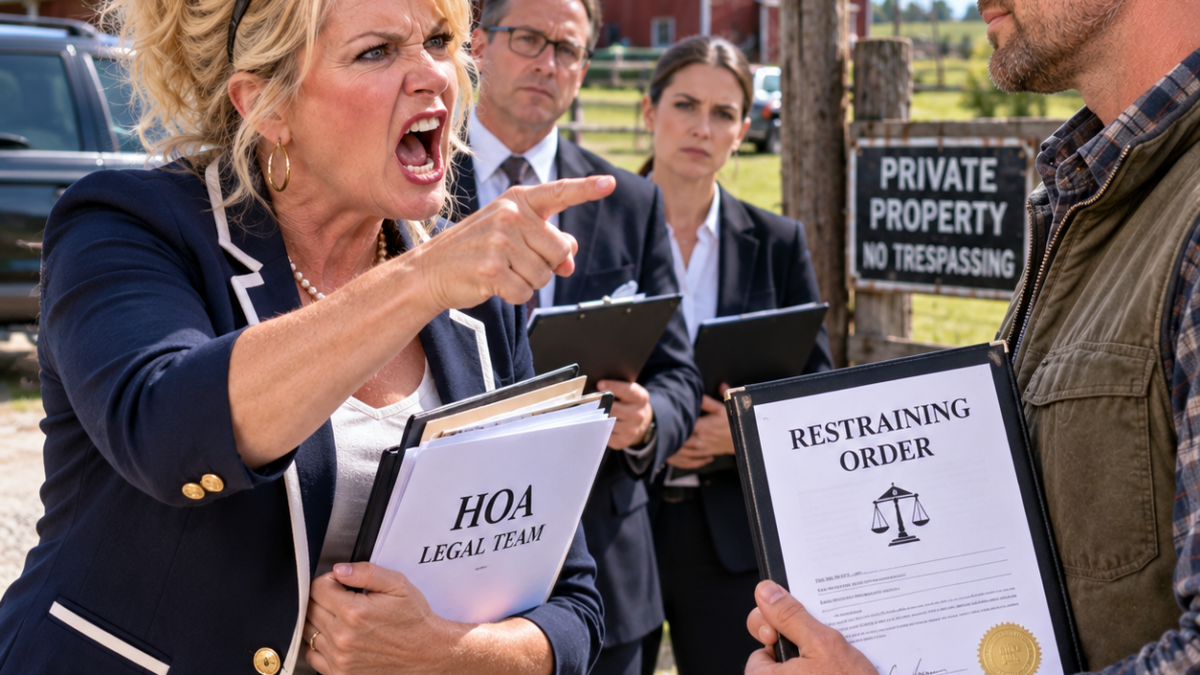
Three black SUVs rolled through my farm gate carrying an HOA president and three lawyers who told me their board had “annexed” my land, voted themselves inspection rights, and would return in twenty-four hours with enforcement if I refused to surrender access.
They came back before the deadline with a surveillance drone buzzing over my livestock, but this time I was standing at the property line holding a judge’s restraining order—and what started as a fight over my fence was about to expose where hundreds of thousands of dollars in neighborhood dues had really gone.
I was waist-deep in hay when the first SUV came grinding up my gravel driveway.
One of my mules had kicked through the back fence sometime before sunrise, so I’d spent most of the morning resetting posts while cursing an animal that had apparently decided treated lumber was a personal insult.
The farm had been mine for fifteen years.
One hundred and twelve acres of pasture, creek bottom, timber, and stubborn Georgia clay.
The barn was older than I was.
The farmhouse was older than my father would have been.
Nothing about the place looked like Willow Creek, the subdivision built a quarter mile down the road seven years after I’d bought my land.
Willow Creek had stone entrance columns, matching mailboxes, sidewalks, a clubhouse, and houses built from three floor plans painted in six approved colors.
My place had goats on the porch when they escaped, a tractor that leaked hydraulic fluid if I parked it facing downhill, and a wind chime made from old horseshoes.
We had coexisted peacefully enough.
Until Janette Bradford became HOA president.
I heard the vehicles before I saw them.
Three black SUVs.
Too shiny for a farm road.
They stopped near the barn in a line.
Doors opened.
Three men climbed out wearing suits despite the heat.
Briefcases.
Leather shoes.
Expressions that suggested somebody else had paid them enough not to care about dust.
Then Janette emerged from the middle vehicle.
Powder-pink pantsuit.
Oversized sunglasses.
Pearl necklace.
She looked like she had arrived to foreclose on a country club.
“Marshall Zeke!”
I rested both hands on the fence post.
“Morning, Janette.”
“We need to talk.”
“You drove through my gate with three lawyers. I figured.”
She marched toward me.
One lawyer stayed slightly behind her.
Another began looking toward the barn as though mentally appraising it.
The third opened a folder.
Janette stopped ten feet away.
“Your property is now subject to Willow Creek jurisdiction.”
I stared at her.
Then I laughed.
I couldn’t help it.
Not a polite chuckle.
A full laugh that startled two goats near the feed trough.
Janette’s mouth hardened.
“I don’t see what’s funny.”
“You just told me an HOA I don’t belong to owns jurisdiction over my farm.”
“That’s not what I said.”
“Sounded exactly like what you said.”
She snapped her fingers.
The lawyer with the folder stepped forward.
He had slicked-back dark hair and the deeply uncomfortable tan of a man who spent most of his life under office lighting.
“Mr. Zeke, I’m Jonathan Pierce. I represent the Willow Creek Homeowners Association.”
“Congratulations.”
He ignored that and handed me the folder.
“The association recently approved a boundary annexation pursuant to its shared perimeter authority provisions.”
I opened it.
Maps.
Meeting minutes.
A resolution.
A document titled:
EXPANDED COMMUNITY OVERSIGHT DISTRICT
I looked up.
“What’s this?”
“Our board voted to include adjoining parcels whose condition may materially affect Willow Creek.”
“You voted.”
“Yes,” Janette said.
“On my land.”
“The HOA is not claiming ownership.”
“Good, because you’d lose.”
“We’re asserting oversight.”
“Which means?”
Jonathan answered.
“Access for inspection, surveying, safety compliance, environmental review, visual-impact standards, and future land-use coordination.”
I slowly closed the folder.
“You want access to my farm.”
“Yes.”
“No.”
Janette sighed as though I were a child refusing vegetables.
“Marshall, your livestock borders residential lots.”
“Quarter mile away.”
“Your drainage affects Willow Creek.”
“The creek flows away from Willow Creek.”
“Your agricultural structures affect property values.”
“My barn was standing before half your board moved here.”
“That isn’t relevant.”
“It seems pretty relevant to the barn.”
Jonathan raised a hand.
“Mr. Zeke, nobody wants conflict.”
“Then get back in your SUVs.”
His expression tightened.
“The association has authorized us to seek judicial enforcement if necessary.”
I tossed the folder onto the hood of Janette’s Escalade.
“You’re trespassing.”
Janette stepped closer.
“This isn’t trespassing.”
“My deed says otherwise.”
“We are conducting official HOA business.”
“You don’t have official business here.”
“We’ve annexed the perimeter.”
“You cannot vote yourselves rights over property you don’t own.”
“You don’t understand the legal framework.”
I looked at the lawyers.
“Any of you want to tell her?”
Nobody answered.
Interesting.
Janette pointed toward the barn.
“We require an inspection of all agricultural structures within the expanded zone.”
“No.”
“The paddock fencing.”
“No.”
“Livestock containment.”
“No.”
“Drainage.”
“No.”
Her voice sharpened.
“You’re officially refusing?”
“I am officially telling four people standing on private farmland to leave.”
Jonathan stepped between us.
“We’ll give you twenty-four hours to reconsider.”
“I don’t need twenty-four minutes.”
“If you continue refusing access, we’ll pursue emergency enforcement.”
I nodded.
“Do whatever you need.”
Janette’s smile returned.
It was small.
Satisfied.
She thought I was bluffing.
“Twenty-four hours,” she said.
“Janette.”
She turned.
“If you come through that gate again without permission or lawful authority, I’m treating it as trespass.”
Her smile disappeared.
“You should be careful, Marshall.”
I looked around at my own pasture.
“On my farm?”
“Yes.”
I laughed again.
That irritated her more than any argument could have.
They climbed into the SUVs and left.
I waited until the dust settled.
Then I walked into the barn.
Whiskey, my mustang, lifted his head from the stall.
“You believe that?”
He chewed.
I took that as agreement.
Then I called Alina Reyes.
PART 2
Years earlier, one of her horses had escaped during a storm.
I’d tracked the animal through nearly ten miles of woods and brought it home after two days.
Ever since then, Alina had insisted she owed me.
I had never collected.
Until now.
She answered immediately.
“Marshall?”
“I need a lawyer.”
“That sentence coming from you terrifies me.”
“HOA says they annexed my farm.”
Silence.
Then:
“I’m sorry, what?”
“They brought three lawyers.”
“That makes it funnier.”
“They want inspection access.”
“Send everything.”
I photographed the documents Janette had left.
Within an hour, Alina called back.
Her voice had changed.
“This annexation resolution is nonsense.”
“I assumed.”
“No, I mean structurally nonsense. Willow Creek’s recorded declaration limits its authority to platted subdivision parcels and specifically described common areas.”
“My farm isn’t either.”
“Correct.”
“What about this shared perimeter language?”
“Made up from three unrelated provisions and stapled together like legal Frankenstein.”
I leaned against the barn door.
“Can they get a court order?”
“They can ask for one.”
“And?”
“I’d enjoy watching them explain it.”
“Can we stop them from coming back?”
A pause.
“Did they threaten entry?”
“Twenty-four hours. Inspection, survey, enforcement.”
“Any previous attempts?”
“Two letters last week. I ignored them because they looked ridiculous.”
“Send those too.”
I did.
She called again twenty minutes later.
“Marshall, those letters matter.”
“Why?”
“They establish repeated demands for access after you’ve rejected jurisdiction.”
“What are you thinking?”
“Temporary restraining order.”
“That fast?”
“If we can show threatened unauthorized entry, surveillance, interference with agricultural operations, and a legally unsupported claim of authority, maybe.”
“Maybe?”
“Judges dislike hypothetical problems. Fortunately, Janette appears determined to stop being hypothetical.”
I smiled.
“What do you need?”
“Deed.”
“Got it.”
“Survey.”
“Got it.”
“Agricultural exemption records.”
“Got them.”
“Photos of your boundary.”
“Easy.”
“Any cameras?”
“Not enough.”
“Fix that.”
By sundown, I had.
Two cameras covering the drive.
One on the barn.
One hidden in the tree line overlooking the eastern pasture.
A fifth camera covered the gate.
Alina emailed me state statutes, county parcel maps, and recorded documents showing Willow Creek’s actual legal boundary.
It ended exactly where I thought it did.
Quarter mile from my fence.
I slept badly anyway.
Not because I believed Janette had authority.
Because people who invent authority are often more dangerous than people who actually have it.
At 5:18 the next morning, Alina texted:
Emergency filing submitted. Judge reviewing at 7.
At 7:43:
Signed. TRO entered. Electronic service going out now. Hard copy en route.
I read the message twice.
Then another alert appeared.
Driveway camera.
Vehicle.
Janette hadn’t waited twenty-four hours.
The drone reached the pasture before the SUV reached the gate.
I heard it first.
A mechanical buzz over the trees.
Whiskey heard it too.
His head snapped upward.
The drone descended over the paddock, hovered near the chicken coop, then swept toward the barn.
I stepped onto the porch.
The camera on the machine tilted downward.
Photographing.
Mapping.
Maybe recording.
Janette’s Escalade stopped outside the gate.
Smart enough not to drive through this time.
Three people climbed out.
Janette.
Jonathan.
The other attorney from yesterday.
And a man in a fluorescent safety vest holding a tablet.
The drone drifted lower.
Whiskey kicked at the air.
I walked toward the gate carrying a plastic document tube.
Janette called out.
“Good morning.”
“Not especially.”
She gestured upward.
“Don’t worry about the drone. Preliminary visual mapping.”
“Turn it around.”
“It isn’t entering structures.”
“Turn it around.”
Jonathan stepped forward.
“Mr. Zeke, aerial observation from lawful operating altitude—”
“Save it.”
The man with the tablet looked at Jonathan.
“I was told this was association property.”
“It isn’t,” I said.
Janette cut in.
“It’s within the expanded oversight zone.”
The man frowned.
“That isn’t what your work order says.”
Janette turned toward him.
“Mr. Collins, please continue.”
He didn’t move.
Interesting.
The drone floated toward the barn.
Janette pointed.
“We received complaints regarding unsafe livestock containment.”
“From who?”
“Residents.”
“Names.”
“Anonymous.”
“Convenient.”
Jonathan opened a folder.
“There are also concerns regarding fire-code compliance involving agricultural structures.”
“County inspected that barn last year.”
“That doesn’t eliminate HOA concerns.”
“HOA concerns don’t create jurisdiction.”
Janette lifted her chin.
“We offered you an opportunity to cooperate.”
“And I declined.”
“You’re obstructing a legitimate safety review.”
“No.”
I held up the document tube.
“I’m enforcing a court order.”
Silence.
Jonathan’s eyes went to the tube.
“What order?”
I removed the papers.
“Temporary restraining order.”
Janette blinked.
I unrolled it against the fence.
“Signed by Judge Landry at seven forty this morning.”
Jonathan stepped closer.
I kept the fence between us.
“Read from there.”
His eyes scanned the first page.
His face changed.
Janette noticed.
“What?”
He didn’t answer.
“Jonathan.”
He lowered his voice.
“This restrains association agents from entering, surveying, inspecting, interfering with, or conducting certain surveillance of the Zeke property pending hearing.”
Janette stared at me.
“You filed against us?”
“You came back sooner than expected.”
“This is obstruction.”
“No.”
I tapped the order.
“This is judicial relief.”
The man in the vest looked at Janette.
“I was not informed there was a court action.”
“Because there wasn’t when we hired you.”
“It exists now,” I said.
He started backing away.
“I don’t want any involvement in this.”
The drone still hovered.
I pointed upward.
“That needs to land too.”
Jonathan said, “The drone isn’t physically trespassing.”
“It’s conducting surveillance connected to conduct specifically addressed in the order.”
“You can’t claim ownership of airspace.”
“I didn’t.”
I smiled.
“But the flight’s already been reported, and Alina is sending the footage and registration information to the appropriate agencies.”
Janette’s face tightened.
“You’re being theatrical.”
“Not as theatrical as four people showing up with a drone to inspect a farm they don’t control.”
A tan sheriff’s cruiser turned onto the road.
Right on cue.
Deputy Luis Morales pulled behind the Escalade.
No lights.
Didn’t need them.
He stepped out.
Janette looked from him to me.
“You called the sheriff?”
“Alina sent them the order.”
Morales walked over.
“Morning.”
“Deputy,” I said.
Jonathan stepped forward.
“We were not aware the restraining order had been entered before arriving.”
Morales took the copy.
He read the first page.
Then looked at Janette.
“Electronic service shows delivery to the HOA’s registered agent at eight oh-two.”
Jonathan checked his phone.
His expression sank.
Morales continued.
“It is eight nineteen.”
Janette said, “We were already in transit.”
“Then now you know.”
He handed the papers back.
“The order’s active.”
Jonathan nodded.
“We’ll leave.”
Janette didn’t.
“This farm directly impacts Willow Creek property values.”
Morales stared at her.
“That has nothing to do with me.”
“We have residents concerned about unsafe conditions.”
“File a complaint with whichever government agency has actual authority.”
“We are the responsible governing body for—”
“No.”
Morales’s voice stayed calm.
“You are the governing body for Willow Creek.”
He pointed toward my farm.
“This isn’t Willow Creek.”
I almost smiled.
Janette turned toward me.
“You have no idea what you’re doing.”
I rested my forearms on the fence.
“I know exactly what I’m doing.”
“You’re creating hostility.”
“You brought lawyers and surveillance equipment to my farm.”
“We were protecting community interests.”
“Your community stops at its property line.”
I looked at Morales.
“Deputy, please tell Ms. Bradford that any further unauthorized entry will be documented for criminal trespass enforcement.”
Morales nodded.
“You heard him.”
Janette’s cheeks reddened.
Jonathan touched her sleeve.
“We need to go.”
She pulled away.
“This isn’t over.”
“No,” I said.
“It’s getting started.”
They left.
The drone rose sharply and disappeared toward the road.
Morales waited until the SUVs were gone.
Then he looked at me.
“You work fast.”
“Alina works fast.”
“Good attorney?”
“Terrifying.”
He handed back the order.
“They’re not the first HOA I’ve seen overreach.”
“Like this?”
“No.”
He looked toward the pasture.
“This is special.”
I nodded.
“It’s not really about inspections.”
“What is it about?”
“Money.”
His expression shifted.
“What kind?”
“Don’t know yet.”
“Fraud?”
“Maybe.”
I looked toward Willow Creek.
“Alina’s digging.”
Morales handed me his card.
“If you find something criminal, call.”
“I will.”
As he drove away, I walked straight to the barn camera.
The tree-line footage had captured the drone dipping much lower than I’d realized.
It had tracked across the chicken run.
Past the barn windows.
Toward the paddock.
And then farther east, beyond my property.
Toward several backyards in Willow Creek.
I sent everything to Alina.
By sunset, she had another surprise.
The drone wasn’t registered to Willow Creek HOA.
It was registered to a company called ClearSight Land Services LLC.
ClearSight shared an address with a mailbox rental business.
The renewal paperwork had been signed by Paul Henley.
Willow Creek’s treasurer.
Alina called me.
“Marshall.”
“I know that tone.”
“Your HOA friends have a shell company problem.”
“They aren’t my HOA friends.”
“Fair.”
“What did you find?”
“ClearSight has no employees listed, no operational address, and almost no public business footprint.”
“Yet they own a survey drone.”
“Apparently.”
“Who paid them?”
“That’s what I’m subpoenaing.”
“You can subpoena already?”
“Not personally. We’re filing for records in the civil action and referring the financial irregularity.”
“Where?”
“State attorney’s office.”
I looked through the barn doors.
Whiskey had finally calmed down.
“How big?”
“Don’t know.”
“Guess.”
“Big enough that your farm might have been an asset, not a nuisance.”
That sentence stayed with me.
An asset.
The next evening, I told my neighbor Franklin.
He lived on a smaller farm west of mine.
We leaned on the fence while his cattle moved through the lower field.
“They want land,” he said.
“Probably.”
“For what?”
“Alina thinks jurisdiction expansion lets them increase assessments.”
Franklin scratched his beard.
“More homes, more dues.”
“More claimed acreage, bigger development numbers.”
“Development?”
“We’re not sure.”
He spat into the grass.
“They picked the wrong mule to kick.”
“That’s what I’m hoping.”
I wasn’t hoping for a fight.
Not really.
I wanted them to leave me alone.
But once somebody tries to manufacture power over land you’ve worked fifteen years to keep, curiosity becomes self-defense.
The next morning, Willow Creek woke up angry.
Someone had posted my camera footage to the community message board.
Not me.
Not Alina.
But there it was.
Janette.
The lawyers.
The drone.
Deputy Morales.
And the restraining order.
Residents began asking questions.
Why were HOA dues paying lawyers to threaten a farmer outside the neighborhood?
Who authorized a drone?
How much had it cost?
Why had there been no board notice?
By noon, the thread had hundreds of comments.
By three, administrators deleted it.
By four, screenshots were everywhere.
At 5:12, I received a voicemail from a number I didn’t recognize.
A woman’s voice.
Quiet.
Nervous.
“My name is Carla Benton. I’m on the Willow Creek board.”
Pause.
“I voted against the annexation plan.”
Another pause.
“Janette pushed it through without proper discussion. I have records.”
Her breathing sounded unsteady.
“If you’re serious about stopping this, call me.”
I listened twice.
Then called.
“Carla?”
“Yes.”
“This is Marshall.”
“Thank God.”
“What do you have?”
“A lot.”
“Can you come here?”
She hesitated.
“I don’t want Janette knowing.”
“Park at Franklin’s.”
“What?”
“Two blocks west. He’ll bring you over through the back lane.”
“You’ve done this before?”
“No.”
I looked toward the road.
“But I’m learning.”
She arrived just before sunset.
Dusty sedan.
Three folders.
And the posture of a person who had spent months looking over her shoulder.
Carla placed the folders on my porch table.
“These are copies.”
“Of?”
“Internal memos. Vendor invoices. Meeting summaries. Emails.”
She looked toward the driveway.
“You have cameras?”
“Every direction.”
“Good.”
I opened the first file.
ClearSight Land Services.
Invoices.
Drone mapping.
Perimeter assessment.
Compliance documentation.
Payments totaling nearly thirty thousand dollars.
“That’s just the drone company?”
“Partly.”
“Why is an HOA paying for land mapping outside its boundary?”
Carla rubbed her forehead.
“Janette said it was liability planning.”
“Liability for what?”
“She never explained.”
Second folder.
Retention Management Services LLC.
More invoices.
“What’s this?”
Carla laughed bitterly.
“Supposedly a landscaping and water-management contractor.”
“Supposedly?”
“It’s a PO box.”
“No equipment?”
“None.”
“Employees?”
“None.”
“Work product?”
“I’ve never seen any.”
“How much?”
“Seventy-eight thousand since February.”
I looked up.
“You voted on these payments?”
“No.”
“Full board?”
“No.”
“Who authorized them?”
“Janette and Paul.”
“Under what authority?”
“Emergency vendor approval.”
“For seventy-eight thousand dollars?”
“She claimed there was an urgent liability problem at the retention pond.”
“Was there?”
“No incident report exists.”
I turned pages.
Backdated invoices.
Generic service descriptions.
No addresses.
No detailed labor.
Nothing.
“Why didn’t you report this?”
Carla looked down.
“Because I’m a coward.”
“No.”
“I sat in those meetings.”
“You brought the records.”
“After they came after you.”
“At least you came.”
She looked at me.
“They punish people.”
“How?”
“Committee removal. Fines. Delayed approvals. Rumors.”
“That sounds petty.”
“It is until it’s your mortgage refinance waiting on an HOA certificate.”
Fair point.
She opened the third folder.
“This is worse.”
Inside were emails between Janette, Paul, and someone named Grant Vale.
Out-of-state developer.
Proposed land assembly strategy.
Northern corridor.
Agricultural conversion opportunity.
I felt my stomach tighten.
“My farm?”
Carla nodded.
“Not just yours.”
She unfolded a map.
Four residential parcels north of Willow Creek had been highlighted.
Then my property.
A line connected them.
“If they could buy these four houses,” she said, “they’d create a corridor.”
“Into my eastern field.”
“Yes.”
“For development?”
“Janette has been meeting with Vale Development for months.”
“And the annexation?”
“Gives them a story.”
“What story?”
“That the HOA already controls land-use oversight around the expansion zone.”
I sat back.
“They’re trying to inflate their footprint.”
“Exactly.”
“Why?”
“More assessable units. Developer contributions. Infrastructure fees.”
“And somebody gets paid.”
Carla didn’t answer.
She didn’t need to.
I held up one invoice.
“This seventy-eight thousand.”
She nodded.
“There’s more.”
“How much?”
“I don’t know.”
“Will you testify?”
Her face went pale.
“To what?”
“Everything you just told me.”
“I need protection.”
“You’ll talk to Alina before anyone else.”
Carla looked at the fields.
Then nodded.
“Yes.”
I called Alina immediately.
She came the next morning.
By afternoon, a state financial investigator had copies.
Two days later, a white-collar unit interviewed Carla for four hours.
Then things accelerated.
An emergency motion froze Willow Creek’s discretionary development accounts.
The judge expanded the existing restraining order to prohibit association agents from conducting surveillance or property access activity against my farm pending further proceedings.
The financial records began opening.
And once they did, the HOA’s story collapsed faster than any fence I’d ever seen.
Deputy Morales arrived at six one morning.
Two state troopers followed him.
One carried an evidence case.
Morales looked exhausted.
“Morning.”
“Not usually when you show up with troopers.”
He handed me paperwork.
“Search warrants.”
“Where?”
“HOA clubhouse. Paul Henley’s home office. Janette Bradford’s residence.”
I read the first page.
Financial records.
Electronic devices.
Vendor contracts.
Surveillance documentation.
“You started something, Marshall.”
“They started it.”
“Fair.”
He nodded toward my cameras.
“There’s another issue.”
“What?”
“The drone footage.”
“I sent everything.”
“We know.”
“What about it?”
“It wasn’t only mapping your farm.”
“I saw neighboring yards.”
“One household had a minor child in the backyard while the drone made repeated low passes.”
I felt the anger return.
“Was that intentional?”
“Investigation’s ongoing.”
“Janette knew?”
“We’re finding out.”
I looked toward Willow Creek.
“They crossed a line.”
Morales shook his head.
“They crossed twenty.”
By eight, news vans had parked outside the clubhouse.
Residents gathered near the sidewalks.
State investigators carried boxes from the HOA office.
Paul Henley came out first.
Handcuffed.
He kept his head down.
Then Janette appeared.
Pearls.
Stiff blazer.
Same posture she’d worn at my gate.
Except her hands were behind her back.
For one strange second, I remembered her saying:
Twenty-four hours.
She had thought the clock was running on me.
Carla stood near a tree.
She looked exhausted.
When she saw me, she walked over and handed me another paper.
“What?”
“Emergency meeting log.”
I read.
SECURITY INITIATIVE
Twenty thousand dollars.
Motion-activated surveillance equipment for “perimeter protection.”
“Where?”
“Properties bordering Willow Creek.”
“HOA property?”
“No.”
I looked at her.
“They installed cameras outside the subdivision?”
“Several.”
“Why?”
“Officially? Security.”
“Unofficially?”
Carla lowered her voice.
“Collecting footage.”
“For what?”
“Building violations. Encroachment claims. Anything useful.”
I stared.
“They were manufacturing complaints.”
“Yes.”
“One woman got a notice saying her fence sits five feet inside HOA land.”
“Is it?”
“Her house predates Willow Creek.”
I folded the paper.
“This keeps getting worse.”
Carla looked toward the investigators.
“It was always this bad.”
“We just didn’t know.”
She shook her head.
“No.”
“We didn’t want to know.”
That hurt because she was probably right.
The state attorney’s office announced charges by the end of the week.
Financial misconduct.
Wire fraud allegations.
Unlawful surveillance.
Conspiracy-related counts under continuing investigation.
The exact charges varied by defendant.
The association’s accounts stayed frozen.
A receiver took control of essential neighborhood operations.
The clubhouse closed except for court-approved administrative use.
Residents who had spent years complaining about HOA meetings suddenly panicked at the idea of having no HOA management at all.
Trash contracts.
Pool maintenance.
Common landscaping.
Drainage.
Insurance.
Real life doesn’t stop because corrupt people get arrested.
The receiver managed essentials.
Carla was selected as interim board president by the remaining lawful members and residents under supervision.
She hated every second of it.
“I never wanted this.”
We sat in the courthouse cafeteria after Janette’s arraignment.
“You’re good at it.”
“That makes it worse.”
She wrapped both hands around a foam coffee cup.
Janette and Paul had both entered not-guilty pleas.
Their attorneys attacked the state’s interpretation of payments and argued surveillance had legitimate safety purposes.
Normal defense work.
Nothing was over.
Carla looked toward the hallway.
“They contacted me.”
“Who?”
“Someone I don’t know.”
“How?”
“Note under my windshield.”
“What did it say?”
She took a folded piece of paper from her purse.
Typed.
No signature.
THE BOARD DOESN’T FORGET ITS FRIENDS OR ITS ENEMIES.
My jaw tightened.
“You reported this?”
“Yes.”
“To Alina?”
“Yes.”
“Morales?”
“Yes.”
“Good.”
Carla stared into her coffee.
“Marshall, I’m scared.”
There was no shame in her voice.
Just exhaustion.
I thought about the night she’d driven to my farm with those folders.
“You should be.”
Her eyes lifted.
“That wasn’t helpful.”
“Fear means you’re paying attention.”
I leaned forward.
“But you’re not alone now.”
She nodded.
Then said, “There’s more.”
“Of course there is.”
“The forensic accountant found transfers to a Nevada trust.”
“How much?”
“Still calculating.”
“Whose trust?”
“Hidden ownership.”
“What does it own?”
“Four parcels north of Willow Creek.”
I knew the map immediately.
“The corridor.”
“Yes.”
“They already bought them?”
“Not all. Two purchases completed. One option agreement. One pending.”
“With HOA money?”
“Some payments came from discretionary accounts.”
I sat back.
“They were buying private real estate through a trust using residents’ dues.”
Carla nodded.
“Then planning to petition for rezoning under another developer name.”
“Vale?”
“Connected.”
“Why Nevada?”
“Privacy. Ownership layering.”
I rubbed my forehead.
“Anything else?”
“Yes.”
“I’m going to regret asking.”
“The accountant matched a compliance-services payment to a cash offer one homeowner received to vacate early.”
I looked at her.
“Off the books?”
“Yes.”
“Using HOA funds.”
“Yes.”
I stood.
“We need Alina.”
“She knows.”
“Then we need the investigator.”
“He knows too.”
I sat again.
Carla gave me the closest thing to a smile I’d seen all morning.
“You’re not very good at letting people work.”
“I’ve noticed.”
Two hours later, we sat in a regional task-force office.
No windows.
White tile.
Bad coffee.
Alina stood beside a forensic accountant.
An investigator with tattoo sleeves arranged statements across the table.
Alina looked at me.
“You were right.”
“About?”
“The farm.”
“They wanted it?”
“They wanted the corridor.”
“How much money moved?”
The accountant answered.
“More than two hundred thousand dollars through shell vendors and related accounts so far.”
Carla inhaled sharply.
“Confirmed?”
“Documented.”
“Janette?”
“Janette and Paul authorized significant portions.”
“Other board members?”
“Some participated. Some may have been misled.”
Alina slid over an email.
Law firm communication.
The lawyers representing the HOA had warned privately that unilateral annexation of independent farmland would almost certainly fail.
Yet another email advised the board to:
Create perception of community consensus while preserving plausible jurisdictional arguments.
I stared.
“They knew.”
Alina nodded.
“They knew the annexation theory was weak.”
“And came anyway.”
“Apparently.”
The investigator tapped another document.
“We also have evidence similar tactics were used by another HOA in a different district.”
“Same lawyers?”
“Yes.”
“Same developer?”
“Related entity.”
Carla whispered, “This is organized.”
“That’s one theory,” the investigator said.
“What happens?”
“Grand jury.”
“And the law firm?”
“Subpoenas already issued.”
“What if they refuse?”
He looked at me.
“Then people with bigger letterhead become interested.”
Federal.
I understood.
The grand jury expanded the investigation.
More board members were indicted.
Two attorneys became subjects of professional and criminal scrutiny.
The Nevada trust was frozen.
The targeted parcels were placed under review so no further transfers could occur during litigation.
Residents received notices explaining their rights.
Some people cried when those letters arrived.
Not because they had lost property.
Because for months they’d thought they were powerless.
The civil side hit almost as hard.
Alina coordinated claims for residents who had been targeted with fabricated violations, unauthorized surveillance, false encroachment notices, and improper assessments.
One woman named Lisa brought us a folder containing eleven warning letters.
Her fence supposedly crossed onto HOA-controlled land.
It didn’t.
The HOA had used a map created by ClearSight—the drone company.
A fabricated overlay shifted her boundary five feet.
“They told me I’d have to remove the fence,” she said.
“Did you?”
“No.”
“Why?”
“My husband built it before he died.”
Her fingers tightened on the papers.
“I told them they’d have to sue me.”
They hadn’t.
Probably because suing would have forced them to prove the map.
Another homeowner had been offered thirty-five thousand dollars to leave his property quietly.
Market value was more than triple that.
“Why didn’t you take it?” I asked.
The man shrugged.
“Didn’t trust anyone paying cash through a company I’d never heard of.”
Smart.
Not everybody had been as lucky.
Two parcel owners had signed preliminary agreements believing the developer was independent.
Those agreements became part of the investigation.
The receiver moved to unwind transactions where legally possible.
Months passed.
The case became bigger than Willow Creek.
But my farm stayed exactly where it had always been.
That was the strange part.
While attorneys argued about conspiracy and financial transfers, I still had fences to repair.
Goats to feed.
Hay to cut.
Whiskey still tried to bite the farrier.
Cattle still found ways to stand precisely where I needed to drive the tractor.
Real life kept moving.
One afternoon Morales pulled into the farm alone.
No troopers.
No paperwork.
He climbed onto the porch.
I handed him iced tea.
“You look terrible.”
“Thanks.”
“How’s the glamorous world of financial crime?”
“Too many spreadsheets.”
“Any final word?”
He nodded.
“Janette and Paul denied bail.”
I raised an eyebrow.
“Fraud defendants don’t usually get held.”
“Judge found serious witness-interference concerns.”
“Carla’s note?”
“Part of the larger picture.”
He drank.
“What about Willow Creek?”
“Residents voted.”
“For what?”
“Dissolution.”
I looked at him.
“How much?”
“Ninety-three percent.”
“That high?”
“People really hate being spied on.”
“Apparently.”
“Receiver will wind it down. Common obligations will transition to direct contracts or another legal structure.”
“Carla?”
“Stepping down when it’s done.”
“She deserves to.”
Morales nodded.
“One more thing.”
“There’s always one more thing.”
“The drone operator cooperated.”
“Mr. Collins?”
“Yeah.”
“He in trouble?”
“Doesn’t look like it.”
“What did he say?”
“ClearSight subcontracted him. Told him he was mapping land for proposed park expansion.”
“He didn’t know?”
“Says he didn’t. Records support it.”
“What about the backyard flights?”
“He gave us full logs.”
Morales looked toward Willow Creek.
“Turns out those low passes weren’t accidental.”
I didn’t say anything.
“They were given specific target coordinates.”
“For houses?”
“Yes.”
“With children.”
“Yes.”
I felt sick.
Morales set down the glass.
“That’s one of the things that pushed prosecutors toward a broader racketeering theory.”
I looked across my pasture.
All this because Janette wanted to walk through my gate.
No.
That wasn’t fair.
All this had already existed.
Her mistake had been bringing it to my gate.
The final indictments named Janette, Paul, three former board members, and two attorneys connected to the scheme.
Not everyone faced the same charges.
Not everybody had done the same things.
Some cooperated.
Some fought.
Some claimed ignorance.
The evidence sorted them out.
Emails.
Bank transfers.
Drone logs.
Vendor invoices.
Trust records.
Board minutes.
Recorded votes.
Private messages.
The kind of paperwork people create when they assume nobody will ever put all of it in one room.
Janette’s defense was that she believed expansion benefited the community.
Paul blamed outside counsel.
One lawyer claimed the board misrepresented facts to him.
The other attorney’s own emails created difficulties for that story.
Carla testified.
Her voice shook during the first ten minutes.
Then stopped.
She explained the fake vendors.
Emergency authorizations.
Closed-door meetings.
Pressure.
Threats.
The annexation vote.
The developer.
The corridor.
At one point Janette stared at her.
Carla looked back.
Didn’t flinch.
I testified too.
Mostly about the first two visits.
The lawyers.
The twenty-four-hour demand.
The drone.
The restraining order.
Janette’s attorney tried to portray me as hostile from the start.
“Mr. Zeke, you laughed at my client when she explained the HOA’s position, correct?”
“Yes.”
“You threw association documents onto her vehicle.”
“I placed the folder on the hood.”
“You called the annexation fictitious.”
“I called the maps made up.”
“Before a judge ruled.”
“I had my deed.”
“You were angry.”
“Absolutely.”
“You threatened criminal trespass.”
“I informed them they were trespassing.”
“You immediately hired an attorney.”
“I called one after three lawyers showed up.”
A few people in the gallery smiled.
The attorney continued.
“Isn’t it true that you wanted to destroy the Willow Creek HOA?”
“No.”
“But it was ultimately dissolved.”
“Yes.”
“And you supported dissolution.”
“After learning what they had done.”
“So your position changed.”
“Yes.”
He paused.
“What was your original goal?”
That question surprised me.
“To get them off my farm.”
“And later?”
“To make sure they couldn’t do to other people what they tried to do to me.”
He returned to his table.
No more questions.
The criminal cases resolved over time.
Some through trial.
Some through negotiated pleas.
Janette and Paul received substantial prison sentences after convictions tied to the financial scheme, fraud, and broader conspiracy proved against them.
The attorneys involved faced consequences based on their individual conduct, including professional discipline and criminal exposure where prosecutors established knowing participation.
Restitution orders were entered.
Money seized from shell accounts and the Nevada trust went toward repaying victims.
Not everybody got everything back.
That’s rarely how these stories work.
But people got something more important than a check.
The paper empire was gone.
Willow Creek remained.
The houses remained.
The pool reopened under a resident-managed recreational cooperative.
Trash pickup continued.
The storm-water drains finally got repaired.
Common landscaping was handled by voluntary contributions and direct service agreements.
No president.
No enforcement committee.
No surveillance initiative.
No architectural tribunal deciding whether somebody’s flower pot threatened neighborhood integrity.
Carla disappeared for a month after the transition.
Not literally.
She went to visit her sister in Arizona.
When she came back, she looked ten years younger.
“I slept.”
“Congratulations.”
“For nine hours.”
“Show-off.”
She laughed.
We sat outside a little diner near the courthouse.
“You know what bothers me?” she asked.
“What?”
“I was on that board.”
“You’ve mentioned.”
“I approved things.”
“Some.”
“I should have seen more.”
“Probably.”
She frowned.
“You’re supposed to make me feel better.”
“No.”
I drank my coffee.
“You’re supposed to remember enough that you never let it happen again.”
She stared at me.
Then smiled.
“I hate you sometimes.”
“Healthy.”
She became one of the loudest advocates for transparent community finance in the county.
Not because she thought she was innocent.
Because she understood how easy silence becomes participation.
The neighborhood invited me to a gathering at the community hall.
I almost didn’t go.
Parties were never my thing.
But Franklin threatened to drag me there in a cattle trailer.
So I put on a clean shirt and went.
The place was packed.
Families.
Retirees.
Young couples.
People I’d seen only through court hallways.
No formal agenda.
No minutes.
No board table.
Just food.
Somebody had made barbecue.
Somebody else brought enough macaroni salad to survive a siege.
Carla stood near the front holding a glass.
“Oh no.”
Franklin grinned.
“You’re getting a speech.”
“I’ll leave.”
“Doors are blocked.”
Carla tapped a spoon against the glass.
People quieted.
“I’ll keep this short.”
Everyone laughed because former HOA meetings had never kept anything short.
She continued.
“We spent years thinking community meant rules.”
She looked around.
“Then we learned rules without accountability are just tools.”
She looked at me.
“And sometimes it takes one stubborn farmer telling a bunch of lawyers to get off his land to remind everybody where the line actually is.”
People laughed.
Carla raised her glass.
“To Marshall.”
I shook my head.
She ignored me.
“Who reminded us that fences don’t only keep things out.”
She paused.
“Sometimes they remind people where their power ends.”
That one got me.
I tipped my hat.
“Glad I could help.”
No speech.
I didn’t need one.
Later, near the parking lot, a man touched my shoulder.
Mid-fifties.
Weathered face.
Calloused hands.
“You Marshall?”
“Depends.”
He laughed nervously.
“I’m David Keller.”
The name clicked.
Northern parcel.
One of the people the trust had approached.
“They offered me money.”
“I heard.”
“Thirty-eight thousand.”
“For property worth?”
“About one-fifty.”
“Why’d you refuse?”
“Didn’t feel right.”
He looked toward the community hall.
“But I didn’t fight either.”
“You didn’t sign.”
“I was scared.”
“You stood your ground.”
“Because they didn’t push hard enough.”
He looked ashamed.
I understood.
“You don’t need to win dramatically for it to count.”
He considered that.
Then nodded.
“Thanks.”
We shook hands.
Back at the farm, everything returned to normal.
Meaning chaotic.
The goats escaped twice.
Whiskey broke a gate latch.
A storm dropped a pine tree across the back trail.
I spent three days repairing fences.
Normal problems.
Wonderful problems.
I kept the cameras.
Not all of them.
The one over the porch came down.
The hidden tree-line camera stayed.
So did the gate camera.
I installed new signs along the eastern boundary.
The old ones had said:
PRIVATE PROPERTY — NO TRESPASSING
The new signs were simpler.
PRIVATE LAND
PROTECTED BY THE PEOPLE WHO LIVE HERE
Franklin saw one.
“Little dramatic.”
“I learned from the HOA.”
He laughed.
One afternoon, I found myself repairing the exact fence I’d been working on when Janette first arrived.
Same stretch.
Same mule damage.
I drove in a new post.
Packed dirt around it.
Then heard an engine.
My shoulders tightened automatically.
Old reflex.
A pickup appeared.
Not black SUV.
Carla.
She parked.
“What do you want?”
“Nice to see you too.”
“You driving onto my farm gives me trauma.”
She held up a pie.
“Peace offering.”
“What kind?”
“Pecan.”
“You may enter.”
We sat on the porch.
She handed me an envelope.
“What?”
“Final receiver report.”
“I don’t want it.”
“You’re going to read it.”
“No.”
“Yes.”
“Why?”
“Because your restraining-order case is page one.”
I opened it.
The report summarized the events leading to receivership.
Repeated unauthorized access attempts.
Surveillance.
Financial irregularities.
Whistleblower evidence.
Investigation.
Dissolution.
At the end was a statement from the receiver:
The initial private-property dispute exposed governance failures and financial misconduct that would likely have continued absent judicial intervention.
I read it again.
Carla watched me.
“You realize what that means?”
“It means I should’ve charged legal consulting fees.”
“Marshall.”
I closed the report.
“Yes.”
“You stopped them.”
“No.”
I looked toward Willow Creek.
“You stopped them.”
She frowned.
“Because I gave you folders?”
“Because you were inside and decided not to stay quiet.”
“Alina stopped them.”
“Partly.”
“Morales.”
“Partly.”
“The investigators.”
“Partly.”
She understood.
“Everybody.”
“Exactly.”
I looked toward the eastern fence.
“People like Janette survive by making everybody feel alone.”
Carla nodded.
“The moment people compare notes…”
“The whole thing gets smaller.”
We ate pie.
She left before dark.
A year later, Willow Creek looked almost exactly the same from the road.
Stone entrance.
Trim lawns.
Pool.
Clubhouse.
But the old HOA sign was gone.
In its place was a wooden board:
WILLOW CREEK NEIGHBORHOOD
WELCOME HOME
That was it.
No rules listed.
No president’s name.
No enforcement phone number.
People still disagreed.
Of course they did.
One homeowner wanted speed bumps.
Another hated speed bumps.
Someone complained about pool hours.
Someone else wanted chickens.
Normal humans.
The difference was nobody could weaponize a board against them.
One morning, Morales stopped by.
He was off duty.
Jeans.
Baseball cap.
I almost didn’t recognize him.
“Coffee?”
“Got any?”
“Unfortunately.”
We sat on the porch.
He looked toward the field.
“Quiet.”
“For now.”
“You always this suspicious?”
“Since three SUVs showed up.”
He smiled.
“Fair.”
After a while, he said, “You know Janette’s appeal was denied.”
“I heard.”
“Paul’s too.”
“Good.”
“You seem less interested than I expected.”
I looked at him.
“What should I do? Throw a parade?”
“Some people would.”
“I wanted them off my land.”
“You got that.”
“I wanted residents protected.”
“They are.”
“Then I’m done.”
Morales nodded.
“That might be the healthiest thing anyone involved has said.”
I thought about that.
“Don’t tell Alina.”
“She’d bill you.”
We laughed.
That fall, I replaced the old sycamore wind chime.
The drone had rattled it so hard during that first illegal survey flight that one horseshoe had cracked loose.
I could have fixed it.
Instead, I made a new one.
Same metal.
Same ugly sound.
Better wire.
I hung it near the porch.
The first breeze moved through.
Clank.
Whiskey looked offended.
Perfect.
A week later, a young couple from Willow Creek walked up the public road beside my property.
They stopped outside the gate.
Didn’t enter.
The man waved.
“Mr. Zeke?”
“Marshall.”
“We just moved in.”
“Sorry to hear that.”
They laughed.
“We heard about everything.”
“People need hobbies.”
The woman smiled.
“We wanted to ask something.”
“Go ahead.”
“Is that trail on your property?”
“Yes.”
“We’ve heard it reaches the creek.”
“It does.”
“Would you ever allow neighbors to use it?”
Interesting question.
A year earlier, I’d probably have said no immediately.
Not because I hated people.
Because every request had begun to feel like the opening move in an invasion.
I looked at them.
“You asking permission?”
“Yes.”
“Not declaring jurisdiction?”
The man laughed.
“Definitely not.”
“Then maybe.”
We worked out a simple arrangement.
Certain weekends.
Walking only.
No vehicles.
No litter.
No entitlement.
Word spread.
A few families began using the trail.
They asked first.
Every time.
One Saturday, I found two kids sitting near the creek throwing stones.
Their father stood nearby.
He waved.
“Hope we’re okay here.”
“You asked last week.”
“Just checking.”
I smiled.
“You’re good.”
That became another thing Janette had never understood.
Respect makes access easier.
Control makes walls higher.
The HOA had tried to force its way onto my farm.
After it disappeared, I voluntarily opened part of the land to the very neighbors it claimed to represent.
Nobody needed a lawyer.
Nobody needed a vote.
They asked.
I said yes.
Simple.
Two years after the first SUVs arrived, Willow Creek organized a cleanup day along the county road.
Not mandatory.
No fines for skipping it.
About sixty people showed up.
Trash bags.
Gloves.
Kids.
Someone brought coffee.
Someone else brought doughnuts.
They cleaned the ditch between the subdivision and my eastern field.
I joined them.
Halfway through, Franklin walked over.
“Look at you.”
“What?”
“Community volunteer.”
“Don’t spread rumors.”
“You’re practically an HOA president.”
I threw a plastic bottle at him.
He laughed.
Carla was down the road filling bags.
Alina arrived around noon.
In heels.
On gravel.
I stared.
“You learned nothing.”
“I don’t own farm shoes.”
“You own money.”
“Fair.”
She handed me a folder.
I groaned.
“No more law.”
“Relax. This one is good.”
It was the final order closing the civil case involving my property.
Permanent injunction.
Willow Creek’s former HOA and successor entities barred from asserting jurisdiction over my farm based on the invalid annexation.
Costs awarded.
Claims resolved.
I read the first page.
“You kept this from me?”
“I wanted dramatic timing.”
“You’ve spent too much time around Janette.”
“Don’t insult me.”
I looked at the signature.
Judge Landry.
Same judge who had signed the temporary restraining order before sunrise two years earlier.
One order had stopped them at the gate.
This one made sure they never came back.
I folded the paper.
“Frame it.”
Alina smiled.
“Already ordered the frame.”
“You’re unbearable.”
“You owed me for the horse.”
“I found that horse.”
“Exactly.”
We walked toward the farm.
The new boundary signs stood beside the road.
People from Willow Creek moved around them.
Not across.
Not without asking.
No lawyers.
No drones.
No claims of oversight.
Just neighbors respecting a line.
That evening, after everyone left, I carried the final order to the barn.
I hung it beside the first restraining order.
Not in the house.
Not in the office.
The barn.
Right above the workbench where I had made the original call to Alina.
The two documents sat side by side.
Temporary.
Permanent.
A beginning and an end.
Whiskey poked his head over the stall.
I looked at him.
“What?”
He snorted.
“That’s what I thought.”
The strangest part was how small the original confrontation seemed in hindsight.
Three SUVs.
Four people.
One ridiculous annexation folder.
At the time, it felt like the entire fight.
It wasn’t.
It was just the loose thread.
Pull one thread, and everything underneath appeared.
The shell drone company.
The fake contractor.
Seventy-eight thousand dollars.
Surveillance.
Off-book land purchases.
Nevada trust.
Developer corridor.
Cash offers.
Lawyers who knew the strategy was questionable.
Board members intimidated into silence.
Residents fined using fabricated evidence.
Children recorded by drones.
More than two hundred thousand dollars routed through entities that had no legitimate reason to exist.
Another district using similar tactics.
It had all been there before Janette rolled onto my gravel.
I was simply the first person who had both reason and resources to force the system to explain itself.
That thought stayed with me.
Because I wasn’t smarter than everybody in Willow Creek.
I wasn’t braver.
I owned farmland outside their bylaws.
I knew Alina.
I had cameras.
I had enough independence to laugh when Janette threatened me.
Most residents didn’t.
They had mortgages.
Approval requests.
Shared amenities.
Certificates needed for home sales.
Rules tangled into their deeds.
Power doesn’t have to be legitimate to feel real.
It only has to make resistance expensive.
Janette understood that.
She just forgot courts exist for the moment when somebody decides the price of resistance is worth paying.
One evening near the end of summer, I stood at the eastern fence watching the light move across the pasture.
The hay had just been cut.
Everything smelled dry and sweet.
Willow Creek’s rooftops showed through the trees in the distance.
Franklin came down the road on his ATV.
He stopped.
“You going to stand there looking dramatic all night?”
“Planning to.”
He shut off the engine.
“Remember what I said?”
“You say a lot of useless things.”
“They picked the wrong mule to kick.”
I laughed.
“You did say that.”
“Turns out I was right.”
“No.”
He looked at me.
“They picked the wrong farm.”
“Same thing.”
I looked toward the barn.
“No. The farm wasn’t wrong because I’m special.”
“Then why?”
“Because it had a boundary.”
Franklin frowned.
“That’s philosophical for a man who smells like tractor fuel.”
I ignored him.
“They thought boundaries were whatever they could vote them into being.”
“Yeah.”
“They learned different.”
Franklin nodded.
“Expensive lesson.”
“Very.”
The wind moved through the trees.
My new horseshoe chime sounded from the porch.
Ugly as ever.
Beautiful.
Franklin started his ATV.
“Dinner at our place tomorrow.”
“What time?”
“Six.”
“Your wife’s cooking?”
“Yes.”
“I’ll be there.”
He drove away.
I stayed another few minutes.
Then walked the fence.
Every post was mine.
Every strand of wire where I’d put it.
The camera at the tree line still watched the field.
Not because I expected Janette back.
She wasn’t coming.
Not because I expected lawyers.
They’d had enough.
It stayed there because memory has value.
So do precautions.
At the gate, I touched the new sign.
PRIVATE LAND.
PROTECTED BY THE PEOPLE WHO LIVE HERE.
Maybe Carla had been right about fences.
They don’t only keep strangers out.
They show everyone where responsibility begins.
My farm ended at that line.
Willow Creek began beyond it.
And for the first time since those SUVs arrived, that was all the relationship needed to be.
Neighbors.
Not rulers.
Not subjects.
Not enemies.
Neighbors.
I walked back toward the farmhouse.
The barn lights glowed yellow.
The goats were already complaining about dinner even though they’d been fed.
Whiskey kicked his stall once for no obvious reason.
Normal.
Everything gloriously normal.
I reached the porch and stopped beneath the old restraining order hanging inside the barn window where I could see its white edge from outside.
Janette had arrived that first morning with three lawyers because she believed enough paper could manufacture power.
In the end, one piece of paper stopped all four of them at my fence.
But it wasn’t the paper that beat them.
It was what stood behind it.
A real deed.
A real boundary.
A real court.
Real evidence.
And eventually, real people willing to speak.
That was the part Janette never understood.
You can bully one homeowner.
You can scare one board member.
You can hide one invoice.
You can falsify one map.
You can even convince a neighborhood for a while that your authority stretches farther than it does.
But every lie creates a record.
Every payment leaves a trail.
Every threatened person remembers.
And if enough of those people finally compare what they know, the empire doesn’t fall because someone attacks it.
It collapses because there was never anything solid underneath.
I opened the farmhouse door.
Before stepping inside, I looked once more across the fields.
Nothing moved except the grass.
No black SUVs.
No drone.
No lawyers.
Nobody coming to inspect what wasn’t theirs.
Just my farm.
Exactly where it had always been.
And that was all I’d wanted from the beginning.








