PART 2: HOA Sent a Tow Truck for My Boat—Harbor Police Shut Them Down When They Learned I Owned the Waterfront
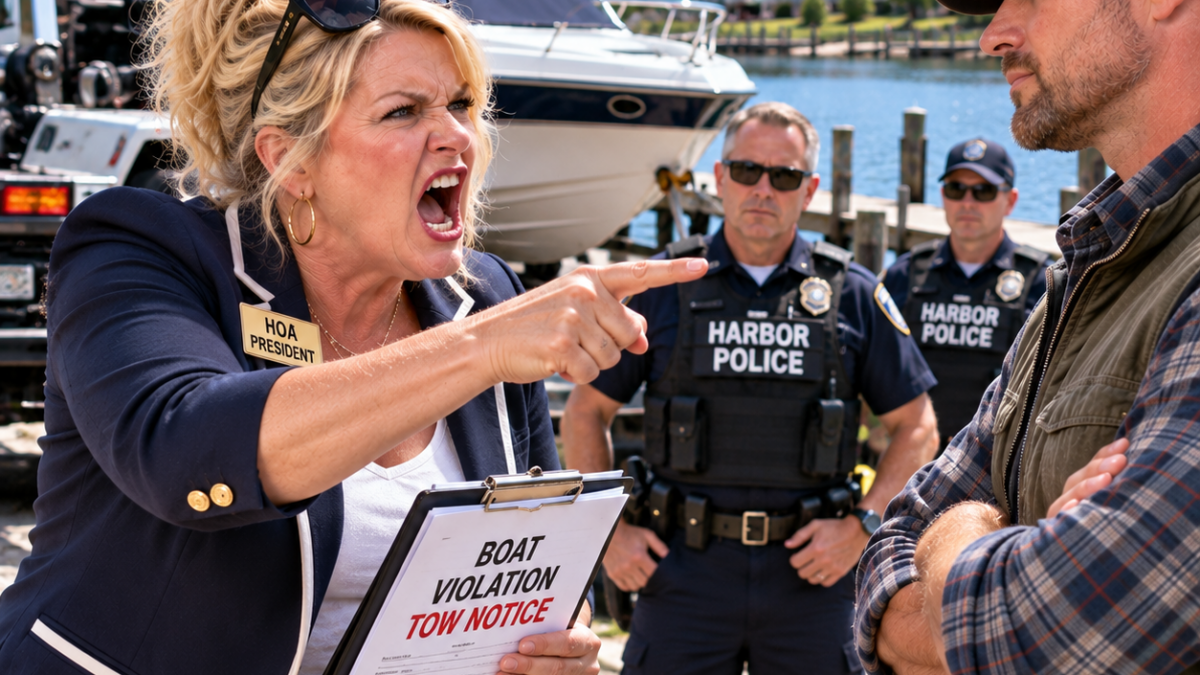
The HOA president actually sent a tow truck down my private driveway to drag my thirty-foot fishing boat away from the dock behind my own house, then stood there with a clipboard and ordered the driver to “hook it up” while insisting her neighborhood rules gave her authority over a waterfront parcel she had never bothered to check.
Ten minutes later, Harbor Police were standing between her and my boat, reading the deed that gave me title from the street all the way to the bulkhead and reminding her in front of the tow operator that HOA aesthetics did not override waterfront property rights, marine regulations, or the simple fact that she was trespassing on land she did not control.
She left promising the fight was only beginning, but the yellow violation notice she zip-tied to my mailbox the next morning contained one tiny reference to a mysterious “special enforcement session,” and when I went looking for the meeting that supposedly gave her all that new power, I found something far more dangerous than an HOA president who hated my boat.
I was halfway through cleaning a pair of striped bass when I heard gravel crunching behind the house.
Not ordinary tire noise.
Heavy.
Slow.
Diesel.
I wiped my hands on a rag and looked up from the cleaning table.
A tow truck was backing down my driveway toward the water.
For about three seconds I just stared at it.
Then I noticed Regina Alder standing beside the truck.
Clipboard tucked against her chest.
Pearls.
Pastel blouse.
Perfect hair.
The woman looked like she had dressed for a charity luncheon and somehow ended up supervising a vehicle repossession.
I dropped the rag.
“You’ve got to be kidding me.”
My dog Jasper lifted his head from beneath the deck table.
I walked quickly up the path from the boathouse.
“Regina!”
She turned like she’d been expecting applause.
“Xander.”
“What the hell is this?”
“Enforcement.”
“Enforcement of what?”
She flipped open her clipboard.
“HOA Clause Eleven Point Two. Large marine vessels may not be stored on personal property where they create an undesirable visual impact.”
I stared past her toward my boat.
Thirty feet.
White hull.
Twin outboards.
Tied to my private dock behind a privacy hedge.
“You mean that boat?”
“Yes.”
“The boat in the water.”
“Yes.”
“At my dock.”
“Yes.”
“Behind my house.”
“You don’t need to repeat everything I say.”
“I do when what you’re saying is this stupid.”
Her mouth tightened.
“Residents have complained.”
“Which residents?”
“That’s confidential.”
“About what?”
“Visual pollution.”
I actually laughed.
The tow driver looked uncomfortable.
Regina didn’t.
“The vessel is inconsistent with neighborhood aesthetic standards.”
“It’s a fishing boat in a waterfront neighborhood.”
“That doesn’t exempt it.”
“It absolutely matters.”
She pointed toward the water.
“The board has determined the vessel needs to be removed until you submit an appearance variance.”
I stepped closer.
“You ordered a tow company onto my property?”
“The association authorized removal.”
“You don’t have removal authority here.”
“We have jurisdiction over neighborhood standards.”
“Not over my dock.”
“Your house is inside Serest.”
“My house is subject to certain covenants.”
I pointed toward the water.
“My waterfront rights are separately deeded.”
She waved toward the driver.
“Hook it up.”
He didn’t move.
Regina turned.
“Did you hear me?”
The driver looked at me.
Then back at her.
“Ma’am, that boat’s floating.”
“Use whatever procedure you normally use.”
He blinked.
“You told dispatch it was a trailer boat.”
Regina hesitated.
Just enough.
I took out my phone.
She rolled her eyes.
“Call whoever you want.”
“I plan to.”
“You’re still getting fined.”
I dialed Harbor Police.
“Yeah, hi. I’ve got an HOA president and a tow company attempting to remove a legally docked vessel from private waterfront property.”
Regina’s smile weakened.
“No, the vessel isn’t abandoned.”
I looked directly at her.
“No, I did not authorize the tow.”
The dispatcher asked something.
I answered.
“Yes, I have the deed.”
Another question.
“Yes, she’s still here.”
I ended the call.
Regina folded her arms.
“You’re making this much more dramatic than necessary.”
“There’s a tow truck beside my boathouse.”
“You could’ve complied.”
“You could’ve read a deed.”
The Harbor Police unit arrived about ten minutes later.
Regina’s confidence lasted until the first officer unfolded my property documents across the hood of his vehicle.
He traced the parcel line.
Looked toward my dock.
Then at Regina.
“Ma’am, this dock is privately controlled.”
She opened her mouth.
He continued.
“And the vessel is lawfully moored.”
“The HOA has aesthetic authority.”
“Not enough to seize a boat.”
“She is in violation of community standards.”
The officer pointed toward the water.
“This is a regulated waterfront area. Your bylaws do not give you the authority to order an unauthorized removal from a private dock.”
Regina’s cheeks turned pink.
“But—”
“No.”
Then he turned to the tow driver.
“Pack up.”
The driver nodded immediately.
The officer added:
“If you accept another unauthorized removal request from this parcel without verifying legal authority, you’re exposing yourself to serious liability.”
The truck was reversing before Regina finished protesting.
She stood beside me watching it leave.
“This isn’t over.”
I looked at her clipboard.
“No.”
I smiled.
“You finally said something we agree on.”
The next morning, a yellow violation notice was zip-tied to my mailbox.
Across the top, in red:
**FINAL WARNING**
At the bottom:
**AUTHORIZED BY SPECIAL SESSION OF THE HOA ENFORCEMENT COMMITTEE**
I read that line twice.
Then a third time.
I had never heard of an HOA enforcement committee.
And I knew enough about Serest’s bylaws to know there hadn’t been a properly noticed special meeting.
That was when I stopped thinking Regina was merely abusing the rules.
I started wondering whether she had begun inventing them.
—
# PART 2
I carried the yellow notice inside and set it on my workbench.
Jasper followed me, nails clicking across the concrete floor.
“You see this?”
He stared at me.
“Special enforcement committee.”
His tail moved once.
“Exactly. Sounds made up.”
I went inside, turned on my laptop, and logged into Serest HOA’s resident portal.
Most people hated that website.
I understood why.
The design looked fifteen years old.
Meeting minutes were buried inside nested folders.
Budgets were uploaded as scanned PDFs.
Search barely worked.
If you wanted to hide something without technically hiding it, Serest’s website was nearly perfect.
I started with the bylaws.
Board authority.
Committees.
Enforcement procedures.
Meeting notice requirements.
Emergency powers.
Nothing.
No permanent enforcement committee.
No clause allowing the president to create one alone.
No authority permitting the seizure of marine property.
Then I opened the most recent meeting minutes.
Normal monthly meeting.
Pool repairs.
Landscaping.
Fence approvals.
Nothing about boats.
Next month.
Nothing.
Then I found a PDF uploaded at 6:12 that morning.
Title:
**SPECIAL SESSION MINUTES — WATERFRONT COMPLIANCE**
One page.
No attendance list.
No recorded vote.
No signatures.
No notice date.
No meeting location.
Nothing showing a quorum.
The document claimed that a special session had granted Regina “temporary expanded enforcement authority necessary to address urgent waterfront violations.”
I checked the metadata.
Created at 3:07 a.m.
Modified at 3:11.
Uploaded three hours later.
The alleged meeting time listed inside the document?
8:00 p.m. the previous evening.
I had been home.
My neighbor Denise, one of the actual board directors, had been at a community theater performance with her husband.
I knew because she’d posted photographs.
Something smelled wrong.
Not HOA annoying.
Wrong.
I saved the file.
Then saved screenshots.
Then downloaded the original server copy.
I was still organizing the folder when footsteps crunched near the sidewalk.
Jasper barked.
I looked through the front window.
A man stood near my hedge with a professional camera.
Long lens.
Dark polo shirt.
He leaned sideways to photograph through a narrow gap toward the dock.
I walked outside.
“You looking for something?”
He took another photo.
“Documenting.”
“What?”
“Noncompliance.”
“For who?”
“The association.”
He lowered the camera.
Late thirties.
Athletic build.
Tactical-looking belt despite wearing no uniform.
“You got a name?”
“Brady Trent.”
“And why are you photographing behind my privacy hedge?”
“Anything visible from a public street can be documented.”
“You’re leaning halfway into my hedge.”
“Still public.”
“Are you an HOA employee?”
“Compliance subcommittee.”
I almost laughed.
“That’s interesting.”
“What?”
“I spent two hours reading the bylaws. That committee doesn’t exist.”
His jaw tightened.
“You should speak with President Alder.”
“I already did.”
He lifted the camera again.
I stepped between the lens and hedge.
“Not from that angle.”
“You can’t obstruct association documentation.”
“Watch me.”
He lowered it.
I stayed calm.
No threats.
No touching him.
Just stood there.
After several seconds, Brady muttered something under his breath.
Then I noticed the earpiece in his right ear.
Not earbuds.
Single communications piece.
“Who are you talking to?”
“No one.”
He turned.
“Brady.”
He stopped.
“If Regina sent you, tell her every photograph taken through that hedge is being documented.”
He walked away.
That was when my concern changed.
The tow truck had been aggressive.
The fake committee looked dishonest.
The photographer made it organized.
Somebody wasn’t merely trying to enforce a boat rule.
Somebody was building a file.
The question was why.
—
My cousin Ellie worked in county zoning.
I called her.
“Hypothetical question.”
“I hate those.”
“What if an HOA invents a committee?”
“That’s oddly specific.”
“And then uses that committee to claim authority contradicting waterfront zoning?”
She laughed.
“Still hypothetical?”
“Deeply.”
“Then hypothetically they’re asking for litigation.”
“What if the meeting didn’t happen?”
Silence.
“That becomes more interesting.”
“Created minutes after the fact.”
“Xander.”
“Hypothetically.”
“Stop saying hypothetically.”
“Fine.”
I explained.
Boat.
Tow truck.
Harbor Police.
Violation.
Fake special-session record.
Brady.
When I finished, Ellie said:
“Save everything.”
“Already am.”
“Original files, not just screenshots.”
“Done.”
“Metadata.”
“Done.”
“Harbor report.”
“Requesting it.”
“Who is representing the HOA?”
“Don’t know yet.”
“Find out.”
She paused.
“And don’t get cute.”
“What does that mean?”
“No baiting Regina. No threatening anybody. No posting accusations online before you know what you can prove.”
“You sound like a lawyer.”
“I work around lawyers.”
“Worse.”
“Xander.”
“I understand.”
“Good.”
Before hanging up, she added:
“Also check whether the HOA board can spend money on enforcement without approval.”
That turned out to matter.
I just didn’t know it yet.
—
The law firm’s email arrived the following afternoon.
**IMMEDIATE COMPLIANCE DEMAND**
The letter said the Serest HOA represented homeowners whose property values were being harmed by my “nonconforming marine storage.”
It demanded removal of the vessel within forty-eight hours.
Daily fines thereafter.
Potential legal action.
I called the number.
A junior associate named Greg answered.
“Greg, I’m Xander Nalin.”
Pause.
“Yes, Mr. Nalin.”
“You sent the boat letter?”
“Our office sent correspondence on behalf of Serest HOA.”
“Great. What provision authorizes fines against a vessel lawfully docked within separately deeded waterfront rights?”
Another pause.
“Our client has broad aesthetic authority.”
“That’s not what I asked.”
“The governing documents empower—”
“Section number.”
Silence.
“Greg?”
“I don’t have the full declaration in front of me.”
“You sent me a threat without the document in front of you?”
“Our client represented—”
“Bad answer.”
His tone hardened.
“Mr. Nalin, if you continue refusing lawful compliance—”
“Was your firm told Harbor Police already rejected the attempted tow?”
Silence.
“Were you told the board created a special enforcement session with no quorum and no recorded vote?”
“I’m not familiar with that characterization.”
“Were you shown the special-session minutes?”
Another pause.
“Certain board materials were provided.”
“Check the file metadata.”
“I don’t see the relevance.”
“It was created at three in the morning.”
Nothing.
“The meeting allegedly happened hours earlier.”
“Mr. Nalin—”
“No signatures. No roll call. No notice. No quorum.”
“You should direct further communications through counsel.”
“I probably will.”
I let that sit.
“Greg, one more thing.”
“What?”
“If your firm sends another threat based on authority nobody can identify, I’ll include the correspondence in whatever complaint follows.”
He ended the call.
An hour later, I requested the Harbor Police incident report.
Then I printed everything.
By that evening, I had a binder.
I hated that I had a binder.
People who attend HOA meetings with binders are rarely enjoying their lives.
But Tuesday was the monthly meeting.
And I planned to attend.
—
Serest’s clubhouse meeting room was packed.
Mostly retirees.
A handful of young families.
People drinking burnt coffee from Styrofoam cups.
Regina sat at the front.
Pearls again.
Denise sat two chairs away from her.
I recognized three other directors.
Brady wasn’t officially seated at the table.
He stood near the rear wall.
Interesting.
The meeting crawled through normal business.
Pool pump.
Entrance flowers.
Mailbox paint.
Then open forum.
I stood with my binder.
Regina saw me.
Her expression changed instantly.
“Mr. Nalin.”
“President Alder.”
“This forum is intended for general member comments.”
“Perfect.”
“Individual enforcement disputes should be handled privately.”
“I’m not discussing an individual enforcement dispute.”
Her shoulders relaxed slightly.
“I’m discussing board procedure.”
They tightened again.
I held up the yellow notice.
“Who sits on the Special Enforcement Committee?”
Silence.
Regina adjusted her microphone.
“A temporary committee was authorized to address urgent compliance matters.”
“Who are the members?”
“This isn’t—”
“Names.”
Someone behind me murmured.
Regina looked toward another board member.
Nobody answered.
I opened the binder.
“Your bylaws require committees exercising delegated board power to be created by recorded board action.”
I held up the printed minutes.
“This document claims such action occurred last week.”
Regina leaned back.
“Yes.”
“Who attended?”
“The relevant directors.”
“Which ones?”
“Mr. Nalin—”
“Denise?”
Every head turned toward Denise.
She looked surprised.
“I wasn’t there.”
I nodded.
“Kathy?”
Another director shook her head.
“I didn’t know there was a meeting.”
The room began murmuring.
Regina’s face hardened.
“This was an emergency session.”
“Then where’s the quorum?”
She said nothing.
“Notice?”
Nothing.
“Vote?”
Nothing.
I continued.
“This PDF was created at three-oh-seven in the morning after the time the meeting supposedly occurred.”
A man near the back called:
“You can prove that?”
I turned.
“Yes.”
I held up a page.
“File metadata.”
Then another.
“Harbor Police incident report.”
Then another.
“Property deed.”
I looked back at Regina.
“This invented committee authorized you to send a tow truck onto my private waterfront.”
Regina’s voice rose.
“The boat was in violation.”
“Harbor Police disagreed.”
“The officer did not understand HOA authority.”
People laughed.
Wrong thing to say.
Denise leaned toward her microphone.
“Regina, did the board vote to order the tow?”
Regina looked at her.
“I acted within delegated enforcement authority.”
“From what vote?”
“Denise—”
“From what vote?”
Silence.
I opened another section.
“Since the fake special session, Brady Trent has photographed my property through a hedge.”
Brady moved against the wall.
I looked directly at him.
“Would you like to explain which lawful committee employs you?”
He said nothing.
A woman three rows behind me stood.
“Sandra Lewis.”
Regina looked annoyed.
Sandra pointed toward Brady.
“Was he on my property Monday?”
Brady glanced at Regina.
Sandra continued:
“I saw somebody with a camera beside my side gate.”
Another resident spoke.
“Mine too.”
Then another.
Regina tried tapping the microphone.
“Order.”
Nobody listened.
Denise took the binder from me.
She skimmed the first few pages.
Then turned to Regina.
“Did you authorize surveillance without a board vote?”
“It’s not surveillance.”
“What would you call it?”
“Compliance documentation.”
“Paid by who?”
That question changed Regina’s face.
Barely.
But I saw it.
Denise saw it too.
“Paid by who, Regina?”
“The association maintains an enforcement budget.”
“Show me the authorization.”
Regina leaned toward the microphone.
“This meeting is becoming hostile.”
“No,” I said.
“This meeting is becoming informed.”
A motion was introduced before I sat down.
Suspend Regina’s unilateral enforcement authority pending review.
Seconded.
Discussion.
Vote.
Passed.
Every vote but one.
Regina’s.
She sat perfectly still.
For the first time, the clipboard in front of her seemed useless.
—
Two days later, a county inspector walked my waterfront.
He checked setbacks.
Dock permit.
Bulkhead.
Boat position.
Marine zoning.
When he finished, he shook my hand.
“You’re fine.”
“Boat?”
“Fine.”
“Dock?”
“Fine.”
“Anything?”
He looked toward Regina’s house across the lane.
“The HOA should never have tried towing that vessel.”
That afternoon, Greg’s law firm sent a new letter.
Not a threat.
A withdrawal.
They wrote that their prior correspondence had been based on incomplete information provided by the client and that they were withdrawing the compliance demand.
I printed it.
Put it in the binder.
Did not frame it.
I considered it.
But restraint is growth.
Over the next week, neighbors started visiting.
One had been fined over fishing gear.
Another over crab pots.
Another because a kayak rack could supposedly be seen from a common pathway.
A retired couple had paid eighteen hundred dollars in penalties rather than keep fighting over their small boathouse.
People asked how I’d challenged the board.
I gave them copies of the actual bylaws.
“Start here.”
Not speeches.
Not revenge.
Documents.
A recall effort began quietly.
Regina stopped appearing outside.
I thought the worst might be over.
Then my mailbox disappeared.
—
I walked outside just after sunrise and found a hole.
Post gone.
Mailbox gone.
Dirt scattered around the crater.
Jasper sniffed the ground.
Tire marks stopped near the curb.
Then I saw footprints.
Mud.
Leading toward the side of the house.
I followed.
They continued around back.
Toward the boathouse.
The camera over the side path hung crooked.
Its wire had been pulled loose.
I stopped.
That wasn’t random vandalism.
Someone had removed the bolt.
Not smashed it.
Unscrewed it.
Deliberately.
My stomach tightened.
I checked the rear camera.
Same.
Disabled.
Then I remembered the cloud backup.
Inside, I opened the local drive stored in the pantry safe.
The system synchronized automatically.
I loaded the footage.
3:42 a.m.
Two figures appeared.
Dark hooded jackets.
One carried bolt cutters.
The other held a red-filtered light.
They didn’t wander.
They knew where the cameras were.
First figure reached up.
Disconnected wiring.
Then looked toward the second camera.
I paused.
Zoomed.
Face.
Brady Trent.
Clear enough.
My skin went cold.
I advanced the footage.
The second man remained mostly turned away.
Thin.
Older.
Familiar build.
I’d seen him standing beside Regina after several meetings.
Some kind of “property standards advisor.”
I copied the footage.
Three locations.
External drive.
Cloud.
Thumb drive.
Then I called the sheriff.
“This isn’t an HOA dispute anymore,” I told the dispatcher.
The deputy agreed.
—
Deputy Maria Castellano arrived shortly after nine.
Sharp eyes.
No wasted words.
She watched the footage on her vehicle monitor.
Then replayed Brady’s face.
“You know him?”
“Yes.”
“Full name?”
“Brady Trent.”
“Relationship?”
“Claims he’s HOA compliance.”
“Claims?”
“Committee isn’t valid.”
She looked at me.
“Anyone have permission to enter your rear property overnight?”
“No.”
“Any legitimate reason for bolt cutters?”
“No.”
“Missing property besides mailbox?”
“Not yet.”
“Anything stored in boathouse?”
“Fishing gear, tools, marine electronics.”
“Expensive?”
“Yes.”
She wrote.
“Could be trespass. Could be attempted burglary. Could be criminal mischief. Depends what evidence supports.”
I nodded.
“What about the second man?”
“I know his face. Not name.”
“Don’t guess.”
“I won’t.”
I handed her the binder.
She stared at its thickness.
“What is this?”
“My descent into HOA madness.”
She almost smiled.
Inside were:
Tow paperwork.
Regina’s notice.
Fake special-session minutes.
Emails.
Greg’s law-firm letter.
Harbor report.
Photographs.
Brady documentation.
Castellano flipped slowly.
“This all happened because of a boat?”
“That’s how it started.”
She stopped at the special-session minutes.
“Who created this?”
“Don’t know.”
“Regina posted it?”
“Under board account.”
She continued.
“If Trent is acting under direction from somebody in the association, this gets bigger.”
“How big?”
“If funds paid for covert entry, surveillance, or property interference, financial crimes becomes interested.”
I hadn’t even thought about money.
Castellano closed the binder.
“I’ll seek device records through proper process.”
She pointed at me.
“You do nothing.”
“I know.”
“No confrontations.”
“I know.”
“No neighborhood detective work.”
I hesitated.
Her eyes narrowed.
“Xander.”
“I heard you.”
She left.
I lasted three hours before doing neighborhood detective work.
Not illegal detective work.
Doors.
Questions.
“Has anyone noticed strangers near your property at night?”
The first two said no.
The third hesitated.
Older couple.
Their shed padlock had been scratched.
Another woman said her security lights had activated three nights in a row.
A commercial fisherman said he’d found footprints near stacked crab pots.
Sandra said somebody had photographed through her side gate.
I did not investigate further.
I wrote names.
Dates.
Observations.
Then sent the list to Castellano.
Her response:
**Thank you. Now stop.**
Fair.
—
Sheriff’s deputies executed a search warrant at Brady’s condo two days later.
Neighbors saw phones.
Laptop.
HOA papers.
Equipment.
Taken in evidence bags.
Castellano called that night.
“We have communications.”
My stomach tightened.
“Regina?”
“Yes.”
“What do they say?”
“I can’t give you everything.”
“Anything?”
She paused.
“Instructions to discreetly investigate noncompliant properties.”
I looked toward the bay.
“My address?”
“Yes.”
“What else?”
“Spreadsheet.”
I said nothing.
“Multiple houses.”
“What heading?”
“Priority removal.”
My fingers tightened around the phone.
“Removal of what?”
“Unknown.”
“Properties?”
“Possibly owners. Possibly items. Context still under review.”
“They made a target list.”
“That’s one interpretation.”
“Was Regina sending instructions?”
“Yes.”
“Funding?”
“Following.”
I stared through the window at my boat.
What began as an argument over visual pollution now looked like something else.
The boat had not made me a unique target.
I had simply resisted.
Other people had probably paid.
Moved things.
Removed structures.
Stopped asking questions.
I had pushed back hard enough that Regina escalated.
And escalation exposed the machinery.
—
Three days later, the local news reported:
**HOMEOWNERS ASSOCIATION UNDER INVESTIGATION FOLLOWING ALLEGED COVERT PROPERTY SURVEILLANCE**
No names of uncharged residents.
No sensational claims.
But Serest knew.
Sheriff’s vehicles removed boxes from an HOA storage unit.
The clubhouse office closed.
Regina’s house remained dark.
Her Range Rover didn’t move.
An emergency board meeting drew fewer than half the directors.
Denise came to my house Sunday afternoon.
Jasper greeted her like they were old friends.
Traitor.
“You have a minute?”
“Sure.”
She sat on the porch.
“We’re dissolving the enforcement committee.”
“The fake one?”
“All enforcement structures.”
I raised an eyebrow.
“Temporary.”
“We’re rewriting procedures.”
“Public votes?”
“Yes.”
“Recorded?”
“Yes.”
“Real quorum?”
She almost smiled.
“Yes.”
“Good.”
She looked tired.
“There’s something else.”
“What?”
“We’re doing an internal financial review.”
“Internal?”
“Yes.”
“No.”
Her expression changed.
“No?”
“You need an independent audit.”
“Xander—”
“If Brady was paid to photograph homes, residents deserve to know.”
“We don’t know he was paid.”
“Exactly.”
She looked down at her hands.
“The association has limited money.”
“Then maybe stop spending twenty grand trying to tow fishing boats.”
Her head snapped up.
“What?”
“That’s not a number I know.”
“Neither do I.”
I leaned forward.
“Which is why you audit.”
She exhaled.
“We were afraid you’d say that.”
“Why?”
“Because I think you’re right.”
—
The audit started the following week.
The first findings were ugly.
More than twenty thousand dollars labeled:
**SECURITY REIMBURSEMENTS**
No public vote.
Invoices from vendors nobody recognized.
“Neighborhood Improvement” payments for late-night labor.
Private-investigation services categorized as safety consulting.
Surveillance equipment.
Vehicle reimbursements.
Most approvals traced back to Regina’s office.
Then auditors found falsified administrative records.
Special-session minutes.
Expense approvals.
Committee authorizations.
Exactly the kind of records used against me.
The prosecutor filed charges.
Regina Alder was arrested.
Misuse of association funds.
Conspiracy related to unlawful property entry.
Falsification of administrative records.
Brady was charged too.
Then he cooperated.
According to investigators, he admitted Regina had ordered mailbox removals and property interference as pressure tactics.
Not because she enjoyed stealing mailboxes.
Because inconvenience created compliance.
That’s what one message apparently said.
**Create pressure until voluntary correction becomes easier.**
That sentence made me angrier than the attempted tow.
She had designed harassment as policy.
Not an emotional outburst.
Strategy.
—
The special election was packed.
Denise became interim president.
The old enforcement operation was eliminated.
A new rule required documented board approval before significant enforcement action.
No single president could invent authority.
No private investigator without disclosed contract and lawful board authorization.
No nighttime property inspections.
No anonymous surveillance teams.
And financial records had to be available online.
That last condition came from me.
The board asked me to help review governance changes.
I told them:
“One condition.”
Denise knew.
“Financial transparency.”
“Real time.”
“Monthly.”
“Receipts.”
“Yes.”
“Legal bills.”
“Yes.”
“Security bills.”
“Yes.”
She smiled.
“You’re annoying.”
“Apparently it’s useful.”
They even installed a new community security system.
Voluntary funding.
Public specifications.
Visible cameras only on HOA-owned common areas.
No cameras aimed at private yards.
I helped choose the system.
Cloud backups.
Tamper alerts.
No hidden wiring Brady could casually pull loose.
Irony.
—
My boat stayed exactly where Regina had tried to remove it.
Thirty feet.
Twin outboards.
White hull.
Same dock.
Same view.
Some evenings I sat beside it with Jasper while the sun dropped over the water.
For a while, I thought that would be the ending.
HOA reformed.
Regina arrested.
Boat safe.
Then a certified envelope arrived.
County Superior Court.
Subpoena.
The prosecutor wanted my testimony.
Not only in Regina’s case.
A broader investigation.
Attached was correspondence from the Office of Public Integrity.
Serest had become part of a larger inquiry involving multiple HOAs and private enforcement contractors.
I called Castellano.
She answered immediately.
“You got it.”
“Yeah.”
“How bad?”
“You pulled a thread.”
“What came out?”
“Everett Moxley.”
“Who?”
“Private contractor.”
“Brady’s boss?”
“Not exactly.”
She explained.
Moxley had worked in real estate.
Lost his state license years earlier.
Afterward, he created companies selling “compliance solutions” to homeowner associations.
Surveillance.
Towing arrangements.
Property investigations.
Violation documentation.
Eviction assistance.
Some legitimate on paper.
A lot unregistered.
Some work allegedly crossed legal boundaries.
“Regina hired him?”
“Yes.”
“Using HOA money?”
“Through a shell vendor.”
“How much?”
“More than thirty thousand off ledger so far.”
I leaned back.
“So Brady was…”
“Field guy.”
“And Regina?”
“Client and participant, according to records.”
“What charges?”
“Prosecutors are looking at wire fraud, conspiracy, extortion-related conduct, obstruction.”
I stared toward the bay.
“And Moxley?”
“Federal exposure.”
I laughed without humor.
“This started with a tow truck.”
“No.”
Castellano paused.
“It started before you.”
That sentence stayed with me.
The tow truck was merely when I noticed.
—
The preliminary hearing was held in a sandstone courthouse that had too many steps and no shade.
I wore a charcoal suit.
Left my fishing cap home.
Denise came for support.
Regina sat at the defense table.
No pearls.
No clipboard.
Gray blazer.
Tired face.
Brady wasn’t there.
Cooperation agreement.
When I took the stand, the prosecutor began with the property.
“Do you own the waterfront parcel?”
“Yes.”
“The dock?”
“Yes.”
“Water-access rights?”
“As defined in my deed, yes.”
“Did you authorize removal of your vessel?”
“No.”
“Did Regina Alder send a tow service?”
“She was present and directed the driver.”
“Did Harbor Police intervene?”
“Yes.”
Then the questions changed.
“When did you discover the special enforcement meeting?”
“After receiving the violation notice.”
“Did you attend such a meeting?”
“No.”
“Did you locate proper records showing it occurred?”
“No.”
“What did you find?”
“A one-page PDF with no quorum, roll call, vote, or signatures.”
“Did you preserve it?”
“Yes.”
“Metadata?”
“Yes.”
The prosecutor entered the record.
Regina’s attorney objected twice.
Overruled.
Then came Brady.
The photographs.
Nighttime footage.
Device communications.
My role was simple.
I told what I knew.
Didn’t speculate.
When I stepped down, Regina wouldn’t look at me.
The court imposed strict conditions while proceedings continued.
No HOA access.
No contact with certain residents or witnesses.
No handling association records.
Moxley’s case moved separately.
Outside, Denise caught me.
“Do you think she understands what she did?”
I looked back at the courthouse.
“No.”
“Why not?”
“Because I still think she sees the problem as getting caught.”
Denise didn’t disagree.
—
The neighborhood changed after that.
Not overnight.
But visibly.
The new board reviewed three years of violations.
Over half were withdrawn or reduced.
Improper fines were refunded.
Late fees tied to questionable enforcement disappeared.
Residents were allowed meaningful votes on rule changes.
The finances went online.
Every expenditure.
Vendor.
Receipt.
Board vote.
People started reading them.
That alone changed behavior.
It’s difficult to hide thirty thousand dollars in “security consulting” when three hundred neighbors can click the invoice.
I installed solar motion lights near the boathouse.
Two new cameras.
Cloud backup.
Not fear.
Experience.
Then one quiet Saturday, a man in his sixties walked down the public path toward my front porch.
Clipboard under his arm.
I nearly laughed.
“Please tell me you’re not HOA.”
He smiled.
“Harold Beach. Department of Community Affairs.”
“Better.”
He showed identification.
“We’ve been reviewing HOA enforcement practices statewide.”
“Congratulations.”
“I wanted to thank you.”
“For what?”
“For making enough noise that somebody looked.”
I leaned against the railing.
“Noise almost got my boat stolen.”
“Sometimes that’s what it takes.”
He looked toward the water.
“This case is influencing proposed oversight requirements, particularly around waterfront properties.”
“What kind?”
“Clear limits on HOA enforcement where marine rights are separately regulated. Better financial disclosure. Stronger documentation for contractor use.”
I was quiet.
Harold smiled.
“You don’t look excited.”
“I wanted to clean fish.”
He laughed.
“Fair.”
He asked whether I’d testify before a state housing committee.
I agreed.
Not because I wanted another microphone.
Because if Regina had gotten away with fabricating one committee and one rule, somebody else would copy it.
—
Moxley eventually pleaded guilty in the broader federal case.
Wire fraud.
Conspiracy.
Off-the-books enforcement contracts across multiple jurisdictions.
His records implicated HOA officials in several places.
Regina’s name appeared on more than one transaction.
Her own criminal case ended with an eighteen-month sentence in a minimum-security facility, restitution obligations, and a permanent bar from holding governing positions in homeowner associations.
Brady received probation after cooperation.
Mandatory training.
Community service.
Most people in Serest considered that too light.
Maybe.
But he provided records that helped expose Moxley.
Justice rarely gives everybody the exact emotional outcome they imagine.
Regina’s house eventually sold.
She moved away after release.
Nobody held a farewell party.
—
Under Denise, Serest became boring.
That may sound like an insult.
It isn’t.
Good governance should often be boring.
People planted flowers.
Children drew chalk pictures on sidewalks.
Nobody measured them.
Crab pots appeared beside sheds.
Nobody photographed them from bushes.
Someone painted a front door bright blue.
The world continued.
Community barbecues happened without enforcement memos.
A cleanup day along the bay drew almost a hundred volunteers.
I showed up with Jasper.
Denise handed me a trash bag.
“This is how I get thanked?”
“Community spirit.”
“I’ve heard those words before.”
She laughed.
The difference was consent.
I chose to be there.
Nobody sent a violation notice if I stayed home.
—
One evening, about a year after Regina’s arrest, I walked down to the dock.
Jasper was slower by then.
Gray around the muzzle.
He followed anyway.
A young couple stood near the public shoreline path admiring the sunset.
They had bought the house two doors over.
The woman waved.
“Xander?”
“That’s me.”
“We just moved in.”
“Welcome.”
She pointed toward my boat.
“Beautiful.”
“Thanks.”
Her husband smiled.
“That’s the famous boat?”
I sighed.
“Apparently.”
“We heard the story.”
“Which version?”
“The HOA tried to steal it and the Coast Guard arrested everybody.”
I rubbed my forehead.
“No.”
They laughed.
The woman looked at the hull.
“Hard to believe anybody thought it was an eyesore.”
I glanced at the sunset reflecting off it.
“Some people mistake control for order.”
Her husband nodded.
“Not anymore.”
They walked home.
I tied the stern line tighter.
Jasper lowered himself near the dock steps.
The bay was calm.
That should have been enough.
But time has a way of revealing the part of a story you didn’t understand while you were living it.
—
Two years later, Denise invited me to an HOA meeting.
I immediately said no.
Then she said:
“It’s about dissolving a rule.”
“Which one?”
“The old aesthetic clause Regina used against the boat.”
I went.
The clause technically remained in the documents, though nobody enforced it the way she had.
The new board wanted to rewrite it so it clearly applied only where the association had lawful authority and could not override municipal, waterfront, marine, or separately deeded property rights.
The room was full.
Denise read the amendment.
Then looked at me.
“Any comments?”
I thought about the tow truck.
The fake minutes.
Brady at my hedge.
The missing mailbox.
Court.
Moxley.
Everything.
“One.”
Everyone waited.
“Don’t write rules pretending you have authority you don’t have.”
Someone laughed.
I didn’t.
“That mistake cost this neighborhood a lot more than legal fees.”
Silence.
Denise nodded.
The amendment passed almost unanimously.
One man voted no because he thought the language was too long.
There is always one.
—
Jasper died that winter.
Fourteen years old.
He had been beside me from before I bought the waterfront house.
He watched every confrontation from the porch.
He barked at the tow truck.
Sniffed the missing-mailbox hole.
Slept under my feet while I read the subpoena.
Walked with me to the dock the night Regina was sentenced.
Then one January morning he couldn’t stand.
The vet came to the house.
I sat with him on a blanket near the back windows overlooking the bay.
My hand rested on his neck.
His breathing slowed.
Then stopped.
For weeks afterward, walking to the dock felt wrong.
Too quiet.
That hurt more than any HOA dispute ever could.
People from the neighborhood surprised me.
Sandra brought food.
Denise brought flowers.
The young couple two doors down left a framed photograph they’d taken of Jasper sitting near the dock at sunset.
Even Harold Beach mailed a note after hearing.
Community.
Real community.
Not rules.
Not enforcement.
People noticing when somebody’s porch suddenly feels empty.
I hung Jasper’s photograph inside the boathouse.
Right above the shelf where I kept spare dock lines.
—
The boat got older.
So did I.
I replaced one engine.
Redid electronics.
Repainted the bottom.
Never removed it.
Every few years, somebody new moved into Serest and heard the story.
Most versions became ridiculous.
In one, Regina hired pirates.
In another, Harbor Police arrested her on the dock.
One teenager told me he’d heard I rammed the tow truck with the boat.
“Do you see how impossible that is?”
He shrugged.
“Still cool.”
I let the legends go.
The truth mattered where it counted.
Association records.
Court files.
Bylaws.
Financial reforms.
Everything else could become neighborhood folklore.
—
The statewide reforms Harold mentioned eventually became real in a more modest form than headlines suggested.
Clearer financial reporting.
More explicit procedural requirements for enforcement actions.
Better disclosure around contractors.
Waterfront disputes had to recognize overriding state and local marine rules where applicable.
Nothing revolutionary.
Just guardrails.
That was fine.
People always expect corruption to end with grand laws.
Usually it ends with better paperwork and fewer loopholes.
I testified once.
Five minutes.
A legislator asked:
“What do you think caused the conflict?”
I answered:
“Someone confused authority with ownership.”
Another asked:
“What stopped it?”
“Documents.”
They seemed disappointed.
Maybe they wanted a speech.
But that was the truth.
My deed.
Harbor report.
Bylaws.
Metadata.
Invoices.
Camera footage.
Texts.
Bank transfers.
Every stage of the case turned because somebody could prove something.
Regina had relied on confidence.
Evidence beat confidence.
—
Years later, the neighborhood held a small music night by the bay.
Legal permits.
Public common area.
Noise cutoff.
Everything approved.
Denise wasn’t president anymore.
She had served two terms and stepped down.
That alone showed how much had changed.
The new president was a quiet accountant named Marcus Hill who apparently believed meetings should end before anyone started hating democracy.
I liked him.
He stopped beside my dock during the event.
“Beautiful night.”
“Yep.”
He pointed at the boat.
“Still compliant?”
I stared at him.
He laughed.
“Kidding.”
“You’re one joke away from losing your presidency.”
“I have six months left.”
“Careful.”
We stood watching the water.
Then Marcus said:
“You know something weird?”
“What?”
“People trust the HOA now.”
“That is weird.”
“Financial participation is up. Volunteer turnout too.”
“Because nobody thinks you’re stealing from them?”
“Apparently a useful management principle.”
I smiled.
He looked toward the neighborhood.
“Denise says none of this happens without you.”
“She exaggerates.”
“Probably.”
He pointed at the dock.
“But you did say no.”
“That shouldn’t be heroic.”
“No.”
He looked at me.
“But sometimes it’s rare.”
—
A few months later, I got a letter.
Not certified.
No court seal.
Handwritten.
No return address.
Inside was a short note.
**Mr. Nalin,**
**My mother was wrong. I don’t expect you to forgive her. I only wanted you to know that what happened forced some of us in her family to stop making excuses for the way she treated people. I’m sorry for what was done to you and your neighbors.**
No signature.
I knew immediately.
One of Regina’s children.
I read it twice.
Then put it in a drawer.
I didn’t answer.
Didn’t know where to send an answer anyway.
But I kept it.
Not because Regina deserved absolution.
Because somebody else was trying not to repeat her mistakes.
That mattered.
—
The boat eventually became part of the landscape.
Nobody called it visual pollution.
Kids pointed at it when I came back with fish.
Neighbors occasionally helped me unload.
I took Marcus offshore once.
Terrible fisherman.
Denise twice.
Good fisherwoman.
Sandra got seasick before we cleared the inlet.
One summer, I organized a boating-safety afternoon for neighborhood kids.
Harbor Police came.
One of the officers was the same man who had responded to Regina’s tow attempt years earlier.
He recognized me.
“Still got it.”
“Still mine.”
He laughed.
A kid asked:
“Is this the boat the HOA tried to steal?”
The officer looked at me.
I shook my head.
He said:
“They tried to remove it without permission.”
“Why?”
The officer considered.
“Because adults sometimes forget to check whether they’re allowed to do something before doing it.”
The kid nodded.
“That’s dumb.”
“Very.”
Perfect summary.
—
I still had the original yellow violation notice.
**FINAL WARNING.**
It sat in a file cabinet.
One day I took it out.
The zip tie was still attached through the punched hole.
I read Clause Eleven Point Two.
Looked at Regina’s signature.
The special-session authorization.
A document meant to frighten me.
Instead it had been the first clue.
If Regina had stopped after Harbor Police rejected the tow, she might have survived politically.
If she’d apologized, maybe the audit never happened.
If she’d withdrawn the fake notice, maybe nobody checked the midnight PDF.
If nobody checked the PDF, Brady’s role might have remained hidden.
If Brady never got caught, Moxley might have kept selling covert enforcement packages to associations for years.
That’s what made the whole thing strange.
Regina destroyed herself because being told “no” felt worse to her than being wrong.
She couldn’t leave it alone.
Every time reality blocked her, she invented more authority.
Until the invented authority created enough paper for investigators to see everything.
—
I eventually donated copies of the case records to a regional homeowners’ rights workshop.
Not private evidence.
Public court records.
Training materials.
Harold’s agency used portions of the procedural timeline.
They titled one slide:
**VERIFY AUTHORITY BEFORE ENFORCEMENT**
Boring title.
Good advice.
At the workshop, a homeowner asked:
“What if the HOA president keeps saying the attorney approved something?”
I answered:
“Ask for the rule.”
“What if they refuse?”
“Ask in writing.”
“What if they threaten fines?”
“Respond in writing.”
“What if you’re sure they’re wrong?”
“Still verify.”
She looked frustrated.
“So just paperwork?”
“Mostly.”
Another homeowner laughed.
“You’re saying we beat bad boards with filing cabinets?”
“Sometimes.”
The room laughed.
But again, true.
—
My father used to say boats teach you respect for boundaries.
Deep water.
Shallow water.
Weather.
Fuel.
Navigation channels.
Tides.
Ignore a boundary on land, you get into an argument.
Ignore one offshore, you may not come home.
Regina never understood boundaries.
Not property lines.
Not board authority.
Not financial authority.
Not privacy.
Every boundary looked like an obstacle to be overcome.
Mine was just the first one that pushed back hard enough.
—
On the fifth anniversary of the tow attempt, I was cleaning fish on the same back deck.
Same basic scene.
Different dog absent beneath the table.
The absence still caught me sometimes.
Gravel crunched.
I looked up automatically.
A vehicle was coming down the drive.
For a second, I felt that old surge.
Tow truck.
Clipboard.
Fight.
Instead, it was Harbor Police.
The original responding officer stepped out carrying a small cooler.
“Caught too much.”
I stared.
“You’re giving fish to the fisherman?”
“My wife doesn’t want another freezer full.”
I laughed.
He walked toward the dock.
“Boat looks good.”
“Thanks.”
He looked around.
“Neighborhood seems quieter.”
“It is.”
“No more towing calls?”
“Not yet.”
“Shame.”
“You miss Regina?”
“Absolutely not.”
We stood beside the water.
He said:
“You know, that first day I figured this was just another HOA argument.”
“So did I.”
“Then it got weird.”
“That’s one word.”
He looked toward Serest.
“Sometimes people build entire systems on everybody assuming they must know what they’re doing.”
I thought about that.
“Until somebody checks.”
“Exactly.”
He handed me the cooler.
“Keep the fish.”
“Payment?”
“For not making me testify again.”
Fair.
—
That evening, the sun turned the bay orange.
I walked down to the boat.
Ran a hand over the rail.
Checked the lines.
Everything secure.
The neighborhood behind me was alive but peaceful.
A child laughed somewhere near the street.
Someone started a grill.
A lawn mower stopped.
Ordinary sounds.
There had been a time when I associated Serest with letters, cameras, fines, hidden contractors, and Regina’s voice telling me what I was allowed to keep at my own dock.
Now it was simply home.
Not perfect.
Never would be.
But honest enough.
Transparent enough.
People had learned that community wasn’t a synonym for obedience.
Board members learned that authority required procedure.
Residents learned they could ask questions.
And I learned something too.
Standing your ground doesn’t always mean shouting louder.
Sometimes it means refusing to move while everybody else wastes energy pretending the line isn’t where it is.
My boat stayed where it had always been.
The dock stayed mine.
The water kept moving.
Regina came and went.
Boards changed.
Rules changed.
Laws changed.
The deed didn’t.
—
A new family moved into Regina’s old house years later.
Young couple.
Two children.
Golden retriever.
They knew nothing about her when they bought it.
Probably healthier that way.
One evening, the husband walked over while I was tying the boat.
“Can I ask you something?”
“Sure.”
“Why does everyone call that ‘the untowable boat’?”
I closed my eyes.
“Who told you that?”
“Marcus.”
“Of course.”
He laughed.
“What’s the story?”
I looked at the boat.
Then at the neighborhood.
“Somebody once tried towing it.”
“From here?”
“Yes.”
“Why?”
“Control.”
“That doesn’t make sense.”
“No.”
“Did they succeed?”
I looked toward the same stretch of driveway where the truck had once stood.
Then back at him.
“What do you think?”
He laughed.
His daughter ran toward him from the sidewalk.
He waved and headed home.
I finished tying the stern line.
The knot tightened against the cleat.
Simple.
Secure.
Exactly what it needed to be.
—
People sometimes asked whether taking on Regina was worth it.
They meant the stress.
The legal meetings.
The testimony.
The vandalism.
The cameras.
The months of uncertainty.
I never knew how to answer.
If the question was whether I would choose the entire ordeal again, no.
I would rather Regina had never called the tow truck.
I’d rather Brady had never touched my cameras.
I’d rather residents had never been investigated secretly.
I’d rather association dues had paid for pool repairs instead of covert contractors.
But once it started, pretending not to see it would have been worse.
Because every system that abuses people survives through the same quiet bargain:
Don’t make trouble and maybe they won’t bother you next.
I could have moved the boat.
Paid the fine.
Applied for a meaningless variance.
Regina would’ve won.
Not because she was right.
Because fighting would’ve been inconvenient.
Then Sandra would’ve been next.
Then the fisherman with crab pots.
Then somebody’s shed.
Somebody’s dock.
Somebody’s home.
Eventually, fabricated authority becomes ordinary authority if nobody challenges it.
That’s how systems like Regina’s grow.
Not through law.
Through exhaustion.
I happened to have enough anger, documentation, and stubbornness to refuse exhaustion.
Others joined.
Then the system cracked.
—
On quiet mornings now, I still clean fish on the deck.
I still hear vehicles on the gravel sometimes.
Deliveries.
Neighbors.
Harbor officers.
Friends.
I still look up.
Old reflex.
But no tow truck has ever returned.
The HOA charter now includes a clear waterfront provision stating that no association enforcement action may authorize seizure, removal, towing, relocation, entry, or interference with marine property without independent lawful authority.
Long sentence.
Good sentence.
Marcus once showed it to me.
“You inspired this.”
“I apologize.”
He smiled.
“It’s staying.”
Fine.
—
The repaired neighborhood security system logs access transparently.
The finances remain online.
Residents still complain.
They should.
Complaints are healthy.
Somebody thinks pool hours are unfair.
Somebody wants quieter landscaping equipment.
Somebody hates holiday lights.
Good.
Argue.
Vote.
Document.
Just don’t invent a midnight committee and send a tow truck.
Apparently that’s where Serest finally draws the line.
—
One final evening, years after everything, I sat near the dock with a glass of iced tea.
Jasper’s photograph hung inside the boathouse behind me.
My boat rocked gently.
The last light reflected off the hull.
A couple walked along the public path.
They stopped.
The woman said:
“Beautiful boat.”
I smiled.
“Thanks.”
Her husband looked over the water.
“Part of the view.”
I thought of Regina.
Visual pollution.
Eyesore.
Violation.
Then everything that followed.
The tow truck.
Harbor Police.
The yellow notice.
The fake session.
Brady’s camera.
The broken wiring.
The missing mailbox.
The raid.
The audit.
The court.
Moxley.
The reforms.
Years of consequences from one woman’s inability to accept that her authority had a shoreline.
I looked at the boat.
“Yeah.”
“It is now.”
They continued walking.
I stayed until the sun disappeared.
No victory speech.
No anger.
No imaginary argument with Regina.
Just water against pilings.
Wind through cedar.
A boat exactly where it belonged.
For years, people had told the story as if Harbor Police saved me from the HOA.
They didn’t.
They simply reminded Regina of something she should have understood before she ever called a tow company.
Her title ended where my property rights began.
The rest of the story happened because she couldn’t accept that.
She tried to create power she didn’t have.
She spent money that wasn’t hers.
She sent people onto properties that didn’t belong to them.
She built enforcement through intimidation and expected everybody to stay quiet.
Eventually somebody didn’t.
That somebody happened to be standing on a dock with fish guts on his boots and a deed in his hand.
I finished my drink.
Checked the bow line.
Turned toward the house.
The porch light was glowing.
For a moment, I still expected to see Jasper curled beside the steps.
Some habits hurt longer than others.
Then the wind shifted off the bay.
I went inside.
Behind me, the boat remained tied to the dock.
No violation notice.
No tow truck.
No clipboard.
Just mine.
And after everything it took to get there, peace had never looked better.
That should have been the end of it.
For a while, I thought it was.
The boat stayed at the dock, the HOA stayed out of my business, the new board learned how to run meetings without treating every disagreement like an act of rebellion, and Serest slowly became the kind of waterfront neighborhood people thought they were buying into in the first place—a place where you could sit outside after sunset, smell salt in the air, hear rigging tapping against masts somewhere across the bay, and not wonder whether somebody with a clipboard was already drafting a violation because your life didn’t match their preferred shade of beige.
Then, three years after Regina’s tow truck rolled down my driveway, a storm came up the coast.
Not a hurricane by the time it reached us.
But close enough that nobody treated it casually.
The forecast started changing on a Wednesday.
Strong winds.
Storm surge.
Heavy rain.
Possibility of localized flooding.
By Thursday afternoon, Harbor Police were recommending that smaller boats be pulled, unsecured equipment moved inland, and residents in the lowest waterfront areas prepare for temporary evacuation if the surge exceeded projections.
I spent most of that day working on my boat.
Extra lines.
Fenders.
Fuel topped off.
Electronics protected.
Loose equipment removed.
I checked the bilge pumps twice.
Then a third time because my father had always said checking something twice meant you trusted yourself too much.
By sunset, the clouds were already moving differently.
Low.
Fast.
The bay had gone dark gray.
The surface looked harder than usual, like polished metal.
I was tying another spring line when my phone rang.
Denise.
She hadn’t been HOA president for nearly two years, but everybody still called her when something went sideways.
“You home?” she asked.
“Where else would I be?”
“Board’s organizing storm prep.”
“Good.”
“We need to ask you something.”
I stopped.
The wording caught my attention.
Ask.
Not notify.
Not inform.
Not declare.
Ask.
“What?”
“The public launch near Harbor Road is already partially flooded.”
I looked across the bay.
“Yeah.”
“Harbor Police think it might become unusable tonight.”
“Probably.”
“There are several waterfront residents on the eastern end who may need boat evacuation if the road floods.”
I didn’t say anything.
Denise continued carefully.
“The board wants permission to use the area near your dock as an emergency staging point if the city requests it.”
Three years earlier, Regina would’ve sent a memo.
She would’ve written something about emergency community authority.
She would’ve decided first and informed me afterward.
Denise asked.
That difference mattered more than she probably understood.
“Harbor Police involved?”
“Yes.”
“Written request?”
“They can send one.”
“Insurance?”
“Covered under emergency municipal operations.”
“Who’s controlling access?”
“The city. Not us.”
I looked at the boat.
“Then yes.”
Denise exhaled.
“Thank you.”
“One condition.”
“What?”
“Nobody touches my boat unless I say so.”
There was a pause.
Then she laughed.
“Fair.”
Twenty minutes later, the written authorization arrived.
Temporary emergency access.
Specific dates.
Specific purpose.
No permanent rights created.
No easement.
No HOA authority over my dock.
Whoever drafted it had either learned from history or heard enough stories about me to be afraid of repeating it.
I signed.
By nine that night, Harbor Police had positioned two officers near my driveway.
The wind was strong enough to bend the cedar branches.
Rain came sideways.
The bay had climbed nearly two feet above the normal high-tide mark.
My dock lights threw broken reflections across the water.
Neighbors began arriving in rain jackets carrying medications, emergency bags, pet crates, flashlights, and the uncertain expressions people wear when they’re trying not to admit they’re frightened.
Nobody argued.
Nobody acted entitled.
They waited where officers directed them.
Around ten, an elderly man named Walter Greene arrived with his daughter.
Walter had lived near the eastern shoreline for almost twenty years.
Seventy-eight.
Bad heart.
Portable oxygen.
His daughter looked terrified.
“The road behind our house is already underwater,” she said.
A Harbor officer nodded.
“We’ve got transport arranged.”
Then his radio crackled.
The municipal rescue boat had been delayed clearing debris near the marina.
The officer looked toward my boat.
Then toward me.
He didn’t say anything.
He didn’t need to.
I looked at Walter.
Rainwater ran from the brim of his hood.
He was trying to smile.
“I’m not much of a swimmer,” he said.
I stared at my thirty-foot fishing boat.
The same boat Regina once called visual pollution.
The same boat she tried to remove because it supposedly harmed neighborhood aesthetics.
I pulled the keys from my pocket.
“Good thing you won’t be swimming.”
The officer stepped closer.
“Xander, you don’t have to—”
“I know.”
That was important.
I know.
Nobody had authority to order me.
Nobody was pretending the community owned the boat.
Nobody was threatening a fine.
I was choosing.
“Where are we going?”
“County marina on the north side. Their upper dock is operational.”
“Get Walter aboard.”
Within ten minutes, we had him seated safely inside the cabin with his daughter beside him.
Two other residents joined us.
One carried a cat in a plastic carrier that protested every movement with the fury of an animal personally offended by weather.
I started the engines.
The sound rolled across the dark water.
For half a second, I remembered that tow-truck driver standing beside Regina.
Hook it up.
I almost laughed.
Then I eased away from the dock.
The bay was ugly.
Not dangerous enough to stop a properly equipped boat with an experienced operator, but bad enough to demand respect.
Waves slapped against the bow.
Rain hammered the windshield.
Harbor Police guided us by radio around debris.
Walter sat quietly behind me.
Halfway across, he said:
“Nice boat.”
I looked over my shoulder.
“Thanks.”
“HOA still hate it?”
His daughter stared at him.
“Dad.”
“What?”
Even in the middle of a storm, news traveled.
I laughed.
“Different HOA now.”
Walter nodded.
“Good.”
We reached the marina safely.
County staff took the evacuees inside.
Before I left, Walter caught my sleeve.
“Xander.”
“Yeah?”
“Thank you.”
“You’re welcome.”
He looked through the rain toward my boat.
“Funny.”
“What?”
“That thing they wanted gone is the thing that got me out.”
I didn’t answer immediately.
Because he had just put into one sentence what I hadn’t realized the night was becoming.
The boat Regina had treated like an eyesore was now carrying her former neighbors to safety.
Not because the HOA owned it.
Because I chose to help.
That was the difference she had never understood.
Real community doesn’t begin when people surrender ownership.
It begins when people respect it enough that generosity remains possible.
I made three trips that night.
Walter’s group.
A mother with two children and a Labrador.
Then an older couple whose car couldn’t get through the flooded eastern road.
Harbor Police eventually got the municipal launch operating from another point, and by two in the morning the worst of the evacuation was over.
I returned home soaked, exhausted, hands stiff from cold.
The dock had survived.
The boat had survived.
Most importantly, everyone we carried had made it safely.
I tied the final line.
Then stood there in the rain.
For some reason, I thought about Jasper.
He would’ve hated the storm.
He hated thunder.
Whenever lightning hit close, he used to pretend he needed to inspect the pantry.
I could almost picture him waiting near the boathouse door, gray muzzle lifted, annoyed that I’d spent half the night on the water without him.
That memory hit harder than I expected.
I rested one hand on the rail.
“Would’ve hated this, buddy.”
The wind answered.
Nothing else.
The storm moved inland before sunrise.
Damage around Serest was real but manageable.
Two flooded garages.
Several downed trees.
A section of common fencing gone.
Dock damage at five houses.
Power outages.
Nobody died.
Nobody suffered major injury.
That afternoon, residents began cleanup.
Chainsaws.
Tarps.
Generators.
Food.
Coffee.
It looked chaotic.
But it wasn’t the chaos Regina would’ve tried to command.
People just helped.
The HOA board coordinated debris pickup and emergency contractor contacts.
Every expenditure went online the same day.
No mystery invoices.
No “special session” created at three in the morning.
No private enforcement contractors wandering through yards.
Then Marcus, the current HOA president, walked down to my dock.
He held an envelope.
I groaned.
“If that’s a violation notice, I’m sinking you.”
He laughed.
“No.”
He handed it over.
Inside was a letter signed by more than a hundred residents.
At the top:
THANK YOU FOR OPENING YOUR DOCK AND YOUR BOAT TO SERest DURING THE STORM.
I read the first paragraph.
Then stopped.
“Marcus.”
“What?”
“I’m not reading one hundred signatures.”
“You don’t have to.”
“Good.”
He looked toward the boat.
“Walter started it.”
“Of course he did.”
“He wants the HOA to reimburse your fuel.”
“No.”
“Xander.”
“No.”
“You made three emergency trips.”
“I know.”
“Fuel wasn’t cheap.”
“I know.”
“Let us reimburse it.”
“No.”
Marcus studied me.
“Why?”
I looked toward the water.
“Because I don’t want this turned into a service.”
“What does that mean?”
“If you pay me, somebody five years from now starts writing it into a budget.”
He laughed.
I didn’t.
“Then ten years later somebody says the neighborhood has always had boat evacuation access.”
His smile vanished.
“Oh.”
“Exactly.”
He folded his arms.
“So what do we do?”
“Say thank you.”
“We did.”
“Then we’re square.”
He nodded.
“You’re difficult.”
“I’ve heard.”
Marcus began walking away.
Then stopped.
“Walter also wants to name the emergency plan after you.”
“No.”
“I already told him.”
“Good.”
“He suggested the Nalin Waterfront Emergency Protocol.”
I stared.
“If that appears in one meeting minute, I’m selling the house.”
Marcus laughed all the way back up the path.
A month later, the board adopted a formal waterfront emergency plan.
No names.
No assumptions about private docks.
The plan identified public launch sites, municipal staging points, voluntary private resources, and procedures for requesting temporary access from willing owners.
Request.
Permission.
Written scope.
Expiration.
Simple words.
Powerful words.
At the meeting where the plan passed, Denise sat beside me.
“You realize this is the exact opposite of how Regina would’ve handled it.”
“I know.”
“She would’ve declared every dock emergency common property.”
“Probably.”
“And then fined people for not helping.”
“Definitely.”
Denise smiled.
“Think she’d understand the difference now?”
I looked at the emergency plan.
“No.”
Then I thought about it.
“Maybe.”
I had spent years telling myself Regina didn’t understand.
Maybe the truth was uglier.
Maybe she understood perfectly well but believed community goals justified skipping consent.
That’s a dangerous idea because it can sound noble.
For safety.
For property values.
For standards.
For harmony.
For the neighborhood.
There is always a good-sounding reason to take control from somebody else.
The hard part is remembering that a good purpose doesn’t erase a boundary.
The storm proved it better than any courtroom ever had.
Serest needed my dock.
They asked.
I said yes.
Nobody lost dignity.
Nobody lost ownership.
Everyone got what they actually needed.
Walter recovered from the excitement and became unbearable.
Every time he saw me, he called me Captain.
I told him to stop.
He did not.
One Saturday, he appeared carrying a wooden sign.
I knew immediately I was going to hate it.
He held it up.
Hand-painted letters:
THE EYESORE
I stared.
“What is that?”
“Boat name.”
“No.”
“Perfect.”
“My boat already has a name.”
“What’s the name?”
I told him.
He frowned.
“Boring.”
“It’s my boat.”
“That’s very Regina of you.”
I almost threw him into the bay.
Instead, I mounted the sign inside the boathouse.
Not on the boat.
Compromise.
Whenever visitors asked about it, I told them Walter had lost oxygen to his brain during the storm.
He told them I was emotionally repressed.
We became friends.
The new board continued improving.
Not dramatically.
That was the beauty of it.
People stopped treating every policy dispute like war.
When residents wanted new dock lighting standards, they invited actual waterfront owners to help draft them.
When somebody proposed restrictions on generator noise, the board made exceptions for emergency use.
When a resident complained that kayaks looked cluttered near the common shoreline, Marcus asked whether the kayaks were on HOA property.
They weren’t.
Meeting over.
Five minutes.
I nearly applauded.
Governance had become boring enough that attendance dropped.
Denise worried.
I didn’t.
“You know what low attendance means sometimes?”
“What?”
“People don’t think every meeting might destroy their life.”
She considered that.
“Fair.”
The people who needed to participate still did.
Budgets remained public.
Records stayed online.
And when somebody challenged a board decision, nobody sent Brady Trent with a zoom lens.
Progress.
Years passed.
My boat accumulated scratches.
The hull lost some shine.
One of the engines needed another rebuild.
Walter moved into assisted living after his daughter finally convinced him stairs were not an expression of constitutional liberty.
Before leaving Serest, he visited the dock one last time.
He ran his hand along the rail.
“Still an eyesore.”
“Still not funny.”
He smiled.
“You going to keep her forever?”
“The boat?”
“Yeah.”
“I don’t know.”
That answer surprised me.
For years, the boat had become more than a boat.
Evidence.
Symbol.
Defiance.
History.
At some point, that can become another kind of burden.
Walter looked at me.
“You should sell it when you want to.”
“I know.”
“Not when the story wants you to.”
I stared at him.
“That was almost intelligent.”
“Write it down.”
Then his face softened.
“You know what I remember most about that storm?”
“What?”
“Not the boat.”
I waited.
“You asking if I was warm enough after we left the dock.”
I didn’t remember that.
“You did.”
“Probably basic human behavior.”
“Exactly.”
He nodded toward Serest.
“That’s what all those rules forgot.”
Then he hugged me.
Walter was not a hugging man.
Neither was I.
It was terrible.
I missed him as soon as his daughter’s car disappeared uphill.
Two years later, Walter died.
His daughter called me herself.
At the memorial, she handed me a small package.
Inside was the original handwritten sign.
THE EYESORE
He had apparently made two.
One for me.
One for himself.
On the back of his was a note.
The best things in a neighborhood are usually the things nobody can force.
That one sentence stayed with me.
I brought the sign home and placed it beside Jasper’s photograph in the boathouse.
Dog.
Boat.
Old man.
All the pieces of my life Regina’s stupid tow attempt somehow became connected to.
Eventually, I did sell the boat.
Not because of age.
Not because of maintenance.
Not because the HOA wanted it gone.
Because one morning I realized I’d spent the previous year fishing less and cleaning it more.
A younger commercial fisherman named Lucas had admired it for years.
Good guy.
Two kids.
Worked hard.
Couldn’t justify buying new.
When I told him I was considering selling, he looked like I’d offered him waterfront property.
“You serious?”
“Maybe.”
“How much?”
I named a fair number.
He went quiet.
“That’s below market.”
“I know.”
“Why?”
“Because if I sell it to some idiot from three counties away, I have to watch him dock it.”
Lucas laughed.
Then his eyes got wet.
He looked away quickly.
I pretended not to notice.
He bought it.
The day he came to take possession, half the neighborhood somehow found out.
People gathered along the public path.
I hated every second.
Denise showed up.
Marcus.
Sandra.
Harold Beach.
Even Deputy Castellano, retired by then, somehow appeared.
Lucas climbed aboard.
I handed him the keys.
He looked toward the small crowd.
“Should I be worried?”
“Yes.”
He smiled.
I stepped onto the dock.
For a moment, my hand stayed on the rail.
Years.
The original tow attempt.
Harbor Police.
Regina.
The storm.
Walter.
Jasper waiting on the steps.
Everything sat inside that touch.
Then I let go.
Lucas started the engines.
The boat pulled away.
People waved.
I didn’t.
I just watched.
When it became small against the bay, Denise stepped beside me.
“You okay?”
“Yeah.”
“Sure?”
“No.”
She nodded.
“Good answer.”
The dock looked enormous without the boat.
Empty.
Too clean.
I went into the boathouse and sat beneath Jasper’s photograph.
For the first time, I understood that winning sometimes means eventually letting go of the thing you fought so hard to keep.
Not because the other side was right.
Because keeping something forever just to prove nobody could take it is another way of letting them control you.
Regina didn’t get my boat.
Time did.
Choice did.
Life did.
That was different.
Lucas kept the boat nearby.
I saw it on the bay often.
Still looked good.
He renamed it.
That offended me until I saw the new lettering.
JASPER
I stood on the dock staring.
Lucas idled near me.
“You mad?”
I couldn’t speak for a second.
“You could’ve asked.”
His face changed.
“Oh. Damn. You’re right.”
I looked at the name.
Then laughed.
“No.”
“What?”
“This time I’ll let it go.”
He smiled.
“Permission?”
“Granted.”
That evening I sat on the empty dock while Jasper—the boat now, not the dog—moved across the sunset.
Something in my chest loosened.
Maybe that was the final lesson.
Boundaries matter.
Permission matters.
But so does knowing when the answer can be yes.
Serest eventually installed a small plaque near the public waterfront.
Not about me.
I made sure of that.
It read:
COMMUNITY BEGINS WITH RESPECT.
No explanation.
No names.
Most new residents had no idea what it referred to.
Good.
History doesn’t always need to become mythology.
Sometimes it only needs to improve behavior.
The HOA kept operating.
Budgets stayed public.
Presidents came and went.
No lifetime rulers.
No secret committees.
No shadow contractors.
People still argued.
That meant the system was alive.
A healthy neighborhood isn’t one where everybody agrees.
It’s one where disagreement doesn’t require fear.
Years after the original tow attempt, I was sitting on the dock at sunset when a boy from three houses down walked past with his father.
The boy pointed toward Lucas’s boat in the distance.
“Dad, is that the boat somebody tried to steal?”
His father laughed.
“Not exactly.”
The boy looked at me.
“Mr. Nalin, what happened?”
I could’ve given him the whole story.
The tow truck.
Harbor Police.
Regina.
The fake meeting.
Brady.
The cameras.
The audit.
Moxley.
Court.
Storm.
Walter.
Everything.
Instead, I said:
“Somebody thought having authority meant they didn’t need permission.”
The boy frowned.
“Were they wrong?”
“Very.”
“What happened?”
I looked toward the neighborhood.
“They learned.”
He seemed disappointed.
Kids prefer explosions.
His father smiled.
“Come on.”
They kept walking.
The sun lowered.
Lucas’s boat crossed the bay, white hull turning gold.
For a moment, I could hear Jasper’s old nails clicking across the deck in my memory.
Walter calling me Captain.
Regina saying visual pollution.
Harbor Police saying you have zero authority here.
All those voices faded into the sound of water against wood.
I sat there until the sky went dark.
My dock was empty now.
And somehow, for the first time, it didn’t feel empty at all.
The boat had never been the victory.
The dock wasn’t the victory.
Regina going to prison wasn’t the victory.
The victory was that years later, when Serest needed help during the worst storm we’d seen in decades, nobody tried to claim my property, nobody invented a rule, nobody sent a truck, nobody waved a clipboard in my face.
They knocked.
They asked.
I opened the gate.
That was community.
Everything else had just been control pretending to be one.
I stood, turned toward the house, and looked once more across the bay.
Far in the distance, Lucas switched on the running lights aboard Jasper.
Two small points of light moved across the darkening water.
I smiled.
Then went inside.
The tide kept coming in.
The neighborhood lights came on one by one.
And for the first time since that tow truck backed down my driveway all those years ago, there was nothing left I needed to prove.
[END OF STORY]








