PART 2: HOA Security Took Over My Garage With Three Trucks—So I Locked Down the Bay and Exposed What They Were Hiding
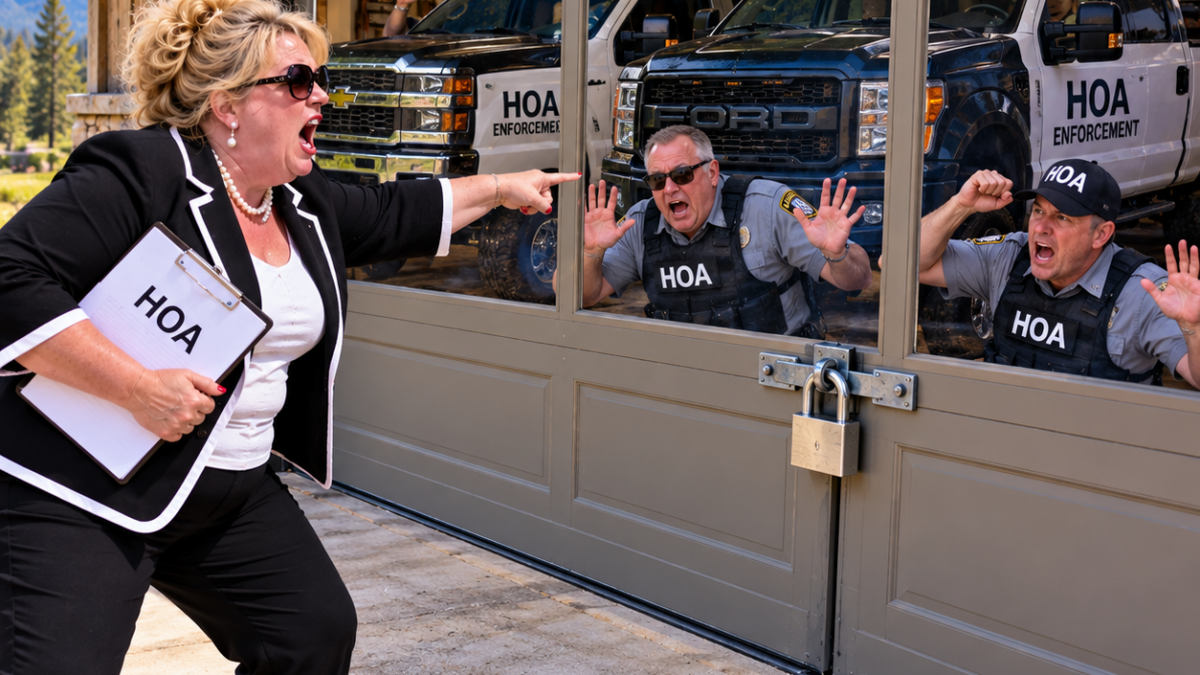
PART 2
The banging started at 7:32 that morning.
I knew the time because I had not slept.
Between 3:17 and sunrise, I had downloaded every recording I could recover from the old camera, copied the important files to two external drives, uploaded a third set to encrypted cloud storage, and started a spreadsheet.
Entry date.
Arrival time.
Departure time.
Vehicles.
Personnel.
Visible equipment.
Visible documents.
By 6:40 a.m., I had confirmed forty-seven separate unauthorized entries over twenty-three months.
Forty-seven.
I stared at that number for a long time.
Not because it was complicated.
Because it was humiliating.
I had slept twenty feet away.
Forty-seven times.
The security team had apparently figured out my work schedule, my travel patterns, and the fact that the detached garage could be accessed without waking me.
I had been designing industrial control systems while strangers were running some kind of operation in my workshop.
The banging on the front door came again.
Harder.
I checked the doorbell camera.
Ray Hoffman stood on my porch.
His uniform was wrinkled.
His face looked like he had spent the last four hours arguing with machines.
Two other security officers waited near the garage.
The fourth was nowhere visible.
Presumably still inside.
I opened the front door but kept the storm door closed.
Ray pointed toward the garage.
“Open it.”
“Good morning.”
“Scott, open the garage.”
“Why?”
His mouth tightened.
“You’ve got three patrol vehicles secured inside and personnel who need access to equipment.”
“Personnel have an unlocked pedestrian exit.”
“That’s not the point.”
“It’s very much the point.”
“You cannot detain our vehicles.”
I almost laughed.
“Your vehicles are inside my garage.”
“We have authorization.”
“Show me.”
He paused.
“HOA authorization.”
“That isn’t what I asked.”
“Your property is subject to Pinewood security access rules.”
“Then show me the document giving you permission to enter my detached garage at three in the morning.”
His jaw shifted.
“I don’t carry HOA records on patrol.”
“Come back when you do.”
His expression changed.
The anger didn’t disappear.
It got quieter.
That made me more cautious.
“You’re making this bigger than it needs to be.”
“No. Someone changed my garage code. That already made it big.”
“Scott—”
“Did you change it?”
He stared at me.
“Open the door.”
“Did you change my code?”
“No answer.”
“Forty-seven times, Ray.”
For the first time, he looked uncertain.
I had not intended to reveal that number.
Mistake.
Small, but real.
Now he knew I had footage.
His eyes moved toward the garage camera mounted outside.
Then back to me.
“You need to talk to Brenda.”
“Tell Brenda to bring the paperwork.”
I closed the door.
My hands began shaking as soon as the lock clicked.
That bothered me.
I wanted to imagine I was completely calm.
I wasn’t.
I was a divorced engineer standing alone in a house while HOA security occupied a building in my backyard.
Confidence only gets you so far.
I made coffee.
Then called in sick to work.
***
Brenda Kesler arrived at 9:45.
I knew who she was before she stepped out of the silver sedan.
Everybody in Pinewood knew Brenda.
Fifty-eight.
HOA president for six consecutive terms.
Hair that never seemed affected by Houston humidity.
A habit of speaking to adults as though explaining consequences to children.
Two board members came with her.
One was a thin man named Martin Bell.
The other, Linda Carr, chaired architectural review.
Brenda carried a leather portfolio.
I stepped onto the porch.
“Mr. Jackson.”
“Brenda.”
“I understand there has been some confusion.”
“My access code was changed.”
“That can be addressed.”
“By who?”
She ignored the question.
“I’m more concerned about the security personnel and equipment you’ve intentionally restricted.”
“They can walk out.”
“The vehicles cannot.”
“They parked them inside my garage.”
“With authorization.”
Finally.
“Show me.”
She opened the portfolio and removed a document.
The header read:
**SECURITY ACCESS AGREEMENT.**
It authorized Pinewood Estates security personnel to enter and use my garage for community safety operations, equipment storage, and emergency staging.
There was my address.
My typed name.
And at the bottom:
**Scott Jackson.**
A cursive signature.
Dated March 15, 2021.
I looked at it longer than Brenda liked.
“You remember signing that?” she asked.
“No.”
Her smile became almost sympathetic.
“It was several years ago.”
“I didn’t sign it.”
“The signature suggests otherwise.”
“Can I have a copy?”
“I can provide one after today’s issue is resolved.”
“No. Give me a copy now.”
Martin shifted uncomfortably.
Brenda kept holding the paper.
“Section 14.3 of the community security plan allows staging access within designated easement zones.”
“My garage isn’t an easement zone.”
“It was added in the 2018 security amendment.”
“Recorded where?”
“In association records.”
“That isn’t the same thing.”
Her eyes narrowed.
“You’re an engineer, Mr. Jackson, not an attorney.”
“True.”
“Then I’d suggest you stop interpreting legal documents.”
Good advice, generally.
Bad strategy from her.
“What happens if I don’t open the garage?”
“Your current interference will be documented.”
“Meaning?”
“Fines.”
“How much?”
“Two hundred fifty dollars per day.”
I almost smiled.
She continued.
“We’re also evaluating potential liability for unlawful restraint of our personnel.”
“They have an open pedestrian exit.”
“That doesn’t eliminate the problem.”
“It eliminates imprisonment.”
Brenda’s voice hardened.
“Open the garage within twenty-four hours.”
“Bring me the original agreement.”
“It exists.”
“Bring it.”
“You’re not in a position to make demands.”
“My property says otherwise.”
Linda looked at Martin.
Martin looked at the driveway.
Neither seemed enthusiastic.
Brenda returned the agreement to her portfolio.
“Twenty-four hours.”
Then she walked away.
I watched the sedan disappear.
The date on the agreement stayed in my head.
March 15, 2021.
There are dates you forget.
There are dates you don’t.
I went inside and opened my calendar archive.
March 2021.
The month loaded.
Then I saw three red blocks.
**SAN DIEGO — MOM.**
March 14.
March 15.
March 16.
I stopped breathing.
My mother died on March 12.
I flew to San Diego the next morning.
March 15 was her funeral.
I had been standing beside her casket while Brenda’s document claimed I was in Texas signing away access to my garage.
I opened an old folder I had avoided for years.
Boarding pass.
Houston to San Diego.
March 13.
Hotel receipt.
March 13 through 16.
Funeral-home invoice.
Signed March 15.
My real signature.
Then photographs my sister had sent.
I opened the metadata.
2:14 p.m.
San Diego.
March 15, 2021.
There I was.
Black suit.
My sister beside me.
My mother’s casket behind us.
Whoever created Brenda’s agreement had selected one of the worst possible dates to forge my name.
They had given me an alibi built out of grief.
I sat at the kitchen table staring at the photograph.
For a minute, the garage disappeared.
So did Brenda.
I saw Mom.
She had been seventy.
Ovarian cancer.
Nine months from diagnosis to funeral.
I had not looked at those photos since my sister sent them.
Now a forged document had dragged me back into the worst week of my life.
That changed something.
Before, I wanted my garage back.
Now I wanted to know who had used my mother’s funeral as the date on a lie.
***
I found Diana Reyes through a referral from a colleague.
Houston real-estate attorney.
HOA disputes.
Property litigation.
Her website biography was less impressive to me than the fact that three reviews said variations of the same thing:
**She reads everything.**
That was what I needed.
Her office gave me an emergency video consultation at 11:30.
Diana appeared on screen wearing reading glasses and the expression of someone already annoyed by facts she had not heard yet.
“Start at the beginning.”
I did.
Engines.
Garage.
Changed code.
Forty-seven recordings.
Security team.
Lockdown.
Open pedestrian exit.
Brenda.
Forged agreement.
Funeral alibi.
Diana rarely interrupted.
When I finished, she asked:
“Do you have your deed?”
“Yes.”
“Open it.”
I did.
“Recorded easements?”
Utility easement.
Drainage easement.
Exterior HOA covenants.
Nothing involving garage access.
I scanned the exhibit.
No security easement.
“No recorded right-of-entry,” I said.
“That helps.”
“Does it kill Brenda’s argument?”
“Nothing dies from one document.”
I liked her immediately.
She continued.
“HOA bylaws can impose certain obligations if validly adopted and applicable, but they don’t magically create unlimited physical access rights to private structures merely because someone wrote a rule.”
“The access agreement?”
“If forged, it has no value except as evidence against whoever created it.”
“Can I keep the vehicles locked inside?”
Diana leaned closer.
“Explain the exits.”
“The garage has three vehicle doors locked in hurricane mode. Side pedestrian door opens outward into my fenced backyard. It is unlocked. The men can leave whenever they want.”
“Can they get from the backyard to the street?”
“Yes. Side gate.”
“Unlocked?”
“Yes.”
“Document that immediately.”
“I already did.”
“Video.”
“I can.”
“Do it.”
“What about their trucks?”
“Do not damage them. Do not block emergency egress. Do not make threats. Preserve everything.”
“So I don’t have to open the bays?”
“I’m not giving you a theatrical answer. You need to let law enforcement evaluate if they come. Your safest posture is that you lawfully secured your own structure, people can exit freely, and disputed property remains exactly where the trespassers placed it.”
“That sounds less fun than ‘I trapped their trucks.’”
“Good. Court is less fun than Facebook.”
Fair.
She told me to preserve every recording.
Make multiple backups.
Photograph the garage interior only from places I could lawfully access.
Do not alter documents.
Do not enter while the men were still occupying it unless police were present.
“And Scott?”
“Yes.”
“Expect retaliation.”
“Why?”
“Because if someone forged an agreement and used your garage dozens of times, embarrassment is not the biggest thing they’re afraid of.”
“What is?”
“That’s what we find out.”
***
Someone knocked on my back door at 12:18.
I froze.
Nobody used the back door.
I checked the camera.
Bradley Allen.
Two houses down.
Sixty-seven.
Retired Houston police officer.
We had exchanged maybe twenty sentences in seven years.
Mostly about weather.
I opened the door.
Bradley stepped inside.
“I saw Brenda.”
“That sentence probably ruins a lot of mornings.”
He didn’t smile.
“I need to tell you something.”
We sat at the kitchen table.
“Three years ago, she tried to get access to my garage.”
My eyebrows lifted.
“Same excuse?”
“Security storage.”
“Agreement?”
“Yep.”
“You signed one?”
“No.”
“She had a document?”
“Supposedly.”
“What happened?”
“I told her if any HOA employee entered my detached garage without lawful authority, I’d call the sheriff and make the complaint myself.”
“She backed off?”
“Immediately.”
“Why?”
“Because she knew I’d spent thirty years writing police reports.”
He leaned back.
“Most people get scared when official-looking paper appears.”
I thought of Brenda’s agreement.
“Did you ever see my security team using this garage?”
“Trucks came in late. I assumed you had an arrangement.”
“I didn’t.”
“I know that now.”
“What were they doing?”
“I saw boxes. Computers sometimes. Ray.”
“Anything else?”
“Different people.”
“What kind?”
“Not security.”
That caught me.
“Who?”
“Men in business clothes. Occasionally.”
“Names?”
“No.”
He looked toward the garage.
“You’ve got leverage right now.”
“Diana said something similar.”
“Who?”
“My lawyer.”
“Good.”
Bradley pointed toward the garage.
“Use leverage to learn. Not to get angry.”
“Everybody keeps telling me not to get angry.”
“Probably because you look angry.”
I laughed once.
He was right.
***
That afternoon, I started reviewing footage systematically.
Not random dates anymore.
All forty-seven entries.
The pattern was remarkably consistent.
Arrival between midnight and 4:00 a.m.
Two or three trucks.
Sometimes four officers.
Stay between three and six hours.
Leave before dawn.
Why?
HOA security patrols should operate outside.
Roads.
Common spaces.
Incident response.
Not inside my garage.
At first, I assumed they were storing surveillance footage.
Maybe radios.
Maybe equipment the association didn’t want residents to see.
Then I found the folders.
Resident names.
Vehicle descriptions.
Addresses.
Routine notes.
The camera angle wasn’t perfect.
But one clip from six months earlier showed Ray spreading documents beneath the overhead work light.
I paused.
Enhanced the frame.
A folder tab:
**MARTINEZ — 1411 CEDAR.**
I knew the house.
Another:
**NGUYEN — 228 PINE.**
Another.
My neighbor.
This wasn’t property security.
It looked like resident profiling.
At 5:20 p.m., I noticed movement outside my kitchen window.
Security uniform.
A man stood near the fence.
Not one of the four from the garage.
He held a radio.
I stepped away before he saw me looking.
They had posted someone outside.
That was when fear finally became real.
Not panic.
Calculation.
The HOA wasn’t just asking for its trucks.
They were watching me.
I called Diana.
“Do not confront him.”
“I wasn’t planning to.”
“Camera coverage?”
“Yes.”
“Save it.”
“Should I call police?”
“If he crosses onto your property or threatens you, yes. Otherwise document.”
I hated how boring good legal strategy sounded.
Document.
Preserve.
Wait.
Meanwhile, people were watching my house.
***
The community email arrived the next morning at 8:14.
**URGENT RESIDENT SAFETY ALERT.**
Brenda never accused me of a crime.
She was too careful.
She wrote that security personnel were experiencing “restricted access conditions.”
That I had refused “reasonable efforts at resolution.”
That residents should use caution near my property.
That any unusual behavior should be reported.
She turned uncertainty into suggestion.
That was enough.
At 10:30, I walked outside for the mail.
My next-door neighbor saw me.
Stopped.
Then went back inside.
A mother approaching with her young daughter crossed the street.
A car slowed as it passed my driveway.
The driver stared.
In less than twelve hours, Brenda had transformed me from boring engineer into neighborhood threat.
I went inside.
Phone ringing.
My daughter.
Lily.
Sixteen.
She lived with her mother in Dallas.
“Dad?”
“What’s wrong?”
“People are sending me things.”
My stomach dropped.
“What things?”
“Posts.”
“What posts?”
“That you locked four men in your garage.”
I closed my eyes.
“Lily, listen carefully. Nobody is trapped.”
“That’s not what people are saying.”
“The pedestrian exit is open. They can walk out anytime.”
“Then why are they still there?”
“Because they don’t want to leave their trucks or whatever else they brought inside.”
She was quiet.
“Mom’s worried.”
“I know.”
“Are the police coming?”
“Probably.”
“Did you really lock the garage?”
“Yes.”
“Dad.”
“I secured the vehicle doors. I did not lock human beings in.”
“That sounds like lawyer language.”
“I have a lawyer.”
“That does not make me feel better.”
I almost laughed.
Almost.
Then her voice softened.
“Are you okay?”
That question hurt.
“I’m fine.”
“You always say that.”
“I’ll call tonight.”
“Promise?”
“Yes.”
After we hung up, I stared at my reflection in the dark phone screen.
Brenda had crossed a line I hadn’t expected.
She had reached my daughter without ever contacting her.
Reputation travels faster than evidence.
***
Deputy Martinez arrived at 2:17.
Two cruisers.
I met him outside.
He was patient.
Professional.
I showed him everything.
Garage ownership.
Footage.
Changed access code.
Open pedestrian exit.
Path from backyard to street.
The alleged agreement.
My funeral records.
The deed.
He personally tested the side door.
Opened freely.
Walked into the yard.
Exited through the gate.
Then returned.
“Mr. Jackson, from what I can see, these individuals are not physically detained.”
“Thank you.”
“However, I want this de-escalated.”
“I understand.”
“Vehicles are disputed property inside your structure. I’m not going to adjudicate access rights on your driveway.”
“I have counsel.”
“Good.”
He looked toward the garage.
“Have they been offered an opportunity to remove personal belongings?”
“People can leave. I’m not opening the vehicle bays until the access dispute is documented.”
He considered that.
“Civil issues aside, don’t do anything to create a safety problem.”
“I won’t.”
He left without arresting anyone.
That mattered.
Within an hour, Brenda’s narrative weakened.
Not publicly.
But legally.
Nobody was imprisoned.
Ray called at 4:06.
His voice echoed.
“Scott.”
“Ray.”
“You proved your point.”
“What point?”
“Open it.”
“What’s in the folders?”
Silence.
“The resident files.”
“Internal security.”
“Why are they in my garage?”
“Operational necessity.”
“What operation?”
“That isn’t your concern.”
“It became my concern when you plugged laptops into my workbench.”
Ray exhaled hard.
“Listen. Open the door. I’ll get Brenda to drop the fines.”
“No.”
“She’ll retract the email.”
“No.”
“No lawyers. No police. Everybody walks.”
“Why are you offering all that?”
Silence.
“Ray?”
“You don’t understand what you’re messing with.”
That sentence was becoming popular.
“Then explain it.”
He hung up.
I stared at the phone.
He had refused the only question that mattered.
***
That night I found the business card.
A three-month-old recording.
Ray opened a leather briefcase beneath my work light.
Inside: folders.
On the top folder lay a white card.
I zoomed.
Enhanced.
Sharpened.
**DATA HARVEST MARKETING SOLUTIONS.**
I had never heard of them.
Search results gave me plenty.
Consumer data marketing.
Behavioral segmentation.
Residential analytics.
Property-owner profiles.
Then enforcement actions.
Texas regulators had previously cited the company over consumer-data sourcing and consent issues.
Small fines.
Enough to establish history.
I called Diana at 7:10 the next morning.
“This got weird.”
“It was already weird.”
“Data Harvest Marketing Solutions.”
Silence.
Then keyboard sounds.
“What’s the connection?”
“Business card in my garage footage.”
“Anything else?”
“Resident files.”
“Do not jump from correlation to sale of data.”
“I know.”
“Send me the frame.”
Twenty minutes later, she called.
“This may matter.”
“That cautious?”
“Extremely.”
“Why?”
“Because data handling can implicate privacy, consumer-protection, contractual, and potentially criminal issues depending on exactly what they collected and how it moved.”
“So we call somebody?”
“We file properly. Consumer Protection. Possibly state agencies. If facts suggest interstate fraud, federal authorities may eventually care.”
“Eventually?”
“Scott, nobody sends helicopters because you found a business card.”
“You ruin everything.”
“I bill for realism.”
***
Bradley made calls too.
He still knew people from law enforcement.
By noon, he had one name.
Kevin Marsh.
Regional sales manager for Data Harvest.
I searched.
Business profile.
Photograph.
Mid-forties.
Expensive suit.
Then a personal biography.
Married to Patricia Marsh.
Formerly Patricia Kesler.
I read it twice.
“Brenda’s sister.”
Bradley nodded.
“Kevin’s her brother-in-law.”
That changed the map in my head.
Brenda controlled the HOA.
Ray controlled security.
Security had access to resident information.
Data Harvest bought residential behavioral data.
Kevin connected the company to Brenda’s family.
My garage sat detached from the house, hidden from the street, rarely entered by anyone but me.
No HOA cameras.
No boardroom records.
A quiet staging location.
I went back through footage.
Now I knew what to look for.
Boxes entering.
Boxes leaving.
Phones photographing papers.
Laptops.
External drives.
Then, eight months earlier:
2:47 a.m.
A man entered the garage.
Suit jacket.
No security uniform.
Ray shook his hand.
Twenty minutes later, the man left carrying a cardboard file box.
I froze the frame.
Kevin Marsh.
I called Diana.
“I have him.”
“Who?”
“Marsh.”
“Where?”
“In my garage.”
“Send it.”
I did.
Her response came five minutes later.
**Do not contact him.**
Naturally, Kevin contacted me first.
***
The call came at 11:47 on the third day.
Unknown Houston number.
“Mr. Jackson?”
“Yes.”
“My name is Kevin Marsh.”
I glanced at the recording indicator on my phone.
Texas generally permits recording when one party to the conversation consents, but I had already asked Diana about preserving calls involving me.
I hit record.
“What can I do for you?”
“I think we have mutual interests.”
“Do we?”
“I understand there’s been a dispute involving Pinewood security.”
“That’s one way to describe forty-seven unauthorized entries.”
Pause.
“I’m told there may have been misunderstandings.”
“Another way.”
“I’d rather resolve this without unnecessary damage.”
“To who?”
“Everyone.”
“How?”
“Compensation.”
I said nothing.
“Fifty thousand dollars.”
My heart kicked.
“For what?”
“You open the garage. Allow removal of all equipment and materials. Delete any recordings involving our personnel or contractors. Agree not to make public statements concerning Data Harvest.”
I almost laughed from pure disbelief.
“Why would a marketing company pay me fifty thousand dollars over an HOA parking dispute?”
Silence.
Then Kevin said:
“You’ve obviously been researching.”
“Answer the question.”
“There are legitimate business relationships that could be misinterpreted without context.”
“What relationships?”
“Service relationships.”
“With Pinewood?”
“With various communities.”
“What does my garage have to do with it?”
“Logistics.”
“What kind?”
“Mr. Jackson, I am offering you a clean exit.”
“From my own garage?”
His voice cooled.
“From a situation that can become much more expensive than you expect.”
“Is that a threat?”
“Clarity.”
I let silence work.
Kevin filled it.
“Organizations protect their interests. You’re an engineer. You understand that.”
“I understand systems.”
“Then understand this one. Open the garage.”
“I need time.”
“You have until six.”
He suggested meeting at a coffee shop.
I agreed.
Then called Diana.
“Please tell me you recorded it.”
“Yes.”
“Good.”
“Fifty thousand.”
“He’s scared.”
“Or confident.”
“Both can be true.”
She advised me to meet in public.
Ask questions.
Do not accuse.
Do not threaten.
Let him talk.
***
Kevin arrived at 2:03.
Dark suit.
No coffee.
He sat across from me.
“Fifty thousand is final.”
“Who authorized that?”
“People who want this resolved.”
“Data Harvest?”
He smiled slightly.
“Does the name on the check matter?”
“To my accountant.”
“You’ll be paid properly.”
“What am I being paid for?”
“Discretion.”
“About what?”
“Misunderstood operations.”
“What operations?”
“Community data services.”
“What data?”
He studied me.
“Resident service patterns.”
“Addresses?”
“Public information.”
“Vehicles?”
“Observable information.”
“Schedules?”
“No answer.”
“Security reports?”
He leaned back.
“This isn’t an interrogation.”
“No. It’s a fifty-thousand-dollar sales pitch.”
His mouth tightened.
“You’re overestimating your position.”
“You came to me.”
That landed.
“What made my garage useful?”
“Privacy.”
The word slipped out naturally.
Then he seemed to realize it.
“Privacy from who?”
“Operational privacy.”
“From residents?”
“Scott.”
“From the HOA board?”
“Stop.”
“Did Brenda know?”
He stood.
“The offer expires at six.”
“Why?”
“Because after that, other people make decisions.”
“What people?”
He buttoned his jacket.
“You keep asking questions like answers can’t create problems.”
“That sounds like another threat.”
“It’s advice.”
He walked away.
I remained seated for five minutes.
Then sent the recording to Diana.
At 3:10, I forwarded a copy to an encrypted drive.
By 4:00, I had decided I would not take the money.
At 5:45, Brenda made her move.
She canceled the open forum at that night’s quarterly HOA meeting.
Or tried to.
***
Diana called immediately.
“She can’t do it unilaterally.”
“You sure?”
“I read the bylaws.”
That was why I hired her.
“Section 8.4 says open forum can be suspended only by resident vote under specified circumstances.”
“She announced security concerns.”
“Still needs the vote.”
“What do I do?”
“When she announces cancellation, raise a point of order.”
“I’m going to become the guy who quotes HOA bylaws.”
“Sometimes revenge has paperwork.”
Bradley had already agreed to second my motion.
Two other residents would support it.
Andrea Price, an investigative reporter who had covered Data Harvest’s prior regulatory trouble, had told me she would attend and observe.
She had not promised a story.
Good reporters don’t.
By six, I had copies of everything.
Footage.
Agreement.
Funeral alibi.
Deed.
Screenshots.
Corporate connections.
Kevin’s call.
Coffee-shop recording.
Forty-seven-entry timeline.
I drove to the community center.
Two hundred thirty people showed up.
Standing room only.
News had traveled.
The first thirty-five minutes were boring.
Budget.
Landscaping.
Speed bumps.
A pool repair.
Brenda behaved as if nothing unusual existed.
At 7:38, she reached the final agenda item.
“Due to ongoing security concerns and pending legal matters, the board has decided to postpone open forum.”
She began stacking papers.
I stood.
“Point of order.”
The room changed.
Brenda looked up.
“Mr. Jackson.”
“Section 8.4 requires a resident vote to cancel open forum.”
“That section does not apply under an active legal matter.”
“It does.”
“Sit down.”
“No.”
A murmur moved through the room.
Brenda’s face hardened.
“This is exactly the disruptive conduct the board is attempting to prevent.”
“Then let residents vote.”
“Mr. Jackson—”
“Section 12.2 requires procedural challenges to be addressed before adjournment.”
Brenda stared.
I saw something I had never seen in her before.
Uncertainty.
Bradley stood.
“I second the motion.”
Someone behind him said:
“Vote.”
Another:
“Let him speak.”
Brenda looked around.
She could ignore me.
Harder to ignore two hundred people.
“Fine.”
Voice vote.
Those in favor of maintaining open forum?
The response hit the room like thunder.
Brenda barely asked for opposition.
Maybe fifteen voices.
She adjusted her glasses.
“The motion carries.”
Then she looked directly at me.
“Ten minutes.”
I walked to the projector.
Connected my laptop.
The first video began.
2:17 a.m.
Three white trucks rolling into my garage.
Security officers.
Ray Hoffman.
Documents.
My workbench.
A map.
The room went quiet.
“This happened forty-seven times over twenty-three months.”
Someone gasped.
I moved to the forged agreement.
“My name appears here.”
Brenda sat completely still.
“Dated March 15, 2021.”
Next slide.
My airline record.
Then funeral documentation.
Then the photograph.
Me beside my mother’s casket in San Diego.
“I did not sign that document in Texas because I was two thousand miles away burying my mother.”
No one moved.
I looked at Brenda.
“Who created it?”
She reached for her microphone.
“This document was provided through standard administrative channels.”
“Who created it?”
“We are not going to litigate contract validity in a community meeting.”
“Then perhaps residents would like to know why security operated from my private garage.”
Next footage.
Resident folders.
Names.
Photos.
Map.
Laptops.
Then Data Harvest business card.
I explained what I had found publicly about the company.
Past consumer-data issues.
Then corporate profile.
Kevin Marsh.
Family connection.
Someone in the crowd said:
“Kevin’s Brenda’s brother-in-law.”
I did not need to say it.
Better that they did.
Next video.
Kevin entering my garage at 2:47 a.m.
Ray greeting him.
Kevin leaving with a box.
Brenda stood.
“This is manipulated.”
Andrea Price’s pen stopped.
“Manipulated how?” I asked.
“Video can be edited.”
“Original files are preserved.”
“You’ve engaged in a campaign of harassment.”
I clicked one final audio file.
Kevin’s voice filled the room.
**Fifty thousand dollars.**
Then:
**Open the garage. Dispose of recordings. Decline to discuss this publicly.**
The room became so quiet that the air-conditioning sounded loud.
Kevin’s warning played next.
**Organizations protect their interests.**
Then:
**Your garage happened to be useful for certain logistics.**
When it ended, I looked at Brenda.
“Why did your brother-in-law offer me fifty thousand dollars to delete evidence of an operation you say was legitimate?”
Brenda’s face had changed color.
“This is outrageous.”
A woman stood.
“Is he your brother-in-law?”
“My family relationships are irrelevant.”
Another voice:
“Did you forge his signature?”
“No!”
“Then who did?”
“I don’t know!”
That answer was worse.
Residents started shouting.
Questions about fines.
Security.
Personal information.
Budgets.
Brenda tried to regain control.
The side door opened.
Deputy Martinez entered with two investigators.
The room quieted.
He approached Brenda.
“Mrs. Kesler, we need to speak with you concerning complaints involving document falsification, unauthorized access, and potential misuse of resident information.”
Brenda stared at him.
“Now?”
“Yes.”
“I’m conducting a meeting.”
“You can come voluntarily.”
“I have counsel.”
“You may contact counsel.”
She looked at the crowd.
For six years, that room had been hers.
Now nobody defended her.
Ray wasn’t there.
He was still at my garage with the trucks.
Kevin wasn’t there.
The board members avoided her eyes.
Brenda gathered her purse.
As she passed me, she stopped.
“You think this ends with me?”
Her voice was barely audible.
“No.”
“You have no idea who you’re dealing with.”
“Then somebody should probably explain it to the investigators.”
Her eyes hardened.
Then she walked out.
No handcuffs.
No dramatic arrest in front of the room.
Just an HOA president leaving beside law enforcement while two hundred neighbors watched.
That was more powerful.
Authority disappears quickly when everyone realizes it was mostly borrowed.
***
The next morning, Ray called.
“Open the garage.”
His voice sounded exhausted.
“It’s been three days.”
“You could have left anytime.”
“I know.”
“Then why didn’t you?”
Silence.
“The trucks?”
“Equipment.”
“The files?”
“Scott.”
“The computers?”
“Open the door.”
Investigators had already contacted Diana.
They wanted to document the interior before anything moved.
At 11:15, Deputy Martinez returned with a warrant related to evidence identified during the investigation.
That changed everything.
I released the garage bays only after officers photographed the vehicles, boxes, computers, resident files, map, and equipment.
Ray stood near the side door watching.
He looked thirty years older than he had three mornings earlier.
“You should’ve opened it,” he said.
“You should’ve never entered.”
He looked at the floor.
“I was following instructions.”
“Forty-seven times?”
No answer.
Investigators removed electronic devices and copied documents.
Then the security trucks were driven away.
My garage became empty.
Not clean.
Empty.
Coffee cups.
Extension cords.
Tape on the floor.
A folding table I didn’t own.
Cables.
A smell of diesel.
I stood alone inside after everyone left.
For three days, I had wanted those trucks gone.
Now I felt strangely unsettled.
The workshop didn’t look like mine.
It looked like a place where something had happened.
I picked up my soldering iron.
Then set it back down.
Not yet.
***
The investigation took weeks.
Not two dramatic days.
Weeks.
Interviews.
Forensic analysis.
Searches.
Financial records.
Vendor contracts.
Email subpoenas.
Data transfers.
Ray eventually cooperated.
His explanation was ugly in its ordinariness.
Brenda had told security the garage was authorized staging space.
He believed the document was valid at first.
Later, he had doubts.
By then, he was involved.
The operation expanded gradually.
Security officers gathered incident reports.
Vehicle information.
Resident complaints.
Entry patterns.
Absence schedules.
Vacation observations.
At some point, selected information began flowing to Data Harvest.
Ray claimed he never knew exactly how much was being sold or what Kevin did with it.
He knew enough to understand secrecy mattered.
“What about my garage?” I asked during a deposition months later.
Ray looked at his attorney.
Then me.
“Brenda said your property was ideal.”
“Why?”
“Detached structure. You worked from home but rarely used the garage overnight. No street-facing windows. Separate electrical service monitoring.”
“So you profiled me too.”
He looked away.
“Yes.”
“How did you get the code?”
“Maintenance vendor.”
“Who changed it?”
“I did.”
At least he finally said it.
“Why?”
“So patrol could enter without depending on your code.”
“That sentence makes no sense.”
“It did then.”
That was the problem with normalized wrongdoing.
Inside a system, absurdity starts sounding procedural.
***
The financial investigation also uncovered conflicts between Brenda and Data Harvest.
Payments did not always move directly from the HOA.
Some went through consulting arrangements.
Some through security subcontractors.
Some benefits were harder to quantify.
Kevin’s company gained access to resident information.
Pinewood received discounted “community analytics” services.
Brenda’s family connections had not been fully disclosed.
The details were complicated enough that prosecutors narrowed their charges to what they could prove cleanly.
That disappointed neighbors who expected one giant conspiracy case.
Diana explained it to me.
“Prosecutors prefer ten strong facts to fifty dramatic theories.”
“Even when the dramatic theories are true?”
“Especially then.”
Ray faced consequences tied to repeated unauthorized entries and his role in the access scheme.
Brenda faced document-falsification and fraud-related allegations, along with HOA governance consequences.
Kevin and Data Harvest drew broader regulatory attention because investigators found similar arrangements involving other communities.
The federal side moved more slowly.
Months.
Then more months.
That was fine.
For the first time, time worked against them instead of me.
***
Andrea Price published her first article eleven days after the HOA meeting.
She did not call it the scandal of the century.
She did something worse for Brenda.
She was precise.
Dates.
Recorded footage.
The forged agreement.
My funeral alibi.
HOA procedures.
Data Harvest’s history.
Kevin’s family relationship.
The $50,000 recording.
Then a second article.
Then a third.
Other neighborhoods called for audits.
Residents from outside Pinewood contacted Andrea.
Some contacted me.
Similar complaints.
Security vendors with unusual access.
Resident information collected without clear consent.
HOA boards contracting with connected businesses.
Not all were illegal.
Some were merely sloppy.
But sunlight makes sloppiness uncomfortable too.
***
Pinewood held an emergency election six weeks later.
Brenda was gone from leadership.
The remaining board resigned under pressure.
Bradley Allen became interim president.
When he told me, I laughed.
“You hate HOA politics.”
“I hate Brenda more.”
“Healthy foundation.”
“Temporary.”
His first move was dissolving Pinewood’s internal security patrol.
They hired a licensed outside firm under a written contract that strictly defined access rights and data handling.
His second move was embarrassing me.
At his first meeting:
“Before anything else, the association formally apologizes to Scott Jackson.”
I shook my head.
He continued anyway.
“For unauthorized use of his property, misleading communications sent to residents, and failures of board oversight.”
Afterward I said:
“You didn’t need to do that.”
“Yes, I did.”
“Why?”
“Because Brenda used the HOA letterhead to make your neighbors afraid of you.”
“So?”
“So the HOA letterhead should also correct the record.”
Fair.
I hated that he was right.
***
The case involving Brenda resolved later that year.
Not with the dramatic punishment neighbors imagined.
There were negotiated outcomes.
Probation.
Fines.
Restrictions.
She permanently lost any practical path back to HOA leadership.
She sold her house shortly afterward.
Ray accepted a reduced resolution in exchange for cooperation.
He lost his security role and, according to the licensing records Bradley later showed me, could no longer work in the same capacity.
The other three officers cooperated early.
Investigators treated them differently because evidence suggested they were lower-level employees operating under Ray and Brenda’s instructions.
That did not make their participation harmless.
It made responsibility layered.
I had learned to live with layered answers.
At the beginning, I wanted four villains.
Then six.
Then everybody involved.
Reality was messier.
Some people knew.
Some suspected.
Some preferred not to ask.
Some just needed a paycheck.
Brenda and Kevin appeared to understand the system best.
Ray understood enough.
Others followed instructions.
Moral clarity gets complicated once depositions start.
***
Kevin’s problem became larger than Pinewood.
Data Harvest’s devices and records connected investigators to other HOA arrangements.
I never received every detail.
Some remained part of ongoing reviews.
Diana warned me not to speculate publicly.
So I didn’t.
What I knew was enough.
The company faced regulatory scrutiny.
Several contracts disappeared.
Kevin left his position.
Other communities audited their data practices.
The $50,000 offer that was supposed to buy silence became one of the most damaging pieces of evidence because it showed how valuable silence was to him.
That part felt satisfying.
Not because he lost money.
Because he priced the truth himself.
***
Four months after the night I locked the garage, Pinewood held a community meeting.
Bradley invited me to speak.
I didn’t want to.
“You started this.”
“No. They started it.”
“You exposed it.”
“Fine. Ten minutes.”
“No projector.”
“Why?”
“People have seen enough slides.”
Fair.
I stood in the same room where Brenda had tried to cancel open forum.
The atmosphere felt different.
Not happier.
More awake.
I said:
“I don’t think what happened here was possible because one woman was uniquely evil.”
Nobody expected that.
“It was possible because too many things happened without independent review.”
Closed contracts.
Security authority.
No resident audit.
No meaningful data rules.
No verification of private access agreements.
People trusted titles instead of systems.
I proposed a resident oversight committee.
Five elected members.
Access to contracts.
Security policies.
Financial reports.
Privacy practices.
No unilateral authority.
The vote passed overwhelmingly.
Bradley whispered afterward:
“You realize you just invented more HOA bureaucracy.”
“Transparent bureaucracy.”
“Still bureaucracy.”
“I’m an engineer. We love procedures.”
***
The garage took longer to reclaim than the neighborhood.
Physically, I changed everything.
New door controller.
New encryption.
New access codes.
Cameras.
Motion alerts.
Independent network.
A lock on the electrical panel.
But for months, I avoided working there after dark.
That annoyed me.
I had bought the house for that garage.
Then Brenda’s people turned it into something I associated with violation.
I started small.
One Saturday morning, I cleared the old folding table they left behind.
Sunday, I reorganized tools.
The next week, I rebuilt a damaged amplifier.
Nothing important.
Just work.
Eventually the room became mine again.
That mattered more than the settlement discussions.
More than articles.
More than Brenda leaving.
You don’t fully recover property when law enforcement removes the trespassers.
You recover it when you stop imagining them every time you turn on the lights.
***
Lily visited in late spring.
Her first overnight since everything happened.
She stood in the garage doorway.
“So this is the infamous crime scene.”
“Workshop.”
“Three trucks?”
“Three.”
“For three days?”
“The people could leave.”
“You say that every time.”
“Because journalists keep using dramatic headlines.”
She smiled.
Then her face became serious.
“Were you scared?”
I started to say no.
She gave me a look.
I stopped.
“Yes.”
“How scared?”
“Enough.”
“Why didn’t you tell me?”
“You’re sixteen.”
“That doesn’t answer it.”
I sighed.
“I didn’t want you worrying.”
“I worried anyway.”
Fair.
We sat on the workbench.
“I’m sorry.”
She shrugged.
“Mom said you get stubborn when scared.”
“Your mother says many things.”
“She also said that’s why she divorced you.”
“That sounds more accurate.”
Lily laughed.
Then she leaned against me.
“I’m proud of you.”
I looked away.
Engineers are better with voltage than emotion.
“Thanks.”
“For not giving up.”
I wanted to tell her I had almost given up several times.
When the neighborhood avoided me.
When she called worried.
When Kevin offered money.
When Diana warned the legal process could take years.
Instead I said:
“I had good help.”
Bradley.
Diana.
Andrea.
Residents who finally spoke.
Even the old camera I had forgotten existed.
Nothing important happens alone, no matter how much stories prefer one hero.
***
The oversight committee found two minor financial irregularities during its first quarter.
Neither was criminal.
One was a duplicate landscaping invoice.
The other was a maintenance contract automatically renewed at the wrong rate.
Both corrected within days.
Bradley called me.
“Boring.”
“Perfect.”
“You’re happy?”
“Very.”
“That’s disturbing.”
Boring was the goal.
Healthy systems are often boring.
Records match.
Votes happen.
Contracts get reviewed.
People know where money goes.
Nobody drives three trucks into somebody’s private garage at three in the morning.
***
I kept the original forged access agreement.
Copy, technically.
The original became evidence.
Diana gave me a certified version after the case closed.
I framed it.
Not because I enjoyed seeing it.
Because of the date.
March 15, 2021.
Beside it, I framed a smaller photograph.
Mom’s funeral.
Not the casket.
A photograph taken afterward.
My sister and me standing outside the funeral home.
Mom would have hated the first photograph people thought of being her coffin.
She was difficult that way.
I once told Lily the story.
She stared at both frames.
“That’s dark.”
“What?”
“Fake contract next to Grandma’s funeral.”
“It proves the lie.”
“It also makes your workshop look like a law office.”
I took her point.
Eventually I moved the funeral photo into the house.
The forged document stayed in the garage.
Alone.
That felt better.
***
One afternoon, almost a year after the scandal, Ray Hoffman contacted me.
Email.
Subject:
**APOLOGY.**
I nearly deleted it.
Then opened it.
He wrote that he had spent months replaying what happened.
That he should have questioned Brenda’s instructions.
That after the first few entries, he understood I probably had not authorized them.
That he kept going because stopping meant admitting the entire operation was questionable.
One paragraph stuck with me.
**The more nights we used your garage, the harder it became to admit the first night was wrong.**
That was probably the most honest explanation I received.
Wrongdoing has momentum.
People imagine corruption begins with giant decisions.
Sometimes it begins with one small compromise.
Then the next compromise protects the first.
Then the third protects both.
Eventually, a man stands in someone else’s garage at 3:00 a.m. reading private files and tells himself he is only doing his job.
I did not forgive Ray in any formal sense.
He had not asked.
I replied:
**I appreciate you putting it in writing. I hope you mean it.**
He never contacted me again.
That was enough.
***
Brenda never apologized to me personally.
I saw her once before she moved.
Grocery store.
Produce section.
Of course.
Nobody gets their cinematic final confrontation.
Sometimes your antagonist is selecting avocados.
She noticed me.
Looked away.
I could have approached.
Asked why.
Asked who forged the agreement.
Asked when she decided my property was hers to use.
I didn’t.
The investigations had answered most of that.
Human explanations would only complicate it.
I walked past.
As I did, she said:
“You ruined my life.”
I stopped.
Turned.
She still wasn’t looking at me.
“You entered my garage forty-seven times.”
“I never entered your garage.”
“No. You sent people.”
Silence.
“You could’ve opened the door on the first morning.”
I stared.
“That’s what you still think?”
She finally looked at me.
“You made this public.”
“You forged my signature.”
Her expression hardened.
“You have no idea what I did or didn’t do.”
“Then we’re done.”
I turned away.
She said:
“Pinewood was falling apart before I took over.”
I stopped again.
There it was.
The justification.
“Maybe.”
“Nobody volunteered. Nobody wanted responsibility. Everybody complained.”
“That sounds exhausting.”
“It was.”
“So you started believing that gave you ownership.”
“That is not what happened.”
“Maybe not at first.”
She said nothing.
I left.
That conversation did not absolve her.
But it helped me understand something.
She probably had not begun as a cartoon villain.
Maybe she started by solving problems nobody else wanted.
Then control became habit.
Then entitlement.
Then secrecy.
Then money.
Then protecting the system mattered more than remembering why the system existed.
Understanding that made me less interested in hating her.
Not less interested in accountability.
Different thing.
***
The garage-door lockdown remains active.
I upgraded it.
Not because I expect another HOA security team.
Because Houston weather is real and the hurricane feature was useful long before it became part of a scandal.
The emergency exit is still there.
The cameras now alert me if they detect a person after midnight.
The first week, every notification spiked my heart rate.
Raccoon.
Cat.
Delivery driver.
Wind.
Then the alerts became ordinary.
One evening, I heard an engine around 3:00 a.m.
I sat upright.
For one second, I was back in that first night.
Then I checked the camera.
Bradley.
His truck had a flat tire.
He had pulled into my driveway because his phone was dead and my lights were on.
I walked outside.
“You’re trespassing.”
He looked at the locked garage.
“Don’t start.”
I helped him change the tire.
Normal life.
That felt good.
***
The Houston Chronicle series eventually moved off the front page.
Investigations ended.
Another scandal replaced ours.
Neighborhood conversations shifted back to property taxes, school zoning, and potholes.
That is how you know life has recovered.
People stop talking about your crisis.
A few residents still treated me differently.
Some apologized for believing Brenda’s email.
Some never mentioned it.
My next-door neighbor, the woman who had gone inside when she saw me, brought cookies one Christmas.
We stood awkwardly on the porch.
“I owe you an apology.”
“You don’t owe me anything.”
“I believed that email.”
“You had limited information.”
“I crossed the street when I saw you.”
“I noticed.”
She winced.
“Sorry.”
I smiled.
“Cookies help.”
She laughed.
So did I.
Reputation can be damaged quickly.
Repair happens in tiny moments.
***
The most unexpected result arrived as a text one Saturday night.
Unknown number.
Arizona area code.
**Mr. Jackson, I read Andrea Price’s articles. Our HOA security has been using an empty home in our neighborhood. Owner lives out of state. Something feels wrong. How did you start?**
I stared at the message.
For a moment I considered ignoring it.
I wasn’t an attorney.
Not law enforcement.
Not an activist.
I was an engineer who wanted to solder circuits in peace.
Then I thought about my first morning.
The confusion.
The forged agreement.
The feeling that everybody else understood a system I somehow didn’t.
I typed:
**Start with the deed. Verify every easement and access right. Preserve notices. Document what you personally observe. Don’t confront anyone based on assumptions. If you find something serious, get a local attorney and law enforcement involved.**
Then I added:
**And back up everything. Twice.**
Engineer reflex.
They thanked me.
I set the phone down.
No grand lesson.
No movement.
Just one person helping another avoid the same confusion.
That felt appropriate.
***
Two years after the night of the trucks, Pinewood’s annual meeting lasted fifty-eight minutes.
Bradley had retired from interim leadership.
A woman named Teresa Kim was president.
Nobody feared her.
She probably preferred it that way.
The treasurer presented the audit.
Oversight committee asked questions.
Security vendor reported incidents.
No secret contracts.
No private garages.
During open forum, one resident complained about trash cans remaining visible after collection day.
I looked at Bradley.
He whispered:
“We survived a data scandal for this.”
I whispered back:
“Democracy.”
He rolled his eyes.
I smiled.
Boring.
Perfect.
***
That night, I returned home and went to the garage.
The workshop lights came on automatically.
My workbench was covered with an amplifier I had promised Lily I would repair for her.
Tools.
Oscilloscope.
Soldering station.
No resident files.
No maps.
No strangers’ laptops.
I sat on the stool where Ray had once sorted documents.
The spot no longer felt contaminated.
It was just a stool.
That surprised me.
Trauma makes objects symbolic.
Healing makes them ordinary again.
I worked for an hour.
Around 11:00, rain started hitting the roof.
Houston storm.
I opened the garage app.
For a second my thumb hovered over the same button I had pressed at 3:17 that morning years earlier.
**STORM LOCKDOWN.**
This time, nobody was inside.
No trucks.
No officers.
No conspiracy.
Just my car, my tools, and Lily’s broken amplifier.
I pressed it.
Three heavy bolts drove into the rails.
**THUNK.**
The exact same sound.
Back then, it had felt like revenge.
Now it sounded like what the system had been designed for.
Protection.
I turned off the bench light.
Before going inside, I looked across the garage.
I had spent months believing the biggest thing I won was the fight against Brenda.
It wasn’t.
I got back something quieter.
The ability to stand in my own workshop at night without feeling like I needed to check who else had keys.
The garage was never supposed to be a battleground.
It was supposed to be where I built things.
So that is what it became again.
Outside, rain hammered the roof.
The security app showed every door closed.
Every access code mine.
Every camera quiet.
I locked the side door, walked into the house, and left the three empty garage bays behind me.
For the first time in years, the sound of those bolts didn’t remind me of the men who had taken over my space.
They reminded me that the space had always been mine.
[END OF STORY]








