PART 2: HOA Ordered Me to Tear Down My Private Dock—Then I Found Their Rental Cabins Built on My Lakefront
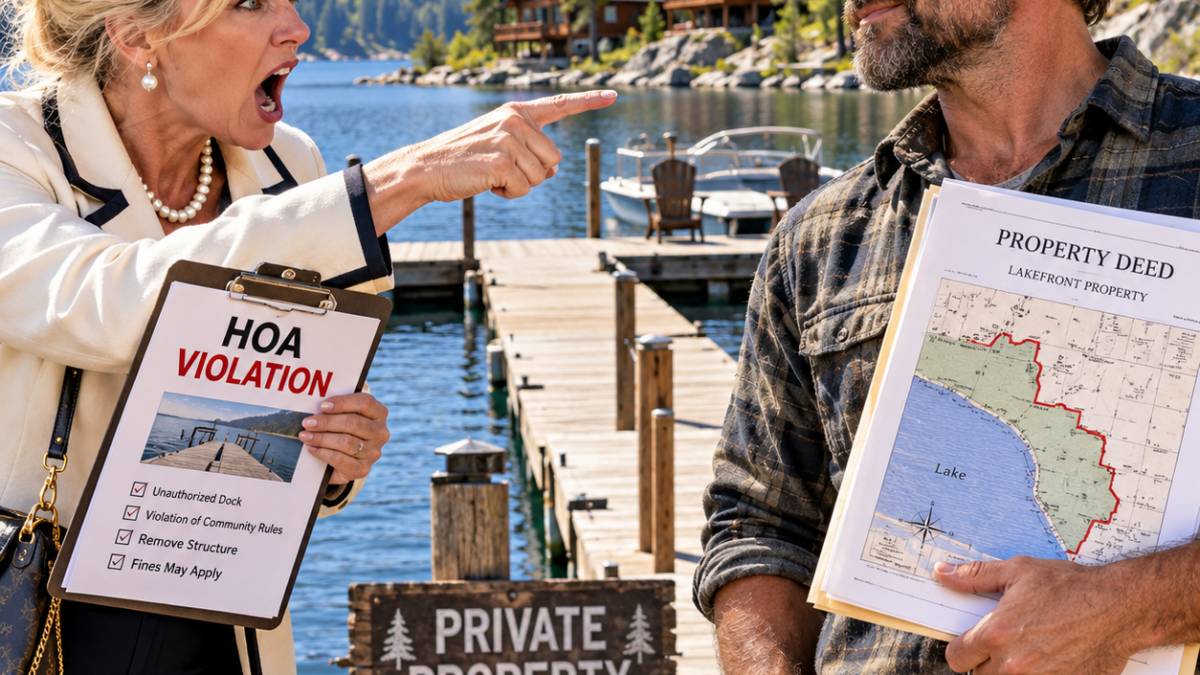
The HOA president stood on my dock with a clipboard in one hand and a violation notice in the other, telling me I had fifteen days to tear down the structure I had legally built years before her association even existed.
She claimed my private shoreline had somehow become “community waterfront,” and when I told her my deed said otherwise, she smiled like the paperwork had already been taken care of somewhere I wasn’t supposed to look.
I might have dismissed her as another power-hungry board president if I hadn’t climbed the west ridge that evening and seen fresh lights glowing from a part of my lakefront that should have been completely empty.
Karen Whitmore arrived just after eight in the morning, stomping down the gravel path in beige capris, a sun visor, and the kind of expression people wear when they’ve already decided the conversation is over before it starts. I was leaning against the railing with coffee, looking across the lake, when she planted herself at the end of the dock and slapped a sheet of paper against her clipboard.
“This dock violates Section Sixteen, Paragraph Nine,” she announced. “You have fifteen days to remove it.”
I lowered my mug. “Remove what?”
“The dock.”
I looked down at the boards beneath her shoes. “The dock you’re currently standing on?”
She didn’t appreciate that. “Unauthorized waterfront structures are prohibited under the revised Sunrise Shores charter.”
I had built that dock fifteen years earlier with a county permit, a licensed contractor, and an inspection certificate still sitting in my fireproof safe. Sunrise Shores HOA had existed for barely a year. When the association formed, I had deliberately kept my five-acre parcel outside it. The lakefront curved around my land in a broad horseshoe, and I had no interest in paying dues so somebody could tell me which color stain was acceptable on my own porch.
“Karen,” I said, “this dock predates your HOA by more than a decade.”
“Irrelevant. Current standards apply.”
“Not to property outside the association.”
Her mouth tightened. “Your lakefront falls within the community waterfront zone.”
I almost laughed. “My lakefront?”
“It contributes to the shared neighborhood aesthetic.”
“That doesn’t make it shared property.”
“The revised charter gave the HOA jurisdiction.”
That sentence changed the conversation.
I set my coffee on the railing. “Show me the deed transfer.”
She blinked once. “Excuse me?”
“If my shoreline became HOA property, show me the recorded transfer.”
“That isn’t how community jurisdiction works.”
“It is when you’re claiming land I pay taxes on.”
She tapped her pen against the clipboard. “I’m not here to debate title law with you. The board has already reviewed the matter.”
“Then the board wasted its time.”
Her face hardened. “Daily fines begin after the fifteenth day.”
“Fine me.”
“I will.”
“Then I’ll see you in court.”
For the first time, the confidence slipped. It lasted maybe half a second, but I saw it. Her eyes moved past me toward the house, then back toward the shoreline as though checking something she expected to be there.
“You should think carefully before turning this into a legal fight,” she said quietly.
That was the first moment I felt uneasy.
Not scared. Uneasy.
Karen had always been pushy, but this was different. She wasn’t arguing about aesthetics anymore. She sounded like someone protecting paperwork.
She marched away, muttering into the walkie-talkie clipped to her waistband. I watched her disappear up the trail, then went inside and opened the safe. My original plat was there. Deed. Dock permit. Inspection records. Tax maps. Nothing had changed.
At least nothing I had agreed to.
That afternoon I called the county clerk and asked whether any boundary amendment had been recorded against my parcel. The woman on the phone paused longer than I liked.
“There was a correction filing six months ago,” she said.
“A correction to what?”
“Parcel boundaries near the western curve of the lake.”
My hand tightened around the phone. “Who filed it?”
“I’d rather you come in and look at the record.”
I ended the call and sat at my kitchen table staring through the window.
The western curve.
My western curve.
Just before sunset, I took the ATV up the ridge because I wanted to see the property from above before driving into town the next morning. Halfway up, I noticed tire marks pressed into the old access trail—wide ones, deeper than anything my ATV could make.
At the top, I killed the engine.
Below me, along a stretch of shoreline that had been woods a month earlier, three identical porch lights glowed between the trees.
And whatever had been built down there was sitting exactly where my survey said nobody but me had the right to build.
PART 2
I left the ATV where it was and walked down the ridge.
At first, the trees blocked most of the view, and for a few seconds I tried to convince myself I was looking at utility sheds, temporary construction trailers, anything that would make sense.
Then I reached the bottom.
Three prefab cabins stood along my western shoreline.
Not sheds.
Not temporary structures.
Cabins.
Identical dark-green roofs, cedar-look siding, little covered porches, outdoor chairs, solar path lights, even decorative signs with names like **LAKE BREEZE**, **HERON HOUSE**, and **SUNSET COVE**.
I stopped so abruptly that gravel shifted beneath my boots.
One cabin had towels hanging over the railing.
Another had two kayaks pulled onto the shore.
Someone was inside the third. I could see movement behind the curtains.
For several seconds, I couldn’t even swear.
All I could do was stare.
That stretch of land had been wooded a month earlier.
I knew because I’d walked it.
I knew where the old cottonwood stood near the water. I knew where the shoreline narrowed around a flat granite shelf. I knew where my trail camera was mounted thirty yards uphill after somebody broke into my equipment shed the previous year.
And I knew exactly where my boundary markers sat.
Those cabins weren’t near my land.
They were on it.
A laminated sign near the first porch carried the Sunrise Shores logo.
**SUNRISE SHORES LAKEFRONT RETREATS**
**MEMBERS AND APPROVED GUESTS ONLY**
Below that was a smaller line:
**RESERVATIONS THROUGH HOA COMMUNITY SERVICES**
I read it twice.
Then a man opened the cabin door.
Mid-fifties, fishing shirt, socks but no shoes.
He looked surprised to see me.
“Can I help you?”
I almost laughed.
Instead, I said, “That’s an interesting question.”
He stepped onto the porch. “We’re renting this place for the weekend.”
“From who?”
“Sunrise Shores.”
“HOA?”
“Yeah.”
“How much?”
His expression changed.
“Why?”
“Because you’re standing on my property.”
He stared at me.
“What?”
“This land is mine.”
He glanced toward the cabin.
“No. They told us these were community rentals.”
“I know what they told you.”
His wife appeared behind him.
“What’s going on?”
“Nothing you did,” I said. “I’m not blaming you. But don’t sign anything else, don’t pay anybody anything additional, and if the HOA asks you to move or tells you I’m harassing you, call the sheriff.”
The husband looked uneasy.
“Do we have to leave?”
I took a breath.
That was where anger could have made me stupid.
The people inside those cabins weren’t the ones who changed my property line.
“I don’t know yet,” I said. “For tonight, stay where you are. I’m sorting this out legally.”
His shoulders loosened slightly.
“Thank you.”
“Did they give you a rental agreement?”
“Yes.”
“I’d like a copy.”
He hesitated.
“You don’t have to give it to me now. But please don’t throw it away.”
He nodded.
I walked away before my temper caught up with me.
At the ridge, I turned once more.
Three cabins.
Three porch lights.
Three structures built on land that had belonged to me for fifteen years.
Karen had stood on my dock that morning and threatened to make me tear it down for violating HOA rules.
She knew those cabins were there.
That was why she’d looked past me toward the shoreline.
I barely slept.
At seven the next morning, I was already outside the county clerk’s office.
The doors opened at eight.
I was first in line.
The clerk I’d spoken with was named Evelyn Carter, a woman in her sixties with silver glasses and the careful patience of somebody who had spent thirty years dealing with deeds people should have read before signing.
When I gave her my parcel number, she recognized it immediately.
“You’re the lake property.”
“Apparently I’m less of it than I used to be.”
She didn’t smile.
“I pulled the filings after your call yesterday.”
“Good.”
“Let’s look together.”
She brought out the original plat first.
Heavy paper.
Survey stamp.
Notary.
The same map I’d kept in my safe.
My five-acre parcel wrapped around the western curve of the lake like a horseshoe.
Then she placed a newer filing beside it.
Six months old.
At first glance, the two looked similar.
Then I saw the red line.
My western boundary had been shifted east.
Not by much on paper.
Maybe the width of a finger.
But on the ground, that little adjustment carved away enough shoreline to fit the three cabins.
The stolen section had been relabeled:
**SUNRISE SHORES COMMUNITY OPEN SPACE**
I pressed both palms against the counter.
“Where’s my signature?”
Evelyn looked at the revised filing.
“There’s an attachment.”
She turned the page.
A typed application:
**CORRECTION TO PARCEL BOUNDARIES — COMMUNITY DEVELOPMENT USE**
Submitted by Sunrise Shores HOA.
There was a signature line for “affected landowner acknowledgment.”
Someone had signed my name.
Not well.
My stomach tightened.
“That isn’t my signature.”
“I assumed you were going to say that.”
“Who notarized it?”
She pointed.
The seal was blurry.
Name difficult to read.
“Was this recorded as a deed?”
“No. It was processed as a corrective plat.”
“Without contacting me?”
“Apparently.”
“How?”
“That part concerns me.”
“Who approved it?”
“Zoning office.”
I took photographs.
Then requested certified copies of everything.
Original.
Revision.
Application.
Signature page.
Recording history.
Payment receipt.
Evelyn handed me the receipt.
Sunrise Shores HOA had paid the filing fee.
“Was this legal?” I asked.
She removed her glasses.
“I’m a clerk, not your attorney.”
“Fair.”
“But?”
“But if someone represented that you approved a boundary correction when you didn’t, you need a lawyer and probably law enforcement.”
That was enough.
I went downstairs to zoning.
A woman named Rita Gomez pulled up the digital file.
She clicked through attachments.
Then frowned.
“December twenty-eighth.”
“What about it?”
“This was approved December twenty-eighth.”
“Holiday week.”
“Skeleton staff.”
“Who signed?”
She leaned toward the monitor.
“Gerald Monk.”
“Know him?”
“Seasonal inspector.”
“Still here?”
“No.”
“How long did he work here?”
“Three weeks.”
I stared at her.
“Three weeks?”
“He came in through a temporary staffing contract while we had two people out.”
“Did he inspect the property?”
Rita opened another tab.
Then another.
Her expression changed.
“No field notes.”
“No site photographs?”
“No.”
“No GPS confirmation?”
“No.”
“Did he call me?”
“There would normally be a contact log.”
“And?”
“Blank.”
She sat back.
“This isn’t how we’re supposed to approve boundary corrections.”
“Then how did it happen?”
“I can’t tell you.”
“Can you tell me where Monk went?”
“Contract ended after New Year’s.”
“Address?”
“HR won’t give me that.”
“Fine.”
I gathered the documents.
Rita lowered her voice.
“You should talk to a land-use attorney.”
“I probably will.”
“And Mr. Rourke?”
I stopped.
“Don’t confront anyone alone.”
That wasn’t the first time somebody had told me to be careful in a property dispute.
It was the first time I listened.
Before calling a lawyer, I wanted independent proof of what had happened physically.
I went home and opened my trail-camera software.
Six cameras surrounded the lake.
I’d installed them after a break-in the previous year.
Most clips were exactly what you’d expect.
Raccoons.
Whitetail deer.
Foxes.
Teenagers sneaking down to fish.
Then I moved back four months.
There.
An unmarked pickup entered the western access trail just after sunset.
Four men in dark utility jackets got out.
Surveying equipment.
Tripod.
GPS rod.
Flags.
None wore county markings.
None came near the house.
They spent forty-eight minutes walking my shoreline.
One man placed a flag near the old cottonwood.
Another photographed the boundary marker.
Then they left.
I kept going.
Seven days later, heavy equipment arrived.
Late evening.
A flatbed trailer.
Loader.
Crane.
The first prefab shell came in just after ten at night.
Construction continued under portable lights.
No permit boards.
No posted inspections.
No attempt to contact me.
I sat in front of that computer until after midnight.
Clip after clip.
Each one felt worse.
Not because they were hiding from everyone.
Because they were hiding from me.
I downloaded the footage.
Original metadata.
Dates.
Times.
Camera IDs.
Copied everything to two drives.
One went into my safe.
The other into my jacket.
At nine the next morning, I was sitting across from Deputy Elena Morales at the sheriff’s office.
She let me talk.
Didn’t interrupt.
I laid out the original plat.
Revised plat.
Forged signature.
Zoning file.
Trail-camera stills.
Cabin photographs.
Rental sign.
When I finished, she leaned back.
“Let me make sure I understand.”
“Okay.”
“You never joined the HOA.”
“Correct.”
“Never transferred shoreline.”
“Correct.”
“Never authorized a boundary correction.”
“No.”
“Never authorized construction.”
“No.”
“And the HOA built rental cabins on the disputed land.”
“My land.”
She looked at me.
“Understood.”
Then she picked up the forged signature.
“This can become very serious very quickly.”
“How serious?”
“If a document was knowingly altered and filed to obtain control of real property, you’re potentially looking at forgery, fraud, falsified public filings, maybe conspiracy depending on who knew what.”
“What do I do about the cabins?”
“Nothing.”
“I own the land.”
“I believe you. Still don’t touch them.”
“I wasn’t planning to.”
“Don’t cut utilities. Don’t lock renters out. Don’t move property.”
“Got it.”
“We’ll assign property crimes.”
She picked up the thumb drive.
“Can we keep this?”
“Copy. Original stays with me.”
She gave me a look.
“You’ve done this before?”
“I’ve owned property for a while.”
“Smart.”
I left feeling slightly better.
That lasted about thirty minutes.
When I returned home, a glossy sign stood beside my dock.
It hadn’t been there that morning.
**COMMUNITY USE AREA**
**NO TRESPASSING WITHOUT SUNRISE SHORES HOA PERMISSION**
Beside it sat a brand-new trash can.
And a park bench.
On my land.
I stood there looking at the scene.
It was almost impressive.
Not legally.
Psychologically.
They were creating visual facts.
Sign.
Bench.
Trash can.
Cabins.
If you arrived without knowing the title history, you’d assume it was community property.
Use becomes appearance.
Appearance becomes assumption.
Assumption becomes “everyone knows.”
I called Marty Ellis.
Marty had worked thirty-two years as a state land assessor before retiring.
He answered on the fourth ring.
“Still alive?”
“Barely.”
“Need a favor.”
“That usually means free labor.”
“Breakfast included.”
“What kind of favor?”
“Someone moved my property line.”
Silence.
“That’s not usually movable.”
“Exactly.”
He arrived the next morning with enough equipment to invade a small country.
Laser transit.
GPS unit.
Survey pins.
Old state-code binder.
He spent three hours walking the parcel.
I followed.
We checked monuments.
Coordinates.
Elevations.
Historic markers.
Marty barely spoke.
That was a bad sign.
At the western curve, he stopped in front of the middle cabin.
Checked the tablet.
Looked at the structure.
Then at me.
“Well.”
“What?”
“They’re not close.”
“To what?”
“The boundary.”
He pointed at the ground.
“Your real line runs nearly forty feet behind this cabin.”
“So?”
“So all three are entirely on your parcel.”
“All three.”
“All three.”
“Any easement?”
“Not according to the records you gave me.”
“Lease?”
“No.”
“Community use right?”
“No.”
He looked toward the lake.
“This isn’t a small encroachment.”
“Can you put that in writing?”
He snorted.
“I brought the printer.”
By lunchtime, I had an independent signed assessment.
Exact coordinates.
Photographs.
Map overlay.
Statement that all three cabins sat entirely within my deeded lakefront parcel.
I sent copies to Morales.
She called that evening.
“Property crimes reviewed the footage.”
“And?”
“Construction contractor isn’t licensed in this county.”
“Of course.”
“Zoning submission doesn’t match proper procedure.”
“Already knew that.”
“Cabins have no occupancy permits.”
I sat up.
“They’re renting them.”
“Not anymore.”
“What do you mean?”
“County is freezing access pending review.”
“People staying there?”
“We’ll handle relocation.”
For the first time since Karen walked onto my dock, something moved in my direction.
The next morning, she came back.
This time she brought two board members.
One was Gregory Salter, the HOA treasurer.
The other was Denise Paulson, secretary.
I recognized their faces from neighborhood mailers.
Karen stopped at the edge of the dock.
“You’ve gone too far.”
I almost admired the nerve.
“I built cabins on your land?”
Gregory shifted.
Karen ignored him.
“The sheriff has interfered with legitimate HOA improvements because of your complaint.”
“My complaint?”
“You’ve created unnecessary legal conflict.”
I held up Marty’s report.
“Your cabins are on my land.”
“They aren’t.”
“Forty feet inside my boundary.”
“The corrected boundary controls.”
“The forged one?”
Denise looked at Karen.
“What does he mean forged?”
Karen’s head snapped toward her.
“Don’t engage.”
I almost smiled.
I held up the original plat.
“My signature on the correction isn’t mine.”
Gregory stared at the paper.
“We were told the land transfer was complete.”
“By who?”
Karen answered before he could.
“Our development consultant.”
“Name.”
“That’s confidential.”
“Not anymore.”
I held up a second sheet.
“Sheriff’s office is already reviewing every rental agreement, every filing, every dollar collected, and every permit you didn’t get.”
Karen’s jaw tightened.
“You think you’ve won?”
“I don’t need to win.”
I folded the papers.
“I need the records to stay honest.”
Denise stepped back.
Gregory looked toward Karen.
Then toward the glossy community-use sign beside the dock.
He walked over.
Pulled it out of the ground.
No one said a word.
He tossed it into the back of their golf cart.
That small action told me more than any apology would have.
The board wasn’t united anymore.
That night, Morales emailed me.
County-wide stop-work order on Sunrise Shores construction.
District attorney reviewing the altered plat.
Formal fraud investigation.
I sat alone on the dock after dark.
Moonlight moved across the water.
The bench and trash can were still beside me.
I should have been furious enough to drag both into the lake.
Instead, I felt something else.
Relief.
For the first time, somebody official had looked at the evidence and said:
Stop.
Two days later, Morales called.
“We found the reason.”
“For what?”
“The cabins.”
“I thought the reason was rental money.”
“That’s part of it.”
Her tone changed.
“Come to the station.”
I was there twenty minutes later.
The briefing room had a whiteboard covered in names, arrows, printouts, and maps.
That was when I knew my property dispute had become a fraud case.
Morales pointed toward the top.
**THEODORE R. MAZE**
“Real-estate developer,” she said. “Two counties over.”
“Never heard of him.”
“He helped fund Sunrise Shores HOA when it formed.”
“Why would a developer fund an HOA?”
“In exchange for development rights.”
“To what?”
“Any unused common space the HOA acquired.”
I stared at the words.
Acquired.
“They never acquired mine.”
“No.”
“So they manufactured it.”
“That’s what we’re investigating.”
She handed me an agreement.
Six months old.
Sunrise Shores HOA leasing “western lakefront common lands” to Maze Development Group.
Twenty-year term.
Cabin rentals.
Future clubhouse.
Boat rentals.
Additional docks.
Event pavilion.
A full retreat center.
My property wasn’t three cabins.
The three cabins were Phase One.
I sat down.
“They were going to build all of this?”
Morales nodded.
“According to the plan.”
“On my land.”
“Mostly.”
“How much money?”
“Projected?”
She pointed to a spreadsheet.
“Hundreds of thousands over the first several years.”
“Who got paid?”
“That’s being traced.”
Then she handed me another document.
Rental ledger.
Income from the three cabins.
Deposits.
Cleaning fees.
Weekend rates.
Holiday premiums.
All routed into an HOA account labeled:
**COMMUNITY BEAUTIFICATION FUND**
“How much went to beautification?”
Morales gave me a look.
“Guess.”
“Zero.”
“Correct.”
I leaned back.
“So Karen knew.”
“We have emails.”
“Show me.”
“Not yet.”
“Why not?”
“Active investigation.”
I hated that answer.
But I understood.
“What do you need from me?”
“Original survey.”
“You’ll get a certified copy.”
“Testimony that you never transferred the land.”
“Easy.”
“Any correspondence when the HOA formed.”
“I kept everything.”
She smiled faintly.
“Of course you did.”
On the drive home, I passed the general store.
Six residents stood outside.
Conversation stopped when they saw my truck.
Then one older man tipped his cap.
Another nodded.
That was new.
Until then, I’d been the stubborn outsider refusing to join the HOA.
Now people were hearing something else.
Back at the lake, a woman with a camera stood near the cabins.
“Press?” I asked.
“Freelance investigative.”
“Who sent you?”
“No one.”
She introduced herself as Laura Bennett.
She’d seen a court filing involving the stop-work order.
“These cabins were online.”
“Rentals?”
“Vacation rentals.”
She pulled out her phone.
Screenshots.
**SUNRISE SHORES ECO-RETREAT**
**PRIVATE LAKEFRONT**
**COMMUNITY-OWNED CONSERVATION LAND**
The words made my jaw tighten.
Then I saw the environmental certificate.
Green seal.
Conservation-friendly development.
Wildlife-sensitive construction.
“That’s fake,” I said.
“You sure?”
“I’ve never authorized an environmental review.”
“I checked the certificate number.”
She zoomed in.
“Doesn’t exist.”
I stared at the screen.
“How much were they charging?”
“Up to four hundred a night during summer weekends.”
I laughed without humor.
“They threatened to fine me for my dock while making sixteen hundred dollars a weekend renting cabins on my land.”
Laura lowered the phone.
“Can I quote that?”
“No.”
She smiled.
“Worth asking.”
We sat under a poplar beside the lake.
I walked her through the timeline.
Not speculation.
Documents.
She asked good questions.
Didn’t try to make me say anything I couldn’t prove.
Before leaving, she handed me a card.
“This goes beyond local.”
“I’d rather it didn’t.”
“I understand.”
“No, I mean that.”
She looked toward the cabins.
“Then somebody should’ve thought of that before forging a landowner’s signature.”
Fair point.
That afternoon, county code enforcement arrived.
Two inspectors.
Orange tape.
Foundation measurements.
Floodplain maps.
One called me over.
“These are coming down.”
“All three?”
“Yes.”
“Why?”
“Multiple reasons.”
He started counting.
“No occupancy certificates. Floodplain setbacks. Commercial use on noncommercial land. No approved septic connection. Unauthorized foundation work. And, obviously, no landowner consent.”
“What happens now?”
“Demolition orders.”
It should have felt satisfying.
Instead, I thought about the trees they’d cut.
The soil they’d disturbed.
The shoreline they’d graded.
Removing cabins wouldn’t put everything back.
A silver sedan rolled down the trail.
Karen stepped out.
Beside her was a man in a navy suit.
He introduced himself as Tom Halpern.
Counsel for Sunrise Shores HOA.
That alone told me how quickly the board’s confidence had collapsed.
“Mr. Rourke,” he said, “we’d like to discuss resolution.”
“Resolution of what?”
Karen looked irritated.
Halpern continued.
“The disputed boundary matter.”
“It’s not disputed.”
“That remains a legal question.”
“No. It’s a forgery question.”
Karen stepped forward.
“This has gotten completely out of hand.”
I looked behind her.
An inspector was placing a red **UNINHABITABLE** tag on Lake Breeze.
“Agreed.”
She folded her arms.
“The board relied on professional advice.”
“Whose?”
She didn’t answer.
Halpern stepped in.
“We’re prepared to recognize your original boundary, restore the shoreline, rescind all notices regarding your dock, and provide financial compensation.”
“Back rent?”
“That could be part of it.”
“How much did you collect?”
He hesitated.
That was enough.
“And what do you want?”
“Release of civil claims against the association.”
“No.”
Karen’s mouth dropped slightly.
“We’re trying to resolve this like adults.”
“You had fifteen years to notice the dock was legal.”
“This isn’t about the dock anymore.”
“No.”
I looked at her.
“That’s the first accurate thing you’ve said.”
Halpern lowered his voice.
“A prolonged lawsuit will be expensive for everyone.”
“So was building three cabins.”
“Mr. Rourke—”
“I want a permanent injunction preventing this HOA or any successor board from claiming my property.”
“That can be discussed.”
“I want the false plat formally withdrawn.”
“Of course.”
“Every board member involved in the filing removed from office.”
Karen snapped,
“Absolutely not.”
There it was.
Power.
Not community.
Not money.
Power.
I looked at Halpern.
“And I won’t interfere with the criminal investigation.”
“We aren’t asking you to.”
“You’re asking me to sign a release before I know what your clients did.”
He said nothing.
I stepped aside.
“Then we’re done.”
Karen’s voice followed me.
“You’re going to destroy this neighborhood over a technicality.”
I turned.
“A forged property line isn’t a technicality.”
“No one was trying to steal your land.”
“You leased it to a developer.”
She looked at Halpern.
He looked at the ground.
That was the end of the conversation.
They left without shaking hands.
The county issued its statement the next day.
Cabins illegal.
No permits.
Improper zoning.
No landowner authorization.
District attorney followed with notice that criminal charges were under review.
A week later, excavators arrived.
I stood on the ridge while the cabins came down.
The whole job took less than a day.
The first roof folded under a hydraulic arm.
The second cabin came apart in sections.
The third had to be lifted because of the foundation.
People gathered at the edge of the legal access road to watch.
Some residents looked angry.
Others embarrassed.
A few relieved.
I felt none of those things strongly enough to name.
Mostly I felt tired.
After the machines left, the shoreline looked wounded.
Bare dirt.
Cut stumps.
Foundation holes.
Construction debris.
But the land was visible again.
Mine again.
Not because it had ever stopped being mine.
Because the physical lie was gone.
Karen resigned two days later.
Gregory resigned the same afternoon.
Denise stepped down after giving investigators a statement.
The HOA scheduled emergency elections.
Almost nobody came.
Residents had paid dues to an organization that secretly used false land claims to create a private development deal.
Trust doesn’t survive that easily.
Marty returned with a fresh county-certified survey.
He handed it to me near the workshop.
“New pins.”
“Necessary?”
“County wanted zero ambiguity.”
I studied the map.
The western curve was restored exactly.
“Think anyone tries again?”
Marty snorted.
“Not unless they’re allergic to freedom.”
I put the survey in the steel locker.
The first criminal hearing came months later.
Tuesday morning.
County courthouse.
I wore clean jeans, flannel, and the same boots I’d worn the day Karen first threatened the dock.
Karen Whitmore sat across the aisle.
Gregory Salter beside her.
Denise Paulson farther down with separate counsel.
Theodore Maze’s case had already moved to state court because investigators found similar filings in other counties.
That was another shock.
My shoreline wasn’t the only place where Maze’s paperwork raised questions.
Investigators reportedly found forged signatures tied to zoning submissions elsewhere.
His case had become larger than Sunrise Shores.
Judge Harwood entered.
No drama.
No television version of justice.
Everyone stood.
Sat.
Then the clerk read the charges.
Fraud.
Unlawful land conversion.
Filing falsified official documents.
Conspiracy to defraud a property owner.
Karen sat completely still.
Deputy District Attorney Leanne Briggs opened with the original plat.
Then revised plat.
She placed them side by side on a screen.
Red boundary line.
Forged signature.
False notary seal.
Cabin construction.
Rental account.
Maze agreement.
Piece by piece.
No shouting.
No insults.
That’s what made it powerful.
Facts don’t need volume.
I testified before noon.
Briggs asked about the dock first.
“When did you build it?”
“Fifteen years ago.”
“Permit?”
“Yes.”
“Inspection?”
“Twice.”
“Did you join Sunrise Shores HOA when it formed?”
“No.”
“Why?”
“I wanted my property independent.”
“Did you sign the revised charter?”
“No.”
“Did you transfer shoreline?”
“No.”
“Did you authorize a boundary correction?”
“No.”
She displayed the signature.
“Is that yours?”
“No.”
“Did you authorize cabins?”
“No.”
“Lease?”
“No.”
“Commercial rentals?”
“No.”
“What was the first indication something was wrong?”
I looked at Karen.
“She threatened to make me remove my dock because she said my shoreline belonged to the community.”
Briggs nodded.
“And when did you discover the cabins?”
“That evening.”
Karen’s attorney stood for cross-examination.
Expensive suit.
Thin smile.
“Mr. Rourke, would you agree that Sunrise Shores residents have historically enjoyed lake access?”
“Some have.”
“And your property contributes to the character of the neighborhood.”
“Everything visible contributes to something.”
A few people smiled.
He didn’t.
“Would it be fair to say the board believed it was improving community amenities?”
“No.”
“You can’t know what they believed.”
“You’re right.”
I leaned slightly toward the microphone.
“I know they built on my property at night without telling me.”
A chair moved somewhere behind us.
He continued.
“Could the boundary issue have resulted from a clerical error?”
“Not unless clerical errors forge signatures.”
The judge looked at the attorney.
The attorney changed direction.
“Are you personally hostile toward the HOA?”
“I was indifferent until they tried taking my shoreline.”
“No further questions.”
During recess, I went outside.
Robert Hayes approached me.
Gray hair.
Weathered face.
Hands in jacket pockets.
“I used to serve on the advisory board.”
“Okay.”
“Quit six months ago.”
“Why?”
“They stopped holding transparency meetings.”
That got my attention.
“Karen?”
“And Greg.”
“Cabins?”
He nodded.
“I asked.”
“What’d they say?”
“That development matters were above my role.”
“Did you know about the boundary?”
“Not exactly.”
He looked uncomfortable.
“Greg brought in somebody from out of town. Called him a zoning consultant. Said he had relationships at the county.”
“Maze?”
“No.”
“Gerald Monk?”
Robert’s eyes narrowed.
“That name sounds familiar.”
I studied him.
“You told investigators?”
“Everything I know.”
“Why now?”
He looked toward the courthouse doors.
“Because I should’ve done it earlier.”
That answer was honest enough.
Back inside, Briggs called a forensic document examiner.
Avery Rosen.
She enlarged the revised plat signature.
Pixel inconsistencies.
Compression differences.
The signature wasn’t simply bad.
It had been digitally inserted.
Then the notary seal.
Copied from another document.
Seal number belonged to a notary who had died more than two years before the filing.
The courtroom went silent.
Karen stared at the table.
Gregory closed his eyes.
Denise began whispering to her attorney.
That was the moment the “clerical mistake” defense died.
Three weeks later, Judge Harwood delivered the ruling.
All three guilty on the charged counts before him.
Karen and Gregory received six months in county jail, followed by two years’ probation.
Denise received a suspended sentence tied to cooperation.
More than eighty thousand dollars in combined fines and penalties.
But I barely heard the numbers.
I was waiting for one thing.
Then Harwood said it.
Permanent injunction.
Sunrise Shores HOA, its officers, successors, agents, and any related community entity were barred from asserting ownership, regulatory jurisdiction, or development rights over my parcel without a lawful voluntary transfer executed by me or a future owner.
The false plat had to be publicly retracted.
County records corrected.
Shoreline restoration paid for.
Debris removed.
Soil stabilized.
Native vegetation replanted where possible.
That’s what I wanted.
Not Karen humiliated.
Not a giant check.
A line nobody could pretend was blurry anymore.
Outside the courthouse, Laura waited.
Camera on.
“What happens now?”
I looked toward the hills beyond town.
“I go home.”
“That’s it?”
“I go back to living without people pretending they own what they don’t.”
That quote made the article.
I would’ve preferred she use something smarter.
But it was true.
The next Sunrise Shores meeting lasted less than ten minutes.
I didn’t attend.
Robert told me afterward.
Motion to dissolve the existing board structure.
No objection.
Outside administrator appointed to wind down accounts.
Unused dues refunded after legitimate obligations were paid.
The office closed.
The banner over the door—**PRESERVING OUR NEIGHBORHOOD VISION**—came down.
People joked about it.
I didn’t.
For some residents, losing the HOA felt destabilizing.
Not everyone on the board had been corrupt.
Not every resident supported Karen.
Most simply wanted roads maintained, community notices, and somebody to organize trash pickup.
Fraud had poisoned ordinary things.
That’s what corruption does.
It doesn’t only steal money.
It makes trust expensive.
Two months after the ruling, the county mailed me a thick certified envelope.
Inside:
Original plat.
New certified plat.
Correction notice.
Formal statement purging the false filing.
Every coordinate restored.
Every page stamped.
I carried it to the dock.
Sat down.
Read it once.
Then again.
Fifteen years earlier, when I’d bought the property, the shoreline had been one of the reasons I stayed.
Not because it was valuable.
Because my father had loved fishing there.
He’d helped me set the first dock posts.
He died before Sunrise Shores existed.
Before Karen.
Before cabins.
Before anyone used the phrase “community waterfront.”
One summer when I was replacing boards, he’d stood waist-deep in the lake holding a post straight and yelled at me for measuring wrong.
“You’re off by half an inch.”
“Water doesn’t care.”
“I care.”
That was Dad.
Half an inch mattered because you either built something square or you didn’t.
Sitting there with the corrected survey, I thought about that.
Property lines are like that.
People dismiss them as abstractions until someone moves one.
Then half an inch becomes forty feet.
Forty feet becomes cabins.
Cabins become a clubhouse.
A clubhouse becomes everyone saying:
It’s always been community property.
That’s why I fought.
Not because I hated neighbors.
Because truth becomes harder to restore once a lie acquires buildings.
Later that summer, I rebuilt the dock gate.
Nothing fancy.
Cedar posts.
Steel latch.
Small sign:
**PRIVATE DOCK**
**NO HOA ACCESS**
**NO EXCEPTIONS**
Somebody online later called it petty.
Maybe.
I didn’t care.
Robert stopped by one afternoon carrying coffee.
Two tin cups.
“Peace offering?”
“For what?”
“Being on that board.”
“You quit.”
“Late.”
I poured coffee.
He pointed down the shoreline.
“Old fishing pier past the bend.”
“Yeah.”
“Residents used to maintain it.”
“I know.”
“Needs work.”
“Definitely.”
He hesitated.
“A few of us want to restore it.”
“On whose land?”
He smiled.
“County parcel.”
“Good start.”
“We checked.”
“Even better.”
He handed me copies of the records.
That made me laugh.
“Learning.”
“Painfully.”
We talked about lumber.
Permits.
Insurance.
No charter.
No power grab.
Just neighbors fixing a pier.
When the work started, I helped.
Not because Sunrise Shores deserved anything from me.
Because Robert did.
So did the kids who fished there.
So did the retirees who sat there at sunset.
A community and an HOA aren’t the same thing.
I had confused them for a while because Karen made the HOA so loud.
Once she was gone, the difference became obvious.
Neighbors showed up without clipboards.
One brought a circular saw.
Another brought sandwiches.
A teenage boy spent an entire Saturday removing rusty screws.
No one issued him a volunteer compliance form.
The restored pier reopened before fall.
No ribbon cutting.
No president speech.
Robert nailed one small plaque to the rail:
**BUILT BY NEIGHBORS**
That was enough.
Theodore Maze’s case continued much longer.
I only knew what became public or what prosecutors told me when necessary.
More altered filings.
Developers.
Consultants.
Temporary county employees.
Gerald Monk eventually resurfaced.
Investigators located him in another state.
According to testimony later made public, he admitted approving several documents without field verification after being told they were routine corrections.
Money had passed through an intermediary.
Whether he fully understood the land scheme became part of the state case.
I was subpoenaed once.
Drove three hours.
Testified about my property.
The same questions.
Did you authorize?
No.
Did you sign?
No.
Did you receive compensation?
No.
Did Maze contact you?
Never.
Maze ultimately faced penalties far larger than Karen’s.
The state case stripped away the idea that he had simply trusted a mistaken HOA map.
Emails showed he knew my parcel was privately owned before construction.
One message referred to me as:
**NONPARTICIPATING OWNER — LIKELY RESISTANCE**
Another said:
**BOUNDARY CORRECTION SOLVES ACCESS ISSUE**
Resistance.
That word bothered me.
Not because it was insulting.
Because it showed they’d reduced a person to an obstacle.
My home wasn’t a home.
My father’s fishing spot wasn’t a memory.
My shoreline wasn’t a place.
It was an access issue.
That’s what greed does when given enough spreadsheets.
It turns people into barriers between money and land.
When Maze’s case finally ended, I didn’t attend sentencing.
I was repairing the dock.
Robert called.
“You want to know?”
“Did he get convicted?”
“Yes.”
“Restitution?”
“Yes.”
“Development bans?”
“Several.”
“Then I’m good.”
“You don’t want the sentence?”
“No.”
He was quiet.
“You’ve gotten boring.”
“Working on it.”
The shoreline restoration took almost two years.
The cabin foundations had disturbed drainage.
One area eroded after heavy spring rain.
County required stabilization.
The responsible parties’ insurance and court-ordered restoration fund paid for much of it.
I still did work myself.
Native shrubs.
Willow cuttings.
Erosion matting.
Marty helped mark where equipment could go without damaging the recovered boundary.
One Saturday, we stood where Sunset Cove had been.
Nothing left except young grass.
“Hard to believe they fit three cabins here.”
“They didn’t fit,” Marty said.
“That’s why everything was too close.”
He pointed toward the lake.
“They were chasing view value.”
“You ever see anything this stupid?”
He considered it.
“Yes.”
“Thanks.”
“People get weird around water.”
True.
By the third summer, you could barely tell where the cabins had stood.
That mattered to me more than any judgment.
Physical restoration.
The land forgetting.
I kept one thing.
A small brass number from Lake Breeze.
It had fallen into the dirt during demolition.
Cabin number 2.
I found it months later.
For a second, I considered throwing it away.
Instead, I put it in the workshop drawer beside old dock hardware.
Not a trophy.
A reminder.
A lie can look permanent when somebody bolts it to concrete.
It still comes down.
Sunrise Shores changed too.
Without the old board, residents experimented with something smaller.
Voluntary neighborhood association.
No property enforcement.
No land claims.
Shared calendar.
Road coordination.
Emergency contacts.
Lake cleanup.
Robert served six months as interim coordinator, then refused another term.
“Learned my lesson about titles.”
Good.
One of the most surprising moments came when a woman named Denise—not Paulson, another Denise—knocked on my door.
She’d lived in Sunrise Shores for six years.
“I owe you an apology.”
“You don’t.”
“I do.”
She held a folder.
“When Karen said your dock violated community rules, I supported her.”
“Okay.”
“I thought you were being selfish.”
“That was popular.”
“She told us your property had already been absorbed.”
“I know.”
“She showed us the revised map.”
“I know.”
The woman looked toward the lake.
“I never questioned it.”
“That part wasn’t your job.”
“Maybe it should’ve been.”
I didn’t know what to say.
She opened the folder.
Inside were printed screenshots of old HOA posts.
One showed an early rendering of the retreat center.
Clubhouse.
Kayak dock.
Six additional cabins.
Fire pit.
Event lawn.
A label over the western shore:
**PHASE TWO**
My stomach tightened even years later.
“They showed residents this?”
“Only committee members.”
“Why do you have it?”
“My husband was on recreation planning.”
“Did he know the land wasn’t theirs?”
“He says no.”
I believed she believed him.
That was enough.
“Why bring this now?”
“Because people should know how far it was supposed to go.”
I gave copies to the county archive.
Then put the originals back in her hands.
“I don’t want them.”
She looked surprised.
“You keep everything.”
“Not anymore.”
That was progress.
There had been a time I saved every scrap because evidence meant safety.
Eventually, safety meant I could stop.
The dock remained.
Same location.
New boards over the years.
Same permit history.
Whenever I replaced anything structural, I filed the proper paperwork.
Not because Karen had been right.
Because lawful rules aren’t the enemy.
Fake authority is.
That distinction mattered.
One spring, county marine safety required updated reflectors on private docks.
A neighbor joked,
“You going to fight them?”
“No.”
“Why not?”
“Because they actually have jurisdiction.”
He laughed.
Simple.
I never became anti-rule.
I became aggressively interested in where rules came from.
Who authorized them.
What land they applied to.
How decisions could be challenged.
That’s healthier than blind obedience and healthier than blind rebellion.
The lake doesn’t care either way.
But people have to live together.
Years later, a storm tore loose two sections of the old fishing pier.
Sunrise Shores residents called before stepping onto my shoreline to retrieve debris.
I laughed when Robert asked.
“You really calling for permission to pick up boards?”
“Yes.”
“Why?”
“Trauma.”
“Go get the boards.”
“Text me that.”
“You’re ridiculous.”
“Documentation.”
I texted.
He saved it.
We both laughed.
That joke would’ve been impossible immediately after the case.
Time did something courts couldn’t.
Made memory less sharp.
Karen eventually returned to the area after completing her sentence and probation.
I didn’t hear it from her.
Heard it from somebody at the general store.
“She moved back?”
“Other side of county.”
“Good for her.”
The man stared.
“That’s it?”
“What do you want me to do?”
“I thought you’d be mad.”
“I was.”
“Was?”
I bought my coffee.
“She’s not on my land.”
That was all that mattered.
I never contacted her.
Never drove past her house.
Never wanted an apology.
Maybe she regretted it.
Maybe she believed she was still the victim.
Didn’t matter.
Closure isn’t forcing somebody else to understand your pain.
Sometimes it’s realizing their understanding is no longer necessary.
My deed didn’t need Karen’s agreement.
My peace didn’t either.
The most emotional moment came unexpectedly.
Dad’s old tackle box had been sitting in my shed for years.
Rust at the hinges.
Faded green paint.
One afternoon, while reorganizing, I opened it.
Inside were old hooks.
Sinkers.
A pocketknife.
And a photograph I’d forgotten existed.
Dad standing on the original dock during construction.
Younger me beside him.
Two unfinished posts behind us.
On the back he’d written:
**Build it right once.**
I sat on the workshop floor holding that photo.
For months, people had told me the fight was about money.
Then property rights.
Then HOA corruption.
Then development fraud.
They weren’t wrong.
But underneath all of it, that dock was connected to something no revised charter could measure.
History.
Work.
Memory.
Karen saw boards.
Maze saw access.
I saw my father waist-deep in lake water complaining about half an inch.
That’s why some property disputes become emotional in ways outsiders don’t understand.
Land isn’t always an investment.
Sometimes it’s the place where your life happened.
I framed the photo.
Not the forged map.
Not the court order.
Dad.
That’s what hangs in my workshop now.
Sunrise Shores eventually stopped being famous.
Another local scandal replaced us.
Then another.
The freelance article stayed online, but fewer people cared.
Good.
I never wanted my home known as the scene of a fraud case.
I wanted it known to me as home.
One summer evening, I walked up the western ridge.
Same route I’d taken the night after Karen threatened the dock.
The trail had changed.
Trees thicker.
Grass over the old construction path.
At the top, I turned off my flashlight and looked down.
One light at my house.
A few lights across Sunrise Shores.
No rental cabins.
No community-development signs.
Dark shoreline.
Exactly as it should be.
For a moment, I could almost see the three prefab cabins again.
Porch lights.
Kayaks.
People inside.
Then the image faded.
I walked down.
At the dock, Robert was waiting.
Two fishing rods.
“You’re late.”
“You’re on my property.”
“Call the HOA.”
“Don’t tempt me.”
We took my boat out.
Didn’t catch much.
Didn’t matter.
On the way back, he looked toward the western curve.
“You know what the weirdest part was?”
“What?”
“Karen really thought the cabins would make everybody happy.”
I considered that.
“Maybe at first.”
“She liked the idea of Sunrise Shores becoming something impressive.”
“That doesn’t excuse it.”
“No.”
He reeled in his line.
“But I think that’s how she justified it.”
I understood.
People rarely wake up deciding to commit land fraud.
They start with a result they want.
Then convince themselves the process is annoying.
Then unnecessary.
Then an obstacle.
The developer needs the shoreline.
The community deserves amenities.
The owner is unreasonable.
The boundary is outdated.
The signature is just paperwork.
One rationalization at a time.
Eventually you’re standing in court explaining a dead notary’s seal.
That’s how people get there.
Not all at once.
Karen’s motive didn’t make her innocent.
It made the story more believable.
Greed alone hadn’t driven her.
Reputation mattered.
Control mattered.
She wanted Sunrise Shores to look successful.
The retreat center would have brought money.
Visitors.
Photos.
Influence.
She wanted to be the president who transformed a quiet subdivision into a destination.
My five acres were simply in the way.
So she convinced herself the community’s desire outweighed my consent.
That’s where leadership becomes dangerous.
When “everyone” becomes an excuse to take from one person.
Robert said,
“If you’d agreed to join the HOA when it formed, could they have done it?”
“Not automatically.”
“But harder to fight?”
“Maybe.”
“You knew something.”
“I knew I hate meetings.”
He laughed.
That was partly true.
But fifteen years earlier, when Sunrise Shores organizers first approached me, they had offered shared amenities in exchange for HOA membership.
I declined politely.
Karen had not been president then.
The association was new.
Most residents joined willingly.
Nothing wrong with that.
My refusal wasn’t a prediction.
Just preference.
I wanted independence.
They accepted it.
Until money made my independence inconvenient.
That’s the part courts ultimately protected.
Not my dislike of HOAs.
Consent.
I had said no.
No remained no.
A revised charter couldn’t change that.
An HOA vote couldn’t change that.
A developer’s lease couldn’t change that.
A forged signature tried.
The court erased it.
Simple principle.
Very expensive lesson.
The final unused HOA funds were refunded years earlier.
Some residents used the checks for ordinary things.
Roof repairs.
Property taxes.
Vacations.
One elderly couple donated theirs to the volunteer rescue squad.
No grand gesture needed.
Sunrise Shores’ voluntary association collected money only for specific projects.
People could opt in.
One year they repaired the entrance sign.
Another year they funded invasive-plant removal.
No one built cabins.
Progress.
The fishing pier became a genuine shared space.
Public county land.
Proper permits.
Neighbors maintained it.
I occasionally sat there instead of my own dock.
That surprised Robert.
“Traitor.”
“Better view.”
“You own the better view.”
“Sometimes I like company.”
He smiled.
That might have been the biggest change in me.
Before the fight, I had thought independence meant distance.
My land.
My dock.
My rules.
Afterward, I understood independence and community aren’t opposites.
Forced community is the problem.
Voluntary community can be something else entirely.
When people respect the boundary, opening the gate becomes easier.
That’s why I eventually allowed a small marked footpath across one corner of my property connecting the county pier to a public trail.
Formal easement.
Narrow.
Recorded.
Written by my attorney.
Robert laughed when he saw the document.
“Six pages for a footpath?”
“I’m sentimental.”
“You’re traumatized.”
“Also true.”
The agreement had everything.
Hours.
Maintenance.
Liability.
No expansion.
No motor vehicles.
No commercial use.
No construction.
No implied additional rights.
Overkill?
Maybe.
But everybody signed.
Nobody complained.
Children used the path.
Families walked along the lake.
Nothing bad happened.
That’s how sharing should work.
Clear.
Voluntary.
Respectful.
Years later, the county replaced the old boundary monument on the western curve.
A survey crew arrived.
This time they knocked.
That alone made me smile.
“Mr. Rourke?”
“Yes.”
“County survey division.”
“Identification?”
The young surveyor blinked.
Then showed it.
“Sorry.”
“Don’t be.”
He explained the work.
Asked permission to cross.
I signed access.
They spent three hours setting a permanent marker.
Before leaving, one surveyor said,
“We studied your case in certification training.”
I stared at him.
“My land dispute is homework?”
“Yes, sir.”
“That’s depressing.”
He laughed.
“The forged-plat example.”
“Wonderful.”
He pointed toward the new marker.
“That one isn’t moving.”
“Good.”
After they left, I stood beside the marker.
Small brass cap in concrete.
Coordinates stamped.
Unremarkable.
That little piece of metal meant more to me than the cabins ever did.
A real boundary doesn’t shout.
It doesn’t need a glossy sign.
It simply exists.
One October morning, I woke before sunrise and carried coffee to the dock.
Fog covered the lake.
The same scene I’d looked at thousands of times.
A heron stood near the western shore.
No buildings behind it.
Just trees.
I sat where Karen had once stood with her clipboard.
I could still remember the exact tone.
“This dock is in violation.”
I smiled.
The dock had outlasted the violation notice.
Outlasted her presidency.
Outlasted the fake plat.
Outlasted the cabins.
Probably outlast me eventually.
That felt appropriate.
Around eight, Robert came down the path carrying a tackle box.
He stopped at the gate.
Read the sign.
**PRIVATE DOCK. NO HOA ACCESS. NO EXCEPTIONS.**
He raised an eyebrow.
“So I’m trespassing?”
“You’re not the HOA.”
“Technicality.”
“Important technicality.”
I opened the gate.
He sat beside me.
For a while we said nothing.
Water tapped against the posts.
Then he asked,
“You ever think about taking the sign down?”
I looked at it.
“Sometimes.”
“Why don’t you?”
I thought about the answer.
At first, the sign had been defiance.
Later, warning.
Then memory.
Now?
“Because it makes me laugh.”
Robert nodded.
“Good enough.”
A boat crossed the far end of the lake.
Sun lifted through the fog.
My property line wasn’t visible from the dock.
Most boundaries aren’t.
That’s why records matter.
That’s why consent matters.
That’s why arrogance is dangerous.
Karen thought the absence of a fence meant an opportunity.
Maze thought a forged map could manufacture a right.
The county temp thought one signature was a routine shortcut.
The board thought buildings would make the new reality permanent.
They were all wrong.
The land had never moved.
Only ink had.
And eventually, the ink got corrected.
When people ask what I got out of the lawsuit, they expect me to talk about money.
I usually disappoint them.
The shoreline restoration was paid.
Legal fees recovered.
Some damages awarded.
Fine.
Useful.
But the thing I wanted is still visible every morning.
Nothing.
Nothing where the cabins were.
Nothing blocking the western shoreline.
Nothing labeled community property.
Nothing commercial.
Nothing pretending.
Just trees.
Grass.
Water.
Sometimes absence is the most satisfying thing a court can give you.
Laura returned years later while working on another story.
She stopped for coffee.
“No camera.”
“I’m off duty.”
“Good.”
She looked over the lake.
“Hard to photograph what happened now.”
“That was the goal.”
“Most people preserve evidence.”
“I preserved enough.”
She smiled.
“Still have the original plat?”
“Fireproof safe.”
“Of course.”
“And copies.”
“Of course.”
She pointed toward the dock sign.
“That still necessary?”
“No.”
“Then why keep it?”
“Robert already asked.”
“What’d you tell him?”
“It makes me laugh.”
She nodded.
“Better ending than anger.”
Exactly.
Anger got me moving.
Evidence kept me disciplined.
Law gave me a remedy.
Time gave me the ending.
That final part took longest.
One afternoon, a family visiting Robert walked down the public pier.
Their little boy pointed toward my dock.
“Can we go over there?”
Robert said,
“That’s private.”
The boy asked,
“Why?”
“Because it belongs to somebody.”
The child shrugged.
“Okay.”
That was it.
No argument.
No philosophy.
No revised charter.
A six-year-old understood something grown adults had spent years litigating.
It belongs to somebody.
Ask before using it.
I wish Karen had learned that before she picked up the clipboard.
I wish Gregory had asked before signing the lease.
I wish Denise had demanded to see the deed.
I wish Gerald Monk had walked the property.
I wish Maze had believed “no” meant no.
A lot of people could have stopped the story early.
Nobody did.
Until I looked.
That’s why I keep telling people to look.
Read the plat.
Check the deed.
Ask who owns the land.
Ask where authority comes from.
Ask who signed.
Ask whether the signature is real.
Most of the time, nothing dramatic follows.
Good.
That’s the point.
The best property dispute is the one that gets corrected before cabins appear.
The final official matter arrived on an ordinary Thursday.
A county notice confirming all restoration obligations had been satisfied.
Case file closed.
I read it standing in the kitchen.
No celebration.
No phone call.
I carried it to the safe.
Placed it on top of the original dock permit.
Then closed the door.
Outside, wind moved across the lake.
I went to the western shoreline.
Native shrubs had filled in.
Young trees were tall enough now to cast shade.
I could still identify where Lake Breeze had stood if I tried.
The ground was slightly flatter.
But eventually even that would disappear.
I sat on a rock.
Thought about how physical land holds memory differently than people do.
People replay.
Land regrows.
Dirt settles.
Roots spread.
Grass covers scars.
Water keeps moving.
Maybe that’s why I stayed.
The lake knew how to move on.
That evening, I walked back to my dock.
My dock.
Not “community waterfront.”
Not Phase One.
Not corrected parcel.
Not disputed land.
Just my dock.
Robert’s thermos sat beside the railing because he’d forgotten it again.
I picked it up.
The gate clicked behind me.
The little sign caught the last orange light of sunset.
**PRIVATE DOCK. NO HOA ACCESS. NO EXCEPTIONS.**
I ran my hand over the wood.
Then looked across the western curve.
No rental cabins.
No fake environmental signs.
No machinery.
No people measuring land that wasn’t theirs.
Only the shore my father had known.
The one I’d paid taxes on.
The one the original plat had shown all along.
Karen had come to my house believing she could make fifteen years of legal ownership disappear with a clipboard and a paragraph from an HOA charter.
Instead, her attempt to erase my dock exposed three illegal cabins, a forged boundary map, a hidden development agreement, a fake notary seal, a rental-money scheme, and a developer who thought property rights were just another obstacle to negotiate around.
Her board lost its authority.
The cabins came down.
The false records were purged.
The shoreline was restored.
The court permanently blocked the HOA from touching my land again.
And eventually Sunrise Shores learned something it should never have needed a criminal case to understand.
Neighbors can share a lake without sharing ownership.
They can help each other without taking from each other.
They can build community without redrawing somebody else’s deed.
That morning years earlier, Karen had told me the waterfront belonged to everyone now.
She was wrong.
But the lake itself had taught me something close to the truth.
The view could belong to everyone.
The memories could be shared.
The fishing stories could be shared.
The sunsets could be shared.
Respect could be shared.
The land didn’t have to be.
I sat there until the last light disappeared and the lake turned black beneath the trees.
Water touched the dock posts in the same slow rhythm it had fifteen years earlier when my father and I finished building them.
Nothing dramatic happened.
Nobody arrived.
Nobody threatened me.
Nobody carried a clipboard.
And after everything it took to get there, that silence felt better than winning.
[END OF STORY]








