PART 2: HOA Ordered Me to Tear Down My Cabin—Then Froze When They Learned I Was the Official Who Approved It
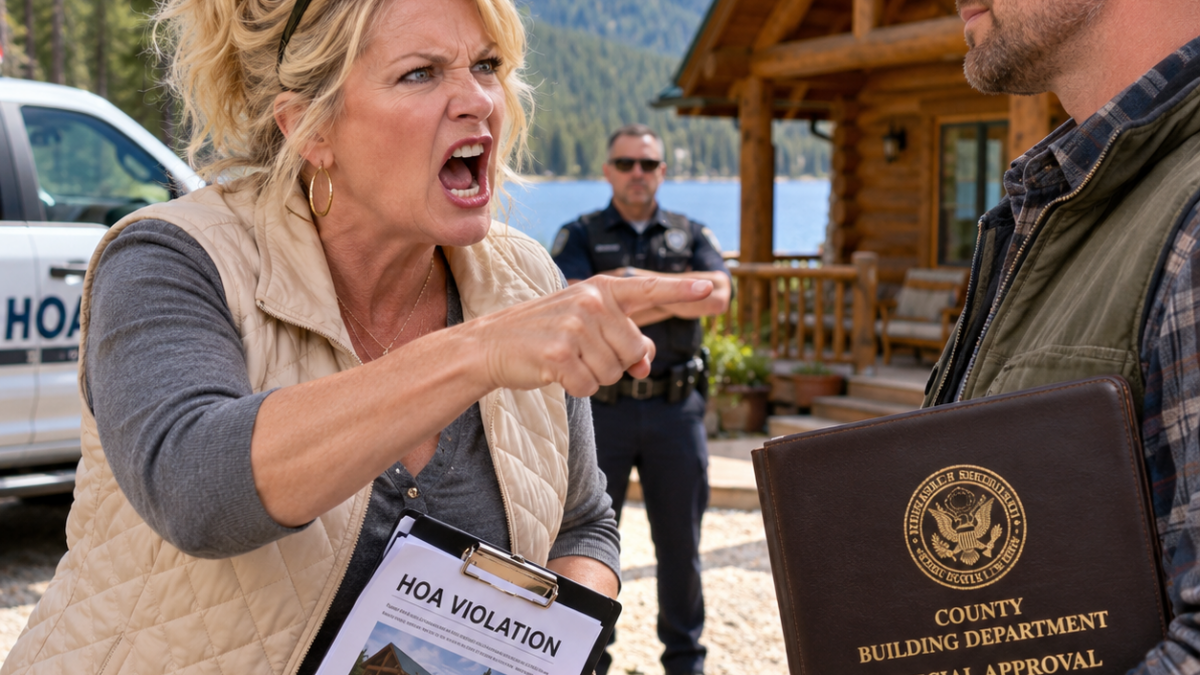
The woman from the HOA marched up my gravel driveway waving a violation folder, told me my brand-new cabin was illegally built and might have to be demolished, then stood there speechless when I handed her the county approval bearing the one signature she never expected to see—mine.
What she thought would be an easy intimidation visit turned into something much uglier when I discovered that my cabin wasn’t really the problem at all; the HOA had quietly redrawn neighborhood boundaries, falsified records, and made a deal that could cost several families their homes if nobody stopped them.
Marlene Baxter had been walking toward me for less than thirty seconds when I knew exactly what kind of afternoon I was about to have.
Pressed beige slacks.
Oversized sunglasses.
A manila folder tucked beneath one arm.
A mouth already moving before she’d reached the porch.
“Excuse me!”
I was sitting on the railing outside the cabin with a mug of coffee in my hand, looking down through the pines toward the creek.
The cabin had taken me nearly eleven months to finish.
Nothing enormous.
Nothing flashy.
A little over nine hundred square feet, cedar siding, dark metal roof, deep porch facing the mountain ridge.
I’d built most of it myself after work and on weekends, hiring licensed contractors for the electrical, septic, and anything else I wasn’t qualified to touch.
It wasn’t some improvised shack nailed together behind my house.
Every footing had been inspected.
Every structural drawing had been reviewed.
The septic permit was current.
The environmental review had been completed because the lower edge of my property sat near a protected drainage channel.
I knew that paperwork better than anybody.
For reasons Marlene was about to discover.
She finally reached the porch and stopped below me.
“You can’t just put something like this up.”
I took a slow sip of coffee.
“Good afternoon to you too.”
She ignored that.
“This structure is in violation of East Hollow HOA architectural code fourteen-point-two.”
I glanced behind me at the cabin.
“That’s impressive.”
“What is?”
“You’ve been standing here thirty seconds and already inspected the entire building.”
Her lips tightened.
“Don’t be sarcastic, Mr. Grant.”
“I wasn’t aware sarcasm required HOA approval.”
She opened the folder.
Marlene chaired the architectural review committee for East Hollow.
She treated the title like a federal appointment.
A year earlier, she’d sent my neighbor Will a formal warning because his front landscaping contained “excessive decorative stone.”
He had four rocks.
Four.
Apparently civilization had nearly collapsed.
Now she was standing on my land looking at a fully inspected cabin as though she’d personally discovered an illegal refinery.
“You failed to submit construction drawings,” she said.
“To whom?”
“The architectural committee.”
“I submitted them to the county.”
“That isn’t what I asked.”
“I know.”
“You also failed to request exterior design approval.”
“From the county?”
“From us.”
“The HOA?”
“Yes.”
I nodded slowly.
“There’s your problem.”
Her eyebrows rose.
“My property back here isn’t within HOA jurisdiction.”
She gave a short laugh.
“Actually, it is.”
“No.”
“Actually, Mr. Grant, there was a boundary amendment adopted last week.”
I looked at her over the rim of my coffee mug.
“Last week.”
“Yes.”
“And somehow that amendment retroactively controls a cabin that finished permitting months earlier?”
“It controls all structures within the newly expanded district.”
I set the mug beside me.
“Who voted on that?”
“The board.”
“How many property owners received notice?”
“You were sent notice.”
“No, I wasn’t.”
“It was mailed.”
“To what address?”
She flipped through the folder.
“Your registered property address.”
“The house or this parcel?”
She looked up.
“Your address.”
“Which one?”
For the first time, she hesitated.
Barely.
Then she recovered.
“The board followed the proper process.”
I almost smiled.
I’d been around county land-use work long enough to know that whenever somebody answered a precise procedural question with “proper process,” there was a decent chance no proper process had occurred.
Marlene pulled out a bright white sheet.
“This cabin fails multiple conformity requirements.”
“Such as?”
“Roof material.”
“Standing-seam steel.”
“Not approved.”
“County approved it.”
“Exterior color.”
“Natural cedar.”
“Not approved.”
“County approved it.”
“Setback.”
“Forty-three feet from the recorded line.”
“That line is disputed.”
“No, it isn’t.”
Her expression hardened.
“You seem to think county approval overrides the HOA.”
“On land outside your HOA, yes.”
“You are inside now.”
“According to an amendment passed last week.”
“Correct.”
“Convenient.”
She snapped the folder shut.
“Whether you like it or not, the structure is subject to enforcement.”
“What kind of enforcement?”
“Fines initially.”
“And after that?”
“If violations remain unresolved, the board can seek removal.”
“Removal.”
“Demolition, if necessary.”
I stared at her.
The mountain wind moved softly through the pines behind us.
Somewhere down the slope, water ran over rocks in the creek.
Marlene stood there waiting for me to get nervous.
That’s what she wanted.
A defensive explanation.
Maybe an apology.
Maybe for me to start begging for a hearing.
Instead I asked, “You sure you want to go down this road?”
She folded her arms.
“Absolutely.”
“All right.”
I stood.
“Give me a second.”
I walked to the small weatherproof mailbox mounted beside the cabin door.
Inside was a laminated copy of the certificate I’d been keeping there for contractors.
I carried it back.
“Here.”
Marlene took it.
Her eyes traveled across the page.
Building permit.
Environmental compliance clearance.
Septic approval.
Final structural inspection.
Certificate of occupancy eligibility.
Then her eyes stopped at the signature near the bottom.
She looked up.
Then down again.
“Wait.”
I didn’t say anything.
“This says…”
“Go ahead.”
Her voice changed.
“You approved this?”
“Correct.”
“You personally signed the zoning compliance review?”
“Yes.”
She looked at me as though I had just changed species.
“You’re Adler Grant.”
“I’ve been Adler Grant the entire afternoon.”
“No, I mean…”
She stared at the document.
“You’re that Grant.”
“There are several.”
“The new county zoning board member.”
“Elected last month.”
She looked back toward the cabin.
Then toward the driveway.
Then at me.
I could almost see the calculation happening.
The man she’d come to intimidate wasn’t simply some homeowner who might not understand land-use law.
I had spent the previous decade working as a planning consultant, sat on county advisory panels, and had recently been elected to fill a vacant position on the county zoning board.
More importantly, because my cabin permit predated my formal appointment, the application had been handled under a county process that required multiple independent reviews, including legal and environmental sign-offs.
I’d signed the final zoning certification only after the staff reports were complete and after recusing myself from anything that could create an improper conflict once I formally joined the board.
There was a paper trail for everything.
Marlene’s voice dropped.
“But the boundary amendment—”
“Is under county review.”
Her head snapped up.
“What?”
“The amendment your board filed last week.”
“There’s nothing wrong with it.”
“County counsel doesn’t seem convinced.”
She froze.
I stepped down from the porch.
“Two people who supposedly voted for the expansion don’t legally reside within East Hollow’s voting boundary.”
“That is not accurate.”
“I checked the parcel records.”
“You had no right—”
“They’re public.”
Her cheeks reddened.
I continued.
“One meeting notice appears to have been posted after the statutory notification deadline.”
“That is a technicality.”
“And your amendment map includes three privately owned parcels whose owners never executed consent documents.”
“You don’t understand how community boundary clarification works.”
“I understand exactly how it works.”
She took a step backward.
I pointed toward the gravel beneath her shoes.
“This cabin sits on private land. It was legally permitted. Your association has never had jurisdiction over this section of my property.”
“The amendment changes that.”
“Maybe.”
I held her gaze.
“If it’s legal.”
Her mouth tightened.
“It is.”
“Then you won’t mind the review.”
For once, Marlene had no immediate answer.
I took the laminated certificate from her.
“And one more thing.”
“What?”
“Don’t come up this driveway again to threaten demolition.”
“I wasn’t threatening you.”
“You told me my cabin might be torn down.”
“That’s enforcement.”
“Not here.”
I pointed toward the road.
“If you need to communicate with me about legitimate HOA business, send a letter.”
She stared at me.
“Otherwise, the next time you walk onto this parcel after I’ve asked you to leave, I’ll document it as trespassing.”
Marlene’s face hardened.
“You think being on the zoning board makes you untouchable.”
“No.”
I slipped the document back into its mailbox.
“It makes me very familiar with paperwork.”
That landed harder.
She turned without another word and marched toward the road, shoes grinding into the gravel.
I watched until she disappeared around the curve.
Then I sat back on the porch.
My coffee had gone cold.
I should have reheated it.
Instead, I pulled out my phone.
Because there was one thing Marlene had said that wouldn’t leave me alone.
Boundary amendment.
I hadn’t received any notice.
And people like Marlene usually didn’t take risks unless somebody stood to make money.
Three days later, I found out how much.
PART 2
The white SUV pulled into my upper driveway just after ten in the morning.
Tinted windows.
New tires.
No dust anywhere on it.
Nobody who drove into the mountains regularly kept a vehicle that clean.
I was down near the rear trail installing motion lights when I heard the tires.
I finished tightening the last bracket before walking up.
No hurry.
If people arrive uninvited, making them wait has a way of improving the conversation.
When I rounded the garage, a man in his forties stood beside the SUV wearing a fleece vest, polished loafers, and the expression of someone who had billed somebody for the drive.
A woman stood beside him.
Late thirties.
Perfect blouse.
Gold East Hollow badge clipped beside her collar.
She was holding a tablet.
The man opened a leather notebook.
“Mr. Grant?”
“You’re on private property.”
He ignored that.
“Daniel Withers. Counsel for East Hollow Homeowners Association.”
The woman nodded.
“Secretary Elaine Caldwell.”
I looked at the little gold badge.
“Do those come with arrest powers?”
Caldwell didn’t smile.
Daniel did, but only because lawyers are trained to pretend insults are amusing until they can invoice you for them.
“We’re here to discuss your recent construction.”
“My cabin.”
“Yes.”
“The permitted cabin.”
Daniel folded his hands.
“There remains significant concern that your structure fails architectural conformity standards.”
“You drove all the way up here to tell me Marlene is still angry.”
“This isn’t personal.”
“Of course not.”
Caldwell spoke.
“Four residents have submitted formal complaints.”
“About what?”
“The visual obstruction.”
I looked behind me.
The cabin was almost completely concealed by trees from the nearest road.
“What visual obstruction?”
“The atypical roof.”
I laughed.
She didn’t.
Daniel continued.
“The association’s position is that your property falls within the expanded jurisdiction.”
“The expansion is under investigation.”
“Review.”
“Investigation.”
He tilted his head.
“That distinction hasn’t been established.”
“County counsel is reviewing procedural violations.”
“Alleged.”
“Two invalid voters.”
“Disputed.”
“Late notice.”
“Disputed.”
“Unconsented private parcels.”
“Disputed.”
I smiled.
“You people really enjoy that word.”
Daniel closed the notebook.
“We aren’t here to argue.”
“Then why are you here?”
“To notify you that the association intends to assess an initial noncompliance penalty of twenty-five hundred dollars.”
I stared at him.
“Against property you’ve never controlled.”
“Our position is that we do control it.”
“Daily fines?”
“Yes.”
“How much?”
“Two hundred and fifty dollars per day after the initial compliance period.”
I nodded.
“Wait there.”
Caldwell looked almost satisfied.
She thought I was retrieving money.
I walked to the porch, picked up a sealed envelope from a crate near the steps, and returned.
I handed it to Daniel.
He opened it.
Read the first paragraph.
His jaw shifted.
“That was quick,” I said.
He kept reading.
Caldwell leaned toward him.
“What is it?”
“A cease-and-desist notice.”
I answered for him.
“Filed with the county clerk yesterday. It outlines the association’s potential jurisdictional overreach and puts you on notice that any attempt to fine, lien, enter, alter, inspect, or interfere with this property under the disputed amendment may result in injunctive proceedings.”
Caldwell stared.
“You’re threatening litigation over a shed.”
I stepped closer.
“It’s a registered dwelling.”
Her eyes narrowed.
“And I’m not threatening anything.”
I looked at Daniel.
“I’m telling you what I’ll file.”
He folded the letter carefully.
“We’ll review this.”
“Do that.”
I started walking back toward my porch, then stopped.
“Oh, Daniel.”
He looked up.
“You might also want to review the vote that approved your expansion.”
“We have.”
“Did Marlene mention that Stephen Pike sold his house three months ago?”
Silence.
Caldwell’s face shifted.
“And Patricia Moss transferred her property to a trust and moved to Arizona last winter.”
Daniel said nothing.
“Neither legally qualified as resident voting members under your bylaws when that amendment passed.”
“That is a matter of interpretation.”
“No.”
I smiled.
“That’s a matter of addresses.”
Caldwell looked at Daniel.
He avoided her eyes.
Interesting.
I had expected them to fight harder.
Instead, they left.
That bothered me.
People certain they’re right argue.
People who know there’s something underneath the argument usually retreat to protect it.
That afternoon, I drove to the county records office.
Lenora Hale worked the front desk.
She’d taught elementary school for thirty-three years before deciding retirement was too boring and taking a county clerk job.
She knew everybody.
And everything.
When I walked in, she lifted one eyebrow.
“I heard somebody made the mistake of annoying Adler Grant.”
“Small county.”
“Smaller gossip network.”
“I need the East Hollow filings.”
She smiled.
“You and apparently half the county.”
She disappeared into the back.
A few minutes later, she returned carrying a folder thick enough to injure somebody.
“Fifty-two pages came in this morning.”
“From the HOA?”
“Marked urgent.”
I opened the first document.
Meeting minutes.
Supplemental minutes.
Clarification memo.
Boundary amendment.
Corrected boundary amendment.
Jurisdictional interpretation.
Someone was trying very hard to create paperwork.
I turned page after page.
Then stopped.
There was an email printout accidentally included between two meeting exhibits.
From Clint Shaver, president of East Hollow HOA.
To Marlene.
Cc Daniel Withers.
And somebody named Jeffrey Vale.
Subject:
**Silver Hollow Expansion Coordination**
I read the first paragraph.
Then the second.
My stomach tightened.
The HOA had been communicating with a developer called Vale Crest Communities.
They planned six luxury homes beyond the ravine.
Access was difficult.
The most practical route crossed or bordered several existing parcels.
Including mine.
One email read:
**HOA jurisdictional unification would simplify access negotiations and architectural control.**
Another:
**Once adjoining parcels are brought under association governance, developer contribution can offset infrastructure acquisition costs.**
I looked at Lenora.
“Can I photograph these?”
“They’re public filings.”
I took pictures.
The more I read, the uglier it became.
This wasn’t about conformity.
It wasn’t about my roof.
It wasn’t even about the cabin.
The HOA was trying to pull surrounding private parcels into its jurisdiction so it could present the area to the developer as one unified controlled district.
My land sat between the existing subdivision and the planned luxury project.
A problem.
Unless the HOA could absorb me.
Then I found a site map.
My parcel wasn’t labeled with my name.
It was labeled:
**GREEN BELT RESERVE C**
I read it twice.
Someone had already designed a future in which my property no longer functioned as mine.
I stepped away from the counter.
“You okay?” Lenora asked.
“No.”
I pulled out my phone.
There was one person I needed.
He answered on the second ring.
“Adler Grant.”
The voice still sounded exactly the same.
“Either you’re running for office again or somebody’s in trouble.”
“Chief.”
He laughed.
“Nobody’s called me that since the DA promoted me.”
“You still running fraud?”
“Unfortunately.”
“I’ve got something.”
His tone changed immediately.
“What?”
“HOA manipulating jurisdictional boundaries to facilitate a private development deal.”
“How bad?”
“Fake or invalid votes. Questionable filings. Private parcels being mapped as development assets. Possible mail and wire issues.”
“You have documents?”
“Emails. Signatures. Meeting minutes. Property maps.”
A pause.
“How soon can you bring them?”
I closed the folder.
“I’m already leaving.”
—
Assistant District Attorney Marcus Hale met me after hours.
We had known each other six years earlier when I served on a county campaign finance reform committee.
He had been a prosecutor then.
He was still one now.
Same square jaw.
Same habit of tapping a pen against his thumb while reading.
We spread the documents across a conference table.
He read silently for twenty minutes.
Then looked up.
“This email chain came from a public filing?”
“Yes.”
“Why would they file it?”
“Probably accidental attachment.”
“Lucky.”
“For us.”
“Very unlucky for them.”
He read another message.
“This sentence.”
I leaned over.
**Boundary incorporation should precede acquisition discussions to avoid individual owner vetoes.**
Marcus tapped the paper.
“They’re trying to remove bargaining leverage from private owners.”
“That’s how I read it.”
“Could still be unethical rather than criminal.”
“I know.”
“Then there’s this.”
Another email.
**We can establish historical inclusion through supplemental minutes if necessary.**
Marcus’s eyes narrowed.
“What are supplemental minutes?”
“Exactly.”
He sat back.
“If those minutes were created after the fact to make it look like jurisdiction existed earlier…”
“Fraud.”
“Potentially.”
He held up one finger.
“Don’t get ahead of the evidence.”
“I’m not.”
“You sound like you are.”
“I know these people.”
“No.”
He pointed at the documents.
“You know what they show.”
That was why Marcus was good.
He didn’t prosecute personalities.
He prosecuted proof.
He continued.
“If this developer knowingly participated in falsified filings, we’re looking at conspiracy concerns. If interstate communications or financial transactions were involved, federal exposure becomes possible.”
“What do you need?”
“Original electronic records.”
“The HOA has them.”
“Not for long.”
“When?”
“We’ll start with subpoenas.”
“Good.”
Marcus looked at me.
“You are now officially too close to this.”
“I know.”
“You’re on the zoning board.”
“Yes.”
“You need to disclose the conflict and recuse yourself from any formal board vote directly involving your own property.”
“Already drafting the memo.”
“Good.”
“But I can still speak as the owner.”
“Absolutely.”
He gathered copies.
“And Adler?”
“Yeah?”
“Do not confront them privately.”
“They’ve been coming to my house.”
“Then record everything.”
“I already am.”
Marcus smiled.
“That’s why I answered your call.”
—
By Friday, panic had reached East Hollow.
You could feel it.
People whispered at the mailbox kiosk.
Board members stopped posting online.
The community group chat suddenly filled with questions about the boundary amendment.
No answers.
Then a sheriff’s cruiser pulled into the HOA office parking area.
No lights.
No siren.
Just a deputy, a county investigator, and two boxes for records.
People photographed everything.
By sunset, screenshots were everywhere.
Will showed up at my cabin carrying a six-pack.
“You really declared war.”
I took one.
“No.”
He sat on the porch step.
“They did.”
I opened the bottle.
“I just made sure the truth got representation.”
He laughed.
Then his expression turned serious.
“Think they were really planning to take your land?”
I looked toward the tree line.
“I think they were planning to control enough of it that eventually the distinction wouldn’t matter.”
“Why?”
“Developer.”
His head turned.
“What developer?”
I told him.
His face changed when I mentioned the site map.
“Green Belt Reserve C?”
“That’s what they’ve renamed my property.”
“What about mine?”
“I didn’t see your parcel in the first file.”
Will took a drink.
“You think I should worry?”
“I think everyone whose property touches the ravine should pull their records.”
We sat there until dark.
For the first time in weeks, nobody drove up the gravel road.
No Marlene.
No Caldwell.
No Daniel.
Just wind in the pine trees.
I should have enjoyed it.
Instead, I couldn’t stop thinking about something Marcus had said.
Original electronic records.
Paper can be manipulated.
Digital logs are harder.
Unless you’re stupid enough to start changing them after investigators are already watching.
The HOA was exactly that stupid.
—
Marcus called Thursday afternoon.
No greeting.
“They’re backdating filings.”
I stopped walking.
“What?”
“Somebody accessed the HOA server last night.”
“What did they change?”
“Meeting records.”
I leaned against the counter.
“What kind?”
“Created supplemental minutes dated a month earlier.”
“Trying to legitimize the expansion vote.”
“Worse.”
His voice hardened.
“They inserted references suggesting you verbally consented to the boundary change.”
I laughed.
Not because it was funny.
Because sometimes corruption becomes so arrogant it loops around into stupidity.
“I’ve never discussed boundary expansion with any board member before Marlene showed up at the cabin.”
“We know.”
“Even if I had, verbal consent doesn’t transfer jurisdiction over private property.”
“They know that too.”
“Then why do it?”
“To create ambiguity.”
“Buy time.”
“Exactly.”
I looked through the kitchen window.
My cabin sat beyond the trees.
“They’re adding obstruction to their list.”
“If we prove who did it.”
“You will.”
Marcus paused.
“IT is cloning the server tomorrow.”
“Warrant?”
“Signed.”
The county team arrived shortly after eight the next morning.
By ten, everybody knew.
Two unmarked cars outside the HOA office.
An investigator carrying a laptop bag.
A technician removing a small server tower.
Marlene was nowhere to be seen.
That evening, Will arrived holding a glossy brochure.
“This was in my mailbox.”
No stamp.
No postage.
Just dropped there.
The cover showed stone entrance columns, curving roads, manicured trees, and houses large enough to have their own weather systems.
Across the top:
**PRESERVE AT SILVER HOLLOW**
I turned the page.
Luxury mountain living.
Private trails.
Gated access.
Architecturally unified community.
Phase One.
Then I saw the map.
Will’s property appeared in a shaded redevelopment zone.
So did ten other homes.
My land was Green Belt Reserve C.
The existing East Hollow neighborhood had been redrawn as part of the future project.
I stared at the page.
Will said, “What?”
“They’re not expanding the HOA.”
“What are they doing?”
“They’re preparing to replace it.”
He frowned.
I spread the map across the porch table.
“Look.”
Existing East Hollow lots appeared beneath new phase labels.
A merger note sat in the legend.
**Association consolidation upon completion of acquisition threshold.**
Will leaned closer.
“They plan to merge us into the development.”
“Exactly.”
“But they can’t.”
“Not legally without required owner approvals.”
“So the boundary amendment…”
“Gets more parcels under the existing association.”
“And then?”
“If enough land is controlled through the HOA, they can present the developer with a unified governance structure, pressure holdouts, and maybe pursue title actions against disputed parcels.”
Will stared.
“That’s insane.”
“No.”
I looked at the glossy houses.
“It’s profitable.”
That night, I pulled the developer’s public records.
Corporate filings.
Land purchases.
Zoning appeals.
There it was.
A pending fast-track application conditioned on:
**Community governance unification and confirmed access rights across adjoining parcels.**
Trojan horse.
The HOA wasn’t protecting architectural standards.
It was becoming a land assembly tool.
I emailed Marcus.
Then I requested an emergency public hearing before the county land commission.
Because this no longer involved my cabin alone.
People needed to hear what was being planned for their homes.
In public.
Where nobody could rewrite the minutes afterward.
—
I spent the weekend knocking on doors.
Not campaigning.
Showing documents.
That distinction mattered.
At the first house, a retired Army sergeant named Calvin Brooks read the Silver Hollow brochure for almost five minutes.
Then he looked at me.
“My property is phase one?”
“Yes.”
“I never agreed to sell.”
“I know.”
“You sure this is real?”
I showed him the developer’s filing.
His jaw tightened.
“They’re going to regret this.”
“Maybe.”
“No maybe.”
He handed the papers back.
“Tell me what you need.”
“Petition.”
The East Hollow bylaws had an emergency provision allowing members to petition for temporary suspension of board authority when credible fraud allegations threatened association assets.
Ironically, the people who had manipulated the bylaws had left the residents a weapon.
By Monday evening, nineteen households had signed.
Then twenty-three.
Then twenty-eight.
People who had never attended a meeting started asking questions.
Some were angry.
Others terrified.
A woman named Denise stared at the redevelopment map with tears in her eyes.
“My husband built the addition himself.”
“I know.”
“He died two years ago.”
“I didn’t know that.”
“They can’t just call my home redevelopment.”
“No.”
I folded the map.
“They can’t.”
That was when the fight stopped being interesting to me.
Until Denise, there had still been a part of me enjoying the technical battle.
Finding errors.
Catching lies.
Watching Marlene’s confidence crack.
Now I saw what the plan meant.
Homes weren’t parcels on a map.
They were dead husbands’ additions.
Kids’ growth marks on kitchen doors.
Mortgages paid over thirty years.
Trees planted for grandchildren.
The developer’s presentation reduced all of it to acquisition phases.
Monday afternoon, Caldwell returned.
She stopped at the sidewalk.
Good.
At least she’d learned one thing.
I walked down.
“What do you want?”
She held out a folded letter.
“Formal notice of censure.”
I didn’t take it.
“For what?”
“Conduct undermining association governance.”
“Be specific.”
“Improper access to protected records.”
“Public records.”
“Incitement of hostility toward the board.”
“Showing homeowners maps of their own property?”
“You’ve created panic.”
“No.”
I stepped closer.
“Your board did that when it decided people’s houses were development inventory.”
Her lips tightened.
“The developer proposal is preliminary.”
“Then why falsify jurisdiction records?”
“We didn’t.”
“Server logs say otherwise.”
Her face twitched.
“You don’t know what investigators found.”
“Neither do you, apparently.”
She held out the letter again.
“Your community privileges are suspended.”
I looked at it.
“What privileges?”
“Clubhouse access. Voting rights. Amenities.”
“I don’t use your clubhouse.”
“That isn’t the point.”
“My land isn’t under your association.”
“That remains disputed.”
I smiled.
“Not for much longer.”
Caldwell’s voice dropped.
“The board will defend itself.”
“Will Daniel?”
“What?”
“Your lawyer.”
Her expression changed.
I had learned the news that morning.
“Daniel Withers was suspended from practice pending disciplinary proceedings involving undisclosed conflicts tied to Vale Crest.”
Her face drained.
“He wasn’t—”
“Developer payroll.”
“He represented the HOA.”
“He represented the developer too.”
“That isn’t true.”
“Financial records say otherwise.”
She lowered the letter.
I could see the exact moment she realized she had been standing inside somebody else’s deal.
Maybe she’d known part of it.
Maybe not all.
Either way, I didn’t feel sorry for her.
Not yet.
I pointed toward the road.
“Tuesday. Land commission.”
Caldwell swallowed.
“You think you can destroy this association.”
“No.”
I looked toward the houses.
“I’m trying to stop your board from selling it.”
She walked away.
This time, slowly.
—
The land commission chamber held maybe a hundred and fifty people.
By nine fifteen Tuesday morning, every seat was taken.
Residents lined the walls.
Reporters stood near the back.
Vale Crest executives sat together in dark suits.
Former HOA board members occupied two rows.
Marlene sat beside Clint Shaver.
Caldwell was three seats away.
She wouldn’t look at me.
Because the issue involved my property, I had formally recused myself from the commission’s deliberation and sat as a private landowner and witness.
When my name was called, I walked to the podium carrying a binder nearly two inches thick.
I didn’t start with accusations.
I started with dates.
“April third.”
Original East Hollow boundary map.
“April ninth.”
Developer communication regarding governance unification.
“April twelfth.”
First internal HOA email discussing incorporation of adjoining parcels.
“April eighteenth.”
Meeting notice.
“April twentieth.”
Purported vote.
“April twenty-third.”
Boundary filing.
Then signatures.
Stephen Pike.
No longer resident.
Patricia Moss.
No longer resident.
Then the notice records.
Incomplete.
Then the server logs.
Supplemental minutes created after the investigation began.
Then the emails.
**Establish historical inclusion through supplemental minutes if necessary.**
The room became quiet.
I displayed the Silver Hollow brochure.
People whispered.
Then the developer’s county application.
**Fast-track approval contingent upon community unification.**
The commission chair leaned forward.
“Mr. Grant, are you alleging the HOA attempted to expand jurisdiction for the purpose of facilitating this development?”
“I’m showing the timeline.”
“Do you have direct evidence of intent?”
“Yes.”
I opened the binder.
“Email between Clint Shaver and Vale Crest development counsel.”
The clerk displayed it on the screen.
**Once peripheral lots fall under East Hollow governance, resistance to consolidation can be managed through enforcement mechanisms.**
People gasped.
Marlene looked toward Shaver.
Shaver stared straight ahead.
Then I played the voicemail.
It had come from Will.
A board member had accidentally pocket-dialed him during a private conversation.
The audio wasn’t perfect.
But Marlene’s voice was unmistakable.
“Once we get Grant’s land marked green belt, we can bulldoze the cabin. He won’t be able to stop it.”
Silence.
Absolute silence.
Marlene went white.
The commission chair looked toward her.
“Ms. Baxter?”
She stood too quickly.
“That was taken out of context.”
I almost laughed.
“What context makes bulldozing someone’s legal cabin appropriate?”
The chair raised his hand.
“Mr. Grant.”
I stopped.
Marlene continued.
“We were discussing future zoning possibilities.”
“On privately owned land?”
“It was hypothetical.”
The chair turned to county counsel.
“Has Mr. Grant’s parcel ever been legally within East Hollow’s original HOA boundary?”
“No.”
“Was owner consent filed with the amendment?”
“No.”
“Were all voters legally qualified?”
“Evidence suggests not.”
“Were supplemental minutes added after the original meeting date?”
“Yes.”
The chairman sat back.
He looked tired.
“That’s enough.”
Vale Crest’s lawyer requested time to respond.
The commission denied the request for delay.
Within the hour, the county froze all permits connected to Silver Hollow.
The disputed HOA boundary amendment was suspended.
East Hollow’s authority over development and land-use enforcement was temporarily frozen pending investigation.
The matter was referred to the state attorney general and appropriate criminal investigators.
When the vote came back unanimous, the room erupted.
Not cheering exactly.
Something heavier.
Relief.
Outside, reporters surrounded Caldwell.
She shielded her face.
Someone shouted a question at Marlene.
She pushed through the crowd.
Will found me near the steps.
“You realize what you just did?”
“I gave a presentation.”
“You killed a multimillion-dollar development plan.”
“No.”
I looked toward the Vale Crest attorneys rushing toward their cars.
“They did.”
Will clapped my shoulder.
“You ever think about running for mayor?”
“No.”
“County commission?”
“Absolutely not.”
“New HOA president?”
I stared at him.
He laughed.
“Okay. Too soon.”
“Forever too soon.”
Then he grinned.
“Fine. Just don’t fine me for my shed.”
“Does it meet code?”
“No idea.”
“Then definitely don’t elect me.”
For the first time in weeks, I laughed without feeling angry underneath it.
But the story wasn’t finished.
Because two days later, the federal agents arrived.
—
I was splitting firewood behind the cabin when a black SUV came up the access road.
Government plates.
Two people stepped out.
Neither wore a uniform.
The taller one showed identification.
“Adler Grant?”
“Yes.”
“Special Agent Lauren Pierce. This is Agent Miles Grantley.”
I set the axe down.
“No relation.”
Agent Grantley smiled.
“Everybody asks.”
Pierce opened a folder.
“You know Clint Shaver?”
“HOA president.”
“Have you seen him recently?”
“Not since the hearing.”
She showed me a photograph.
Shaver stood on a golf course shaking hands with Jeffrey Vale, one of the Silver Hollow principals.
“You recognize the other man?”
“Vale.”
“Mr. Shaver hasn’t returned home in three days.”
“Fled?”
“We’re trying to determine that.”
Grantley spoke.
“Two days ago, a transfer exceeding four hundred thousand dollars moved from HOA reserve accounts into a Nevada corporation connected to Shaver.”
I stared.
“That money was for drainage.”
“Among other projects.”
“We’ve been waiting two years for lower culvert repairs.”
Pierce nodded.
“Federal and county investigators have identified multiple invoices to contractors associated with the developer.”
“For work that wasn’t done?”
“Some appear questionable.”
I thought about the pool.
Lighting.
Road maintenance.
“They were using HOA money to finance the development.”
“That’s one theory.”
I looked toward my cabin.
“My emails are organized.”
Pierce raised an eyebrow.
“Excuse me?”
“I have copies of communications, maps, records.”
She smiled slightly.
“We expected you might.”
I sent everything.
That evening, residents gathered in the park pavilion.
The association’s bank accounts had been frozen.
Formal HOA authority was suspended.
Nobody knew who was responsible for anything.
Drainage.
Common-area insurance.
Roadside maintenance.
Panic would have been easy.
Instead, a woman named Rachel Kim placed a legal pad on the picnic table.
“All right.”
Everyone looked at her.
“We have no functioning board, frozen funds, and a drainage trench that becomes a lake every time it rains.”
Will said, “We’re not rebuilding the old HOA.”
“No one said we were.”
I leaned forward.
“But we need temporary coordination.”
Miguel Santos, a retired firefighter, raised a hand.
“I can handle infrastructure coordination.”
Rachel nodded.
“I’ll do communications.”
Everyone looked at me.
“No.”
Will smiled.
“You don’t even know what we’re asking.”
“I know that look.”
“Temporary third member.”
“I have a zoning job.”
“You also caused this mess.”
I stared.
He held up both hands.
“In a good way.”
Rachel laughed.
I finally agreed on one condition.
“No unilateral power.”
“Agreed.”
“No fines.”
“Agreed.”
“No decorative rock committee.”
Will said, “What if somebody has five?”
“Meeting adjourned.”
People laughed.
It felt strange.
For years, HOA meetings had been tense.
Now we were sitting under a pavilion talking like neighbors.
Not subjects.
Neighbors.
—
The following morning, while organizing evidence for the agents, I found another email chain.
Shaver.
Vale Crest legal.
Daniel Withers.
Subject:
**Quiet Title Strategy**
I opened it.
A draft action had been prepared weeks before Marlene ever confronted me.
The plan outlined how disputed parcels might be converted through legal pressure after HOA jurisdiction was asserted.
My land appeared by parcel number.
So did Will’s.
Denise’s.
Calvin’s.
They weren’t merely hoping owners would cooperate.
They had prepared to force us.
I forwarded the documents.
Agent Pierce called an hour later.
“This changes scope.”
“I figured.”
“This suggests coordinated efforts to alter or challenge title rights.”
“Criminal?”
“Potentially.”
“Shaver?”
“We’re looking.”
They found him two hours later.
Hotel outside Reno.
Fake name.
Two phones.
Laptop.
Burner credit cards.
The story broke nationally enough to make local residents uncomfortable.
Justice Department inquiry.
Real estate fraud.
Property misappropriation.
Embezzlement.
Possible conspiracy.
By the next morning, every board loyalist disappeared.
Caldwell resigned.
Her note had no signature.
Marlene loaded boxes into a rented truck before sunrise.
Will texted me a photograph.
On her porch hung a ceramic sign.
**BLESS THIS HOME**
He captioned it:
**Irony remains undefeated.**
I told him to leave her alone.
People deserved consequences through courts.
Not mobs.
That distinction mattered to me.
Marlene had abused power because she believed her cause justified her method.
I didn’t want us becoming the same kind of people with different slogans.
—
The county approved our provisional neighborhood council.
Temporary.
Limited.
Transparent.
Miguel coordinated drainage repairs.
Rachel created a public expense spreadsheet.
I helped secure emergency infrastructure funding that would later be reimbursed once legal control of remaining HOA assets was resolved.
Every receipt went online.
Every decision was posted.
Residents could attend meetings.
Or not.
No mandatory participation.
No performance theater.
One evening, after a long day reviewing drainage estimates, I walked back to the cabin.
There was an envelope wedged between the door and frame.
No name.
Inside was one handwritten line.
**You don’t know me, but I watched what you did. Thank you for not backing down.**
I read it twice.
Then pinned it inside the cabin above the window.
Not because I thought I was a hero.
I wasn’t.
I had advantages many residents didn’t.
I understood zoning.
I knew lawyers.
I knew where records lived.
I knew which words mattered.
Marlene had expected a regular homeowner who would panic when she said “code.”
Instead, she happened to choose a property owned by the person most equipped to recognize what she was doing.
That bothered me.
Because what about everyone else?
What about somebody who didn’t know?
Somebody who couldn’t afford counsel?
Somebody who believed the letterhead?
That became the question guiding everything we rebuilt.
A rule shouldn’t require a lawyer to understand.
A decision shouldn’t be hidden.
Authority shouldn’t depend on intimidation.
The new system didn’t need to be clever.
It needed to be boring.
Boring is underrated.
Boring financial reports.
Boring public votes.
Boring notices.
Boring receipts.
Corruption likes mystery.
Good government loves paperwork everybody can see.
—
Vale Crest collapsed under investigation.
Not the entire company.
But the Silver Hollow project died.
Financing partners withdrew.
County approvals were rescinded.
Several executives hired criminal counsel.
Daniel Withers eventually faced professional discipline for conflicts and conduct connected to the matter.
Shaver was indicted for financial crimes and property-related conspiracy allegations.
The four-hundred-thousand-dollar transfer became one of several transactions investigators traced.
Some money was recovered.
Some disappeared into accounts and legal fees.
Marlene wasn’t treated as the mastermind.
That disappointed a few residents who wanted a simple villain.
Reality was messier.
She had participated.
She had enforced.
She had pushed the false expansion.
She had discussed bulldozing my cabin.
But Shaver and the developer network had driven much of the financial scheme.
Marlene faced her own legal consequences based on evidence prosecutors could prove.
Caldwell cooperated.
Others did too.
I testified when asked.
Nothing more.
I didn’t chase humiliation.
Didn’t post arrest photographs.
Didn’t put Marlene’s face on signs.
Will once joked about naming the drainage ditch after her.
I told him no.
“Why not?”
“Because then I’d have to think about her every time it rains.”
“Fair.”
Our neighborhood had spent enough time revolving around those people.
Freedom meant forgetting them eventually.
Not forgiving everything.
Not pretending nothing happened.
Just refusing to let them remain the center.
—
Months later, the county invited residents to establish a permanent governance structure.
Nobody wanted to call it an HOA.
The letters had become radioactive.
So we called it the East Hollow Community Council.
Its authority was narrow.
Shared infrastructure.
Common insurance.
Emergency maintenance.
Nothing else without direct resident approval.
No design police.
No color committees.
No fines for decorative stones.
Will put six giant rocks in his front yard just to celebrate.
“Too many?” he asked.
“Seven and I call the sheriff.”
He laughed.
Rachel became elected chair.
Miguel stayed on infrastructure.
I refused nomination.
Everyone booed.
I took it as a compliment.
I still attended land-use meetings when they involved legitimate county business.
I still served on the zoning board.
But whenever an East Hollow matter directly touched my property, I disclosed and stepped away from the formal vote.
Transparency wasn’t only for people you disliked.
That lesson mattered.
One Saturday, Calvin helped me clear brush near the creek.
Denise brought sandwiches.
Will appeared with lumber.
“For what?”
“Bridge.”
“What bridge?”
He pointed across the water.
“You said a footpath would be useful.”
“I said maybe.”
“Well, maybe brought lumber.”
Miguel checked the span.
Nothing complicated.
Just a small pedestrian crossing on private property where permitted.
We built it over the weekend.
No ribbon cutting.
No press.
No HOA badge.
Just neighbors.
By evening Sunday, the final plank was screwed down.
Will stepped onto it.
“It holds.”
“That was the goal.”
He bounced.
“Stop.”
“Testing.”
“You weigh two hundred pounds.”
“Exactly. Professional testing.”
Denise laughed from the bank.
For months, we’d fought people trying to turn land into control.
Now we were building something because it was useful.
There was a difference.
No one was forced.
No one lost anything.
No one forged consent.
—
The first snow came early that year.
I woke before sunrise and walked down to the cabin.
Snow covered the roof Marlene had called “nonconforming.”
It looked exactly right to me.
The dark metal stood against white branches.
Smoke rose from the chimney.
The little bridge crossed the creek below.
I made coffee.
Same porch.
Same railing.
Same view.
Then headlights appeared along the road.
For half a second, my body reacted before my mind did.
Marlene.
Caldwell.
Daniel.
Somebody with another folder.
Instead, it was Will.
He parked and climbed out holding a paper bag.
“Breakfast.”
“You know it’s six thirty?”
“That’s why I brought breakfast.”
Inside were biscuits.
We sat on the porch.
He looked at the cabin.
“You ever think how stupid this all started?”
“What?”
“Roofing.”
I smiled.
“It wasn’t about roofing.”
“Yeah.”
He looked across the trees.
“That’s what makes it worse.”
For a while, we didn’t speak.
Then Will said, “I almost sold.”
I turned.
“When?”
“Before all this.”
“Why?”
“The HOA wore me down.”
I waited.
“Letters. Warnings. Inspections. Every little thing.”
He looked at his hands.
“I started thinking maybe moving would be easier.”
“Why didn’t you?”
“My wife wouldn’t let me.”
“Smart woman.”
“She said if we left because of Marlene, we’d regret it.”
He smiled.
“She was right.”
I looked toward the creek.
“You know what scared me most?”
“What?”
“That if they hadn’t come after the cabin, we might never have known.”
Will nodded.
“They got greedy.”
“Greed makes people visible.”
That was probably the truest thing I’d learned.
The scheme had survived because it moved quietly.
Small procedural changes.
Dense documents.
Boring meetings nobody attended.
A boundary line nobody checked.
Then Marlene marched onto my land and threatened to bulldoze something I knew was legal.
She created resistance where none had existed.
Power often collapses that way.
Not because somebody becomes more powerful.
Because arrogance finally becomes loud enough to be noticed.
—
The final legal resolution took almost two years.
Shaver received a substantial prison sentence after conviction on financial and conspiracy counts.
Other participants received sentences based on their roles.
Vale Crest paid civil penalties and settlements connected to the failed Silver Hollow project.
Residents recovered a significant portion of diverted community money.
Not all.
Some would never return.
Daniel lost his ability to casually hide behind professional authority.
Marlene sold her house.
I heard she moved three counties away.
Nobody threw a party.
Nobody needed one.
Rachel sent one email.
**Former Baxter property sold. New owners moving next month. Please be welcoming. They had nothing to do with prior events.**
That sentence told me we’d built something better.
No inherited grudges.
No collective punishment.
A new couple moved in.
Two children.
One enormous dog.
Their first weekend, the dog escaped and ran directly into Will’s yard.
It knocked over one of his decorative rocks.
I received a photograph fifteen minutes later.
**HOA EMERGENCY.**
I responded:
**FINE: ONE BISCUIT FOR THE DOG.**
He sent a thumbs-up.
That was as close to architectural enforcement as East Hollow ever got again.
—
One evening the following spring, I was sanding the cabin porch when a county truck came up the road.
Lenora stepped out.
She had retired for real this time.
“What are you doing here?”
“Inspecting illegal structures.”
I stared at her.
She laughed.
“Relax.”
She held out an envelope.
“What is it?”
“Archive copy.”
Inside was the county’s final determination regarding the old East Hollow boundary amendment.
Void.
Procedurally defective.
Unsupported by required consents.
All affected private parcels confirmed outside the attempted expansion.
I read the conclusion.
Then folded it.
Lenora looked toward the cabin.
“Still standing.”
“Barely.”
“Funny.”
“What?”
“All that trouble because somebody told the wrong man his cabin didn’t meet code.”
I smiled.
“It met code.”
“I know.”
“I approved it.”
She rolled her eyes.
“Yes, Adler. The entire county knows.”
We walked down toward the creek.
At the bridge, she stopped.
“Did you get a permit for this?”
I looked at her.
She held the straight face for maybe two seconds.
Then laughed.
“Couldn’t resist.”
We crossed.
On the opposite bank, the trail opened toward East Hollow.
Kids rode bikes near the park.
Miguel was checking a drainage grate.
Rachel talked to a contractor.
Will stood near his yard pretending his six decorative rocks constituted landscape architecture.
Ordinary life.
That’s what victory looked like.
Not television cameras.
Not courtrooms.
Ordinary life returning after people who loved control were finally removed from it.
—
That summer, the community council held its annual meeting outdoors.
Thirty-two residents attended.
Fifteen left early because there was a baseball game.
Nobody cared.
Rachel reviewed finances.
Miguel discussed drainage.
A resident requested a bench near the trail.
Another suggested replacing two streetlights.
Everything took forty minutes.
Then someone raised her hand.
“What about architectural standards?”
The entire group groaned.
The woman laughed.
“No, seriously. The new family on Birch Road wants to build a shed.”
Will immediately pointed at me.
“Ask the zoning king.”
“I am not the zoning king.”
Rachel smiled.
“What do we actually need?”
I answered.
“County permit if the size triggers one. Setback compliance. Anything required under recorded property restrictions.”
“And council approval?”
“No.”
The woman nodded.
“That’s it?”
“That’s it.”
“Color?”
“No.”
“Roof?”
“As long as it complies with building requirements.”
“Decorative rocks?”
Will shouted, “Protected species!”
Everyone laughed.
That was the moment I knew we’d finally recovered.
People could laugh about rules again because rules no longer felt like weapons.
After the meeting, Rachel walked with me toward the cabin trail.
“You ever regret getting involved?”
“Yes.”
She stopped.
I smiled.
“Usually during meetings.”
“I’m serious.”
“So am I.”
Then I considered it.
“No.”
“Why?”
I looked back toward the houses.
“Because somebody would have eventually lost something they couldn’t get back.”
She nodded.
“Your cabin?”
“No.”
I thought about Denise’s house.
Will almost selling.
Calvin discovering his property marked for redevelopment.
“Trust.”
The word sounded sentimental.
But it was true.
When people stop believing that deeds matter, votes matter, records matter, consent matters, community collapses before any bulldozer arrives.
We had fixed that.
Slowly.
Messily.
With subpoenas, audits, petitions, arguments, and a mountain of paper.
But we’d fixed it.
—
The little anonymous note stayed pinned inside my cabin.
**Thank you for not backing down.**
Sometimes visitors asked who wrote it.
I told them I didn’t know.
I never tried to find out.
Maybe that was better.
It could have been anyone.
That’s what made it matter.
One October evening, I lit the wood stove and sat on the porch as the sun dropped behind the ridge.
The pines were turning dark.
The creek sounded louder in the cold air.
My phone buzzed.
Will.
**You home?**
**Cabin.**
Five minutes later, he appeared carrying two beers.
He sat beside me.
We watched the mountains.
“Remember Marlene standing right there?”
He pointed toward the gravel.
“Unfortunately.”
“Folder and all.”
“Very threatening folder.”
“What’d she say?”
I mimicked her voice badly.
“‘This entire thing may need to be torn down.’”
Will laughed.
“Then you handed her the permit.”
“Yep.”
“I wish I’d seen her face.”
“It was satisfying.”
He took a drink.
“Best part of the whole story.”
I looked toward the neighborhood.
“No.”
“What was?”
I pointed toward the bridge.
A family was crossing it.
The new couple from Marlene’s old house.
Their kids ran ahead.
The huge dog pulled at the leash.
They waved.
I waved back.
“That.”
Will watched them.
Then nodded.
“Yeah.”
We sat quietly.
People often think winning means making the other side suffer.
Sometimes it does involve consequences.
Shaver deserved prison.
People who forged documents deserved prosecution.
Professionals who betrayed their duties deserved discipline.
But those were consequences.
Not the victory.
The victory was that the developer never touched Denise’s home.
Will never had to sell because he was exhausted.
Calvin kept his land.
The county corrected the records.
The drainage project finally got finished.
The neighborhood meetings became boring.
And my cabin remained exactly where I built it.
I finished the beer.
Then stood.
“You staying?”
“No. Wife says dinner at seven.”
He looked at his watch.
“It’s seven fifteen.”
“You better run.”
He cursed, grabbed his jacket, and hurried toward the bridge.
I called after him.
“Will!”
He turned.
“Yeah?”
“Your decorative rocks are still illegal.”
He raised one finger in my direction.
“Come fine me.”
I laughed until he disappeared through the trees.
Then I went back inside.
Above the window hung the anonymous note.
Beside the door hung the original laminated permit Marlene had read on the first afternoon.
I had considered throwing it away.
Instead, I framed it.
Not because my signature mattered.
Because what the document represented mattered.
Process.
Evidence.
Rules applied correctly.
The exact things Marlene’s board had tried to imitate while doing the opposite.
I stood in front of it for a moment.
Then turned off the lights.
Outside, moonlight reflected from the metal roof.
The same roof they’d called noncompliant.
The same cabin they’d planned to bulldoze.
The same property they’d already renamed on a developer’s map.
Still there.
Still mine.
The next morning, I woke early and walked down to the creek.
Frost covered the bridge.
I could see footprints from somebody who had crossed before sunrise.
No permission request.
No board approval.
Just a neighbor using something neighbors had built together.
I smiled.
For years, people like Marlene had confused control with community.
They thought a neighborhood worked because somebody enforced it.
Measured it.
Approved it.
Threatened it.
But communities don’t survive because everybody’s roof matches.
They survive because people trust one another enough to build bridges instead of boundaries.
Marlene had walked up my driveway intending to remind me who had authority.
Instead, she forced me to ask the question that eventually destroyed everything her board had been trying to hide:
Who actually gave you that authority?
Once we started looking for the answer, their entire scheme unraveled.
The fake boundary.
The invalid votes.
The backdated records.
The developer deal.
The hidden plan to absorb private homes.
The false legal strategy.
The stolen reserve money.
The shell companies.
The attempt to convert our properties into somebody else’s luxury development.
All because they believed nobody would inspect the paperwork closely enough.
They were wrong.
Facts don’t shout.
They don’t wear badges.
They don’t march up driveways waving folders.
They wait.
Quietly.
In county records.
In server logs.
In signatures.
In timestamps.
And when someone finally puts them in the right order, they can be louder than any threat.
I crossed the bridge.
Behind me, the cabin stood among the trees exactly where the approved plans said it should.
No demolition order.
No fines.
No developer.
No HOA committee deciding whether cedar was aesthetically acceptable.
Just a legally built home in the mountains.
That afternoon, I sat on the porch with another cup of coffee.
Hot this time.
Nobody interrupted me.
No SUV.
No clipboard.
No gold badge.
Wind moved through the pines.
Water ran below.
And as the sun disappeared behind the ridge, I looked at the cabin Marlene once threatened to tear down and thought about how close an entire neighborhood had come to being sold out from under the people who lived there.
All because everyone had been trained to assume the board knew what it was doing.
That assumption was gone now.
In its place was something better.
Questions.
Open records.
Votes that actually counted.
Neighbors who understood where their property lines ended and somebody else’s began.
And one cabin on the edge of the woods that had somehow become the place where the whole lie started falling apart.
Marlene had come here expecting me to ask permission.
Instead, she gave me a reason to start checking hers.
That was the mistake she never recovered from.
And every time I stepped onto that porch afterward, I could still see the exact patch of gravel where she had stood holding her violation folder, confidently telling me my cabin wasn’t up to code.
The irony never got old.
Because the cabin had been legal from the beginning.
The people threatening it were the ones who weren’t.








