PART 2: HOA Karen Sent a Tow Boat to Seize My Boat From My Own Dock—Harbor Patrol Shut Her Down, Then Found Her Bigger Scheme
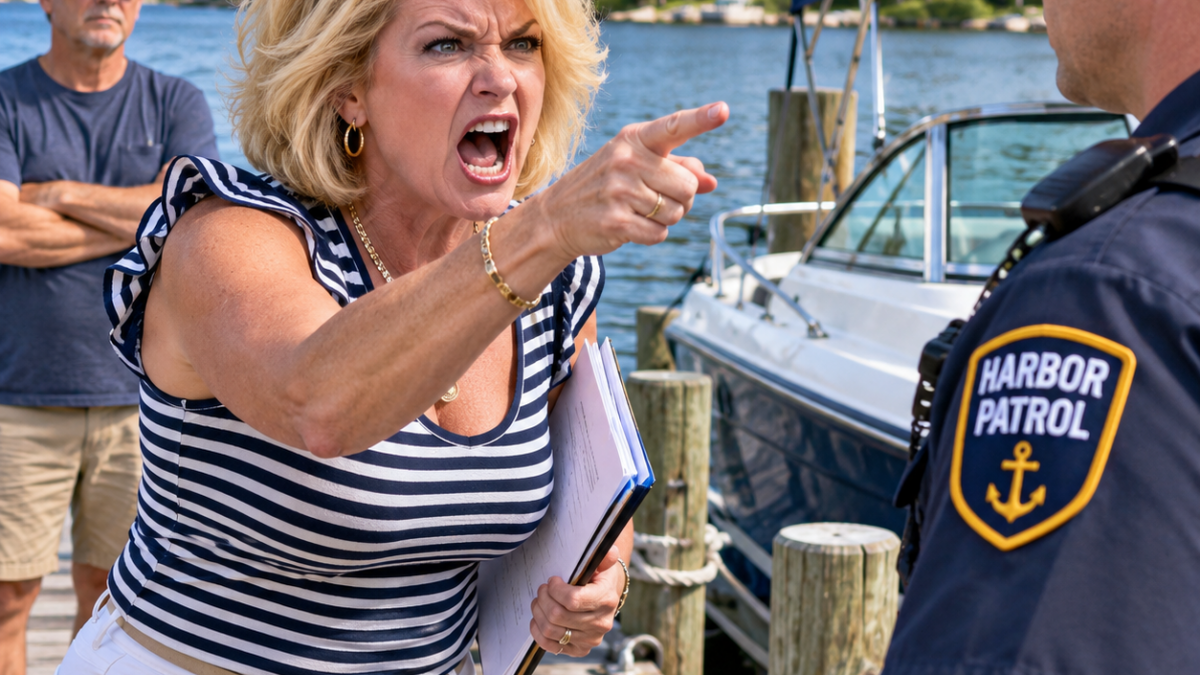
The HOA president actually sent a tow boat to my private dock and tried to have my fishing boat hauled away while I was gone, apparently believing that a stapled packet of HOA rules gave her more authority than my deed, county permits, and property line.
But the moment Harbor Patrol unfolded my survey, looked at her complaint, and told her she had no jurisdiction whatsoever, I saw something in her face that warned me this wasn’t going to end with one failed tow attempt.
I was sitting on my back deck with a mug of coffee when I first saw Meredith Talcott coming down the hill.
You didn’t need binoculars to recognize Meredith.
Nobody in Bay Pines did.
She moved through the neighborhood with the kind of confidence usually reserved for people who owned everything they could see.
She didn’t.
But that had never stopped her from acting like it.
She was wearing wedge sandals, white capri pants, a navy blouse, oversized sunglasses, and the expression of somebody who had just discovered a federal crime taking place between two improperly trimmed hedges.
In one hand she carried a stapled packet.
That packet told me everything I needed to know.
Meredith loved paperwork.
Not because she respected rules.
Because she loved having something she could wave in your face while telling you what you were allowed to do.
She had been president of the Bay Pines HOA for a little over two years, and in that time she’d managed to turn an ordinary waterfront neighborhood into something resembling a low-budget dictatorship with landscaping requirements.
She fined people for ridiculous things.
Garbage bins visible too early.
Porch decorations left up too long.
Incorrect mulch.
Boats stored where she didn’t like them.
Shutters that supposedly faded outside approved color tolerances.
Once, she tried to fine me because my wind chimes were “audible from a community pathway during quiet hours.”
The nearest community pathway was almost two hundred feet away.
And I had never met anyone capable of hearing those wind chimes from there unless they were standing outside my house with their ear tilted toward the breeze.
Which, knowing Meredith, was entirely possible.
That morning, though, she wasn’t interested in my wind chimes.
She was heading straight toward the dock.
My dock.
I set my coffee down.
My waterfront property had been mine for almost nine years.
The lot predated the current HOA boundaries, and that mattered.
The house itself sat inside Bay Pines.
The dock didn’t.
Not legally.
I had purchased the property knowing that.
Before building the dock, I’d hired a licensed surveyor, filed county permits, gone through environmental review, obtained waterfront construction approval, and spent more money on engineered pilings than I care to remember.
The county property map was crystal clear.
The dock sat entirely on my deeded waterfront parcel.
No community easement.
No shared access.
No HOA ownership.
At the end of that dock sat my twenty-three-foot fishing boat.
Second Wind.
White hull.
Blue canvas.
Twin outboards.
Nothing fancy by marina standards, but I’d saved for years to buy her.
There are some things you own because they’re useful.
Others you own because they represent something.
Second Wind was both.
I bought her after one of the worst years of my life.
Business had been slow.
My father had died.
A long relationship had ended.
I spent months feeling like every part of my life had been reduced to paperwork, phone calls, and bad news.
Then one Saturday morning, Dennis—my neighbor and longtime fishing partner—dragged me onto his battered center-console and refused to let me talk about anything serious until we’d been on the water three hours.
That day didn’t fix my life.
But it reminded me that my life wasn’t over.
Six months later, I bought Second Wind.
The name wasn’t accidental.
So when Meredith reached the dock gate that morning and announced, without greeting me,
“You can’t keep that boat here,”
I almost smiled.
Almost.
I walked down the deck steps.
“Good morning to you too.”
“I’m serious, Carter.”
“So am I.”
She held up the packet.
“Section Twelve, Paragraph Three of the Bay Pines charter prohibits watercraft over eighteen feet from being stored within visible range of community areas.”
I looked over my shoulder.
Then toward the water.
Then back at her.
“Which community area can see my boat?”
“That’s irrelevant.”
“The pelicans?”
Her jaw tightened.
“Don’t be sarcastic.”
“My neighbor’s cat?”
“Carter.”
“I’m trying to figure out who we’re protecting here.”
She opened the packet.
“Your vessel exceeds the permitted length.”
“My vessel?”
“Yes.”
“You mean my boat.”
“Call it what you want.”
“I’ll call it what the county calls it: private property tied to a private dock on a privately deeded parcel.”
Meredith lowered the papers.
“You live in an HOA.”
“My house does.”
Her eyebrows rose.
“Excuse me?”
“The dock sits outside the association boundary.”
“No, it doesn’t.”
“Yes, it does.”
“The waterfront is governed by Bay Pines.”
“Some of it.”
“All of it.”
I leaned against the railing.
“Meredith, I built this dock.”
“That doesn’t make you exempt from community standards.”
“I paid for the survey.”
“Surveys can be interpreted.”
“I paid for the county permits.”
She hesitated.
“You still have obligations.”
“I do.”
I pointed toward the shoreline.
“To the county, state environmental regulations, marine safety rules, and my insurance company. Not to you.”
Her lips compressed.
“You’re setting a bad example.”
“For what?”
“Noncompliance.”
“With a rule that doesn’t apply.”
“The board disagrees.”
“The board can disagree with gravity if it wants.”
Her face reddened.
“We will be taking action.”
That was classic Meredith.
When facts failed, she switched to threats.
I walked past her and unlocked the dock gate.
“Go ahead.”
She turned.
“You think this is funny?”
“No.”
I looked directly at her.
“I think you should know exactly where your authority ends before you try exercising it.”
For a second, neither of us spoke.
Water slapped gently against the pilings.
PART 2
A gull cried somewhere over the inlet.
Then Meredith gave me a look I would remember later.
Not angry.
Calculating.
Like I had stopped being a neighbor and become a problem she needed to solve.
“Fine,” she said.
She turned.
Her sandals hammered against the dock boards as she left.
I watched her walk away.
At the time, I genuinely thought that might be the end of it.
I should have known better.
Two days later, I drove into town for fuel filters, marine grease, and a replacement bilge switch.
I was gone less than ninety minutes.
When I turned onto my street, I saw a marine tow vessel behind my house.
For half a second, my brain couldn’t process it.
The tow boat was idling twenty yards off my dock.
One crewman held a line.
Another was maneuvering toward Second Wind.
A Harbor Patrol truck sat near the edge of my driveway.
I stopped so hard gravel sprayed behind my tires.
“No way.”
I threw the truck into park.
Ran down the hill.
“Hey!”
Everyone turned.
One tow operator froze with a line in his hand.
A Harbor Patrol officer stood near the dock gate holding a clipboard.
I kept moving.
“Do not touch that boat.”
The officer raised one hand.
“Sir, slow down.”
“I’m the owner.”
He looked toward Second Wind.
“You’re Carter Whit?”
“Yes.”
He checked the clipboard.
“We received a complaint stating this vessel is illegally moored on HOA-controlled waterfront.”
I stared at him.
“From Meredith Talcott?”
He didn’t answer.
Didn’t need to.
I almost laughed.
Instead I said,
“Give me thirty seconds.”
I walked toward the storage cabinet built into the side of my deck.
Opened it.
Pulled out a waterproof folder.
Dennis had once mocked me for keeping laminated copies of my dock permit and survey outside.
He had said I was preparing for a maritime apocalypse.
That afternoon, the maritime apocalypse arrived wearing an HOA logo.
I handed the officer the survey.
County assessor’s map.
Dock construction permit.
Waterfront property description.
He read them.
The tow operators waited.
The officer unfolded the map completely and compared the parcel line with the complaint.
His expression changed.
He took out his radio.
“Dispatch, Harbor Twelve. Confirm parcel designation for 814 Bay Pines Drive.”
Static.
Then an answer.
He checked another page.
“Copy.”
He looked at me.
Then toward the tow boat.
“Stand down.”
The operator pulled the line back aboard immediately.
The officer turned to me.
“I don’t have a violation.”
“I know.”
“This dock is private.”
“I know.”
“And outside the association’s waterfront parcel.”
“I definitely know.”
He closed his clipboard.
Then a voice came from the top of the hill.
“Excuse me!”
Meredith.
Of course.
She appeared beside the driveway with her hands planted on her hips.
I’d never learned how she received bad news so quickly, but Bay Pines apparently operated a private Meredith emergency alert system.
She came down the walkway.
“Why are they stopping?”
The Harbor Patrol officer looked toward her.
“Are you Ms. Talcott?”
“I’m the Bay Pines HOA president.”
“Did you submit this complaint?”
“I submitted notice of an unauthorized watercraft violation.”
“This isn’t an HOA dock.”
Her expression stiffened.
“It’s visible from HOA property.”
“That doesn’t make it HOA property.”
“The charter clearly states—”
“Ma’am.”
The officer held up my county map.
“This dock sits outside your association boundary.”
“That’s not correct.”
“It’s county-certified.”
“Our legal interpretation—”
“Doesn’t matter.”
Meredith looked at me.
“This is exactly the kind of hostility I was talking about.”
I blinked.
“Hostility?”
“You refuse to cooperate.”
“With stealing my boat?”
“No one is stealing anything.”
I pointed toward the tow vessel.
“They literally arrived with ropes.”
The tow captain suddenly became very interested in his dashboard.
The officer’s patience thinned.
“Ms. Talcott, the tow order was based on inaccurate property information.”
“I acted in good faith.”
“You claimed the vessel was on association property.”
“It effectively is.”
“No.”
The officer stepped closer.
“It legally is not.”
Meredith opened her mouth.
He continued.
“If you knowingly submit another false report involving this property, you may expose yourself to penalties for misuse of Harbor Patrol resources or filing false information.”
That landed.
Her cheeks reddened.
She looked at me.
“You’ll regret turning this into a spectacle.”
I almost couldn’t believe it.
“I turned it into a spectacle?”
“You could have resolved this quietly.”
“You sent a tow boat.”
She turned away.
Then looked back.
“This isn’t over.”
The officer beside me muttered,
“I’m getting that impression.”
Meredith stormed uphill.
The tow vessel pulled away.
Second Wind remained exactly where she belonged.
I should have felt victorious.
For about ten minutes, I did.
Then the Harbor Patrol officer handed my documents back and said something that changed the mood.
“We’ve had calls from her before.”
“What kind?”
He gave me a tired smile.
“Complaints.”
“Legitimate?”
“Let’s just say she keeps us busy.”
“Over boats?”
“Boats. Kayaks. dock ladders. Mooring lines. One floating cooler.”
I laughed.
He didn’t.
“Keep your paperwork handy.”
“I always do.”
He nodded toward the hill where Meredith had disappeared.
“Probably a good idea.”
By Thursday, everyone knew.
Bay Pines was a neighborhood where news traveled faster than weather.
People had watched the tow attempt from decks.
One resident apparently used binoculars.
Another filmed part of it.
Dennis came over Saturday afternoon while I was cleaning algae from the dock.
He carried a can of paint thinner in one hand and wore the fishing vest he refused to remove even when he wasn’t fishing.
“Heard the admiral attempted to seize your flagship.”
I kept scraping.
“Very funny.”
“You should’ve fired a warning flare.”
“I considered naval engagement.”
Dennis sat on the edge of the dock.
“She actually called a tow boat?”
“Yep.”
“How’d Harbor Patrol react?”
“They told her the dock wasn’t hers.”
He grinned.
“I would’ve paid admission.”
“Half the neighborhood probably would.”
Dennis shook his head.
“You know she ran for president on neighborhood harmony.”
“She has an unusual definition.”
“To Meredith, harmony means everyone agreeing with Meredith.”
That evening, after Dennis left, I finished cleaning Second Wind.
The sun had almost disappeared when I noticed the dock gate.
The padlock was gone.
I stopped.
It wasn’t hanging open.
It wasn’t cut.
It was simply missing.
I ran my fingers over the latch.
No obvious damage.
No scratches.
Nothing stolen from the boat.
The electronics were intact.
Fuel tanks untouched.
Compartments closed.
But somebody had entered.
I stood on the dock long after sunset.
The water had turned black.
Everything was quiet.
Too quiet.
The tow attempt had been public.
Embarrassing.
This felt different.
Personal.
The next morning, I bought a motion-activated security camera.
Installed it high on a dock post facing the gate.
I didn’t tell Dennis.
Didn’t tell the board.
Didn’t tell Meredith.
I wanted whoever had taken that lock to feel comfortable enough to come back.
Three nights later, at 12:17 a.m., my phone buzzed.
MOTION DETECTED — DOCK CAMERA.
I sat upright in bed.
Opened the app.
A hooded figure stepped through the gate.
Flashlight.
Dark sweatshirt.
Slow movements.
For one second, I couldn’t identify the person.
Then the hood shifted.
Meredith.
I stared at the screen.
She walked down my dock after midnight as casually as if she were checking her own mailbox.
She reached Second Wind.
Shined her flashlight along the hull registration numbers.
Looked toward the boat lift.
Inspected the cleats.
Then she touched one of my stern lines.
Untied it.
Retied it.
Poorly.
I stopped breathing for a moment.
A badly tied stern line could let the boat swing during wind.
Damage the hull.
Strike the dock.
She stepped back.
Looked around.
Never saw the camera.
Then left.
Total time:
Three minutes, fourteen seconds.
I watched the video four times.
My anger came slowly.
That was unusual for me.
Normally, I’m annoyed quickly and calm down quickly.
This felt different.
She had crossed the boundary physically now.
Not paperwork.
Not emails.
Not threats.
She came onto my property in darkness and put her hands on my boat.
My first impulse was to drive to her house.
Knock on the door.
Hold up the footage.
Ask what the hell she thought she was doing.
Instead, I called Lena Morales.
Lena was a local attorney specializing in property disputes.
We had known each other since college.
Years earlier, I’d helped her brother renovate a foreclosure he bought before he realized owning a fixer-upper meant learning forty different ways plumbing could betray you.
She answered on the third ring.
“Carter, if this is about a DUI, I don’t do criminal defense.”
“It’s about Meredith.”
Silence.
“The HOA Meredith?”
“Yes.”
“That’s worse.”
I sent the video.
She watched it while we were on the phone.
When she came back, her tone changed.
“This is textbook trespassing.”
“She didn’t steal anything.”
“Doesn’t matter.”
“She retied my stern line.”
“Did she damage it?”
“Not that I can tell.”
“Still relevant.”
I leaned against the kitchen counter.
“What can I do?”
“Police report immediately.”
“Over trespassing?”
“Carter, stop minimizing it.”
“I’m not.”
“You are. She already tried to cause the removal of your property using a false jurisdiction claim. Now she’s entering the disputed area at midnight.”
“True.”
“Document everything.”
“I have.”
“Good.”
She paused.
“Was she acting as HOA president?”
“She was dressed like a burglar.”
“That’s not what I asked.”
“I don’t know.”
“If she later claims she was inspecting a violation on behalf of the association, that’s actually worse for them.”
“Why?”
“Because now you’re dealing with potential HOA liability, abuse of authority, and breach of fiduciary duty.”
I thought about that.
“What if the board knew?”
“Then discovery gets interesting.”
“How interesting?”
Lena laughed quietly.
“Emails. Text messages. Financial records. Meeting minutes. Every communication involving your property.”
I smiled for the first time that night.
“I like the sound of that.”
“I knew you would.”
The next morning, I filed a police report.
Deputy Laramy watched the footage.
Paused it.
Zoomed in.
Looked at me.
“Meredith Talcott?”
“You recognize her.”
He sighed.
“You’d be surprised.”
“Harbor Patrol said the same thing.”
“That doesn’t surprise me.”
I gave him the camera logs.
Copy of the tow complaint.
My certified property map.
A notarized statement.
“I want it documented.”
“It will be.”
“And if she comes back?”
“Call us immediately.”
“I’d also like information on a no-trespass notice.”
He nodded.
“That can be arranged.”
Friday afternoon, a deputy visited Meredith.
Saturday morning, the HOA sent every resident a strange email.
Subject:
**CLARIFICATION REGARDING WATERFRONT POLICY.**
It blamed “recent misunderstandings.”
Said the board would review its position regarding “watercraft visibility and dock access.”
Not one mention of my boat.
Not one mention of the false report.
Not one mention of Meredith standing on my dock after midnight.
Damage control.
Lena called me.
“They’re scared.”
“Good.”
“Don’t celebrate.”
“I’m not.”
“Yes, you are.”
“A little.”
“Don’t.”
Monday morning, she filed a formal complaint with the county and sent notice that we were considering civil action.
The package included:
My deed.
The property survey.
Dock permits.
Harbor Patrol records.
The failed tow documentation.
Security footage.
Police report.
HOA emails.
County confirmation that the dock was outside HOA jurisdiction.
Within days, the county attorney opened an inquiry.
That was when neighbors began appearing.
Sharon Foster knocked on my door first.
She lived five houses inland.
Friendly woman, late fifties, usually wore gardening gloves even when she wasn’t gardening.
“I heard you have a lawyer.”
“That sounds ominous.”
“It’s about Meredith.”
“Come in.”
She placed a folder on my kitchen table.
Holiday-decoration fines.
She had taken down Christmas decorations in January.
One decorative wreath remained inside her covered porch.
Meredith fined her in February.
“Seventy-five dollars.”
“For a wreath?”
“Apparently the neighborhood was at risk.”
Then came Mark and Julie Lea.
They’d applied three times to repaint their porch.
The color was literally printed in the approved HOA palette.
Rejected every time.
No explanation.
A retired teacher named Ellen brought violation notices for having a basketball hoop visible from the road.
She didn’t own a basketball hoop.
Dennis brought beer.
Not evidence.
Useful anyway.
Within a week, a pattern formed.
Meredith didn’t enforce rules consistently.
She used rules selectively.
People who disagreed with her were inspected more often.
People who supported her rarely received warnings.
Residents who challenged fees suddenly encountered permit delays.
Complaints disappeared.
Appeals were postponed.
The HOA hadn’t become strict.
It had become personal.
Then Dennis learned the board was holding an emergency meeting.
He heard from his wife.
His wife heard from the treasurer’s daughter.
The treasurer’s daughter heard because Dennis’s wife had brought muffins.
Democracy is strange.
Lena and I walked into the meeting together.
The room went quiet.
Meredith sat at the head of the table.
Her face looked like she’d swallowed a lemon whole.
Five board members sat around her.
Most avoided eye contact.
Lena placed a stack of documents on the table.
“My client has documented criminal trespass, misuse of association authority, false reporting related to private property, and potential malicious interference with personal property.”
Meredith laughed once.
“This is ridiculous.”
Lena didn’t even glance at her.
“We are prepared to name the association and Ms. Talcott individually in civil litigation.”
Meredith leaned forward.
“Over a boat?”
Lena looked at her.
“No.”
The room went silent.
“Over an HOA president attempting to exercise authority she does not have, requesting removal of private property from land the association doesn’t own, and entering that property without consent after midnight.”
Meredith’s mouth tightened.
“I was conducting an inspection.”
There it was.
I looked at Lena.
Lena almost smiled.
“On behalf of the HOA?”
Meredith hesitated.
“Yes.”
The treasurer slowly turned toward her.
Lena nodded.
“Thank you.”
Meredith realized too late.
She had just connected her trespass directly to association business.
Lena handed out copies.
The footage.
My property survey.
County letter.
Police report.
Harbor Patrol findings.
The treasurer cleared his throat.
“We weren’t aware you’d entered his property.”
I looked at him.
“Then perhaps you should ask what else you aren’t aware of.”
Meredith snapped,
“This board has the right to investigate violations.”
Lena replied,
“Not on land outside your jurisdiction.”
“He still lives within Bay Pines!”
“And he still owns property.”
Lena turned toward the board.
“You have two options from my client’s perspective.”
Meredith laughed.
“You don’t dictate board procedure.”
Lena ignored her.
“Remove Ms. Talcott from leadership, formally disclaim authority over Mr. Whit’s dock, issue a written apology, and preserve all relevant records.”
She paused.
“Or we file.”
Nobody spoke.
“If we file, we subpoena communications, spending records, enforcement logs, internal votes, and every message involving waterfront property.”
That changed the room.
I saw it.
The secretary, George, an older man who rarely spoke, looked down at his hands.
The vice president shifted.
The treasurer swallowed.
Meredith saw it too.
“Don’t you dare.”
George looked up.
“Meredith—”
“No.”
She pointed at me.
“He’s trying to intimidate us.”
I said quietly,
“No. I’m trying to stop you from trespassing on my property.”
“You’ve poisoned this neighborhood against me.”
“Did I make you walk onto my dock at midnight?”
Her face flushed.
George took a breath.
“I move that Meredith Talcott be removed as board president pending legal review.”
Meredith stared at him.
“You can’t.”
“I second,” the treasurer said.
She turned.
“What?”
The vice president closed his eyes.
Then said,
“Agreed.”
One by one, the others voted.
The motion passed.
Meredith stood so violently her chair slammed backward.
“You’re making a huge mistake.”
Nobody answered.
She pointed toward the board.
“I built this community.”
That was when I spoke.
“No.”
She looked at me.
“You tried to control it.”
I leaned forward.
“There’s a difference.”
She stormed out.
Lena looked at me.
“That went better than expected.”
I watched the door swing closed.
“She’s not done.”
I was right.
Three days later, a certified envelope arrived.
No return address.
One page.
ALL CAPS.
Bad grammar.
Worse spelling.
It accused me of destroying neighborhood unity.
Warned that “some people don’t forget easy.”
I took it directly to Deputy Laramy.
He read it.
Sighed.
“Looks like someone’s getting desperate.”
“Can you trace it?”
“Maybe.”
“Meredith?”
He folded the paper into an evidence sleeve.
“We don’t guess.”
Fair enough.
I thought it was her final tantrum.
Then the county assessor called me before sunrise on Thursday.
“Mr. Whit?”
“Yes.”
“We received a property-line amendment concerning your parcel.”
I sat upright.
“What kind of amendment?”
“It claims a portion of your waterfront access overlaps HOA-controlled land.”
My stomach dropped.
“That’s false.”
“We suspected a discrepancy.”
“Who filed it?”
Pause.
“Meredith Talcott.”
I was dressed and out the door within fifteen minutes.
The county clerk showed me the document.
It was almost laughable.
Almost.
A crude diagram redrew the waterfront boundary to create a narrow strip labeled:
BAY PINES PUBLIC EASEMENT.
That easement did not exist.
It had never existed.
If approved, however, it would place part of my dock on supposed HOA-controlled ground.
Meredith hadn’t accepted losing authority.
She was trying to manufacture authority retroactively.
I took certified copies to Lena.
She read the first page.
Then the second.
Then looked at me.
“Well.”
“What?”
“She finally did something even I didn’t expect.”
“How bad?”
“She submitted a fraudulent property claim to a government office.”
“Felony?”
“Potentially.”
“What do we do?”
Lena closed the folder.
“We don’t.”
“What?”
“We give this to the district attorney.”
By that afternoon, the DA had my original surveyor’s affidavit.
Certified parcel maps.
County records.
Meredith’s filing.
Expert confirmation that her claimed easement had no legal basis.
A criminal investigation opened.
Then the subpoenas went out.
That was when everything changed.
Investigators pulled HOA communications concerning waterfront boundaries.
Internal emails surfaced.
Meredith hadn’t acted alone.
Two former board members had discussed “reclassification” of private docks months earlier.
One email referred to:
**WATERFRONT CONTROL CONSOLIDATION.**
Another discussed “revenue capture.”
Another:
“Owners can be brought into compliance after jurisdiction is established.”
I read that line twice.
Brought into compliance.
After jurisdiction is established.
They planned to change the maps first.
Then claim authority.
Then charge dock owners.
My dock wasn’t a personal obsession.
It was the test case.
Lena called me late that night.
“They were going to impose access fees.”
“On private docks?”
“Looks like it.”
“How?”
“Redefine boundaries. Claim an association easement. Require annual licenses.”
“That’s insane.”
“It’s profitable.”
“What happens if owners refuse?”
She paused.
“Possible loss of docking privileges.”
I laughed bitterly.
“Privileges? We own the docks.”
“I know.”
“They were planning to charge us for permission to use our own property.”
“Yes.”
That was the moment my anger became something else.
Until then, I wanted Meredith punished for targeting me.
Now I wanted the whole scheme dragged into daylight.
The county issued a temporary injunction freezing HOA enforcement.
No fines.
No new property citations.
No waterfront enforcement.
Nothing.
Bay Pines celebrated like somebody canceled taxes.
People put garbage bins out an hour early just because they could.
Dennis left his boat cover half open in what he called “an act of resistance.”
Sharon hung a decorative wreath.
In June.
Meredith disappeared from meetings.
For several days, things were quiet.
Then I noticed the black SUV.
First pass:
4:30 p.m.
Second:
6:15.
Third:
just before dusk.
Slow.
Headlights off.
The driver never stopped.
I wrote down the plate as best I could.
That night, my dock camera went offline.
I woke at 12:41.
Opened the app.
No signal.
I went outside with a flashlight.
The camera was gone.
Ripped off the post.
This time, I didn’t hesitate.
Sheriff’s department.
Deputy Laramy arrived with another officer and an evidence technician.
They dusted the mount.
Checked the dock.
Reviewed my backup camera beneath the house eave.
Meredith didn’t know about that one.
The wide-angle footage showed the black SUV reversing near the waterfront entrance.
License plate clear enough to read.
Registered owner:
Her cousin.
His history wasn’t impressive.
Trespass.
Petty vandalism.
Disorderly conduct.
The DA already had an active property-fraud investigation.
A judge signed a warrant.
Deputies searched the cousin’s garage.
They found my camera.
That alone would’ve been enough.
But beside it sat a folder.
Written across the front:
**HOA PLAN B.**
Inside:
Property maps.
Waterfront owner lists.
Draft notices.
Compliance-fee schedules.
Threatening letters stating dock access could be revoked unless owners signed new usage agreements.
One handwritten note beside my property said:
WHIT WILL RESIST.
That line bothered me more than I expected.
Somebody had sat somewhere and categorized me.
Not as a neighbor.
Not as an owner.
An obstacle.
Meredith’s cousin was arrested.
Then the local news got involved.
The story aired at six.
A blurred still image showed Meredith on my dock.
The headline read:
**FORMER HOA PRESIDENT INVESTIGATED IN PRIVATE DOCK CONTROL SCHEME.**
Bay Pines exploded.
Residents who had tolerated Meredith for years suddenly wanted the HOA gone completely.
Sharon started a dissolution petition.
Within seventy-two hours, more than two-thirds of eligible homeowners signed.
The recall and dissolution vote passed overwhelmingly.
But the investigation continued.
Meredith was charged with falsifying government documents and conspiracy to defraud property owners.
Her cousin faced criminal trespass and destruction of property.
One former board member cooperated.
Then another.
They turned over records.
Emails.
Draft plans.
The final goal emerged.
Bay Pines was supposed to become what Meredith called a “managed marina community.”
Private dock use would be converted into licensed access.
Outside users could pay for priority docking.
Real-estate buyers willing to pay premiums would receive waterfront privileges.
The HOA would control access.
And whoever controlled the HOA-controlled contracts would profit.
Meredith already had a proposed partnership with a local real-estate company.
My Second Wind wasn’t too long.
It was occupying space Meredith hoped to monetize.
That realization made the original tow attempt look different.
She wasn’t enforcing aesthetics.
She was testing possession.
If she could remove my boat once based on a fake jurisdiction claim, she could create a precedent.
The HOA dissolved.
In its place, residents created a voluntary civic association.
Newsletter.
Community calendar.
Shared cleanup days.
No fines.
No enforcement power.
No threatening letters.
Dennis brought a six-pack to my dock.
We sat beside Second Wind.
“Never thought I’d see Bay Pines without an HOA.”
“Technically we have an association.”
“An association can’t fine me.”
“Correct.”
“Then it’s not an HOA.”
“Fair.”
He raised his beer.
“To freedom.”
I tapped mine against his.
“To documented property lines.”
“You’re no fun.”
For a while, it seemed over.
Then Meredith disappeared.
Her house went dark.
Mail piled up.
No car.
Neighbors said she left town after her court date was announced.
I didn’t care where she went.
The criminal case would find her.
A month after the HOA dissolved, I received a certified subpoena.
State Attorney General’s Office.
Material witness.
Different case.
I read it twice.
Then called Lena.
“What now?”
She was quiet.
“Anchor Ridge.”
“Who?”
“Anchor Ridge Solutions.”
The name meant nothing to me.
It soon would.
The company had consulted for neighborhood associations across the county.
Officially:
Community governance.
Compliance modernization.
Shared-amenity optimization.
In reality, investigators suspected they advised HOA boards on aggressively expanding control over private property rights.
Boundary adjustments.
Restrictive covenants.
Usage waivers.
Dock agreements.
Compliance pressure.
Worse, they had received state grant money through a pilot community-improvement program.
Taxpayer money.
I drove to the Attorney General’s office for a deposition.
The investigator was in his fifties.
Military haircut.
Gravel voice.
Stack of files.
He took me through the timeline.
Meredith’s complaint.
Tow attempt.
Harbor Patrol.
Trespass.
Camera footage.
Fraudulent reassessment petition.
Internal emails.
Plan B.
Then he asked,
“Did Meredith ever use the term Anchor Ridge?”
“No.”
“Regional strategy?”
I thought.
“Yes.”
He looked up.
“When?”
“Months ago. HOA meeting. She said Bay Pines could become a model community under a regional waterfront strategy.”
He wrote something.
“That tracks.”
“With what?”
He opened an email.
Anchor Ridge consultant to another HOA president.
Words highlighted:
PILOT ENFORCEMENT ZONES.
SCALABLE DOCK REGULATION.
PROPERTY-RIGHT CONSOLIDATION.
I stared at the page.
“You’re telling me they were teaching boards how to do this.”
“We’re investigating whether they encouraged unlawful conduct.”
“How many neighborhoods?”
“Seventeen.”
I sat back.
“Seventeen?”
“Across three counties.”
“And nobody stopped it?”
“Not like Bay Pines.”
“Why us?”
He looked at me.
“Documentation.”
I didn’t answer.
“You had original permits.”
“Yes.”
“Survey.”
“Yes.”
“Harbor Patrol record.”
“Yes.”
“Security video.”
“Yes.”
“Police report.”
“Yes.”
“Counsel.”
“Yes.”
“You forced the issue before the revised boundary could be normalized.”
That sentence stayed with me.
Normalized.
That’s how schemes like Meredith’s survive.
Not because they’re legal.
Because after enough time, people stop asking whether they were ever legal to begin with.
If I’d let Second Wind be towed, what happened next?
Maybe I paid a fine.
Maybe I argued for months.
Maybe the fake easement got recorded.
Maybe one year later everyone looked at the map and assumed it had always been that way.
After my deposition, I sat on the deck staring at the water.
Dennis arrived around nine.
Folder under one arm.
Bottle of rye under the other.
“You’re famous.”
“That’s unfortunate.”
He handed me the county newspaper.
Front page.
Terrible photograph of me pointing toward the dock during a hearing.
Headline:
**LOCAL HOMEOWNER EXPOSES HOA SCHEME LINKED TO STATE PROBE.**
I groaned.
“They couldn’t find a better picture?”
Dennis opened the rye.
“That’s the face of justice.”
“Justice needs sleep.”
He poured two glasses.
The article said the state had frozen funding connected to Anchor Ridge.
A joint task force was reviewing contracts.
The governor’s office ordered an audit of the pilot grant program.
Homeowners from other neighborhoods had begun filing complaints.
I put the paper down.
“This got big.”
Dennis looked toward Second Wind.
“Started with a tow boat.”
“Started with Meredith.”
“No.”
He shook his head.
“Started because she thought you’d fold.”
Maybe he was right.
Bay Pines spent the next few weeks learning how to exist without an HOA.
Some residents were uncomfortable.
People get used to systems, even bad ones.
Who handles shoreline cleanup?
Who pays for shared signage?
What happens if the entrance landscaping dies?
Who coordinates storm debris?
Sharon proposed something simpler.
Cooperative harbor council.
No enforcement authority.
No fines.
Dock owners and waterfront residents could coordinate voluntarily.
Shared lighting.
Security information.
Emergency plans.
Maintenance contacts.
“You don’t need rules to force neighbors to act civilized,” she said. “You need neighbors willing to speak to each other.”
The first meeting was held at the marina rec hall.
Folding chairs.
Whiteboard.
Potluck table bending under casseroles, brownies, and three competing key lime pies.
Children ran between tables.
Classic rock played from somebody’s speaker.
No microphone.
No executive table.
No president sitting higher than everyone else.
We discussed dock maintenance.
Shared storm preparation.
A kayak rack.
Emergency contact chains.
Nobody threatened anybody.
Nobody produced a violation packet.
Afterward, Sharon and I walked along the shoreline.
She asked,
“Do you think Meredith actually believed she was right?”
I considered it.
“No.”
“Really?”
“I think she believed she deserved control.”
“Same thing?”
“No.”
I watched the water.
“People can know they’re bending rules and still convince themselves the outcome justifies it.”
Sharon nodded.
“She picked the wrong dock.”
I laughed.
“She picked the wrong survey.”
Meredith was eventually indicted on expanded charges.
Conspiracy to commit fraud.
Tampering with government property records.
Misuse of public funds tied to the consulting arrangement.
Anchor Ridge collapsed almost immediately afterward.
Executives faced federal scrutiny over grant fraud.
Their offices reportedly emptied overnight.
Records were seized.
State auditors began reviewing every participating HOA.
Homeowners from outside Bay Pines contacted Lena.
Some had nearly identical stories.
Private easements suddenly “clarified.”
Dock regulations that appeared after decades.
Usage rights converted into annual permits.
Compliance waivers homeowners were pressured to sign.
The pattern was undeniable.
Meredith hadn’t invented everything.
But she embraced it.
Aggressively.
The restitution order came months later.
She was required to reimburse legal costs connected to homeowners she had targeted.
Assets were sold.
Her house.
Car.
Personal property.
Someone at the courthouse told Dennis her jewelry collection went too.
I didn’t verify that.
Didn’t care.
The check I received wasn’t enormous.
It didn’t cover the hours.
Stress.
Security equipment.
Legal meetings.
Lost sleep.
But when I held it, I thought about something my father used to say.
Principles are expensive only when you wait too long to defend them.
Maybe he was right.
Bay Pines changed.
House colors got brighter.
Holiday decorations lingered.
One homeowner kept a skeleton dressed in beach clothes on his porch year-round purely because nobody could fine him anymore.
Lawn flamingos multiplied.
Dennis blamed “regulatory collapse.”
Sharon called it self-expression.
I called it entertaining.
The neighborhood felt alive.
Not perfect.
Freedom doesn’t make people less annoying.
It just prevents one annoying person from becoming ruler.
One evening, I took Second Wind out with Dennis and Sharon.
We anchored near the inlet.
Fishing rods out.
Beer cold.
Sunset turning the water orange.
A heron landed on a piling.
Dennis caught a snapper barely big enough to brag about.
He held it up.
“You think Meredith sees pictures of this wherever she is?”
“If she does,” I said, “I hope she’s taking notes.”
Sharon laughed.
Dennis released the fish.
The boat rocked gently.
I looked back toward my dock.
The camera Meredith’s cousin stole had been replaced.
Actually, I installed two.
One on the dock.
One beneath the eave.
Some lessons stick.
For months, people described the dock as the place where “the whole HOA thing started.”
I didn’t like that description at first.
A dock is wood.
Pilings.
Bolts.
Permits.
But eventually, I understood what they meant.
Meredith had tried to turn that dock into a test of authority.
She believed power worked like ownership.
If she could order the boat removed, she could establish that she controlled the space.
If she controlled the space, she could redraw the line.
If she redrew the line, she could charge for access.
If she charged for access, private property became association revenue.
The plan was clever in the ugliest possible way.
But it depended on one thing.
Nobody challenging the first step.
I challenged it.
Not because I’m heroic.
Because I was irritated.
Because I had documents.
Because I knew where my property line was.
That’s all.
Sometimes the thing standing between someone and your rights isn’t a dramatic courtroom speech.
It’s a laminated permit in a waterproof folder.
The criminal and civil cases dragged on long after Bay Pines returned to normal.
Meredith fought the charges.
Of course she did.
Her attorneys argued she relied on consultants.
That she believed the disputed property filings were lawful.
That boundary questions were complex.
That the tow complaint was an innocent mistake.
Harbor Patrol records destroyed that argument.
The officer testified that after seeing my survey, he explicitly told Meredith the dock was private and outside HOA control.
That date mattered.
Because everything afterward happened with knowledge.
The midnight trespass.
The forged property claim.
The Plan B materials.
Internal correspondence.
Once she’d been told she had no authority, she didn’t stop.
She tried to create authority.
That distinction became central.
Lena explained it one night after a hearing.
“Mistakes happen.”
We stood outside the courthouse.
“Submitting a complaint based on a mistaken map might be negligent.”
“But?”
“But when the government tells you the map proves you’re wrong, and then you submit a new map trying to move the boundary…”
She smiled.
“That’s harder to explain.”
One former board member testified.
He admitted Meredith had presented Anchor Ridge’s strategy as a way to generate “sustainable waterfront revenue.”
He said she believed homeowners underused private docks.
She wanted the association to monetize unused capacity.
The prosecutor asked:
“Did the homeowners agree?”
The witness hesitated.
“No.”
“Did Ms. Talcott propose asking them?”
Another pause.
“Not initially.”
“What did she propose?”
The courtroom was silent.
“Establishing jurisdiction first.”
There it was again.
Jurisdiction.
First.
Consent later.
Maybe never.
Another witness described discussions about creating “compliance leverage.”
That phrase made my skin crawl.
In practical terms:
If dock owners resisted, increase pressure elsewhere.
Landscaping citations.
Permit reviews.
Architectural approvals.
Special assessments.
Make their life inconvenient until they signed.
Meredith had already been doing smaller versions of it for years.
Sharon’s wreath.
The Leas’ porch.
My wind chimes.
Those ridiculous enforcement fights weren’t random.
They trained residents to believe challenging the board cost too much time.
The prosecution used that history carefully.
Not every petty fine was criminal.
But together they showed culture.
Control.
Intimidation.
Then came the state investigators.
They explained Anchor Ridge’s grant-funded pilot.
The company had marketed stronger HOA regulation as community improvement.
On paper, the language sounded harmless.
Shared-resource optimization.
Conflict reduction.
Unified property governance.
Then internal documents revealed a different tone.
Monetization opportunities.
Enforcement leverage.
Scalable compliance.
Asset-control pathways.
I sat in court thinking about how much evil can hide inside boring words.
Nobody writes:
STEAL PEOPLE’S DOCKS.
They write:
REALIGN WATERFRONT USAGE RIGHTS.
Nobody writes:
PRESSURE HOMEOWNERS UNTIL THEY SURRENDER.
They write:
IMPROVE COMPLIANCE THROUGH MULTI-CHANNEL INCENTIVES.
Language can hide intent.
Until somebody asks what the words actually do.
Meredith eventually reached a plea agreement on some counts while contesting others.
I wasn’t involved in negotiations.
Didn’t want to be.
I had reached a point where I cared less about years in prison than making sure every fraudulent filing disappeared.
The court voided the false easement claim.
County records were corrected permanently.
Other waterfront parcels were reviewed.
Two homeowners discovered draft boundary amendments had already been prepared for their docks.
Never filed.
Because the scheme collapsed first.
That bothered me.
How close we’d been.
Dennis had been one of them.
His property appeared in Plan B.
I showed him the copy after the case allowed disclosure.
He read his name.
Looked toward his old dock.
“Seriously?”
“Yep.”
“What were they going to do?”
“Claim partial common access.”
He stared.
“That dock was built by my father.”
“I know.”
He folded the paper.
For once, Dennis had no joke.
Then he said,
“I would’ve burned the HOA office down.”
“No, you wouldn’t.”
“Metaphorically.”
“Better.”
He looked at me.
“Thanks.”
“For what?”
“Being more stubborn than me.”
That was probably the nicest thing Dennis had ever said.
The restitution process finished slowly.
Legal fees.
Improper fines.
Some association payments connected to the waterfront project.
Residents received checks.
Most weren’t huge.
But every check represented something important.
An admission.
You were not crazy.
The rule wasn’t valid.
The fine wasn’t justified.
The board didn’t own what it claimed.
That mattered.
Meredith’s house eventually sold.
New owners moved in.
A young couple.
Two dogs.
They removed the old COMMUNITY FIRST sign from the yard.
Put up a hammock.
The first week they lived there, one dog escaped and Dennis spent forty minutes helping catch it.
Nobody mentioned Meredith.
That was healthy.
People expected me to feel triumphant when her assets were sold.
I didn’t.
Watching someone lose things isn’t as satisfying as movies pretend.
What felt satisfying was seeing residents stop flinching at official-looking envelopes.
Seeing Sharon leave decorations out.
Seeing the Leas repaint their porch the exact color Meredith had rejected three times.
Seeing kids ride bicycles through the marina lot without a compliance officer photographing them.
Seeing Dennis tie his boat wherever the actual law allowed.
Seeing Second Wind still at my dock.
One Saturday morning, I sat in the same chair where I’d been drinking coffee the day Meredith first marched down the dock.
Same view.
Same water.
Different feeling.
Sharon came over carrying paperwork.
I groaned.
“No.”
She laughed.
“Relax. Harbor council budget.”
“We have a budget?”
“Two hundred eighty dollars.”
“For what?”
“Replacement bulbs for shared safety lights and printing emergency maps.”
“Seems corrupt.”
“Absolutely.”
“Who’s skimming?”
“Dennis.”
“I knew it.”
Dennis shouted from his yard,
“I can hear you!”
Sharon sat.
We reviewed the budget in five minutes.
Every expense published online.
Every contribution voluntary.
That was the difference.
Transparency isn’t complicated when nobody benefits from confusion.
Years passed.
The Anchor Ridge investigation expanded.
Executives were prosecuted over misuse of public funds and fraudulent grant representations.
Other neighborhoods reversed questionable covenants.
State lawmakers held hearings.
New disclosure requirements followed.
I watched some of it on television.
Most of the policy language was painfully boring.
Good.
Boring rules can protect people if they’re written clearly.
Bay Pines appeared in training material for property boards.
I hated that.
Dennis loved it.
He told strangers at the marina,
“We’re historically significant.”
I told him he was historically annoying.
He accepted that.
The strangest part was how small the original conflict looked afterward.
A twenty-three-foot fishing boat.
An HOA rule mentioning eighteen feet.
That’s all Meredith thought she needed.
If Harbor Patrol had accepted her complaint without checking the deed, Second Wind would’ve been towed.
I would’ve paid storage fees.
Maybe damage.
Maybe I would have argued afterward.
Maybe others would’ve seen my boat removed and assumed Meredith had authority.
That’s how precedent works socially even when it doesn’t legally.
People see enforcement.
They assume legitimacy.
Then they comply.
But Harbor Patrol checked.
I had documents.
The officer said no.
That “no” exposed how much Meredith depended on nobody verifying anything.
Years later, Deputy Laramy stopped by the marina while I was fueling Second Wind.
He recognized me.
“Still got the boat.”
“Still got the dock.”
He smiled.
“Still got cameras?”
“Two.”
“Smart.”
“Still seeing Meredith complaints?”
“Not from Meredith.”
“Good.”
He looked toward the water.
“You know what I remember?”
“What?”
“That first trespass video.”
“Why?”
“She walked down that dock like she owned it.”
I nodded.
“That’s the whole story.”
He laughed.
“Pretty much.”
One summer evening, the harbor council held a cookout.
Kids jumped from the public swim platform.
People brought folding chairs.
Someone overcooked burgers.
Dennis argued with a teenager about fishing knots.
Sharon organized everything while insisting she wasn’t in charge.
I walked down my dock alone for a minute.
Second Wind rocked gently.
The sun was dropping.
Orange reflections stretched across the inlet.
I put one hand on the piling.
Wood weathered now.
Bolt heads dull from salt and rain.
Still strong.
My father had taught me something when I was younger.
A boundary isn’t meaningful because a line exists on paper.
It’s meaningful because people respect what the line represents.
Ownership.
Responsibility.
Consent.
You can invite someone across.
You can share.
You can cooperate.
But none of that means someone else gets to erase the line because sharing would be profitable.
Meredith never understood that.
She believed community erased consent.
That if she could call something a neighborhood initiative, individual rights became optional.
Maybe that’s the danger of people who talk constantly about “the community” while never listening to the people inside it.
They stop seeing neighbors.
They see units.
Compliance percentages.
Revenue sources.
Obstacles.
Votes.
Property.
My dock was never community property.
But that didn’t mean I hated community.
Quite the opposite.
When storms came, we tied each other’s boats.
When somebody got sick, meals appeared.
When Dennis’s roof leaked, five neighbors showed up with tarps before he could ask.
Nobody needed a fine schedule for that.
Real community is voluntary.
It grows from trust.
Meredith tried to manufacture community through control.
In the end, she nearly destroyed it.
Removing her didn’t destroy Bay Pines.
It revealed Bay Pines had existed underneath her the whole time.
The final state letter regarding my property arrived almost four years after the tow attempt.
Formal confirmation.
No HOA or successor association held any easement, lien, dock right, access right, regulatory right, or usage interest in my waterfront parcel.
I read it twice.
Laminated it.
Dennis saw me.
“Seriously?”
“What?”
“You’re laminating another document.”
“Tradition.”
“You need help.”
“Probably.”
I put it in the waterproof folder beside the original permits.
Same cabinet.
Same deck.
You never know.
That evening, Dennis and Sharon joined me aboard Second Wind.
We motored beyond the inlet.
Water smooth.
Sky turning red.
Dennis opened a beer.
Sharon looked back toward Bay Pines.
“You ever miss the drama?”
“No.”
“Not even a little?”
“No.”
Dennis said,
“I miss watching Meredith lose arguments.”
“That’s different.”
We anchored.
Rods out.
For an hour, nobody caught anything.
Perfect evening.
Eventually, Sharon asked,
“What do you think would’ve happened if Harbor Patrol sided with her?”
I thought.
“They didn’t.”
“I know.”
“But what if?”
I looked toward the shoreline.
“Then I would’ve fought longer.”
Dennis raised his drink.
“That sounds like you.”
“But that’s not the important part.”
“What is?”
“The officer checked.”
They waited.
I continued.
“That’s what stopped the first lie.”
Meredith had paperwork.
Title.
Confidence.
Official complaint.
Tow crew.
Everything looked legitimate until somebody compared the claim to the actual record.
Truth didn’t shout louder.
It simply survived inspection.
That idea stayed with me.
We live around paperwork.
Rules.
Notices.
People in official positions.
Most of the time, the system works because people act in good faith.
But sometimes someone counts on the fact that nobody will look closely.
That was Meredith.
She assumed nobody would ask where the HOA line actually ended.
Nobody would compare ballots.
Nobody would inspect grant documents.
Nobody would check whether the easement existed.
Nobody would install a camera.
Nobody would notice Plan B.
She was wrong.
Not because I was smarter.
Because eventually too many people looked.
The day the new harbor council installed the community kayak rack, Dennis brought a small brass plaque.
I thought it was ridiculous.
He screwed it to the side.
It read:
**BAY PINES HARBOR**
**SHARED BY AGREEMENT.**
**NOT BY FORCE.**
I stared at it.
“That’s surprisingly thoughtful.”
“Shut up.”
“Who wrote it?”
“Sharon.”
“I knew it.”
Sharon laughed.
The plaque stayed.
Maybe that’s the best ending.
Not Meredith’s charges.
Not the restitution.
Not Anchor Ridge collapsing.
Not seeing my boat stay where it belonged.
Those mattered.
But the real victory was the sentence on that plaque.
Shared by agreement.
Not by force.
That’s what Meredith never understood.
She thought refusing her meant refusing community.
She was wrong.
I still help my neighbors.
I still contribute to shared repairs.
I still lend tools.
I still let Dennis use my dock when he’s too lazy to walk to his own.
I still attend harbor meetings.
Sometimes.
When the key lime pie is good.
The difference is that cooperation begins with choice.
Nobody has to threaten your home to earn your participation.
Nobody needs to redraw your property line to make you generous.
Nobody needs to tow your boat to prove they’re in charge.
Second Wind is older now.
So am I.
I’ve replaced a fuel pump.
Two batteries.
One prop.
More bilge switches than should be scientifically possible.
I’ve considered upgrading.
Never do.
Some things become part of the landscape of your life.
When I look at that boat, I remember why I bought it.
Second chances.
When I look at the dock, I remember something else.
Lines matter.
There are days when fighting seems ridiculous.
When you wonder if it’s worth calling a lawyer over one false complaint.
Worth filing a police report because somebody stepped onto a dock.
Worth saving emails.
Worth paying for certified maps.
Worth showing up at a board meeting.
Worth refusing to let someone else define your rights simply because resistance is exhausting.
I can tell you now.
Sometimes it is worth it.
Because Meredith’s scheme depended on everyone deciding it wasn’t.
If I had shrugged when the tow boat arrived, she would’ve learned the tactic worked.
If I had ignored the missing lock, she would’ve gotten bolder.
If I hadn’t installed the camera, she’d deny the trespass.
If Lena hadn’t forced disclosure, maybe the waterfront emails stayed hidden.
If the county clerk hadn’t flagged the false amendment, maybe somebody recorded it.
If investigators hadn’t searched the cousin’s house, maybe Plan B survived.
If residents hadn’t voted, the HOA might have limped on.
Every step mattered.
No single dramatic moment destroyed Meredith.
A chain of ordinary people checking facts did.
Harbor officer.
County clerk.
Deputy.
Attorney.
Surveyor.
Neighbors.
Investigators.
Voters.
That’s less cinematic than revenge.
But it’s more powerful.
One morning, long after everything ended, I sat on the deck drinking coffee.
Same chair.
The inlet glassy.
Second Wind at the dock.
A woman walked down the shoreline path.
For half a second, from a distance, the posture reminded me of Meredith.
My body tensed automatically.
Then she turned.
Sharon.
She waved.
I laughed at myself.
She reached the deck.
“What’s funny?”
“Nothing.”
“That’s suspicious.”
I handed her coffee.
We sat.
A pelican landed on the dock.
I pointed.
“There’s the only HOA inspector I recognize.”
Sharon smiled.
“What’s the fine?”
“One fish.”
“Reasonable.”
We watched the water.
Peace.
Not the fragile peace of everyone staying quiet because one person might punish them.
The better kind.
The peace that comes after people learn they don’t have to be afraid of each other.
Earned peace.
Meredith Talcott walked onto my dock believing rules made her powerful.
She sent a tow boat because she believed authority belonged to whoever issued the order.
Harbor Patrol opened my property map and proved otherwise.
That should have ended it.
Instead, she doubled down.
She trespassed at midnight.
Touched my boat.
Filed false property documents.
Worked with others to redraw private boundaries.
Tried to create fees on land she didn’t own.
Sent someone back to destroy my camera.
And exposed a much larger scheme involving homeowners across three counties.
She wanted one boat removed.
Instead, she lost her presidency.
Then her board.
Then the HOA itself.
Then her house.
Then her assets.
And finally the illusion that nobody could stop her.
Anchor Ridge fell.
Other neighborhoods challenged their own questionable agreements.
State investigators followed the money.
Homeowners recovered legal fees.
Private property records were restored.
Bay Pines rebuilt without coercion.
And Second Wind?
She’s still there.
Twenty-three feet long.
Tied to the end of the exact same private dock.
Every once in a while, somebody jokes that Meredith would’ve hated seeing her.
They’re right.
But I don’t keep the boat there to spite Meredith.
I keep it there because that’s where it belongs.
There’s a difference.
One summer night, Dennis and I returned from fishing well after sunset.
We tied up.
Secured the lines.
Locked the gear compartment.
Dennis looked toward my two security cameras.
“Still paranoid.”
“Still prepared.”
He glanced toward the laminated folder cabinet.
“Still got the permits?”
“Of course.”
He shook his head.
“You’re never letting that go.”
“No.”
We climbed onto the deck.
Before leaving, Dennis stopped.
“You know what the funniest part is?”
“What?”
“Meredith was right about one thing.”
I narrowed my eyes.
“What?”
“You did set an example.”
I looked back at Second Wind.
The boat moved gently beneath the dock lights.
Dennis grinned.
“Just not the one she wanted.”
He walked home.
I stayed outside.
The harbor was quiet.
Lights reflected across the water.
A soft breeze moved through the palms and rattled the rigging of boats farther down the shoreline.
No HOA patrol.
No warning notices.
No tow vessel.
No black SUV.
Nobody creeping onto my dock at midnight.
Just water.
Boat.
Home.
Meredith once told me I would regret challenging her.
I don’t.
Not for one second.
Because sometimes the most dangerous thing you can give a bully isn’t anger.
It’s documentation.
And sometimes all it takes to bring down an entire abuse-of-power scheme is one homeowner standing on his own dock and saying:
No.
That boat stays exactly where it is.








