PART 2: HOA Karen Cut My Power and Gave Me 24 Hours to Leave—Then the Utility Chief Checked My Meter and Exposed Her Entire Scheme
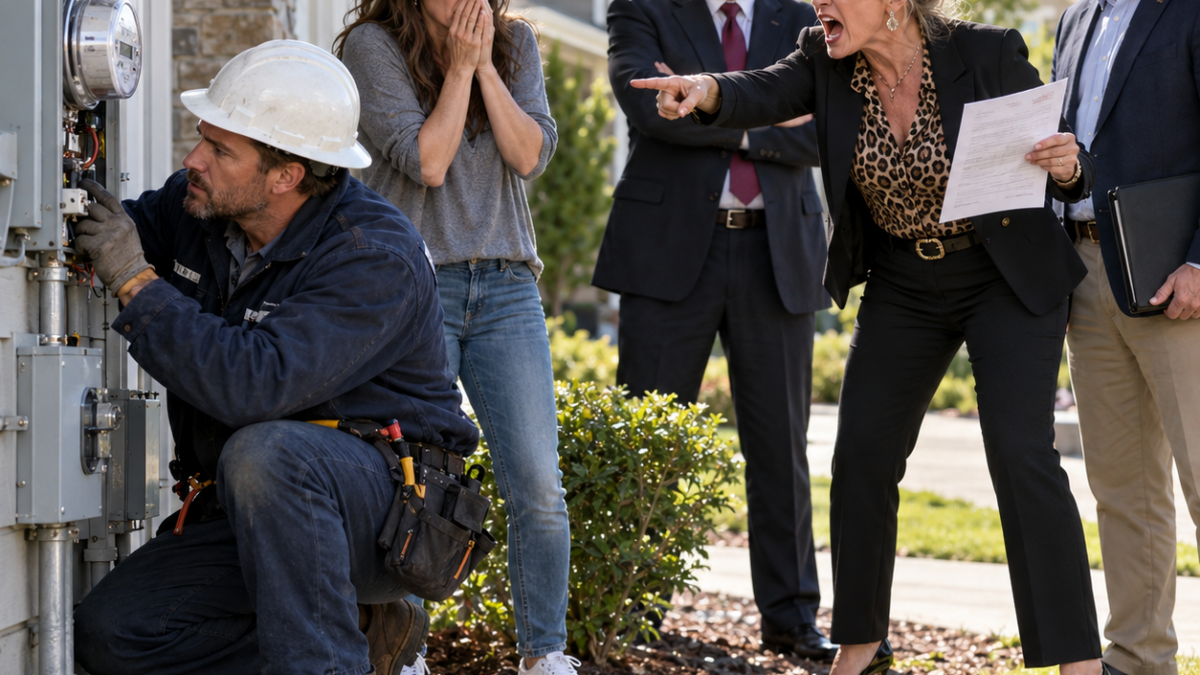
PART 2
Six months earlier, I had no reason to believe Marissa Vale would ever interfere with my electricity.
Back then, the problem seemed much simpler.
She wanted a piece of my land.
I didn’t want to give it to her.
That should have been the end of the matter.
My eleven acres ran along the eastern boundary of Stonebridge Crest.
The property contained the machine shop, an equipment storage building, a gravel work yard, and an older service road that had existed long before the development.
Near the eastern boundary ran a narrow recorded utility easement.
It allowed the utility company to access and maintain certain equipment.
That was all.
It wasn’t a public street.
It wasn’t a neighborhood entrance.
It wasn’t a construction road.
And it didn’t grant the HOA control over my property.
For years, everyone understood the arrangement.
Utility crews could enter the designated strip when needed for legitimate maintenance.
I kept the area reasonably accessible.
The HOA stayed on its side of the boundary.
Nobody had a problem.
Then Stonebridge Crest announced plans for a major expansion.
Twenty-eight new luxury homes.
A new clubhouse.
A fitness center.
A maintenance building.
And additional infrastructure to support the development.
The proposed construction sat near my property.
More specifically, the cheapest route for new utility lines crossed the eastern portion of my land.
The association could have designed another route.
But that would have cost more money.
And delayed construction.
Marissa apparently considered those alternatives unacceptable.
The first time she approached me, she carried a simple purchase proposal.
One acre.
Along the boundary.
She offered a price that wasn’t especially attractive and described the transaction as a minor adjustment benefiting both properties.
I declined.
She seemed surprised.
“You’re not interested?”
“No.”
“May I ask why?”
“Because I use that land.”
“It’s mostly open.”
“It’s part of my property.”
She smiled.
“Everything has a value, Elliot.”
“Sure.”
“Then let’s discuss yours.”
I shook my head.
“I’m not selling.”
She left politely.
A month later, she returned.
This time she didn’t want to buy the acre.
She wanted to lease a forty-foot-wide strip along the property line.
She called it a mutually beneficial access arrangement.
I asked to see the proposed use.
She showed me a development drawing.
It depicted utility construction equipment moving through the corridor.
Trenching machines.
Service trucks.
Maintenance vehicles.
And temporary access connected to the new neighborhood expansion.
I studied the route.
“How long would this last?”
“Through construction, with appropriate ongoing access.”
“Meaning permanent access?”
“Certain maintenance needs would continue.”
I shook my head.
“No.”
She frowned.
“You’re refusing before we’ve discussed compensation.”
“I’m refusing because I don’t want a construction corridor through my property.”
“The work would improve infrastructure.”
“For your development.”
“And the surrounding area.”
I folded the drawing.
“Then put the route on land your association owns.”
She didn’t appreciate that answer.
The third proposal arrived through an attorney.
More than thirty pages.
Dense language.
Access rights.
Construction privileges.
Maintenance authority.
Temporary staging.
Utility installation.
And provisions that could have substantially restricted how I used the eastern edge of my property.
I read it carefully.
Then sent it to Tessa Langford, a real estate attorney I’d used on several business matters.
She called two days later.
“Elliot, don’t sign this.”
I almost laughed.
“Wasn’t planning to.”
“Good. Because the rights they’re requesting extend well beyond a short-term construction lease.”
I looked toward the property line.
“What do they actually want?”
“Enough control over the corridor to support the expansion without having to negotiate with you every time they need access.”
I nodded.
“Then the answer is still no.”
She paused.
“Marissa may not accept that easily.”
I glanced toward Stonebridge Crest.
“She’ll have to.”
I was wrong about how far she was willing to go.
Because after that third refusal, the pressure started.
And it continued until the morning she arrived with security guards and told me I had twenty-four hours to leave my own workshop.
The first HOA violation arrived eleven days after I rejected the thirty-page access agreement.
It accused me of operating machinery at unreasonable hours.
I stared at the notice, trying to understand what they were referring to.
The shop opened at seven most mornings.
Occasionally, a farmer would bring in equipment before sunrise during harvest season. Sometimes my crew stayed late to finish an urgent repair.
But we’d operated on the same schedule for years.
And my property wasn’t subject to Stonebridge Crest’s residential quiet-hour rules.
I wrote a brief response.
Then another notice arrived.
This one complained about commercial vehicles parked near the property boundary.
A third cited outdoor equipment storage.
A fourth claimed that my gravel yard was inconsistent with community appearance standards.
The language was polished.
The threats were formal.
And none of it applied to my land.
I called the management office.
A young woman answered and transferred me to the compliance department.
After several minutes on hold, a man asked for my lot number.
“I don’t have a Stonebridge Crest lot number.”
“Then how can I help you?”
“Your association keeps sending me violation notices.”
He asked for my address.
I gave it to him.
There was a pause.
“Mr. Branson, I see the notices.”
“Good. Then you can remove them.”
“I’ll need authorization.”
“From whom?”
“The board president.”
I closed my eyes.
“Marissa Vale?”
“Yes, sir.”
Of course.
I asked him to identify the governing document giving the association authority over my property.
He couldn’t.
He told me somebody would call back.
Nobody did.
A week later, a county inspector appeared at my shop responding to a noise complaint.
His name was Patrick Lewis.
He was a decent man who looked almost apologetic before he’d finished introducing himself.
“Elliot, somebody complained about the equipment.”
I looked toward the service bay.
“Which equipment?”
“The complaint refers to excessive industrial noise.”
I gestured toward the open doors.
“You’re welcome to take a look.”
He checked what he needed to check.
Reviewed the conditions.
Asked a few questions about operating hours.
And determined there wasn’t evidence supporting the complaint as presented.
He closed his notebook.
“Everything seems normal.”
I nodded.
“Been normal for almost twenty years.”
He hesitated.
Then said, “You might want to document these complaints.”
I looked at him.
“That obvious?”
He gave me a tired smile.
“Just keep your records.”
He left without taking enforcement action against the business.
But the interruption cost me another afternoon.
And that was the point.
Marissa didn’t need every complaint to succeed.
She only needed the complaints to keep coming.
When inspectors arrived, I had to stop working.
When notices appeared, I had to answer them.
When a customer asked about the security vehicles lingering near my entrance, I had to explain why the neighborhood was suddenly treating my repair shop like a problem.
Then delivery trucks started having trouble reaching me.
Stonebridge Crest security vehicles began parking near the shared approach at awkward angles.
Not always enough to create a clear roadway violation.
Just enough to make a long equipment trailer difficult to maneuver.
A truck carrying a replacement combine engine had to wait nearly forty minutes one afternoon because a security SUV sat near the entrance.
Another delivery driver called to ask whether my business was closing.
“Why would you think that?”
“Somebody at the neighborhood gate told me access might be restricted.”
I gripped the phone.
“Who?”
“He didn’t give his name.”
I looked toward the entrance.
“Bring the truck around. I’ll guide you in.”
When the driver arrived, I noticed a security guard recording his license plate.
I approached.
“Why are you photographing my customers?”
The guard lowered his phone.
“Access monitoring.”
“For what?”
“Community security.”
“This is my business entrance.”
“Sir, we’re documenting commercial traffic near the development.”
I felt anger rise.
“Your community ends on the other side of that boundary.”
He didn’t argue.
He simply returned to his vehicle.
The next morning, another guard was there.
Soon afterward, Marissa began referring to my old service road as an HOA emergency access route.
I knew that wasn’t true.
The road had been part of my family’s property for decades.
No recorded document transferred it to the association.
No easement granted Stonebridge Crest general use.
But Marissa repeated the phrase at meetings and in correspondence until some residents began treating it as a fact.
One afternoon, an older man from the development stopped by.
He stood outside the shop holding a copy of an HOA newsletter.
“Mr. Branson, can I ask you something?”
“Sure.”
“Why are you blocking the emergency road?”
I stared at him.
“What emergency road?”
He showed me the newsletter.
A diagram displayed my eastern service lane as part of Stonebridge Crest’s future infrastructure access.
I looked at the drawing.
“That’s my private road.”
He seemed surprised.
“The newsletter says the community has rights to it.”
“It doesn’t.”
He frowned.
“But Marissa said—”
I interrupted gently.
“Have you seen a recorded easement granting your HOA access?”
He looked uncomfortable.
“No.”
“Neither has Marissa, because there isn’t one.”
He studied the drawing.
Then looked toward the workshop.
“I didn’t know.”
I believed him.
That was what made Marissa’s tactics so effective.
Most people wanted to trust that an HOA president had checked the documents before announcing property rights.
They assumed a map distributed by the association was accurate.
They assumed a formal notice reflected real authority.
And they assumed that if someone refused a community improvement project, there must be a reasonable explanation on the association’s side.
Marissa knew that.
She didn’t need everybody to read the underlying documents.
She needed them to accept her summary.
Over the next several months, the atmosphere around the shop changed.
The neighboring development no longer felt like a collection of houses.
It felt like an organization waiting for me to make a mistake.
I started checking the cameras every morning.
Saved every letter.
Photographed the security vehicles.
And kept a detailed log of the disruptions.
My mechanic, Hank Dorsey, noticed.
Hank had worked for me for fourteen years.
He was a broad-shouldered man in his late forties who could diagnose a bad bearing by sound and considered most office paperwork a personal insult.
One evening, he found me reviewing another HOA notice.
“Again?”
I nodded.
He looked toward the window.
“What do they want now?”
“Apparently, my equipment doesn’t match their neighborhood appearance standards.”
Hank glanced toward a mud-covered tractor in the service bay.
“Maybe we should paint it beige.”
I laughed despite myself.
He grinned.
“Make the engine match the mailboxes.”
Then his expression became serious.
“Elliot, they’re not going to stop, are they?”
I looked down at the notice.
“Not until they get that utility corridor.”
Hank folded his arms.
“Then why don’t they just pay for another route?”
“Because this one is cheaper.”
He shook his head.
“So they’re trying to make you miserable enough to give them the cheap option.”
I looked at him.
“That’s about the size of it.”
He was quiet for a moment.
Then said, “Don’t sign anything.”
I smiled faintly.
“Wasn’t planning to.”
But six months of pressure can wear a man down in ways he doesn’t expect.
I’d become accustomed to irritation.
To late-night emails.
To certified letters.
To watching unfamiliar security vehicles slow down outside my gate.
What I wasn’t prepared for was losing electricity.
Because that changed everything.
A dark workshop meant I couldn’t operate most of my equipment.
Without compressors, welders, charging systems, diagnostic tools, and proper lighting, the business was nearly useless.
And when Marissa arrived carrying a twenty-four-hour vacancy demand, I realized she’d moved beyond trying to inconvenience me.
She was trying to make the property impossible to occupy.
Then persuade me to surrender control of it.
Back at the meter, Dean Harrow waited until Ronan had finished documenting the enclosure.
Marissa stood near the gate, her arms crossed.
Brooke remained beside the security vehicle.
I could tell she was nervous.
The younger guard looked even worse.
Dean straightened and examined the seal number.
“Ronan, confirm the serial.”
Ronan checked the handheld device.
“Matches the account equipment.”
“Any disconnect command?”
“None.”
“Any scheduled field work?”
“Nothing assigned to this service.”
Dean nodded.
Then turned toward me.
“Mr. Branson, who normally has access to this area?”
“Me. My employees. Authorized utility workers.”
“Any outside contractors recently?”
“Not for electrical work.”
He looked at the enclosure again.
“Has anyone asked you to authorize a disconnect?”
“No.”
“Signed any work order?”
“No.”
“Reported unsafe equipment?”
“No.”
Ronan looked up from his device.
“Chief, I’ve got the interruption time.”
Dean turned.
“Go ahead.”
“5:43 this morning.”
I looked at my watch.
The shop had been dark long before I noticed the problem.
Dean asked whether I had security cameras covering the entrance.
“Yes.”
“Could we review the footage?”
I nodded.
“Of course.”
I opened the camera app on my phone.
The gate camera recorded continuously, storing footage locally and in a backup system.
I navigated to the relevant time.
At 5:39 a.m., a plain white van entered the property.
It slowed near the side of the workshop.
A man climbed out.
He wore a work jacket.
The vehicle carried a contractor logo on the door.
I recognized it.
Not immediately.
But after enlarging the image, I realized it belonged to a contractor working on Stonebridge Crest’s expansion.
I felt my stomach tighten.
Dean watched the video.
“Can you preserve the original footage?”
“Yes.”
“Please do. We’ll need a proper copy.”
I nodded.
The man in the recording approached the utility equipment.
The camera didn’t show every movement inside the enclosure.
But the timing was unmistakable.
The van arrived at 5:39.
The meter data showed service interruption at 5:43.
And the utility company had issued no disconnect order.
Dean looked toward Marissa.
“Mrs. Vale, you said the utility company disconnected this service.”
She lifted her chin.
“That was my understanding.”
“Based on what?”
“Our contractor’s report.”
“Who hired the contractor?”
“The association works with licensed professionals.”
“I asked who hired this one.”
She hesitated.
Then said, “The project management team.”
Dean watched her for a moment.
“Did the association instruct anyone to operate this meter?”
“Absolutely not.”
“Then I need the name of the contractor who was here this morning.”
She looked toward the van in the video.
“That company has been working on infrastructure improvements.”
“That doesn’t answer my question.”
Her voice sharpened.
“Chief Harrow, I’m not a utility technician. I don’t supervise every individual work assignment.”
Dean remained calm.
“Someone interfered with utility-owned equipment. I need to determine who did it and under whose authorization.”
Marissa reached into her vehicle and retrieved a thick folder.
“Perhaps you should review our association’s governing documents.”
Dean looked at it.
“Why?”
“They establish our responsibilities regarding utility safety.”
He didn’t take the folder.
“Your HOA covenants don’t authorize anyone to open our metering equipment.”
The silence that followed was remarkable.
Marissa stood holding the folder.
For the first time since arriving, she looked as though she didn’t know what to say.
Dean continued.
“The account is active. There is no authorized disconnect order. The seal is cut, and the enclosure shows recent tool marks.”
He glanced toward the meter.
“That’s being handled as suspected tampering.”
Marissa’s expression tightened.
“You’re overreacting.”
Dean looked directly at her.
“No, ma’am. I’m documenting what happened to utility equipment.”
He turned back toward Ronan.
“Open a tampering investigation. Preserve the data, equipment photographs, and service history.”
Ronan nodded.
Marissa took a step forward.
“That could delay our expansion project.”
Dean looked at her.
“Right now, my responsibility is this service.”
She appeared stunned.
As though she’d assumed that mentioning the development’s importance would immediately change his priorities.
I knew the feeling.
I’d been listening to the same argument for months.
The project was important.
Therefore I should cooperate.
Therefore my refusal was unreasonable.
Therefore Marissa could do whatever she believed necessary to move it forward.
Dean didn’t accept any of that.
He wanted to know who cut the seal.
And his equipment records were beginning to provide the answer.
The crew didn’t restore the electricity immediately.
At first, that frightened me.
I looked toward the dark workshop.
“Dean, how long am I going to be without power?”
He understood the question.
“We need to preserve the condition of the equipment before changing anything.”
“I have a business to run.”
“I know.”
“Customers waiting.”
He nodded.
“We’ll work as efficiently as we safely can. But we can’t erase evidence of possible tampering before it’s documented.”
I looked at the broken seal.
Then toward Marissa.
For a moment, I hated the situation so much I could barely speak.
Somebody had deliberately interrupted my electricity.
The utility company hadn’t authorized it.
And now restoring my service required extra time because the equipment had become evidence.
Marissa had created a problem that continued hurting me even after her explanation collapsed.
But Dean was right.
If the crew simply reconnected everything without documenting it, the people responsible might later claim there had never been an unauthorized interruption.
So I stepped back.
Let them work.
And called Hank to tell him not to start the morning’s repairs until I gave him an update.
He listened.
Then said, “Somebody actually cut the power?”
“Looks that way.”
“From outside?”
“Utility chief says the seal was broken.”
There was a long silence.
Then Hank said, “Elliot, that’s not an HOA violation. That’s somebody messing with the power company.”
“I know.”
“What do you want me to do?”
I looked toward the shop.
“Call the customers with early pickups. Tell them we’ve had a service interruption.”
“How long?”
“Don’t promise anything yet.”
“All right.”
I could hear concern in his voice.
Before hanging up, he said, “Boss?”
“Yeah?”
“Don’t let that woman make you sign something stupid just to get the lights back.”
I looked toward Marissa.
She stood beside her security vehicle, watching the technicians.
“I won’t.”
After the call, I returned to the gate.
The twenty-four-hour notice was still taped to the wood.
I read it again.
Then noticed a paragraph I’d barely considered earlier.
It didn’t simply demand that I leave.
It instructed me to acknowledge temporary administrative possession by the Stonebridge Crest HOA.
The wording was dense.
Formal.
And buried beneath several paragraphs about utility safety.
I took a photograph.
Then called Tessa Langford.
I explained the outage, the unauthorized meter interference, and the notice.
Her voice changed when I mentioned the administrative-possession clause.
“Elliot, don’t sign that.”
“I haven’t.”
“Send it to me immediately.”
I emailed a photograph.
She called back several minutes later.
“Do you understand what this document is trying to do?”
“Evict me?”
“No. That’s the distraction.”
I stared at the notice.
“What do you mean?”
“The acknowledgment would give the association a written basis to claim temporary administrative control over your gate and the utility corridor.”
I felt cold.
“The same corridor they’ve been trying to lease?”
“Exactly.”
I looked toward the meter.
The broken seal.
The dark workshop.
Marissa.
Everything connected.
“They cut my power so I’d sign the access document.”
“That appears to be the purpose of the pressure. We’ll need evidence to establish who arranged it.”
I read the notice again.
Twenty-four hours to vacate.
Temporary administrative possession.
A deadline designed to make me panic.
A document designed to make surrender look voluntary.
I gripped the phone.
“She’s not trying to get me out permanently.”
“Not necessarily.”
“She wants me to give her control while I’m frightened.”
Tessa’s voice remained steady.
“That’s what the acknowledgment would help her claim.”
I stared across the road.
Stonebridge Crest looked peaceful.
Porch lights glowed.
Cars rolled toward the neighborhood gate.
Residents were going to work, walking dogs, and preparing for ordinary Mondays.
None of them knew their HOA president had arrived at my workshop with a vacancy demand after somebody interfered with my electricity.
I looked back at the notice.
Then at Dean.
He was examining the meter photographs.
For months, I’d been trying to convince Marissa that my refusal should be respected.
Now I was beginning to understand that she hadn’t simply ignored my answer.
She’d developed a plan to replace it.
If I wouldn’t sign a land-access agreement while my business was operating normally, perhaps I’d sign one when the building was dark, the work had stopped, and a twenty-four-hour clock was supposedly running.
I felt sick.
Because for the first time, the entire morning made sense.
And it was worse than I’d imagined.
Dean’s team completed the evidence collection late that morning.
They photographed the broken seal from several angles.
Recorded the enclosure’s condition.
Preserved the meter’s activity history.
Verified the absence of a utility disconnect command.
And documented the service interruption.
Then Ronan approached Dean with something on his handheld device.
“Chief, there’s another item in commercial services.”
Dean turned.
“What?”
“A request came in three days ago.”
I stepped closer.
Ronan looked at me.
“Mr. Branson, did you request disconnection of your workshop service last Friday?”
I stared.
“No.”
He scrolled.
“Somebody submitted an email requesting that the service be isolated because of an allegedly unsafe private installation.”
Dean frowned.
“Was the request approved?”
“No. Commercial services rejected it.”
“Reason?”
“Missing valid account-holder authorization.”
I felt anger tightening my chest.
Somebody had tried to get the utility company to shut me off through official channels.
That had failed.
Then a contractor’s van had appeared before sunrise.
And the power had gone dark anyway.
Dean asked for the original request and attachments to be preserved.
Ronan opened the submission.
The sender claimed to act under property authority connected to the adjoining development.
Attached was a document supposedly bearing my signature.
I stared at the copy.
“That’s not mine.”
Dean looked at me.
“You’re certain?”
“Completely.”
I pointed toward the signature.
“I’ve signed thousands of repair invoices over the years. I know my handwriting.”
The letters were wrong.
The loops too wide.
The final stroke unnaturally straight.
It looked like someone had studied one of my old signatures and copied the general shape without understanding how I actually wrote my name.
Then Ronan opened another attachment.
A scanned driver’s license.
Mine.
Except it was an old copy.
I recognized it immediately.
The address was correct, but the license had been replaced years earlier.
I stared at the screen.
“Where did they get that?”
Dean looked toward me.
“Do you recognize the image?”
“Yes.”
I thought for a moment.
Then remembered providing a license copy during an unrelated property-access discussion years earlier.
It had been included in a document packet that eventually passed through the development’s management system.
I couldn’t prove that was where the image came from.
But the possibility chilled me.
Somebody had taken an old identity document and paired it with a forged signature to make a utility disconnection request appear authorized.
I looked toward Marissa.
She was speaking quietly with Brooke.
“Marissa!”
She turned.
I held up the phone displaying the attachment.
“Did you submit this?”
Her expression tightened.
“Submit what?”
“A request to disconnect my electricity with a forged signature.”
She looked offended.
“I have no knowledge of any forged signature.”
“Then who sent it?”
“Ask the contractor.”
I stared at her.
“You told me the utility company disconnected my service.”
“That’s what I was informed.”
“The utility company rejected the request.”
She hesitated.
“Then perhaps there was an administrative misunderstanding.”
Dean stepped forward.
“Mrs. Vale, we’re preserving the submission records. Please provide the identity of the person or company that initiated the request on behalf of the project.”
She crossed her arms.
“I’ll have our management office respond.”
He nodded.
“Please do.”
His voice wasn’t threatening.
But he wasn’t asking for a favor either.
He was protecting the integrity of utility equipment and records that someone appeared to have manipulated.
Marissa looked away.
Brooke kept her gaze lowered.
I wondered whether she knew about the forged document.
Or the early morning van.
Or whether she’d simply been told to accompany the president and enforce a notice.
I didn’t know.
And I wasn’t going to accuse her without evidence.
That was one thing the entire dispute had taught me.
When somebody lies confidently enough, innocent people can become part of the story without understanding what they’re helping to do.
Dean eventually authorized the restoration procedure.
His crew completed the necessary safety checks, preserved the relevant evidence, and installed replacement temporary seals as required.
I stood beside the workshop while Ronan finished the work.
For a moment, nothing happened.
Then the service was restored.
The lights inside the building came on.
The compressor control panel illuminated.
The office computer began starting up.
I watched the bright rectangles appear through the windows.
Something loosened in my chest.
Ronan looked toward me.
“You’re back in service, Mr. Branson.”
I nodded.
“Thank you.”
He gave a small smile.
Then returned to the truck.
I stood there for another moment.
For months, Marissa had tried to make me feel as though I wasn’t entitled to use my own property.
Now electricity was flowing into the workshop again, and the utility company had confirmed that no legitimate disconnect order had ever existed.
I walked toward the gate.
Marissa was still standing nearby.
The notice remained taped to the wood.
I carefully removed it.
Folded it.
And placed it in my pocket.
Marissa watched.
“Tearing down that notice doesn’t change your deadline.”
I looked at her.
“No?”
“Tomorrow morning, Elliot. Twenty-four hours.”
I glanced toward the meter.
“Somebody cut a utility seal and disconnected my service without authorization.”
She said nothing.
I continued.
“That changes quite a lot about today.”
Her expression hardened.
“This isn’t over.”
I met her eyes.
“You’re right.”
Then I turned and walked into the shop.
The overhead lights were on.
The ventilation system was running.
And Hank was waiting near the service bay.
He looked around.
“Well, that’s a beautiful sight.”
I nodded.
“Never thought I’d be so happy to hear a compressor.”
He grinned.
Then noticed my expression.
“What happened?”
I showed him the notice.
The false utility request.
And the photographs of the broken seal.
His smile vanished.
He read the documents.
Then looked up.
“She actually tried to make you leave?”
“Twenty-four hours.”
He stared toward the gate.
“Over an outage they arranged?”
“That’s what the evidence is beginning to suggest.”
Hank shook his head.
“All because you wouldn’t let them use that strip of land.”
I looked toward the eastern boundary.
“That’s what I intend to find out.”
Dean didn’t treat the incident as a minor contractor mistake.
The meter had been opened without authorization.
The service was interrupted without a utility work order.
And a rejected disconnection request contained documents falsely claiming my consent.
Those facts were enough to require a serious investigation.
He placed non-emergency utility work associated with the Stonebridge Crest expansion on hold while his company determined whether the same contractor or project personnel had interfered with other equipment.
Marissa learned about the hold almost immediately.
I knew because she called me that afternoon.
Her voice was sharp.
“Elliot, what did you tell Dean Harrow?”
I was sitting at my desk reviewing a customer invoice.
“The truth.”
“You’ve created a serious problem for the expansion.”
I looked at the phone.
“Somebody disconnected my electricity.”
“That’s being reviewed.”
“Yes.”
“And now critical infrastructure work has been suspended.”
I leaned back.
“Then perhaps your contractors should have stayed away from equipment they weren’t authorized to touch.”
She exhaled angrily.
“You understand that twenty-eight new homes are waiting on utility approval?”
“I understand my shop was shut down this morning.”
“Those homes represent millions of dollars.”
“Then you should have planned a route you had permission to use.”
She went silent.
I continued.
“Marissa, you offered to buy my land. I said no. You offered to lease it. I said no. You sent a thirty-page access agreement. I said no.”
She interrupted.
“Those were reasonable proposals.”
“And I had every right to reject them.”
Her voice turned cold.
“You’re going to regret making this personal.”
I stared at the phone.
“You made it personal when somebody cut off my electricity.”
The line went dead.
I set the phone down.
Then called Tessa.
She was already reviewing the notice.
“How bad?” I asked.
“Bad enough that we need to preserve every document and every minute of footage.”
“What about the twenty-four-hour deadline?”
“An HOA notice doesn’t give Stonebridge Crest authority to evict you from land outside its jurisdiction.”
I exhaled.
“I know that.”
“But the acknowledgment attached to the notice is the real concern.”
I looked at the unsigned page.
“Temporary administrative possession.”
“Yes. If you’d signed it, the association could have tried to characterize your signature as consent to control the gate and utility corridor.”
“Even though my land isn’t part of the HOA?”
“That’s the claim the document appears designed to support. We’d challenge it, but there’s no reason to give them the argument.”
I looked toward the gate.
“She knew I couldn’t operate without power.”
“That may have been the pressure she intended.”
I rubbed my forehead.
“What’s our next step?”
“We verify the underlying land records.”
“Again?”
“Not just your deed. The original subdivision plat, the utility easement, and the maps Stonebridge submitted for its expansion.”
I thought about the plans Marissa had shown me.
The utility corridor.
The construction route.
The thirty-page agreement.
Then I remembered something.
On the newest project drawings, the boundary seemed farther west than I’d remembered.
At the time, I assumed it was a drafting issue.
Now I wasn’t so sure.
I looked toward the eastern fence.
“Tessa, I think we need to compare those maps.”
She paused.
“That’s exactly what I was thinking.”
The following afternoon, we met Wesley Pritchard at the county records office.
Wesley had spent years maintaining land-use documents, plats, and recorded easements.
He was the kind of clerk who knew where older records were filed even when the computer index made them difficult to locate.
Tessa explained the dispute.
Wesley listened.
Then retrieved the original subdivision plat.
The document had been recorded decades earlier.
Its edges were worn from handling.
The property lines were clearly drawn.
My eleven acres lay outside Stonebridge Crest.
Along the eastern boundary ran the limited utility easement.
Wesley traced it with his finger.
“This is the recorded corridor.”
I leaned forward.
“Utility maintenance only?”
“That’s the purpose reflected in the instrument.”
Tessa placed Stonebridge’s newer expansion map beside it.
For a moment, the drawings looked similar.
Then Wesley aligned the reference points.
The differences became obvious.
On the association’s proposal, the utility corridor was shaded to resemble community-controlled land.
The boundary of my parcel had been shifted west.
Not by hundreds of yards.
By several dozen feet.
Just enough to make the proposed utility installation appear to remain outside my property.
I stared.
“That’s not the line.”
Wesley shook his head.
“No.”
Tessa looked at him.
“Has there been a recorded boundary adjustment?”
He checked the index.
“No.”
“A deed transfer?”
“No.”
“An expanded utility easement?”
“No.”
“Any agreement signed by Mr. Branson?”
Wesley continued reviewing the records.
Then stopped.
“There’s an access-consent document attached to the expansion review.”
I felt my stomach tighten.
“What document?”
He retrieved it.
The title read:
UTILITY ACCESS CONSENT.
And near the bottom was a signature.
Elliot Branson.
Except I hadn’t signed it.
I stared at the page.
Then looked at Tessa.
“That’s another one.”
She examined the signature.
It wasn’t identical to the one on the rejected utility disconnect request.
It appeared even less convincing.
Someone had used my name twice in documents intended to give the expansion access it didn’t have.
I felt a wave of anger so strong I had to stand up.
I walked toward the window.
Outside, county employees were crossing the parking lot with ordinary folders beneath their arms.
People going about their day.
And somewhere across town, an HOA president was trying to turn my eleven acres into a utility construction corridor using false signatures and altered maps.
I turned back.
“When was this filed?”
Wesley checked the date.
The submission came after the county requested proper written authorization for the expansion route.
That detail mattered.
The county had already recognized that Stonebridge needed my consent.
Instead of obtaining it, someone supplied a document purporting to bear my signature.
Tessa asked Wesley to preserve the submission history and identify the original source of the document.
He agreed.
I sat down.
For several seconds, I couldn’t speak.
Then I looked at Tessa.
“The power cut wasn’t their first attempt.”
She shook her head.
“No.”
“They tried the paperwork.”
“Yes.”
“The utility company rejected one request.”
“Yes.”
“And the county had already asked for authorization.”
She nodded.
I looked at the forged signatures.
“Then somebody decided to force me to sign for real.”
Tessa’s expression was grim.
“That is one explanation the evidence supports.”
I stared at the documents.
The altered map.
The false consent.
The unauthorized meter interference.
The twenty-four-hour demand.
And the administrative-possession acknowledgment.
It all pointed toward the same outcome.
Control over the corridor.
Not because Stonebridge owned it.
Not because I had agreed.
But because Marissa wanted the expansion to proceed without the expense of changing the design.
I looked toward Wesley.
“Does the recorded easement give the HOA any right to use my road?”
He shook his head.
“No general road access is shown here.”
“Construction traffic?”
“No.”
“Temporary possession?”
“No.”
He tapped the original instrument.
“The recorded utility easement is limited to its stated purpose.”
I sat back.
The truth was simple.
The paperwork trying to obscure it was complicated.
That was what Marissa had been counting on.
Most people wouldn’t know where to find an original subdivision plat.
Most people wouldn’t compare boundary descriptions line by line.
And most people, confronted with a dark workshop and an official-looking eviction notice, might sign something simply to get the problem resolved.
I thought about how close I’d come to doing exactly that.
Not because I believed Marissa had authority.
But because I needed the power restored.
I needed my employees working.
I needed customers to stop calling.
The frightening part was how quickly those ordinary needs could be turned into leverage.
Then Tessa’s phone rang.
She listened.
Her expression changed.
When she hung up, she looked at me.
“Marissa’s bringing security back tomorrow.”
I stared.
“What?”
“Four additional guards. Barricades. And a tow truck.”
I felt my stomach drop.
Tessa continued.
“She apparently intends to secure the corridor when the twenty-four-hour period expires.”
I looked toward the original plat.
My land.
My service road.
My utility easement.
Marissa had already tried false paperwork and an unauthorized power cut.
Now she was preparing to arrive with a security team and physically take control of the entrance.
I folded my hands.
“Then we’d better make sure somebody is there to document it.”
Tessa nodded.
“Agreed.”
And the following morning, Marissa Vale arrived with enough vehicles to make my workshop look like the site of a police operation.
Only this time, Dean Harrow was ready for her.
The next morning, I was waiting at the gate when the convoy arrived.
Not because I wanted a confrontation.
Because I knew Marissa had decided that the twenty-four-hour notice gave her some imaginary authority to take control of my property.
Tessa stood beside me with a folder beneath her arm.
The original deed.
The recorded easement.
The county plat.
The altered development map.
And copies of the forged consent documents.
My security cameras were recording.
I’d also positioned a second camera to capture the approach without interfering with legitimate traffic.
At 8:17, the first Stonebridge security vehicle appeared.
Then another.
Then a truck pulling a trailer loaded with temporary metal barricades.
A tow truck followed at the rear.
Marissa arrived in her white SUV.
She climbed out wearing a dark blazer and the expression of someone prepared to deliver a victory speech.
Brooke Talmage stood beside the lead security vehicle.
Four additional guards climbed out behind her.
I looked at the tow truck.
Then at Marissa.
“Planning a parade?”
She didn’t smile.
“Your deadline has expired.”
I glanced at my watch.
“And?”
“And the association will now secure the disputed utility corridor.”
Tessa stepped forward.
“Marissa, the corridor isn’t association property.”
Marissa’s eyes narrowed.
“Ms. Langford, I suggest you stop interfering with a lawful community safety operation.”
Tessa remained calm.
“Do you have a court order authorizing possession of Mr. Branson’s property?”
Marissa lifted her chin.
“We have administrative authority.”
“Under what recorded instrument?”
Marissa gestured toward the guards.
“Proceed.”
Two men began unloading barricades.
I watched carefully.
They were preparing to place them across the approach to my service road.
The same road my delivery trucks used.
The same road my employees drove every morning.
I took out my phone and began recording.
Marissa noticed.
“Put that away.”
I looked at her.
“No.”
“You’re interfering with security operations.”
“I’m standing on my property documenting what you’re doing.”
She turned toward Brooke.
“Make sure he doesn’t obstruct the work.”
Brooke looked uncomfortable.
“Mr. Branson, please remain clear of the equipment.”
I nodded.
“That’s reasonable.”
Then I stepped farther back, staying within my property and away from the unloading area.
Tessa remained beside me.
Marissa seemed disappointed.
She wanted me to block the guards.
Argue.
Push a barricade aside.
Give her something she could describe as aggressive resistance.
Instead, I kept recording.
One guard carried a metal barrier toward the driveway.
Another began positioning a support.
Then I heard a familiar diesel engine.
A utility truck turned into the lane.
Then a second.
Then a third.
Dean Harrow stepped out of the lead vehicle.
Ronan Pike followed.
Marissa turned toward them.
For a moment, I thought she might finally show some concern.
Instead, she smiled.
“Chief Harrow. Excellent timing.”
Dean looked at the barricades.
Then at the tow truck.
Then toward my entrance.
“What’s happening here?”
Marissa lifted her folder.
“We’re securing the utility corridor while the property issue is resolved.”
Dean looked at her.
“Who authorized you to do that?”
“The association’s project authority.”
“That’s not a utility authorization.”
She held out the development map.
“We’ve already provided documentation.”
Dean accepted the map.
Studied it.
Then asked Ronan to retrieve the recorded easement.
A few minutes later, both documents lay across the hood of Dean’s truck.
The association’s plan.
And the actual recorded property instrument.
Dean aligned the reference points.
Then looked at Marissa.
“These don’t match.”
She crossed her arms.
“The project map reflects the current development plan.”
“The property boundary is different.”
“That map was prepared by professionals.”
Dean pointed toward the recorded easement.
“This is the legal corridor. Your drawing moves the line.”
Marissa leaned forward.
“Only because the new utility design requires an adjustment.”
Dean looked at her.
“Where’s the recorded adjustment?”
She hesitated.
“The paperwork is being processed.”
“Then the adjustment hasn’t been established.”
She took a breath.
“Chief Harrow, we have twenty-eight new homes depending on this infrastructure.”
“I understand.”
“Then you understand why we can’t keep delaying construction because one landowner refuses to cooperate.”
Dean’s expression didn’t change.
“Your construction schedule doesn’t give you authority over his property.”
Her smile disappeared.
He continued.
“The utility company has a limited easement here for maintenance access. That doesn’t give Stonebridge Crest control of Mr. Branson’s road.”
Marissa pointed toward a large metal cabinet near the property line.
“That equipment belongs to our development’s utility system.”
Dean turned toward it.
Then looked back at her.
“No, ma’am.”
She blinked.
“What?”
“That cabinet belongs to the utility company.”
Marissa stared.
Dean walked toward the enclosure.
“It sits within the recorded easement on Mr. Branson’s land.”
He looked toward the guards.
“Has anyone from your team opened it?”
Nobody answered.
Brooke shifted her weight.
Dean repeated the question.
“Has anyone opened this enclosure without utility authorization?”
One guard looked toward Marissa.
She snapped, “Don’t answer speculative questions.”
Dean turned toward her.
“This isn’t speculative. It’s our equipment.”
Ronan stepped beside him.
“Chief, the inspection history doesn’t show authorized access this week.”
Dean looked toward the cabinet.
Then toward Brooke.
“Ms. Talmage, does your company maintain camera records for work performed at this entrance?”
Brooke hesitated.
“Yes.”
“Those records may be relevant to the equipment investigation.”
She glanced at Marissa.
Then answered.
“I understand.”
Marissa’s face tightened.
“Brooke, remember who employs you.”
Brooke looked at her.
For several seconds, the two women stared at each other.
Then Brooke said quietly, “My employer is the security company contracted by the association.”
Marissa looked irritated.
“Then tell your people to finish the barricades.”
Brooke didn’t move.
Dean turned toward the guards.
“Stop work near the utility enclosure.”
His voice wasn’t loud.
But the men stopped.
Marissa stepped forward.
“You can’t interfere with our private security arrangements.”
Dean looked at her.
“I’m directing that no unauthorized work occur on utility equipment or within the affected utility work area while this is being investigated.”
He pointed toward the enclosure.
“We have evidence of possible tampering involving nearby equipment. Until the situation is verified, nobody touches this installation without proper authorization.”
Marissa stared at him.
The security guards slowly set down the barricades.
The tow truck driver turned off his engine.
I felt the tension in my shoulders begin to ease.
Not because Marissa had accepted the truth.
She hadn’t.
But because the people she’d hired were finally hearing it from someone whose authority over the electrical equipment was real.
I looked toward the meter on my workshop.
Two mornings earlier, its severed seal had left me without power.
Now the utility chief was standing on my property, telling the HOA president that the corridor she’d been trying to seize was never hers to control.
For the first time, she seemed to understand that her plan might have consequences far beyond my workshop.
The inspection expanded that same morning.
Dean’s concern was no longer limited to the meter.
The utility company’s equipment records showed no authorized reason for Stonebridge personnel to access the cabinet near the road.
And the available security footage indicated that guards connected to the association had opened it earlier in the week.
Brooke supplied the relevant information after consulting her company’s procedures.
Dean made sure the material was preserved appropriately.
He then directed the necessary safety and tampering review across the affected equipment.
The association’s contractor was instructed to stop work on the expansion’s utility installations pending the required investigation and approvals.
The order didn’t interrupt power to the residents already living in Stonebridge Crest.
I was glad of that.
Those people hadn’t cut my meter seal.
They hadn’t forged my signature.
And most of them had no idea what Marissa was doing.
But the twenty-eight-home expansion was another matter.
Its utility connection approvals were now on hold.
The planned infrastructure work couldn’t proceed as though nothing had happened.
And Marissa’s timeline was collapsing.
I watched her speak urgently into her phone.
She turned away from us, but her voice carried.
“This project cannot be delayed again!”
A pause.
Then louder.
“I don’t care what Harrow says. We have deadlines!”
She listened.
Her shoulders tightened.
Then she ended the call and marched toward Dean.
“Do you understand what this suspension is going to cost the association?”
Dean nodded.
“I understand the project has financial consequences.”
“Millions, potentially.”
“Then the people coordinating it should have ensured the design and authorizations were correct.”
Her face reddened.
“We followed professional advice.”
Dean looked toward the altered project map.
“Then I suggest reviewing that advice.”
She stared at him.
“You’re taking his side.”
Dean shook his head.
“I’m taking responsibility for our equipment.”
He looked toward the meter enclosure.
“Someone interfered with service equipment we control. Someone submitted an unsupported disconnect request. And the expansion documents don’t match the recorded easement.”
Marissa opened her mouth.
Then closed it.
Dean continued.
“Those facts need to be resolved before work proceeds.”
I stood a few feet away.
For months, I’d been trying to explain the same basic principle to Marissa.
A property boundary doesn’t change because a development needs it to change.
A private road doesn’t become an HOA access route because someone draws it on a map.
And a utility easement doesn’t become association property simply because the HOA president says it does.
Dean had managed to express all of that in a few calm sentences.
Marissa looked toward the security guards.
“Load the barricades.”
Brooke nodded.
The team began carrying the metal barriers back to the trailer.
The tow truck pulled away.
Marissa remained near her SUV, visibly furious.
Before leaving, she turned toward me.
“This isn’t finished, Elliot.”
I looked at her.
“Then I hope you’ve started keeping better records.”
She slammed the vehicle door.
And drove away.
The convoy followed.
I stood beside Tessa watching the last security truck disappear down the lane.
Then I looked toward the workshop.
The lights were on.
The entrance was clear.
And nobody had placed a single barricade across my road.
Tessa closed her folder.
“That could have gone a lot worse.”
I nodded.
“Yeah.”
She looked at me.
“How are you feeling?”
I considered the question.
“Tired of people acting like my land belongs to them.”
She smiled faintly.
“That’s understandable.”
I looked toward the recorded easement marked along the eastern boundary.
“All I ever said was no.”
Tessa nodded.
“And that should have been enough.”
The contractor’s records began unraveling soon afterward.
Stonebridge’s utility installation contractor faced a serious problem.
Its crew had apparently handled utility-owned equipment without a valid authorization.
The company needed to establish what its workers had been instructed to do, who supplied the instructions, and why anyone believed the utility company had approved a disconnect when no such approval existed.
A field supervisor agreed to cooperate with the investigation.
His account was troubling.
According to him, the crew had received a work packet stating that I had already authorized the necessary utility access.
It claimed my parcel was controlled by the association for the project.
It represented that the utility company had approved isolation of my meter.
And it required the meter to be disconnected before six o’clock that Monday morning.
I stared at the summary when Tessa showed me.
“Before six?”
“Yes.”
“Marissa arrived at my gate just after I discovered the outage.”
Tessa nodded.
I thought about the timing.
The van entered at 5:39.
The meter recorded the interruption at 5:43.
I discovered the darkness when I opened the shop.
Then Marissa arrived with an eviction notice already prepared.
The sequence was too convenient to dismiss as coincidence.
Tessa continued.
“The contractor says management represented the consent as already obtained.”
I looked toward the file.
“Did they verify it?”
“That’s part of the review.”
The work packet contained another name.
Vale Property Coordination.
A limited liability company I’d never heard of.
I looked at Tessa.
“Vale?”
She nodded.
“Yes.”
“Like Marissa Vale?”
“The name is suggestive. We still need to establish the actual relationship.”
The company had been registered less than a year earlier.
Its business address led to a rented mailbox in a strip mall two towns away.
Its filings didn’t openly list Marissa as the individual in charge.
But financial records later produced through the association’s disclosures showed repeated consulting payments moving from Stonebridge Crest into the company’s account.
The invoices carried vague descriptions.
Project coordination.
Electrical consulting.
Property access administration.
Site compliance.
The amounts weren’t enormous individually.
But the payments formed a consistent pattern over several months.
I looked at the list.
“This company was getting HOA money to coordinate the project?”
“That’s what the association’s financial records show.”
“And the contractor received instructions through it?”
“The work packet identifies it as an intermediary.”
I rubbed my forehead.
“Did the board know?”
“That’s one of the central questions.”
Tessa laid the documents across her conference table.
The forged utility disconnect request.
The second access-consent form.
The altered expansion map.
The contractor’s work packet.
The invoices to Vale Property Coordination.
The twenty-four-hour notice.
And the temporary-possession acknowledgment.
Every document seemed to support another.
The map made the corridor look like association property.
The forged consent purported to give access.
The work packet claimed the power interruption was approved.
The outage created a supposed safety problem.
The vacancy notice turned that problem into a twenty-four-hour deadline.
And the acknowledgment offered the association written control over the same corridor I’d refused to sell or lease.
I stared at the arrangement.
“It was planned.”
Tessa looked at me.
“The evidence points toward a coordinated effort to obtain access.”
I shook my head.
“She didn’t just lose patience one morning.”
“No.”
“She kept trying new ways to get what she wanted.”
Tessa nodded.
“And now the people reviewing the records can compare each step.”
I thought about Marissa’s smile when she stepped out of the SUV with the eviction notice.
She’d looked so confident.
So certain.
As though the outcome had already been decided.
Now I understood why.
She believed every part of the plan would fit together.
The contractor would disconnect service.
The HOA would issue the occupancy demand.
I would panic.
Sign the acknowledgment.
And the association would have the document it needed to claim control over the corridor.
Except the utility company hadn’t approved the disconnect.
The meter recorded the interruption.
The cameras captured the van.
And Dean Harrow had examined the broken seal before anyone could conceal what happened.
Marissa’s entire plan depended on nobody looking too closely.
That turned out to be a very bad assumption.
Brooke Talmage contacted the investigators several days later.
She had been quiet through most of the confrontation at my gate.
I’d assumed she was simply uncomfortable being caught between Marissa’s orders and Dean’s evidence.
But Brooke knew more than she’d said.
Her security company maintained camera logs from patrol vehicles and body-worn equipment used during certain assignments.
When the utility investigation expanded, she arranged for the relevant recordings to be preserved and provided through the appropriate process.
One clip was especially important.
It came from the evening before my power was disconnected.
Marissa stood outside my gate speaking with someone connected to the contractor.
The conversation wasn’t a complete confession.
But one sentence was unmistakable.
“By tomorrow, he won’t have a reason left to stay.”
I listened to the recording with Tessa.
Then sat back.
For a moment, I couldn’t speak.
Marissa had known something would happen to my property before sunrise.
She’d prepared a vacancy notice.
Arrived with security guards.
And demanded that I leave within twenty-four hours.
Now there was recorded evidence suggesting that she’d anticipated the pressure the night before it happened.
I looked at Tessa.
“She knew.”
Tessa nodded carefully.
“The recording strongly supports that she anticipated an event intended to pressure you.”
I stared toward the window.
“Brooke heard her say that?”
“She preserved the recording.”
“Why didn’t she say something earlier?”
Tessa folded her hands.
“That’s a question for Brooke. But she’s cooperating now.”
I thought about the guard standing beside Marissa while I called the utility company.
The way she’d glanced away when Dean found the broken seal.
The moment she refused to let Marissa dictate what happened to the camera records.
Maybe she’d suspected something wasn’t right.
Maybe she had been afraid of losing her job.
Maybe she hadn’t understood the plan until the utility chief began asking questions.
I didn’t know.
But I appreciated that she’d chosen to preserve the truth rather than protect the person who’d hired her company.
The footage also confirmed that Marissa’s confrontation at my gate wasn’t simply an unfortunate response to a surprise outage.
She had been discussing the situation beforehand.
And that made her claim of innocent misunderstanding increasingly difficult to accept.
Stonebridge Crest’s board scheduled an emergency meeting.
By then, rumors had spread throughout the neighborhood.
Residents knew the expansion’s utility work had been suspended.
They knew the contractor was under scrutiny.
They knew the president had issued a vacancy demand against a neighboring property owner.
And some had seen photographs of my broken meter seal.
But most didn’t understand how the pieces connected.
Marissa apparently believed she could still control the explanation.
She arrived at the meeting with a thick binder and a carefully prepared statement.
I attended with Tessa.
The clubhouse was crowded.
Homeowners sat in rows of folding chairs.
Board members occupied a long table near the front.
There were no children present, only adults who appeared to understand that the discussion involved more than a neighborhood disagreement.
Marissa began confidently.
She described me as an uncooperative landowner who refused reasonable infrastructure proposals.
She said the utility company had overreacted to a contractor error.
She characterized the twenty-four-hour notice as an administrative response to a safety problem.
And she reminded everyone that the expansion represented millions of dollars in projected value for the community.
I listened without interrupting.
I knew her style by then.
She spoke as though every disputed fact had already been decided in her favor.
Then Tessa stood.
She didn’t raise her voice.
She simply placed the original recorded subdivision plat on the table.
“This is Mr. Branson’s property.”
She pointed to the boundary.
“These eleven acres existed before Stonebridge Crest was developed.”
A few residents leaned forward.
Tessa placed the recorded easement beside the plat.
“This instrument gives the utility company limited access for its stated maintenance purposes. It does not give the homeowners association possession of the corridor.”
Marissa interrupted.
“The expansion map reflects updated planning.”
Tessa placed that map beside the original.
“Then perhaps you can explain why the boundary has shifted several dozen feet.”
The room became quiet.
One board member frowned.
“Shifted?”
Tessa nodded.
“The newer drawing shows land outside the association’s ownership as though the planned utility route avoids the private parcel.”
Marissa’s expression hardened.
“Those drawings were prepared by professionals.”
Tessa looked at her.
“Where is the recorded boundary adjustment?”
Marissa didn’t answer.
Tessa continued.
“Where is the deed?”
Silence.
“And where is the valid access agreement signed by Mr. Branson?”
Marissa looked toward the board.
“These are technical matters.”
A resident stood.
“Are you saying we don’t actually have permission to use that land?”
Marissa sighed.
“We’ve been negotiating access.”
I spoke for the first time.
“I said no. Three times.”
Several people turned toward me.
I continued.
“She offered to buy an acre. I refused. She offered to lease a forty-foot strip. I refused. Then her attorney sent a thirty-page agreement giving the association broader rights across my property. I refused that too.”
A woman near the front raised her hand.
“Why?”
I looked at her.
“Because I use that land for my business, and I don’t want a construction corridor running through it.”
She nodded slowly.
I continued.
“I never joined your HOA. I’ve never asked it to maintain my property. I’ve never interfered with its legitimate roads or facilities.”
I looked toward Marissa.
“All I did was refuse to give it land it didn’t own.”
The room grew quiet again.
Tessa placed the first forged document on the table.
“This is a utility disconnection request submitted in Mr. Branson’s name.”
Marissa shifted in her chair.
Tessa continued.
“The utility company rejected it because the required account-holder authorization was not valid.”
She placed the second document beside it.
“This is a separate utility access consent submitted during the county’s expansion review.”
A board member leaned forward.
“Are those his signatures?”
I shook my head.
“No.”
Marissa interrupted.
“That allegation hasn’t been proven in court.”
Tessa nodded.
“The documents are under investigation. Mr. Branson denies signing either one, and the submission histories are being preserved for examination.”
She turned another page.
“This is the meter activity report.”
Then another.
“These are photographs of the severed seal and enclosure.”
Then the security footage.
And finally, the contractor’s work packet identifying Vale Property Coordination.
The board members began whispering.
One asked who had authorized payments to that company.
Another wanted to know why it had been registered so recently.
A third asked whether the full board had approved its role in the project.
Marissa’s voice rose.
“You’re allowing an outside landowner to attack this community.”
Tessa looked at her.
“The documents concern actions taken in the association’s name.”
Marissa pointed toward Brooke, who stood near the side of the room.
“That security footage was confidential. You had no right to share it.”
Brooke stepped forward.
Her expression was tense.
But her voice was steady.
“The recording was preserved and provided through the proper investigative process.”
Marissa glared.
“You work for this association.”
Brooke took a breath.
“I work for the security company the association hired.”
She paused.
“And my job doesn’t include destroying evidence to protect anyone.”
A ripple moved through the room.
Marissa stared at her.
For a moment, she looked as though she might explode.
Then the clubhouse door opened.
Dean Harrow entered carrying a sealed evidence packet.
He hadn’t come to support me personally.
He’d come to explain the utility company’s findings.
The room quieted as he approached the table.
He introduced himself and described the service interruption.
He made no sweeping criminal accusation.
He didn’t announce that every allegation had already been proven.
He simply stated what his department had verified.
My utility account was active.
No authorized disconnection order existed.
No utility technician had been dispatched to interrupt service.
The meter seal had been cut.
The enclosure showed evidence of unauthorized access.
And the company was investigating the source and circumstances of the interference.
Marissa looked toward him.
“Chief Harrow, surely you recognize that contractors sometimes make mistakes.”
Dean nodded.
“Contractors can make mistakes.”
She seemed encouraged.
“Exactly.”
He continued.
“But a contractor’s mistake doesn’t create utility authorization that never existed.”
Marissa stopped smiling.
Dean opened the packet.
He explained that the contractor’s work records contained an authorization number supposedly issued by the utility company.
Ronan had checked it.
The number didn’t correspond to any valid authorization in the utility company’s system.
It had apparently been invented.
The room became completely silent.
Dean looked toward the board.
“To be clear, the utility company did not authorize your association or its contractors to disconnect Mr. Branson’s service.”
Nobody spoke.
He continued.
“The fact that a number appears on a contractor’s work packet doesn’t make it genuine.”
A man near the front stood slowly.
“Then who gave the contractor that number?”
Dean looked at him.
“That’s part of the ongoing investigation.”
The man turned toward Marissa.
“Did you know?”
She looked down at her binder.
“I relied on our project professionals.”
Another resident spoke.
“Did the board approve the disconnect?”
A director shook his head.
“Not to my knowledge.”
The questions came faster.
Who approved Vale Property Coordination?
Who supplied the old driver’s license?
Why did the association’s map show the wrong boundary?
Why had a vacancy notice been prepared before the utility company identified any service problem?
And why did the notice ask me to acknowledge administrative possession of land the HOA didn’t own?
Marissa tried to answer.
But every explanation required somebody else to have made a mistake.
The contractor.
The utility company.
The management staff.
The mapping consultant.
The county.
Me.
Everyone except the person who had spent six months demanding access across my property.
Finally, an elderly woman stood near the back.
Her name was Mrs. Eleanor Price.
She’d lived in Stonebridge Crest since the earliest years of the development.
I’d repaired her husband’s old garden tractor once, years earlier.
She looked toward Marissa.
“I voted for you twice.”
Marissa’s expression softened.
“Eleanor, you know how much I’ve done for this community.”
Mrs. Price nodded.
“I thought I did.”
The words were quiet.
But they reached the entire room.
She continued.
“Did you authorize anything that caused this man’s electricity to be shut off?”
Marissa opened her mouth.
Then looked toward her attorney.
The silence lasted several seconds.
Mrs. Price slowly sat down.
And in that moment, I think many residents understood the difference between supporting a community improvement and allowing one person to pursue it without limits.
The board didn’t resolve every issue that night.
The utility investigation was still active.
The financial review was incomplete.
And there were questions only independent investigators could answer.
But the association’s trust in Marissa was broken.
The directors began reviewing the expansion’s expenditures.
They discovered invoices that hadn’t received proper approval under the association’s rules.
Survey revision.
Electrical consulting.
Private security access acquisition.
Emergency property control.
Those descriptions had appeared in financial records without attracting much attention.
Now they looked very different.
The invoices connected to Vale Property Coordination required particular scrutiny.
Marissa had repeatedly described the expansion as necessary to protect property values.
But the board had not understood the full scope of the work being performed in its name.
Nor had it authorized anyone to forge my signature, alter property records, or interfere with utility equipment.
The board moved to remove Marissa from the presidency through its governing procedures.
She tried to resign before the investigation expanded further.
But the directors refused to destroy records, erase correspondence, or grant any sweeping release from responsibility.
They insisted the files be preserved.
The removal proceeded.
Marissa lost the office she’d used to pressure me.
Her name disappeared from association letterhead.
Her access to project records and financial systems was terminated under the board’s revised controls.
And the people who’d once relied on her confident explanations began examining the paperwork themselves.
The financial consequences spread beyond the HOA.
The contractor suspended its relationship with the association pending resolution of the investigation.
The lender financing the expansion began requesting explanations about the delays and authorization problems.
County approvals for the affected expansion phase remained on hold.
The utility company required a properly documented redesign of the connection route before it would consider approving the necessary non-emergency work.
Twenty-eight luxury homes.
A clubhouse.
A fitness center.
And an expensive infrastructure plan.
All delayed because the project had been built around access the association never secured.
Marissa had spent six months telling me the cheapest route was the only sensible option.
Now the community had to confront the actual cost of her trying to force that route through my property.
It wasn’t simply the price of moving utility lines.
It was the cost of bad decisions made by someone who believed ordinary property rights were obstacles to be overcome.
A week after Marissa’s removal, Mrs. Price stopped by my workshop.
I was standing beside an engine lift when I saw her at the entrance.
She wore a blue cardigan and held her purse in both hands.
“Elliot?”
I wiped my hands.
“Mrs. Price.”
She gave me a small smile.
“I hope I’m not interrupting.”
“Not at all.”
She looked around the workshop.
Everything was running normally.
The lights were bright.
Hank was working at the far end.
A radio played quietly near the office.
Mrs. Price looked toward the ceiling.
“I suppose the electricity is behaving itself now.”
I laughed softly.
“So far.”
She smiled.
Then her expression grew serious.
“I wanted to apologize.”
I set down the rag.
“For what?”
“For believing what Marissa said.”
I waited.
She looked toward the entrance.
“She told us you were preventing the neighborhood from getting the infrastructure it needed.”
“I declined the use of my land.”
“I know that now.”
Her voice trembled slightly.
“She made it sound like you were holding the whole community hostage.”
I thought about the notices.
The security vehicles.
The broken seal.
The eviction threat.
“I wasn’t trying to hurt anybody over there.”
She nodded.
“I believe you.”
For a moment, she looked embarrassed.
Then she said, “We trusted her because she always sounded so certain.”
I understood.
Confidence can make a false statement sound official.
And when the person making it occupies a leadership position, questioning the statement can feel like challenging the entire organization.
Mrs. Price looked around the shop.
“Did you ever consider signing that access agreement just to make her stop?”
I thought about the morning the lights went out.
The notice on the gate.
The possibility that my employees would lose work if the shop remained closed.
“Yes,” I admitted.
She looked surprised.
I continued.
“Not because I thought she was right. Because I was tired.”
Mrs. Price nodded slowly.
“That may have been what she was counting on.”
I looked toward the eastern boundary.
“I think so.”
She took a breath.
“Well, I’m glad you didn’t.”
I smiled.
“So am I.”
She shook my hand.
Then left.
Several other residents reached out over the following weeks.
Some apologized.
Others asked how the recorded easement actually worked.
A few were simply angry that the association had spent their dues pursuing a project through another person’s property.
I didn’t blame them.
Most had been misled.
They hadn’t forged my signature.
They hadn’t cut the meter seal.
And they hadn’t arrived at my gate demanding I leave within twenty-four hours.
I was careful not to turn my anger at Marissa into anger at an entire neighborhood.
Stonebridge Crest would still be there after she was gone.
Its residents deserved a functioning association.
And I deserved to operate my business without being treated as an obstacle to somebody else’s financial plans.
The civil resolution took additional time.
Tessa documented the losses connected to the wrongful power interruption.
The repair and inspection expenses.
The business disruption.
The unauthorized security actions.
The property-access interference.
And the legal costs of defending rights that had never been properly transferred to Stonebridge Crest.
The association’s new leadership entered settlement discussions.
The resulting agreement addressed those documented losses and required the association to stop claiming control over my land.
It also reaffirmed the limited recorded utility easement.
That distinction was important.
I didn’t want to prevent the utility company from maintaining its own infrastructure.
Legitimate utility crews had used the easement for years without trouble.
They notified me when appropriate.
Performed necessary work.
And left the property in reasonable condition.
I wasn’t opposed to utility service.
I was opposed to an HOA pretending that a maintenance easement gave it authority to occupy my road and force a new development connection through my land.
The utility company’s rights remained intact.
The association’s unsupported claims did not.
A new steel gate was installed along the appropriate boundary.
I placed a small sign beside it.
PRIVATE PROPERTY.
UTILITY ACCESS BY RECORDED EASEMENT ONLY.
It wasn’t dramatic.
No mention of Marissa.
No insults.
No threats.
Just a boundary clearly identifying what was permitted.
Several weeks later, the utility company confirmed the relevant service equipment was operating normally.
The workshop returned to its familiar schedule.
Trucks came and went.
Customers dropped off machinery.
Hank complained about parts shortages.
And I began spending more time repairing engines than organizing evidence files.
That felt like progress.
Still, I occasionally caught myself looking toward the meter.
Every time a utility truck passed, I remembered Dean crouching beside the enclosure and examining the severed seal.
Every time I saw a Stonebridge security vehicle, I remembered the barricades and tow truck that had come to take my road.
And whenever I opened the file drawer containing the twenty-four-hour notice, I felt the same cold anger I had felt that Monday morning.
Not because I was afraid Marissa would return.
Because I understood how close she’d come to making me sign.
If she’d found me during a worse financial month, perhaps I’d been tempted to compromise.
If the utility company hadn’t been available quickly, perhaps the shop would have remained dark longer.
If the meter hadn’t logged the interruption, perhaps the contractor would have claimed the outage was accidental.
And if the gate camera hadn’t captured the white van, perhaps connecting the service interruption to the expansion project would have been harder.
The case turned on facts that were easy to overlook.
A cut seal.
A timestamp.
A rejected work order.
An old subdivision plat.
A forged signature.
A camera recording.
And a utility chief who cared more about evidence than a woman waving an HOA binder in his face.
The final scene happened on a quiet morning several weeks after the civil settlement.
I was opening the workshop when a county vehicle pulled up outside the gate.
Behind it came a familiar utility truck.
Dean Harrow climbed out.
Two investigators followed, carrying evidence cases and document folders.
I walked toward them.
“Dean.”
“Morning, Elliot.”
I glanced at the equipment cases.
“Please tell me the power isn’t going out again.”
He smiled faintly.
“Nothing wrong with your electricity.”
“Good. Because Hank’s finally caught up on the jobs we lost.”
Dean nodded toward the meter.
“We’re completing another stage of the original-source review.”
I looked at the investigators.
They were carefully checking the preserved evidence records associated with the tampered equipment.
The broken seal had been retained under documented evidence procedures.
The investigators needed additional examination and confirmation of the original service-request records.
I stepped aside.
“Whatever you need.”
Dean approached the meter.
The replacement seal remained intact.
The enclosure was secure.
Everything looked ordinary.
The same equipment that had become the center of a fight over my land was now doing what it was supposed to do.
Supplying electricity to my workshop.
One investigator opened a folder.
Across the top was a heading concerning the original source of the purported authorized service request.
Dean examined it.
Then spoke quietly.
“Start with the signature.”
I looked toward him.
For a moment, I remembered the false document Ronan had shown me that first morning.
My name.
My old driver’s license.
The claim that I had personally requested service disconnection.
I thought about how strange it was that the entire plan depended on somebody believing a copied name on a piece of paper meant more than the actual account holder standing in front of them.
Then I noticed a vehicle across the road.
A white SUV.
Parked beyond the entrance to Stonebridge Crest.
Marissa stood beside the open driver’s door.
She appeared to have stopped when she saw the county and utility vehicles near my shop.
For a moment, she watched the investigators.
One hand rested on the door.
She didn’t approach.
Didn’t shout.
Didn’t produce a clipboard.
The woman who had once stood at my gate demanding I leave within twenty-four hours now remained across the road while professionals examined the evidence associated with her former project.
Dean didn’t turn toward her.
His attention stayed on the meter and the investigation.
The two investigators worked quietly.
Photographs.
Records.
Evidence labels.
Document comparisons.
Ordinary procedures.
Nothing theatrical.
No camera crew.
No dramatic announcement.
Just people doing the work Marissa had apparently counted on nobody doing.
I watched them for a moment.
Then looked across the road again.
Marissa was still standing beside her vehicle.
She didn’t look powerful anymore.
She looked like someone watching events she could no longer control.
I didn’t wave.
Didn’t smile.
Didn’t walk over to confront her.
There was nothing left to say.
The utility equipment had been restored.
The association no longer controlled the project through her.
The access agreement remained unsigned.
And my eleven acres were still mine.
I thought about the morning she’d arrived with that clipboard.
How certain she’d sounded.
How confidently she’d declared that I had twenty-four hours to leave.
How she’d insisted the utility company had legally disconnected me.
And how quickly her confidence had disappeared when Dean examined the meter and asked who had touched it.
I turned toward the workshop.
Inside, the overhead lights were on.
Hank was moving a tractor toward the service bay.
The compressor hummed.
A customer was pulling into the gravel yard with a trailer.
Everything sounded normal.
The ordinary noise of a working business.
I had never appreciated it more.
Dean finished speaking with the investigators and approached me.
“Service is looking good,” he said.
I nodded.
“Best thing I’ve heard all morning.”
He smiled.
Then glanced toward the new gate.
“That’s a clearer boundary arrangement.”
“Figured it was time.”
He read the sign.
PRIVATE PROPERTY.
UTILITY ACCESS BY RECORDED EASEMENT ONLY.
“Accurate,” he said.
“That’s what I was going for.”
He gave a small nod.
Then returned to the truck.
The investigators gathered their materials.
A few minutes later, the vehicles pulled away.
Across the road, Marissa climbed into her SUV.
She drove off without approaching my gate.
I watched until she disappeared beyond the neighborhood entrance.
The broader investigation into the unauthorized disconnect and related documents continued through the proper channels, and I knew any criminal findings would depend on the evidence and the law—not on how angry I felt about what had happened.
But my own property dispute had reached its end.
The association had withdrawn its claims.
Its president was gone.
The utility route for the twenty-eight-home expansion had to be redesigned through legitimate approvals.
And the business my father helped me build was still operating on land we’d never agreed to surrender.
I walked back toward the shop.
Hank stood near the entrance with a wrench in his hand.
“Everything all right?”
I looked at the bright lights above him.
“Everything’s fine.”
He grinned.
“Good. Because this tractor isn’t going to fix itself.”
I laughed.
Then followed him inside.
As I reached the workbench, I looked once more toward the meter through the side window.
It was such an ordinary piece of equipment.
A box.
A seal.
A record of electrical service.
But that morning, Dean Harrow had found the detail that Marissa never expected anyone to examine.
She had tried to turn a manufactured power outage into proof that I should leave my own land.
Instead, the meter exposed the interruption she couldn’t explain.
Marissa had believed that if she controlled the electricity, she could control my future.
She thought twenty-four hours of darkness would accomplish what six months of negotiations and threats had failed to do.
She was wrong.
She cut my power to force me off my land—but when the utility chief checked the meter, the only thing she succeeded in shutting down was her own scheme.