PART 2: HOA Karen Cut Down 12 Survey Posts on My Ranch—Then Federal Agents Shut Down Her $11.8 Million Summit Project
PART 2
Dean Weatherford reached my ranch in less than an hour.
That alone told me how serious it was.
Dean was not a man who hurried without reason. He was sixty-one, narrow-shouldered, sun-browned, and quiet in the way good surveyors often are. He had spent nearly thirty years reading land through maps, monuments, bearings, old field notes, and the kind of evidence most people walk past without seeing.
He had done the boundary retracement on Whitaker Ridge years earlier.
He knew that western line better than anyone alive except maybe me.
His truck came rattling up the ranch road with survey equipment in the bed, laminated maps stacked on the passenger seat, and a thick folder tucked under one arm.
He stepped out, glanced once toward the missing posts, and his face changed.
Not dramatically.
Dean did not do dramatic.
But the corners of his mouth tightened.
“Show me every cut,” he said.
I walked him down the line.
He crouched at the first stump, then the second, then the third.
By the fourth, he was no longer asking questions.
He was taking notes.
At the twelfth, he stood and looked across toward the idling equipment.
Marlene’s crews had moved farther up the slope.
A bulldozer blade scraped the wet ground.
Rhett Callaway stood near a pickup, phone in hand, looking less confident than he had when he arrived.
Dean opened the folder on the tailgate of his truck and spread out three maps.
One showed my ranch.
One showed the Silver Crest project boundary.
The third was older, yellowed at the edges, marked with government land references and cadastral monument data.
Marlene would later pretend she had never understood why that third map mattered.
But Dean understood.
So did I.
He tapped the line with one finger.
“Those posts weren’t boundary monuments,” he said. “They were witness posts.”
“I know that.”
“Then you know removing them doesn’t move the line.”
“No.”
“But it does hide it from people who don’t know what they’re looking at.”
I looked toward the machines.
“Tell me the rest.”
Dean adjusted his glasses.
“The western boundary of your ranch was reestablished from federal cadastral monuments recorded decades ago. That line also ties into federally managed land beyond the ridge.”
I looked down at the map.
“The land past my line.”
“Not Silver Crest land.”
“Federal.”
“Yes.”
A bulldozer beeped as it backed near the slope.
Dean’s jaw tightened.
“These posts made the line visible for contractors. Easy to avoid. Easy to respect.”
“And now they’re gone.”
“Now anyone who wants to pretend the line is somewhere else has room to do it.”
I watched Marlene talking to Rhett.
She stood with one hand on her hip, pointing toward the ridge as if the land itself needed to obey her schedule.
Dean took out a GPS receiver and walked the line again, this time measuring against the federal reference data.
It took him most of the morning to confirm what he already suspected.
Silver Crest’s new construction stakes did not match the historic boundary.
Not by a few inches.
Not by a rounding error.
In several places, their stakes sat more than a hundred feet past where they should have been.
One was nearly 140 feet inside federally controlled land.
I stood beside Dean as the numbers settled on his screen.
He did not swear.
He just exhaled.
“That’s not a mistake you explain away with bad tape measure work.”
“How bad is it?”
He looked toward the site.
“Bad enough that I would not want my name on those plans.”
By noon, Marlene returned with Rhett.
She looked impatient now, not amused.
“Silas, you’re disrupting an active construction site.”
“No,” I said. “I’m standing on my ranch.”
Her eyes flicked toward Dean.
“And now you’ve brought your own surveyor to manufacture confusion.”
Dean’s head lifted slowly.
People who mistook his quiet for weakness often regretted it.
“I conducted the formal retracement on this boundary,” he said. “Those witness posts referenced established federal cadastral monuments. Your construction stakes are not consistent with recorded boundary data.”
Marlene laughed.
“Federal monuments. Historic data. Cadastral whatever. This project was approved under a current plan.”
Dean said, “A current plan can still be wrong.”
Her face hardened.
Rhett looked from Dean to Marlene.
“Marlene,” he said carefully, “if there’s a federal boundary question, we should probably pause long enough to verify.”
She turned on him.
“I am paying you to build, Rhett. Not entertain ranch folklore.”
That word did something to me.
Folklore.
My father’s land.
My deed.
Dean’s survey.
Federal records.
All reduced to folklore because it stood between Marlene Prescott and a ribbon-cutting ceremony.
I stepped closer, stopping on my side of the fence.
“Marlene, I’m sending a formal notice today. Halt work until the boundary is jointly verified.”
“You can send whatever you want.”
“You should take this seriously.”
“I am taking my project seriously.”
“Those are different things.”
Her smile returned, but it was colder now.
“If you interfere with construction, the association will seek damages. Every hour you delay this project costs money.”
“Then stop spending it on the wrong land.”
For the first time, anger flashed openly across her face.
She turned to Rhett.
“Continue grading.”
Dean looked at me.
His expression said what his mouth did not.
Let her.
Not because it was harmless.
Because every new mistake she made would be documented.
That afternoon, I sent the formal notice.
Dean attached preliminary survey findings.
We demanded a halt until proper boundary verification could be completed.
Marlene replied before dark.
Her email was short, sharp, and arrogant.
The HOA’s current survey controls. Your outdated ranch survey is rejected. Any continued interference will result in claims for delay damages.
I read it twice at my kitchen table.
Then I forwarded it to Warren Tisdale.
Warren was a land-use attorney with the patience of a fence post and the instincts of a man who had watched too many people talk themselves into legal disaster.
He called me twenty minutes later.
“Silas, do not confront her physically.”
“I haven’t.”
“Do not block equipment.”
“I won’t.”
“Do not remove their stakes.”
“I know better.”
“Good. Because she’s building your case faster than you could.”
That became the rhythm of the next several days.
Marlene pushed.
We documented.
She threatened.
We filed.
She spoke loudly.
We gathered evidence.
Dean completed a full overlay of the Silver Crest Summit Pavilion plans against the federal cadastral map.
The result was worse than anyone expected.
It was not only the access road.
One corner of the planned pavilion foundation itself crossed beyond any land Silver Crest had a right to use.
Part of it reached into federally managed land.
When Dean showed me, I felt the room go quiet around us.
The kitchen clock ticked above the sink.
Outside, cattle moved near the lower pasture.
Dean tapped the map.
“Here.”
The red line of the proposed foundation crossed the boundary.
There are moments in disputes when the ground changes beneath the entire case.
That was one of them.
Up until then, Marlene could pretend she was fighting a stubborn rancher.
Now she had a federal problem.
Marlene did not know that yet.
Or if she did, she chose not to understand it.
Instead, she doubled down.
Construction fencing went up around the disputed area.
A large banner appeared along the access route.
SILVER CREST SUMMIT PAVILION — COMING SOON
PRIVATE RIDGE ACCESS FOR RESIDENTS
I stood at my fence one afternoon staring at that banner staked partly into soil I had paid taxes on for more than a decade.
My hands wanted to rip it out.
I did not.
I photographed it.
Date.
Time.
Coordinates.
Then I added it to the file.
Around the neighborhood, Marlene began telling people I was trying to extort the HOA.
At the next board meeting, she stood in front of residents and declared that Whitaker Ridge Ranch was relying on “outdated survey assumptions that no longer reflected modern development reality.”
That phrase reached me through Naomi Keating.
Naomi was the association treasurer, and unlike most people on Marlene’s board, she still believed numbers should mean something.
She called me two days after that meeting.
Her voice was cautious.
“Mr. Whitaker, I know this may be unusual, but I need to ask whether your attorney has sent any documents to the HOA.”
“Yes.”
“Boundary documents?”
“Yes.”
“Federal boundary documents?”
“Yes.”
She went quiet.
Then she said, “Marlene did not share them with the board.”
“I’m not surprised.”
“I asked whether our attorney had confirmed her position in writing.”
“What did she say?”
“She changed the subject.”
That was the first crack inside Silver Crest.
Naomi did not take my side right away.
She took the side of records.
That was enough.
While she quietly began searching internal association emails, Dean kept retracing the boundary.
He used GPS coordinates, archived field notes, original plats, and a surviving brass federal monument located far from the construction disturbance.
No matter how many times he recalculated, the result held.
The HOA had shifted the working boundary line.
Not slightly.
Not innocently.
Materially.
Dean later found one of the HOA’s new construction stakes driven almost directly beside the stump of a witness post I had photographed months earlier.
That detail bothered him more than almost anything else.
“It means someone saw the marker,” he said.
“Maybe they didn’t know what it meant.”
“Maybe. But they knew it meant something.”
Warren dug through title records, project filings, planning board notes, and correspondence tied to the summit development.
Then he found the letter.
Three months before Marlene cut my posts, the title company handling the Silver Crest project had issued a formal exception notice.
Federal boundary concern.
Additional survey recommended before construction.
Do not disturb area without verification.
Marlene had received it.
Naomi found the internal email where Marlene forwarded the notice to the project manager and wrote:
We are not delaying six months over ancient government markers.
That one sentence changed everything.
Until then, Marlene could pretend ignorance.
After that email, ignorance was gone.
She knew enough to be warned.
She chose speed anyway.
Warren told me over the phone, “Silas, that email may be the most expensive sentence she ever wrote.”
It turned out he was right.
Marlene still believed silence meant weakness.
Because I did not shout at her.
Because I did not park tractors in front of her machines.
Because I did not tear down her banners.
Because I did not stand on the hill and threaten her crews.
She assumed I was retreating.
I was not retreating.
I was building a record.
Every night, I sat at my kitchen table and organized the file.
Photographs of the twelve cut posts.
GPS coordinates.
Tire tracks.
Dean’s preliminary findings.
Marlene’s refusal email.
The title company exception notice.
Naomi’s forwarded meeting notes.
The banner photographs.
Videos of equipment pushing closer.
New stakes.
Removed stakes.
Dates.
Times.
Weather.
Locations.
It was slow work.
Unglamorous work.
The kind people like Marlene never respect because it does not look powerful while it is happening.
But paper has patience.
So does land.
Marlene increased the construction pace.
A retaining wall was prepared near the disputed section.
The access road was widened.
A new subcontractor crew appeared after Rhett began hesitating.
Dean came back and placed fresh temporary survey stakes with formal notice tags.
I filmed the entire process from my side of the fence.
The next morning, several of those new stakes were gone too.
This time, one of my ridge cameras captured a project pickup pulling up near the location before daylight.
Two men got out.
One checked over his shoulder.
The other yanked the stake from the ground and threw it into the truck bed.
I sent the footage to Warren.
He sent it to the federal field office along with everything else.
That same week, a formal written request arrived from the federal land office instructing the association to preserve the disputed area until boundary verification could be completed.
Marlene received it.
Naomi later confirmed she opened the email herself.
Construction continued anyway.
That was the point when Warren sat across from me at my kitchen table, folded his hands, and said, “Yesterday this was your boundary dispute. Today Marlene made it the federal government’s problem.”
I looked out the window toward the ridge.
Machines were moving in the distance.
“How fast do they move?”
“Federal land offices?” he asked.
“Yes.”
“Slowly when people cooperate.”
“And when they don’t?”
Warren’s expression did not change.
“Deliberately.”
Jocelyn Hartwell entered the story quietly.
I did not meet her at first.
She was a federal land agent responsible for that region, and she did not strike me as the kind of person who enjoyed being rushed by angry ranchers or arrogant HOA presidents.
That suited me.
I did not call demanding arrests.
I did not demand the project be shut down.
I sent coordinates, photographs, Dean’s survey overlays, cadastral references, the missing post evidence, the title company warning, and the notice Marlene ignored.
Jocelyn verified everything.
She called Dean.
Then she called the county planning office.
Then she compared historic satellite imagery with project plans.
Then she had her cadastral verification team recalculate the line independently.
Weeks of Marlene’s confidence were undone by people who understood maps better than slogans.
The final verification showed what Dean had already found.
A portion of the access road and graded construction zone crossed beyond lawful project limits.
A corner of the planned pavilion foundation crossed into federal land.
The case had left the world of neighborhood arguments and entered the world of federal enforcement.
Marlene, unaware of how close the hammer was, hosted a presentation for investors and residents.
She had a massive banner stretched across the clubhouse stage.
THE SUMMIT IS COMING.
Renderings showed glass walls, stone fireplaces, a ridge deck, elegant lighting, and sunset views over land she did not legally control.
Residents applauded.
Investors shook hands.
Marlene stood under the banner smiling like the future was already poured in concrete.
That same afternoon, she sent me a demand letter giving me twenty-four hours to accept the HOA’s boundary position or face further legal action.
I read it twice.
Then I called her.
She answered with satisfaction in her voice.
“Have you finally decided to be reasonable, Silas?”
“No.”
Silence.
Then, “Excuse me?”
“No.”
“You are making a very expensive mistake.”
“No, Marlene. You are.”
Her voice turned sharp.
“Watch us build around you.”
She hung up.
That was the last time she ever sounded fully in control.
Two mornings later, I heard engines on the county road.
Not bulldozers.
Different engines.
Steady.
Controlled.
Official.
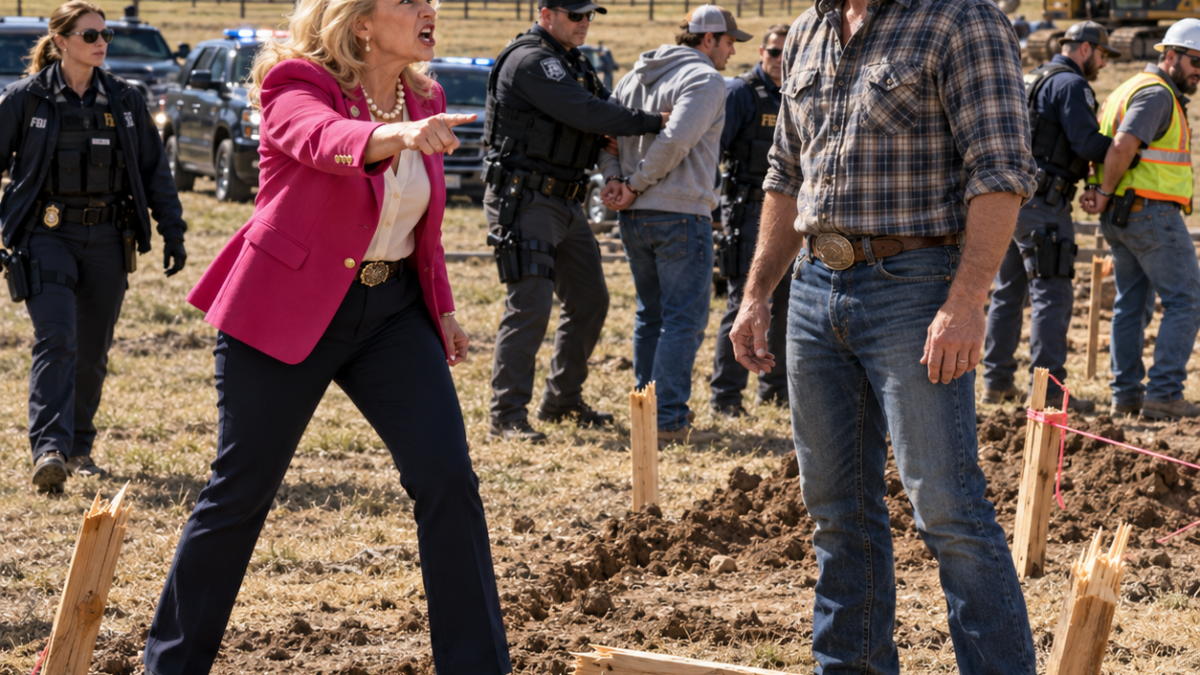
I was near the barn when three federal vehicles came up the access road toward the summit project site.
White and dark green markings.
Government plates.
No sirens.
No drama.
Just the kind of arrival that makes machinery seem suddenly very small.
Jocelyn Hartwell stepped out of the lead vehicle with a folder in her hand.
She was in her forties, composed, practical-looking, with boots that suggested she spent more time on land than behind a desk.
A cadastral specialist followed her.
A land management officer stepped out behind him.
I stayed by my fence.
This was no longer mine to perform.
Marlene saw them and marched down from the project trailer with the same confidence she had used on me, Dean, Rhett, Naomi, Warren, and every resident who had dared question her.
“Can I help you?” she called.
Jocelyn looked up from her map.
“Marlene Prescott?”
“Yes.”
“I’m Jocelyn Hartwell with the federal land field office. We’re here to verify a boundary concern.”
Marlene’s smile turned brittle.
“This is homeowners association property. You’ll need permission to enter an active construction site.”
Jocelyn studied the map for another second.
Then she looked at Marlene.
“Determining whose property this is happens to be the purpose of the visit.”
That line traveled across the site like wind.
Workers stopped moving.
Rhett, who had come to retrieve documents after being pushed aside, stood near his truck and watched silently.
Naomi had arrived too, though Marlene clearly had not invited her.
Dean walked the federal team through the coordinates.
He did not gloat.
He did not rush.
He showed them the surviving monument, the field notes, the retraced line, the missing witness post positions, the stumps, the HOA stakes, the access road cut, and the foundation corner.
The federal team measured.
Checked.
Rechecked.
Marked.
Compared.
The process took hours.
Marlene tried twice to interrupt.
Jocelyn did not argue with her.
She simply continued working.
There is a certain kind of authority that does not need volume.
By early afternoon, the answer was official.
Silver Crest equipment and grading activity had crossed into land under federal jurisdiction.
A portion of the project footprint extended beyond lawful boundaries.
The removed witness posts had aligned with the boundary Dean originally marked.
And construction had continued after written notice to preserve the area.
Jocelyn asked one question.
“Who gave the order to remove the original survey posts?”
For the first time all day, nobody spoke.
Rhett looked away.
Naomi looked at Marlene.
Workers pretended to study their boots.
Marlene lifted her chin.
“I did.”
Jocelyn wrote it down.
“They were interfering with construction progress,” Marlene added.
Jocelyn kept writing.
That was worse than any argument.
Marlene wanted a fight.
Jocelyn gave her a record.
After more verification, Jocelyn issued the order.
All work within the affected area was halted immediately pending federal review.
No grading.
No digging.
No concrete.
No equipment movement.
No access beyond authorized personnel.
The summit project stopped cold.
Within an hour, yellow federal warning tape stretched around idle machinery.
Signs went up.
FEDERAL AREA
ACCESS RESTRICTED
The bulldozers that had roared across the ridge sat silent behind tape.
Excavators froze with their buckets lowered.
Flatbeds waited with nothing to haul.
Workers packed up tools without needing to be told twice.
That image became the one nobody in Silver Crest forgot.
That morning, Marlene had stood beneath a banner promising residents that the summit was coming.
That afternoon, her $11.8 million project sat dead quiet behind federal warning tape.
She turned toward me.
Her face had gone pale with fury.
“You called them.”
I stood on my side of the fence.
“I reported the coordinates.”
“You did this.”
“No, Marlene.”
I looked at the cut stumps along the fence line.
“You crossed the line.”
Something about that answer broke through the noise.
Not because it was clever.
Because it was literally true.
The line had been there the whole time.
She had cut the posts because she thought the posts were the obstacle.
They were only warnings.
The boundary remained.
The fallout arrived faster than even Warren expected.
Rhett turned over his work orders.
Every one of Marlene’s instructions.
Every warning he had sent.
Every message where she dismissed his concerns.
He had kept records because some professional instinct told him the project was going bad.
Now those records mattered.
Naomi called an emergency HOA meeting.
For the first time, residents heard the facts in order.
Marlene had received a title exception notice warning of federal boundary concerns.
She had not brought it to the board.
She had ordered twelve survey witness posts removed.
She had continued construction after Dean’s notice.
She had ignored the federal field office preservation request.
The project had crossed into land the HOA did not control.
Federal review was now active.
The lender suspended disbursements.
The title insurer demanded a new survey.
Contracts were frozen.
Vendors began asking whether they would be paid.
Residents who had invested additional funds for priority access to the pavilion demanded answers.
The beautiful renderings were replaced by spreadsheets, liability memos, and panic.
Marlene tried to blame me.
She stood in that meeting and said I had launched a personal attack against the community.
That I hated development.
That I wanted to destroy Silver Crest.
That I had manipulated obscure government records to stop progress.
Naomi let her speak.
Then Naomi projected Marlene’s own email onto the wall.
We are not delaying six months over ancient government markers.
The room went silent.
Naomi stood beside the screen.
“This outcome was not caused by Mr. Whitaker,” she said. “It was caused by a warning that was received and ignored.”
Marlene’s face turned red.
Then Warren Tisdale walked in.
He carried a folder thick enough to shift the room before he opened it.
“There is another matter,” he said.
The encroachment was not limited to federal land.
Nearly two acres of my private ranch had been graded without authorization during the project’s expansion work.
Warren laid out photographs, survey overlays, and restoration estimates on a folding table at the front of the room.
He explained everything calmly.
No theatrics.
No threats.
Just facts.
The grading equipment had reshaped ranch land that had never been part of any easement, agreement, or HOA claim.
Topsoil had been displaced.
Drainage had been altered.
Native grass had been stripped.
Restoration would take time, money, and professional oversight.
This was separate from the federal case.
A second front.
A second bill.
A second consequence of Marlene’s certainty.
Residents who had been sympathetic to her began looking at her differently.
It is one thing to support a leader fighting a stubborn neighbor.
It is another to realize that leader exposed your entire association to federal enforcement, private restoration claims, suspended financing, and possible insurance disputes because she did not want to slow down for a boundary review.
A board member finally asked the question out loud.
“Marlene, did you inform this board of the title exception before construction began?”
She opened her mouth.
Closed it.
The silence answered for her.
Within minutes, the board voted to strip her of authority over the project.
By the end of the meeting, she was removed as HOA president.
Outside, workers were already taking down the massive Summit Pavilion banner.
That part was not planned.
It just happened that way.
Marlene walked out of the clubhouse as the banner that had carried her grand promise sagged loose from its frame and folded in on itself.
Nobody clapped.
Nobody shouted.
Her collapse did not need an audience.
It needed only the truth catching up.
Federal review continued for months.
Jocelyn’s office referred the destruction of survey markers and unauthorized activity for further review through proper channels.
The affected areas had to remain untouched until restoration requirements were established.
Any portion of the project footprint outside lawful boundaries had to be removed or redesigned.
The HOA bore a significant portion of the cost.
The title insurer demanded corrected documentation.
The lender required revised plans.
The county required updated permits.
Everything Marlene had tried to avoid by cutting down twelve posts came back larger, slower, and more expensive.
As for my claim, I did not ask for the impossible.
I did not demand the HOA hand me the clubhouse.
I did not try to bankrupt residents who had mostly believed what they were told.
My requests were specific.
Restore the damaged ranch land.
Reimburse survey and legal costs.
Record the boundary agreement properly.
Agree in writing that the line would not be crossed again.
Warren said that restraint made the case stronger.
Maybe.
Mostly, I did it because my father had taught me that justice and revenge are not the same chore.
I wanted the land restored.
I wanted the line respected.
I wanted the lies corrected.
That was enough.
Naomi eventually became interim board president.
She did not want the job.
That was probably why she deserved it.
Her first official act was to send residents the full document packet Marlene had withheld.
Title exception.
Dean’s survey notices.
Federal preservation letter.
Email records.
Financial exposure memo.
Everything.
Transparency did not fix the damage, but it stopped the bleeding.
Rhett returned only after the new board guaranteed in writing that no work would continue without verified legal boundaries.
The redesigned pavilion, when it finally happened, looked nothing like Marlene’s original vision.
It sat farther back.
Smaller.
Less dramatic.
Within land the association actually controlled.
No access road crossed my ranch.
No overlook touched protected land.
No construction fencing leaned over my boundary.
The grand summit dream became a modest clubhouse that knew its place.
That was fitting.
Months after the shutdown, Dean came back to the ranch for the final coordinated survey.
Representatives from my ranch, the HOA, and the federal land office were all present.
No shouting.
No posturing.
No white pickup rolling in with threats.
Just survey equipment, notebooks, maps, and people careful enough to admit the line mattered.
New reference posts were placed with precision.
Not where Marlene wanted them.
Where the boundary already was.
I watched Dean set one of them near the same stretch where I had found the first stump months earlier.
He tamped soil around it with the heel of his boot.
“Solid,” he said.
I looked down the line.
Twelve new posts stood bright against the grass.
It was strange seeing them back.
For months, their absence had felt louder than any object should.
Now they stood quietly, doing the same simple job they had always done.
Pointing to a truth that existed whether people respected it or not.
I said, “Strange thing, isn’t it?”
Dean looked at me.
“She really thought cutting them down would change where the boundary stood.”
He smiled faintly.
“A marker only tells you where the line is, Silas. It doesn’t create the line.”
I looked toward the ridge.
In the distance, the remains of Marlene’s original construction site were still visible.
A scar in the hillside.
Not permanent, but not gone either.
Restoration crews would work on that for a long time.
So would the HOA.
So would the residents who had believed her.
So would Marlene, whether she admitted it or not.
She had once believed twelve small posts were the problem.
They were not.
They were the warning.
The problem was her belief that ambition could erase a boundary.
That confidence could replace records.
That a project rendering could outrank land law.
That if she removed the visible evidence, the invisible truth would somehow vanish with it.
She learned too late that land does not work that way.
Neither does truth.
I climbed back onto my ATV and started toward the ranch house.
Dean followed in his truck.
The western fence line looked ordinary again in the late afternoon light.
Grass moving.
Posts standing.
Cattle grazing below the slope.
From a distance, nobody would know how close Marlene came to turning that ridge into a legal disaster deeper than any hole her bulldozers dug.
But I knew.
Dean knew.
Naomi knew.
Jocelyn knew.
And somewhere in the records now, the federal government knew too.
That was enough.
I never had to raise my voice louder than Marlene’s.
I never had to block her machines with mine.
I never had to tear down her signs in the dark.
I simply let her keep moving forward, certain of her own authority, until the very boundary she tried to erase became the one thing powerful enough to stop her entire project cold.
Marlene cut down twelve posts because she thought they were standing in her way.
What she never understood was that those posts were not the boundary.
They were the last warning she received before crossing into land that was never hers.
[EXPANDED ENDING — 5000 WORDS]
The day Marlene Prescott lost control of the Silver Crest Summit Pavilion project, the ridge did not look any different.
That was the strange part.
The same wind moved through the grass. The same hawks circled over the high pasture. The same line of cedar trees stood along the western fence where my father had once taught me how to read clouds before a storm.
The land had not changed.
Only the story people told about it had finally cracked open.
For months, Marlene had spoken about that ridge like she could own it by describing it loudly enough. She called it community infrastructure. She called it modern development. She called it progress. She called my objections selfish, outdated, unreasonable, and dangerous to property values.
But after the federal warning tape went up around her idle machines, all those words began to sound very small.
I stood on my side of the fence that afternoon and watched residents gather near the clubhouse road in uneasy clusters. Some still did not understand what had happened. Some had heard rumors about federal land. Some thought it was a paperwork problem that could be fixed with another meeting, another vote, another attorney letter. A few looked directly at me and then looked away, as if they were beginning to realize I had not been the problem they had been told I was.
Marlene stood near the project trailer, talking fast into her phone.
Even from a distance, I could see the anger in her posture.
She had not yet accepted the difference between a delay and a shutdown.
A delay was something she could manage.
A shutdown was something she had caused.
Rhett Callaway’s crew moved differently now. Earlier that week, his workers had climbed in and out of machines like men racing a schedule. Now they loaded equipment with the quiet caution of people who understood that every bucket, blade, and tire track might become evidence. No one joked. No one shouted across the site. The bulldozers that had sounded so powerful that morning sat silent behind yellow federal tape.
That silence did more damage to Marlene than any speech I could have given.
Jocelyn Hartwell, the federal land agent, remained on site for hours after issuing the stop-work order. She was not theatrical about it. She did not raise her voice. She did not lecture. She took notes, confirmed coordinates, photographed disturbed ground, marked restricted areas, and explained the process to anyone who was legally entitled to hear it.
Marlene tried to interrupt twice.
The first time, Jocelyn let her finish and then continued exactly where she had left off.
The second time, Jocelyn looked at her over the top of the clipboard and said, “Mrs. Prescott, the record is being established now. You will have an opportunity to respond through the proper channels.”
The proper channels.
That phrase landed hard because Marlene had spent months trying to avoid exactly that.
She had preferred board meetings where she controlled the agenda. Contractor calls where she controlled the money. Resident gatherings where she controlled the story. Emails where she could bury warnings behind confident language.
But on that ridge, under federal review, the land itself became the agenda.
No one cared how expensive her renderings were.
No one cared how many residents had applauded her presentation.
No one cared that investors had been promised a scenic overlook by fall.
The only question that mattered was brutally simple.
Where was the line?
And once that question was answered, every other excuse collapsed around it.
Near sunset, Warren Tisdale drove up to the ranch house.
He did not come through the construction entrance. He came up my road, parked beneath the cottonwood, and walked toward the porch with a folder under his arm.
I was sitting on the steps, boots dusty, shirt damp with sweat, hands still smelling faintly of fence wire and grass.
He looked toward the western ridge.
“Well,” he said, “she finally did it.”
“Got herself stopped?”
“Made the facts louder than her voice.”
I almost smiled.
Warren sat beside me without asking.
For a while, neither of us spoke.
Down the slope, cattle moved slowly toward the water trough. The whole ranch seemed to be exhaling after holding its breath for weeks.
“What happens now?” I asked.
“Federal review continues. They’ll determine the full scope of unauthorized disturbance. Anything inside federal jurisdiction gets handled through their process. Separately, we move forward on your private land claim.”
“How much of mine did they grade?”
“Preliminary overlay says close to two acres.”
I looked at him.
“Two acres.”
“Yes.”
It was not the number alone that hit me.
Two acres on a working ranch is not abstract. It is grass, drainage, topsoil, seed, grazing pattern, weed control, fence access, and years of careful use. It is not just ground. It is function.
Marlene had treated it like empty space beside her dream.
Warren continued.
“We’ll need restoration estimates. Soil work. Reseeding. Possibly drainage correction depending on how far they cut into the slope.”
“I don’t want to punish the whole neighborhood for what she did.”
“I know.”
“I want it repaired.”
“That is not punishment.”
I looked toward the ridge.
“She’ll tell them it is.”
“She already has.”
That was true.
By dusk, Silver Crest residents were already receiving Marlene’s version.
A hostile rancher. An overreaching federal office. An outdated survey. A temporary political misunderstanding. A project too important to fail. A community under attack.
People like Marlene do not surrender a story just because it becomes false.
They tighten their grip.
But this time, Naomi Keating had copies.
Naomi had been quiet for most of the conflict. That had made some residents underestimate her. They saw Marlene as the leader because Marlene filled every room with certainty. Naomi sat at the treasurer’s end of the board table with a notebook, reading numbers and asking questions people found inconvenient.
But while Marlene performed confidence, Naomi preserved records.
The title exception notice.
The internal email about “ancient government markers.”
The board minutes where no vote had authorized pushing into disputed ground.
The project expense reports.
The warning letters Marlene had failed to circulate.
The federal preservation request.
By the time Naomi called the emergency meeting, she was not guessing anymore.
She had a file.
The meeting took place in the clubhouse two nights after the stop-work order.
I did not want to go.
Warren advised me to attend but not speak unless necessary. Dean came too, carrying rolled maps and wearing the same faded jacket he always wore when he wanted people to know he had come for facts, not politics.
The clubhouse parking lot was full.
Inside, residents packed the room wall to wall. Some stood with arms crossed, already angry. Others whispered with the stunned unease of people beginning to suspect that the project they had supported might be something very different from what they had been sold.
At the front of the room, the massive Summit Pavilion rendering still hung on the wall.
Glass walls.
Stone terrace.
Sunset overlook.
Happy residents gathered beneath string lights.
A future that now looked less like a promise and more like evidence.
Marlene sat at the board table, lips pressed tight, papers stacked neatly in front of her.
She had dressed like a woman prepared to regain control.
Naomi sat three chairs down.
No stack of speech notes.
No dramatic posture.
Just a laptop, a folder, and the calm expression of someone who had decided not to be afraid anymore.
Marlene opened the meeting.
“This community is facing an unprecedented external attack on a project approved through lawful association channels,” she began.
I felt Warren shift beside me.
Marlene continued, her voice rising with practiced emotion.
“For months, Mr. Whitaker has attempted to obstruct progress, intimidate contractors, and weaponize obscure historical records to interfere with a project designed to benefit every resident in Silver Crest.”
A few residents murmured.
Some nodded.
Old habits die slowly.
Marlene pointed toward the rendering behind her.
“The Summit Pavilion represents years of planning. It represents value, beauty, and community. We cannot allow one rancher’s hostility toward growth to destroy what we have built together.”
Then Naomi stood.
She did not ask permission.
She simply stood, connected her laptop to the projector, and said, “Before we discuss hostility, the residents deserve to see what the board was not shown.”
Marlene turned sharply.
“Naomi, this is not on the agenda.”
“It should have been months ago.”
The room went quiet.
The first document appeared on the screen.
The title company’s exception notice.
Federal boundary concern. Additional survey recommended. Do not disturb area pending verification.
Residents leaned forward.
Naomi said, “This was received three months before construction reached the ridge.”
Marlene’s face hardened.
“That document was preliminary.”
Naomi clicked again.
Marlene’s internal email appeared.
We are not delaying six months over ancient government markers.
Someone in the back of the room muttered, “Oh my God.”
Naomi turned toward the residents.
“This was written by President Prescott to the project manager after receiving the boundary warning.”
Marlene stood.
“You are presenting that out of context.”
Naomi looked at her.
“Then give us the context.”
Silence.
That silence did more than Naomi’s documents. It gave every resident in the room a chance to feel the gap where Marlene’s explanation should have been.
Naomi continued.
She projected Dean’s survey overlay next.
Then the federal preservation request.
Then photographs of the twelve cut witness posts.
Then my photographs of construction fencing placed across disputed land.
Then the federal stop-work notice.
By the time she finished, Marlene’s version of events had nowhere left to stand.
A man in the front row raised his hand, though the room had already stopped following normal meeting procedure.
“Are you saying she knew before construction?”
Naomi answered carefully.
“I am saying the association received warnings before construction continued, and those warnings were not brought to the full board for proper review.”
Another resident stood.
“Did our money fund work on land we don’t even own?”
Naomi’s face tightened.
“That is part of what must now be audited.”
The room erupted.
Marlene grabbed the microphone.
“This is panic. This is exactly the kind of panic Mr. Whitaker wanted to create.”
That was when Warren stood.
He did not move quickly.
He walked to the front with a separate folder and placed it on the table.
“My name is Warren Tisdale. I represent Silas Whitaker.”
Marlene snapped, “This is a private association meeting.”
Warren looked at Naomi.
Naomi said, “He is here because association activity has damaged private land. The residents need to hear the claim.”
Marlene’s face flushed.
Warren removed the first survey overlay and placed it under the document camera.
“This is not limited to federal land,” he said. “Nearly two acres of Mr. Whitaker’s ranch were graded without authorization.”
The room fell quiet again, but differently now.
The first silence had been shock.
This one was fear.
Warren pointed to the overlay.
“This area here was never part of any easement. Never conveyed. Never granted. Never approved for access, grading, staging, or construction activity. Yet equipment entered, stripped vegetation, changed drainage patterns, and disturbed productive ranch ground.”
He placed photographs beside the map.
Before.
After.
The difference was undeniable.
One woman covered her mouth.
A board member leaned forward, staring at the images like he might understand them differently if he looked hard enough.
Warren’s voice stayed measured.
“Mr. Whitaker’s demands are limited. Restoration of damaged land. Reimbursement of survey and legal costs. A binding recorded boundary agreement. Written assurance that this line will not be crossed again.”
Marlene laughed bitterly.
“Limited? He shut down an eleven-million-dollar project and calls his demands limited?”
Warren looked at her.
“The federal government shut down the work because construction crossed into land under federal jurisdiction. Mr. Whitaker documented what happened on his own property.”
Naomi added quietly, “And the project crossed because warnings were ignored.”
That was when one of the board members turned toward Marlene.
“Did you tell us about the title exception?”
Marlene did not answer.
He asked again.
“Did you tell us?”
She said, “There are always title details on projects of this size.”
“That is not what I asked.”
Her jaw worked.
The room waited.
Finally, another board member spoke.
“We need an emergency vote.”
Marlene’s head snapped toward him.
“Absolutely not.”
But the room had shifted beyond her reach.
For years, she had trained people to look to her before deciding what they believed. That night, for the first time, they looked at the documents instead.
The vote stripped Marlene of authority over the Summit Pavilion project.
Then another vote removed her as HOA president pending further review.
She tried to object on procedural grounds.
Naomi had already checked the bylaws.
Marlene tried to claim the meeting lacked authority.
The board secretary confirmed quorum.
Marlene tried to frame the vote as emotional overreaction.
A resident shouted, “You hid a federal warning from us.”
That ended the performance.
By the time Marlene walked out of the clubhouse, workers outside were taking down the Summit Pavilion banner from the entrance lawn.
I do not know who ordered it removed.
Maybe Naomi.
Maybe the receiver later appointed by the board.
Maybe some maintenance worker who had finally had enough.
But the timing was unforgettable.
Marlene stepped into the evening air just as one corner of the banner came loose.
The printed image of the glittering pavilion folded over on itself.
Then the whole thing sagged, wrinkled, and dropped into the arms of two men who carried it away like a broken promise.
No one cheered.
No one needed to.
Her authority had not exploded.
It had drained out, document by document, until nothing remained for her to stand on.
The weeks that followed were not dramatic in the way people expect.
There were no daily confrontations at the fence.
No shouting matches.
No dramatic arrests in front of cameras.
There were inspections.
Letters.
Insurance calls.
Survey revisions.
Federal review notices.
County restoration requirements.
Board audits.
Lender communications.
Vendor claims.
Attorney conferences.
That is how real consequences usually arrive.
Not as one thunderclap, but as weather that does not stop.
The lender suspended all remaining disbursements until the project could be redesigned within verified legal limits.
The title insurer required a completely updated survey before extending any coverage.
The county planning department reopened its review.
Federal officials required restoration plans for the disturbed protected area.
Every contract tied to the original pavilion footprint came under scrutiny.
Residents who had paid extra for priority pavilion privileges demanded to know whether their money was gone.
Some money was gone.
That was another truth Naomi had to tell them.
Dirt had been moved.
Vendors had been paid.
Materials had been ordered.
Consultants had invoiced.
Engineers had drawn plans around boundaries that should never have been used.
The money could not simply be snapped back into residents’ accounts because Marlene had finally been proven wrong.
Wrong decisions still send checks.
That was part of the damage.
At one board meeting, an older resident stood and said, “I trusted her.”
Nobody answered at first.
Then Naomi said, “So did many people. Trust is not a control system.”
I wrote that down later.
Trust is not a control system.
My father would have liked that.
He trusted neighbors, but he still kept fences maintained, deeds filed, and surveys in a metal cabinet above the workbench.
“Good fences are not insults,” he used to say. “They are reminders.”
Marlene had treated reminders like obstacles.
And obstacles, to her, existed to be removed.
After her removal, she disappeared from most public life.
I saw her only once during those early weeks.
She drove past the ranch entrance in her white pickup, slower than necessary, head turned toward the ridge.
I was repairing a gate latch.
She did not stop.
I watched the truck continue down the road.
For the first time, I felt no anger when I saw her.
Only recognition.
She was looking at the land the way people look at something they still believe should have been theirs.
That belief was the root of all of it.
Not confusion.
Not bad surveying.
Not contractor error.
Belief.
Marlene believed her vision was more important than the boundary.
More important than the title warning.
More important than Dean’s survey.
More important than Naomi’s questions.
More important than my ranch.
More important than federal land.
And because people had rewarded her confidence for years, she mistook that confidence for authority.
The federal process continued independently.
Jocelyn’s office required a full disturbance assessment. Specialists walked the affected ground with measuring equipment, soil probes, cameras, and maps. They documented where grading had crossed into protected land, where drainage had been altered, where vegetation had been stripped, and where equipment had compacted soil.
Jocelyn was thorough.
She did not exaggerate the damage.
She did not minimize it either.
One morning, while her team worked near the ridge, she walked over to where I stood by the fence.
“Mr. Whitaker,” she said.
“Silas is fine.”
She nodded once.
“Silas, your documentation helped. The photographs of the cut posts, the coordinates, the dates—without that, establishing sequence would have taken much longer.”
“I figured the paper would matter.”
“It did.”
She looked toward the disturbed slope.
“People often think boundary cases are about dirt. They are usually about decision-making.”
“That sounds right.”
“Your neighbor made several decisions after being warned.”
“My neighbor would be the wrong word.”
For the first time, Jocelyn almost smiled.
“Fair enough.”
I asked, “What happens to her?”
“That depends on which channels move forward. Administrative consequences are certain. Civil liability is already obvious. Anything beyond that will depend on findings and intent.”
“She admitted ordering the posts cut.”
“She did.”
“She said they interfered with construction.”
“She did.”
Jocelyn looked at the ridge.
“Sometimes people confess the important part because they do not understand what the important part is.”
That stayed with me.
Marlene had admitted the order proudly because in her mind it showed leadership.
Decisiveness.
Control.
She had not understood that those same words would show willful removal of boundary evidence after prior warning.
Rhett Callaway came by the ranch a week later.
He drove alone, no crew, no company logo trailer behind him.
I met him near the barn.
He took off his cap and held it in both hands.
“I owe you an apology,” he said.
That surprised me.
“For what?”
“For not stopping sooner.”
“You weren’t the one giving orders.”
“No, but I knew something was wrong before I acted like I knew.”
I let that sit.
The easiest thing would have been to tell him not to worry about it, but I had learned not to hand out forgiveness just to make a conversation more comfortable.
Rhett looked toward the ridge.
“I’ve built roads, retaining walls, foundations, drainage systems. I know when a site feels wrong. Those stakes bothered me. Your surveyor bothered me. Marlene’s answers bothered me. I kept telling myself the owner had the paperwork.”
“Did she?”
“No.”
He looked back at me.
“I kept records. I gave them to Warren and the board.”
“I heard.”
“Not to save myself entirely.”
“No?”
“Maybe partly. I’m not going to lie. But also because if I let her write the story, she’d bury every warning I gave her.”
I believed that.
Marlene had already tried to blame him.
She said Rhett misunderstood plans.
Rhett had emails showing otherwise.
She said he never raised concerns.
Rhett had daily logs showing he did.
She said contractors had full discretion over field decisions.
Rhett had written instructions from her office telling him to proceed.
Records saved him from becoming her shield.
That did not make him innocent of every delay in judgment, but it made him useful to the truth.
“You coming back to finish the redesigned project?” I asked.
“Only if the new board puts every boundary condition in writing.”
“Smart.”
“I should’ve required that before.”
“Yes.”
He nodded.
That was all he needed me to say.
The restoration of my private land began before the federal portion was fully resolved.
I insisted on that.
The damaged ranch acreage had to be corrected while the season still allowed reseeding.
A soil specialist came first. Then a drainage consultant. Then a native grass supplier. Then a crew that worked carefully, nothing like the bulldozers that had caused the damage.
They recontoured the disturbed slope.
Replaced topsoil where they could.
Stabilized the drainage cut.
Seeded native grass.
Installed temporary erosion control.
It would take time for the land to heal.
Land does not accept apology on paper.
It requires seasons.
Rain.
Roots.
Patience.
For weeks afterward, I rode out every evening to check the restored section.
At first, it looked raw.
Too clean.
Too arranged.
Like a wound after stitches.
Then small green blades appeared.
Not many.
Enough.
Claire, my sister, came out one Sunday with her kids. They stood at the fence while I explained why the grass mattered.
My nephew, twelve years old and impatient with adult explanations, asked, “Why didn’t you just move the posts back and tell her to leave?”
I looked at Dean, who had come by with updated measurements.
Dean answered before I did.
“Because a post is not the line.”
My nephew frowned.
“What?”
Dean crouched and drew in the dirt with a stick.
“The line exists because of records, monuments, measurements, and law. A post helps people see where it is. But if someone pulls up the post, the line stays where it was.”
The boy looked at the new grass.
“So cutting them didn’t do anything?”
“It did plenty,” I said. “It proved she knew they were in the way.”
Dean smiled.
“Exactly.”
That became the lesson I carried from all of it.
A marker is not the truth.
It points to the truth.
Destroying the marker does not destroy what it points to.
Marlene never understood that distinction.
Naomi did.
Under her temporary leadership, Silver Crest changed slowly.
Not perfectly.
No community shifts overnight from personality-driven rule to actual governance.
Some residents still missed Marlene’s energy. They missed her certainty. They missed the way she made everything feel possible. People often miss confidence even after it costs them money.
But Naomi forced the board to operate differently.
Meeting packets were distributed in advance.
Legal warnings had to be shared.
Large expenditures required documented review.
Boundary work required independent verification.
No project could proceed on land-adjacent construction without recorded title confirmation.
Residents complained at first that it was too slow.
Naomi’s answer became famous in the neighborhood.
“Slow is cheaper than federal tape.”
That shut most of them up.
The redesigned Summit Pavilion eventually came back for approval.
I attended the public county hearing, not because I wanted to stop it, but because I wanted to hear the words spoken into the record.
The new project footprint sat entirely within Silver Crest’s verified land.
The access road no longer crossed my ranch.
The overlook had been reduced and pulled back from the federal boundary.
The parking area had been relocated.
The design was smaller, less dramatic, and far more honest.
One planning commissioner asked Rhett Callaway whether he was confident about the revised boundaries.
Rhett answered, “Yes, because this time they were verified before design rather than argued after grading.”
That sentence earned a few uncomfortable looks from the Silver Crest side.
Good.
A little discomfort can be useful if it keeps people from repeating expensive mistakes.
Warren leaned toward me and whispered, “That may be the closest thing to a confession we get from the construction industry.”
I almost laughed.
When the county approved the revised plan with conditions, I felt no resentment.
That surprised some people.
They expected me to oppose anything Silver Crest wanted forever.
But that was not the point.
The point was not to stop every building.
The point was to stop theft disguised as building.
If they stayed on their land, respected the federal boundary, restored what they damaged, and stopped treating my ranch like overflow space, they could build their modest clubhouse and hang all the string lights they wanted.
I had cattle to feed.
I had fences to mend.
I did not need to own their future.
I only needed them to stop trying to own mine.
Months passed.
The restored grass thickened.
The federal tape disappeared.
The old construction scar softened.
The new reference posts stayed bright through sun, dust, and the first fall rain.
Marlene’s name faded from meeting minutes.
At first, residents still said, “Back when Marlene was president.”
Then it became, “Before the boundary mess.”
Then just, “Before.”
That is how communities digest scandal.
They rename it until they can live beside it.
One afternoon near the end of summer, Dean and I rode the western fence line together.
He drove his truck slowly while I followed on the ATV.
No urgency.
No missing posts.
No machines idling beyond the fence.
Only the slow routine of men checking work that had finally been done right.
We stopped at the first new reference post.
Dean stepped out and checked the cap.
“Still solid.”
I looked down the line.
All twelve stood where they belonged.
Orange tops bright against the grass.
“You ever get tired of being right?” I asked.
Dean snorted.
“I’m a surveyor. I get paid because everybody thinks they’re right until measurements show up.”
We walked to the next post.
In the distance, the redesigned pavilion site was active again, but smaller now. The machinery stayed well back. The workers did not cross the line. No one waved us off. No one called my ranch outdated. No one laughed at ancient government markers.
That quiet respect felt better than any apology Marlene could have offered.
At the third post, I stopped.
“This is where I found the first stump.”
Dean looked down.
“I remember.”
“I can still see it.”
“You probably will for a while.”
I nodded.
For months, I had imagined that cut stump whenever I thought of Marlene. The clean saw mark. The pale wood. The tire track beside it. The arrogance of someone believing that removing a warning was the same as removing the problem.
Now a new post stood in its place.
Straight.
Measured.
Documented.
Witnessed by ranch, HOA, and federal representatives alike.
No one could call it junk now.
Dean said, “Strange thing, isn’t it?”
“What?”
“How often people think land is flexible because paper seems complicated.”
I looked across the ridge.
“Land is patient. People confuse that with weakness.”
He smiled.
“That sounds like something your father would’ve said.”
“It probably is.”
We walked the rest of the line.
At the final post, Dean rested one hand on top of it.
“Marlene thought these created the boundary,” he said.
“No. She thought destroying them destroyed the boundary.”
“Same mistake.”
He was right.
The marker only tells you where the boundary already is.
It does not create the boundary.
It cannot move it.
It cannot erase it.
It can be cut, pulled, burned, buried, or ignored, and the line remains where law, record, monument, and measurement place it.
That is what stopped Marlene.
Not me.
Not Dean.
Not Warren.
Not Naomi.
Not even Jocelyn.
We all played our parts, but the boundary itself was the thing she could not beat.
It had been there before her project.
Before her presidency.
Before Silver Crest.
Before the renderings, the banners, the investor presentations, the private access promises, the bulldozers, and the saw that cut those posts at sunrise.
The line had been waiting.
All we did was prove it.
On the ride back toward the ranch house, I passed the place where Marlene’s original access road would have crossed my pasture.
The restored ground was green now.
Not perfect.
Healing.
I slowed the ATV and let the engine idle.
For the first time in months, I did not feel anger looking at it.
I felt protective, yes.
Watchful.
But not angry.
Anger had done its work early. It woke me up. It made me document. It kept me from dismissing twelve missing posts as nothing.
But anger is not meant to be a permanent residence.
The land needed care, not rage.
So I drove on.
Dean followed behind me, dust rising softly under his tires.
At the ranch house, he loaded his equipment and closed the truck bed.
Before leaving, he looked back toward the western ridge.
“You know,” he said, “most people would’ve made this uglier.”
“How?”
“Blocked machines. Threatened workers. Pulled their stakes. Turned it into a shouting match.”
“I thought about it.”
“I know.”
“I’m not that patient.”
“No,” Dean said. “You’re just patient enough.”
That was probably the best compliment he had ever given me.
After he drove away, I sat on the porch until the evening cooled.
The ridge turned gold.
The fence line cast long shadows.
The new posts caught the last light.
Somewhere beyond them, the smaller pavilion project continued inside its proper limits.
That was enough.
Not every victory requires destruction.
Sometimes victory is a bulldozer that stops where it should have stopped in the first place.
Sometimes it is a board finally reading the documents it should have read months earlier.
Sometimes it is a treasurer finding her voice.
Sometimes it is a federal agent writing down an admission without blinking.
Sometimes it is grass growing back over land someone thought they could take.
And sometimes it is twelve new posts standing where twelve old ones were cut down, quietly reminding everyone that the truth had never moved.
Marlene Prescott had believed the posts were obstacles.
She had believed I was the obstacle.
She had believed Dean’s maps, Warren’s letters, Naomi’s questions, and Jocelyn’s review were obstacles.
But the real obstacle was simpler.
The land was not hers.
Everything else followed from that.
When the sun finally slipped behind the ridge, I walked down from the porch and closed the ranch gate for the night.
I paused with my hand on the latch and looked west.
For the first time since that morning when I found the stumps, the fence line felt ordinary again.
That was the ending I wanted most.
Not Marlene humiliated.
Not Silver Crest ruined.
Not some dramatic public apology that would never sound honest anyway.
Ordinary.
The quiet right of a boundary respected.
The simple peace of land allowed to be what it had always been.
The knowledge that my father’s ranch had held its line without me turning myself into the kind of man Marlene expected to fight.
I did not beat her by shouting.
I did not beat her by force.
I did not even beat her by being clever.
I let the records speak.
I let the land speak.
I let the line remain exactly where it had always been until everyone else had no choice but to see it.
Marlene cut down twelve survey posts because she thought they stood between her and victory.
She never understood they were the last mercy the boundary offered her.
After that, there was no warning left.
Only the line.
And the line stopped her cold.
[END]