PART 2: HOA Karen Called the Cops Because I Looked Too Poor to Own My House—So I Hired a PI, and What He Found Shook the Entire Neighborhood
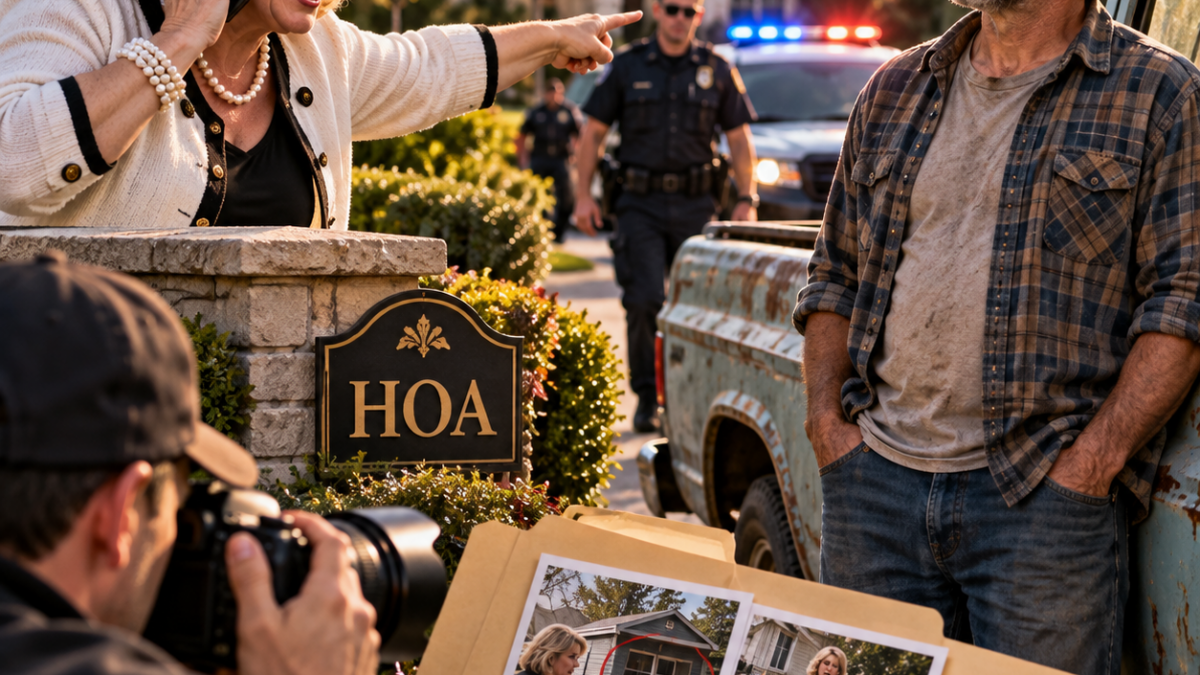
PART 2
“You thought somebody was burglarizing the place with a U-Haul?”
Her smile tightened.
“I didn’t know what was happening.”
“You could’ve walked over and asked.”
“Safety comes first.”
That answer told me everything.
She hadn’t been afraid to stand at the end of the street and watch police confront me.
She had simply been unwilling to walk over and speak to me like a neighbor.
I told her I’d bought the house.
Closed three days earlier.
Moving in permanently.
Her eyes slowly traveled over me.
Sweat-stained shirt.
Old jeans.
Work boots.
Callused hands.
Then she glanced toward the open U-Haul, where some of my secondhand furniture was still visible.
Something changed in her face.
It wasn’t surprise.
It was judgment.
“Well,” she said eventually, “welcome to Willowbrook. I’m sure you’ll find our community standards educational.”
Then she turned around and walked away.
I stood in the driveway watching her.
Educational.
That was the word she’d chosen.
Not welcoming.
Not friendly.
Educational.
As if I had arrived needing correction.
I finished moving alone.
By sunset, every box was inside.
The U-Haul was empty.
I should have been sitting on my couch drinking a cold beer and enjoying the first evening in the first house I’d ever owned.
Instead, I stood in the middle of my living room and felt like someone had already entered without permission.
Janet Sanders knew almost nothing about me.
But she’d looked at my clothes, my truck, my furniture, and my hands and made a decision.
I didn’t fit.
I told myself to forget about it.
People make mistakes.
Maybe she really had been cautious.
Maybe the whole thing would become one of those uncomfortable stories I laughed about later.
One week later, the first violation notice arrived.
I found it when I came home from work.
White envelope.
Willowbrook Estates HOA logo.
NOTICE OF VIOLATION printed in bold across the top.
The offense?
Improper debris management.
I had placed flattened moving boxes beside the curb for Thursday trash pickup.
Neatly stacked.
Exactly where other residents placed theirs.
Fine: $75.
I stood beside my mailbox reading it twice.
Then I laughed.
“Seriously?”
I could have fought it.
Instead, I paid.
Seventy-five dollars wasn’t worth turning a stupid misunderstanding into a neighborhood war.
At least that’s what I thought.
The second letter arrived the following week.
Vehicle Aesthetic Standards Violation.
Apparently my ten-year-old Ford F-150 was “visually inconsistent with community expectations.”
I read that phrase three times.
Visually inconsistent.
The truck ran perfectly.
No rust.
No broken windows.
No leaking fluids.
I washed it regularly and maintained it better than some people maintained their houses.
The notice suggested that I either replace it with a newer vehicle or keep it inside my garage.
Fine: $150.
Additional penalties would accumulate each week.
I looked down the street.
Two houses away, somebody had a boat sitting uncovered in a driveway.
Across from me sat an old utility trailer with visible rust along the frame.
Neither owner seemed concerned.
That evening, I walked over and spoke to one of them.
“You ever get an HOA notice for that trailer?”
He frowned.
“No.”
“Never?”
“No. Why?”
I showed him mine.
He whistled softly.
“Janet send this?”
“Apparently.”
He gave me a strange look, then handed the letter back.
“Good luck.”
That was all he said.
Good luck.
As if everybody already knew what kind of person I was dealing with.
I wrote a polite response to the HOA.
I explained that my vehicle was registered, maintained, operational, and caused no hazard. I also asked why similar vehicles and equipment elsewhere in the neighborhood had not received citations.
No response.
Then Janet came to my house personally.
Seven in the evening.
I was halfway through dinner when she knocked.
I opened the door.
She stood beneath my porch light holding another envelope.
“Mr. Jones.”
“Janet.”
“We’ve received reports that you may be operating an unauthorized rental property.”
I stared at her.
“What?”
“Multiple vehicles have been observed here at unusual hours.”
I almost smiled.
“You mean Marcus?”
“I don’t know who you’re referring to.”
“My friend. He drove from Cincinnati to help me replace the water heater. He stayed one night.”
She gave me a slow nod.
“I see.”
There was that voice again.
Polite enough to sound reasonable.
Cold enough to make every word an accusation.
“Well, we’re required to investigate reports.”
“Reports from who?”
“I can’t disclose complaints made by residents.”
“You mean complaints made by you?”
Her expression didn’t move.
“Nothing personal, Mr. Jones.”
She handed me the envelope.
Inside was a demand for proof of sole occupancy.
Utility bills.
Occupancy documents.
A written declaration that I wasn’t renting rooms.
Statements from neighbors.
I looked up.
“You want me to prove I live alone in the house I own?”
“It’s standard procedure.”
“No, it isn’t.”
Her smile disappeared for half a second.
“You’ve been here less than a month. I would suggest familiarizing yourself with how this community operates.”
There it was.
Not a request.
A warning.
I stepped closer to the doorway.
“And I’d suggest you stop treating me like I’m doing something wrong just because you keep imagining things.”
Her eyes hardened.
“We enforce standards equally.”
“Then I’m sure you won’t mind explaining why the boat down the street gets ignored while my truck gets fined.”
She didn’t answer.
Instead she gave me a small smile.
“Good evening, Mr. Jones.”
Then she walked away.
I shut the door harder than I intended.
That night I called my mother.
She lived four hours away in Indiana, in the same little house where I grew up.
I didn’t tell her everything.
I just said the HOA was giving me some trouble.
She became quiet.
Then she said, “Joe, you worked your whole life for that house.”
“I know.”
“Don’t let somebody make you feel like you don’t deserve to be there.”
“I won’t.”
“Promise me.”
I looked around my kitchen.
Boxes still stacked against the wall.
Tools from the water-heater installation sitting near the pantry.
My house.
My mortgage.
My years of sacrifice.
“I promise.”
After we hung up, I sat in the dark for almost an hour.
That was when I stopped seeing Janet’s behavior as irritating.
It was deliberate.
And it was escalating.
I filed a formal grievance with the HOA alleging selective enforcement.
I included photographs.
Dates.
Examples.
My truck citation beside photos of the neglected trailer.
The cardboard fine compared with trash left elsewhere.
I expected the matter to go before some neutral committee.
Instead, two weeks later, I received a response.
One paragraph.
Your complaint has been reviewed and deemed without merit.
Signed:
Janet Sanders.
That was when I finally understood the structure of the place.
Janet wasn’t simply HOA president.
She chaired the compliance committee.
She had influence over architectural review.
She controlled the meeting agendas.
Her friends occupied key board positions.
Complaints about Janet went through Janet.
Appeals of Janet’s decisions went to people aligned with Janet.
It wasn’t that the system was malfunctioning.
The system was built around her.
Then I met Carol Whitman.
She stopped me while I was checking my mailbox one afternoon.
She was around sixty, silver hair cut short, gardening gloves tucked into the back pocket of her jeans.
“You’re Joe, right?”
“Yeah.”
“The new guy.”
“That’s me.”
She looked toward Janet’s house.
“She’s giving you trouble.”
It wasn’t a question.
I studied her.
“How’d you know?”
Carol smiled without humor.
“Because she gave me trouble when I moved here. And the family before you. And another couple on Birch Court.”
“What kind of trouble?”
“The kind where rules suddenly become very important when she decides she doesn’t like somebody.”
I glanced toward Janet’s house.
“What does she have against me?”
Carol looked at my old truck.
Then at my work clothes.
Then back at me.
“I think you already know.”
I didn’t answer.
Before leaving, she lowered her voice.
“Be careful.”
“Why?”
“Because Janet has more power here than people realize.”
She took two steps, then stopped.
“And she’s protecting something.”
That caught me.
“What?”
Carol shook her head.
“I’ve never figured that part out.”
Then she walked away.
I watched her disappear into her house.
Protecting something.
For the next couple of weeks, that sentence stayed with me.
Then came the monthly HOA meeting.
I had never bothered attending before.
I figured HOA meetings were mostly arguments over landscaping and pool rules.
But things in the neighborhood had changed.
People were watching me.
I noticed conversations stopping when I walked past.
A woman who used to wave from her porch suddenly avoided looking at me.
One evening while I jogged past a family on the sidewalk, the mother pulled her child closer.
That bothered me more than any fine.
So I went to the meeting.
About sixty people were packed into a room meant for forty.
Janet sat at the front behind a long table, wearing a cream blazer and pearl earrings.
She looked completely comfortable.
Budget updates.
Landscaping.
Pool fence.
Routine business.
Then Janet reached “community concerns.”
She adjusted the microphone.
“As many of you know, we’ve had certain security concerns recently.”
My stomach tightened.
She continued.
“There have been unfamiliar vehicles, unusual activity, and individuals whose relationship to certain properties has raised questions.”
People started turning around.
Looking at me.
She never said my name.
She didn’t need to.
“We’re considering establishing a neighborhood watch program,” she said. “Residents should report anything suspicious. We also want to ensure that properties are being occupied by their legitimate owners and used in accordance with community standards.”
Someone whispered.
Another person nodded.
I felt heat rise into my face.
She had just turned sixty neighbors into amateur investigators assigned to watch me.
And because she never used my name, she could deny everything.
The consequences came quickly.
Neighbors who once nodded stopped.
The children next door suddenly stopped playing outside when I was in my yard.
Then I found a note in my mailbox.
No signature.
No envelope.
Just one sentence.
WE DON’T WANT TROUBLE HERE. MAYBE YOU SHOULD FIND SOMEWHERE MORE SUITABLE.
More suitable.
I stood in the driveway reading those words.
Something in me changed.
I had spent fifteen years being careful.
Saving.
Working.
Following rules.
Avoiding debt.
Doing everything people tell you to do when they say, “Work hard and build a life.”
Then I finally bought a home.
And within two months, strangers were suggesting I leave because one woman had decided I looked wrong.
At the next HOA meeting, I came prepared.
When Janet opened the floor, I stood.
“I’d like to address the community.”
Her smile twitched.
“Mr. Jones, this portion is limited to questions concerning scheduled agenda items.”
I ignored her.
“My name is Joe Jones. I own 47 Maple Lane.”
The room quieted.
“I purchased that property legally. I have the deed. I have closing papers. I have mortgage documents. I have identification. If anybody in this room wants to inspect them, they’re right here.”
I lifted the folder.
A man in the second row laughed.
“Nobody asked for your life story, buddy.”
A few people chuckled.
Janet raised one hand.
“Mr. Jones, perhaps this isn’t the appropriate forum—”
“You made it the appropriate forum.”
Silence.
Her eyes narrowed.
I continued.
“When you stood in this room last month talking about suspicious individuals who might not legally own the properties they live in, half this room turned around and looked at me.”
“That is your interpretation.”
“No. That’s what happened.”
Someone near the back raised a phone.
Recording.
“I am not a squatter. I am not running an illegal boarding house. I am not breaking into a vacant property. I am a homeowner.”
Nobody laughed now.
“I work for a living. I paid for my house. I pay my dues. And I’m done being treated like I need to prove I belong here every week.”
Janet stared at me.
Then she smiled.
“Thank you for sharing, Mr. Jones.”
Sharing.
As though I had just discussed my feelings in group therapy.
“Now,” she said, “we’ll return to the agenda.”
The meeting continued.
But the room felt different.
Afterward, while I was heading toward the exit, Janet intercepted me.
“Mr. Jones.”
I turned.
She stepped close enough that nobody else could easily hear.
Her voice was low.
“That little performance changes nothing.”
“Wasn’t a performance.”
“You think waving a deed around makes you one of us?”
I stared at her.
There was no smile now.
“I’ve been running this community for seven years,” she said. “I know everyone here. Their families. Their businesses. Their history.”
She tilted her head.
“You’ve been here two months.”
“So?”
“So you have no idea what you’re dealing with.”
I looked directly into her eyes.
“Neither do you.”
For the first time since I’d met her, Janet looked surprised.
Only for a second.
Then she straightened her blazer.
“Good night, Mr. Jones.”
She walked away.
That night, the video of my speech appeared in the private neighborhood group.
Caption:
NEW HOMEOWNER GETS DEFENSIVE AT MEETING. THOUGHTS?
The comments divided almost instantly.
He showed proof. Leave the guy alone.
Why is he so angry if he has nothing to hide?
Janet is just protecting property values.
This feels like harassment.
Maybe there’s more to the story.
I read them until midnight.
Then I shut my laptop.
Janet had succeeded in turning my existence into a neighborhood debate.
But I wasn’t leaving.
Then came the graffiti.
Saturday morning.
I opened my garage expecting to mow the lawn before it got hot.
Instead I saw red spray paint across the door.
GO BACK WHERE YOU CAME FROM.
I froze.
The words were huge.
Two feet tall.
Paint dripping down the panels.
For weeks, Janet’s campaign had been paperwork.
Fines.
Whispers.
Suspicion.
This was different.
Someone had come onto my property at night.
Someone had stood ten feet from where I slept.
Someone had painted a message across my home telling me to leave.
I took photographs.
Then I called police.
The officers were professional.
They photographed everything and filed a report.
“Security cameras?” one asked.
“No.”
“Neighbors?”
“Not that face this direction.”
He nodded.
Without witnesses or footage, there wasn’t much they could do.
They gave me a case number.
Two hours after they left, Janet emailed the entire neighborhood.
We are aware of a vandalism incident on Maple Lane and are deeply concerned. The board encourages anyone with information to come forward.
That was it.
Not a mention of the months of hostility.
Not a mention that I’d been the target.
Not a word acknowledging why somebody might suddenly believe I needed to “go back” anywhere.
I tried every official channel I could find.
Civil rights commission.
Attorney.
Even a newspaper.
The answer changed slightly depending on who gave it, but the message was basically the same.
Where’s your proof?
One attorney listened carefully.
“You may have a harassment claim,” he said. “But proving intent will be difficult.”
“What would it cost?”
He sighed.
“Twenty thousand dollars wouldn’t be unusual if this turns into serious litigation.”
I almost laughed.
Twenty thousand.
Most of my savings had gone into the house.
The newspaper reporter sounded interested until her editor rejected it.
“Without criminal charges, litigation, or stronger evidence, they see it as a private HOA dispute.”
I thanked her.
Then I sat in my kitchen staring at my folder.
Three months of documentation.
Fines.
Letters.
Photos.
Emails.
Meeting notes.
Police reports.
And somehow I still felt as powerless as I had the morning the police showed up.
Then Carol knocked on my door.
She carried a bottle of wine.
“Saw the garage.”
I stepped aside.
“Come in.”
We sat at the kitchen table.
I told her everything.
Not just the sequence.
The humiliation.
The exhaustion.
The anger.
How every time I drove into the neighborhood, I wondered who was watching.
How I no longer relaxed in my own front yard.
How I’d started checking the windows before going to bed.
How buying a house had somehow made me feel less secure than renting ever had.
Carol listened.
When I finished, she poured another glass.
Then she said, “There’s something about Janet you should know.”
I looked up.
“She came here after her divorce.”
“Okay.”
“Her husband got almost everything.”
“So?”
“Then she filed bankruptcy.”
I waited.
“Two years later she’s driving a new Lexus, wearing a Rolex, refinancing her house repeatedly, and living like somebody with a lot more money than she actually makes.”
That got my attention.
Carol leaned forward.
“She’s also been the primary person controlling the HOA finances for seven years.”
“Are you saying she’s stealing?”
“I’m saying I don’t know.”
Carol paused.
“But I’ve never seen an independent audit.”
“Never?”
“Not once.”
“Financial statements?”
“One-page summaries.”
“Bank records?”
She shook her head.
“Vendor invoices?”
Another shake.
“She’s always got an explanation.”
I leaned back.
Carol’s next words changed the entire direction of the fight.
“Sometimes people spend a lot of energy controlling who gets close because they don’t want anybody looking behind them.”
I thought about Janet.
The police call.
The citations.
The threats.
Her obsession with controlling meetings.
Her reaction when challenged.
“What do I do with that?”
Carol hesitated.
Then she wrote a name on a piece of paper.
Gerald Hines.
“Who is he?”
“Former detective. Private investigator now. Financial fraud, civil disputes.”
I looked at her.
“You’ve used him?”
“No.”
“Then how do you know him?”
“Friend of my brother.”
She pushed the paper toward me.
“He’s expensive.”
“How expensive?”
“Enough that you won’t like it.”
I looked at the name.
Three months earlier, hiring a private investigator over an HOA dispute would have sounded ridiculous.
Now it sounded like the first useful option anybody had given me.
I called Gerald the next morning.
Three days later, I sat across from him in a plain office above an insurance agency.
He was in his fifties, heavyset, gray beginning to show at his temples.
His office had no dramatic detective-movie atmosphere.
Just filing cabinets.
Computer.
Coffee.
Stacks of paper.
He listened to my story without reacting.
Then he asked questions.
Dates.
Names.
Board positions.
How many notices.
Who signed them.
What financial records residents received.
Whether Janet had outside employment.
Whether I’d seen audits.
After nearly an hour, he leaned back.
“What exactly are you asking me to do?”
“I want to know what she’s hiding.”
He studied me.
“You understand I might find nothing.”
“I understand.”
“And even if I find something questionable, questionable isn’t necessarily illegal.”
“I understand.”
“And my retainer is thirty-five hundred dollars.”
That hurt.
Thirty-five hundred dollars represented most of what remained in my emergency fund.
Money I had spent years building.
I thought about the graffiti.
Then about the police cruiser on moving day.
I took out my checkbook.
Gerald watched me write.
“You sure?”
“No.”
That made him smile slightly.
“But I’m doing it.”
He accepted the check.
“Then let’s find out who Janet Sanders really is.”
A week later, Gerald asked me to meet him at a diner outside town.
“Not Willowbrook,” he said. “No reason to advertise.”
We took a booth in the back.
He placed a manila folder between us.
“You were right about one thing.”
“What?”
“Her public image and her financial history don’t match.”
He opened the folder.
Janet Marie Sanders.
Divorced.
Bankruptcy.
Debt.
Refinancing.
Gerald had reconstructed years of publicly accessible records.
After her divorce, Janet had walked away with little.
About fifteen thousand dollars in savings and an old Honda.
Two years later, she filed Chapter 7 bankruptcy.
Tens of thousands in debt.
Then, somehow, her lifestyle changed.
Lexus.
Jewelry.
Cash-out refinancing.
Gerald showed me the property records.
“She’s refinanced three times.”
“How much?”
“Approximately a hundred and eighty thousand dollars pulled out over several years.”
“Could that explain the lifestyle?”
“Some of it.”
“Then what’s suspicious?”
He pointed at another document.
“Her house isn’t appreciating enough to make this sustainable. She’s leveraged heavily. And her reported income is modest.”
“How modest?”
“About twenty-eight thousand annually from a pension, based on what I can document.”
I looked at him.
“Twenty-eight thousand?”
“Exactly.”
He took a sip of coffee.
“So either she’s terrible with money and constantly borrowing against the house…”
“Or?”
“Or there’s income we haven’t identified.”
He opened another section of the folder.
“This is where it gets more interesting.”
He had found an archived financial report from Willowbrook.
2019.
The community had reportedly collected $147,000 in dues and assessments.
Documented expenditures totaled around $89,000.
Difference:
$58,000.
Listed as reserve allocation.
“Where’s the reserve account?”
“That’s the question.”
“No statements?”
“Not in the archive.”
“Receipts?”
“No.”
“Capital projects?”
“Nothing that explains it.”
I stared at the page.
“Fifty-eight thousand dollars.”
“In one year.”
I thought about every seventy-five-dollar fine.
Every one-hundred-fifty-dollar citation.
Every conversation about community standards.
Gerald raised one hand.
“Slow down.”
“What?”
“This does not prove theft.”
“Then what does it prove?”
“That there’s a question worth asking.”
He closed part of the file.
“Suspicion is not evidence. Missing documentation is not automatically embezzlement.”
“So what do we need?”
“Bank statements. Canceled checks. Vendor contracts. Full accounting records.”
“Janet controls those.”
“Exactly.”
I sat back.
It felt like running into another wall.
Then Gerald said, “But you have one advantage.”
“What?”
“You’re a member of the HOA.”
“So?”
“You can request an independent audit.”
I stared at him.
“And if she refuses?”
“Refusal isn’t proof of theft either.”
He smiled faintly.
“But it becomes very interesting.”
Gerald had found something else.
A former board member.
David Hartley.
Former treasurer.
He had resigned abruptly several years earlier.
Gerald tracked him to a suburb near Cleveland.
David agreed to speak.
“He says Janet wouldn’t give him access to the full books,” Gerald told me.
“The treasurer?”
“Yes.”
“She wouldn’t let the treasurer see the accounts?”
“According to him.”
Gerald read from his notes.
“Every time he requested bank records, there was an excuse. Records being reconciled. Accountant had them. Software migration. Missing passwords. After two years, he quit.”
“Will he say that publicly?”
“If necessary.”
That was the first moment I felt the balance shifting.
For months, everything had been Janet’s word against mine.
Now there was history.
Patterns.
Documents.
Witnesses.
Still not enough to accuse her of stealing.
But enough to ask questions she didn’t want asked.
The annual HOA meeting was three weeks away.
Gerald and I developed a plan.
I would propose an independent audit covering the previous five years.
Nothing more.
No accusation of theft.
No public claim that Janet had taken money.
Just transparency.
If the records were clean, an audit would prove it.
If they weren’t…
Well.
That was the whole point.
I began quietly speaking with neighbors.
Carol first.
Then Martin, a retired accountant.
Two more residents who had complained privately about Janet.
Then another.
I showed them the 2019 numbers.
Not Gerald’s confidential research.
Just the HOA’s own archived report.
“Have you ever seen proof that this fifty-eight thousand went into reserves?” I asked Martin.
He adjusted his glasses.
“No.”
“Should we?”
“Absolutely.”
“Could there be an innocent explanation?”
“Of course.”
“Then an audit should settle it.”
He nodded.
“Exactly.”
Five committed supporters.
Then six.
Then eleven.
I needed a majority.
But the numbers weren’t my biggest problem.
Janet found out.
Five days before the meeting, certified mail arrived.
A law firm.
Four pages.
CEASE AND DESIST.
Janet accused me of defamation.
Harassment.
Interference with community governance.
If I continued making “false allegations,” she threatened litigation.
I read it at my kitchen table.
Then again.
Then a third time.
My hands started shaking.
Not because I believed I’d done anything wrong.
Because lawsuits cost money even when you’re right.
I called Gerald.
He listened.
Then asked, “What have you said publicly?”
“Nothing.”
“Accused her of theft?”
“No.”
“Posted financial allegations online?”
“No.”
“Threatened her?”
“No.”
“Then relax.”
“Easy for you to say.”
He laughed softly.
“I didn’t say ignore it. I said relax.”
He researched the law firm.
Called me back later.
“Small operation. Mostly real estate and contracts.”
“So?”
“My guess? She paid for a scary letter.”
“Could she sue?”
“Anybody can file a lawsuit.”
“That’s comforting.”
“But based on what you’ve told me, the bigger question is why she’s threatening you before you’ve made any accusation.”
That stopped me.
Gerald continued.
“People who are completely confident in their records normally say, ‘Audit them.'”
I looked at the letter.
Janet didn’t sound confident.
She sounded cornered.
Two days before the annual meeting, Gerald called again.
“I found something else.”
“What?”
“Greenfield Property Management.”
I didn’t recognize the name.
He explained.
Greenfield had been involved with the original development and management of Willowbrook.
Buried in Janet’s old bankruptcy documents was a personal loan.
Twelve thousand dollars.
Creditor:
Greenfield Property Management.
“When?”
“Before the company went under.”
“Why does that matter?”
“Because Janet was involved in negotiating HOA business with them.”
I sat silently.
“So she personally owed money to a company she was dealing with on behalf of the association?”
“According to the records.”
“Illegal?”
“Not automatically.”
Gerald always answered carefully.
He refused to turn suspicion into fact.
“But it creates a potential conflict of interest,” he added. “And it gives us another reason to examine vendor relationships.”
The night before the meeting, I couldn’t sleep.
I spread every document across the kitchen table.
The archived report.
Copies of fines.
The cease-and-desist letter.
David Hartley’s statement.
Public property records.
I kept hearing Janet’s voice.
You have no idea what you’re dealing with.
Maybe she was right.
But neither had she.
The community center was packed the next night.
More people than I’d ever seen there.
Rumors had spread.
Janet sat at the front.
Cream blazer.
Pearls.
Perfect hair.
But she wasn’t relaxed.
She kept scanning the room.
When she saw me in the third row, her eyes stayed on me for a second longer than necessary.
Then she looked away.
The meeting began.
Budgets.
Committee reports.
A proposed dues increase.
Landscaping expenses.
Janet moved quickly.
Too quickly.
She reduced discussion.
Skipped pauses.
Pushed toward adjournment.
Finally, she said, “If there is no further scheduled business—”
I stood.
“I have a motion.”
The room changed instantly.
Janet froze.
“Mr. Jones, the agenda was finalized two weeks ago.”
I held up a copy of the bylaws.
“Section 4.7 allows an emergency motion during the annual meeting if it’s seconded by at least five members in good standing.”
She stared at me.
“I have six.”
Carol stood.
Martin stood.
Then four more people rose around the room.
For the first time since I’d moved into Willowbrook, Janet wasn’t controlling what happened next.
Her jaw tightened.
“Very well. State the motion.”
I opened my folder.
“I move that Willowbrook Estates authorize an independent financial audit covering all HOA accounts, reserve funds, vendor payments, reimbursements, contracts, and transfers for the previous five years.”
The room erupted in whispers.
Janet immediately raised her hand.
“That would represent a substantial and unnecessary expense.”
“Maybe.”
“Our finances are already reviewed.”
“By who?”
“Our treasurer.”
Martin spoke from behind me.
“With access to the underlying bank records?”
Janet ignored him.
I continued.
“In 2019, the HOA reported collecting one hundred forty-seven thousand dollars.”
People quieted.
“Reported expenditures were eighty-nine thousand.”
I paused.
“That leaves fifty-eight thousand dollars listed as reserve allocation.”
Janet jumped in.
“Correct. Those funds were placed in reserves.”
“Great.”
I looked directly at her.
“Then an independent auditor can verify that.”
Silence.
Not the comfortable silence Janet usually commanded.
A sharp silence.
The kind that comes right before something breaks.
Janet’s face hardened.
“This is a witch hunt.”
I stayed standing.
“No. It’s an audit.”
“You have disrupted this community since the moment you arrived.”
“You called the police on me while I was moving into my own house.”
“For security.”
“You fined me for cardboard.”
“Violation notices are issued according to established—”
“You told people I might not legally own my home.”
“I never used your name.”
“Because you didn’t need to.”
Her voice rose.
“This is exactly what I’m talking about. Harassment. Accusations. Hostility.”
Carol stood.
“Then let the audit happen, Janet.”
Janet swung toward her.
“Excuse me?”
Carol didn’t flinch.
“I’ve lived here longer than you. I’ve never seen a complete financial statement.”
“Financial summaries are distributed annually.”
“Summaries aren’t bank statements.”
Janet’s face reddened.
Martin stood next.
“I’d like to know whether the reserve balances reconcile with the reported allocations.”
Someone else called out.
“So would I.”
Another voice.
“Why haven’t we had independent audits before?”
Janet struck the table with her palm.
“Enough!”
The room fell quiet.
She looked around at the residents she’d controlled for years.
“You have no idea how much work goes into running this community.”
Nobody spoke.
“Seven years,” she continued. “Seven years of unpaid, thankless work. Seven years protecting property values while people sit at home and complain.”
Then she pointed directly at me.
“And now this man comes in here after barely living in Willowbrook and thinks he can destroy everything I’ve built.”
I felt the room shift.
But Janet wasn’t finished.
“He doesn’t even belong here.”
The words landed harder than anything else she’d said.
Carol’s eyes widened.
Martin slowly lowered his papers.
Somewhere in the back, a woman said, “What?”
Janet realized it too late.
She tried to recover.
“I mean he doesn’t understand the history of this community—”
The woman in the back stood.
“You said he doesn’t belong here.”
“I meant—”
“He owns a house here, doesn’t he?”
Janet’s mouth tightened.
“He pays dues?”
No answer.
“Then what exactly does he need to do to belong?”
People were no longer looking at me.
They were looking at Janet.
For months, she had communicated through implication.
Suspicious individual.
Community standards.
Appropriate residents.
People who belonged.
Now she’d finally said the quiet part too clearly.
I looked at the chairman’s copy of the bylaws.
“I call for the vote.”
Janet shook her head.
“This motion requires additional review.”
Martin immediately responded.
“No, it doesn’t.”
She glared at him.
“Emergency motions under Section 4.7 require a simple majority of members present.”
“I am aware of our bylaws.”
“Then call the vote.”
For several seconds, Janet didn’t move.
Then she sat.
“All in favor of authorizing an independent five-year audit, raise your hands.”
Hands went up.
Carol.
Martin.
My supporters.
Then people I hadn’t spoken to.
More hands.
Across the room.
Janet began counting.
One of the other board members counted independently.
Thirty-four.
“Opposed?”
Twelve.
The rest abstained.
The audit passed.
I didn’t cheer.
Neither did Carol.
We simply watched Janet.
She sat motionless.
For years, she’d been the person everybody watched while she delivered decisions.
Now sixty people were waiting to see what she would do after losing one.
She gathered her papers.
Then stood.
Carol spoke.
“One more motion.”
Janet stopped.
Carol’s voice stayed steady.
“Given the audit and the obvious conflict of interest, I move that Janet Sanders be temporarily suspended from her duties as HOA president until the audit is complete.”
The room exploded again.
Janet turned around.
“You cannot be serious.”
“I am.”
“This is outrageous.”
“Then vote it down.”
Someone seconded the motion.
Janet looked to the board.
No rescue came.
Another vote.
Thirty-one in favor.
Fifteen opposed.
Janet stood beside the door.
Her back was toward us.
She didn’t yell.
Didn’t threaten.
Didn’t make another speech.
She simply remained there for several seconds, perfectly still.
Then she walked out.
After she left, the meeting dissolved into chaos.
Everybody suddenly had questions.
Reserve funds.
Vendor contracts.
Special assessments.
Landscaping invoices.
Why hadn’t anyone asked earlier?
Why had one person controlled so much?
Carol sat beside me.
“You did it.”
I shook my head.
“No.”
“What do you mean?”
“She did.”
Carol looked toward the empty doorway.
“I just asked a question.”
She smiled.
“Sometimes that’s all it takes.”
I drove home alone.
The street was dark.
Porch lights glowing.
Halloween decorations beginning to appear on a few lawns.
When I pulled into my driveway, I sat in the truck.
The garage door had been repainted.
The graffiti was gone.
But sometimes I could still see the words.
GO BACK WHERE YOU CAME FROM.
I looked at the house.
The one I’d saved fifteen years to buy.
For the first time in months, I didn’t feel like I was defending it.
I just felt tired.
The audit began the following week.
Janet immediately hired an attorney.
Requests for records were delayed.
Passwords supposedly couldn’t be found.
Several boxes of invoices were “misfiled.”
The auditors pushed.
The temporary board pushed.
Eventually, bank records were produced.
Then the calls started.
First from Carol.
“You need to come over.”
“What happened?”
“Just come.”
She had Martin with her at the kitchen table.
His face was pale.
“They found discrepancies.”
“How bad?”
He looked at Carol.
Then back at me.
“Bad.”
It took six weeks for the full picture to emerge.
The auditors didn’t find one missing reserve transfer.
They found years of irregular transactions.
Payments to vendors residents couldn’t identify.
Reimbursements without legitimate receipts.
Checks issued for work that appeared never to have happened.
Transfers that moved through accounts connected through layers of business entities.
Gerald helped explain some of the structure to me, but even he seemed surprised at the extent.
When the final report arrived, one number stood out.
Approximately $127,000.
That was the amount auditors concluded had been misappropriated over seven years.
One hundred twenty-seven thousand dollars.
Suddenly the Lexus made more sense.
So did the Rolex.
So did the frantic secrecy.
So did the former treasurer being denied access.
So did the cease-and-desist letter.
So did Janet’s obsession with controlling every process.
I sat at my kitchen table reading the audit summary twice.
Gerald had been right from the beginning.
Suspicion wasn’t evidence.
Now we had evidence.
The board forwarded everything to law enforcement.
Two weeks later, Janet was charged.
The woman who had called police because she thought I looked like I didn’t belong in my own home now had police investigating her financial records.
I thought that would feel satisfying.
It didn’t.
Mostly, it felt strange.
For months I’d imagined the moment Janet finally faced consequences.
In my head, there had always been some dramatic sense of victory.
Instead, I felt empty.
Maybe because nothing could give me back those first months in my house.
Nothing could erase the humiliation of standing in my driveway showing a cop my deed.
Nothing could erase the graffiti.
Nothing could erase the nights I wondered whether somebody would come onto my property again.
Janet eventually pleaded guilty to a reduced charge rather than take the case to trial.
Restitution.
Probation.
Legal consequences.
Within a month, her house went up for sale.
Then she disappeared from Willowbrook.
No farewell.
No final HOA speech.
No public apology.
The Lexus vanished from the driveway.
A moving company loaded her furniture.
Then the house stood empty.
I watched from my porch for a few minutes.
Carol walked over.
“You okay?”
“Yeah.”
“You don’t look happy.”
“I thought I would be.”
“About her leaving?”
“About all of it.”
Carol sat on the porch step beside me.
After a minute, I said, “I keep thinking about the first day.”
“The police?”
“Yeah.”
I rubbed my hands together.
“She took one look at me and decided I was the problem.”
Carol nodded.
“And the whole time…”
“The whole time she was terrified somebody would look at her.”
We sat there quietly.
The new election was held a few weeks later.
Carol became president.
Martin became treasurer.
Three other residents joined the board.
Their first major decision was boring.
And beautiful.
Financial controls.
Quarterly reporting.
Independent annual audits.
Two signatures required on expenditures over $500.
Vendor disclosure requirements.
Resident access to detailed financial summaries.
No president could act as sole signatory.
The kind of rules that should have existed from the beginning.
Janet’s proposed neighborhood watch quietly disappeared.
Nobody missed it.
Then I received a letter from the new board.
For a moment, seeing the HOA logo still made my stomach tighten.
I opened it.
This one was different.
Formal apology.
Selective enforcement.
Improper treatment.
Prior fines rescinded.
Refund issued.
$450.
I stared at the amount.
Four hundred fifty dollars wasn’t much compared with what the whole ordeal had cost me.
The private investigator alone had cost far more.
But the check wasn’t what mattered.
It was the sentence above it.
The board acknowledges that Mr. Jones was subjected to selective enforcement inconsistent with the standards expected of this association.
I read that sentence several times.
Acknowledges.
For months, I’d been told I was imagining it.
Overreacting.
Being defensive.
Being difficult.
Now it existed in writing.
What happened had been wrong.
That evening, I called my mother.
This time, I told her everything.
The police.
Janet.
The fines.
The meetings.
The graffiti.
The attorney.
Gerald.
The audit.
The missing money.
The charges.
All of it.
My mother stayed quiet for a long time.
Then she said, “I’m proud of you.”
I swallowed.
“Because I won?”
“No.”
Her answer came immediately.
“I’m proud of you because you didn’t let them turn you into somebody you’re not.”
I didn’t know what to say.
So I just said, “Thanks, Mom.”
After Janet left, Willowbrook changed slowly.
Not dramatically.
There was no neighborhood ceremony.
Nobody showed up at my door begging forgiveness.
A few people apologized.
Most didn’t.
Instead, there were little things.
A neighbor waved.
Somebody stopped to talk while I checked the mail.
The family next door let their children play outside again.
I received an invitation to the block party.
The guy with the rusted trailer brought me a beer and said, “For what it’s worth, I should’ve said something earlier.”
I looked at him.
“Why didn’t you?”
He stared into his bottle.
“Didn’t want her coming after me.”
At least it was honest.
Not everyone changed.
Some people continued avoiding me.
Maybe they were embarrassed.
Maybe they still believed Janet.
Maybe admitting they’d judged me would require admitting something about themselves they didn’t want to face.
I stopped caring.
One Saturday morning in late November, I walked outside before sunrise.
The neighborhood was silent.
Cold gray sky.
Leaves gathered along the curb.
Winter coming.
My truck was parked in the driveway.
The same old Ford Janet had once declared inconsistent with community expectations.
I ran my hand along the hood.
Ten years old.
Still running.
Still mine.
Then I looked at the garage.
Fresh paint.
No graffiti.
I looked at the porch where Janet had stood demanding proof that I wasn’t illegally renting my own home.
The sidewalk where police had walked toward me.
The street where neighbors had watched.
The house looked exactly the same as it had the day I bought it.
But it didn’t feel the same.
For the first time since moving in, I felt completely at home.
Not because the neighborhood finally approved of me.
That wasn’t it.
I had learned something during those months.
Belonging isn’t something Janet Sanders had ever been qualified to grant me.
Neither were my neighbors.
I didn’t need a Lexus.
I didn’t need a Rolex.
I didn’t need soft hands or expensive furniture or a newer truck.
I didn’t need to fit somebody else’s idea of what a homeowner should look like.
I had worked fifteen years for that house.
Every scar on my hands represented part of the price.
Every overtime shift.
Every vacation I skipped.
Every lunch I packed.
Every morning I went to work when I’d rather have stayed in bed.
Nobody standing at the end of a cul-de-sac had the authority to erase that.
Janet’s biggest mistake wasn’t calling the police.
It wasn’t the fines.
It wasn’t even standing in front of the neighborhood and saying I didn’t belong.
Her biggest mistake was believing that because I looked ordinary, I would be easy to intimidate.
She thought embarrassment would make me leave.
She thought paperwork would wear me down.
She thought a lawyer’s letter would frighten me into silence.
She thought years of power made her untouchable.
What she never understood was that men who spend fifteen years building something one overtime shift at a time tend to become very patient.
I didn’t need to scream louder than she did.
I didn’t need to threaten her.
I didn’t need revenge.
I just needed the truth.
And the truth had one advantage Janet didn’t.
It didn’t need her permission.
For seven years, she had built her authority on fear, secrecy, and the assumption that nobody would ever look closely enough.
Then she looked at a man in dirty jeans and work boots and decided he was beneath her.
So she called the cops.
She fined him.
She humiliated him.
She tried to turn his neighbors against him.
And eventually she pushed him far enough that he started asking questions.
Questions led to records.
Records led to an audit.
The audit led to $127,000 she could no longer explain away.
People later told me I had taken Janet down.
I always corrected them.
I didn’t take her down.
She built the whole thing herself.
Every hidden transaction.
Every missing document.
Every lie.
Every abuse of authority.
Every attempt to silence somebody who challenged her.
She spent seven years stacking those mistakes on top of one another.
All I did was turn on the light.
And years later, whenever I think about that first morning at 47 Maple Lane, I don’t remember the police cruiser first.
I remember the key.
The key in my pocket while I stood in my own driveway being asked to prove I belonged there.
I remember reaching into that pocket after the officers left and wrapping my fingers around it.
At the time, it felt like the neighborhood was telling me that key didn’t mean enough.
Now I know better.
The key opened my front door.
My deed established ownership.
My work paid for the house.
And nobody—not an HOA president, not a suspicious neighbor, not a room full of people who had already judged me—could change any of those facts.
That November morning, I walked back inside, closed the door, and made coffee.
No police.
No violation notice.
No whispers.
No one demanding documents.
Just silence.
My silence.
Inside my house.
The home I had spent fifteen years earning.
For months, Janet Sanders had tried to convince me I didn’t belong in Willowbrook.
In the end, she was the one who left.
And I was still standing exactly where I had been from the beginning.
Home.







