PART 2: HOA Karen Broke Into My Garage Looking for the Deed—Then She Called the Sheriff on Me
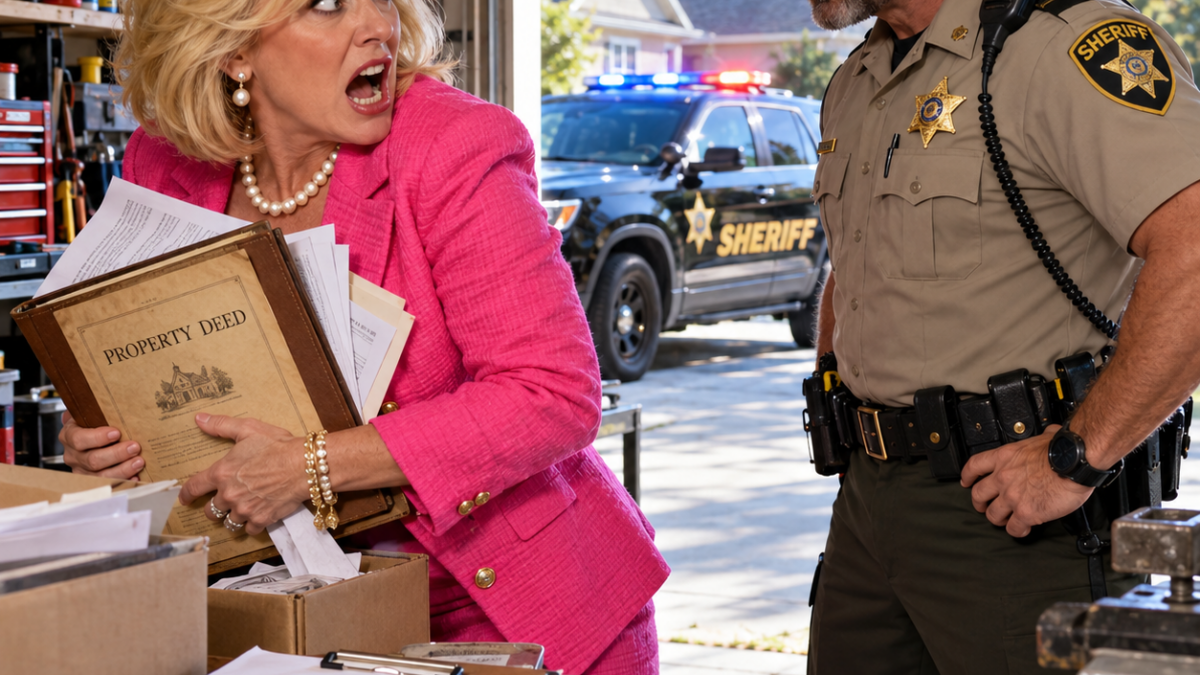
PART 2
I watched her for another four minutes.
She never glanced toward the street.
Never hesitated.
That was what bothered me most.
People who know they are somewhere they shouldn’t be usually move differently. They rush. They look over their shoulders. They jump at headlights.
Lauren moved like she believed the yard belonged to her.
She crouched beside the garage side door, ran her fingertips around the frame, tested the knob again, then stood and aimed the flashlight through the narrow window.
The beam swept slowly across the garage interior.
Workbench.
Shelves.
Tool cabinet.
Storage boxes.
Then it stopped.
For almost ten seconds, the flashlight remained fixed on the old metal filing cabinet the previous owners had left behind.
I felt my grip tighten around the steering wheel.
So that was it.
Or at least it was something.
Lauren eventually stepped away.
She crossed my lawn, passed beneath a streetlight, and walked back toward the end of the block.
Only after she disappeared did I pull into my driveway.
I didn’t enter the garage.
Not immediately.
I walked around the exterior first.
The side door showed fresh scratches near the latch.
Nothing dramatic.
Nothing I could prove had been made that night.
But enough to photograph.
I took close-ups.
Wide shots.
A picture of the door with the house number visible in the frame.
Then I went inside and added everything to the notebook I had started the week I moved in.
11:06 p.m.—Observed Lauren Chavez inside yard.
11:08—Testing garage side door.
11:10—Looking through garage window with flashlight.
11:14—Departed property.
Photographs saved.
No confrontation.
Documentation had been a habit of mine for more than twenty years.
Most people remember what something felt like.
Paper remembers what happened.
That distinction matters when people start lying.
The next morning, I finally opened the garage filing cabinet.
The top drawer contained manuals for appliances that had been replaced years ago.
Warranty paperwork.
Paint swatches.
Old utility bills.
Nothing useful.
The second drawer was different.
HOA letters.
Dozens of them.
Most addressed to the Porters, the family who had owned the house before me.
The first few looked ordinary.
Annual dues statement.
Pool rules.
Parking reminder.
Then the tone changed.
NOTICE OF VIOLATION.
EXTERIOR MAINTENANCE DEFICIENCY.
LAWN NONCOMPLIANCE.
UNAUTHORIZED VEHICLE STORAGE.
LATE PENALTY.
ADMINISTRATIVE PROCESSING FEE.
COMPLIANCE REVIEW CHARGE.
LEGAL NOTICE PREPARATION FEE.
I spread them across the garage floor by date.
The pattern was almost identical to mine.
Small violations first.
Then multiple violations.
Then fees attached to earlier fees.
Then a demand for several thousand dollars.
Then a Notice of Lien Intent.
I found the next envelope.
Benson Development.
Cash purchase offer.
No inspection.
Fast closing.
I sat back on my heels.
The Porters hadn’t just experienced something similar.
They had experienced the same sequence.
I kept digging.
Near the bottom of the drawer was a manila folder marked PROPERTY.
Inside were copies of the deed, title policy, closing statement, and correspondence from a lawyer the Porters had apparently hired before selling.
One sentence had been highlighted in yellow:
The association has failed to produce adequate supporting documentation for several charges assessed against your account.
Another letter mentioned concern regarding selective enforcement.
Another requested records showing how violation inspections were performed.
No reply from the HOA was included.
At the very back of the folder, I found a folded legal pad sheet.
It wasn’t an official document.
Just handwriting.
Dates.
Amounts.
Initials.
LC.
CB.
KM.
Some entries were followed by a check mark.
Others had words beside them.
“Porter—pressure.”
“Nguyen—attorney.”
“Henderson—done.”
The largest number on the sheet was $12,500.
Beside it were the initials LC.
I read the page twice.
Then I photographed it without moving anything.
Whatever the sheet meant, Lauren knew it existed.
That explained her interest in the garage.
But knowing why somebody wanted evidence and proving what that evidence meant were different things.
I needed the public record.
Over the next week, I spent my evenings pulling property transactions.
County deed history first.
Then corporate registrations.
Tax records.
Lien filings.
Business ownership records.
I built a spreadsheet with every Pinewood Heights property Benson Development had purchased in the previous five years.
Seven purchases countywide.
Five inside Pinewood Heights.
Every Pinewood Heights purchase occurred after documented HOA activity.
Every purchase was below estimated market value.
Every property was resold within six months.
Every resale produced a substantial profit.
The Henderson house had been acquired for $218,000.
Resold for $263,000.
The Nguyen house had been acquired for $241,000.
Resold for $294,000.
The Porters had received $229,500.
Four months later, Benson sold my house for $287,000.
To me.
I stared at that number longer than the others.
I had thought I’d found a bargain.
What I had actually bought was the final piece of somebody else’s exit.
That realization bothered me more than I expected.
I had been so focused on what Lauren was doing to me that I had almost forgotten someone else had been pushed out to make room for me.
I called the real-estate attorney I’d found through referrals.
Timothy White practiced property law about forty-five minutes away.
His office smelled like old books and burnt coffee.
He listened while I described the violations, the fabricated balance, the lien, the Benson offer, and the transaction history.
He asked very few questions until I finished.
Then he lifted the lien notice.
“This is sloppy.”
“Sloppy enough to stop it?”
“Possibly.”
“Possibly?”
“You want certainty, don’t hire lawyers.”
I almost smiled.
He pointed to the paperwork.
“Where is the itemized statement?”
“They never sent one.”
“Where is the record of notices supporting the balance?”
“They refused my request.”
“You requested records in writing?”
I handed him the certified-mail receipt.
He nodded.
“Good.”
“So?”
“So if these charges are unsupported, the lien is vulnerable. If they knowingly filed a lien based on fabricated amounts, that becomes much more serious.”
“Criminal?”
“It can be.”
He leaned back.
“But slow down. Right now you have a suspicious lien, suspicious real-estate transactions, and suspicious timing. Suspicious is not the same as provable.”
I slid the Benson offer across the desk.
He read it.
“The same day?”
“Same mail delivery.”
“That is helpful.”
I pulled out the transaction spreadsheet.
Then the Porter letters.
Then the photograph of the handwritten ledger.
Timothy stopped on that one.
“Where is the original?”
“My garage.”
“Don’t alter it.”
“I haven’t.”
“Don’t write on it. Don’t laminate it. Don’t put fingerprints all over it.”
“I know.”
He looked up.
“You law enforcement?”
I paused.
“What makes you ask?”
“The way you preserved that document.”
I didn’t answer immediately.
Timothy studied me.
Then shrugged.
“None of my business.”
“Let’s keep it that way for now.”
“Fine.”
He looked back at the records.
“Find Benson’s ownership.”
“That’s next.”
The connection appeared in a UCC filing.
Benson Development LLC listed Carl Benson as managing member.
That part was obvious.
Less obvious was a membership-interest assignment from four years earlier.
Fifteen percent of Benson Development had been assigned to the L. Chavez Family Trust.
I searched the trust.
Lauren Chavez’s name appeared in connected property filings.
Her husband Ronald’s appeared too.
The family trust received distributions.
Benson Development bought homes targeted by Lauren’s HOA.
The company flipped them.
Lauren’s family benefited.
I printed everything.
Timothy read the documents carefully.
When he reached the trust assignment, he removed his glasses.
“Well.”
“She owns part of Benson.”
“Her family trust appears to hold an interest.”
“You lawyers really hate plain English.”
“We like surviving depositions.”
I leaned forward.
“She controls HOA enforcement. Homeowners get buried in debt. Benson appears. Benson buys them below market. Lauren profits.”
“That is a theory supported by increasingly strong evidence.”
“It’s a scheme.”
“It may very well be.”
“What do you still need?”
“Intent.”
I stared at him.
“She’s outside my garage at eleven at night looking for records.”
“That helps.”
“She filed false charges.”
“Likely.”
“She profits when owners sell.”
“Yes.”
“Then what are we waiting for?”
“A case that doesn’t collapse because everyone got excited too early.”
I hated the answer because I knew he was right.
I started tracking down former owners.
The Hendersons were easiest to find.
Daniel Henderson answered the phone.
The second I gave him my address, his voice changed.
“What did they do to you?”
That question told me everything.
“They’re claiming I owe thousands.”
“Of course they are.”
“Lauren Chavez?”
“Yes.”
“Benson Development?”
Silence.
Then, “They contacted you too?”
“Yes.”
Daniel swore.
I heard a woman in the background ask what was wrong.
He lowered his voice.
“My wife still doesn’t like talking about that place.”
“I understand.”
“No, you probably don’t.”
“You’re right.”
That seemed to surprise him.
I continued.
“I’m not asking you to relive anything you don’t want to. I need to know whether you kept documents.”
Another silence.
“Why?”
“Because I think the same thing is happening again.”
His wife took the phone.
“My name is Beth.”
“Gary Stewart.”
“What exactly do you want?”
“Records. Violation letters. Purchase offers. Anything showing the timeline.”
“Are you suing?”
“Not yet.”
“Police?”
“Not yet.”
“Reporter?”
“No.”
“What do you do?”
I hesitated.
“County work.”
It wasn’t exactly a lie.
It was also not the whole truth.
Beth’s voice hardened.
“We spent six months fighting those people. Every week something new. Grass. Trash cans. Holiday lights. Our daughter’s basketball hoop. Then legal fees. Then a lien threat.”
“Did Benson contact you before or after the lien threat?”
“After.”
“How long?”
“Maybe a week.”
Daniel spoke in the background.
“Four days.”
Beth corrected herself.
“Four days.”
“What was the offer?”
“Forty thousand below what our realtor said the house was worth.”
“Why did you take it?”
The answer took longer.
Finally, she said, “Because our ten-year-old started crying whenever the mail truck stopped.”
I stopped writing.
Beth continued.
“She thought letters from the HOA meant we were going to lose the house.”
I closed my notebook.
“I’m sorry.”
“So am I.”
They mailed copies three days later.
The Nguyens had records too.
More detailed.
Mr. Nguyen had hired an attorney and kept everything in chronological order.
The violations had started after he challenged a proposed special assessment.
Within four months, he owed more than $8,000 according to HOA calculations.
His attorney disputed most of it.
Benson offered cash during that dispute.
Nguyen refused once.
A month later, the offer increased slightly.
Legal expenses kept rising.
He sold.
When I asked whether he regretted it, he said something that stayed with me.
“I don’t regret protecting my wife from another year of that. I regret that leaving was the only protection I could afford.”
The Porters were different.
They refused to speak.
I called twice.
The second time, Mrs. Porter answered.
“We are not going back into that.”
“I’m not asking you to.”
“You live there now?”
“Yes.”
“Then sell.”
“I don’t intend to.”
Her laugh was short and bitter.
“That’s what my husband said.”
Then she hung up.
I didn’t call again.
By then, my problem was no longer simply an HOA dispute.
The pattern looked criminal.
That meant I had to deal with my own complication.
I was Sheriff Gary Stewart.
Madison County.
Twenty years in law enforcement.
Eight as sheriff.
But I had intentionally kept that fact mostly invisible after moving into Pinewood Heights.
My divorce had been ugly in the quiet way.
No screaming court battle.
No affair.
No dramatic betrayal.
Just two people who gradually realized they had spent years living around each other instead of with each other.
My ex-wife, Laura, once told me, “You come home from work, but the sheriff never does.”
She was right.
The badge entered every room before I did.
Neighbors wanted favors.
Friends wanted advice.
Strangers wanted tickets fixed, complaints investigated, relatives hired, or deputies disciplined.
When I bought the Pinewood Heights house, I wanted something anonymous.
A place where nobody needed anything from Sheriff Stewart.
So I didn’t announce myself.
My official residence was public record if somebody cared enough to search.
Lauren apparently never did.
I parked my unmarked vehicle in the garage.
I didn’t wear the uniform home unless necessary.
My badge stayed under a jacket or in a drawer.
To Lauren, I was a divorced middle-aged man who worked odd hours and lived alone.
Exactly the kind of person her operation considered vulnerable.
The moment I realized I might be a victim of fraud, I knew I could not use my office to investigate my own case.
Not even if everything I suspected was true.
Especially then.
I contacted District Attorney Robert Harmon.
We had worked together for years.
We were friendly without being friends.
Robert was the kind of prosecutor who could make a room uncomfortable by saying nothing.
I explained the situation over the phone.
“I need to recuse.”
“From what?”
“Potential fraud involving my HOA.”
Pause.
“Your HOA?”
“Yes.”
Another pause.
“You joined an HOA?”
“I bought a house.”
“That’s not what I asked.”
“Robert.”
He sighed.
“Fine. What do you have?”
“Enough that I don’t want my office touching it.”
“Then don’t.”
“I want your office to handle any criminal referral independently.”
“Bring everything.”
“Not through sheriff channels.”
“Understood.”
We scheduled a meeting for the following week.
Before that meeting, I installed cameras.
I did not need county equipment.
I bought everything personally.
Front entrance.
Driveway.
Garage side.
Back gate.
Cloud backup.
Motion alerts.
I also told Christine enough that she understood why her existing system might matter.
She already had four cameras because someone had broken into her garden shed years earlier.
A week later, she knocked on my door.
“Gary.”
It was the first time she used my first name.
“You need to see something.”
Her study looked like a small surveillance room.
She opened footage from two weeks earlier.
11:47 p.m.
Lauren walked along the sidewalk.
Crossed onto my property.
Tested the garage handle.
Looked through the window.
Left.
Christine opened another date.
Same thing.
“How long has she been doing this?”
“I don’t know.”
“Why didn’t you tell me?”
“I thought she was snooping for violations.”
“At midnight?”
Christine frowned.
“She does strange things.”
We checked my newer cameras.
Lauren appeared there too.
Two nights earlier.
10:31 p.m.
Same window.
Same handle.
Same fixation on the garage.
Christine crossed her arms.
“What’s in there?”
“Something she wants.”
“The Porter records?”
“Probably.”
“Then move them.”
“I already secured copies.”
“That isn’t what I said.”
“I know.”
She stared at me.
“You’re letting her keep looking.”
“I’m documenting her behavior.”
“That sounds dangerously close to letting a snake crawl farther into the kitchen because you want a better picture.”
“I’m not inviting her in.”
“No. You’re just leaving the mouse where she can smell it.”
Christine was sharper than people gave her credit for.
I secured the originals in a fireproof document bag inside a locked interior cabinet and replaced the folder in the old filing drawer with photocopies.
Not fake evidence.
Actual copies.
If Lauren entered without permission and took them, the act would still be hers.
I also documented exactly what I moved and when.
Then came the HOA meeting.
Thirty residents.
Lauren in the center.
Ronald Chavez to her right.
Kevin Marsh to her left.
Lauren ran the room like she had practiced for years.
Residents had two minutes each.
A woman named Patricia Hall complained that she had been fined for a fence color the architectural committee had approved.
Lauren said, “The committee approval did not supersede updated community standards.”
Patricia held up paperwork.
“It was approved six months ago.”
Lauren didn’t look at it.
“You can appeal in writing.”
“I did.”
“Then the board will respond.”
“It’s been forty-five days.”
Lauren tapped her gavel.
“Your two minutes are finished.”
Next resident.
A man challenged a forty-percent increase in annual dues.
Lauren said rising costs made it necessary.
He asked for financial statements.
She said records could be requested under association procedures.
He said he had already requested them.
Her expression hardened.
“If the financial obligations of Pinewood Heights exceed what you find reasonable, homeowners always retain the option to sell.”
Several people shifted in their chairs.
Sell.
That word seemed to appear whenever Lauren faced resistance.
I wrote it down.
Kevin Marsh noticed.
Our eyes met.
He looked away.
After the meeting, Lauren followed me into the parking lot.
“Mr. Stewart.”
I stopped.
“You’ve been unusually quiet.”
“I was listening.”
“You took a lot of notes.”
“I like accurate information.”
Her smile appeared.
“I hope you’re considering the Benson offer.”
“Why?”
“It would solve your financial issue.”
“I don’t have a financial issue.”
“You have a lien.”
“A lien you filed.”
“On behalf of the association.”
“For charges you won’t document.”
She took a step closer.
“You’ve become very adversarial.”
“I asked for records.”
“You challenged the board.”
“I asked for records.”
“You contacted former homeowners.”
That caught me.
“How do you know that?”
Her expression flickered.
Only for a second.
Then she said, “Pinewood Heights is a small community.”
“The Hendersons live two counties away.”
Silence.
I continued.
“Who told you I contacted them?”
“You’re missing the point.”
“No. I think I found one.”
Her voice dropped.
“You should accept Benson’s offer.”
“Why?”
“Because people who cooperate tend to have easier lives.”
“And people who don’t?”
“They usually don’t stay very long.”
My phone was recording in my pocket.
I said, “Is that a threat?”
“Of course not.”
She smiled.
“An observation.”
Three nights later, my security alert went off at 11:22 p.m.
I was at the sheriff’s office.
Lauren appeared on my phone screen.
Dark pants.
Light jacket.
Gloves.
And a tool in her hand.
She went directly to the garage side door.
I stood so fast my chair rolled backward.
Deputy Shawn Baker looked up from the desk across the room.
“Sheriff?”
I didn’t answer.
Onscreen, Lauren bent over the lock.
Shawn came around.
“That your house?”
“Yes.”
“Who’s that?”
“Lauren Chavez.”
“The HOA president?”
“Yes.”
He watched the screen.
“Is she picking your lock?”
“Yes.”
“You want patrol?”
“Yes.”
He looked at me.
“How do you want this handled?”
That question mattered.
“I am the victim. Nothing more.”
“Understood.”
“Call it in as burglary in progress from a private security alert. Don’t make me the reporting officer.”
“You going home?”
“Not until somebody else is on scene.”
Shawn nodded.
“I’ll handle dispatch.”
I emailed a copy of the live feed to a private secure account.
Then I watched.
The door opened.
Lauren entered.
Her flashlight moved quickly.
Workbench.
Boxes.
Shelves.
She didn’t steal tools.
Didn’t touch electronics.
Didn’t even look at equipment worth hundreds of dollars.
She was searching for paper.
Twelve minutes later, she opened the filing cabinet.
Top drawer.
Then second.
Her shoulders changed.
The movement was tiny but obvious.
She had found what she wanted.
She removed the folder.
Opened it.
Flipped pages.
Then tucked it under her arm.
Headlights appeared outside.
Deputy Maria Ellis arrived.
Lauren hurried toward the side door.
Maria met her before she could clear the garage.
The audio came partly through my camera.
“Ma’am, stop.”
Lauren froze.
“I’m with the HOA.”
“At eleven forty?”
“I’m conducting a compliance inspection.”
“Inside a locked garage?”
“The property appeared vacant.”
Maria pointed to the damaged latch.
“Did you force that door?”
“No.”
A second deputy arrived.
Lauren’s posture became stiff.
“I am Lauren Chavez, president of Pinewood Heights Homeowners Association.”
Maria said, “Okay.”
“I have authority to inspect properties for compliance.”
“Show me where that authority includes entering a private garage.”
“I don’t have the bylaws with me.”
“Who gave you permission?”
“The HOA has standing authority.”
“Who owns this property?”
Lauren hesitated.
“Mr. Stewart.”
“Did Mr. Stewart give you permission?”
“No, but—”
Maria looked at the folder under her arm.
“What’s that?”
“HOA records.”
“They came from inside the garage?”
Lauren’s expression changed.
“I want my attorney.”
Maria nodded.
“Turn around.”
“What?”
“Hands behind your back.”
Lauren stared.
“You’re arresting me?”
“I’m detaining you while we sort out why you were inside somebody else’s locked garage.”
“You know who I am.”
“Yes.”
“I run this neighborhood.”
Maria said, “That’s not helping.”
I almost laughed.
Twenty-three minutes later, Shawn called.
“She’s being transported.”
“Evidence?”
“Folder recovered. Body camera on everything.”
“Good.”
“You coming in?”
“I’m already here.”
“No. Jail.”
“Not tonight.”
“Probably smart.”
I sat alone in my office after he left.
My hands were steady.
But inside, I felt something different from satisfaction.
Relief, maybe.
For weeks I had wondered if I was reading too much into a pattern.
If the divorce had left me defensive.
If years in law enforcement had trained me to see conspiracies where ordinary incompetence existed.
Lauren had answered that question by picking my lock.
The next morning, I met Robert Harmon.
I brought two binders.
He stared at them.
“You weren’t exaggerating.”
“I rarely do.”
“That is not what your ex-wife says.”
I looked at him.
“Laura talks to you?”
“Our wives were in the same charity committee.”
“Were?”
Robert wisely changed the subject.
He reviewed the evidence for almost an hour.
Violation notices.
Canceled checks.
Records request.
Lien.
Benson offer.
Transaction histories.
Trust ownership.
Former homeowner statements.
Lauren’s parking-lot threat.
Security footage.
Arrest report.
Then the Porter ledger.
He tapped LC with a pen.
“You think this is Chavez.”
“Yes.”
“CB is Benson?”
“Likely.”
“KM?”
“Kevin Marsh.”
“Board member.”
“Yes.”
“Does handwriting analysis identify who wrote this?”
“Not yet.”
“Any fingerprints?”
“Original is secured.”
Robert looked up.
“You moved it before the burglary.”
“Yes.”
“Good.”
“I left copies.”
“Also good.”
“She stole copies.”
“Still burglary if she entered unlawfully to take property.”
He turned another page.
“She doesn’t know you’re sheriff?”
“I don’t think so.”
Robert leaned back.
“That part I’m struggling with.”
“My house is outside town. I drive unmarked.”
“Your name is on election signs every four years.”
“Pinewood Heights has a lot of new residents.”
“She never Googled you?”
“Apparently not.”
He laughed once.
“That arrogance may be the most believable part of this.”
Then his expression hardened.
“You are fully recused.”
“Yes.”
“No deputies doing favors.”
“Agreed.”
“No evidence collection through your office unless requested formally by yours.”
“Agreed.”
“No pressure.”
“Robert.”
“I know you know. I need to say it.”
“Understood.”
He closed the binder.
“The lien alone may justify investigation. The financial relationship makes it stronger. The burglary gives us leverage. We’ll subpoena Benson’s books.”
Lauren posted bail that afternoon.
By evening, Shawn told me she was making calls.
Attorney.
Ronald.
Carl Benson.
Kevin Marsh.
Somebody at the county recorder’s office.
The kind of call pattern people make when they are trying to determine how many holes exist in a sinking boat.
My cameras captured her driving past my house at 11:14 p.m.
Slowly.
She didn’t stop.
Didn’t enter.
Just looked.
I saved the clip.
Three days later, Timothy filed to challenge the lien.
The HOA responded through counsel.
They claimed all charges were valid.
They claimed records had been available.
They claimed my requests were “procedurally deficient.”
Timothy read that phrase aloud in his office.
“Procedurally deficient.”
“Meaning?”
“Meaning they don’t have the records.”
“Then why not say that?”
“Because lawyers charge by the word.”
He smiled.
I didn’t.
“What happens if they start foreclosure?”
“We seek an injunction.”
“How long?”
“Depends.”
“Can they sell the house before we stop them?”
“Very unlikely.”
“That isn’t zero.”
“No.”
I rubbed my forehead.
Timothy studied me.
“You’re used to controlling timelines.”
“Yes.”
“Courts don’t care.”
“I know.”
“No, you understand it intellectually. Emotionally, you’re still trying to manage this like an operation.”
That annoyed me.
Because he was right.
The hardest part of being the victim instead of the sheriff was waiting for people whose decisions I couldn’t control.
The DA.
The court.
The grand jury.
Financial investigators.
Timothy.
Even Lauren.
All I could do was preserve evidence and avoid making my own mistake.
Nine days after Lauren’s arrest, she came to my door.
Saturday afternoon.
I saw her on the camera.
Navy blazer.
Pearl earrings.
Purse held tight under one arm.
Her lawyer either didn’t know she was there or had failed spectacularly at giving advice.
I opened the door before she knocked.
She stopped.
“Mr. Stewart.”
“Mrs. Chavez.”
“We need to talk.”
“No.”
“This has gone far enough.”
“You’re on my property.”
“I’m here on HOA business.”
“You are out on bail in a case where I’m the victim.”
Her eyes narrowed.
“The charges will be dropped.”
“Then let your lawyer handle them.”
“My lawyer believes I was unlawfully targeted.”
“I’m sure.”
“You planted those documents.”
“No.”
“You arranged the cameras.”
“They’re mine.”
“You knew I would go into that garage.”
“No.”
“You set me up.”
“I didn’t ask you to come onto my property.”
She stepped closer.
“You moved into this neighborhood pretending to be just another homeowner.”
I watched her carefully.
“Pretending?”
“You know exactly what I mean.”
“Actually, I don’t.”
She was losing control.
I could see it in the tightness around her eyes.
The grip on her purse strap.
The slight tremor in her jaw.
People like Lauren spent years practicing dominance.
Fear looked unnatural on them.
“I know people in this county,” she said.
“I’m sure.”
“Important people.”
“Okay.”
“You think a few documents are going to destroy eight years of work?”
“What work?”
She stopped.
I waited.
She changed direction.
“The HOA is going to proceed against your property.”
“Timothy White is handling that.”
Her face changed at the lawyer’s name.
“He’s expensive.”
“I can afford him.”
“For now.”
There was the threat.
I said nothing.
She continued.
“You should have taken Benson’s offer.”
“Why?”
“Because it was generous.”
“For a house worth more?”
“It was clean.”
“Clean for who?”
Her face flushed.
“I am done being harassed by you.”
“I’m standing in my doorway.”
“You contacted former residents.”
“Yes.”
“You dug into private finances.”
“Public filings.”
“You recorded me.”
“On my property.”
“You had me arrested.”
“No. You entered my garage.”
“You think you’re untouchable.”
“No.”
“I’ll show you what it feels like to have authorities examine your life.”
Then she took out her phone.
“I’m calling the sheriff.”
That sentence nearly broke my composure.
Not because it was funny.
Because it was so perfectly Lauren.
When challenged, she reached for authority.
If one layer failed, she assumed another would protect her.
She dialed.
“Yes,” she said when dispatch answered. “I need the sheriff immediately.”
I leaned against the doorframe.
“This is Lauren Chavez, president of Pinewood Heights Homeowners Association. I’m at a residence where I’m being threatened and harassed.”
She gave the address.
Then waited.
A few seconds passed.
Her expression changed.
“What?”
Another pause.
Her eyes lifted toward me.
The dispatcher’s voice was faint, but I heard enough.
“Ma’am, that is Sheriff Stewart’s residence.”
Lauren didn’t move.
The dispatcher continued.
“Is Sheriff Gary Stewart the person you’re speaking with?”
Lauren slowly lowered the phone.
Her gaze moved from my face to my jacket.
The fabric had shifted.
My badge was clipped at my belt.
Visible.
Her mouth opened.
“You’re…”
“Yes.”
“The sheriff.”
“Yes.”
For eight years, Lauren Chavez had walked through Pinewood Heights like she outranked everybody.
In that moment, she looked smaller than I had ever seen her.
Then the fear converted into anger.
“You lied.”
“No.”
“You deliberately hid this.”
“I didn’t introduce myself by occupation.”
“You let me—”
She stopped.
I waited.
“Let you what?”
Her face tightened.
“You knew who I was.”
“You signed every fine.”
“You abused your office.”
“I have not used my office at all.”
“You had deputies arrest me.”
“Patrol responded to a burglary call.”
“Your house.”
“Yes.”
“You directed them.”
“No.”
She raised her phone again.
“I want another officer here.”
“That’s fine.”
I keyed my radio.
“Dispatch, Stewart.”
Her eyes widened again when the radio answered.
“Go ahead, Sheriff.”
“I have contact with Lauren Chavez at my residence. She is currently involved in an active case where I am a complainant. Send a unit for documentation.”
“Copy.”
Lauren whispered, “You can’t do this.”
“I’m not investigating you.”
“You’re the sheriff.”
“That’s why the district attorney is.”
A patrol car arrived within minutes.
Shawn and another deputy stepped out.
Christine appeared across the street.
Phone already recording.
Lauren noticed.
“Tell her to stop filming me.”
I said nothing.
Shawn approached.
“Mrs. Chavez, we need to document this contact.”
“I came here to discuss HOA business.”
“Do you have contact restrictions?”
“My attorney says—”
“That isn’t what I asked.”
She looked at me.
“You planned this.”
I said, “No.”
“You wanted to humiliate me.”
“No.”
“You think people will believe you because of the badge.”
“No.”
For the first time, I stepped fully onto the porch.
“Lauren, the badge is exactly why I stayed out of your investigation.”
That silenced her.
I continued.
“The evidence against you came from county records, your own HOA notices, private cameras, former homeowners, financial filings, and what you carried out of my garage.”
“You planted that.”
“Then tell the DA.”
“I will.”
“Good.”
The deputies documented the encounter.
Lauren was not arrested again that afternoon.
Robert later told me the contact could become relevant to bail conditions and intimidation evidence.
But psychologically, something had shifted.
Lauren finally understood she had misjudged me.
The more important truth was that she had misjudged everyone.
Three days before the scheduled grand-jury session, indictments came down.
Lauren Chavez.
Burglary.
Fraud-related charges.
Conspiracy.
Fraudulent lien allegations.
Ronald Chavez.
Conspiracy.
False financial records.
Participation in fraudulent assessments.
Carl Benson.
His case moved quickly toward federal interest because the transactions crossed jurisdictional and banking lines.
Wire transfers.
Multiple counties.
Business entities.
Electronic communications.
Kevin Marsh did what frightened people often do once they realize loyalty has become evidence.
He got a lawyer.
Then he cooperated.
The first time Robert told me Kevin wanted immunity, I wasn’t surprised.
“What does he have?”
“Enough.”
“Did he participate?”
“Yes.”
“In what?”
“Gary.”
I nodded.
“Right. Not my case.”
“Exactly.”
I walked away angry.
Recusal is easy when the investigation is theoretical.
It is harder when people know things about what happened to you and you’re not allowed to ask.
Kevin’s testimony became public during hearings months later.
That was when the full system emerged.
Lauren kept what Kevin called the “pressure list.”
Properties were ranked.
Age.
Family size.
Income estimates.
Whether residents lived alone.
Whether they had previously hired lawyers.
How quickly they paid fines.
How often they traveled.
Whether they complained publicly.
I was marked:
NEW OWNER.
SINGLE.
LONG WORK HOURS.
NO CHILDREN.
LIKELY LOW RESISTANCE.
That description made me laugh when I first saw it.
Not because it was funny.
Because it was technically accurate.
They had simply drawn the wrong conclusion.
The violation generator was even uglier.
Kevin described spreadsheets with common offenses that could be rotated through targets.
Grass height.
Driveway parking.
Trash containers.
Decorations.
Mailbox appearance.
Curtains.
Landscaping.
Exterior maintenance.
If one violation was easily disproved, another followed.
The objective wasn’t to win each argument.
It was to create volume.
Volume created fatigue.
Fatigue created unpaid balances.
Unpaid balances justified more fees.
Then liens.
Then Benson.
Lauren and Carl would allegedly review targeted properties.
Home equity.
Estimated mortgage.
Market price.
The ideal target had enough equity that a low cash offer could still pay off the mortgage and give the homeowner enough money to leave.
People underwater weren’t useful.
People wealthy enough to fight weren’t useful.
They wanted the middle.
People with something to lose but not enough resources to fight indefinitely.
Kevin testified about the Porters.
Mrs. Porter had started asking where HOA legal fees were going.
That made Lauren nervous.
The Porters found inconsistencies.
They kept records.
Then they sold before completing their challenge.
Lauren believed documents had been left behind.
After I purchased the house, she apparently tried multiple times to locate them.
That explained the garage.
Carl Benson’s financial records explained the ledger.
LC.
Lauren Chavez.
CB.
Carl Benson.
KM.
Kevin Marsh.
The numbers were distributions, payments, transaction bonuses, and amounts associated with specific acquisitions.
Not every figure was illegal.
Some were legitimate investment distributions.
Others were disguised consulting fees that prosecutors said tracked directly with targeted sales.
Lauren hadn’t broken into my garage for the deed.
Not exactly.
She wanted documents capable of exposing how the previous owner had connected the HOA pressure to Benson Development.
The “deed” was only part of the file.
But by then, neighborhood gossip had simplified the story.
Lauren broke into the sheriff’s garage looking for property papers.
The irony spread faster than any official statement.
I hated that.
Not because it made me look bad.
Because it made the case sound like a joke.
It wasn’t.
Beth Henderson still had a daughter who hated mailboxes.
Mr. Nguyen still had legal bills.
The Porters still refused to drive through Pinewood Heights.
A joke erases victims.
So I refused interviews.
Reporters called.
I gave the same answer.
“I’m a complainant in an active case. The district attorney’s office handles questions.”
One reporter shouted as I entered the courthouse, “Sheriff, did Lauren Chavez really call you to report yourself?”
I kept walking.
Technically, yes.
But the funny part wasn’t the important part.
The civil lien against my house was voided before the criminal trial.
Timothy called.
“You are officially free of imaginary debt.”
“How much do I owe you for that sentence?”
“More than the HOA claimed you owed.”
“Perfect.”
The county recorder issued a release.
I checked the property record online twice.
Lien gone.
Clear title.
I thought I would feel triumphant.
Instead, I stood in my home office staring at a screen and felt tired.
My house had never truly been in danger the way Lauren wanted me to believe.
I had legal resources.
Knowledge.
Income.
Professional connections.
The Hendersons hadn’t.
The Nguyens hadn’t.
That difference bothered me.
I called Beth Henderson.
“The lien is gone.”
She was quiet.
“Good.”
“The criminal case is moving.”
“Good.”
“I wanted you to know.”
Another pause.
Then she said, “Gary?”
“Yes.”
“Don’t let them turn this into a story about the sheriff beating the HOA.”
I sat down.
“Why?”
“Because we weren’t sheriffs.”
That was exactly what I had been thinking.
“I won’t.”
“Promise?”
“Yes.”
The prosecution used seven families as the clearest financial pattern.
Others came forward.
Some had valid complaints.
Some had ordinary disagreements with the HOA.
Some wanted old fines refunded simply because Lauren was charged.
Robert refused to turn the case into a referendum on every unpopular HOA decision.
He explained it to me once over coffee.
“If we make Lauren responsible for every bad thing that ever happened in Pinewood Heights, the jury stops believing the things she actually did.”
“She targeted people.”
“We prove who.”
“She abused violations.”
“We prove which ones.”
“She profited.”
“We trace what money.”
“That feels narrow.”
“That is how criminal cases survive.”
Again, the correct answer was frustrating.
Lauren’s trial began eight months after the garage arrest.
The courthouse was packed.
Half Pinewood Heights.
Half reporters.
Lauren entered wearing gray.
No pearls.
No HOA pin.
No smile.
Her attorney was excellent.
That mattered.
Stories like this often make villains stupid once they reach court.
Lauren wasn’t stupid.
Her lawyer wasn’t either.
The defense strategy was clear from opening statements.
Lauren was an aggressive HOA president.
Maybe unpleasant.
Maybe overzealous.
But not a criminal mastermind.
Benson Development was an independent company.
Her trust investment was passive.
The burglary was a misunderstanding born from legitimate HOA concerns.
The lien errors were administrative.
Kevin Marsh was a self-serving liar trading testimony for immunity.
Former homeowners were angry because they regretted selling.
And I was a powerful elected official whose personal dispute had become a prosecution.
That last point was the dangerous one.
My testimony came early.
Lauren’s attorney stood slowly.
“Sheriff Stewart, you hold the highest elected law-enforcement office in Madison County, correct?”
“Yes.”
“You control the sheriff’s department.”
“I administer it.”
“You hire deputies.”
“With county procedures.”
“You discipline them.”
“Yes.”
“You influence promotions.”
“Yes.”
“And the woman you accused of burglary was arrested by your deputies.”
“Deputies responding to a dispatched call.”
“From your subordinate.”
“Deputy Baker handled the notification.”
“After you instructed him.”
“I asked that a burglary in progress be reported.”
“At your house.”
“Yes.”
He walked toward the jury.
“So the sheriff of Madison County watched a woman enter his garage, directed a subordinate to send deputies, and those deputies arrested her.”
“That is one way to describe it.”
“Is it inaccurate?”
“It leaves out the part where she picked my lock.”
A few jurors looked toward Lauren.
Her attorney continued.
“You had already been investigating Mrs. Chavez personally.”
“No.”
“You gathered property records.”
“Public records concerning my home.”
“You contacted former residents.”
“Yes.”
“You installed hidden cameras.”
“Security cameras.”
“You recorded my client.”
“Yes.”
“You met with a lawyer.”
“Yes.”
“You compiled transaction spreadsheets.”
“Yes.”
“That sounds like an investigation.”
“It sounds like a homeowner documenting a dispute.”
He moved closer.
“Except you are not just a homeowner.”
“No.”
“You are sheriff.”
“Yes.”
“Did Mrs. Chavez know that?”
“No.”
“Did you tell her?”
“No.”
“Why not?”
“Because my occupation had nothing to do with whether the HOA could document charges against my property.”
He paused.
“You enjoyed watching her discover who you were.”
“No.”
“Not even a little?”
The courtroom became very quiet.
I could have lied.
Instead, I said, “For about two seconds.”
A few jurors smiled.
Her attorney raised an eyebrow.
“Thank you for your honesty.”
“Then I remembered why I had recused myself.”
The smile disappeared.
He continued.
“You intentionally let her enter the garage.”
“No.”
“You watched remotely.”
“Yes.”
“You did not call her.”
“No.”
“You did not warn her.”
“No.”
“You wanted her inside.”
“I wanted to document whatever she chose to do without interference.”
“That sounds like entrapment.”
“No one instructed her to enter.”
“You left the records she wanted in the garage.”
“Copies.”
“You moved the originals.”
“Yes.”
“So you knew what she wanted.”
“I suspected.”
“And you created a scenario where she could steal them.”
“I locked my garage.”
That answer stopped him.
He stared for a second.
Then changed subjects.
The prosecution showed the footage.
Lauren approaching on earlier nights.
Testing the handle.
Looking through the window.
Then the final night.
Tool.
Lock.
Entry.
Search.
File.
Deputy Ellis’s body-camera footage.
The defense argued Lauren believed she had authority to inspect.
Then prosecutors displayed Pinewood Heights bylaws.
Exterior inspections were permitted from common areas or with notice.
No provision authorized entry into homes, garages, locked yards, or enclosed structures without consent.
Lauren had no scheduled inspection.
No notice.
No emergency.
No plausible reason to be there near midnight.
Christine testified next.
She wore a dark blue dress and looked furious at having to swear she would tell the truth, as though anybody might suspect otherwise.
The prosecutor asked how long she had lived in Pinewood Heights.
“Fifteen years.”
“Did you know Mrs. Chavez?”
“Unfortunately.”
The judge looked up.
Christine corrected herself.
“Yes.”
The prosecutor walked through the Hendersons, Nguyens, Porters, and Lauren’s late-night visits.
Then defense counsel stood.
“Mrs. Clark, you disliked my client.”
“I dislike lima beans. Lauren was more complicated.”
A few people laughed.
“Please answer yes or no.”
“Then ask a yes-or-no question.”
Even the prosecutor looked down.
Defense counsel tried again.
“You believed Mrs. Chavez was unfair.”
“Yes.”
“You complained about HOA management.”
“Yes.”
“You supported Mr. Stewart.”
“I supported the truth.”
“You recorded my client.”
“My security camera recorded the street.”
“You gave footage to Sheriff Stewart.”
“To Gary, my neighbor.”
“You knew he was sheriff?”
Christine paused.
“Yes.”
That surprised me.
I had never told her.
The lawyer turned toward the jury.
“So unlike Mrs. Chavez, you knew.”
“I recognized him two weeks after he moved in.”
“How?”
“My husband was a deputy for twenty-six years.”
I looked at Christine.
She glanced at me with a tiny smile.
The attorney asked, “Why didn’t you tell Mrs. Chavez?”
Christine’s expression sharpened.
“Why would I?”
The jury liked her.
Kevin Marsh was different.
Nobody liked Kevin.
That actually helped.
He looked ashamed.
He admitted his role.
He admitted signing board documents he hadn’t fully reviewed.
He admitted suspecting violations were being manipulated.
He admitted knowing Benson benefited.
He admitted taking small payments for consulting work.
The defense attacked him relentlessly.
“You are testifying to save yourself.”
“Yes.”
“You lied before.”
“Yes.”
“You signed false documents.”
“Yes.”
“You accepted money.”
“Yes.”
“You want immunity.”
“Yes.”
The attorney spread his hands.
“So why should anyone believe you?”
Kevin looked at Lauren.
Then back at the attorney.
“You shouldn’t believe me because I’m good. I’m not.”
The courtroom quieted.
“Believe the emails.”
The prosecution then displayed the messages.
Lauren and Benson.
Lauren and Ronald.
Lauren and Kevin.
Target lists.
Discussion of fines.
Timing.
Property values.
“Porter is close.”
“Nguyen lawyer is draining them.”
“Henderson should move if we keep pressure consistent.”
Then my entry.
“New owner works long hours. Lives alone. Paid first notices immediately. Likely low resistance.”
The prosecutor asked Kevin, “What did low resistance mean?”
“That he’d probably pay until the numbers got too high, then sell.”
“What happened instead?”
Kevin glanced at me.
“He started asking questions.”
“And what did Mrs. Chavez say?”
“She said we needed to accelerate.”
“What did that mean?”
“More violations. Lien. Benson offer.”
The prosecutor showed dates.
The chronology matched.
Violation.
Violation.
Violation.
Lien intent.
Actual lien.
Benson offer.
Then the burglary.
Kevin testified that Lauren had become increasingly concerned about documents the Porters had left behind.
“She believed they had copies of payment records.”
“What payment records?”
“Consulting payments from Benson.”
“To whom?”
“Lauren.”
Lauren’s attorney objected.
The judge required foundation.
The prosecutor established emails.
Bank records followed.
Payments from Benson Development to the L. Chavez Family Trust.
Separate consulting transfers to an LLC controlled by Ronald.
Dates close to acquisitions.
Amounts that corresponded with the Porter ledger.
The handwritten page from my garage was not enough by itself.
But once financial records matched it, the paper became a map.
The prosecution called a forensic accountant.
She explained transactions without drama.
That made them worse.
$8,500 after Henderson closing.
$10,000 after Nguyen acquisition.
$12,500 associated with Porter.
Payments described as “community acquisition consulting.”
No contracts explaining the services.
No work product.
No reports.
No invoices beyond generic descriptions.
Then Lauren testified.
Her lawyer had a difficult choice.
If she stayed silent, Kevin’s version stood.
If she testified, she could explain.
She took the stand.
For the first hour, she was excellent.
Calm.
Measured.
Reasonable.
She had invested in Benson Development through a trust because Carl Benson was a longtime acquaintance.
She had no involvement in day-to-day acquisitions.
HOA violations were issued by compliance processes.
Some paperwork may have been sloppy.
Aggressive enforcement protected property values.
Benson’s purchase offers were independent.
The garage entry was a terrible mistake.
She believed the house might be vacant because I worked late.
She believed HOA-related records belonging to the association had been improperly retained.
Her lawyer asked, “Did you intend to steal Mr. Stewart’s property?”
“No.”
“Did you know he was sheriff?”
“No.”
“Would you have acted differently if you had?”
That question was a mistake.
Lauren hesitated.
“Yes.”
The prosecutor noticed.
So did the jury.
On cross-examination, Robert’s assistant district attorney began gently.
“You would have acted differently if you knew Mr. Stewart was sheriff?”
“Yes.”
“Why?”
“I would have contacted him through official channels.”
“Why not contact him through ordinary channels?”
“I tried.”
“At 11:22 p.m. with a lock tool?”
Lauren’s composure slipped.
“That night was a mistake.”
“Were the earlier nights mistakes?”
“What earlier nights?”
The prosecutor displayed Christine’s footage.
Lauren at 11:47.
Then my footage.
Lauren at 10:31.
“Were those compliance inspections?”
“I was checking exterior conditions.”
“At night?”
“I have a busy schedule.”
“Did you routinely perform inspections after ten p.m.?”
“Sometimes.”
“Can you produce records of those inspections?”
“I don’t personally keep every record.”
The prosecutor changed topics.
“Did you financially benefit when Benson Development bought the Henderson home?”
“Indirectly, through the trust.”
“The Nguyen property?”
“The trust owned an interest in the company.”
“The Porter property?”
“Yes.”
“My client’s property?”
“Mr. Stewart’s house was purchased before he owned it.”
“Exactly.”
The prosecutor displayed a Benson distribution schedule.
“Did your trust receive distributions after each of those transactions?”
“Yes.”
“Did you disclose that interest to Pinewood Heights homeowners?”
“I was not required to disclose private investments.”
“Did the board know?”
“Some did.”
“Did the Hendersons know?”
“No.”
“Nguyens?”
“No.”
“Porters?”
“No.”
“Mr. Stewart?”
“No.”
The prosecutor paused.
“So homeowners facing HOA pressure were receiving purchase offers from a company that financially benefited the HOA president, but the homeowners were never told.”
“I didn’t control Benson’s offers.”
“That wasn’t my question.”
Lauren’s jaw tightened.
The prosecutor displayed an email from Lauren to Carl Benson.
PORTER IS CLOSE. ANOTHER TWO WEEKS OF FEES AND THEY’LL TAKE CASH.
“Did you write that?”
Lauren stared at the screen.
“I don’t recall.”
The prosecutor zoomed in on the account information.
“It came from your email.”
“It appears so.”
“Did someone hack your account?”
“I have no reason to believe that.”
“So did you write it?”
“I may have.”
“Another email.”
HENDERSON WON’T FUND A LAWYER MUCH LONGER.
“Yours?”
“It appears to be.”
Then:
NEW OWNER LOOKS EASY. LIVES ALONE. LONG HOURS. NO PUSHBACK SO FAR.
Lauren looked toward me.
The prosecutor asked, “Who is the new owner?”
“I assume Mr. Stewart.”
“Why were you discussing whether I—whether Mr. Stewart—would push back with the developer buying targeted homes?”
“We discussed community trends.”
“Did community trends require knowing he lived alone?”
“No.”
“Did community trends require knowing his work hours?”
“No.”
“Did community trends require coordinating enforcement before Benson sent an offer?”
“I reject that characterization.”
The prosecutor showed another email.
SEND OFFER AFTER LIEN POSTS. HE’LL UNDERSTAND HIS OPTIONS THEN.
The room went silent.
Lauren’s attorney objected.
The judge overruled.
The prosecutor asked, “Did you write this?”
Lauren did not answer immediately.
“Mrs. Chavez?”
“Yes.”
“What options?”
“Financial options.”
“Sell or face foreclosure?”
“No.”
“Then explain.”
She tried.
The explanation lasted nearly three minutes.
By the end, nobody seemed clearer.
The prosecutor waited.
Then asked one sentence.
“Why did you need the Porter records from Sheriff Stewart’s garage?”
Lauren looked at the jury.
“I believed they belonged to the HOA.”
“At midnight.”
“Yes.”
“Behind a locked door.”
“I made a mistake.”
“With gloves.”
Silence.
“With a lock tool.”
Silence.
“After visiting the same garage multiple nights.”
Lauren’s face flushed.
“I panicked.”
That was the first completely honest thing she had said.
The prosecutor nodded.
“Why?”
Lauren looked at Carl Benson’s empty seat—his federal proceedings were separate.
Then at Ronald.
Then at Kevin.
Finally, she said, “Because I knew how it would look.”
The prosecutor stepped back.
“No further questions.”
The jury deliberated for eight hours.
I spent most of that day walking.
Courthouse hallway.
Stairs.
Coffee machine.
Outside.
Back inside.
Christine knitted something she refused to identify.
“It’s crooked,” I told her.
“So is your framed title letter.”
“I haven’t framed it.”
“You will.”
Beth Henderson had attended closing arguments.
Daniel came later.
The Nguyens sat quietly near the back.
The Porters did not come.
I didn’t blame them.
When the jury returned, Lauren stood.
Guilty.
Burglary.
Guilty.
Fraud.
Guilty.
Conspiracy.
Guilty on the principal fraudulent filing counts.
She closed her eyes.
Ronald covered his face.
Kevin stared at the floor.
I expected relief.
Instead, my first thought was Beth’s daughter.
Mail truck.
Crying.
That was what Lauren’s conviction meant to me.
Not revenge.
Confirmation that those families hadn’t imagined what happened.
Lauren received four years in state prison followed by supervision.
Her sentence was less dramatic than some residents wanted.
More than her lawyer requested.
The court also entered restrictions preventing her from holding HOA leadership positions after release.
Ronald received probation and community service under his agreement and conviction.
His accounting firm fired him.
His professional reputation collapsed.
Carl Benson’s federal trial began months later.
By then, the investigation had expanded beyond Pinewood Heights.
Other developments.
Other companies.
Wire transfers across state lines.
Layered ownership.
Property management entities.
Benson had a prior fraud conviction from years earlier.
He had learned from it.
Not enough.
Federal prosecutors argued he had built a model where legitimate-looking real-estate transactions concealed coercion.
The federal case lasted three weeks.
Kevin testified again.
So did Ronald under a cooperation agreement.
Financial experts reconstructed transaction flows.
Former homeowners described pressure.
Corporate records connected investment interests.
The jury convicted Benson on twelve counts.
Six years federal prison.
Benson Development dissolved.
Assets seized.
Then came restitution.
Nobody understands how complicated justice becomes after the verdict until money has to move backward.
Homes had new owners.
Mortgages had been paid off.
Prices had changed.
Taxes had changed.
Some victims wanted money.
Others wanted property.
Current owners had purchased homes without knowledge of fraud.
Title insurers became involved.
Banks.
Lawyers.
Accountants.
Judges.
It took six more months to create workable resolutions.
The Hendersons received substantial compensation but stayed where they had moved.
Beth told me, “I don’t want my daughter ever living near that mailbox again.”
The Nguyens accepted compensation for their financial loss and legal expenses.
Mr. Nguyen joked that he intended to spend some of it on “a lawn where nobody owns a ruler.”
The Porters eventually came forward.
Not publicly.
Only through attorneys.
Mrs. Porter sent me a letter.
Gary,
We heard what happened.
The documents in the garage were ours.
We meant to take them.
The movers packed the wrong cabinet and we didn’t realize until months later. By then we wanted no contact with Pinewood Heights.
We knew some of the payments were suspicious, but we never had enough to prove it.
I’m sorry you inherited the mess.
I’m also glad somebody finally finished what we couldn’t.
Please don’t contact us. We’re doing better now.
—Melissa Porter
I respected the final sentence.
I never contacted them.
Three families chose to repurchase former homes through arrangements funded partly from seized assets.
Other current homeowners received protection and compensation so they weren’t punished for buying property unknowingly.
There was no perfect solution.
Some people still lost years.
Some lost money nobody could fully recover.
Some marriages had suffered.
Some children had changed schools.
Legal justice is capable of many things.
Time travel isn’t one of them.
Pinewood Heights almost abolished the HOA.
The first resident meeting after Lauren’s conviction lasted four hours.
Half the room wanted dissolution.
Others pointed out common landscaping, stormwater structures, private signage, and maintenance obligations still needed funding.
Christine stood up near the end.
“I don’t think the letters HOA are evil.”
A man shouted, “They sure looked evil for eight years.”
Christine nodded.
“So did my eighth-grade vice principal, but the school still needed administration.”
People laughed.
She continued.
“The problem was never that we had rules. The problem was that one person turned the rules into a weapon.”
Someone asked, “You volunteering?”
“No.”
Two weeks later, Christine was elected president.
She blamed me.
“You nominated me.”
“I seconded somebody else’s nomination.”
“You encouraged them.”
“I nodded.”
“That is encouragement.”
Her first three policies passed unanimously.
No lien without independent legal review.
Full itemized accounting before serious collection action.
Homeowner appeal panel independent of the board president.
Then she added something I hadn’t expected.
Every board member with a financial interest in any vendor, purchaser, contractor, management company, or related business had to disclose it publicly and recuse from decisions affecting that entity.
When the vote passed, Christine looked at me.
“That one is for Lauren.”
“No.”
She corrected herself.
“That one is for the next Lauren.”
That was smarter.
People like to believe bad systems become good when the bad person leaves.
They don’t.
If one person can abuse a structure easily, somebody else eventually will.
You fix the structure.
A year after I moved into Pinewood Heights, the neighborhood looked almost exactly the same.
That surprised me.
Same houses.
Same sidewalks.
Same trees.
Same ridiculous fountain near the entrance.
But the feeling had changed.
When I first arrived, people waved and then looked toward Lauren’s house.
Now they stopped to argue openly.
The new board received complaints.
Residents yelled about dues.
Someone accused Christine of discriminating against inflatable Halloween decorations.
She told him, “Your twelve-foot vampire blocks the stop sign, Harold.”
That argument lasted three meetings.
Nobody was threatened with foreclosure.
Nobody received a Benson offer.
Nobody lowered their voice when saying the board president’s name.
Normal disagreement felt almost luxurious.
One Saturday, Shawn helped me replace the garage side door.
The old frame still showed marks where Lauren had forced it.
I had repaired the lock after the arrest, but never replaced the damaged wood.
Shawn held the new door steady.
“You sure this is level?”
“Yes.”
“You’re sheriff, not carpenter.”
“I own a level.”
“That does not answer the question.”
Christine walked over carrying tomatoes.
“It’s crooked.”
“It isn’t even installed yet.”
“I’m preparing.”
Shawn laughed.
We finished near sunset.
The new deadbolt clicked cleanly.
I stood looking at it.
For months, the garage had been evidence.
Camera angle.
Entry point.
Crime scene.
Storage location.
Now it was a garage again.
Tools.
Mower.
Paint.
Boxes.
I liked that.
Christine noticed the framed letter in my office when she came inside for water.
“You framed the lien release.”
“Title clearance.”
“It’s crooked.”
“It is straight.”
She walked over and adjusted it anyway.
“Now it’s straight.”
I stared at her.
“You’re becoming exactly like Lauren.”
Christine turned slowly.
“Take that back.”
I laughed.
“So threatening homeowners is acceptable now?”
“Only sheriffs with crooked wall art.”
We took drinks to the porch.
For a while, neither of us spoke.
Then Christine said, “Why didn’t you tell me?”
“Tell you what?”
“That you were sheriff.”
“You knew.”
“Eventually.”
“How?”
“My husband carried a badge for twenty-six years. You all stand the same way when you’re watching something you don’t like.”
“That’s not a real answer.”
“I recognized you from the county fair.”
“You said nothing.”
“You didn’t seem to want people knowing.”
“I didn’t.”
She nodded.
“Your divorce?”
I looked at her.
“Neighborhood information.”
“Gossip.”
“Same thing with better manners.”
I took a drink.
“Partly.”
“Hard?”
“Yes.”
“Still?”
“Sometimes.”
Christine looked toward the street.
“You moved here to disappear.”
“Something like that.”
“And instead Lauren chose you.”
“Apparently.”
She smiled.
“That woman had terrible luck.”
“No.”
I shook my head.
“She had a bad system.”
Christine looked at me.
“What’s the difference?”
“Luck would mean she happened to target somebody capable of fighting back. The system only worked because most targets didn’t have the same resources.”
She grew quiet.
“That bothers you.”
“Yes.”
“Good.”
I looked over.
“Good?”
“If it didn’t bother you, I’d worry.”
A few weeks later, Beth Henderson called.
Her daughter needed a school project interview about “a time adults fixed something unfair.”
Beth asked if I would participate.
“No.”
She laughed.
“I expected that.”
“Interview Christine.”
“My daughter wants the sheriff.”
“Why?”
“Because she thinks you arrested the HOA lady yourself.”
“I specifically did not.”
“I know. Try explaining recusal to a twelve-year-old.”
I thought about it.
“Fine. Ten minutes.”
The call lasted forty.
Her daughter asked better questions than reporters.
“Were you scared you’d lose your house?”
“A little.”
“But you’re sheriff.”
“Sheriffs can lose houses.”
“Did you want to arrest Lauren?”
“No.”
“That sounds fake.”
Beth laughed in the background.
I said, “Okay. At one point, yes.”
“Why didn’t you?”
“Because wanting to do something isn’t the same as having the right to do it.”
She was quiet.
Then: “Was calling you the funniest thing she did?”
I smiled.
“Probably.”
“What did her face look like?”
“I’m not answering that.”
“Why?”
“Because your mother asked me to discuss fairness, not humiliation.”
Beth said, “Good answer.”
Her daughter groaned.
Before hanging up, she asked, “What actually stopped Lauren?”
I looked toward the framed title letter.
“People keeping records.”
“That’s boring.”
“Most useful things are.”
The conversation stayed with me.
Lauren’s downfall had been dramatic only at the end.
Before that, it was boring.
Certified mail.
Screenshots.
County records.
Dates.
Canceled checks.
Camera timestamps.
Corporate filings.
People saving letters.
A neighbor remembering.
Former homeowners keeping folders in closets.
Kevin saving emails.
Financial institutions keeping transaction records.
Lauren had built her power on people becoming exhausted.
Records don’t get exhausted.
The sheriff’s office held an ethics training that winter.
Normally, I let command staff handle it.
This time, I spoke.
Not about Lauren by name.
About conflicts.
I told the deputies, “Authority doesn’t belong to us personally.”
Some younger deputies looked confused.
I continued.
“If somebody insults you, that is not contempt of law. If someone challenges your decision, that is not an attack on the county. If your family is involved in a case, you step out.”
Shawn sat in the back.
Afterward, he said, “You’re getting philosophical.”
“Divorce.”
“That bad?”
“Apparently.”
He laughed.
Then he said, “You did the right thing staying out.”
“I know.”
“You don’t sound convinced.”
“I am.”
“Then what?”
I thought about it.
“I’m wondering how many times people in authority don’t.”
He nodded.
“That’s a worse question.”
It was.
The house gradually became mine.
That sounds simple.
It wasn’t.
For months, I had resisted changing anything because every room felt temporary.
Divorce does that.
You move somewhere and tell yourself it is home, but half your belongings are still in boxes and you keep thinking of furniture as “the new couch” instead of “my couch.”
After the case, I painted the spare bedroom.
Replaced kitchen lights.
Built shelves in the garage.
Planted two oak trees.
Christine said they were too close together.
I moved one.
Not because she was HOA president.
Because she was right.
The first spring after Lauren’s conviction, I found an old cardboard box behind the garage cabinet.
Inside were children’s drawings.
PORTER FAMILY.
Crayon houses.
A dog.
A stick figure standing beside a mailbox.
I sat on the garage floor looking through them.
For all the legal documents, financial charts, and testimony, those drawings hit differently.
A family had lived there.
Kids had called the place home.
Then adults they barely knew created enough fear to push them out.
I packed the drawings carefully.
Through Timothy, I sent them to the Porters’ attorney with a note.
Found these behind the filing cabinet. No response needed.
Three months later, a package arrived.
No return address.
Inside was a photograph.
The Porter family standing in front of a different house.
Older children.
A different dog.
On the back, Melissa had written:
We’re okay.
That was enough.
I put the picture in the file but not with the evidence.
With the personal things.
The neighborhood held its first summer block party under Christine’s board.
Lauren had apparently discouraged large informal gatherings unless approved in advance.
Christine’s first rule was:
“No approval required for hamburgers.”
People brought folding chairs.
Children ran across lawns.
Someone played country music too loudly.
A resident complained.
Christine told him to eat a hot dog.
I stood near the grill talking to Daniel Henderson, who had driven in with Beth.
They had debated coming.
Beth wanted to see the old house.
Their daughter refused.
“She says she’s fine never seeing it again,” Beth told me.
“I understand.”
Daniel looked toward my place.
“Looks good.”
“Thanks.”
“You still have that stupid side garage door?”
“New one.”
“Good.”
He drank from his cup.
“I hated that house for a long time.”
“Do you still?”
He considered.
“No.”
“What changed?”
“Lauren doesn’t own the memory anymore.”
That was a better answer than anything I could have given.
Later that evening, Christine tapped a glass and made everybody quiet.
“I have one announcement.”
People groaned.
“No, it’s not a dues increase.”
More laughter.
She held up a folder.
“The court supervisor officially ends next month.”
Applause.
“We are returning to normal self-governance.”
A man shouted, “Dangerous.”
Christine pointed at him.
“You’re on the landscaping committee, Harold.”
He sat down.
She continued.
“I want everyone to remember something. We didn’t fix this because one sheriff moved in.”
She looked toward me.
I appreciated that.
“We fixed it because residents testified, kept records, changed rules, and stopped being afraid of asking questions.”
Beth squeezed Daniel’s arm.
Christine raised her glass.
“To being annoying.”
Everybody laughed and raised drinks.
It sounded silly.
But she was right.
Healthy communities need annoying people.
People who ask for receipts.
People who read minutes.
People who demand conflicts be disclosed.
People who refuse, politely and persistently, to accept “because I said so.”
Lauren’s power had grown partly because residents learned that questioning her brought pain.
Once questioning became normal again, the power dissolved.
I visited the county recorder’s office one afternoon for unrelated work.
The clerk recognized me.
“Sheriff Stewart.”
“Afternoon.”
She smiled.
“I handled your lien release.”
“Thank you.”
She lowered her voice.
“That whole case made us change procedures.”
“How?”
“Additional verification on HOA liens. More documentation before indexing disputed amounts.”
“Good.”
She nodded.
“We found two older questionable filings.”
My attention sharpened.
“Connected to Pinewood?”
“One.”
“And?”
She saw my expression.
“District attorney already knows.”
I relaxed.
Old habits.
“Sorry.”
She smiled.
“You really are recused.”
“Trying.”
That night, I realized I had gone an entire week without checking the home cameras.
At the height of the case, I looked at them constantly.
Front yard motion.
Garage motion.
Driveway motion.
Every late-night car.
Every shadow.
Hypervigilance becomes a habit before you notice it.
I almost deleted the monitoring app.
Then remembered I was still a sheriff living alone.
I kept it.
But turned off most alerts.
At 11:06 one Friday night, I came home after a late shift.
Almost exactly the same time I had first seen Lauren in the yard.
I parked beneath the oak tree where I had hidden the vehicle months earlier.
For a moment, memory overlaid reality.
Flashlight.
Garage.
Woman crouched by the door.
Then the image faded.
My lawn was empty.
Christine’s porch light glowed next door.
A bicycle lay on another neighbor’s driveway.
Somebody’s dog barked once.
Nothing else.
I pulled into my driveway.
No need to document the time.
No need to photograph the door.
No need to watch from the dark.
Inside, I found an envelope from the HOA.
I laughed before opening it.
The letter said:
ANNUAL COMMUNITY MEETING
THURSDAY, 7:00 P.M.
At the bottom, Christine had handwritten:
YOU ARE REQUIRED TO BRING COOKIES.
I called her.
“That violates the bylaws.”
“I changed them.”
“No board vote.”
“Emergency authority.”
“I’m filing an appeal.”
“I’ll deny it.”
“You’re drunk with power.”
“You created me.”
I hung up smiling.
Two years after Lauren first fined me over grass height, Pinewood Heights voted on a new reserve budget.
People argued for three hours.
Someone accused the board of spending too much on landscaping.
Someone else said the entrance fountain looked cheap.
Harold proposed banning inflatable vampires taller than eight feet.
Christine threatened to resign.
Nobody believed her.
I sat in the back taking notes out of habit.
At one point, a new homeowner leaned over.
“Is it always like this?”
“Pretty much.”
“Seems dysfunctional.”
I looked around.
Residents disagreeing openly.
Documents projected on a screen.
Budget numbers distributed to everyone.
Board members answering questions.
No hidden developer.
No secret financial interest.
No threat.
I smiled.
“This is what functional looks like.”
He didn’t seem convinced.
He would learn.
When Lauren was released years later, I received no call.
No letter.
No confrontation.
She did not return to Pinewood Heights.
Ronald had sold their house while she was incarcerated.
The trust had been largely exhausted by restitution, penalties, legal fees, and forfeiture.
I heard she moved to another county.
That information came through public records, not gossip.
I did not look further.
Some people expected me to care where she ended up.
I didn’t.
The case had taken enough of my attention.
She had consequences.
That was sufficient.
Carl Benson remained in federal custody.
Kevin Marsh moved away after his cooperation became public.
Some residents hated him.
Others viewed him as the person who finally exposed everything.
I thought both interpretations were incomplete.
Kevin had participated.
Then he helped.
Human beings are inconvenient that way.
Rarely pure villain.
Rarely pure hero.
Christine once asked whether I forgave him.
“That isn’t my job.”
“Cowardly answer.”
“Accurate answer.”
“You have too many of those.”
My relationship with Laura, my ex-wife, improved too.
Not reconciliation.
Something quieter.
We stopped blaming each other for the marriage ending.
One afternoon, she came to Pinewood Heights to return old documents from storage.
She looked around my living room.
“You finally unpacked.”
“Only took two years.”
She noticed the framed title-clearance letter.
“What’s that?”
“Long story.”
“I saw the news.”
“Then why ask?”
“I wanted to hear how you describe it.”
I sat down.
She remained standing.
Finally, I said, “An HOA president tried to use fake debt to force homeowners into selling to a company she benefited from.”
“And then she broke into your garage.”
“Yes.”
“And called the sheriff.”
“Yes.”
Laura looked at me.
“You?”
“Yes.”
She laughed.
Not politely.
Full laughter.
I waited.
“Finished?”
“No.”
She laughed harder.
Eventually, she sat.
“That might be the most Gary thing that has ever happened.”
“What does that mean?”
“You spent our marriage telling me people should read documents before signing anything.”
“That is good advice.”
“You brought a notepad to arguments.”
“Once.”
“Three times.”
“Documentation prevents confusion.”
She shook her head.
Then her expression softened.
“You okay?”
“Yeah.”
“Really?”
I thought about it.
“Better.”
She nodded.
“That house suits you.”
That meant more than I expected.
After she left, I stood on the porch.
Christine was trimming roses.
She shouted, “Girlfriend?”
“Ex-wife.”
“That looked friendly.”
“It was.”
She nodded approvingly.
“Growth.”
“Trim your roses.”
“They’re compliant.”
“Three point two inches too tall.”
Christine threw a gardening glove at me.
I kept the first grass violation.
Of all the documents, that one became my favorite.
3.2 inches.
$75.
The beginning of the machine.
Sometimes I showed it during talks about fraud prevention.
Not as sheriff.
As a homeowner.
I would hold it up and say, “Fraud rarely starts with a dramatic crime.”
It starts with something small.
A fee.
An inconsistency.
A missing receipt.
A charge nobody explains.
Most people pay because $75 is cheaper than conflict.
That is rational.
Lauren counted on rational people.
She depended on each small fight being too expensive to win.
The mistake wasn’t paying the first fine.
The mistake would have been ignoring the pattern after the numbers stopped making sense.
I never told people to fight every HOA notice.
That would be ridiculous.
Some notices are legitimate.
Mine sometimes were after Christine became president.
I once left the trash can out overnight.
She fined me.
I marched to her house.
“You fined the sheriff.”
“You left the trash can out.”
“It was raining.”
“The truck came at eight.”
“I worked until midnight.”
“Then move it in the morning.”
“You have become corrupt.”
She closed the door in my face.
I paid the fine.
The difference was the accounting matched.
The rule existed.
The enforcement applied equally.
And Benson Development did not mail me an offer the next day.
That distinction mattered.
Years later, a young deputy asked me about the case.
We were driving back from a county event.
“Sheriff, when did you know Chavez was going down?”
“I didn’t.”
“Come on.”
“No.”
“Not even when she broke in?”
“I knew she had created serious problems for herself.”
“When she called dispatch?”
“I knew she had embarrassed herself.”
“When the emails came out?”
“I thought the case was strong.”
“But you knew.”
“No.”
He looked disappointed.
I said, “That’s dangerous thinking.”
“What is?”
“Believing the ending was inevitable because you already know it.”
He waited.
“When you’re inside a case, nothing is inevitable. Witnesses change. Evidence gets excluded. Juries surprise you. Lawyers find weaknesses. People lie convincingly.”
“So what do you trust?”
“Process.”
He groaned.
“That’s boring.”
“Exactly.”
Same answer I had given Beth’s daughter.
Useful things are often boring.
Chain of custody.
Conflict rules.
Independent investigators.
Records.
Appeals.
Audits.
Not dramatic.
But drama is usually where people start making mistakes.
The final time I opened the old Lauren Chavez case file was on the fifth anniversary of buying the house.
I hadn’t planned to.
I was cleaning my office.
The binder sat on a lower shelf.
I pulled it out.
First violation.
Records request.
Lien.
Benson offer.
Trust filing.
Photos.
Transcript excerpts.
Restitution order.
Release of lien.
Then the photograph of the Porter ledger.
At the back was a copy of the photograph Melissa Porter had sent.
The family in front of their new house.
WE’RE OKAY.
I closed the binder.
That mattered more than the verdict.
I carried the box to the garage.
The filing cabinet still stood against the wall.
I had almost thrown it away several times.
Instead, I cleaned it.
Repainted it.
Used it for household documents.
Insurance.
Tax records.
Manuals.
The same drawer Lauren had searched now held warranties for the refrigerator and lawn mower.
Ordinary paper.
I put the old case binder in the bottom drawer.
Locked it.
Then stood there for a moment.
The garage smelled like cut wood and motor oil.
Evening sunlight entered through the small door window.
The new lock was scratched from normal use.
Nothing symbolic.
Nothing dramatic.
Just a lock.
Christine appeared outside.
She was eighty by then and still refused to stop gardening.
“You hiding?”
“No.”
“HOA meeting starts in twenty minutes.”
“I retired.”
“From sheriff.”
“Yes.”
“Not from being annoying.”
“I’m not going.”
“We’re voting on mailbox standards.”
“Absolutely not.”
She crossed her arms.
“You started this.”
“I did not start mailbox standards.”
“You taught people to ask questions.”
“That sounds like your problem now.”
Christine smiled.
Then she looked at the filing cabinet.
“You still have that ugly thing?”
“Yes.”
“Why?”
I thought about my answer.
For years, I might have said evidence.
Then memory.
Then reminder.
Now?
“Storage.”
Christine nodded.
“Good.”
That was all.
We walked toward the clubhouse together.
The sun had dropped low over Pinewood Heights.
Children rode bikes near the entrance.
Two neighbors argued about parking.
Someone’s dog escaped a yard.
The fountain still looked cheap.
Normal life.
I passed the place in my driveway where Lauren had stood with her flashlight years earlier.
Nothing marked it.
No plaque.
No scar.
No reason anyone new would know.
And I liked that.
The neighborhood didn’t need to remain frozen around what happened.
Neither did I.
At the meeting, Harold stood with a three-page proposal regulating mailbox finishes.
Christine looked at me.
“This is why you should have stayed sheriff.”
“You’re on your own.”
Harold began.
“Section one—approved materials.”
Everyone groaned.
I laughed.
Five years earlier, an HOA letter made neighbors afraid.
Now they complained loudly before the first paragraph was finished.
Christine struck the gavel.
“Order.”
Nobody listened.
She struck it again.
Still nothing.
Then she looked at me.
“Sheriff?”
“Retired.”
“Traitor.”
Eventually, Harold finished.
The proposal failed twenty-seven to three.
People gathered chairs.
Talked.
Argued.
Laughed.
Christine came beside me.
“You remember when nobody challenged Lauren?”
“Yes.”
“Look at them now.”
A resident was loudly demanding an audit of landscaping costs.
Another wanted to know why flowers had doubled in price.
Christine looked exhausted.
“You happy?”
“Very.”
“You’re sick.”
“Accountability.”
She rolled her eyes.
Outside, the sky had gone dark.
I walked home alone.
The streetlights came on one by one.
When I reached my driveway, I stopped.
The garage side door was closed.
The deadbolt locked.
The camera above it still worked, though I rarely checked recordings anymore.
I thought about the night Lauren first stood there.
Flashlight in her hand.
Confidence in every movement.
She believed she understood the balance of power.
HOA president.
New homeowner.
Authority.
Target.
She thought the mistake was choosing the sheriff.
It wasn’t.
Her mistake was believing only certain people deserved to be dangerous to her.
A teacher could keep footage.
A frightened board member could save emails.
A former homeowner could keep letters.
A lawyer could challenge a lien.
A clerk could preserve filings.
A neighbor could testify.
A family trust could leave a record.
A camera could remember what a person later denied.
And ordinary homeowners could learn to ask for proof.
My badge made the final confrontation ironic.
It did not make the case.
I unlocked the garage.
Inside, the old filing cabinet sat beneath the workbench.
I opened the bottom drawer.
The binder was still there.
I closed it again.
Then I turned off the light.
For years, I had thought the most satisfying part of the story would always be Lauren’s face when dispatch told her whose house she was standing in.
It wasn’t.
The best part came later.
It was walking through Pinewood Heights and hearing residents argue openly with their HOA board without lowering their voices.
It was seeing Beth’s daughter grow up somewhere she no longer feared the mailbox.
It was knowing the Porters were okay.
It was watching Christine become exactly the kind of president Lauren claimed to be—annoying, stubborn, demanding, but accountable.
And it was opening my garage without thinking of evidence.
Without thinking of cameras.
Without thinking of Lauren.
I closed the side door behind me.
The lock clicked.
Then I went inside my house.
My house.
And that was finally enough.
[END OF STORY]








