PART 2: HOA Gave Me 30 Days to Abandon My Log Cabin—Then the Judge Opened My Family’s 1847 Land Grant
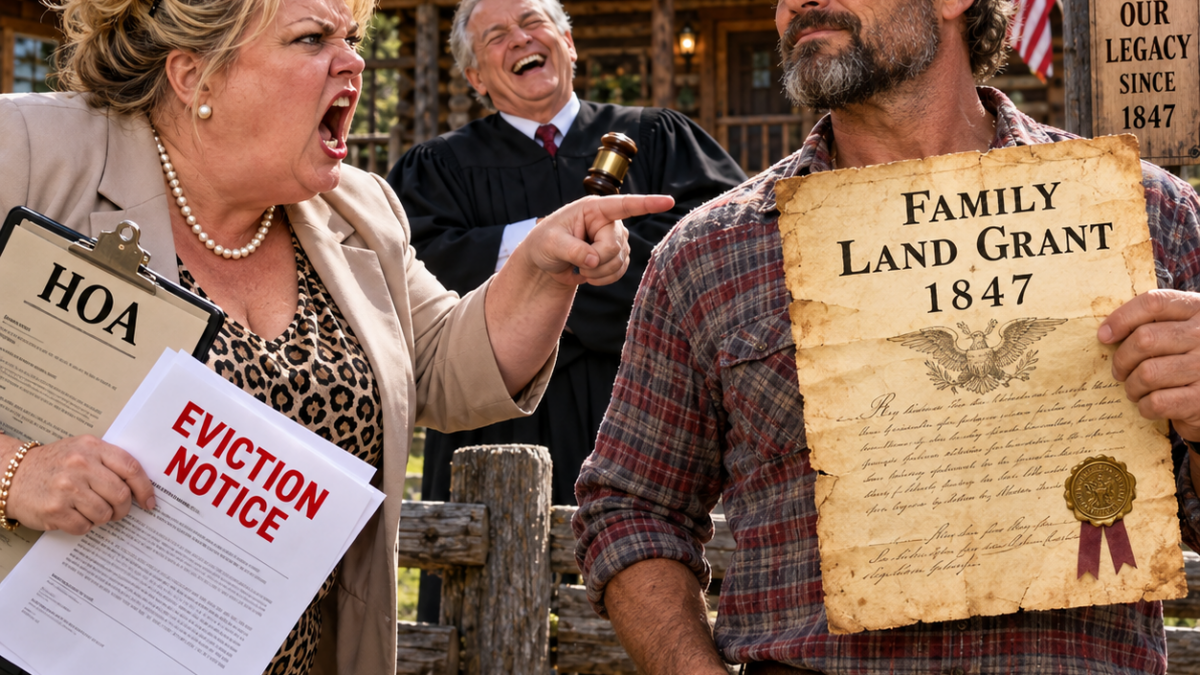
The HOA president drove onto my family’s Tennessee land, pointed at the log cabin my relatives had cared for across generations, and gave me thirty days to get out before her board started eviction proceedings against me.
She came armed with official-looking maps, violation notices, and an attorney’s letter claiming my property had suddenly become part of a subdivision built more than a century after my family first settled there, and she smiled like paperwork alone had already made the cabin hers.
I didn’t shout, threaten her, or beg for more time, because there was something hanging above my fireplace that made her thirty-day ultimatum feel less like an eviction notice and more like the first piece of evidence in a much bigger mistake.
I was splitting oak behind the cabin when Cheryl Netherly’s SUV came grinding up my gravel drive.
You could hear expensive tires complaining about country roads long before you saw them.
I set my axe against the chopping block and watched the vehicle stop beside the old hickory tree. Cheryl climbed out wearing wedge heels, cream slacks, and the expression of someone arriving to correct a problem she had already decided was beneath her.
Willow Creek sat half a mile east of my property.
Rows of new houses.
Vinyl fences.
Decorative streetlights.
A clubhouse with stone columns that had been stained to look older than the land beneath it.
My cabin had been standing long before Willow Creek existed.
My family had been on the land longer still.
That apparently didn’t matter to Cheryl.
She walked toward me holding a manila envelope.
“You’re Quinton Nash?”
“You know I am.”
“We’ve corresponded.”
“You’ve sent letters. I threw most of them away.”
Her mouth tightened.
“That wasn’t wise.”
I leaned against the chopping block.
“What can I do for you?”
She pointed toward my cabin.
“You cannot maintain that structure here.”
I looked at the hand-hewn logs, stone chimney, metal roof, and porch my grandfather had repaired with me when I was seventeen.
“Seems like I’ve been managing.”
“It is not compliant with Willow Creek architectural standards.”
“This isn’t Willow Creek.”
“Actually, that’s why I’m here.”
She removed several papers.
“Following the recent jurisdictional amendment, adjoining parcels within the revised community perimeter are now subject to HOA regulation.”
I stared at her.
“You voted my land into your HOA?”
“The board approved an annexation.”
“Did the land vote too?”
“This isn’t funny.”
“No, Cheryl. It really isn’t.”
She unfolded a map.
A thick red line ran beyond Willow Creek’s original boundary, crossed the county road, then curved directly through my property.
My cabin sat inside a shaded area marked **EXPANDED COMPLIANCE ZONE**.
I almost laughed again.
Instead, I asked, “Who drew this?”
“Our property committee.”
“County approve it?”
“The HOA followed proper procedure.”
“That wasn’t my question.”
She ignored me and began reading from a violation sheet.
“Unregistered dwelling. Nonconforming exterior materials. Noncompliant fencing. No approved landscaping plan. Potential septic documentation issues.”
“My septic was inspected.”
“Not by our committee.”
“Your committee isn’t digging around my septic tank.”
“Then you’ll have an opportunity to address that during compliance review.”
I looked at her.
“What exactly are you asking me to do?”
“Vacate.”
For a moment, even the birds seemed to go quiet.
“Excuse me?”
She handed me the notice.
“You have thirty days.”
“To do what?”
“Remove yourself from the property pending resolution of ownership and compliance.”
I read the first paragraph.
**NOTICE TO VACATE**
My own name appeared beneath it.
“That word means eviction, Cheryl.”
“If necessary.”
“From my own cabin.”
“From property now under HOA jurisdiction.”
I folded the paper once.
Then again.
“You’ve been president how long?”
“Six months.”
“And in six months you decided you can evict families who’ve been here longer than the subdivision?”
“This isn’t about history.”
I looked toward the cabin.
She had no idea how wrong that sentence was.
“This is about enforceable community standards,” she continued. “If you cooperate, perhaps the board will consider allowing the structure to remain after modifications.”
“Perhaps.”
“Yes.”
I handed the notice back.
She refused to take it.
“Keep it. You’ll need it.”
“For what?”
“Court.”
Her smile returned.
“You really want to fight this?”
I picked up my axe.
“No.”
She looked satisfied for half a second.
Then I added, “I want you to file it.”
Her smile vanished.
“File what?”
“Everything you just claimed.”
I nodded toward the road.
“Put it in front of a judge.”
Cheryl stared at me.
“You have thirty days.”
“I heard you.”
She turned toward the SUV.
As she reached the driver’s door, I called after her.
“Cheryl.”
She looked back.
“You should make sure that map is real before your lawyer puts his name on it.”
Her face changed just enough for me to notice.
Then she drove away.
I waited until the dust settled before walking inside.
Above the stone fireplace was an old wooden frame my grandfather had warned me never to open casually.
Inside it sat a sheet of aging parchment, browned around the edges, carrying a seal and a date that had survived wars, depressions, floods, deaths, births, and every generation of my family that had slept beneath that roof.
I stood beneath it for a long time.
Then my phone rang.
A lawyer representing Willow Creek was calling.
And when he told me Cheryl’s map had already been filed with the county, I finally understood that this wasn’t just an arrogant HOA president bluffing at my gate.
Someone had started changing records.
PART 2
I let the phone ring once more before answering.
“Quinton Nash.”
The voice on the other end belonged to a man who sounded like he’d spent years learning how to make threats sound polite.
“Mr. Nash, this is Gregory Sloane. I represent the Willow Creek Homeowners Association.”
“I figured somebody eventually would.”
“I understand President Netherly delivered notice this morning.”
“She did.”
“I’d like to avoid unnecessary escalation.”
“Then tell her to stay off my land.”
He paused.
“That’s precisely the sort of language that makes resolution more difficult.”
I looked at the old document above my fireplace.
“What resolution are you proposing?”
“You acknowledge Willow Creek’s expanded jurisdiction, submit the cabin for architectural and safety review, pay the current administrative assessments, and temporarily vacate while the compliance process is completed.”
“How much are these administrative assessments?”
“Currently forty-eight hundred dollars.”
I laughed once.
“That’s impressive.”
“Mr. Nash—”
“You people managed to fine me nearly five grand before I even joined the HOA I never joined.”
“You were properly annexed.”
“According to Cheryl.”
“According to recorded documentation.”
That caught my attention.
“Recorded where?”
“County clerk.”
“When?”
“Approximately two weeks ago.”
“Who submitted it?”
“The association.”
“And there’s a document with my consent?”
Another pause.
“That would be a matter contained in the filing.”
“Have you personally seen it?”
“I don’t discuss privileged client documentation over the telephone.”
“That wasn’t what I asked.”
“Mr. Nash, I strongly recommend you retain counsel.”
For the first time in our conversation, we agreed.
“I plan to.”
“If you ignore the notice, the HOA will seek injunctive relief and possession.”
“Possession.”
“Temporary possession if necessary to cure violations.”
I stared through the front window toward the woods my great-grandfather had hunted.
“You understand you’re talking about removing me from family property, right?”
“I understand the HOA’s legal position.”
“No, Gregory. You understand what Cheryl told you.”
“Good afternoon, Mr. Nash.”
He hung up.
I remained beside the fireplace.
My grandfather had framed the land grant himself.
He used walnut from a tree that had fallen behind the cabin after a lightning strike.
When I was eight, he’d caught me touching the parchment through the glass.
“Don’t put greasy fingers on history,” he’d said.
At eight years old, history sounded boring.
At forty-three, it suddenly sounded like the most important thing I owned.
I removed the frame.
Set it carefully on the dining table.
Then called Zachary Mullen.
He answered from his bait shop.
“Nash.”
“Zach.”
“Quinton? Somebody die?”
“Not yet.”
“That sounds promising.”
“You still licensed?”
“As an attorney?”
“Yes.”
“Unfortunately.”
“I need property counsel.”
Long silence.
Then I heard him yell to somebody in the shop.
“Billy, watch the minnows!”
A door closed.
Zachary came back.
“How bad?”
“HOA says they annexed the cabin.”
He laughed.
I didn’t.
The laughter stopped.
“Your cabin?”
“Yes.”
“The Nash land?”
“Yes.”
“The land with that ridiculous ancient parchment your grandfather used to show everybody after his second bourbon?”
“That one.”
“I’m coming over.”
“Bring a suit.”
“I own one.”
“One that fits.”
“Now you’re asking too much.”
—
Zachary arrived forty minutes later in jeans, boots, and a faded Tennessee Volunteers sweatshirt.
He carried two coffees and the look of a man delighted to be angry on somebody else’s behalf.
The moment he saw the land grant on the table, his expression changed.
“Take that out of the sun.”
“It’s late afternoon.”
“Still.”
I closed the curtains.
He set his coffee down and leaned over the frame.
The document dated to 1847.
Our family story said the original grant had been issued to my great-great-grandfather’s father as part of the settlement of that section of Tennessee.
Whatever family legend had embellished over the generations, the legal chain itself was real.
Grant.
Recorded survey.
Later remeasurement.
Successive estates.
No sale.
No voluntary subdivision of my cabin tract.
No conveyance to Willow Creek.
Zachary had seen certified copies years earlier when helping with an easement dispute.
He stared at it now.
“Where’s the modern title abstract?”
“Safe.”
“Survey?”
“Safe.”
“Tax statements?”
“Desk.”
“HOA letter?”
I handed it over.
He read for five minutes.
Then frowned.
“Where did they get this parcel number?”
“No idea.”
He pointed.
“This isn’t yours.”
“What?”
“The suffix is wrong.”
I took the page.
My real parcel ended in 017-B.
The HOA document listed 017-D.
“What’s D?”
“Don’t know.”
Zachary pulled out his phone.
Ten minutes later, he had the county GIS system open.
Parcel 017-D didn’t exist.
He looked at me.
“They invented a parcel number.”
“You sure?”
“I want certified records before I say anything under oath.”
He stood.
“County recorder first thing tomorrow.”
“Why wait?”
He checked the clock.
“Because government employees have this strange objection to me breaking in after hours.”
“You’ve gotten soft.”
“You’ve gotten felonious.”
He picked up the HOA letter.
“Did their lawyer say they filed annexation documents?”
“Yes.”
“Good.”
“Good?”
He smiled.
“If they’re stupid enough to put this into the public record, they’ve preserved evidence for us.”
—
The county courthouse sat in the middle of town behind three massive oak trees and a bronze statue nobody could ever agree was historically accurate.
Zachary arrived the following morning wearing his promised suit.
It was charcoal gray.
Wrinkled.
The sleeves were slightly too short.
I looked at him.
“You look like you slept in a donation bin.”
“This is what justice looks like before coffee.”
We entered the recorder’s office.
The clerk recognized me.
Small town.
Most people did.
“Quinton Nash?”
“Yes, ma’am.”
“You’re here about Willow Creek.”
That told me how far gossip had already traveled.
Zachary slid his license across the counter.
“We need certified copies of all filings referencing the Nash tract for the past twelve months.”
The clerk’s expression became cautious.
“There’s a new filing.”
“We know.”
She disappeared into the back.
When she returned, she carried a folder.
Zachary read the first document.
Then the second.
His jaw tightened.
“What?” I asked.
He turned it toward me.
**VOLUNTARY ANNEXATION CONSENT**
My name appeared below.
Quinton Nash.
Underneath was a signature.
It wasn’t mine.
Not close.
The Q looked like an O with a tail.
The N in Nash leaned backward.
I’ve signed my name on tax documents, checks, deeds, military forms, permits, and contracts for decades.
Nobody who had ever seen my signature would mistake that thing for mine.
“She forged my name.”
“Looks like somebody did.”
Zachary turned the page.
“Notary.”
He read the name.
“Edwin Paul Mercer.”
The clerk looked up from her computer.
“That name sounds familiar.”
She typed.
Then went still.
“He isn’t active.”
“When did his commission expire?” Zachary asked.
“Three years ago.”
I stared at the fake form.
Zachary continued reading.
“This says you voluntarily submitted your tract to Willow Creek authority last October.”
“I didn’t.”
“Were you even in Tennessee last October?”
“I was in Kentucky helping my sister after surgery.”
“You can prove it?”
“Hotel receipt. Credit card. Probably hospital parking.”
“Good.”
The next document was even worse.
A boundary map showed Willow Creek’s outer line crossing the road and wrapping around my cabin.
No planning commission approval.
No zoning reference.
No affected-owner signatures beyond the fake one bearing my name.
Zachary pointed to a filing stamp.
“This wasn’t processed as an official annexation.”
“What is it?”
“They basically deposited it into the general record index as supporting HOA material and are now pretending filing equals approval.”
The clerk looked embarrassed.
“We receive thousands of documents. Recording something doesn’t validate the legal claims inside it.”
“I know,” Zachary said. “But they may be counting on Mr. Nash not knowing.”
I looked at the forged signature.
My anger came slowly.
Different from when Cheryl stood in the driveway.
That had been absurd.
This was deliberate.
Somebody sat at a desk.
Wrote my name.
Pretended I had agreed.
Then built an eviction threat on top of it.
“Certified copies,” I said.
The clerk nodded.
“How many?”
“Everything.”
Zachary looked at me.
“Then sheriff.”
—
Sheriff Luis Mendez had served the county longer than Willow Creek had existed.
He listened without interrupting.
Zachary laid the forged annexation consent on his desk.
Mendez put on reading glasses.
“This is supposed to be your signature?”
“Yes.”
“You deny signing it?”
“Completely.”
“Notary?”
“Expired commission,” Zachary said.
Mendez looked toward his computer.
“And you’re saying they’re trying to evict you based on this.”
“Thirty-day notice.”
I handed him Cheryl’s letter.
He read.
Then looked back at the forgery.
“This potentially moves beyond an HOA dispute.”
“That was my thought,” Zachary said.
“Don’t tell me my job.”
“Wouldn’t dream of it.”
Mendez almost smiled.
Then turned serious.
“Quinton, I’ll need a sworn statement.”
“Fine.”
“Signature samples.”
“Fine.”
“Original title material.”
“We brought certified chain-of-title records.”
Mendez looked toward the large archival case beside my chair.
“And the old grant?”
I opened it carefully.
He stared.
“Good Lord.”
“1847.”
He leaned closer.
“You carry this around?”
“Not normally.”
“I’d put that thing in a bank vault.”
“My grandfather would haunt me.”
“He can haunt the bank.”
Deputy Sarah Work entered with an affidavit form.
For the next hour, I gave a statement.
Every visit.
Every letter.
Every phone call.
Every claim.
When I finished, Mendez gathered the documents.
“If somebody knowingly forged your signature and used it to interfere with title or possession, the DA is going to care.”
“What about Cheryl?”
“We follow evidence.”
He looked directly at me.
“Do not go confront her.”
“Wasn’t planning to.”
“Do not threaten board members.”
“I won’t.”
“Do not rip down any notices they put on public property.”
“What if they nail one to my fence?”
“Photograph it first.”
Zachary raised a hand.
“Can he rip it down after?”
Mendez stared.
“Get out of my office.”
—
By midafternoon, deputies were at Willow Creek’s clubhouse.
I didn’t go.
Zachary wanted to.
I told him he had developed an unhealthy relationship with spectacle.
He said he’d been selling worms for five years and deserved excitement.
We stayed at the cabin instead.
Around three, his phone buzzed.
Then mine.
Then both again.
The neighborhood message board had exploded.
Two patrol cars.
Sheriff’s investigators.
Boxes being carried from the HOA office.
Someone posted a photograph of Cheryl standing in the clubhouse doorway with her arms crossed while Deputy Work handed her papers.
Zachary whistled.
“She looks happy.”
“She always looks like that.”
A second message came from Mendez.
**Need no action from you. Records secured. Investigation expanding.**
“Expanding,” Zachary said.
“What does that mean?”
“It means you’re not the only one.”
He was right.
By evening, Mendez called.
“Three other boundary files.”
I stood from the kitchen table.
“What about them?”
“Similar annexation claims.”
“Forged?”
“Not saying yet.”
“Owners?”
“One widow. One absentee property owner. One couple who sold recently.”
My stomach tightened.
“Sold why?”
“Neighbors say they were facing heavy HOA penalties.”
Zachary leaned toward the phone.
“Sheriff, did the HOA buy the property?”
“No.”
“Who did?”
“Investment company.”
“Name?”
“Not giving you that yet.”
Fair.
Mendez continued.
“Quinton, stay put.”
“I’m on my land.”
“Exactly.”
After the call, I walked outside.
The cabin sat beneath oaks and tulip poplars, smoke rising from the chimney even though the afternoon wasn’t particularly cold.
My great-great-grandfather had known this hill.
My grandfather had been born a few hundred yards away.
My father taught me to shoot behind the southern ridge.
My mother’s ashes had been scattered near the creek.
Cheryl had reduced all of it to a fake red line on a map.
That was what made me understand the fight wasn’t about keeping my cabin.
It was about stopping somebody from learning that forged paper could become reality if the victim was too tired, too scared, or too uninformed to fight.
—
The next morning, someone had nailed a handwritten notice to my fence.
Not official letterhead.
Not HOA stationery.
Just thick white paper.
**MR. NASH:**
**YOUR CONTINUED CAMPAIGN OF HOSTILITY AGAINST WILLOW CREEK AND ITS ELECTED LEADERSHIP CONSTITUTES HARASSMENT. FURTHER ACTION WILL RESULT IN CIVIL LIABILITY.**
Signed:
**CHERYL NETHERLY**
I photographed it.
Then pulled out the nail.
Zachary arrived twenty minutes later.
He read the note and laughed so hard he had to sit on the porch step.
“This isn’t funny.”
“It is a little.”
“She forged my signature and now I’m harassing her.”
“Panic makes people write strange things.”
“What do we do?”
“Nothing.”
“Nothing?”
“Give a copy to Mendez.”
“That feels unsatisfying.”
“Law is frequently unsatisfying in the short term.”
He folded the notice.
“Want satisfying?”
“Yes.”
“Our countersuit is ready.”
That got my attention.
“For what?”
“Declaratory relief confirming your title and exemption from Willow Creek. Injunction against enforcement. Damages. Attorney fees where available. Claims arising from fraudulent filings.”
“And Cheryl?”
“She’s going to have enough problems.”
He placed a second folder on the table.
“Hearing request.”
“When?”
“Thursday.”
“That fast?”
“They’re claiming an eviction right. We asked for emergency resolution.”
I looked toward the framed land grant.
“Bring the original?”
Zachary smiled.
“Oh, absolutely.”
—
Judge Harold Bixby had been on the bench for thirty years.
Silver hair.
Heavy eyebrows.
A voice that made people stop shuffling papers when he spoke.
The courtroom Thursday morning was fuller than I expected.
Cheryl sat beside Gregory Sloane.
She wore a navy suit.
No wedge heels.
Behind her sat two Willow Creek board members.
Zachary and I took the other table.
The archival case containing the original land grant rested beside my chair.
Judge Bixby entered.
Everyone stood.
The clerk called the matter.
Bixby glanced through the pleadings.
Then looked over his glasses.
“This concerns an attempted HOA enforcement action against property owned by Mr. Nash.”
“Yes, Your Honor,” Zachary said.
Gregory stood.
“The association’s position is that Mr. Nash voluntarily submitted the parcel to expanded jurisdiction.”
Judge Bixby looked at him.
“Is that the document currently under criminal investigation for an allegedly forged signature?”
Gregory hesitated.
“That issue remains unresolved.”
“Then perhaps relying heavily on it today would be ambitious.”
A few people behind me shifted.
Cheryl whispered something.
Gregory ignored her.
Zachary stood.
“Your Honor, the underlying title question is considerably simpler.”
“How simple?”
Zachary looked at me.
“May we present the original grant?”
Judge Bixby leaned back.
“The original?”
“Yes, sir.”
“Not a copy.”
“No, sir.”
“All right. Let’s see it.”
I carried the archival case to the clerk.
She placed the parchment before the judge.
Bixby stared at it.
For several seconds, nobody spoke.
He leaned closer.
Read the old legal description.
Examined the seal.
Then looked at the certified chain of title Zachary submitted beside it.
His mouth twitched.
Not quite a smile.
Then he looked across the courtroom at Cheryl.
“This instrument is older than every person in this courtroom.”
A few people laughed quietly.
Gregory’s shoulders sank.
Judge Bixby continued.
“And unless counsel intends to argue that a nineteenth-century recorded grant somehow became subject to a homeowners association created last year without a conveyance, covenant, valid annexation, or owner consent, I’m struggling to see why we’re here.”
Gregory cleared his throat.
“Your Honor, the association relied upon its annexation records.”
“The ones bearing a signature Mr. Nash denies?”
“Yes, but—”
“And a purported notarization by a person whose commission, according to the sheriff’s preliminary report, had expired?”
Gregory looked at Cheryl.
For the first time since I’d met her, Cheryl seemed small.
Zachary stood.
“We have also submitted the official survey history, Your Honor. The Nash tract was remeasured in 1861 and has remained materially unchanged in the county title records. Willow Creek’s new map simply draws its boundary across Mr. Nash’s property without lawful basis.”
Judge Bixby flipped pages.
Then said, “Yes. I noticed.”
Cheryl suddenly stood.
“Your Honor, this property affects our community.”
Bixby looked at her.
“Sit down.”
“But—”
“Ms. Netherly.”
She froze.
“Your attorney is speaking for you.”
She sat.
Bixby looked toward Gregory.
“Anything else?”
Gregory whispered with Cheryl.
Then stood.
“The association requests time to investigate irregularities in the filing.”
Zachary almost smiled.
Judge Bixby didn’t.
“Your client filed the documents.”
“Yes, Your Honor.”
“Now your client requires time to determine whether her own documents are irregular.”
Silence.
The judge took off his glasses.
“As to the civil title issue before me today, there is no credible evidence that Mr. Nash’s parcel is subject to Willow Creek HOA authority.”
My chest loosened.
Judge Bixby continued.
“The attempted eviction notice is void.”
Cheryl stared straight ahead.
“The association is enjoined from asserting possession, imposing fines, conducting inspections, or interfering with Mr. Nash’s use of the tract based on the disputed annexation.”
He looked at me.
“Mr. Nash.”
“Yes, sir.”
“Your land is yours.”
The words were simple.
They still hit me harder than I expected.
“It always has been.”
I swallowed.
“Thank you, Your Honor.”
Then Bixby’s expression hardened.
“This court has reviewed preliminary law-enforcement materials concerning possible forged public filings. Those matters are outside today’s title determination and will proceed separately.”
He looked directly at Cheryl.
“Ms. Netherly, I strongly recommend you follow your attorney’s advice before speaking publicly about any of this.”
Her lips tightened.
Court adjourned.
Zachary leaned toward me.
“Did a judge just politely tell her to shut up?”
“Pretty much.”
He grinned.
“I missed this job.”
—
Outside the courthouse, reporters were already waiting.
Small-town news travels faster than weather.
Zachary stopped to speak with one.
I kept walking.
Cheryl exited behind us.
A woman shouted, “Did you forge his name?”
Another reporter asked, “Were other properties targeted?”
Gregory pulled Cheryl toward a waiting vehicle.
She looked at me once.
No anger.
Fear.
For the first time, I understood the land case was no longer her biggest problem.
Mendez confirmed it that afternoon.
“We found money issues.”
I was sitting on the cabin porch.
“How bad?”
“Still determining.”
“Sheriff.”
He sighed.
“Association dues routed into a private account labeled Outreach and Beautification.”
“Whose control?”
“Cheryl had signing authority.”
“For legitimate expenses?”
“Some.”
“And the rest?”
“Personal landscaping. Patio improvements. Resort charges.”
I stared at the woods.
“She’s been stealing dues.”
“Evidence suggests misuse.”
“Charges?”
“DA decides.”
“What about the annexed properties?”
“Two homeowners sold after aggressive fines.”
“To the same buyer?”
“Yes.”
“Connected to Cheryl?”
“Investigating.”
My anger returned.
Not because she’d stolen from people.
Because I knew now why the cabin mattered.
It wasn’t random.
My land had value.
Road frontage.
Woods.
Water.
Development potential.
If Cheryl could fabricate jurisdiction and pressure me, perhaps she could force a sale the way she’d apparently pressured others.
“How many people knew?”
“That’s the question.”
—
Zachary filed a petition to place Willow Creek under temporary receivership.
The county supported oversight while the financial investigation continued.
Judge Bixby approved an interim receiver within forty-eight hours.
Franklin Dorsey arrived at Willow Creek with gray hair, suspenders, and the patience of a man who had audited enough organizations to know everyone lies differently.
Board members began resigning.
The court froze structural changes until records could be preserved.
One board member named Kent came to my cabin.
He didn’t call.
Just stood outside the gate until I noticed him.
“You need something?”
He removed his cap.
“I wanted to explain.”
I opened the gate but didn’t invite him inside.
He understood.
“I voted for the annexation policy.”
“I know.”
“Cheryl told us it was voluntary.”
“Mine wasn’t.”
“I know that now.”
“She showed you my consent?”
“No.”
“Did you ask?”
He looked at the ground.
“No.”
“Why?”
“She said legal had reviewed everything.”
“Gregory?”
“She said counsel.”
“That wasn’t my question.”
Kent rubbed his forehead.
“I don’t know.”
“Did you ever see a county approval?”
“No.”
“Planning commission vote?”
“No.”
“Owner petition?”
“No.”
I waited.
He finally said, “I should’ve checked.”
“Yes.”
He looked toward the cabin.
“I didn’t know she was forging anything.”
“I believe you.”
His eyes lifted.
“But?”
“You knew enough to ask questions.”
He nodded.
“I don’t expect forgiveness.”
“Good.”
That seemed to surprise him.
I wasn’t trying to be cruel.
Forgiveness isn’t something you hand out because a guilty person knocks politely.
Kent had participated in a structure that threatened my home.
Maybe he hadn’t forged the signature.
Maybe he hadn’t stolen money.
But he’d voted without doing the basic work.
He needed to live with that.
So did I.
—
The town council held an emergency meeting the following week.
Residents packed the chamber.
The council passed a new local ordinance requiring HOA boundary expansions to go through public zoning review with documented notice to every affected landowner.
No more “internal amendments” pretending to change external property rights.
No more phantom maps.
No annexation based on papers nobody verified.
I attended from the back.
When the vote passed, an elderly woman sitting beside me started crying.
“You okay?”
She wiped her eyes.
“My name is Ruth Collins.”
The name was familiar.
One of the edge properties.
“My husband built our house in 1967,” she said. “Cheryl told me last month I was inside Willow Creek now.”
“Did you sign anything?”
“No.”
“Did she fine you?”
“Three thousand dollars.”
“For what?”
“Fence. Shed. A pecan tree.”
I stared.
“A tree.”
“Said the roots might affect community drainage.”
“Did you pay?”
“Some.”
She looked embarrassed.
“I thought if I didn’t, they’d take my house.”
That sentence stayed with me.
Fear had done most of Cheryl’s work for her.
—
Two days after Cheryl’s arrest on initial fraud and forgery charges, the HOA accountant walked into the sheriff’s office crying.
Her name was Lorna Pierce.
Mid-thirties.
Dark hair pulled tightly back.
Blue folder pressed against her chest.
Mendez called Zachary and me after she agreed to cooperate.
Lorna sat at a conference table.
She looked as though she hadn’t slept.
“I didn’t know everything.”
Nobody answered.
She opened the folder.
“At first, expenses just didn’t match.”
“What expenses?” Zachary asked.
“Maintenance.”
She pulled a spreadsheet.
“Parking lot paving.”
“Willow Creek has one clubhouse lot,” I said.
“Yes.”
“They repaved it?”
“According to the books, three times in twenty-two months.”
I looked at Zachary.
He looked at Lorna.
“Was it?”
“No.”
She turned another page.
“Clubhouse electrical rewiring. Twice in one year.”
“Same electrician?”
“Same invoice number.”
Mendez sat straighter.
“Paid twice?”
“Yes.”
“Where did the duplicate payment go?”
Lorna’s hands trembled.
“WC Improvements LLC.”
“Registered where?” Zachary asked.
“It isn’t.”
“What?”
“No registration I can find.”
“Bank?”
“New Mexico.”
Mendez looked at her.
“Who controlled the account?”
“I don’t know.”
“You handled accounting.”
“I handled the books Cheryl gave me.”
Her voice broke.
“When I asked for bank authorization records, she told me to stop asking questions.”
“Why didn’t you quit?”
“I needed the job.”
She wiped her eyes.
“My husband was laid off.”
Nobody spoke for a moment.
Then Zachary asked, “Property sales?”
Lorna’s face changed.
“That was worse.”
She pulled out another ledger.
“When owners accumulated violations, Cheryl sometimes offered a preferred real-estate agent.”
“Who?”
“Bradley Raines.”
I knew the name.
Local agent.
Aggressive.
“Commission arrangement?” Mendez asked.
“Officially normal.”
“And unofficially?”
“Kickbacks.”
The room went quiet.
“How do you know?” I asked.
“Transfers into WC Improvements after closings.”
“How many?”
“Seven.”
“Two of those were edge properties?” Zachary asked.
“Yes.”
Mendez exhaled slowly.
“Pressure owners with fines, push a sale, collect money on the sale.”
Lorna nodded.
“And acquire strategic parcels.”
My stomach tightened.
“For what?”
“I don’t know.”
I did.
Development.
My family land bordered all of them.
—
The prosecutor froze Willow Creek’s accounts.
Franklin Dorsey called an emergency board meeting.
Only two members showed up.
Kent wasn’t one of them.
Lester Pike was.
So was Elise Warren.
Franklin sat at the front with stacks of files.
I stayed in the back.
Lester kept repeating the same sentence.
“We were misled.”
Franklin finally interrupted.
“You approved budgets.”
“We relied on the president.”
“You have fiduciary responsibilities independent of the president.”
“She told us everything had legal review.”
“Show me the legal opinions.”
Lester said nothing.
Elise looked sick.
“We didn’t know about the fake maps.”
Franklin lifted a document.
“This annexation filing includes a notarization attributed to a former official who was dead when the document was supposedly executed.”
Nobody breathed.
I leaned forward.
“Dead?”
Franklin nodded.
“One year.”
Even I hadn’t known that.
Elise covered her mouth.
“She showed us copies.”
“Did you verify?”
“No.”
Franklin closed the file.
“Effective immediately, this association is operating under court supervision.”
Lester tried to protest.
Franklin ignored him.
“No expenditures without receiver approval. No enforcement. No fines. No title communications. No contracts.”
He looked around the room.
“Willow Creek is no longer autonomous.”
I left before the meeting ended.
Watching frightened board members squirm didn’t give me anything.
There was work to do.
—
Zachary came to the cabin the next afternoon carrying a report.
“You’re going to hate this.”
“What’s left to hate?”
“Private investigator.”
I stared.
“What?”
“HOA funds paid a man named Russell Caine.”
“For what?”
“Background checks.”
“On who?”
“Residents.”
“Why?”
Zachary tossed photographs and invoices onto the table.
“Anyone who pushed back.”
One file belonged to a homeowner who had complained about lawn regulations.
Another to a woman who challenged pool assessments.
Another to Kent.
Another to me.
I picked up my file.
It contained property records.
Tax documents.
Old civil filings.
My sister’s address.
My previous employer.
Even photographs of my truck in town.
“He followed me?”
“Looks like.”
“Why?”
“Leverage.”
I flipped through.
There was nothing particularly embarrassing.
That wasn’t the point.
“The man who complained about lawn height?” Zachary said. “His divorce documents started circulating through neighborhood emails afterward.”
I looked up.
“Cheryl leaked them.”
“We can’t prove who leaked them yet.”
“She was blackmailing residents.”
“At minimum, investigators are looking at extortion and privacy issues.”
I walked to the fireplace.
My land grant hung in its frame again.
“She’s a predator.”
Zachary didn’t disagree.
We took the files to the DA.
Charges expanded.
Forgery.
Fraud.
Embezzlement.
Wire-related financial offenses.
Extortion.
Privacy-related counts.
The simple eviction dispute was now a criminal enterprise case.
And it had started because Cheryl couldn’t stand seeing one log cabin outside her control.
—
The trial was scheduled for early spring.
Winter arrived first.
Snow dusted the ridge behind the cabin.
For several months, life slowed.
The receiver untangled Willow Creek.
The county investigated infrastructure.
Residents challenged old fines.
Some money was returned.
Some claims required litigation.
Ruth Collins received her payments back.
When Franklin handed her the refund letter, she cried again.
“I feel foolish.”
“You shouldn’t,” I told her.
“I paid for a tree.”
“You paid because someone convinced you your home was at risk.”
“Still.”
I looked at her.
“Fear isn’t stupidity.”
She folded the check carefully.
“No.”
Then she smiled.
“But I’m keeping the pecan tree.”
“Good.”
—
Zachary prepared me for trial at his bait shop.
That was as ridiculous as it sounds.
We sat behind tubs of nightcrawlers while fishermen walked in and out.
“Again,” he said.
“Cheryl arrived on—”
“Don’t memorize it.”
“You told me to practice.”
“Practice being accurate, not robotic.”
A customer approached.
“Y’all got chicken liver?”
Zachary pointed toward a freezer.
The man grabbed two packs, paid, then looked at me.
“You the cabin guy?”
I sighed.
Zachary smiled.
“He is.”
“Judge really laughed at the HOA?”
“He did not technically laugh.”
Zachary said, “He spiritually laughed.”
The customer nodded.
“Good enough.”
After he left, I glared at Zachary.
“This is why you stopped practicing law.”
“No, billing software.”
He became serious again.
“Defense will call it misunderstanding.”
“It wasn’t.”
“Don’t argue.”
“Fine.”
“They’ll say Cheryl relied on advisors.”
“She forged my name.”
“Say exactly that when asked.”
“They may suggest your old grant doesn’t automatically defeat modern law.”
“That part’s true.”
I paused.
The old parchment was powerful evidence of family history, but legally our modern recorded chain of title was what mattered.
Zachary had drilled that into me.
“Don’t turn the 1847 document into magic,” he said. “It’s powerful because the title chain stayed intact.”
“I know.”
“Good.”
That distinction would matter later.
I wanted the truth to win.
Not a legend.
—
Lorna testified on the second day.
She looked nervous walking to the witness stand.
Then the prosecutor began asking about numbers.
Her fear disappeared.
Spreadsheets were her language.
She explained the paving invoices.
Duplicate electrical charges.
Shell accounts.
Cash withdrawals.
Property-sale kickbacks.
She showed how money moved.
One account to another.
Then another.
The jury watched closely.
Cheryl didn’t.
She stared at the table.
Then Russell Caine, the private investigator, testified.
He wore a cheap brown suit.
The prosecutor asked, “What were you hired to do?”
“Background research.”
“On whom?”
“Residents.”
“Which residents?”
“People identified by Ms. Netherly.”
“For what purpose?”
“She said security.”
“What information were you asked to locate?”
He shifted.
“Anything useful.”
“Useful for what?”
“Pressure.”
The prosecutor waited.
“Pressure to do what?”
“Stop challenging the board.”
A woman on the jury frowned.
“Did Ms. Netherly ever use the word ‘dirt’?”
Russell looked toward Cheryl.
Then answered.
“Yes.”
“What did she say?”
“Find dirt.”
That was the moment whatever remained of Cheryl’s respectable-neighborhood-president image disappeared.
She wasn’t protecting property values.
She was collecting vulnerabilities.
—
I took the stand the following afternoon.
The prosecutor began with the cabin.
Then the first visit.
The thirty-day eviction notice.
The fabricated map.
The forged consent.
Eventually, he held up the 1847 grant.
“Mr. Nash, what is this?”
“A land grant preserved by my family.”
“How does it relate to the property?”
“It begins the documented ownership history in our family. The current title chain continues from it through later recorded transfers and estates.”
“Was the land ever conveyed into Willow Creek HOA?”
“No.”
“Did you sign the voluntary annexation document?”
“No.”
“Did you authorize anyone to sign for you?”
“No.”
The prosecutor handed the document to the judge for viewing.
Judge Bixby wasn’t presiding over the criminal trial—that matter had another judge—but the document still drew attention.
Old parchment does that.
The modern title records followed.
Survey.
Deeds.
Tax records.
No HOA.
Then the fake map.
The contrast was brutal.
Cheryl’s attorney stood.
“Mr. Nash, isn’t it true your family has emotionally identified with this property for generations?”
“Yes.”
“And that emotional attachment may cause you to exaggerate perceived threats?”
“No.”
“You were angry with Ms. Netherly.”
“Yes.”
“You wanted her punished.”
“At first.”
He paused.
“At first?”
“When she tried to evict me, yes.”
“And now?”
“I want the court to do its job.”
“You’ve sued.”
“Yes.”
“You supported receivership.”
“Yes.”
“You helped push for regulation of future HOA expansions.”
“Yes.”
“So this isn’t merely about your cabin.”
“No.”
He smiled slightly.
“Exactly.”
I looked at him.
“It stopped being only about my cabin when I found out other people had been targeted.”
His smile disappeared.
“No further questions.”
—
The jury deliberated less than two hours.
Guilty.
Not because of one dramatic piece of parchment.
Because of everything.
Forgery.
Bank records.
Fake invoices.
Kickbacks.
Witness testimony.
Private investigator records.
Annexation files.
The pattern.
Cheryl stood beside her attorney as the verdicts were read.
She didn’t look at me.
Sentencing came weeks later.
Twelve years.
Eligibility for release restricted for a substantial portion of that sentence under the terms imposed.
Restitution.
Financial penalties.
No future fiduciary role in community associations.
The courtroom remained silent.
I had imagined that moment before.
I thought I’d feel vindicated.
Instead, I remembered Cheryl on my driveway.
Wedge heels in gravel.
Thirty days.
So much destruction had come from one woman’s belief that authority existed because she said it did.
Outside, reporters surrounded Zachary.
He loved it.
Naturally.
One asked me if I had a statement.
I gave them one.
“I’m not moving.”
Another reporter pushed forward.
“Do you feel justice was served?”
“Yes.”
“What happens now?”
I looked toward the hills.
“I go home.”
—
The state dissolved Willow Creek HOA shortly after the criminal case.
County administration handled essential matters during transition.
Residents could later establish a lawful replacement if they chose.
For the moment:
No secret meetings.
No arbitrary fines.
No private investigator.
No forged annexations.
No Cheryl.
I replaced the section of fence her SUV had scraped on that first morning.
Painted the porch trim.
Repaired the shed.
Then planted three apple trees along the western field.
My grandfather always wanted an orchard there.
He died before getting around to it.
Planting them felt better than any courthouse victory.
Zachary came by one afternoon carrying a fishing pole and a manila envelope.
“No.”
“You haven’t opened it.”
“I hate envelopes now.”
“This one’s good.”
He handed it over.
Inside was the final civil order.
Recorded title confirmed.
Willow Creek’s attempted annexation declared void.
Permanent injunction against successor HOA entities asserting authority over my tract absent lawful, voluntary action consistent with property law.
The order referenced the chain of title beginning with the historic grant.
I read it twice.
Then looked at Zachary.
“Permanent?”
“As permanent as courts get.”
“Signed?”
“Yes.”
“Sealed?”
“Yes.”
“Notary alive?”
He smiled.
“I checked.”
I laughed.
That felt good.
—
Two months later, county assessors began reviewing Willow Creek’s physical alterations.
The results were almost comical.
Almost.
Sidewalk sections built across easements the HOA never controlled.
A playground extending into protected watershed land.
A retention pond partially filled to create what Cheryl had called a meditation garden.
That explained why several lower homes had flooded the previous spring.
The county could have punished homeowners.
Instead, officials recognized most residents hadn’t authorized or understood the violations.
A town hall was scheduled.
Repair grants.
Drainage restoration.
Public planning.
I attended.
Not as the target.
As somebody residents asked to hear from.
I kept my remarks short.
“I had documents.”
I looked around.
“Some of you didn’t.”
Ruth sat near the front.
“That’s why rules going forward need to be understandable, public, and challengeable.”
A woman in the third row began crying.
Afterward, she introduced herself.
Her husband had been one of the owners pressured into selling.
“We’re trying to reverse it,” she said.
“I heard.”
“He died before the investigation finished.”
I didn’t know what to say.
She took my hand.
“He thought he’d failed us.”
“No.”
“He kept saying he should’ve fought.”
I thought about my own family.
Generations of people who had survived because land gave them something solid.
“He was pressured by people who knew how to make resistance expensive.”
She nodded.
“That’s what Zachary said.”
“He stole that from me.”
She laughed through tears.
Good.
Sometimes grief needs somewhere to breathe.
—
Then Daryl McKenna found us.
Broad shoulders.
Hands scarred from construction.
He’d been one of Cheryl’s contractors.
Not part of the fraud knowingly.
Victim of it.
“I paved the clubhouse driveway twice,” he said.
Zachary blinked.
“Actually twice?”
“Yes.”
“Why?”
“Second time Cheryl said the first surface was defective.”
“Was it?”
“No.”
“Different contractor name on the invoice?”
Daryl looked surprised.
“How’d you know?”
“Pattern.”
Daryl shook his head.
“She gave me paperwork under two company names.”
“Payments?”
“First one cleared. Second bounced.”
“How much?”
“Five thousand labor.”
He looked away.
“That was my nephew’s college money.”
Zachary asked if he’d provide a statement.
Daryl answered before he finished.
“Yes.”
His testimony brought more contractors.
Landscapers.
Electricians.
Cleaning staff.
One crew had been paid with HOA money to clean Cheryl’s private lake house.
The management company overseeing Willow Creek had approved expenses without meaningful review.
Investigators dug deeper.
Then they discovered company executives were taking percentages from inflated contracts.
Cheryl hadn’t built the system alone.
She had partners who benefited from not asking questions.
State investigators opened another case.
One management-company executive was arrested before boarding a private flight out of state.
The scandal that started with my thirty-day eviction notice now stretched beyond Willow Creek.
That bothered me more than Cheryl ever had.
How many neighborhoods had similar systems nobody had challenged?
—
Quiet returned slowly.
Not overnight.
The birds seemed first to notice.
Wild turkeys began appearing near the south field again.
Deer crossed beside the creek at dawn.
I installed a rain barrel behind the cabin.
Rebuilt the old shed.
Finished the apple-tree fence.
One morning, I found a letter in my mailbox.
No return address.
My name written shakily.
Inside was a photograph of Cheryl.
Years younger.
Standing outside a modest ranch house.
Two children beside her.
She was smiling.
Not her HOA smile.
A real one.
On the back:
**She wasn’t always like this. I’m sorry.**
No signature.
I stared at the photograph for a long time.
Zachary came by later.
I showed him.
“One of her kids?” he asked.
“Maybe.”
“Going to keep it?”
“I don’t know.”
He looked at Cheryl’s younger face.
“Sometimes people get power and forget they were ever small.”
That evening, I burned the photograph in the fire pit.
Not from hatred.
I didn’t know the younger woman in that picture.
The person who sent it deserved privacy.
And I didn’t want Cheryl living on my wall in any form.
The land already carried enough history.
She didn’t need space in it.
—
The following spring, residents formed the Willow Creek Alliance.
Not an HOA.
No enforcement authority.
No mandatory dues.
No power to fine.
Just neighbors coordinating volunteer work and sharing information.
They asked me to speak at the first meeting.
I said no.
They asked again.
I said no microphones.
No cameras.
No podium.
Just chairs.
They agreed.
About forty people came.
Daryl.
Ruth.
Kent sat in the back.
Elise.
Families I’d never met.
We formed a circle inside the community hall.
Someone made coffee.
Someone brought cookies.
Nobody opened a rulebook.
I told them about my grandfather.
How he’d plowed the western field with a mule long after tractors became common because he distrusted machines that required debt.
How our family ledger recorded trees planted, fences moved, floods, births, deaths, winters when the creek froze.
Not because government required it.
Because remembering mattered.
Then I asked:
“What does it mean to live somewhere?”
Nobody answered immediately.
Finally, Ruth said, “To feel safe there.”
Daryl said, “To have some say.”
A young mother added, “To know nobody can take it because you missed a meeting.”
Kent spoke from the back.
“To pay attention.”
Everyone turned.
He looked uncomfortable.
“I didn’t.”
He swallowed.
“I sat on that board and didn’t ask enough questions.”
Nobody attacked him.
Nobody comforted him either.
That seemed right.
He continued.
“If we’re building anything new, people need to know silence is still a decision.”
That was probably the best thing said all night.
By the end, someone organized a creek cleanup.
Daryl offered tools for elderly residents.
Three teenagers volunteered to mow Ruth’s lawn during summer.
No dues.
No vote.
No enforcement.
Just people choosing to help.
—
County crews reopened the old retention pond.
The ridiculous meditation garden came out.
Drainage improved.
Sidewalks crossing illegal easements were redesigned.
A Scout troop replanted native grasses Cheryl had ordered removed because they looked “untidy.”
Irony grew beautifully.
The state later certified stronger rules for HOA formation and expansion in the area.
Affected property owners received direct notice.
Major boundary changes required genuine owner participation and public oversight.
Fake maps wouldn’t be enough.
Neither would internal votes.
Zachary brought me a framed copy of the ordinance.
The frame was reclaimed oak.
“Figured you’d hang it beside the 1847 grant.”
I looked at the fireplace.
“No.”
“You hate my gift?”
“I like it.”
“Then?”
I set the ordinance on the mantel beneath a photograph of my great-great-grandfather standing beside a wagon.
“New law shouldn’t compete with old family history.”
Zachary nodded.
“Fair.”
He looked toward the parchment.
“You know the judge didn’t actually laugh.”
“Everybody says he did.”
“He smiled.”
“People prefer the story.”
“Truth’s better.”
He looked at me.
“Coming from the man with an 1847 land grant, that’s annoyingly profound.”
—
I planted a dogwood near the spot where Cheryl had parked her SUV.
The tire ruts were long gone.
Grass covered everything.
The sapling was barely shoulder high.
Franklin Dorsey stopped by while I was watering it.
“Memorial?”
“No.”
“To Cheryl?”
“Absolutely not.”
“Then what?”
“A line.”
He looked confused.
“The property line?”
“No.”
I pressed soil around the roots.
“The line between what happened and what comes next.”
Franklin smiled.
“That’s sentimental.”
“Tell anyone and I’ll deny it.”
—
Real estate changed after the HOA disappeared.
Three houses listed with signs reading:
**NO HOA**
One sold the first day.
Then another.
Zachary and I saw the signs driving into town.
“Funny,” he said.
“What?”
“People used to advertise HOA amenities.”
“Now they’re advertising absence.”
“Market speaks.”
We stopped at his bait shop.
The radio played quietly.
He began tying fishing rigs behind the counter.
“You ready to forget all this?”
“No.”
He looked up.
“I thought you’d say yes.”
“Forgetting is how it happens again.”
“So what do you do?”
“Remember without living inside it.”
He smiled.
“You should put that on a sign.”
“I’ve had enough signs.”
—
Summer came.
Then another fall.
The dogwood grew.
So did the apple trees.
Willow Creek began feeling less like the place Cheryl built and more like what existed underneath her.
Families.
Neighbors.
Arguments.
Cookouts.
Broken lawnmowers.
Borrowed tools.
Normal things.
Ruth’s pecan tree became a joke.
People began calling it the Three-Thousand-Dollar Tree.
Someone made her a wooden plaque.
She put it beneath the branches.
**STILL HERE.**
I loved that.
—
A year after the trial, the woman whose husband had sold under pressure called me.
They had reached a settlement.
The property could not be returned because an innocent third-party family had purchased it.
But the estate received compensation from restitution and civil claims.
“I wanted the house back,” she said.
“I know.”
“But the new family didn’t do anything wrong.”
“No.”
“My husband would’ve understood.”
She was quiet.
Then:
“I planted a tree at our new place.”
“What kind?”
“Dogwood.”
I smiled.
“Good choice.”
—
The final proceeding involving the management company happened nearly eighteen months after Cheryl’s conviction.
I wasn’t required to attend.
I did anyway.
Not for revenge.
Closure.
Executives testified.
Emails came out.
Approval processes that had existed mostly on paper.
Warnings ignored because inflated contracts produced fees.
They had enabled people like Cheryl because aggressive boards generated revenue.
That was the ugly truth.
Corruption rarely survives on one villain.
It survives through small incentives.
Convenient silence.
Somebody making ten percent.
Somebody deciding verification takes too long.
Somebody saying, “Not my problem.”
The company paid major penalties and restitution.
Several executives lost licenses or faced criminal consequences according to their individual involvement.
The state imposed new oversight requirements.
When I walked out of the courthouse, Zachary was waiting.
“You done now?”
“Maybe.”
“Fishing?”
“Tomorrow.”
“I’ll bring bait.”
“You own a bait shop.”
“That’s why I’ll bring good bait.”
—
The next morning, we walked down to the creek before sunrise.
No reporters.
No lawyers.
No paperwork.
Zachary cast upstream.
I sat on a rock.
“You know,” he said, “if Cheryl had just left your cabin alone, she might’ve gotten away with everything for years.”
“I know.”
“That’s wild.”
“Arrogance.”
He nodded.
“Always expensive.”
We fished three hours.
Caught almost nothing.
Best morning I’d had in two years.
—
That winter, I finally opened my grandfather’s old ledger.
It had been years.
The first pages dated back farther than I could easily read.
Different handwriting every few decades.
Entries about harvests.
Floods.
A barn fire.
A mule named Jasper that apparently bit everybody.
Births.
Deaths.
One line from my grandfather caught my attention.
**Land doesn’t belong to us because paper says so. Paper just tells strangers what the family already knows: we’re responsible for leaving it better than we found it.**
I read that sentence three times.
Then looked toward the framed grant.
For most of the fight, I’d treated the 1847 parchment like a weapon.
Proof.
Defense.
Something powerful enough to make a judge dismiss Cheryl’s nonsense.
But my grandfather understood something better.
The grant wasn’t important because it gave me permission to dominate the land.
It gave me responsibility.
Cheryl wanted authority because authority made people obey.
My family valued ownership because ownership meant stewardship.
Completely different things.
—
Willow Creek Alliance held a creek cleanup every spring.
The first year, thirty people came.
The second, almost eighty.
I supplied a trailer.
Daryl brought tools.
Teenagers pulled trash from the banks.
Ruth sat beneath a tent serving lemonade.
Kent showed up early and left late.
He had never asked me to forgive him again.
That helped.
At lunch, he sat beside me.
“Dogwood looks good.”
“You’ve been spying on my property?”
He smiled.
“Public road.”
We ate in silence.
Then he said, “I still think about that vote.”
“I figured.”
“Sometimes I wonder what would’ve happened if I’d said no.”
“Maybe Cheryl would’ve done it anyway.”
“Maybe.”
“You can’t change it.”
“I know.”
I looked at him.
“You can make sure the next room you’re in doesn’t go quiet when somebody lies.”
He nodded.
“That I can do.”
—
The new ordinance became a model neighboring counties discussed.
I didn’t take credit.
Zachary tried to.
Mostly for himself.
He began practicing property law part-time again.
Kept the bait shop.
His new business card said:
**ZACHARY MULLEN**
**ATTORNEY AT LAW**
**PROPERTY DISPUTES • LAND RIGHTS • FISHING ADVICE**
I told him the third service violated professional ethics.
He said only if the fishing advice was competent.
Fair.
—
Years after Cheryl first drove onto my land, somebody asked whether I hated her.
The question surprised me.
I thought about the fake signature.
The thirty-day notice.
The private investigator.
Ruth’s fear.
The families pressured to sell.
The money stolen.
The contractors cheated.
There had been plenty to hate.
But hatred is heavy.
Land teaches you not to carry unnecessary weight.
“No,” I said.
“Why not?”
“Because she’s gone.”
That was enough.
—
One late October evening, I walked the entire boundary of the Nash tract.
I hadn’t done it in years.
Started at the road.
Past the dogwood.
Along the southern fence.
Across the creek.
Up toward the ridge.
Down through the oaks.
The cabin appeared between the trees near sunset.
Smoke rose from the chimney.
Exactly the kind of scene developers put on brochures when they want to sell “authentic mountain living.”
Except mine wasn’t designed by a marketing team.
The porch sagged slightly on the east corner.
One shutter was older than the others.
The logs didn’t match perfectly because repairs had been made by different generations.
It was beautiful because it wasn’t uniform.
Cheryl would’ve hated that.
I climbed the porch steps.
Inside, the 1847 grant hung above the fireplace.
Below it sat the framed court order Zachary had given me.
Beside those rested the county ordinance.
Old law.
New law.
Family.
Court.
Community.
All of them telling versions of the same story.
Lines matter.
Consent matters.
Records matter.
Power has boundaries.
I poured coffee.
Sat near the fire.
Outside, wind moved through the trees.
No SUV.
No violation notice.
No legal representative telling me my cabin’s logs were historically incompatible.
Just quiet.
The way it had been before Willow Creek.
But not exactly the same.
The neighborhood down the road was different now too.
Safer.
Louder in good ways.
People argued openly at meetings instead of whispering after them.
Nobody had power to fine somebody because they disliked a flowerpot.
The people who wanted community had built one without needing an empire.
That mattered.
—
The following spring, Ruth died.
Ninety-one.
Her daughter invited me to the funeral.
Afterward, she handed me a small envelope.
“Mom wanted you to have this.”
Inside was the wooden plaque from beneath the pecan tree.
**STILL HERE.**
I couldn’t speak for a moment.
“She said you would understand.”
I did.
I brought it home.
For the first time since Cheryl’s photograph, I added something new to the cabin wall.
The plaque went beside the back door.
Not the land grant.
Not the court order.
The door.
Where I’d see it every time I walked outside.
Still here.
That was the whole story, really.
Not winning.
Not revenge.
Staying.
—
Years from now, somebody else in my family will probably live in the cabin.
Maybe they’ll repaint it.
Maybe they’ll replace the roof.
Maybe they’ll think my furniture looks ridiculous.
They’ll probably know the story of Cheryl Netherly because families enjoy stories where ancestors make bullies look foolish.
The version will get exaggerated.
Judge Bixby will actually laugh.
Zachary’s suit will become three sizes too small.
Cheryl will arrive with fifty lawyers.
The 1847 parchment will glow when opened.
That’s what families do to history.
I hope somebody also tells them the less entertaining version.
The part where a widow paid money because she was afraid.
The accountant who cried because she stayed quiet too long.
The board member who voted without checking.
The contractor whose nephew lost college money.
The residents whose private lives were investigated because they asked questions.
Those details matter more than whether a judge laughed.
Because the lesson isn’t that my family possessed an ancient piece of paper powerful enough to defeat an HOA.
The real lesson is much less magical.
Documents only matter when people are willing to read them.
Rights only matter when people are willing to assert them.
Authority only remains legitimate when somebody can question it.
And communities become dangerous when everyone assumes somebody else checked.
—
One evening, Zachary and I sat on the porch with fishing rods leaning against the railing.
The dogwood near the road had grown tall enough to flower heavily.
White blossoms glowed in the fading light.
“You realize,” Zachary said, “this all started because she hated your cabin.”
“She hated not controlling it.”
“Same thing.”
“No.”
I looked at the logs.
“Important difference.”
He nodded.
“Fair.”
We sat quietly.
Then a vehicle slowed on the county road.
For half a second, old reflex kicked in.
I looked up.
A young couple stopped beside the property line.
The woman lowered her window.
“Excuse me!”
I walked toward them.
“Can I help you?”
“We’re thinking about buying a house in Willow Creek.”
“Congratulations or condolences, depending on the house.”
They laughed.
The man said, “We heard you know the area.”
“Some.”
“Is it true there’s no HOA?”
“True.”
The woman smiled.
“That’s actually why we’re looking.”
I glanced toward Willow Creek.
Houses among trees.
Kids riding bikes.
One mailbox painted purple.
Ruth would’ve loved that.
“Good neighborhood,” I said.
“Any advice?”
I thought about Cheryl.
Then the grant.
Then Judge Bixby.
“Meet your neighbors.”
They waited.
“Read everything before you sign it.”
They laughed.
I didn’t.
“I’m serious.”
The man nodded.
“We will.”
They drove away.
I returned to the porch.
Zachary looked at me.
“You’re becoming an old man.”
“Get off my land.”
He grinned.
“Can’t. You invited me.”
“Damn consent.”
—
That night, the temperature dropped.
I lit the fireplace.
The flames reflected across the glass protecting the 1847 parchment.
The ink had faded.
The seal showed its age.
A hundred and eighty years from now, maybe none of it would be readable.
That was fine.
The land would still be here.
The creek would find its way downhill.
Dogwoods would bloom.
Cabins would need repairs.
People would come and go.
No paper lasts forever.
What lasts is what people protect while they’re here.
I stood and touched the walnut frame my grandfather built.
Not the glass.
He’d still haunt me for that.
Then I turned off the lights.
Through the window, Willow Creek’s distant homes glowed between the trees.
Once, that neighborhood had felt like something approaching my land.
A threat creeping closer through fake red lines.
Now it was simply a neighboring community.
Nothing more.
Nothing less.
Exactly where its authority should have ended from the beginning.
At its own boundary.
I stepped onto the porch.
Wind moved across the ridge.
An owl called somewhere beyond the creek.
The dogwood branches shifted beside the driveway where Cheryl’s SUV had once sat.
No tire ruts remained.
No notice hung from my fence.
No one was coming to evict me.
I looked back at the cabin.
Hand-hewn logs.
Old stone.
Uneven porch.
A house Cheryl once called illegal because it didn’t match the standards of a subdivision that hadn’t existed when my family first worked that soil.
She gave me thirty days to leave.
Years later, the cabin was still standing.
The HOA wasn’t.
The fake map was void.
The forged signature was evidence.
The money trail had been exposed.
The people she’d frightened had learned how to speak again.
And the land had done what it always did.
Stayed.
I smiled.
Then went inside.
Because after all the courtrooms, indictments, hearings, investigations, reforms, and headlines, that was the ending I cared about.
Not that Cheryl lost.
Not that a judge admired an old piece of parchment.
Not even that my family had held the property since 1847.
The ending was simpler.
The door closed behind me.
The fire was warm.
The coffee was fresh.
The hills outside were quiet.
And I was still home.
[END OF STORY]








