PART 2: HOA Demanded $18,472 From My New River Cabin—Then I Proved My Land Was Never Theirs
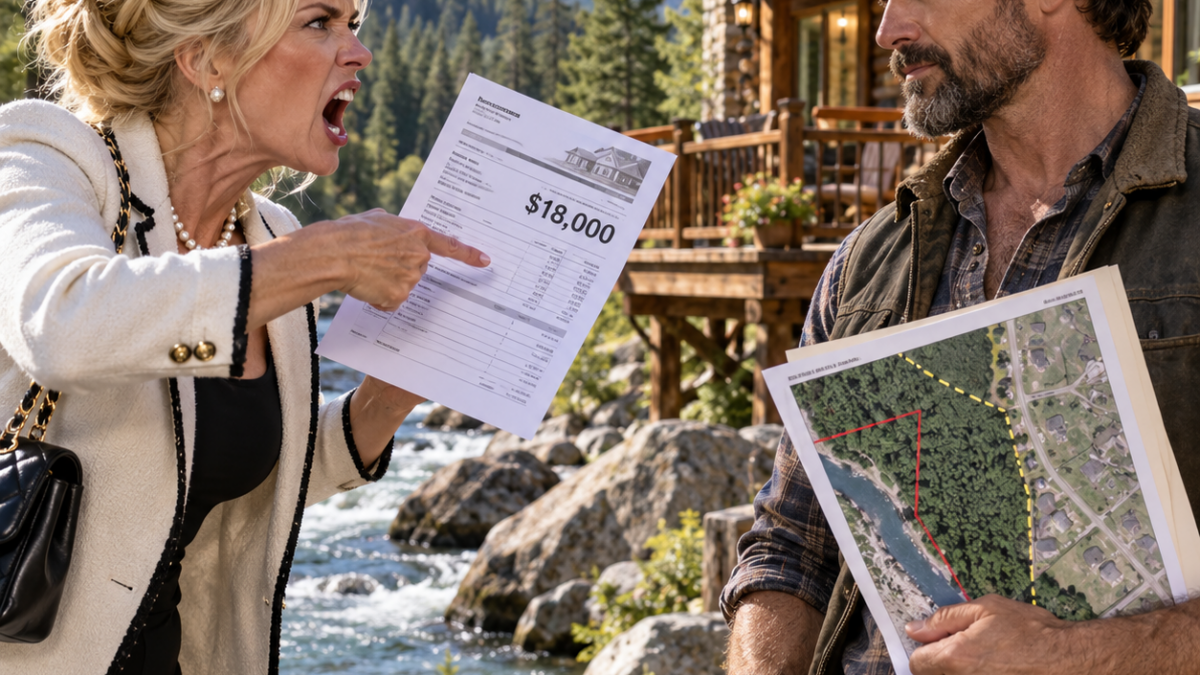
The first letter arrived barely two weeks after I bought my river cabin, demanding $18,472.25 in “back HOA dues” for seven years I hadn’t even owned the place—and threatening a lien if I refused to pay.
What made my stomach turn wasn’t the amount; it was the fact that I had checked the deed, parcel map, county zoning, and title records before closing, and every single document said the same thing: my land was outside their HOA.
By the time the woman behind that letter finally realized I wasn’t going to be scared into writing a check, the fight had already uncovered something much uglier than an illegal bill—and people who had stayed quiet for years were finally ready to talk.
The envelope was impossible to take seriously at first.
Pastel pink.
Heavy cream-colored paper.
A faint perfume smell that reminded me of a department-store cosmetics counter.
There was even a little embossed willow tree in the corner.
I had been expecting utility bills, insurance paperwork, maybe something from the county assessor.
Instead, I got what looked like a wedding invitation threatening to take my house.
I stood on the half-restored front porch of the cabin and read the first line twice.
**Dear Mr. Xander,**
**Welcome to the Willow Creek Lakeside Community.**
Then came the number.
**Outstanding dues: $18,472.25.**
Seven years of unpaid assessments.
Administrative charges.
Road maintenance.
Community enhancement fees.
Security contributions.
Lake-access upkeep.
There was a sentence near the bottom thanking me for my “prompt attention to this inherited obligation.”
Inherited obligation.
I laughed.
Not because it was funny.
Because sometimes something is so ridiculous your brain doesn’t know what else to do.
I had owned the cabin for fourteen days.
Fourteen.
Two weeks earlier, I had stood in a closing office signing enough documents to clear a forest.
Deed.
Title policy.
Tax certification.
Survey acknowledgement.
Parcel map.
Flood-zone disclosure.
Utility easement information.
And because I’d specifically wanted nothing to do with an HOA, I’d asked the same question until my real estate agent probably dreamed about it at night.
“Is this property part of any homeowners association?”
No.
“Any mandatory road association?”
No.
“Any recorded covenants?”
No.
“Any deed restrictions tied to Willow Creek?”
No.
“Any voluntary membership agreements running with the land?”
None recorded.
The map was especially clear.
Willow Creek Lakeside HOA occupied a cluster of planned homes closer to the paved county road.
My property sat beyond the boundary.
Not barely beyond it.
Not one fence post beyond it.
About two hundred feet beyond the official sign, on county land beside the river.
That separation was one of the reasons I’d bought the place.
The cabin itself wasn’t impressive.
Two bedrooms.
One bathroom.
Old stone fireplace.
Warped cedar siding.
Roof that needed work.
Kitchen cabinets from an era when people apparently believed brown laminate would never go out of style.
But behind it ran the river.
Cold.
Clear.
Wide enough that trout rose near dusk.
The property backed into woods.
No streetlights.
No manicured entrance.
No committee deciding whether my firewood stack was aesthetically harmonious.
After years of apartment living, traffic, upstairs neighbors, office phones, and people constantly wanting something from me, that sounded perfect.
I bought the place to hear water instead of opinions.
Then Willow Creek mailed me eighteen thousand dollars worth of opinions.
I folded the letter.
Put it in my jacket.
And walked down the gravel road.
The transition was obvious.
My driveway met a narrow county-maintained lane.
A couple hundred feet toward town, the gravel gave way to pavement.
Right beside that point stood a large wooden sign.
**WILLOW CREEK LAKESIDE HOA**
**EST. 1999**
Their neighborhood began there.
My cabin sat behind me.
I pulled out my phone.
Photographed the sign.
Photographed the road.
Photographed my driveway.
Photographed the distance.
Then I called my real estate agent.
She answered cheerfully.
“Settling in?”
“I just got an HOA bill.”
Silence.
“What?”
“Eighteen thousand four hundred seventy-two dollars and twenty-five cents.”
More silence.
Then:
“You’re not in the HOA.”
“I know.”
“You’re absolutely not in the HOA.”
“I also know.”
“I pulled the covenant records myself.”
“I have the copies.”
“Who’s claiming this?”
I looked back at the letter.
“Beverly Armstrong.”
My agent made a sound.
Not quite a groan.
Not quite a curse.
“You know her?”
“I know of her.”
“That doesn’t sound promising.”
“It isn’t.”
She told me not to pay anything.
Not even a dollar.
Not even if they offered a “settlement.”
A partial payment, she warned, could later be misrepresented as acknowledgment of an obligation.
I assured her I had no intention of sending Beverly so much as a nickel.
The next morning, Beverly arrived in person.
I knew it was her before she introduced herself.
There are certain people who approach somebody else’s house as though they’re arriving to inspect troops.
She came up the gravel drive in a white golf cart with a small green Willow Creek emblem on the front.
White capri pants.
Lemon-yellow blouse.
Oversized sunglasses.
Clipboard.
Pen clipped at the top like a sidearm.
She parked directly beside the porch.
Didn’t ask permission.
Didn’t say good morning.
She climbed out and looked at the cabin slowly.
Her eyes paused on the stack of cedar boards I’d bought to replace two damaged railing sections.
Then she looked at the old red pickup beside the shed.
Then the river path.
She was conducting an assessment before we’d even spoken.
“You must be Mr. Xander.”
“Depends who’s asking.”
She didn’t smile.
“Beverly Armstrong. President of the Willow Creek Lakeside Homeowners Association.”
“I figured.”
She blinked.
“You received our letter?”
“The pink ransom note?”
Her mouth tightened.
“It was a dues statement.”
“It says I owe eighteen thousand dollars.”
“Eighteen thousand four hundred seventy-two dollars and twenty-five cents.”
“Thank you. I’d hate to forget the quarter.”
She clicked the pen.
“You’re actually fortunate.”
I stared at her.
“That’s a surprising interpretation.”
“The board waived several years of late penalties because of the ownership transition.”
“How generous.”
“We try to be reasonable.”
I leaned against the porch post.
“You’re not my HOA.”
That stopped her.
Only briefly.
Then she smiled.
Not pleasantly.
Patiently.
Like she was explaining something simple to a difficult child.
“That’s where you’re mistaken.”
“No.”
“The previous property owner elected to join Willow Creek voluntarily.”
“No, he didn’t.”
Beverly flipped through her clipboard.
“The parcel was scheduled for annexation approximately seven years ago. While formal annexation wasn’t completed, the owner signed an agreement accepting association governance and assessments.”
“I checked the recorded documents before closing.”
“Records aren’t always complete.”
“The county records are very complete when someone tries attaching obligations to real estate.”
She pulled out a photocopy.
“Fortunately, we maintain our own archives.”
She handed it to me.
I read it.
The paper said:
**VOLUNTARY HOA MEMBERSHIP ACKNOWLEDGMENT**
There was my parcel number.
A date from seven years earlier.
A scribbled signature supposedly belonging to the prior owner.
No notary.
No recording stamp.
No witness information.
No legal description beyond the parcel number.
No evidence it had ever been filed anywhere.
It looked like something somebody had created in fifteen minutes using Microsoft Word.
“You’re serious?”
“Completely.”
“You expect me to pay eighteen thousand dollars based on this?”
“This agreement establishes the obligation.”
“This establishes that somebody owns a printer.”
Beverly’s shoulders stiffened.
“The prior owner received association services.”
“What services?”
“Road maintenance.”
“The county maintains my road.”
“Indirect neighborhood improvements.”
“What does that mean?”
“Security.”
“I don’t have your gate.”
“Community value benefits all adjacent homeowners.”
“So if I can see your landscaping from the road, I owe you money?”
“Don’t be childish.”
I held the photocopy up.
“This isn’t recorded.”
“It doesn’t have to be.”
“If you’re trying to bind the property after a sale, yes, that’s kind of important.”
“Our counsel disagrees.”
“Give me your counsel’s name.”
She hesitated.
Just enough.
Then recovered.
“The board handles communications.”
“Of course it does.”
She crossed her arms.
“You have thirty days.”
“No.”
Her eyes narrowed.
“No?”
“No payment.”
“Then we’ll begin lien proceedings.”
There it was.
No more pastel paper.
No more “welcome.”
The threat underneath everything.
I stepped down from the porch.
Not aggressively.
Just enough that she had to look directly at me.
“You are threatening to put a lien on property your association does not govern, based on a document that isn’t recorded, notarized, or verified.”
Beverly gave a small shrug.
“We’ll let the county sort it out.”
Then she turned.
Walked toward her golf cart.
I called after her.
“Beverly.”
She stopped.
I held up the photocopy.
“You should probably be very sure this is real.”
She looked over her shoulder.
“It is.”
Then she drove away.
I watched the golf cart disappear toward the pavement.
What Beverly didn’t know was that before she ever came up my driveway, I had already called the county.
And the clerk had already told me something interesting.
Willow Creek had tried this before.
PART 2
The county recorder’s office opened at eight.
I was there at 8:07.
I brought everything.
Closing documents.
Deed.
Title policy.
Survey.
Parcel map.
Beverly’s letter.
The fake-looking membership agreement.
A county clerk named Lionel sat behind the counter.
Buzz cut.
Reading glasses.
The kind of man who looked like he had spent twenty years watching people discover why property law mattered.
I explained the situation.
He listened without interrupting.
When I finished, he stared at Beverly’s membership form.
Then sighed.
“They’re trying that again.”
That sentence changed everything.
“Again?”
Lionel turned to his computer.
“Parcel number?”
I gave it to him.
He typed.
Pulled up the map.
Printed it.
Then pulled another record.
Willow Creek’s legally recorded HOA boundary.
My parcel sat clearly outside.
“No annexation,” he said.
“I know.”
“No covenant attachment.”
“I know.”
“No voluntary membership recorded.”
“I know.”
“No lien authority.”
I leaned on the counter.
“Then why did you say again?”
Lionel glanced around the office.
Then lowered his voice slightly.
“Last year they tried something similar with an older couple off Sycamore Hill.”
“What happened?”
“Claimed their RV pad fell under association rules because of some old shared-access provision.”
“Did it?”
“No.”
“What did the couple do?”
“Their daughter works for the state attorney’s office.”
I smiled.
“That ended quickly?”
“Very.”
“So Beverly backed off.”
“For them.”
That last part bothered me.
“For them?”
Lionel removed his glasses.
“She’s been trying to stretch that HOA boundary for years.”
“How?”
“Different arguments. Implied easements. Voluntary memberships. Shared-benefit assessments. Annexation discussions that never became annexations.”
“And the county lets her?”
“We reject filings that don’t comply with recording requirements.”
“That’s not what I asked.”
He sighed.
“The county can reject paperwork. Harassment is harder. If she sends private letters claiming people owe money, that’s usually treated as a civil dispute unless somebody establishes fraud.”
“So she can threaten people until someone fights?”
“Basically.”
“How many?”
“I don’t know.”
“You’ve seen more than one?”
“Yes.”
I tapped Beverly’s membership agreement.
“Can you certify that this parcel has never been inside Willow Creek?”
“Absolutely.”
“And certify no membership agreement is recorded?”
“Yes.”
“Do it.”
Lionel smiled faintly.
“Planning something?”
“I don’t know yet.”
He handed me a number.
“Take a seat.”
I left an hour later carrying certified copies of every record that mattered.
Parcel boundaries.
Zoning classification.
HOA legal description.
Chain of title.
No covenant.
No annexation.
No HOA agreement.
I drove home feeling less angry and more focused.
Beverly believed fear would do the work for her.
Eighteen thousand dollars is a terrifying number when somebody puts the word lien beneath it.
Especially for older homeowners.
People on fixed incomes.
Families with mortgages.
People who don’t have time to become amateur real-estate lawyers.
You don’t need to win in court if you can scare someone into paying before court ever happens.
That seemed to be the model.
I decided I wanted to know how often it had worked.
That afternoon, I installed cameras.
One facing the driveway.
One covering the porch.
One angled toward the mailbox and road.
Maybe that was paranoid.
But Beverly had already threatened my title after knowing me for less than five minutes.
I wasn’t going to assume her professionalism improved after sunset.
That evening, I searched Willow Creek online.
Official HOA website first.
Boring.
Landscaping rules.
Pool schedule.
Board announcements.
A photograph of Beverly smiling beside a newly planted flower bed.
Then I searched:
**Willow Creek HOA complaints**
That’s how I found the Facebook group.
**WILLOW CREEK SURVIVORS**
Nineteen members.
The name sounded dramatic.
The posts did not.
They sounded exhausted.
A man fined for an “unauthorized bird-feeding apparatus.”
Woman warned because her wind chimes exceeded “approved acoustic standards.”
Family charged because their garbage cans had been visible for forty-two minutes after collection.
Someone else posted a photograph of a warning about lawn paint.
I scrolled.
Then saw something more relevant.
Angela Morales.
Her post:
**Beverly keeps leaving HOA notices at my property even though county records show I’m outside Willow Creek. Has anyone else dealt with this?**
I messaged her.
She replied within ten minutes.
We met the next morning at a diner off Route 12.
Angela arrived carrying a thick manila envelope.
She slid it across the table before ordering coffee.
“Everything.”
I opened it.
Warning letters.
Fine notices.
Photocopied “membership” forms.
Threats of collections.
Her supposed agreement looked almost identical to mine.
Same font.
Same spacing.
Same cheap logo.
Different handwritten signature.
“This isn’t yours?”
“No.”
“Previous owner?”
“He died before the date on that paper.”
I looked up.
“What?”
“My property was inherited by his daughter. She sold it to me. The supposed signature is dated eight months after he died.”
That was no longer sloppy.
That was fraud.
“Did you tell Beverly?”
Angela laughed bitterly.
“Of course.”
“What’d she say?”
“Administrative discrepancy.”
“You went to court?”
“Small claims over fines.”
“What happened?”
“Judge threw their claim out.”
“And then?”
“They stopped billing me for six months.”
“Only six?”
She nodded.
“Then the letters started again under a different category.”
I leaned back.
“Why doesn’t everyone fight?”
Angela stirred her coffee.
“Money.”
“Court isn’t eighteen thousand dollars.”
“No, but attorneys cost money. Days off work cost money. Stress costs money.”
She looked at me.
“And Beverly knows most people don’t understand liens.”
“What do they think?”
“That she’ll take their house.”
“She can’t if she has no authority.”
“You know that.”
She pointed at herself.
“I know that now.”
Then toward the folder.
“Most people see official letterhead and panic.”
I flipped through another notice.
“Has anyone gone to the sheriff?”
“Civil matter.”
“Even with the fake signatures?”
“That needs proof.”
“This is proof.”
“One person becomes a disputed signature.”
Angela stared at me.
“Ten people becomes a pattern.”
I nodded slowly.
“So let’s find ten.”
Her eyebrows rose.
“You serious?”
“Yes.”
That week became something I hadn’t planned when I bought a river cabin.
Instead of repairing porch boards, I was driving around meeting people who had been bullied by an HOA I didn’t belong to.
One was Earl Thompson.
Vietnam-era Army veteran.
Seventy-four.
Lived in a small ranch house outside the western HOA boundary.
He showed me a lien notice claiming almost twelve thousand dollars in assessments.
“I paid some of it.”
“How much?”
“Six thousand.”
“Why?”
He looked embarrassed.
“Because they said foreclosure.”
No shame should attach to fear.
But Beverly had counted on people feeling ashamed afterward.
Earl handed me receipts.
Another homeowner, Henry Wallace, had paid almost ten thousand in “back dues” after receiving a letter claiming his property had voluntarily joined Willow Creek years earlier.
His alleged agreement looked exactly like mine.
Carla Reyes showed me special road assessment bills.
Her road was county-maintained.
A widowed schoolteacher named Dolores had received escalating notices over two years until the HOA filed what appeared to be a lien.
She cried while explaining it.
“I stopped visiting my sister because I was saving everything.”
“For the HOA?”
“I thought if I missed a payment they’d take the house.”
I sat at her kitchen table looking at a neat stack of canceled checks.
Hundreds.
Thousands.
Fear converted into money.
By Friday, I had five sworn statements.
Copies of fake membership forms.
Receipts.
Threatening correspondence.
And certified county maps showing every targeted parcel sat outside Willow Creek’s legal boundary.
I submitted everything to the county attorney.
Two days later, a paralegal named Mason called me.
“What you’ve submitted is significant.”
“How significant?”
“Enough that counsel reviewed it this morning.”
“Good.”
“But to open a broader fraud investigation, we’d like additional corroborating testimony.”
“How many?”
“At least three more affected individuals would help.”
“I can get five.”
He paused.
“You sound confident.”
“I’ve already met them.”
Mason laughed quietly.
“Send everything.”
I did.
The county moved faster after that.
Not publicly.
But people talk.
Especially inside small communities.
The next morning, I walked outside with coffee and found my mailbox on the ground.
Not knocked loose.
Destroyed.
Metal crushed inward.
Wooden post split.
Red flag bent backward.
Tire marks cut into the shoulder.
I stood there silently.
The cameras had captured it.
2:37 a.m.
White SUV.
Plates obscured.
Person in a dark hoodie stepped out carrying something long.
Baseball bat, probably.
Three swings.
Mailbox destroyed.
SUV left.
I called the sheriff.
Deputy took photographs.
Watched the footage.
“Any enemies?”
“I’ve lived here three weeks.”
He looked toward the smashed box.
“Fast worker.”
I handed him a flash drive.
“HOA dispute.”
His expression shifted.
“Willow Creek?”
“You know them too?”
“Everybody knows Willow Creek.”
“What does that mean?”
“It means save every recording.”
He filed the vandalism report.
That afternoon, Beverly sent another letter.
Different presentation.
No pink paper.
This one looked official.
Heavy white stock.
Black embossed seal.
Language announcing that a lien would be filed within ten days unless I remitted full payment or a “good-faith partial amount.”
The seal bothered me.
It resembled the county emblem.
Too closely.
I drove to the clerk’s office.
A secretary held the letter under the fluorescent light.
Turned it.
Ran her finger over the seal.
Then frowned.
“This isn’t ours.”
“Looks like yours.”
“That’s the problem.”
“Could someone mistake it for a county notice?”
“Absolutely.”
I called Mason from the parking lot.
Sent photographs.
He called back six minutes later.
His voice was different.
“No more waiting.”
“What changed?”
“Government-looking seals.”
“So?”
“If someone is manufacturing documents meant to imply county authority, we’re beyond aggressive HOA collections.”
“Criminal?”
“Potentially.”
“Good.”
He didn’t share my satisfaction.
“Be careful.”
That night, six homeowners gathered behind my cabin.
I borrowed a projector from the library.
Hung a white sheet between two trees.
Pulled the certified county parcel map onto the screen.
The river moved quietly behind us.
Pine smoke from the firepit drifted across the yard.
Angela held cider.
Earl sat with his arms folded.
Dolores had brought cookies.
Nothing about it looked revolutionary.
Just tired people comparing paperwork.
I pointed to Willow Creek’s legal boundary.
“Here.”
Then the targeted properties.
“Here. Here. Here. Mine here.”
All outside.
“She knew?” Carla asked.
“She certainly knows now.”
Henry held up his fake agreement.
“What do we do?”
“We make it impossible to isolate us.”
Angela nodded.
“Public meeting.”
“Exactly.”
Earl frowned.
“She’ll come.”
“I hope she does.”
We rented the local recreation center.
Printed flyers.
**PUBLIC COMMUNITY FORUM: HOA BOUNDARIES, DUES, LIENS, AND PROPERTY RIGHTS**
No accusations on the flyer.
Just facts.
Location.
Time.
Bring documents.
Three days later, the anonymous letters started.
First one on my windshield.
**STOP YOUR LIES OR FACE CONSEQUENCES.**
Second slid beneath the cabin door.
**YOU ARE DESTROYING THIS COMMUNITY.**
Third taped to Angela’s mailbox.
Sheriff collected all of them.
No fingerprints.
No useful DNA.
Whoever sent them understood intimidation better than spelling.
I considered canceling the forum.
For maybe ten minutes.
Then Earl called me.
“Still happening?”
“Yes.”
“Good.”
“Why good?”
“Because if they’re threatening us before we even speak, we probably should speak.”
He was right.
The recreation center held about sixty chairs.
More than fifty filled.
Willow Creek residents.
Outside residents.
Curious neighbors.
A few people wearing HOA polos.
Two former board members I didn’t recognize.
I stood at the podium.
My stomach tightened.
I hadn’t planned on becoming the face of anything.
I bought a cabin because I wanted fewer people in my life.
Now fifty people were staring at me.
I began.
“My name is Xander.”
The room settled.
“I bought a cabin outside Willow Creek’s legal HOA boundary.”
Projector came on.
County map.
“Two weeks later, I received a bill for $18,472.25 in alleged back dues.”
Murmurs.
“I was told the previous owner voluntarily joined the HOA.”
Next slide.
Beverly’s membership form.
“This is the document they gave me.”
Next.
Certified county record.
“There is no recorded agreement.”
Next.
Legal HOA boundary.
“My property is not inside Willow Creek.”
Next.
Angela’s fake form.
“I’m also not the only one.”
Angela stood.
Told her story.
Then Earl.
Then Dolores.
Then Carla.
One by one.
By the time Henry finished, the room had changed.
People weren’t just listening.
They were comparing.
Opening folders.
Whispering.
Taking photographs of their own letters.
Then the doors opened.
Beverly walked in.
Crimson blazer.
Black slacks.
Clipboard.
No golf cart this time.
She moved down the center aisle and sat in the front row.
Arms folded.
I looked directly at her.
“You’ve threatened people with liens based on authority the county says you do not have.”
She stood.
“This is a disgrace.”
The room quieted.
“These claims are being manufactured by people who simply don’t want to follow community standards.”
I said, “They’re not your standards to enforce outside your jurisdiction.”
“Adjacent properties benefit from Willow Creek investments.”
“That doesn’t give you ownership.”
“You’ve deliberately misrepresented legal documents.”
I held up the certified map.
“This came from the county.”
“Maps can change.”
“This one didn’t.”
A man in the back stood.
“She fined me for my boat trailer.”
Beverly turned.
The man continued.
“My house isn’t in Willow Creek.”
Another woman spoke.
“She threatened legal action over my shutters.”
Another.
“I paid four years of dues because they said there was an old agreement.”
The room erupted.
Beverly raised her voice.
“You people are being manipulated!”
Then the side door opened.
A uniformed sheriff’s deputy entered.
Conversation died instantly.
He walked toward the front.
Looked at me.
Nodded.
Then faced the room.
“This is a notice that county investigators are collecting information concerning potentially fraudulent HOA correspondence.”
Beverly’s face changed.
Not dramatically.
A small loss of color.
The deputy continued.
“If you have received documents asserting HOA membership, lien authority, county approval, annexation, or mandatory dues and you believe those claims are incorrect, please provide copies to the county attorney’s office.”
Beverly grabbed her purse.
She left without another word.
The residents stayed.
For two more hours.
Stories kept coming.
Receipts.
Letters.
Threats.
A woman brought a notice signed by someone who hadn’t served on the board for six years.
One man had paid five thousand dollars.
Another had been told he couldn’t refinance until an HOA balance was satisfied.
That night, Beverly lost the one thing she’d depended on most.
Isolation.
Every victim had believed they were alone.
Now they were sitting in one room.
Two days later, Mason called.
“We confirmed four forged signatures.”
I sat beside the cabin window.
River visible through the trees.
“One belongs to a deceased individual.”
“Angela’s previous owner?”
“Different case.”
I went cold.
“How many fake documents are we talking about?”
“Too early to say.”
“What charges?”
“Criminal fraud. Forgery. Possibly mail fraud. Conspiracy to commit extortion depending on evidence and jurisdiction.”
I looked at Beverly’s original pink letter lying on my table.
“You need me to do anything?”
“Testify.”
“When?”
“We’ll tell you.”
“I’m available.”
Subpoenas began the following week.
Craig Donnelly, HOA treasurer, was questioned first.
His name appeared on a lot of the payment records.
He was also the man one resident had filmed slipping notices beneath garage doors after midnight.
Angela called me before sunrise three days later.
“You need to come here.”
“Where?”
“Community center.”
“Why?”
“Money.”
That word had become dangerous.
I met her in the parking lot.
Rain misted across the pavement.
She held a flash drive.
“Anonymous former board member.”
“What’s on it?”
“Financial records.”
We opened them on my laptop inside the truck.
Invoice after invoice.
Landscaping services.
Storm cleanup.
Private security.
Surveillance upgrades.
Road repairs.
Some projects didn’t exist.
Others were wildly inflated.
One ten-thousand-dollar security invoice covered cameras nobody could locate.
Then Angela opened a spreadsheet.
Payments categorized as:
**COMMUNITY GOVERNANCE CONSULTING**
Payee:
Beverly Armstrong.
I scrolled.
Again.
Again.
Again.
Three years.
More than ninety thousand dollars.
Angela stared at me.
“They’ve been pulling money out.”
“And using fake dues to fill the holes.”
“Looks like it.”
I sent everything to Mason.
Then drove to the sheriff’s office.
Twenty-four hours later, deputies executed a search warrant.
The HOA office wasn’t really an office.
Converted garage behind Beverly’s house.
Filing cabinets.
Computers.
Printer.
Stacks of letterhead.
Beverly came outside while investigators carried boxes.
Neighbors watched from a distance.
By noon, she was in handcuffs.
I didn’t go there to watch.
Angela did.
She called afterward.
“They took her.”
“How’d she act?”
“Like they were inconveniencing her.”
That sounded right.
The charges grew fast.
Fraud.
Forgery.
Tampering with public records.
Racketeering allegations.
Potential extortion-related conduct.
At arraignment, prosecutors described the pattern.
Target properties outside Willow Creek.
Create or use false documents claiming voluntary membership.
Demand years of back dues.
Threaten liens.
Escalate legal language.
Collect whatever frightened owners would pay.
Beverly’s attorney called it an administrative misunderstanding.
The judge didn’t seem impressed.
Bail was initially denied because investigators alleged risk of document tampering and witness intimidation.
Anonymous letters mattered now.
So did my mailbox.
Even without proving Beverly personally swung the bat, investigators viewed the intimidation as part of the timeline.
The district attorney released a statement.
Local news ran the story.
Suddenly Willow Creek wasn’t just an annoying HOA.
It was a scandal.
But arresting Beverly didn’t undo the damage.
Earl still had lien paperwork attached to his property history.
Dolores had spent years sending money she needed.
Henry had nearly ten thousand dollars missing.
Several Willow Creek residents realized their actual HOA dues might also have been stolen.
That’s when the question changed.
At first, we wanted Beverly stopped.
Now residents wanted the structure that protected her gone.
The Willow Creek bylaws allowed dissolution if sixty percent of eligible homeowners approved.
Angela found the clause.
We read it three times.
Then started knocking on doors.
Some residents signed immediately.
Others resisted.
Not because they liked Beverly.
Because the HOA had existed for decades.
Who would maintain the entrance?
Who would organize snow removal?
What about the community dock?
What about common landscaping?
“Those things can still exist,” I told them. “They just don’t require giving one board unchecked power.”
A woman named Carla held her annual assessment statement.
“I paid sixty-five hundred dollars last year for road improvements.”
“Were your roads improved?”
She looked through the window toward potholes.
“No.”
“Then ask where the money went.”
She signed.
An older man who’d been fined because his grandchildren left bicycles on the lawn signed.
A young couple who had paid a special lighting assessment on a road with no new lights signed.
Within six days, we crossed sixty percent.
Kept going.
The dissolution vote was scheduled under the county pavilion.
Turnout exceeded anything Willow Creek had seen.
Lawn chairs.
Coolers.
Families.
One guy brought a grill.
If democracy smelled like burgers, it might be more popular.
We counted ballots publicly.
Whiteboard.
Every tally visible.
When the final number went up, people stared.
**84% — DISSOLVE**
For a second, silence.
Then cheering.
The Willow Creek Lakeside HOA was finished.
Not suspended.
Not reorganized.
Dissolved.
Angela hugged Dolores.
Earl shook my hand.
Carla cried.
I stood there feeling strangely empty.
Months earlier, I had wanted only one thing.
For Beverly to take her eighteen-thousand-dollar bill and leave my cabin alone.
Instead, we had dismantled the institution she used to threaten dozens of people.
But the cleanup had barely started.
The HOA bank accounts were frozen by court order.
Auditors went through transactions.
Investigators searched Craig’s garage.
That’s where they found the returned checks.
Dozens.
Payments from homeowners that had never entered official HOA accounts.
Some had been redirected through a company tied to Craig.
The fraud case expanded again.
Then came the recordings.
Password-protected flash drive recovered from Beverly’s house.
Audio from strategy meetings.
Apparently, Beverly had recorded other board members without telling them.
Maybe as leverage.
Maybe because she trusted nobody.
One recording captured her instructing Craig how to modify parcel maps in an image-editing program.
Make the boundary “look more flexible.”
Another included laughter.
A homeowner with a large garden-gnome collection had resisted paying.
Beverly’s voice:
“Pull six grand out of that loudmouth. Once he gets a lien notice, he’ll fold.”
The DA released excerpts.
That ended any remaining argument that this was confusion.
There was no confusion.
There was strategy.
By then, Willow Creek barely resembled the neighborhood I’d first seen.
People who had once avoided each other were exchanging tools.
Organizing river cleanups.
Sharing contractor contacts.
One resident started a food train for Dolores after she had surgery.
Angela joined an interim volunteer committee.
No enforcement power.
No dues.
No fines.
Just coordination.
Ironically, after years of Beverly insisting the neighborhood needed strict control to maintain community, the strongest community emerged after she lost control.
My cabin finally started feeling like mine.
I repaired the railing.
Replaced roof shingles.
Pulled poison ivy from the south fence.
Built shelves inside the shed.
One afternoon, I was cutting back honeysuckle near the creek when a silver sedan pulled in.
A woman in a gray blazer stepped out.
Folder in hand.
“Mr. Xander?”
“Unfortunately.”
She smiled.
“State auditor’s office.”
That got my attention.
She explained that my original file had helped establish the pattern.
The state was reviewing broader HOA oversight.
Boundary claims.
Audit requirements.
Potential criminal penalties for boards knowingly asserting authority outside recorded jurisdictions.
“Your case could influence recommendations.”
I leaned against the shovel.
“Good.”
She waited.
I continued.
“Maybe the next person doesn’t need to become a part-time investigator just to keep their house.”
She nodded.
“That is exactly the concern.”
After she left, I stood near the river for a while.
Wind moved through cottonwoods.
Chainsaw somewhere upriver.
Ordinary sounds.
That night, I took Beverly’s final demand letter outside.
The one with the fake seal.
Held the corner over the firepit.
Flame crawled slowly across the paper.
The embossed emblem curled.
Blackened.
Collapsed.
Eighteen thousand dollars of fake authority turned into ash.
I watched it disappear.
Then went inside.
Opened every window.
Slept with river air moving through the cabin.
For the first time since buying the place, I didn’t feel like somebody was waiting beyond the road with another envelope.
The audit report became public before dawn several weeks later.
My phone vibrated on the kitchen counter.
Headline:
**WILLOW CREEK HOA MISUSED MORE THAN $140,000 IN HOMEOWNER FUNDS, COUNTY AUDIT FINDS**
Below it:
Beverly Armstrong.
Investigators beside her.
I called Mason.
“Real?”
“Very.”
“What’d they find?”
“Second account.”
“Whose?”
“Controlled by Beverly.”
“What was she buying?”
He sighed.
“Travel. Furniture. Personal expenses.”
“Using HOA money?”
“Yes.”
Then:
“You’re going to like this one.”
“I doubt it.”
“Cedar hot tub.”
I stopped.
“What?”
“For her back deck.”
“What did she call it?”
“Community wellness expense.”
I stared at my coffee.
“That isn’t funny.”
“No.”
And it wasn’t.
Some crimes become absurd enough people laugh because outrage gets exhausting.
But Earl had spent six thousand dollars he didn’t owe.
Dolores had skipped trips to see her sister.
Families had tightened grocery budgets.
People had worried about foreclosure.
Meanwhile Beverly sat in a cedar hot tub financed by “community wellness.”
The DA added embezzlement and wire-fraud allegations.
Craig eventually cooperated.
He handed over emails.
Beverly directing him to falsify minutes.
Backdate votes.
Create approvals for expenditures that never occurred.
Make it appear board decisions were unanimous when meetings hadn’t even happened.
A judge authorized seizure of property purchased with misappropriated funds.
Angela called me when trucks arrived at Beverly’s house.
I went down mostly because investigators wanted witnesses nearby.
Contractors carried out boxes.
Wine refrigerator.
Expensive furniture.
Outdoor dining table almost twenty feet long.
Angela folded her arms.
“Ever see the neighborhood use that?”
“No.”
“Apparently our community gatherings happened on her private patio without us.”
A deputy almost smiled.
Then came restitution.
That was harder.
Money disappears faster than investigators recover it.
Some assets depreciate.
Some funds can’t be traced.
Some victims don’t have complete records.
Most people would not get everything back.
That bothered me.
Stopping Beverly didn’t refill Dolores’s savings.
Didn’t return months of Earl’s worry.
Didn’t repay hours people spent talking to lawyers.
Justice is often incomplete even when it works.
So we created something else.
Legal aid.
I knew Maya from college.
She ran a small nonprofit helping low-income homeowners fight housing fraud and abusive liens.
I called.
Explained Willow Creek.
She listened.
Then said,
“How many?”
“Potentially dozens.”
“Send me the cases.”
Within a week, volunteer attorneys were reviewing files.
We raised money for filing fees.
Title corrections.
Court copies.
Survey work.
Dolores’s lien was cleared.
Henry recovered money after investigators proved he had been double-billed.
Earl finally got written confirmation that the HOA claim against his property was invalid.
He came to my cabin one rainy night carrying a six-pack of root beer.
“Can’t drink beer anymore.”
“Neither can I if I plan to function tomorrow.”
We sat on the porch.
Rain tapped the metal roof.
The river sounded heavier.
For nearly an hour, neither of us said much.
Then Earl spoke.
“I served overseas.”
I nodded.
“I know.”
“Saw things I don’t talk about.”
I didn’t ask.
He continued.
“You know what messes with your head?”
I waited.
“When the enemy looks like they’re supposed to be helping you.”
His eyes stayed on the rain.
“You expect threats from people who hate you.”
He tapped the cleared lien letter in his jacket.
“You don’t expect somebody with a neighborhood logo to threaten your home.”
I understood.
He reached into his coat.
Pulled out an old envelope.
“Found this in my attic.”
Inside was a draft letter signed by Beverly.
Seven years old.
Never mailed.
It discussed “expanding governance through moral obligation.”
The language was extraordinary.
Homeowners outside Willow Creek should be encouraged to submit to association guidance for the “collective stability of the area.”
Without strong governance, Beverly wrote, neighboring parcels could become sources of disorder.
I read that twice.
Earl pointed.
“This is what she thought.”
“What?”
“That we couldn’t manage our lives without her.”
I folded the letter carefully.
“State Attorney General should see this.”
“Figured.”
We added it to the archive.
By then, state officials had announced a wider review of HOA practices.
News articles talked about audit rules.
Term limits.
Jurisdiction disclosures.
Clearer lien requirements.
I didn’t follow every legislative detail.
Angela did.
She joined an advisory committee.
So did Henry.
Carla participated too.
I preferred staying closer to the river.
We held Willow Creek’s first open town hall after dissolution in the old community center.
No bylaws debate.
No elections for president.
No fine schedule.
We asked one question.
“What do we actually need?”
Tool library.
Monthly river cleanup.
Emergency phone tree.
Shared snow-plow contacts.
Volunteer rides for older residents.
Teenager named Marcus offered to mow lawns for elderly homeowners.
Someone suggested a little free library.
People liked it.
Nobody proposed a compliance department.
Funny how little force is needed when people trust each other.
Beverly’s trial began in early spring.
She pleaded not guilty.
Craig had already agreed to cooperate.
The prosecution built the case methodically.
Fake agreements.
Dead signatures.
Altered maps.
Official-looking false seals.
Threatening letters.
Bank records.
Private accounts.
Payments to Beverly.
Craig’s shell company.
Audio recordings.
Backdated minutes.
Victim after victim.
I testified on the third day.
Walking into court felt strange.
Beverly sat at the defense table.
Gray suit.
Pearl earrings.
Hair perfect.
For months I’d seen her in photographs.
Now, in person, she looked smaller.
The prosecutor asked when I purchased my cabin.
I answered.
Asked whether the property was within the HOA.
“No.”
“How did you verify that?”
“County parcel map, deed records, title search, zoning records, real-estate disclosures.”
“Did you sign any HOA membership agreement?”
“No.”
“Did you agree to pay Willow Creek assessments?”
“No.”
“What was the first demand?”
“Eighteen thousand four hundred seventy-two dollars and twenty-five cents.”
One juror’s eyebrows rose.
“Had you owned the property for seven years?”
“Two weeks.”
The prosecutor displayed Beverly’s photocopied membership form.
“Did you rely on this document?”
“No.”
“Why?”
“It wasn’t recorded. No notary. No county stamp. No proof the prior owner signed it.”
“Did Ms. Armstrong threaten consequences?”
“Yes.”
“What?”
“Lien proceedings.”
“Were later documents sent to you?”
“Yes.”
The fake seal appeared on screen.
The county employee testified afterward.
Not authentic.
Then Angela.
Then Earl.
Then Dolores.
Then Lionel.
County boundary records.
No annexation.
No HOA jurisdiction.
Craig took the stand near the end.
He looked exhausted.
The prosecutor asked whether Beverly knew some properties were outside Willow Creek.
“Yes.”
“Then why were dues demanded?”
Craig swallowed.
“She said adjacent owners benefited from the community and should contribute.”
“Voluntarily?”
“At first.”
“And later?”
“She said if we created enough documentation, most wouldn’t challenge it.”
The room was silent.
“What documentation?”
“Membership agreements.”
“Were those authentic?”
Craig stared at the table.
“No.”
I watched Beverly.
She didn’t move.
The prosecutor continued.
“Who directed you?”
Craig’s voice was barely audible.
“Beverly.”
Emails supported him.
Recordings supported him.
Bank statements supported him.
The jury didn’t deliberate long.
Seven counts.
Guilty.
Not every accusation resulted in conviction.
But enough.
Fraud.
Forgery-related offenses.
Embezzlement-related conduct.
Public-record tampering components.
The judge imposed five years.
Full restitution ordered where recoverable.
Craig received eighteen months after cooperation and a permanent prohibition against fiduciary roles.
Some neighbors wanted longer.
Earl didn’t.
That surprised me.
“Five years enough?”
“No amount gives me my six grand back.”
“Then why aren’t you angry?”
He looked toward the river.
“Tired.”
I understood.
Beverly was taken away.
No speech.
No final confrontation.
No dramatic apology.
The courtroom emptied.
Outside, reporters waited.
I declined interviews.
One asked:
“Do you consider yourself the person who brought Willow Creek down?”
“No.”
“Then who did?”
I looked back toward the courthouse.
“Beverly.”
He seemed confused.
I continued walking.
Because it was true.
Beverly destroyed herself.
We only stopped pretending not to see it.
The day after the verdict, someone left a rosemary plant on my porch.
Clay pot.
No note.
I asked around.
Nobody admitted it.
I put it by the window.
Watered it.
It grew.
By summer, Willow Creek looked different.
The old HOA entrance sign came down.
For a few weeks, the posts stood empty.
Then somebody carved a replacement.
Simple cedar.
**WILLOW CREEK**
**EST. 1999**
**RECLAIMED 2024**
Some people thought “reclaimed” was dramatic.
I liked it.
Kids built a tire swing near the river.
The free library appeared beside the community center.
Old paint.
Cedar shingles.
Books inside.
Mysteries.
Romance novels.
Fishing guides.
Children’s stories.
No board approval required.
My cabin changed too.
New railing.
Repaired roof.
Fireplace cleaned.
Kitchen painted.
I left the old cabinets for a while.
They had character.
Or maybe I had run out of money.
I finally built the river bench I’d wanted since moving in.
Solid cedar.
Nothing fancy.
One rainy afternoon, I sat there alone.
Water running high.
Moss bright on the rocks.
For months, every quiet moment had been interrupted by something.
Letter.
Call.
Meeting.
Evidence.
Court.
Reporter.
Now there was nothing.
Just rain.
I realized how long I’d been holding tension in my shoulders.
I exhaled.
Really exhaled.
Then laughed.
I had bought that cabin to get away from people.
Instead, it introduced me to half the county.
Life has a sense of humor.
The state case continued beyond Beverly.
Auditors reviewed other associations.
Angela sent me updates.
Draft legislation proposed mandatory financial audits above certain budget thresholds.
Clear disclosure of jurisdiction boundaries.
Board term limits.
Criminal penalties for knowingly filing false lien claims.
Stronger requirements before an HOA could assert obligations against new owners.
Whether every measure would pass, I didn’t know.
But Willow Creek had become the example lawmakers pointed to when someone asked why oversight mattered.
The news called it precedent-setting.
I mostly called it exhausting.
One afternoon, Mason visited.
No suit.
Jeans.
He stood on the porch looking toward the river.
“Worth it?”
I thought.
“Ask me in ten years.”
He laughed.
“Fair.”
“You ever figure out who smashed the mailbox?”
“Not enough evidence for charges.”
“Anonymous letters?”
“Same.”
“Probably Beverly?”
He shrugged.
“We don’t say probably in court.”
“Right.”
He looked at the rosemary plant.
“That yours?”
“Apparently.”
“Looks healthy.”
“Unlike my faith in community associations.”
He laughed again.
After he left, I thought about the things we never proved.
Not every act gets a name.
Not every threat leads to handcuffs.
Sometimes justice means enough truth is established that the rest stops mattering.
My mailbox got replaced.
The anonymous letters stopped.
Beverly lost power.
That was enough.
Months later, restitution checks began arriving.
Mine wasn’t large.
I hadn’t paid the fake dues.
My direct financial losses were mostly security cameras, legal consultations, document fees, and repairs.
Others got more.
Earl recovered part of what he’d paid.
Dolores received money.
Henry got a larger payment.
Not everything.
But something.
We held a gathering near the river when the first major batch of lien releases came through.
No official reason.
Carla brought food.
Angela brought a stack of corrected documents.
People treated lien releases like graduation diplomas.
Dolores held hers against her chest.
“I’m keeping this forever.”
“You should frame it.”
“I might.”
Earl raised his.
“This is the first piece of HOA paperwork I’ve ever liked.”
Everyone laughed.
That laugh mattered.
For years, official letters had produced fear.
Now one produced relief.
The final liquidation of Beverly’s property took longer.
House sold.
Some personal assets.
The infamous hot tub.
Dennis—one of the actual Willow Creek residents—sent me a photograph from the auction listing.
Caption:
**Community wellness equipment available.**
I laughed harder than I should have.
Over time, the anger faded.
Not completely.
Certain things still set me off.
Official-looking letters.
Fake urgency.
People saying “that’s just policy” without explaining the law behind it.
But anger stopped driving me.
Something better replaced it.
Attention.
I read things now.
All of them.
Fine print.
Maps.
Recorded documents.
Maybe too carefully.
When a new neighbor moved into a property outside the old HOA zone, they asked me whether there were any weird rules.
I said:
“County zoning. Septic regulations. Floodplain rules.”
“No HOA?”
“No.”
“You sure?”
I smiled.
“Extremely.”
They didn’t understand why that was funny.
Good.
They shouldn’t have to.
That was the point.
One evening, Earl walked down to my bench.
We sat.
No root beer this time.
He had coffee.
Sunset turned the river bronze.
“You know what Beverly never understood?” he asked.
“What?”
“People don’t hate rules.”
I looked at him.
“We hate rules used as weapons.”
He nodded.
“Exactly.”
He pointed toward the neighborhood.
“We still clean the road.”
“Yep.”
“Still fix the community dock.”
“Yep.”
“Still help Dolores.”
“Of course.”
“No one sends us a fine if we don’t.”
“No.”
“And somehow civilization hasn’t collapsed.”
I smiled.
“Miracle.”
He laughed.
The river kept moving.
That’s what I remember most now.
Not the trial.
Not Beverly in handcuffs.
The river.
It existed before Willow Creek.
Before Beverly.
Before my cabin.
It ignored property maps and board meetings and arguments.
But human beings can’t live like rivers.
We need lines.
Boundaries.
Agreements.
Titles.
Rules.
Those things aren’t inherently bad.
They’re how strangers live next to each other without constant conflict.
The problem begins when someone decides the line can move because they want something on the other side.
Beverly wanted money.
Maybe control too.
Probably both.
So she tried to move the line between her authority and everybody else’s property.
Not literally at first.
Socially.
Psychologically.
Send a letter.
Use official language.
Create urgency.
Threaten liens.
Make the homeowner feel like resistance is dangerous.
Then the fake agreement becomes easier to accept.
Then payment becomes easier than fighting.
Then one person pays.
Then another.
Eventually, a lie can start to look like precedent.
That’s what scared me most after everything ended.
Not that Beverly was unusually brilliant.
She wasn’t.
Some of her fake documents were embarrassingly bad.
What made the scheme work was that most people are busy.
Busy raising kids.
Working.
Caring for parents.
Getting through illness.
Grieving spouses.
Living on fixed incomes.
Trying to sleep.
They don’t have weeks to research property law every time somebody sends threatening stationery.
Beverly weaponized ordinary exhaustion.
That’s why exposing her mattered.
Not because she annoyed me.
Because what she did works until people compare notes.
The rosemary bush got huge.
Too huge for the original pot.
I transplanted it near the kitchen window.
Every time I brushed past it, the smell reminded me of the morning it appeared.
No note.
No credit.
Just a small living thing left by someone who wanted to say thank you without becoming part of the story.
I understood that.
None of us wanted to become famous.
Angela didn’t.
Earl didn’t.
Dolores certainly didn’t.
We wanted our homes left alone.
That’s all.
Somewhere along the way, protecting our own homes required protecting each other’s.
Maybe that’s what community was supposed to mean from the beginning.
Not authority.
Not fines.
Not matching mailboxes.
Standing beside someone when they’re being bullied.
Checking the map.
Sharing the lawyer’s number.
Showing up.
Years later, people still occasionally contacted me after finding old news stories.
“I’m dealing with an HOA dispute.”
“My board says I owe fees.”
“They claim my property joined years ago.”
I always gave the same advice.
Get the recorded documents.
Don’t rely on what the HOA says.
Don’t rely on what angry neighbors say.
Don’t rely on what someone remembers.
Get the deed.
Get the plat.
Get the covenants.
Get the county record.
Facts first.
Then fight what needs fighting.
One man emailed me from another county.
His situation turned out completely different.
He actually was inside his HOA.
He owed legitimate dues.
He wanted me to tell him how to escape.
I told him I couldn’t.
Beverly taught me to hate fake authority.
She didn’t teach me to hate lawful agreements.
That’s an important difference.
Rights matter.
So do obligations you actually accepted.
Willow Creek failed because Beverly erased that distinction whenever it benefited her.
One fall afternoon, a new wooden sign appeared near where the old HOA boundary marker once stood.
Not official.
Someone had carved it as a joke.
**YOU ARE NOW LEAVING THE LAND OF CLIPBOARDS**
Angela denied involvement.
Nobody believed her.
It lasted two weeks before county road crews asked us to remove it.
We complied.
Voluntarily.
That’s the funny part.
People who’d spent years battling unreasonable control had no problem following reasonable rules.
Because reasonable authority explains itself.
It doesn’t need fake seals.
Winter came.
First snow covered the cabin.
The river ran dark between white banks.
I kept firewood stacked beside the porch.
Nobody inspected it.
Nobody measured it.
Nobody sent a picture.
The silence felt luxurious.
On the anniversary of the first $18,472 letter, I found the original envelope in my filing cabinet.
Pastel pink.
Still faintly smelled like perfume.
I sat at the table and read it again.
The language was almost polite.
Welcome.
Guidelines.
Outstanding obligations.
Prompt attention.
No shouting.
No profanity.
No obvious threat until the end.
That’s another thing I learned.
Abuse doesn’t always arrive angry.
Sometimes it arrives courteous.
Professionally formatted.
It says please.
Then threatens your home.
I considered burning that letter too.
Didn’t.
I placed it in a frame.
Not because I admired it.
Because it represented a moment.
The moment somebody tried to make me afraid enough not to ask a question.
Above it, I put a copy of the certified county map.
Pink letter below.
Truth above.
Visitors sometimes ask.
I tell them the short version.
“They billed me eighteen grand.”
“For what?”
“An HOA I wasn’t in.”
“What’d you do?”
“Didn’t pay.”
They laugh.
Then:
“Seriously?”
Then I tell them the long version.
Fake agreements.
Dead signatures.
Threats.
Money.
Fraud.
The old HOA dissolving.
By the end, they usually stop laughing.
That’s appropriate.
The funniest part was always the beginning.
The rest wasn’t funny.
One summer, Willow Creek held its largest river cleanup ever.
Nearly seventy volunteers.
No dues.
No fines.
No mandatory attendance.
Kids collected bottles.
Adults cleared storm debris.
Local hardware store donated gloves.
Someone grilled lunch.
Dolores sat beneath a canopy handing out water.
Earl supervised everybody while pretending he wasn’t supervising.
Angela had become the unofficial organizer of almost everything.
I teased her.
“You replaced Beverly.”
She looked horrified.
“Take that back.”
“You have a clipboard.”
“This clipboard doesn’t issue liens.”
“Yet.”
She hit me with it.
People nearby laughed.
I looked around.
This was what Beverly claimed she was protecting.
Community.
Except she never trusted the community enough to exist without her control.
She believed people had to be managed into caring.
Threatened into maintaining.
Fined into beauty.
Forced into cooperation.
She was wrong.
The neighborhood became stronger after the enforcement machine disappeared.
Not because rules vanished.
Because ownership of decisions returned to the people affected by them.
The state eventually passed several HOA oversight reforms.
Not every proposal.
Enough.
Greater financial disclosure.
Stricter notice requirements.
More transparency around liens.
Improved complaint pathways.
Angela called me the day the governor signed part of the package.
“You watching?”
“No.”
“Turn on the news.”
“I bought this cabin specifically to watch less news.”
“Xander.”
I turned it on.
Willow Creek was mentioned.
Briefly.
Case study in overreach and financial abuse.
I felt something complicated.
Pride.
Embarrassment.
Sadness.
Relief.
Mostly relief.
Then I turned the television off.
Walked outside.
The river mattered more.
Another year passed.
Earl’s health declined.
Nothing dramatic.
Age.
He moved closer to his daughter.
The day he left, he stopped at my cabin.
We stood beside his truck.
“I hate cities.”
“You’re moving to a suburb.”
“Same disease.”
I smiled.
He handed me an envelope.
“What now?”
“Open later.”
We shook hands.
He held mine longer.
“You did good.”
“We did.”
He frowned.
“You always do that.”
“What?”
“Refuse credit.”
“Because dozens of people helped.”
“Still.”
He got in the truck.
Drove away.
That evening, I opened the envelope.
Inside was a photocopy of the cleared lien.
Across the bottom he’d written:
**Sometimes the most patriotic thing a man can do is tell a petty tyrant no.**
I laughed.
Then cried a little.
Didn’t tell anyone.
I put that page behind the framed pink letter.
Beverly’s name slowly disappeared from daily conversation.
That’s how communities heal.
Not by forgetting.
By no longer organizing every day around the person who hurt them.
Her old house sold.
New owners painted it dark blue.
Put a swing on the porch.
Planted sunflowers.
No one told them they couldn’t.
Craig finished his sentence.
Never returned to any board role.
I saw him once at a hardware store.
He saw me too.
We didn’t speak.
Didn’t need to.
Beverly completed her sentence years later.
Someone asked if I worried she’d come back.
No.
Not because I believed she’d changed.
Because Willow Creek had.
The conditions that let her dominate didn’t exist anymore.
No secret books.
No unquestioned board.
No residents isolated from each other.
No one-person control over correspondence and collections.
A bully is strongest when everyone thinks they’re the only target.
That illusion was gone forever.
The cabin became exactly what I had hoped when I bought it.
Quiet.
I taught myself to fly-fish badly.
Built a better shed.
Replaced the terrible kitchen cabinets.
Kept one old brown door as a joke.
Angela said I was sentimental.
I said I was cheap.
Both true.
On hot evenings, I sat by the river.
Rosemary near the window.
Cedar bench weathering nicely.
No perfume-scented envelopes.
No clipboards.
No one deciding I owed seven years of fees for a place I’d owned two weeks.
Sometimes I thought about how easily it could have gone differently.
What if I hadn’t checked before buying?
What if my agent hadn’t printed the map?
What if I assumed Beverly knew better?
What if I paid a small amount “in good faith”?
What if Lionel hadn’t remembered Sycamore Hill?
What if Angela hadn’t kept her paperwork?
What if Earl threw away his receipts?
What if Craig never flipped?
What if the anonymous board member never copied those financial files?
What if everybody continued believing their problem was unique?
Beverly didn’t lose because I was fearless.
I wasn’t.
The lien threat scared me.
Seeing my mailbox destroyed scared me.
Anonymous letters scared me.
Anyone who says they wouldn’t be worried is either lying or has never had somebody threaten the roof over their head.
Courage wasn’t feeling nothing.
It was checking the records while worried.
Calling the county while angry.
Showing up to the forum while wondering who might be sitting in the parking lot.
Testifying while Beverly stared at me.
That’s all.
Small decisions.
Repeated.
That became enough.
The $18,472.25 invoice is still framed.
Visitors think that’s odd.
Maybe it is.
But I like seeing the exact number.
Because Beverly believed numbers created legitimacy.
Specificity can be persuasive.
Not “about eighteen thousand.”
**$18,472.25.**
Twenty-five cents makes it look calculated.
Official.
Verified.
Real.
It wasn’t.
Precision is not truth.
Letterhead is not law.
A seal is not authority.
A threat is not a lien.
And a board president is not a government just because she owns a clipboard.
Years after everything ended, a storm hit Willow Creek hard.
Trees down.
Power out.
Road covered with limbs.
The old HOA would have sent notices about emergency procedures.
Maybe collected a special assessment.
The new neighborhood did something simpler.
People came outside.
Chainsaws.
Trailers.
Gloves.
Coffee.
Teenagers dragged branches.
Carla coordinated meals.
Angela checked older residents.
I used my truck to move debris.
By sunset, the road was passable.
No board order.
No fines.
No compliance deadline.
Just neighbors.
I remember standing in the road covered in sawdust when Angela walked over.
“Beverly would’ve charged a storm cleanup fee.”
“Probably.”
“Then hired Craig.”
“Definitely.”
“Then bought patio furniture.”
“Community emergency seating.”
Angela laughed so hard she had to sit on a log.
That’s when I knew we were truly past it.
We could laugh.
Not because the damage wasn’t real.
Because it no longer owned us.
The final page in my file is a letter from the county.
It confirms my property remains outside any mandatory association.
No Willow Creek covenants.
No dues.
No lien rights.
No annexation.
Simple.
Boring.
Beautiful.
I keep it behind the original map.
Every once in a while, someone jokes that I bought the most expensive “HOA-free” cabin in the county because of all the legal trouble.
Maybe.
But I got what I wanted in the end.
Trees.
River.
Peace.
And something I hadn’t expected.
Neighbors.
Real ones.
The kind who show up because they want to.
Not because somebody wrote a rule.
One evening, years after Beverly’s conviction, I sat on the river bench with Angela.
Sun low.
Water gold.
She asked,
“Would you buy the cabin again?”
I didn’t answer immediately.
Same old roofline.
Smoke curling from chimney.
Rosemary bush near the window.
A child’s laughter from somewhere downriver.
Willow Creek sign barely visible beyond the trees.
“Yeah.”
“Even knowing everything?”
“Yeah.”
“Why?”
I looked toward the cabin.
“Because Beverly was temporary.”
Angela nodded.
“The river wasn’t.”
Exactly.
The property existed before her authority.
My rights existed before her letter.
Truth existed before we proved it.
Sometimes you have to fight long enough for paperwork to catch up.
That’s what happened at Willow Creek.
A woman sent me a pink envelope and told me I owed eighteen thousand dollars for seven years of fees on land her HOA didn’t govern.
She thought the amount would frighten me.
She thought the word lien would finish the argument.
She thought a blurry signature was enough.
She thought an official-looking seal could make a fake document real.
She thought old people would pay.
Busy people would surrender.
Outside homeowners wouldn’t compare notes.
Board members would stay loyal.
Money could disappear quietly.
And nobody would ever ask why a “community wellness” budget included her personal cedar hot tub.
For years, she was right often enough to become arrogant.
Then she sent the wrong letter to the wrong cabin.
Not because I was special.
Because I checked.
Then Angela checked.
Then Earl.
Then Dolores.
Then Henry.
Then Carla.
Then fifty people in a recreation center checked.
Then the sheriff.
County attorney.
District attorney.
Auditors.
Jury.
By the time everybody finished checking, Beverly’s entire system had collapsed.
The HOA was gone.
Fraudulent liens were cleared.
Money was partially returned.
Craig lost his position and freedom.
Beverly lost hers.
State rules changed.
And Willow Creek learned something no HOA manual had ever taught it.
A community doesn’t belong to whoever controls the letterhead.
It belongs to the people who live there.
The people who mow an elderly neighbor’s lawn.
Bring food after surgery.
Clear trees after storms.
Watch someone’s house while they’re away.
Share tools.
Sit together beside the river.
People don’t need fake authority to make them care.
They need trust.
And trust was the one thing Beverly could never bill us for.
The last time I thought seriously about that original $18,472.25 was on a cool October evening.
I had spent the day repairing the shed roof.
My hands hurt.
Back hurt.
Everything smelled like cedar and leaves.
I poured coffee.
Walked outside.
Sat on the river bench.
The current moved steadily.
I could hear music faintly from the community center.
Somebody was having a birthday party.
No permit from an HOA.
No event fee.
No approved decorations.
Just people.
I pulled out my phone.
Scrolled to an old photograph.
The first letter.
Pastel pink.
Beverly’s “welcome.”
I looked at it.
Then at my cabin.
The difference made me smile.
On the day that letter arrived, I thought the story would end one of two ways.
Either I paid.
Or I proved I didn’t owe anything.
I had no idea there was a third ending.
I would prove I didn’t owe the money.
Then discover other people had been robbed.
Then help expose the people behind it.
Then watch an abusive HOA disappear.
Then see the neighborhood rebuild itself into something better than what had existed before.
That was the ending Beverly never imagined.
She thought resistance meant destruction.
Instead, resistance created the first real community Willow Creek had had in years.
I leaned back.
Listened to the river.
And finally understood why the cabin had felt different after everything.
The deed hadn’t changed.
The boundaries hadn’t changed.
They had always been mine.
What changed was my certainty.
Nobody could bluff me out of my own home anymore.
No pink envelope could do that.
No fake seal.
No clipboard.
No board vote held in secret.
No manufactured agreement.
No threat.
The law had drawn the line long before Beverly tried to erase it.
All I had done was refuse to move.
And sometimes, when someone builds an entire empire on the assumption that everyone else will step aside, refusing to move is enough to bring the whole thing down.








