PART 2: HOA “Cops” Locked Me Out of My Family’s Legal Road—Then Lied About My Shotgun, and Their Own Cameras Destroyed Them
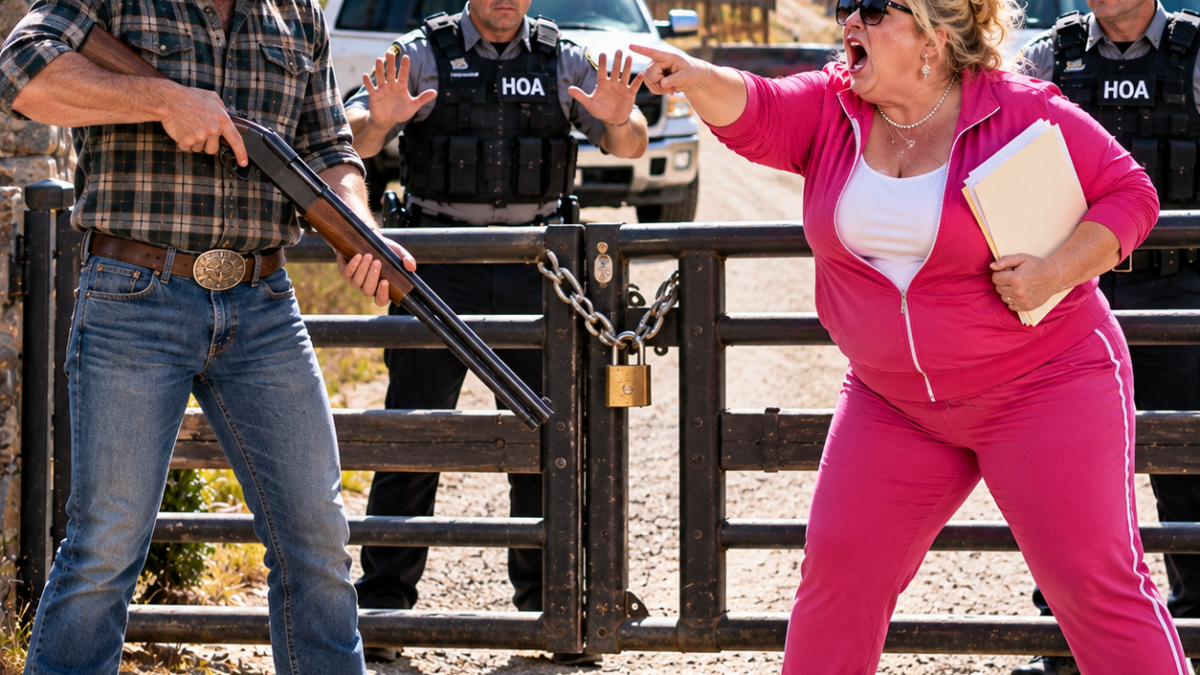
PART 2
The woman answering the HOA office sounded cheerful in the way people do when they have been trained to make obstruction sound like customer service.
“Whispering Meadows Homeowners Association. How can I help?”
“My name is Walter Hadley. I own the forty-five-acre parcel at the end of Miller Creek Road.”
There was a pause.
Not long.
Just long enough to tell me she recognized the issue.
“I see.”
“I need to speak to whoever authorized the gate.”
“Our board president handles infrastructure matters.”
“Good. Put her on.”
“I’m afraid Mrs. Mercer is in meetings.”
“I’ll wait.”
“She’s booked throughout the day.”
“Tomorrow.”
“Also booked.”
“When?”
“The earliest available appointment is Thursday at three.”
Five days.
Five days of driving twenty-four unnecessary miles every round trip because somebody had poured concrete over a right my grandfather secured before most of Whispering Meadows existed.
“Can this be expedited?”
“I’m afraid not.”
“What if an ambulance needs access?”
“Emergency services have procedures.”
“Which procedures?”
“I would need to check.”
“What if there’s a fire?”
“Sir, Mrs. Mercer can address your concerns Thursday.”
I thanked her.
Hung up.
Then wrote an email.
No emotion.
No accusation.
Attached:
Certified scan of the 1987 deed.
Recorded easement.
Original survey.
I highlighted the relevant clause.
**Permanent access.**
**Runs with the land.**
**Binding on successors.**
I requested that the gate be opened within forty-eight hours.
I copied the general HOA board address.
Sent it at 9:14 a.m.
No response came that day.
Or the next.
So I kept taking the detour.
Twenty-four extra miles every round trip.
The back route was mostly gravel and county road, climbing past a creek bed that flooded whenever we had several days of rain.
For a pickup, manageable.
For a livestock trailer, unpleasant.
For an ambulance?
Potentially deadly.
Thursday afternoon, I walked into the Whispering Meadows office.
The development was still fairly new.
Neat houses.
Identical mailboxes.
Decorative stone signs.
New trees supported by stakes because their roots had not yet learned the ground.
Inside, architectural renderings covered the walls.
Future pool.
Expanded clubhouse.
Second development phase.
More homes.
More roads.
A receptionist led me into a conference room.
Diane Mercer sat at the head of the table.
Mid-fifties.
Navy blazer.
Gold earrings.
Perfectly arranged hair.
She stood.
“Mr. Hadley.”
“Mrs. Mercer.”
“Diane.”
“Walter.”
We shook hands.
Firm.
Measured.
She gestured toward a chair.
“I reviewed the information you sent.”
“Good.”
I placed another copy of the deed on the table.
“This easement was recorded in 1987.”
“I understand.”
“It gives my parcel permanent access through Miller Creek Road.”
“I understand your interpretation.”
“It’s not an interpretation.”
Diane smiled slightly.
“Property matters are rarely that simple.”
“This one is.”
She glanced at the deed.
“We’ve invested significantly in road safety and neighborhood security.”
“You put up a gate.”
“We implemented controlled access.”
“Across my easement.”
“Inside our development.”
I leaned forward.
“Those facts can both be true. Your development surrounds the road. My easement crosses it.”
She tapped one finger on the table.
“Our counsel will review it.”
“How long?”
“Legal review takes time.”
“Remove the obstruction during review.”
“That would defeat the purpose of security.”
“Your security does not cancel my property right.”
Her smile tightened.
“Let me offer something practical.”
I waited.
“Resident-level access credential.”
“I’m not a resident.”
“Functionally, you would be treated as one for road access.”
“And the cost?”
“Five hundred dollars annually.”
For a moment I honestly thought I had misunderstood.
“You want me to pay you five hundred dollars a year to use a road I already possess a legal right to use.”
“It would eliminate uncertainty.”
“There is no uncertainty.”
“There clearly is.”
“No.”
I pushed the deed closer.
“The county recorded this thirty-seven years ago.”
Diane barely looked down.
“Documents from another era don’t always reflect present conditions.”
“That sentence works well in speeches. Not in land records.”
The smile vanished.
“We’re trying to be reasonable.”
“So am I.”
“Five hundred dollars is hardly burdensome.”
“That’s irrelevant.”
“Not if it resolves the matter.”
“It doesn’t resolve the matter. It converts my legal right into your annual permission.”
Her eyes changed.
There it was.
The first moment neither of us pretended this was a misunderstanding.
She leaned back.
“Your farm has attracted interest.”
I said nothing.
“Developers are looking for larger parcels.”
“Not interested.”
“You might be surprised by the offers.”
“No.”
She folded her hands.
“Maintaining rural land at your age can become difficult.”
I stared at her.
“I’m sixty-two.”
“Of course.”
“And I’m not dead.”
“I didn’t imply that.”
“You implied the farm may become inconvenient enough to sell.”
Diane tilted her head.
“Circumstances change.”
That sentence followed me out of the office.
In the parking lot, one of the same uniformed guards stood near my truck.
Phone held up.
Photographing the license plate.
I stopped.
He lowered the phone.
“Problem?”
“No, sir.”
“You photographing my vehicle?”
“Security documentation.”
“Good.”
I took out my phone.
Photographed him.
His expression changed.
“Sir.”
“Documentation.”
He walked away.
That evening I made two calls.
First:
County recorder.
The easement was still valid.
No amendment.
No termination.
No release.
Nothing.
Second:
Ruth Clayborne.
Property lawyer.
A retired judge I used to know from my deputy years had recommended her.
I emailed everything.
She called back within an hour.
“How soon can you come in?”
“Next week.”
“Bring originals if you have them.”
“I do.”
“Don’t threaten anyone.”
“I haven’t.”
“Don’t touch the gate.”
“I won’t.”
“Don’t even joke about touching the gate.”
“I spent twenty-eight years in law enforcement, counselor.”
“Then you know exactly why I’m telling you.”
I did.
That night I opened a notebook.
Date.
Time.
Person.
Statement.
Action.
Evidence.
Old habit.
As a deputy, I learned quickly that memory feels accurate right until six months later when an attorney asks which hand someone used to open a door.
Records matter.
Three days after the meeting, the HOA replied.
Official letterhead.
Two pages.
Their position:
My easement allegedly lacked “sufficient standing under current development agreements.”
The gate would remain.
Any attempt to bypass or damage HOA property would be treated as trespassing.
Possible law-enforcement referral.
I read the letter twice.
Then laughed quietly.
Not because anything was funny.
Because they had just put bad faith in writing.
They had my recorded deed.
They had been told.
They refused anyway.
That matters in court.
The detour became routine.
A miserable routine.
Twelve miles out.
Twelve miles back.
Feed deliveries became complicated.
My usual supplier finally called.
“Walter, I can’t keep sending the truck through that back route.”
“Why?”
“Insurance.”
“What about Miller Creek?”
“Your HOA gate.”
“Not my HOA.”
“You know what I mean.”
“Unfortunately.”
Veterinarian appointments became harder.
Fuel costs increased.
An emergency-service response that should have taken minutes now required either the gate to be opened by someone else or the long route.
I was living forty-five acres away from people who had intentionally made me more isolated.
And Diane knew it.
Two weeks after the gate went up, HOA patrol vehicles started appearing.
White SUVs.
**COMMUNITY SAFETY.**
They parked near my property line.
Sometimes fifteen minutes.
Sometimes an hour.
Never trespassing fully.
Just watching.
One morning, I found garbage scattered across the front pasture.
Fast-food wrappers.
Beer bottles.
Plastic sacks.
I photographed everything.
Cleaned it.
Three days later, again.
Different garbage.
Same area.
Photographed.
Logged.
A week later, Helen Vasquez stopped me at the gas station.
I knew her face from Whispering Meadows but not her name.
Retired teacher.
Maybe late sixties.
She waited until no one was standing near us.
“Mr. Hadley?”
“Yes?”
“I’m Helen Vasquez.”
“Nice to meet you.”
She looked nervous.
“Diane has been talking about you.”
“I assumed.”
“She’s telling residents you’re threatening security staff.”
“I’m not.”
“I know.”
That surprised me.
“How?”
“My husband was military police for twenty-two years.”
She smiled faintly.
“He said the story didn’t sound right.”
“What story?”
“That you showed up angry. Threatened to destroy the gate. Mentioned weapons.”
I went still.
“I have never threatened those men.”
“I believe you.”
“Why are you telling me?”
Helen looked toward her car.
“Because I’ve seen this happen before.”
“Here?”
“Florida.”
She described her previous HOA.
President who targeted families.
Selective violations.
Rumors.
Pressure.
Eventually people moved.
“Diane doesn’t make direct accusations unless she has to.”
Helen said.
“She implies.”
That was smarter.
Harder to sue.
Harder to disprove.
“She sent a safety advisory last week.”
“About me?”
“Technically no name.”
“But everyone knows.”
“Yes.”
I thanked her.
Before she left, she said:
“Most residents don’t want trouble.”
“I don’t either.”
“That’s how people like Diane win.”
She drove away.
I stood beside the gas pump for a long time.
That evening, I installed cameras.
Four units.
Road frontage.
Driveway.
Fence.
Side approach.
Motion activated.
Cloud backup.
Then I ordered certified copies of everything.
Not photocopies from Grandpa’s box.
County-certified deed.
Recorded easement.
Survey plat.
Original developer acknowledgment.
No amendments.
Then I hired Martin DeRaco.
Licensed surveyor.
Forty years in the county.
He spent an entire day walking the corridor with GPS equipment.
Two days later, he spread the results across my kitchen table.
“Walter.”
“Give me the bad news.”
“There isn’t any.”
He placed a transparent overlay on the aerial map.
The easement corridor ran directly beneath the new gate.
Concrete posts and all.
“Entirely?”
“Entire gate.”
“No overlap issue?”
“No.”
“Boundary uncertainty?”
“No.”
“Can their lawyer argue the road shifted?”
“It hasn’t.”
“Abandonment?”
“You’ve used it continuously.”
He looked at me.
“This is one of the cleanest easements I’ve seen.”
I stared at the overlay.
“So why would they build there?”
“Either title review missed it…”
“Or?”
“They assumed nobody would challenge them.”
Two days later, certified mail arrived from the HOA’s law firm.
Cease-and-desist.
I was accused of harassment.
Unauthorized surveillance.
Hostile conduct.
They demanded removal of cameras.
No contact with “community personnel.”
No “provocative activity.”
I called Ruth.
“They want me to remove cameras from my own farm.”
She laughed once.
Dry.
“Excellent.”
“Excellent?”
“They now know they’re being recorded.”
“How is that excellent?”
“Because instead of stopping questionable conduct, they tried to stop documentation.”
She paused.
“Save the envelope too.”
“I save everything.”
“That’s why retired cops make annoying clients.”
“Thank you.”
When I met Ruth at her office, I understood the retired judge’s recommendation.
She wasted no words.
Read the easement.
Read Martin’s report.
Read the HOA letters.
Read Diane’s five-hundred-dollar access proposal.
Then looked up.
“They’re going to lose.”
I didn’t react.
Ruth added:
“Assuming you remain smarter than your anger.”
“I’m not angry.”
She looked over her glasses.
“Walter.”
“Fine.”
“You’re furious.”
“Yes.”
“Stay furious privately.”
I nodded.
She outlined our options.
Injunction.
Damages.
Tortious interference.
Bad-faith obstruction.
Potential punitive damages because Diane continued after actual notice.
We filed.
Formal demand:
Remove or open the gate.
Thirty days.
County building complaint regarding construction inside a recorded easement.
Civil complaint prepared.
Everything served.
Three days later, I decided to hand-deliver one formal notice at the gate.
Not because I wanted drama.
Because I wanted clear acknowledgment of receipt.
Witnessed.
Timestamped.
My shotgun was where it had been for weeks.
Locked hard case.
Behind the seat.
Legal.
Unloaded.
I used it for hunting and farm predator control.
Nothing more.
I had never pointed it at a human being.
I had no intention of starting now.
The tall guard saw me.
Stepped into the road.
I stopped.
Window down.
Held up the envelope.
“Legal notice for the HOA.”
“You need to exit the vehicle.”
“No.”
“Sir, exit.”
“I’m delivering an envelope.”
“You are refusing a security instruction.”
“I’m not subject to your detention authority.”
His partner moved toward the booth and picked up a phone.
The taller man’s voice rose.
“Exit now.”
I placed both hands visibly on the steering wheel.
“No.”
Eight minutes later, a sheriff’s cruiser appeared.
Deputy Tom Kendrick stepped out.
I almost smiled.
I had trained Tom during his first year.
Fifteen years younger than me.
Good officer.
Calm.
He recognized me.
“Walter?”
“Morning, Tom.”
The guard immediately interrupted.
“He threatened us with a firearm.”
Tom’s expression changed.
He looked at me.
“Firearm?”
“Shotgun in a locked case behind the seat.”
The guard said:
“He said he’d use it if we didn’t open the gate.”
I stared at him.
“That’s a lie.”
Tom raised one hand.
“Everybody stop.”
Then to me:
“Mind if I check?”
“No.”
I gave consent.
Tom opened the rear door.
Locked case.
Latch secured.
No handling.
No display.
He closed the door.
Then looked at the guards.
“Weapon is secured.”
The tall guard insisted:
“He threatened us.”
Tom looked toward their uniforms.
“You guys running body cameras?”
The two men glanced at each other.
Small reaction.
Huge mistake.
Tom saw it.
“So you have cameras.”
The shorter one nodded.
“Yes.”
“Good.”
Tom pulled out his notebook.
“I’ll need the footage.”
The tall guard’s face tightened.
“For what?”
“For my report.”
“It’s private security footage.”
“You alleged a criminal threat involving a firearm.”
Tom’s voice hardened.
“Now it’s evidence.”
I said nothing.
Tom walked over.
Lowered his voice.
“Walter, I don’t know what game these guys are playing.”
“Neither do I.”
“But what they told dispatch doesn’t match what I found.”
“I know.”
“Be careful.”
“I am.”
He stepped aside.
I handed the formal notice to the guard.
“Received?”
He took it.
I noted the time.
Then I drove away.
That evening, Whispering Meadows posted a security alert.
**ARMED INDIVIDUAL MAKES THREATENING STATEMENTS AT COMMUNITY GATE.**
No name.
Again.
But enough detail for everyone to know.
Comments appeared.
Dangerous.
Unstable.
Why is he allowed near the neighborhood?
Call police.
Get a restraining order.
I screenshot everything.
Sent it to Ruth.
She called.
“Don’t respond.”
“Wasn’t planning to.”
“Good.”
“They lied to police.”
“I know.”
“And posted it.”
“I know.”
“What now?”
“Now their cameras become ours.”
Six weeks later, we walked into preliminary court.
I wore the dark gray suit from my wife’s funeral.
Hadn’t touched it since.
Mary had been gone five years.
Cancer again.
Life had a cruel sense of repetition.
The courthouse felt familiar from my deputy days.
Different being on this side.
Ruth carried a thick briefcase.
Diane arrived with three city attorneys.
Charcoal suits.
Expensive shoes.
Big-firm confidence.
Judge Patricia Hullbrook took the bench.
Sixties.
Known for disliking nonsense.
Ruth presented first.
Recorded deed.
Continuous usage.
Survey.
Developer acknowledgment.
HOA notice.
Refusal.
Actual expenses caused by detour.
Then Diane’s lawyers argued the easement was old.
Not “integrated” into modern development documents.
Possibly abandoned.
Judge Hullbrook looked toward them.
“Abandoned?”
Lead counsel nodded.
“Due to historic nonconformity and changed land use.”
Ruth stood.
“My client has used that road continuously for thirty-seven years.”
The judge looked back at defense counsel.
“Do you have evidence of abandonment?”
“We’re continuing title research.”
“How long have you had this case?”
“Six weeks.”
“And your client constructed a permanent gate without confirming the easement status?”
He tried again.
“Your Honor—”
“Answer.”
“No written extinguishment has been identified.”
“Thank you.”
Then Ruth said:
“There is an additional matter.”
USB drive.
Security body-camera footage.
The room watched.
There I was.
Sitting in my truck.
Hands on wheel.
Envelope on dashboard.
The guard demanding I exit.
My refusal.
No yelling.
No threat.
Then the guard’s phone call.
Clear enough.
“He has a weapon. He’s threatening us.”
In the footage, I hadn’t mentioned the shotgun.
Hadn’t touched it.
Hadn’t moved.
Then Tom arrived.
Inspected.
Locked.
Legal.
The judge watched until the end.
Nobody moved.
Then she looked at Diane’s lawyers.
“Your security personnel appear to have made a false report.”
The lead lawyer stood.
“We were not provided this footage in complete form before today.”
Behind him, Diane whispered urgently.
He ignored her.
The judge issued a temporary injunction.
Gate access must be opened immediately.
No interference with my use of the easement.
Body-camera footage forwarded to county prosecutor.
Potential false-report investigation.
Diane’s face finally changed.
Not anger first.
Fear.
Outside, Ruth said:
“Temporary win.”
“Feels permanent.”
“Don’t get comfortable.”
“You think Diane stops?”
“No.”
“Why?”
“She thinks backing down equals guilt.”
“She is guilty.”
“People rarely understand their own problem that clearly.”
I drove home through Miller Creek Road.
Gate open.
No guard stopping me.
I slowed under the camera.
The old road looked unchanged.
The oak.
The dip.
The patched pavement.
It did not feel victorious.
It felt normal.
That was all I ever wanted.
Forty-eight hours later, the newspaper ran the story.
**HOA GATE DISPUTE HEADS TO COURT; SECURITY FOOTAGE RAISES QUESTIONS**
I declined interviews.
Diane responded with another community email.
**URGENT — PROTECTING WHISPERING MEADOWS**
I was now “weaponizing litigation.”
“Undermining safety.”
“Threatening property values.”
She announced more security staff.
No mention of their false report.
Three days later, Ruth called.
“The guards were charged.”
“Both?”
“Yes.”
“False police report?”
“Yes.”
“One cooperating?”
Pause.
“Yes.”
“What did he say?”
“Diane gave instructions.”
My stomach tightened.
“Specific?”
“Do whatever it takes to keep Hadley off the road.”
“That’s bad.”
“It gets worse.”
“Go ahead.”
“He has emails.”
Ruth explained three tracks.
Civil property case.
Criminal false-report case.
Internal HOA financial exposure.
A resident accountant named Marcus Webb had begun asking where Diane found money for legal bills and security expansions.
The quarterly statements didn’t reconcile cleanly.
Security contracts lacked clear board approval.
Legal fees were buried in broad categories.
I almost laughed.
“What?”
Ruth asked.
“Same disease.”
“What disease?”
“People with too much unchecked authority eventually start believing records are optional.”
“Exactly.”
The emergency HOA meeting happened Saturday.
I didn’t attend.
Helen called afterward.
“It fell apart.”
“What did?”
“Everything.”
Diane gave another speech.
Safety.
Property values.
Dangerous outsider.
Then Marcus Webb stood.
“Show us the legal expenses.”
Diane refused.
“Show us the security contract.”
She called him disruptive.
“Did the board vote?”
She said she had emergency authority.
Marcus asked where.
Diane snapped.
Helen told me:
“She started screaming.”
“About?”
“That she was the only person protecting everybody.”
A resident recorded it.
The video reached me that night.
Diane at the podium.
Face red.
Voice cracking.
“I BUILT THIS COMMUNITY!”
Residents began walking out.
She continued shouting.
“IF HE WINS, EVERYTHING WE BUILT IS AT RISK!”
More left.
By the final seconds, half the room was gone.
Diane still talked.
Power changes people strangely.
At first they defend the institution.
Eventually they believe they are the institution.
Petition for audit:
Forty-three signatures.
Then more.
Petition for special election.
Board resignations.
A retired attorney demanded itemized legal expenses.
Then Diane’s law firm withdrew.
Breakdown in attorney-client relationship.
Ruth translated.
“They’re done with her.”
“Why?”
“Pick one.”
The final civil trial was scheduled four months later.
By then, the original gate was still physically there but locked open under injunction.
Diane had new counsel.
One lawyer.
Young.
Nervous.
The courtroom was larger.
Twelve jurors.
Martin DeRaco testified first.
Survey.
Coordinates.
Easement corridor.
Gate location.
No ambiguity.
Defense tried abandonment again.
Martin said:
“Mr. Hadley drove it for thirty-seven years. If that is abandonment, I would be interested to hear your definition of use.”
A few jurors smiled.
Then Ruth introduced the emails obtained through subpoenas and the cooperating guard.
Projected on screen.
From Diane:
**DO NOT ALLOW HIM THROUGH UNDER ANY CIRCUMSTANCES.**
Another:
**IF HE CAUSES TROUBLE, REPORT HIM AS A THREAT.**
Another:
**WHY WASN’T HE TAKEN INTO CUSTODY?**
Then:
**INCREASE PRESSURE. CODE CONTACTS. SECURITY VISIBILITY. MEDIA IF NECESSARY.**
My hands tightened under the table.
There is something uniquely disturbing about reading someone’s plan to make your life unbearable in clean office language.
No shouting.
No curse words.
Just logistics.
Ruth called Diane.
Hostile witness.
She started simple.
“You approved the gate?”
“Yes.”
“You reviewed title?”
“Our attorneys did.”
“Before construction?”
“I believe so.”
“Written opinion?”
“I don’t recall.”
“Did you receive Walter Hadley’s easement before refusing access?”
“Yes.”
“Did you ask counsel to obtain a legal ruling before continuing obstruction?”
“We believed it invalid.”
“That wasn’t my question.”
Diane shifted.
Ruth displayed the email.
“Did you write this?”
Diane stared.
**REPORT HIM AS A THREAT.**
“I was protecting residents.”
“Yes or no?”
“Yes.”
“Had Mr. Hadley threatened anyone at that time?”
“I had concerns.”
“Did he threaten anyone?”
“I was told—”
“Did you personally have evidence of a threat?”
“No.”
Next.
“Did you instruct guards to deny access under all circumstances?”
“For safety.”
“Despite the recorded easement?”
“Our legal position—”
“Despite the easement?”
“Yes.”
Then finances.
“Did the board authorize more than $90,000 in legal expenses?”
“I had emergency authority.”
“Show the bylaw.”
Diane’s attorney objected.
Overruled.
Ruth handed her the governing documents.
“Point to it.”
Diane flipped pages.
Couldn’t.
The jury watched.
Finally Diane snapped.
“I was the only one doing anything!”
The courtroom went still.
“Everyone else sat around while he attacked us!”
Ruth asked quietly:
“Mr. Hadley attacked you by using his road?”
Diane’s face flushed.
“He threatened everything.”
“What?”
“Safety.”
“What else?”
“Property values.”
“What else?”
“Our authority.”
That was the answer.
She realized too late.
Ruth sat down.
Three hours.
That’s how long the jury deliberated.
Then verdict.
Liable.
All principal civil counts.
Actual damages:
$47,000.
Punitive:
$150,000.
Legal fees and court costs:
$85,000.
Total:
$282,000.
Permanent injunction.
Gate must be removed.
Never replaced in the easement.
Judge Hullbrook addressed Diane.
“The evidence demonstrates deliberate interference with a recorded property right and an escalation campaign after actual notice.”
Then:
“Relevant materials remain referred for criminal review.”
Outside, reporter asked:
“How do you feel?”
I looked at the microphone.
Months of detours.
Trash.
Rumors.
Fake security.
False firearm report.
Court.
I said:
“I wanted to go home.”
She waited.
“That’s all.”
Another reporter asked about the shotgun.
I looked directly at him.
“It never left the locked case.”
“Why carry it?”
“Farm.”
“Hunting?”
“Yes.”
“Did you consider using it?”
“No.”
Not once.
That matters.
Because Diane tried to turn an ordinary lawful object into a story about a dangerous man.
If I had touched that gun in anger, even for one second, I would have handed her the story she wanted.
I knew that because I spent twenty-eight years responding to people who regretted the second they stopped thinking.
Being armed is not power.
Restraint is.
The gate came down in November.
I didn’t watch.
Helen called.
“It’s gone.”
“Good.”
“Posts too.”
“Good.”
“You don’t sound excited.”
“I’m tired.”
She hesitated.
“Walter.”
“Yes?”
“I’m sorry.”
“For what?”
“For believing some of it.”
I stayed quiet.
“The safety alerts.”
“I know.”
“I thought maybe there was something we didn’t know.”
“That was the point.”
“I should’ve asked.”
“Most people trust official messages.”
“That’s an excuse.”
“No.”
I looked across my pasture.
“It’s a fact.”
Then:
“The problem is what happens after evidence appears.”
Helen understood.
Criminal case followed.
Diane eventually pleaded guilty to a reduced conspiracy-related false-report charge.
Probation.
Fines.
Community service.
Permanent resignation from HOA leadership.
Separate licensing consequences affected her real-estate career.
No prison.
Some people thought that wasn’t enough.
Maybe.
I had no interest in deciding her entire life.
The guards pleaded guilty too.
One sent me an apology.
Handwritten.
He said Diane pressured them.
Said he knew the firearm accusation was false.
Said he was afraid of losing his job.
He didn’t ask forgiveness.
I put the letter in a drawer.
Never answered.
Fear explains conduct.
It doesn’t erase responsibility.
Whispering Meadows held a special election.
Marcus Webb—the accountant who had demanded financial records—became president.
First act:
Independent audit.
Findings:
More than $90,000 in unauthorized or inadequately approved legal expenses.
Security contracts without proper board authorization.
Questionable vendor payments.
Several vendors linked to Diane’s relatives.
The new board filed its own civil action.
The security program was dissolved.
No fake cops.
No pseudo badges.
No road intimidation.
The compensation from my case arrived in stages.
After fees, I had just under $160,000.
I didn’t buy anything flashy.
Fence repairs.
Barn roof.
Security.
Emergency reserve.
Grandpa taught me:
“Land isn’t worth much if you can’t afford to keep it.”
I also had a sign made for the entrance to Miller Creek Road.
Nothing dramatic.
White background.
Black letters.
**RECORDED EASEMENT — ACCESS RIGHTS PROTECTED BY LAW**
County recording number below.
No threats.
Just proof.
Thanksgiving, my daughter came with her husband and the boys.
My seven-year-old grandson wanted to know why “the bad gate” disappeared.
Children simplify things.
“They put it where it didn’t belong.”
“Did you knock it down?”
“No.”
“Police?”
“No.”
“Who?”
“A judge told them to remove it.”
He thought.
“Because you owned the road?”
“Not exactly.”
“Then what?”
“Because Grandpa’s family had a legal right to use it.”
He looked disappointed.
“That’s boring.”
I laughed.
“Most useful law is.”
We spent Thanksgiving splitting firewood.
Playing cards.
Eating too much.
The morning they left, my daughter sat beside me on the porch.
“You scared me.”
“When?”
“When Helen called about the gun story.”
I looked at her.
“Helen called you?”
“She found me online.”
I groaned.
“She thought I should know.”
“You know me.”
“I do.”
“But?”
“You were angry.”
“Yes.”
“You had a shotgun.”
“Locked.”
“I know.”
“Never touched.”
“I know.”
“Then what scared you?”
She looked toward Miller Creek Road.
“That someone could lie and make truth arrive too late.”
That hit me.
Because she was right.
Truth is powerful.
But truth is not always fast.
That is why restraint matters before the truth catches up.
If I had responded to the guards’ lies with anger, the public story might have become muddy.
He said.
They said.
Instead:
Body camera.
Locked case.
Hands visible.
Deputy witness.
Clean.
My daughter leaned against me.
“I’m proud of you.”
“For winning?”
“No.”
She looked at me.
“For not becoming what they said you were.”
I didn’t answer.
Couldn’t.
Spring came early.
Pastures green.
Creek full.
Miller Creek Road went back to being just a road.
At first I still slowed near where the gate had stood.
Habit.
A little tightening in my chest.
Then weeks passed.
I stopped thinking about it.
One April afternoon, a pickup with out-of-state plates turned into the easement.
Young couple.
Maybe thirties.
They stopped when they saw me by the fence.
Driver lowered his window.
“Sir, is this private?”
“Easement road.”
“We’re looking at property.”
“Then you’ve got legitimate business.”
“So we can continue?”
“Yes.”
His wife smiled.
“You own the farm back there?”
I pointed toward the trees.
“Forty-five acres.”
“How long?”
“Family since 1951.”
“That’s incredible.”
I watched them drive away.
Dust settling.
Grandpa had walked that road with Grandma.
My father had used it.
My daughter.
Now grandsons.
Diane saw asphalt.
Development access.
A security problem.
Grandpa saw continuity.
That’s what people miss about property fights.
They think it is about dirt.
Or money.
Sometimes it is.
But sometimes it is about memory made physical.
A porch.
A tree.
A road.
A fence line.
Things that tell you somebody was here before you and trusted you not to surrender everything they protected.
I went back to the house.
Later that evening, I opened Grandpa’s metal box.
The deed went back inside.
The court judgment beside it.
Martin’s survey.
Photograph of the gate.
The false security report.
Body-camera transcript.
Then the order requiring permanent removal.
I added a note for my grandsons.
Not dramatic.
Just:
**If anyone ever tells you this road no longer belongs to the farm, read the documents before you argue.**
Then:
**And keep your hands where everyone can see them.**
I smiled when I wrote that.
They’ll understand eventually.
Years passed.
Whispering Meadows stabilized.
Marcus served one term.
Then stepped down voluntarily.
That mattered to me.
Real leadership leaves.
Diane’s problem had never been merely making bad decisions.
It was believing her position converted judgment into ownership.
The new board added clear procurement rules.
Competitive bids.
Recorded votes for legal spending.
Annual financial review.
No security officer permitted to represent themselves in a police-like manner.
Residents could inspect contracts.
Meeting minutes were posted.
Boring reforms.
Important reforms.
Helen once told me:
“People don’t attend meetings anymore.”
“That bad?”
“At first I thought so.”
“And now?”
“Maybe people finally don’t feel like they have to watch every second.”
That is the paradox of healthy governance.
When it works, most people can ignore it.
Diane demanded constant attention.
Every email urgent.
Every challenge dangerous.
Every disagreement an attack on the community.
That’s how controlling people keep everyone emotionally dependent.
Calm systems don’t require heroes every week.
They require rules that even boring people can follow.
The farm changed too.
I repaired the barn.
Replaced old fencing.
Put part of the settlement into drainage work near the lower pasture.
My grandson, the seven-year-old who thought judges were boring, became obsessed with tractors.
By ten, he could reverse a small utility trailer better than some adults.
One summer, I let him drive my old truck down Miller Creek Road.
Slow.
My hand near the wheel.
He asked:
“This where the gate was?”
“Yes.”
“Right here?”
“Right here.”
“Why did they put it here?”
“They thought they could.”
“That’s dumb.”
“Yes.”
“Didn’t they read the deed?”
“Apparently not carefully enough.”
He thought.
“Grandpa says always read instructions.”
“Your father is smarter than he looks.”
He laughed.
At the old oak, I told him Grandpa proposed to Grandma along that bend.
He made a face.
“Gross.”
I laughed until my eyes watered.
That road held all of it.
Love.
Family.
Conflict.
Courthouse.
Children calling romance gross.
No gate could turn it into merely “HOA property.”
That was Diane’s central mistake.
She mistook control for ownership.
The guards made the same mistake.
Uniforms gave them confidence.
Not authority.
The gate looked official.
Not lawful.
The community alerts sounded authoritative.
Not truthful.
And the shotgun sounded terrifying once Diane attached it to a lie.
But facts remained stubborn.
Weapon locked.
No threat.
Easement recorded.
Road used continuously.
Gate unlawful.
Report false.
Authority has to survive verification.
Theirs didn’t.
Years after the case, Deputy Tom Kendrick retired.
I attended the small party.
He found me near the coffee.
“Still carrying that shotgun?”
“During season.”
“Locked?”
“Always.”
He laughed.
“You know how close those guards came to ruining you?”
“I do.”
“If they hadn’t had cameras—”
“I know.”
“If you’d gotten out angry—”
“I know.”
“If you had even touched that case—”
“I know, Tom.”
He smiled.
“Good.”
Then he became serious.
“You did everything right.”
“No.”
“What’d you do wrong?”
“I assumed the system would stop them before it got that far.”
He nodded.
“That’s not exactly wrong.”
“Maybe.”
“You know what I learned after thirty-two years?”
“What?”
“Systems need evidence.”
I raised my cup.
“Unfortunately.”
“They also need people stubborn enough to keep evidence.”
“That I can do.”
We toasted with bad retirement-party coffee.
Ruth called occasionally.
Mostly unrelated property questions.
Once, she asked if I would speak at a county bar seminar on easement litigation.
“No.”
“Why?”
“I hate lawyers.”
“You like me.”
“Exception.”
She laughed.
“Five minutes.”
“No.”
“Ten.”
“That negotiation is backward.”
Eventually she convinced me.
I told the room of attorneys three things.
First:
Recorded property rights should be checked before expensive “security improvements.”
Second:
Private organizations should never assume police-like authority.
Third:
If your client’s security team wears body cameras, tell them not to lie about what happened while the cameras are running.
That got the biggest laugh.
Afterward, a young attorney approached.
“Mr. Hadley, did you ever consider displaying the shotgun when they blocked you?”
“No.”
“Even to show you wouldn’t be intimidated?”
“No.”
“Why?”
“Because a firearm isn’t punctuation.”
He looked confused.
I explained.
“You don’t pull one out to make a point.”
He nodded.
“Once a gun appears in a confrontation, everything changes.”
“Exactly.”
“I’m glad you clarify that.”
“So am I.”
That became part of how I told the story.
Some neighbors later exaggerated it.
Walter brought a shotgun.
Walter showed the HOA.
Walter scared the guards.
None true.
The gun never left the case.
The real weapon—if you insist on calling anything that—was the body-camera footage.
And the deed.
And patience.
That version is less cinematic.
Also more useful.
One afternoon, several years after Diane left Whispering Meadows, I passed her in the grocery store.
I recognized her immediately.
Older.
Hair shorter.
No blazer.
She saw me.
Stopped.
I stopped too.
For a few seconds neither of us spoke.
Finally:
“Walter.”
“Diane.”
She looked at her cart.
“I heard the farm is doing well.”
“It is.”
Pause.
“I’m sorry.”
I had imagined this moment before.
In those fantasies, I always had the perfect line.
Something sharp.
Something that left her speechless.
Reality was quieter.
“For what?”
She looked surprised.
Then:
“The road.”
“That’s not all.”
“No.”
She swallowed.
“The report.”
“Not all.”
“The things I said.”
“Still not all.”
Her eyes met mine.
“For believing I had the right to decide what happened to you.”
That was closer.
I nodded.
“I accept that you said it.”
Not forgiveness.
Not rejection.
Just truth.
She looked relieved and disappointed at the same time.
Maybe she wanted me to absolve her.
I couldn’t.
Maybe someday.
We walked separate directions.
I didn’t tell Helen for months.
When I did, she asked:
“Did it help?”
“A little.”
“You forgive her?”
“I don’t spend enough time thinking about her to know.”
Helen laughed.
“That might be better.”
Probably.
The road remains open.
No gate.
No booth.
The concrete scars faded after several winters.
Grass reclaimed the edges.
If you didn’t know the story, you might never guess anything happened there.
That is one thing I like about land.
It absorbs human drama.
We build fences.
Tear them down.
Argue.
Sue.
Die.
The creek keeps moving.
Grass grows.
Trees crack pavement.
Grandpa understood that better than I did.
Maybe that’s why he insisted on perpetual language in 1987.
He knew people change.
Boards change.
Developers change.
But a future owner might still need the road.
So he wrote for the future.
I am grateful.
The original shotgun remains in my gun safe now.
Older than some Whispering Meadows residents.
I use another for hunting these days.
Sometimes people ask why I kept the old one after it became part of such an ugly story.
Because it wasn’t the problem.
The lie was.
Objects don’t create meaning alone.
People do.
Diane tried to transform a locked farm gun into evidence that I was dangerous.
The camera transformed the same object back into what it really was:
A secured legal firearm I never touched.
That distinction nearly decided my future.
Whenever my grandsons are old enough to discuss firearms seriously, I’ll tell them that story.
Not:
“Always carry.”
Not:
“Never back down.”
Something simpler.
If you own something capable of changing a room instantly, your responsibility is greater, not smaller.
Keep it secured.
Stay calm.
Walk away when you can.
Let evidence speak.
That lesson cost me months.
Worth preserving.
My daughter eventually had a small plaque made for Grandpa’s metal box.
She thought I’d object.
I didn’t.
It reads:
**HADLEY FAMILY RECORDS — MILLER CREEK FARM**
Inside are now four generations of documents.
1951 deed.
1987 easement.
Survey.
Court order.
My own updated estate papers.
One day the farm will pass to my daughter.
Then maybe the boys.
They might sell.
That’s their choice.
Grandpa protected access, not obligation.
But if they keep it, nobody will charge them five hundred dollars a year to use Miller Creek Road.
Not while that easement exists.
Not while the county record exists.
And certainly not while the story exists.
That may be the most satisfying part.
Diane tried to make me disappear.
Instead, every future HOA board will know the Hadley easement before they consider putting anything near that road.
Whispering Meadows even added it to their title disclosures.
New buyers see:
**PERPETUAL ACCESS EASEMENT — MILLER CREEK FARM.**
No surprise.
No ambiguity.
Transparency replaced conflict.
That is better revenge than making somebody afraid.
Make it impossible for the next person to repeat the same abuse quietly.
The final time I spoke with Ruth about the case, she said:
“You know, most clients want to know how much money they can get.”
“What did I want?”
“Your road.”
“That’s what they took.”
She nodded.
“That made the case easier.”
“Why?”
“Juries understand simple injustice.”
“Gate on my road?”
“Exactly.”
I thought about the $282,000 judgment.
Money mattered.
It compensated losses.
Paid legal costs.
Punished bad faith.
But if the judge had offered me one choice—
Money or permanent open access—
I would have taken the road.
Every time.
Because the road led home.
And home is not an abstraction after you’ve nearly lost access to it.
It is the view after the old oak.
The fence Dad repaired crookedly because he refused to replace the whole section.
The porch Mary and I painted twice.
The kitchen where Grandpa’s lockbox sat.
The bedroom where my grandsons sleep during Thanksgiving visits.
The barn that leaks in exactly the same corner every ten years no matter what roofing contractor swears he fixed it.
Diane saw a parcel.
I saw a life.
Maybe that difference explains everything.
People who chase control often see places as assets.
Leverage.
Development opportunity.
A line on a planning map.
People who live somewhere long enough begin seeing layers.
Who planted that tree.
Who built that wall.
Where somebody proposed.
Where somebody died.
Which floorboard squeaks because Grandpa never used enough nails.
Those things have no line item.
But they are why people fight.
One autumn evening, I sat on the porch while the sun lowered behind the tree line.
My older grandson, now twelve, came outside.
He sat beside me.
“Dad said you used to be a cop.”
“Deputy.”
“Same thing.”
“Don’t say that around a city officer.”
He smiled.
“Did you ever shoot anybody?”
“No.”
“Ever pull your gun?”
“Yes.”
“Were you scared?”
“Yes.”
He looked surprised.
“You’re supposed to say no.”
“Why?”
“Because you were a Marine.”
“Marines get scared.”
“Grandpa says bravery means doing stuff even when you’re scared.”
“Your father has been reading motivational posters.”
He laughed.
Then he asked:
“Were you scared at the HOA gate?”
“Yes.”
“Because of the guards?”
“Partly.”
“Because of your shotgun?”
“Because they were lying about it.”
He got quiet.
“That can happen?”
“Yes.”
“What did you do?”
“Nothing dramatic.”
“Then how did you win?”
I looked toward Miller Creek Road.
“Stayed boring.”
He frowned.
“That doesn’t sound heroic.”
“It isn’t.”
Then I told him:
“Heroic is overrated. Reliable is better.”
He considered that like only a twelve-year-old can.
Then:
“So the camera won.”
“The truth won.”
“Because of the camera.”
“Fair.”
He smiled.
We watched the sunset.
Grandpa told me that road was the blood of the farm.
At fourteen I rolled my eyes.
At sixty-two I fought in court for it.
At seventy, I finally understood he wasn’t talking about asphalt.
He meant connection.
A farm cut off from its road becomes vulnerable.
A family cut off from its history becomes vulnerable too.
The easement protected both.
Diane Mercer made the mistake of believing the newest structure on the road had the strongest claim.
New gate.
New HOA.
New rules.
But property law remembers old promises when they were properly recorded.
And families remember too.
The afternoon she first told me that a thirty-seven-year-old deed was merely “an old piece of paper,” she revealed exactly why she was dangerous.
She believed age weakened truth.
Sometimes age strengthens it.
That document had survived developers.
Sales.
County changes.
New subdivisions.
New owners.
My grandfather’s death.
My father’s death.
My wife’s death.
It survived Diane too.
The gate didn’t.
If you drive Miller Creek Road today, there is no guard.
No iron bars.
No HOA pass.
Just the white easement sign with the recording number beneath.
Sometimes strangers slow to read it.
Most keep driving.
That’s fine.
The sign isn’t there to intimidate.
It’s there so nobody can ever say they didn’t know.
That was the ultimate lesson.
Diane’s entire strategy depended on uncertainty.
Maybe the easement was invalid.
Maybe the HOA controlled the road.
Maybe I threatened security.
Maybe the shotgun came out.
Maybe I was dangerous.
Maybe residents were at risk.
She survived by filling empty spaces with fear.
Documents closed those spaces.
The deed.
Survey.
Body-camera footage.
Emails.
Financial records.
Court orders.
Once uncertainty disappeared, her power disappeared with it.
People sometimes imagine bullies are defeated by someone stronger.
Not always.
Sometimes they are defeated by clarity.
Diane Mercer wasn’t beaten because I intimidated her back.
I never threatened her.
Never touched the gate.
Never displayed the shotgun.
Never drove through by force.
I asked one question repeatedly:
**What gives you the legal right to do this?**
She never had a good answer.
So she substituted authority.
Then security.
Then fear.
Then lies.
And every substitution created evidence.
By the end, I didn’t have to destroy her position.
She documented its collapse herself.
That is why the moment with the guards mattered so much.
They thought the shotgun would be the thing that ruined me.
They saw it on whatever vehicle information or conversation had been passed around.
Maybe Diane knew I hunted.
Maybe a guard glimpsed the case.
I never learned exactly how they decided to use it.
But they made the classic mistake of people accustomed to controlling the narrative.
They forgot the recording existed.
The lie was designed for a world without evidence.
Unfortunately for them, they recorded the truth themselves.
The camera they wore to protect the HOA protected me instead.
The security system Diane installed to control the gate exposed her guards.
The lawyers she hired created discoverable billing records.
The emails she sent created a conspiracy timeline.
The emergency meeting she called gave residents a place to organize against her.
Every tool of control turned around.
Not because I was cleverer at revenge.
Because abusive systems become fragile once transparency enters them.
I still think about Helen’s first warning.
Most people go along because it’s easier than asking questions.
That sentence explains more than HOAs.
People like Diane don’t usually seize power in one dramatic act.
They collect it in tiny pieces nobody wants to fight over.
A discretionary decision.
An unchallenged email.
An “emergency” expenditure.
A security contract nobody reads.
A gate nobody checks against the deed.
A rumor nobody questions.
Eventually, asking becomes harder than obeying.
Until somebody gets locked out of his own road.
Then suddenly everybody wants to know how things got so far.
One unquestioned step at a time.
Whispering Meadows is healthier now.
Not perfect.
No community is.
Marcus annoyed half the neighborhood by insisting on receipts.
The next president annoyed the other half by restricting reserve spending.
Residents argue about landscaping.
Pool hours.
Street parking.
Normal arguments.
I prefer them.
Normal conflict is evidence nobody controls everything.
The road is normal too.
That is my favorite outcome.
Not a monument.
Not revenge.
Normal.
I wake up.
Make coffee.
Drive Miller Creek Road.
Sometimes wave at Whispering Meadows residents.
Nobody stops me.
Nobody asks for a pass.
Nobody photographs the truck.
No emergency.
No drama.
Just home.
Years ago, the reporter outside court asked how I felt after winning.
I said I only wanted to go home.
I meant it.
At sixty-two, after being a Marine, deputy, husband, father, widower, and grandfather, I had very little interest in becoming the hero of anybody’s neighborhood war.
I had fences to repair.
Animals to feed.
Grandchildren to spoil.
Life.
Diane interrupted that life because she saw my farm as leverage.
Then the system she built collapsed.
The road reopened.
And life resumed.
That is what justice felt like.
Not the judgment number.
Not her probation.
Not seeing the gate dismantled.
It was the first morning I drove down Miller Creek Road and forgot to remember there had ever been a gate.
I came around the bend.
Passed the old oak.
Reached home.
Only after parking did I realize I hadn’t thought about Diane once.
That was freedom.
The land still remembers.
So do I.
But memory no longer controls the road.
The road is open.
The gate is gone.
The shotgun never left its case.
And the mistake that destroyed the people who tried to paint me as a threat was the simplest mistake of all:
They recorded an honest man while they were lying about him.








