PART 2: HOA “Cops” Forced Me to Crush My Dad’s 1967 Mustang—Then They Learned I Owned the Land Beneath Their Clubhouse
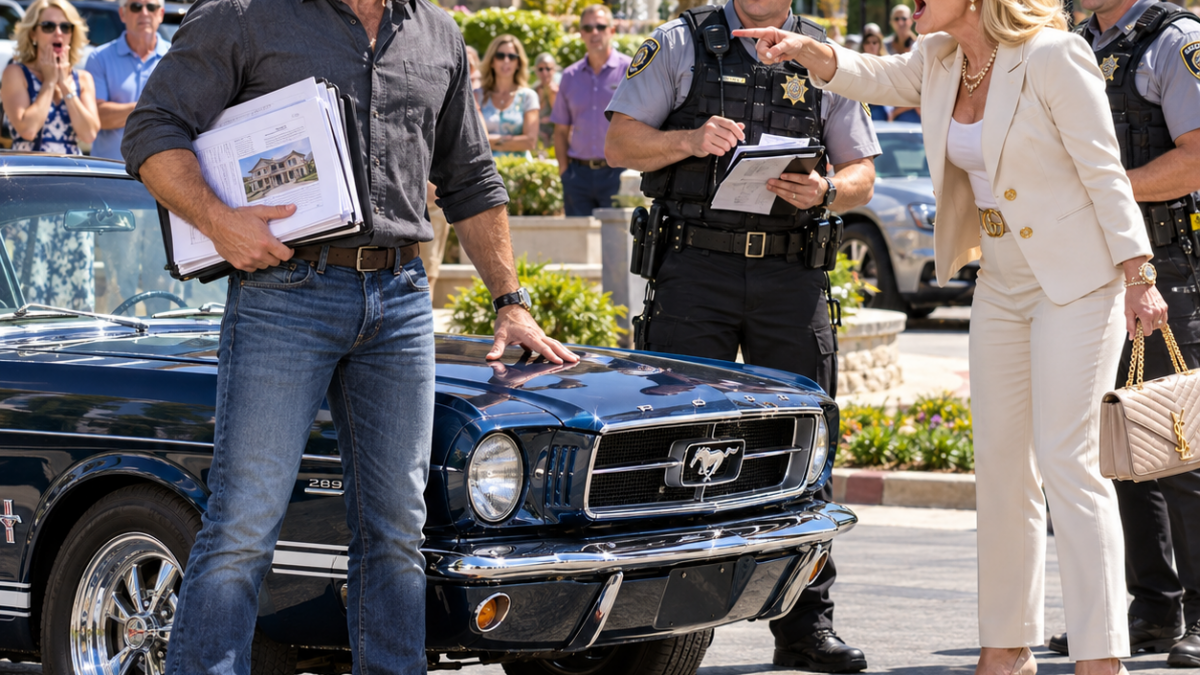
PART 2
He waved me off when I suggested we stop.
“Finish the side.”
“Dad, you’re bleeding.”
“Nosebleed.”
“You’ve had three this week.”
“Finish the side.”
That was Dad.
Stubborn.
I got it honestly.
On the workbench behind me sat the cardboard box.
I looked at it.
Then looked away.
Not yet.
The next morning, I called Robert Castellano.
He had handled Dad’s estate.
Good lawyer.
Careful.
When I showed him the destruction notice, he actually laughed.
Not because it was funny.
Because it was absurd.
“They want you to crush the car?”
“Yes.”
He read it again.
“Has anyone inspected it?”
“No.”
“Fire department?”
“No.”
“Environmental agency?”
“No.”
“Mechanical inspection?”
“Passed three months ago.”
Robert opened the Meadowbrook covenants.
Two hours later, he leaned back.
“There’s nothing here.”
“Nothing?”
“Section 12.7 allows the association to regulate abandoned or inoperable vehicles visible from common areas.”
“Mine is neither.”
“I know.”
“And it’s in my garage.”
“I know.”
“So what is Gerald doing?”
Robert removed his glasses.
“Testing whether you’ll comply.”
We drafted an appeal.
The letter cited the actual covenant language.
Vehicle registration.
Inspection records.
Photographs showing the Mustang garaged.
California property protections.
We sent it certified mail.
For about twenty-three hours, I felt better.
Then Gerald responded.
6:14 a.m.
Appeal denied.
Not by the full board.
By Gerald under something he called presidential emergency authority.
The Mustang was suddenly an “imminent fire hazard.”
A “potential environmental contamination source.”
A “community safety concern.”
All because it was old.
Robert called.
“This is nonsense.”
“Then stop it.”
“We can challenge it.”
“How long?”
Silence.
“Robert.”
“Possibly months.”
“How many?”
“Could be a year before full hearing depending on court calendar.”
“And the fines?”
“Continue unless we get an injunction.”
“Can we?”
“We can try.”
Try.
Gerald knew exactly what he was doing.
The harassment began the next morning.
A white sedan with Meadowbrook logos rolled past my house eight times.
I counted.
Slow each time.
The passenger took photographs.
Tuesday:
Grass half an inch too high.
$50.
Wednesday:
Trash container visible two hours after collection.
$50.
Thursday:
Water stain classified as a potential chemical spill.
$50.
Friday:
Garage door allegedly left open beyond approved maintenance period.
$75.
My father had lived in that house for twenty-five years.
Same grass.
Same driveway.
Same garage.
Never these fines.
This was pressure.
Not enforcement.
I installed cameras.
Four of them.
Front porch.
Driveway.
Side yard.
Garage exterior.
Everything backed up to cloud storage.
I photographed my lawn with a ruler.
Timestamped the trash cans.
Logged every patrol pass.
Saved every letter.
My profession helped.
I had spent eight years working as a forensic accountant.
Most of my cases involved people who believed paperwork could hide what they had done.
Executives moving money.
Managers inflating invoices.
Partners creating companies nobody bothered verifying.
My job was to find patterns.
People lie emotionally.
Numbers lie structurally.
If you know where to look, both leave fingerprints.
On Friday, a neighbor forwarded me an HOA email.
Subject:
PROTECTING OUR PROPERTY VALUES
There was a photo of my Mustang.
Taken from an angle that made it appear partially outside the garage.
Gerald described “a resident” refusing to cooperate with safety standards.
He called the car an eyesore.
Said one individual’s selfishness threatened every homeowner’s investment.
No name.
He didn’t need one.
By Saturday, people avoided looking at me.
That afternoon, an elderly woman approached while I checked the mail.
“David’s son?”
“Yes.”
“I’m Margaret Patterson.”
I recognized the name.
Dad had mentioned her.
She had lived three houses down for decades.
“I’m sorry about your father.”
“Thank you.”
She looked toward the road.
Then lowered her voice.
“He fought Gerald once.”
I froze.
“Dad?”
“Yes.”
“Over what?”
“Land.”
I waited.
“What land?”
“I don’t know all of it.”
“Mrs. Patterson.”
“He said Gerald forgot who owned something.”
My pulse changed.
“When?”
“Years ago.”
“What happened?”
“Your father dropped it.”
“Why?”
“He didn’t like conflict.”
That sounded like Dad.
He could rebuild an engine from rust but hated arguments with neighbors.
Margaret looked toward my garage.
“He told me once that Gerald thought kindness was weakness.”
She looked me in the eye.
“Your father said eventually Gerald would cross the wrong line.”
Then she walked away.
That night, I stood in front of the cardboard box.
Dad’s handwriting looked smaller than I remembered.
IMPORTANT DOCUMENTS.
I put my hand on the lid.
Couldn’t open it.
The grief came strangely.
Not when he died.
Not during the funeral.
Not when I moved into the house.
It came through objects.
His coffee mug.
His wrench marks.
His work gloves.
His handwriting.
I walked away.
The next morning, another notice appeared.
FINAL COMPLIANCE DEADLINE — 14 DAYS
Surrender the Mustang.
Certified destruction.
If I refused:
$1,000 per day.
Immediate lien.
Forced-sale proceedings.
Now Gerald wasn’t threatening the car.
He was threatening Dad’s house.
The house where I learned to ride a bicycle.
The kitchen where Mom once burned Thanksgiving dinner.
The bedroom where I slept after college when my first job fell apart.
The garage where Dad taught me patience.
I called Robert.
He sounded tired.
“We’ll file.”
“Will it stop the destruction?”
“I’ll request emergency relief.”
“Will we get it?”
“I can’t promise.”
“You said judges don’t usually let HOAs destroy registered cars.”
“They don’t.”
“Usually isn’t good enough.”
“I know.”
Thirteen days into the fight, someone knocked at 8:06 a.m.
Not HOA pounding.
Professional.
I opened the door.
Gerald stood there.
Beside him was a real county sheriff’s deputy.
Actual badge.
Actual agency uniform.
Manila folder.
Gerald’s smile was enormous.
The deputy looked uncomfortable.
“Mr. Thompson?”
“Yes.”
“I’m Deputy Wallace.”
He handed me the folder.
Temporary court order.
Gerald had filed an emergency petition claiming the Mustang created an imminent environmental and fire hazard.
A judge had signed limited enforcement authority pending further hearing.
I called Robert immediately.
He read the order.
His voice dropped.
“Damn.”
“What?”
“It’s valid.”
“Based on lies.”
“I know.”
“Then stop it.”
“We can appeal.”
“When?”
“Earliest emergency motion might be several days.”
“Gerald says they’re taking the car today.”
Robert was silent.
I looked at Gerald through the screen.
He stood there waiting.
Robert finally said:
“I’m sorry.”
Two words.
Useless words.
Painful words.
The system was supposed to protect people from obvious abuse.
Sometimes it arrived late.
Gerald stepped forward after I hung up.
“You have two options.”
I said nothing.
He held up a form.
“Voluntary compliance.”
“What does that mean?”
“You surrender the Mustang today.”
“And?”
“Five-thousand-dollar compliance fee.”
“Five thousand after destroying my car?”
“Administrative costs.”
I laughed.
He didn’t.
“Second option?”
“Refuse.”
He looked at the house.
“Lien.”
Then:
“Fifty-thousand-dollar civil action.”
Then:
“Foreclosure proceedings.”
The deputy shifted uncomfortably.
Gerald extended a pen.
“I told you what happens when people fight.”
I looked past him toward the garage.
Cherry-red Mustang.
Dad’s car.
Our car.
Three years.
I remembered him teaching me to rebuild the carburetor.
“Feel it,” he said.
“Feel what?”
“When the screw seats.”
“I can see it.”
“Machines aren’t just eyes.”
He put my fingers on the adjustment.
“Feel.”
Another memory.
Paint booth.
Dad arguing that the red had too much orange.
Me telling him nobody could tell.
He could.
Another.
His chemotherapy port hidden beneath his shirt while he tightened the last chrome trim bolt.
“You’re supposed to rest.”
“I am resting.”
“You’re using a torque wrench.”
“Restfully.”
I looked at Gerald’s pen.
If I refused, I could lose the house before the court ever untangled the lie.
I thought Dad would want me to protect the house.
I told myself that.
Maybe I needed to believe it.
I signed.
Gerald nodded.
“Smart decision.”
I nearly hit him.
Nearly.
Instead I said:
“Don’t call it that.”
The tow truck arrived forty minutes later.
They let me follow.
The crusher yard sat outside the city behind chain-link fencing.
Rows of dead cars.
Broken trucks.
Twisted metal.
The Mustang looked almost alive among them.
Clean.
Red.
Perfect.
The operator read the paperwork.
He frowned.
“You sure?”
“No.”
He looked at Gerald.
Gerald nodded.
“Order requires documented destruction.”
The operator looked at me.
“I’m sorry.”
I asked:
“Can I sell it?”
“No.”
“Donate it?”
“Not with this order.”
“Remove parts?”
“Paper says full destruction.”
Gerald stood twenty feet away.
Watching.
I wondered if that was why he came.
Not to supervise.
To watch me lose.
The Mustang rolled toward the hydraulic crusher.
My legs felt weak.
I could have gone into the office.
I stayed.
I owed Dad that much.
The first compression crushed the roof.
Metal screamed.
The windshield exploded.
The hood folded.
The rear quarter-panel Dad and I had spent seventy hours restoring bent inward like paper.
The machine didn’t care about memory.
Ninety seconds.
Three years became a compressed block of red steel.
Gerald left before it finished cooling.
I stood there for another twenty minutes.
The operator approached.
“You want something from it?”
“Can I?”
He looked around.
Then picked up a small chrome fragment that had snapped loose before compression.
Part of the Mustang emblem.
He placed it in my hand.
“Don’t tell anyone.”
I closed my fist around it.
“Thank you.”
The drive home was silent.
When I opened the garage door, the emptiness hit harder than the crusher.
The space looked enormous.
On the concrete was a faint outline where the tires had rested.
Dad’s rolling stool sat near the workbench.
His old radio.
The cardboard box.
I finally opened it.
Folders.
Tax returns.
Photographs.
Insurance records.
Then a large envelope with my name.
MICHAEL.
Dad’s handwriting.
Inside were three things.
A deed.
A twenty-five-year lease.
A yellow legal sheet.
The note said:
Son, if they ever cross the line, you’ll know what to do. This land remembers who owns it. They just forgot.
I read the deed.
Then again.
CHEN FAMILY HOLDINGS TRUST.
Dad had used Mom’s maiden name when he formed it years earlier.
The trust owned 2.3 acres inside Meadowbrook Estates.
Not a house lot.
Commercial-community parcel.
I pulled up the county map.
My heart started hammering.
Clubhouse.
Pool.
Administrative parking lot.
Land beneath all three.
Owned by the trust.
Dad’s trust.
Now mine.
The lease began in 1999.
Twenty-five years.
Monthly rent:
$800.
I stared.
The HOA paid less per month for the land beneath its entire clubhouse complex than some people paid for a studio apartment.
The lease expired in six months.
Then I found Clause 12.
Rent could be adjusted to market rate upon renewal with proper notice.
Market rent, based on comparable land, was likely around $8,000 monthly.
Ten times higher.
Then Clause 14.
No structural modification, expansion, reconstruction, or permanent alteration without written landlord approval.
I drove to the clubhouse the next morning.
New windows.
Expanded patio.
Second-floor addition.
None of that existed in Dad’s older photographs.
County permits showed renovations completed three years earlier.
Cost:
Approximately $200,000.
I went through every paper in Dad’s box.
No approval.
No signed consent.
No amendment.
They had materially altered a building sitting on Dad’s land without asking the landlord.
My grief changed temperature.
Not gone.
Focused.
Gerald had forced me to destroy the last machine Dad and I built together.
He thought the story ended at the crusher.
Dad had left me a second chapter.
I spent seventy-two hours working.
Property records.
Lease terms.
Commercial land comparisons.
HOA financial disclosures.
Corporate registrations.
I requested five years of association financial statements.
California law gave homeowners substantial inspection rights.
Gerald resisted at first.
Then Robert helped formalize the demand.
Records arrived.
I started with clubhouse assessments.
Every year, Meadowbrook collected $200 per household labeled:
FACILITY MAINTENANCE AND COMMUNITY IMPROVEMENTS.
312 homes.
$62,400 annually.
Five years:
Approximately $312,000.
I matched expenses.
Documented legitimate maintenance:
About $130,000.
Difference:
$182,000.
Money collected.
Money spent somewhere.
Records unclear.
Several vendors had generic names.
Exposed Services LLC.
Meadowbrook Maintenance Solutions.
Premier Community Partners.
I searched state business registries.
Some did not exist.
Others had incomplete records.
All large disbursements carried one authorization signature.
Gerald Hoffman.
I needed a better attorney.
Robert admitted it.
“This has outgrown me.”
He referred me to Lisa Yamamoto.
Real-estate litigation.
Landlord rights.
HOA governance.
She reviewed everything for almost an hour.
No dramatic reaction.
Then she looked up.
“How attached are you to the clubhouse?”
“What?”
“You own the land.”
“I know.”
“You can potentially terminate the lease for material breach.”
I said nothing.
“You can also raise rent at renewal.”
“How much?”
“Market estimate?”
“Yes.”
“Seven to nine thousand monthly.”
I almost laughed.
“From eight hundred.”
“Yes.”
“So the title writes itself.”
Lisa smiled slightly.
“Don’t get excited.”
“I’m not.”
“You are.”
“I watched them crush my father’s car.”
Her smile disappeared.
“I know.”
I looked at the lease.
“I want Gerald out.”
“Of the clubhouse?”
“Of power.”
“That’s different.”
“I want the community to know what he did.”
She nodded slowly.
“And the missing money?”
“I want it audited.”
“If it’s criminal?”
“Refer it.”
“And the lease?”
“I want him to understand I can raise it tenfold.”
“Do you want to?”
I thought about Dad.
His note.
His twenty-five years charging almost nothing.
“Not sure.”
“Good.”
“Why?”
“Because revenge decisions are usually expensive.”
“That car was expensive.”
“I meant morally.”
She leaned forward.
“Use leverage to expose abuse. Don’t become abusive because you have leverage.”
That sounded like Dad.
I hired her.
Her first letter went to every board member.
Not just Gerald.
That mattered.
Copies of the deed.
Lease.
County assessor records.
Notice of ownership.
Notice of lease renewal window.
Notice of possible breach involving unauthorized renovation.
Request for emergency meeting.
Seventy-two hours.
Gerald called fourteen hours later.
11:40 p.m.
“What game are you playing?”
His confidence was still there.
But cracked.
“No game.”
“Your father never told us about this.”
“You’ve been paying rent for twenty-five years.”
“That was an administrative arrangement.”
“It’s a lease.”
“The documents may be invalid.”
“Check the county.”
“Michael—”
“Check the deed.”
“This community will not be extorted.”
“Check the calendar.”
Silence.
“Six months.”
“What?”
“Lease expiration.”
I hung up.
He called back twice.
I didn’t answer.
The emergency board meeting happened Tuesday.
Same clubhouse.
My land.
That irony kept me calm.
Lisa connected a projector.
Gerald sat in the center.
Four board members around him.
Alice Cook, treasurer.
Richardson.
Delgado.
Another man named Peter Walsh.
Most looked confused.
Gerald looked annoyed.
Lisa began.
County deed.
Chain of title.
Dad purchased the property after the original developer went bankrupt.
At the time, Meadowbrook risked losing the clubhouse parcel.
Dad bought it.
Then leased it back to the association.
$800 per month.
For twenty-five years.
Alice stared at Gerald.
“We don’t own this building?”
Gerald answered quickly.
“The arrangement is complicated.”
“No,” Lisa said. “It is surprisingly simple.”
She displayed the deed.
Alice leaned forward.
Gerald’s jaw tightened.
Next:
Lease.
Renewal.
Market rent.
Approximately $8,000 per month.
The room changed.
Then unauthorized renovation.
County permit.
$200,000.
Clause 14 requiring written landlord permission.
Lisa asked:
“Does the board possess written consent from Chen Family Holdings?”
Silence.
Alice looked at Gerald.
“Did you get approval?”
“The landlord was unavailable.”
“David lived three blocks away.”
“It was an emergency renovation.”
“Three-year renovation project?”
Gerald glared.
“Safety.”
Lisa asked:
“Board vote?”
“Yes.”
“Minutes?”
“In archives.”
“We formally request them.”
Gerald leaned back.
“This is extortion.”
I finally spoke.
“No.”
Every head turned.
“I lived here as a kid.”
I looked around.
“My father loved Meadowbrook.”
Gerald laughed.
“You don’t even use the same last name as the trust.”
“My mother’s maiden name.”
He stopped.
I continued.
“Dad kept rent at eight hundred dollars for twenty-five years.”
Nobody spoke.
“He could have raised it.”
Alice looked at the projected market comparison.
“Considerably.”
“Yes.”
“Why didn’t he?”
“Because he believed community facilities shouldn’t be used as leverage.”
I looked directly at Gerald.
“He also believed HOA rules shouldn’t be used as weapons.”
Gerald’s face hardened.
I described the Mustang.
Not the legal argument.
The human part.
Dad.
Three years.
Cancer.
Crusher.
Ninety seconds.
Alice stopped writing.
Richardson looked sick.
Delgado stared at Gerald.
Then Lisa presented our demands.
Formal apology.
Compensation equal to the Mustang’s appraised value: $45,000.
Independent forensic audit.
Gerald’s immediate resignation.
Gerald laughed.
Actually laughed.
“You people are insane.”
Lisa waited.
“The board stands united.”
Alice looked at him.
He continued.
“This man is grieving and using fabricated property claims to attack an association that protected his father for decades.”
I stared.
“Protected him?”
“Yes.”
“By forcing his son to destroy his car?”
“You refused compliance.”
Lisa raised one hand.
“Mr. Hoffman, let’s discuss the alternative.”
His smile disappeared.
“If the demands are not addressed, the landlord reserves all rights under the lease.”
She displayed the market analysis.
“Upon renewal, monthly rent may be adjusted from $800 to approximately $8,000.”
Alice inhaled sharply.
Gerald said:
“Bluff.”
Lisa continued.
“Separately, unauthorized structural alterations may constitute a material breach supporting termination proceedings.”
“Bluff.”
“And financial records supplied by the association reflect approximately $182,000 in special-assessment expenditures that cannot presently be reconciled with documented services.”
That one hit him.
His face changed.
Tiny.
But I saw it.
Forensic accountants learn to watch people when numbers appear.
Alice looked at me.
“Where did you get that?”
“Your financial statements.”
Gerald said:
“Accounting timing.”
“Possible.”
“Vendor accruals.”
“Possible.”
“Reserve transfers.”
“Possible.”
He leaned forward.
“Then stop implying criminal activity.”
“I didn’t.”
I kept my voice calm.
“I said the money isn’t adequately documented.”
Lisa added:
“An independent audit will determine the rest.”
Gerald went pale.
Alice requested executive session.
Gerald objected.
She made a formal motion.
Richardson seconded.
Vote.
Four to one.
Gerald lost.
Lisa and I waited outside.
Forty-five minutes later, Alice came out.
She looked stunned.
“Gerald says it’s all fabricated.”
Lisa said:
“You’ve seen the deed.”
“I know.”
“He says the lease isn’t enforceable.”
“You’ve seen the lease.”
“I know.”
“He says the financial difference is normal.”
I asked:
“Do you believe him?”
Alice looked at the clubhouse.
“I don’t know what I believe anymore.”
Three days later, Alice called me privately.
Coffee shop two towns away.
She wore sunglasses even though the sky was gray.
Sat facing the entrance.
Then slid a folder across the table.
“I’ve been treasurer four years.”
I opened it.
Spreadsheets.
Invoices.
Bank records.
“I’m treasurer in name.”
“What does that mean?”
“Gerald controls payments.”
“Board approval?”
“Sometimes.”
“Signatures?”
“Mostly his.”
She pointed.
“After your presentation, I went back.”
One vendor:
No business registration.
Another:
Residential address.
Another:
Bank account linked to a company associated with Gerald’s brother-in-law.
Total questionable payments:
$183,000.
Almost exactly my estimate.
“Why didn’t you see this?”
Alice’s face tightened.
“Because I wasn’t looking.”
That honesty mattered.
“Why not?”
“Gerald handled everything.”
“That isn’t an answer.”
“I know.”
She looked down.
“He made questioning feel like disloyalty.”
I had seen that before.
Not just HOAs.
Companies.
Church boards.
Families.
Anywhere one person convinces everyone that oversight equals betrayal.
Alice continued.
“He held another meeting after you left.”
“What happened?”
“He said you forged the deed.”
“Easy to check.”
“I checked.”
“And?”
“You own the land.”
“What else?”
“He said anyone cooperating with you would be removed.”
I looked at her.
“And you’re here.”
“Yes.”
“Why?”
She swallowed.
“Because I signed some of these checks.”
That was the real fear.
Not Gerald.
Liability.
“I didn’t steal anything.”
“I believe you.”
“But I didn’t ask.”
“That matters.”
“I know.”
“What do you want?”
“To fix it.”
I told her about the statutory path for financial inspection and independent audit.
Homeowner petition.
Signatures.
Gerald could fight politically.
Harder to stop legal process.
Alice said:
“I can get signatures.”
“Be careful.”
“He’ll come after me.”
“Yes.”
“You say that very calmly.”
“He crushed my father’s car.”
That ended the discussion.
Forty-eight hours later, Gerald sent a community email.
Subject:
URGENT COMMUNITY ALERT
He described a “predatory landlord.”
Claimed I intended to increase rent tenfold.
Evict the clubhouse.
Sell the property to developers.
Destroy the pool.
Attack home values.
The email included the old Mustang photograph.
Caption:
THE BEGINNING OF THE ATTACK ON OUR COMMUNITY.
I read it twice.
Then laughed.
Because Gerald had accidentally told everybody the HOA rented the clubhouse.
Most residents apparently didn’t know.
Neighborhood message boards exploded.
What landlord?
We don’t own the clubhouse?
Who owns the pool?
Why have we been paying special assessments?
Why was this never disclosed?
Gerald tried to control the conversation.
Too late.
People started checking county records.
Dad’s trust appeared instantly.
Truth is inconvenient that way.
Mrs. Patterson organized a gathering.
Forty-one residents packed her house.
She told them Dad’s story.
Original developer bankrupt.
Clubhouse parcel at risk.
Dad bought the land.
Leased it cheaply.
Protected the community.
Never asked recognition.
Never raised rent.
Then she told them about the Mustang.
People cried.
Not everyone.
But enough.
Alice’s financial analysis circulated.
Twenty-three homeowners signed an audit petition that first night.
More the next day.
Then sixty-three.
Emergency recall petition.
Gerald’s twelve years of control started collapsing because people compared notes.
Around the same time, Lisa’s team reviewed my surveillance footage.
Three incidents stood out.
2:03 a.m.
One of Gerald’s HOA officers scratched my mailbox with a key.
Two nights later:
Same man photographing through my garage window.
Then audio.
His radio captured Gerald’s voice.
Distorted.
But understandable.
Make his life hell until he sells.
I listened three times.
Dad’s house.
He wanted it too.
Or at least wanted me gone.
Gerald called after midnight.
No greeting.
“What do you want?”
“Why are you calling?”
“I’m tired of games.”
“So am I.”
“One hundred thousand.”
I went silent.
He continued.
“I’ll arrange payment.”
“For what?”
“Settlement.”
“Meaning?”
“You stop the lease nonsense.”
“It isn’t nonsense.”
“You stop the audit.”
“No.”
“Michael.”
“No.”
“One hundred thousand dollars.”
I looked into the empty garage.
The tire marks were still faintly visible.
“Gerald.”
“What?”
“You watched my father’s Mustang go into a crusher.”
Silence.
“You didn’t have to be there.”
“I was ensuring compliance.”
“You wanted to watch.”
“No.”
“Yes.”
Silence.
“You wanted me to understand you could take something from me.”
His breathing changed.
“And now?”
“Now I want you to explain the missing $183,000 to the people who paid it.”
“This is your last chance.”
“No.”
“I can make the settlement bigger.”
“You can’t buy back ninety seconds.”
He said nothing.
“I’ll see you Saturday.”
I hung up.
Saturday arrived.
Emergency meeting.
The clubhouse had never been so full.
More than two hundred residents.
People stood three deep at the back.
Others filled the patio.
Local news camera near the wall.
Gerald sat at the board table beside a lawyer.
Not Robert.
Not anyone I knew.
Expensive suit.
Expression of someone regretting his client.
Alice called the meeting to order.
Her hands trembled.
Voice steady.
Sixty-three homeowner signatures.
Mandatory audit presentation.
Leadership vote.
Independent CPA Margaret Chen stood.
Five years reviewed.
Bank statements.
Invoices.
Tax filings.
Vendor validation.
Special assessments collected:
$314,000.
Documented legitimate expenditures:
$131,000.
Unreconciled vendor payments:
$183,000.
The room erupted.
Gerald’s lawyer objected.
“Preliminary analysis.”
Margaret calmly continued.
Several vendors could not be verified.
Some addresses linked to residential properties.
One account connected to a business tied to a board officer’s relative.
She did not accuse Gerald of embezzlement.
Professionals know better.
She said:
“These patterns are indicators requiring referral for further investigation.”
That was worse.
Gerald slammed his hand on the table.
“Order!”
Nobody listened.
A man shouted:
“Where is our money?”
Another:
“I paid that assessment every year!”
Another:
“You told us the pool needed repairs!”
Gerald shouted again.
Lisa stood.
Alice recognized her.
The projector changed.
Property deed.
Trust ownership.
Lease.
Dad’s signature.
HOA predecessor’s signature.
$800 monthly.
Twenty-five years.
Then current market estimate.
$8,000.
Residents murmured.
Gerald pointed at me.
“There! That’s his plan! Tenfold rent!”
Lisa raised her voice.
“He has not raised the rent.”
Gerald stopped.
She continued.
“He has the legal right to negotiate market renewal terms.”
Then she displayed the renovation permits.
Second floor.
Patio expansion.
New windows.
Clause 14.
No landlord approval.
Gerald’s lawyer whispered urgently.
Gerald ignored him.
“This community had to modernize.”
Lisa continued.
Then the surveillance footage.
Mailbox scratched.
Garage photographed.
Finally:
Radio audio.
Static.
Then Gerald’s voice.
Make his life hell until he sells.
Silence.
Not ordinary silence.
The kind that changes relationships permanently.
Gerald stood.
“Fabricated.”
No one reacted.
“Deep fake.”
His lawyer grabbed his arm.
Gerald shook him off.
“This man wants revenge!”
Mrs. Patterson stood.
Eighty-one.
Small.
Bent slightly with age.
The room quieted.
“I knew David Thompson twenty-two years.”
Gerald looked away.
She continued.
“He bought this land when Meadowbrook almost lost its clubhouse.”
People listened.
“He never raised rent because he said neighbors shouldn’t profit from each other’s fear.”
Her voice cracked.
“He spent his last years restoring a car with his son.”
I closed my eyes.
Margaret continued.
“Gerald forced that boy—”
“I’m thirty-eight,” I said softly.
A few people laughed through tears.
She smiled.
“Still David’s boy.”
The room softened.
Then she continued.
“He forced David’s son to watch that car be destroyed.”
I stood.
Lisa had prepared remarks.
I left them on the chair.
“I can’t get the Mustang back.”
My voice sounded strange through the microphone.
“Nothing anyone votes today changes that.”
I looked at the room.
“Three years.”
I swallowed.
“Three years Dad and I spent rebuilding it.”
I described Saturday mornings.
Carburetor.
Paint.
Radio.
Cancer.
Last chrome trim.
People listened.
“That car wasn’t valuable because it was a Mustang.”
I looked at Gerald.
“It was valuable because Dad was inside every part of it.”
Gerald stared.
“When the roof collapsed in the crusher, I heard metal.”
I paused.
“But what I felt was time disappearing.”
Someone near the back started crying.
“I came home and opened the box Dad left me.”
I looked toward the clubhouse walls.
“He left me this land.”
I could feel everyone understanding where they were standing.
“I could raise the rent tenfold.”
Gerald pointed.
“There! He admits it!”
I held up one hand.
“Let me finish.”
For once, he did.
“I could terminate the lease.”
Residents looked nervous.
“I could make this building unusable to the HOA.”
Silence.
“I could make you all pay for what Gerald did to me.”
I looked at Mrs. Patterson.
Alice.
Families.
Children near the back.
“But you didn’t crush my car.”
The room shifted.
“You didn’t order the harassment.”
I pointed toward the financial report.
“You may have trusted the wrong man. You may have stayed silent too long.”
Alice looked down.
“But my father believed this community was worth protecting.”
I breathed.
“So I’m not here to punish Meadowbrook.”
Then I looked at Gerald.
“I’m here to stop him from confusing Meadowbrook with himself.”
Gerald’s face turned red.
He stood so violently the chair fell backward.
“You people need me!”
His lawyer closed his eyes.
Gerald shouted.
“This place was nothing before I took over!”
Someone yelled:
“Sit down!”
He pointed around the room.
“I decide what standards mean!”
Another voice:
“Exactly the problem!”
“You think Alice can run this?”
Alice stared at him.
“You think homeowners understand budgets?”
Margaret Chen crossed her arms.
“You think this community survives without enforcement?”
His voice cracked.
“I made Meadowbrook!”
There it was.
The truth.
Not in a bank record.
Not in an email.
In his own mouth.
He didn’t see the HOA as an organization.
He saw it as himself.
Alice called for the vote.
Removal of Gerald Hoffman.
Immediate.
Hands rose.
Rows.
Then entire sections.
Ninety-four percent.
Gerald stared.
Second motion.
Refer audit to district attorney.
Unanimous.
Third.
Formal apology to my family.
Unanimous.
Gerald’s lawyer packed his briefcase.
The remaining board members physically moved away.
Gerald stood alone.
Twelve years.
Ended in silence.
He walked toward the door.
Then stopped.
Looked at me.
I expected hatred.
What I saw was fear.
Lisa leaned toward me.
“Lease?”
I looked around the clubhouse.
Dad’s land.
His generosity.
His note.
“Renew.”
“At what rate?”
“Eight hundred.”
She stared.
“Michael.”
“Same rate.”
“You could charge eight thousand.”
“I know.”
“Ten times.”
“I know.”
“Why?”
I looked toward the door Gerald had just exited.
“Because I’m not him.”
Four months later, Gerald Hoffman was arrested.
Tuesday morning.
District attorney.
Embezzlement.
Grand theft.
Fiduciary violations.
The full investigation traced payments through shell companies.
Fraudulent invoices.
Work never performed.
Companies linked to Gerald and his brother-in-law.
The $183,000 from our review was only part of the pattern.
The misconduct stretched years.
Gerald’s mugshot appeared on the local news.
Same silver hair.
No polo.
No confident smile.
His bank employer terminated him the next day.
His assets were frozen in the civil recovery action.
His wife filed for divorce.
His adult children released a statement distancing themselves.
People expected me to celebrate.
I didn’t.
I thought I would.
The night he was arrested, I stood in the empty garage.
I held the chrome Mustang fragment.
Cold metal.
Small enough to fit in my palm.
Gerald losing his job did not rebuild the car.
His arrest did not give me Dad back.
His humiliation did not reverse the crusher.
Consequences matter.
But revenge is strange.
You imagine it will fill the hole.
Usually it only proves the hole is still there.
Alice became HOA president.
Her first meeting lasted three hours.
People complained about everything.
Accounting.
Pool hours.
Landscaping.
Parking.
She called me afterward.
“How did Gerald do this for twelve years?”
“Control.”
“I understand why.”
I laughed.
She didn’t.
Then reforms.
Two signatures for expenses over $500.
Annual independent audits.
Published results.
Term limits.
No president more than four consecutive years.
HOA patrol program dissolved.
The fake uniforms disappeared.
Compliance became written notices followed by mediation.
Section 12.7?
Removed.
No more authority to demand destruction of personal property.
At the meeting where they voted, Alice looked toward me.
“Any comment?”
I said:
“Should’ve happened before.”
She nodded.
Fair.
The lease remained $800.
Lisa repeatedly told me I was irrational.
“You’re subsidizing them.”
“My father subsidized them.”
“You aren’t your father.”
“I know.”
“Then why?”
“Because he was right about this.”
“About what?”
“Gerald shouldn’t get to decide what Meadowbrook is.”
Lisa eventually stopped arguing.
The board proposed a memorial garden near the clubhouse.
Quarter acre.
Native plants.
Benches.
Stone marker.
DAVID THOMPSON MEMORIAL GARDEN.
I almost refused.
Dad hated attention.
Mrs. Patterson convinced me.
“He won’t know.”
“That’s not how memorials work.”
“Exactly.”
The dedication happened in April.
More than a hundred residents.
Cherry blossoms.
Children running nearby.
Alice spoke about accountability.
Mrs. Patterson spoke about Dad.
How he bought the land when Meadowbrook was vulnerable.
How he quietly protected it.
How he charged almost nothing.
How he believed broken things could become beautiful again.
Then they asked me to speak.
I had written something.
Couldn’t read it.
I looked at the stone.
Inscription:
IN MEMORY OF DAVID THOMPSON, WHO BELIEVED BROKEN PLACES COULD BECOME BEAUTIFUL AGAIN—AND GAVE US THE CHANCE TO PROVE IT.
I placed a framed photograph beside it.
Mustang.
Cherry red.
Last photo before Gerald.
Dad wasn’t in the picture.
But he was everywhere.
Every bolt.
Every wire.
Every inch of chrome.
I touched the chrome fragment in my pocket.
Then managed:
“My father would complain the garden needs more shade.”
People laughed.
That was enough.
I still live in his house.
The garage remains mostly empty.
I never bought another Mustang.
People asked why.
I could afford one eventually.
Could even build another 1967 Fastback.
Same color.
Same engine.
Same trim.
But it wouldn’t be the car.
That’s something Gerald never understood.
Objects can carry time.
Not because they’re magical.
Because hands touched them.
Conversations happened around them.
Arguments.
Silences.
Illness.
Love.
That Mustang contained three years I could physically touch.
Once crushed, buying another would not restore them.
So the garage stays mostly empty.
Dad’s stool remains.
His radio.
Tool chest.
And the framed note:
Son, if they ever cross the line, you’ll know what to do. This land remembers who owns it. They just forgot.
Underneath, I added:
And now it remembers who you were.
Mrs. Patterson visits sometimes.
Cookies.
Coffee.
One afternoon she stood in the garage.
“You should put another car here.”
“No.”
“Your father would.”
“Dad isn’t here.”
“No.”
She looked at me carefully.
“That’s why.”
I didn’t understand.
She touched Dad’s tool chest.
“He didn’t teach you to preserve everything untouched.”
“What do you mean?”
“He rebuilt things.”
I stared.
“He restored that Mustang because somebody else had given up on it.”
“So?”
“So maybe the empty garage is becoming its own shrine.”
That irritated me.
Probably because she was right.
Weeks later, I found an old photograph Dad had kept.
Me at sixteen.
Standing beside a rusted motorcycle frame.
Dad smiling.
We rebuilt that too.
Not well.
But we tried.
I started looking.
Not for another Mustang.
Something different.
Eventually, I found a 1972 Ford F-100.
Bad paint.
Blown transmission.
Rust.
Perfect.
I bought it.
When the tow truck dropped it in Dad’s driveway, Mrs. Patterson walked over.
“That thing is ugly.”
“I know.”
“Your father would love it.”
“I know.”
I started rebuilding slowly.
No deadline.
No obsession.
First evening, I sat on Dad’s stool holding a wrench.
For several minutes, I couldn’t move.
Then I heard his voice in memory.
“Feel when it seats.”
I tightened the bolt.
Not because I was replacing the Mustang.
Because I finally understood the lesson Dad had been trying to teach me long before Gerald.
Broken is not finished.
Metadowbrook learned it too.
The community changed.
Not perfectly.
There were still arguments.
A homeowner wanted purple shutters.
Another wanted chickens.
Someone complained about children leaving bicycles near the sidewalk.
Alice learned that reform doesn’t turn neighbors into saints.
But power was distributed.
Records were open.
Questions were normal.
That mattered.
The memorial garden became popular.
People sat there.
Kids did homework on benches.
Widows met for morning walks.
New residents sometimes asked who David Thompson was.
Older neighbors told them.
Not about Gerald first.
About Dad.
That made me happier.
Gerald went through court.
The final criminal case took time.
Plea negotiations.
Financial recovery.
Charges reduced in some areas, sustained in others.
Eventually he was convicted on major theft-related counts tied to HOA money and received a prison sentence followed by supervision and restitution obligations.
People asked if I attended sentencing.
I did.
Gerald looked older.
Not dramatically.
Just human.
That surprised me.
For months he had been the villain in my head.
At sentencing, he was a sixty-something man in a suit sitting beside an exhausted lawyer.
The prosecutor described shell companies.
False invoices.
Misappropriated funds.
Abuse of fiduciary position.
Then victims spoke.
Homeowners who paid assessments they couldn’t afford.
Families pressured with violations.
A widow who said Gerald fined her repeatedly while she cared for her dying husband.
I hadn’t known that one.
When my turn came, the prosecutor had asked whether I wanted to speak.
I almost said no.
Then I stood.
“My father’s car is not part of the financial charges before this court.”
The judge nodded.
“But it is part of understanding the man who committed them.”
Gerald looked at me.
“He believed authority gave him ownership over other people’s lives.”
My voice remained steady.
“He believed if he could create enough cost, enough fear, enough paperwork, people would surrender.”
I looked at the judge.
“For years, they did.”
Then Gerald.
“I don’t want a sentence because I hate him.”
That surprised even me.
“I want a sentence that makes clear leadership is not a license to exploit people who trusted you.”
I stepped down.
Outside afterward, Alice asked:
“Did it help?”
“What?”
“Seeing him sentenced.”
I thought.
“A little.”
“Enough?”
“No.”
She nodded.
“Probably never is.”
She was right.
Closure is a word people use when they want grief to behave like a door.
Close it.
Lock it.
Done.
Grief doesn’t work like that.
Neither does injustice.
Years later, a smell of old oil can still put me back in the Mustang.
A hydraulic hiss from construction equipment can make my stomach tighten.
A red classic car on the freeway can make me follow it longer than I should.
But the memories changed.
At first, every memory ended at the crusher.
Now more often, they end earlier.
Dad laughing.
Dad teaching.
Dad cursing at a stubborn bolt.
Dad falling asleep in a folding chair while I sanded primer.
That’s healing.
Not forgetting the worst thing.
Remembering the better things more often.
The F-100 took two years.
Dark blue.
Dad would’ve chosen red.
I didn’t.
When it finally ran, I invited Mrs. Patterson.
Alice.
Lisa.
Robert.
Even Bill, the neighbor who always complained about noise.
We stood in the driveway.
I turned the key.
Engine caught.
Rough idle.
Then settled.
Mrs. Patterson cried.
I pretended not to see.
Alice said:
“HOA approved?”
I looked at her.
She laughed.
“Sorry.”
“Too soon.”
“Three years.”
“Still too soon.”
The truck was never as beautiful as the Mustang.
That wasn’t the point.
The first time I drove it past the memorial garden, I stopped.
Dad’s name on the stone.
I parked.
Sat on the bench.
The clubhouse stood behind me.
Still paying $800 per month.
Lisa still hated that.
By then, comparable rent had climbed even higher.
She called once a year.
“Market adjustment?”
“No.”
“You enjoy wasting leverage.”
“Probably.”
Then one year, I changed the lease.
Not tenfold.
I added a clause.
A portion of the rent—still low—would fund the memorial garden and a community hardship reserve.
Homeowners facing genuine emergencies could request temporary dues support.
Medical crises.
Job loss.
Disaster.
Alice loved it.
Dad would have too.
That was the rent increase Gerald never imagined.
Not money.
Responsibility.
My father left me power over land.
Gerald thought power meant extracting maximum value.
I learned power could mean choosing restraint.
Sometimes people ask about the original title.
Did I really come back and raise their rent tenfold?
I could have.
I threatened market rent because it was legitimate leverage.
The number was real.
Eight hundred to roughly eight thousand.
Gerald’s face when he realized it?
I’ll admit.
Satisfying.
But I didn’t do it.
That matters.
Because if the lesson is simply that I got a bigger weapon and used it, then I learned nothing.
Gerald destroyed what I loved because he had the authority to make destruction expensive to resist.
If I had turned around and punished three hundred families because I suddenly controlled their clubhouse land, I would have become another version of him.
Dad didn’t leave me that deed so I could become Gerald.
He left it because he understood eventually kindness might need teeth.
That’s different.
Kindness without boundaries becomes exploitation.
Power without restraint becomes abuse.
The hard part is holding both.
I failed at that sometimes.
There were nights I wanted to evict the HOA.
Sell the land.
Build apartments.
Make every homeowner remember Gerald every time their dues increased.
Lisa talked me down more than once.
“You’re angry.”
“Correct.”
“Don’t sign anything angry.”
“Is that legal advice?”
“Life advice.”
Dad would have agreed.
One afternoon, years later, a young man knocked on my door.
Maybe twenty-six.
New homeowner.
He had heard pieces of the story.
“Are you the guy who owns the clubhouse?”
“Technically the trust owns the land.”
“Same thing.”
“Not quite.”
He looked into the garage.
Saw the F-100.
“Is that the Mustang?”
“No.”
“Oh.”
He looked disappointed.
“The Mustang was destroyed.”
“I heard.”
He hesitated.
“Why didn’t you raise the rent?”
I smiled.
Everybody asks that eventually.
“Because Gerald was gone.”
“So?”
“So the problem wasn’t the community.”
He considered it.
“He deserved it.”
“Gerald?”
“Yes.”
“Probably.”
“But you couldn’t make him pay the rent.”
“No.”
“Only everyone else.”
He nodded slowly.
“Okay.”
Then:
“Still would’ve been satisfying.”
I laughed.
“Yes.”
That honesty matters too.
Justice and revenge are cousins.
Pretending otherwise makes people dishonest.
The difference isn’t whether revenge feels good.
It often does.
The difference is whether you stop when the consequence reaches the guilty person—or keep going until innocent people hurt too.
Gerald never stopped.
I had to.
The HOA eventually paid me $45,000 for the appraised Mustang value through settlement.
I donated part of it to a vocational automotive program.
Not all.
I’m not a saint.
I used some to rebuild the F-100.
The program named one of its workshop scholarships after Dad.
David Thompson Restoration Scholarship.
First recipient was a seventeen-year-old girl named Mia whose father was incarcerated.
She wanted to become an automotive technician.
At the ceremony, she told me:
“I like fixing things people think aren’t worth fixing.”
I almost lost it.
Dad’s sentence.
Different words.
Same meaning.
Broken things become beautiful.
That was his real inheritance.
Not the Mustang.
Not the house.
Not the land.
The idea.
Gerald could crush metal.
He couldn’t crush that.
He tried.
Failed.
Years after everything, I found one more envelope in Dad’s papers.
Not legal.
Personal.
Never mailed.
Addressed to me.
I opened it at the memorial garden.
His handwriting shaky.
Probably near the end.
Michael,
You’re going to be angry when I’m gone. Maybe not at first. You’ll keep busy because that is what you do. But eventually you’ll be angry at me, at the doctors, at the house, at things that break.
I stopped reading.
Then continued.
Don’t make anger your inheritance.
I had to close my eyes.
The Mustang matters because we built it together. But if something happens to it, remember that the work mattered more than the metal. I wasn’t teaching you to save a car. I was teaching you what patience can do.
I cried.
Not quietly.
Didn’t care.
There was more.
The land papers are in the box. Gerald has been getting worse. I should have dealt with him, but I was tired and I thought keeping peace was kindness. Sometimes it is. Sometimes it only postpones the bill. If he crosses the line, use what I left. But don’t become him.
There it was.
Dad knew.
Even before Gerald crushed the Mustang.
Don’t become him.
I sat in the memorial garden for an hour.
People walked by.
Nobody bothered me.
When I got home, I framed that letter beside the old note.
Two lessons.
This land remembers who owns it.
And:
Don’t become him.
Those sentences became the edges of everything afterward.
Power and restraint.
Memory and rebuilding.
Justice and mercy.
The next lease renewal came years later.
By then, Alice had stepped down because of term limits.
New board.
New families.
Nobody remembered Gerald personally except older homeowners.
Lisa called.
“Ready to charge market?”
“No.”
“Michael.”
“I’m changing it.”
“Finally.”
“Cost-of-living adjustment.”
Silence.
“That’s it?”
“Enough to maintain the land properly.”
“You are impossible.”
“Thank you.”
“And hardship fund clause?”
“Stays.”
She sighed.
“Your father ruined you for capitalism.”
“Probably.”
The rent rose moderately.
Transparent formula.
No sudden tenfold increase.
The board approved.
Residents understood.
That was how agreements should work.
Not threats.
Not ambushes.
Not one man deciding.
One summer evening, I drove the F-100 home after a long day.
As I passed the clubhouse, children were swimming.
Parents sat on the pool deck.
People were laughing.
Nobody knew the property had once nearly become a weapon.
The memorial garden glowed in the late light.
I pulled over.
Walked inside.
Dad’s stone marker was warm from the sun.
I sat.
A little boy rode a bicycle past.
His mother called:
“Watch the curb!”
Normal life.
That was what Dad paid for with twenty-five years of cheap rent.
Not prestige.
Normal life.
Gerald had confused order with control.
Dad understood community is what happens when people can live without fear of whoever holds the clipboard.
I finally understood too.
I still have the red violation notice.
The original.
Faded now.
DESTRUCTION.
Sometimes I show it to people when I speak about HOA governance, fiduciary controls, or financial transparency.
Not often.
I’m not an activist.
I’m still an accountant.
But occasionally lawyers or homeowner groups invite me.
I tell them the same thing.
Read the documents.
Verify authority.
Demand records.
Separate the institution from the person temporarily controlling it.
And document retaliation.
People like Gerald depend on confusion.
They make their authority look inevitable.
It rarely is.
At one event, someone asked:
“What was the moment you knew you’d won?”
I thought about the meeting.
The audit.
The vote.
The arrest.
None.
“The moment I opened my father’s box.”
“Because you owned the land?”
“No.”
“Then why?”
“Because I stopped being alone.”
The person looked confused.
I explained.
Before the box, I thought the fight was me versus Gerald.
Car versus covenant.
Homeowner versus HOA.
After the box, Dad was in it.
His choices.
His planning.
Mrs. Patterson.
Alice.
Other homeowners.
Records.
History.
Truth rarely belongs to one person.
Gerald isolated people.
Dad had left connections.
That was stronger.
The chrome Mustang emblem sits on my desk.
Small.
Bent.
One letter missing.
I could restore it.
Haven’t.
It reminds me what happened.
Not Gerald.
Dad.
The operator at the crusher yard who quietly handed me something when rules said everything had to disappear.
An act of human kindness inside a brutal afternoon.
I visited that yard once years later.
The operator remembered me.
“Red Mustang.”
“Yeah.”
He winced.
“Worst one I ever crushed.”
“Thanks.”
“Sorry.”
“Not your fault.”
He looked at the F-100 outside.
“Yours?”
“Yeah.”
“Nice.”
“My dad would complain about the paint.”
“What color would he want?”
“Red.”
The operator laughed.
We shook hands.
I never went back.
Some places don’t need revisiting twice.
Gerald eventually got out.
I heard through neighbors.
Older.
Quieter.
He moved away.
No return to Meadowbrook.
No HOA role.
No public apology to me.
That used to bother me.
Not anymore.
Apologies are valuable when sincere.
Useless when demanded.
Consequences didn’t require Gerald to understand.
The community understood.
I understood.
That was enough.
One day, an envelope arrived.
No return address.
Inside:
A short handwritten note.
I was wrong about your father. He was stronger than I understood.
No signature.
Gerald’s handwriting?
Maybe.
I couldn’t prove it.
I put it in the file.
Forensic accountant habits.
Then forgot about it.
I didn’t need his remorse to complete the story.
The story was already complete.
Dad left me a car.
Gerald destroyed it.
Dad left me land.
Gerald unknowingly stood on it while threatening me.
Dad left me evidence.
Gerald left more.
Dad left me a lesson.
That was the part Gerald could never touch.
Today, if you walk through Meadowbrook Estates, you won’t see HOA patrol cars.
You won’t see men in fake uniforms taking photographs of garages.
You won’t see Gerald’s name anywhere.
You will see the clubhouse.
Pool.
Parking lot.
Memorial garden.
Children.
Neighbors.
At the entrance to the garden sits Dad’s stone.
Sometimes there’s a flower beside it.
I don’t know who leaves them.
I stopped asking.
My house still stands.
The garage isn’t empty anymore.
The F-100 sits where the Mustang once did.
Different truck.
Different story.
Same tools.
Sometimes on Saturday mornings I open the garage door.
Turn on Dad’s old radio.
Work slowly.
No HOA officer photographs me.
No patrol car stops.
No red notices.
Just tools.
Music.
Memory.
And when something doesn’t fit, when a bolt refuses to turn, when I’m tempted to force it, I still hear Dad.
“Patience.”
I usually answer out loud.
“I know.”
If anyone heard me, they’d think I was crazy.
Maybe grief makes us talk to empty garages.
I don’t mind.
Gerald Hoffman thought power meant the ability to order a man to destroy what he loved.
He thought the uniform made the rule real.
He thought the court order made him right.
He thought twelve years in office made Meadowbrook his.
He thought forcing me to watch the Mustang collapse would teach me obedience.
Instead, it sent me home to open the one box I had been too afraid to touch.
Inside that box was a deed proving my family owned the land beneath his kingdom, a lease proving the HOA had enjoyed my father’s generosity for twenty-five years, and a paper trail that led straight to Gerald’s financial abuse.
I could have raised the rent from $800 to $8,000.
I could have terminated the lease.
I could have made hundreds of families pay for one man’s cruelty.
For a while, I wanted to.
Then I remembered Dad.
Broken things become beautiful when somebody chooses to rebuild them.
Gerald destroyed.
Dad built.
That was the difference.
And when I finally had more power than Gerald ever dreamed of having, the most important thing I did was refuse to use it the way he would have.
Gerald crushed my father’s Mustang in ninety seconds.
He spent twelve years building his empire.
It took one deed, one audit, one room full of neighbors, and the truth to bring that empire down.
The car never came back.
My father never came back.
Some endings don’t restore what was taken.
Sometimes the satisfying ending is knowing the person who tried to break you failed to decide what you became afterward.
Gerald wanted to teach me that power belongs to whoever can destroy the most.
My father had already taught me better.
Power is what you choose to build when destruction would be easier.
And that is why Gerald Hoffman lost long before the judge ever sentenced him.








