PART 2: HOA “Cops” Demolished the House on My New Land—Then They Sued Me for $175,000 and Handed Me the Evidence That Destroyed Them
PART 2
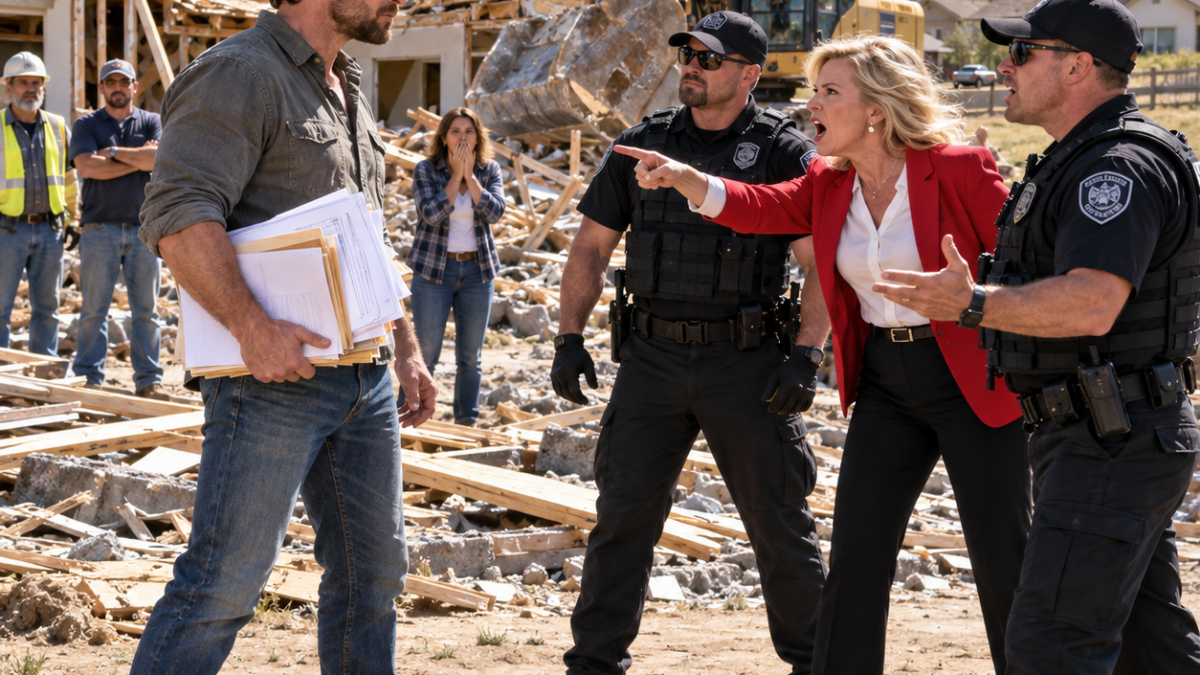
The three of them left ten minutes later.
Victoria walked to a silver SUV.
The two men climbed into separate pickup trucks with removable HOA ENFORCEMENT signs stuck to the doors.
One of them—the man who had moved toward me while I recorded—had a name tag that read **RUSSELL REYES**.
He kept watching me as he opened his truck door.
I kept recording.
License plate.
Vehicle.
Face.
Uniform.
Holster.
Everything.
He gave me a look that was probably intended to say, *You’re going to regret this.*
Instead, all I could think was:
*Good. Keep performing.*
Their tires threw dust into the air as they drove away.
Then silence fell over the property.
I stood inside the ruins.
That was the first time the full impact hit me.
I had seen plenty of construction debris before.
This was different.
The pieces had meaning.
A section of wall framing lay snapped beside the slab.
Roofing shingles were crushed into the dirt.
A section of PVC pipe that had once run toward the unfinished bathroom stuck out beneath a pile of lumber.
Gerald had touched these things.
Some man I never met had spent the last months of his life building this house.
His family had sold it to me believing his work would become somebody else’s future.
I had bought it believing I was giving that work an ending.
Now it looked like a tornado had come through.
Except tornados don’t wear embroidered uniforms.
A voice came from behind me.
“They finally got another one.”
I turned.
An older man stood near the property line.
Maybe seventy.
Flannel shirt.
Work boots.
Gray beard.
He had the face of someone who had spent most of his life outside.
“What did you say?”
He nodded toward the rubble.
“Third one I know of.”
“Third what?”
“Building they tore down.”
I walked toward him.
“Who are you?”
“Walter Jensen.”
He pointed toward a house barely visible beyond the trees.
“Been there twenty-seven years.”
“Are you in Meadowbrook Heights?”
“County parcel. Like you.”
That got my attention.
“Like me?”
He nodded.
“Outside the subdivision.”
I looked back at the wreckage.
“They knew?”
Walter gave me a tired expression.
“They know everything they want to know.”
“What happened to the other owners?”
“Same story.”
“What story?”
“New person buys property. Victoria comes around. Says they’re inside the community service area. Says they owe fees. They argue.”
“And?”
“Things get complicated.”
“What does complicated mean?”
Walter shoved his hands into his pockets.
“Fines. Lawyers. Threats. Enforcement crews.”
“You said they destroyed other buildings.”
“A shed. Small cabin.”
“Did anyone sue?”
“A couple tried.”
“What happened?”
He looked at me for several seconds.
“Didn’t go well.”
“Why?”
“Victoria knows people.”
“What people?”
“County people. Lawyers.”
He glanced toward the road where her SUV had disappeared.
“If I were you, Mr. Brooks, I’d sell the land.”
I almost laughed.
“You think someone’s buying it after they see that?”
“Sell cheap.”
“And run?”
Walter’s expression hardened.
“I’m trying to help you.”
“I know.”
“No, you don’t.”
His voice dropped.
“People around here tried being brave before.”
Then he walked away.
I stayed at the foundation until dark.
Not because there was anything more to see.
Because leaving felt like conceding something.
Around six, I sat on the edge of the slab and pulled out my closing file.
Title commitment.
Deed.
Survey.
Tax records.
Disclosure forms.
I read everything again.
No HOA.
No restrictive covenants.
No mandatory association.
No Meadowbrook Heights.
Nothing.
Maybe the title company had made a catastrophic mistake.
Possible.
Rare, but possible.
But another possibility kept bothering me.
Victoria Marsh had destroyed a house she knew she didn’t control.
The next morning, I was outside the county recorder’s office fifteen minutes before it opened.
I barely slept.
Every time I closed my eyes, I saw the roof gone.
I saw Victoria’s face when she said *enforcement authority*.
I saw Russell’s hand near his belt.
But anger wasn’t enough.
I have never believed anger wins complicated fights.
Information does.
At eight exactly, the doors opened.
The clerk behind the counter was a woman in her fifties wearing reading glasses on a chain.
“I need every recorded document connected to this parcel.”
She took the number.
“Recent purchase?”
“Three weeks ago.”
“Problem already?”
“You could say that.”
Fifteen minutes later, she returned with a stack of documents and a digital plat map.
My deed was clean.
Recorded.
Stamped.
No liens.
No restrictions hidden in old filings.
Then she pulled up the Meadowbrook Heights subdivision.
Forty-seven residential lots.
A central community road.
Recorded boundary.
She turned the monitor toward me.
“There.”
I followed the subdivision boundary with my finger.
Then looked at my parcel.
It sat beside Meadowbrook Heights.
Not inside.
Beside.
Between the subdivision and my land was even a narrow county-owned strip.
“Can you zoom in?”
She did.
“Again.”
She did.
No doubt.
My 2.3 acres was an unincorporated county parcel entirely outside the subdivision.
“Is there any amended boundary?”
She searched.
“No.”
“Annexation?”
“No.”
“Supplemental covenant?”
“No.”
“Anything placing my parcel under Meadowbrook Heights?”
She searched again.
“No.”
I let the breath out slowly.
“I need that certified.”
She looked at me.
“Dispute?”
“Someone demolished a house on that parcel yesterday claiming HOA authority.”
Her face changed.
“They what?”
“I need the map.”
She printed it.
Stamped it.
Signed certification.
I asked another question.
“Any court orders against the parcel?”
She searched.
“No.”
“Demolition orders?”
“No.”
“Liens?”
“No.”
“HOA actions?”
“No.”
“So legally?”
She looked at the map.
“Your parcel is outside Meadowbrook Heights.”
The sentence was simple.
It changed everything.
My next stop was the building department.
Gerald Morrison’s original permit was still active.
The inspector pulled the file.
Foundation inspection: passed.
Framing inspection: passed.
Structural review: passed.
Roof inspection: passed.
No stop-work order.
No pending violation.
No demolition authorization.
The inspector frowned.
“When was it demolished?”
“Yesterday.”
“By who?”
“Meadowbrook Heights HOA enforcement.”
He stared at me.
“They can’t issue demolition orders.”
“They said their covenants gave them authority.”
“For land in the HOA?”
“My property isn’t.”
His expression shifted from confusion to concern.
“Then I’d talk to law enforcement.”
County code enforcement confirmed the same thing.
Even if my house had violated local construction codes—which it didn’t—an HOA did not possess unilateral power to physically demolish a structure.
A private association might pursue contractual remedies against its own members.
Fines.
Injunctions.
Civil actions.
But drive a demolition crew onto private land and tear down a lawful house?
No.
I filed a sheriff’s report that afternoon.
The deputy on the phone was careful.
He didn’t promise arrests.
He didn’t tell me what charges would be filed.
He did tell me to preserve everything.
Photos.
Video.
Names.
Vehicle plates.
Uniforms.
Statements.
“Did any of them represent themselves as law enforcement?”
“They called themselves HOA enforcement.”
“Did they claim legal authority?”
“Yes.”
“Any weapons?”
“I saw a holster. Couldn’t confirm what was in it.”
“Keep the original video.”
“I will.”
He gave me a case number.
It wasn’t justice.
Not yet.
But it was a record.
Four days later, Meadowbrook Heights mailed me their answer.
Not an apology.
Not an explanation.
A bill.
**NOTICE OF VIOLATION AND ASSESSMENT OF PENALTIES**
Unauthorized construction.
Failure to obtain architectural approval.
Unpaid assessments.
Interference with enforcement officers.
Total:
**$47,500.**
I stared at the number.
They destroyed approximately $85,000 worth of partially completed construction.
Then charged me another $47,500 for allegedly forcing them to destroy it.
The arrogance was so complete it almost became impressive.
At the bottom:
**Failure to remit payment within thirty days may result in lien placement and further legal action.**
Signed:
**Victoria Marsh
Chief Compliance Officer**
I called the title company.
They rechecked the file.
Same conclusion.
No HOA.
Then I started building my own file.
Folder one:
Ownership.
Folder two:
Recorded subdivision documents.
Folder three:
Building permits.
Folder four:
Demolition photographs.
Folder five:
HOA communications.
Folder six:
Law-enforcement report.
I backed everything up digitally.
I wrote a chronology.
Date.
Time.
Person.
Statement.
Evidence.
I did not call Victoria.
I did not threaten her.
I did not post online.
People like Victoria usually depend on emotional responses.
Angry voicemails.
Threatening emails.
Public rants.
Anything they can pull out later and say:
*See? This person is unstable.*
I wasn’t giving her that.
The monthly Meadowbrook Heights meeting was the second Thursday at seven.
I arrived fifteen minutes early.
The community center looked ordinary.
Brick building.
Fluorescent lights.
Folding chairs.
Coffee urn in the corner.
Nothing about it suggested a private government operating outside its legal borders.
Twenty residents sat facing a long table.
Victoria was in the center.
Same silver hair.
Same rigid posture.
Beside her sat four board members.
One man sat slightly apart.
Late fifties.
Thinning hair.
Rumpled suit.
His placard said:
**HAROLD PENCE — LEGAL COUNSEL**
Victoria moved through the agenda quickly.
Landscaping.
Pool maintenance.
Budget update.
Then:
“Violation disputes.”
Her eyes went directly to me.
“Mr. Brooks.”
I stood.
She gestured toward the front.
“You may approach.”
The phrasing was deliberate.
As if she were a judge.
I placed the certified county map on the table.
“My name is Daniel Brooks. I’m the legal owner of parcel 18-443-027.”
Victoria watched silently.
“This certified map establishes that my parcel is outside Meadowbrook Heights.”
No reaction.
“My property is not subject to your recorded covenants.”
Still nothing.
“The house your enforcement team demolished had an active county permit and no code violations.”
Victoria folded her hands.
I continued.
“No court order authorized demolition.”
Her smile appeared.
Thin.
Condescending.
“Are you finished?”
“For now.”
She didn’t touch the map.
“Mr. Brooks, we are aware that your parcel sits outside the original subdivision plat.”
A few residents shifted.
I heard it.
Original.
I repeated:
“You acknowledge it’s outside the recorded boundary.”
“Yes.”
That was the sentence I needed.
My phone was recording audio in my pocket.
Victoria continued.
“However, Meadowbrook Heights operates under expanded governance protocols affecting our broader community service area.”
“Where is that recorded?”
“Internal governance instruments.”
“That wasn’t my question.”
Harold Pence leaned forward.
“Mr. Brooks, community associations frequently exercise authority beyond original parcel lines where structures affect shared aesthetic interests.”
I looked at him.
“What statute?”
He blinked.
“There is extensive case authority.”
“Name one.”
He shifted papers.
“The visual-corridor doctrine is well established.”
“Citation?”
“That’s a complex question.”
“You just said it was well established.”
His face reddened.
“I’d be happy to provide written authority.”
“State bar number?”
Silence.
“What?”
“You’re representing this HOA as legal counsel. What’s your bar number?”
Victoria interrupted.
“That is not relevant.”
“It’s extremely relevant.”
Harold straightened.
“My credentials are not subject to interrogation by residents.”
“I’m not a resident.”
That silenced the table.
“I’m not even in your HOA.”
Victoria leaned forward.
“Mr. Brooks, you’re attempting to evade community obligations on a technicality.”
I almost laughed.
“A property boundary is not a technicality.”
“Our community has evolved beyond the original plat.”
“Land ownership doesn’t evolve because you say it does.”
Her smile disappeared.
“You have thirty days to pay the $47,500 assessment.”
“No.”
“If you refuse, we will file a lien.”
“You can’t.”
“We can.”
“You have no contractual relationship with me.”
Harold spoke.
“You are receiving poor advice.”
“I haven’t hired a lawyer yet.”
“Then perhaps you should.”
Victoria’s expression told me she enjoyed that.
I looked back at her.
“I probably will.”
She leaned closer.
“If you continue obstructing enforcement, the matter will be referred to our enforcement partners.”
“What does that mean?”
“You’ll find out.”
There it was.
A threat disguised as procedure.
I turned.
Twenty residents sat behind me.
Nobody looked up.
Nobody spoke.
One man stared at his shoes.
A woman pretended to read her phone.
Fear has a posture.
I recognized it.
After the meeting, I walked toward my car.
Footsteps came behind me.
“Mr. Brooks.”
I turned.
A board member.
Late forties.
Worried eyes.
Her name plate inside had said Grace Harris.
She glanced back toward the building.
“You need to be careful.”
“So I’ve heard.”
“No. Really.”
“What happened?”
“Victoria has connections.”
“Everyone says that. Nobody says what it means.”
Grace crossed her arms tightly.
“There was a man two years ago.”
“Name?”
“Steven Castillo.”
“What happened?”
“Bought property near the subdivision.”
“Inside?”
“Outside.”
My attention sharpened.
“Same situation?”
She nodded.
“Storage building.”
“What did Victoria do?”
“Tore it down.”
“And?”
“They sued him.”
I stared.
“How much?”
“Ninety thousand, I think.”
“What happened?”
“He settled.”
“Why?”
“He ran out of money.”
Grace looked toward the building again.
“You should leave.”
“Why are you telling me this?”
Her eyes filled with something like shame.
“Because we all keep saying that.”
“Saying what?”
“Leave.”
She swallowed.
“Every time somebody fights Victoria, we tell them to leave.”
“And?”
“Maybe that’s why she keeps winning.”
Before I could answer, she walked away.
Three days later, I found Steven Castillo.
He lived forty miles away.
Worked maintenance for a commercial property company.
When I called, there was a long silence.
Then:
“She did it again?”
“Yes.”
“House?”
“Yes.”
Another silence.
“I knew she would.”
We arranged to meet.
But before that meeting happened, Victoria escalated.
I drove to my property with a contractor named Bill Patterson.
Bill was there to inspect the surviving foundation and estimate rebuilding costs.
As we came around the bend, I saw four vehicles blocking the entrance.
Three pickups.
One silver SUV.
Eight people.
Uniforms.
Victoria stood in front.
Waiting.
I parked on the shoulder.
Bill pulled in behind me.
“Friends of yours?”
“No.”
We got out.
Victoria walked toward us.
“Mr. Brooks, this property is currently designated an active enforcement zone.”
I looked around.
“My property.”
“Yes.”
“Designated by who?”
“The association.”
“You have no authority.”
“Section 12.4 allows us to restrict access during unresolved compliance actions.”
“Which recorded covenant is Section 12.4 in?”
She ignored that.
“Your contractor needs to leave.”
Bill looked at me.
I shook my head.
“No.”
Victoria turned toward the uniformed men.
“Five minutes.”
Russell Reyes stepped forward.
His hand settled on his hip.
This time, I saw it clearly.
A handgun.
I looked directly at him.
“Are you armed?”
He didn’t answer.
“Russell. Are you carrying a firearm?”
“Enforcement personnel are authorized to carry protective equipment.”
“By who?”
“The board.”
Victoria said:
“Don’t antagonize him.”
I looked at her.
“There is an armed private individual standing on my land preventing me from entering my property.”
“This is not your interpretation to make.”
I pulled out my phone.
“What are you doing?”
“Calling 911.”
Her face changed.
Small.
But real.
I told dispatch:
“I’m the recorded owner of a private parcel. Eight people identifying themselves as HOA enforcement are blocking access. At least one is visibly armed. The HOA has no recorded jurisdiction over the parcel.”
The dispatcher asked whether anyone had threatened me.
I looked at Russell.
“He has not verbally threatened me.”
Good.
Facts only.
“His hand is resting on the firearm while they’re ordering us to leave.”
Deputies were sent.
Neighbors appeared.
First one.
Then three.
Then seven.
Phones came out.
Doorbell cameras captured the road.
Victoria realized the scene was no longer private.
When the sheriff’s cruiser arrived, two deputies stepped out.
One male.
One female.
The male deputy approached Victoria.
“Ma’am, we received a report of armed persons restricting access to private property.”
Victoria immediately switched into performance mode.
“Deputy, thank goodness. This gentleman is interfering with a lawful HOA enforcement operation.”
The deputy listened.
She explained compliance.
Expanded jurisdiction.
Community standards.
Restricted access.
Then he asked:
“Do you have a court order?”
Victoria paused.
“We operate under covenant authority.”
“Court order?”
“No.”
“Recorded easement?”
“The association—”
“Ma’am, do you have recorded legal authority to exclude Mr. Brooks from this parcel?”
She stiffened.
“Our attorney can explain.”
The deputy held out his hand.
“Credentials.”
Victoria produced her laminated HOA card.
He looked at it for two seconds.
“This is not a government credential.”
“I never said it was.”
“You’re calling this an enforcement operation.”
“It is.”
“HOA enforcement is not law enforcement.”
He turned toward Russell.
“Sir, firearm?”
Russell nodded once.
“Permit?”
No answer.
The deputy’s voice changed.
“Do you have a valid permit?”
Russell looked at Victoria.
Wrong move.
The female deputy stepped closer.
“Answer him.”
Russell finally said:
“I’m legally allowed to carry.”
“That wasn’t the question.”
Long silence.
The male deputy looked toward me.
“Mr. Brooks, you have ownership documentation?”
I handed him copies.
County map.
Deed.
He studied them.
Then returned to Victoria.
“You and your people need to leave.”
Her face went rigid.
“This is a civil dispute.”
“Correct.”
“So we have the right—”
“No.”
He cut her off.
“Civil dispute means you go to court. It does not mean you bring armed personnel onto disputed property and block the recorded owner.”
She opened her mouth.
He continued.
“If we come back because this happens again, criminal enforcement is on the table.”
Victoria looked at me.
“This isn’t over.”
I almost smiled.
That sentence would become prophetic.
Her convoy left.
Bill examined the foundation.
“Good news.”
“I need some.”
“The slab survived.”
“So we can rebuild?”
“Yes.”
“How much?”
He sighed.
“Not cheap.”
Then he looked down the road.
“But if I were you, I’d solve that problem first.”
Three days later, a process server knocked on my apartment door.
Thick envelope.
Civil complaint.
**MEADOWBROOK HEIGHTS HOMEOWNERS ASSOCIATION v. DANIEL BROOKS**
Damages demanded:
$175,000.
Fifty thousand for unauthorized construction.
Seventy-five thousand for interference with lawful enforcement.
Fifty thousand for emotional distress allegedly suffered by HOA personnel.
I sat at my kitchen table and laughed.
Not because it was funny.
Because something inside me finally crossed from disbelief into clarity.
They demolished my house.
They threatened me with armed men.
And now they were suing me for damaging them.
Attorney of record:
**Harold Pence.**
That name bothered me.
So I searched him.
State Bar directory.
I entered the name.
Found the profile.
Then stared.
**LICENSE STATUS: SUSPENDED.**
Effective eighteen months earlier.
Client trust-account violations.
Not authorized to practice.
I checked again.
Same result.
The man who sat at the board table inventing “visual corridor doctrine” was not legally permitted to practice law.
And he had just signed a lawsuit asking a court to award $175,000 against me.
That was when I understood Victoria’s biggest mistake.
She had finally dragged her fantasy authority into a real courtroom.
At the HOA meeting, she controlled the table.
At my property, she controlled the uniforms.
In letters, she controlled the language.
But court?
Court created records.
Court required evidence.
Court required credentials.
Court required claims that could survive scrutiny.
And she had walked into it carrying a suspended lawyer.
I met Steven Castillo the next morning.
Diner halfway between us.
He looked older than his late fifties.
Tired eyes.
Calloused hands.
He ordered coffee.
Never touched it.
“They tore down my shed.”
“How big?”
“Eight hundred square feet.”
“For landscaping equipment?”
He nodded.
“My business.”
“Your property inside Meadowbrook?”
“No.”
“Why did they claim jurisdiction?”
“Community appearance zone.”
I almost laughed.
“Visual corridor?”
Steven looked up.
“They used that with you too?”
“Yes.”
He rubbed his face.
“Same script.”
“What happened?”
“I told them no.”
“And?”
“They sued me for ninety thousand.”
“Attorney?”
“Pence.”
There it was.
“Did you check his license?”
“At the time he was active.”
So the scheme was older than the suspension.
“I couldn’t afford to fight.”
“How much did you settle?”
“Thirty-five thousand.”
I felt sick.
“And your shed?”
“Gone.”
“Business?”
“Collapsed.”
He slid a folder toward me.
Photographs.
Violation notices.
Settlement agreement.
Canceled check payable to Meadowbrook Heights HOA.
At the bottom was an NDA.
“Why give me this?”
“Because I spent two years being ashamed.”
“Ashamed of what?”
“Losing.”
I looked at him.
“You didn’t lose.”
“I paid them.”
“You survived extortion.”
He gave a bitter smile.
“That’s a generous interpretation.”
“Know anyone else?”
“At least five.”
“Names?”
He wrote them down.
“Steven.”
He looked up.
“If this becomes public, Victoria may come after you.”
He laughed.
“She already took the thing I was protecting.”
That sentence stayed with me.
The next day, I hired Olivia Carter.
Property-rights litigator.
Eight years in the state attorney general’s office.
Reputation for treating intimidation like an invitation.
I put everything on her conference table.
Deed.
County map.
Building permit.
Photos.
Video.
Sheriff report.
HOA notices.
Meeting recording.
Steven’s file.
The lawsuit.
Harold’s suspended-license page.
She read for over an hour.
No small talk.
No dramatic reactions.
Then she sat back.
“This is one of the ugliest HOA files I’ve seen.”
“Good ugly or bad ugly?”
“There’s no good ugly in law.”
“What do we do?”
She tapped the complaint.
“First, we kill this.”
“The lawsuit?”
“Yes.”
“Then?”
She pointed toward Victoria’s demolition notice.
“We build ours.”
“Civil?”
“At minimum.”
“What else?”
“Possible property destruction. Fraud. Extortion. Unauthorized practice. Maybe impersonation issues depending on how the uniforms were used.”
“And Russell?”
“Let law enforcement investigate the weapon.”
She looked at me.
“One warning.”
“What?”
“Do not contact Victoria.”
“Wasn’t planning to.”
“Do not post.”
“Fine.”
“Do not threaten anyone.”
“I haven’t.”
“Good.”
She gathered the documents.
“Because right now you are the best kind of plaintiff.”
“What kind?”
“The boring one.”
I laughed.
“I’m serious.”
She pointed toward my evidence.
“You have paper. Video. certified records. witnesses.”
Then toward the HOA complaint.
“They have theater.”
Her motion to dismiss was surgical.
My property sat outside the recorded HOA boundary.
No contractual jurisdiction.
No recorded covenant.
No annexation.
No legal basis for fines.
No basis for the $175,000 lawsuit.
Attached:
Certified county plat.
Deed.
Recorded CC&Rs.
Permit records.
We filed.
Under the rules, Meadowbrook had twenty-one days to respond.
On day nineteen, they responded.
Olivia called me at 6:42 that evening.
“Come in tomorrow morning.”
“What happened?”
“They filed amended covenants.”
“So?”
“They claim the HOA expanded six years ago.”
“Did the county miss it?”
“No.”
Her voice sharpened.
“Because it’s fake.”
I was at her office at eight.
She had the document open beside the official CC&Rs.
“Look.”
The alleged amendment was dated March 15, 2018.
Notarized.
Board signatures.
Expanded “community service area.”
Visual corridor.
My parcel specifically listed.
It looked legitimate.
At first.
Olivia pointed to the notary stamp.
“I called the Secretary of State.”
“And?”
“The notary commission number was issued in September 2018.”
Six months later.
“So impossible.”
“Yes.”
Next:
The document used parcel identifiers in a format the county did not adopt until years later.
Next:
Formatting inconsistent with the association’s historical documents.
Then document metadata obtained through the filing showed creation software much newer than the alleged date.
Olivia looked almost offended on behalf of competent criminals.
“They didn’t just forge this.”
She tapped the page.
“They forged it badly.”
“They submitted it to a judge.”
“Yes.”
“That’s insane.”
“That’s arrogance.”
“What happens now?”
She started drafting.
Motion for sanctions.
Supplemental motion regarding fraudulent evidence.
Formal referral to district attorney.
Complaint regarding Harold Pence’s unauthorized practice.
Then she stopped.
“Daniel.”
“What?”
“The lawsuit was the best thing they could have done for us.”
“How?”
“Until now, Victoria could characterize everything as a messy property dispute.”
She held up the forged amendment.
“Now she has manufactured evidence and submitted it to a court.”
That changed everything.
Within forty-eight hours, Victoria launched a public smear campaign.
Neighborhood forums.
Local apps.
Posts describing me as threatening.
Violent.
Obsessive.
A danger to volunteers.
She claimed I had stalked her family.
Completely false.
I screenshot everything.
Olivia added it to the retaliation file.
“Don’t respond.”
“I know.”
“Good.”
“But I want to.”
“Everyone does.”
“People believe her.”
“Some do.”
“What about reputation?”
“Court records age better than gossip.”
That was one of those lawyer sentences I hated because it was true.
The state bar moved first.
Harold Pence received notice of an investigation into unauthorized practice.
Forty-eight hours later, he withdrew from the HOA case.
His notice cited “irreconcilable differences.”
Olivia laughed when she read it.
“Translation?”
“‘I finally realized this ship is on fire.’”
Victoria called six firms.
All declined.
One attorney eventually agreed to limited representation.
By then, the district attorney had called.
Investigator Thompson met me in a windowless county office.
He had a file several inches thick.
“You people work fast.”
He didn’t smile.
“We were already looking.”
“At Meadowbrook?”
“For almost two years.”
I stared.
“Why?”
“Complaints.”
“Then why didn’t anyone stop them?”
“Complaints are not cases.”
That answer bothered me.
Thompson saw it.
“I know.”
“What changed?”
“You.”
“Me?”
“Your evidence.”
He opened the file.
“Other people complained after settlements. Years later. No original photographs. No recordings. No certified title research. NDAs complicated witness cooperation.”
“And mine?”
“Fresh scene. Uniforms. vehicle photos. sheriff response. recorded board admission. active fraudulent lawsuit.”
I understood.
“Russell Reyes?”
Thompson’s face hardened.
“Felony record.”
“For what?”
“Aggravated assault.”
“And the gun?”
“He’s prohibited.”
I sat back.
“He was standing on my land with a gun.”
“Yes.”
“Claiming enforcement authority.”
“Yes.”
“What does that mean?”
“It means Russell Reyes has problems.”
For the first time in weeks, I smiled.
Olivia filed my countersuit.
Defendants:
Victoria Marsh.
Harold Pence.
Russell Reyes.
Two demolition-team members.
Claims included destruction of property.
Trespass.
Fraud.
Abuse of process.
Intentional infliction of emotional distress.
Related civil claims based on their impersonation of official enforcement authority.
Damages sought exceeded $300,000 when punitive damages, fees, rebuilding costs, and consequential losses were included.
Then Steven Castillo agreed to speak publicly.
Two more victims came forward.
Olivia knew a regional investigative journalist.
Four days later, the story hit.
**HOA ENFORCEMENT TEAM ACCUSED OF DEMOLISHING PRIVATE STRUCTURES, FORGING DOCUMENTS**
Photos of my demolished house.
Steven’s shed.
Forged amendment excerpts.
Harold’s license status.
County boundaries.
Victoria responded:
“Disgruntled property owners who refuse to respect community standards are coordinating a campaign of harassment.”
She did not explain the fake amendment.
Did not explain why my parcel wasn’t inside Meadowbrook.
Did not explain the demolition authority.
Did not explain Russell.
Because she couldn’t.
Residents began messaging me.
Some hostile.
Most curious.
Several frightened.
One email said:
**My father paid Victoria $18,000 after she threatened to demolish his garage. Can we talk?**
Another:
**We were told the HOA could seize our property even though we’re outside the subdivision.**
Another:
**Harold Pence represented the board at our hearing last year. Was he already suspended then?**
The wall cracked.
Then the stories came through.
People Victoria had isolated now realized there were others.
That mattered.
The first major court hearing happened on a Tuesday morning.
Victoria’s new attorney tried to dismiss the HOA’s own lawsuit without prejudice.
Walk away.
Preserve the option to refile.
Olivia stood.
“Your Honor, they do not get to manufacture evidence, submit it to this court, and then retreat the moment fraud is discovered.”
The judge looked toward opposing counsel.
“Explain the notary.”
He shuffled papers.
“Your Honor, we need additional time to investigate the history of these amendments.”
“The document was submitted by your client.”
“Yes.”
“Did you authenticate it?”
“I entered recently.”
“That was not my question.”
He hesitated.
“No.”
The judge looked toward Victoria.
Then back at him.
“Why should this case be dismissed without prejudice?”
He talked about fairness.
Ongoing investigation.
Possibility of legitimate board resolutions.
The judge wasn’t persuaded.
“Evidentiary hearing in thirty days.”
She looked directly toward both counsel.
“And I want every original document.”
Victoria sat behind him.
No smile.
No clipboard.
No uniformed men.
Just a defendant in a courtroom that did not care how confidently she spoke.
Outside, Steven Castillo waited.
“Think she understands now?”
“No.”
“How can she not?”
“People like Victoria don’t lose the belief first.”
“What do they lose?”
“Options.”
The evidentiary hearing was packed.
Journalist.
Victims.
Meadowbrook residents.
Steven.
Grace Harris.
Victoria wore a navy blazer.
Harold Pence did not appear.
Olivia began with records.
Recorded subdivision plat.
My deed.
Original covenants.
Then the fake amendment.
Dr. Patricia Holloway, a forensic document examiner, testified.
She walked through the impossible notary date.
County parcel-number format.
Metadata.
Formatting artifacts.
Dating inconsistencies.
Her conclusion:
The amendment could not have been created when it claimed.
It was fabricated later.
The county recorder testified next.
“No amended Meadowbrook covenants have ever been recorded.”
Olivia asked:
“So as of today, what recorded governing instrument places Mr. Brooks’s parcel within Meadowbrook Heights?”
“None.”
That word echoed.
None.
Victoria’s attorney tried to argue that internal board resolutions could create supplemental authority.
The judge interrupted.
“Not over land owned by nonmembers.”
Silence.
Then:
“Ms. Marsh may testify if she wishes.”
Her attorney whispered urgently.
Victoria ignored him.
She took the stand.
That was her final major mistake.
Olivia approached.
“Ms. Marsh, did you have a court order to demolish Daniel Brooks’s house?”
“No court order was necessary.”
“Why?”
“Our enforcement powers.”
“Recorded where?”
“Under expanded governance.”
“Show this court the recorded instrument.”
Victoria’s jaw tightened.
“The community evolved.”
“Property law did not.”
Objection.
Overruled.
Olivia continued.
“Did you know Mr. Brooks’s parcel was outside the original subdivision?”
Victoria hesitated.
Then:
“Yes.”
There it was again.
“Before demolition?”
“Yes.”
People in the gallery shifted.
“What legal opinion did you obtain authorizing demolition of a nonmember’s house?”
“Harold advised us.”
“Harold Pence?”
“Yes.”
“The man whose law license had been suspended eighteen months before he filed this suit?”
Victoria looked toward her attorney.
“His licensing status was not my responsibility.”
“But you relied on him.”
“Yes.”
“Did you verify his status?”
“No.”
“Did you verify county jurisdiction?”
“We believed—”
“Did you verify?”
“No.”
“Did you verify whether Mr. Brooks’s building permit was valid?”
“No.”
“Did you contact county code enforcement?”
“No.”
“Did you obtain a judicial injunction?”
“No.”
“Did you provide him notice before demolition?”
“We sent notices to the property address.”
“The property was unoccupied.”
Victoria hesitated.
“We followed our procedure.”
“What address did you send them to?”
Victoria couldn’t answer immediately.
Olivia produced the HOA file.
The notices had been mailed to Gerald Morrison.
The dead previous owner.
Three months after his death.
The courtroom went very quiet.
Olivia held up the letters.
“You continued sending notices to a deceased man.”
Victoria said nothing.
“Then after the parcel transferred to Mr. Brooks, you demolished the structure before confirming he had received any notice.”
“We had enforcement deadlines.”
“Your deadlines.”
“Yes.”
“Created by your HOA.”
“Yes.”
“For property outside your HOA.”
Silence.
Olivia returned to counsel table.
“Nothing further.”
The judge did not recess.
She ruled from the bench.
The HOA’s $175,000 lawsuit:
Dismissed with prejudice.
Never to be refiled.
Sanctions:
$25,000 personally against Victoria for litigation misconduct connected to the fraudulent filings.
Criminal referral:
Confirmed.
My countersuit:
Allowed to proceed.
Victoria sat perfectly still.
The judge looked toward her.
“Community leadership does not create sovereignty.”
That sentence was the end of Victoria Marsh’s kingdom.
Not legally.
Not yet.
But psychologically.
Outside the courtroom, reporters surrounded her.
“Ms. Marsh, did you authorize forged documents?”
“This is a witch hunt.”
“Why did your HOA demolish a house outside its subdivision?”
“We were protecting Meadowbrook.”
“From what?”
She stopped.
That question exposed everything.
From what?
My unfinished house?
Steven’s shed?
A garage?
People asking questions?
Victoria couldn’t say the real answer.
She was protecting control.
Six weeks later, indictments were unsealed.
Victoria Marsh:
Fraud.
Filing false documents.
Criminal property destruction.
Related conspiracy allegations.
Harold Pence:
Unauthorized practice of law.
Fraud-related charges tied to filings.
Russell Reyes:
Illegal firearm possession due to prior felony status.
Charges connected to impersonating enforcement authority.
Two other enforcement participants:
Trespass.
Property destruction.
All five were arrested within twenty-four hours.
Victoria’s mugshot appeared on regional television.
No silver SUV.
No clipboard.
No “Chief Compliance Officer.”
Just a booking photograph.
The same woman who had looked at the rubble of my house and calmly warned me not to rebuild now had to answer questions from people whose authority she could not invent away.
The civil case settled before criminal trial.
Insurance refused to cover certain intentional conduct.
That changed the negotiation dramatically.
The settlement involving my claims totaled $185,000.
Not everything I could theoretically pursue.
Enough to rebuild.
Enough to cover losses.
Enough to make the point.
Payment came from Meadowbrook’s enforcement fund and other recoverable sources.
That detail mattered to Steven.
When I told him, he stared at me.
“The enforcement fund?”
“Yes.”
“The money they took from us?”
“Some of it.”
He laughed.
Then covered his face.
“That’s perfect.”
“It isn’t perfect.”
“No.”
His voice broke.
“But it’s close.”
Steven filed his own lawsuit.
So did two others.
The enforcement fund Victoria had built through fear began flowing back toward the people that fear had extracted it from.
There was symmetry in that.
Not magic.
Not full restoration.
But something close to justice.
Victoria eventually entered a no-contest plea on key charges.
Eighteen months in state prison.
Three years’ probation.
Permanent prohibition from serving in HOA leadership.
Harold Pence lost whatever remained of his professional future.
His law license was permanently revoked.
Russell Reyes went to trial.
Convicted.
Three years.
The other enforcement members received lesser sentences, probation, and restitution obligations based on their roles.
The independent audit came after the criminal case.
More than $340,000 had moved through Victoria’s so-called enforcement program across several years.
Some was legitimate expense.
Much was not.
Settlement payments.
Fines.
“Compliance fees.”
Administrative penalties.
Money collected from people who did not know whether the HOA really had power over them.
The audit went to the attorney general.
State lawmakers began discussing restrictions on extreme HOA enforcement.
One proposal required judicial authorization before associations could pursue certain property-seizure actions.
Another strengthened disclosures regarding boundaries and enforcement jurisdiction.
Whether every reform survived politics didn’t matter to me as much as something simpler.
People had started checking.
That was what Victoria could never survive.
I rebuilt the house.
Eight months.
Bill Patterson supervised most of it.
We used Gerald’s foundation.
The slab remained solid.
The framing went back up.
Then walls.
Roof.
Windows.
Electrical.
Plumbing.
Each stage passed county inspection.
I framed every permit approval.
Not because normal people frame inspection stickers.
Because I had developed a sense of humor about documentation.
Bill laughed when he saw them.
“You decorating with government paperwork now?”
“Yes.”
“That’s sad.”
“It’s beautiful.”
When the front porch was finished, I stood there alone.
The view was exactly what made me buy the property.
Trees.
Open field.
Long gravel road.
No HOA sign.
No clubhouse.
No gate.
No fake enforcement truck.
Just land.
Gerald Morrison had poured that foundation expecting to sit there one day.
He never got the chance.
I did.
I sometimes wondered whether completing the house felt like finishing something for him too.
Grace Harris came by a few weeks after I moved in.
Bottle of wine.
Awkward smile.
She stood on the porch.
“You did it.”
“We did.”
She looked at the house.
“I should have spoken sooner.”
I remembered the parking lot.
Her shaking hands.
“You spoke when it mattered.”
“Not soon enough for Castillo.”
“No.”
“Or the others.”
“No.”
She appreciated that I didn’t lie.
“I sat on that board.”
“I know.”
“I told myself I wasn’t responsible because Victoria made decisions.”
“You voted?”
“Sometimes.”
“Then you have something to live with.”
Her eyes filled.
“I know.”
I softened.
“But living with it can mean doing something.”
“What?”
“Help rebuild the board.”
She laughed bitterly.
“I don’t ever want another HOA meeting.”
“Then help from outside.”
She thought.
“Transparency committee?”
“Sounds boring.”
“Exactly.”
She smiled.
That was how Meadowbrook changed.
Not through one dramatic replacement.
Not because everyone suddenly became brave.
The remaining board dissolved the fake enforcement division.
Uniforms gone.
Magnetic signs gone.
No armed private “officers.”
Financial statements became public to members.
External audits became mandatory.
Major legal actions required actual licensed counsel verified through the state bar.
Reaching beyond subdivision boundaries?
Prohibited without proper recorded rights or court process.
It sounds obvious.
Most reforms do after abuse exposes why they’re necessary.
The first new board meeting after Victoria went to prison had seventy-six residents.
Walter Jensen attended even though he didn’t belong to the HOA.
He sat in back.
Afterward, I found him outside.
“You told me to run.”
“I did.”
“You were trying to protect me.”
“Yes.”
“You thought I’d lose.”
“Yes.”
He looked embarrassed.
“Still do?”
Walter smiled.
“No.”
Then he looked toward Meadowbrook.
“You know what bothers me?”
“What?”
“We all knew.”
“Knew what?”
“That she was making things up.”
“You knew the specifics?”
“No.”
“But?”
“We knew it didn’t smell right.”
He rubbed his beard.
“We just decided surviving her was easier than challenging her.”
That was the whole operation.
Victoria’s true authority had never been recorded.
It had been psychological.
She didn’t need every threat to be legally valid.
She needed people to believe checking would cost more than paying.
That was enough.
Steven called me the day Victoria reported to prison.
He didn’t say hello.
“She’s in.”
“I heard.”
Long silence.
Then:
“I watched the report twice.”
“How do you feel?”
“I don’t know.”
“Fair.”
“I thought I’d be happy.”
“Are you?”
“No.”
His voice cracked.
“My business is still gone.”
I closed my eyes.
Justice has limits.
People don’t tell enough stories about that.
Punishment doesn’t rewind.
Steven’s years were still gone.
The money he lost.
Clients.
Confidence.
Sleep.
His wife had left during the financial collapse.
Victoria going to prison could not put those pieces back automatically.
“I’m sorry.”
“I know.”
Another pause.
“But I’m glad.”
“That sounds contradictory.”
“Maybe.”
He laughed weakly.
“I’m glad nobody else will hear her tell them they have thirty days to pay and think she’s God.”
That I understood.
He eventually started another landscaping business.
Smaller.
His son helped.
The civil settlement gave him enough capital to buy equipment.
Not everything returned.
Something did.
One Saturday he drove out to my place with a young tree in the back of his truck.
“What is that?”
“Red oak.”
“Why?”
“Housewarming.”
“You’re eight months late.”
“I was busy suing people.”
We planted it near the drive.
Years from now, it’ll shade part of the yard.
Maybe long after both of us are gone.
I liked that.
Something living where the story had started with destruction.
I found Gerald Morrison’s daughter through the estate attorney.
Her name was Melissa.
I sent her photographs of the completed house.
She called the next day.
For a few seconds she couldn’t speak.
“Dad would’ve loved it.”
“I kept the foundation.”
“I can see.”
She cried.
Then apologized.
“No need.”
“I’m sorry you had to go through all of that.”
“Not your fault.”
“Dad used to talk about the porch.”
“What about it?”
“He wanted it deep enough for two rocking chairs.”
I looked outside.
Bill and I had built a deep porch.
“Tell me something.”
“What?”
“Did he ever choose the chairs?”
She laughed through tears.
“No.”
A week later, two arrived.
Melissa had sent them.
Wooden rocking chairs.
Simple.
I put both on the porch.
For a while, one stayed empty.
Then Walter started wandering over in the evenings.
He claimed it was because my coffee was better.
It wasn’t.
He just liked the chair.
That became our routine.
We’d sit there watching the road.
One evening, a white SUV slowed near the driveway.
My body tensed instinctively.
Walter noticed.
“Still do that?”
“Do what?”
“Watch cars.”
“Yes.”
“They got you good.”
“For a while.”
The SUV kept going.
Nothing happened.
Walter rocked slowly.
“Funny.”
“What?”
“Used to be we all watched for Victoria.”
“Why?”
“Same reason.”
He looked toward the road.
“Difference is, we expected her.”
I thought about that.
Fear turns normal places into surveillance posts.
A road becomes a warning.
A truck becomes a threat.
A knock becomes a violation.
The house was rebuilt.
My nervous system took longer.
Months passed before I stopped photographing unfamiliar vehicles automatically.
Longer before a certified-mail envelope didn’t tighten my chest.
I kept every legal document anyway.
Some habits were staying.
I had a fireproof cabinet installed in the office.
Olivia laughed when she saw it.
“You’re becoming your own records department.”
“I learned from the best.”
“That would be me.”
“That would be Victoria.”
She stared.
“Explain yourself.”
“She taught me never to trust anything without checking.”
Olivia reluctantly nodded.
“I hate that that’s a good point.”
The countersuit settlement paid her fees, rebuilding costs, losses, and damages.
People asked whether the $185,000 made me whole.
No.
“Whole” isn’t a number.
The unfinished house I bought had history.
Gerald’s history.
The beams he chose.
The rooms he planned.
Some of that was destroyed permanently.
My two weeks of believing I was starting over quietly became months of litigation.
My trust in official-looking paperwork changed forever.
Money repairs some things.
Not all.
But a fair settlement did something important.
It moved the burden.
Before, Victoria’s entire model put the cost of resistance on victims.
Fight?
Hire a lawyer.
Miss work.
Pay experts.
Spend months scared.
Lose sleep.
Maybe settle.
Maybe sell.
She counted on that imbalance.
The settlement reversed it.
She and her organization finally paid for forcing the fight.
That mattered.
A year after I moved in, Meadowbrook invited me to speak at an annual meeting.
I almost declined.
Then Grace called.
“Please.”
“Why?”
“People need to hear what happened.”
“They can read the newspaper.”
“They need to understand how easy it was.”
That convinced me.
The community center looked different.
Same folding chairs.
Same fluorescent lighting.
But the long front table had new faces.
No “legal counsel” placard.
No security men.
No uniforms.
I stood at the front.
About a hundred residents attended.
I didn’t give a victory speech.
I told them the simplest version.
“My property was never in your HOA.”
Everyone knew.
“Everything that followed depended on nobody checking that fact.”
I held up the certified county map.
“This cost me less than twenty dollars.”
Silence.
“This piece of paper defeated the central claim behind hundreds of thousands of dollars in threats.”
People shifted.
“Not because it was magical.”
I set it down.
“Because it was real.”
Then I held up one of Victoria’s old enforcement notices.
“This looked more official.”
Gold logo.
Bold heading.
Legal language.
Red warnings.
“Which one had more authority?”
The room knew.
“The plain county map.”
I nodded.
“Exactly.”
I looked around.
“Victoria’s system depended on confusing appearance with legitimacy.”
Uniform.
Clipboard.
Attorney.
Official title.
Legal terminology.
Weapons.
Letters.
Meetings.
People had been trained to react before verifying.
“She didn’t need lawful authority every time.”
I continued.
“She needed enough people to assume she had it.”
Walter sat in the back.
Steven was there too.
I pointed toward him.
“Steven paid $35,000 because he couldn’t afford to find out whether she was bluffing.”
Steven didn’t look ashamed anymore.
“That is not stupidity.”
I said it clearly.
“That is what coercion looks like.”
People listened.
“You make the cost of checking so high that surrender becomes rational.”
A woman raised her hand.
“What should we have done?”
“Earlier?”
“Yes.”
“Ask questions.”
“Would that have stopped her?”
“Maybe not one question.”
“What then?”
“Ten.”
I looked around.
“Twenty.”
Another resident asked:
“What if she retaliated?”
“She did.”
“So what was the answer?”
“Stop letting one target stand alone.”
That landed.
I thought of Walter.
Grace.
Steven.
The others.
Victoria had fought individuals.
She never wanted a network of witnesses.
“Abusive authority loves isolation.”
I said.
“Transparency is dangerous to people like Victoria because transparency connects stories.”
After the meeting, an elderly man approached.
“I hated you.”
That was an interesting opening.
“When?”
“When the newspaper story first came out.”
“Why?”
“I thought you were trying to destroy Meadowbrook.”
“That’s what Victoria said.”
“I believed her.”
He looked down.
“My wife told me to check the county map.”
“Smart wife.”
“She usually is.”
He smiled.
“I didn’t want to believe it.”
“Why?”
“Because if you were right, then we had let her do this for years.”
There it was.
Sometimes people reject truth not because evidence is weak.
Because accepting it creates responsibility.
I shook his hand.
“What changed?”
“The forged court document.”
“Why that?”
“Couldn’t explain it.”
Neither could Victoria.
Years later, I still own the 2.3 acres.
The red oak Steven planted is taller now.
Gerald’s rocking chairs sit on the porch.
One has faded slightly more than the other because Walter always chooses the left side.
Meadowbrook Heights is still there.
Houses still stand.
Lawns still get mowed.
People still argue about paint colors.
They still have an HOA.
That surprises people.
They expect stories like mine to end with the association dissolved.
It didn’t need to disappear.
It needed boundaries.
Real boundaries.
Recorded boundaries.
Institutional boundaries.
Human boundaries.
No leader should have power over land she doesn’t govern.
No private “enforcement officer” should be able to imitate public authority.
No suspended lawyer should sit behind a placard and terrify people who don’t know how to check his license.
No board should treat silence as consent.
And no homeowner should assume a document is legal just because somebody printed it on expensive paper.
One evening, several years after everything ended, I found the very first photograph I had taken after arriving at the demolished house.
Foundation.
Rubble.
Victoria in the background.
Russell beside her.
I stared at it.
I remembered exactly how powerless I felt.
That is difficult to admit.
People prefer justice stories where the protagonist knows immediately what to do.
I didn’t.
I stood there looking at a destroyed house thinking:
*How can this possibly be legal?*
For a few minutes, I believed maybe I had missed something.
Maybe the title company had failed.
Maybe obscure HOA law allowed it.
Maybe Victoria knew something I didn’t.
That uncertainty was her real weapon.
Not Russell’s gun.
Not Harold’s legal language.
Uncertainty.
She wanted people asking:
*What if she’s right?*
Then she supplied the answer:
Pay.
Leave.
Settle.
Obey.
I closed that photograph.
Then opened another.
Finished house.
Porch.
Two rocking chairs.
Oak tree.
That was the answer.
She wasn’t right.
She was simply accustomed to nobody checking.
The greatest moment wasn’t her mugshot.
It wasn’t the judge calling the documents fraudulent.
It wasn’t the $185,000 settlement.
It wasn’t even the day the house was finished.
The moment that changed everything happened the morning after the demolition when the county clerk turned her monitor toward me.
My parcel.
Outside Meadowbrook.
One clean line on a map.
That line had existed the entire time.
Victoria couldn’t erase it.
She couldn’t vote it away.
She couldn’t expand it through “governance protocols.”
She couldn’t move it by hiring men in uniforms.
She couldn’t change it by threatening liens.
She couldn’t change it with a suspended attorney.
And when she tried to change it with forged documents, she transformed her civil bluff into evidence of crime.
That was the irony.
If she had stopped after destroying the house, my case would still have been strong.
If she had settled, she might have avoided the worst consequences.
Instead, she sued me.
She demanded $175,000.
She walked into a real court and expected the judge to accept the same theater that frightened homeowners in a fluorescent community room.
She believed everyone was part of her audience.
They weren’t.
The court asked for proof.
That was all it took.
Where is the recorded covenant?
None.
Where is the court order?
None.
Where is the jurisdiction?
None.
Where is the valid lawyer?
Suspended.
Where did this amendment come from?
Fabricated.
Why was an armed felon conducting HOA enforcement?
No good answer.
Victoria’s empire was enormous when viewed through fear.
Measured against evidence, it was surprisingly small.
That lesson stayed with me.
A few months after the fifth anniversary of the demolition, Melissa Morrison visited.
Gerald’s daughter.
She wanted to see the finished house in person.
She stood in the driveway for a long time.
Then walked slowly onto the porch.
“You used his foundation.”
“Every inch.”
She touched one of the posts.
“He would’ve changed this.”
“What?”
“The railing.”
“What’s wrong with it?”
“He hated square balusters.”
I laughed.
“Well, he should’ve left instructions.”
“He probably did somewhere.”
We sat in the rocking chairs.
She looked toward the trees.
“Dad wanted to retire here because he said the city had become too loud.”
“Did he hate HOAs?”
She laughed.
“With a passion.”
“That would’ve been useful information.”
“He once told me he bought this parcel specifically because it wasn’t inside Meadowbrook.”
I looked at her.
“Seriously?”
“Yes.”
“He knew?”
“Absolutely.”
That made me laugh harder.
Gerald had deliberately chosen land outside the HOA.
Then years later, Victoria demolished his house under HOA authority.
The absurdity would have amused him.
Melissa became quiet.
“I was angry when we sold.”
“Why?”
“It felt like giving up on him.”
“You didn’t.”
“I know now.”
She looked at the completed house.
“You finished it.”
“Different from his plan.”
“Still.”
She smiled.
“It lived.”
That phrase stayed with me.
It lived.
The house had been seventy percent complete.
Then zero.
Then one hundred.
Not the same wood.
Not the same roof.
Not the same walls.
But the same foundation.
Sometimes justice works like that.
It doesn’t restore the original thing untouched.
It rebuilds on what survived.
Steven rebuilt.
Grace rebuilt trust.
Meadowbrook rebuilt governance.
I rebuilt the house.
Even Walter rebuilt his faith that somebody could push back and stay.
One winter afternoon, Walter and I sat on the porch watching rain.
“You ever think you should’ve sold?”
He asked.
“First week?”
“Yes.”
“No.”
“You’re lying.”
“Fine.”
I smiled.
“Once.”
“When?”
“After the lawsuit.”
“Not the demolition?”
“Demolition made me angry.”
“And lawsuit?”
“Made me realize how much money fighting could cost.”
Walter nodded.
“That’s where they got most people.”
“I know.”
“Did you almost quit?”
I looked across the yard.
“Yes.”
That was true.
There had been one night after I received the $175,000 complaint when I sat alone and calculated worst cases.
Attorney fees.
Lost work.
Years.
Appeals.
What if the judge believed them?
What if some ancient covenant existed?
What if Russell returned?
What if the DA did nothing?
What if I won but spent more winning than the property was worth?
That was Victoria’s business model.
Not certainty.
Cost.
Make justice expensive enough that surrender looks financially intelligent.
“What stopped you?” Walter asked.
I thought.
“The lawsuit.”
He laughed.
“That makes no sense.”
“It made the stakes worse.”
“Exactly.”
“No.”
I shook my head.
“It made them clearer.”
“How?”
“If I paid or sold after they demolished my house, I wasn’t ending a problem.”
I looked at him.
“I was financing the next demolition.”
Walter stopped rocking.
That was what changed revenge into something larger.
I wanted Victoria punished.
Of course I did.
Anyone saying otherwise is lying about human nature.
But punishment alone was too small.
The goal became breaking the model.
No more uniforms.
No more fake jurisdiction.
No more outside-property targets.
No more settlements feeding the fund that financed the next threat.
Steven eventually told me five additional owners had contacted him.
Some cases were too old.
Records missing.
Statutes of limitation.
People moved.
Memories faded.
Not every wrong became a lawsuit.
That frustrated him.
“Why do they get away with some of it?”
“Because systems have limits.”
“That’s not fair.”
“No.”
“What do you do with that?”
I didn’t know.
Eventually, I said:
“Make the next wrong harder.”
That was the only answer I had.
State legislation inspired partly by the Meadowbrook case eventually passed in modified form.
Less dramatic than advocates wanted.
More useful than critics expected.
Additional notice.
Clearer judicial oversight.
Restrictions on deceptive enforcement branding.
Stronger disclosure obligations.
Nothing makes abuse impossible.
Good laws rarely eliminate bad actors.
They add friction.
Friction matters.
Every extra signature.
Every required notice.
Every recorded vote.
Every independent review.
Every public filing.
Every requirement to verify jurisdiction.
Those are boring protections.
Victoria thrived because she eliminated friction for herself and maximized it for victims.
Reform reversed some of that.
Olivia later gave a continuing-education presentation to attorneys using parts of the case.
She called me afterward.
“You’re famous.”
“I hate that sentence.”
“You’re a slide.”
“That’s worse.”
“Title: ‘When Community Governance Becomes Fabricated Jurisdiction.’”
“Catchy.”
“You want to know the first bullet?”
“No.”
“Verify the recorded boundary before arguing anything else.”
I laughed.
“Twenty-dollar map.”
“Exactly.”
She paused.
“Daniel.”
“Yeah?”
“You did unusually well.”
“At what?”
“Not making things worse emotionally.”
I thought about every night I wanted to drive to Victoria’s house.
“You have no idea.”
“I probably do.”
“You ever want to scream at a defendant?”
“Daily.”
“What stops you?”
“Billing.”
I laughed.
Then she became serious.
“You know what won your case?”
“Documents.”
“Yes, but before that.”
“What?”
“You photographed the scene before arguing.”
I remembered standing in the rubble with my phone.
“You didn’t give Russell a reason to escalate.”
“Barely.”
“You went to the county before confronting the HOA.”
“Yes.”
“You asked Harold for a citation instead of calling him a liar.”
“He was a liar.”
“I know.”
She laughed.
“But you made him show everyone.”
That was true.
People reveal themselves when asked calm questions they cannot answer.
*Where is it recorded?*
*What statute?*
*What case?*
*What credential?*
*What court order?*
*What jurisdiction?*
Victoria hated those questions because authority built on bluff cannot tolerate specificity.
Her words were enormous.
Community safety.
Expanded governance.
Enforcement protocols.
Visual corridor.
Compliance authority.
But every time we asked for something concrete, the language shrank.
No statute.
No deed restriction.
No order.
No license.
No authority.
The night before the house demolition anniversary, I pulled out Victoria’s original $47,500 violation notice.
I had kept it in the fireproof cabinet.
Red letters:
**FAILURE TO COMPLY MAY RESULT IN FURTHER LEGAL ACTION**
I smiled.
For once, the threat had come true.
There was further legal action.
Just not the kind she imagined.
The next morning I sat on the porch with coffee.
Gerald’s second rocking chair was empty.
Walter hadn’t arrived yet.
Sunlight came through the trees.
Somewhere beyond the narrow county strip sat Meadowbrook Heights.
Still there.
Still ordinary.
Children catching a school bus.
People heading to work.
Trash cans waiting beside driveways.
Nobody thought about Victoria much anymore.
That might have bothered her most.
For years, she made herself the center of Meadowbrook.
Chief Compliance Officer.
Authority.
Gatekeeper.
Punisher.
Protector.
Everyone had to think about her.
Now the neighborhood continued without her.
That is one of the quietest consequences for people addicted to control.
The world keeps functioning after they leave.
Walter finally appeared carrying coffee.
“You made some?”
“Yes.”
“Good?”
“No.”
He sat anyway.
We looked toward the road.
“You know,” he said, “first day I saw you standing in that rubble, I thought you were an idiot.”
“For staying?”
“For looking angry.”
“That’s comforting.”
“I figured Victoria would eat you alive.”
“Thanks.”
“Then you went to the county.”
“You heard?”
“Everyone heard.”
He smiled.
“That was when I thought maybe you were a different kind of idiot.”
“What kind?”
“Persistent.”
I raised my mug.
“To persistent idiots.”
He raised his.
The red oak moved in the breeze.
I thought about the chain of events again.
I bought a legal parcel.
Victoria destroyed a legal house.
She invented authority.
Sent fines.
Threatened a lien.
Admitted my property was outside the HOA.
Blocked my land with armed men.
Then sued me for $175,000.
That lawsuit was supposed to finish me.
Instead, it forced her claims into a venue where she no longer controlled the definitions.
She sued me because she assumed court was just another room she could dominate.
She was wrong.
That was her biggest mistake.
Not demolishing the house.
Not the uniforms.
Not Russell’s gun.
Not even the forged covenants.
The biggest mistake was believing nobody outside her system would check.
A judge checked.
A county clerk checked.
An investigator checked.
A forensic examiner checked.
A real attorney checked Harold Pence’s license.
Victims checked their old files.
Residents checked their own memories.
And the entire structure collapsed.
Power built on intimidation only works while everyone participates in the illusion.
Documentation does not require participation.
A deed is still a deed if Victoria hates it.
A boundary is still a boundary if the board votes otherwise.
A suspended lawyer is still suspended if he puts “Legal Counsel” on a placard.
A fake covenant is still fake if it has a notary stamp.
And a house demolished without authority is still somebody’s property.
Years later, people sometimes ask what I would say if Victoria stood at my gate again.
Nothing dramatic.
No speech.
No revenge line.
I’d probably point toward the little metal marker near the drive.
County survey monument.
Recorded coordinates.
Permanent.
Then I’d say:
“Check the map.”
Because in the end, that was all she should have done.
If she had checked before sending bulldozers, there would have been no destroyed house.
No fake enforcement scheme exposed.
No forged lawsuit.
No criminal investigation.
No prison sentence.
No emptied enforcement fund.
No regional news.
No legislative hearings.
No rebuilding story.
Just a man finishing a house on 2.3 acres.
But Victoria Marsh had spent too many years believing her confidence could redraw other people’s boundaries.
She learned otherwise.
And I learned something too.
The first time I saw that house reduced to rubble, I thought they had taken my fresh start.
They hadn’t.
They had delayed it.
Made it more expensive.
Made it uglier.
Made me fight for something I should never have needed to defend.
But they didn’t take it.
The foundation survived.
The deed survived.
The truth survived.
And eventually, I did what Gerald Morrison had started.
I finished the house.
Now, when I sit on the porch in the evening, I don’t see the rubble anymore.
I see the oak Steven planted.
I see Walter in the second chair.
I see Gerald’s daughter smiling the first time she walked through the finished kitchen.
I see county inspection stickers framed in my office because apparently litigation damaged my sense of interior design.
Mostly, I see a home.
A real one.
Built legally.
Owned legally.
Protected not by threats, uniforms, or made-up titles, but by something Victoria Marsh never respected until a judge forced her to.
Boundaries.
She destroyed my house believing nobody would question hers.
Then she sued me.
And by doing that, she finally placed every lie she had told where lies like hers are most dangerous.
On the record.
That was the mistake that ended everything.








