PART 2: HOA Claimed My Private Forest Trail—So I Locked the Gate and Their Home Values Crashed by $50,000
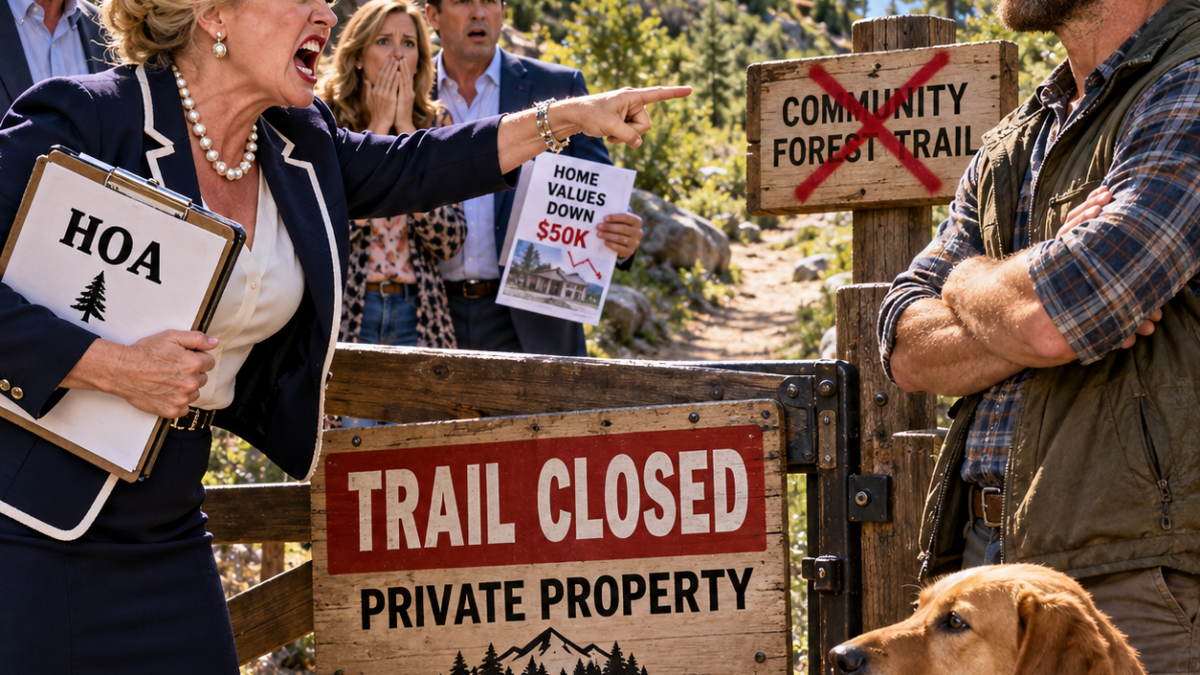
The HOA president walked onto my private forest trail with two board members, announced that years of neighbor use had somehow turned my land into “community property,” and told me I would need her board’s permission if I ever wanted to close it.
Three days later, they put the threat in writing—$200 a day if I blocked access to a trail I had personally cleared, paid for, maintained, surveyed, and owned outright on my recorded deed.
I didn’t argue at their next meeting or beg them to reconsider; I simply pulled the original plat, made one phone call, and did something before sunset that would force half the neighborhood to discover exactly how much one strip of forest had really been worth.
I had lived in Ridgrove Hills for fourteen years before Margaret Jennings decided she knew my property better than I did.
That was almost funny, considering I worked as a county surveyor.
Property lines were my job.
I spent my days reading plats, checking monuments, reconciling old deeds with modern GIS layers, and explaining to angry people that fences, hedges, memories, and assumptions were not legal boundaries.
The trail behind my house was not an assumption.
It ran across the wooded rear section of my lot, curved between two stands of pine, crossed a narrow seasonal drainage channel, and ended near an old oak ridge that overlooked the valley.
I had cut the first version of it myself years earlier.
I cleared fallen branches after storms, laid gravel over the muddy sections, rebuilt two small footbridges, and trimmed back brush every spring.
Sometimes neighbors used it.
I never minded.
Parents walked with their kids.
Teenagers jogged through.
Older couples came out in the mornings.
Nobody paid.
Nobody signed anything.
It was neighborly permission.
Nothing more.
Then Margaret became HOA president.
Margaret loved authority the way some people loved oxygen.
She once fined a homeowner because his porch furniture was allegedly the wrong shade of beige.
Another resident received three warnings for leaving a trash can visible for more than two hours after collection.
Margaret called that “preserving standards.”
Most of us called it exhausting.
That Saturday morning, I was drinking coffee on my back deck when I saw three people walking up my trail.
Margaret.
Ron, one of the board members.
Kathy, the treasurer.
All three carried clipboards.
I stepped off the deck.
“Can I help you?”
Margaret barely looked at me.
“We’re inspecting the trail.”
“For what?”
“We’re adding it to the HOA maintenance schedule.”
I stared at her.
“Why?”
She finally turned.
“Because this is technically common property.”
“No, it isn’t.”
Ron looked uncomfortable.
Kathy kept writing.
I walked toward them.
“The entire trail runs inside the rear boundary of my deeded lot.”
Margaret smiled the way people smile when they think they’re speaking to somebody who hasn’t done the research.
“I’m sure that’s what you believe.”
I almost laughed.
“I surveyed this section myself when I bought the house.”
“That doesn’t change established use.”
“What established use?”
“Residents have used this path for years.”
“Because I allowed them.”
“That makes it communal by precedent.”
“No.”
Her smile tightened.
“Excuse me?”
“Use doesn’t magically erase title.”
Ron muttered, “We should have counsel review this.”
Margaret raised one hand.
“We already have.”
I looked at her clipboard.
“So what’s the plan?”
“The HOA will formally classify the trail as a shared amenity. From there, we’ll budget for cleanup, liability coverage, signage, and maintenance.”
“On my land.”
“On land serving the community.”
“Same answer. My land.”
Margaret sighed.
“Damon, you’re making this unnecessarily confrontational.”
“You walked into my woods and announced you were taking control of something I own.”
“Nobody is taking anything.”
“Then leave.”
Her expression changed.
“We’ll issue formal notice.”
“Good.”
“You can appeal through the board.”
That did make me laugh.
“Appeal to you about whether I own my own property?”
Margaret’s cheeks flushed.
“You’ll receive instructions.”
They turned around and walked back toward the subdivision.
I didn’t stop them.
I wanted it in writing.
Three days later, the letter arrived.
Official Ridgrove Hills HOA stationery.
Board seal.
Legal language.
It declared the trail a “shared neighborhood amenity established through longstanding communal access.”
Effective immediately, I was prohibited from obstructing, altering, closing, or restricting it.
Violation:
Two hundred dollars per day.
I read the letter twice.
Then went to work.
By noon, I had printed my deed, the county plat, the registered survey, and the original development plans from twenty years earlier.
Every document showed the same thing.
My boundary.
My forest.
My trail.
By four that afternoon, a fencing contractor was setting six-foot privacy fencing across the rear access points.
At the main trail entrance, I installed a steel gate with a heavy lock.
Then I hung one laminated sign at eye level.
**PRIVATE PROPERTY — NO TRESPASSING**
**ACCESS REVOKED UNTIL FURTHER NOTICE**
I stepped back and looked at it.
For years, I had given Ridgrove Hills something for free because I thought we were neighbors.
Margaret had just taught me that permission without respect eventually gets mistaken for ownership.
She was about to learn the difference.
PART 2
Margaret lasted nineteen hours.
The next morning, I was in my garage sharpening a mower blade when I heard a vehicle stop hard near the rear access road.
Then came the footsteps.
Fast.
Angry.
I stepped outside.
Margaret was standing at the locked trail gate gripping the chain with both hands as if she might personally tear it off.
“You can’t do this.”
I wiped metal filings from my hands.
“Good morning.”
“Open the gate.”
“No.”
Her eyes widened.
“You are obstructing a designated HOA amenity.”
“You designated my land as an amenity.”
“The board voted.”
“My deed didn’t.”
She shook the gate.
The steel rattled.
“Families use this trail.”
“They used it with my permission.”
“For years.”
“Yes.”
“That creates rights.”
“No.”
“You’re not an attorney.”
“No.”
I walked toward her carrying a folder.
“I’m a surveyor.”
That slowed her down.
I removed the plat.
“Here’s my recorded boundary.”
Next sheet.
“Original Ridgrove Hills development plan.”
Another.
“Registered survey.”
I pointed at the thick black line marking my rear property.
“Trail stays inside this boundary from beginning to end.”
Margaret barely looked.
“Our counsel interprets the historic use differently.”
“Then your counsel can write to mine.”
“You hired a lawyer?”
“Not yet.”
Her expression eased.
That was interesting.
She thought that meant weakness.
I continued.
“But if you or another board member crosses this gate again, I’ll file for trespass, send a cease-and-desist, and hire one.”
The relief disappeared.
“You’re being selfish.”
“No.”
I pointed toward the locked gate.
“I was generous.”
Her mouth tightened.
“You’re damaging the neighborhood.”
“You claimed my property.”
“Because everyone uses it.”
“Margaret, if you let people sit on your porch for five years, does the HOA get your living room?”
“That is ridiculous.”
“Exactly.”
She stared at me through the fence.
“I will have this gate removed.”
“Try.”
Her eyes narrowed.
“Is that a threat?”
“No.”
I held up the survey.
“That’s confidence.”
She turned and marched away.
Ten minutes later, I checked the camera footage to make sure everything had recorded.
It had.
I saved it.
Experience had taught me that land disputes rarely stayed verbal once somebody decided entitlement was a legal theory.
I didn’t know how right I was.
—
Word spread quickly that the trail was closed.
At first, I received ordinary complaints.
A father two streets over asked whether I could unlock it on weekends.
A woman who jogged every morning told me the road route added nearly a mile.
A teenager messaged me through the neighborhood app saying the forest trail was the only safe place to run without crossing the busy county road.
I understood all of that.
I felt bad.
But every answer was the same.
“Talk to the board.”
Not because the board had authority.
Because the board had created the problem.
People needed to understand why access disappeared.
By Friday, the tone changed.
My neighbor April caught me pulling weeds near the driveway.
She was a single mother with an eight-year-old son and the kind of calm demeanor that made people underestimate her until she decided otherwise.
“You heard about the Whitman sale?”
“No.”
“They lost their buyer.”
“Why?”
She hesitated.
“Trail.”
I stopped pulling weeds.
“What?”
“The listing advertised direct access to the Ridgrove nature trail.”
I frowned.
“There is no Ridgrove nature trail.”
“I know that now.”
“So does their agent, apparently.”
April folded her arms.
“The buyer found out the trail crossed private land and the gate was locked. Backed out during inspection period.”
“That doesn’t make sense by itself.”
“It wasn’t only the trail. The buyer thought the HOA owned it because that’s what the listing said.”
My stomach tightened.
“Who told the agents that?”
She gave me a look.
“You know.”
Margaret.
That evening, I searched old listings.
There it was.
House after house bordering my property:
**DIRECT ACCESS TO RIDGROVE HILLS PRIVATE NATURE TRAIL**
**COMMUNITY FOREST AMENITY**
**WOODLAND WALKING PATH**
One listing from three years earlier called it:
**HOA-maintained recreation corridor.**
I stared at the screen.
The HOA had never spent a dollar maintaining it.
I had.
No one had asked me whether agents could advertise it.
No one had even told me they were.
I began saving screenshots.
By the following week, appraisal rumors started.
Then one became real.
Joel Mercer, an HVAC technician who lived behind me, stopped his truck near my mailbox.
“You busy?”
“Depends.”
He handed me a folded appraisal page.
“My sister’s refinancing.”
I looked.
The report contained a comparison adjustment.
**Loss of adjoining recreational amenity access.**
Estimated value impact:
Approximately forty-seven thousand dollars.
I stared.
Joel said, “Another guy around the corner heard fifty-two.”
“That’s insane.”
“Apparently houses backing the trail sold at a premium because agents marketed access.”
“Access they never owned.”
“Yep.”
I rubbed my forehead.
Joel watched me.
“You going to reopen it?”
“No.”
He nodded.
“Good.”
That surprised me.
“You just showed me your neighborhood lost money.”
“And?”
“And you’re happy?”
“No.”
He leaned against his truck.
“But if Margaret steals your trail because my house is worth more with it, then I’m helping steal your trail.”
I looked at him.
Joel shrugged.
“I’m an HVAC guy, Damon. If somebody wants cold air, they buy the unit. They don’t vote my compressor into communal ownership.”
I laughed.
“Fair.”
He nodded toward Margaret’s street.
“Make her fix it.”
That was when I realized the falling values weren’t making everyone angry at me.
They were making people ask why the board had advertised something it did not own.
Margaret had wanted leverage.
Instead, she’d created exposure.
—
Two days later, a white SUV appeared outside my house.
Tinted windows.
No company logo.
It parked across from my driveway and idled for almost twenty minutes.
Nobody got out.
I didn’t approach.
I had installed cameras the previous year after packages started disappearing from porches.
The system covered the driveway, front walk, rear gate, and portions of the street.
I pulled up the feed.
Captured the plate.
Then called a friend at the sheriff’s department.
I didn’t ask him to do anything illegal.
I asked whether he recognized the company vehicle because he’d dealt with several surveying contractors during flood-mapping work.
He called back later.
“Registered to Heritage Community Consulting.”
“What do they do?”
“Real-estate strategy.”
“Where?”
“Two counties over.”
“Any reason they’d be in Ridgrove?”
“Not unless somebody hired them.”
I thanked him.
The next afternoon, a courier delivered a thick packet.
The first page read:
**FORMAL DEMAND FOR RECOGNITION OF PRESCRIPTIVE AND EQUITABLE EASEMENT RIGHTS**
I laughed so hard I startled myself.
Margaret had upgraded from inventing common property to inventing easements.
The letter claimed that continuous resident use over several years had created enforceable access rights.
It described the trail as essential to community recreation.
It cited reliance by homeowners.
It referenced property marketing.
That part caught my attention.
They knew.
They knew houses had been sold with trail access as a feature.
Now they were trying to turn their own misrepresentation into an argument against me.
I called Lacy Monroe.
Lacy had represented me two years earlier in a boundary dispute involving a neighboring municipality’s drainage project.
She was sharp, patient, and terrifying when people confused confidence with law.
I emailed the demand.
She called seven minutes later.
“Please tell me you haven’t answered this.”
“I haven’t.”
“Good.”
“They have anything?”
“Based on what you’ve sent me? They have stationery.”
“What about prescriptive use?”
“Permission defeats the hostile-use theory they’re trying to build.”
“I never posted written permission.”
“You don’t need a ceremonial scroll every time a neighbor walks in your woods.”
“What about reliance?”
“Reliance doesn’t transfer title.”
“What do we do?”
“Cease-and-desist.”
“Anything else?”
Lacy paused.
“How petty are you feeling?”
“Legally petty.”
“My favorite kind.”
“What?”
“If they’re asserting years of formal community use, we can demand records showing maintenance payments, insurance coverage, trail management, board approvals, and whatever else they claim demonstrates responsibility.”
“They have none.”
“Exactly.”
I smiled.
“And send them an invoice.”
Lacy laughed.
“For what?”
“Retroactive private-land access at market recreational-use rates.”
“That may not be recoverable.”
“I don’t care.”
“You want to make a point.”
“Yes.”
“Fine.”
Two days later, Margaret received a letter from Lacy informing the HOA that access had always been permissive, revocable, and uncompensated.
The association was ordered to stop representing the trail as HOA property.
Any attempt to enter, remove the gate, or interfere with fencing would be treated as trespass.
Attached was an estimated valuation of historical recreational access the HOA had apparently marketed for its own benefit.
It was not a small number.
Margaret came to my house that afternoon.
This time she brought the lawyer.
—
Greg Linton wore a gray blazer and enough cologne to change the local air quality.
He smiled before I’d even opened the porch gate.
“Mr. Carter.”
“Greg.”
“We haven’t met.”
“Your name was on the letter.”
“Right.”
Margaret stood beside him.
She wasn’t smiling.
Greg glanced at my yard.
“Beautiful landscaping.”
“Did Margaret approve it?”
He chuckled.
She didn’t.
“We’d like to find a practical solution.”
“You can start by admitting the trail is private.”
Greg kept smiling.
“Property disputes are rarely that simple.”
“This one is.”
“The HOA recognizes that you hold title.”
Margaret turned toward him.
He raised one hand.
“But there are longstanding access issues.”
“Permission.”
“Community reliance.”
“Permission.”
“Homeowner expectations.”
“Not my contract.”
Greg’s smile thinned.
“Property values have already been affected.”
“I’ve heard.”
“Some homes may be down fifty thousand dollars.”
“That sounds like something the people who advertised my property as an HOA amenity should explain.”
Margaret stepped forward.
“You know exactly what you’re doing.”
“Yes.”
“You’re punishing families.”
“No.”
“You closed something people depended on.”
“Because you tried to take it.”
She pointed toward the woods.
“You could reopen it tomorrow.”
“You could retract every false claim tomorrow.”
Greg intervened.
“Let’s lower the temperature.”
I looked at him.
“What’s your offer?”
He brightened.
“The HOA assumes trail maintenance.”
“I already maintain it.”
“Liability insurance.”
“I have insurance.”
“Professional landscaping.”
“It’s a forest.”
“Cleanup.”
“I clean it.”
“Signage.”
“I have a sign.”
Greg glanced at the PRIVATE PROPERTY sign.
“Yes. We noticed.”
“What do you want in return?”
“Shared resident access under an HOA-administered use agreement.”
“No.”
He blinked.
“You haven’t heard the full terms.”
“No.”
Margaret stared at me.
“You’d rather destroy property values.”
“I’d rather not sign away control of my land because your board created a financial problem.”
Greg closed his folder.
“What if the HOA paid you?”
“No.”
“Leased the trail?”
“No.”
“Purchased an easement?”
“No.”
Margaret said, “Everyone has a price.”
I looked at her.
“That’s probably why you keep misunderstanding people.”
Her face hardened.
Greg tried again.
“Think about your neighbors.”
“I am.”
I stepped toward the front door.
“If I reward your board for attempting to confiscate property, every homeowner in Ridgrove learns that enough pressure eventually makes theft negotiable.”
“That’s inflammatory language.”
“Then sue me.”
I went inside and closed the door.
Through the glass, I watched Margaret stare at the house.
Greg said something quietly.
She turned and walked away.
That should have ended the day.
Instead, I woke at 12:17 that night to a motion alert.
A figure in a hood approached my mailbox.
They looked around.
Then grabbed the metal door and bent it backward.
The hinge snapped.
The person ran.
I saved the footage.
Called the sheriff.
Filed the report.
I couldn’t identify the person.
So I didn’t accuse anyone.
Privately, I had suspicions.
But suspicion isn’t evidence.
That distinction was becoming more important every day.
—
Thirty-six hours later, county zoning contacted me.
Anonymous complaint.
Fence height violation.
Improper setback.
Possible encroachment.
I almost admired the predictability.
The inspector who arrived was a man named Samuel Price.
We had worked on county projects together.
He got out of his truck, saw me, and sighed.
“You.”
“Me.”
“You know why I’m here?”
“Somebody’s upset about a fence.”
“Anonymous complaint.”
“Of course.”
I handed him the survey before he asked.
Samuel checked the monuments.
Measured the setback.
Reviewed the local height rules.
Then looked toward the locked gate.
“Compliant.”
“Thought so.”
“You filed this survey?”
“I commissioned it.”
“Good.”
He wrote something.
“What happens?”
“I close the complaint.”
“Anything else?”
Samuel shook his head.
“Somebody wasted county time.”
I looked toward Margaret’s street.
Samuel followed my gaze.
“Don’t.”
“I didn’t say anything.”
“Your face did.”
I smiled.
“Thanks.”
The next day, April knocked on my door.
She looked uncomfortable.
“I need to tell you something.”
I stepped aside.
“What?”
“Margaret came by yesterday.”
That was becoming a sentence I hated.
“What did she want?”
“A signature.”
“For?”
“She called it a public-necessity petition.”
My stomach tightened.
“What exactly did it say?”
April handed me a photograph she’d taken.
The petition declared that residents had used the trail openly, continuously, and “as of right” for years and considered it necessary for pedestrian connectivity.
I stared.
“She told me it would support something called prescriptive easement.”
“Did you sign?”
“No.”
“Why?”
“Because I asked whether you’d agreed.”
I looked at her.
“What did she say?”
“She said your agreement wasn’t necessary.”
Of course.
April lowered her voice.
“She said if enough residents confirm uninterrupted use, the court can force access.”
I handed back her phone.
“Thank you.”
“Am I in trouble?”
“No.”
“I did use the trail.”
“I know.”
“So did my son.”
“I know.”
“You always let us.”
“Exactly.”
She understood.
“Permission.”
“Yes.”
Margaret wasn’t trying to prove history.
She was trying to rewrite it.
One doorstep at a time.
That night, I created a simple website.
Nothing flashy.
Property map.
Recorded deed references.
Trail location.
Timeline.
Copies of the HOA notices.
My attorney’s response.
A clear explanation of the difference between permission and ownership.
Then I printed flyers.
At the top:
**KNOW WHAT YOU’RE SIGNING BEFORE SOMEBODY USES YOUR NAME TO TAKE A NEIGHBOR’S LAND**
Underneath was a QR code.
By Saturday morning, almost every house on our street had one.
I didn’t accuse Margaret of crimes.
Didn’t call anybody corrupt.
Didn’t speculate.
I showed documents.
That was enough.
Joel arrived Saturday afternoon with a six-pack.
“About time.”
“For what?”
“Somebody standing up.”
He sat on the porch.
“They fined me last year for a condenser screen.”
“What?”
“Apparently my HVAC unit was visible from the street.”
“You install HVAC systems.”
“Exactly.”
“What’d you do?”
“Built a decorative screen.”
“Happy?”
“No. Restricted airflow.”
I laughed.
He pointed a bottle at me.
“They’ve been doing this for years.”
Retired firefighter Ken Morris showed up an hour later.
He offered to help install floodlights and another camera.
“I don’t like people messing with mailboxes.”
Neither did I.
By Sunday, the story wasn’t Damon Carter versus the HOA.
It was becoming residents versus a board that had trained everyone to assume resistance was pointless.
That was when Lacy found the money.
—
She called Monday morning.
“You sitting?”
“No.”
“Sit.”
I sat at the kitchen table.
“What?”
“I pulled the HOA financial disclosures.”
“And?”
“They’re paying Greg Linton out of maintenance funds.”
“How much?”
“So far? Fifteen thousand six hundred.”
“For the trail fight?”
“Entries are coded Trail Development Consulting.”
I frowned.
“They never voted on trail development.”
“Correct.”
“I checked meeting minutes.”
“So did I.”
“Can they spend maintenance funds on legal counsel?”
“Not like this without the approvals required by their governing documents and applicable rules.”
“Misuse?”
“Potentially.”
“Fraud?”
“Slow down.”
“Lacy.”
“Bad bookkeeping is not automatically criminal.”
“What else?”
“The invoices are strange.”
“How?”
“Greg’s law firm bills litigation activity. HOA ledger calls it consulting.”
“Why?”
“Good question.”
I looked toward the gate.
“What do we do?”
“Request records formally.”
“And if they refuse?”
“Court.”
I thought about the petition.
The mailbox.
The zoning complaint.
“Public integrity?”
“Maybe, depending on what records show.”
I didn’t wait long.
Another resident contacted me that afternoon.
He had been asked to sign a declaration about trail use.
Margaret told him it was for “insurance documentation.”
The actual language described use as adverse to my ownership.
He signed before reading closely.
When he realized what it said, he panicked.
Lacy prepared an affidavit.
Now we had:
Financial irregularities.
Misleading petition tactics.
Unauthorized legal spending.
Potentially false declarations.
Vandalism we could not attribute.
Anonymous zoning complaints we could not attribute.
We took only what we could prove to the county district attorney’s public integrity unit.
No drama.
Documents.
Invoices.
Affidavits.
Video.
The investigator listened.
Then asked one question.
“Why does an HOA care this much about a walking trail?”
I didn’t have an answer.
Not yet.
—
Three weeks later, Margaret received a subpoena.
Greg received one two days after.
The HOA board called an emergency meeting.
They tried to close it to residents.
Bad decision.
Half the neighborhood arrived carrying printed copies of the bylaws showing members had attendance rights for the matters being discussed.
I stood near the back beside April.
Joel was three rows ahead.
Ken stood against the wall.
Margaret entered late.
She looked different.
No confident stride.
No smile.
Kathy sat at the table flipping through papers.
Ron was absent.
Margaret tapped the microphone.
“This emergency session is called to order.”
Joel stood.
“No.”
The room went silent.
Margaret stared.
“Sit down.”
Joel didn’t.
“Not until somebody explains why our maintenance dues paid fifteen grand to a lawyer trying to seize Damon’s property.”
Applause erupted.
Margaret’s face reddened.
“This meeting will follow procedure.”
A woman shouted, “Where was procedure when you lied about the trail?”
Another voice:
“Why did you tell my realtor it was HOA property?”
Kathy looked toward Margaret.
That was the moment I noticed something.
Fear.
Not anger.
Kathy looked scared.
Margaret raised her voice.
“The trail issue has been misrepresented by a hostile homeowner.”
I stepped forward.
Every head turned.
“Show them the deed.”
Margaret stared at me.
“You’re not recognized.”
“Then recognize the plat.”
The room erupted again.
Brian Torres, a former Marine who lived across from me, stood.
“Point of order.”
Margaret snapped, “What?”
“Members are asking about financial expenditures.”
“I will address them after the board—”
“No.”
Brian’s voice wasn’t loud.
Didn’t need to be.
“You don’t get to run out the clock.”
Margaret looked around.
For the first time, the room wasn’t afraid of her.
That changed everything.
Kathy leaned toward the microphone.
“I think we should suspend legal action.”
Margaret turned.
“What?”
“Until the investigation concludes.”
“You approved the action.”
“I approved what I was told was necessary to preserve an existing community asset.”
A murmur moved across the room.
Margaret’s face hardened.
“You knew exactly—”
Greg stood from the side table.
“I advise the board to avoid statements concerning legal advice or pending investigation.”
Joel laughed.
“With our money?”
More shouting.
Finally, Kathy made a motion to suspend all trail-related legal spending and return improperly allocated maintenance funds pending audit.
Another board member seconded.
The vote passed.
Margaret voted no.
Too late.
Her board had cracked in public.
But the financial investigation wasn’t stopping.
—
Two weeks later, Detective Aaron Lynn called.
County Financial Crimes Division.
“We completed preliminary review.”
I leaned against my kitchen counter.
“What did you find?”
“Enough that I wanted you to hear this directly.”
I waited.
“Unauthorized expenditure of member funds.”
I said nothing.
“Voting records that don’t match available attendance documentation.”
My grip tightened around the phone.
“Falsified?”
“Potentially.”
“What else?”
“Residents appear to have been encouraged to sign legal declarations under misleading descriptions.”
“April told you?”
“Several people did.”
“Charges?”
“DA decides.”
“Your recommendation?”
“Criminal review for at least two board members.”
“Margaret?”
“I won’t discuss targets.”
Fair.
He continued.
“Damon, don’t contact anyone involved.”
“I haven’t.”
“Good.”
After hanging up, I looked through the kitchen window toward the rear gate.
Locked.
Quiet.
Pine needles covered the trail.
For the first time since I’d closed it, I didn’t feel vindicated.
I felt tired.
I had built that trail because walking through the woods cleared my head.
Now every step reminded me of filings, attorneys, appraisals, subpoenas.
Margaret hadn’t just tried to take land.
She’d contaminated something peaceful.
I walked the trail anyway.
Slowly.
Birds moved through the canopy.
Sunlight broke across wet soil.
By the time I reached the old oak ridge, the tension in my shoulders had eased.
The trail was still mine.
Not because Margaret lost.
Because title had never changed.
That distinction helped.
—
The next morning, the HOA bulletin board near the entrance was gone.
Not empty.
Gone.
Glass case removed.
Screws hanging from the posts.
Nobody knew who did it.
I didn’t ask.
That evening, Brian knocked on my door carrying a petition.
“Recall.”
I looked at him.
“You serious?”
“Very.”
“How many signatures?”
“Enough to trigger special-election procedures if the rest hold.”
“You want to become president?”
“No.”
“Then who’s running?”
“Anyone competent.”
“High bar.”
He smiled.
Then became serious.
“I spent two deployments overseas.”
I waited.
“I didn’t come home to be told tulips are a governance crisis.”
I laughed.
He held out the petition.
“This neighborhood forgot the board works for us.”
I read.
Special meeting.
Recall election.
Financial transparency.
Independent audit.
I signed.
Three days later, residents distributed their own flyers.
April organized a forum.
Joel offered his garage.
Ken brought folding chairs and industrial coffee strong enough to dissolve paint.
More than eighty people showed up.
Margaret did not.
Kathy didn’t either.
Greg Linton stood in the back.
Brian took the microphone.
“We can argue about landscaping later.”
Laughter.
“Tonight is about governance.”
He held up a folder.
“Our bylaws provide mechanisms for member oversight. We’re using them.”
Applause.
An older man named Harold asked:
“What if the district attorney charges them?”
April stood.
“Then we still audit everything.”
Another resident:
“What happens to fines already issued?”
Brian looked at me.
I shook my head.
Not my call.
He answered:
“New board reviews them.”
Joel shouted:
“Start with my air conditioner.”
People laughed.
Something changed in that garage.
People who had spent years talking privately were finally speaking where everyone could hear.
By the end of the night, recall support exceeded seventy percent.
Margaret’s presidency wasn’t going to survive even if prosecutors never charged her.
Then prosecutors charged her.
—
Lacy forwarded me the filing before breakfast.
Margaret Jennings.
Kathy Bell.
Three felony counts initially alleged around fraud, misuse of association funds, and coercive conduct connected to false legal claims.
Greg Linton was identified in court papers as part of an ongoing investigation but had not been charged at that point.
I read the document twice.
Then sent it to Brian.
By noon, copies were everywhere.
Not because I posted them.
Residents did.
Two sheriff’s vehicles entered Ridgrove Hills that afternoon.
Margaret refused to open her door initially.
After several minutes, officers entered under warrant authority.
Neighbors watched from sidewalks.
No cheering.
No yelling.
That mattered.
I stood beside April.
She whispered, “I thought I’d feel happy.”
“So did I.”
Margaret emerged.
No clipboard.
No board seal.
Just a woman in a dark sweater looking ten years older.
She saw me.
For half a second, our eyes met.
I didn’t smile.
There was nothing funny about where arrogance had taken her.
The next board meeting took place under supervision.
Interim members were appointed pending formal elections.
Brian became acting president.
April secretary.
Joel volunteered for treasurer.
When he accepted, everyone laughed.
“I’m serious,” he said.
“Every invoice goes online.”
Brian nodded.
“No closed financial meetings.”
April added:
“No legal spending without documented authorization.”
Ken shouted from the back:
“And no committees for porch beige.”
Even the county observer smiled.
The neighborhood was learning how to breathe again.
—
A week later, I walked the trail.
Near the old oak, I noticed something sticking from the soil.
Wood.
I pulled away leaves.
An old signpost.
Weathered nearly gray.
Faded words remained:
**PROPOSED COMMON PATHWAY — PENDING OWNER PERMISSION**
I stood there for a long time.
There it was.
The original developers had wanted a shared trail.
But they knew what Margaret refused to accept.
Pending owner permission.
Permission had never become conveyance.
The project never happened.
I had later built my own trail along roughly the same natural route.
Margaret must have found that old sign or seen it referenced somewhere.
Maybe she’d convinced herself the unfinished proposal was proof of community ownership.
Maybe she knew better from the beginning.
Either way, one faded sign had become the seed of a legal fantasy.
I photographed it.
Then left it where it was.
A reminder.
—
The interim board held a block party the following Saturday.
No agenda.
No sign-in sheet.
No compliance table.
Food trucks.
Music.
Kids.
I worked a grill beside Ken.
Brian spent twenty minutes chasing a piñata that had broken loose from its rope.
April laughed so hard she had to sit down.
For the first time in months, Ridgrove Hills felt like a neighborhood again.
Lacy arrived near sunset.
She handed me a packet.
“What now?”
“Good news.”
“Those words from a lawyer scare me.”
“Civil trail claim withdrawn.”
I opened it.
The HOA formally acknowledged it had no ownership interest in my trail.
Cease-and-desist resolved.
Fines canceled.
No easement established.
No access right.
“Done?”
“Done.”
I raised my iced tea.
“To boundaries.”
Lacy tapped her cup against mine.
“To people learning what boundaries mean.”
The trail remained locked.
I wasn’t ready to reopen it.
Nobody pressured me.
That was the difference.
—
Summer arrived.
Home values stabilized but hadn’t fully recovered.
Some appraisers still discounted the houses that had been marketed with trail access.
Margaret’s supporters blamed me.
Privately.
They were entitled to their opinions.
I didn’t owe anybody fifty thousand dollars because their realtor had advertised a benefit sitting on someone else’s land.
Then investigative reporter Tia Grange called.
“I want to do a story.”
“No.”
“That was fast.”
“I don’t want publicity.”
“I don’t want a hero story.”
“Then what?”
“Unchecked HOA authority.”
I stayed silent.
“I’ve read the filings,” she continued. “I’ve spoken with residents.”
“Which ones?”
“Brian. April. The zoning inspector. Two former board members.”
“Margaret?”
“Her attorney declined.”
“What do you want from me?”
“The property evidence.”
“Why?”
“Because people keep saying this began as a complicated easement dispute.”
“It wasn’t complicated.”
“Exactly.”
That got my attention.
I agreed on one condition.
“Don’t make it about me.”
“What should it be about?”
“Everybody who didn’t know they could ask for proof.”
She accepted.
The interview took place in my backyard with the locked gate behind us.
Tia asked:
“What was the HOA’s strongest evidence that it owned the trail?”
I held up the original plat.
“None.”
“So why did the dispute last months?”
“Because confidence can look like authority if nobody checks.”
“What did they count on?”
“Cost.”
“Explain.”
“Most people can’t spend thousands fighting a board over something small. The board knew that.”
“Was the trail small?”
“Legally? Yes. Financially? Apparently not.”
She mentioned the fifty-thousand-dollar valuation losses.
I nodded.
“That explains the desperation. It doesn’t create ownership.”
At the end, I handed her a clean copy of the plat.
“This was available from day one.”
She looked at it.
“And they ignored it?”
“They thought pressure would matter more.”
The segment aired Sunday night.
By Monday, Ridgrove’s HOA inbox was flooded.
Not with hate.
Questions.
Homeowners from other communities asked how to obtain financial reports.
How to challenge fines.
How to read plats.
How to confirm easements.
How to request meeting records.
Our dispute had become a lesson.
Then Tia’s report triggered something none of us expected.
A broader compliance audit.
—
A county association oversight office began reviewing five years of Ridgrove filings.
A clerk named Fallon Reese knocked on my door one afternoon.
She carried a laptop and authorization documents.
“We need footage.”
“Trail?”
“Months before the dispute.”
“Why?”
“Digital filing anomalies.”
I let her inside.
She showed me annual reports.
Vote tallies.
Budget approvals.
Signatures.
Then one document with my name.
I stared.
“That’s not my signature.”
“We know.”
“No, I mean it’s literally a scanned image.”
“Explain.”
I pointed.
“I stopped signing my surname in cursive years ago. That’s copied from an older document.”
Fallon nodded.
“We found several.”
“Several people?”
“Yes.”
“What were the signatures approving?”
“Budget actions.”
My stomach tightened.
“Which budget?”
“Development consulting.”
I looked toward the trail.
There it was again.
Development.
Fallon opened another file.
“Your camera footage may help establish who accessed the trail before Margaret’s original inspection.”
I pulled archived recordings.
It took hours.
Then we found something.
Three months before the confrontation, Margaret entered the trail with Ron and a man I’d never seen.
The man wore a branded jacket.
I zoomed in.
**NORTHSTAR DEVELOPMENT GROUP**
Fallon stared.
“You recognize him?”
“No.”
“I do.”
She took a screenshot.
“Regional acquisitions representative.”
And suddenly the trail fight made sense.
Not property values.
Not jogging.
Development.
—
The investigators uncovered the rest.
Northstar had been lobbying to build eight luxury townhomes on land adjacent to Ridgrove Hills.
The project had a problem.
Access.
Marketing.
Amenities.
A permanent trail connection through my forest would dramatically increase desirability.
The original plan showed a private pedestrian corridor tying the new units to Ridgrove’s existing streets.
That corridor crossed my land.
Without it, the project lost one of its selling points and required a more expensive access layout.
Northstar couldn’t build on my property.
So somebody created another strategy.
Turn my private trail into an HOA asset.
Then negotiate with the developer.
The financial records showed discussions about an “environmental enhancement grant.”
It sounded harmless.
It wasn’t.
The proposed grant would send money to the HOA after easement acquisition.
A consulting payment tied to that grant would benefit Margaret through a separate entity.
Kathy had helped route preliminary payments through layered accounts.
Ron had resigned weeks earlier, apparently hoping distance would protect him from the transfers already made.
It didn’t.
Lacy called me after investigators briefed affected residents.
“You understand now?”
“Why fifty thousand per house mattered?”
“Bigger.”
“The trail wasn’t just preserving existing values.”
“It unlocked new development.”
I stared toward the forest.
Margaret had looked me in the eye and called me selfish.
While trying to monetize my land behind my back.
That anger was different from before.
Cold.
Clean.
I wanted to drive to her attorney’s office.
I didn’t.
I called Lacy instead.
“Tell me not to do something stupid.”
“Don’t do something stupid.”
“Thanks.”
“Bill’s in the mail.”
—
Grand jury indictments followed.
Margaret faced expanded allegations including conspiracy to commit fraud, forgery-related conduct, money laundering, and violations tied to fiduciary responsibilities.
Kathy faced financial and disclosure charges.
The Northstar regional representative was arrested.
The company immediately distanced itself from him and eventually entered a substantial settlement while withdrawing the Ridgrove expansion proposal.
Ron cooperated after investigators confronted him with wire records.
Greg Linton’s role became the subject of separate professional and investigative review based on what he knew, what he billed, and when he knew it.
I wasn’t involved in charging decisions.
Didn’t want to be.
My job was evidence.
The system’s job was consequences.
Margaret’s second arrest made the evening news.
This time, oversized sunglasses covered her eyes.
Nobody in Ridgrove cheered.
The silence said enough.
—
Brian stood at the next community meeting holding the existing bylaws.
“This document gave too much discretion to too few people.”
He set it on the table.
“We’re rewriting it.”
Residents applauded.
The reforms were simple.
Every financial statement online.
Legal expenditures separately disclosed.
Recorded votes.
Conflict-of-interest statements.
Term limits.
No closed meetings except where legally necessary.
No enforcement escalation without documented notice and appeal.
Independent audit annually.
Major spending required member approval.
No board claim over private land without recorded legal rights.
Joel ran reimbursements.
The board reviewed fines issued during Margaret’s term.
Legitimate safety issues remained.
Petty and unsupported penalties were erased.
More than twenty households received money back.
Ken got a refund over a shed-screening fine.
He framed the check.
April’s son wanted to spend hers on a dirt bike.
April did not share that enthusiasm.
Slowly, the HOA stopped behaving like a small government and started acting like a service organization.
That was the point.
—
A local library asked me to teach a workshop on property rights.
I refused twice.
Lacy convinced me.
“People need this.”
“I’m not a professor.”
“You explain surveys for a living.”
“To angry landowners.”
“Perfect training.”
I agreed on one condition.
Open to everyone.
Not only Ridgrove.
The library moved us to the largest room.
Still not enough chairs.
I brought old plats.
Modern aerial overlays.
Sample deeds.
A handout titled:
**IF THEY SAY IT’S THEIRS, ASK THEM TO PROVE IT**
I explained boundaries.
Recorded easements.
Permission.
Adverse use.
The difference between an HOA rule and actual ownership.
A woman from another subdivision stayed after.
“They made me remove a shed.”
“Was it violating a recorded restriction?”
“I don’t know.”
“Did you ask?”
“No.”
“Why?”
“They sent a letter.”
There it was.
A letter.
Official stationery.
Confidence.
Fear.
I gave her a referral to a pro bono land-use clinic Lacy recommended.
“Don’t assume you’re right,” I told her.
She looked surprised.
“Then why challenge it?”
“Because don’t assume they’re right either.”
She smiled.
“I can do that.”
Good.
—
One evening, I walked home through Ridgrove and saw April near the trail entrance.
She and her son were painting a wooden sign.
“What are you doing?”
She turned it around.
**CARTER PATH**
I stared.
“No.”
Her son laughed.
“Yes.”
“Absolutely not.”
April smiled.
“Relax. We’re not claiming ownership.”
“Why my name?”
“Because people remember.”
“I don’t want recognition.”
“That’s why we’re doing it.”
I shook my head.
Brian arrived carrying screws.
“You approved this?”
“No.”
“Democracy.”
“On my property?”
He stopped.
Then grinned.
“Good point.”
I pointed toward the neighborhood side of the boundary.
“Put it over there.”
They did.
Technically not on my land.
I couldn’t argue.
The sign didn’t mean public access.
Everyone knew that.
The gate stayed locked.
But conversations began.
People asked whether I’d consider opening the trail occasionally.
Community cleanup days.
Holiday walks.
Kids’ nature programs.
This time, nobody said precedent.
Nobody said rights.
Nobody said communal.
They asked.
That changed everything.
Brian proposed a formal private license.
I declined anything permanent.
Eventually, we settled on something simpler.
Written temporary permissions for specific events.
Revocable.
No easement.
No ownership interest.
HOA provided event insurance when necessary.
I kept control.
They got access sometimes.
The first community walk happened in October.
I unlocked the gate at nine.
Families entered.
Kids carried hot chocolate.
Ken walked slowly with a cane.
April’s son ran ahead and had to be called back twice.
Nobody treated the trail like they owned it.
At noon, everyone left.
Brian helped me close the gate.
He waited until I locked it.
“Thanks.”
“That’s all Margaret had to say.”
He nodded.
“Funny.”
“What?”
“How expensive arrogance is.”
I looked toward the houses.
“About fifty thousand each for a while.”
He laughed.
—
The property values recovered over the following year.
Not because I reopened the trail permanently.
I didn’t.
They recovered because buyers stopped seeing Ridgrove as a neighborhood controlled by a corrupt board.
The scandal had hurt.
The reforms helped.
Public financials helped.
Transparent governance helped.
A local agent told me something unexpected.
“People ask about your trail.”
“I figured.”
“But they don’t expect access.”
“Good.”
“They like the fact the dispute ended with private property respected.”
I stared.
“So not owning the trail is now a selling point?”
“In a weird way.”
“That is ridiculous.”
“Real estate usually is.”
The fifty-thousand-dollar losses faded.
Some homes sold above previous comps.
One listing said:
**TRANSPARENT HOA GOVERNANCE — ADJACENT TO PROTECTED PRIVATE WOODLAND**
I laughed when I saw it.
At least they finally got the adjective right.
Private.
—
Margaret eventually accepted a plea agreement on some charges while other counts were resolved through the broader criminal process.
Financial restitution.
Probationary restrictions after incarceration requirements.
Permanent exclusion from HOA leadership roles.
Kathy cooperated substantially and received consequences reflecting that cooperation.
The Northstar representative faced his own case.
The development expansion disappeared permanently.
I did not attend every hearing.
I attended the one where Margaret addressed the court.
She looked smaller.
Not physically.
Something else.
“I believed I was protecting property values,” she said.
The prosecutor looked at her.
“By forging records?”
She looked down.
“I lost perspective.”
That phrase bothered me.
Lost perspective.
As if perspective were car keys.
But then she said something more honest.
“I stopped seeing individual homeowners as owners.”
The room went quiet.
“There it is,” Lacy whispered beside me.
Margaret continued.
“I saw the neighborhood as something I was responsible for protecting.”
The judge asked:
“From whom?”
She didn’t answer immediately.
Finally:
“From anyone who said no.”
That was the most truthful thing I’d ever heard her say.
—
I walked the trail alone the next morning.
Pine needles under my boots.
Fog low between trees.
The small footbridge I’d built ten years earlier creaked.
I stopped at the old signpost.
**PROPOSED COMMON PATHWAY — PENDING OWNER PERMISSION**
I had left it half buried.
Now I pulled it free.
Carried it home.
Cleaned the dirt.
Then mounted it inside my garage.
Not as decoration.
As a lesson.
Permission.
One word Margaret ignored.
One word that could have prevented all of it.
—
Months passed.
Ridgrove became ordinary again.
That was the best outcome.
People argued over pool hours.
Dog owners complained about leash rules.
Kids left bikes in driveways.
Joel installed a new HVAC system and intentionally left the condenser visible.
Nobody cared.
Ken painted his mailbox dark green instead of approved charcoal.
Nobody collapsed.
April joined the board after Brian convinced her.
She resisted.
Then accepted.
At her first meeting, somebody proposed creating a trail committee.
The room went silent.
April looked at me.
I raised an eyebrow.
She laughed.
“Poor choice of words.”
They called it the Community Recreation Committee instead.
Its first project was building a walking loop entirely on HOA-owned common land.
Imagine that.
They surveyed it.
Verified title.
Budgeted openly.
Got insurance.
Then built their own trail.
When it opened, Brian invited me.
The entrance sign read:
**RIDGROVE COMMUNITY LOOP**
Below it:
**BUILT ON HOA-OWNED LAND**
I laughed.
Brian pointed.
“We triple-checked.”
“Smart.”
The new path was shorter than mine.
Less forested.
But it belonged to everyone.
Legally.
Properly.
Nobody needed my property.
That was the solution Margaret should have pursued from the beginning.
Build something.
Don’t steal something.
—
The library workshops became annual.
I hated admitting I enjoyed them.
Lacy spoke about easements.
I explained surveys.
A title attorney explained deeds.
The county assessor covered records.
Attendance grew.
People came from three counties.
Most didn’t have dramatic HOA stories.
Good.
The goal wasn’t rebellion.
The goal was understanding.
One year, a man raised his hand.
“What if the HOA is right?”
I smiled.
“Then they’re right.”
He looked surprised.
“This isn’t about beating HOAs.”
I held up a plat.
“It’s about proving claims.”
Another woman asked:
“What if the homeowner is wrong?”
“Then the homeowner learns where the line is.”
Simple.
Property rights cut both ways.
I didn’t want Margaret’s arrogance reproduced by homeowners who thought ownership meant immunity from legitimate law.
Facts first.
Always.
—
Tia Grange eventually won a regional journalism award for the Ridgrove investigation.
She invited me to the ceremony.
I didn’t go.
She mailed me a copy of the segment instead.
I kept it in a drawer.
The part I cared about wasn’t my interview.
It was April talking about fear.
She said:
“For years, we thought challenging the board meant becoming a target. Once one person asked them to prove what they were saying, everybody realized we could ask too.”
That was the real story.
Not the gate.
Not the fifty thousand dollars.
Questions.
—
Five years after Margaret first walked onto the trail, the forest looked different.
Trees had grown.
One storm took down an old pine.
I cut it into benches and placed one near the ridge.
The bridge needed replacement.
April’s son, now a teenager, helped.
“So this was really worth fifty grand to people?”
“Apparently.”
He looked around.
“It’s just trees.”
“Don’t tell realtors.”
He laughed.
Then asked:
“Why didn’t you just open it again when everybody got mad?”
I sat on the new bridge beam.
“Because then Margaret would’ve learned pressure worked.”
He thought about that.
“But you let us use it now.”
“Sometimes.”
“What’s different?”
“You asked.”
He nodded.
“That’s it?”
“That’s most of civilization.”
He laughed.
Maybe he’d understand later.
—
One fall morning, a realtor called me directly.
“I have buyers interested in the house behind you.”
“Congratulations.”
“They’re asking about trail access.”
“No permanent access.”
“I know.”
“I don’t grant easements.”
“Understood.”
“No representation that the HOA owns it.”
“Understood.”
“Then we’re good.”
She paused.
“They asked whether you’d consider occasional neighbor permission.”
“Maybe.”
“Should I tell them that?”
“No.”
“Why?”
“Because permission is mine to give when I choose.”
She laughed.
“Fair.”
That call meant more than she knew.
Five years earlier, agents had advertised my generosity like a transferable asset.
Now they asked first.
That’s what respect looks like in boring, ordinary life.
—
Ken died the next winter.
Heart attack.
Seventy-two.
At his funeral, Brian told a story about the night Ken installed floodlights along my fence.
“He said if Margaret sent anybody sneaking through those woods, he wanted them visible from space.”
Everyone laughed.
April cried.
Joel did too but pretended he had allergies.
Ken’s daughter gave me his old flashlight.
“He kept it from his fire department days.”
“I can’t take this.”
“He wanted you to.”
“Why?”
She smiled.
“He said you taught the neighborhood that boundaries need light.”
That sounded exactly like the kind of dramatic nonsense Ken would’ve loved.
I kept the flashlight.
—
The old property-value crisis became almost funny in hindsight.
A neighborhood agent once showed me a graph.
Homes bordering the trail fell between forty-three and fifty-six thousand dollars during the dispute.
After the corruption case ended and reforms took hold, values recovered.
Then surpassed the previous baseline.
She pointed to the chart.
“See?”
“What?”
“Transparency premium.”
“That’s not a real term.”
“It is now.”
“You made it up.”
“Real estate is ninety percent words people make up.”
I couldn’t argue.
“So what do buyers ask?”
“Low fees. Public budgets. No special assessments hidden in meetings.”
“And trail?”
“Sometimes.”
“What do you say?”
“Private forest. Occasional community access by owner’s invitation.”
I nodded.
“Perfect.”
—
I eventually replaced the six-foot fence with something less severe.
Not because Margaret had been right.
Because I no longer needed a fortress.
The steel gate stayed.
The lock stayed.
Cameras stayed.
But sections of privacy fencing came down and were replaced with split rail where the woods allowed it.
People could see the forest again.
Visibility without entitlement.
One morning, Brian walked by.
“Softening?”
“Getting old.”
“Same thing.”
He pointed toward the gate.
“Community walk next month?”
“Submit request.”
He laughed.
“To who?”
“Me.”
“Forms?”
“Bring coffee.”
“Approved.”
—
The most surprising consequence of everything was what happened to the HOA itself.
It survived.
That annoyed people who liked dramatic endings.
They wanted dissolution.
Fire.
Total destruction.
But the residents chose something harder.
Reform.
The board stopped acting like rulers.
Budgets became boring.
Meetings became shorter.
Terms rotated.
Legal advice became actual advice rather than ammunition.
Fines dropped drastically because informal conversation solved most problems.
When somebody violated a genuine safety rule, enforcement still happened.
Reasonably.
Documented.
Appealable.
The HOA didn’t become powerless.
It became limited.
That’s healthier.
Margaret had believed community required control.
The new board learned community requires consent.
—
One evening, April and I stood near Carter Path’s neighborhood-side sign.
The wood had weathered.
“You still hate the name?”
“Yes.”
“Liar.”
“I tolerate it.”
She smiled.
Her son had left for college.
Brian was preparing to step down after his final term.
Joel still watched every dollar like the IRS had personally appointed him.
Life moved.
April looked toward the gate.
“Do you ever regret closing it?”
I thought about the families whose appraisals dropped.
The angry messages.
The legal bills.
The subpoenas.
The arrests.
Ken.
The long months when walking the trail felt like walking through a lawsuit.
“No.”
“Not even a little?”
“I regret that it became necessary.”
She nodded.
“That sounds like a surveyor answer.”
“Straight lines.”
“Your trail isn’t straight.”
“Property is complicated.”
She laughed.
—
The old Northstar development site eventually sold to a conservation trust.
That may have been the most satisfying piece of all.
No luxury townhomes.
No private access corridor.
No kickback-funded “environmental grant.”
The land became protected woodland.
When the trust held its first open house, I attended.
Their director showed a map.
The protected parcel touched my rear boundary.
“We’d like to discuss ecological coordination.”
I braced myself.
She noticed.
“Not an easement.”
I relaxed.
She laughed.
“I’ve heard the story.”
“Of course.”
“We’re interested in wildlife corridors and invasive-plant control.”
“That’s fine.”
“No public access through your parcel unless you choose.”
“Then we’re going to get along.”
We did.
For the first time, the woods beyond my lot were protected by someone who understood that conservation didn’t require ownership by assumption.
—
Years later, I ran into Margaret.
Not at court.
Not in Ridgrove.
A grocery store two towns over.
She looked older.
Hair longer.
No sharp bob.
No clipboard.
We saw each other near the produce section.
For a second, neither spoke.
Then she said:
“Damon.”
“Margaret.”
She looked down.
“I heard the trail is open again.”
“Sometimes.”
“To residents.”
“By permission.”
She nodded.
That word hung between us.
“I was wrong.”
I hadn’t expected it.
Not after all those years.
“Yes.”
She flinched slightly.
Maybe she’d expected me to make forgiveness easier.
I didn’t.
Then she said:
“I thought if I gave ground once, nobody would respect the board.”
I looked at her.
“That’s where you got it backward.”
She waited.
“Respect isn’t people being afraid to say no.”
She nodded slowly.
“I know that now.”
I had imagined, years earlier, that meeting her again would produce something dramatic.
A speech.
A perfect line.
Nothing came.
I picked up my groceries.
“Take care, Margaret.”
“You too.”
I walked away.
That was enough.
—
The trail still begins behind my house.
Pine needles.
Oak roots.
Two small bridges.
A ridge bench made from the storm-fallen tree.
Ken’s flashlight hangs in my garage.
The old proposed-pathway sign is mounted above my workbench.
And beside it, framed, is the first HOA letter.
The one threatening two hundred dollars per day if I blocked access to my own land.
People ask why I kept it.
Because memory matters.
Not revenge.
Memory.
It reminds me how quickly generosity can be rewritten as obligation if nobody draws the line.
It reminds me that neighbors using a trail are guests until a legal right says otherwise.
It reminds me that declining to surrender property isn’t selfish.
And it reminds me that power tends to invent reasons for itself when nobody asks for proof.
—
One October morning, I walked out with coffee and unlocked the gate.
Community autumn walk.
Maybe sixty people arrived.
Children.
Parents.
Retirees.
Brian, moving slower but still talking too much.
April.
Joel.
A few families I’d never met.
At the entrance, everyone stopped.
Not because I asked them to.
Brian raised his coffee.
“Permission to enter, land baron?”
I laughed.
“Granted.”
People walked in.
No clipboards.
No claims.
No precedent arguments.
Just permission.
I stayed near the rear until the last family passed.
Then followed.
Halfway up the trail, a little girl stopped beside me.
“Do you own all these trees?”
“Some of them.”
“Can trees be owned?”
“Land can.”
She thought about that.
“Do you let people use it?”
“Sometimes.”
“Why?”
I looked ahead.
Neighbors moving between pines.
Because this time they asked.
“Because sharing something is nicer when nobody tries to steal it.”
She seemed satisfied.
Kids usually understand boundaries faster than boards.
—
At the ridge, people spread out.
Someone poured cider.
Children collected leaves.
April sat on the bench.
Brian looked over the neighborhood visible through the trees.
“Hard to believe houses lost fifty grand because of this.”
I joined him.
“Because of access.”
“Still.”
He shook his head.
“All that money tied to a dirt path.”
“It wasn’t the dirt.”
“What was it?”
“Trust.”
He looked at me.
I pointed toward Ridgrove.
“Buyers were paying for something they believed the neighborhood controlled.”
“When they learned it didn’t…”
“The story fell apart.”
“And now?”
“Now they know exactly what they get.”
Brian nodded.
“Funny how honesty raised the value back.”
“Don’t let Joel hear you. He’ll put honesty in the budget.”
Too late.
Joel was behind us.
“Already did.”
We laughed.
—
By noon, everyone left.
No trash.
No damage.
The last person through was April.
She stood outside the gate while I locked it.
“Same time next year?”
“Maybe.”
“Still making us ask?”
“Absolutely.”
She smiled.
“Good.”
I pulled the chain tight.
Clicked the lock.
Then walked back alone.
The forest settled around me.
For years, I thought the most satisfying part of the story would be watching Margaret lose.
Watching the board collapse.
Watching investigators seize records.
Watching a developer walk away from millions.
Watching property owners finally understand the trail wasn’t theirs.
Those moments mattered.
But revenge burns hot and fast.
Ownership is quieter.
The best moment came much later.
It was the moment I realized I could open the gate without being afraid that kindness would be used against me again.
That was what we’d rebuilt.
Not merely property values.
Not merely an HOA.
Trust.
—
I reached the old oak near the center of the trail.
Sunlight passed through yellow leaves.
The ground smelled like pine and damp earth.
I stopped beside the place where Margaret and her board had first stood with clipboards years earlier.
I could still picture it.
Margaret smiling.
Ron uncomfortable.
Kathy writing.
“We’re adding it to the HOA maintenance plan.”
Like saying the words made them true.
I smiled at the memory now.
Not because what followed was funny.
Because of how simple the answer had always been.
No.
Not angry.
Not complicated.
No.
This land is mine.
Show me otherwise.
They couldn’t.
So they tried pressure.
Legal jargon.
Petitions.
Money.
Fear.
Fraud.
Development deals.
And every escalation only created another document showing what they were doing.
In the end, the trail never moved.
The boundary never changed.
The trees never cared what the HOA voted.
Only people did.
And eventually, the people learned where the line really was.
—
That evening I sat on my deck.
Ridgrove’s lights came on one by one.
Some houses that had once lost fifty thousand dollars in value had since sold for more than anyone expected.
Not because the trail became theirs.
It never did.
Because the neighborhood became something buyers trusted.
Budgets were public.
Board members rotated.
Arguments happened in open meetings.
No one woke up to discover a private asset had been declared communal through a vote they never attended.
Carter Path still existed as a name on the neighborhood side.
The real trail stayed behind my gate.
Sometimes open.
Sometimes closed.
Always mine.
I finished my coffee.
A deer crossed near the pines.
Somewhere farther up, an owl called once.
No SUVs idling.
No lawyers.
No clipboard inspections.
No anonymous zoning complaint waiting in my mailbox.
Just woods.
Quiet.
Exactly what I built the trail for.
Margaret believed the neighborhood’s property values gave her the right to take something from me.
Instead, her attempt to take it cost those homes tens of thousands, exposed illegal spending, opened a criminal investigation, destroyed her presidency, killed a developer’s backroom deal, forced the HOA to rewrite its rules, and taught an entire community that convenience doesn’t become ownership just because enough people get used to it.
That was never the revenge I planned.
I hadn’t planned revenge at all.
I locked a gate.
They did everything after that to themselves.
And when I went inside that night, the key was still in my pocket.
Exactly where it belonged.
[END OF STORY]








