PART 2: HOA Bulldozed My Family Barn Over Fake “Violations”—Then I Found Out I Owned the Ground Beneath Her Mansion
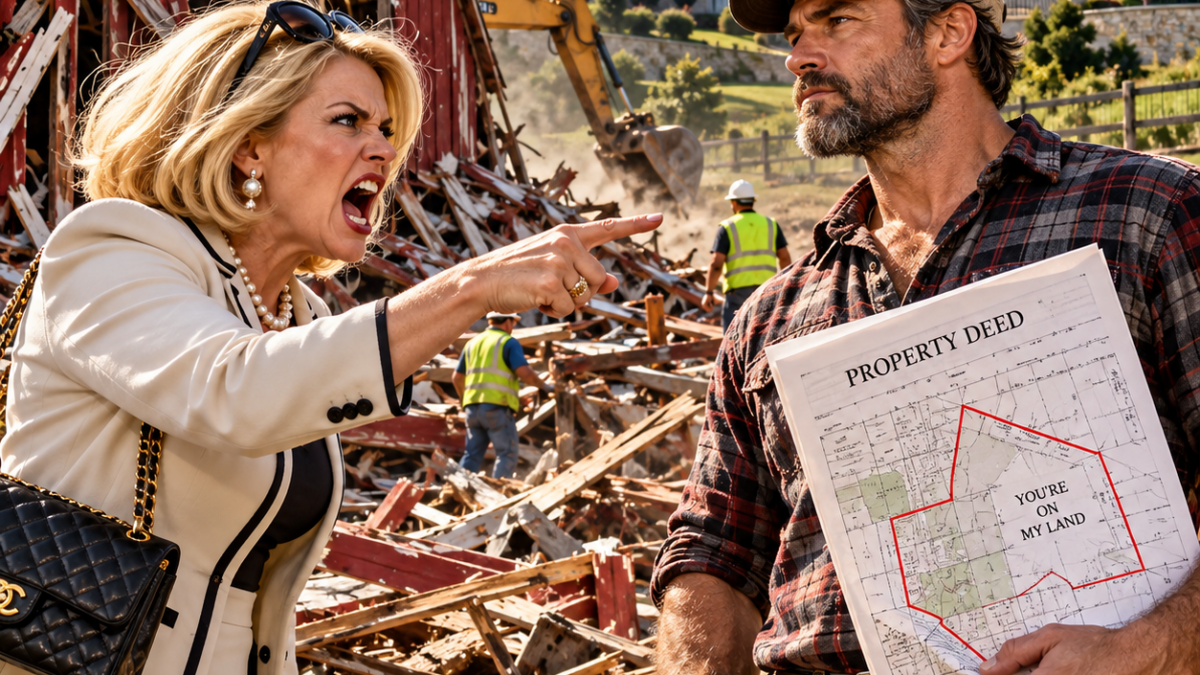
I walked outside one clear morning expecting to feed the chickens and finish repairing a gate, only to find my grandfather’s barn reduced to splintered beams, twisted roofing, and muddy excavator tracks while the HOA president stood across the road sipping from a tumbler and smiling like she had just improved the neighborhood.
She told me her board had “annexed” my property without my signature, claimed a vote gave her the authority to destroy a structure that had stood on my family’s land for generations, and actually said I should thank her for removing an eyesore before warning me that more fines would follow if I kept resisting.
I spent the rest of that day trying to prove she had no legal right to touch my barn, but before sunset my attorney called back with a discovery neither of us expected—something buried in the original development records that suddenly made the woman who had just bulldozed my history far more vulnerable than she could possibly imagine.
For a few seconds, I honestly thought a tornado had come through during the night.
That was the only explanation my brain could make sense of.
The sky was perfectly blue, the air was still, but where my barn had stood the evening before there was now a jagged pile of broken timber, roofing metal, shattered windows, bent hinges, and gray dust hanging above the dirt.
Then I heard a diesel engine descending the hill.
I looked toward the road and caught the back of an excavator being hauled away on a flatbed.
Fresh tracks cut straight across my property.
My stomach dropped.
That barn wasn’t beautiful in the way Charlene McDoy understood beauty.
It didn’t have decorative pillars.
No stone fountain.
No manicured boxwoods.
It had cedar siding faded by decades of Tennessee weather, a patched metal roof, hand-forged hinges, and beams my grandfather had rebuilt using timber salvaged from our family’s original farm.
When I was nine, he taught me to sharpen a plane inside that barn.
At sixteen, I rebuilt my first engine there.
After he died, I found his initials carved into one of the support posts.
I had deliberately left them untouched.
Now that post was somewhere beneath six tons of wreckage.
“Ray!”
I heard the voice before I saw her.
Charlene stood across the road wearing oversized sunglasses, a leopard-print blouse, and white pants far too clean for someone standing beside a demolition site.
She lifted her tumbler toward me.
“You’re welcome.”
I stared at her.
“What did you just say?”
She crossed the road with the relaxed confidence of someone who believed the argument had already been settled.
“I said you’re welcome. Honestly, Ray, it should’ve been handled months ago.”
My hands started shaking.
“What did you do to my barn?”
She sighed.
“That structure violated Article Twelve, Section Six of Brier Glen’s architectural and aesthetic standards. Agricultural outbuildings visible from a community road are prohibited without board approval.”
I looked at the wreckage.
Then at her.
“You had my barn demolished?”
“You received notices.”
“I received harassment.”
“You ignored them.”
“Because I’m not in your HOA.”
Her smile sharpened.
“Actually, you are.”
“No.”
“The board updated the boundary last year.”
“You cannot vote my property into your HOA.”
“We annexed the strip.”
“Without my signature?”
“It was unanimous.”
“That wasn’t my question.”
Charlene lowered her sunglasses slightly.
“Ray, community governance doesn’t stop working just because one difficult homeowner refuses to cooperate.”
“My property was never part of Brier Glen.”
“You should check the updated maps.”
“I checked the deed when I bought it at county auction five years ago.”
“And maps change.”
“Ownership doesn’t because you hold a meeting.”
Her jaw tightened.
She hated that I never treated her title like royalty.
I had been the one house along the lower road that didn’t pay her dues, didn’t request permission to repaint a fence, didn’t submit landscaping plans, and didn’t attend compliance hearings when she sent me invitations.
For years, she had called me uncooperative.
I called it owning property outside her jurisdiction.
Now she had crossed a line neither of us could pretend was administrative.
I stepped toward the wreckage.
A piece of the old weather vane lay partly buried beneath mud.
My grandfather’s iron rooster.
Bent.
Rust-covered.
But recognizable.
Something tightened in my chest.
Charlene was still talking behind me.
“If you’d submitted the proper application, this could’ve been avoided.”
I picked up the weather vane.
“You destroyed this.”
“Ray, don’t get dramatic.”
I turned.
Her smile disappeared.
“That barn existed before Brier Glen.”
“And now it doesn’t.”
For one second, neither of us spoke.
Then I said:
“Go home, Charlene.”
She folded her arms.
“Are you threatening me?”
“No.”
I looked toward the hill where her enormous white mansion rose above the subdivision.
“I’m giving you the last peaceful morning you’re going to have for a while.”
She laughed.
I didn’t.
By noon, I had called county zoning, the assessor, the recorder’s office, the sheriff, and my friend Marty Hale, a property attorney who had handled two boundary disputes for me before.
At four thirty-seven that afternoon, Marty called back.
“Ray?”
“Tell me she’s wrong.”
“Oh, she’s wrong.”
I closed my eyes.
“Good.”
“But that’s not why I’m calling.”
His voice had changed.
“What did you find?”
“A title problem inside Brier Glen.”
“Whose?”
There was a pause.
Then Marty said:
“Charlene’s.”
I sat forward.
“What do you mean?”
“The developer made a transfer error years ago. Three acres in the middle of the subdivision never conveyed into the HOA or the individual lot chain the way everyone assumed.”
“And?”
“Remember that tax-lien parcel you bought two years ago because you thought it was useless wooded acreage?”
My pulse slowed.
“Yes.”
“It’s not useless.”
He exhaled.
“Ray, according to the certified record, you own the underlying tract.”
I looked out the window toward Charlene’s hill.
Marty continued.
“And her mansion sits right in the middle of it.”
—
# PART 2
For several seconds, I genuinely thought Marty was joking.
Not because he had a sense of humor.
He didn’t.
Marty could make ordering lunch sound like a deposition.
But what he had just said was so absurd that humor seemed more likely than reality.
“Say that again.”
“You own Tract Fourteen, Section Three-B.”
“I know I own the tax parcel.”
“No, Ray. I mean you actually own it.”
“I bought three acres of scrubland listed as residual developer property.”
“That’s how the tax sale described it.”
“Exactly.”
“The tax description was incomplete.”
I stood from the kitchen table.
“What is on it?”
“Seven residential structures overlap the original tract.”
My stomach tightened.
“How many?”
“Seven.”
“Charlene?”
“Right in the center.”
I walked toward the window even though I couldn’t see her house from there.
“Are you sure?”
“I’m looking at the original subdivision plat, developer trust documents, tax-lien certificate, deed issued after redemption expired, and the county’s historic transfer ledger.”
“Could it be some kind of mineral-right parcel?”
“No.”
“Utility reserve?”
“No.”
“Common easement?”
“No.”
“Then how in hell did seven houses get built?”
“Developer error followed by twenty years of assumptions.”
I said nothing.
Marty continued.
“The original developer created Brier Glen in phases. Most land transferred correctly. Tract Fourteen didn’t.”
“And nobody noticed.”
“Apparently not.”
“What does that mean for the houses?”
“Slow down.”
“I am slow.”
“You sound like you’re about to rent Charlene her front porch by the hour.”
That thought had briefly occurred to me.
“I want facts.”
“Good. Fact one: the situation is complicated.”
“You just told me I own her land.”
“I told you your deed appears to cover the underlying tract.”
“Difference?”
“Several thousand dollars in title work and potentially years of litigation.”
That was the Marty I knew.
“So don’t drive over there carrying eviction papers.”
“I don’t have eviction papers.”
“Good.”
“Yet.”
“Ray.”
I smiled despite myself.
“What do we do?”
“Tomorrow morning, county recorder. Certified copies. Then a licensed boundary survey. Then a title examination independent of the HOA’s records.”
“And Charlene?”
“Don’t tell her anything yet.”
“Why?”
“Because she already authorized an illegal demolition.”
“So?”
“So people who panic destroy evidence.”
That stopped me.
Marty continued.
“Photograph the barn. Preserve every HOA notice. Get contractor information. Find out who ordered the excavator. Check whether the demolition crew had a permit.”
“I doubt they did.”
“Don’t doubt. Prove.”
“And the annexation?”
“I’ve already checked preliminary filings.”
His tone hardened.
“There wasn’t one.”
I looked down at the bent weather vane on my kitchen table.
“What do you mean there wasn’t one?”
“No recorded boundary amendment. No owner consent. No planning approval. No survey accepted by the county. No legal annexation of your parcel.”
“Then Charlene made it up.”
“At minimum, the HOA has been asserting jurisdiction it doesn’t have.”
“She destroyed my barn using it.”
“Yes.”
I heard papers moving through the phone.
“Which is why you’re not going to Charlene’s house tonight.”
I smiled.
“You know me too well.”
“Unfortunately.”
—
I barely slept.
Every time I closed my eyes, I saw the barn.
Not the wreckage.
The old version.
Granddad standing under the rafters.
He had been a tall man until age bent him.
Hands permanently cracked from work.
He could identify oak, hickory, cedar, walnut, and poplar by smell after one cut.
He rebuilt the barn after a storm in 1987 using reclaimed timbers from the family farm where his father had grown up.
“Old wood remembers,” he used to tell me.
At the time, I thought it was another one of those things old men said to make children stop asking questions.
Years later, when I bought the property at auction and found that barn still standing, neglected but salvageable, I understood.
The first thing I restored wasn’t the house.
It was the barn.
I replaced rotten boards.
Straightened doors.
Reused original hardware.
Installed electricity.
Kept the old frame.
Kept his initials.
Kept the iron rooster.
Charlene had looked at all of it and seen an aesthetic violation.
That hurt worse than the money.
Insurance could replace lumber.
A contractor could build walls.
Nobody could rebuild forty years of fingerprints.
—
At eight the next morning, I was waiting outside the county recorder’s office.
Marty arrived carrying a leather briefcase, two coffees, and the expression of a man whose day had already been ruined by somebody else’s paperwork.
“You sleep?”
“No.”
“Good. Neither did I.”
We entered.
The clerk behind the counter had a buzz cut and a coffee mug reading:
**NOT MY CIRCUS.**
I liked him immediately.
Marty slid the parcel identification across.
“We need certified copies of all recorded documents affecting Tract Fourteen, Section Three-B, from original developer acquisition through current date.”
The clerk looked at the number.
Then at us.
“Brier Glen?”
“Yes.”
He typed.
His eyebrows rose.
“You sure?”
“Very.”
He disappeared into the records room.
Twenty minutes later, we had enough paper to destroy a medium-sized forest.
Original developer conveyance.
Phase maps.
Tax delinquencies.
Trust dissolution.
Lien records.
My tax deed.
Parcel overlays.
Marty spread them across a research table.
The more we compared, the less funny it became.
The original developer trust owned a larger tract.
When Brier Glen was subdivided, most parcels were carved out through recorded deeds.
Tract Fourteen appeared on the planning map.
But the final transfer document omitted the legal description.
Development continued anyway.
Roads were built.
Utilities installed.
Homes sold based on title work that referenced later lot maps rather than resolving the missing underlying conveyance.
Years later, the developer trust dissolved.
The residual tract remained on county tax records.
Taxes went unpaid.
The county eventually auctioned the interest.
I bought it because it adjoined property I already owned and I thought someday I might use it for drainage rights or access.
Nobody else bid seriously.
Now we knew why the legal description had looked strange.
Marty tapped the map.
“Your deed covers this.”
His finger moved over Charlene’s circular driveway.
Then her koi pond.
Then most of her mansion footprint.
I felt a cold satisfaction that made me uncomfortable.
“Don’t enjoy it too much,” he said.
“I didn’t say anything.”
“You’re smiling.”
“No, I’m not.”
“You are.”
“Maybe I’m thinking about community aesthetics.”
He almost laughed.
Then became serious.
“This isn’t an instant eviction card.”
“I understand.”
“Those homeowners purchased in good faith.”
“I know.”
“Title insurers will be involved.”
“Fine.”
“Courts will care about equitable interests, improvements, reliance, and decades of recorded transactions.”
“Marty.”
“What?”
“I don’t want their houses.”
He looked at me.
“Good.”
“I want Charlene held accountable.”
“Also good.”
“And I want the HOA off my property forever.”
“Very good.”
I looked at her mansion on the map.
“But I’m not pretending this isn’t leverage.”
Marty nodded slowly.
“Now you’re thinking like a plaintiff.”
—
We recorded a notice preserving my ownership claim.
Then hired an independent surveyor.
Not somebody connected to Brier Glen.
Not somebody recommended by the HOA.
A woman named Carla Reeves who had surveyed half the county and had no patience for neighborhood politics.
She spent two days researching control points.
The third morning, she arrived with a crew.
Bright orange flags began appearing through the subdivision.
The boundary crossed landscaped beds.
A decorative walkway.
A section of sidewalk.
Then Charlene’s koi pond.
I arrived just as Carla’s assistant placed a flag beside a marble fountain.
Charlene came through her front door wearing a cream robe.
“What are you doing?”
Carla didn’t look up.
“Boundary survey.”
“On my property?”
“Yes, ma’am.”
“Who authorized this?”
“Recorded owner.”
Charlene saw me.
Her face changed.
“You.”
“Morning.”
“Get off my lawn.”
Carla checked her instrument.
“Technically, ma’am, we’re establishing where that lawn sits.”
Charlene stared.
I almost loved Carla.
Almost.
Charlene marched toward me.
“You’re trespassing.”
I held a rolled parcel map.
“I don’t think you understand what’s happening.”
“I understand you’re retaliating because the HOA lawfully removed an illegal structure.”
“Lawfully?”
“Yes.”
“County says my parcel was never annexed.”
Her expression flickered.
“That’s being reviewed.”
“No. It’s being invented retroactively.”
She looked toward the survey flags.
“What is this?”
I unrolled the map on the hood of my truck.
“Tract Fourteen.”
“I don’t care.”
“You should.”
I pointed at the legal description.
“Because I bought it at tax sale two years ago.”
Her eyes moved over the document.
“So?”
“The developer never transferred it properly.”
Silence.
Carla’s instrument beeped in the background.
I pointed toward Charlene’s house.
“Your mansion sits on it.”
For a moment she didn’t react.
Then she laughed.
It sounded forced.
“That is the stupidest thing you’ve ever said.”
“Certified county record.”
“You think you own my house?”
“I own the underlying tract according to the current record.”
“You’re insane.”
“Maybe.”
I handed her Marty’s card.
“But I’m an insane man with a recorded deed.”
She didn’t take the card.
It dropped into the grass.
“Get out.”
“We will when the survey is complete.”
“I’ll call the sheriff.”
“Please do.”
That stopped her.
She stared at me.
“Ray, this has gone far enough.”
I looked toward my property down the hill.
From here, I could see the new emptiness where the barn had stood.
“No.”
I lowered my voice.
“You decided how far this would go when you sent an excavator onto land you never owned.”
Her face paled.
“I didn’t know about this title problem.”
“You didn’t know whether you had jurisdiction over my barn either.”
“That isn’t the same.”
“It is to me.”
I picked up Marty’s card and held it out again.
“Call him.”
This time she took it.
—
The sheriff’s office became involved later that afternoon.
Not because Charlene called.
Because I did.
The day after the demolition, I had filed an initial property-damage report.
Now I had contractor records.
The demolition company had been hired through the HOA.
The authorization carried Charlene’s electronic signature.
No court order.
No county condemnation.
No demolition permit applying to my barn.
No proof of HOA ownership.
No consent from me.
The deputy reviewing the file rubbed his jaw.
“Value?”
“Replacement cost maybe one hundred twenty thousand.”
Marty added, “Historic and sentimental elements don’t fit neatly into that.”
The deputy looked at photographs.
“This was standing the day before?”
“Yes.”
“Safe?”
“County inspected it two years ago when I upgraded electrical.”
“Any violations?”
“None.”
“And HOA says it annexed you.”
“They didn’t.”
The supervisor entered.
She had already spoken with zoning.
“Mr. Coulson, you’re willing to make a formal statement?”
“I brought one.”
Marty sighed.
“Of course you did.”
They took it.
Before we left, the supervisor said:
“If the facts hold, this is not simply a covenant dispute.”
“What is it?”
“Destruction of private property. Potential trespass. Possible false filing issues depending on what documents were used.”
Charlene had wanted me to attend her little compliance system.
Instead, she had introduced herself to the criminal justice system.
—
When I got home, there was a handwritten note taped to my door.
**RAY—WE NEED TO TALK. THIS HAS GONE TOO FAR. CALL ME. —CHARLENE**
I stared at it.
Then photographed it.
Marty called.
“Do not call her.”
“I know.”
“I mean it.”
“I said I know.”
“I’m hearing your voice.”
“What does my voice say?”
“That you’re considering walking uphill.”
I looked toward Brier Glen.
“Maybe.”
“Don’t.”
“Fine.”
“Ray.”
“I won’t.”
I hung up.
Then sat on the porch looking at the wreckage.
For the first time since the demolition, anger gave way to something else.
Grief.
I climbed into the debris carefully.
Found an old hand plane.
Bent.
One hinge.
A section of cedar board with part of my grandfather’s initials.
Only the C remained.
I sat on a broken beam.
As a kid, I’d believed barns lasted forever.
They seemed permanent.
More permanent than houses.
More permanent than people.
Now one woman with a clipboard and a rented excavator had erased it in less than an hour.
I held the broken board and cried.
Not loudly.
No dramatic collapse.
Just tears I was too tired to stop.
That was the moment revenge changed shape for me.
I no longer wanted to scare Charlene.
I didn’t want to bulldoze her mansion.
I didn’t want to make innocent families homeless.
I wanted something harder.
I wanted every lie she used to destroy my barn examined publicly.
Every vote.
Every map.
Every dollar.
Every signature.
If she had built her power out of paperwork, then paperwork was going to bury it.
—
Marty filed the quiet-title action.
Every affected homeowner received formal notice.
I insisted on a separate letter.
Not legal threats.
Plain English.
**Your home may be affected by a historic title defect involving the underlying tract. I am not seeking immediate removal of any resident from their home. Please consult independent counsel and your title insurer. My dispute concerns clarification of ownership and misconduct associated with Brier Glen HOA.**
Marty read it.
“This is unusually reasonable.”
“Don’t sound disappointed.”
“I charge by conflict.”
“Send it.”
The response was immediate.
Phones rang constantly.
One man screamed at me for ten minutes.
Another woman cried.
A young couple showed up at my house carrying their closing documents.
They had a baby.
The woman looked terrified.
“Are you going to take our house?”
“No.”
“You own the land.”
“That’s what the current record says.”
“What happens to us?”
“Your attorney and title company need to sort the legal part.”
“Can you make us leave?”
“I have no intention of doing that.”
Her husband looked toward the demolished barn.
“Is this because of Charlene?”
“This started because of Charlene.”
The woman asked:
“What do you want?”
I answered honestly.
“For the HOA to stop pretending it owns things it doesn’t.”
They left calmer.
That conversation repeated in different forms for a week.
The residents weren’t my enemies.
Most had never known about the title defect.
Some had lived there for fifteen years.
Their children had grown up in those houses.
I knew what it meant for a building to carry memories.
I wasn’t going to avenge my grandfather’s barn by destroying other families’ homes.
But I also wasn’t giving away the leverage.
Not yet.
—
The first board resignation came forty-eight hours later.
Teresa Langley.
Compliance chair.
Her resignation email said she had “lost confidence in the organization’s legal direction.”
Translation:
Lawyers had begun asking questions.
Doug Meyers resigned the next day.
His landscaping company had received several HOA contracts.
The county subpoenaed invoices.
Charlene remained.
She sent an email to residents accusing me of conducting a “hostile land grab.”
That was rich.
Marty advised me not to respond publicly.
I didn’t.
Then the sheriff served Charlene with a summons related to the barn investigation.
Her email stopped.
The HOA bank account was placed under temporary court restrictions while financial records were preserved.
A receiver wasn’t appointed yet, but major expenditures required additional oversight.
Meetings descended into chaos.
Residents demanded to know why no one had verified the annexation.
Why Charlene authorized demolition.
Why the HOA had used boundary maps inconsistent with county records.
Why seven homes had underlying title problems nobody disclosed.
I watched from a distance.
For years Charlene had controlled rooms because everyone assumed she knew the rules.
Now the room had discovered she had been making some of them up.
Authority evaporates quickly when confidence stops being mistaken for competence.
—
Meanwhile, I rebuilt.
Not immediately.
First came cleanup.
Watching the excavator remove the wreckage was brutal.
Different machine.
Different purpose.
Still brutal.
I insisted on salvaging everything possible.
The old weather vane.
Iron hinges.
Several intact roof panels.
Two beams.
One stone from the original foundation had my grandfather’s initials scratched into it.
I found the rest of the broken post too.
The section with the missing initials.
I put the pieces together on my workbench.
C.O.
Carl Coulson.
My grandfather.
Marty found me there one evening.
“You eat?”
“Eventually.”
He looked at the wood.
“That from the barn?”
“Yes.”
He didn’t say anything for a while.
Then:
“Quiet-title conference is Thursday.”
“I’ll be there.”
“Title insurers are getting involved.”
“Good.”
“The affected homeowners are frightened.”
“I know.”
“One attorney wants to know your settlement position.”
I looked up.
“Tell them I don’t want the houses.”
“They’ll need more.”
“I want the HOA dissolved.”
Marty smiled slightly.
“There he is.”
“And clean title for residents.”
“That can be structured.”
“How?”
“We resolve your superior underlying claim through negotiated transfers. Their title insurers contribute. Owners receive corrected title. You can make your price nominal if you want.”
“One dollar.”
“Ray.”
“One dollar each.”
“You paid taxes and legal fees.”
“I’ll recover legitimate expenses separately if insurers agree.”
“Why one dollar?”
“Because I don’t want their money.”
“What do you want?”
I looked at the barn pieces.
“No more Brier Glen HOA.”
Marty sat down.
“That may be possible if enough members vote and governing documents allow termination, plus whatever court orders are needed to clean up the invalid portions.”
“Make it possible.”
“You understand you can’t unilaterally dissolve every covenant just because you own a tract.”
“I know.”
“Good.”
“I want leverage, not fantasy.”
He nodded.
“Then let’s work.”
—
I announced a property meeting at my place.
Saturday.
Four o’clock.
No HOA branding.
No formal agenda.
Just a sign at the community entrance:
**IMPORTANT TITLE MEETING — AFFECTED BRIER GLEN HOMEOWNERS — COULSON PROPERTY — SATURDAY 4 PM**
Thirty-two people came.
Some carried folding chairs.
One brought a thermos.
Another brought a lawyer.
Good.
I stood on the temporary platform where the new barn foundation would eventually go.
The ruins had been cleared.
Only the old stone footing remained.
Marty stood nearby.
I began:
“I’m not here to take anybody’s house.”
That quieted them faster than any introduction.
“I want that clear before anything else.”
A man in a flannel shirt raised his hand.
“Then why’d you send title notices?”
“Because you deserve to know the record problem exists.”
Another woman:
“Do you own the land?”
“Current county record says I own Tract Fourteen. The court will confirm the extent.”
“What happens if you win?”
“That’s why we’re here.”
I held up a folder.
“My proposal.”
People shifted.
“If the affected owners and the broader membership complete lawful termination of the existing HOA structure, resolve the invalid annexation practices, and adopt a clean title settlement, I will convey my interest beneath each affected home for one dollar.”
Silence.
The flannel-shirt man stared.
“One dollar?”
“One.”
“Why?”
“Because your homes aren’t what I want.”
“What do you want?”
I looked toward the road where Charlene used to drive past my property slowly whenever she wanted to remind me she was watching.
“I want the system that bulldozed my barn without legal authority dismantled.”
A woman in the back said:
“What if the HOA is reformed?”
“That isn’t my decision alone.”
“You just said dissolution.”
“Yes.”
“Why?”
“Because this board expanded authority beyond its lawful boundaries, falsified or misused maps, punished dissent, and destroyed private property. I don’t trust a name change.”
Someone called:
“Charlene isn’t the entire HOA.”
“No.”
I nodded.
“She’s what the HOA allowed.”
That created uncomfortable silence.
The flannel-shirt man spoke again.
His name was Marcus Doyle.
I’d lived near him for years and barely exchanged more than waves.
“What if somebody doesn’t sign?”
“Then the title dispute continues through court.”
“Rent?”
Marty stepped forward.
“We are not issuing surprise rent demands or ejectment notices. Any unresolved parcel would be handled through the court, title insurers, and applicable property law.”
I appreciated that.
The source of leverage needed to be real.
Not cruelty.
Marcus looked relieved.
“So the dollar deal is real?”
“Yes.”
“Why should we trust you?”
Fair question.
I pointed toward the barn foundation.
“You shouldn’t.”
People looked surprised.
“Trust the documents. Have your own lawyer review them. Get your title insurer involved. Don’t do what Charlene did and assume somebody with confidence must be right.”
That landed.
By the end of the meeting, twenty-four owners and members signed preliminary support for HOA termination and title settlement negotiations.
Six more contacted Marty the next morning.
Charlene did neither.
Her mansion remained dark.
Blinds closed.
Mail piling up.
Someone said she had moved temporarily to an extended-stay hotel.
Someone else said she was staying with her sister.
I didn’t care.
She could hide from neighbors.
She couldn’t hide from recorded title.
Or subpoenas.
—
The county prosecutor filed formal charges the following week.
Property destruction.
False assertion of authority tied to the demolition.
Administrative fraud-related counts connected with HOA filings.
The exact charges were more technical than neighborhood gossip made them sound.
Naturally, local social media simplified everything.
**HOA QUEEN BULLDOZES BARN, DISCOVERS VICTIM OWNS HER LAND**
That headline traveled faster than facts.
A television reporter appeared at my driveway.
I declined an interview.
She shouted one question as I walked away.
“Mr. Coulson, what do you want people to learn from this?”
I stopped.
Probably shouldn’t have.
But I turned.
“Power isn’t ownership.”
She raised the microphone.
“What does that mean?”
“It means holding an office doesn’t make other people’s property yours.”
The quote appeared in Sunday’s paper as:
**“POWER IS BORROWED. OWNERSHIP HAS TO BE PROVEN.”**
Not exactly what I said.
Close enough.
—
Charlene missed her first arraignment.
Her attorney appeared.
Family emergency.
Continuance.
The judge granted it once.
Marty and I used the time.
A land-use attorney from the neighboring county reviewed Tract Fourteen independently.
Her name was Vanessa Pike.
She spent two hours reading before speaking.
“The title defect is substantial.”
“What options?”
“Litigation. Settlement. Corrective conveyances.”
“Could I eject homeowners?”
She looked at me sharply.
“Are you asking because you want to?”
“No.”
“Good.”
She closed one file.
“Because the answer isn’t as simple as social media thinks. Longstanding possession, title insurance, recorded lot sales, equitable doctrines, improvements, and potential claims among multiple parties all matter.”
“Can the underlying ownership give me leverage?”
“Yes.”
“Can we use settlement to clean the titles and end the HOA?”
“Possibly.”
“That’s what I want.”
She looked toward Marty.
“He serious?”
“Unfortunately.”
Vanessa smiled.
“Then make the transfers nominal but condition them on a global settlement approved by the court and affected parties.”
“Dollar each.”
She laughed.
“You already decided.”
“Yes.”
“What about Charlene?”
I didn’t answer.
Vanessa waited.
Finally I said:
“She gets the same legal offer as everyone.”
Marty looked surprised.
“You sure?”
“No.”
But I knew it was right.
If I wrote a special punishment into her property transfer, she could argue retaliation contaminated the settlement.
More importantly, the mansion wasn’t my target.
Accountability was.
Charlene could keep her house if the law let her.
She could not keep her kingdom.
—
The county held a public hearing on the HOA’s supposed annexation.
The room overflowed.
Residents lined the walls.
I sat beside Marty.
Charlene sat near the front with her attorney.
She looked immaculate again.
Hair done.
Makeup perfect.
Pearls.
For a second, seeing her that way dragged me straight back to the demolition morning.
“You’re welcome.”
My hands tightened.
Marty noticed.
“Don’t.”
“I didn’t move.”
“Your face did.”
One by one, county staff explained the record.
No lawful annexation of my parcel.
No owner consent.
No accepted survey.
No planning approval.
No statutory process supporting the HOA’s claimed boundary expansion.
Then residents spoke.
An elderly woman named Ruth carried a thick folder.
“These are my violations.”
She held them up.
“Mailbox numbers faded.”
Page.
“Garden ornament not approved.”
Page.
“Trash bin visible at nine fifteen the morning after pickup.”
People murmured.
“Rose bushes.”
The hearing officer looked confused.
“Rose bushes?”
Ruth nodded.
“Compliance committee said they weren’t on the recommended planting schedule.”
Teresa stared at the table.
Another homeowner described being threatened with escalating fines after questioning board minutes.
Another said Charlene had pressured neighbors to give her proxy votes.
Then Teresa Langley asked to speak.
Charlene’s head turned sharply.
Teresa walked to the microphone.
Her voice shook.
“I signed documents I shouldn’t have.”
The room went still.
“Which documents?” the hearing officer asked.
“Compliance actions.”
“Did you understand them?”
“Sometimes.”
“Sometimes?”
Teresa looked toward Charlene.
“She would bring papers after meetings and say the board had already approved them.”
Charlene whispered to her attorney.
Teresa continued.
“I started refusing last year.”
“What happened?”
“She told me if I wasn’t loyal, I’d be removed.”
The hearing officer asked:
“Did the board lawfully approve Mr. Coulson’s annexation?”
“No.”
Charlene stood.
Her attorney pulled her back down.
The hearing officer called for order.
Teresa looked directly at me.
“And we never voted to demolish his barn.”
My breath caught.
Marty leaned forward.
“What?”
The officer asked:
“Who authorized demolition?”
Teresa’s answer was barely audible.
“Charlene.”
Every head turned.
The hearing room erupted.
—
The county nullified the HOA’s annexation filing.
Any claim that my original parcel had become subject to Brier Glen authority through the board’s internal vote was formally rejected.
That should have been the worst day of Charlene’s case.
It wasn’t.
The forensic audit began.
Initially it was supposed to answer a narrow question:
Did HOA money pay for the demolition?
Yes.
Then:
Who approved it?
Charlene.
Then auditors began seeing strange vendors.
**Community Enrichment Solutions.**
Generic name.
No visible employees.
Invoices for neighborhood beautification.
Consulting.
Community engagement.
Special project coordination.
Seventy thousand dollars over three years.
Some invoices matched no completed work.
Others duplicated legitimate vendors.
Payments eventually traced to accounts associated with Charlene.
Marty called me when the news became public.
“You sitting?”
“Why does everybody ask me that?”
“Because you have dramatic friends.”
“What happened?”
“They found money.”
“How much?”
“About seventy thousand so far.”
“From dues?”
“Yes.”
“Charlene?”
“Looks that way.”
I stared at the barn construction site.
Workers were setting the new frame.
“Embezzlement?”
“Prosecutors will decide exact charges.”
“She demolished my barn with money stolen from her neighbors.”
Marty was quiet.
“Possibly.”
That detail somehow made everything uglier.
She had used other people’s dues to fund the machine that destroyed property she falsely claimed authority over.
Not community governance.
Personal power subsidized by everyone around her.
—
The new barn rose slowly.
I refused to rush it.
The frame used modern engineered supports where necessary, but I incorporated the two salvaged beams.
The old iron hinges went on an interior storage door.
Granddad’s initials became part of a wall display beside photographs of the original barn.
Solar panels covered the south-facing roof.
Cameras went under the eaves.
Not because I expected another excavator.
Because I had learned.
A flagpole stood near the front.
From an old cedar chest, I took out a faded farm flag my grandfather had saved.
Nothing political.
Just the old family farm name and a simple black rooster.
I flew it the day the roof finished.
Marcus stopped his truck.
“Looks good.”
“Thanks.”
“Charlene’s going to hate it.”
“Then she’ll finally have something to complain about from property she doesn’t control.”
He laughed.
Then became serious.
“You know we’re close on the HOA vote.”
“How close?”
“Enough.”
“Don’t do it for me.”
“We’re not.”
That mattered.
Marcus leaned against the fence.
“People are tired.”
“Of Charlene?”
“Of needing permission to breathe.”
I understood.
“But something needs to maintain common areas.”
“We know.”
“What replaces the HOA?”
“Voluntary maintenance cooperative, maybe. County takes some roads. Private contracts for the rest.”
“Get lawyers.”
“Already did.”
I smiled.
“Look at you learning.”
“Your legal bills scared everyone straight.”
—
Charlene’s attorney sent an offer.
She would resign permanently.
Sign the dissolution settlement.
Withdraw civil claims.
In return, I would agree not to pursue rent against her parcel and would ask prosecutors not to pursue further charges.
Marty read the letter at my kitchen table.
“Well?”
“Can I stop criminal charges?”
“No. They’re the state’s case.”
“Then why is that in here?”
“Leverage. They want a victim-impact position.”
“She wants me to help.”
“Yes.”
I turned the letter over.
Wrote:
**There is no board left to resign from. Criminal accountability is not mine to trade.**
Marty read it.
“A little theatrical.”
“She’ll appreciate aesthetics.”
He shook his head.
“Send?”
“Send.”
—
The HOA termination vote passed.
Not because I owned Tract Fourteen.
Not because residents feared me.
Because once the financial records became public, the organization had lost legitimacy.
The court supervised the final pieces.
Common property transferred into a limited maintenance entity with narrow responsibilities.
No compliance police.
No aesthetic enforcement empire.
Necessary shared obligations—stormwater, small common green, entry lighting—were handled transparently.
The corrected title settlement followed.
One dollar from each affected homeowner.
Formal deeds.
Title companies covered substantial legal and administrative costs according to negotiated responsibilities.
Seven families received clear corrected ownership.
Including Charlene.
I signed hers the same way I signed the others.
Marty watched.
“You don’t have to look happy.”
“I’m not.”
“You could’ve fought her title separately.”
“I know.”
“Why not?”
I placed the pen down.
“Because I said this wasn’t about taking houses.”
He nodded.
“You kept your word.”
“Don’t sound surprised.”
“I’ve known you twenty years.”
Fair.
—
Charlene’s criminal trial began months later.
The prosecution had demolition records.
Emails.
County testimony.
Financial trails.
Witnesses.
Teresa.
Doug.
Contractor testimony.
The demolition contractor admitted Charlene told him the barn had been condemned and the HOA controlled the land.
Neither statement was true.
He never verified.
That hurt him too.
Then came the most damaging evidence.
Teresa filed a civil claim against Charlene alleging forged signatures on board paperwork.
During document review, she turned over an audio recording.
The prosecutor let me hear it privately before trial because my property was discussed.
Charlene’s voice came through clearly.
“If Ray keeps pushing, we’ll bury him.”
Another voice—Doug’s—said:
“Charlene, we don’t own his parcel.”
She responded:
“I don’t care whose land it is.”
I stopped breathing.
The recording continued.
“I’ll have the board take it. Eminent domain, annexation, whatever Marty wants to call it.”
Doug replied:
“HOAs don’t have eminent domain.”
“Then we’ll call it something else.”
A chair scraped.
Then Charlene:
“That barn comes down before the next meeting. Once it’s gone, he’ll understand he doesn’t control the neighborhood.”
I removed the headphones.
My hands were shaking.
Marty sat across from me.
“You okay?”
“No.”
That recording was worse than the wreckage.
Because for months, some part of me had wondered whether Charlene had genuinely believed her own authority.
Maybe she had been reckless.
Ignorant.
Misadvised.
The recording removed that comfort.
She knew.
She didn’t care.
The barn wasn’t demolished because of architecture.
It was punishment.
An example.
She wanted me to understand that refusing her came with consequences.
Instead, the recording proved intent.
I stood.
“Where are you going?”
“Barn.”
Marty didn’t stop me.
—
I entered the rebuilt barn alone.
Sunlight came through the high windows.
The place smelled like new pine mixed with old wood.
I walked to the salvaged beam.
Granddad’s initials.
C.O.
My fingers traced them.
“I should’ve protected it better,” I whispered.
Ridiculous thing to say to a dead man.
But grief isn’t logical.
I had owned the property.
Paid taxes.
Maintained the barn.
Checked zoning.
I had done everything right.
Still, I felt guilty.
Then I remembered something Granddad once told me after a storm damaged a fence.
I had been twelve.
We spent all day resetting posts.
I complained that fixing things was pointless because storms could just break them again.
He laughed.
“That’s not why you fix things.”
“Then why?”
“So the next day still belongs to you.”
Standing in the new barn, I finally understood.
Charlene had destroyed the old structure.
She did not get the next day.
I did.
—
The audio expanded the criminal case.
So did the federal investigation.
Agent Delaney arrived one afternoon with a joint DOJ and IRS task force.
Three black SUVs.
Government plates.
No drama.
No sirens.
They drove straight to Charlene’s mansion.
I was mounting the restored iron weather vane when they arrived.
I climbed down.
Delaney showed identification.
“We’re executing a federal warrant.”
“For the HOA money?”
“Larger.”
She opened a file just enough for me to see terms involving wire fraud and tax offenses.
“Community Enrichment Solutions wasn’t the only entity.”
“What else?”
“Grant applications. False vendor contracts. Property transactions using community-development representations.”
“Charlene?”
“Among others.”
“So the HOA was part of it.”
“Part of the money flow.”
I looked toward the mansion.
The koi pond.
Imported marble benches.
Landscaping that probably cost more than my first truck.
“All that?”
“Some expenditures are under review.”
A man in a rumpled navy suit stepped from another vehicle.
“Receiver,” Delaney said.
“Assets?”
“Potential seizure pending court orders.”
I should have felt triumphant.
Instead, I felt tired.
Months earlier, I imagined how satisfying it would be to watch Charlene lose the mansion sitting on land I owned.
Now the title had been corrected.
The house was legally hers.
And federal agents were entering because of what she had done with money, not because I had taken her home away.
That felt right.
Her consequences came from her decisions.
Not my revenge.
Delaney asked:
“Would you testify if necessary?”
“Yes.”
“She made this personal.”
Delaney looked at me.
“People like this often do.”
Then she added:
“But don’t make the mistake of thinking personal revenge is what wins these cases.”
I glanced at the stacks of files being carried from the mansion.
“What does?”
“Records.”
Marty would’ve proposed marriage.
—
Charlene was convicted in the state proceeding first.
The federal financial case added additional consequences after coordinated prosecution.
The final sentencing hearing combined the practical reality of what she had done.
The judge spoke for several minutes.
I attended.
I hadn’t planned to.
Then Teresa asked me to come.
She was terrified.
So I sat two rows behind her.
Charlene stood before the court.
No pearls.
No leopard print.
No oversized sunglasses.
Just a woman whose entire identity had once been built around controlling a few suburban streets.
The judge said:
“You used the illusion of governance to enrich yourself and intimidate people who challenged you.”
Charlene stared forward.
“You treated private rules as though they were public law.”
Silence.
“You falsified authority where authority did not exist.”
More silence.
“You directed the destruction of property to punish dissent.”
Teresa began crying beside me.
The judge continued:
“You were not protecting a community. You were exploiting one.”
The sentence was twelve years across the resolved criminal matters, with substantial custody requirements before release eligibility under the applicable judgments, plus restitution, asset forfeiture where ordered, and permanent restrictions on serving in fiduciary community-governance roles.
The mansion was ultimately sold as part of the financial resolution.
The proceeds went toward restitution and lawful claims.
The koi pond was drained before the sale.
One of the marble benches ended up at an auction.
Marcus texted me a photo.
**Want it for the barn?**
I replied:
**I’d rather sit on the floor.**
—
I didn’t celebrate sentencing.
I drove home.
Parked beside the new barn.
Walked inside.
The place was quiet.
My grandfather’s repaired weather vane still sat on the workbench waiting for installation.
The rooster’s tail was bent slightly.
I had considered replacing it.
Instead, I left the scar.
I carried it up the ladder.
Bolted it onto the roof.
Climbed down.
The wind caught it.
For a second, it resisted.
Then turned west.
Simple.
Working.
Still itself.
That was enough.
—
Without the old HOA, Brier Glen changed.
Not into chaos.
That surprised some people.
Lawns didn’t become junkyards.
Houses didn’t collapse because somebody painted a door red.
Property values didn’t vanish because Ruth kept three garden gnomes.
People still cared where they lived.
They just stopped confusing care with control.
Marcus painted his garage dark blue.
Nobody fined him.
A couple near the entrance installed solar panels.
Kids drew chalk all over the sidewalks.
A retired mechanic kept his trailer in his own driveway.
Someone built a chicken coop.
The rooster was louder than the HOA ever had been.
People complained.
The neighbors talked.
They solved it.
Imagine that.
—
I had expected resentment.
After all, I had become the man associated with killing the HOA.
Instead, people began waving.
A woman who had barely spoken to me brought cookies.
Marcus helped unload lumber.
Ruth delivered tomatoes.
The young couple whose title had overlapped Tract Fourteen invited me to their daughter’s birthday.
I went for twenty minutes.
Stayed three hours.
The strangest part was realizing how little we’d known one another before.
Charlene’s system had talked endlessly about “community” while turning neighbors into potential rule violations.
Once the system disappeared, people actually became neighbors.
—
The barn slowly became something more than my barn.
Not legally.
I had learned that lesson.
The deed stayed mine.
The locks stayed mine.
Nobody formed a Barn Access Committee.
But every Saturday, I left the big doors open.
At first, Marcus came by to use my table saw.
Then Ruth’s grandson needed help repairing a bicycle.
Then somebody brought a broken mower.
A group started playing cards in one corner.
People swapped tools.
Food appeared.
Coffee.
Sometimes beer after the power tools were put away.
No dues.
No board.
No compliance committee.
One Saturday, I counted thirty-one people.
I stood near the doorway watching.
Marcus walked over.
“You realize you’ve created a community center.”
“Don’t say that.”
“Why?”
“I’ll start charging dues.”
He laughed.
A little girl ran past us carrying chalk.
“Can I draw on the barn floor?”
“No.”
She stopped.
Then I added:
“Outside concrete.”
“Okay!”
She ran away.
Marcus looked at me.
“Rules.”
“Boundaries.”
“Same thing.”
“No.”
I pointed at the girl.
“I own the floor.”
He laughed.
The distinction mattered, even when we joked about it.
Healthy community isn’t the absence of rules.
It’s knowing who has the right to make which ones.
—
Teresa came by one Saturday.
She stood outside for a long time before entering.
People noticed.
Nobody confronted her.
She had helped Charlene.
Maybe not willingly every time.
But she had signed documents.
Enforced fines.
Stayed silent.
She carried that shame visibly.
I walked over.
“Coffee?”
She looked surprised.
“Yes.”
I poured two cups.
We stepped outside.
She stared at the weather vane.
“I remember when Charlene complained about that.”
“Of course she did.”
“She said it made the barn look rural.”
“It was a barn.”
Teresa laughed weakly.
Then started crying.
I waited.
“I’m sorry.”
“For what?”
“All of it.”
“That covers a lot.”
“I should’ve stopped her.”
“Yes.”
She flinched.
I didn’t apologize for saying it.
She continued.
“I kept telling myself I wasn’t the one making decisions.”
“You signed them.”
“I know.”
“I don’t hate you, Teresa.”
She looked at me.
“But?”
“You don’t get to pretend you were only a passenger.”
She nodded.
“I know.”
We stood quietly.
Then I said:
“You testified.”
“Too late.”
“Late isn’t the same as never.”
She wiped her eyes.
“Can I still come Saturdays?”
I looked inside.
Ruth was beating Marcus at cards.
Kids were arguing over a bicycle pump.
Someone had brought smoked sausage.
“It’s a barn, Teresa.”
She waited.
“Door’s open.”
—
Months later, a county historical group contacted me.
They had heard about the original barn.
One researcher asked whether any parts survived.
I showed her the beams.
Hinges.
Weather vane.
Photographs.
My grandfather’s initials.
She asked:
“Would you consider registering the rebuilt barn as a local heritage reconstruction?”
I almost said no.
Paperwork had become suspicious to me.
Then she explained.
No HOA.
No control.
Just documentation preserving the story of the original structure and salvaged elements.
I agreed.
The plaque arrived months later.
Small.
Bronze.
I mounted it inside, not outside.
**COULSON BARN**
**REBUILT USING SALVAGED ELEMENTS FROM THE FAMILY STRUCTURE DESTROYED IN 20—**
**ORIGINAL TIMBER TRADITION PRESERVED**
No mention of Charlene.
I liked that.
She didn’t deserve to be the most important thing about the barn.
—
One evening, Marcus and I sat on the fence eating smoked sausage from a plastic bag.
The sun was going down.
Federal agents had finished removing property from Charlene’s mansion weeks earlier.
A FOR SALE sign now stood near the driveway.
“You ever think about buying it?” Marcus asked.
I almost choked.
“What?”
“Her house.”
“Why would I want that?”
“View’s great.”
“So is hell from the right angle.”
He laughed.
Then:
“Somebody will buy it.”
“I hope they do.”
“You don’t care?”
“Why would I?”
“After everything?”
I looked toward the mansion.
For months, it had symbolized leverage.
Justice.
Irony.
The woman who demolished my barn had unknowingly built her kingdom on land I owned.
That was the hook everybody loved.
But it wasn’t the part I cared about anymore.
“The land issue was useful,” I said.
“Useful?”
“It made everyone pay attention.”
“That’s one word.”
“But the house itself?”
I shrugged.
“Just a house.”
Marcus nodded.
“What matters?”
I looked back at the barn.
“That.”
—
A family bought Charlene’s mansion.
Two parents.
Three kids.
No connection to her.
They changed the front door from black to yellow.
Charlene would have hated it.
That made me smile.
The koi pond became a vegetable garden.
The marble fountain disappeared.
One afternoon, the new owner walked down to my barn.
His name was Daniel.
“I wanted to introduce myself.”
We shook hands.
“Welcome.”
He looked awkward.
“I know the history.”
“Not your problem.”
“Still.”
“Your title clean?”
He laughed nervously.
“Three attorneys checked.”
“Smart man.”
He looked toward the barn.
“My daughter wants chickens.”
“Then get chickens.”
“There isn’t an HOA.”
“Nope.”
He smiled.
“Still getting used to that.”
“Don’t put fifty.”
“Why?”
“Then we’ll have to invent an HOA.”
He laughed.
We got along fine.
A year later, Daniel helped me replace a section of fence.
That’s how neighborhoods should work.
Not everyone needs to be best friends.
Just decent enough to help lift a post when someone needs another pair of hands.
—
The criminal cases finally ended.
Appeals ran.
Financial restitution moved slowly.
Some residents recovered money.
Not all.
You rarely get everything back after corruption.
But they got something else.
Records.
Truth.
Proof that the years of intimidation hadn’t been imaginary.
Ruth received reimbursement for several improper fines.
She spent part of it buying the largest garden gnome she could find.
Nearly four feet tall.
She placed it beside her mailbox.
I drove by and almost ran off the road laughing.
A little plaque hung around its neck.
**APPROVED BY ME.**
That may have been my favorite monument to the entire scandal.
—
Years passed.
The rebuilt barn weathered.
The bright new boards darkened.
Scratches appeared.
Oil stains accumulated.
Granddad’s old hinges squeaked.
Good.
A barn shouldn’t look new forever.
The place filled with other people’s memories.
Saturday card games.
Birthday cake.
A teenager rebuilding his first motorcycle.
Ruth teaching children how to preserve tomatoes.
Marcus welding a broken mower bracket.
Teresa organizing donated tools after a storm.
Nobody planned any of it.
Nobody appointed officers.
When the roof fund needed money after hail damage, people contributed voluntarily.
Someone suggested forming a formal association to manage the barn.
Thirty people shouted “NO” at once.
I had never been prouder.
—
One fall morning, I stood beneath the weather vane while leaves crossed the yard.
A boy named Ethan was helping me stack wood.
He pointed upward.
“That rooster old?”
“Older than you.”
“Older than you?”
“Watch it.”
He grinned.
“Where’d it come from?”
“The first barn.”
“What happened to that one?”
I paused.
Everybody in Brier Glen knew some version.
Children usually knew the dramatic version.
“Someone tore it down.”
“Why?”
“They thought they had the right.”
“Did they?”
“No.”
“What happened to them?”
I considered telling him prison.
Fraud.
Court.
Lawsuits.
Instead:
“They learned they didn’t.”
He frowned.
“That doesn’t sound like enough.”
I smiled.
“You’re thirteen.”
“So?”
“At thirteen, revenge always sounds better.”
“What sounds better when you’re old?”
I looked around.
At the barn.
Neighbors.
Daniel’s kids riding bicycles up the road.
Ruth’s ridiculous gnome.
“Rebuilding.”
He rolled his eyes.
“That’s boring.”
“Give it thirty years.”
—
Marty retired before I expected.
At his retirement dinner, he told the barn story.
Badly.
He claimed I had threatened to charge Charlene “one thousand dollars per hour for standing on my dirt.”
Never happened.
He claimed Carla the surveyor drove a stake through the koi pond.
Also false.
Then he told everyone:
“The important part is Ray came to me wanting revenge and accidentally became reasonable.”
I stood.
“I object.”
He pointed at me.
“Overruled.”
Everybody laughed.
Afterward, he handed me the original copy of the first Tract Fourteen map he’d marked up.
Red pen everywhere.
At the bottom he had written on that first day:
**DO NOT LET RAY DO ANYTHING STUPID.**
I framed it in the barn.
Beside the historical plaque.
Marty called that defamation.
—
One day, years after Charlene’s sentencing, I received a letter from prison.
Her name on the return line.
I considered throwing it away.
Instead, I opened it.
The letter wasn’t long.
No dramatic apology.
No excuses about stress.
No accusation.
She wrote that she had spent a long time blaming me.
Then Teresa.
Then auditors.
Then prosecutors.
Then former board members.
Eventually there was nobody left to blame who had actually made her decisions.
She wrote:
**I thought if I lost control, everything I built would fall apart. I didn’t understand that my need to control it was what destroyed it.**
I stopped reading.
Walked outside.
Sat on the barn steps.
Finished the letter there.
Near the end:
**I know an apology cannot rebuild what I had destroyed. I heard through someone that you rebuilt the barn. I am glad.**
I folded the paper.
For several days, I didn’t know what to do.
Marcus asked whether I’d answer.
“No.”
“Why?”
“What would I say?”
“Maybe nothing.”
“Exactly.”
I didn’t forgive her because she asked.
I didn’t need her apology to heal.
But I kept the letter.
Not displayed.
Not framed.
Inside a file.
Because accountability had eventually reached somewhere court orders couldn’t.
Whether it lasted wasn’t my responsibility.
—
Ruth died at ninety-three.
The neighborhood held a memorial in the barn.
Her family brought photographs.
Someone carried in the giant garden gnome.
We placed it near the door.
Her daughter told the story about the mailbox-number fine.
Everyone laughed.
Then cried.
I realized something that night.
The barn my grandfather built had carried our family.
The barn Charlene destroyed had carried my memories.
The barn we rebuilt now carried everybody’s.
That didn’t dilute what it meant to me.
It made it bigger.
Charlene believed community meant taking private things and declaring them communal.
She had it backward.
Real community happens when someone owns something, protects it, and then chooses to share it.
Choice.
Again.
That was the word she never understood.
—
On the tenth anniversary of the demolition, I woke before sunrise.
No ceremony planned.
No plaque unveiling.
I made coffee.
Walked outside.
The barn stood against a pale sky.
Its roof panels reflected the first light.
The weather vane turned slowly.
I opened the big doors.
The smell inside was dust, wood, motor oil, old coffee, and something sweet from cookies left the day before.
I walked to the salvaged beam.
Touched Granddad’s initials.
C.O.
For years, I wished I could tell him what happened.
How somebody destroyed his work.
How I fought.
How the law turned.
How Charlene fell.
How the neighborhood changed.
Standing there that morning, I realized I knew what he’d say.
He wouldn’t ask about Charlene.
He wouldn’t care about the federal sentence.
He wouldn’t care about the mansion.
He’d look at the roof.
The joints.
The foundation.
Then he’d ask:
“Does it leak?”
I laughed alone.
“No, Granddad.”
The barn didn’t leak.
That would’ve mattered to him.
—
Around eight, Marcus arrived carrying donuts.
“You having some secret anniversary?”
“No.”
“You opened early.”
“Couldn’t sleep.”
He placed the box on the workbench.
“Ten years.”
“You remembered.”
“Everybody remembers.”
“I wish everybody would stop.”
“Not happening.”
Soon Daniel came.
Then Teresa.
Kids.
Neighbors.
Nobody had organized anything.
By noon, forty people were there.
Someone started grilling.
A teenager brought a guitar.
The giant garden gnome watched from the door because Ruth’s daughter had donated it permanently.
I stood at the edge of everything.
Marcus walked over.
“You okay?”
“Yeah.”
“You look weird.”
“Thanks.”
He nodded toward the crowd.
“Your grandfather would like this.”
“You never met him.”
“No.”
Marcus smiled.
“But I know you.”
That was enough.
—
Near sunset, a little girl climbed onto the bottom barn step.
She looked at the weather vane.
“Mr. Coulson?”
“Yeah?”
“Why is the rooster bent?”
I looked up.
The tail still carried the damage from the demolition.
“Because something knocked it down a long time ago.”
“Why didn’t you fix it straight?”
I could have.
Any metalworker could’ve made it perfect.
I had chosen not to.
“Because it still works.”
She thought.
“So it’s broken?”
“No.”
“Then what is it?”
I looked at the scarred iron rooster turning into the wind.
“It’s repaired.”
She seemed satisfied.
Children understand some things immediately.
—
That evening, everybody went home.
The barn emptied.
I swept the floor.
Closed tool cabinets.
Turned off lights one row at a time.
Before shutting the big doors, I stepped outside.
Brier Glen stretched uphill.
Different colors.
Different gardens.
Trailers.
Solar panels.
Chickens somewhere I could hear but not see.
Daniel’s yellow front door stood out on the old McDoy mansion.
No uniform perfection.
No Charlene.
No compliance patrol.
But the neighborhood hadn’t collapsed.
If anything, it looked more alive.
I remembered the morning she stood across the road holding her tumbler.
**You’re welcome.**
At the time, those words made me furious.
Years later, I could almost laugh.
Because in one twisted sense, she had given us something.
Not intentionally.
She pushed too far.
Far enough that everyone finally looked.
At property records.
At finances.
At bylaws.
At signatures.
At their own fear.
Her demolition order exposed the entire structure beneath her power.
But I would never thank her.
Some lessons cost too much.
I would have rather kept Granddad’s original barn.
I would have rather never known what Community Enrichment Solutions was.
I would have rather Teresa didn’t have to spend years regretting her silence.
I would have rather Ruth never paid a fine over a garden gnome.
You don’t romanticize damage just because something good grows afterward.
You honor what was lost.
Then build anyway.
—
I walked toward the flagpole.
The old family banner moved gently.
Beyond it, the weather vane turned north.
The barn lights glowed through the windows.
My grandfather’s salvaged beam stood inside.
Charlene’s mansion belonged to another family now.
The HOA was a memory.
Her money scheme was finished.
The residents owned clean title to their homes.
Nobody owed me rent.
Nobody had been thrown onto the street.
That mattered more to me than the revenge fantasies I had during those first furious days.
I had possessed enough leverage to make people afraid.
I chose not to become the person who had made me afraid.
Maybe that was the real victory.
Charlene believed ownership meant control.
Then she believed office meant ownership.
Both were wrong.
Ownership is responsibility.
Authority is temporary.
Community is voluntary.
And revenge?
The satisfying kind isn’t always destroying what your enemy loves.
Sometimes it’s rebuilding what they tried to erase so well that eventually their name becomes the least important part of the story.
—
A truck came slowly down the road.
Daniel.
He stopped near my fence.
Window down.
“Forgot something.”
He held up my cordless drill.
“You stole that six months ago.”
“Borrowed.”
“Thief.”
He tossed it gently.
I caught it.
“Tomorrow?”
“What?”
“Kids want to finish the birdhouses.”
“Ten.”
“Coffee?”
“Bring it.”
He drove away.
I looked down at the drill.
Then toward the barn.
Ten years earlier, I’d stood in almost the same place surrounded by splintered timber believing someone had taken something from me that could never be returned.
I was partly right.
The old barn never came back.
My grandfather never walked through those doors again.
History doesn’t reset.
But something else happened.
The ruins became evidence.
Evidence became accountability.
Accountability became freedom.
Freedom gave people room to know one another.
And that open door became a place where the neighborhood learned a different definition of community.
Not a board.
Not a charter.
Not a list of approved paint colors.
People.
Nothing more complicated than that.
I put the drill inside.
Pulled the doors shut.
The old hinges—two of them salvaged from the original barn—gave their familiar heavy squeak.
I left one door cracked.
Saturday morning wasn’t far away.
Above me, the bent iron rooster shifted with the wind.
Still moving.
Still pointing forward.
Exactly like Granddad said old wood did.
It remembered.
But it didn’t stay stuck in the past.
Neither did I.
[END OF STORY]








