PART 2: HOA Bulldozed My $2 Million Lake House Over “Unpaid Dues”—They Had No Idea Whose Land They Were Standing On
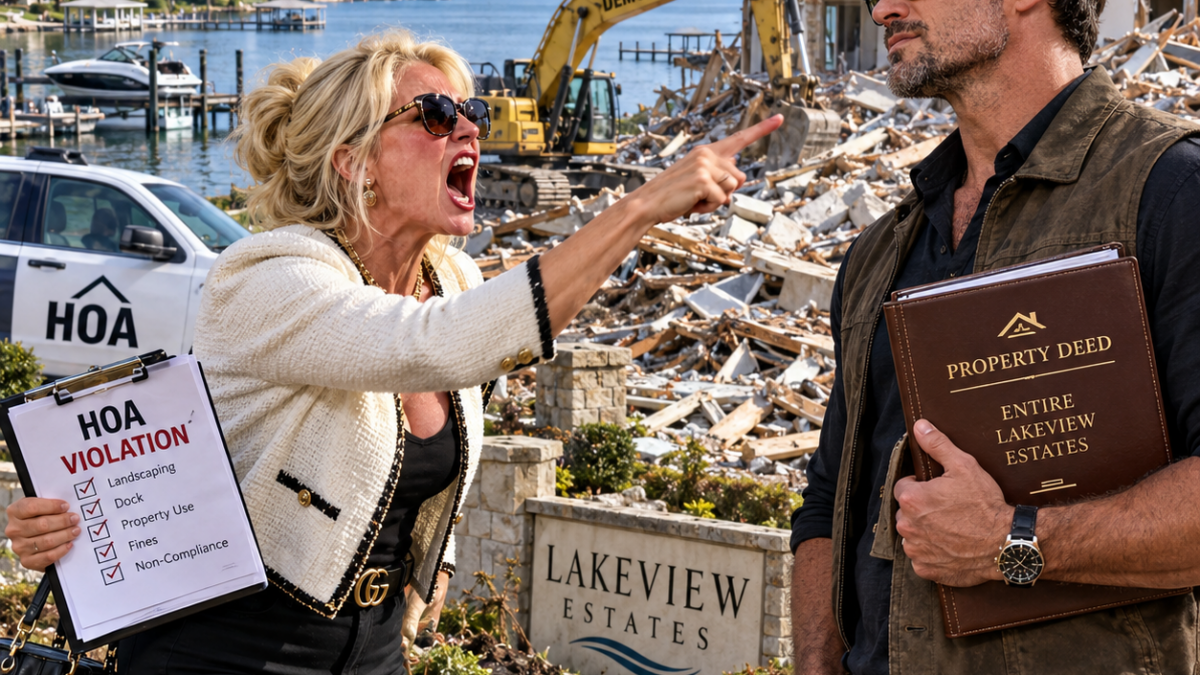
I came home from a week-long fishing trip expecting to see my four-bedroom lake house glowing above the water, but instead I found a bulldozed crater, broken stone, splintered beams, and the HOA president standing beside the wreckage with a clipboard explaining that my home had been “disposed of” because I had failed to pay association dues.
She was so proud of herself that she admitted she had personally authorized the demolition without a court order, without a valid lien, and without ever bothering to confirm whether the HOA actually owned or controlled the property she had just reduced to rubble.
I didn’t yell, because while she was lecturing me about “community responsibility,” I was already thinking about one document locked in my truck—and the moment she saw it, the entire balance of power in Lakewood Pines was going to change.
I sat on the hood of my pickup for almost a full minute before I said anything.
The lake was exactly where I’d left it.
Blue water.
Pines moving gently in the morning wind.
My dock still extended into the cove.
But the house behind it was gone.
Not damaged.
Gone.
The wide stone chimney had collapsed sideways into what used to be my living room. The wraparound deck I’d built three summers earlier had been ripped apart. Half the foundation was exposed, and a demolished section of roof lay upside down near the shoreline.
The place had been worth a little over two million dollars.
More important than that, it had been mine.
Then I saw Kendora Briggs walking across the lawn.
Powder-blue blazer.
Pearl earrings.
Clipboard pressed against her chest.
President of the Lakewood Pines HOA.
For the previous eighteen months, Kendora had been trying to turn neighborhood governance into a private kingdom.
She’d cited people for trash cans being visible ten minutes too early.
She’d threatened a retired couple over solar panels.
She’d once sent me three violation notices in the same week because the cedar stain on my dock was supposedly “inconsistent with community aesthetics.”
I had ignored most of it.
That morning, ignoring her was no longer an option.
“Oh, Quarin,” she called. “Thank God you’re back.”
I looked at the rubble.
“That’s an interesting way to welcome somebody home.”
Her expression hardened.
“We’ve been trying to contact you.”
“I was gone seven days.”
“You were delinquent.”
“On what?”
“Association dues.”
I slowly stepped off the truck.
“How much?”
She flipped through her clipboard.
“Three thousand eight hundred and forty dollars, including penalties.”
“And that somehow equals my house?”
“Section Five, Subsection C gives the association authority to reclaim property after unresolved delinquency.”
“No, it doesn’t.”
Her eyes narrowed.
“Excuse me?”
“It gives you collection remedies. Maybe amenity restrictions. Maybe a lien if you follow the law.”
I pointed toward the crater.
“It doesn’t give you a bulldozer.”
“We followed protocol.”
“Did a judge authorize this?”
“The board did.”
“Was there a foreclosure?”
“No.”
“A sheriff’s sale?”
“No.”
“A court order?”
Her lips tightened.
“That wasn’t necessary.”
I almost laughed.
“Who told you that?”
“I signed the demolition authorization myself.”
There it was.
I looked directly at her.
“You signed it?”
“As president and acting treasurer.”
“And you hired the crew?”
“The HOA retained a contractor.”
“You paid them with association money?”
She hesitated for the first time.
“That’s internal financial business.”
“Not anymore.”
Kendora lowered the clipboard.
“Quarin, let’s not make this more dramatic than it needs to be. You’ve always resisted community rules, and now you’re acting shocked that there are consequences.”
I stared at the shattered beams where my kitchen used to be.
Then I walked to my truck.
“Where are you going?”
“To get something.”
I opened the rear door, reached beneath the passenger seat, and pulled out a sealed property folder.
Kendora watched me return.
“What is that?”
“You remember when Lakewood Pines Development went into receivership three years ago?”
She didn’t answer.
“I bought the development assets.”
“That doesn’t mean—”
“It means exactly what the documents say.”
I unfolded the certified ownership schedule.
Her eyes moved across the page.
Then stopped.
“What is this?”
“The master land deed.”
She looked up.
“No.”
“Yes.”
“The HOA owns the neighborhood.”
“No, Kendora.”
I pointed toward the subdivision behind her.
“The HOA manages certain shared services under a management agreement.”
Then I pointed toward the ground beneath her shoes.
“I own the underlying development property.”
Her face began to lose color.
“That’s impossible.”
“County registrar. Recorded transfer. Three years ago.”
She grabbed the document.
I let her.
Her eyes moved faster.
My name appeared beside the master parcel.
Quarin Wesley.
Owner.
Her lips parted.
I looked past her toward the wreckage.
“You didn’t reclaim HOA property.”
She slowly raised her eyes.
“You demolished my private residence on land your association was only authorized to manage.”
For once, Kendora Briggs had absolutely nothing to say.
I took the deed back.
“You should call an emergency board meeting.”
She swallowed.
“And then,” I said, “you should call a criminal lawyer.”
PART 2
Kendora stood in front of me with her clipboard hanging loosely at her side.
A few minutes earlier, she’d been speaking like a judge delivering a sentence.
Now she looked as if somebody had quietly removed the floor beneath her.
“You’re bluffing,” she finally said.
I folded the deed.
“I don’t bluff about county records.”
“The homeowners own their lots.”
“They hold the residential interests created under the master development structure.”
“That means they own them.”
“They own what their recorded instruments say they own.”
I kept my voice even.
“And none of that gives your board title to this parcel or authority to bulldoze my house.”
Her face tightened.
“You haven’t paid dues.”
“That dispute can be handled separately.”
“You were warned.”
“To pay money.”
“Yes.”
“Not that you planned to destroy a two-million-dollar structure.”
“We sent notices.”
“Show me one notice authorizing demolition.”
She began flipping through the clipboard.
Fast now.
Too fast.
“I don’t have every file with me.”
“Of course you don’t.”
“You need to understand something, Quarin. The board acted in good faith.”
I looked at the remains of my living room.
“You hired heavy equipment to destroy somebody’s house without confirming title.”
“We were advised—”
“By who?”
She stopped.
“Who advised you?”
“Our counsel.”
“Name.”
“This conversation is over.”
She spun around.
I called after her.
“Kendora.”
She stopped but didn’t turn.
“You stepped onto this property today knowing the house had been destroyed.”
Silence.
“You just admitted you signed the order.”
Her shoulders went rigid.
“And my cameras recorded every word.”
That made her turn.
“You recorded me?”
“My property.”
“You can’t—”
“Call your lawyer.”
Her face became a mask of anger.
“This association will defend itself.”
“Good.”
I looked toward the destroyed foundation.
“Because I’m not interested in an apology.”
She walked away quickly.
Not running.
Kendora Briggs would never run where somebody might see her.
But close.
I watched her disappear toward the cul-de-sac.
Then I sat back on the hood of my truck.
Only then did my hands begin shaking.
That surprised me.
Until that moment, anger had kept everything sharp.
Simple.
There was a wrong.
There would be consequences.
But once Kendora was gone, the reality of what I’d lost settled in.
I had designed that house myself.
Not professionally—I wasn’t an architect—but I’d worked with one for months to get every room positioned around the lake.
The kitchen faced east because my late father used to wake before sunrise, and I’d wanted that light in the house.
The deck wrapped around the western side because my mother loved sunsets.
She had died before the house was finished.
I’d kept the first chair she’d ever sat in on that deck.
It was somewhere beneath the rubble.
Maybe broken.
Maybe buried.
That’s when rage became grief.
For five minutes, I stood alone beside the wreckage and let myself feel it.
Then I made the first phone call.
Sheriff’s office.
The second went to the county assessor.
The third went to my contractor.
Not a lawyer.
Not yet.
First, I wanted facts.
—
Deputy Carson arrived twenty-five minutes later.
He had been with the county sheriff’s office long enough that his hair had gone almost entirely gray around the temples.
He stepped from the cruiser and stared at the rubble.
“Quarin.”
“Morning.”
“Please tell me that’s not your house.”
“It was.”
He removed his sunglasses.
“What happened?”
“HOA demolished it.”
Carson stared at me.
“Say that again.”
“Kendora authorized a demolition because she claims I owe association dues.”
He looked at the foundation.
Then at me.
“Court order?”
“No.”
“Foreclosure?”
“No.”
“Condemnation?”
“No.”
“Fire?”
“No.”
He exhaled slowly.
“You have documentation?”
I handed him copies of the demolition notice I’d found attached to a surviving stone column.
Then the ownership documents.
Then my phone recording of Kendora’s admission.
Carson listened with one earbud.
His jaw tightened.
“She actually says she personally signed it.”
“Twice.”
“Contractor?”
“Pine Ridge Hauling and Demo.”
“You know them?”
“No.”
“Permit?”
“County system shows none.”
He pulled out his phone.
A few seconds later, his expression changed.
“Company doesn’t appear in the state contractor database.”
“That was my next guess.”
Carson looked toward the lake.
“Security cameras?”
“Dock camera survived.”
“Anything else?”
“Tree-line system. Solar backup.”
“You have footage of the demolition?”
“I haven’t watched it yet.”
“Let’s.”
We walked toward the dock equipment shed.
The small security recorder was still running.
I pulled footage from three days earlier.
At 7:04 a.m., two dump trucks arrived.
Then an excavator.
Then a white pickup with an unmarked magnetic door sign.
At 7:19, Kendora appeared.
Clipboard.
Hard hat.
The irony almost made me sick.
The camera had no audio from that distance, but the images were clear.
Kendora pointed toward the house.
Spoke with the equipment operator.
Signed something on the hood of the truck.
Then stepped back.
At 7:43, the excavator bucket hit the front porch.
I stopped the recording.
Carson looked at me.
“You okay?”
“No.”
“You want a minute?”
“No.”
I started the video again.
Watching your own house being demolished is a strange thing.
The walls don’t fall like they do in movies.
They resist.
Then buckle.
Then disappear in pieces.
The crew tore through the kitchen.
Living room.
Bedrooms.
Deck.
Stonework.
At one point, Kendora stood with her hands on her hips as though supervising landscaping.
Carson watched silently.
When it ended, he said, “I need copies.”
“You’ll have them.”
“You want to press charges?”
I looked at the frozen image of the house collapsing.
“I want every charge the evidence supports.”
“Understood.”
He closed his notebook.
“This is going to get ugly.”
“Good.”
Carson studied me.
“Quarin.”
“What?”
“Don’t make ugly your goal.”
I looked at him.
“Justice is.”
He nodded.
“That answer keeps you out of trouble.”
—
The county assessor arrived twenty minutes after Carson left.
Lindell Hayes and I had worked together when I purchased Lakewood Pines’ master development interests three years earlier.
He climbed from his white sedan carrying an oversized plat map.
“Wesley.”
“Lindell.”
He looked toward the rubble.
“Jesus.”
“Pretty much.”
“I brought what you asked for.”
He unfolded the map across my truck hood.
Lakewood Pines was originally structured as a master-planned lake development.
The developer retained underlying land interests and created long-term recorded residential estates and leasehold arrangements depending on the section.
The HOA never owned the entire development.
It had contractual management rights over common services and limited covenant enforcement.
When the original developer’s company collapsed financially, I purchased the master development entity and its remaining underlying interests.
I’d done it mostly as an investment.
And because I loved the lake.
I had no interest in running an HOA.
So I left the association intact under its existing management agreement.
They handled trash contracts.
Pool maintenance.
Entrance landscaping.
Community events.
Minor covenant administration where legally valid.
I collected ground rents and development income where applicable, funded major infrastructure through the master entity, and mostly stayed out of neighborhood politics.
It had worked.
Until Kendora.
Lindell pointed at the map.
“Your residence parcel is here.”
“Correct.”
“Never transferred to HOA.”
“No.”
“HOA common property starts over here.”
He pointed.
“Correct.”
“And the master deed remains in your entity?”
“Yes.”
He looked at me.
“So they really bulldozed the master owner’s private residence over HOA dues?”
“That’s why I called.”
Lindell whistled.
“You planning to make an example out of them?”
“No.”
“What are you planning?”
I looked toward Kendora’s house on the opposite side of the neighborhood.
“To make sure nobody ever confuses management with ownership again.”
He folded the plat.
“I’ll certify copies.”
“One for the sheriff.”
“Done.”
“One for the district clerk.”
“Done.”
“One for my attorney.”
“You finally calling one?”
“Now.”
—
Nadira Patel answered while I was sitting on the remains of the lower deck stairs.
She had spent twelve years as a federal prosecutor before moving into private practice.
She handled complex property disputes, financial crimes, and civil fraud cases.
I’d used her once before during the development acquisition.
She had a habit of listening without interrupting.
I told her everything.
She said nothing for almost a minute.
Then:
“Send me the demolition footage.”
“Already uploading.”
“Ownership documents.”
“Coming.”
“HOA declaration and management agreement.”
“Got them.”
“Demand notices.”
“I’m collecting.”
“Board minutes.”
“Not yet.”
“We’ll subpoena those.”
“How bad is this?”
“Depends.”
“On?”
“Whether Kendora was merely stupid or criminally stupid.”
I almost smiled.
“Difference?”
“If she misunderstood the documents and made an unauthorized decision, we have enormous civil exposure.”
“And criminal?”
“If she knowingly used HOA funds, false documents, an unlicensed contractor, or deceptive representations to destroy your property, prosecutors will have plenty to examine.”
“I want the HOA dissolved.”
“Don’t decide that yet.”
“I’ve decided.”
“Quarin.”
“She destroyed my home.”
“I know.”
“She used the association to do it.”
“I understand.”
“Then why keep it?”
“Because an HOA is a legal structure, not one woman.”
I said nothing.
“Residents may rely on it for infrastructure, insurance, contracts, and common property. If we burn everything down emotionally, innocent homeowners could pay the price.”
I hated how reasonable that sounded.
“What do you recommend?”
“Freeze the board.”
“Meaning?”
“Emergency injunction. Freeze discretionary accounts. Suspend enforcement powers. Preserve records.”
“And then?”
“Receiver.”
“Court-appointed?”
“Yes.”
“Then dissolution?”
“If the audit and governance documents support it.”
I looked at the rubble.
“Do it.”
“Quarin.”
“What?”
“Do not threaten anybody.”
“I haven’t.”
“Do not remove records.”
“I won’t.”
“Do not terminate utilities or access to residents even if your ownership documents technically give you leverage.”
“I wasn’t planning to.”
“Good.”
“Anything else?”
“Yes.”
Her voice softened.
“Find somewhere else to sleep tonight.”
I looked at the remains of my house.
“I’ve got the cabin.”
“Go there.”
—
The cabin sat across the lake on a wooded parcel accessible by a private gravel road.
I had built it years before the mansion.
One bedroom.
Stone fireplace.
Old dock.
No neighbors close enough to see the porch light.
That night, I sat at the kitchen table with the demolition footage playing silently on my laptop.
I watched Kendora point.
Sign.
Smile once at somebody off camera.
Then the excavator moved.
I kept replaying one section.
Not because I enjoyed torturing myself.
Because something bothered me.
At 8:14, a second vehicle appeared.
Gray SUV.
A man stepped out.
He walked to Kendora.
They spoke for several minutes.
Then he opened the rear hatch.
Kendora removed an envelope.
I zoomed in.
Too far.
No details.
But the exchange mattered.
I saved the clip.
Then I opened the HOA’s public financial statements.
The demolition hadn’t come from nowhere.
Somebody had paid the crew.
If association funds were used, there should be a transaction.
Unless they hid it.
At 11:30, I found the first inconsistency.
Lakewood Pines reported fifty-five thousand dollars in “community beautification expenditures” for the quarter.
No detailed invoices.
No contractor names.
That wasn’t illegal by itself.
But it was odd.
The demolition crew had arrived during the same quarter.
I emailed Nadira.
Subject:
**LOOK AT BEAUTIFICATION LINE**
Then I went to bed.
I barely slept.
—
By morning, Lakewood Pines was in full panic.
The residents’ online forum had exploded.
**DID THE HOA REALLY DEMOLISH QUARIN’S HOUSE?**
**CAN THEY DO THIS TO ANY OF US?**
**WHY IS KENDORA NOT ANSWERING?**
**WHO PAID THE DEMOLITION COMPANY?**
**ARE OUR DUES SAFE?**
I didn’t post.
Anything I said would become evidence, gossip, or both.
At 8:17, Carson called.
“We picked up Kendora for questioning.”
“Arrest?”
“Not yet.”
“What happened?”
“She tried to tell us the HOA owned the parcel.”
“And?”
“We showed her Lindell’s certified plat.”
I smiled.
“What did she do?”
“Asked for a lawyer.”
“Smartest thing she’s done.”
“There is more.”
I stood.
“What?”
“We subpoenaed preliminary bank records last night.”
“That fast?”
“DA got interested after the video.”
“What’d you find?”
“Transfers.”
“Where?”
“Still tracing them.”
“Amount?”
“Enough to matter.”
“Personal?”
“Some money left HOA accounts and ended up connected to an account Kendora controls.”
I went quiet.
Carson continued.
“And there was a cash withdrawal three days before demolition.”
“How much?”
“Twenty-eight thousand.”
I looked at the screen showing the excavator.
“That crew got paid cash.”
“That’s what we’re investigating.”
“Freeze the account.”
“Already done.”
I ended the call and stared through the cabin window.
The water was calm.
Across the lake, the place where my home had stood was just visible through the trees.
Justice was no longer abstract.
There was a money trail.
—
Nadira met me at her office before noon.
She had printed everything.
Bank records.
Association reports.
Management agreement.
Master deed.
Demolition order.
Video stills.
She tapped the signature page.
“Kendora signed this as both president and acting treasurer.”
“Yes.”
“That matters.”
“Why?”
“Concentration of authority.”
She turned another page.
“The board supposedly approved demolition during an emergency session.”
“Was there a quorum?”
“That’s what we’re about to find out.”
She held up another document.
“Your management agreement has a termination-for-cause provision.”
“I remember.”
“Fraud, gross misconduct, misuse of funds, willful violation of owner rights.”
“So I can terminate the HOA.”
“Not exactly.”
She shook her head.
“You can terminate its management authority under the master agreement.”
“Difference?”
“The homeowners’ association still exists as a corporate entity until dissolved according to law and its documents.”
“But I can remove its authority over master-owned functions.”
“Yes.”
“Do it.”
“Not yet.”
I stared.
“Why?”
“Because I want the court to do it with us.”
“Nadira—”
“A judicial order protects residents and protects you.”
She leaned forward.
“You’re emotionally entitled to be furious. Legally, I want you boring.”
“Boring.”
“Painfully.”
She began counting on her fingers.
“No revenge evictions.”
“Wasn’t planning any.”
“No locking residents out of shared amenities.”
“No.”
“No threats about your ownership.”
“No.”
“No shutting off services.”
“Obviously.”
“No bulldozing Kendora’s house.”
I almost laughed.
“Tempting.”
“Quarin.”
“I’m joking.”
“Start sounding more boring.”
I nodded.
“What do we file?”
“Emergency injunction freezing discretionary spending and suspending enforcement actions.”
“And receiver?”
“Immediately afterward.”
“I want every fine voided until this is sorted.”
“We can request it.”
“Every pending lien too.”
“Request.”
“And Kendora barred from association records.”
“Absolutely.”
For the first time since I’d come home, I felt like something concrete was moving.
Not revenge.
Control.
The legal kind.
—
The first real break came from a place nobody expected.
The social committee.
Lakewood Pines had a volunteer group that organized Christmas lights, summer picnics, children’s events, and the annual lake cleanup.
Kendora had gradually turned them into an unofficial propaganda arm.
They sent reminders.
Repeated board messages.
Defended enforcement decisions.
Two days after her questioning, the committee asked to meet me.
Six residents sat inside the clubhouse.
They looked uncomfortable.
Eliza Warren, a retired schoolteacher, spoke first.
“We didn’t know.”
“About the demolition?”
“About any of this.”
“You knew the house was being demolished.”
A man near her looked down.
“Kendora told us it had been legally reclaimed.”
“Did any of you ask for the court order?”
Silence.
“The foreclosure paperwork?”
Nothing.
“The condemnation notice?”
Eliza swallowed.
“She told us you had abandoned the property.”
“I was gone seven days.”
“She said you’d been avoiding dues for months.”
“So you believed she could destroy the house?”
Eliza’s hands twisted together.
“She threatened the events budget whenever we questioned board decisions.”
Another woman spoke.
“She removed two people from committees last year.”
I looked around.
“That explains why you stayed quiet.”
Eliza flinched.
“It doesn’t excuse it.”
That answer changed my tone.
“No.”
She reached into her purse.
“I kept copies.”
She placed a thumb drive on the table.
“Meeting agendas. Emails. Notes Kendora told us to delete.”
I took it.
“Why keep them?”
“I’m a teacher.”
She gave a weak smile.
“We save everything.”
Back at the cabin, I opened the files.
One phrase appeared repeatedly.
**Targeted enforcement.**
Another:
**Reclaim delinquent properties where strategically beneficial.**
Then my name.
**WESLEY — FINAL PHASE**
I stared at those words.
Final phase.
Not collection.
Not delinquency.
Phase.
Like the demolition was part of a plan.
I called Nadira.
“Come to the cabin.”
“Why?”
“I found motive.”
—
Nadira arrived with her laptop.
We spent three hours sorting files.
Some emails referred to using aggressive enforcement against residents who challenged the board.
Others discussed “revenue recovery opportunities.”
Then an internal message from Kendora to Margaret Tilling, the vice president:
**Once Wesley property is removed, board leverage with master ownership improves substantially.**
I read it aloud.
Nadira stopped typing.
“Again.”
I read it.
She leaned back.
“This wasn’t about dues.”
“I know.”
“She wanted leverage against you as master owner.”
“Why?”
“We need financial records.”
Another email offered a clue.
**Developer inquiry requires clean lakefront alignment before negotiations.**
“Developer?” I asked.
Nadira searched.
Nothing public.
Yet.
The demolition suddenly felt different.
My house hadn’t been merely punishment.
It had been an obstacle.
Someone wanted that lakefront.
And Kendora thought removing my residence would weaken my practical control over it.
Nadira closed the laptop.
“We amend the complaint.”
“For what?”
“Conspiracy.”
—
Subpoenas went out to every sitting board member.
Two immediately tried to resign.
The court froze board restructuring until records could be preserved.
The sheriff’s department posted a notice at the clubhouse:
**ALL HOA ENFORCEMENT ACTIVITY SUSPENDED PENDING COURT REVIEW.**
Residents gathered around it.
Some photographed it.
Others simply stood there.
No fines.
No violation hearings.
No new liens.
No architectural penalties.
For the first time in years, Kendora’s machinery stopped.
That’s when neighbors began knocking on my cabin door.
Miguel Alvarez came with a folder of unpaid landscaping invoices.
“I did work for the HOA,” he said.
“How much?”
“Fourteen thousand.”
“Paid?”
“Three.”
“Where are the remaining invoices?”
“They kept saying year-end reconciliation.”
I added them to the stack.
A couple brought notices threatening foreclosure over disputed solar-panel fines.
An elderly man had been charged repeatedly for trash containers.
A widow showed me a lien warning she had never understood.
The pattern became obvious.
The board wasn’t merely strict.
It used penalties as financial pressure.
Meanwhile, expenses disappeared into vague categories.
Money in.
Money out.
Little explanation.
When Nadira filed for a receiver, our evidence binder required two hands to carry.
The hearing lasted less than an hour.
The board hired a junior attorney using its emergency legal fund.
He looked exhausted before proceedings began.
Nadira stood.
“The current board has demonstrated gross failure of fiduciary duty, possible misuse of association funds, unauthorized destruction of private property, deficient recordkeeping, and continuing risk to residents and assets.”
Judge Miriam Hale looked through the binder.
“You’re asking me to suspend the entire board.”
“Yes.”
“And appoint a receiver.”
“Yes.”
“Counsel?”
The HOA attorney stood.
“Your Honor, these allegations remain disputed, and removing elected leadership would destabilize the community.”
Judge Hale looked at him.
“Your client’s president authorized demolition of a two-million-dollar residence without a court order.”
He swallowed.
“Based on her understanding of association authority.”
“Her understanding appears remarkably expensive.”
Nobody laughed.
The judge continued.
“And preliminary banking evidence suggests association funds may have been diverted.”
The lawyer had no good answer.
Judge Hale looked toward Nadira.
“You’ve also requested that enforcement actions remain suspended.”
“Yes, Your Honor.”
“Pending review.”
“Yes.”
She tapped her pen twice.
“Granted.”
The board attorney seemed to shrink.
Judge Hale continued.
“A neutral receiver will assume operational control. All sitting directors are suspended from HOA-related financial or enforcement activity pending further order.”
There it was.
Kendora’s board was finished.
At least temporarily.
Outside the courthouse, reporters waited.
I walked past them.
I didn’t need cameras.
I needed a house.
—
That evening, I went back to the crater.
The lake wind moved through the exposed foundation.
A piece of metal flashing tapped softly against broken stone.
I climbed carefully through the rubble.
Near where the western deck had been, I found something.
A crushed wooden chair.
My mother’s chair.
One arm broken.
Back split.
But recognizable.
I lifted it.
Dust fell from the seat.
For the first time since coming home, I cried.
Not dramatically.
No shouting.
I simply sat on what remained of the foundation holding the broken chair.
All the court orders in the state couldn’t rebuild the memories attached to it.
That was the part Kendora would never understand.
Property value is one thing.
Home is another.
I carried the chair to the cabin.
My contractor, Ben Maddox, looked at it the next morning.
“Can be repaired.”
“You sure?”
“Wood’s stubborn.”
“So was she.”
He smiled.
“Your mother?”
I nodded.
“I’ll handle it.”
“How much?”
“Don’t insult me.”
That chair became the first thing we rebuilt.
The mansion could wait another week.
—
The receiver arrived in Lakewood Pines carrying two legal pads, a laptop, and exactly zero patience.
Marian Belt had been a judge before retiring.
She took the receiver assignment because, according to Nadira, “retirement had made her dangerous.”
Marian set up temporarily inside the clubhouse.
Within seventy-two hours, she issued a neighborhood-wide notice.
All board enforcement suspended.
All discretionary contracts frozen.
No former board member authorized to represent Lakewood Pines.
Residents directed to submit disputed fines for review.
Then she opened the books.
It got ugly immediately.
Cancelled checks written to Kendora.
Reimbursements without receipts.
Luxury travel labeled community outreach.
Beauty treatments labeled professional presentation.
Meals.
Hotels.
Cash withdrawals.
The fifty-five-thousand-dollar beautification line had almost no legitimate supporting documents.
Marian held up three checks.
“Payee: Kendora Briggs.”
“Signer?”
“Kendora Briggs.”
“Purpose?”
“Miscellaneous.”
I stared.
“What does miscellaneous buy?”
Marian looked over her glasses.
“Apparently Miami.”
I laughed despite myself.
Then she showed me another payment.
Twenty-eight thousand dollars.
Cash withdrawal.
Three days before demolition.
Exactly the number Carson had mentioned.
“There’s your crew,” I said.
“Maybe.”
Marian never jumped farther than evidence.
“We trace first.”
They did.
Pine Ridge Hauling and Demo wasn’t a real registered company.
The phone number led to a prepaid account.
The men who actually performed the demolition were subcontract laborers.
Investigators eventually found them.
Their testimony was devastating.
Kendora had told them the building was condemned.
She said the owner had abandoned it.
She claimed to represent both the HOA and local authority.
“She told you she was with the city?” the prosecutor later asked one worker.
“That’s what we thought.”
“Did you verify?”
“No.”
“Why?”
“She paid cash.”
That line would eventually silence an entire courtroom.
—
Then Special Agent Daniel Reen from the State Bureau of Investigation appeared.
He met me near the community garden I’d funded the previous spring.
Yes, there was irony in that.
A legal garden.
On community-designated land.
With permission.
Reen wore a dark blue suit and carried the expression of someone who lived inside spreadsheets.
“Mr. Wesley?”
“Quarin.”
He showed identification.
“Financial Crimes.”
I handed him a folder.
“Three years of association financial reports.”
He opened it.
“I’ve seen some.”
“Theirs or the real ones?”
He almost smiled.
“Fair question.”
I pointed to flagged pages.
“Fifty-five thousand beautification. Minimal support.”
He turned.
“Twenty-eight thousand cash withdrawal.”
“Already tracing.”
“Check amounts just below internal approval thresholds.”
His attention sharpened.
“How many?”
“At least seventeen over two years.”
He scanned my spreadsheet.
“Who did this analysis?”
“Forensic accountant Nadira hired.”
“These withdrawals happen within forty-eight hours after board meetings.”
“Yes.”
“Interesting.”
“Structuring?”
“Possibly.”
He closed the folder.
“Anything else?”
“Storage shed.”
Inside, old HOA files remained from the prior administration.
I had made copies before Kendora began moving records.
Reen opened a binder marked:
**VENDOR CONTRACTS — YEAR TWO**
Pine Ridge appeared inside.
No license.
No tax ID.
No certificate of insurance.
No real address.
Reen stopped.
“You’re certain this name matches the demolition truck?”
“Enhanced footage confirms it.”
He photographed the page.
“This company doesn’t exist.”
“I know.”
“Then somebody created it to receive money or conceal who was hired.”
“Exactly.”
He looked at me.
“Mr. Wesley, you understand you’re a victim and potential witness, right?”
“Yes.”
“Then stop doing my job.”
I smiled.
“You people move slow.”
“You people contaminate cases.”
That wiped the smile away.
“Understood.”
“Give me what you have.”
I did.
Then stepped back.
That wasn’t easy.
But Nadira had been right.
Boring.
Evidence.
Process.
Let the system work.
—
The developer connection emerged two weeks later.
A shell corporation called Blue Shore Capital had made inquiries about assembling lakefront acreage.
Its representatives had met privately with Kendora three times.
One meeting occurred at a resort ninety miles away.
Another at the home of Margaret Tilling.
Blue Shore wanted contiguous shoreline for a luxury resort-style expansion.
My mansion sat on the most desirable stretch.
They couldn’t buy the master property without me.
I’d already declined exploratory interest from developers the previous year.
Kendora knew that.
An email recovered from her private account read:
**Wesley will never sell while residence remains primary lake anchor. Enforcement pressure may alter his position.**
Another:
**Removal creates leverage.**
I stared at the words when Nadira showed me.
“They destroyed my house to force a sale.”
“That’s what prosecutors will argue if they establish the full chain.”
“Blue Shore knew?”
“That’s less clear.”
“Someone did.”
“Yes.”
“Who?”
“Investigators are working on it.”
I stood and began pacing.
Nadira watched me.
“You’re thinking something stupid.”
“I own Kendora’s underlying lot.”
“No.”
“I didn’t say anything.”
“You didn’t need to.”
“I could terminate her ground agreement for breach.”
“No.”
“Why not?”
“Because then every defense attorney in the case tells the jury this is a feud between powerful landowners.”
“She destroyed my home.”
“And she’s facing criminal charges.”
“I want her out.”
“Then let a lawful foreclosure, restitution judgment, or sale do it if that becomes appropriate.”
I stopped.
“You’re infuriating.”
“That’s why you pay me.”
She was right again.
I hated it.
—
The residents’ mood shifted as more records became public.
At first, many had defended Kendora.
Not because they loved her.
Because admitting she’d been corrupt meant admitting they’d trusted the wrong person.
That’s painful.
Eliza told me as much.
“We thought strict meant competent.”
“Common mistake.”
“She always had paperwork.”
“Paper doesn’t make something legal.”
“She spoke like she knew.”
“That doesn’t make it true either.”
Eliza sighed.
“I taught kids to question sources for thirty years.”
“And then?”
“I stopped doing it myself.”
I shook my head.
“You brought the thumb drive.”
“Late.”
“Still counts.”
She looked toward the lake.
“What happens if the HOA disappears?”
“We figure out what actually needs managing.”
“Pool?”
“Yes.”
“Road landscaping?”
“Yes.”
“Trash?”
Contract directly.”
“And rules?”
I looked at her.
“Do you need somebody telling you what color your mailbox should be?”
She smiled.
“No.”
“Then maybe fewer rules.”
It sounded simple.
It wasn’t.
Common properties had legal obligations.
Insurance had to continue.
Stormwater infrastructure needed maintenance.
Some covenants were recorded separately from the HOA corporation.
Nadira made sure I understood.
“Dissolving a corrupt board doesn’t erase property law.”
“I know.”
“Some residents think you’re going to declare the whole neighborhood free territory.”
“I won’t.”
“Others think you’re going to evict everyone because of your master ownership.”
“Absolutely not.”
“Say that publicly.”
I did.
At the receiver’s first open meeting.
The clubhouse was packed.
I stood for less than two minutes.
“I want everybody here to understand something.”
People quieted.
“My ownership interests do not mean I’m taking anybody’s home.”
A woman in front exhaled visibly.
“The families living here are not my enemy.”
I looked around.
“The people who abused the management structure are the problem.”
Someone asked, “Are you dissolving the HOA?”
“The court and residents will determine the lawful structure.”
Another voice.
“But you want it gone.”
I thought about my house.
Then answered carefully.
“I want this version of it gone.”
That earned applause.
I didn’t smile.
This wasn’t a campaign rally.
But something important happened.
People stopped looking at me like another powerful man arriving to replace Kendora.
They began bringing evidence.
—
Miguel’s unpaid invoices exposed another account.
Then solar-panel disputes led to emails showing Kendora had selectively waived fines for friends.
A former board member admitted votes were sometimes recorded after meetings rather than during them.
Another turned over text messages.
Margaret Tilling hired her own attorney and began distancing herself from Kendora.
Carson joked that rats were leaving the clipboard.
I told him rats had better instincts.
The receiver eventually found more than four hundred thousand dollars in questionable spending over several years.
Not all stolen.
Some merely undocumented.
Some wasteful.
Some legitimate but poorly recorded.
But enough was clearly improper to keep investigators busy.
The state brought charges.
Kendora.
Margaret.
Two other board members.
The counts varied.
Felony criminal mischief related to the demolition.
Theft and misuse of association funds.
Wire-related offenses.
Fraud.
Fiduciary breaches handled through parallel civil proceedings.
Prosecutors did not turn every bad decision into a crime.
That made the case stronger.
They focused on what could be proven.
Nadira liked that.
“Never prosecute a personality,” she said.
“Prosecute acts.”
I had heard a version of that somewhere before.
It was good advice.
—
My new house began rising before the criminal trial.
I didn’t rebuild the old one exactly.
I couldn’t.
Trying to recreate it would have felt like pretending nothing happened.
The new design sat slightly farther from the water.
Wide glass walls.
Reinforced concrete foundation.
Wraparound deck.
Geothermal system.
Better fire protection.
A safe room that doubled as my office.
Ben supervised everything.
One afternoon, he carried my mother’s repaired chair onto the unfinished deck.
I stopped working.
He set it facing west.
Same direction she’d sat years earlier.
The broken arm had been replaced with matching cedar.
The back had been rebuilt.
You could still see one scar where the original wood had split.
“Couldn’t hide that completely,” Ben said.
“Don’t.”
He looked at me.
“Sure?”
“Leave it.”
Some things should show what happened.
I sat.
The house around me was skeletal.
Studs.
Open walls.
Exposed wiring.
But the lake looked exactly the same.
My eyes burned.
Ben pretended not to notice.
Good man.
—
The criminal trial began the following month.
It wasn’t cinematic.
No dramatic music.
No screaming attorneys.
Just evidence.
That was worse for Kendora.
The prosecution played the demolition video.
Showed the cash withdrawal.
Presented the fake contractor paperwork.
Introduced internal emails.
Then the laborer testified.
“Kendora Briggs told you the residence had been condemned?”
“Yes.”
“Was it?”
“I don’t know.”
“Did you verify?”
“No.”
“Why?”
“She said she represented the city and the HOA.”
“Did she show you city credentials?”
“No.”
“Permit?”
“No.”
“Court order?”
“No.”
“Why proceed?”
He looked uncomfortable.
“She paid cash.”
Silence.
Even Kendora’s attorney stopped writing for a second.
Then Carson testified.
Lindell testified.
The forensic accountant.
Marian.
Several residents.
I testified last.
The prosecutor showed me a photograph.
My house before demolition.
“What was this property to you?”
“My home.”
“Approximate value?”
“Just over two million.”
“Did you authorize demolition?”
“No.”
“Did you receive a court-approved foreclosure notice?”
“No.”
“Did you abandon the property?”
“No.”
“How long were you away?”
“Seven days.”
A few jurors looked toward Kendora.
The prosecutor held up the master deed.
“Did the HOA own this land?”
“No.”
“Who did?”
“My development company.”
“Did the HOA have management rights?”
“Yes.”
“Ownership?”
“No.”
“Could the association lawfully demolish your private residence solely because it alleged unpaid dues?”
“No.”
Kendora’s lawyer rose for cross-examination.
“Mr. Wesley, you disliked my client before this incident.”
“I disliked some of her decisions.”
“You had resisted HOA rules.”
“Where they exceeded authority.”
“You had unpaid fees.”
“Disputed assessments.”
“You own the master development interests.”
“Yes.”
“So you held enormous power over this neighborhood.”
“I deliberately didn’t use it.”
“That is your claim.”
“No.”
I looked at him.
“That’s the management agreement.”
He changed direction.
“You told Ms. Briggs she should call a criminal lawyer.”
“Yes.”
“You wanted her prosecuted.”
“After she admitted authorizing my house’s demolition.”
“You wanted revenge.”
I paused.
At first, I had.
There was no point lying.
“When I saw the house, yes.”
His eyebrows lifted.
“But?”
“I learned revenge and justice aren’t the same thing.”
“Yet you’re pursuing millions in damages.”
“For a house worth millions.”
“You sought HOA dissolution.”
“I sought removal of people abusing it.”
“You own the underlying development.”
“Yes.”
“And if the HOA disappears, your control increases.”
“No.”
That was important.
“Why not?”
“Because residents’ recorded property rights remain. Dissolving a management corporation doesn’t erase their deeds.”
He stopped.
I continued.
“I don’t want their homes.”
I looked toward the residents sitting behind the prosecutor.
“I wanted mine.”
The lawyer returned to his table.
—
The jury convicted Kendora on the major counts arising from the demolition and proven financial misconduct.
Not every allegation.
That mattered too.
Justice wasn’t a wish list.
The judge sentenced her to six years in state custody, with parole restrictions applying under the sentence imposed.
Margaret received a shorter sentence on aiding-related offenses.
Others received combinations of probation, restitution, fines, and incarceration according to their roles.
One former board member, Calvin Pierce, cried during sentencing.
He had once threatened a homeowner over a wind chime.
Now he faced two years for knowingly helping authorize improper financial transfers connected to the scheme.
I didn’t attend every sentencing.
By then, I was tired of courtrooms.
I wanted sawdust.
Concrete.
Lake water.
Life.
—
Marian called the final community vote three weeks later.
Lakewood Pines residents were given options.
Rebuild a conventional HOA under strict transparency rules.
Create a narrow community-services association with limited authority.
Or dissolve the HOA and shift necessary shared obligations into separate county-recognized agreements and voluntary structures where legally possible.
Turnout was nearly complete.
The result stunned even me.
Ninety-five percent rejected restoring the HOA.
Residents chose a limited service framework.
No architectural enforcement board.
No routine fines.
No private patrol.
No board with power to invent penalties.
Common infrastructure remained funded through transparent contracts and required assessments only where legally necessary.
Everything else became voluntary.
Lakewood Pines HOA—the organization Kendora had used as a weapon—was dissolved.
The old entrance sign read:
**LAKEWOOD PINES**
**A COMMUNITY OF EXCELLENCE**
Someone removed it overnight.
A week later, residents installed a wooden marker.
**LAKEWOOD PINES**
**PRIVATE LAKE COMMUNITY**
Underneath:
**NO HOA**
I stood beside Eliza when they put it up.
She smiled.
“Never thought three letters could make people so happy.”
“Which three?”
“H-O-A.”
“Technically that’s—”
“Don’t ruin it.”
I laughed.
—
Rebuilding the neighborhood took longer than dissolving its government.
People had spent years being taught to report each other.
That habit didn’t disappear because a judge signed something.
A trash can sat out too long.
A neighbor complained.
Then remembered there was nobody to complain to.
So he walked across the street.
They talked.
Problem solved.
A family’s solar panels reflected light into another yard.
Instead of submitting a violation, the homeowners adjusted one panel after a conversation.
Miguel finally received most of what he was owed.
He helped build my new dock.
The couple who’d been threatened over their solar installation invited me to dinner.
Eliza started organizing events again.
Voluntary.
No board approval.
No events budget controlled by one person.
Just neighbors bringing food.
One afternoon, she arrived at my construction site carrying a Bundt cake.
“What did I do wrong?”
“Nothing.”
“Then why cake?”
“Community bonfire.”
“That’s not an answer.”
“We’re having one Saturday.”
“Where?”
“Lakeshore.”
“Whose property?”
“Yours.”
I stared.
She smiled.
“I was hoping you’d approve.”
“See? You’re learning.”
“Can we?”
I looked at the half-finished new house.
Then the lake.
“Yeah.”
—
Saturday night, nearly the whole neighborhood showed up.
Folding chairs.
Coolers.
Homemade pies.
A guitar.
Children ran barefoot along the shoreline.
Someone built a fire ring in the approved open area.
Miguel supervised because none of us trusted Calvin’s former approach to safety.
Then I saw the pile.
Old HOA signs.
Expired notices.
Rusty enforcement placards.
Copies of fines residents no longer wanted.
And one clipboard.
I looked at Eliza.
“No.”
She grinned.
“Yes.”
“Was that Kendora’s?”
“Maybe.”
“Eliza.”
“I found it in the clubhouse storage after the receiver cleared everything.”
“You’re burning evidence?”
“The case is over.”
Fair.
The fire caught.
Paper curled black at the edges.
An old sign reading:
**UNAUTHORIZED DECORATIONS SUBJECT TO FINE**
collapsed into sparks.
People cheered.
Not because rules were evil.
Because fear was ending.
The clipboard burned last.
Someone applauded.
Others joined.
I didn’t.
I watched the flames.
For months, I had imagined that moment would make me feel triumphant.
Instead, I felt tired.
Marian came to stand beside me.
She held a thermos.
“You look disappointed.”
“No.”
“Then what?”
I stared across the lake.
“Thought winning would feel louder.”
“It rarely does.”
She took a drink.
“You did something important.”
“The courts did.”
“You started it.”
“Kendora started it.”
Marian smiled.
“Fair.”
She looked toward the crowd.
“You gave these people a second chance.”
“No.”
I watched Eliza laughing beside Miguel.
“They gave themselves one.”
Marian nodded.
“Still.”
I said nothing.
After a while, she asked, “Why did you keep the master ownership when you bought the development?”
“Leverage.”
“That simple?”
“Pretty much.”
“You don’t sound ashamed.”
“I’m not.”
I looked toward the houses.
“I learned a long time ago that ownership is leverage.”
Then toward the fire.
“And leverage works better when you don’t have to use it.”
—
The civil case continued after the criminal trial.
Insurance carriers argued.
Contractors argued.
Former directors blamed one another.
Blue Shore tried to distance itself from Kendora.
Discovery revealed that one representative had known about the pressure campaign but claimed not to know demolition was planned.
Nadira pursued them based on the evidence.
No theatrical shortcuts.
Eventually, settlements covered most of the rebuilding cost, lost property, and consequential damages.
Kendora’s assets were subject to restitution and civil judgments.
Her house eventually went up for sale.
Because of judgments.
Not because I personally threw her out.
That mattered to me.
A young couple bought it.
New baby.
Two dogs.
They painted the front door navy blue.
One afternoon, the husband approached me near the new dock.
“Mr. Wesley?”
“Quarin.”
He looked nervous.
“We bought the Briggs place.”
“I know.”
“I just wanted to say we don’t want any trouble.”
I felt bad immediately.
“You don’t inherit her trouble.”
He relaxed.
“Really?”
“It’s your home.”
“We were told you own the land.”
“I own the master interest.”
“And?”
“And your recorded rights are your recorded rights.”
He waited.
“That’s it?”
“That’s it.”
He laughed.
“People made you sound terrifying.”
“Who?”
“Everybody.”
“Excellent.”
He smiled.
A week later, he installed a porch swing.
Nobody fined him.
—
The new house was finished almost eleven months after demolition.
Ben handed me the keys on a Friday evening.
“Ready?”
“No.”
“Too bad.”
He opened the front door.
The house smelled like cedar, stone, and fresh paint.
The kitchen faced sunrise.
The western deck wrapped around the water side.
My office safe room sat behind a reinforced door.
The new dock stretched farther than the old one.
And beside the western window sat my mother’s chair.
Repaired.
Scar visible.
I walked over.
Touched the arm.
Ben stood behind me.
“You can sand the seam out more.”
“No.”
“You sure?”
“Absolutely.”
I sat.
The chair creaked.
Same sound I remembered.
That almost broke me.
Ben pretended to study the ceiling.
Again.
Good man.
“What are you going to do first?”
I looked toward the kitchen.
“Cook.”
“What?”
“Steak.”
He smiled.
“Your grill survive?”
“No.”
“Then I brought you something.”
Outside sat a new grill.
Nothing fancy.
Ben pointed to one leg.
“You still have to kick it.”
“Why?”
“Tradition.”
I laughed so hard I had to sit down again.
—
Nadira joined me for dinner a week later.
She walked through the house inspecting everything like opposing counsel.
“You built a bunker.”
“Office.”
“Reinforced walls.”
“Quiet office.”
“Independent power.”
“I hate outages.”
“Exterior cameras.”
“I enjoy wildlife.”
She stared.
“Quarin.”
“Fine. Security.”
We sat on the deck.
The lake reflected the sunset.
She handed me a folder.
“What now?”
“Final settlement documents.”
I groaned.
“Last ones.”
“Promise?”
“Never promise a client that.”
I opened the folder.
Civil judgment satisfied in substantial part.
Insurance settlement completed.
Receiver discharged.
HOA dissolution finalized.
Master management agreement terminated.
Resident service structure established.
One chapter reduced to paperwork.
Nadira lifted her glass.
“To boredom.”
I laughed.
“To boredom.”
—
A year later, Lakewood Pines barely resembled the place Kendora had ruled.
Not physically.
The houses were still there.
Lake still blue.
Pines still thick.
The change was smaller.
And bigger.
Mailboxes weren’t identical anymore.
One family painted theirs red.
An elderly woman painted sunflowers on hers.
Nobody died.
A man parked a fishing boat in his driveway for three days.
Civilization survived.
Solar panels appeared.
Different porch lights.
Kids’ basketball hoops.
Wind chimes.
Calvin would’ve hated the wind chimes.
Trash cans still had schedules because raccoons didn’t care about personal freedom.
The pool still had safety rules because children were children.
The road still needed maintenance.
But nobody pretended those practical responsibilities justified controlling people’s lives.
The service committee posted every expense online.
Meetings lasted thirty minutes.
Sometimes nobody attended except the treasurer and Marian’s former assistant, who stayed on as an independent bookkeeper.
That was fine.
Boring.
Exactly what Nadira had promised.
—
One autumn afternoon, I walked past the old demolition site.
Technically, there was no demolition site anymore.
New house.
New foundation.
New grass.
But I still knew exactly where the excavator had first hit the porch.
I stopped.
The young couple from Kendora’s old house walked by pushing a stroller.
Their baby was asleep.
The husband waved.
“Beautiful day.”
“It is.”
They continued.
I looked at my house.
For months, I’d thought the story was about ownership.
I own this.
You don’t.
My deed.
Your mistake.
Then I thought it was about corruption.
Money.
Power.
Fraud.
But standing there, I understood the part that stayed with me most wasn’t the land or money.
It was permission.
Kendora had built an entire system around the belief that adults should fear her permission.
Permission to paint.
Permission to install.
Permission to disagree.
Permission to exist comfortably inside homes they’d paid for.
The demolition was simply that philosophy taken to its ugliest conclusion.
If you don’t obey, I decide whether your home deserves to stand.
That’s why the neighborhood changed so deeply after she was gone.
People stopped asking permission for things they already had a legal right to do.
They started talking.
Negotiating.
Being neighbors.
It was messier.
Also healthier.
—
That winter, Eliza organized another bonfire.
No HOA signs left to burn.
So we burned fallen branches.
Much less symbolic.
Much better for everyone.
A little girl asked why the old clubhouse had a patch on the wall where something had been removed.
Eliza looked at me.
“You tell her.”
“No.”
“You started this.”
“I absolutely did not.”
The girl waited.
I finally crouched down.
“There used to be a big sign there.”
“What did it say?”
“Rules.”
She frowned.
“All the rules?”
“Pretty much.”
“Why’d they take it down?”
I thought carefully.
“Because people realized they could remember the important ones.”
“What are the important ones?”
I looked toward the fire.
“Don’t hurt people.”
She nodded.
“Don’t steal.”
Another nod.
“Don’t destroy somebody’s house.”
She giggled.
“That one’s obvious.”
“You’d think.”
She ran away.
Eliza shook her head.
“You’re terrible with children.”
“I own that.”
“Finally, something you admit owning.”
—
Carson retired the following spring.
We held a little dinner at my house.
He stood on the deck looking at the lake.
“Better than the old place.”
“Don’t tell my mother.”
“Chair hers?”
I nodded toward the window.
“Still there.”
He smiled.
After dinner, he pulled me aside.
“You remember what I told you?”
“When?”
“First day.”
“You said don’t make ugly the goal.”
“Yep.”
I looked across Lakewood Pines.
“No regrets.”
“Not even one?”
“I wish I’d been home.”
“Would’ve stopped demolition.”
“Probably.”
“Then none of the rest comes out.”
I looked at him.
“You think it would’ve stayed hidden?”
“For a while.”
That bothered me.
Somebody else would’ve paid.
Maybe Miguel.
Maybe the solar-panel couple.
Maybe a homeowner facing a false lien.
Maybe Kendora would’ve gone after another property.
Carson put a hand on the railing.
“Sometimes the stupidest crime exposes the smartest scheme.”
“You calling my house stupid?”
“I am now that it’s rebuilt.”
I laughed.
—
The final piece of the story arrived in a plain envelope.
No return address.
Inside was a photograph.
My old mansion being demolished.
Taken from across the lake.
Beneath it, someone had written:
**NEVER AGAIN.**
No name.
I pinned it inside my office.
Not because I wanted to stare at loss.
Because memory is useful.
The photo reminded me of the exact moment authority becomes dangerous.
Not when somebody has power.
When nobody asks whether that power is legitimate.
Kendora had a title.
President.
Acting treasurer.
Clipboard.
Board votes.
Letters.
Not one of those things gave her ownership.
Not one authorized her to destroy my home.
But enough people assumed they did.
Until the house was gone.
—
Three years after the demolition, Lakewood Pines held a lakeside dinner.
No official reason.
Someone simply suggested it.
Long tables.
String lights.
Barbecue.
Music.
Kids running along the shore.
The community-service committee collected voluntary money for a dock repair project.
The total and every expense were posted the next morning.
Miguel sat beside me.
“You ever miss the old HOA?”
I nearly choked.
“Trying to kill me?”
He laughed.
“Just checking.”
Eliza joined us.
“Quarin does miss one thing.”
“What?”
“The drama.”
“No.”
“He secretly loved suing everybody.”
“Nadira loved it.”
“True.”
Nadira, sitting three chairs away, raised her glass without turning around.
“I heard that.”
We laughed.
The sun dropped behind the lake.
My new house reflected gold across the water.
Then I noticed my mother’s chair through the glass.
Scarred arm.
Still there.
Still strong.
That chair had become the symbol I cared about more than any court judgment.
The house had been destroyed.
The chair had been broken.
Both were rebuilt.
Not identical.
Better in some ways.
Marked in others.
Same with the neighborhood.
Freedom hadn’t returned because we erased what happened.
It returned because we remembered enough not to repeat it.
—
Later, after everyone went home, I sat alone on the deck.
The lake was almost completely black.
A few porch lights glowed around the shoreline.
Different colors.
Different brightness.
No standard.
No complaints.
I opened a cold root beer.
Same kind I’d opened on the hood of my truck the morning I came home to rubble.
I hadn’t planned that.
The taste brought the whole day back.
Kendora walking toward me.
Her clipboard.
Her confidence.
“Dispose of the property.”
“Acting treasurer and president.”
“We followed protocol.”
I almost smiled.
Kendora had believed she understood power because people obeyed her.
She believed the association owned what it regulated.
She believed dues created title.
She believed a board vote could replace a court order.
She believed the man sitting on the hood of his truck staring at the ruins of his home was simply another resident she’d finally taught a lesson.
She was wrong about all of it.
But the biggest thing she’d misunderstood wasn’t that I owned the master development.
It wasn’t that I had security footage.
It wasn’t that I had money for lawyers.
It wasn’t even that her own financial records would eventually destroy her defense.
Her biggest mistake was assuming ownership meant the right to control people.
I’d owned the development for three years before the demolition.
Most residents hadn’t known.
Because they didn’t need to.
Their homes were theirs under their recorded rights.
Their lives were theirs.
I wanted investment income and a quiet lake.
Not obedience.
Kendora had far less legal authority than I did.
Yet she’d made herself feel powerful by using every inch of it against people.
That’s what destroyed her.
Not me.
Her own need to control.
I finished the root beer.
Inside, my mother’s repaired chair sat beside the window.
Behind me, Lakewood Pines was quiet.
No patrol cart.
No violation officer.
No emergency board meeting.
No letter telling somebody their wind chime was six inches too long.
Just houses.
Families.
A lake.
Home.
I stood and walked to the railing.
The exact spot where the old deck had once stood was a few feet beneath me.
For a moment, I could almost see the previous house.
My mother’s chair.
Old grill.
Kitchen lights.
Then the image disappeared.
The new house remained.
That was enough.
The demolition crew had torn down wood, stone, glass, and memories.
Kendora had believed that destroying the structure would give her leverage over me.
Instead, it exposed everything she’d been hiding.
The money.
The fake contractor.
The selective enforcement.
The developer discussions.
The misuse of dues.
The fear she’d built around herself.
She destroyed one house.
And in doing so, she destroyed the system that had allowed her to terrorize an entire neighborhood.
I wouldn’t have chosen that price.
But once it had been paid, I wasn’t going to waste it.
The lake wind moved across the deck.
Somewhere across the water, somebody laughed.
Another porch light switched off.
I took one last look at the neighborhood sitting on land I’d technically owned all along.
I could have ruled it.
Kendora would’ve loved that word.
Instead, I went inside and locked the door.
Because by then, every family in Lakewood Pines finally understood the lesson she never did.
Owning land may give you rights.
Holding office may give you responsibilities.
But neither gives you ownership of the people who call that place home.
[END OF STORY]








