PART 2: HOA Built a $3.2 Million Stadium on My Land—So I Let Them Finish Before I Took Back Every Acre
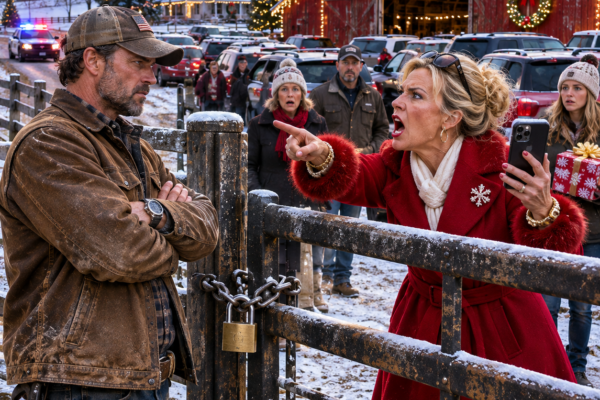
The first time I saw a bulldozer tearing through the twenty acres my aunt had left me, I already knew the HOA president directing the project had no legal right to touch a single tree, much less build a multimillion-dollar sports complex there.
Victoria Sterling had forged a land-transfer agreement, convinced an entire neighborhood that my property belonged to their HOA, and persuaded families to pay thousands of dollars each toward a stadium she planned to name after herself.
By the time the ribbon-cutting ceremony was finally scheduled, the question was no longer whether Victoria had crossed a line—it was how many people would still be standing beside her when the truth finally walked onto the field.
Three years earlier, I was forty-two, freshly divorced, and living in an apartment so small I could reach the kitchen from my couch without standing up.
My ex-wife had kept the house we built together.
I kept my laptop, my job as an IT consultant, and an impressive collection of cardboard boxes I never bothered unpacking.
Life wasn’t terrible.
That almost made it worse.
It was simply empty.
Then Aunt Eleanor died.
She wasn’t technically my aunt. She was my mother’s cousin, but nobody in the family called her anything except Aunt Eleanor.
She had lived alone on twenty wooded acres beside Riverside Heights, one of the wealthiest subdivisions in the county. As a kid, I spent entire summers there fishing the creek, following deer trails, and sleeping in the little cabin she’d built in the 1970s.
Eleanor never married.
Never had children.
When the estate attorney told me she had left the land to me, I thought he’d called the wrong David Carson.
He hadn’t.
The property was worth close to two million dollars.
Maybe more.
Developers would have bought it quickly.
I didn’t care.
For the first time since my divorce, I had something that felt less like an asset and more like a place where I could start over.
I repaired the cabin roof.
Cleared old trails.
Replaced rotten porch boards.
Sometimes I drove out there after work just to sit beneath the giant oaks and listen to absolutely nothing.
Six months after I inherited the property, Victoria Sterling arrived.
Black Mercedes.
Cream slacks.
Silk blouse.
Designer sunglasses.
She stepped from the SUV holding a gift basket full of wine and expensive cheese like she was welcoming me to a country club.
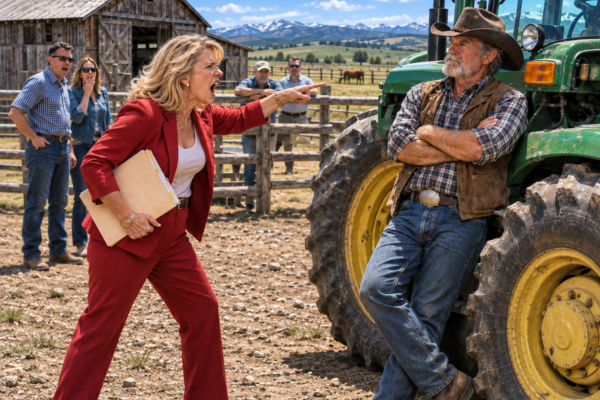
“You must be Mr. Carson.”
“David.”
“Victoria Sterling. President of the Riverside Heights Homeowners Association.”
She offered her hand.
Her smile was warm.
Her eyes weren’t.
She told me Riverside Heights was committed to maintaining property values, preserving community standards, and creating “a lifestyle worthy of the neighborhood.”
Then she asked what I planned to do with my land.
“Nothing for now.”
“Nothing?”
“I’m fixing the cabin. Maybe someday I’ll build a house.”
Victoria looked past me toward the trees.
“Twenty acres is a lot of land to leave unused.”
“I don’t consider trees unused.”
She laughed politely.
Then she told me Riverside Heights wanted expanded recreational facilities.
A soccer field.
Tennis courts.
Walking trails.
Maybe a pavilion.
“We’d be interested in a long-term partnership,” she said. “Lease arrangement, perhaps. You could generate income while contributing to the community.”
“No.”
The answer came easily.
Her smile barely changed.
“Think about it.”
“I already did.”
She studied me for another second.
Then handed me her business card.
“If you change your mind.”
“I won’t.”
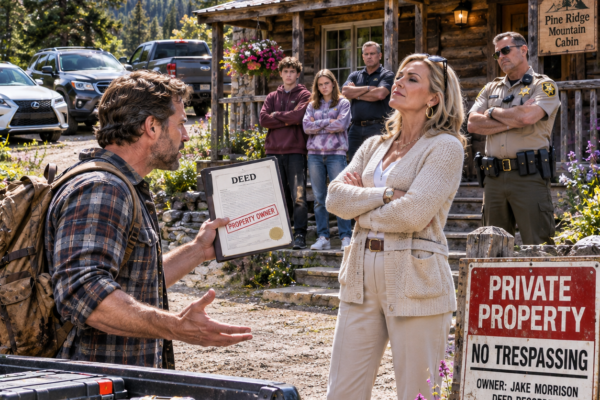
Three months later, I found orange survey stakes two hundred feet inside my property.
Two men in reflective vests were measuring a grid through the woods.
I walked over.
“Can I help you?”
One of them smiled.
“We’re almost finished.”
“With what?”
“The HOA sports complex.”
I stared at him.
“What sports complex?”
He pointed across my land.
“Main stadium goes through here. They break ground next month.”
My stomach went cold.
“Who told you this belonged to the HOA?”
“Victoria Sterling.”
I didn’t argue.
I didn’t threaten them.
I drove directly to the county recorder.
Six weeks earlier, somebody had filed a document claiming Aunt Eleanor had agreed to transfer fifteen acres to Riverside Heights before her death.
Purchase price: fifty thousand dollars.
Her signature appeared at the bottom.
So did a notary stamp.
I knew Eleanor’s handwriting.
The signature wasn’t hers.
And when I showed the document to my attorney, Maria Rodriguez, she studied it for less than five minutes before looking up at me.
“David,” she said quietly, “somebody just tried to steal fifteen acres from you with a forgery.”
I stared at the paper.
“What do we do?”
Maria leaned back.
“We can stop them now.”
Then she paused.
“Or we can find out exactly how far Victoria is willing to go.”
PART 2:
I looked at Maria across her desk.
“What does that mean?”
She tapped the forged transfer agreement.
“Right now, we have an attempted fraudulent transfer.”
“Attempted?”
“It hasn’t defeated your title. Your deed is clean. Eleanor’s probate records are clean. The will is clean. Her authentic signatures are available in dozens of documents.”
“So we go to the police.”
“We can.”
“But?”
Maria knew me too well.
“There is a but.”
She stood and walked toward the window.
“Victoria didn’t forge this because she wanted a strip of woods. She forged it because she’s planning something expensive.”
“Three-million-dollar sports complex.”
“Exactly.”
I leaned forward.
“You’re suggesting I let her build it?”
“I’m suggesting that if we’re going to delay action, we document everything. Perfectly.”
“That sounds insane.”
“It might be.”
“Great legal strategy.”
She smiled slightly.
“I’m not telling you to help her. Don’t sign anything. Don’t approve anything. Don’t participate. But if she is willing to spend HOA funds, make false public statements, hire contractors based on fraudulent title, and continue after representing that she owns this property, every step creates evidence.”
I thought about the trees.
The creek.
Aunt Eleanor’s trails.
“You’re talking about letting them destroy the land.”
“I know.”
“That doesn’t bother you?”
“Yes.”
“Doesn’t sound like it.”
Maria’s expression softened.
“David, I knew Eleanor too.”
That stopped me.
Maria and I had gone to college together. She had visited the property several times when we were younger.
“She’d hate seeing bulldozers out there.”
“Yes.”
“But she’d hate someone getting away with stealing it more.”
I stood and paced.
“What if something goes wrong?”
“We monitor title constantly.”
“What if they sell it?”
“We move immediately.”
“What if the forged transfer somehow gets accepted?”
“It has already been recorded as a document. Recording doesn’t make a fraudulent instrument valid. Your title history is stronger.”
“And if Victoria realizes I know?”
“Then the plan changes.”
I looked down at the forged signature again.
The imitation was good enough to fool somebody unfamiliar with Eleanor.
But I’d watched that woman write birthday cards for thirty years.
She made the capital E in Eleanor with a huge bottom loop.
This signature didn’t.
Somebody had researched her.
Copied examples.
Created legal descriptions.
Found a notary format.
This was not impulsive.
It was calculated.
I sat down.
“What would you do?”
Maria didn’t answer immediately.
“If someone did this to my family?”
“Yes.”
She looked at the paper.
“I’d want them to finish digging their own hole.”
That night I bought four cellular trail cameras.
High-resolution.
Cloud backup.
Motion activated.
I positioned them throughout the section Victoria planned to develop.
One near the access road.
One facing the central clearing.
One toward the creek.
One high in an oak overlooking most of the eastern acreage.
The next Riverside Heights HOA meeting was two weeks later.
I attended.
Nobody stopped me.
My property bordered the development, and Victoria seemed almost pleased to see me.
Forty residents sat facing a projection screen.
Victoria stood beneath an architectural rendering that looked like something from a luxury college campus.
A regulation soccer field.
Four tennis courts.
Basketball court.
Playground.
Locker rooms.
A pavilion large enough for weddings.
Walking paths.
LED stadium lighting.
Parking.
Then the title appeared.
**THE STERLING SPORTS COMPLEX**
I nearly laughed.
She named it after herself before they’d broken ground.
Victoria clicked to the next slide.
“This facility will transform Riverside Heights.”
A man in front raised his hand.
“Cost?”
“Current projected budget is approximately $3.2 million.”
People murmured.
She continued smoothly.
“We’ve secured an $800,000 municipal recreation grant.”
More murmurs.
“The remaining amount will be funded through reserves and a special assessment of fifteen thousand dollars per household spread over three years.”
That got a reaction.
Several residents spoke at once.
Victoria raised both hands.
“I understand this sounds substantial.”
“It is substantial,” someone said.
She smiled.
“Please consider the return. Comparable communities with premium athletic facilities have experienced significant increases in property value.”
Then she talked about children.
Health.
Community identity.
Legacy.
Everything except whether residents could afford it.
I raised my hand.
Her eyes found me immediately.
“Mr. Carson.”
“I have a question about the land.”
The room quieted.
Victoria’s smile remained perfect.
“Of course.”
“How exactly did Riverside Heights acquire it?”
She didn’t blink.
“The previous owner, Eleanor Carson, generously transferred the acreage before her death.”
“Sold or donated?”
“A combination of nominal compensation and community donation.”
Interesting.
The forged document called it a sale.
Her presentation called it generosity.
“Do you have the paperwork?”
“Certainly.”
“I’d like to see it.”
“It’s public record.”
“I have seen it.”
For the first time, something moved behind her eyes.
Not fear.
Assessment.
Then she smiled again.
“Wonderful. Then you know everything is properly documented.”
I nodded.
“Very properly.”
A few people looked between us.
Victoria turned back to the screen.
“Now, regarding construction—”
I sat down.
She had no idea whether I believed her.
That mattered.
I wanted her comfortable.
Construction began on a gray Monday in April.
At 7:12 a.m., my phone vibrated.
First trail-camera alert.
Excavator.
Then dump truck.
Then another.
By eight, workers were walking through Eleanor’s woods.
By nine, the first mature oak had an orange X painted across its trunk.
I sat at my apartment kitchen table watching the live feed.
I told myself I was ready.
I wasn’t.
That land held pieces of my childhood.
Aunt Eleanor used to hang a rope swing from one of those oaks.
I learned to swim in the creek.
I kissed my first girlfriend beneath a dogwood near the eastern trail.
Now contractors walked through it with chainsaws.
Maria called.
“You watching?”
“Yes.”
“You can stop this.”
“I know.”
“I’m serious.”
“I know.”
“You don’t owe the plan anything.”
I watched the excavator swing.
“Let them continue.”
“David.”
“She wants her legacy.”
I stared at the screen.
“Let’s make sure she gets one.”
The first tree fell at 9:47.
I recorded the time.
After that, documenting became almost mechanical.
Contractor.
Truck company.
Concrete supplier.
Delivery dates.
Equipment.
Steel erection.
Electrical work.
Turf installation.
Paving.
I created spreadsheets.
Maria laughed the first time she saw them.
“You really are an IT consultant.”
“Color coding helps.”
“You color-coded your revenge.”
“Accountability.”
“Sure.”
Victoria posted everything online.
Every milestone.
Every beam.
Every concrete pour.
She wore hard hats in photos without ever appearing dusty.
One local news segment showed her standing in front of the unfinished stadium.
“This isn’t simply construction,” she told the reporter. “It’s legacy.”
I saved the clip.
At every board meeting, costs climbed.
Three point two million became three point three.
Then three point four.
Victoria called them “adjustments.”
An older resident named Patricia asked where the extra money came from.
Victoria replied:
“Creative reallocation.”
Patricia frowned.
“From what accounts?”
“We’re optimizing reserves.”
“Emergency reserves?”
“Patricia, I would be happy to review the financial structure privately after the meeting.”
“Why not now?”
The room shifted.
Victoria’s smile sharpened.
“Because detailed accounting isn’t the purpose of tonight’s presentation.”
Patricia sat down.
She looked unconvinced.
I wrote her name in my notebook.
Later, in the parking lot, I approached her.
“Good question.”
She looked at me.
“You’re Eleanor’s nephew.”
“Close enough.”
“Your aunt was a good woman.”
“You knew her?”
“Not well. She let my grandkids fish in that creek once.”
I smiled.
“That sounds like Eleanor.”
Patricia looked toward Victoria’s Mercedes.
“Something isn’t right.”
“With the money?”
“With all of it.”
“What makes you say that?”
“She never answers the same question twice.”
I stored that away.
The stadium framework rose throughout summer.
From a distance, it was beautiful.
That angered me.
If it had been ugly, hating it would have been easier.
Instead, skilled workers were building something impressive on stolen ground.
Then James Sterling knocked on my apartment door.
It was mid-July.
He looked exhausted.
Wrinkled shirt.
Red eyes.
Hands trembling.
“David.”
“James.”
“I need to come in.”
I stepped aside.
He walked toward my couch, then stopped.
“Does Victoria know you own that land?”
I said nothing.
He laughed once.
Not from humor.
“You know.”
“What do I know?”
“The documents.”
“Which documents?”
“The transfer.”
I kept my face still.
James looked at me.
“Please don’t make me say everything twice.”
I sat.
“So say it once.”
He lowered himself onto the couch.
“Victoria forged them.”
The room felt smaller.
“How do you know?”
“I found the originals.”
“What originals?”
“Eleanor’s records. Old samples Victoria used. Copies of her signature.”
My jaw tightened.
“Where?”
“Victoria’s home office.”
“You searched your wife’s office?”
“She locks it now.”
“Why?”
“Because she knows I’m asking questions.”
He rubbed his forehead.
“She told me the land had been donated. I believed her.”
“Why?”
“Because she’s my wife.”
That answer hurt more than I expected.
Not because I pitied him.
Because I understood it.
You want the people you love to be better than evidence says they are.
“What changed?”
“The project went over budget.”
“I know.”
“You don’t know how much.”
“How much?”
“Hundreds of thousands.”
“Construction overruns?”
“Not all of it.”
I leaned forward.
James looked sick.
“She has been moving money.”
“From where?”
“HOA reserves.”
“How much?”
“At least two hundred thousand that I can identify.”
I stared at him.
“Embezzlement?”
“I don’t know what else to call it.”
“Who else knows?”
“My sister Diane.”
“What does she do?”
“CPA.”
“Does she work for Riverside Heights?”
“Contract basis. Financial reviews.”
“And?”
“She found discrepancies.”
James stood and paced.
“Fake vendor invoices. Contractors getting paid strange amounts. Reserve transfers. Victoria has been manipulating the reports she gives the board.”
“How long?”
“I don’t know.”
“Why come to me?”
He stopped.
“Because she is destroying everybody.”
“Your wife.”
“I know.”
“Your children’s mother.”
His face broke.
“I know.”
He sank back down.
For several seconds neither of us spoke.
Finally I asked:
“What do you want me to do?”
James reached into his pocket.
USB drive.
Set it on my coffee table.
“Everything I found is there.”
I didn’t touch it.
“Why give it to me?”
“Because you already know what she did with the land.”
“How do you know I know?”
He smiled sadly.
“You’ve been sitting through HOA meetings watching her talk about Eleanor’s ‘donation’ without saying a word.”
“So?”
“You’re not stupid.”
“Flattering.”
“You’re waiting.”
I looked at him.
He continued.
“I don’t know what you’re waiting for. But if you’re going after her, do it legally.”
“That depends on what she’s done.”
“All of it is there.”
I picked up the drive.
“Does she know you copied this?”
“No.”
“Does Diane?”
“Yes.”
“Why isn’t Diane going to police?”
“She might.”
“Then she should.”
“She is scared.”
“Of what?”
“Victoria threatened her business.”
That sounded exactly like the woman I’d watched at meetings.
Control first.
Truth second.
“What did Victoria say?”
“She said if Diane kept asking questions, she’d file complaints with the licensing board and tell clients she mishandled HOA accounts.”
I shook my head.
“Grand opening?”
James nodded.
“October fifteenth.”
“Why tell me that?”
His eyes met mine.
“Because that’s the day she wants everybody watching.”
I sat very still.
He knew.
Maybe not every detail.
But enough.
“You want her exposed in public.”
“No.”
His answer surprised me.
“I want the truth exposed publicly.”
“Difference?”
“My kids.”
He swallowed.
“They’re twelve and nine.”
I understood.
“You don’t want this to look like their father destroyed their mother.”
“I don’t want anyone manipulating the story later.”
James stood.
“Victoria has spent her entire life controlling rooms. If this comes out quietly, she’ll spend years telling people she was misunderstood.”
“And if it happens with cameras?”
“She’ll still say that.”
He looked toward the USB.
“But the world will have seen the truth.”
At the door, he paused.
“I used to love her more than anything.”
I didn’t know what to say.
“I probably still do.”
“James.”
“She isn’t always like this.”
“I’ve heard that sentence before.”
“So have I.”
He left.
I called Maria.
She came over.
We did not plug the USB into my computer.
Maria took it for proper forensic handling.
Smartest thing we could have done.
Three days later, she called.
“James was telling the truth.”
“How bad?”
“Bad.”
“Specific.”
“Potential false invoices. Misappropriation. Communications concerning the forged transfer. Contractor messages.”
“Victoria?”
“Directly.”
I sat down.
“Can we move now?”
“Yes.”
“But you don’t want to.”
“I want law enforcement involved now.”
That surprised me.
“What happened to waiting?”
“Different category of evidence. We don’t sit on active financial crimes indefinitely.”
“So the grand opening is off?”
“Not necessarily.”
Maria had already contacted a county fraud investigator through proper channels.
Detective Sarah Chen.
Quietly.
Documents went to forensic review.
No arrests.
No public accusation.
Not yet.
Investigators wanted records preserved.
More evidence.
Independent verification.
And Victoria, unaware of the scrutiny building behind her, kept spending.
By August, Riverside Heights was cracking.
Residents complained about assessments.
One woman wrote online that her husband had lost his job and they couldn’t keep up with payments.
Victoria responded publicly:
**The approved payment schedule applies equally to all households. I recommend reviewing discretionary spending and adjusting household priorities.**
I read it three times.
Then checked Victoria’s latest social-media photograph.
She was standing beside a new Mercedes.
I saved both.
Not because the car proved anything.
Because the contrast told me who she was.
Patricia stopped attending board meetings.
I visited her.
She opened the door wearing slippers and holding a stack of mail.
“You’re the man with Eleanor’s property.”
“David.”
“I remember.”
“Can I ask you something?”
“If it’s about Victoria, come inside.”
Her dining table was covered with bills.
One envelope read:
**RIVERSIDE HEIGHTS SPECIAL ASSESSMENT — FINAL NOTICE**
“I paid the first ten thousand.”
“You owe five?”
“Plus fees.”
“Can you manage it?”
“I can.”
She said it too quickly.
“What did you give up?”
Patricia looked toward a framed photograph of an older man.
“My husband died two years ago.”
“I’m sorry.”
“He left enough that I shouldn’t be worrying about things like this.”
She touched the envelope.
“I used part of his life insurance.”
For a soccer complex.
I didn’t say it.
I didn’t need to.
“I asked Victoria for financial records.”
“What happened?”
“She told me I was undermining the community.”
“Did she give them?”
“No.”
“Would you be willing to speak to an attorney?”
Patricia looked at me.
“Why?”
I chose my words carefully.
“Because I think your instincts may be right.”
Her expression changed.
“What do you know?”
“Enough to tell you not to delete anything.”
She looked toward the assessment notice.
“Is this project in trouble?”
I stood.
“Keep every document.”
Then Diane Sterling called.
James’s sister.
We met two towns away.
She arrived carrying a laptop and a folder.
She didn’t waste time.
“It’s worse.”
“How much worse?”
“Victoria didn’t steal two hundred thousand.”
My stomach tightened.
“How much?”
“Directly and indirectly? Around three hundred fifty thousand.”
I stared.
Diane opened spreadsheets.
“She started small.”
Padded invoices.
Ghost vendors.
Fake reimbursements.
Then more sophisticated transfers.
Contractor kickbacks.
Vendor companies that appeared connected to entities with no actual operations.
Reserve funds rerouted.
“Offshore?” I asked.
Diane nodded.
“I found transfer confirmations.”
“How?”
“Victoria asked me to reconcile project accounts, then forgot which files she’d already shared with me.”
“That’s convenient.”
“She’s unraveling.”
Diane’s hands shook.
“But don’t mistake unraveling for harmless.”
“What did she threaten you with?”
Her eyes sharpened.
“Everything she could.”
“Why keep digging?”
Diane looked at me for a long moment.
Then took out her phone.
The lock screen showed a teenage girl smiling beside a school track.
“My daughter.”
“She knows?”
“Not details.”
Diane closed the phone.
“But she watches me.”
I understood before she finished.
“I can’t tell her integrity matters if I stay silent because telling the truth might cost me clients.”
“You could lose your practice.”
“Yes.”
“You’re okay with that?”
“No.”
That answer mattered.
“I am terrified.”
She leaned forward.
“But courage that costs nothing isn’t courage.”
I never forgot that.
Diane provided records through the proper legal process.
Investigators independently obtained what they needed.
The case grew.
Meanwhile, Victoria’s public image got brighter.
Business magazine profile.
Statewide HOA conference.
Leadership panels.
Photos.
Quotes.
Legacy.
Vision.
Excellence.
Her life had become one giant advertisement for the person she wanted to be seen as.
At home, James was preparing to leave.
He took the children.
Victoria barely noticed until nearly everything was gone.
According to Diane, when she finally realized James had moved out, she called him seventeen times in one evening.
He answered once.
“What are you doing?” she demanded.
“Protecting the kids.”
“From what?”
“You.”
That ended the call.
Seven weeks before the grand opening, Maria met me at the property.
We stood behind the cabin looking toward the stadium lights.
They were testing them.
Night became day.
“Beautiful,” Maria said.
“I hate it.”
“No you don’t.”
I looked at her.
“You hate how it got here.”
She was right.
The facility itself was remarkable.
Kids would love it.
Families would use it.
That was part of what made everything complicated.
“I thought revenge would feel cleaner.”
“Revenge usually does from far away.”
“What does that mean?”
“It means when you’re angry, you imagine Victoria losing.”
I looked at the lights.
“And up close?”
“You see James.”
“The children.”
“Patricia.”
“Diane.”
“Every family who paid fifteen thousand dollars.”
I nodded.
Maria said:
“This stopped being just your revenge months ago.”
“I know.”
“Good.”
October fifteenth arrived with a perfect blue sky.
The kind of autumn day that makes public events look staged.
The grand opening began at two.
I arrived at one thirty.
Cars lined both sides of the road.
Hundreds of residents.
Children.
Local politicians.
Press.
Representatives from the state HOA association.
Banners stretched across the entrance.
**STERLING SPORTS COMPLEX — BUILDING COMMUNITY, BUILDING THE FUTURE**
I stood at the edge of the parking lot and stared.
Fifteen acres of my inheritance had become a stadium.
Artificial turf.
LED towers.
Tennis courts.
Basketball.
Locker rooms.
Playground.
A pavilion with stone fireplaces and a commercial kitchen.
They had spent millions.
And I had not paid one dollar.
Maria arrived beside me.
“Last chance.”
“To stop?”
“To handle it privately.”
I looked toward Victoria.
White designer suit.
Auburn hair.
Perfect smile.
She moved through the crowd accepting congratulations.
“You know what Patricia told me yesterday?”
“What?”
“She has friends who took out loans to pay the assessment.”
Maria nodded.
“Then let’s do it.”
Detective Sarah Chen was already there.
Two uniformed officers remained discreetly back.
Forensic accountants stood near the pavilion.
James arrived with his children.
He positioned himself far from Victoria.
The kids looked confused.
That hurt.
Diane stood beside him.
At exactly two o’clock, Victoria stepped to the microphone.
Applause.
She smiled.
“This extraordinary facility represents eighteen months of vision, discipline, and belief.”
I listened.
She thanked contractors.
Board members.
Residents.
She talked about courage.
Future generations.
Community.
Legacy.
Then:
“The Sterling Sports Complex belongs to all of you.”
My jaw tightened.
No.
It didn’t.
She lifted oversized ceremonial scissors.
People cheered.
Children crowded near the ribbon.
Cameras moved closer.
Victoria stepped forward.
I walked toward the front.
“Mrs. Sterling.”
My voice carried.
She stopped.
The crowd quieted slowly.
Victoria saw me.
Her smile flickered.
Then returned.
“Mr. Carson.”
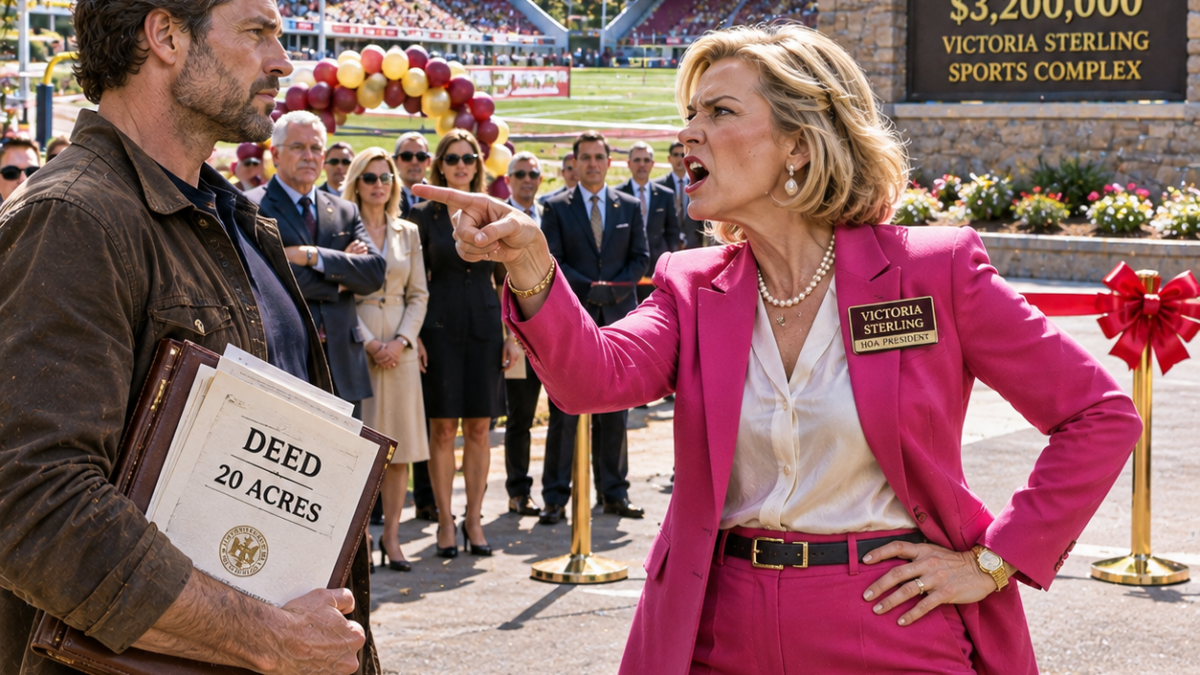
“Before you cut that ribbon, I have a question.”
A few people laughed.
Victoria didn’t.
“I’m sure we can discuss any concerns after the ceremony.”
“No.”
Cameras turned.
“Let’s do it now.”
Her jaw tightened.
“What concern?”
I pointed toward the field.
“Why are you opening a multimillion-dollar sports complex on property you don’t own?”
Silence.
Absolute.
Victoria laughed.
Too quickly.
“I’m sorry?”
“This land belongs to me.”
People began whispering.
She lifted the microphone.
“Mr. Carson appears to be confused about a historical property transfer—”
“The transfer was forged.”
Everything changed.
The reporters moved closer.
Victoria lowered the microphone.
Her face was still smiling.
Her eyes weren’t.
“Careful.”
I heard it.
Maybe three people around us did.
I continued.
“My aunt Eleanor Carson never sold fifteen acres to Riverside Heights.”
Victoria raised her voice.
“The county record says otherwise.”
“The county record contains a forged document.”
Gasps.
Someone behind me said:
“What?”
I held up a folder.
“We have authenticated signatures.”
Maria stepped beside me.
“Original estate documents.”
Victoria stared at her.
“We have the will.”
Maria continued.
“Probate records.”
“Survey.”
“Notary records showing the stamp used on the transfer was invalid.”
Victoria’s face lost color.
Then Detective Chen walked forward.
“Mrs. Sterling.”
Victoria looked toward the badge.
“What is this?”
“Detective Sarah Chen, county fraud division.”
The ceremonial scissors lowered.
“We need to speak with you regarding financial activity connected to Riverside Heights.”
Victoria stopped breathing for a second.
I saw it.
Detective Chen continued.
“Specifically, discrepancies involving several hundred thousand dollars in association funds.”
The scissors fell.
Metal struck pavement.
A sharp sound.
And then Victoria ran.
Not far.
Designer heels are not built for escaping police on asphalt.
She made maybe twenty feet before an officer intercepted her.
“Mrs. Sterling, stop.”
“Get away from me!”
“Stop.”
“Do you know who I am?”
The crowd recoiled.
Her entire public personality disappeared in seconds.
“I am president of this association!”
The officer repeated:
“Stop.”
“I’ll have your badge!”
James moved forward.
“Victoria.”
She turned.
Saw him.
Then saw the children.
Her face changed.
“What are you doing here?”
James stared at her.
“What?”
“Why did you bring them?”
“Victoria—”
“This is my day.”
I watched James’s face break.
“Your day?”
“Yes!”
“Look around.”
People were staring.
Hundreds.
Phones raised.
Residents who had paid for this.
James said:
“They trusted you.”
“I did this for them.”
“No.”
“For us.”
“No.”
“For our family!”
James shook his head.
“You built it on someone else’s land.”
“James.”
“You lied.”
“Don’t.”
“You stole.”
“Stop.”
“Our kids deserve to know why we’re leaving.”
Victoria stared at him.
“You left?”
James almost laughed.
“You didn’t notice?”
That hit harder than anything I’d said.
Victoria’s mouth opened.
Nothing came out.
Diane moved beside James.
Victoria saw her.
“You.”
Diane didn’t step back.
“You went through my accounts.”
“I audited HOA records.”
“You betrayed me.”
“I did my job.”
“You destroyed my family.”
Diane’s voice shook.
“No. You did.”
Residents began shouting questions.
“Where’s our money?”
“Did she steal the assessment?”
“Is the land really his?”
“What happens to the complex?”
Patricia pushed through the crowd.
Her face was red.
“I paid fifteen thousand dollars.”
Victoria looked at her.
“Patricia, not now.”
“Not now?”
“I can explain.”
“You wouldn’t explain for eighteen months.”
Victoria raised a hand.
“People are emotional.”
Patricia’s voice cracked.
“I used my husband’s life-insurance money.”
The crowd fell quieter.
Victoria looked irritated.
Actually irritated.
“This project increased your property value.”
Patricia stared at her.
“My husband died.”
Victoria froze.
“I know.”
“No, you don’t.”
Patricia pointed toward the stadium.
“You took money he spent forty years saving and used it while lying to me.”
“I did not lie.”
Detective Chen spoke.
“Mrs. Sterling, I strongly recommend you stop making statements.”
Victoria ignored her.
She looked at me.
“This is your fault.”
There it was.
She stepped toward me.
The officer blocked her.
“You planned this.”
I said nothing.
“You knew.”
I met her eyes.
“Yes.”
That silenced her.
“You knew?”
“From the survey stakes.”
“How?”
“The forged deed wasn’t very good.”
Her expression became something I had never seen on her face.
Fear.
“You let us build.”
“Yes.”
The crowd reacted.
Even Maria glanced at me.
Victoria whispered:
“You watched?”
“Every truck.”
“No.”
“Every concrete pour.”
“No.”
“Every beam.”
“You could have stopped it.”
“Yes.”
Her face twisted.
“You let me spend millions.”
“I didn’t make you forge Eleanor’s signature.”
“You could have warned me.”
“I told you no before any of this began.”
“This isn’t justice.”
“No?”
“This is revenge.”
For a moment, I couldn’t answer.
Because part of her was right.
There had been revenge in it.
I had imagined this moment.
Her humiliation.
Her fear.
Her empire collapsing.
Then I looked beyond her.
James.
The children.
Patricia.
Diane.
Families.
I said:
“You’re right about one thing.”
Victoria stared.
“I could have stopped construction sooner.”
Maria looked at me carefully.
I continued.
“But you could have stopped every morning for eighteen months.”
Victoria shook her head.
“No.”
“You could have told the truth.”
“No.”
“You could have returned the money.”
“Stop.”
“You could have admitted Eleanor never gave you this land.”
“STOP!”
“You kept choosing this.”
Her shoulders sagged.
Detective Chen stepped closer.
“Victoria Sterling, we have warrants relating to fraud, forgery, and financial crimes under investigation.”
The detective began explaining her rights.
Victoria barely seemed to hear.
Her perfect makeup had started running.
She looked suddenly smaller.
Not because she had changed.
Because the image around her was gone.
As officers prepared to escort her away, she looked at me.
“You’ve taken everything.”
I shook my head.
“No.”
“My reputation.”
“You built it on lies.”
“My family.”
“James made his choice.”
“My project.”
I looked across the stadium.
“My land.”
She closed her eyes.
When officers led her away, nobody applauded.
I’m glad they didn’t.
Justice shouldn’t always feel like a sporting event.
The cruiser left.
The crowd remained.
Nobody knew what to do.
The grand opening banners fluttered above a complex that had just become evidence.
Reporters surrounded Maria.
Residents surrounded the board.
Kids stood beside parents who were suddenly talking about fraud, assessments, lawyers, refunds.
Someone behind me asked:
“What happens to all this?”
I turned.
A father held a little boy’s soccer ball.
The child looked toward the field.
I didn’t know the answer.
The easy answer would have been:
It’s mine now.
Get off.
That was what I’d imagined months earlier.
But standing there, revenge felt smaller.
Maria joined me.
“We should leave.”
I nodded.
Then Patricia approached.
“What happens?”
“Legally?”
“To this.”
She looked around.
“The courts will sort out title and fixtures.”
“But it’s your land.”
“Yes.”
“You’re going to tear it down?”
I looked at the stadium.
The pavilion.
The playground.
Children staring through the fence.
“No.”
Maria raised an eyebrow.
I added:
“I don’t know what I’m doing yet.”
Patricia nodded.
“Fair.”
“But I’m not tearing it down tomorrow.”
She started crying.
Not dramatically.
Just relief.
Three days later, the HOA board effectively collapsed.
Emergency meetings.
Resignations.
Attorneys.
Insurance.
Audits.
The new board elected Patricia interim president.
She called me.
“You’re joking.”
“No.”
“You hate HOA politics.”
“I hate bad HOA politics.”
“Difference?”
“We’re about to find out.”
The audit went deeper.
The final suspected loss exceeded what Diane first calculated.
Ghost vendors.
Inflated invoices.
Unauthorized transfers.
Fake reimbursements.
Questionable contractor payments.
Victoria’s criminal case became complicated, technical, and much less cinematic than the arrest.
That was fine.
Court isn’t supposed to entertain.
James filed for divorce.
He took the children.
Diane gave investigators everything.
Her accounting firm lost two nervous clients.
Then gained six new ones after word spread that she’d exposed fraud rather than hide it.
Patricia froze all nonessential assessments.
Families received partial relief through insurance, recovered funds, and restructuring while lawyers fought over the rest.
Meanwhile, I faced a different problem.
The sports complex.
A multimillion-dollar facility sat on my land.
The forged transfer was invalid.
My title held.
The structures were fixtures built on property Victoria never owned.
Contractors and insurers filed claims.
The HOA argued residents had paid for the complex.
Maria spent weeks untangling everything.
One afternoon she dropped a stack of folders onto her desk.
“Congratulations.”
“For what?”
“You now understand why lawyers charge by the hour.”
“I understood before.”
“No, now you understand spiritually.”
I smiled.
“What’s the situation?”
“Your ownership is solid.”
“And the complex?”
“There’s going to be a settlement.”
“Meaning?”
“Meaning everybody involved would rather negotiate than spend five years arguing.”
Eventually contractors settled outstanding claims with insurers and the HOA.
The association conceded title.
I waived certain damages in exchange for clear ownership and final resolution.
When everything was signed, the land was legally and indisputably mine.
So were the permanent improvements under the settlement.
I stood alone on the field the first morning after closing.
Artificial turf beneath my boots.
Empty stadium seats.
Sunlight touching the LED towers.
I should have felt triumphant.
Instead, I missed the trees.
I walked toward the eastern edge.
One enormous oak had survived because engineers incorporated it into a landscaped walking area.
I put my hand against the bark.
Aunt Eleanor once tied a rope swing to a branch not far from there.
“I let them do this.”
Saying it aloud hurt.
Maria had warned me.
I had chosen the long game.
I had won.
But victory didn’t restore eighty-year-old trees.
That was the first lesson revenge taught me.
You can win and still lose something permanent.
Three weeks later, Maria called.
“Estate storage delivered a box.”
“What estate storage?”
“Eleanor’s personal effects. Apparently nobody ever forwarded it.”
Inside were journals.
Photographs.
Old letters.
I took them home.
That night I sat in the cabin and read.
Eleanor wrote about everything.
Bird migrations.
Garden disasters.
People.
Weather.
Then I found a name.
**Margaret Sterling.**
Victoria’s mother.
They had been friends.
I turned pages faster.
Then found a photograph.
Two women standing near the creek.
Eleanor.
Margaret.
Between them, a little girl around seven years old.
Auburn hair.
Dirty knees.
Huge smile.
Victoria.
I stared.
Behind them stood one of the oaks removed for the stadium.
I kept reading.
**Victoria spent the afternoon drawing castles. Says she’s going to be an architect and build beautiful places where everyone can play.**
Another entry.
**That Sterling girl climbed the old oak again. Nearly gave Margaret a heart attack. Fearless child.**
Years later:
**Margaret worries about Victoria. Says she works constantly, never sleeps, only talks about making partner.**
Then:
**Sometimes ambition looks so much like discipline that nobody notices when it becomes hunger.**
I stopped.
Eleanor’s handwriting blurred.
I wasn’t crying exactly.
Not yet.
Final entries were harder.
Margaret developed cancer.
Victoria became busier.
When Margaret died, Victoria didn’t attend the funeral because of work.
Eleanor wrote:
**I keep thinking about the little girl who drew fairy castles in my woods. Where did she go?**
I closed the journal.
For months, Victoria had existed in my mind as an enemy.
A fraud.
A thief.
A woman who destroyed my trees and robbed her neighbors.
Now suddenly she had been seven years old.
Grass stains.
Fairy castles.
A mother worried about her.
That did not excuse anything.
It made it sadder.
The next day I visited James.
He lived in a rental house outside Riverside Heights.
The kids were at school.
I placed Eleanor’s journal on his kitchen table.
“What is this?”
“Something you should see.”
He read the marked pages.
His face changed.
“Victoria never told me.”
“About Eleanor?”
“No.”
“She played there.”
He touched the photograph.
“She looked happy.”
“Eleanor thought she was.”
James looked away.
“She wasn’t always like this.”
“I know.”
He laughed bitterly.
“No. Everybody says that after somebody destroys their life.”
He closed the journal.
“But she really wasn’t.”
“What happened?”
“I don’t know.”
He thought.
“Maybe nothing happened all at once.”
That answer stayed with me.
Maybe that’s how people lose themselves.
Not in one dramatic choice.
In a thousand small ones.
One shortcut.
One lie.
One rationalization.
One person you silence because they disagree.
One rule you bend because you know better.
Until eventually you’re standing in front of a stadium built on stolen land wondering why everyone has betrayed you.
I called Patricia.
“We need a community meeting.”
“You’re joining the HOA?”
“Absolutely not.”
She laughed.
“Then what’s the meeting about?”
“The complex.”
Two hundred residents came.
No media.
I requested that.
No banners.
No podium.
Just folding chairs on the field.
I stood near midfield holding Eleanor’s journal.
“I know many of you are wondering what happens here.”
People nodded.
“The simple answer is that the land is mine.”
Silence.
“The legal settlement confirms that.”
Someone asked:
“Are you closing it?”
“No.”
Murmurs.
“I could.”
More silence.
“I could tear everything down.”
A child nearby gripped his mother’s hand.
I continued.
“For a long time, part of me wanted to.”
Patricia watched me.
“Victoria stole my land. She forged Eleanor’s signature. She used your money. I thought the most satisfying ending would be taking everything she built.”
I looked around.
“I was wrong.”
Nobody moved.
I held up the journal.
“Eleanor knew Victoria.”
Confusion spread.
“She knew her as a child.”
I showed the photograph.
James sat near the back with his children.
His daughter began crying before I even finished explaining.
“Victoria played in these woods.”
I told them about the castles.
The trees.
Eleanor’s memories.
Then I said:
“That doesn’t excuse what Victoria did.”
James nodded.
“It doesn’t reduce her responsibility.”
Diane sat beside him.
“But Eleanor believed land mattered because of what people did on it.”
I looked across the soccer field.
“She hated waste.”
A few people laughed.
“She once chased me halfway across this property because I left fishing line beside the creek.”
More laughter.
“She would hate knowing her woods were taken through lies.”
I paused.
“But I think she’d hate seeing everything destroyed just to satisfy my anger.”
The crowd went silent.
“So here’s what I’m offering.”
Patricia leaned forward.
“The HOA can lease the developed section.”
People whispered.
“For ninety-nine years.”
Silence again.
“For one dollar per year.”
Patricia stood.
“What?”
“One dollar.”
She stared.
“David.”
“There are conditions.”
Everyone listened.
“Independent annual audits.”
Patricia nodded immediately.
“Open financial reporting.”
“Yes.”
“No president gets unilateral spending authority beyond ordinary operating limits.”
“Yes.”
“Facility revenue goes first to maintenance.”
“Of course.”
“Then a portion goes into a community relief fund for families facing hardship.”
The woman whose husband had lost his job covered her mouth.
“And the Sterling name comes off.”
James closed his eyes.
I continued.
“This place will be renamed the Eleanor Carson Memorial Sports Complex.”
Nobody spoke for two seconds.
Then Patricia started crying.
Not delicate tears.
Full crying.
She walked toward me.
“Why?”
“Because you already paid for it.”
“We paid Victoria.”
“You paid for this.”
She shook her head.
“You could charge us whatever you wanted.”
“I know.”
“You could make millions.”
“Probably.”
“Then why one dollar?”
I looked toward the oak.
“Because I already know what happens when somebody decides power matters more than people.”
Patricia hugged me.
That started it.
People stood.
Applause.
I hated applause after what Victoria had done with it.
But this sounded different.
No one was applauding me for being a visionary.
They were relieved.
James approached after the meeting.
His children stayed close.
His daughter looked at me.
“Did my mom really play here?”
“Yes.”
“She climbed trees?”
“Apparently badly enough to scare her mother.”
The girl smiled through tears.
“Dad says Mom used to draw.”
“Eleanor wrote about that.”
She looked toward the stadium.
“Do you hate her?”
That question came from a nine-year-old.
I crouched slightly.
“No.”
James looked surprised.
“I’m angry about what she did.”
“But you don’t hate her?”
“No.”
“Why?”
Because your mother was once seven years old drawing castles on this land.
I almost said it.
Instead:
“Because hating someone forever is a lot of work.”
She smiled a little.
“Dad says that too.”
James looked at me.
“I absolutely do not.”
For the first time, we all laughed.
Three months later, we reopened the complex.
Quietly.
No politicians.
No television.
No enormous scissors.
A small wooden sign stood near the entrance.
**ELEANOR CARSON MEMORIAL SPORTS COMPLEX**
Below it:
**COMMUNITY • INTEGRITY • SECOND CHANCES**
I almost removed the second line.
It felt too sentimental.
Patricia insisted.
The first official event was a youth soccer game.
I volunteered to help.
Then volunteered again.
Eventually somebody called me Coach David.
I protested.
Nobody cared.
I built a modest house on the remaining five acres near the cabin.
Not large.
Porch facing west.
Big windows.
A path connecting it to Eleanor’s original cabin, which I kept.
At sunset I could watch stadium lights flicker on through the trees we had left.
The community fund grew.
Facility rentals.
Tournaments.
Pavilion events.
A few responsible sponsorships.
Within the first year, six Riverside Heights families received temporary assistance with HOA payments or emergency expenses.
Patricia made every dollar public.
Monthly reports.
Independent audit.
Residents could request records without being treated like traitors.
She called me after the first annual audit.
“Want to see it?”
“No.”
“Seriously?”
“Is the money where it’s supposed to be?”
“Yes.”
“Then congratulations.”
“You fought an eighteen-month fraud scheme and now you’re not interested in spreadsheets?”
“I’ve seen enough spreadsheets for one lifetime.”
She emailed it anyway.
Diane’s accounting firm performed outside review.
Her business grew.
Not because people enjoyed scandal.
Because integrity became her reputation.
James finalized his divorce.
He received primary custody.
Sometimes he brought the children to the complex.
At first that felt strange.
Their mother had built the place with stolen money.
But they had lost enough.
I wasn’t going to make the soccer field another thing taken from them.
Victoria eventually resolved her criminal case.
The process took longer than anybody expected.
Some allegations were narrowed.
Others were supported by overwhelming records.
She entered guilty pleas on multiple serious fraud-related and financial charges rather than take every count to trial.
The judge imposed a substantial prison sentence, restitution obligations, and other financial penalties.
I attended sentencing.
Not because I wanted to watch.
Because Eleanor’s name was part of the case.
So was mine.
So were dozens of families.
Victoria looked different.
No designer suit.
No perfect hair.
No podium.
She wore jail clothing.
Her face looked older.
When permitted to speak, she stood.
For several seconds, nothing came.
Then:
“I wanted to build something important.”
The judge waited.
“I thought if Riverside Heights became exceptional, people would understand what I was capable of.”
Her voice shook.
“I told myself the land was being wasted.”
I stared.
“I told myself the residents would benefit.”
She looked toward James.
“I told myself the money would be replaced.”
Then toward Diane.
“I told myself everyone criticizing me lacked vision.”
Her eyes reached me last.
“And I told myself Mr. Carson would eventually be grateful.”
I almost laughed.
But she continued.
“Every time something didn’t fit the story I wanted, I changed the story.”
That was the first honest thing I’d ever heard Victoria Sterling say.
The judge asked:
“Do you understand now that you were not entitled to change reality to fit your ambitions?”
Victoria nodded.
“Yes.”
The sentence came afterward.
I won’t pretend I felt sorry enough to wish it away.
People had been hurt.
Money stolen.
Documents forged.
Land taken.
Families pressured.
Consequences mattered.
But when officers led Victoria away, I didn’t feel triumph either.
I remembered Eleanor’s photograph.
Seven-year-old Victoria.
Dirty knees.
A drawing in her hand.
James sat alone outside the courthouse.
I joined him.
“How are the kids?”
“Better.”
“You?”
He laughed.
“Define better.”
I sat beside him.
After a while he asked:
“Did you hear her?”
“Yes.”
“Do you believe her?”
“About what?”
“Being sorry.”
I looked at him.
“I believe she finally understands she lost.”
“That’s not the same.”
“No.”
We sat quietly.
Then James said:
“My daughter wants to be an architect.”
I smiled.
“Seriously?”
“Seriously.”
“How do you feel about that?”
“Terrified.”
“She draws castles?”
“Mostly environmentally sustainable schools.”
“Probably safer.”
James laughed.
“I hope so.”
Years passed.
The complex became ordinary.
That was one of the best outcomes.
Kids didn’t know the scandal.
New residents didn’t automatically know Victoria’s name.
They knew Eleanor’s.
They knew the field.
Summer tournaments.
Friday-night basketball.
Birthday parties in the pavilion.
Senior walking groups on the trail.
One spring morning, I coached an under-ten soccer game.
A little boy missed an open goal and collapsed dramatically onto the turf like his professional career had ended at age nine.
I walked over.
“You planning to stay there?”
“I ruined everything.”
“You missed one shot.”
“The winning shot.”
“There are four minutes left.”
He looked up.
“Really?”
“Get up.”
He jumped to his feet.
Two minutes later, he scored.
His mother screamed louder than anyone.
After the game I sat in the empty bleachers.
Patricia joined me.
“You know what today is?”
“No.”
“Five years since the original grand opening.”
I looked around.
No ribbons.
No reporters.
Just parents packing coolers.
“Feels longer.”
“You regret waiting?”
The question surprised me.
I knew exactly what she meant.
Letting construction continue.
Losing trees.
Watching Victoria spend.
“I don’t know.”
“That’s not an answer.”
“It is.”
I looked toward the surviving oak.
“Sometimes I think I should have stopped the first bulldozer.”
“Would’ve saved us a lot of money.”
“Yes.”
“Saved Eleanor’s woods.”
“Yes.”
“Maybe saved Victoria?”
I thought.
“I don’t know.”
Patricia nodded.
“Me neither.”
“What I do know is that revenge wasn’t the best part.”
“What was?”
I gestured toward the field.
“This.”
A family walked across the pavilion carrying birthday decorations.
An elderly couple sat beneath the oak.
Teenagers shot basketball.
“That sounds suspiciously wholesome.”
“Don’t tell anybody.”
She smiled.
“What happened to the man who wanted to take everything Victoria built?”
“He got tired.”
“Of revenge?”
“Of letting her define what winning meant.”
Patricia sat quietly.
Then:
“That sounds like something Eleanor would say.”
“I hope not.”
“Why?”
“Because then I’m turning into an old woman.”
Patricia punched my shoulder.
Harder than expected.
That evening, I walked through Eleanor’s cabin.
I had preserved most of it.
Same stone fireplace.
Same small kitchen.
Same uneven floors.
Her journals sat on a shelf.
I opened the one containing Victoria’s childhood.
The photograph fell out.
I picked it up.
Eleanor.
Margaret Sterling.
Little Victoria.
All three smiling beneath trees that no longer existed.
I took the photo outside.
Walked toward the surviving oak.
The stadium lights came on.
Children shouted somewhere behind me.
I thought about legacy.
Victoria had been obsessed with the word.
She wanted her name on a building.
Wanted magazine profiles.
Conference invitations.
Applause.
She believed being remembered meant winning.
Eleanor never cared whether anybody remembered her name.
She lived simply.
Helped neighbors.
Let kids fish.
Kept journals.
Made sandwiches.
Grew terrible tomatoes.
And now hundreds of families used a sports complex named after her.
Not because she chased legacy.
Because she lived in a way worth remembering.
That irony felt almost too perfect.
James’s daughter eventually enrolled in architecture school.
She came to see me before leaving.
Her name was Claire.
Twenty years old.
Confident.
Nothing like the frightened nine-year-old at the grand opening.
“I have something for you.”
She handed me a tube.
Inside was a drawing.
Not a fairy castle.
A proposed pavilion extension made from timber and stone with huge open sides overlooking restored native woodland.
“What’s this?”
“Studio project.”
“For here?”
“Inspired by here.”
I studied it.
“It’s beautiful.”
She smiled.
“Mom used to draw castles.”
“I know.”
“Dad showed me the journal entry.”
I handed the drawing back.
She shook her head.
“Keep it.”
“You sure?”
“Yes.”
I looked toward the stadium.
“Have you talked to her?”
Claire knew who I meant.
“Yes.”
“How is she?”
“Older.”
I nodded.
“She asks about the complex.”
“What do you tell her?”
“The truth.”
“What truth?”
“That it’s doing well.”
Claire looked toward the sign.
“That it has Aunt Eleanor’s name.”
“Does that hurt her?”
“Yes.”
I didn’t know what to say.
Claire continued.
“But I think it helps too.”
“How?”
“She spent her whole life believing her name had to be on something for her life to matter.”
Claire looked at me.
“Now she sees something can matter even when your name isn’t there.”
That girl had learned more from her mother’s failure than many adults learn from success.
Before she left, she said:
“Can I ask you something?”
“Sure.”
“Why didn’t you destroy it?”
“The complex?”
“Yes.”
I thought.
“Because destroying it would have made Victoria the most important person on this land forever.”
Claire frowned.
“How?”
“Every empty acre would’ve been about what she did.”
I pointed toward children practicing soccer.
“This became about what came after.”
She smiled.
“I like that.”
“So do I.”
By then, I was in my fifties.
The apartment from my divorce years was a distant memory.
My house stood among the remaining trees.
I still worked in IT, though less.
Coaching took more weekends than I expected.
The Riverside Heights HOA remained in existence.
Patricia eventually retired.
Her replacement was boring.
Competent.
Exactly what an HOA president should be.
The one-dollar rent check arrived every January.
Paper check.
Apparently Patricia had written the requirement into the lease because she thought it was funny.
The memo line always read:
**ANNUAL RENT — ELEANOR CARSON MEMORIAL SPORTS COMPLEX**
I deposited every one.
Not because I needed the dollar.
Because agreements matter.
One January morning, the new HOA treasurer called.
“Mr. Carson?”
“Yes?”
“We accidentally sent two dollars.”
I stared at the phone.
“What?”
“Accounting error.”
“You’re overpaying rent?”
“Yes.”
“Should I alert authorities?”
Silence.
Then she realized I was joking.
I mailed one dollar back.
Maria framed the correspondence.
I told her she needed hobbies.
She reminded me I once spent eighteen months tracking concrete trucks on spreadsheets.
Fair point.
A decade after the stadium first opened, Riverside Heights held an anniversary event.
I resisted speaking.
They insisted.
This time there was a microphone.
No giant scissors.
I stood on the field.
Older now.
Gray at the temples.
A crowd gathered.
Some residents had lived through Victoria.
Many had not.
I looked toward the sign bearing Eleanor’s name.
“When this complex was first built, I hated it.”
A few older residents laughed knowingly.
“You’ve probably heard the story.”
More laughter.
“I won’t repeat the scandal.”
Thank God.
“That isn’t the part worth repeating.”
The crowd quieted.
“What matters is what happened after.”
I pointed toward the field.
“Thousands of kids have played here.”
The pavilion.
“Hundreds of families have celebrated birthdays, weddings, graduations.”
The community fund.
“Dozens of neighbors have received help when jobs disappeared, medical bills hit, or life simply got difficult.”
Then the trees.
“We’ve restored several acres of native woodland.”
I looked toward Eleanor’s old cabin.
“And a woman who never asked for a building named after her is remembered every day.”
I paused.
“When somebody hurts you, there is a temptation to measure justice by how much they lose.”
Nobody moved.
“I did that.”
I thought about Victoria being led away.
“For a while, I thought winning meant watching the person who wronged me lose everything.”
I looked at James.
Older.
His children beside him.
Claire now an architect.
Diane nearby.
Patricia sitting in the front row.
“But punishment and healing are different things.”
The words surprised even me.
“You can have justice and still remain angry.”
“You can win a case and still miss the trees that were cut down.”
“You can take ownership of a stadium and still wonder whether you should have stopped the first bulldozer.”
I let the silence stay.
“So eventually I had to decide what happened next.”
I smiled.
“That turned out to matter more than revenge.”
Afterward, people came up.
Hands shaken.
Stories told.
Then everyone left.
Sunset settled across the field.
I stayed.
Just me.
The stadium lights.
The creek.
The old oak.
I walked toward the edge of the property where Eleanor’s cabin still stood.
The woods were quieter there.
I could almost imagine them before construction.
Twenty acres.
No stadium.
No HOA.
No Victoria.
Then I realized something.
For years I had told myself Victoria built the stadium.
Technically, she had.
Her obsession created it.
Her fraud funded it.
Her lies drove it.
But that wasn’t the whole truth anymore.
Victoria built the first version.
Everybody else built what it became.
Patricia built transparency.
Diane built accountability.
James protected his children.
Residents built trust again.
Kids built memories.
Claire built new ideas.
I had built restraint after spending months thinking only about revenge.
And Eleanor?
Eleanor had planted the seed long before any of us understood it.
Not with money.
Not with power.
By making people feel welcome on twenty acres of woods.
I sat on the cabin porch.
The same porch where Victoria had once offered me wine and cheese and asked me to lease my land to the HOA.
I remembered her smile.
The calculation.
The way she said:
**We take care of our community here.**
She had misunderstood community completely.
Community isn’t control.
It isn’t forcing people to pay for your ambition.
It isn’t turning leadership into personal branding.
It isn’t getting your name engraved on the biggest building.
Community is the person who asks where the money went when everyone else stays quiet.
The sister who risks her career to tell the truth.
The husband who finally stops protecting a lie because his children are watching.
The neighbor who admits she was scared but speaks anyway.
The person who owns the land choosing not to destroy what innocent families paid to build.
A breeze moved through the trees.
From the field came a final burst of laughter.
Some teenagers had stayed late kicking a soccer ball beneath the lights.
I smiled.
Victoria wanted the entire county to remember the Sterling Sports Complex.
Almost nobody called it that anymore.
Kids called it Eleanor’s.
Parents called it the complex.
I called it home.
Before going inside, I looked once at Eleanor’s photograph.
Little Victoria still smiled between the two women.
Seven years old.
No fraud.
No power.
No $3.2 million stadium.
Just a child who believed she could build castles.
I never excused the woman she became.
I never forgot the land she stole.
I never pretended consequences were cruel.
Justice required consequences.
But I stopped pretending that hatred was the same thing as justice.
Victoria lost years of her freedom.
Lost her marriage.
Lost her position.
Lost the reputation she had spent her life manufacturing.
Those were consequences of her choices.
My victory was something else.
My aunt’s land was still mine.
Her name was clean.
Families weren’t left staring at a locked stadium they had emptied their savings to build.
A corrupt project became an honest one.
And the place Victoria created to make herself unforgettable ended up honoring a woman who never needed attention at all.
That was the part that finally made sense.
The stadium wasn’t my revenge.
What I did with it was.
I stood, closed Eleanor’s journal, and listened to the soccer ball striking the goal net in the distance.
Then one of the kids shouted:
“Coach David! You coming?”
I laughed.
“I’m retired!”
A voice answered:
“You said that last year!”
I walked toward the lights anyway.
Past the old oak.
Across land that had survived ambition, fraud, bulldozers, lawsuits, anger, and rebuilding.
My land.
Eleanor’s memory.
Their community.
And this time, every person standing on it was there with permission.
[END OF STORY]