PART 2: I Bought an Abandoned Mountain Cabin—Then an HOA Karen’s Family Took It Over and Had Me Removed From My Own Property
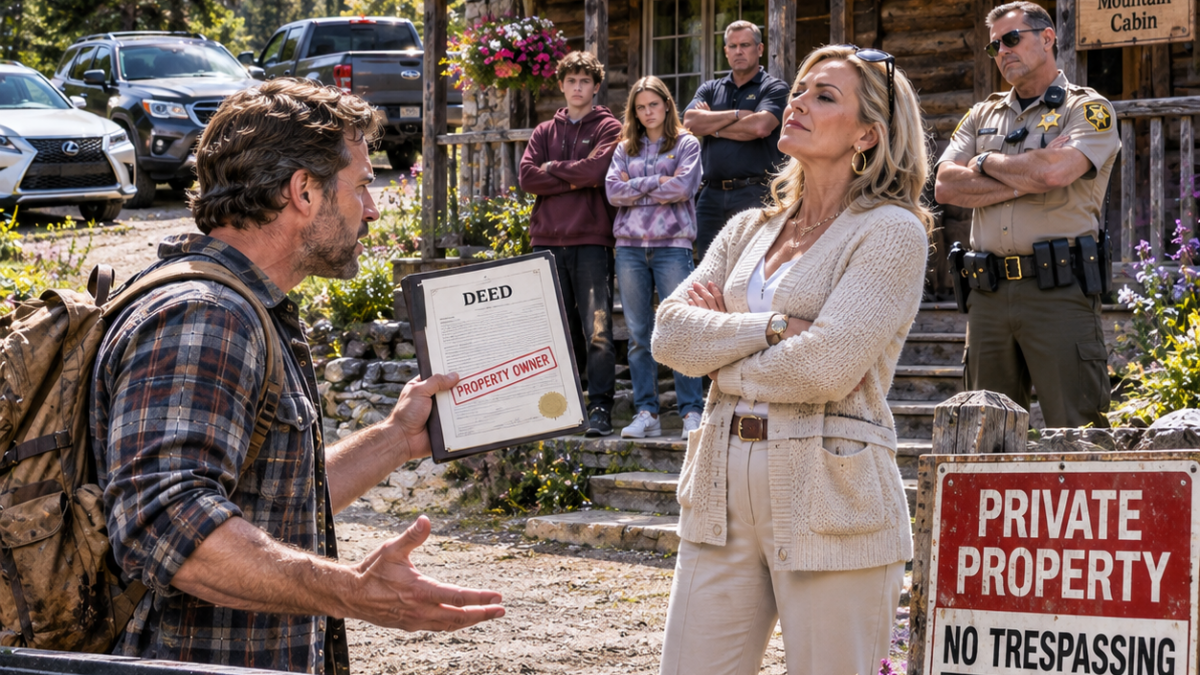
I bought an abandoned mountain cabin because I needed one place in my life nobody else could claim, so when I came back three months later with renovation tools and found a stranger drinking coffee in my kitchen while children’s bikes leaned against my porch, I honestly thought I had driven to the wrong property.
When I showed Kendra Malloy my recorded deed, she smiled, told me her family had been living there long enough to claim “adverse possession,” slammed my own front door in my face, and then watched a deputy she clearly knew hug her in the driveway before warning me that I could be arrested if I kept harassing “the residents.”
At that moment I still believed I was fighting a brazen squatter with a talent for manipulating people, but the first few records I pulled that night contained contradictions that made me wonder whether stealing my cabin was only one piece of whatever she had been doing on that mountain.
My name is Jake Morrison. I had bought the place at a county foreclosure auction after the ugliest year of my life.
My divorce had taken half my savings and most of my appetite for noise. I had spent twenty years running a contracting business in Denver, fixing other people’s homes while my own life came apart behind closed doors, and when I saw a neglected two-acre cabin outside Pine Ridge for a price I could afford, I treated it like a second chance.
The listing photos were awful—sagging porch, cracked windows, weeds against the siding.
Perfect.
I called my foreman, Lucas Ramirez, and told him to keep a Saturday open.
“Fixer-upper?” he asked.
“Money pit.”
“Better.”
“Why?”
“Fixer-uppers lie.”
Three months after closing, we drove into the mountains with tools in the truck and plans for a full renovation.
Then I saw the cars.
Three of them.
A Subaru. An old Ford Ranger. A white Lexus.
Fresh curtains hung inside the cabin. Smoke came from the chimney. Somebody had painted the porch. A bicycle lay beside the steps.
Lucas stared through the windshield.
“Boss, you said this place was empty.”
“It was supposed to be.”
I grabbed the folder containing my deed and walked up the path.
Before I knocked, the door opened.
Kendra stood there in expensive workout clothes with a coffee mug in one hand.
“Can I help you?”
“Yes. I own this property.”
She glanced at the deed as if I were trying to sell her a coupon.
“We live here.”
“I can see that.”
“Then why are you bothering us?”
“Because I bought this cabin at county auction three months ago.”
Her mouth curled.
“Oh, sweetheart. We’ve been here over a year. Adverse possession. Look it up.”
“That isn’t how adverse possession works.”
“Tell it to a judge.”
Behind her, a lanky young man appeared. Later I learned he was her adult son, Zayn. A teenage girl watched from the hallway.
I kept my voice level.
“Show me a lease, deed, court order—anything giving you a right to occupy the property.”
Kendra leaned closer.
“You’re the one trespassing.”
Then she shut the door.
Twenty minutes later, Deputy Carl Dwire pulled into the driveway.
My relief lasted until he stepped out, walked straight past me, and hugged Kendra.
She immediately started crying.
“He came here threatening my children.”
“I did no such thing.”
Dwire held up a hand.
“Sir, back away.”
I showed him the deed.
He barely looked.
“This sounds civil.”
“They are inside property I own.”
“And they claim residency. You don’t get to force your way in.”
“I haven’t.”
“Then keep it that way.”
Kendra stood behind him wiping tears that had appeared with suspicious speed.
Dwire pointed toward my truck.
“Leave today. Use the courts. If you come back here causing a disturbance, you may be arrested.”
I drove down the mountain with my deed on the seat beside me and anger so sharp I could taste it.
At three that morning, I was still awake reading Colorado property law.
Kendra had claimed one year of occupancy.
The requirement she was invoking was nowhere close to one year.
Then I started checking everything else.
Utilities had been connected only eight months earlier.
Tax records did not show her as owner.
And just before sunrise, a search result appeared on my laptop that made me sit completely still.
The listing showed my porch, my fireplace, my mountain view—and beneath the photographs were four words:
**Hosted by Kendra Malloy.**
PART 2
Underneath her name was a nightly price.
$175.
I scrolled.
Thirty-seven reviews.
Five-star comments about the fireplace.
The mountain view.
The “authentic rustic kitchen.”
My kitchen.
One guest had posted a photograph sitting on the deck with a glass of wine.
Another thanked Kendra for providing extra firewood.
A third wrote:
**Kendra was an amazing host. She told us the cabin had been in her family for generations.**
I stared at that sentence until sunrise turned my apartment window gray.
Lucas called at seven.
“You sleep?”
“No.”
“That good?”
“Better.”
“What happened?”
“She’s renting it.”
Silence.
“My cabin.”
Another pause.
“As an Airbnb?”
“Looks like it.”
“How long?”
“Months.”
Lucas whistled.
“So she’s claiming adverse possession while collecting rent from tourists?”
“Apparently.”
“Boss?”
“Yeah?”
“You sound way too calm.”
I looked at the screenshots covering my screen.
“Hot anger is for arguments.”
“What kind is this?”
“Cold.”
That morning I called the county clerk, assessor, utility provider, and title company.
I did not pretend to be law enforcement.
I asked for records I was legally entitled to or submitted written requests where needed.
By noon I had enough to know Kendra’s story was unraveling.
She had not occupied the cabin for anything close to the period she claimed.
Utilities began eight months before.
My title had transferred cleanly after the county sale.
Property taxes were current under my ownership.
No recorded deed named Kendra.
No probate filing gave her the property.
No lease appeared in the county’s foreclosure file.
The cabin had belonged to a seventy-eight-year-old widower named Walter Briggs.
After his death, unpaid taxes and other liens eventually pushed the property into foreclosure.
That was all I knew then.
I found a lawyer that afternoon.
A colleague from my construction business referred me to Ava Chen.
Her office was on the fourth floor of a brick building in Denver, small enough that I expected a solo practice and organized enough that I knew within five minutes she was dangerous.
She had spent years prosecuting financial crimes before moving into civil litigation.
I laid the deed, auction documents, screenshots, and Deputy Dwire’s incident card across her conference table.
Ava read everything before speaking.
Finally she leaned back.
“First question. Did you enter the cabin after she told you to leave?”
“No.”
“Change locks?”
“No.”
“Shut off utilities?”
“No.”
“Threaten her?”
“I told Lucas she was going to regret this.”
“To her?”
“No.”
“Good.”
She pointed at the Airbnb screenshots.
“Second question. Did you make these bookings?”
“No.”
“Send anyone there?”
“No.”
“Contact guests?”
“No.”
“Excellent. Keep not doing things.”
I almost smiled.
“What can we do?”
“We start with possession, not revenge.”
“I didn’t say revenge.”
“You didn’t have to.”
She tapped the deed.
“You appear to have title. She claims a right to possession. We let the court sort that out. No self-help eviction. No cutting utilities. No showing up with friends and tools.”
“What about the rental income?”
“We ask the court to stop new rentals while ownership and possession are litigated.”
“What about adverse possession?”
Ava shook her head.
“Based on what you’ve told me, her one-year claim doesn’t get her close. But I want the full title history before I say anything absolute.”
“Good.”
“You sound disappointed.”
“I hired you because you didn’t tell me what I wanted to hear.”
“Smart.”
She picked up Dwire’s card.
“This deputy hugged her?”
“Yes.”
“Friend?”
“Looks like it.”
“Do not make that the center of the case.”
“He ordered me off my property.”
“He prevented a confrontation while someone inside claimed residency. Maybe he handled it badly. Maybe he was biased. Maybe both. We document it and keep moving.”
That was less satisfying than calling him corrupt.
It was also better legal strategy.
Ava spent the next week building something stronger than anger.
Recorded title.
Auction confirmation.
Tax records.
Utility activation dates.
Rental listings.
Guest reviews.
Social-media posts.
The sheriff’s incident.
Then Kendra made our work easier.
She went public.
The Pine Ridge Community Group had maybe two thousand members and apparently no shortage of people eager to judge strangers before breakfast.
Kendra posted a photograph of herself with her daughter, Haley.
Her hair was messy in a way that looked professionally arranged.
The caption read:
**A wealthy Denver investor is trying to throw a single mother and her children out of the home we cared for after its elderly owner passed away.**
By noon my business page was flooded.
One-star reviews.
Messages.
Accusations.
**Predator.**
**Corporate vulture.**
**Leave that family alone.**
My contracting company employed twelve people.
By three, one client had postponed a kitchen remodel because she “didn’t feel comfortable with the controversy.”
Lucas called me.
“You seeing this?”
“Yes.”
“Let me answer them.”
“No.”
“They’re calling us thieves.”
“No posts.”
“Jake.”
“Ava said silence.”
“Ava doesn’t have strangers calling her business.”
Actually, she probably did.
Still.
“Lucas, don’t.”
He exhaled.
“Fine.”
That evening, the HOA joined in.
Pine Ridge Meadows sat down the road from my cabin. My two acres were not inside it.
That didn’t matter to Barbara Kent.
Barbara had the smooth voice of someone who could insult you while making it sound like a community newsletter.
She was the HOA president and one of Kendra’s closest friends.
Her official statement appeared on HOA letterhead:
**Pine Ridge Meadows stands with the Malloy family against predatory displacement and unethical property practices.**
I sent it to Ava.
She called thirty seconds later.
“Do not respond.”
“I know.”
“Do not respond.”
“You already said that.”
“I know your personality.”
“What’s wrong with my personality?”
“You own four nail guns.”
“Construction business.”
“Exactly.”
She paused.
“Jake, they’re creating evidence.”
“For us?”
“For themselves.”
That became my new way of looking at every insult.
Evidence.
Barbara held a community meeting called **Property Fairness in Pine Ridge**.
Someone recorded it.
I still don’t know who sent Ava the file.
The first voice belonged to Barbara.
“We cannot allow outsiders to use money and technicalities to erase community history.”
Then Kendra.
She cried on cue.
“I cared for Walter Briggs before he died. I cooked for him. Cleaned for him. He told me I was family.”
That was new.
She continued.
“After Walter passed, the cabin would have fallen apart if I hadn’t stayed.”
A man asked:
“Did he leave it to you?”
Kendra hesitated.
“He wanted me to have it.”
Not yes.
Ava rewound that part three times.
“Interesting.”
“What?”
“She changed the claim.”
“From adverse possession to inheritance?”
“Not quite. She said he wanted her to have it.”
“Meaning?”
“Meaning she knows better than to say there is a will if there isn’t one.”
The recording continued.
Barbara called me “an absentee speculator.”
Kendra claimed I’d arrived screaming.
That I had frightened Haley.
That I had threatened to put them “out in the snow.”
None of it was true.
Ava made notes.
“Does this help?”
“Yes.”
“How?”
“Because the more specific a false statement becomes, the easier it is to test.”
I rubbed my face.
“My business is getting killed.”
“I know.”
“What if I make one statement?”
“No.”
“Just the deed.”
“No.”
“Why?”
“Because your possession case is stronger than their social-media circus. Don’t turn it into a shouting contest.”
“What am I supposed to do while people destroy my name?”
Her expression softened slightly.
“Survive being misunderstood for a few weeks.”
I hated that answer.
It turned out to be one of the most important pieces of advice anyone gave me.
The court temporarily prohibited new short-term rentals while the possession dispute was pending.
The booking page disappeared two days later.
Kendra immediately went online crying about financial abuse.
Then her fundraiser appeared.
**HELP SAVE A MOUNTAIN FAMILY FROM EVICTION**
The goal was $10,000.
Within forty-eight hours, strangers had donated thousands.
I sent the link to Ava.
“Anything illegal?”
“Not automatically.”
“She’s raising money using lies.”
“Potentially relevant. Save it. Don’t report it twenty times like an angry ex-boyfriend.”
“You make me sound unstable.”
“I’m trying to keep you stable.”
The first court hearing was almost anticlimactic.
Kendra wore a conservative sweater.
No expensive yoga clothes.
Haley sat behind her.
Zayn didn’t appear.
Her lawyer argued that she had established residency with Walter’s permission and that removing her without a full hearing would cause hardship.
Ava didn’t ask the judge to throw anyone into the street that afternoon.
She asked for expedited discovery and continuation of the ban on commercial rentals.
The judge granted both.
Outside, reporters waited.
Kendra cried.
I walked past.
A woman yelled:
“Mr. Morrison, why are you evicting children?”
I kept walking.
In the truck, my hands shook so badly I missed the ignition twice.
Lucas sat beside me.
“You okay?”
“No.”
“You want me to drive?”
“Yes.”
That admission cost me more than it should have.
I had spent my adult life being the guy who fixed things.
Broken framing.
Bad wiring.
Collapsed schedules.
Clients’ panic.
My marriage had ended partly because I treated feelings like change orders.
Identify the problem.
Assign labor.
Close it.
Now I had a deed and still couldn’t enter my own house.
A stranger controlled my property.
A town hated me.
And none of my tools mattered.
Lucas drove.
Halfway back to Denver, he said:
“You know this isn’t why your marriage ended.”
I stared at him.
“I didn’t say anything.”
“You’ve got the face.”
“What face?”
“The one where you blame yourself for every disaster because it makes you feel like you can control it.”
I looked out the window.
“Focus on driving.”
“That’s what your ex said too, probably.”
“Lucas.”
“Done.”
He wasn’t wrong.
Three days later, Ava found the first serious contradiction involving Walter.
Kendra had filed a homestead-related document claiming the cabin as her primary residence.
But other records placed her primary residence elsewhere during overlapping periods.
More importantly, her own rental listings described the cabin as a vacation property available most weeks.
Ava slid the records toward me.
“This doesn’t prove a crime by itself.”
“Then why are you smiling?”
“Because it damages credibility.”
She had also obtained a sworn statement from Walter’s nephew, Colin Briggs.
Colin had not been close to his uncle near the end.
That fact would matter later.
But he had never heard Walter say he was giving Kendra the house.
According to him, Kendra began as a part-time caregiver after Walter’s mobility declined.
Then she became increasingly involved in his finances.
Colin had argued with Walter about it.
Walter told him to mind his own business.
After Walter died, Colin assumed the estate would be handled through the county.
There was little money left.
The cabin went into foreclosure.
Then Kendra stayed.
“Did Colin know she was there?”
“Not initially.”
“Why didn’t the estate remove her?”
“Small estate. Debt. Family conflict. Nobody was paying close attention.”
That sentence bothered me.
Nobody was paying close attention.
Fraud loves empty rooms.
A week later, Kendra filed a complaint with the county claiming I had neglected “tenant safety” at the cabin.
Ava called me laughing.
“Why is that funny?”
“She just signed a document calling herself a tenant.”
“She says she owns it.”
“Exactly.”
The complaint listed cracked windows, old plumbing, unsafe railings.
Most of those conditions were visible in the foreclosure photographs.
Conditions that existed before I purchased the property.
Kendra claimed I had failed to repair them.
“How am I supposed to repair a house she won’t let me enter?”
Ava smiled.
“That’s the question.”
The possession hearing came three weeks later.
This time, the judge had the full chain of title.
Kendra’s attorney abandoned the one-year adverse-possession claim almost entirely and focused on alleged permission from Walter.
“Do you have a lease?” the judge asked.
“No.”
“Written occupancy agreement?”
“No.”
“Deed?”
“No.”
“Will?”
Kendra looked at her lawyer.
“No formal will.”
The judge studied her.
“Then on what document do you base your claim of ownership?”
Kendra’s voice became soft.
“Walter promised me.”
“I understand. What document?”
None.
The court ruled that I held title and ordered a lawful process returning possession to me after the required period.
Kendra didn’t scream.
She didn’t faint.
She stood in the hallway after the hearing while cameras surrounded her and said:
“This isn’t justice. It’s what happens when rich men buy courts.”
I wasn’t rich.
That part almost made me laugh.
Almost.
A reporter asked whether I had anything to say.
Ava looked at me.
For once she didn’t say no.
I stopped.
“My name is Jake Morrison. I bought a foreclosed property through a legal county sale. I have followed the court process from the day I discovered people living there. That’s all I’m going to say.”
“Will you put the family on the street?”
“The court order has a date. We will follow it.”
Then I left.
My first public statement was boring enough that nobody could turn it into much.
That felt like victory.
The next morning Barbara Kent released another HOA message condemning “outsider intimidation.”
That was when one of her own board members contacted me.
His name was Martin Hale.
He asked to meet in a diner thirty miles away.
I brought Ava.
Martin looked nervous from the moment he sat down.
“I can’t be seen helping you.”
Ava said:
“Then maybe you shouldn’t be here.”
He swallowed.
“Kendra lied to us.”
“About what?” I asked.
“She said Walter left her the cabin.”
“Did she show you a will?”
“She showed Barbara something.”
“What?”
“I don’t know. Barbara wouldn’t let us copy it.”
Ava leaned forward.
“What did the board do based on that representation?”
“We voted to support her publicly.”
“Anything else?”
Martin looked at me.
“We discussed helping pay her attorney from a neighborhood assistance fund.”
My jaw tightened.
“Did you?”
“No. I stopped it.”
“Why?”
“Because I checked the county records.”
He looked embarrassed.
“I should’ve checked earlier.”
Ava asked:
“Would you sign an affidavit regarding what you personally heard and saw?”
Martin hesitated.
Then nodded.
“Yes.”
That affidavit cracked Barbara’s support.
Not immediately.
But enough.
The eviction deadline approached.
Kendra’s online persona changed.
The tears disappeared.
The posts became angrier.
She accused the assessor of corruption.
The judge of favoritism.
Me of buying witnesses.
Ava of “weaponizing legal technicalities against mothers.”
Then my bank called.
Someone had filed a complaint alleging the money used in my property purchase came from fraudulent business activity.
It was nonsense.
But compliance departments don’t laugh at accusations involving property transactions.
A temporary review began.
Two client payments into my business account were delayed.
I nearly put my fist through my office wall.
Instead I called Ava.
“They’re hitting my business now.”
“I know.”
“How?”
“Kendra sent allegations to multiple institutions.”
“Can we sue her today?”
“We already have claims pending.”
“I want something that hurts now.”
Silence.
“Jake.”
“What?”
“You are starting to sound like her.”
That stopped me.
Ava continued.
“You want a process to produce a result because you’re angry, not because the evidence is ready.”
I sat down.
“That is what she does.”
I hated her for being right.
Again.
“What do I do?”
“Send the bank what it asks for.”
“That’s it?”
“And let me handle the false filings.”
I did.
The bank released the review quickly once purchase records and business documentation were verified.
But the damage wasn’t zero.
My patience was thinning.
Then Kendra made a mistake.
She called me.
Unknown number.
I answered without thinking.
“You think you’re clever.”
Her voice.
I stood.
“Kendra?”
“You destroyed my income.”
“You were renting my cabin.”
“My home.”
“The judge ruled on that.”
“Judges can be wrong.”
“Talk to Ava.”
“I don’t talk to your little attack dog.”
I almost laughed.
Calling Ava little was a mistake on several levels.
Kendra continued.
“You’re ruining my daughter.”
“I haven’t contacted Haley.”
“You’re taking the only home she has.”
“You had months to arrange housing.”
“You think everybody has your money?”
I looked around my small apartment.
“You don’t know anything about my money.”
“I know your business.”
The sentence chilled me.
“What about it?”
“I know who your customers are.”
I stayed silent.
“You should think about how much more you can afford to lose.”
“Is that a threat?”
She laughed.
“You contractors hear threats everywhere.”
The line went dead.
I called Ava.
Then the sheriff’s office.
Deputy Dwire took the report.
Of course he did.
He sat behind the desk reading my written statement with the expression of a man reviewing a parking dispute.
“She didn’t explicitly threaten violence.”
“I didn’t say she did.”
“You’re asking us to document a vague phone call.”
“Yes.”
He sighed.
“You know, Jake, Kendra’s under a lot of stress.”
I stared at him.
“Did you just call me Jake?”
He looked up.
“You’ve been around enough.”
“I’ve spoken to you twice.”
Silence.
There it was.
Familiarity.
Not friendship with me.
Information about me through her.
I stood.
“Give me the report number.”
He slid it over.
“Don’t stir this up.”
I picked up the card.
“I’m documenting it.”
“You came into a small town and immediately turned everything into lawyers and paperwork.”
“No.”
I looked at him.
“I came into a small town and found a woman charging tourists to sleep in my house.”
His jaw tightened.
I left.
I filed a formal complaint about Dwire’s handling with the sheriff’s supervisor.
Not corruption.
Not conspiracy.
Specific conduct.
Failure to meaningfully review my ownership documents at the first encounter.
Personal familiarity with one party.
Comments suggesting partiality.
The department opened an internal review.
Dwire was reassigned from matters involving me or Kendra.
That was all.
No dramatic badge removal.
No handcuffs.
Just one compromised piece removed from the board.
The day the possession order became enforceable, deputies went to the cabin.
I stayed away.
Ava insisted.
“Let the process happen without you.”
Hours later, she called.
“They’re out.”
I sat very still.
“Everyone?”
“Yes.”
“Kendra?”
“Yes.”
“Zayn?”
“Yes.”
“Haley?”
“Yes.”
“Any trouble?”
“Some yelling. No violence.”
I closed my eyes.
“Can I go?”
“Tomorrow.”
“Why tomorrow?”
“Because county staff are documenting condition.”
That sentence saved us.
When I arrived the next morning, I barely recognized the cabin.
Every front window was broken.
Kitchen cabinet doors hung by hinges.
Faucets had been left running.
Water had warped sections of flooring.
Someone had spray-painted **THIEF** across the living-room wall.
A bedroom door was kicked in.
Drywall smashed.
The old fireplace surround cracked.
Lucas stood beside me.
He didn’t make a joke.
Not one.
“Security footage?” he asked.
I pointed toward the exterior camera we’d installed after obtaining court permission near the end of the case.
“Cloud backup.”
Inside cameras had been disabled.
Outside footage showed enough.
Kendra’s Lexus.
Zayn carrying items out.
Zayn returning with a sledgehammer.
Kendra standing on the porch.
At one point Zayn looked directly toward the exterior camera and raised one finger.
Lucas stared at the paused image.
“He’s an idiot.”
“Yes.”
“Good.”
The sheriff’s office came.
Different deputies.
County investigator.
Photographs.
Evidence.
No one called it a civil matter now.
While they documented the bedroom, one investigator noticed papers inside a cavity where Zayn had smashed the drywall.
At first, I assumed they were insulation packaging.
Then he put on gloves.
“Mr. Morrison, don’t touch this.”
Inside the wall was a plastic-wrapped bundle.
Old bank statements.
Medical paperwork.
Insurance documents.
Copies of identification.
A power-of-attorney form.
Walter Briggs’s name appeared repeatedly.
I watched from the doorway.
The investigator looked through several pages without removing them from the protective sleeve.
“Did you put these here?”
“No.”
“Know they existed?”
“No.”
“Anyone else have access after you bought?”
“Kendra and her family.”
He called his supervisor.
The cabin became a scene again.
Not mine.
Not yet.
I stood outside with Lucas.
The morning was cold enough that our breath hung between us.
“What does it mean?” he asked.
“I don’t know.”
“Good answer?”
“Only one I have.”
Ava arrived two hours later.
She was not smiling.
The documents did not prove murder.
That became important.
Social media later jumped from “hidden paperwork” to “killer caregiver” in less than a day.
Reality moved slower.
The county’s elder-abuse investigators reviewed the records.
Walter had given Kendra limited authority to assist with some medical and financial tasks.
The authenticity of later documents was questionable.
Several signatures differed sharply from verified examples.
There were withdrawals from Walter’s accounts that his nephew didn’t recognize.
An insurance policy had been changed months before Walter died.
Kendra appeared as beneficiary on at least one modest policy.
None of that automatically meant she killed him.
It did mean investigators wanted to know more.
Colin Briggs was interviewed again.
This time he brought old emails.
In one, Walter complained:
**Kendra keeps telling me I shouldn’t bother you with money things.**
Another:
**She says the bank forms are routine. I’m tired of arguing.**
Colin looked wrecked when he showed me the copies later.
“I thought he was being stubborn.”
“You couldn’t know.”
“I could have visited.”
I had nothing useful to say.
So I didn’t.
Kendra and Zayn were charged in connection with the property destruction based on video and other evidence.
Kendra’s lawyer called the hidden documents “abandoned papers belonging to a deceased former owner.”
Maybe.
Then a forensic document examiner reviewed them.
Some signatures appeared inconsistent.
Financial investigators followed the money.
Walter’s account showed withdrawals that increased as his health declined.
Transfers moved through accounts associated with Kendra.
Then insurance.
Then rental income after his death.
The case moved from county elder exploitation into a broader financial investigation because some transactions and communications crossed state lines.
That was how I met Special Agent Sophia Reyes.
Not in some dark FBI interrogation room.
In Ava’s office.
Reyes was compact, calm, and allergic to unnecessary drama.
She arrived with another agent named Derek Cole.
Before sitting, she told me:
“This is not a television show.”
“I figured.”
“You will not investigate for us.”
“Fine.”
“You will not contact Ms. Malloy.”
“Gladly.”
“You will not try to bait her into admitting anything.”
I looked at Ava.
Ava looked innocent.
“Did she tell you I was going to?”
Reyes almost smiled.
“She described you as motivated.”
“That sounds nicer.”
Reyes opened a notebook.
“We’re interested in the financial records found in the cabin and certain interstate transactions. We are not telling you that Ms. Malloy killed Walter Briggs.”
“Understood.”
“Do you actually understand?”
“Yes.”
“Good.”
She interviewed me for nearly two hours.
Purchase timeline.
First encounter.
Dwire.
Airbnb.
Court case.
Vandalism.
Hidden papers.
Every detail.
At the end I asked one question.
“Was Walter exploited?”
Reyes closed her notebook.
“It looks that way.”
“By Kendra?”
“We’re investigating.”
I hated that answer.
But it was the right one.
The Pine Ridge rumor mill had no such restraint.
Within days, people who had called me a monster were suddenly claiming they’d “always known” Kendra was dangerous.
Mandy, the barista who refused to serve me, offered free coffee.
I declined the free part.
Barbara Kent removed her statement supporting Kendra from the HOA website.
Then posted:
**The association had no knowledge of any alleged financial misconduct and was misled regarding the property dispute.**
Martin sent me a screenshot with one word.
**Coward.**
I didn’t reply.
Barbara came to my cabin the following week.
She brought cookies.
Of course she did.
“Jake.”
“Barbara.”
“I feel terrible.”
“I’m sure.”
“We believed Kendra.”
“You published accusations about me.”
“We were trying to support a family.”
“You called me a predatory investor.”
Her cheeks tightened.
“That was based on information we had.”
“You had my deed available in county records.”
“We’re an HOA, not investigators.”
“Then maybe don’t issue investigative conclusions.”
She looked at the damaged cabin.
“We’re reviewing our policies.”
“Good.”
“Some residents would like to help rebuild.”
That surprised me.
I almost said no.
Pride.
Then I remembered Lucas accusing me of needing to control every outcome.
“Tell them I’ll think about it.”
Barbara smiled with relief.
“Thank you.”
“That wasn’t forgiveness.”
Her smile faded.
“I know.”
She left.
I eventually let people help.
Not Barbara at first.
Lisa Rodriguez from the diner brought sandwiches.
Frank Murphy from the lumber store offered materials at cost.
Martin brought two friends and rebuilt part of the fence.
A retired electrician rewired damaged outlets.
Even Mandy showed up with coffee.
She stood awkwardly on the porch.
“I owe you an apology.”
“Yes.”
She looked surprised.
Most people expect forgiveness before they’ve finished apologizing.
“I treated you like trash.”
“Yes.”
“I believed Kendra because everybody else did.”
I waited.
She swallowed.
“I should’ve checked.”
“Yes.”
Then I took the coffee.
“Thank you.”
That was enough.
Healing does not require pretending people did nothing wrong.
The financial investigation continued quietly.
Then Walter’s medical records raised a question.
Several medication entries did not match his regular prescriptions.
A state medical examiner reviewed the circumstances of his death.
Walter had been elderly and ill.
His death had originally looked natural.
But because investigators now had evidence suggesting possible financial exploitation, prosecutors sought further review.
I learned very little while it happened.
That was frustrating.
Then Reyes called me.
“Come to Ava’s office.”
“Why?”
“Because I don’t want to explain this by phone.”
That sentence ruined my morning.
When I arrived, Ava already knew something.
I could tell by her face.
Reyes placed three folders on the table.
“Walter Briggs may not be the only victim of the financial scheme we’re investigating.”
I stared.
“What does that mean?”
“We found similar transactions involving two elderly property owners in other counties.”
“Kendra?”
“Names associated with her. Different variations. Some may be aliases.”
My stomach tightened.
“How did they die?”
Reyes held up a hand.
“Don’t jump.”
“I’m asking.”
“Both were elderly. Both died after periods of declining health.”
“Natural causes?”
“Originally.”
Silence.
Ava asked:
“What links them?”
“Caregiving arrangements. Property documents. Insurance changes. Transfers.”
I leaned back.
“So the cabin—”
“May be part of a pattern.”
That sentence changed the room.
Not proof of murder.
Pattern.
That was enough.
Kendra’s public story collapsed.
Her fundraiser disappeared.
The short-term rental platform removed her account.
The county opened a separate tax investigation.
The HOA board scheduled a meeting to discuss Barbara’s conduct.
Then someone smashed the remaining windows at the cabin.
Again.
This time the cameras captured Zayn clearly.
He arrived after midnight.
Hoodie.
Pry bar.
Gas can.
Lucas happened to be staying in a motel nearby because we’d started repairs.
His phone received the camera alert.
He called me.
I called 911.
No heroics.
No driving up the mountain at ninety miles an hour.
Deputies arrived while Zayn was still on the property.
They found the gas can near the detached shed.
Whether he intended arson or intimidation became a matter for prosecutors.
What mattered to me was simpler.
He was arrested.
The next morning I stood beside the cabin staring at the can.
Ava joined me.
“You okay?”
“No.”
“Good.”
I looked at her.
“You always say that.”
“Because people keep asking you if you’re okay during objectively terrible situations.”
I laughed despite myself.
Then stopped.
“What if Kendra sends someone else?”
“Protection order.”
“She doesn’t care.”
“Then criminal consequences.”
“What if that’s not enough?”
Ava looked toward the trees.
“Then you decide whether owning this place is worth living scared.”
That hurt.
Because I had begun believing that leaving would mean losing.
Ava saw it.
“Jake, selling a house is not surrender.”
“I know.”
“No, you don’t.”
I looked at the cabin.
The sagging porch was gone.
Lucas and I had rebuilt it.
New windows waited in crates.
Fresh lumber lay stacked beneath tarps.
I had bought the property to rebuild my life.
Now it felt as if Kendra had moved into my head even after leaving the house.
“I’m not deciding today.”
“Good.”
A week later, Walter’s nephew Colin came to see me.
He carried a box.
“I found these in my garage.”
Inside were Walter’s journals.
Nothing dramatic.
Weather.
Groceries.
Doctor visits.
Notes about the creek.
Then Kendra’s name began appearing.
**Kendra came by. Nice girl. Says she can help with errands.**
Weeks later:
**Kendra says Colin worries too much. Maybe she’s right.**
Then:
**Signed bank paper. Hard to read today.**
Later:
**Asked K about account. She got angry. Said I was confused.**
And finally:
**I don’t like when Z is here. He goes through drawers.**
Z.
Possibly Zayn.
Colin sat across from me at the kitchen table in Ava’s office.
“I left him alone.”
“He was an adult.”
“He was sick.”
“You didn’t know.”
“I knew enough to be annoyed.”
He wiped his face.
“I thought Kendra was doing the work nobody else wanted to do.”
That was the tragedy.
Manipulators rarely begin by asking for everything.
They begin by being useful.
Reyes took custody of copies through proper channels.
The journals became part of the larger case.
Then came toxicology.
Walter’s preserved medical samples were limited.
But investigators in another county obtained an exhumation order involving a different alleged victim.
I did not know the details until charges were eventually filed.
The state alleged that a toxic substance inconsistent with the man’s prescribed treatment had contributed to his death.
Then a second victim showed similar findings.
Suddenly, the investigation wasn’t just fraud.
Kendra was arrested on a new warrant while staying with a relative outside Pine Ridge.
No dramatic shootout.
No television confession.
She was taken into custody in a grocery-store parking lot.
Reyes called me afterward.
“We have her.”
I sat on my rebuilt porch.
“What charges?”
“Financial crimes for now, plus state charges tied to exploitation and the death investigation. More may follow.”
“Did she say anything?”
“Jake.”
“Right.”
“Stay out of it.”
“I’m on my porch.”
“Remain there.”
She hung up.
I expected relief.
Instead I felt tired.
Deeply, stupidly tired.
Lucas found me there an hour later.
“She’s arrested?”
“Yes.”
“Then why do you look like somebody died?”
I looked toward the cabin.
“Because somebody did.”
Walter.
Maybe others.
And somehow my fresh start had become the doorway into all of it.
The cabin wasn’t just stolen property anymore.
It was where an old man might have been manipulated while everyone around him assumed someone else was paying attention.
I went inside.
The bedroom wall remained open where the hidden documents had been found.
For weeks I’d avoided closing it.
That night I stood there with a sheet of drywall and couldn’t move.
Lucas came in.
“Want help?”
“No.”
He waited.
“I can do it.”
“I know.”
“Then why are you still here?”
“Because sometimes people don’t need help doing the work.”
“What do they need?”
“Someone there while they do it.”
I hated him again.
We closed the wall together.
The prosecution took more than a year.
During that year, investigators connected Kendra to multiple identities and several older people whose finances had been compromised before their deaths.
Not every death became a homicide charge.
That distinction mattered.
Some victims had died of genuine medical causes while money was stolen around them.
Others required deeper forensic review.
The case that ultimately went to trial focused on what prosecutors believed they could prove beyond a reasonable doubt.
Walter’s financial exploitation.
Forgery.
Identity-related fraud.
Obstruction.
Conspiracy.
And homicide charges connected to Walter and another victim after medical and documentary evidence were reviewed.
The federal case handled interstate fraud and related conspiracy counts.
The state handled the homicide prosecution.
Zayn eventually entered a plea on property destruction, fraud-related conduct, and evidence issues.
As part of his cooperation, he gave investigators information about his mother’s aliases and document sources.
I didn’t celebrate.
He was a grown man responsible for his choices.
He was also Kendra’s son.
Both things could be true.
Haley vanished from Pine Ridge after her mother’s arrest.
I worried about her more than I expected.
She had been a teenager inside a house adults were fighting over.
Whatever Kendra had done, Haley hadn’t chosen the world she’d been raised in.
Barbara Kent’s HOA situation unraveled too.
Residents discovered how aggressively she’d used association resources to support Kendra without verifying the facts.
The community fund had not paid Kendra’s attorney, thanks largely to Martin.
But HOA staff time, official communications, mailing lists, and the association website had been used to campaign against me.
Residents demanded a vote.
Barbara resigned before they could remove her.
The old board collapsed.
An audit later found sloppy related-party spending and several questionable reimbursements, though nothing approaching Kendra’s criminal conduct.
Pine Ridge Meadows eventually dissolved the old governing structure and replaced it with a much narrower association responsible mainly for shared road maintenance, snow removal, and common infrastructure.
No president with a personal propaganda department.
No “community morality” statements.
Martin became treasurer.
I teased him once.
“You joined the government.”
“Snowplows, Jake.”
“Power corrupts.”
“Come talk to me in February.”
Fair.
Deputy Dwire’s internal review ended quietly.
The department found that he had exercised poor judgment in his handling of the original call and failed to maintain appropriate professional distance given his familiarity with Kendra.
He received discipline and retraining.
Later he transferred to another assignment.
Months after that, he appeared at my cabin.
No uniform.
Jeans.
Work gloves.
I was replacing porch boards.
He stood at the gate.
“Can I come in?”
The question mattered.
“Yes.”
He walked up.
“I owe you an apology.”
I waited.
“I knew Kendra.”
“I noticed.”
“She helped my sister after her husband died. Brought food. Watched the kids.”
That complicated the picture.
“I thought I knew what kind of person she was.”
“Most people did.”
“I saw you as some investor showing up to throw out a family.”
“You didn’t look at my deed.”
“No.”
He looked down.
“I should have.”
“Yes.”
“I also shouldn’t have hugged her before I figured out what was happening.”
“No.”
“That was stupid.”
“Yes.”
He finally smiled.
“You going to make this easy at all?”
“No.”
“Fair.”
He pointed at the boards.
“Need help?”
I considered it.
Then handed him a hammer.
“Start there.”
We worked three hours.
He didn’t ask for forgiveness again.
That helped more than another speech would have.
The trials were brutal.
I attended only the portions where I was required or where Walter’s family asked me to be there.
Kendra looked different.
Smaller.
Gray in her hair.
No expensive athleisure.
No smug smile.
Her defense challenged the financial records.
The medical conclusions.
The chain of custody.
Witness credibility.
They argued that Walter had voluntarily given her broad access because he trusted her.
They argued that some signatures were genuine and some questionable records could have been created by Zayn or another associate.
They argued that Walter’s health was already poor.
That was their job.
The prosecution answered with documents.
Bank transfers.
Messages.
Insurance records.
Recorded calls.
Metadata.
Walter’s journal.
Expert testimony.
Zayn’s cooperation.
Evidence from other properties.
Then came the voice recordings recovered from Kendra’s devices.
No movie-style confession.
Something worse because it sounded ordinary.
In one recording she complained to an associate that Walter was “taking too long.”
In another, she discussed getting a document signed before he became “too confused to hold a pen.”
Then an investigator recovered messages with a man identified in the case as Harold Stone.
Stone had once worked around real-estate law and title transactions.
By the time Kendra knew him, prosecutors alleged, he was helping a network create fraudulent documents and move money through shell companies.
One message from Kendra read:
**If county moves before we record, I lose the cabin.**
Stone replied:
**Then keep possession and make the buyer fight. Time is leverage.**
I sat in the courtroom reading that on a screen.
My first day at the cabin came back.
Kendra at the door.
**Adverse possession. Look it up.**
Not improvisation.
A strategy.
Make the rightful owner believe the process is hopeless.
Use occupancy.
Use delay.
Use sympathy.
Use local allies.
Monetize the property while litigation drags.
For the first time, everything fit.
After court, Reyes found me on the steps.
“You okay?”
“No.”
“Good answer.”
“Ava taught you that?”
“She talks about you.”
“Terrifying.”
Reyes looked toward the courthouse.
“Stone is cooperating.”
“The broker?”
She nodded.
“He helped with more than Kendra.”
“How many?”
“Enough.”
“Will they get everyone?”
“No.”
I appreciated the honesty.
“But they’ll get some.”
The state jury convicted Kendra on the major counts it was asked to decide.
The exact verdict was not the sweeping fantasy the internet later invented.
Some charges were dismissed before trial.
One count resulted in acquittal.
Others produced guilty verdicts.
But the most serious homicide and exploitation charges were sustained.
The federal fraud case ended with additional convictions and plea resolutions involving coconspirators.
Kendra received a sentence that meant she would spend the rest of her meaningful adult life in prison.
When the judge spoke, the courtroom stayed almost perfectly silent.
I thought I would feel triumph.
Instead I thought of Haley.
Then Walter.
Then the first night I’d spent Googling adverse possession at three in the morning because a stranger had convinced a deputy that I didn’t belong at my own cabin.
The judge asked whether I wanted to provide a victim statement.
I stood.
“I bought a building.”
My voice sounded strange in the courtroom.
“I thought that was what this case was about.”
I looked toward Kendra.
“It wasn’t.”
Then Walter’s nephew.
“It was about how easily someone can take advantage of empty spaces—empty houses, empty paperwork, empty relationships, the places where everybody assumes someone else is paying attention.”
Kendra stared at the table.
“I wanted my cabin back.”
I swallowed.
“Walter Briggs deserved more than that. He deserved someone to notice while he was still alive.”
I sat down.
Outside, reporters shouted questions.
I answered none.
Lucas waited beside my truck.
“How’d it go?”
“It’s over.”
He looked at me.
“No, it isn’t.”
I hated that he knew me so well.
The cabin was still scarred.
Crime-scene repairs.
Water damage.
Broken drywall.
Burn marks near the fireplace where evidence had been destroyed.
Every room had a memory I hadn’t chosen.
I considered selling.
Ava told me there was no shame in it.
Lucas said the same.
Even Reyes.
For a week, I prepared a listing in my head.
Then I found the tin box.
It happened while replacing damaged framing in the master bedroom.
My pry bar hit metal behind an old timber brace.
I stopped.
Not another hidden evidence compartment.
That was my first thought.
I called Lucas.
He stood beside me as I carefully pulled out a small rusted box wrapped in old cloth.
No plastic.
No modern tape.
Dust had sealed the edges.
“Police?” Lucas asked.
“Probably.”
We called.
An investigator checked it.
Nothing obviously connected to Kendra.
After documentation, it was returned as old property contents.
Inside were photographs.
Walter as a young man beside a pickup.
Walter with a woman I assumed was his wife.
A fishing picture.
A wedding photograph.
Then a folded note.
The handwriting was shaky but deliberate.
**To whoever owns this house next,**
**Take care of the creek. It’s where I met the love of my life.**
**If the walls ever feel heavy, open the windows. The mountain will remind you it’s still good.**
**Walter Briggs**
I read it twice.
Then sat on the floor.
Lucas didn’t speak.
For months Walter had existed in my head as a victim.
A name on records.
A dead man at the center of Kendra’s crimes.
The photographs changed that.
He had laughed.
Loved somebody.
Owned a truck.
Fished badly, judging by the tiny trout in his picture.
Built a life before Kendra ever arrived.
I suddenly understood why selling felt wrong.
Not because I needed to prove I had won.
Because the cabin had spent long enough being defined by the worst thing that happened inside it.
I folded Walter’s note.
“Not selling.”
Lucas smiled.
“Knew it.”
“Shut up.”
We rebuilt.
Properly this time.
Cedar siding where rot had spread.
New windows.
Reinforced porch.
Updated plumbing.
Electrical.
A stone fireplace cleaned and restored instead of replaced.
I used the stain I’d chosen before any of this began.
Cedar Ember.
At sunset, the deck really did glow gold.
Volunteers came.
Some because they felt guilty.
Some because they cared.
I stopped trying to distinguish.
Lisa from the diner brought food.
Frank Murphy supplied lumber nearly at cost.
Mandy showed up with coffee.
Martin organized people from Pine Ridge Meadows.
Dwire came twice more.
No one livestreamed.
No reporters.
Just work.
One afternoon, while we were rebuilding the fence, a car stopped at the road.
A teenage girl got out.
Red hair.
Thin jacket.
Haley.
My hammer stopped.
She stayed outside the gate.
“Mr. Morrison?”
“Yes.”
“Can I talk to you?”
I walked over.
She held an envelope with both hands.
“You don’t have to let me in.”
“Do you want to come in?”
She looked toward the cabin.
“No.”
That hurt more than if she’d said yes.
“All right.”
She stared at the new porch.
“Mom said you stole this place.”
“I know.”
“I believed her.”
“You were her daughter.”
“That doesn’t make it okay.”
“You were a kid.”
She looked at me sharply.
“I’m eighteen.”
“Now.”
Her eyes filled.
“Zayn knew more.”
I stayed quiet.
“I didn’t.”
“I believe you.”
“How?”
“Because investigators would know more than I do.”
That almost made her laugh.
Then she looked at the cabin again.
“Walter was nice to me.”
My throat tightened.
“You knew him?”
“A little.”
“Before he died?”
She nodded.
“He gave me drawing paper.”
“What did you draw?”
“Horses.”
For some reason, that detail hit hard.
Haley wiped her face.
“My mom said he didn’t have family who cared.”
“His nephew cared.”
“I know that now.”
She held out the envelope.
“I’m moving to Oregon. My aunt lives there.”
“Good.”
“She says I can finish school.”
“Better.”
Haley looked at me.
“I’m sorry for what my family did to you.”
“You don’t owe me their apology.”
“I owe you mine.”
I accepted the envelope.
“Then I accept it.”
She started walking away.
“Haley.”
She turned.
“Don’t make your mother’s guilt your inheritance.”
Her face crumpled for a second.
Then she nodded.
She walked down the mountain road until the pines hid her.
Inside the envelope was one sentence.
**Maybe this place can finally heal someone the way it couldn’t heal her.**
I put it beside Walter’s note.
That sentence changed the cabin’s future.
At first, the idea was small.
Ava and I were sitting on the porch after the renovation passed final inspection.
She looked around.
“So what now?”
“I live here.”
“For real?”
“Mostly.”
“No flipping?”
“No.”
“You spent a year telling me it was an investment.”
“I was wrong.”
She smiled.
“Growth.”
“Don’t ruin the moment.”
I looked toward the creek.
“What if part of it was used for something else?”
“What?”
“People who get scammed out of property.”
Ava’s expression changed.
“Legal clinic?”
“Maybe.”
“Temporary lodging?”
“Maybe.”
“Education?”
“Maybe.”
She leaned back.
“You’ve thought about this.”
“For six minutes.”
“Dangerous.”
The Briggs Foundation started with one room, one lawyer, and one old contractor who had no idea how nonprofit paperwork worked.
Ava handled that part.
Lucas repaired a detached workshop into an office.
Reyes connected us with victim-assistance professionals after she was allowed to.
We did not become vigilantes.
That rule was mine.
No crowd-sourced investigations.
No “exposing” strangers online.
No amateur criminal cases.
People brought documents.
We helped them find lawyers, law enforcement, housing services, and legitimate resources.
The first family stayed three nights.
A widow named Marjorie arrived months later after losing access to property through forged liens.
She sat at my kitchen table with hands shaking around coffee.
“I feel stupid.”
“Don’t.”
“I signed something.”
“So have I.”
“I should’ve known.”
“Why?”
“Because everybody says these scams are obvious afterward.”
I leaned forward.
“Afterward is cheating.”
She looked up.
“What?”
“Once you know the answer, every clue looks obvious.”
That was something I had learned from Kendra.
Marjorie stayed six weeks.
The day she left, she hugged Lucas.
Then Ava.
Then me.
“I thought that house was the last thing my husband left me.”
I understood.
“What did you get back?”
She smiled.
“Myself, I think.”
The foundation grew.
Slowly at first.
Then faster.
Too fast sometimes.
Donations.
Lawyers volunteering hours.
Retired title examiners.
Forensic accountants.
Victim advocates.
A small cabin was added down the hill.
Then another.
I refused every suggestion to turn Walter’s cabin into a tourist attraction.
No Airbnb.
No murder tours.
No “true crime weekend.”
A streaming producer offered an amount of money that made Lucas sit down.
I declined.
“You’re insane,” he told me.
“Probably.”
“That money could build two cabins.”
“They want actors reenacting Kendra threatening me.”
“So?”
“I don’t need to watch somebody play me.”
Lucas thought.
“Can I?”
“No.”
Eventually, I agreed to one documentary.
A small production.
No reenactments.
No dramatic music over Walter’s photographs.
The director, Tessa Liu, focused on the aftermath.
The town.
The foundation.
Haley’s decision to start over.
Deputy Dwire’s apology.
Barbara’s resignation.
The people who had believed a lie because it felt morally convenient.
When the film aired, I watched ten minutes and turned it off.
Ava watched all of it.
“You looked old.”
“Thank you.”
“You cried nicely.”
“I hate you.”
It helped the foundation raise enough to hire a full-time advocate.
That mattered more than my discomfort.
Years after the cabin fight began, Reyes called.
By then she’d retired from federal service.
“The broker case is done.”
I stood on the porch.
“Harold Stone?”
“Yes.”
“What happened?”
“Plea. Long sentence. Asset forfeiture. Cooperation.”
“How many victims?”
“More than I want to say casually.”
I leaned against the railing.
“Was Kendra his biggest operator?”
“No.”
That surprised me.
“She was one of several.”
“So she learned it from him.”
“She learned methods. She made her own choices.”
Important distinction.
“Did he mention Pine Ridge?”
Reyes laughed.
“He said the Morrison purchase ruined a profitable chain.”
“That may be the nicest thing anyone has ever said about me.”
“Don’t put it on a business card.”
Too late.
Lucas wanted to.
We didn’t.
The old HOA never returned in its previous form.
Pine Ridge residents created a limited road and snow-maintenance association.
Barbara moved away.
I heard she was living near her sister in Arizona.
No criminal empire.
No dramatic end.
Just a woman who had publicly trusted the wrong person and used authority irresponsibly.
Her consequence was losing the position she had treated like a throne.
That was enough.
Martin ran the new association’s finances.
Every meeting agenda and statement went online.
Once a year he sent me a joke invoice:
**OUTSIDER SURCHARGE — $0.00**
I paid promptly.
Deputy Dwire retired earlier than expected.
He occasionally volunteered at foundation workdays.
The first time someone introduced him as “the deputy who threw Jake off his own property,” he went red.
I stopped it.
“He made a bad call.”
The volunteer apologized.
Dwire looked at me afterward.
“You didn’t have to do that.”
“Yes, I did.”
“Why?”
“Because if I let the worst thing you did become your whole identity, I’d be doing what everybody did to me.”
He didn’t answer.
We went back to work.
Haley returned to Colorado when she was twenty-one.
She had been studying psychology and victim advocacy.
She emailed first.
Not Kendra’s daughter asking for forgiveness.
Haley Malloy applying for an internship.
Ava laughed when she saw the application.
“That’s bold.”
“Runs in the family.”
“Too soon.”
“Probably.”
We interviewed her like anyone else.
She was nervous.
Prepared.
Smart.
At the end Ava asked:
“Why here?”
Haley looked toward me.
Then back to Ava.
“Because my mother taught me what happens when someone builds their identity around getting away with things.”
She breathed.
“I want mine to be about what happens after.”
We accepted her.
Not because of Kendra.
Not despite Kendra.
Because she earned it.
The first time Haley led a survivor-support group, I stood outside the door listening for maybe thirty seconds.
Then walked away.
Some moments belong to the people having them.
Walter’s creek became the center of the property.
Not the cabin.
Not the crime.
The creek.
I built a simple footbridge with Lucas.
Nothing fancy.
Good timber.
Steel brackets.
Stone footings.
A small plaque stood beside it:
**WALTER BRIGGS, 1931–2023**
**HE BUILT A HOME. WE KEPT IT STANDING.**
The anniversary gathering started accidentally.
Five people came the first year.
Twenty the next.
Eventually more than a hundred survivors and families gathered each autumn with candles along the water.
No speeches from me if I could avoid them.
Ava usually failed to let me avoid them.
One year Haley took the microphone.
She was twenty-three.
Steadier now.
“My mother hurt people.”
The creek moved behind her.
“She also spent years teaching me, without meaning to, that lies grow strongest in silence.”
She looked toward the crowd.
“I used to think my only choices were defending her or hating her.”
She paused.
“Neither helped anybody.”
Her voice tightened.
“I can love the parts of the mother I remember without pretending the harm didn’t happen.”
Nobody moved.
“And I can choose not to continue it.”
I looked away because my eyes were burning.
Afterward, she found me near Walter’s bridge.
“You okay?”
“No.”
She smiled.
“Good answer.”
Ava had infected everyone.
“You did well.”
“I thought I was going to throw up.”
“Also normal.”
Haley looked toward the cabin lights.
“Do you ever think about the first day?”
“All the time.”
“My mom closing the door?”
“Yes.”
“She told me afterward you were a bad man.”
“I know.”
“I wanted to believe her.”
“You were sixteen.”
“I still remember smiling when the deputy made you leave.”
That admission hurt.
She saw it.
“I’m sorry.”
I took a long breath.
“Thank you.”
She stared at the creek.
“I wish I could change that.”
“You can’t.”
“I know.”
“But you changed what came after.”
That was enough.
On the fifth anniversary of buying the cabin, I opened Walter’s old note.
The paper had softened along the folds.
**If the walls ever feel heavy, open the windows. The mountain will remind you it’s still good.**
I walked through the cabin opening every window.
Cold air pushed through the rooms.
Pine.
Water.
Wood smoke from the volunteer cabins.
Laughter somewhere downhill.
The house no longer smelled like Kendra’s stew.
Or crime-scene bleach.
Or wet drywall.
It smelled like cedar.
Coffee.
A little dust.
Home.
Lucas came in carrying a toolbox.
“Why are all the windows open?”
“Walter said so.”
“Walter has been dead for years.”
“Still gives better instructions than you.”
He set the box down.
“You remember our first drive up?”
“Yes.”
“Coffee all over my dashboard.”
“You complained for six months.”
“You slammed the brakes.”
“There were people in my house.”
“Still the strangest job I’ve ever had.”
“Same.”
He looked around.
“You ever regret buying it?”
That should have been easy.
Instead I thought.
The divorce.
Kendra.
The deputy.
The town turning on me.
My business nearly damaged.
The vandalism.
Walter.
Courtrooms.
The people who died.
The foundation.
Haley.
Finally:
“No.”
Lucas nodded.
“Me neither.”
“You didn’t buy it.”
“Still ruined my dashboard.”
Winter came early that year.
Snow covered the roof and bent the pines until they looked like old men leaning into wind.
A woman named Marjorie returned for the annual vigil.
She brought a photograph of the farm she’d once lost.
Her case had ended with a settlement and partial recovery.
Not everything.
Real life rarely returns every stolen thing.
She had used the money to buy a small house closer to her daughter.
“You happy?” I asked.
“Mostly.”
“Good.”
“You?”
I looked at the cabin.
“Mostly.”
She smiled.
“Better answer.”
The foundation had helped hundreds by then.
Not saved.
Helped.
Important difference.
Some people won their cases.
Some lost.
Some got property back.
Some got only money.
Some got neither and still needed a way to begin again.
We learned not to sell justice as guaranteed.
We sold nothing.
We offered a chair.
A room.
A lawyer when available.
A place to organize documents without someone calling you stupid.
Sometimes that was enough to keep a person moving.
The last major legal chapter arrived in a Department of Justice envelope.
United States v. Harold Stone had concluded.
Multiple fraud and money-laundering counts.
Conspiracy.
Restitution and forfeiture orders involving millions in stolen assets.
The letter thanked the foundation for records and victim referrals that had helped investigators identify connections.
At the bottom was a handwritten note from Reyes.
**The mountain got loud enough. They heard it.**
I sat alone on the porch.
Then I cried.
Not because we won.
Because Walter never got to see any of it.
Neither did Earl Wright or the other older people whose names had entered the investigation as files before I ever knew they had lives.
You can expose a system.
You can convict people.
You cannot retroactively give someone the day they should have had.
That truth kept the foundation honest.
We never used the slogan **Justice Always Wins**.
Because sometimes it doesn’t.
Our sign said:
**THE BRIGGS FOUNDATION**
**WHERE HONESTY TAKES ROOT**
Below it:
**IN MEMORY OF THOSE WHO BUILT BEFORE US**
One evening, after everybody left, I walked to the creek.
Snow had started.
Light flakes disappearing into dark water.
I carried Walter’s note in my coat pocket.
Haley’s first letter was folded beside it.
Two pieces of paper from opposite sides of the same disaster.
Walter:
**The mountain will remind you it’s still good.**
Haley:
**Maybe this place can finally heal someone the way it couldn’t heal her.**
I stood on the little bridge.
Five years earlier, I had driven up that road thinking a house could fix a broken life.
That was naive.
Buildings don’t fix people.
Neither do verdicts.
Neither does revenge.
But building gives your hands somewhere to put grief.
Community gives pain somewhere to go besides inward.
Truth gives you solid ground when everyone around you insists the floor belongs to somebody else.
Kendra had taken my cabin.
For a while.
She had taken my reputation.
For a while.
She had even taken my certainty that a deed, a court, or a badge would automatically make people care what was true.
But the thing she never managed to keep was the ending.
I went back inside.
The fire had burned low.
I added another log.
Then I looked at the front door.
Same doorway where Kendra had stood with her coffee and told me I was the trespasser.
For years I had imagined that moment whenever I walked through it.
Eventually I stopped.
That night I realized I couldn’t remember the last time I’d thought about her while opening my own door.
That was how I knew the cabin was finally mine.
Not because the deed said so.
It always had.
Because her voice no longer lived inside it.
I crossed the room and opened a window.
Freezing mountain air rushed in.
Downhill, someone at one of the foundation cabins laughed.
The creek moved beneath the ice.
The pines shifted in the dark.
And for the first time since the morning I had found strangers living inside the place I bought to rebuild my life, there was nothing left to reclaim.
I was already home.
[END OF STORY]