PART 2: His Owner Walked Away After Sky Was Shot in the Face—75 Days Later, the Dog He Abandoned Got the Last Word
PART 2
The surgeon removed her cap as she came toward us.
I stood before she even reached the chairs.
“How is he?”
“He made it through.”
Those four words should have brought relief.
They did.
But only for a moment.
Then she continued.
“The damage was extensive.”
She explained everything slowly.
A large amount of unhealthy tissue had been removed. Several teeth were gone. Bone fragments had been cleaned out. The remaining portions of Sky’s jaw had been stabilized as much as possible, but there were pieces that simply no longer existed.
A bullet does not break bone neatly.
It destroys.
And that destruction had changed the shape of Sky’s face permanently.
“Will he eat normally again?”
“We hope so.”
Hope.
That word became the foundation of the next seventy-five days.
Not certainty.
Not guarantees.
Hope.
When I was finally allowed to see him, Sky was still heavily sedated.
His head rested against a folded blanket.
A feeding tube had been placed because he could not safely eat through his mouth. His face remained swollen, only now there were surgical incisions and carefully positioned dressings around the wounds.
I sat beside him for a long time.
He didn’t know I was there.
Or maybe he did.
Sometimes dogs know things we don’t expect them to know.
I rested my fingers lightly against his shoulder and watched his chest rise and fall.
For the first time since he arrived, he wasn’t looking toward the door.
The person he had been waiting for wasn’t coming back.
I knew that.
The medical team knew that.
Sky would have to learn it.
And I suspected that lesson might hurt almost as much as his jaw.
—
## THE FIRST NIGHT
Sky woke slowly.
Confusion came before fear.
His eyes opened halfway, then closed again. A few minutes later they opened wider.
His head shifted.
Immediately, his body tensed.
I moved my chair closer.
“You’re okay.”
He looked at me.
Then at the room.
Then toward the door.
Again.
I hated that door.
For the next several days, it seemed to be the center of Sky’s universe.
Every time someone entered, his eyes lifted.
Every time footsteps approached, his ears reacted.
Every time the door opened and revealed a nurse, veterinarian or volunteer instead of the person he remembered, he lowered his head again.
It would have been easier if he hated his former owner.
But dogs are rarely that convenient.
They don’t organize their pain into neat categories like humans do.
Sky didn’t understand abandonment.
He understood only absence.
The person he expected was gone.
And he kept waiting for that person to return.
His physical recovery was equally difficult.
Because he couldn’t chew, the feeding tube became his lifeline.
Several times each day, we prepared his nutrition carefully and fed him through the tube.
Afterward we cleaned the area, checked his surgical sites and monitored him for infection.
Sky tolerated almost everything.
That frightened me sometimes.
Dogs in terrible pain may react.
Sky rarely did.
He simply endured.
One afternoon, while a nurse examined his mouth, she stopped and looked at me.
“He should be protesting more.”
“I know.”
“He’s almost too quiet.”
I understood what she meant.
There is a kind of stillness that doesn’t feel like calm.
It feels like surrender.
That evening, I sat inside Sky’s kennel rather than beside it.
I brought paperwork with me and pretended to work.
For twenty minutes, he ignored me.
Then his nose moved.
He sniffed toward my shoe.
I didn’t react.
A few minutes later, he shifted closer.
Not much.
Maybe three inches.
To anyone else, it would have looked meaningless.
To me, it was the first victory.
“You can take your time,” I said quietly.
His eyes closed.
But he didn’t move away.
—
## THE QUESTIONS WE COULDN’T IGNORE
While Sky recovered, we began organizing the information surrounding his arrival.
I want to be careful about one thing.
I did not know who fired the shot.
None of us did.
There was no evidence that allowed me to make that accusation against a specific person.
What we did know was that Sky had suffered a devastating injury and had not received immediate treatment.
The veterinary examination documented the age and condition of the wound as accurately as possible.
Photographs were taken.
X-rays were preserved.
The damaged tissue, fractured jaw and infection were all described in the medical record.
The surrender paperwork was also preserved.
We sent the information to the appropriate animal-welfare authorities.
I didn’t do that because I wanted drama.
I did it because dogs cannot file reports.
Sky could not explain where he had been.
He could not tell an investigator how many nights he had spent unable to close his mouth properly.
He could not describe the hunger.
He could not say whether he had hidden beneath a porch, lain on a floor or wandered outside while infection spread through his face.
All he could do was survive.
So the medical evidence had to speak for him.
When I told one of our volunteers that a report had been made, she looked through the glass at Sky.
“Good.”
There was anger in her voice.
I understood it.
I felt it too.
But anger couldn’t become the center of Sky’s recovery.
He didn’t need us spending every day thinking about the person who had abandoned him.
He needed us thinking about him.
So we made ourselves a promise.
Whatever happened with the investigation would happen through the proper channels.
Inside the hospital, Sky’s world would be about healing.
—
## DAY SIX
On the sixth morning, Sky wagged his tail for me.
It wasn’t dramatic.
I was changing his blanket when I noticed it.
Thump.
I froze.
His tail moved again.
Thump.
I looked at him.
“Was that for me?”
Nothing.
I leaned slightly closer.
“Sky?”
Thump.
I laughed.
It was the first time I had laughed around him.
His expression didn’t change much because of the damage to his jaw, but there was something different in his eyes.
Attention.
Curiosity.
A tiny spark.
That afternoon, I brought him a soft toy.
He couldn’t chew it, obviously.
I simply placed it beside him.
He sniffed it.
Then rested his paw on it.
For three days, the toy stayed exactly there.
Whenever we changed his bedding, we put it back beside him.
A blue stuffed elephant became Sky’s first possession in his new life.
He slept with one paw touching it.
—
## THE WOUND WAS HEALING, BUT THE DOG WASN’T
People sometimes imagine recovery as a straight line.
Sick.
Treatment.
Better.
Home.
Real recovery rarely looks like that.
One day Sky would seem stronger.
The next morning, swelling would worry us.
One day he would stand eagerly when I entered.
The next, he would curl into the corner and refuse to move.
The surgical wound required careful monitoring.
His mouth needed cleaning because the altered shape of his jaw made ordinary self-cleaning difficult.
His feeding tube required maintenance.
Medication schedules had to be followed precisely.
And then there was the fear.
The first time we tried to walk him outside, Sky stopped at the hospital entrance.
Four paws planted.
Body low.
Eyes wide.
I loosened the leash.
“It’s okay.”
He backed up.
I tried again.
He turned toward the interior hallway.
At first I thought perhaps the sunlight bothered him.
Then a car passed through the parking lot.
Sky dropped to the floor.
His entire body shook.
I crouched immediately.
“Okay. We’re done.”
I didn’t pull him.
I didn’t force him.
I sat beside him on the tile several feet from the exit.
Outside, people continued moving.
Doors closed.
Engines started.
Someone dropped something metallic near a vehicle.
Sky flinched so hard his shoulder hit my knee.
That answered my question.
Whatever he associated with the outside world, it terrified him.
We went back inside.
The next day, we tried again.
We got two feet closer to the doorway.
Then we stopped.
The following day, three feet.
Healing Sky’s jaw had required surgeons.
Healing his fear would require patience.
—
## THE FIRST SIGN THAT HIS BODY WANTED LIFE
Around the second week, Sky began becoming restless before feeding time.
That mattered.
Hunger meant his body was recovering enough to demand energy.
When he smelled food prepared for other dogs, he would lift his head.
Once, I caught him following the scent with such concentration that I smiled.
“You remember food, huh?”
His eyes tracked the bowl in my hand.
“Soon.”
I hoped I wasn’t lying.
The veterinarians were cautious.
The tissues inside his mouth had to heal properly before we risked normal feeding.
His jaw was no longer shaped the way it once had been.
Missing bone meant his mouth would never be symmetrical.
Some functions we take for granted—gripping, chewing, moving food with the tongue—might be difficult.
Nobody could promise what his new normal would look like.
The only thing we could do was give him time.
On day seventeen, I found him standing with his front paws against his kennel door.
That had never happened before.
“You want out?”
His tail moved.
I attached the leash.
We walked down the hallway.
When we reached the exterior door, he stopped.
I waited.
He looked outside.
Then back at me.
“Your choice.”
For nearly a minute, neither of us moved.
Then Sky stretched one paw forward.
It landed across the threshold.
I felt ridiculous for how emotional that made me.
One paw.
That was all.
But that one paw was Sky deciding that perhaps the world outside the hospital wasn’t finished with him yet.
The second paw followed.
Then the third.
Then he panicked.
He scrambled backward.
I went with him.
No disappointment.
No correction.
No pressure.
“Good job.”
The next day, he made it completely outside.
For fifteen seconds.
Then thirty.
Then a minute.
We built his courage the same way we rebuilt everything else.
Piece by piece.
—
## THE MAN WHO WALKED AWAY
About three weeks into Sky’s recovery, I received a call connected to his case.
His former owner wanted information.
Not because he had suddenly decided to take responsibility.
He wanted to know whether Sky had survived.
For a moment, I didn’t know what to say.
My first emotion was anger.
It was immediate and hot.
I remembered Sky trying to stand as that man walked out.
I remembered the whine.
I remembered five hours outside an operating room.
I remembered cleaning saliva from Sky’s mouth while he looked at the door.
But I reminded myself that my anger did not give me permission to behave recklessly.
The proper response was simple.
Sky had been legally surrendered.
His medical care and future placement were now being handled by the rescue.
That was all he needed to know.
He asked whether he could visit.
My answer was no.
Not because I wanted revenge.
Because Sky was finally beginning to stop watching every doorway.
I wasn’t going to reopen that wound for someone who had already chosen to leave.
“He knows me,” the man argued.
“Yes,” I said. “He did.”
Silence.
“You don’t understand.”
I looked through the office window.
Sky was lying beside a volunteer with the blue elephant tucked beneath his paw.
“I understand enough.”
The call ended shortly afterward.
My hands were shaking.
Not from fear.
From restraint.
Part of me wanted to describe every minute of Sky’s surgery.
I wanted to explain what dead tissue looked like when a medical team removed it from the mouth of an abandoned dog.
I wanted to tell him about the feeding tube.
The fear.
The nights.
The doorway.
But none of that would help Sky.
The greatest consequence was already happening.
Sky was learning that a life could exist without the person who had abandoned him.
—
## DAY THIRTY
The thirtieth day became one of the most important days of Sky’s recovery.
The veterinarian stood in front of me holding a small bowl.
The food inside looked almost like paste.
Extremely soft.
Easy to manage.
Safe enough to attempt.
“You ready?”
I don’t know whether she was asking me or Sky.
Probably both.
The feeding tube had sustained him for weeks.
But eventually, Sky needed to begin using his mouth again.
His anatomy was different now.
The lower jaw had healed into an imperfect shape.
There were missing teeth and missing bone.
Eating might be messy.
It might be slow.
It might require lifelong assistance with cleaning afterward.
But if he could do it, the tube would no longer define his day.
We placed the bowl in front of him.
Sky sniffed.
His eyes changed immediately.
Food.
Real food.
He lowered his head.
Then stopped.
He seemed unsure how to begin.
The veterinarian guided a small amount toward an easier position.
Sky extended his tongue.
Touched it.
Pulled back.
I held my breath.
“Come on, buddy.”
He tried again.
This time, he swallowed.
Nobody celebrated yet.
We were too nervous.
He took another small amount.
Then another.
His mouth worked awkwardly.
Food slipped from the damaged side.
We cleaned it gently.
Sky went back for more.
That was when I started crying.
I turned my face away because I felt foolish.
The veterinarian laughed softly.
“You’ve watched worse things than a dog eat.”
“Exactly.”
She understood.
For thirty days, the question had been whether Sky would ever do this again.
Now he was standing over a bowl, messy and determined, trying to teach his changed body something it had once known automatically.
By the time he finished, his face needed cleaning.
His blanket needed changing.
Half the food looked like it had landed everywhere except his stomach.
I didn’t care.
“Best meal I’ve ever seen.”
Sky licked what he could reach from his nose.
His tail wagged.
That evening, we removed another item from the mental list of things the bullet had stolen from him.
It had not stolen food forever.
—
## THE ROUTINE THAT BECAME LOVE
Once Sky began eating, our days changed.
Meals became training sessions.
We learned how to position the bowl.
We learned which textures he managed best.
We learned how quickly he tired.
We learned how to clean his mouth without frightening him.
Because of the missing portions of his jaw, food could become trapped in places where a normal mouth would clear it naturally.
So after every meal, he needed help.
At first he disliked the cleaning.
He would turn his head away.
I never forced it quickly.
Touch.
Pause.
Reward.
Touch.
Pause.
Praise.
Eventually he understood.
After eating, he would come to me.
He didn’t enjoy the process.
But he trusted it.
That distinction meant everything.
Trust is not the absence of discomfort.
Trust is allowing someone close when you know they could hurt you and believing they won’t.
Sky had every reason to be suspicious of people.
Instead, he chose again.
Slowly.
Carefully.
He chose us.
—
## HIS PERSONALITY FINALLY ARRIVED
Around day forty, I discovered Sky was a thief.
Not an impressive thief.
A terrible one.
He stole towels.
That was his crime.
Clean towels.
Dirty towels.
Folded towels.
If a towel was within reach, Sky believed it belonged to him.
One afternoon I walked into his recovery area and found three towels arranged around his bed.
“Where did you get those?”
His tail wagged.
A nurse appeared behind me.
“He stole mine too.”
Sky looked very pleased with himself.
“Criminal,” I told him.
Thump.
“You know what happens to towel thieves?”
Thump.
“Nothing, apparently.”
He grabbed one and attempted to retreat.
His altered jaw made carrying it difficult, so half of it dragged along the floor.
I laughed so hard I had to sit down.
That moment changed something for me.
Until then, I had thought of Sky mainly through the lens of what happened to him.
The gunshot dog.
The shattered-jaw dog.
The abandoned dog.
But trauma is not a personality.
Sky was funny.
Sky was stubborn.
Sky loved blankets.
He hated cold floors.
He preferred women with quiet voices but would eventually climb into the lap of almost anyone patient enough.
He liked having his chest scratched.
He had an unreasonable fascination with car rides once he stopped being terrified of the parking lot.
And apparently, he considered every towel in the building communal property.
The more Sky revealed himself, the angrier I became at the idea that someone had nearly reduced his entire existence to a medical tragedy.
He was so much more than what had been done to him.
—
## THE INVESTIGATION MOVED FORWARD
Several weeks after we submitted Sky’s records, we were contacted again.
Authorities had reviewed the veterinary documentation.
Questions were being asked regarding the delay in obtaining treatment and the circumstances of Sky’s condition before surrender.
I was interviewed.
So were members of the medical team.
I provided exactly what I personally knew and nothing more.
That mattered to me.
I was angry, but anger is not evidence.
I did not claim that Sky’s former owner fired the shot because I did not know that.
I did describe the condition in which Sky arrived.
The wound.
The swelling.
The infection.
The man’s decision to surrender him after learning the extent of treatment required.
And Sky’s reaction when he left.
The investigator paused when I described that part.
“He tried to follow him?”
“Yes.”
“And the dog was already injured that badly?”
“Yes.”
There was silence.
Then the investigator continued with the formal questions.
When the interview ended, I returned to Sky.
He was lying on his back with his legs in the air.
A volunteer was scratching his chest.
I smiled.
The legal process felt heavy.
Sky did not.
Sky was busy becoming a dog again.
—
## THE FIRST REAL WALK
Day forty-seven.
I remember the number because we had been trying for weeks.
Until then, Sky’s outdoor trips were short.
The parking lot still worried him.
Sudden noises made him freeze.
If a vehicle backfired in the distance or a door slammed unexpectedly, he wanted to return inside.
On day forty-seven, we made it past the edge of the parking lot.
There was a narrow grassy path behind the clinic.
I let Sky decide the pace.
He sniffed one patch of grass.
Then another.
His tail slowly rose from between his legs.
We moved farther.
Twenty yards.
Thirty.
Then Sky stopped.
A bird had landed near a fence.
He stared.
The bird hopped.
Sky took one cautious step toward it.
The bird flew away.
For perhaps half a second, Sky tried to chase it.
The leash went tight.
He startled himself.
Then looked at me.
I laughed.
“Did you forget you’re a dog?”
His tail wagged.
We continued walking.
The sun was warm.
The grass was dry.
Nothing terrible happened.
That last part may sound ordinary.
For a traumatized animal, ordinary is extraordinary.
We walked for twelve minutes.
When we returned to the hospital, Sky didn’t rush through the entrance.
He looked back.
At the grass.
At the path.
At the outside world.
Then at me.
“Tomorrow,” I promised.
—
## THE WOMAN WHO CHANGED EVERYTHING
Her name was Claire.
She first met Sky on day fifty-two.
She didn’t arrive looking for him specifically.
She had come to speak with our rescue about fostering a recovering dog.
Claire was the kind of person I liked immediately because she didn’t begin by asking which dog was cutest.
She asked which dog needed patience.
That is a different question.
I told her about Sky.
Not everything.
Just enough.
Severe facial injury.
Long hospitalization.
Special feeding considerations.
Ongoing mouth cleaning.
Fear of sudden noises.
Possible permanent medical needs.
She listened.
“What is he like?”
That question made me smile.
“Now?”
“Yes.”
“He steals towels.”
She laughed.
“Good. I have too many.”
I introduced them.
Sky was lying on his bed.
Claire entered slowly and sat sideways several feet away.
She didn’t reach for him.
Didn’t call him repeatedly.
Didn’t make kissing noises.
She simply sat.
Sky watched her.
After several minutes, he stood.
Walked halfway toward her.
Stopped.
Claire looked at the floor instead of directly into his eyes.
Sky moved closer.
He sniffed her hand.
Then walked away.
Claire remained seated.
Five minutes later, he returned.
This time, he leaned his shoulder against her knee.
Claire’s eyes filled with tears.
She didn’t move.
Neither did I.
Sky stood there for nearly a minute.
Then he lowered himself beside her.
When Claire left that afternoon, she said, “If you decide I’m the right person, I’d like to help him.”
I watched Sky staring after her.
But this time, he wasn’t crying.
—
## I WAS AFRAID TO LET HIM GO
People assume rescuers always feel joy when an animal finds a home.
We do.
But sometimes joy shares space with fear.
Sky had become part of my daily life.
I knew how he ate.
How he slept.
How he reacted when frightened.
Which side he preferred people to approach from.
How to clean his mouth.
How long he could walk before tiring.
Which sounds made him nervous.
What expression meant he wanted space.
What expression meant he wanted his chest scratched.
I knew his routines so well that handing them to someone else felt terrifying.
What if Claire underestimated the work?
What if Sky panicked?
What if she became frustrated with the mess after meals?
What if the novelty disappeared and she realized that caring for a dog with permanent facial damage was more complicated than she expected?
Most of all, what if Sky trusted someone again and was abandoned again?
I could survive a lot.
I wasn’t sure Sky could survive that.
So we took our time.
Claire visited repeatedly.
She learned his feeding routine.
She practiced cleaning his mouth under supervision.
She walked him.
She sat with him.
She brought him a towel as a joke.
Sky stole it immediately.
“That’s legally his now,” I told her.
“I figured.”
She didn’t treat him like glass.
I liked that.
Compassion can become its own form of limitation when people see only the injury.
Claire saw Sky.
His strange jaw.
His fear.
His ridiculous towel obsession.
His stubborn refusal to walk through puddles.
All of him.
And Sky saw something in her too.
—
## THE CALL I HAD BEEN WAITING FOR
Near the end of Sky’s hospitalization, we received another update regarding the investigation.
I won’t pretend it became some dramatic courtroom spectacle overnight.
Real accountability often moves more slowly than people expect.
Statements are reviewed.
Records are examined.
Responsibility must be separated from assumption.
What mattered was this:
Sky’s condition had not disappeared into silence.
His medical records existed.
His suffering had been documented.
The delay in treatment was being taken seriously.
The person who had walked away could not simply erase the condition in which the dog arrived.
Animal-welfare officials made clear that abandoning responsibility did not erase questions about what happened before the surrender.
There would be consequences determined through the appropriate process.
For me, that was enough.
I didn’t need revenge in the form of screaming or threats.
I wanted a record.
I wanted someone official to look at photographs of Sky’s jaw and say:
This mattered.
This dog mattered.
And that was happening.
—
## DAY SIXTY
By day sixty, Sky had transformed.
He had gained strength.
His coat looked healthier.
The swelling was gone.
The wound in his cheek had closed.
His face remained permanently asymmetrical, but the expression people noticed first was no longer pain.
It was curiosity.
He greeted staff members.
He walked outside willingly.
He had even begun pulling toward the car when Claire arrived because he associated her with short practice rides.
The first time he jumped into her vehicle on his own, she looked at me.
“Did you see that?”
“I saw.”
“He actually wanted to get in.”
“I know.”
Sky turned around on the back seat, stepped on a blanket and looked out the window.
His tongue slipped slightly from the damaged side of his mouth.
He looked ridiculous.
Beautifully ridiculous.
I thought about the dog who had collapsed near the clinic door weeks earlier.
The dog who cried when a man left.
That dog still existed inside Sky.
Trauma does not vanish.
But now it shared space with something stronger.
Expectation.
Sky was beginning to expect good things.
—
## THE SETBACK
Then, on day sixty-three, he frightened us.
I arrived early and found him quieter than usual.
He hadn’t finished his food.
For Sky, that was unusual by then.
I checked his mouth.
One area looked irritated.
The veterinarian examined him immediately.
Food debris had become trapped near a difficult section of his altered jaw, irritating the tissue.
It wasn’t catastrophic.
But it was exactly the kind of complication we had feared.
His mouth would need lifelong attention.
Cleaning wasn’t optional.
It was medical care.
We treated the irritation, adjusted the cleaning routine and monitored him closely.
Claire came that afternoon.
I explained what happened.
This was the moment I watched carefully.
Some adopters become frightened when a special-needs animal proves that “special needs” isn’t just a phrase in a biography.
It means appointments.
It means surprises.
It means responsibility.
Claire listened.
Then she asked the veterinarian to show her the problem area again.
“Can you show me exactly how to reach it without hurting him?”
The veterinarian demonstrated.
Claire practiced.
Sky looked annoyed.
She scratched his chest.
“You can complain,” she told him. “I’m still doing it.”
His tail thumped.
I looked away so nobody would see how relieved I was.
—
## HE DIDN’T NEED PERFECT
That night, I understood something I should have understood earlier.
I had been looking for a perfect home for Sky.
Perfect homes don’t exist.
Perfect people don’t exist.
What Sky needed was someone who would stay when things became inconvenient.
Someone who understood that love wasn’t measured by how affectionate you were when the dog was healthy.
Love was the hand cleaning his damaged mouth after dinner.
Love was the veterinary appointment you didn’t want to pay for.
Love was sitting on the floor during a thunderstorm because loud noises still frightened him.
Love was patience after progress.
Love was showing up again tomorrow.
Claire could do that.
More importantly, she already was.
—
## DAY SEVENTY
We began discussing a discharge date.
I should have been ecstatic.
Instead, I became emotional about everything.
His blanket.
His medications.
His favorite toy.
The blue elephant was filthy by then.
One ear was nearly detached.
“Throw that thing away,” one nurse said.
“Absolutely not.”
“It’s disgusting.”
“It’s his.”
Sky watched us argue.
I held up the elephant.
“This is coming with him.”
The nurse shook her head.
“You’re ridiculous.”
Maybe.
But that toy had been beside Sky during the nights when he wouldn’t lift his head.
It had been under his paw when he first stopped watching the door.
It belonged in his new life.
We packed it.
Along with stolen towels.
Naturally.
—
## THE LAST VISIT FROM HIS PAST
Two days before Sky’s discharge, his former owner contacted the rescue again.
He had heard Sky was doing better.
This time, he wanted to know whether surrendering the dog had been “permanent.”
I had to read the message twice.
Then a third time.
I carried it to our director.
She read it.
Her expression hardened.
“He wants him back?”
“He’s asking whether he can.”
The answer was straightforward.
No.
The surrender had been final.
Sky was no longer his dog.
Medical expenses had been assumed by the rescue.
His care had been provided by others.
His future would be determined by the rescue under the terms of that surrender.
There was no ambiguity.
Still, the request infuriated me.
Where had this concern been when Sky needed five hours of surgery?
Where was it when infection was eating through damaged tissue?
Where was it during the feeding tube?
The thirty days without eating normally?
The fear?
The nights?
Now Sky was standing again.
Eating again.
Walking again.
Trusting again.
And suddenly someone wanted to know whether he could have him back?
No.
The answer was not emotional.
It did not need to be.
The paperwork had already spoken.
For once, the fact that the man had walked away became the very reason he could not simply walk back in.
That felt like justice.
Not revenge.
Justice.
He had made a choice when Sky was at his worst.
Now he had to live with it while someone else chose Sky at his best, his messiest and everything in between.
—
## DAY SEVENTY-FIVE
Sky’s final morning at the hospital arrived quietly.
I got there early.
He was already awake.
When he saw me, his tail began moving.
“Big day.”
He stood.
I opened the kennel.
He came directly to me.
Seventy-five days earlier, he had watched the door because he wanted someone else.
That morning, he walked toward me.
I crouched and pressed my forehead gently against his.
“You did it.”
His tail hit the wall.
We completed the final examination.
Weight improved.
Surgical sites healed.
No sign of active infection.
Eating independently.
Mouth-cleaning plan understood.
Follow-up care scheduled.
The veterinarian signed the discharge paperwork.
Then Claire arrived.
Sky heard her voice before he saw her.
His entire body changed.
He pulled toward the lobby.
“Easy!”
He didn’t care.
He rounded the corner, spotted Claire and started running.
Not perfectly.
Not gracefully.
His paws slid on the floor.
His leash tangled around my leg.
Claire dropped to her knees.
Sky crashed into her.
She laughed as he leaned his whole body against her.
“You ready to go home?”
Home.
I had heard that word thousands of times in rescue work.
It had never sounded better.
—
## THE WALK TO THE CAR
We stepped outside.
For a moment I remembered the first time I tried to bring Sky through those doors.
The shaking.
The panic.
The desperate retreat.
Now he walked ahead of us.
Sunlight hit his face.
He stopped on the grass and lifted his nose.
Warm air moved through his fur.
Claire opened the car door.
Sky looked at it.
Then jumped inside.
No hesitation.
No fear.
Just excitement.
He turned around and looked back at us.
His damaged lower jaw gave his face a permanent crookedness.
One side of his mouth sat differently from the other.
His teeth would never look normal.
His meals would always require more attention.
His mouth would always need cleaning.
None of that mattered in that moment.
Because the happiest thing about Sky’s face was not its shape.
It was what had returned to it.
Life.
I handed Claire his bag.
Medication.
Cleaning supplies.
Food instructions.
Medical records.
And the disgusting blue elephant.
She laughed.
“You actually packed it.”
“Of course.”
Sky saw the toy and tried to grab it.
“See?”
Claire placed it beside him.
He immediately put one paw over it.
Some things never changed.
—
## THE PART I WASN’T READY FOR
I thought I would remain professional when they left.
I didn’t.
Claire hugged me.
“Thank you for trusting me with him.”
I shook my head.
“He decided.”
We both looked at Sky.
He was watching us from the back seat.
“Call me if anything feels wrong.”
“I will.”
“I mean anything.”
“I know.”
“And send pictures.”
“I definitely will.”
She closed the door.
I stepped back.
The car started.
For a split second, my stomach tightened.
Because I remembered another departure.
A door closing.
Sky crying.
Someone walking away.
This time was different.
Sky wasn’t being left.
He was leaving with someone.
There is an enormous difference.
The car rolled toward the exit.
Sky moved to the window.
He looked back at me.
I lifted my hand.
Then they were gone.
I stood in the parking lot crying like an idiot.
One of the nurses came outside.
“You okay?”
“No.”
She laughed.
“He’s going home.”
“I know.”
“That’s the point.”
“I know.”
But rescue has strange endings.
The ending you pray for can still hurt.
—
## HIS FIRST NIGHT HOME
Claire sent me a message that evening.
There was a photograph attached.
Sky was asleep on a couch.
He had one blanket beneath him.
Another over his back.
The blue elephant was near his front paws.
The message read:
“He ate everything. Cleaning went fine. Walked around the yard twice. Now he snores.”
I stared at the photo for a long time.
Then another message appeared.
“And he stole a towel.”
I laughed.
Of course he did.
—
## THE JUSTICE SKY NEVER ASKED FOR
In the weeks after Sky went home, the case surrounding his former care continued.
The veterinary documentation remained important.
So did the timeline.
We cooperated whenever information was requested.
Eventually, the person responsible for failing to obtain timely treatment and abandoning responsibility for Sky’s condition faced formal consequences through the animal-welfare process.
I won’t pretend that any penalty could equal what Sky endured.
Nothing could give him back the missing pieces of his jaw.
Nothing could erase the pain.
Nothing could make those frightening days disappear.
But accountability mattered.
There were financial consequences connected to the case and Sky’s care.
There were restrictions regarding future animal ownership.
And most importantly to me, there was an official record acknowledging that leaving a severely injured animal without appropriate care was not something that could simply be shrugged away.
The person who once walked out while Sky cried had lost any claim to him permanently.
That was enough for me.
Because I had never wanted Sky’s story to end with revenge.
I wanted it to end with consequence.
There is a difference.
Revenge asks, “How can I make someone hurt?”
Justice asks, “How do we make sure what happened matters?”
Sky deserved the second.
—
## THREE MONTHS LATER
Claire brought Sky back for a follow-up.
I heard him before I saw him.
Not barking.
His nails clicking rapidly against the lobby floor.
Then he came around the corner.
He recognized me immediately.
His body started wiggling.
“Sky!”
He ran.
I barely had time to crouch.
He slammed into me with enough force to knock me backward.
Claire laughed.
“He remembers.”
“I’d hope so.”
Sky licked my chin with the side of his mouth that worked best.
His face looked different from the dog I remembered.
Not medically.
The jaw was still misshapen.
The scar remained.
But his eyes were bright.
His body was stronger.
His coat shone.
He had gained healthy weight.
“What have you been feeding him?”
“Everything you told me to.”
“He looks amazing.”
“He thinks he owns the house.”
“That sounds right.”
“He sleeps on my bed.”
“Of course.”
“And he has stolen every bathroom towel at least once.”
I looked at Sky.
“Proud of yourself?”
Tail wag.
The veterinarian examined him.
His mouth looked good.
Claire’s cleaning routine was working.
There were no major new problems.
When the appointment ended, Sky headed toward the exit.
Not away from it.
Toward it.
He knew exactly where he was going.
Claire opened the door.
Sky stepped into the sunshine.
No trembling.
No freezing.
No panic.
I stood behind them and remembered that first day.
The dog who could barely hold his head up.
The swollen face.
The blood.
The broken jaw.
The desperate look toward the door after someone left.
If I could have shown that version of Sky what was waiting seventy-five days ahead, I wonder whether he would have believed me.
Probably not.
I barely would have believed it myself.
—
## THE THING PEOPLE NOTICE FIRST
Whenever Claire sends pictures now, strangers tend to notice Sky’s jaw immediately.
They ask what happened.
Sometimes children stare.
His mouth is permanently crooked.
His tongue occasionally slips out.
He eats differently.
He needs help keeping his mouth clean.
Those things are part of him.
But they are not all of him.
Claire once told me about a man at a park who looked at Sky and said, “Poor dog.”
She smiled at him.
“He’s not poor anything.”
I loved that answer.
Sky wasn’t living a tragic life.
Something tragic happened to him.
Those are not the same thing.
His life now contains car rides.
Warm beds.
Grass beneath his feet.
Walks in the sun.
A human who checks his mouth after every meal.
A collection of stolen towels.
A ruined blue elephant.
And the absolute certainty that when Claire leaves the house, she comes back.
That last part may be the most important.
—
## SIX MONTHS AFTER THE SHOOTING
Sky discovered the beach.
Claire sent me a video.
At first he was suspicious of the water.
A small wave rolled toward him.
He jumped backward.
Then he barked.
Another wave came in.
He chased it.
For five straight minutes, Sky attempted to defeat the ocean.
The ocean won.
But Sky seemed satisfied with his performance.
I watched the video three times.
Then I watched it again.
There was a moment near the end when he stopped running and simply stood there.
Wind against his face.
Sun above him.
Water around his paws.
His mouth open in what looked remarkably like a smile.
The scar was visible.
The crooked jaw was visible.
Everything that happened to him was still written on his face.
But it no longer controlled the meaning of that face.
That is what healing sometimes looks like.
Not becoming who you were before.
Becoming someone new who can still feel joy.
—
## WHAT HAPPENED TO THE MAN WHO LEFT HIM?
People often asked me that.
They wanted something dramatic.
They wanted me to say he came crawling back.
That he begged.
That Sky rejected him.
That a judge shouted at him.
Real life rarely arranges itself into scenes that perfectly.
What happened was quieter.
And, in my opinion, more fitting.
He lost Sky.
Permanently.
When Sky was broken, expensive to treat and uncertain to recover, he chose not to remain responsible for him.
Later, when Sky survived, that choice could not simply be undone.
Authorities dealt with the neglect-related issues through the proper channels.
Records were made.
Consequences followed.
Restrictions were imposed.
The rescue never returned Sky.
And the dog he once walked away from eventually stopped waiting for him.
That final consequence may have been the most complete one of all.
Sky moved on.
—
## THE DAY I REALIZED HE HAD FINALLY LET GO
Almost a year after Sky first entered our hospital, Claire invited me to a small gathering at her house.
When I arrived, Sky was in the backyard.
He saw me through the glass door.
He ran inside immediately.
I knelt.
He greeted me enthusiastically.
For a few minutes, I felt like the most important person in the world.
Then Claire walked into the kitchen.
Sky left me instantly and followed her.
I laughed.
“That’s cold.”
Claire smiled.
“He loves you.”
“Apparently less than you.”
“Good.”
She was right.
Good.
That was exactly how it should be.
Sky followed Claire from the kitchen to the living room.
When she sat down, he settled beside her feet.
No anxiety.
No need to watch the front door.
No constant scanning for someone else.
He knew where he belonged.
Later that evening, Claire stepped outside to get something from her car.
Sky watched the door close.
For a second, an old memory passed through me.
The clinic.
His trembling body.
His desperate cry.
But Sky didn’t panic.
He didn’t scratch at the door.
He didn’t whine.
He simply waited.
Thirty seconds later, Claire returned.
Sky wagged his tail.
That was when I understood.
He had learned the difference between someone leaving and someone abandoning him.
That lesson had taken almost a year.
But he had learned it.
—
## IF SKY COULD UNDERSTAND REVENGE
Sometimes people describe stories like Sky’s as revenge stories.
The abandoned dog survives.
The person who discarded him loses him.
The world sees what happened.
Justice comes later.
I understand why people like that framing.
There is satisfaction in seeing cruelty fail.
But if Sky could understand the word revenge, I don’t think he would care much about it.
Dogs don’t spend their evenings imagining the suffering of people who hurt them.
Sky would rather steal a towel.
He would rather lie in the sun.
He would rather hear Claire open the refrigerator.
He would rather climb into the car.
He would rather sleep with his ridiculous blue elephant tucked beneath his paw.
That may be why animals sometimes teach us more about surviving than people do.
Sky did not win because somebody else lost.
Sky won because what happened to him failed to become the rest of his life.
—
## THE LAST TIME I SAW HIM
The last time I saw Sky, he ran toward me across Claire’s yard.
Actually ran.
No hospital walls.
No feeding tube.
No bandages.
No terrified pause at a doorway.
Just Sky.
His legs stretched beneath him as he crossed the grass.
The afternoon sunlight caught the white patches in his coat.
His damaged jaw bounced slightly as he ran.
His tongue hung sideways.
He looked absurd.
I had never seen anything more beautiful.
He reached me and pressed against my legs.
I scratched his chest.
“You know something?” I said.
He looked up.
“You got the last word.”
Of course, Sky had no idea what I meant.
He only wagged his tail.
But I knew.
The bullet had said his life would never be the same.
It was right.
His life became better.
The infection had tried to take his future.
It failed.
The shattered jaw had tried to take away eating.
Thirty days later, Sky ate again.
Fear had tried to keep him trapped inside.
He learned to walk into the sunshine.
And abandonment had told him that humans leave when loving him becomes difficult.
Claire proved otherwise.
That was the answer.
Not anger.
Not violence.
Not revenge.
A home.
—
## EPILOGUE
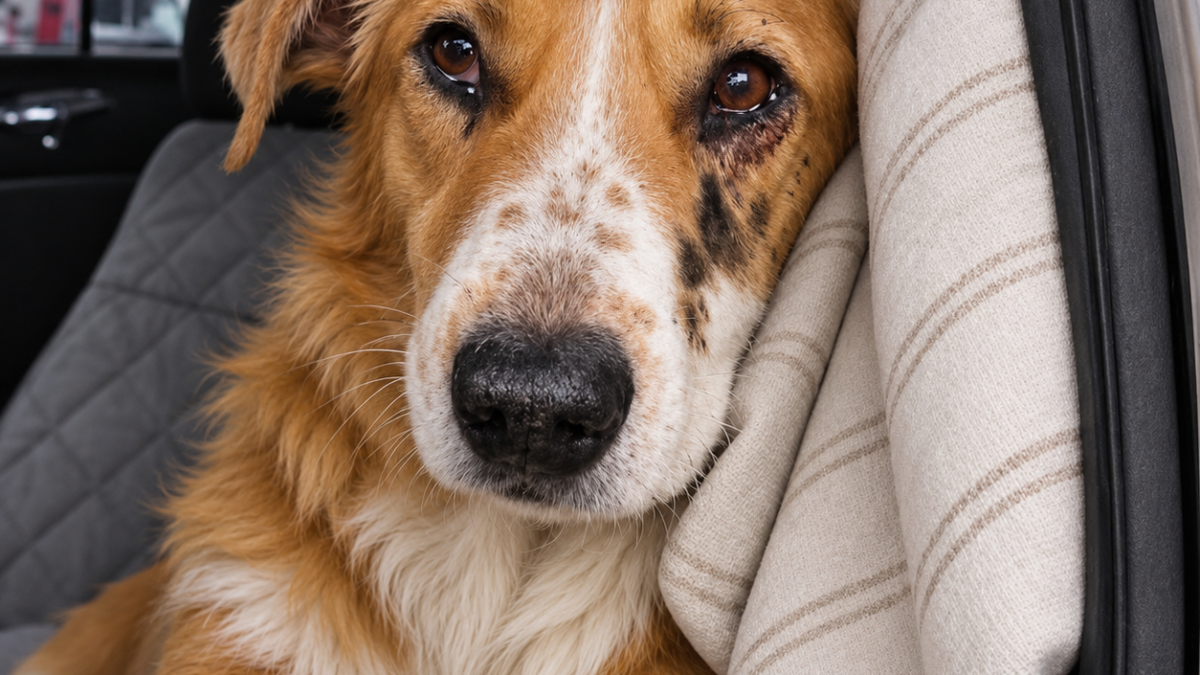
There is one photograph of Sky that I keep returning to.
It was taken shortly after he went home.
He is lying in the back seat of Claire’s car.
Sunlight is coming through the window.
His blue elephant is beneath one paw.
His jaw is crooked.
His scar is visible.
And his eyes are half closed.
He looks peaceful.
That picture matters to me more than any photograph from his medical treatment.
Because the first time I met Sky, his eyes had been fixed on a door.
He was waiting for someone who had already decided to leave.
In that car, he was no longer looking backward.
He was going home.
Sky spent five hours in surgery.
Thirty days unable to eat normally.
Seventy-five days fighting his way out of a hospital.
He lost teeth.
He lost pieces of his jaw.
He lost the person he once trusted.
But he did not lose his ability to love.
And in the end, the person who abandoned him had to live with the consequences of that decision while Sky gained something infinitely more valuable than revenge.
He gained someone who stayed.
Someone who cleaned his mouth after every meal.
Someone who took him outside when he was afraid.
Someone who learned every medical routine.
Someone who laughed when he stole towels.
Someone who opened the car door and said, “Come on, Sky. Let’s go home.”
And this time, when a door closed behind him, Sky didn’t cry.
He was exactly where he belonged.