PART 2: He Weighed Only 19 Pounds and Couldn’t Even Stand—20 Days Later, Sugar Snap Walked Toward a Life No One Thought He’d Live to See
PART 2
I barely slept that night.
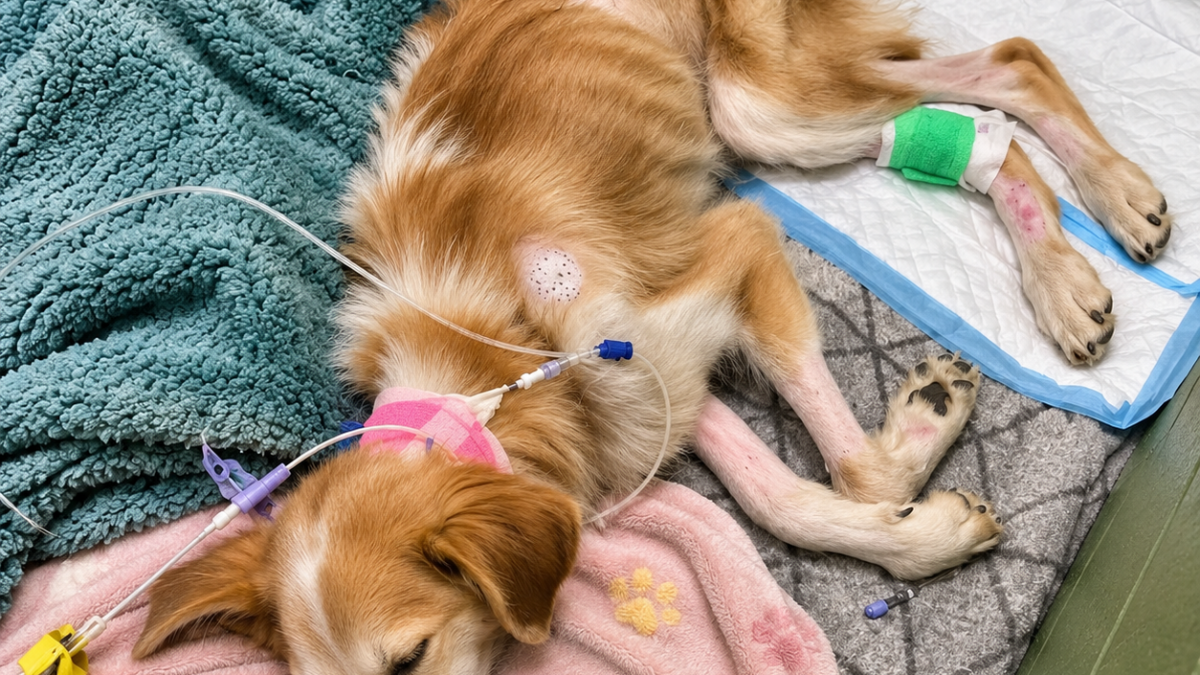
Every time someone moved quickly near Sugar Snap’s treatment area, I looked up. Every time a monitor changed its rhythm, my stomach tightened. The medical team had warned me that the first night could tell us a great deal, but sitting there while his body struggled made every minute feel like something we had to earn.
The blood transfusion continued.
I kept thinking about the donor dog whose blood was now moving into Sugar Snap’s depleted body. Somewhere, another healthy animal had provided something this dying dog desperately needed, and now that blood was giving him a chance his own body could no longer provide.
I leaned closer.
“You’re borrowing a little strength tonight.”
Sugar Snap’s eyes remained closed.
“You can pay it back later by getting into trouble.”
A technician smiled.
“That’s the goal?”
“Absolutely.”
I looked at Sugar Snap.
“I want him healthy enough to be annoying.”
At that point, annoying would have been a miracle.
The transfusion helped stabilize him, but nobody celebrated.
We had already learned that with Sugar Snap, improvement did not mean safety.
His blood sugar needed monitoring.
His blood pressure had to stay up.
His temperature mattered.
His red blood cell values mattered.
Signs of infection mattered.
Everything mattered.
Starvation doesn’t damage only the outside of a body.
By the time an animal reaches the condition Sugar Snap had reached, every organ has been forced to adapt to deprivation. The heart has less muscle. The immune system has fewer resources. The blood may not carry enough oxygen. The digestive system, deprived for too long, cannot simply be overwhelmed with food because the dog suddenly has access to it.
Saving him meant fighting the natural urge to fix everything at once.
He was starving.
We wanted to feed him.
But he had to be fed carefully.
He was dehydrated.
We wanted to replace everything immediately.
But fluids had to be controlled.
He was weak.
We wanted him standing.
But his muscles needed time.
Everything about Sugar Snap required patience when every emotion in me wanted speed.
The next morning, I walked toward his kennel expecting to see the same dog I had left hours earlier.
Sugar Snap opened his eyes.
“Morning.”
His tail tapped once.
I smiled.
“You’re still doing that?”
Another weak wag.
“Good.”
The technician brought a small meal.
Sugar Snap smelled it immediately.
His head came up farther than I expected.
“There he is.”
He ate.
Carefully supervised.
Still eager.
That appetite became one of the few things that seemed untouched by everything happening inside his body.
“He really wants to eat,” I said.
The veterinarian nodded.
“That’s encouraging.”
“But?”
There was always a but.
“But we still need to watch his bloodwork very closely.”
I looked at Sugar Snap.
He finished the little amount he had been given and stared at the bowl as it disappeared.
“Apparently he disagrees with portion control.”
The veterinarian smiled.
“He can disagree.”
“He looks personally offended.”
“That’s fine.”
It was fine.
More than fine.
I wanted opinions.
I wanted attitude.
I wanted this dog to have enough energy to be irritated.
What I didn’t want was the next blood result.
His values dropped again.
When the veterinarian came to explain, I knew from her face.
“He needs another transfusion.”
I stared at her.
“Already?”
“Yes.”
“But the first one helped.”
“It did.”
“Then why are we here again?”
“Because his body is still critically ill.”
That phrase hit me.
Still critically ill.
Sugar Snap had eaten.
He had wagged his tail.
He looked slightly brighter.
And underneath those visible improvements, his body remained close to disaster.
It taught me something that would define the next several weeks.
Recovery is not a straight line.
You can celebrate in the morning and be terrified again by afternoon.
Sugar Snap could take one step forward while his bloodwork took two steps back.
I crouched beside him.
“You’re very dramatic.”
His tail moved.
“I mean it. We celebrated breakfast.”
Another wag.
“And now you need another transfusion.”
He looked at me.
“All right.”
I touched his head.
“We’ll do another one.”
So we did.
Another blood transfusion.
Another stretch of hours watching.
Another reminder that his survival depended on far more than appetite and determination.
There were moments during those early days when I wondered what Sugar Snap remembered.
Did he remember the road?
Did he remember how he got there?
Did he know how long he’d been hungry?
Did he understand why his body could no longer stand?
We had no history.
No explanation.
Only the evidence written across his body.
Thirty pounds missing.
Severe anemia.
Possible sepsis.
Weakness so extreme that gravity itself seemed stronger than he was.
Someone asked me whether I thought he had been neglected.
I looked at Sugar Snap.
“I don’t know.”
It would have been easy to invent a villain.
Easy to imagine a person deliberately starving him.
Easy to build anger around a story we didn’t actually know.
But Sugar Snap didn’t need speculation.
He needed medicine.
So that became the focus.
Whatever had happened before the roadside belonged to a part of his story we couldn’t change.
What happened next belonged to us.
The second transfusion gave him another chance.
His numbers improved enough to continue.
Then one afternoon, Sugar Snap did something that turned the entire treatment room quiet.
He tried to stand.
At first, I thought he was simply repositioning himself.
His front legs moved.
His paws searched for traction.
His body trembled.
A technician reached toward him.
“Wait.”
We all watched.
Sugar Snap pushed.
His chest came up.
Then his hind legs tried to follow.
They shook violently.
I moved closer.
“Easy.”
His body rose.
For a second.
Two.
Then he sank back down.
I looked at the technician.
“Did he just—”
“Yes.”
“He stood.”
“Almost.”
“No. That counts.”
Sugar Snap looked exhausted.
I laughed.
“That absolutely counts.”
He had been found unable to get up at all.
The muscles in his legs had been consumed by starvation.
His body had no reason to cooperate.
And yet he had tried.
A few hours later, he tried again.
This time we supported him carefully.
“Come on, buddy.”
His paws touched the floor.
His legs trembled.
I could feel how little strength he had.
But he stayed upright.
Three seconds.
Maybe four.
Then down.
I knelt beside him.
“You did it.”
His tail moved.
“You know everyone is getting emotional about you standing for four seconds?”
Wag.
“I hope you’re proud of yourself.”
Wag.
I was beginning to understand his personality.
Sugar Snap could be surrounded by fear, needles, blood tests, transfusions and strangers, and somehow he still found a reason to wag.
Sometimes it happened when someone entered.
Sometimes when food arrived.
Sometimes just because a hand touched his head.
That tail became our little gauge of the dog hidden inside the illness.
His body looked broken.
His spirit wasn’t.
A few days into treatment, his team decided he could spend a short period outside.
Nothing ambitious.
Just sunlight.
Fresh air.
A change from the hospital walls.
We carried him because he still couldn’t walk any meaningful distance.
Outside, the sunlight touched his face.
For several seconds he simply stood with support and looked around.
There were sounds he hadn’t heard inside.
Birds.
Cars farther away.
Wind moving leaves.
His nose worked constantly.
I smiled.
“Remember outside?”
His ears moved.
“Hopefully this version is better than the roadside.”
We lowered him carefully.
Sugar Snap tried to step.
One front paw moved.
Then the other.
His hind legs struggled to keep up.
I stayed beside him.
“One.”
Another step.
“Two.”
His body shook.
“That’s enough if you’re tired.”
Sugar Snap tried again.
“Three.”
He stopped.
I was almost laughing.
Three steps.
Nothing to a healthy dog.
Everything to him.
“You are showing off now.”
He looked toward me.
Then his tail wagged.
That sunlight became part of his treatment in a way no medication could measure.
Not because sunshine cured anemia.
It didn’t.
Not because fresh air treated infection.
It didn’t.
But recovery is about more than lab values.
Sugar Snap needed to remember what life outside a hospital room felt like.
He needed smells.
Warmth.
Grass beneath his paws.
Something worth getting stronger for.
We brought him back inside before he exhausted himself.
The next day wasn’t as good.
His energy dipped.
His temperature worried us.
The medical team adjusted things.
Once again, celebration turned into monitoring.
I began to hate how quickly hope could become fear.
One minute I was telling someone, “He took three steps today.”
The next I was asking, “What does that blood result mean?”
Sugar Snap’s recovery taught me to stop asking whether he was “better” as though better were one permanent condition.
Instead, I started asking more precise questions.
Did he eat?
Did he keep the food down?
Did he stand?
How long?
What was his temperature?
What were his blood values?
How was his blood pressure?
Did he seem comfortable?
How was his stool?
Did he wag?
Especially that last one.
The medical team didn’t technically chart tail wags.
I did.
“Tail?”
A nurse laughed.
“Still wagging.”
“Good.”
“You know that’s not a medical value.”
“It is to me.”
The nurse smiled.
“Then yes. Tail normal.”
That became our joke.
Blood work complicated.
Temperature monitored.
Appetite good.
Tail normal.
Days passed.
Sugar Snap began gaining weight.
The scale became another emotional event.
Every time he stepped—or more often was carefully positioned—onto it, I stared at the numbers.
One day the technician looked up.
“He’s gained four pounds.”
I blinked.
“Four?”
“Four.”
Nineteen had become twenty-three.
For most dogs, twenty-three pounds would still have been alarmingly low for his frame.
For Sugar Snap, those four pounds meant his body was finally keeping something.
Food was becoming tissue instead of disappearing into the emergency of survival.
I crouched beside him.
“Twenty-three pounds.”
His tail moved.
“You’re huge.”
The technician laughed.
“Don’t lie to him.”
“I’m building confidence.”
He needed more than confidence.
But the weight mattered.
So did standing.
We began timing how long he could remain upright with minimal support.
Seconds turned into half a minute.
Then longer.
One day, Sugar Snap stood for almost five minutes.
Five.
Whole.
Minutes.
I looked at the clock repeatedly.
“Are we counting this?”
“Yes.”
“How long?”
“Four minutes and twenty seconds.”
Sugar Snap’s legs trembled.
“Come on.”
Four thirty.
Four forty-five.
His body swayed.
“You can stop.”
He stayed.
Five minutes.
The technician smiled.
“Five.”
I immediately crouched beside him as he lowered himself.
“Five minutes.”
Sugar Snap’s tongue appeared briefly.
“You couldn’t stand at all.”
His tail thumped the floor.
“And now you’re making us time you like an athlete.”
I was absurdly proud.
Five minutes would be nothing in the life we hoped Sugar Snap would eventually have.
Someday, if things went right, he might stand for hours without anyone noticing.
He might run.
Jump.
Play.
He might become so physically normal that nobody would ever count his minutes again.
That was the goal.
The disappearance of milestones.
For now, we celebrated every one.
Then came the fever.
I remember the veterinarian telling me and feeling my stomach sink.
“How high?”
She explained.
“What does that mean?”
“We need to continue monitoring him closely.”
“Are we thinking infection?”
“It’s one concern.”
“Sepsis?”
“Still something we’re watching.”
I looked at Sugar Snap.
He had gained weight.
He had stood five minutes.
He had started taking steps.
And now fever.
Again, the road tilted downward.
I sat beside him.
“You really don’t like simple stories, do you?”
Sugar Snap looked tired.
“Every time we celebrate, you give us another problem.”
His tail moved once.
I shook my head.
“You think that gets you out of trouble?”
Another weak wag.
“It does.”
The fever reminded us that Sugar Snap was still nowhere near finished with emergency care.
He needed continued monitoring.
Continued treatment.
Continued nutrition.
Continued medical support.
A feeding tube remained part of his care.
Every day, the team balanced the desire to advance his recovery against the reality of how fragile his body remained.
The hospital became his world.
At first, I worried that he would become depressed.
Instead, Sugar Snap seemed to build a relationship with everyone.
People walked into the treatment area and talked to him.
“Morning, Sugar.”
Wag.
“Ready for breakfast?”
Faster wag.
“Need another blood draw?”
The wag sometimes slowed at that question.
I laughed.
“He understands English selectively.”
“He’s smart.”
“He’s a dog. Of course he understands the unpleasant words.”
The veterinary team became invested in his tiny victories.
One nurse brought him outside whenever his condition allowed.
Another knew exactly how he liked his blankets arranged.
Someone else discovered that Sugar Snap responded especially strongly when spoken to in a ridiculous high-pitched voice.
I refused to imitate it at first.
Then I tried.
His tail wagged.
“All right.”
The nurse laughed.
“What?”
“You mocked me for doing that.”
“I was wrong.”
Sugar Snap’s tail continued.
“I will embarrass myself for the patient.”
That dog changed the atmosphere around him.
Critical animals often fill a treatment room with tension.
Sugar Snap certainly did.
But he also filled it with hope.
Every wag reminded us there was a personality waiting behind the numbers.
Every bite of food said he hadn’t quit.
Every attempt to stand told us he wanted to participate.
Still, the length of his hospitalization began to weigh on everyone.
Day ten.
Then eleven.
Twelve.
There had been times during the first night when I wasn’t sure we would see the second morning.
Now we were counting weeks.
That should have felt entirely positive.
And it was.
But hospital time is strange.
The longer an animal remains, the more you recognize that survival and recovery are different things.
Sugar Snap had survived the immediate collapse.
Now we had to build a body capable of leaving.
He needed enough strength.
Enough stability.
Enough nutrition.
Enough confidence.
Enough improvement in those terrifying blood values.
There was no shortcut.
Around the middle of the second week, I sat beside him while he ate.
“You know what you’re doing?”
Sugar Snap kept chewing.
“You’re rebuilding yourself.”
No reaction.
“Very slowly.”
Food disappeared.
“But still.”
He looked toward me when the bowl was empty.
“No.”
His head tilted.
“You already ate.”
His eyes stayed fixed.
“You weighed nineteen pounds because you were starving, and somehow you’re already good at begging.”
Tail wag.
I sighed.
“Fine. I’ll ask if you can have more.”
That appetite never stopped amazing me.
It had been there on the first day.
Even when his blood pressure failed.
Even when his blood sugar dropped.
Even when he required transfusions.
Sugar Snap wanted food.
Now, as his body stabilized, his appetite became a force.
Feeding was still carefully managed.
But the desperate hunger slowly transformed into something more normal.
He began to trust that another meal would come.
That difference was subtle.
At first, food made him frantic.
Later, he could finish and rest.
Maybe his body was learning abundance.
Maybe his mind was too.
A starving dog has no reason to trust tomorrow’s bowl.
A recovering dog can learn.
Breakfast comes.
Then lunch.
Then dinner.
And the people who bring them keep returning.
Routine became part of Sugar Snap’s healing.
There were difficult days too.
One morning, he seemed weaker.
His legs did not cooperate as well.
I felt disappointed, then immediately guilty for feeling disappointed.
Recovery had taught me better.
A bad morning did not erase a good week.
Still, I sat beside him.
“Yesterday you were stronger.”
Sugar Snap rested his head.
“That’s okay.”
I stroked between his ears.
“You don’t owe us improvement every day.”
I meant that.
People can unintentionally turn recovery into performance.
Every visit becomes, “Did he walk farther?”
“Did he gain more?”
“Did the numbers improve?”
But Sugar Snap was not a progress chart.
He was a sick dog.
Some days his job was simply to rest.
So that day we celebrated nothing.
We let him sleep.
The next day, he stood again.
Then he took more steps.
That became another lesson.
Rest is not failure.
The body rebuilds while nothing dramatic is happening.
Some of the most important work Sugar Snap did happened while his eyes were closed.
His heart beating.
Bone marrow trying to produce blood cells.
Digestive system absorbing nutrition.
Immune system fighting.
Muscles repairing with every calorie his body could spare.
None of that could be photographed.
But it was survival.
Day fifteen came.
Then sixteen.
The fever improved.
His medical team remained cautious, but the crisis atmosphere was slowly changing.
The conversations began sounding different.
Instead of, “Can we get him through the night?” we were asking, “What does he need before he can leave?”
That shift was enormous.
I asked the veterinarian directly.
“What are we waiting for now?”
She explained.
His feeding.
His stability.
His strength.
His lab values.
The ability to continue safely outside a hospital environment.
I nodded.
“So not tomorrow.”
“Probably not.”
“Soon?”
“If he keeps moving in the right direction.”
I looked at Sugar Snap.
“You heard that.”
His tail wagged.
“Don’t get cocky.”
Day seventeen.
Sugar Snap went outside again.
This time, we didn’t carry him the entire way.
He took several steps.
Stopped.
Rested.
Then moved again.
His gait was still weak and awkward.
His muscles had a long way to go.
But the dog who had once been incapable of lifting himself from the roadside was choosing where his paws went.
That felt enormous.
He stopped in the sunlight.
His nose lifted.
Wind crossed his face.
I watched him take in the world.
“You know, eventually people are going to expect you to walk everywhere yourself.”
Sugar Snap looked at me.
“No free rides forever.”
Tail wag.
“I know. You don’t believe me.”
He took another slow step.
I remembered that first attempt.
Three shaky movements outside.
Now he could remain up longer.
Move farther.
Recover faster.
The scale kept moving upward too.
Not quickly.
That was fine.
Healthy rebuilding takes time.
There was no need to rush a body that had already been pushed beyond its limits.
On day eighteen, we received news I’d been waiting to hear.
The team was beginning to discuss removing the feeding tube.
I almost didn’t react at first.
“Really?”
“If he continues eating enough on his own.”
“He will.”
The veterinarian smiled.
“You sound very confident.”
“Have you met him at mealtime?”
“Yes.”
“Then you understand.”
The tube had represented how medically dependent he still was.
Removing it would mean something more than comfort.
It would mean Sugar Snap was taking over another part of his own survival.
Food in.
Body using it.
No tube required.
The next day, his intake held.
His condition stayed stable.
I watched the feeding tube being removed.
Sugar Snap looked mildly offended by the entire process.
I laughed.
“You’re free.”
He shook himself weakly.
“Okay, mostly free.”
The veterinarian checked him.
“He’s doing well.”
“Those are dangerous words.”
She looked at me.
“You’ve become superstitious.”
“Every time someone says he’s doing well, something happens.”
“Fair.”
I smiled.
“But I’ll take it.”
Then came day twenty.
Exactly twenty days after Sugar Snap entered emergency care.
Twenty days after arriving at nineteen pounds.
Twenty days after being unable to stand.
Twenty days after the first night when his blood pressure and blood sugar dropped and we wondered whether he would make it.
Twenty days after the first transfusion.
Twenty days of needles.
Food.
Blood tests.
Medications.
Another transfusion.
Temperature checks.
Feeding support.
Tiny walks.
Setbacks.
Tail wags.
Twenty days.
The veterinarian came toward me holding discharge paperwork.
For a second, I didn’t understand.
“What’s that?”
She smiled.
“He can leave.”
I stared at her.
“Leave the treatment room?”
“Leave the hospital.”
I laughed.
“You’re serious?”
“Yes.”
“Today?”
“Yes.”
I looked at Sugar Snap.
He was standing.
Not perfectly.
Not for hours.
But standing.
I looked back at the doctor.
“You’re sure?”
She laughed.
“Yes.”
“I think I’m supposed to trust you more than this.”
“That would be nice.”
I knelt beside Sugar Snap.
“Buddy.”
His tail wagged.
“You’re getting out.”
The tail moved faster.
“You have absolutely no idea what I’m saying.”
He looked toward the door.
“Or maybe you do.”
Discharge day should have felt like the end.
Instead, it felt like the beginning of another kind of work.
Sugar Snap was alive.
That was enormous.
But he remained thin.
Weak.
Recovering.
He still needed weight.
Muscle.
Rest.
Monitoring.
He needed a place where those things could happen safely.
A foster home was waiting.
When we loaded him for the trip out of the hospital, I looked back toward the doors.
Twenty days earlier we had carried in a dog whose body was collapsing.
Now he was leaving on his own path toward recovery.
Not cured.
Not finished.
But alive enough that the emergency hospital was no longer the safest place for him.
That mattered.
At the foster home, Sugar Snap was given something hospitals cannot replicate no matter how caring the staff are.
A home environment.
Soft beds in quiet rooms.
People nearby without uniforms.
Household sounds.
Regular meals.
The smell of normal life.
And eventually, another dog.
Fitz.
Their relationship didn’t need some dramatic introduction.
Dogs have their own way of understanding one another.
Sugar Snap watched him.
Fitz watched Sugar Snap.
There was curiosity.
Space.
Then growing familiarity.
Sugar Snap began following him.
At first, slowly.
Fitz could move with the effortless confidence of a dog whose body worked properly.
Sugar Snap couldn’t.
But he watched.
Then followed.
One room.
Then another.
A few steps at a time.
Fitz became something like a four-legged example of the future.
This is what dogs do.
They walk around the house.
They investigate.
They go outside.
They play.
They lie down wherever they want.
Sugar Snap learned.
The first weeks outside the hospital were still cautious.
There were meals carefully managed.
Rest.
Monitoring.
Short periods of activity.
Nobody wanted to push him too fast.
But Sugar Snap had other ideas.
His curiosity expanded faster than his muscles.
He wanted to see what Fitz was doing.
He wanted to follow people.
He wanted to explore.
His tail, already famous among everyone who had treated him, seemed to gain energy before the rest of him did.
When someone walked in, it wagged.
When food arrived, it wagged faster.
When Fitz moved toward the door, Sugar Snap’s entire body seemed to say, Wait for me.
That became motivation.
“Easy.”
Sugar Snap followed.
“Slow down.”
He did not.
Fitz stopped and looked back.
Sugar Snap reached him.
“There.”
I smiled.
“You caught up.”
That phrase meant more than either dog understood.
Sugar Snap had been trying to catch up with life since the morning he was found.
Catch up in weight.
Strength.
Blood values.
Mobility.
Trust.
Now he was literally following another dog down a hallway.
The milestones changed.
At the hospital, we celebrated blood pressure.
At home, we celebrated Sugar Snap reaching the kitchen without needing to rest.
Then reaching the yard.
Then staying outside longer.
Then moving with enough confidence that we stopped hovering over him every second.
His body began filling out.
The bones that had once defined his silhouette became less sharp.
His neck gained muscle.
His legs changed.
Food was becoming body.
Every meal that entered him helped rebuild something starvation had taken.
I would sometimes compare him mentally to the dog beside the road.
It became harder.
That frightened face still existed in my memory.
But the dog in front of me had brighter eyes.
Better posture.
More interest in the world.
He wasn’t merely surviving anymore.
He was beginning to live.
One of the first truly playful moments happened almost accidentally.
Fitz had a toy.
Sugar Snap watched him.
Fitz moved.
Sugar Snap followed.
Then there was a little burst of energy.
Not much.
But enough.
Sugar Snap reached toward the toy.
I froze.
“Is he playing?”
Someone smiled.
“I think he is.”
Sugar Snap moved again.
Fitz responded.
For a few seconds, they interacted the way healthy dogs do.
No medical equipment.
No one timing his standing.
No discussion about transfusions.
Just two dogs and a toy.
I laughed.
“Look at him.”
Sugar Snap’s tail wagged wildly.
There are transformations you see on a scale.
Nineteen pounds becomes more.
There are transformations you see in bloodwork.
Numbers climb.
There are transformations you see in muscle.
Legs become stronger.
But play is different.
Play means the body has energy it doesn’t need for survival.
Think about that.
When Sugar Snap was beside the road, every calorie in his body was being spent keeping essential systems functioning.
There was no extra energy for joy.
No extra energy to run after a toy.
No extra energy to be silly.
Now he had energy to waste.
That was one of the most beautiful things I had ever seen.
“Waste all of it,” I told him.
He continued following Fitz.
“You earned it.”
The first time Sugar Snap encountered snow after his recovery had advanced, he seemed confused.
He stepped onto it.
Paused.
Lifted a paw.
Put it down.
Then tried another step.
The dog who had once fought to remain upright now stood in a world covered in white.
Fitz moved ahead.
Sugar Snap followed.
At first cautiously.
Then faster.
The snow seemed to wake something in him.
He moved.
Not the slow, counted steps from the hospital lawn.
Real movement.
His legs carried him.
His body leaned forward.
His tail lifted.
Then Sugar Snap ran.
I couldn’t speak for a moment.
He wasn’t the fastest dog in the world.
That didn’t matter.
He was running.
I watched his paws hit the snow.
Again.
Again.
Again.
The same paws that had been useless beneath him beside the road.
The same legs we had watched tremble after seconds of standing.
Now they were throwing snow behind him.
“Sugar!”
He looked back.
Then ran again.
I laughed.
Fitz moved ahead.
Sugar Snap chased him.
The two dogs crossed the snow while I stood there thinking about a hospital room.
Five minutes.
We had once celebrated five minutes of standing.
Now I couldn’t get him to stop moving.
That was Sugar Snap’s revenge.
Not revenge against a person.
We didn’t know enough about his past to invent someone to punish.
It was revenge against every terrible possibility that had surrounded him.
The roadside said he was finished.
He ran.
The scale said nineteen pounds.
He grew.
His blood values crashed.
He recovered.
His body couldn’t stand.
He crossed snow on his own four feet.
Sepsis threatened.
He lived.
Starvation had reduced his world to survival.
He discovered play.
If there had to be revenge in Sugar Snap’s story, that was it.
Living so fully that his worst day no longer had the power to define him.
His first trip to the beach gave me another one of those moments.
At first, Sugar Snap seemed uncertain about the water.
He approached.
Stopped.
A wave moved toward him.
He stepped backward.
I laughed.
“You survived blood transfusions, and this is scary?”
Another wave came.
Sugar Snap watched.
Fitz moved closer to the water.
Of course Sugar Snap followed.
That had become their pattern.
Where Fitz went, Sugar Snap wanted to go.
His paws touched the wet sand.
Then water.
He jumped slightly.
I laughed.
“There you go.”
Another wave.
This time he didn’t back away as far.
Then curiosity won.
He moved forward.
His paws splashed.
He looked down.
Splashed again.
Something clicked.
Soon Sugar Snap was stepping through the shallow water, following Fitz, making little bursts of movement whenever the waves changed around his feet.
I stood watching.
The first time I’d seen him, his paws could barely support him.
Now those paws were splashing in ocean water.
There are moments when your brain holds two images at once.
Sugar Snap on the roadside.
Sugar Snap at the beach.
Nineteen pounds.
Healthy enough to splash.
Unable to stand.
Running after another dog.
Hospital blankets.
Open water.
Both dogs were the same animal.
That is what rescue can do when medicine, timing and stubborn survival all come together.
It doesn’t erase what happened.
It gives the animal something larger to become.
Sugar Snap kept gaining weight.
His body transformed so steadily that people who saw later photographs struggled to connect them to the skeletal dog from the beginning.
“That’s him?”
“Yes.”
“The nineteen-pound dog?”
“Yes.”
“The one who couldn’t stand?”
“The same one.”
They would look again.
I understood the disbelief.
I had seen every step and still sometimes felt it.
His chest had filled out.
Muscle returned to his legs.
His face changed.
Even his expression changed.
There is a certain look animals carry when the body is in constant crisis.
Sugar Snap had lost it.
In its place was expectation.
He expected dinner.
He expected people to come home.
He expected Fitz to be around.
He expected walks.
He expected comfort.
Expectation is a quiet form of trust.
A starving dog doesn’t trust food to return.
A dying dog can’t imagine next week.
Sugar Snap eventually lived as though tomorrow were guaranteed.
That was exactly what I wanted.
His foster home stopped feeling temporary.
He belonged there more each day.
Sugar Snap followed Fitz through the house.
They developed routines.
If Fitz moved, Sugar Snap often went too.
If one settled, the other was never far away.
The dog that had once been completely dependent on medical professionals now had something different.
A dog brother.
One afternoon, I watched Sugar Snap trailing Fitz from one room to another.
“Do you ever do anything by yourself?”
Sugar Snap’s tail wagged.
Fitz looked back.
Sugar Snap reached him.
I smiled.
“Apparently not.”
There was comfort in their companionship.
Sugar Snap didn’t need to know Fitz understood his history.
Dogs don’t exchange medical records.
Fitz didn’t know about blood pressure.
Transfusions.
Sepsis concerns.
The feeding tube.
Day twenty.
He knew Sugar Snap was there.
That was enough.
And eventually, foster became forever.
Sugar Snap had survived long enough to need a permanent family.
Think about how extraordinary that sentence is.
When he arrived at the hospital, we weren’t discussing adoption.
We were discussing whether his blood pressure could be stabilized.
Whether infection would overwhelm him.
Whether the transfusion would be enough.
Whether he would make it through the night.
Later, the questions became different.
What food should he eat?
How quickly should activity increase?
How much weight had he gained?
Then different again.
Who would love him permanently?
Where would he sleep?
Who would be his family?
Those were beautiful problems to have.
And Sugar Snap’s life found the answer.
Home.
Fitz.
People who loved him.
Safety.
The first time I saw him truly relaxed in that life, he was asleep.
Nothing dramatic.
No running.
No snow.
No beach.
Just asleep.
He was stretched comfortably, completely unconcerned.
I stood watching longer than was necessary.
Someone asked, “What?”
I shook my head.
“Nothing.”
But it wasn’t nothing.
I remembered him collapsed beside the road.
A dog unable to stand cannot choose where to sleep comfortably.
A critically ill dog in emergency care sleeps because the body demands it, surrounded by monitoring and intervention.
This Sugar Snap was simply tired.
That was normal.
Ordinary.
Beautiful.
His chest rose.
Fell.
His legs twitched slightly in a dream.
I wondered what he was chasing.
Maybe Fitz.
Maybe something in the snow.
Maybe nothing.
I hoped his dreams had forgotten the road.
People often asked what happened to him before he was found.
I still didn’t know.
And over time, I realized I didn’t need to invent an answer.
The facts we had were enough.
He was found critically starved.
He weighed nineteen pounds when he should have weighed more than fifty.
He couldn’t stand.
He was severely anemic.
Sepsis was a concern.
His blood pressure dropped.
His blood sugar dropped.
He needed a transfusion.
Then another.
He developed a fever.
He required nearly three weeks of emergency treatment.
Those facts were terrible enough without adding a villain we couldn’t prove existed.
What mattered most was what happened after he was found.
A father stopped.
A child saw compassion in action.
They picked him up.
The police helped connect him to rescue.
The emergency team treated him.
Blood donors gave him strength he didn’t have.
People fed him carefully.
Staff watched him through setbacks.
Someone took him outside for sunlight.
People celebrated five minutes of standing.
A foster home opened.
Fitz accepted him.
A family loved him.
One act led to another.
That’s how Sugar Snap survived.
Not through one giant miracle.
Through a chain of ordinary people deciding not to walk away.
I thought often about that father and child.
They probably could not have known what would happen after they picked him up.
They couldn’t know about the transfusions.
They couldn’t know he would spend exactly twenty days receiving emergency care.
They couldn’t know about Fitz.
Snow.
Beach water.
A forever home.
They simply saw a suffering dog and stopped.
Sometimes rescue begins with nothing more complicated than that.
Stop.
Notice.
Act.
Every joyful moment Sugar Snap later experienced existed on the other side of that decision.
The snow beneath his paws.
The ocean touching his legs.
The house he shared with Fitz.
Every meal.
Every nap.
Every tail wag.
All of it almost disappeared beside a road.
That thought stayed with me.
Sugar Snap’s tail remained one of my favorite parts of his story.
I had seen it wag when almost nothing else worked.
A dog at nineteen pounds.
Wag.
After blood pressure dropped.
Wag.
During difficult treatment.
Wag.
Trying to stand.
Wag.
Sunshine.
Wag.
Foster home.
Fitz.
Snow.
Beach.
Home.
Wag.
At the beginning, that tail had seemed almost disconnected from his condition.
How could an animal that sick still respond with happiness?
Later, I understood.
The tail was the first part of Sugar Snap’s future we got to see.
His body had not caught up yet.
His bloodwork had not caught up.
His legs had not caught up.
But somewhere inside him was still the dog who wanted people.
Food.
Sun.
Company.
Life.
The wag came first.
Everything else followed.
One evening, long after the hospital was behind him, I watched Sugar Snap and Fitz together.
Fitz moved toward another room.
Sugar Snap got up.
No hesitation.
No shaking legs.
No careful timing.
He simply stood.
That hit me harder than running in the snow.
Because nobody noticed.
No one said, “Five minutes!”
No technician watched a clock.
No one placed a supporting hand beneath his body.
Sugar Snap just got up because he wanted to follow his brother.
That is when I knew his recovery had reached the place I had always hoped for.
The extraordinary had become ordinary.
I smiled.
“Do you know we used to celebrate you standing?”
Sugar Snap continued after Fitz.
“Of course you don’t.”
He disappeared around the corner.
I laughed.
“That’s okay.”
I wanted him to forget.
Maybe not literally.
But emotionally.
I wanted the hospital to belong to us, not him.
We could remember the needles.
The fear.
The blood values.
The transfusions.
Sugar Snap could remember dinner.
Fitz.
Snow.
Water.
Hands that touched gently.
Beds that stayed warm.
That seemed fair.
There was one image from the hospital I could never entirely shake.
Sugar Snap during that first night.
Still beneath blankets.
Blood entering his body.
So little muscle that he seemed to disappear under the bedding.
I remembered asking whether he would survive.
Nobody could promise it.
Veterinary medicine is cruel in that way.
You can do everything right and still lose.
No amount of love makes biology predictable.
That’s why Sugar Snap’s ending meant so much.
It wasn’t inevitable.
The dog running through snow had once been a patient we might lose before morning.
The dog splashing in water once needed donor blood to stay stable.
The dog following Fitz around a home once couldn’t rise from the ground.
Nothing about those later moments was guaranteed.
They were gifts.
I don’t call Sugar Snap’s recovery a miracle because that can accidentally erase the work behind it.
There was science.
Blood transfusions.
Antibiotics.
Monitoring.
Nutrition.
Careful feeding.
Emergency medicine.
People making decisions around the clock.
There were also things medicine cannot manufacture.
Sugar Snap’s appetite.
His willingness to try standing again.
The way his tail answered kindness.
The stubborn spark that remained even when the body had almost nothing left.
Both mattered.
Medicine gave that spark time.
Sugar Snap used it.
On the worst nights, our goal had been microscopic.
Get to morning.
On better days, it became bigger.
Stand.
Gain weight.
Remove the feeding tube.
Leave the hospital.
At foster care, bigger still.
Walk farther.
Build muscle.
Play.
Then eventually nobody needed to set goals for him anymore.
Sugar Snap chose his own.
Catch Fitz.
Run through snow.
Investigate the beach.
Find the comfortable spot.
Get to dinner first.
Be loved.
He became a dog with ordinary ambitions.
That is the happy ending.
Not perfection.
Normal life.
One day, someone showed me an early photograph beside a newer one.
I stared.
In the first, Sugar Snap looked almost impossibly fragile.
His body was angles.
His eyes tired.
In the later photo, he looked substantial.
Present.
Alive.
“That’s hard to look at,” I said.
“Which one?”
“The first.”
“But look where he is now.”
“I know.”
That was exactly why it hurt.
Once you know the dog, seeing how close you came to never knowing him becomes harder.
At the roadside, Sugar Snap wasn’t yet “Sugar Snap” to us.
He was an unknown dog.
Once you know his personality, you realize what almost disappeared.
The tail wag.
The obsession with food.
His bond with Fitz.
The way he experienced snow.
The curiosity at the beach.
The dog he became had been inside that nineteen-pound body all along.
Starvation had simply buried him.
Medicine and care uncovered him.
That idea changed how I thought about critically neglected animals.
The body you see at intake isn’t the whole animal.
Sometimes disease is so loud it hides personality.
Pain hides play.
Hunger hides preferences.
Fear hides affection.
Weakness hides energy.
The rescue isn’t merely about keeping the body alive.
It’s about giving the hidden animal enough time to emerge.
Sugar Snap emerged slowly.
First through appetite.
Then the tail.
Then standing.
Then steps.
Then following Fitz.
Then running.
Each stage revealed more.
The father and child who found him had no way of knowing that.
They didn’t need to.
They just needed to believe the collapsed dog beside the road was worth picking up.
He was.
More than any of us understood.
Sometimes I imagined speaking to the version of myself sitting in the hospital on night one.
I would want to say, “You are going to see him run.”
I would want to say, “One day those legs will carry him through snow.”
“You will watch him splash at a beach.”
“He will have a brother named Fitz.”
“He will leave this place.”
“He will be loved.”
But if someone had told me that during the transfusion, would I have believed it?
Probably not.
That night, hope had to remain small enough to survive reality.
I didn’t need the beach.
I needed morning.
I didn’t need snow.
I needed blood pressure.
I didn’t need a forever home.
I needed Sugar Snap’s heart to keep beating.
Sometimes hope works best in pieces.
Sugar Snap taught me that too.
If the future feels impossible, ask for the next hour.
Then another.
If standing seems impossible, ask for three seconds.
Then five.
If fifty pounds seems impossible, gain four.
If running seems impossible, take one step in the sun.
That is how Sugar Snap built his recovery.
Not by leaping from nineteen pounds to healthy overnight.
By collecting small victories until they became a life.
I remember the day he stood for five minutes because at the time it felt enormous.
Later, I watched him run through snow for longer than that and realized nobody was counting.
That’s the perfect progression.
At first, every second mattered.
Then life became too full to measure.
There is something deeply satisfying about an animal outgrowing the metrics that once defined survival.
Nineteen pounds.
Blood pressure.
Blood sugar.
Red cell values.
Five minutes standing.
Twenty days hospitalized.
Those numbers mattered.
Then one day, Sugar Snap was no longer a set of numbers.
He was somebody’s dog.
Fitz’s brother.
A creature running through snow.
That’s where I prefer to leave him in my memory.
Not under hospital lights.
Under open sky.
Sugar Snap’s life did not become meaningful because he suffered.
His suffering was not necessary.
He should never have been starved.
He should never have collapsed.
He should never have needed transfusions.
The meaningful part was what people did when they saw that suffering.
They responded.
The father could have driven on.
He stopped.
The police could have treated Sugar Snap as someone else’s problem.
They helped connect him to care.
The rescue could have looked at a nineteen-pound dog with enormous medical needs and said it was too much.
They didn’t.
The veterinary team could not guarantee success.
They treated him anyway.
The foster family could have chosen an easier dog.
They opened their home.
Every time the story could have ended, someone added another chapter.
And Sugar Snap kept meeting them there.
That is why I don’t think his story needs revenge against a human antagonist.
We don’t know enough to tell that story honestly.
But I do understand the desire for justice when looking at his first photograph.
How could a dog reach nineteen pounds?
How could he end up beside a road?
Why did nobody help sooner?
Those questions create anger.
Sugar Snap eventually gave me another answer.
Justice can also look like restoration.
A body that had been starved gets fed.
A dog who couldn’t stand gets to run.
A dog found alone gets a brother.
A dog nearly lost beside a road gets a family waiting for him at home.
A life reduced to nineteen pounds expands again.
That is not punishment.
It is better.
It gives the injured one something back.
Sugar Snap got his life back.
And he used it.
He ran.
He played.
He followed Fitz.
He explored.
He went to the beach.
He felt snow.
He became loved enough that the frightening hospital chapter slowly became the beginning of a much larger story rather than its defining event.
The last time I watched Sugar Snap running, I stopped trying to compare him to the dog he had been.
For a long time, I couldn’t help it.
Every healthy movement reminded me of weakness.
Every meal reminded me of starvation.
Every joyful moment reminded me of the road.
But eventually, that comparison felt unfair.
Sugar Snap deserved to exist without constantly being measured against his worst day.
He wasn’t the starving dog anymore.
He was just Sugar Snap.
So I watched him run.
No flashback.
No hospital.
Just a dog.
Fitz ahead.
Sugar Snap behind.
Tail up.
Paws moving.
Alive.
Then he stopped and looked back.
I smiled.
“What?”
His tail wagged.
Still that tail.
Of course.
“Go.”
He turned.
And ran again.
I think about that whenever I remember the twenty days.
The blood.
The fever.
The tube.
The five minutes.
All of those moments were leading toward something none of us could see yet.
Freedom.
Sugar Snap had spent so long trapped by weakness that movement became the perfect ending.
His legs chose a direction.
His body followed.
Nobody lifted him.
Nobody supported his weight.
Nobody counted seconds.
He just went.
And maybe that is the best way to understand what everyone fought for.
We weren’t saving Sugar Snap so that he could become a good rescue story.
We were saving him so that one day he wouldn’t need rescuing.
So that his body could belong to him again.
So that hunger wouldn’t control every thought.
So that medical equipment wouldn’t surround him.
So that people could stop saying, “He’s critical,” and start saying things like, “Sugar Snap and Fitz are outside.”
So that twenty days in emergency care could become twenty days in a life lasting years.
That was the goal.
More time.
Not hospital time.
Real time.
Messy time.
Boring time.
Beach days.
Snow days.
Days when he did absolutely nothing important.
Those are the days critically ill animals fight to reach.
One quiet afternoon, Sugar Snap and Fitz were asleep near each other.
No drama.
I looked at Sugar Snap’s body.
Healthy enough to relax.
Fed enough to sleep without hunger waking him.
Safe enough not to be alert.
Loved enough that nobody was going to leave him beside another road.
I sat nearby and thought about the first meal at the hospital.
Sugar Snap had eaten like he couldn’t trust that there would be another one.
Now his bowl could be empty and he could simply walk away.
He knew dinner would come later.
That may be one of the greatest transformations in the entire story.
Not weight.
Trust.
He trusted tomorrow.
There is a moment in recovery when an animal stops behaving like survival is temporary.
You can see it.
They relax differently.
Sleep differently.
Eat differently.
Interact differently.
Sugar Snap reached that place.
He no longer needed to consume every second as though it might disappear.
Life had become reliable.
I wish every animal found in his condition could reach that point.
Not every one does.
That makes his story precious.
And it also makes it a responsibility.
Sugar Snap lived because people acted early enough.
Barely.
His condition shows how thin the margin can become.
If that father had not noticed.
If he had driven past.
If Sugar Snap had spent another night beside the road.
We don’t know.
I don’t like imagining it.
Instead, I think of the child in the car.
That child saw an adult stop.
Saw someone choose inconvenience over indifference.
Saw a dying animal become worth changing the morning for.
They were on the way to school.
I think Sugar Snap taught a lesson before they ever arrived.
Compassion is not just feeling bad.
It interrupts your schedule.
It makes you stop the car.
Pick up the body.
Find help.
Stay long enough for someone else to take over.
Sugar Snap’s life became proof of what that interruption made possible.
Twenty days later he walked out of a hospital.
Months later he ran.
That connection is extraordinary.
The first person didn’t cure him.
They just refused to leave him.
Sometimes that is your part.
Someone else handles the next.
And the next.
Until an entire community of actions creates an ending no single person could have produced alone.
Sugar Snap’s story belonged to all of them.
But the life belonged to him.
He was the one who finally got to enjoy it.
When I look at the images of him later—healthy, active, surrounded by love—I always come back to the same thought.
He had no idea how close he came.
Dogs don’t understand the paperwork of survival.
Sugar Snap didn’t know his blood values.
He didn’t know he weighed nineteen pounds instead of more than fifty.
He didn’t know the medical team feared sepsis.
He didn’t know why donor blood was entering his body.
He didn’t know we counted five minutes.
He knew hunger.
Then food.
Weakness.
Then strength.
Loneliness.
Then people.
A road.
Then home.
Maybe that simplicity is a gift.
He didn’t have to spend his future thinking about what almost happened.
We could remember for him.
He could live.
And live he did.
Snow under his paws.
Water around his legs.
Fitz nearby.
Food waiting.
People laughing when his tail started.
A safe bed when he was tired.
That’s enough.
More than enough.
Sometimes an ending doesn’t need a dramatic final scene.
Sometimes you don’t need a villain punished or a courtroom or someone begging forgiveness.
Sometimes the most satisfying ending is the one the suffering animal gets to enjoy personally.
Sugar Snap did.
He did not get revenge by hurting anyone.
He got revenge by becoming impossible to recognize as the dog starvation had nearly destroyed.
He answered nineteen pounds with a healthy body.
He answered collapse with running.
He answered hospital isolation with a brother.
He answered the roadside with a home.
And he answered every frightening night with another morning.
That was enough justice for me.
More than enough.
The father and child who found him beside the road saw a dog who couldn’t stand.
The hospital saw a critical patient.
The bloodwork saw anemia.
The scale saw nineteen pounds.
But none of those things could measure what Sugar Snap eventually became.
You can’t measure the feeling of snow under a dog’s paws on a medical chart.
You can’t record the joy of a first beach day in a blood result.
You can’t put the comfort of following a dog brother through a safe home on a scale.
Those were the things waiting beyond survival.
That’s why we kept going.
Every transfusion.
Every antibiotic.
Every monitored meal.
Every frightening lab result.
Every tiny step outside.
Every minute standing.
All of it was buying Sugar Snap access to ordinary joy.
Eventually, he collected it.
All of it.
And if I could speak to the starving dog beside that road now, I wouldn’t tell him everything.
I wouldn’t overwhelm that exhausted body with promises about the future.
I would say what I said during the first night.
“Stay.”
Just stay.
Stay long enough for the blood to help.
Stay long enough for another meal.
Stay long enough to stand.
Stay long enough for the feeding tube to come out.
Stay twenty days.
Stay long enough to meet Fitz.
Stay until snow becomes something you run through instead of something you fear surviving.
Stay until water at a beach splashes around paws that once couldn’t hold you.
Stay until the word “forever” describes your family instead of your suffering.
Just stay.
Sugar Snap did.
And because he did, the dog who once weighed only nineteen pounds got something that seemed almost impossible on the day he was found.
Not simply survival.
A life worth surviving for.
Years from now, most people who meet Sugar Snap may never know what he looked like beside the road.
They may simply see a happy dog.
They may see him with Fitz.
They may watch his tail move.
Maybe someone will say, “He’s such a sweet boy.”
And that will be perfect.
He doesn’t need everyone to see the skeleton first.
He doesn’t need pity attached to every introduction.
His life no longer needs an explanation.
That is another kind of healing.
When the past stops entering the room before you do.
Sugar Snap gets to be Sugar Snap.
Not the nineteen-pound dog.
Not the transfusion patient.
Not the starvation case.
Just Sugar Snap.
Loved.
Safe.
Hungry at normal times.
Tired after play.
Curious about the world.
The hospital gave him back the chance.
His family gave that chance somewhere to belong.
And Sugar Snap filled it with everything he had.
That tail never stopped.
It had wagged when he was too weak to stand.
It wagged when he first stepped into the sunshine.
It wagged through foster care.
It wagged around Fitz.
And now it belonged to a dog whose life was no longer measured by whether he could survive another night.
I think that is why the tail stays with me.
It was a promise his body made before his body was strong enough to keep it.
I’m still in here.
Just give me time.
We did.
Twenty days in emergency care.
Weeks of rebuilding.
Meals.
Rest.
Movement.
Love.
And Sugar Snap kept his promise.
He came back.
Not all at once.
Pound by pound.
Step by step.
Wag by wag.
Until the dying dog beside the road disappeared into memory and a completely different dog came running out the other side.
A dog in snow.
A dog in water.
A dog beside Fitz.
A dog at home.
A dog who finally had more than enough strength to stand.
He had somewhere worth running to.
And after everything Sugar Snap survived, that was the ending he deserved.



