PART 2: He Was Only 10 Weeks Old and Already Marked for Death—But Squid Refused to Stop Fighting:
PART 2
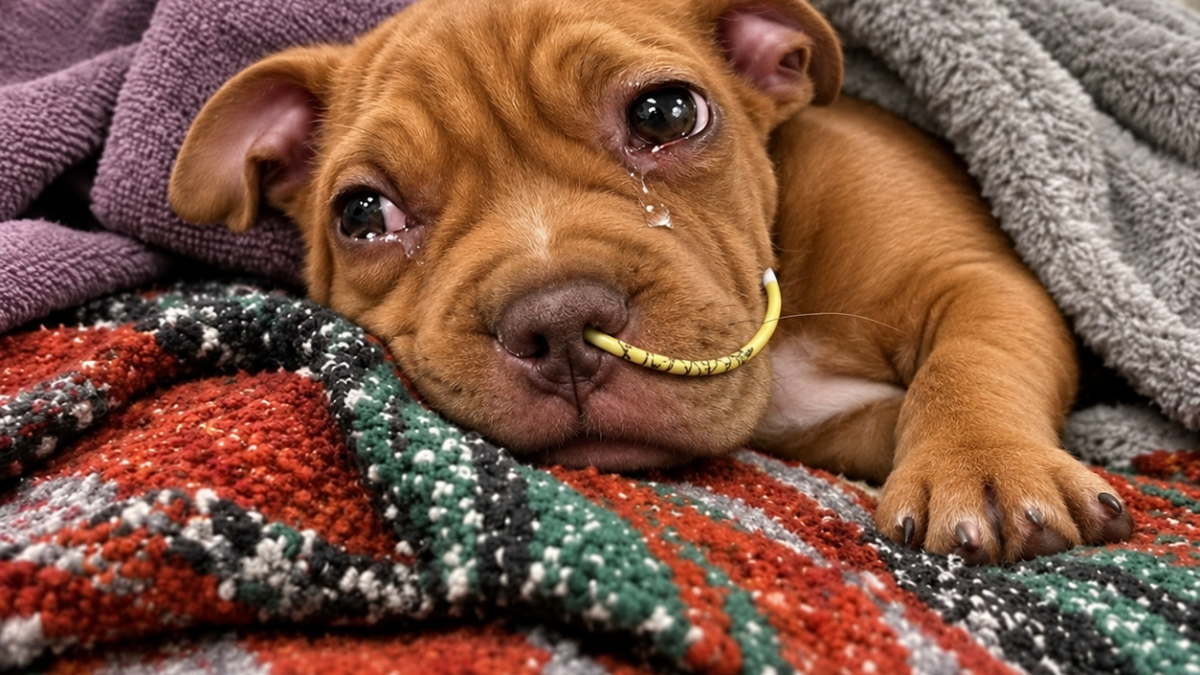
When Squid came out of surgery, I thought we had finally crossed one of the biggest obstacles.
I was wrong.
The first thing we noticed was weakness.
That wasn’t surprising.
He was a tiny puppy who had been sick before surgery, undergone anesthesia, and was trying to recover from a body already under enormous stress.
But then we noticed his legs.
He tried to stand.
They bent beneath him.
At first, I thought he was simply tired.
“Easy.”
I supported him.
“Don’t push it.”
He tried again.
His back legs trembled.
His front legs didn’t seem much better.
He sank back down.
I looked toward the veterinary staff.
“Is that from the surgery?”
“Possibly.”
But their faces told me they weren’t sure.
Over the next several attempts, the weakness became harder to dismiss.
Squid wanted to move.
That was obvious.
The desire was there.
His body simply couldn’t do what he asked.
He would gather himself.
Push upward.
Hold for a moment.
Then his legs folded.
Watching it hurt more than I expected.
A healthy ten-week-old puppy shouldn’t have to think about standing.
He should simply do it.
He should race toward a shoe because the shoe exists.
He should chase something that rolled across the floor.
He should stumble because he is moving too fast, not because his muscles cannot support him.
I knelt beside him.
“Come here.”
Squid looked at me.
He tried again.
His body rose.
Then trembled.
I placed my hands beneath him.
“I’ve got you.”
That became another sentence he heard often.
I’ve got you.
We didn’t know yet what was happening.
The veterinary team suspected there might be a condition affecting his muscles.
More testing was discussed.
Neuromuscular problems.
Weakness.
Possibilities.
None of the words made me feel better.
“What are you thinking?” I asked one of the vets.
“It’s too early to know.”
“What do we test next?”
She explained.
I listened.
I asked questions.
I tried to remember everything.
But underneath all the medical information was a simpler thought.
How many things can be wrong with one puppy?
Squid was ten weeks old.
That number kept repeating in my head.
Ten weeks.
He should have been healthy enough to annoy everyone.
Instead, every part of his body seemed to be asking for help.
The doctors planned further evaluation.
But before we could get all the answers we were looking for, something far worse happened.
Squid’s condition changed.
His exam showed signs that worried the team immediately.
Tests were run.
The veterinarian came back with an expression I had already learned to fear.
She sat down.
“We’re concerned about sepsis.”
The room seemed to change.
I knew enough to understand that word.
An infection had spread.
His entire system was threatened.
“This is serious,” she said.
“How serious?”
She paused.
“Very.”
I stared at her.
“What do we do?”
“He needs another surgery.”
For a moment, I thought I had misunderstood.
“Another surgery?”
“Yes.”
“He just had one.”
“I know.”
“He’s barely strong enough to stand.”
“I know.”
“He’s a baby.”
Her face softened.
“I know.”
There are moments when your mind starts rejecting reality because the sequence feels impossible.
This puppy had already been on a euthanasia list.
Already struggled to breathe.
Already required surgery.
Already lost strength in his legs.
And now sepsis.
Another operation.
Another anesthesia risk.
Another possibility that he might not wake up.
I looked through the glass where I could see part of the treatment area.
Squid was there.
Medical lines.
Blankets.
People moving around him.
So small.
Too small.
I thought about how confidently I had said, “We’ll take him.”
As if taking him meant I could protect him from everything.
As if love alone could create a guarantee.
It couldn’t.
I looked back at the vet.
“What are his chances?”
She chose her words carefully.
“He’s very sick.”
“That’s not what I asked.”
“No,” she said softly. “It isn’t.”
I waited.
“We can’t promise you anything.”
That was the answer.
I nodded.
“What happens if we don’t operate?”
She explained.
Again, the alternative wasn’t really an alternative.
Squid needed the surgery.
I walked toward him before they prepared him.
“Hey.”
His eyes moved.
I touched his head.
“You don’t know how much trouble you are, do you?”
Nothing.
His body was exhausted.
I swallowed.
“I need you to do one more thing.”
His eyes stayed on mine.
“Wake up.”
I bent closer.
“That’s it. You don’t have to run. You don’t have to eat. You don’t have to stand. Just wake up when they’re finished.”
I kept my hand beside him.
“You understand?”
Of course he didn’t.
But I needed the promise anyway.
A technician came closer.
“We need to take him.”
I nodded.
Then I let go.
Squid went into another surgery.
And I waited.
Again.
I hated waiting by then.
Waiting is passive, but emotionally it feels like work.
You replay every decision.
Could we have noticed something sooner?
Did we miss a sign?
Should we have brought him in earlier?
Did the first procedure cause something?
Was the infection already there?
What if?
What if?
What if?
None of those questions helped.
So I tried to stop asking them.
Instead, I focused on the only thing I could control.
Being there when the phone rang.
Hours later, it did.
“He made it through surgery.”
I stood up so quickly the chair moved behind me.
“He’s alive?”
“Yes.”
“Is he awake?”
“He’s recovering. He’s still critical.”
Critical.
I heard the word.
I accepted it.
But I held onto something else.
Alive.
Squid was alive.
The next week became a blur of intensive care.
Seven days.
It doesn’t sound like much.
But seven days in an ICU can feel like seven months.
Every update carries weight.
His temperature.
His breathing.
His bloodwork.
His hydration.
His appetite.
His bowel function.
Whether he lifted his head.
Whether he moved.
Whether he reacted to touch.
I called constantly.
Sometimes the update was simple.
“He’s stable.”
Stable became beautiful.
Before Squid, I thought stable was almost a boring medical word.
During that week, stable sounded like victory.
One day I asked, “Did he eat?”
“A little.”
“How little?”
“Just a few bites.”
I smiled.
“That’s enough.”
Another day:
“He was more alert today.”
“How alert?”
“He watched us when we came into the room.”
“That’s Squid.”
The technician laughed.
“You say that every time.”
“Because every tiny improvement is Squid.”
I visited whenever I could.
Seeing him in intensive care was both comforting and terrible.
Comforting because he was alive.
Terrible because he looked too small among the equipment.
I sat close.
“Hey, trouble.”
His eyes opened slowly.
Then something changed.
Recognition.
His head moved slightly.
That nearly broke me.
“Yeah.”
I put my fingers near his nose.
“It’s me.”
He touched them.
“I’m still here.”
His eyes closed again.
I stayed.
I didn’t need anything else from him.
For the first time, I understood that survival doesn’t always look dramatic.
Sometimes survival is lifting your head.
Sometimes it is swallowing medication.
Sometimes it is sleeping through the night.
Sometimes it is taking three bites of food.
Sometimes the bravest thing a body can do is simply keep functioning until the next morning.
Squid did that.
One morning after nearly a week, the phone rang.
“I think we may be able to send him home soon.”
I stopped breathing for a second.
“Home?”
“Yes.”
“You’re sure?”
“He’s stable enough.”
I looked around the room as if someone else needed to confirm that I had heard correctly.
“Home.”
When I went to pick him up, I had tears in my eyes before I even saw him.
A technician brought him out.
He was weak.
Thin.
Still recovering.
But he was alive.
I took him carefully.
“Hi.”
His head rested against me.
“You survived.”
He didn’t know what that meant.
I did.
We drove home slowly.
I kept checking him.
Not because he was doing anything wrong.
Because I had forgotten what it felt like to have him outside a hospital.
At home, I made him comfortable.
Fresh blankets.
Food nearby.
Water.
Medication organized.
Every instruction written down.
I sat on the floor beside him.
“This is what normal looks like.”
Squid slept.
I smiled.
“Maybe you don’t know normal yet.”
I thought that would be the beginning of recovery.
It should have been.
But Squid wasn’t finished terrifying us.
Within a short time, another infection became apparent.
The sepsis had caused complications.
An infection had spread to his testicles.
When I heard the diagnosis, I stared at the veterinarian.
“You’re telling me he needs another surgery.”
“Yes.”
I laughed once.
Not because it was funny.
Because sometimes the brain does strange things when it has no useful reaction left.
“How many surgeries can one puppy have?”
No one answered.
I looked at Squid.
He was lying quietly.
I felt anger.
Not at the doctors.
Not at the shelter.
Not at anyone.
Just anger at the unfairness.
This puppy should have been chasing toys.
Instead, I was signing surgical forms.
Again.
He should have been learning house rules.
Instead, I knew the schedules of multiple medications.
He should have been biting things he shouldn’t.
Instead, we were talking about another infection.
I crouched beside him.
“You need to stop collecting medical emergencies.”
Squid licked my finger.
I laughed through tears.
“Oh, now you’re cute?”
He looked at me.
That tiny lick changed something.
I had been feeling defeated.
Squid wasn’t.
He was tired.
But he wasn’t finished.
So neither were we.
The surgery went ahead.
And he survived.
Again.
There was still another problem.
His breathing.
Those terrifying episodes returned.
Every time his rhythm changed, my body reacted before my brain did.
I would freeze.
Watch his chest.
Count.
Is this normal?
Is he struggling?
Do we go back?
Do we call?
After you’ve watched an animal nearly suffocate, you stop taking breathing for granted.
I watched Squid sleep.
Chest up.
Chest down.
Up.
Down.
Again.
Again.
I would sometimes place my hand near him just to feel it.
Still here.
Still breathing.
Eventually, the episodes became more manageable.
His body stabilized enough that he could be home.
Then, slowly, something good started happening.
His appetite returned.
At first, only a little.
He would sniff the food.
Take a bite.
Pause.
Then maybe another.
I never rushed him.
“That’s okay.”
Another bite.
“Good boy.”
Another.
“There you go.”
It is strange how emotional a food bowl can become.
Before Squid, a puppy eating was normal.
With Squid, eating meant his body still wanted something.
Energy.
Nutrition.
Tomorrow.
He started eating more.
Then we noticed another change.
Personality.
The illness had hidden so much of him that we had never really met Squid.
Now, little by little, he appeared.
Curious.
Stubborn.
Nosy.
Playful.
He noticed toys.
He noticed people moving through rooms.
He wanted to follow.
His legs still weren’t strong enough.
But that didn’t seem to matter to him.
His body said no.
His mind said go.
He would try to stand.
Wobble.
Fall.
Then try again.
“Slow down.”
He ignored me.
“Squid.”
Nothing.
“You have two speeds. Stop and bad decisions.”
He tried again.
His legs shook.
I supported him.
“You’re not supposed to be running yet.”
He looked toward a toy.
I could almost see the argument in his face.
The toy was over there.
Therefore he needed to be over there.
Simple.
He didn’t know the word rehabilitation.
He didn’t know weakened muscles.
He didn’t know prognosis.
He knew desire.
That was enough to make him move.
I started allowing myself to imagine the future.
Not too far.
I had learned not to get careless with hope.
But I imagined him stronger.
Walking normally.
Maybe running.
I imagined his first birthday.
Then I stopped myself.
First birthday felt too far away.
One day at a time.
That was the rule.
One day.
Then another.
Squid continued improving.
And just when we began to think maybe, finally, the worst was behind us, the phone rang.
I remember the voice.
I remember the pause.
Then the words.
“Squid tested positive for parvo.”
I didn’t answer.
“Did you hear me?”
“Yes.”
I heard.
I just couldn’t accept it.
Parvo.
After everything else.
After the shelter.
After the breathing problems.
After the prolapse.
After surgery.
After muscle weakness.
After sepsis.
After intensive care.
After another infection.
After another surgery.
After finally beginning to eat.
After finally beginning to act like a puppy.
Parvo.
I sat down.
“No.”
The person on the phone waited.
I wasn’t saying no to them.
I was saying no to reality.
“No. He already did this.”
“I’m sorry.”
“He already fought everything.”
“I know.”
“He just started getting better.”
“I know.”
“How bad is it?”
There was silence.
Then the answer.
“We need to hospitalize him.”
Again.
I looked at Squid.
He had no idea.
He had begun becoming himself.
Now he was going back.
I carried him into the clinic.
Again.
The smell.
The lights.
The doors.
The same kind of questions.
The same handoff.
The same empty arms.
I stood in the parking lot afterward and couldn’t move for a while.
I had rescued Squid because I wanted to give him a chance.
Now I wondered how many chances his body had left.
Parvo is brutal, especially for puppies.
And Squid was not starting from strength.
His body had already survived more than seemed reasonable.
I went home.
His bed was empty.
That destroyed me.
It still held the shape where he had slept.
His toy was beside it.
His food bowl sat nearby.
Only a short time earlier, I had watched him eat from that bowl and felt hope.
Now he was hospitalized again.
I sat on the floor.
And for the first time, I cried without trying to stop.
I cried from exhaustion.
Fear.
Anger.
Frustration.
I cried because I had started believing we were winning.
I cried because every time Squid touched normal life, something dragged him back toward death.
I cried because of one thought I didn’t want to say aloud.
What if this is the thing he can’t beat?
He had survived so much.
But survival doesn’t guarantee the next victory.
Strong animals die.
Loved animals die.
Animals with entire teams fighting for them still die.
I knew that.
And knowing it made everything worse.
The next morning, I called as early as I could.
“How is he?”
“He’s hanging in there.”
I closed my eyes.
“Hanging in there” wasn’t good news.
But it wasn’t the worst news either.
“Is he responsive?”
“Yes.”
“Is he eating?”
“Not much.”
“What are his vitals?”
They explained.
I wrote everything down.
Fluids.
Medication.
Monitoring.
Supportive care.
Isolation.
Time.
Time was the one thing we couldn’t manufacture.
We just had to keep Squid alive long enough for his body to fight.
Day one.
Then day two.
Then day three.
Every morning, I called.
Every time the phone rang unexpectedly, my stomach dropped.
Sometimes they told me he was about the same.
Sometimes slightly better.
Sometimes not.
I stopped asking when he could come home.
That question felt too ambitious.
I started asking simpler things.
“Did he look at you?”
“Did he move?”
“Did he drink?”
“Did he sleep?”
I learned to live inside tiny measurements.
The biggest lesson Squid ever taught me was that progress is often almost invisible.
People love the dramatic transformation.
The before photo.
The after photo.
The sick puppy.
The healthy dog.
But between those two images are thousands of tiny moments that no one sees.
A body temperature moving in the right direction.
A medication beginning to work.
A puppy keeping fluids down.
A little interest in food.
One stool that looks better than the last.
One night without crashing.
One technician saying, “He seems brighter today.”
Those moments save lives.
Around the middle of Squid’s parvo hospitalization, we got the first update that sounded different.
“He’s more interested in what’s happening around him.”
I leaned forward.
“What do you mean?”
“He watched us when we entered. He seemed more alert.”
“Did he eat?”
“A little.”
“How much?”
“Not enough yet.”
“But some?”
“Yes.”
I smiled.
“That’s Squid.”
Another day.
“He ate more.”
“On his own?”
“Yes.”
I cried.
Again.
By then, I had become very comfortable crying over things other people considered normal.
A puppy eats.
I cry.
A puppy stands.
I cry.
A puppy wags his tail.
I cry.
You learn not to care.
When you’ve almost lost them, ordinary things become sacred.
About a week after Squid was hospitalized with parvo, the call came.
“He can go home.”
I didn’t respond immediately.
“Say that again.”
“He can go home.”
“Today?”
“Yes.”
I started laughing.
Then crying.
The person on the phone waited.
“I’m sorry.”
“Don’t apologize.”
I drove to the clinic.
When Squid came out, he looked thin.
Tired.
Weak.
But alive.
That word again.
Alive.
I knelt down.
“Do you have any idea what you’ve done to me?”
His tail moved.
Barely.
But it moved.
“Oh, now you wag.”
I picked him up.
“You are the most stressful little dog I have ever met.”
His head rested against me.
“And I wouldn’t trade you for anything.”
This time, I didn’t pretend we were finished.
We had learned better.
Squid still had weak muscles.
His legs needed rehabilitation.
He had lost strength.
Physical therapy would be part of his next chapter.
And for the first time, I loved hearing the words physical therapy.
Why?
Because physical therapy is a problem for an animal who is alive.
We weren’t talking about keeping his organs functioning.
We were talking about helping him get stronger.
That difference meant everything.
We began carefully.
Supported movement.
Short sessions.
Rest.
Repetition.
Squid hated patience.
He wanted to move.
Now.
If a toy was across the room, he didn’t care that his muscles were weak.
If someone walked away, he wanted to follow.
If food appeared, every medical restriction was suddenly negotiable in his mind.
“Slow.”
He moved faster.
“Squid.”
Faster.
“You are going to hurt yourself.”
He looked back as if I were the unreasonable one.
The early therapy sessions were hard.
His legs bent.
His coordination wasn’t great.
Sometimes he tired quickly.
We helped him.
Supported his body.
Encouraged him.
Rested.
Then tried again.
Progress came in inches.
One extra step.
A longer stand.
Less trembling.
Better balance.
One day, he stood without needing my hand beneath him.
Only for a few seconds.
I froze.
“Nobody move.”
Someone laughed.
“What?”
“He’s standing.”
Squid looked around.
Then sat.
I started laughing.
“Did you see that?”
“Yes.”
“He stood.”
“Yes.”
“By himself.”
“Yes.”
I looked at Squid.
He had already moved on emotionally.
I had not.
A few days later, he did it again.
Then walked several steps.
Then more.
His body began remembering what it was built to do.
And Squid became impatient with our celebration.
To him, standing wasn’t an achievement.
It was just the fastest way to get somewhere.
One afternoon, a toy rolled across the floor.
Squid saw it.
His head lifted.
Before I could react, he moved.
One step.
Two.
Three.
Then faster.
I stared.
“Squid.”
He reached the toy.
Picked it up.
Turned around.
I covered my mouth.
“What did you just do?”
He shook the toy.
“You ran.”
Squid moved again.
Not gracefully.
Not perfectly.
But faster than before.
I started crying.
Of course I did.
There he was.
The puppy whose legs had once bent beneath him.
Running.
I thought of the shelter.
The little body in my arms.
The euthanasia list.
The breathing episodes.
The emergency clinic.
The surgeries.
Sepsis.
Parvo.
And now he was running because there was a toy on the floor.
Sometimes the greatest miracles are embarrassingly ordinary.
A dog running.
That was all.
But for Squid, it meant everything.
He started improving faster after that.
Strength created movement.
Movement created more strength.
His muscles developed.
His confidence grew.
The puppy hidden beneath illness finally emerged completely.
And he was ridiculous.
In the best way.
Squid was curious about everything.
He had opinions.
He stole things.
He explored.
He tested boundaries.
He discovered the kitchen.
That was a mistake for us.
A victory for him.
The first time he stole something he wasn’t supposed to have, I chased him.
“Squid!”
He ran.
Actually ran.
Fast.
“Come back.”
He looked over his shoulder.
Then accelerated.
I stopped.
Not because I couldn’t catch him.
Because I suddenly realized what I was watching.
Squid was making me chase him.
The same puppy I once supported just to stand was running away from me with something he wasn’t supposed to have.
I laughed.
“Fine.”
Squid continued.
“Be a criminal.”
That became one of the happiest problems I’ve ever had.
Healthy dogs create inconvenience.
They knock things over.
They steal socks.
They wake you up.
They demand food.
They get muddy.
They bark at nonsense.
They ignore you when you need them to listen and somehow understand every word when food is involved.
After what Squid had survived, I wanted every inconvenience.
I wanted normal.
And Squid gave us normal in abundance.
He grew.
Not suddenly.
But steadily.
His body filled out.
His face changed.
His coat looked healthier.
His eyes became brighter.
The biggest transformation wasn’t physical.
It was confidence.
The puppy I first met looked like he was asking permission to exist.
The young dog Squid became entered rooms like he had personally paid the mortgage.
People who had seen him during treatment sometimes stared.
“That’s Squid?”
“That’s Squid.”
“The same puppy?”
“The same puppy.”
They looked again.
It was hard to reconcile the images.
A weak little puppy.
A dog racing around.
But they were both him.
That is what people don’t always understand about rescue.
The suffering is part of the story.
It doesn’t have to become the animal’s identity.
Squid wasn’t “the sick puppy” forever.
He became Squid.
A dog who liked certain toys.
A dog who had favorite spots.
A dog who wanted food the second someone entered the kitchen.
A dog who believed every object on the floor had been placed there specifically for him.
His history mattered.
But it no longer defined every day.
And that was the victory I had wanted from the beginning without knowing how to say it.
I didn’t want Squid to spend his life being a symbol of suffering.
I wanted him to become ordinary enough that his past stopped being the most interesting thing about him.
Months passed.
And one day, I looked at the calendar.
His first birthday was approaching.
I sat there for a while.
A year old.
When I first met Squid, that milestone had felt almost absurd.
Ten weeks old and on a euthanasia list.
A first birthday was not something I allowed myself to imagine.
There were too many smaller goals.
Survive tonight.
Survive surgery.
Wake up.
Beat sepsis.
Come home.
Eat.
Stand.
Beat parvo.
Come home again.
Walk.
Run.
But all those small goals had accumulated.
One day plus another.
One victory plus another.
Until suddenly Squid had a birthday.
His first.
I bought him something special.
Of course I did.
He had no idea why.
Squid’s understanding of birthdays was simple.
Food appeared.
People were excited.
Therefore birthday good.
I looked at him.
“Do you know what today is?”
He looked at the food.
“No.”
I laughed.
“You’re one.”
Food.
“One year old.”
Still food.
“I spent months wondering whether you’d make it through the night, and you don’t even care.”
Squid moved closer to the treat.
“Right.”
I put it down.
He attacked it with enthusiasm.
I watched him eat.
No feeding assistance.
No coaxing.
No medical monitoring.
No IV.
No one counting bites.
Just a dog enjoying his birthday.
I sat down.
And for a while, I simply watched.
People asked me later what I thought about that day.
Everything.
I thought about the shelter worker saying, “He’s on the list.”
I thought about holding Squid and feeling how light he was.
I thought about his struggling chest.
I thought about the emergency drive.
I thought about waiting for X-rays and ultrasounds.
I thought about signing the first surgery consent.
Then another.
Then another.
I thought about his legs bending.
About the word sepsis.
About intensive care.
About learning to love the word stable.
I thought about the infection that required another operation.
About his breathing problems returning.
About the first time he ate with real interest.
The first time he tried to play.
Then the phone call.
Parvo.
I thought about going home to the empty bed.
I thought about crying on the floor because I was finally afraid to hope.
I thought about the week he spent fighting again.
Then home.
Physical therapy.
Weak legs.
Tiny steps.
Standing.
Walking.
Running.
And now this.
A first birthday.
Squid finished his food and ran past me.
Fast.
I laughed.
“Of course.”
He turned around.
Then ran again.
His breathing was normal.
His legs were strong.
His eyes were bright.
I stared at him.
There had been a time when every one of those things seemed uncertain.
Now he took them for granted.
That made me happy.
I wanted him to take life for granted in the way healthy animals do.
I wanted him to wake up and assume there would be food.
Assume someone would care.
Assume he would be safe.
Assume tomorrow existed.
That is what healing really looks like.
Not just scars closing.
Trust becoming automatic.
The hardest part of Squid’s story was never any single diagnosis.
It was the repetition.
Every time we survived something, another problem appeared.
There was no moment when we got to say, “That’s it. He’s safe forever.”
Life doesn’t offer that.
Rescue doesn’t offer that.
Medicine doesn’t offer that.
What we had instead was a series of decisions.
Do we keep going?
Yes.
Again.
Yes.
Again.
Yes.
Again.
Squid taught me that courage is often repetitive.
It isn’t a grand speech.
It isn’t one dramatic act.
It is waking up the next morning and doing the same difficult thing again.
Giving medication.
Driving to the clinic.
Signing the form.
Waiting for the call.
Supporting the legs.
Offering food.
Cleaning.
Watching.
Hoping.
Again.
Again.
Again.
And that wasn’t only Squid’s courage.
It belonged to everyone around him.
The shelter worker who told us the truth.
The rescue team that said yes.
The emergency staff who stabilized him.
The vets who searched for answers.
The surgeons who operated when his body was fragile.
The ICU technicians who watched him when we couldn’t be there.
The people who cleaned him.
Fed him.
Turned him.
Comforted him.
The people who treated his parvo.
The people who guided his physical therapy.
Every person added a small piece to the future Squid eventually reached.
Sometimes people tell rescue stories as though love alone saved the animal.
I don’t believe that is fair.
Love mattered.
But love wasn’t enough.
Love didn’t cure sepsis.
Medicine did.
Love didn’t repair his body.
Surgery did.
Love didn’t defeat parvo by itself.
Supportive treatment and Squid’s immune system did.
But love made sure those things happened.
Love picked him up from the shelter.
Love paid attention when his breathing changed.
Love drove him to emergency care.
Love signed the forms.
Love called every morning.
Love sat beside him while he couldn’t stand.
Love did physical therapy again and again.
Love is not just a feeling in rescue.
It is logistics.
It is responsibility.
It is action.
It is exhaustion.
It is showing up.
Squid’s story made that clear.
There was another lesson too.
When Squid was placed on the euthanasia list, no one could know what he might become.
That’s what makes those decisions so painful.
You are choosing based on the present.
You see a sick puppy.
A difficult case.
A long list of medical problems.
You cannot see the first birthday.
You cannot see the running.
You cannot see the stolen toy.
You cannot see the day that same puppy will become healthy enough to annoy everyone.
The future is invisible.
All you can decide is whether to give it a chance to exist.
Squid got that chance.
And then he had to fight for every inch of it.
There were days when I wondered whether we were asking too much of him.
That question still bothers me.
When an animal is sick, people often say, “He wants to live.”
Sometimes they do.
Sometimes we interpret normal survival instinct through our own emotions.
With Squid, I tried to stay honest.
I watched his quality of life.
His pain.
His response.
His desire to interact.
His ability to recover.
I listened to the vets.
I asked difficult questions.
I didn’t want to keep him alive only because I couldn’t let go.
But again and again, Squid gave us reasons to continue.
He responded.
He ate.
He looked at us.
He tried to stand.
He played.
He improved.
Every time we gave him a chance, he used it.
That mattered.
By his first birthday, the question had changed completely.
We were no longer asking whether he would survive.
We were asking how to stop him from stealing things.
That is the kind of problem I wish for every rescue case.
One evening after his birthday, Squid fell asleep.
He was stretched across a comfortable bed.
His legs were completely relaxed.
I sat beside him.
His breathing was slow.
Easy.
In.
Out.
In.
Out.
I placed my hand gently against his side.
His body rose.
Fell.
Rose.
Fell.
There had been a time when I watched every breath in terror.
Now I watched because I could.
“Remember when breathing used to scare me?”
Squid slept.
“Probably not.”
I smiled.
Maybe he didn’t remember.
Maybe that was a blessing.
Dogs don’t organize their identity around medical history.
Squid didn’t wake up thinking, I am a sepsis survivor.
He didn’t introduce himself as the dog who beat parvo.
He didn’t define himself by his surgeries.
He didn’t know he’d been on a euthanasia list.
He was just Squid.
And maybe that was the best possible ending.
Not that he survived.
That survival stopped being the most important thing about him.
He became a dog.
A whole dog.
With a whole life.
That is what we had been fighting for.
Not a story.
Not a dramatic transformation photo.
Not praise.
Not recognition.
A life.
Ordinary mornings.
Meals.
Toys.
Walks.
Naps.
Trouble.
Years.
When Squid first came into my arms, I wanted to save everything at once.
I wanted certainty.
I wanted the veterinarian to say, “He will be okay.”
Nobody could.
So we saved what we could.
One breath.
Then another.
One surgery.
Then recovery.
One night.
Then morning.
One bite.
Then another.
One step.
Then another.
Eventually, the tiny pieces added up to something enormous.
A life.
If you had shown me Squid’s first birthday photograph on the day I met him, I don’t know whether I would have believed you.
That little puppy barely had enough strength to exist.
But maybe belief wasn’t necessary.
Maybe what mattered was action before certainty.
We didn’t know he would survive.
We knew he deserved the chance.
That was enough.
I sometimes think about the shelter list.
A name.
A deadline.
A medical case.
A ten-week-old puppy nobody could guarantee.
Then I look at Squid running.
And I understand how much can be hidden inside a single uncertain life.
All the years that haven’t happened yet.
All the toys that haven’t been destroyed.
All the naps that haven’t been taken.
All the people who haven’t been loved.
All the ridiculous habits that haven’t developed.
All the ordinary days waiting for their chance to exist.
Squid nearly lost all of that before he could even begin.
But he didn’t.
He got out.
Then he got sick.
Then sicker.
Then nearly died.
Then survived.
Then nearly died again.
Then survived again.
And again.
Until one day, without any ceremony, survival transformed into living.
That is the moment I remember most.
Not a surgery.
Not a discharge.
Not even his birthday.
It was watching him run after a toy.
No one announced anything.
No one said, “This is the moment.”
Squid simply ran.
His legs worked.
His breathing stayed steady.
He grabbed the toy.
Then he turned around.
And I saw it.
The puppy who had spent his first weeks being acted upon by the world had finally become strong enough to act on it.
He wanted something.
So he went and got it.
That was freedom.
That was recovery.
That was life.
I laughed.
“You have no idea what you just did.”
Squid shook the toy.
Of course he didn’t.
He didn’t need to.
I knew.
The doctors knew.
Everyone who had seen him at his worst knew.
There were scars behind that run.
Bills.
Needles.
Surgeries.
Hospital nights.
Fear.
Tears.
But none of those things could keep up with him anymore.
Squid was faster.
And maybe that’s the image I will always carry.
Not the puppy on the euthanasia list.
Not the puppy struggling to breathe.
Not the puppy whose legs collapsed.
Not the patient with sepsis.
Not the dog isolated with parvo.
Squid running.
Because there is something powerful about watching a body that once failed at basic survival become capable of joy.
Joy requires energy.
It requires safety.
It requires enough health to waste strength on play.
Squid finally had strength to waste.
He could run for no reason.
Bark at nothing.
Carry a toy from one room to another just because he wanted to.
That is the luxury of health.
He had earned it.
Sometimes people ask whether rescuing one animal really matters.
The world still has suffering.
Shelters are still crowded.
Veterinary bills are still expensive.
Animals are still abandoned.
One rescue does not fix everything.
That’s true.
But everything is not the scale that Squid understands.
His scale is smaller.
Food.
Warmth.
Safety.
Pain.
Comfort.
Play.
People.
Tomorrow.
For Squid, one rescue changed everything that existed.
His entire universe.
Sometimes that’s enough reason.
One life doesn’t become less valuable because others also need help.
Squid taught me that too.
I used to think rescue stories needed extraordinary endings.
Adoptions that made everyone cry.
Dramatic reunions.
Big moments.
Now I think the best ending is ordinary.
Squid sleeps.
Squid wakes.
Squid eats.
Squid plays.
Squid grows older.
Squid does nothing remarkable at all.
Because every ordinary day is a day he almost didn’t get.
I don’t need him to prove anything.
He already has.
Not to the shelter.
Not to the doctors.
Not to me.
To life itself.
He stayed.
And we stayed with him.
That’s the whole story.
A puppy was given almost no time.
People gave him a chance.
His body failed.
People helped.
His body failed again.
People helped again.
He kept trying.
And slowly, the balance changed.
The emergencies became memories.
The hospital became somewhere we used to go.
The weak legs became strong legs.
The frightened eyes became bright.
The tiny body grew.
The puppy became a dog.
That is what we were fighting for during every impossible night.
Not just one more breath.
All the breaths that would come after.
When I think back to the first time I held Squid, I remember how careful I was.
I thought he might break.
Now he races through rooms and crashes into things because he doesn’t understand the concept of caution.
Sometimes I say, “You know, there was a time I was afraid to move you.”
Squid looks at me.
Then does something reckless.
I laugh.
“Right. Never mind.”
His first birthday passed.
Then came more days.
Real days.
The kind where nothing happened.
Those became my favorites.
No emergency call.
No surgery.
No bad lab results.
No rushing anywhere.
Just Squid being Squid.
One afternoon, he slept in a patch of sunlight.
I sat nearby working.
Every few minutes, he adjusted his position.
That was it.
Nothing happened.
And I remember thinking:
This is the miracle.
Not the dramatic rescue.
Not the surgeries.
Not the recovery footage.
This.
A dog asleep in sunlight because his body isn’t fighting anything.
A room where no one is afraid.
A day that doesn’t need saving.
I wanted more of those for him.
Years of them.
Eventually, Squid woke.
He stretched.
Walked over.
Looked at me.
“What?”
He stared.
“You ate.”
Still staring.
“You went outside.”
Nothing.
“You’re not getting another treat.”
His ears moved.
I laughed.
“Okay. One.”
He got the treat.
Of course he did.
A dog who survived everything Squid survived has earned the right to manipulate people occasionally.
Maybe more than occasionally.
But I didn’t mind.
Every annoying habit was proof of life.
Every demand.
Every stolen object.
Every muddy paw print.
Every interruption.
Every time he barked at something unnecessary, I remembered when he barely had enough air.
I never wanted to romanticize his suffering.
What happened to Squid was terrible.
He should not have had to be strong.
People often praise animals for resilience as though suffering was a test created to reveal character.
It wasn’t.
Squid deserved health from the beginning.
He deserved to be a normal puppy.
He didn’t get that.
What he did get was help.
And because he got help, he eventually received something close to what should have been his all along.
A safe life.
That mattered more than calling him brave.
Still, brave is the word people use.
I understand why.
It is hard to look at his story and not see courage.
But if Squid was brave, he was brave in the most innocent way possible.
He didn’t know he was fighting an inspiring battle.
He didn’t know anyone would someday tell his story.
He was just trying to feel better.
Trying to eat when he was hungry.
Trying to stand when he wanted to move.
Trying to reach a toy.
Trying to stay close to people who made him feel safe.
Maybe that is why his story moves me so much.
He never knew how extraordinary it looked from the outside.
To him, life was simple.
Keep going toward what feels good.
Away from pain.
Toward food.
Toward warmth.
Toward people.
Toward play.
Toward tomorrow.
And somehow, following those small instincts carried him through impossible things.
At ten weeks old, Squid’s future fit inside a question.
Would he survive?
At one year old, the question was different.
What will he do next?
That change means everything.
The first question belongs to crisis.
The second belongs to life.
When I look at him now, I don’t see a medical chart.
I see possibility.
More birthdays.
More toys.
More ridiculous behavior.
Maybe more gray hairs someday.
I want all of it.
I want Squid to grow old enough that people stop calling him a puppy.
I want him to reach an age that once would have seemed impossible.
I want to complain about how stubborn he is when he’s ten.
I want to watch him slow down someday.
Not because illness forces him.
Because time does.
Because he got enough time.
That would be the final victory.
Not living forever.
No one gets that.
Just getting the full chance.
Getting years.
Getting old.
Getting ordinary.
The puppy on the euthanasia list deserved that.
All puppies do.
Sometimes, late at night, I still remember the fear.
It returns unexpectedly.
A strange breath.
A cough.
A moment of weakness.
My mind jumps back.
Emergency room.
Sepsis.
Parvo.
I have to remind myself that memory is not the present.
Squid is here.
Healthy.
Breathing.
Sleeping.
Then I look.
Chest up.
Chest down.
I smile.
Still here.
Maybe I’ll always check.
Maybe part of rescue is carrying a little piece of the emergency forever.
That’s okay.
Squid doesn’t have to carry it.
I can do that for him.
He can carry the toy.
That seems fair.
If there is one thing I wish people could understand from Squid’s journey, it is this:
You rarely know what a life can become when you first encounter it at its worst.
The worst moment is loud.
Pain is visible.
Disease is measurable.
Fear dominates the room.
The future is silent.
You cannot see it yet.
That doesn’t mean it isn’t there.
Squid’s future was invisible when I held him at ten weeks old.
But it existed.
His first birthday existed.
His running existed.
His favorite toy existed.
His ridiculous personality existed.
All of it was waiting behind time he nearly didn’t get.
We couldn’t see those things.
We just had to believe they were possible enough to try.
And try we did.
Again.
Again.
Again.
Until possibility became reality.
So when I remember Squid’s story, I don’t end it with the hospital.
I don’t end it with parvo.
I don’t even end it with his first birthday.
I end it with motion.
Squid running.
Because that is the clearest image of what everyone fought for.
Not survival in a cage.
Not survival attached to medical equipment.
A life with room to move.
A body strong enough to waste energy.
A dog fast enough to disappear around the corner with something he definitely wasn’t supposed to have.
I hear his paws against the floor.
“Squid!”
He keeps going.
“Come back.”
He doesn’t.
I laugh.
And every time he runs away from me, a part of me remembers the day his legs couldn’t hold him.
I never chase too quickly.
Sometimes I let him win.
Not because he needs the victory.
Because I do.
I need to see him run.
I need to watch the distance grow between who he was and who he became.
The sick puppy.
The healthy dog.
One step.
Another.
Faster.
Farther.
Alive.
Squid was only ten weeks old when the world almost gave up on him.
But someone didn’t.
Then someone else didn’t.
And another.
And another.
Eventually, enough people refused to give up that Squid had the time to become strong enough to take over the fight himself.
He did.
He fought through surgery.
Sepsis.
Intensive care.
Infection.
Parvo.
Weak muscles.
Rehabilitation.
Fear.
And finally, he reached the part of life where fighting was no longer necessary.
He could simply live.
That tiny puppy once struggled for every breath.
Now he runs until he is tired.
He once needed support just to stand.
Now he races through rooms.
He once had to be coaxed to eat.
Now he appears instantly when he hears anything that sounds remotely like food.
He once had a name on a euthanasia list.
Now he has a birthday.
A home.
A future.
And people who know exactly how close the world came to never meeting the dog he became.
That knowledge changes the way I look at him.
Sometimes he is sleeping.
Sometimes causing trouble.
Sometimes staring at me because he wants something.
And I think:
You almost weren’t here.
Then he does something ridiculous.
And I think:
Thank God you are.
Squid’s story didn’t end when we rescued him from the shelter.
It didn’t end when he left intensive care.
It didn’t end when he beat parvo.
It didn’t end when he learned to run.
And it didn’t end at his first birthday.
That’s the best part.
The story kept going.
Ordinary day after ordinary day.
The kind of days no one writes about.
The kind of days every sick animal deserves.
And for Squid, every one of them is proof that the decision to give him a chance mattered.
The puppy whose life almost ended before it began finally got to grow up.
Not because he was guaranteed to survive.
Not because the road was easy.
Not because love magically fixed everything.
He grew up because medicine, patience, care, courage, and countless small decisions gave his little body enough time to keep fighting.
And because Squid, whenever he could, chose the next step.
One breath.
One bite.
One stand.
One step.
One run.
One birthday.
One life.
Now, when I watch him racing around, I no longer see a dying puppy.
I see everything that came after.
Everything we nearly lost.
Everything he won.
I see a dog who doesn’t know he was ever considered hopeless.
A dog who doesn’t know how many people cried over him.
A dog who doesn’t understand why everyone gets emotional when he runs.
A dog who only knows that life is here.
And he wants all of it.
Maybe that’s the ending Squid deserves most.
Not a sad ending.
Not even a miraculous ending.
A beginning.
Because after everything he survived, his first birthday wasn’t the conclusion of his story.
It was proof that his real life had finally begun.
And as I watched him race across the room on the same legs that once couldn’t hold his weight, breathing easily through the same body that once fought for every bit of air, I realized something I had been too afraid to believe when I first carried him out of that shelter.
Squid hadn’t just escaped death.
He had made it all the way to life.
And this time, life was finally his.