PART 2: He Chained Phoenix Outside Until He Could Barely Stand—Then One Neighbor Posted the Video He Never Wanted the World to See
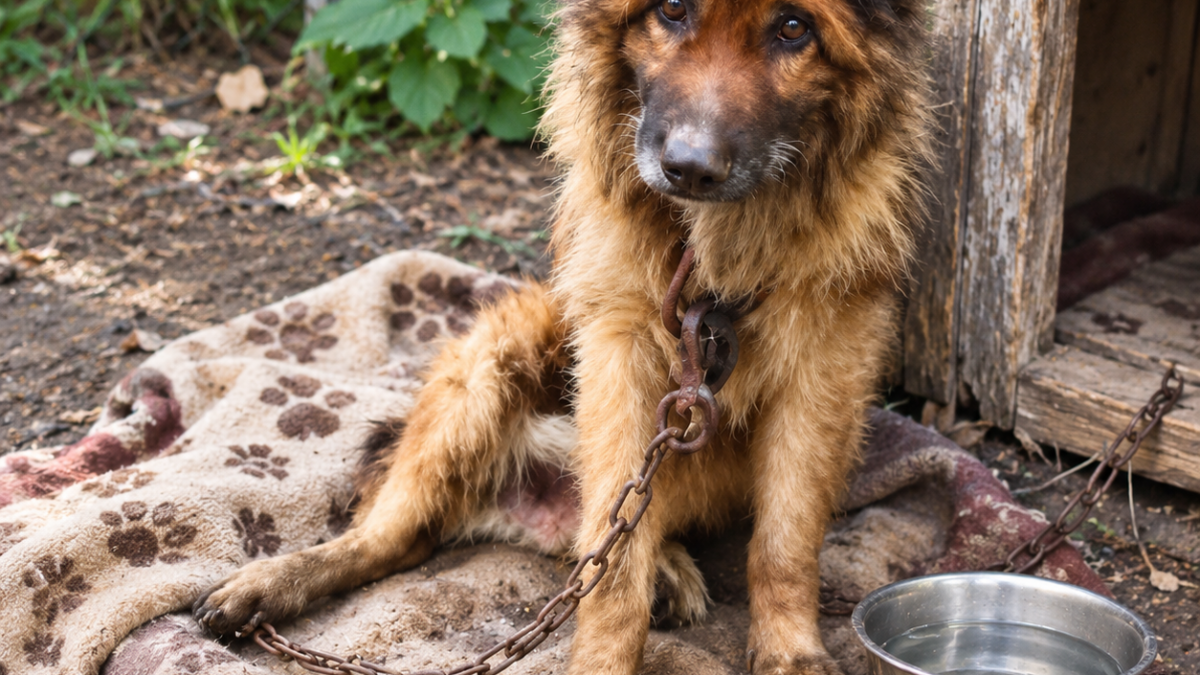
PART 2
I didn’t.
I was angry, yes.
But anger and courage are not the same thing.
My hands were shaking.
My stomach felt tight.
The closer we got to Phoenix, the worse he looked.
From our window, I had seen the dirt.
Up close, I saw everything else.
His coat was matted into hard sections.
The fur along his belly was wet and dark.
His ribs were visible beneath the tangled hair.
He looked much smaller than I remembered.
Not puppy-small.
Starved-small.
There is a difference.
Phoenix noticed us.
For a second his ears lifted.
His tail moved weakly.
Then he tried to stand straighter.
That tiny effort almost broke my heart.
Dogs do that sometimes.
Even after people fail them again and again, they still try to greet us.
I crouched a few feet away.
“Hey, sweetheart.”
Phoenix took one step toward me.
The chain tightened.
He stopped.
I looked toward the building.
His owner was nearby.
I stood.
“We need to talk about your dog.”
He barely looked at Phoenix.
“What about him?”
I couldn’t believe the question.
“What about him?”
My husband touched my arm lightly, reminding me not to lose control.
I pointed toward Phoenix.
“Look at him.”
The man shrugged.
“He’s fine.”
“He’s not fine.”
“He has food.”
“He can barely stand.”
“He’s my dog.”
“That doesn’t make this okay.”
His expression changed then.
Not guilt.
Annoyance.
As if Phoenix’s suffering was less important than the inconvenience of being questioned about it.
I told him that neighbors had been worried for weeks.
I told him I had already reported the conditions.
I told him Phoenix looked dangerously thin.
He stared at me.
Then he said the sentence I would remember for a long time.
“Don’t stick your nose into other people’s business.”
My husband stepped forward.
“When an animal is suffering where everyone can see it, it becomes people’s business.”
The man’s voice hardened.
“You don’t tell me what to do with my dog.”
I looked down at Phoenix.
He had lowered himself onto the wet ground.
The chain lay across his front leg.
“Then take care of him.”
“I do.”
“No, you don’t.”
My husband gave me another look.
Careful.
I took a breath.
“We’re asking you to bring him inside. Feed him properly. Get him checked. Do something.”
The owner waved us off.
“He gets dirty inside.”
For a moment, I honestly thought I had misunderstood him.
“What?”
“He used to stay in the apartment. He got dirty. I put him outside.”
I stared at him.
Phoenix had once been a tiny puppy living indoors.
Then, instead of teaching him, grooming him, cleaning him or providing proper care, the solution had apparently been simple.
Put him outside.
Attach a chain.
Let the problem disappear from the apartment.
Except Phoenix was not a problem.
He was a living animal.
And outside, he had slowly deteriorated where everyone could see him.
I said, “He was a baby.”
“He’s fine.”
“He is not fine.”
The argument went in circles.
It always came back to the same thing.
His dog.
His property.
His choice.
My husband finally asked, “Would you give him up?”
The owner’s expression changed immediately.
“No.”
“If you don’t want him inside, let someone else take him.”
“No.”
“We’ll help.”
“No.”
“Then let a rescue take him.”
“No.”
Every answer was the same.
He didn’t seem interested in improving Phoenix’s life.
But he also refused to release him.
That was the part I could not understand.
If you do not want to care for an animal, why fight to keep him?
Pride?
Control?
Possession?
I still don’t know.
What I know is that Phoenix stood behind him on a chain while two adults begged for a chance to help him.
And the man walked away.
He literally turned his back and went inside.
The conversation was over.
Phoenix watched him go.
Then he looked at us.
My husband exhaled slowly.
“What now?”
I looked at the little dog.
“We don’t stop.”
THE PUPPY HE USED TO BE
That night, I kept thinking about Phoenix before the chain.
I remembered him inside the apartment.
His little head poking through the doorway.
His clean fur.
His bright eyes.
He had been around one month old when his life with that owner began.
One month.
That is barely a beginning.
A puppy that young does not understand rules.
He doesn’t understand why he is punished for making a mess.
He doesn’t understand why yesterday he slept indoors and today he is tied outside.
He only understands where warmth is.
Where food is.
Where his person is.
And suddenly Phoenix had lost all three.
The more I thought about it, the angrier I became.
But anger by itself was useless.
Phoenix didn’t need me furious in my living room.
He needed evidence.
My husband was the one who said it.
“We need people to see exactly what’s happening.”
I looked at him.
“We’ve already reported it.”
“I know.”
“So what do you mean?”
He pointed toward my phone.
“Record it.”
At first I hesitated.
Not because I wanted to protect Phoenix’s owner.
Because public exposure is serious.
Once something goes online, you cannot fully control where it goes.
But then I looked outside.
Phoenix was curled against the ground.
The chain was visible beside him.
The muddy patch around him had become his entire world.
I thought about all the quiet reports.
The calls.
The waiting.
The nothing.
Maybe quiet had failed him.
Maybe it was time to stop being quiet.
THE VIDEO
We didn’t create some dramatic production.
There was no music.
No elaborate editing.
No narration designed to manipulate people.
We simply showed Phoenix.
That was enough.
The chain.
The dirty coat.
The thin body.
The puddle.
The way his legs weakened beneath him.
The confined area.
The reality.
My husband filmed while I stood nearby.
Phoenix tried to come toward us.
The chain stopped him.
He looked into the camera for a second.
That image stayed with me.
His eyes did not look angry.
They looked tired.
That made it worse.
I said quietly, “People need to see you.”
Phoenix wagged his tail.
He had no idea what I meant.
We uploaded the video to TikTok.
I expected some attention.
Maybe a few local people would share it.
Maybe someone who knew the right authority would see it.
Then I put my phone down.
An hour later, I picked it up.
Notifications filled the screen.
Comments.
Shares.
Messages.
I refreshed.
More.
My husband leaned over my shoulder.
“How many?”
I told him.
He frowned.
“That fast?”
“Yes.”
We refreshed again.
The number climbed.
People were furious.
They asked where Phoenix was.
They asked whether authorities had been contacted.
They tagged animal-welfare organizations.
They tagged local pages.
They demanded action.
Some simply wrote:
“Please save him.”
That sentence appeared again and again.
Please save him.
For weeks, I had felt almost alone in my frustration.
Now thousands of strangers were looking at the same dog and feeling the same thing.
The difference was overwhelming.
The video spread beyond our neighborhood.
Then beyond our immediate area.
My phone began ringing.
People wanted details.
Some offered to foster Phoenix.
Some offered veterinary help.
Some offered food.
Some asked whether they could adopt him immediately.
I had to keep repeating:
“He is still there.”
That sentence became unbearable.
The world had finally noticed Phoenix.
But Phoenix did not know that.
He was still attached to the same chain.
THE OWNER FOUND OUT
It did not take long.
Someone showed him the video.
He came outside angry.
I was near our building when I saw him approaching.
“You put me online?”
His voice carried across the yard.
My husband stepped beside me.
I answered, “We posted Phoenix.”
“You posted my property.”
I felt my jaw tighten.
“He’s not a chair.”
“You had no right.”
“We asked you to help him.”
“You make me look bad.”
I almost laughed, but there was nothing funny about it.
“We didn’t make Phoenix thin.”
He stared at me.
“We didn’t put him on that chain.”
His face hardened.
“You take it down.”
“No.”
“You take it down now.”
“No.”
For the first time since this began, I was not asking him for anything.
That changed the balance completely.
Before, we had begged.
Please feed him.
Please bring him inside.
Please get him help.
Please surrender him.
Now we were simply refusing to hide what everyone could already see.
“You’re causing trouble,” he said.
I looked toward Phoenix.
“No. The trouble was already here.”
He walked away furious.
Phoenix remained outside.
But something had shifted.
The owner could ignore two neighbors.
He could dismiss a few complaints.
Ignoring thousands of people was harder.
And those people were making calls.
A lot of them.
WHEN THE PHONE CALLS STARTED
Local authorities had already heard concerns before.
This time the volume was different.
People were contacting police.
Animal-welfare services.
Local officials.
Rescue organizations.
Anyone whose number they could find.
The video had created a public record that was difficult to dismiss.
It showed Phoenix’s condition in real time.
I received a call asking for the location.
Then another asking when the footage had been recorded.
Then someone wanted to know how long Phoenix had been outside.
I answered every question.
“Yes, we’ve tried speaking to the owner.”
“Yes, we previously reported it.”
“Yes, the dog is still there.”
“Yes, he is extremely thin.”
“Yes, I’m afraid his condition is getting worse.”
After one of the calls, I sat at the kitchen table holding my phone.
My husband placed a cup of coffee in front of me.
“You okay?”
“No.”
“What’s wrong?”
“What if it still isn’t enough?”
He pulled out the chair opposite me.
“It’s different now.”
“How do you know?”
“Because they can’t say they didn’t know.”
I looked toward the window.
Phoenix was there.
I whispered, “I just need somebody to go get him.”
THE MORNING EVERYTHING CHANGED
The next day, vehicles arrived.
I saw them from the window.
For a second I thought I was imagining it.
Then I saw uniforms.
My heart started pounding.
“Honey.”
My husband was already moving.
“I see them.”
We went outside but kept our distance.
Police had arrived.
People were speaking to Phoenix’s owner.
The conversation was tense.
I could not hear every word.
I did not need to.
Phoenix stood near his usual spot.
His chain stretched from his collar.
He looked from one person to another.
Confused.
An officer crouched near him.
Phoenix stepped forward.
The chain tightened.
The officer looked at it.
Then looked toward the owner.
Something in me broke.
I had imagined this moment so many times.
Someone finally seeing him up close.
Someone with authority standing where I had stood.
Someone who could do more than ask.
There was discussion.
More people arrived.
Phoenix’s condition was assessed.
His owner argued.
Of course he did.
I heard his voice rise.
“He’s my dog!”
Those words again.
My dog.
As though ownership were a shield against responsibility.
My husband stood beside me.
“Stay calm.”
“I am calm.”
“You’re shaking.”
“I know.”
Minutes felt like hours.
Then someone reached for the chain.
My breath stopped.
A hand worked at the attachment.
Metal moved.
The chain loosened.
Phoenix took one step forward.
Nobody stopped him.
Then another.
The chain did not pull him back.
I covered my mouth.
My husband whispered, “They’re taking him.”
Phoenix was free.
Not adopted.
Not healed.
Not safe forever.
But free from that chain.
For the first time since he was a baby, Phoenix could walk away from that spot without being jerked backward.
I started crying.
I didn’t care who saw.
HIS OWNER’S LAST ARGUMENT
The owner continued protesting.
“This is ridiculous.”
One of the officers remained calm.
The rest of the exchange was handled officially.
I will not pretend I heard every sentence or knew every legal detail.
What mattered was the outcome.
Phoenix was removed.
His owner no longer controlled where he slept that night.
As they prepared to leave, the man looked toward us.
Anger was written all over his face.
I knew exactly what he was thinking.
We had done this.
The neighbors who refused to shut up.
The people who filmed.
The strangers who shared.
The calls.
The pressure.
For weeks he had told us Phoenix was his business.
Now Phoenix’s condition had become everybody’s business.
He said something under his breath.
I did not answer.
There was nothing left to argue about.
I looked toward Phoenix instead.
Someone was holding his leash.
Not a chain.
A leash.
He took a few uncertain steps.
Then stopped.
Turned.
And looked back.
For one terrible second I worried he wanted his owner.
Dogs do not stop loving people just because those people fail them.
But then Phoenix turned forward again.
He walked toward the vehicle.
That was enough for me.
THE FIRST EXAMINATION
We received updates later.
The first thing caregivers needed to do was understand what they were dealing with.
Phoenix’s coat hid much of the truth.
People who had watched the video knew he was thin.
But tangled, dirty fur can create the illusion of more body underneath.
So his coat had to be trimmed.
The clippers began cutting through mats.
Dirty hair fell away.
And little by little, the real Phoenix appeared.
I saw the photos afterward.
I had to sit down.
His body was shockingly narrow.
His ribs stood out.
His hips were pronounced.
His legs looked too thin to support him.
Underneath the filthy fur was a dog who had been slowly disappearing.
One caregiver told me, “The coat made him look bigger than he was.”
I stared at the image.
“I knew he was thin.”
“I know.”
“But not like that.”
His eyes were the part I struggled with most.
Even after he was safe, they still looked sad.
People sometimes expect rescued animals to understand immediately.
Door closes.
Chain disappears.
Food arrives.
Now be happy.
But dogs do not understand rescue paperwork.
Phoenix had spent most of his life in one reality.
Outside.
Chain.
Hunger.
Isolation.
Then suddenly strangers were touching him, trimming him, examining him, moving him into a new environment.
Safety can feel frightening when you have never experienced it.
HIS FIRST NIGHT WITHOUT THE CHAIN
I thought about Phoenix constantly that first night.
Where was he sleeping?
Was he afraid?
Did he understand that nobody was putting him back outside?
Was he looking for the chain?
That last thought stayed with me.
When something has restricted you long enough, even freedom can feel strange.
I messaged one of the people caring for him.
“Is he okay?”
The reply came later.
“He ate.”
Two words.
He ate.
I smiled.
“How much?”
“Good amount. He’s tired, but he’s resting.”
I put the phone down.
My husband looked at me.
“Well?”
“He ate.”
He smiled too.
“That’s a start.”
It was more than a start.
Food meant Phoenix’s body had something to work with.
Rest meant he didn’t have to spend the night guarding himself in a puddle.
A clean place meant his fur would no longer soak in the same mud.
For the first time in a very long time, Phoenix’s only job was to recover.
DAY TWO
By the second day, Phoenix was eating well.
That update spread quickly among everyone following his rescue.
People celebrated a bowl of food as though it were a championship victory.
I understood why.
When you watch an animal suffer because basic needs are ignored, basic things become enormous.
A full stomach.
Fresh water.
A warm bed.
A clean blanket.
Nobody dragging a chain behind him.
Phoenix was cautious around people.
He watched everything.
If a hand moved too quickly, he pulled back.
If someone approached while he was eating, he became tense.
Not aggressive.
Protective.
As if the food might disappear.
His caregivers understood.
They did not crowd him.
They let him eat.
They used quiet voices.
They moved slowly.
A volunteer described sitting several feet away after Phoenix finished a meal.
He did not come over at first.
She ignored him.
Eventually he sniffed toward her.
Then took one step closer.
Then another.
When she finally touched his head, Phoenix froze.
She kept her hand still.
A few seconds later, his body softened.
That was how his new life began.
Not with grand gestures.
With tiny permissions.
THE VIDEO KEPT SPREADING
Even after Phoenix was safe, the original video continued circulating.
People wanted updates.
They wanted to know what had happened.
Some had watched the first clip when Phoenix was still chained.
Now they saw photographs of him with his coat shaved.
The difference shocked them.
Comments poured in.
“How could anyone let him get that thin?”
“Thank you to the neighbors.”
“Please tell us he’s eating.”
“Please tell us he won’t go back.”
That final question appeared constantly.
Will he go back?
I had the same fear.
The legal and administrative side had to be handled properly.
But the direction was clear.
Phoenix had been removed because his condition required intervention.
The chain was gone.
The neglect was documented.
Public attention was intense.
His owner’s refusal to listen had finally created the very thing he seemed to hate most:
scrutiny.
For months, he had controlled the story.
Phoenix is fine.
It’s my dog.
Mind your business.
Now photographs told another story.
A painfully thin body.
Matted fur.
A chain.
A dog who had been left outside until strangers forced the situation into the light.
The owner could argue with me.
He could not argue with Phoenix’s ribs.
A WEEK LATER
Seven days after Phoenix was removed, caregivers decided he was strong enough for a gentle walk.
The first time I saw the video, I cried again.
He wore a proper harness.
A leash was clipped to it.
There is a difference between a leash and a chain.
A chain says:
You stay where I put you.
A leash, in the right hands, says:
We are going somewhere together.
Phoenix stepped outside cautiously.
He looked around.
His body was still thin.
His coat was short where the mats had been removed.
He did not resemble the fluffy puppy I remembered.
But he was standing.
The caregiver took a few steps.
Phoenix followed.
Then he stopped.
She waited.
He sniffed the ground.
Another step.
Then another.
Nothing pulled him backward.
Phoenix looked behind him once.
Then forward.
I replayed that moment.
Again.
Again.
Again.
My husband finally said, “You’re going to wear that video out.”
“I don’t care.”
He sat beside me.
“Look at his tail.”
I paused the video.
Phoenix’s tail was slightly raised.
Not fully confident.
But not tucked underneath him either.
Hope can be that small.
THE OWNER WHO SAID WE HAD NO RIGHT
I saw Phoenix’s former owner several times afterward.
We never had another long conversation.
There was no need.
The dynamic had changed.
He had once looked at me and said I had no right to complain.
Now he no longer had Phoenix.
That was not revenge I had planned.
It was simply consequence.
If he had listened when we first spoke to him, perhaps none of this would have gone as far as it did.
He could have brought Phoenix inside.
He could have fed him properly.
He could have asked for help.
He could have surrendered him willingly.
He could have changed.
Instead, every plea became an argument about ownership.
By the time authorities arrived, Phoenix’s condition spoke louder than he did.
People sometimes imagine revenge as something dramatic.
A confrontation.
An insult.
A humiliating scene.
For me, the most powerful moment was quieter.
One afternoon I saw the empty place where Phoenix’s chain used to be.
No dog.
No muddy fur.
No thin body curled against the ground.
Just an empty patch.
The man had insisted Phoenix belonged there.
Now Phoenix was gone.
And nothing he said could put him back.
PHOENIX STARTED CHANGING
Food did what food does.
Sleep did what sleep does.
Safety did what safety does.
Slowly.
Not magically.
Phoenix began gaining weight.
His legs looked stronger.
His energy increased.
The sadness in his face began softening.
He started showing interest in toys.
At first he seemed confused by them.
Someone rolled a small ball toward him.
Phoenix watched it pass.
No reaction.
They rolled it again.
He sniffed it.
A few days later, he nudged one with his nose.
Then one morning, he chased it.
Not far.
Just a few feet.
But the person recording laughed.
Phoenix stopped.
His ears lifted.
He looked toward the sound.
Then his tail wagged.
That was another thing he needed to learn.
Human laughter could mean something good.
HIS HAIR GREW BACK
Weeks passed.
Phoenix’s coat began returning.
At first it was uneven.
Soft patches appeared along his back.
New growth covered places that had looked bare after shaving.
The healthy food helped.
So did cleanliness.
So did regular care.
Eventually the little dog from the old photographs started becoming recognizable again.
But there was something different in him now.
Before, Phoenix had looked like a puppy asking the world what it was.
After rescue, he began looking like a dog discovering that the answer might be better than he expected.
His caregivers sent videos.
Phoenix stretching on a clean bed.
Phoenix sniffing another dog.
Phoenix standing in sunlight.
Phoenix approaching people voluntarily.
Phoenix eating with enthusiasm.
Every clip felt like evidence against the life he had left behind.
Not evidence for court.
Evidence for the heart.
Proof that he had never been “a dirty dog.”
He had been an uncared-for dog.
There is a difference.
Give him clean conditions, and he became clean.
Give him food, and his body strengthened.
Give him affection, and he sought people.
Give him freedom, and he ran.
The problem had never been Phoenix.
THE FIRST TIME HE PLAYED
One of my favorite updates arrived on a quiet afternoon.
The message said:
“You need to see this.”
I opened the video.
Phoenix was in a small enclosed yard.
Another dog stood nearby.
Phoenix approached cautiously.
The other dog bowed.
Front legs down.
Rear end up.
A play invitation.
Phoenix stepped backward.
He looked confused.
The other dog bounced sideways.
Phoenix stared.
Then something happened.
His body loosened.
He made a tiny hop.
The other dog ran.
Phoenix followed.
At first he moved awkwardly.
Then faster.
They circled the yard.
Phoenix’s ears flew back.
His mouth opened.
His tail rose.
For several seconds, he looked like the puppy he should have been all along.
No chain.
No puddle.
No owner telling people to mind their business.
Just two dogs running because running felt good.
I cried.
My husband walked in.
Again?
I pointed at the screen.
“Look.”
He watched.
Then he sat beside me.
Neither of us spoke until the video ended.
Finally he said, “That’s why you didn’t give up.”
I shook my head.
“That’s why all those people didn’t give up.”
A DOG LEARNS FREEDOM IN PIECES
Phoenix’s recovery was not perfect.
Some days he was frightened.
Certain movements made him flinch.
Being tethered even briefly during normal care could make him uncomfortable.
If a leash became tight, he sometimes froze.
His caregivers adjusted.
They used positive reinforcement.
They allowed him to move at his own pace.
They taught him that pressure could be released.
That hands could be gentle.
That doors could open.
That food would return tomorrow.
That water bowls could stay full.
That being dirty did not mean being punished.
That making a mistake did not mean being put outside forever.
I wish every person who says, “It’s just a dog,” could see what dogs remember.
They remember routines.
They remember fear.
They remember safety.
They remember who comes back.
Phoenix was learning a completely different language of life.
THE QUESTION EVERYONE ASKED
“Who is going to adopt him?”
People asked constantly.
At first the rescue did not rush.
Phoenix needed stability before another major transition.
He needed medical evaluation.
Nutrition.
Socialization.
Routine.
And most of all, people needed to understand that adopting Phoenix was not about taking home a viral dog.
He was not an internet symbol.
He was an individual.
A dog with history.
A dog who might need patience.
A dog who deserved a permanent home, not temporary excitement.
Applications began arriving anyway.
A lot of them.
People from different areas offered to take him.
Some wrote long messages.
Some sent photographs of their homes.
Some described previous rescue animals.
The caregivers reviewed everything carefully.
I was grateful.
After what Phoenix had already experienced, the last thing anybody wanted was a rushed decision.
THE FAMILY
Eventually, one application stood out.
The family did not begin by talking about how famous Phoenix had become.
They asked practical questions.
What scared him?
How did he behave around new people?
What food was he eating?
Did he enjoy other dogs?
How much exercise could he handle?
Had he ever lived normally indoors?
Was he house-trained?
What should they expect during the adjustment period?
Those questions mattered.
They weren’t asking for the dog from the viral video.
They were asking about Phoenix.
They met him.
At first, Phoenix kept some distance.
Nobody forced him.
One person sat on the floor.
Phoenix circled.
Sniffed.
Walked away.
Came back.
The meeting lasted longer than expected.
By the end, Phoenix had rested near them.
Not on them.
Near them.
For a dog who once had no choice about where he stayed, choosing proximity mattered.
The caregivers felt cautiously hopeful.
A second meeting went better.
Then another.
The family remained committed.
Soon we received the news.
Phoenix had been adopted.
I stared at the message.
My husband read it over my shoulder.
“He got a home?”
“He got a home.”
I laughed and cried at the same time.
“Finally.”
THE DAY PHOENIX LEFT
The adoption day was almost surreal.
Photos showed Phoenix clean and healthy enough to look like a different dog.
His coat had grown back significantly.
He had gained weight.
His face looked brighter.
He wore a collar that fit properly.
A leash hung loosely.
No heavy chain.
His new family had prepared everything.
Bed.
Bowls.
Food.
Toys.
Blankets.
They understood his history.
They knew he might need time.
Phoenix did not know what “adopted” meant.
He simply knew familiar caregivers were placing him near new people.
At first he hesitated beside the car.
One of his new family members crouched.
No pulling.
No forcing.
Phoenix sniffed the doorway.
Then climbed in.
That image felt like a perfect opposite to the one in my memory.
Months earlier, he had fallen into a puddle because a chain kept him trapped.
Now he was climbing into a car that would carry him toward an entire new life.
HIS FIRST NIGHT IN A REAL HOME
The update came the same evening.
Phoenix had explored cautiously.
He sniffed furniture.
Checked corners.
Walked through rooms more than once.
He seemed especially interested in the doorway.
That didn’t surprise me.
For so much of his life, doors had decided where he was allowed to exist.
Inside.
Then outside.
Then apparently never inside again.
Now doors were open to him.
He chose where to lie down.
At first, he picked the floor.
His family placed a bed nearby.
Phoenix sniffed it.
Stepped onto it.
Stepped off.
Later that night, they found him asleep on it.
Nobody celebrated loudly.
They took a photograph.
Phoenix curled into the soft fabric.
His body relaxed.
The caption was simple.
“First night home.”
I saved the picture immediately.
HE KEPT EXPECTING TO BE SENT OUTSIDE
One part of Phoenix’s adjustment hurt to hear about.
Whenever someone cleaned something inside the house, Phoenix became nervous.
If a towel came out.
If the floor was wiped.
If someone reacted to a mess.
Phoenix sometimes moved toward the door.
As though he expected the old punishment.
Dirty dog.
Outside.
His family noticed.
They began deliberately reassuring him.
Accidents were cleaned quietly.
Nobody shouted.
Nobody dragged him away.
Nobody attached him to anything.
The first few times, Phoenix looked confused.
Weeks passed.
He began relaxing.
One day he tracked a little mud across the floor after going outside.
His owner laughed.
“You’re a mess.”
Phoenix wagged his tail.
The floor was cleaned.
Phoenix remained inside.
That might sound insignificant.
It wasn’t.
For Phoenix, it was a correction to an old memory.
Mess did not equal abandonment.
THE COAT EVERYONE HAD BEEN WAITING FOR
As the months passed, Phoenix’s coat became beautiful.
Full.
Soft.
Healthy.
The same dog who had once been covered in filthy mats now looked almost proud of himself.
His family brushed him regularly.
At first he tolerated only short sessions.
Then he began enjoying them.
He would sit nearby when the brush appeared.
Sometimes he leaned against the person grooming him.
One photo showed Phoenix after a bath.
His fur was fluffy.
His eyes were bright.
He had a slightly mischievous expression.
I stared at it for a long time.
“Look at him.”
My husband smiled.
“Hard to believe.”
I shook my head.
“No. It’s easy to believe.”
“What do you mean?”
“This is what he was supposed to look like.”
That was the tragedy and beauty of Phoenix.
Nothing miraculous had been required to create that healthy dog.
Food.
Shelter.
Cleanliness.
Medical attention.
Affection.
Basic responsibility.
The things he should have had from the beginning.
HIS CHEEKY GREETING
Phoenix developed personality once he felt safe.
A lot of personality.
He became known for a funny greeting.
When someone he loved came home, he would race toward them with his body wiggling so hard that he seemed unable to run in a straight line.
Sometimes he made a strange little sound.
Not quite a bark.
Not quite a whine.
His family called it his “complaint.”
As though Phoenix were saying:
Where have you been?
Why did you leave?
Do you understand how long twenty minutes is?
Then he would demand attention.
The dog who once lay quietly at the end of a chain now expected people to notice him.
I loved that.
Confidence had returned so completely that Phoenix had become demanding.
He wanted walks.
He wanted affection.
He wanted treats.
He wanted the good spot on the couch.
He wanted people to come home on schedule.
That was not spoiled behavior to me.
That was recovery.
THE FIRST TIME I SAW HIM AGAIN
Months after the rescue, I finally saw Phoenix in person.
His new family brought him back for a visit.
I knew they were coming, but I was still nervous.
Would he remember me?
Did I want him to?
Part of me hoped he had forgotten everything connected to that old place.
Then the car arrived.
The door opened.
Phoenix jumped down.
For a second he looked around.
Then he saw me.
His ears lifted.
I said, “Phoenix?”
His entire body changed.
He ran toward me.
I dropped to my knees.
Phoenix hit me in the chest hard enough to almost knock me backward.
I wrapped my arms around him.
He smelled clean.
That detail destroyed me.
Clean.
Soft.
Warm.
Healthy.
I buried my face in his fur.
“You’re okay.”
His tail kept hitting my arm.
“You’re really okay.”
His family laughed.
“He remembers you.”
I looked at Phoenix.
“I hope he remembers the good part.”
WE WALKED PAST THE OLD SPOT
I did not plan it.
Maybe I should have avoided it.
But during the visit we walked near the place where Phoenix had once been chained.
He slowed.
My heart tightened.
Did he recognize it?
I don’t know.
Nobody can know exactly what a dog is thinking.
Phoenix sniffed the ground.
He looked around.
For a moment, I saw the old image again.
Dirty fur.
Thin legs.
Mud.
Metal.
Then Phoenix’s new owner continued walking.
The leash moved gently.
Phoenix followed.
No chain stopped him.
He did not remain there.
He simply passed through.
That was one of the most satisfying moments of the entire story.
The place that had once been his whole world had become somewhere he could walk past.
THE FORMER OWNER SAW HIM
I had wondered whether it would ever happen.
Eventually, it did.
Phoenix’s former owner saw him from a distance.
Phoenix was with his new family.
Healthy.
Coat restored.
Tail up.
Moving freely.
I noticed the man before Phoenix did.
For a moment, everything in me went cold.
I remembered our argument.
Don’t stick your nose into others’ business.
My dog.
You have no right.
I remembered the puddle.
The thin body.
The chain.
Part of me wanted some dramatic confrontation.
I wanted him to see what Phoenix had become and understand everything he had thrown away.
But nothing dramatic happened.
He looked.
Phoenix looked briefly in his direction.
Then Phoenix turned toward his new family.
A hand reached down.
Phoenix leaned against it.
And they kept walking.
That was it.
No barking.
No running back.
No desperate recognition.
No scene.
Phoenix simply chose the life in front of him.
I could not have designed a better ending.
THAT WAS THE REVENGE
People online sometimes asked what happened to the man.
They wanted punishment.
They wanted anger.
Some wanted humiliation.
I understood.
When you see an animal suffer, anger comes easily.
But I realized something after watching Phoenix walk away.
The best revenge was not that the owner became embarrassed online.
It was not that strangers criticized him.
It was not even that police had intervened.
The best revenge was that everything the man had denied Phoenix now belonged to him anyway.
Freedom.
Food.
A warm home.
A clean coat.
People who cared where he was.
People who noticed when he was hungry.
People who worried when he was sick.
People who laughed when he was silly.
People who missed him when they left the house.
People who came back.
The man had treated Phoenix as though keeping him alive at the end of a chain was enough.
Phoenix went on to prove how enormous a dog’s life can become when someone actually loves him.
THE WORLD THAT HAD ONCE BEEN TEN FEET WIDE
There is something I think about often.
For a long time, Phoenix’s entire world was defined by the length of a chain.
Maybe eight feet.
Maybe ten.
Whatever the exact distance, it was small.
He could walk to the puddle.
To the bowl.
To the dirty patch.
Then the chain stopped him.
That was the boundary of his life.
Today Phoenix goes on walks.
He rides in a car.
He explores parks.
He runs across grass.
He sniffs trees.
He meets people.
He sleeps indoors.
He chooses where to lie down.
If a door opens, he can move through it.
If he wants to turn left, he turns left.
If he wants to stop, he stops.
Freedom sounds philosophical until you watch a dog discover it physically.
Step.
Step.
Step.
No metal tightening.
Another step.
Still nothing.
Then running.
HIS FIRST REAL RUN
The video that affected me most arrived months after the adoption.
Phoenix was standing in a wide grassy area.
His new owner unclipped the leash inside a safe enclosed space.
For half a second, Phoenix didn’t move.
Then he realized.
He ran.
Not trotted.
Not walked carefully.
Ran.
His legs stretched fully beneath him.
His coat moved in the wind.
He crossed the grass, turned sharply and raced back.
Then away again.
He looked almost shocked by his own speed.
His family laughed.
Phoenix ran faster.
Watching it, I remembered him falling into that puddle.
Same legs.
Same dog.
Different life.
I paused the video at the point where all four paws were off the ground.
Phoenix was airborne.
Free.
I saved that frame.
Sometimes healing can be captured in one photograph.
PEOPLE CALLED ME A HERO
I never liked that.
People said:
“You saved him.”
No.
I was the neighbor who refused to stop complaining.
My husband refused too.
The people who shared the video helped.
The people who called authorities helped.
The officers who responded helped.
The caregivers helped.
The veterinarians and volunteers helped.
The family who adopted him helped.
Phoenix’s rescue was not one heroic moment.
It was a chain of people choosing not to look away.
Ironically, that was the only chain Phoenix needed.
One person saw.
Another shared.
Another called.
Another arrived.
Another opened a door.
Another provided food.
Another offered a home.
That chain carried him out.
WHY I KEPT REPORTING IT
Some people asked why I became so involved.
Why not mind my own business?
That phrase again.
Here is my answer.
Because suffering does not become acceptable just because it happens on someone else’s property.
Because ownership is responsibility.
Because a dog cannot knock on a neighbor’s door and say:
I’m hungry.
I’m cold.
I can’t get out of this water.
My fur hurts.
My legs are weak.
Please call someone.
Phoenix had no voice humans were legally required to understand.
All he had were visible signs.
His body.
His behavior.
His condition.
Those of us around him became responsible for deciding whether those signs mattered.
I will always be grateful that enough people finally decided they did.
THE OWNER COULD HAVE BEEN PART OF THE HAPPY ENDING
This is something people rarely talk about.
Phoenix’s original owner had chances.
Many of them.
The first complaint could have been a wake-up call.
He could have said, “You’re right.”
He could have asked for advice.
He could have admitted he was overwhelmed.
He could have surrendered Phoenix peacefully.
He could have let us help.
Had he done that, I would have respected the decision.
Sometimes people realize they cannot properly care for an animal.
Giving that animal to someone who can is not failure.
Refusing help while the animal deteriorates is different.
That was the tragedy.
Every step toward the viral video was avoidable.
The argument.
The public exposure.
The police intervention.
All of it.
One sentence could have changed everything:
“I can’t care for him. Please help.”
He never said it.
So eventually thousands of people answered for Phoenix instead.
PHOENIX LEARNED WHAT HOME MEANT
At first, home was simply the place where he was no longer chained.
Then it became more.
Home was breakfast at the same time.
A familiar voice.
A favorite corner.
The sound of keys.
A bed that smelled like him.
A water bowl that was always there.
A hand on his head.
Eventually he started sleeping deeply.
That was one of the changes his family noticed.
Early on, Phoenix woke easily.
Every noise mattered.
Every movement pulled him from sleep.
Months later, he could lie upside down with his paws in the air and snore through normal household noise.
That posture told me more about his emotional recovery than almost anything else.
A dog exposing his stomach while sleeping is not preparing to survive.
He feels safe.
THE PUDDLE
I still think about the puddle.
It is strange what memory chooses.
Not the police vehicles.
Not the viral numbers.
Not the arguments.
The puddle.
Phoenix falling.
Trying to stand.
Falling again.
At the time, it felt like the lowest point.
Now, when I remember it, another image follows automatically.
Phoenix running.
My mind has joined the two.
The fall.
The run.
Maybe that is why his name felt so appropriate in the end.
Phoenix.
A creature associated with rising again.
I don’t know whether his original owner thought about the meaning when he named him.
But the little dog certainly lived it.
ONE YEAR LATER
Around a year after the video, Phoenix barely resembled the dog people had first seen online.
His coat was fully restored.
His weight was healthy.
His posture was confident.
His eyes were bright.
There was a sparkle in him that had been absent during those days on the chain.
His family sent a photograph celebrating the anniversary of his rescue.
Phoenix sat beside a small sign.
One year free.
I stared at those words.
Free.
Not rescued.
Not viral.
Not famous.
Free.
That was the word that mattered.
HE BECAME A DIFFERENT KIND OF VIRAL
People who had followed his original story began sharing his recovery images.
The contrast was enormous.
Before:
Mud.
Chain.
Matted fur.
Thin body.
Sad eyes.
After:
Healthy coat.
Bright expression.
Open grass.
A home.
A family.
The transformation traveled online almost as widely as the rescue video.
I was glad.
I did not want Phoenix permanently frozen in public memory as a suffering dog.
He deserved to be remembered alive.
Not just surviving.
Living.
THE MOMENT HIS FAMILY KNEW HE TRUSTED THEM
His adopter told me this story later.
One night there was a loud storm.
Thunder shook the windows.
Phoenix became frightened.
He paced.
His body trembled.
Instead of hiding alone, he walked into the bedroom.
His owner sat on the floor.
Phoenix approached.
Then pressed his entire body against the person’s chest.
He stayed there until the storm passed.
“That was when I knew,” his owner told me.
“Knew what?”
“That he finally believed we could protect him.”
I couldn’t answer for a moment.
Because trust is expensive for a dog like Phoenix.
He paid for it once and lost everything.
Then, somehow, he found enough courage to spend it again.
THE LAST TIME SOMEONE TOLD ME TO MIND MY BUSINESS
Months later, someone who knew the story jokingly said:
“You really don’t know how to mind your own business, do you?”
I laughed.
“Nope.”
Then I looked at Phoenix.
He was rolling in the grass.
His coat was clean.
His legs were strong.
His leash lay loose beside his family.
And I thought:
Good.
If minding my own business had meant leaving that dog where he was, I am glad I failed.
A HAPPY ENDING IS NOT THE SAME AS FORGETTING
Phoenix’s story has a happy ending.
But I never want the ending to erase the beginning.
It matters that he suffered.
It matters that reports initially changed nothing.
It matters that a neighbor had to keep pushing.
It matters that public attention was required before decisive action came.
Because another Phoenix may still be outside somewhere.
Another dog may be thin beneath a dirty coat.
Another neighbor may be wondering whether they are overreacting.
Another person may be hearing:
Mind your business.
Phoenix’s story answers that sentence better than I ever could.
THE DOG WHO ONCE COULDN’T WALK TEN FEET
Today, Phoenix has favorite routes.
He recognizes certain parks.
He knows which cabinets contain treats.
He has opinions about where he sleeps.
He gets excited when he sees his leash.
Think about that.
The same dog who spent so long restrained by a chain now gets excited when he sees a leash.
Why?
Because the meaning changed.
The chain meant confinement.
The leash means adventure.
Context is everything.
HIS OWNER’S PUNISHMENT WAS LOSING THE DOG HE NEVER APPRECIATED
People still ask whether I think justice was done.
I think about that carefully.
Nothing can refund Phoenix the months he lost.
Nobody can give him back his earliest puppyhood.
Nobody can erase hunger.
Or rain.
Or isolation.
But his owner lost the right to decide Phoenix’s future.
That mattered.
He once said:
“My dog.”
In the end, that phrase no longer applied.
Phoenix became someone else’s dog.
Someone who actually treated those words as a responsibility.
Someone whose idea of ownership meant food, care, patience, medical attention, exercise, safety and love.
If there was poetic justice in the story, that was it.
The person who fought hardest to keep Phoenix tied to him was the person who ultimately lost him.
The people who fought to free him became the reason he found a family.
THE BEST PHOTO OF PHOENIX
There are many.
The rescue photo.
The first walk.
The adoption day.
The full coat.
The grass.
But my favorite was taken on an ordinary morning.
Phoenix is sitting near a doorway.
Sunlight falls across the floor.
His coat looks almost golden in the light.
He is looking over his shoulder with that cheeky expression he developed after recovery.
Behind him, the door is open.
That detail matters.
Open.
Nobody is forcing him through it.
Nobody is locking him outside.
Nobody is attaching him to anything.
Phoenix could stay.
Phoenix could leave.
Phoenix could choose.
And he chose to turn back toward the person taking the photograph.
Because that was home.
IF I COULD TALK TO PHOENIX ON THAT FIRST DAY
Sometimes I imagine going back.
Phoenix is in the puddle.
The chain is heavy beside him.
His fur is filthy.
His legs are weak.
I crouch beside him.
I cannot remove the chain yet.
Not that day.
But I know what is coming.
I would tell him:
Hold on.
I know you don’t understand.
I know it feels like this patch of mud is the whole world.
It isn’t.
Soon people you have never met are going to see you.
They will get angry for you.
They will make calls.
Strangers will fight over who gets the chance to love you.
Someone in a uniform is going to reach for this chain.
And one day it will come off.
You will eat until your ribs disappear beneath healthy weight.
Your hair will grow back.
Someone will brush it.
Someone will buy you a bed.
You will sleep inside.
You will get muddy and nobody will throw you away.
You will hear laughter and learn it is safe.
You will run so fast that all four paws leave the ground.
You will have a family.
And someday you will walk past this place.
The chain will be gone.
You will not stop.
THE FINAL WALK
The last video Phoenix’s family sent me showed him running ahead on a trail.
The path was wide.
Trees lined both sides.
Sunlight came through the leaves.
Phoenix moved confidently.
His new owner called his name.
Phoenix turned.
For one second he stood looking back.
Then he ran toward the person who called him.
That small moment contained the whole story.
Once, Phoenix had been unable to reach the people walking past him because a chain stopped him.
Now someone he loved called his name from across open ground.
Nothing held him back.
He ran because he wanted to.
EPILOGUE
Phoenix began life as a tiny puppy inside an apartment.
He made messes.
He needed care.
He needed patience.
Instead, he was put outside.
A chain became his world.
His coat became filthy.
His body became thin.
His legs weakened.
He fell into dirty water.
People reported what they saw.
Still, he remained there.
When I confronted his owner, I was told not to interfere.
When my husband and I asked him to help Phoenix, he insisted the dog belonged to him.
When we asked him to surrender Phoenix, he refused.
So we stopped asking quietly.
We showed people.
One video spread.
Then thousands of people saw what Phoenix had been enduring.
Calls came.
Pressure grew.
Police arrived.
And finally, someone removed the chain.
That moment did not instantly heal Phoenix.
Freedom was only the beginning.
His coat had to be shaved.
The thin body underneath shocked everyone.
He needed food.
Rest.
Care.
Time.
On his second day, he was eating well.
After a week, he was walking.
Over the following weeks, his hair began growing back.
His body filled out.
His strength returned.
Then his personality came back too.
The frightened little dog became playful.
Curious.
Cheeky.
Affectionate.
And finally, Phoenix was adopted.
The dog who once had nowhere to go except the distance allowed by a chain suddenly had an entire home.
Then a yard.
Then walks.
Then parks.
Then open grass.
He learned that getting dirty did not mean being thrown outside.
He learned that food would come again.
He learned that people could leave for work and still return.
He learned that a leash could mean a walk instead of confinement.
He learned that hands could groom instead of punish.
He learned that a home was not simply four walls.
A home was being wanted inside them.
His former owner once told me Phoenix was none of my business.
Maybe he was right about one thing.
Phoenix was never meant to belong to me.
But his suffering was impossible for me to ignore.
And because enough people refused to ignore it too, Phoenix eventually belonged exactly where he should have.
With a family that saw him as more than property.
With people who understood that “my dog” does not mean:
I can do whatever I want.
It means:
I am responsible for you.
I will feed you.
I will protect you.
I will notice when you hurt.
I will care where you sleep.
I will not leave you in the rain because you are inconvenient.
I will not decide your life is worth less because you made a mess.
And most importantly:
I will not give up on you.
The man who once fought to keep Phoenix at the end of a chain eventually had to watch that dog become healthy and happy without him.
That was the consequence.
Phoenix did not need revenge.
He needed a future.
And he got one.
Today, the chain exists only in old videos.
The puddle dried long ago.
The matted coat is gone.
The sharp ribs are covered by a healthy body.
The frightened eyes have changed.
Now when Phoenix sees someone he loves, he runs toward them.
He runs with all the strength those thin legs eventually found.
He runs with his coat moving in the wind.
He runs because there is no metal around his neck telling him where he must stop.
And every time I see him running, I remember the puppy who once fell into that puddle and could not escape.
I remember how his owner turned away.
I remember being told to mind my business.
Then I look at Phoenix now.
Healthy.
Handsome.
Loved.
Free.
And I know exactly what I would say if I had to make that choice again.
I would pick up the phone.
I would record the truth.
I would make the call.
I would knock on the door.
I would refuse to look away.
Because Phoenix’s story did not change when someone felt sorry for him.
It changed when somebody finally decided feeling sorry was not enough.
And in the end, the little dog who had spent most of his young life tied to one filthy patch of ground got the one thing his old owner could never give him.
A life without a chain.



