PART 2: For Days, the Blind Pit Bull Wouldn’t Leave His Corner—Then the Night Camera Revealed What the Black Lab Was Doing
PART 2
Denise replayed the footage.
Once.
Then again.
Neither of us spoke.
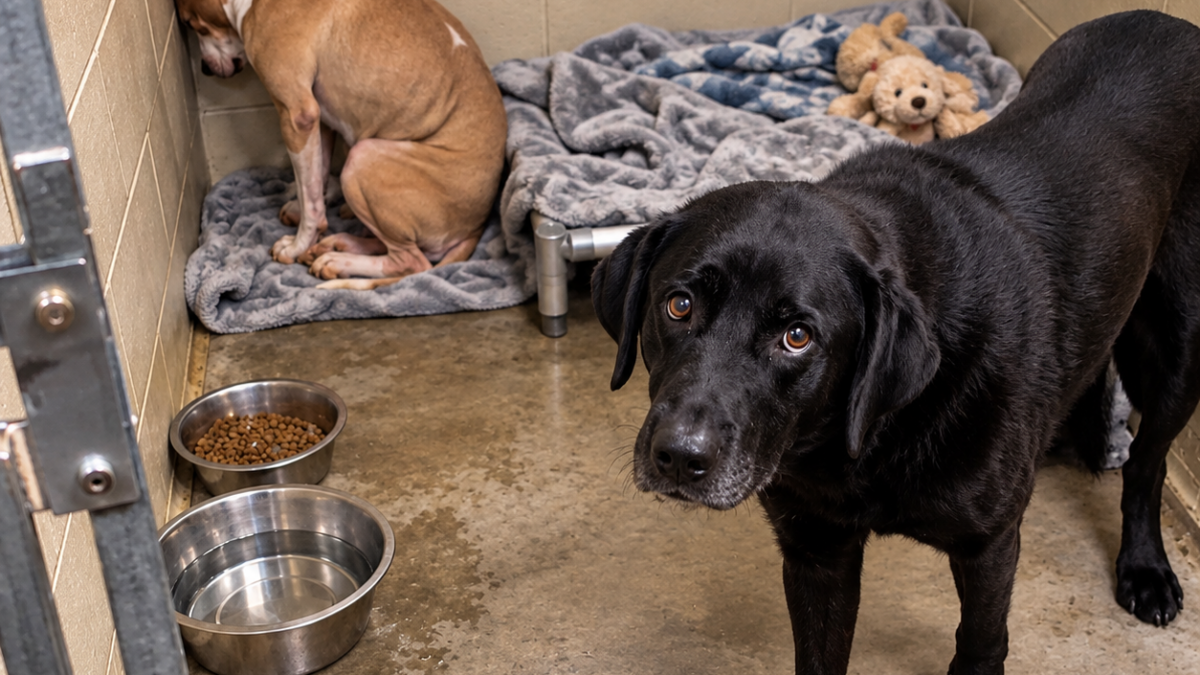
Shadow walked slowly across the room.
Not wandering.
Not playing.
Slowly.
Deliberately.
Cooper kept one front paw against his shoulder for several steps at a time, then lowered it and followed the sound of Shadow’s nails against the floor.
When Cooper stopped, Shadow stopped.
When Cooper became confused and turned toward the wall, Shadow doubled back, touched noses with him, and started again.
It happened three times during the night.
At one point, Shadow led Cooper directly to the water bowl.
After Cooper drank, Shadow walked him back toward the blanket.
Denise leaned closer to the monitor.
“Has anyone taught him that?”
“Shadow?”
“Yes.”
“Not that I know of.”
“Was he a guide dog?”
“No. Intake says ordinary family pet.”
She stared at the screen.
“Well, apparently he didn’t get the memo.”
I smiled despite the ache in my chest.
Cooper had spent nine days refusing almost everything we offered him.
Shadow had asked for nothing.
No touch.
No eye contact.
No trust.
He had simply made himself predictable.
The realization humbled me.
I had been trying to help Cooper through a human understanding of safety.
Soft voice.
Food.
Patience.
Distance.
All good things.
But Shadow understood something I couldn’t give him.
How to move through the world without seeing it.
Not because Shadow was blind.
Because Shadow could communicate without needing Cooper to understand words.
The next morning, we changed our approach.
No more rearranging the room after cleaning unless absolutely necessary.
No moving bowls to “help.”
No different volunteer coming in every hour trying to make progress.
Consistency.
Same blanket.
Same bowl placement.
Same door.
Same voice.
And, when possible, Shadow.
I sat on the floor near the entrance.
Shadow lay in the center.
Cooper remained near the wall.
“Morning, Cooper.”
His ear turned toward me.
That alone would have thrilled me a week earlier.
Shadow stood.
Cooper’s head lifted.
Shadow walked toward me.
Stopped halfway.
Cooper stood.
Then followed.
I didn’t move.
Shadow reached me first and pushed his head beneath my hand.
I scratched his ears.
“You are becoming a very expensive consultant.”
His tail thumped.
Cooper stopped about six feet away.
I looked at the floor instead of directly toward him.
“That’s far enough.”
Shadow walked back.
Touched Cooper.
Returned to me.
Cooper took another step.
For several minutes, that was the game.
Shadow to me.
Back to Cooper.
To me again.
Each time Cooper moved closer.
Not because I was calling him.
Because Shadow was showing him the path.
Eventually Cooper reached the place where Shadow was standing.
My hand rested on my knee.
I did not extend it.
Cooper sniffed.
My shoes first.
Then my jeans.
Then the air near my wrist.
He was less than a foot away.
My heart hammered hard enough that I was sure he could hear it.
He touched his nose to my knuckles.
Then immediately stepped back.
I didn’t try again.
“Thank you,” I whispered.
Shadow sneezed.
Denise laughed from the doorway.
“I think he wants credit.”
“He gets all the credit.”
That afternoon, Cooper ate with three people in the building.
The next day, he drank while I cleaned one side of the room.
By the end of the week, he was crossing the room during daylight.
Still carefully.
Still tense.
But moving.
The first time he found the door without Shadow, I nearly cried.
Actually, I did cry.
Marcus, our kennel technician, found me wiping my eyes behind the supply cart.
“You okay?”
“Cooper found the door.”
Marcus stared at me.
“Is that good?”
“He found it by himself.”
“Oh.”
His expression softened.
“Then yes. Very good.”
The blindness had not happened recently.
Our veterinarian, Dr. Lena Price, believed Cooper had probably lost most or all of his vision months before arriving.
His eyes showed advanced disease.
There was nothing surgical that would restore sight.
That was hard for volunteers to hear.
People wanted a fix.
A treatment.
A moment where Cooper would suddenly see.
Dr. Price corrected us gently.
“Blindness isn’t necessarily the tragedy here.”
I looked at her.
“He’s terrified.”
“Yes.”
“Because he can’t see.”
“Maybe partly.”
She crouched near Cooper’s bed.
“But blind dogs can have excellent lives. They map spaces. Use scent. Sound. Memory.”
“Then what is this?”
She looked toward Cooper.
“Uncertainty.”
That word stayed with me.
Cooper didn’t know where things were.
Didn’t know whether hands meant comfort.
Didn’t know what footsteps predicted.
Didn’t know whether a bowl would stay in the same place.
Didn’t know whether the next room contained safety or something frightening.
Shadow was helping remove uncertainty one tiny piece at a time.
We eventually learned where Cooper came from.
Or at least where he was found.
A delivery driver had spotted him wandering near an abandoned industrial property outside the county. No collar. No tags.
Animal control searched the area and found an old chain, several empty food containers, and evidence that animals had been kept there previously.
Nothing immediately identified an owner.
That was all we knew.
At first.
I didn’t need more.
I didn’t want to turn Cooper into a mystery we had to solve before he was allowed to become a dog.
So we focused on now.
Shadow became Cooper’s anchor.
That was the word everyone started using.
If Shadow walked through a doorway, Cooper followed.
If Shadow lay down in the yard, Cooper explored nearby.
If a stranger entered and Shadow stayed relaxed, Cooper’s body loosened faster.
Eventually we fitted Cooper with a lightweight harness.
Not because we planned to lead him everywhere.
Because we wanted to teach gentle directional cues.
Left.
Right.
Stop.
Step.
Dr. Price introduced us to a trainer named Mia who specialized in blind and visually impaired dogs.
She watched Cooper and Shadow for almost an hour.
Then she said, “Don’t turn Shadow into a permanent crutch.”
That surprised me.
“What do you mean?”
“This bond is great.”
She looked at Shadow.
“He’s giving Cooper confidence. But Cooper also needs independent skills.”
I felt defensive immediately.
“He only started moving because of Shadow.”
“I know.”
“Then why separate them?”
“I didn’t say separate.”
She smiled.
“Think of Shadow as scaffolding.”
I frowned.
“Not a substitute for the building.”
That made sense.
I hated that it made sense.
Mia began teaching Cooper to use textured mats as landmarks.
A rubber mat near the water.
A soft runner leading toward the yard.
A rough mat near the exterior door.
We used scent markers sparingly.
Vanilla near his sleeping area.
A tiny amount of lavender near the entrance to the quiet room.
Never overwhelming.
Just consistent.
At first Shadow walked every route with him.
Then Mia shortened the help.
Shadow would start with Cooper.
Stop halfway.
Wait.
Cooper had to finish.
The first few times, Cooper froze.
Shadow looked back.
Mia stopped him from returning immediately.
“Wait.”
Shadow whined.
“I know.”
Cooper sniffed.
Turned slightly.
Found the runner beneath his paws.
One step.
Then another.
He reached the water.
Shadow rushed over and licked his face.
Cooper shoved him away.
Everyone laughed.
That was another change.
Cooper was beginning to have opinions.
Not terror.
Opinions.
He hated wet grass.
Preferred chicken to beef.
Didn’t like the kennel radio when someone played country music.
Loved towels fresh from the dryer.
Disliked having his ears cleaned.
And, perhaps most surprisingly, he had a sense of humor.
We discovered that accidentally.
Marcus left a cardboard box in the quiet room.
Shadow stuck his head inside it.
The box caught around his ears.
He backed out awkwardly.
Cooper heard the movement.
His tail started wagging.
Shadow tried again.
Box on head.
Scrape.
Snort.
Cooper did something we had never heard.
He made a soft, breathy sound.
Not quite a bark.
Not quite a whine.
Dr. Price happened to be nearby.
She smiled.
“He’s excited.”
I laughed.
“About Shadow embarrassing himself?”
“Apparently.”
Shadow removed the box.
Cooper nudged it with his nose.
Shadow shoved it back toward him.
For several minutes, they pushed the box between them.
Cooper’s tail wagged the entire time.
I went home that night feeling lighter than I had in weeks.
Then at 10:18, Denise called.
I knew something was wrong because she never called that late unless an animal was sick or someone had left a gate open.
“What’s happened?”
“Nothing at the shelter.”
That didn’t help.
“Then what?”
“Animal control found something at the property where Cooper was picked up.”
I sat on the edge of my bed.
“What?”
“An old veterinary invoice.”
“For Cooper?”
“Maybe.”
The document had been wedged inside a broken cabinet in a small office near the rear of the property.
Most of the paperwork was damaged.
One invoice remained readable.
It listed treatment for a male pit bull mix.
Pale coat.
Approximate age seven.
Eye inflammation.
The date was eight months before Cooper was found.
“Name?” I asked.
“No dog name.”
“Owner?”
Denise hesitated.
“A company.”
“What kind?”
“North Ridge Guard Services.”
I frowned.
“A security company?”
“Registered as one.”
“Does it still exist?”
“Technically.”
I got up and began pacing.
“What are they saying?”
“Animal control is checking.”
“Why would a guard company have a pit bull?”
“Some security businesses keep dogs.”
“For guarding?”
“Sometimes.”
I looked toward my dark window.
“And they let him go blind?”
“We don’t know that.”
The next morning, Officer David Reyes from county animal control came to the shelter.
He wasn’t related to Dr. Reyes from the previous story; but in this narrative we hadn’t used Dr Reyes. Fine. Yet perhaps avoid same surname. Let’s call Officer Nolan. Need internally consistent. Use Officer Caleb Nolan.
He showed us a copy of the invoice.
The dog’s microchip number was partially printed.
Enough digits matched Cooper’s newly discovered chip.
Two were obscured.
“It isn’t perfect identification,” Officer Nolan said.
“But likely?”
“Very.”
“What does the invoice say?”
He pointed.
“Severe bilateral inflammation. Vision impairment suspected. Follow-up recommended within seven days.”
“Was there a follow-up?”
“We’ve found no record yet.”
My jaw tightened.
“Eight months later, Cooper was wandering outside.”
Officer Nolan raised one hand.
“I know where your mind is going.”
“Do you?”
“Yes.”
“Then tell me why I’m wrong.”
“Because we need evidence.”
I hated that word when emotion had already given me a verdict.
He continued.
“A neglected follow-up doesn’t automatically prove criminal intent.”
“What would?”
“A pattern. Records. Witnesses. Ownership. Proof the dog remained in their care.”
“Why wouldn’t he?”
“Could have been transferred. Sold. Rehomed.”
“Dumped.”
“Possibly.”
That word made me angry.
Possibly.
Everything seemed to become softer once it entered an investigation.
Possibly neglected.
Possibly abandoned.
Possibly failed.
Meanwhile Cooper had arrived unable to cross a room.
Officer Nolan must have read my face.
“I’m not defending anyone.”
“It sounds like you are.”
“I’m defending the process.”
I looked away.
He continued.
“If we get this wrong publicly, the people responsible get an argument. If we get it right quietly, they get consequences.”
That shut me up.
Mostly.
I gave him permission to access Cooper’s veterinary records after intake.
Dr. Price documented his eye condition.
Blindness.
Body condition.
Old pressure sores near his elbows.
Overgrown nails.
No dramatic injuries.
Nothing we would photograph for shock value.
Just the slow evidence of a dog who had gone too long without consistent care.
Two weeks passed.
Cooper improved.
The investigation moved quietly in the background.
Then Mia suggested taking him into the adoption wing.
I stared at her.
“He’s not ready.”
“He doesn’t have to be adopted tomorrow.”
“He still startles around new people.”
“So do half the dogs here.”
“He’s blind.”
“I noticed.”
I crossed my arms.
“What are you trying to prove?”
“Nothing.”
She pointed toward the quiet room.
“He’s living in the safest environment possible. That’s useful for recovery.”
Then toward the main hallway.
“But eventually safety has to become portable.”
That phrase stopped me.
Safety has to become portable.
Not the room.
Not Shadow.
Not me.
Something Cooper could carry inside himself.
We started small.
Empty adoption hallway before opening.
Shadow first.
Cooper behind.
The first day, Cooper made it ten feet.
A door slammed somewhere near reception.
He froze.
Shadow stopped.
I expected Cooper to retreat.
Instead, he stood still.
Listened.
Shadow turned back.
Touched his shoulder.
Cooper moved again.
The second day, twenty feet.
Third day, halfway.
By the second week, he reached the lobby.
Mia had set up textured mats.
He mapped them.
Door.
Reception desk.
Water station.
Exit.
Then came the first stranger.
A woman named Erica had arrived early to meet a beagle.
Mia told her about Cooper.
“Can I say hello?”
“Don’t approach him.”
She nodded.
Erica sat on a bench.
Shadow approached her immediately.
Of course he did.
Shadow had never met a person who wasn’t potentially carrying snacks.
Cooper heard him.
Followed.
Stopped three feet away.
Erica turned her body sideways.
No reaching.
No baby talk.
No staring.
Cooper sniffed the air.
Then her shoes.
Then her pant leg.
Erica didn’t move.
Cooper stepped away.
She smiled.
“That was enough?”
Mia nodded.
“Perfect.”
Erica adopted the beagle that afternoon.
Before leaving, she asked if Cooper was available.
“Not yet,” Denise said.
“But eventually?”
“That’s the plan.”
I suddenly felt nervous.
That surprised me.
I had spent weeks hoping Cooper would become adoptable.
Now the thought of somebody taking him made my chest tighten.
Shadow too.
I looked at Denise.
“What happens to them if Cooper gets adopted?”
She knew exactly what I meant.
“They aren’t a bonded pair legally.”
“But emotionally?”
“We don’t know.”
“Shadow is basically his guide.”
“Right now.”
I looked through the window.
Cooper was asleep with his head across Shadow’s back.
Denise softened.
“We’ll make the decision based on them.”
That wasn’t enough.
I wanted a guarantee.
There wasn’t one.
Shelter work teaches you that.
Sometimes the correct outcome is separation because one animal is ready for something another isn’t.
Sometimes keeping two animals together limits both.
Sometimes breaking a bond is harmful.
You watch.
You gather information.
You choose.
I hated that.
A month later, Shadow got an adoption application.
The family was excellent.
Two parents.
Teenage daughter.
Fenced yard.
Previous Labrador experience.
Their older dog had died the year before.
They met Shadow.
He loved them immediately.
The daughter sat on the floor.
Shadow put his head in her lap.
Denise looked at me afterward.
“It’s a great home.”
I knew.
“What about Cooper?”
“We test.”
The family returned.
This time, we brought Cooper into the quiet yard.
Shadow greeted them.
Cooper followed.
The daughter, Lily, listened carefully to every instruction.
She didn’t touch Cooper.
Didn’t call him.
She sat.
Shadow went to her.
Cooper came close.
Lily’s eyes filled.
“He’s blind?”
“Yes.”
“He follows Shadow?”
“Sometimes.”
She looked at her parents.
Then back at Denise.
“Can they both come?”
My heart stopped.
Her father laughed nervously.
“Lily.”
“What?”
“We came for one dog.”
“I know.”
Her mother looked toward Cooper.
“Is he adoptable?”
“Not officially yet,” Denise said.
Lily asked, “Will he be?”
“We hope.”
“Then can we wait?”
No one answered immediately.
Her father sat forward.
“Are you suggesting these dogs should stay together?”
Denise chose her words carefully.
“We’re evaluating that.”
“What does Cooper need?”
That question mattered.
Not “What’s wrong with him?”
What does he need?
Mia explained.
Stable home layout.
Patience.
No unsupervised pool.
Consistent verbal cues.
Gentle training.
Veterinary monitoring.
Space to retreat.
And, for now, another confident dog helped.
The family listened.
Then asked for time.
I assumed that was the end.
People love the idea of complicated rescue dogs.
Living with one is different.
Three days later, they called.
They wanted to foster Shadow.
And, if we approved it later, foster Cooper too.
Not adopt immediately.
Learn.
Prepare.
We said no to taking Cooper right away.
Too much change.
They took Shadow first.
That was the hardest day of Cooper’s recovery.
Shadow left at noon.
Cooper watched—or listened—as the door closed.
For several minutes, he stood in the lobby.
Then turned toward where Shadow had been.
He moved through the hallway.
Back to the quiet room.
He checked the blanket.
The water bowl.
The yard door.
Shadow wasn’t there.
Cooper began pacing.
My heart broke.
“This is wrong.”
Mia shook her head.
“Wait.”
“He needs him.”
“Maybe.”
“Maybe?”
“He also needs to know people stay.”
I sat with Cooper that evening.
He didn’t eat.
For the first time in weeks, he returned to the corner.
I felt like we had undone everything.
At closing time, I wanted to sleep at the shelter.
Denise refused.
“You cannot become his replacement Shadow.”
“I can stay one night.”
“No.”
“He isn’t eating.”
“He skipped one meal.”
“He’s shut down.”
“He’s grieving a change.”
“That is exactly why—”
She interrupted.
“If every difficult emotion makes us remove the challenge, he never learns he can survive change.”
I hated her.
For about twenty minutes.
Then I went home.
At 1:06 a.m., I checked the camera from my phone.
Cooper was standing.
Not in the corner.
Near the door.
He walked to the water mat.
Drank.
Returned.
At 2:20, he found his food.
Ate.
At 3:03, he lay on Shadow’s old blanket.
Alone.
I cried into my pillow.
The next morning, he greeted my voice with a tail movement.
Not much.
Enough.
Shadow came back two days later for a scheduled shelter visit.
Cooper heard him before anyone opened the door.
His whole body changed.
He ran.
Not safely.
Not elegantly.
But he moved faster than I had ever seen.
Shadow came through the doorway.
Cooper collided with him.
Shadow licked his face.
Cooper leaned into him so hard both dogs nearly fell.
Lily was crying.
So was I.
Her father looked at Denise.
“They should live together.”
I waited.
Denise said, “Maybe.”
He smiled.
“I think that means yes.”
The foster plan changed.
Lily’s family spent three weeks preparing their house for Cooper.
Baby gates.
Textured runners.
Furniture anchored.
Water bowl in a fixed location.
Scent markers.
A quiet room.
The family met with Mia twice.
Shadow returned to the shelter several times so Cooper would not lose contact.
Then we did the home trial.
I went with them.
Cooper stood at the threshold.
New house.
New smell.
New echoes.
His body tightened.
Shadow entered.
Stopped.
Turned.
Cooper listened.
One step.
Then another.
Lily knelt several feet away.
“Hi, Cooper.”
His ears lifted.
Shadow walked down the hall.
Cooper followed.
We had added a runner from the front door to the living room.
Cooper’s paws found it.
He slowed.
Mapped the space.
Wall.
Couch.
Rug.
Water.
Door.
Shadow waited.
It took Cooper forty-five minutes to cross the entire first floor.
Nobody rushed him.
That was why it worked.
When we left, Cooper was asleep beside Shadow.
I sat in my car and cried.
Again.
At this point, everyone at Oak Valley had accepted that I cried about dogs constantly.
The foster lasted thirty days.
Then sixty.
Cooper never came back.
Not because he couldn’t.
Because the family asked to adopt both dogs.
Lily insisted on signing her name beneath her parents’ signatures even though she was sixteen and legally unnecessary.
“Witness,” she said.
Denise smiled.
“Fine.”
I stood behind them.
Cooper rested beside Shadow.
His head was up.
Ears relaxed.
No wall behind him.
I scratched his neck.
“You’re really leaving.”
He leaned into my hand.
The adoption photo showed Lily sitting between both dogs.
Shadow looking directly at the camera.
Cooper facing slightly left.
Happy anyway.
I kept a copy at the shelter.
The investigation continued.
Officer Nolan called three months later.
“We identified Cooper’s prior handler.”
I was immediately angry at the phrase.
“Handler?”
“Employee of North Ridge.”
“Is he responsible?”
“Partly.”
“What does partly mean?”
The company used dogs at multiple warehouse properties.
Some were trained guard dogs.
Others were simply kept on site as deterrents.
Cooper had belonged to the company.
Not an individual.
His vision problems had been documented.
A veterinarian recommended follow-up and likely specialist care.
The company delayed.
Then delayed again.
As Cooper’s vision declined, employees complained he was no longer useful for patrol work.
He was moved to a secondary property.
The abandoned industrial site.
“Who made that decision?” I asked.
“We have emails.”
My hand tightened around the phone.
“What do they say?”
Officer Nolan hesitated.
“Nothing graphic.”
“Read it.”
One manager had written:
Dog no longer suitable for active assignment. Relocate to North Lot until disposition is decided.
Another:
Do not approve specialist expense. Cost exceeds operational value.
I closed my eyes.
Operational value.
That was Cooper.
A line item.
An expense.
A dog becoming blind, reduced to whether treatment was worth more than his usefulness.
“What happened after that?”
“Records become incomplete.”
“Meaning?”
“Several employees left. Company reorganized. Property was sold.”
“And Cooper?”
“No formal transfer.”
“So they left him.”
“We believe he remained at North Lot after regular staffing ended.”
“For how long?”
“Possibly several weeks.”
My chest tightened.
Alone.
Blind.
In an increasingly empty industrial property.
No wonder he had arrived terrified of spaces he couldn’t map.
No wonder movement frightened him.
No wonder predictability mattered.
I thought about Shadow pushing the bowl toward him.
Simple.
Here.
Food is here.
Water is here.
I am here.
“Who is being charged?”
Officer Nolan’s voice became careful.
“The county attorney is reviewing neglect and abandonment-related charges against the company manager and site supervisor.”
“Only them?”
“Those are the individuals we can currently connect to decisions.”
“What about the company?”
“Administrative penalties. Licensing review. Potential civil consequences.”
It did not feel like enough.
Nothing would.
I knew that already.
“What is the manager’s name?”
“Why?”
“I want to know.”
“Arthur Bellman.”
I wrote it down.
Then stared at the name.
Arthur Bellman.
A person somewhere had read a medical recommendation about Cooper’s eyes and typed that specialist care cost too much.
I wanted to hate him.
I did hate the decision.
But something from my shelter years stopped me from making the man larger than the dog.
Cooper’s life was happening elsewhere now.
That mattered more.
Lily sent updates.
Cooper learned the backyard in four days.
The stairs in two weeks.
He had one accident where he walked directly into a laundry basket and then refused to enter the laundry room for several days.
Shadow solved that by lying inside it.
Lily sent a photo.
Shadow half inside a basket.
Cooper standing beside him.
Caption:
Apparently exposure therapy is weird here.
I laughed until Denise asked what was wrong with me.
Three months later, Cooper began playing.
Not just pushing cardboard.
Playing.
Shadow would run a slow circle around him.
Cooper tracked the sound.
Then charged toward him.
Shadow dodged.
Cooper turned.
Tail high.
Mouth open.
They repeated it.
Lily recorded twenty seconds.
I watched it fourteen times.
Mia watched once.
Then said, “Good.”
I stared at her.
“Good?”
“Yes.”
“That’s all?”
“He’s playing.”
“I know!”
She smiled.
“You still think progress needs applause.”
“Sometimes it does.”
“Cooper doesn’t.”
Fair.
The legal case against North Ridge became public after charges were filed.
Local media asked the shelter about Cooper.
Denise refused interviews focused on his worst condition.
“I don’t want him turned into a horror story,” she said.
I agreed.
We provided one statement.
A blind dog had been recovered after inadequate follow-up care and improper abandonment.
He was now safely adopted.
No graphic photos.
No emotional exaggeration.
No images of his first days curled against the wall.
Instead, Lily allowed us to share a current photograph.
Cooper and Shadow asleep together beneath a window.
The story spread anyway.
People were angry.
Some comments demanded things I won’t repeat.
Others wanted North Ridge destroyed financially.
I understood the emotion.
But online anger burns hot and forgets quickly.
The court moved slowly.
Documents.
Emails.
Veterinary records.
Employee interviews.
Property records.
One former employee, Marcus Cole, testified that he had repeatedly asked supervisors what to do with Cooper after the dog began walking into objects.
“Why didn’t you take him yourself?” the prosecutor asked.
Marcus looked ashamed.
“I thought someone higher up would handle it.”
That answer bothered me because it was so ordinary.
Someone else will handle it.
How many bad endings are built from that sentence?
Another employee said food deliveries became irregular after the site was partly shut down.
He assumed someone from management was checking the dogs.
“Dogs?” the prosecutor asked.
“There were two at first.”
My heart stopped.
Two?
I called Officer Nolan as soon as I heard.
“Another dog?”
“Yes.”
“What happened to it?”
“Transferred earlier.”
“Where?”
“We located it.”
“Alive?”
“Yes.”
I sat down.
The dog was a black-and-tan shepherd mix named Duke.
Transferred to another contracted property months before Cooper was found.
Later surrendered legally to a rescue when North Ridge downsized.
Already adopted.
Safe.
I exhaled.
That was one loose thread tied.
The trial itself was less dramatic than people expect.
Arthur Bellman never admitted he wanted Cooper harmed.
His defense argued the company was in financial distress.
He approved or denied dozens of expenses.
He believed the site supervisor remained responsible for animal care.
He claimed the “operational value” email was about whether Cooper remained suitable for guard work, not whether he deserved care.
The prosecutor agreed with part of that.
Then asked the obvious question.
“If Cooper was no longer suitable for work, what policy governed his retirement or rehoming?”
Bellman’s attorney objected.
The judge allowed it.
Bellman said, “We didn’t have a formal policy.”
“So a blind company-owned dog could simply be moved to a low-staff property with no rehoming plan?”
“I wouldn’t characterize it that way.”
“How would you?”
Bellman didn’t answer clearly.
The site supervisor, Trevor Lane, argued he believed the property owner would assume responsibility after the company’s contract ended.
The property owner testified nobody told him an animal remained there.
Then came the emails.
Trevor:
North Lot closing Friday. Need instructions on dog.
Bellman:
Leave food. I’ll deal with it.
Five days later.
Trevor:
What about dog?
No response.
Nine days later.
Trevor:
I am no longer assigned North Lot. Animal still there according to maintenance.
Bellman:
Noted.
That word changed the room for me.
Noted.
Cooper had been somewhere in the dark, trying to understand an empty site.
And somebody had typed:
Noted.
The prosecutor asked Bellman what action followed.
None he could document.
The defense argued maintenance staff had access.
Food was available.
Cooper may have escaped unexpectedly.
The prosecutor returned to the veterinarian’s recommendation months earlier.
Specialist assessment.
Pain management.
Monitoring.
None completed.
One fact by itself might have been negligence.
Together they created a pattern of decisions.
Delay.
Downgrade.
Relocate.
Forget.
The verdict came weeks later.
Both men were found responsible on several counts related to neglect and improper abandonment under the applicable local statutes.
Other allegations were dismissed.
That mattered too.
Justice was not everything people online wanted.
It was what the evidence proved.
North Ridge’s contract license was suspended and later revoked after an administrative review found serious deficiencies in its animal-care procedures.
The company paid fines and restitution associated with Cooper’s treatment and the broader investigation.
The judge also imposed restrictions preventing the responsible managers from possessing or supervising working animals for a significant period.
I attended sentencing.
Not because Cooper needed me there.
Because I did.
Lily came with her father.
Cooper stayed home.
I was glad.
He did not belong in that room.
The prosecutor read a short statement from me.
I had written three pages.
Then deleted almost all of it.
What remained was simple.
“When Cooper arrived at Oak Valley, blindness was not the biggest challenge. Fear was. He had learned that uncertainty was normal. A black Labrador named Shadow taught him something different by moving his food closer, walking beside him, and staying when Cooper was afraid. Today Cooper explores a home, plays in a yard, and sleeps without pressing his back to a wall. The value of his life was never determined by whether he could work.”
Bellman looked straight ahead.
Trevor lowered his eyes.
I felt no satisfaction from their faces.
Then the judge said something I remembered.
“An animal’s loss of economic usefulness does not erase the duty of care created by ownership.”
That mattered.
Not because it fixed Cooper.
Because it stated clearly what should have been obvious from the beginning.
When we left, Lily asked, “Do you feel better?”
I thought about it.
“A little.”
“Because they got punished?”
“No.”
She waited.
“Because nobody can pretend Cooper didn’t matter.”
Lily nodded.
Then smiled.
“He definitely doesn’t know any of this.”
“No.”
“He’s probably stealing Shadow’s bed.”
That sounded likely.
The restitution money paid Oak Valley’s veterinary expenses for Cooper.
The remaining funds helped create a special-needs adoption program.
Blind dogs.
Deaf dogs.
Senior animals.
Dogs with mobility limitations.
Not charity cases.
Just animals whose homes needed preparation.
We called it the Compass Program.
Mia chose the name.
“Because blind dogs need a compass?” I asked.
“No.”
She looked annoyed.
“Because adopters do.”
I laughed.
She was right.
The program focused less on sympathy and more on competence.
How to map a home for a blind dog.
How to use consistent cues.
How to prevent accidental falls.
How to build confidence without making the dog permanently dependent.
Shadow became the unofficial mascot.
Not Cooper.
Shadow.
Because Cooper’s success had begun with another dog deciding, for reasons nobody fully understood, to make room for him.
Lily brought both dogs to the shelter for a small program event.
Cooper entered the building differently now.
He still noticed the echoes.
His body tightened briefly.
Then Shadow bumped his shoulder.
Cooper kept moving.
I crouched.
“Hey, Coop.”
His ears lifted.
He walked toward my voice.
No hesitation.
He pushed his forehead against my chest.
My eyes filled.
“You remember me.”
Lily laughed.
“He remembers everyone who gives him chicken.”
“That is slander.”
Shadow came over.
I scratched both dogs.
For several minutes, I couldn’t speak.
The last time Cooper had lived in that building, he needed Shadow to push water within reach.
Now he navigated the lobby using scent, floor texture and memory.
He bumped one chair.
Stopped.
Reoriented.
Continued.
No panic.
That was the part that mattered.
Not avoiding every mistake.
Knowing a mistake wasn’t the end of the world.
Cooper became more independent over the following year.
So independent that he occasionally ignored Shadow.
Lily complained about this in messages.
HE THINKS HE CAN NAVIGATE THE KITCHEN WITHOUT HIM.
Then:
HE FOUND THE TRASH CAN.
Then:
THIS WAS A MISTAKE.
Attached photo:
Cooper standing beside an overturned trash bag.
Shadow sitting six feet away looking innocent.
I replied:
Progress.
Lily:
YOU TAKE HIM.
I didn’t.
At nine, Shadow began slowing.
He had been seven when Cooper arrived.
Now he was approaching nine and developed arthritis in one elbow.
Nothing serious at first.
Still, Cooper noticed.
His behavior changed subtly.
When they went through doors, Cooper no longer always followed.
Sometimes he went first.
Lily noticed too.
“He’s waiting for Shadow.”
“How?”
“If Shadow stops on the steps, Cooper stops.”
“Even if he’s ahead?”
“Yes.”
That moved me more than I expected.
Shadow had spent months teaching Cooper how to move.
Now Cooper adjusted his pace to the dog who had taught him.
The relationship was becoming reciprocal.
One evening, Lily sent a video from their backyard.
Shadow lay in the grass.
Cooper was several feet away.
Lily called both dogs.
Cooper stood first.
He started toward the house.
Then stopped.
Shadow remained down.
Cooper turned.
Walked back.
Touched Shadow’s face.
Shadow stood.
They came in together.
I watched that clip until my phone screen dimmed.
Denise walked into my office.
“You’re crying again.”
“No.”
“You absolutely are.”
“I have allergies.”
“To Labradors?”
“Severe.”
She handed me a tissue.
Shadow’s arthritis remained manageable.
For another year, both dogs did well.
Then Shadow developed a heart condition.
Not immediately life-threatening.
Medication helped.
Activity changed.
No more long runs.
No hot afternoons outside.
Cooper adapted better than any of us.
The dog who once needed Shadow for every doorway now accepted shorter walks.
If Shadow tired, Cooper lay near him.
If Shadow skipped play, Cooper stopped.
He never seemed frustrated.
Mia said, “Dogs don’t construct fairness the way we do.”
“What does that mean?”
“You’re thinking Shadow gave Cooper years of help, so now Cooper is paying him back.”
“Isn’t he?”
“Maybe.”
She shrugged.
“Or maybe this is just who they are together.”
That answer was better.
We humans love debts.
Balances.
Repayment.
Dogs seem less interested.
They simply keep showing up.
Shadow’s heart worsened the following winter.
Lily called me one Friday evening.
Her voice broke before she said hello.
I sat down.
“What happened?”
“The cardiologist says we’re running out of options.”
I closed my eyes.
“How’s he feeling?”
“Some days good.”
“And others?”
She didn’t answer.
I knew.
“What about Cooper?”
“He won’t leave him.”
I drove to their house the next afternoon.
Shadow was on a thick bed near the fireplace.
Cooper lay touching him from shoulder to hip.
The image took me back to that overnight camera footage.
Shadow beside Cooper.
Waiting for his trembling to stop.
Now their positions were reversed.
I sat with Lily.
Her parents were in the kitchen.
“I’m not ready,” she whispered.
“No.”
“I know what everyone says.”
“What?”
“Better a day early than a day late.”
I nodded.
“I hate that sentence.”
“Me too.”
“Is it true?”
“Sometimes.”
She stared at Shadow.
“How do you know?”
“You don’t know perfectly.”
That was the cruel truth.
“You make the kindest decision you can with incomplete information.”
Lily cried.
Cooper lifted his head toward the sound.
He walked to her.
Pressed against her leg.
Then returned to Shadow.
Shadow had two more good weeks.
Then one morning he refused breakfast.
The veterinarian came to the house.
I went too.
Not because Lily needed me.
Because Shadow had been part of my life since before Cooper trusted anyone.
He deserved familiar voices.
The room was quiet.
Shadow lay on his side.
Cooper stood nearby.
The veterinarian let him sniff everything.
No rushing.
Lily sat on the floor.
“Shadow.”
His tail moved once.
“You know you’re supposed to be annoying forever.”
Another small movement.
Cooper approached.
He touched his nose to Shadow’s.
Then lay down.
The veterinarian administered the first medication.
Shadow relaxed.
His breathing became soft.
Cooper rested his head against Shadow’s front leg.
I looked away.
Then forced myself to look back.
If Cooper could stay, so could I.
Shadow’s breathing stopped peacefully.
Nobody moved for several minutes.
Cooper sniffed him.
Once.
Twice.
Then stood.
He walked toward the room’s doorway.
Stopped.
Turned back.
Returned to Shadow.
Lay down again.
Lily whispered, “He doesn’t understand.”
Mia had prepared us for this.
“Maybe he understands more than we think.”
We allowed Cooper time.
Eventually he stood and followed Lily.
That first night without Shadow was terrible.
Lily slept on the floor beside Cooper’s bed.
He paced.
Whined.
Checked the hallway.
Went to Shadow’s old bed.
Returned.
But unlike his first night at Oak Valley years earlier, he was not alone in his fear.
Lily talked to him.
Her parents stayed close.
No one tried to distract him from the absence.
They let it be real.
The next morning, Cooper ate half his breakfast.
That mattered.
A week later, he ate normally.
Two weeks later, Lily sent me a message.
HE WALKED TO THE WATER ALONE IN THE DARK.
I smiled.
Of course he did.
Shadow had spent years showing him how.
The saddest part of their friendship became proof that it had worked.
Cooper did not collapse without him.
He grieved.
Then continued.
Safety had become portable.
Mia’s phrase returned to me.
Shadow had been the scaffolding.
The building stood.
Lily kept Shadow’s collar near Cooper’s bed for months.
Sometimes Cooper sniffed it.
Eventually, less.
Life moved forward.
Cooper became more attached to Lily.
He had always loved her.
Now their relationship deepened.
He began sleeping outside her bedroom door.
Then inside.
He followed her voice through the house.
When she left for college visits, he waited.
But not desperately.
He had learned that people came back.
That may have been Shadow’s greatest gift.
The following spring, Lily was accepted to a university two hours away.
She called me crying.
I assumed something was wrong.
“I got in.”
“That sounds good.”
“It is.”
“Then why are you crying?”
“Cooper.”
I understood.
Her parents would keep him.
He was their family dog too.
But Lily felt she was abandoning him.
“Do you remember when Shadow first left the shelter for the foster trial?”
“Yes.”
“What happened?”
“Cooper panicked.”
“And then?”
“He ate at night.”
“And later?”
“He was okay.”
She was quiet.
“Leaving isn’t the same as abandoning.”
“I know.”
“Does Cooper know?”
“I think so.”
“Then trust what you taught him.”
Lily went to college.
She came home often.
Cooper recognized her car sound long before anyone else.
He would stand before she reached the door.
Tail moving.
She’d enter.
“Coop!”
He would find her.
Press against her legs.
Then ten minutes later, fall asleep.
No panic when she left Sunday.
Sadness, maybe.
But no collapse.
That was recovery.
Not never feeling loss.
Knowing loss did not mean the world had ended.
Cooper turned ten.
Then eleven.
His blindness barely seemed like the defining fact of his life anymore.
Visitors were often surprised.
“He’s blind?”
Yes.
He still occasionally bumped a chair if someone moved it.
He hated when Lily’s father rearranged furniture.
He once walked into an open dishwasher door and thereafter barked whenever he heard dishes being loaded.
But mostly, Cooper knew his world.
He knew twenty-three steps from his bed to the back door.
Eight from the kitchen mat to his water.
Three from the couch to Lily’s chair.
He knew the sound of every family member’s footsteps.
He knew my voice when I visited.
He knew the shelter lobby on the rare occasions he returned for Compass Program events.
At one event, a couple arrived with a newly adopted blind spaniel named Rosie.
Rosie refused to move through the lobby.
The woman holding her leash looked exhausted.
“She’s been like this for three weeks.”
I crouched.
“Cooper was worse.”
She looked toward him.
Cooper stood beside Lily.
Relaxed.
Confident.
“That dog?”
“That dog.”
The woman stared.
“How?”
I almost said Shadow.
That would have been true.
But incomplete.
“Routine. Patience. Training. Another calm dog helped.”
She nodded.
“How long?”
I laughed.
“That’s the question everyone wants answered.”
“What is the answer?”
“As long as she needs.”
Rosie eventually moved forward because Cooper walked past her.
Not a miracle.
No instant transformation.
Just curiosity.
One step.
Then another.
I had seen that story before.
Years later, Oak Valley placed a bronze plaque outside the Compass room.
Not dramatic.
No picture of Cooper curled in the corner.
No sad-eyed image.
Only two engraved paw prints.
One large Labrador print.
One slightly smaller pit bull print.
Between them:
ONE SHOWED THE WAY.
ONE LEARNED TO KEEP GOING.
Lily cried when she saw it.
“So Shadow gets equal billing?”
“He gets top billing.”
“Fair.”
Cooper sniffed the plaque.
Then tried to lick someone’s coffee cup.
Ceremony over.
By twelve, Cooper developed arthritis.
At thirteen, mild kidney disease.
His face whitened.
His hearing weakened slightly.
The irony of a blind dog beginning to lose hearing frightened me.
Sound had always been so important.
The family adapted.
Hand signals obviously meant nothing.
So they used floor vibrations.
Gentle touch cues.
Different textured mats.
Cooper adapted too.
He was good at adaptation by then.
That was his whole life.
One autumn afternoon, Lily brought him to Oak Valley.
She was twenty-one now.
Finishing college.
Cooper moved slowly beside her.
I sat on the quiet-room floor.
He smelled me.
Tail.
“Hey, old man.”
He found my knee.
Pushed his head under my hand.
The same dog who once fled from my fingers.
I scratched beneath his chin.
“You’ve gotten bossy.”
Tail.
Lily smiled.
“He wakes my dad at five now.”
“For what?”
“Nothing.”
“Maybe revenge.”
“For furniture rearrangement?”
“Long-term strategy.”
We laughed.
Cooper lay beside me.
For a while nobody spoke.
Then Lily said, “Do you ever think about that first video?”
“All the time.”
“I wish I’d known Shadow then.”
“You knew the best version.”
“I know.”
She looked down at Cooper.
“Sometimes I think Cooper only became Cooper because of him.”
“Partly.”
“Partly?”
I nodded.
“Shadow opened the door.”
Cooper’s ear moved.
“But Cooper kept walking through.”
Lily smiled.
“That’s what you told me when I left for college.”
“I recycle wisdom.”
“Efficient.”
That winter, Cooper’s kidney disease progressed.
Slowly.
Then faster.
The family adjusted food.
Medication.
Fluids at home.
He tolerated it.
Mostly.
Then he began losing interest in food.
That scared everyone.
Lily came home from college.
For several weeks, Cooper rallied.
Ate.
Walked around the yard.
Slept in sunlight.
Then one morning, he couldn’t find the energy to stand.
The veterinarian came.
I did too.
Lily had asked.
The house was quiet.
Cooper lay on the rug near the fireplace.
Shadow’s old collar rested on a shelf above him.
His black leather collar.
Faded.
A little cracked.
Lily sat beside Cooper.
“I keep thinking about the first bowl.”
I knew exactly what she meant.
Shadow pushing food across the floor.
“He wouldn’t eat.”
“No.”
“And now we’re back here.”
I looked at Cooper.
His appetite was gone for a different reason.
His body was tired.
Not afraid.
That difference mattered.
Lily offered chicken.
Cooper sniffed.
Turned his head.
She smiled sadly.
“Okay.”
No forcing.
One of the first lessons Cooper had taught us.
No was allowed.
The veterinarian explained that his kidneys were failing despite treatment.
Hospitalization could extend time.
Maybe.
But would require days away from home.
Cooper hated clinical confinement even after all these years.
Lily’s father asked, “Would he feel better?”
The veterinarian answered honestly.
“Possibly temporarily.”
Lily looked at me.
I didn’t decide.
It wasn’t my dog anymore.
It hadn’t been for years.
Her mother asked, “What would you do?”
The veterinarian looked at Cooper.
“I’d keep him home.”
That was the decision.
One more day.
Comfort.
Familiar smells.
Family.
No fear.
Cooper spent his final afternoon in the backyard.
Lily placed a blanket in the grass.
He lay in the sun.
I sat several feet away.
Not beside him at first.
That felt right.
The first days of our relationship had been built on giving him space.
Eventually Cooper stood.
Slowly.
He walked toward my voice.
Found me.
Then lay with his head against my shoe.
I laughed softly.
“Took you nine days the first time.”
His tail moved once.
Lily sat on the other side.
“We should’ve timed this.”
I looked at her.
“What?”
“How long it took him to become annoying.”
“About six months.”
Cooper exhaled.
His breathing was calm.
Lily touched his ear.
“Do you think he remembers Shadow?”
I looked toward the house.
The old collar visible through the window.
“Yes.”
“How can you know?”
“I can’t.”
She smiled.
“Good answer.”
We stayed outside until evening.
When the veterinarian returned, Cooper was already deeply tired.
Everyone gathered quietly.
No crowd beyond family and me.
Lily placed Shadow’s collar beside Cooper’s blanket.
“Is that weird?” she asked.
“No.”
“Maybe he doesn’t care.”
“Maybe it’s for you.”
She nodded.
Cooper’s head rested in her lap.
I sat near his shoulder.
The veterinarian administered the calming medication.
Cooper relaxed.
His body became heavy.
No trembling.
No pressing into corners.
No searching.
I thought about the first security footage.
2:13 a.m.
Shadow walking through the dark.
Lying beside a terrified blind dog.
Waiting.
3:47.
Shadow walking away.
Stopping.
Turning.
Showing Cooper that the room extended beyond one safe corner.
Cooper following.
One step.
Then another.
The veterinarian quietly gave the final medication.
Lily whispered, “You can stop following now.”
I looked at her.
Tears ran down her face.
“He’ll know the way.”
I couldn’t breathe for a second.
Cooper’s breathing slowed.
One breath.
Another.
Then stillness.
Lily bent over him.
Her father put his hand on her shoulder.
I touched Cooper’s head.
The same place I had been afraid to touch years before.
Warm.
Soft.
Safe.
I whispered, “Good job, buddy.”
There was nothing else to say.
Oak Valley received Cooper’s ashes a week later because Lily’s family chose to have part of them placed beneath a tree in their yard and part buried beside Shadow.
They planted a dogwood tree.
Not intentionally symbolic.
It was simply the tree that fit the yard.
Mia found that funny.
“Of course it’s a dogwood.”
“We were trying not to be sentimental.”
“You failed.”
The Compass Program continued.
Hundreds of dogs passed through Oak Valley over the next several years.
Not all blind.
Not all traumatized.
Not all saved by another dog.
Some never became social butterflies.
Some needed quiet homes.
Some remained cautious forever.
That was okay.
Healing did not require turning every fearful animal into Shadow.
Sometimes success was smaller.
Eating with someone in the room.
Sleeping without pressing into a wall.
Choosing to walk through a doorway.
Allowing a hand near a collar.
Resting deeply enough to dream.
The overnight video of Cooper and Shadow stayed on the shelter server.
We never posted the full clip publicly.
People asked.
We said no.
It belonged to them before it belonged to the internet.
But we used a short section during volunteer training.
Not the emotional parts.
The practical part.
Shadow walking.
Cooper following.
Stop.
Wait.
Move again.
I would pause the video.
“What is Shadow doing?”
New volunteers gave different answers.
Guiding him.
Helping.
Leading.
Protecting.
Then Mia would say, “Watch again.”
They watched.
Shadow never dragged Cooper.
Never pushed him.
Never forced him out of the corner.
He moved.
Waited.
Let Cooper decide.
That became the lesson.
Not rescue.
Agency.
The dog who had lost his sight still needed choices.
Maybe especially because he had lost his sight.
Years after Cooper died, a young volunteer named Maya asked me a question after training.
“Do you think Shadow knew Cooper was blind?”
I smiled.
“I don’t know.”
“But he acted like he did.”
“Yes.”
“Then how?”
I looked at the frozen image.
Black Labrador.
Pale pit bull.
One behind the other.
“Maybe Shadow didn’t need a diagnosis.”
She frowned.
“He just noticed what Cooper needed.”
Maya nodded.
That answer satisfied her.
It satisfied me too.
The legal case faded into history.
North Ridge Guard Services never reopened under the same ownership.
The managers served their penalties and restrictions.
The property where Cooper was found was eventually demolished and redeveloped into a warehouse complex under another company.
For a while, I resented that.
I wanted something to remain.
A marker.
A sign.
Proof that Cooper had been there.
Then I realized he had enough markers.
The Compass Program.
The plaque.
The dogwood tree.
The volunteers who learned not to force frightened dogs.
Rosie the blind spaniel, now living with the couple who once thought she would never cross their living room.
A deaf cattle dog adopted after six months because the shelter had learned better communication techniques through the same program.
A senior terrier whose family installed textured floor strips after watching Cooper’s training materials.
Those were better monuments than an abandoned building.
One autumn, Lily returned to the shelter with her husband.
That sentence made me feel ancient.
She had married the year before.
They had a Labrador.
Of course.
Yellow, not black.
His name was Benji.
He was young.
Ridiculous.
Happy.
He dragged Lily through the lobby toward me.
“Please tell me he isn’t a tribute to Shadow,” I said.
“No.”
“Good.”
“My husband chose him.”
Her husband smiled.
“I had no idea I was entering a family with Labrador expectations.”
“Very dangerous.”
Lily laughed.
Then she looked toward the Compass plaque.
“Can Benji see the room?”
“Technically dogs don’t appreciate plaques.”
“You know what I mean.”
We walked down the hallway.
Benji sniffed everything.
The quiet room had changed over the years.
Better flooring.
Lower lighting.
More acoustic panels.
Same basic layout.
Lily stood where Cooper’s corner used to be.
“It was here?”
I nodded.
“He stayed right there?”
“For days.”
She looked toward the center.
“And Shadow pushed the bowl?”
“From there.”
Benji picked up an empty enrichment bowl and carried it across the room.
We both started laughing.
“No,” Lily said. “Absolutely not.”
Benji dropped it near the wall.
I stared.
“Okay. That’s weird.”
Her husband looked confused.
Lily had tears in her eyes from laughing.
“Wrong Labrador.”
Benji wagged.
Before leaving, Lily placed one hand on the plaque.
“I used to think Shadow saved Cooper.”
“Me too.”
“Then you told me Cooper did the hard part.”
“Yes.”
She looked down the hallway.
“I think they both did.”
That was probably the best answer.
I still volunteer.
Less than I used to.
My knees complain about concrete floors now.
New volunteers think I’ve been there forever.
Maybe I have.
Sometimes another blind dog arrives.
People immediately tell me about Cooper.
As if I don’t know.
“Did you know there was once a blind pit bull here whose friend guided him?”
“Yes.”
“There’s a video.”
“I know.”
“It made me cry.”
“Me too.”
Then I remind them that the point of Cooper’s story isn’t that every frightened blind dog needs a Labrador.
The point is to notice.
What scares this dog?
What helps?
What can stay predictable?
What choices can we return?
Which obstacle can we remove without turning the dog helpless?
Who in the room is asking too much?
Sometimes the answer is a person.
Sometimes it’s another dog.
Sometimes it’s simply time.
On rainy mornings, I still think of Cooper’s arrival.
Wet pavement.
Clouded eyes.
Body tucked into the smallest possible shape.
I remember sitting outside his room and saying, “I’m here,” over and over without knowing whether it mattered.
It did matter.
Just not in the way I expected.
I thought my voice would become the bridge.
Shadow became the first bridge.
Then Cooper learned to build his own.
The final time I visited him before his health declined, he walked across Lily’s living room without touching Shadow, a wall, or a guide runner.
He found me by voice.
Stopped directly in front of my knees.
Then leaned his entire body against me.
I scratched his neck.
“You know, you used to hate me.”
Lily laughed.
Cooper wagged.
“No, really. I have witnesses.”
He pressed harder against my legs.
That was his answer.
A blind dog who once believed the safest place in the world was a corner eventually learned that safety could be a room.
Then a hallway.
Then a yard.
Then a home.
Then a person.
And it began because one black Labrador quietly moved a bowl across the floor when nobody was supposed to be watching.
[END OF STORY]







