PART 2: Fake HOA Cops Handcuffed Me on My Own 1,000 Acres—Then I Opened My Jacket and Their Entire Empire Collapsed
PART 2
He wasn’t bluffing in the ordinary sense.
He believed what he was saying.
Maybe not legally.
But socially.
Operationally.
He had been obeyed for so long that he had stopped noticing where his power ended.
Before I could answer, movement near the guard station caught my eye.
Two more security officers were escorting an elderly man toward another SUV.
He was thin, seventy-five at least, wearing walking shoes and a cardigan.
“Please,” he said. “I was just walking.”
One guard opened the rear door.
“Curfew violation.”
“I’ve lived here thirty years.”
“Pedestrian activity after eight requires authorization.”
“It’s barely after eight.”
“Third offense.”
The old man looked humiliated.
“What’s the fine?”
“Five hundred.”
His shoulders fell.
The officer guided him into the vehicle.
Christopher Allen watched me watching.
He wanted me to see.
That was the point.
Not law.
Demonstration.
“This how you treat your residents?” I asked.
“They know the rules.”
“He was walking.”
“He violated the rules.”
“In his own neighborhood.”
Allen moved closer.
“Mr. Reed, Willow Creek is orderly because people understand consequences.”
“Consequences imposed by whom?”
“By me, when necessary.”
There it was.
I could feel my FBI credentials against the inside of my jacket.
One motion.
That was all it would take.
Open the wallet.
Show the badge.
Watch Brown step back.
Watch Allen recalculate.
But if I did that now, I would learn nothing.
They would behave.
They would call attorneys.
They would sanitize the scene.
The elderly man I had just watched being put into a fake patrol SUV would still be living behind those gates tomorrow.
So I said only:
“I’ll leave today.”
Allen smiled.
“Smart.”
“But I’ll be back.”
His smile vanished.
“This property belongs to me now.”
He leaned close enough that I smelled his cologne.
“Land is dirt.”
His voice dropped.
“Power is what matters.”
Then he pointed toward me.
“I have power here. You have nothing.”
He turned to Brown.
“Flag his license plate.”
Brown nodded.
“If he returns?”
“Hold him.”
“For how long?”
Allen looked at me.
“Until I decide.”
I drove away without another word.
Two miles down the road, I pulled into a gas station.
My hands were steady.
My pulse wasn’t.
I sat in the car and removed the leather credential wallet from my jacket.
**FEDERAL BUREAU OF INVESTIGATION.**
Special Agent Arthur Reed.
Fifteen years.
I stared at it for several seconds.
Then my phone buzzed.
Unknown number.
**WILLOW CREEK HOA SECURITY. YOUR VEHICLE HAS BEEN FLAGGED. RETURN WITHOUT AUTHORIZATION AND YOU WILL BE REPORTED FOR TRESPASSING AND HARASSMENT. DO NOT TEST US.**
I took a screenshot.
Created a folder.
**WILLOW CREEK.**
Then I began writing.
Jose Brown.
Physical restraint.
Unauthorized search.
Christopher Allen.
Directive to detain returning visitor.
Elderly resident.
Private detention.
Fine.
Curfew.
I stopped myself before writing legal conclusions.
Training matters.
You document facts first.
Conclusions come later.
That night, I called Michelle’s estate attorney.
“Tell me exactly what she owned.”
He was silent for a second.
“You’ve been to Willow Creek.”
“Yes.”
“What happened?”
“Answer the question first.”
He pulled the records.
Michelle held title to the thousand-acre tract underlying the original development.
Long-term ground agreements allowed residential use.
Some individual parcels had later been converted into different ownership structures, but the central land interest remained in Michelle’s estate.
Road access.
Community facilities.
Several undeveloped parcels.
Reversion rights.
Lease obligations.
It was complicated.
But not ambiguous.
“Could the HOA legally bar me from inspecting the property?”
“No.”
“Can private security search me because an HOA regulation says so?”
“No.”
“Can they detain residents for rule violations?”
A pause.
“What exactly did you see?”
I told him.
When I finished, his voice was quieter.
“Arthur, Michelle hated that board.”
“You knew?”
“She complained.”
“About Allen?”
“Yes.”
“Why didn’t anyone do something?”
“She wouldn’t let us.”
“Why?”
“She was afraid they’d retaliate against tenants and residents.”
That mattered.
“Did she leave anything besides the land records?”
“Maybe.”
“What does that mean?”
“She kept files.”
“Where?”
“I don’t know.”
I ended the call with a knot in my stomach.
Ten days later, I returned.
Not as an FBI agent.
As Arthur Reed.
Heir.
Landowner.
Ordinary citizen.
I left my federal credentials locked away.
I carried certified replacement copies of every document.
Probate order.
Survey.
Original land agreement.
County records.
I also activated audio recording on my phone and smartwatch.
Redundancy.
Before leaving, I called a colleague at the regional field office.
“I’m going back.”
“Official?”
“Not yet.”
“How long?”
“Four hours.”
“And if you don’t check in?”
“Start looking.”
She was quiet.
“You sure you want to do this?”
“No.”
“Good answer.”
The Willow Creek gate looked exactly the same.
Brown was waiting.
Three security officers stood with him.
He stepped into the road.
“Well.”
I stopped.
“The trespasser returns.”
“I have court-certified documents.”
“I warned you.”
I held out the folder.
“This is the probate certificate.”
Brown took it.
Opened it.
Read the first page.
Then tore it in half.
Slowly.
Deliberately.
The two pieces fell onto the asphalt.
“Forgery.”
I stared at them.
“What?”
“Trash.”
“That document bears a probate court certification.”
“Anyone can print seals.”
“I want Christopher Allen.”
“You don’t get to make requests.”
His hand moved to his belt.
Not the cuffs.
A stun device.
Black housing.
Two metal contacts.
My body changed instantly.
Training narrowed the scene.
Distance.
Hands.
Officers behind him.
Vehicles.
Cameras.
Bystanders.
“Step out.”
I shut off the engine.
Opened the door.
The second my feet touched the pavement, two men grabbed my arms.
A third moved into my vehicle.
Brown stood in front of me with the stun gun angled downward.
“You are being detained for criminal trespass and obstruction of community security operations.”
“Under whose authority?”
“Ours.”
“What law authorizes that?”
“This is private property.”
“My property.”
“You have no property here.”
“My documents say otherwise.”
“You don’t have rights here.”
He leaned closer.
“I am the law at this gate.”
There it was.
I felt the urge to end it.
To tell him.
To pull credentials.
But I didn’t.
The cuffs snapped around my wrists.
They shoved me against the hood.
One guard removed my phone.
“Recording app.”
Brown looked at the screen.
Then smiled.
“Trying to collect evidence?”
“I’m documenting an interaction.”
“Obstruction.”
He powered off the phone.
The smartwatch remained active.
They missed it completely.
I was placed in the back of a security SUV.
No seat belt.
No explanation.
No police.
The vehicle drove past rows of manicured houses until we reached the Willow Creek Community Management Center.
Inside, they took me down a hallway.
Locked room.
Metal table.
Two chairs.
Security camera.
Nothing else.
The door closed.
I checked the time.
Then I waited.
Three hours.
No Miranda warning.
No lawyer.
No call.
No police booking.
No criminal complaint.
They simply held me.
But they had made one mistake.
They believed locked rooms create helplessness.
They also create observation.
Through the narrow door window I could see part of the hall.
Desk.
Security monitor.
Logbook.
The spine read:
**DETENTION RECORD.**
It was thick.
Hundreds of pages.
On the wall behind it hung a map of the neighborhood.
Red pins marked dozens of homes.
Targets.
Problem residents.
Repeat violators.
I memorized what I could.
A young security employee eventually opened the door.
Maybe twenty-five.
He placed water on the table.
“Sorry about the wait.”
“What’s your name?”
He glanced toward the hall.
“Tyler.”
“Tyler what?”
He shook his head.
“I shouldn’t talk.”
He left.
Fear.
Not arrogance.
I remembered him.
An hour later, Christopher Allen entered.
He closed the door behind him.
“Arthur Reed.”
He sat.
“You looked me up.”
“We look up everyone who threatens Willow Creek.”
“I threatened no one.”
“You challenge authority.”
“Not the same thing.”
“To me, it is.”
He folded his hands.
“You have no criminal history.”
I said nothing.
“No civil judgments.”
Nothing.
“No mental-health flags.”
Nothing.
“Ordinary background.”
I almost smiled.
He had not looked far enough.
“What do you want, Mr. Allen?”
“I want this to end.”
“So do I.”
“Then abandon the land claim.”
“No.”
His expression changed.
“You think this is about legal documents?”
“I think ownership usually is.”
“No.”
He leaned forward.
“Ownership is whatever can be enforced.”
There was an ugly kind of honesty in that sentence.
“If you come back again, I’ll hold you overnight.”
“That sounds like unlawful imprisonment.”
“It sounds like policy.”
“You aren’t police.”
He smiled.
“Residents don’t care about the distinction.”
That may have been the most important thing he said.
Residents don’t care about the distinction.
They had badges.
Lights.
Cuffs.
Rooms.
Rules.
Fines.
Records.
Enough theater to make people surrender.
Allen stood.
“Release him.”
At the door, he looked back.
“Next time, we file stalking charges and let actual police decide whether you’re as clever as you think.”
The cuffs left red rings around my wrists.
Brown tossed my phone into the passenger seat.
“Drive.”
I did.
Two miles later, I stopped at a supermarket.
Checked my watch.
Three hours, seventeen minutes of audio.
Every word.
My colleague answered immediately.
“I’m out.”
“Are you hurt?”
“Bruising.”
“Did they detain you?”
“Yes.”
“How long?”
“Three hours.”
“Police involved?”
“No.”
Silence.
Then:
“Arthur.”
“I know.”
“Come in.”
By midnight, Willow Creek stopped being a personal property dispute.
It became an investigative question.
Not yet an indictment.
Not yet a raid.
A question.
How many people had been treated the same way?
Who received the money?
What legal authority had the security company claimed?
Who knew?
Who benefited?
I spent the next several weeks building answers.
My apartment became a wall of records.
Public filings.
Land documents.
HOA budgets.
Security-company registrations.
Victim statements.
Open-source corporate data.
I did not start with Christopher Allen as a criminal mastermind.
I started with verifiable facts.
Willow Security Services existed.
Christopher Allen owned it.
Willow Creek HOA paid it.
That meant the man deciding who violated HOA rules also profited from security enforcement.
Conflict number one.
Then the residents began finding me.
The first email was anonymous.
**YOU’RE NOT THE FIRST.**
I arranged a meeting outside Willow Creek.
The woman who arrived was Nancy Adams.
Sixty-eight.
Retired teacher.
Hands trembling around a coffee cup.
“Six months ago, they arrested me in my driveway.”
“What happened?”
“My granddaughter had a birthday party.”
“How many people?”
“Children?”
“Yes.”
“Eight.”
“Alcohol?”
“No.”
“Fight?”
“No.”
“Noise complaint?”
“Not until Jose arrived.”
“What did he say?”
“Unauthorized gathering.”
Nancy swallowed.
“They took me to that room.”
“The management center?”
She nodded.
“How long?”
“Four hours.”
“Did they call police?”
“No.”
“Did they issue a court citation?”
“No.”
“Fine?”
“$1,200.”
“For a birthday party?”
“Security response. Processing. Repeat violation.”
Her fingers moved to her neck.
Something was missing there.
“My mother’s necklace disappeared.”
“During detention?”
“Yes.”
“Did you report it?”
“To Jose.”
“What did he say?”
“That I probably lost it.”
Nancy introduced me to four more residents.
Same architecture.
Different details.
A man detained three times over parking angles.
A woman fined repeatedly because her flowers allegedly violated the approved color palette.
A family charged more than $12,000 after their teenage son played basketball after six in the evening.
Another resident detained for refusing to surrender a garage remote during a security inspection.
None involved actual police.
All involved money.
Then I met Abigail Jones.
Seventy-one.
Former bank auditor.
Former member of the Willow Creek finance committee.
She arrived carrying numbers.
That made me trust her faster than emotion would have.
“I was removed two years ago.”
“Why?”
“I asked where the security money went.”
She handed me statements.
HOA fine revenue.
Security expenses.
Vendor payments.
Contractor charges.
In two years, more than $300,000 collected in fines and penalties.
Willow Security Services received around $180,000.
Additional payments went to contractors Abigail could not verify.
Names without valid business footprints.
Invoices without clear work.
Transfers into vague accounts.
“What happened when you questioned them?”
“Christopher said I didn’t have clearance.”
I almost laughed.
“You were on the finance committee.”
“I know.”
“What happened next?”
“Performance concerns.”
She looked at me.
“I was seventy years old and had spent thirty-five years auditing banks.”
“What performance concern?”
“Asking questions.”
That night, I traced the ownership of Willow Security Services.
Sole controlling interest:
Christopher Allen.
I stared at the screen.
The HOA president owned the private security company.
The security company generated violations.
Violations generated fines.
Fines fed the association.
Association money paid the security company.
Closed loop.
Then another number appeared.
Jose Brown received salary from Willow Security.
But an accounting source later revealed a second stream of money from something called the Community Enhancement Fund.
More than $40,000 annually.
No clear documented purpose.
The investigation expanded.
So did Allen’s retaliation.
My photograph appeared on local community pages.
**WARNING: POSSIBLE PROPERTY SCAMMER.**
The image had been taken at the gate.
Posts claimed I was approaching elderly homeowners and falsely asserting ownership of their land.
Newly created accounts repeated identical phrases.
Protect our families.
Trust Willow Creek Security.
Don’t engage.
Report sightings.
It was clumsy.
Effective enough socially.
Useful evidentially.
I archived everything.
Then came the cease-and-desist letter.
Downtown law firm.
Accusations of trespassing.
Harassment.
Fraud.
Elder manipulation.
And at the bottom, a settlement proposal.
Pay Willow Creek $50,000.
Abandon all ownership claims.
They would “refrain from pursuing criminal referrals.”
I read it twice.
The extortion theory was beginning to write itself.
Attached was a motion seeking a temporary restraining order preventing me from coming within five hundred feet of Willow Creek or contacting residents.
That concerned me more.
Paperwork can turn lies into institutional momentum if nobody challenges it.
My property attorney reviewed the filing.
“Your title position is extremely strong.”
“And the restraining order?”
“Built on allegations we can contest.”
“Who’s the judge?”
She told me.
The name sounded familiar.
I searched campaign records.
Christopher Allen had contributed $15,000 to the judge’s reelection campaign.
Other Willow Creek board members contributed another $8,000.
That did not prove corruption.
Campaign contributions aren’t automatically bribes.
But it created another question investigators had to examine.
I added it to the file.
No accusation.
Just money.
Follow the money.
Two weeks later, I requested speaking time at Willow Creek’s annual meeting.
Certified mail.
Legal basis included.
Proof of land interest attached.
Allen approved nothing.
But the bylaws allowed parties with legitimate legal interest to request comment.
I intended to show up regardless.
By then, the federal investigation had matured enough that my role had changed.
I was no longer simply the heir collecting evidence alone.
Other agents were working financial records.
Subpoenas were moving.
Warrant applications were being developed.
Witnesses had been interviewed independently.
My personal victim status created complications, so supervisors built separation into the case wherever possible.
That mattered.
I did not want Christopher Allen convicted because I was angry.
I wanted the evidence tested by people who did not inherit Michelle’s land.
The annual meeting began at seven.
I arrived fifteen minutes early.
One hundred twenty residents filled the community center.
Christopher Allen sat in the middle of a long board table.
Jose Brown stood beside him.
Same black uniform.
Same handcuffs.
Same confidence.
Nancy sat near the back.
Abigail on an aisle.
Other residents were scattered through the room.
No one acknowledged me.
Allen opened with budget updates.
Maintenance.
Security.
Then announced a twenty-percent increase in annual fees.
“Enhanced community protection.”
No discussion.
No detailed accounting.
Just a declaration.
When public comment arrived, he looked directly at me.
“I see we have a request from an individual who is not a member of Willow Creek.”
I stood.
“Your bylaws permit comment from parties holding legitimate legal interests.”
“You hold none.”
“My name is Arthur Reed.”
People turned.
“My aunt Michelle Carter died three months ago.”
Whispers.
“She left me her estate.”
I opened my briefcase.
“This certified probate transfer includes one thousand acres underlying and associated with Willow Creek.”
I held up the document.
“I am not a trespasser.”
Allen’s jaw tightened.
“I am not a con artist.”
Silence.
“And depending on the parcel and agreement, I am effectively the landowner whose property supports large portions of this community.”
That phrase caused the room to erupt.
Allen struck the table.
“Enough.”
I continued.
“For weeks, your security employees have denied me access, searched my property, detained me, destroyed legal documents, and threatened residents who spoke with me.”
Allen stood.
“Mr. Brown.”
Jose stepped forward.
“Remove him.”
Residents went quiet.
Brown walked down the center aisle.
Nobody moved to stop him.
Why would they?
They had been trained not to.
He stopped in front of me.
“You were warned.”
“Yes.”
“You are under arrest.”
A few people gasped.
I looked at him.
“For what?”
“Trespassing. Fraudulent misrepresentation. Disruption of community operations.”
“You’re a private security employee.”
“I have authority here.”
He reached toward my shoulder.
This time, I was done waiting.
I stepped backward.
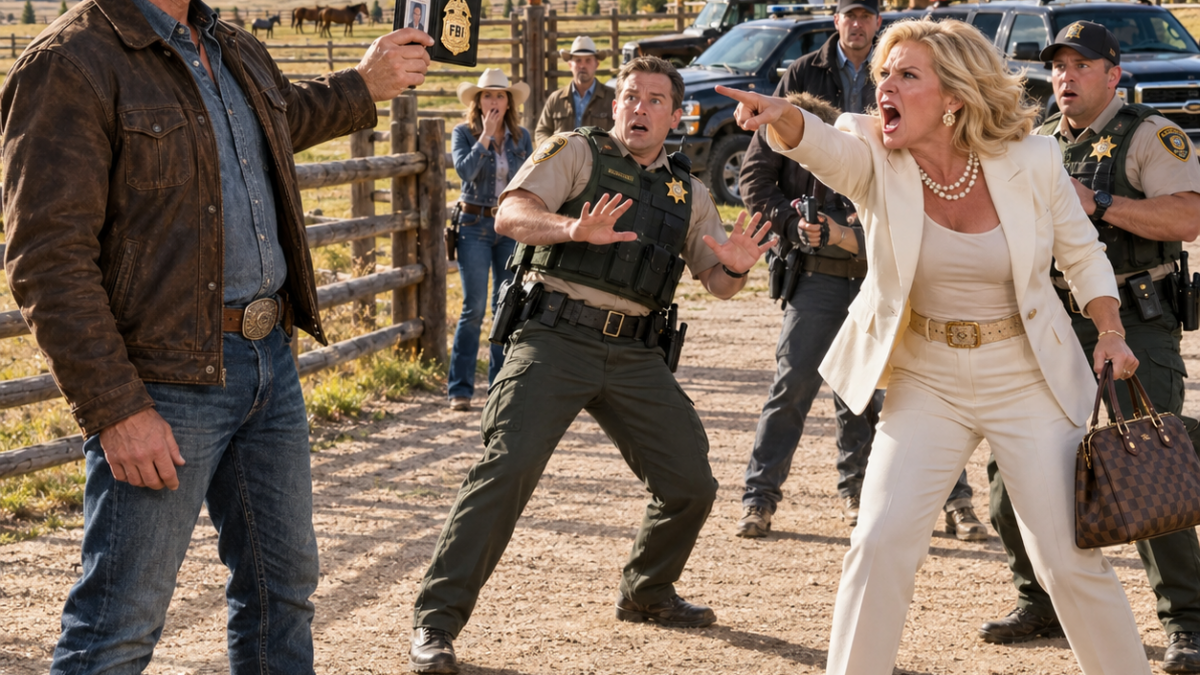
Reached inside my jacket.
Removed the credential wallet.
Flipped it open.
Gold badge.
Photo identification.
**FEDERAL BUREAU OF INVESTIGATION.**
Jose Brown stopped breathing.
At least it looked that way.
His hand froze halfway between us.
The blood drained from his face.
The room went so quiet I could hear the fluorescent lights.
“My name is Special Agent Arthur Reed.”
Brown stared.
Christopher Allen rose behind him.
“No.”
I looked toward Jose.
“You have spent weeks treating me as if I were an ordinary citizen you could intimidate.”
His mouth opened.
Nothing came out.
“That was your mistake.”
Then I turned enough for the residents to see.
“But this is not about me being FBI.”
That mattered.
“A citizen should not need a federal badge to prevent a private security guard from inventing arrest powers.”
A murmur moved through the room.
I looked toward Allen.
“The investigation into Willow Creek Security now includes allegations of false imprisonment, extortion, theft, financial fraud, and coordinated abuse of residents.”
Allen pushed away from the board table.
“This badge is fake.”
I almost expected that.
“Call the police,” he shouted.
Someone near the back actually pulled out a phone.
Allen pointed at me.
“This man is a fraud.”
The main doors opened.
Four people entered.
Two FBI agents.
Two state officers.
Credentials visible.
The room changed.
My colleague looked toward me.
“Agent Reed.”
That one word ended Allen’s performance.
Jose looked at the doors.
Then at me.
Then down at his own cuffs.
They slipped from his hand.
Hit the floor.
Metal clattering across tile.
Christopher Allen’s face became gray.
He tried one last reflex.
“This is private property.”
I looked at him.
“No.”
Then I placed the certified land document on the table.
“This is privately controlled land in part owned through my aunt’s estate.”
The lead agent approached Allen.
“And we have federal warrants.”
Allen looked around.
Residents watched.
Nancy.
Abigail.
People he had fined.
People he had humiliated.
People he had trained to fear him.
The lead agent unfolded papers.
“Christopher Allen.”
Allen stepped back.
“You are being placed under arrest pursuant to a federal warrant.”
His dignity returned for half a second.
“I want my attorney.”
“You’ll have that opportunity.”
“Do you know who I am?”
Nobody answered.
That may have been the cruelest moment for him.
For years, that question had been a weapon.
Now it was irrelevant.
Jose suddenly moved.
Toward the side exit.
Four steps.
That was all.
Agents blocked him.
“Jose Brown.”
He stopped.
“Hands behind your back.”
“No.”
His voice cracked.
“You don’t understand.”
“I understand the warrant.”
“I was following HOA policy.”
“Hands behind your back.”
He looked toward Allen.
Allen didn’t look back.
That told Jose everything.
The cuffs closed around his wrists.
Not HOA cuffs.
Federal arrest.
Residents began shouting.
Questions.
Anger.
Some crying.
Allen’s remaining security officers were separated.
Two were detained.
One young guard stood trembling near the wall.
Tyler.
The one who had brought me water.
He approached my colleague.
“I want to cooperate.”
Nobody had asked him.
That mattered.
“I’ll tell you everything,” he said.
“What they made us do.”
My colleague looked toward me.
I nodded once.
“Separate interview.”
Tyler was taken outside.
That was the moment the wall really started collapsing.
Not the badge.
Not Allen’s cuffs.
The first insider deciding silence was more dangerous than truth.
The next forty-eight hours turned Willow Creek into an evidence site.
Search teams entered the management center.
Security offices.
Allen’s house.
Jose’s office.
The detention ledger I had seen through the door contained 217 entries over approximately three years.
Names.
Dates.
Times.
Violations.
Fines.
Duration of detention.
Some residents had been held for an hour.
Others overnight.
No lawful arrest authority.
No actual police booking.
No courts.
Just a private system using confinement as enforcement.
The financial records were worse.
More than $420,000 from fines, processing charges, security assessments, enforcement fees, confiscation costs, and penalties.
Large portions flowed into accounts controlled directly or indirectly by Allen.
Others went to phantom contractors.
Willow Security.
Consulting entities.
Maintenance businesses with no meaningful operations.
And Jose.
A lot went to Jose.
Then agents opened his office safe.
Jewelry.
Watches.
Cash.
Credit cards.
Property taken from residents during “processing.”
Nancy’s necklace was there.
Gold chain.
Small pendant.
Tagged with her address.
I called her personally.
“We found something.”
Her voice immediately changed.
“What?”
“Your mother’s necklace.”
Silence.
Then a sound I will never forget.
Not quite a sob.
Something deeper.
“Where?”
“Jose’s office.”
“I knew it.”
“I know.”
“I knew I didn’t lose it.”
“I know.”
That was the real violence of what Allen built.
People didn’t only lose money.
They lost confidence in their own memory.
Their judgment.
Their right to be angry.
They were told every humiliation was procedure.
Every theft was processing.
Every threat was safety.
Then we found the surveillance recordings.
Allen had placed cameras throughout the management center.
He probably thought they protected him.
Instead, they documented years of abuse.
Residents shoved into chairs.
Hands cuffed.
Threats.
Property taken.
Forms signed under pressure.
One file stopped the investigation cold.
Harold Winters.
Eighty-two years old.
Video showed security officers bringing him into the detention room.
He stumbled at the threshold.
An officer jerked his arm.
Harold lost balance.
Hit the doorframe.
Collapsed.
For nearly a minute, nobody checked him.
He later went to the hospital.
Two weeks after that, he died from complications connected to the injuries.
No meaningful incident report had been sent to police.
The case had been treated as if an elderly resident simply suffered a medical episode.
I stood in Allen’s office staring at the paused frame.
My colleague came beside me.
“Arthur.”
“I’m fine.”
“No, you’re not.”
“No.”
Harold’s face on the screen reminded me of the elderly man I had watched being placed in the SUV on my first day.
Bernard Thompson.
Walking after curfew.
If I had shown my badge that afternoon, maybe Brown would have backed down.
Maybe Allen would have behaved.
Maybe I would never have seen Bernard.
Maybe Nancy would never have emailed.
Maybe Abigail’s numbers would still be in a drawer.
Maybe Harold’s death would remain buried.
That thought followed me for months.
The political money expanded the case again.
Shell entities connected to the HOA had made donations to local officials.
Campaign contributions by themselves proved nothing criminal.
But financial records showed suspicious timing between certain payments, land decisions, enforcement cooperation, and official actions.
Those threads were transferred and investigated separately.
Some led nowhere.
Some didn’t.
The important thing was we stopped guessing.
Evidence decided.
Eight months later, Christopher Allen and Jose Brown went to trial.
By then, Willow Creek had become national news.
Not because HOA disputes are unusual.
Because these men had built something that looked too much like a private government.
Patrol vehicles.
Detention rooms.
Cuffs.
Fines.
Confiscations.
Watch lists.
Residents who believed the guards could arrest them.
The courtroom was full every day.
I testified on the third.
The prosecutor began with Michelle.
“How did you first become involved with Willow Creek?”
“My aunt died.”
“What did she leave you?”
“Property interests totaling approximately one thousand acres connected to the Willow Creek development.”
“Did you know about the security operation before visiting?”
“No.”
“What happened when you arrived?”
I described the gate.
Brown.
Search.
Allen.
Bernard.
Threat.
Then the second visit.
The torn probate certificate.
Stun gun.
Handcuffs.
Three-hour detention.
The prosecutor showed photographs of the bruises around my wrists.
Then played the smartwatch recording.
Brown’s voice filled the courtroom.
**You have no rights here.**
Then:
**I am the law.**
Jose looked down.
Christopher Allen remained still.
Then Allen’s voice.
**Ownership is whatever can be enforced.**
I watched jurors react.
The prosecutor stopped the audio.
“Agent Reed, why did you not identify yourself immediately as FBI?”
“Because I was there regarding a private inheritance matter.”
“Did your federal employment give you special property rights?”
“No.”
“Did it give Willow Creek security fewer rights against you than against any other citizen?”
“No.”
“Then why conceal it?”
I paused.
“Because I wanted to know whether their behavior depended on believing the person in front of them had no power.”
“And did it?”
“Yes.”
“What happened once your identity became known?”
“The behavior changed immediately.”
Defense counsel attacked that hard.
“You deliberately concealed your occupation.”
“Yes.”
“You returned knowing there might be confrontation.”
“Yes.”
“You recorded people without telling them.”
“Lawfully, yes.”
“You wanted them to make mistakes.”
“I wanted them to act exactly as they normally acted.”
“You baited my clients.”
“No.”
“You could have displayed your credentials at the first gate encounter.”
“Yes.”
“And prevented everything.”
“For me.”
That stopped him.
“What?”
“I could have prevented it for me.”
I looked toward the jury.
“But Nancy Adams didn’t have an FBI badge.”
The prosecutor objected to the direction.
The judge allowed limited explanation.
I continued.
“Bernard Thompson didn’t have one. Harold Winters didn’t have one. The question was never whether Christopher Allen would respect an FBI agent. The question was what he did to people who were not.”
Defense counsel moved on.
Nancy testified later that week.
The prosecutor held up her recovered necklace in an evidence bag.
She cried before answering the next question.
“My mother gave me that when I turned eighteen.”
“Did you consent to Willow Security taking it?”
“No.”
“Were you told it had been taken?”
“No.”
“What did Jose Brown tell you?”
“That I lost it.”
She looked toward him.
“I spent six months thinking maybe I had.”
Her voice broke.
“That’s what they did to us. They made us think everything was our fault.”
Abigail testified about money.
Calm.
Precise.
Deadly.
She traced HOA revenue into Willow Security.
Willow Security into related accounts.
Phantom vendors.
Recycled funds.
Personal expenses.
Jose’s supplemental payments.
Christopher Allen’s entities.
The jury watched the architecture appear one transfer at a time.
Bernard Thompson took the stand.
The man I had seen detained for walking.
He wore a dark suit slightly too large in the shoulders.
“How long did you live in Willow Creek?”
“Thirty-one years.”
“Were you aware of a law making it illegal to walk after eight?”
“No.”
“HOA rule?”
“They said it was.”
“What happened after your third violation?”
“They put me in a car.”
“How did that make you feel?”
He looked at the jury.
“Old.”
The prosecutor paused.
Bernard continued.
“I know I’m old.”
A few people smiled sadly.
“But I had never felt ashamed of it until those men treated me like I was too stupid to know whether I was allowed outside.”
No dramatic speech could have matched that.
Then Harold Winters’s daughter testified.
That was the hardest day.
She had not known what truly happened to her father until the FBI recovered video.
She described the hospital call.
Confusion.
No incident report.
No explanation.
Then the prosecution played limited portions of the footage.
Harold entering the room.
The stumble.
The arm jerk.
Impact.
Collapse.
One juror covered her mouth.
Harold’s daughter cried silently.
Jose stared at the defense table.
Christopher Allen showed almost nothing.
That absence of reaction hurt his case more than anger might have.
Tyler testified under a cooperation agreement.
The young guard described training.
“We were told never to call ourselves police.”
“Why?”
“Legal exposure.”
“What were you told to do?”
“Act like residents thought we were.”
That sentence stopped the room.
The prosecutor asked:
“What does that mean?”
“Use command voice. Keep hands on cuffs. Control positions. Use vehicle lights. Say detained instead of arrested if we could.”
“Why?”
“Mr. Allen said people comply faster when they think refusal has criminal consequences.”
“Did residents understand you were private security?”
“Some did.”
“And others?”
“No.”
“What happened if guards objected?”
“Reduced shifts.”
“Did you object?”
“Once.”
“What happened?”
“I lost thirty hours the following month.”
“What caused you to cooperate?”
Tyler looked toward me.
Then at the jury.
“He thanked me for water.”
I had forgotten.
“When?”
“During his detention.”
Tyler swallowed.
“Everybody else we held either yelled or begged.”
“What did Agent Reed say?”
“Thank you.”
He looked down.
“And I realized we had put handcuffs on someone who was still treating me more humanely than my boss treated any of us.”
Tyler’s sentence eventually reflected his cooperation.
Not everyone inside a bad system is equally guilty.
That mattered too.
After two weeks, the jury deliberated less than five hours.
Guilty on the major counts.
Christopher Allen closed his eyes.
Jose collapsed slightly into his chair.
There was no cheering.
The judge had warned the gallery.
Still, you could feel something move through the room.
Relief.
Not celebration.
At sentencing, the judge spoke directly to Allen.
“You created a structure that imitated public authority while avoiding public accountability.”
Allen stared ahead.
“You used fear to generate money.”
No reaction.
“You deprived people of dignity in their own homes.”
Still nothing.
“And when challenged, you did not correct the system. You escalated it.”
The court imposed a lengthy federal prison sentence, substantial restitution, forfeiture of criminal proceeds, and restrictions tied to the convictions.
Jose received a lengthy sentence for his role in unlawful detentions, theft, assaultive conduct, and the broader conspiracy.
Other guards received lower sentences according to involvement.
Tyler received probation and community service under his cooperation agreement.
The numbers mattered.
But not as much as what happened afterward.
Willow Creek’s old HOA collapsed.
Court supervision and resident action replaced the structure.
Willow Security Services disappeared.
No more black uniforms.
No fake patrol cars.
No detention room.
The iron gate remained because residents wanted security.
But security became what it should have been.
Access control.
Emergency response coordination.
Observation.
Not invented police power.
A new Willow Creek Community Association was formed.
Rotating board positions.
Term limits.
Published meeting minutes.
Open budgets.
Independent audits.
No fines without written process.
No private detention.
No confiscation.
No curfew arrests because there was no such thing as a curfew arrest.
The detention room was demolished.
Residents voted to turn the space into a small library.
Bernard suggested that.
“Put books where they used to put people.”
The motion passed unanimously.
Nancy got her necklace back after trial.
The first time I saw her wear it again, she kept touching the pendant as if checking that it was still there.
“You okay?” I asked.
“No.”
She smiled through tears.
“But better.”
Bernard received civil compensation.
He spent part of it installing a bench in the community park.
The plaque said:
**FREEDOM HAS NO CURFEW.**
The first time I saw it, I laughed.
Then cried.
Harold Winters’s daughter received compensation too.
Nothing about that felt sufficient.
Money is useful.
It repairs financial harm.
It cannot replace a father.
The community installed a second plaque near the library.
Harold’s name.
Date.
A short sentence acknowledging that abuse of authority contributed to the circumstances surrounding his fatal injuries.
His daughter approved the wording.
That mattered.
I asked Michelle’s estate attorney to help me restructure the land interests so no future board could manipulate ambiguity again.
Some residents bought out portions of ground arrangements.
Other parcels remained under long-term lease.
Common areas received clear recorded easements.
Every title question was put into language normal people could understand without hiring three lawyers.
I could have used the land as leverage.
Raised rents aggressively.
Forced sales.
Punished everyone.
For a while, I wanted to.
That is the part I’m least proud of.
During the investigation, every time another victim came forward, anger expanded.
One night I sat alone looking at financial models showing what the thousand acres could be worth if I terminated certain agreements and redeveloped sections.
The number was enormous.
Part of me thought:
Take it.
Let them all feel what Michelle felt.
Then I remembered Bernard.
He wasn’t Christopher Allen.
Nancy wasn’t.
Harold wasn’t.
Most Willow Creek residents had been victims of the same machine.
Punishing them would not be justice.
It would simply put me in Allen’s chair.
So I didn’t.
Instead, I used a portion of recovered lease revenue to establish something in Michelle’s name.
The **Michelle Carter Property Rights Fund**.
Not an FBI project.
Not government.
A private legal-assistance fund supporting homeowners and small property owners facing fraudulent HOA liens, fabricated enforcement actions, and other documented abuses.
The first year, it helped dozens of families obtain legal review they otherwise could not afford.
One of the first clients was a widow in another county whose HOA had threatened foreclosure over a disputed landscaping fine.
Her case was nowhere near Willow Creek.
No fake cops.
No criminal enterprise.
Just a woman terrified by paperwork she didn’t understand.
The fund paid for an attorney.
The lien threat turned out to be invalid.
She kept her house.
That felt better than every headline about Christopher Allen.
Eighteen months after the trial, I returned to Willow Creek.
For the first time, nobody stopped my car.
The guard booth was empty.
Residents had replaced the security company with a contracted service that handled gate technology remotely and called actual police for actual crimes.
What a revolutionary concept.
I drove through.
Children played basketball in the street.
After six.
No one arrested them.
A woman had purple flowers along her walkway.
Very unauthorized under the old rules.
Nobody cared.
An elderly couple walked near the clubhouse.
I checked my watch.
8:53 p.m.
Bernard would have appreciated that.
Inside the community center, residents had gathered for a small ceremony.
Nancy stood near the front.
Her mother’s gold necklace around her neck.
Abigail held a binder containing the new annual audit.
Not hidden.
Available to anyone.
Bernard sat beside the library door.
When he saw me, he raised one hand.
“Landlord.”
I groaned.
“Please don’t start.”
He laughed.
“You said it first.”
Technically, he was right.
The community’s new president was a woman named Rachel Kim.
Former emergency-room nurse.
She approached with a folder.
“No surprises.”
“People who say that usually have surprises.”
“Just signatures.”
I read them.
Residents had voted to approve the revised ground-use agreements.
Transparent rates.
Fixed terms.
Independent dispute resolution.
No authority language hidden inside.
I signed.
Rachel watched me.
“You know, people were afraid you’d shut the place down.”
“I considered it.”
Her eyes widened.
“I’m kidding.”
“Are you?”
“No.”
That answer surprised her.
I looked around the room.
“There were days I wanted to punish everybody connected to Willow Creek.”
“Even residents?”
“Especially when I was angry.”
“What changed?”
I nodded toward Bernard.
“Nobody should need permission to walk after dinner.”
Then toward Nancy.
“Nobody should lose their mother’s necklace because they had a birthday party.”
Then toward the library.
“And nobody should die because private security thinks accountability is optional.”
Rachel nodded slowly.
“So you kept the community.”
“The community was never the problem.”
“Allen was.”
“Allen’s system was.”
That distinction mattered.
Christopher Allen was not magic.
He did not personally control every person.
He built incentives.
Money for guards.
Silence for residents.
Fear for critics.
Confusion between rules and laws.
Once those incentives changed, the community changed.
That was the lesson I carried away.
People like Allen love making every conflict personal.
Me versus him.
Owner versus board.
Federal agent versus fake cop.
But the badge reveal was not the most important moment.
It was dramatic.
I won’t pretend otherwise.
Seeing Jose Brown’s face when he read **Federal Bureau of Investigation** felt satisfying.
For weeks, he had touched people as if their bodies belonged to his authority.
That night, his hands stopped working.
Christopher Allen had told me:
**I have power here. You have nothing.**
Then federal agents walked through the doors with warrants.
It felt like the universe correcting punctuation.
But if the story ended there, it would be shallow.
The truth is my badge should never have been necessary.
Nancy deserved rights without one.
Bernard deserved rights without one.
Harold deserved rights without one.
Every resident did.
The Constitution doesn’t become more valuable because the person being abused happens to work for the federal government.
And private property does not become more legitimate because its owner carries credentials.
When I showed my badge, I wasn’t becoming entitled to dignity.
I was revealing that the people who had denied dignity to others had finally chosen the wrong target.
That difference stayed with me.
After the ceremony, Bernard asked me to walk with him.
We went outside.
Evening.
Warm breeze.
Streetlights coming on.
He moved slower than when I first saw him.
But freer.
We passed his bench.
“Sit.”
I did.
He lowered himself beside me.
“You remember the first day?”
“Yes.”
“I remember you too.”
I looked at him.
“You saw me?”
“From the security car.”
“I thought you were too upset to notice.”
“I noticed the stranger watching.”
He smiled.
“I thought you were smart for leaving.”
“I wasn’t leaving.”
“I know that now.”
He looked across the park.
“After they let me go that night, I stopped walking.”
“For how long?”
“Seven months.”
I turned toward him.
“You stopped completely?”
“After dark.”
“Why?”
“I didn’t want to see them.”
His voice stayed calm.
“I’m old, Arthur. I’ve been through things.”
He stared at his hands.
“But there’s a particular humiliation in being made afraid of your own sidewalk.”
We sat quietly.
Then a teenage boy jogged past us.
Headphones.
No permit.
No guard.
Bernard smiled.
“That’s what I wanted back.”
“What?”
“Nothing happening.”
I understood.
Freedom often looks boring after you have lost it.
People walking.
Children playing.
Neighbors arguing.
Nobody checking permissions.
Nobody asking the HOA president whether breathing after eight p.m. complies with Section Whatever.
Nothing happening.
Beautiful.
Before I left, Nancy stopped me near the parking lot.
“I wanted to give you something.”
She held out an envelope.
“I can’t take money.”
“It isn’t money.”
Inside was a photograph.
Michelle.
Younger.
Standing beside Nancy at a Willow Creek picnic.
I had never seen it.
My aunt was laughing.
Not polite-smile laughing.
Really laughing.
“Where did you get this?”
“Community archive.”
Nancy looked toward the building.
“Before Allen, this place wasn’t always bad.”
I looked at the photograph.
“Michelle liked it here?”
“For a long time.”
“Then why didn’t she tell me what was happening?”
“Maybe she was embarrassed.”
That hurt.
“Embarrassed about what?”
“Being afraid.”
Nancy touched her necklace.
“I was.”
I folded the photo carefully.
“She shouldn’t have been.”
“No.”
Nancy looked toward the gate.
“But that’s what people like Allen do. They make decent people embarrassed about being mistreated.”
I put the photograph in my jacket.
Not in the pocket where I carried my credentials.
The other side.
That distinction felt right.
Months later, Michelle’s attorney found one final document among her stored estate papers.
Not evidence.
Not a secret lease.
A letter addressed to me.
Arthur,
If this reaches you, it means I finally did something I should have done years ago and put my affairs in order.
I smiled.
That sounded like her.
She wrote about the land.
The community.
The people.
Then:
Willow Creek changed.
I told myself it was easier to ignore the board because I was getting older. That was partly true.
But mostly I was tired.
Christopher Allen was good at making resistance expensive.
I stopped attending meetings.
Stopped arguing.
Stopped asking questions.
I regret that.
My throat tightened.
Then:
The land is valuable, but don’t mistake value for purpose.
If you inherit it, use it carefully.
There are good people living there.
Do not punish them for the people who control them.
I closed my eyes.
Michelle had known me too well.
Then the final paragraph:
You always cared about rules because you believed rules should protect people.
Remember that rules can also be costumes.
Look underneath.
Love,
Michelle
I read the letter four times.
Rules can be costumes.
That was Willow Creek.
Uniforms that looked almost police.
Vehicles that looked almost official.
Badges that looked almost real.
Detention records that looked almost legal.
Fines that looked almost governmental.
Authority that looked almost legitimate.
Almost.
My career had taught me that the gap between almost and actual can be where entire criminal enterprises live.
Michelle had understood the same thing without a badge.
She just got tired before she could fight it.
So I finished what she couldn’t.
Years after the case ended, reporters still occasionally contacted me.
They always asked the same question.
“What did Christopher Allen’s face look like when you showed the FBI badge?”
They wanted the cinematic answer.
White.
Terrified.
Destroyed.
I usually told them the truth.
He looked confused.
Because men like Allen don’t believe consequences are real until they enter the room.
They spend years watching people back down.
Years hearing yes.
Years discovering that every successful intimidation makes the next one easier.
Eventually, resistance feels abnormal to them.
Accountability feels unfair.
Then somebody says no.
Not louder.
Not stronger.
Just long enough.
That is when their world starts breaking.
Jose Brown later wrote a letter as part of his post-conviction process.
I did not respond.
But I read it.
He said he had joined Willow Security believing it was normal private enforcement.
He learned quickly that Allen rewarded aggression.
More fines meant better shifts.
More detentions meant bonuses.
Residents who challenged them were labeled hostile.
Once everyone inside the organization accepted those labels, abuse became procedure.
Jose apologized to me.
He apologized to Nancy.
Bernard.
Families.
He did not mention Harold by name.
That bothered me.
Maybe he couldn’t.
Maybe shame has limits.
I put the letter away.
Forgiveness was not necessary for the system to remain dismantled.
Accountability does not require reconciliation.
Willow Creek’s second annual audit under the new association came back clean.
I read it.
Of course I did.
Abigail called afterward.
“You know you’re not on the finance committee.”
“I inherited trust issues.”
“You inherited a thousand acres.”
“That too.”
She laughed.
“All expenditures reconciled.”
“I saw.”
“Security?”
“Reasonable.”
“Reserve?”
“Healthy.”
“Any phantom contractors?”
“Sadly, no exciting felonies this year.”
“Disappointing.”
“Very.”
We both laughed.
That laughter mattered.
Abigail had once been removed for asking questions.
Now she could joke about an audit.
Nancy eventually joined the resident council.
Bernard refused every position offered.
“Governance causes wrinkles.”
He spent evenings walking.
At nine.
Sometimes nine-thirty just to be obnoxious.
Tyler finished probation.
Years later, I heard he became an EMT.
That felt fitting.
A young man who once carried water into an illegal detention room now responded to people who actually needed help.
Harold’s daughter remained private.
I respected that.
Not every victim wants their pain turned into reform language.
Some simply want distance.
The Michelle Carter Fund grew.
Slowly.
We did not turn it into a crusade against every HOA in America.
Most neighborhood associations are not criminal enterprises.
Most disputes are boring.
Landscaping.
Parking.
Budgets.
Governance.
The fund focused on documented cases where ordinary people could not afford legal review.
Sometimes the HOA was wrong.
Sometimes the homeowner was.
That was important.
Justice isn’t picking a side before seeing evidence.
Michelle’s letter remained framed in my office.
The last line underlined:
**Rules can also be costumes. Look underneath.**
My FBI badge sat locked away when I wasn’t working.
That felt appropriate too.
A badge is authority borrowed from the public.
Not personal power.
Not social rank.
Not permission to win arguments.
Christopher Allen never understood that distinction.
Jose eventually did.
I tried never to forget it.
On the fifth anniversary of Michelle’s death, I drove to Willow Creek alone.
No case.
No agents.
No lawyers.
Just me.
The gate opened automatically.
I parked near the community center.
The library that replaced the detention room was open.
A little girl sat inside reading on the floor.
Her mother looked up and smiled.
Nobody knew what that room had once been.
Good.
Outside, I found Bernard’s bench.
**FREEDOM HAS NO CURFEW.**
I sat.
The sun went down.
Around 8:15, residents began walking dogs.
At 8:40, two teenagers rode bicycles past.
At 9:03, an elderly couple walked through the park.
No patrol SUV.
No blue-red lights.
No one asked for permits.
I pulled Michelle’s photograph from my wallet.
The one Nancy gave me.
My aunt laughing at the picnic.
Before fear.
Before Allen.
Before all of it.
I looked at the houses.
A thousand acres.
When I first inherited them, I thought ownership was the story.
It wasn’t.
The land was only the door.
Behind it was a community that had forgotten the difference between rules and laws, security and policing, leadership and domination.
I could have shown my badge the first day.
Maybe Brown would have apologized.
Maybe Allen would have shaken my hand.
Maybe they would have let me through.
That would have solved my problem.
And nobody else’s.
Instead, Brown put handcuffs on me.
Allen locked me in a room.
They tore a court document.
They searched my property.
Threatened me.
Called me a fraud.
Tried to bar me from my land.
Then stood in front of a hundred residents and ordered their fake cop to arrest me again.
That was when I finally opened my jacket.
Not because the badge made my land mine.
The deed did that.
Not because the badge gave me rights.
The law did that.
The badge mattered because Christopher Allen had built his empire around one assumption:
The people he abused had nobody stronger standing behind them.
For years, he was right often enough to become reckless.
Then he reached for the wrong man.
The gold badge caught the fluorescent light.
Jose Brown froze.
Christopher Allen told everyone it was fake.
Then the doors opened.
Federal agents walked inside.
Real warrants.
Real authority.
Real consequences.
His empire collapsed in minutes.
But the victory took years.
It ended in audits.
Restitution.
A library.
An old man walking after dark.
A woman wearing her mother’s necklace again.
Children playing basketball without checking the time.
And me sitting on Michelle’s land finally understanding what she had actually left me.
Not a weapon.
Not leverage.
Not a kingdom.
A responsibility.
Christopher Allen once leaned close and told me:
“Land is just dirt. Power is what matters.”
He was wrong.
Land remembers nothing.
Power disappears.
Titles change.
Uniforms come off.
Badges expire.
Money moves.
People forget names.
What remains is what your power did while you had it.
Christopher used his to make people smaller.
Michelle used hers to build something.
When my turn came, I nearly made the mistake of thinking justice meant proving I could destroy everyone who had stood on the wrong side of the gate.
It didn’t.
Justice meant removing the people who had abused power, returning what could be returned, compensating what could be compensated, documenting what could never be undone, and then giving ordinary life enough room to come back.
Nothing happening.
That was Bernard’s phrase.
And sitting on his bench after nine at night, watching people move freely through a place where they had once been afraid to walk, I finally understood it.
The fake HOA cops tried to seize control of land they never owned.
They handcuffed me.
Locked me up.
Threatened me.
And ultimately tried to arrest me in front of the entire community.
Then they saw my FBI badge.
That was the dramatic moment.
But it wasn’t the ending.
The ending was quieter.
No flashing lights.
No courtroom cameras.
No handcuffs.
Just an elderly couple walking slowly beneath the streetlights on land my aunt once feared had been lost to men who believed nobody could challenge them.
I checked the time.
9:17 p.m.
Nobody stopped them.
Nobody asked for identification.
Nobody demanded a permit.
Nobody told them they didn’t belong.
And for the first time since inheriting Michelle’s thousand acres, I looked around Willow Creek and thought:
**Now it belongs to the people who actually live here again.**
That was worth more than watching Christopher Allen collapse when he saw my badge.
That was justice.








