PART 2: Fake HOA Cops Ambushed My Wife on a Dark Road—They Had No Idea Who They’d Just Pulled Over
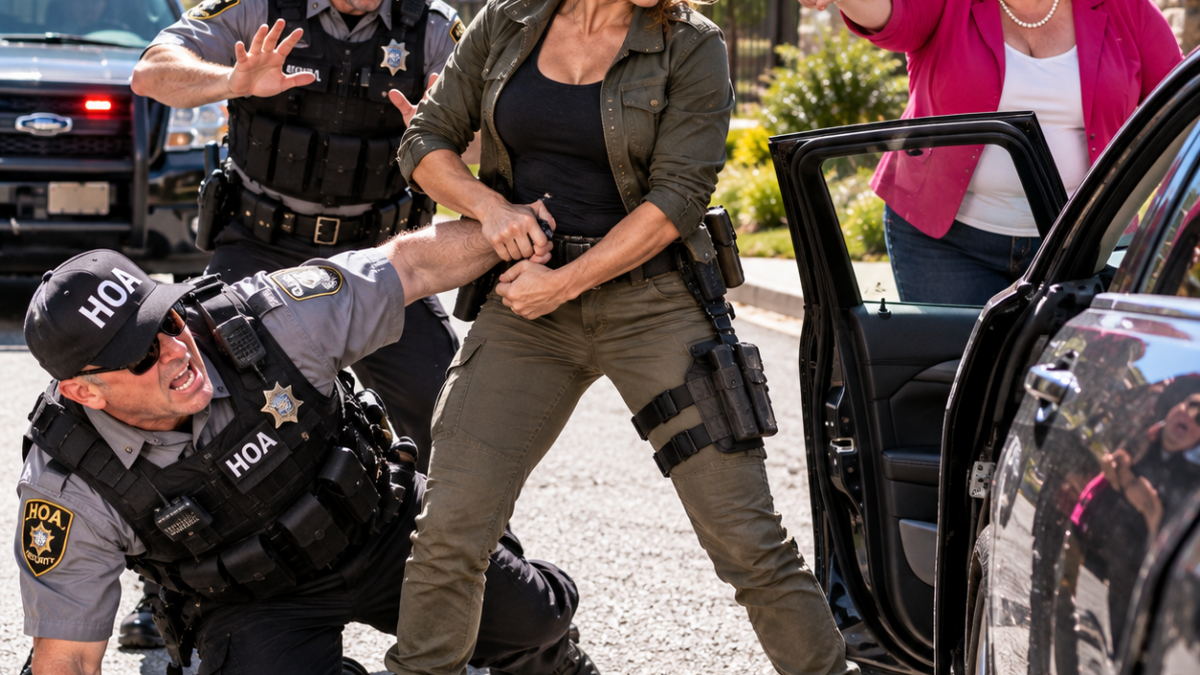
PART 2
We drove home separately.
I kept Jacqueline’s taillights in view the entire way.
The black SUV never followed.
At least not that night.
When we pulled into our driveway, I expected Jacqueline to be shaken.
Instead, she walked directly inside, removed her shoes, placed her purse on the kitchen counter, and opened her laptop.
“Jack.”
“Give me a minute.”
“A minute for what?”
“To check something.”
I stood there staring at her.
“You were just pulled over by two men impersonating law enforcement.”
“Not exactly.”
“What part of that sentence are you disagreeing with?”
“They were impersonating enough of law enforcement to intimidate people. That distinction may matter later.”
“Later?”
She opened a browser.
“Jacqueline.”
She finally looked up.
“I’m okay.”
“That’s not the question.”
“I know.”
“Who were those men?”
“I don’t know yet.”
“And why did you talk to them like you did?”
She was quiet.
Then she turned back to the screen.
“Because I recognized the structure.”
“What structure?”
She typed Pinewood Heights HOA into a state corporate registry.
A series of records appeared.
“Private security division. Compliance enforcement. Mandatory security fees. Administrative hearings.”
“That sounds like an annoying HOA.”
“No.”
Her expression hardened.
“It sounds like a revenue model.”
I stared at her.
She didn’t explain.
Not that night.
At two in the morning, I woke and found her still sitting at the kitchen table.
HOA bylaws covered half the surface.
State security regulations were open on one monitor.
Corporate registrations filled another.
She had a yellow legal pad divided into columns.
Pinewood Heights HOA
Security Enforcement
Property Transfers
Related Entities
“Come back to bed.”
“Soon.”
“That’s what you said two hours ago.”
“I need to understand how deep this goes.”
“How deep what goes?”
She highlighted a paragraph.
“The board created this security division eighteen months ago.”
“So?”
“There’s no state license attached to it.”
“Meaning?”
“Meaning whatever Crane and Simmons are, they aren’t police, and they aren’t licensed private patrol officers with the powers they implied tonight.”
“You already knew that.”
“I suspected it.”
“And now?”
“Now I know.”
I pulled out a chair.
“Then we call the police.”
“Tomorrow.”
“Why tomorrow?”
“Because I want every fact organized first.”
“They illegally stopped you.”
“I know.”
“They surrounded you on a dark road.”
“I know.”
“They put their hands near their belts.”
“I know, Ryan.”
That last word carried enough weight to stop me.
She softened.
“I know.”
I sat beside her.
For a moment, the tough, controlled woman from Miller’s Creek disappeared.
Her hands were shaking.
Barely.
But they were.
I covered one with mine.
“You don’t have to be okay just because you knew they were fake.”
“I’m not afraid of them.”
“That wasn’t what I said.”
She looked away.
“I’m afraid of what this might be.”
That was worse.
The first violation notice arrived before noon.
Someone had taped it to our front door.
FAILURE TO COMPLY WITH MANDATORY SECURITY VERIFICATION
Fine: $500.
Secondary allegation:
THREATENING BEHAVIOR TOWARD COMMUNITY ENFORCEMENT PERSONNEL
A compliance hearing had been scheduled for the following Tuesday.
At the bottom, printed in bold red:
FAILURE TO APPEAR MAY RESULT IN ESCALATED ENFORCEMENT, INCLUDING PROPERTY LIENS AND COMMUNITY EXPULSION.
I read that line three times.
“Community expulsion?”
Jacqueline photographed the notice.
“Meaningless language designed to sound frightening.”
“They ambush you, then fine you.”
“Yes.”
“And call you threatening.”
“Yes.”
“You’re awfully calm about this.”
She photographed the adhesive marks where the notice had been attached.
“The details matter.”
“What details?”
“Time. Delivery. Wording. Signatures. Revision numbers. People running operations like this become comfortable. Comfort creates patterns. Patterns create evidence.”
There was that tone again.
Professional.
Detached.
I watched her slide the notice into a clear document sleeve.
“Who were you before we met?”
She stopped.
Only for a second.
Then kept working.
“We’ll talk.”
“When?”
“When I know what we’re actually dealing with.”
The surveillance started forty-eight hours later.
Black SUV.
Same model as the one from Miller’s Creek.
It crawled past our house around seven in the morning.
Returned at noon.
Parked three houses down that evening.
Tinted windows.
No front plate visible from our angle.
Jacqueline photographed everything.
Date.
Time.
Direction.
License plate when possible.
She built a spreadsheet.
I joked once that she was treating our HOA dispute like organized crime.
She didn’t laugh.
“Because it might be.”
That ended the joke.
The neighbors noticed.
Mrs. Patterson, who lived across the street, approached me while I was collecting mail.
Her voice was barely above a whisper.
“You should be careful.”
“That’s becoming a popular phrase.”
She glanced toward the black SUV.
“People who fight Janice tend to have problems.”
“Janice Martinez?”
“The president.”
“What kinds of problems?”
Mrs. Patterson looked uncomfortable.
“The Chens.”
“Who are they?”
“Were.”
The correction mattered.
“They lived on Magnolia Court.”
“What happened?”
“Fence dispute.”
“That doesn’t sound catastrophic.”
“It wasn’t at first.”
She lowered her voice further.
“Then security started stopping their son when he drove home late. They received inspections every week. Fines. A lien warning.”
“Did they fight?”
“For a while.”
“And?”
“They sold.”
“How long?”
“Six months.”
“For less than market?”
Her eyes widened.
“How did you know?”
I looked toward our house.
“I’m starting to understand the pattern.”
Mrs. Patterson backed away.
“I didn’t say anything.”
“I know.”
“Please don’t tell anyone I talked to you.”
“Why?”
Her face answered before she did.
Fear.
“Because we still live here.”
She walked away.
The Thomases next door stopped waving.
We had borrowed tools from each other for eight years.
Shared Christmas cookies.
Helped each other clean branches after storms.
Now Mr. Thomas looked at the pavement whenever I approached.
That hurt more than strangers.
Three days after the traffic stop, we attended the compliance hearing.
The community center had been arranged like a courtroom.
Long table at the front.
Three board members.
Rows of folding chairs.
Janice Martinez sat in the center.
Mid-fifties.
Silver-streaked dark hair.
Navy blazer.
Perfect posture.
She wore authority differently from the men on Miller’s Creek.
They performed intimidation physically.
Janice used procedure.
On her right sat the stocky man.
Victor Crane.
On her left, the taller one.
Derek Simmons.
No uniforms tonight.
Suits.
Janice introduced them formally.
“Mr. Crane serves as director of community security operations. Mr. Simmons is our compliance enforcement coordinator.”
Jacqueline leaned toward me.
“Made-up titles.”
“How do you know?”
“No recognized licensing category.”
Janice began.
“Mrs. Howard, on Tuesday evening you failed to comply with a lawful community security verification.”
Jacqueline sat perfectly still.
Janice continued.
“You then threatened two designated enforcement officers.”
“I did not.”
“You will have an opportunity.”
Victor Crane read a statement describing Jacqueline as belligerent.
Derek’s statement called her “physically confrontational.”
I nearly stood.
Jacqueline touched my wrist.
Don’t.
Janice cited community bylaws.
Amendments.
Resolutions.
All delivered with enough legal vocabulary to sound legitimate.
Then she announced the board’s decision.
“Two thousand dollars.”
I stared.
“What?”
Janice looked at me.
“Mr. Howard, please refrain from interruptions.”
“Two thousand dollars for what?”
“Failure to comply, threatening conduct, and costs associated with the emergency review.”
“There was no emergency.”
Janice raised one hand.
“You will have an opportunity to speak when recognized.”
I almost laughed.
Recognized.
As though we were before Congress.
Then came mandatory “compliance counseling.”
And a final warning.
Any further incident could trigger “accelerated removal proceedings.”
That phrase made me stand.
“You cannot remove homeowners because they question two fake cops.”
Victor Crane’s chair scraped.
Janice didn’t blink.
“Mr. Howard, this community retains broad authority to enforce its standards.”
“Not criminal law.”
“No one mentioned criminal law.”
“They stopped my wife on a public road using red-and-blue emergency lights.”
“The road crosses community-managed territory.”
“That doesn’t turn your employees into police.”
Victor stood.
“Watch your language.”
Jacqueline spoke for the first time in several minutes.
“Sit down, Victor.”
The entire room changed.
He stared at her.
She stared back.
Then, incredibly, he sat.
Janice’s eyes narrowed.
Jacqueline folded her hands.
“Are you finished?”
Janice’s cold smile returned.
“Yes.”
“Good.”
Jacqueline stood.
“For the record, I dispute every allegation. I request certified copies of the resolution creating your security division, all vendor agreements related to its operation, insurance policies covering those officers, licensing documentation, training records, body-camera or dash-camera footage, radio logs, and all financial records relating to security assessments for the past four years.”
Nobody moved.
Janice’s smile vanished.
“You are not entitled to confidential personnel information.”
“I didn’t ask for confidential personnel information.”
“You asked for training records.”
“Licensing and qualification records relevant to their authority.”
Janice shifted.
“We’ll consult counsel.”
“Please do.”
Jacqueline collected her folder.
“One more thing.”
Janice looked at her.
“Preserve all records connected to Miller’s Creek Road, including texts, emails, dispatch logs, GPS history, and communications between board members and security personnel.”
Victor Crane laughed.
“Who do you think you are?”
Jacqueline looked at him.
“Someone giving you a chance not to make this worse.”
We left.
In the car, I gripped the steering wheel.
“I’m calling a lawyer.”
“Soon.”
“Soon?”
“They just fined us two grand.”
“I know.”
“They threatened our house.”
“I know.”
“What are you waiting for?”
She looked at her phone.
Then turned it toward me.
An organizational chart.
Pinewood Heights HOA.
Security division.
Several LLCs.
Property transactions.
“What am I looking at?”
“The skeleton.”
“Of what?”
“An extortion operation.”
I turned off the engine.
“Explain.”
She took a breath.
“Not here.”
At home, she made coffee.
Then sat across from me at the kitchen table.
“Before we met, I worked for the FBI.”
I waited for the punch line.
None came.
“What?”
“Organized crime and financial racketeering.”
I stared.
“You told me you worked in federal compliance.”
“I did.”
“That’s not the same thing.”
“It was easier.”
“Easier than telling your husband you were an FBI agent?”
“We weren’t married when I left.”
“We were dating.”
“I know.”
“For three years.”
“I know.”
“And then ten years of marriage.”
“Ryan.”
“No, hold on.”
I stood and walked away from the table.
Not furious.
Disoriented.
I thought about all the unexplained fragments.
The parking-garage incident.
Why she always noticed exits.
Why she could identify a fake badge in seconds.
Why she knew exactly when someone was following us.
Why she never sat with her back to a restaurant door if she could avoid it.
“Seven years,” she said.
I turned.
“I investigated organized-crime networks using legitimate businesses to hide fraud, coercion, and money laundering.”
“Were you undercover?”
“Sometimes.”
“Was that classified?”
“Some assignments.”
“Did people threaten you?”
“Yes.”
“How many?”
She didn’t answer.
That was answer enough.
“Why did you leave?”
Her expression finally cracked.
“Because I got tired of knowing how ugly people could be.”
I sat again.
“I wanted a normal life.”
“You could’ve told me.”
“I know.”
“Did you think I’d see you differently?”
“Yes.”
“Why?”
“Because everyone did.”
That silenced me.
She continued.
“Agents saw the cases. Defendants saw the badge. Supervisors saw performance numbers. Sources saw somebody who could save them or ruin them.”
Her eyes met mine.
“You saw Jacqueline.”
Something inside my anger softened.
“But now?”
“Now I’m looking at a structure I’ve seen before.”
She opened her laptop.
Pinewood Heights contained 412 homes.
Residents paid normal HOA dues.
But four years earlier, Janice’s board had added a mandatory security assessment.
Nearly $300,000 per year.
“Where does it go?” I asked.
“That’s the problem.”
Jacqueline pulled up public tax filings.
“About forty percent is inadequately accounted for.”
“How much?”
“Roughly $120,000 annually.”
I stared.
“Four years?”
“Approximately.”
“Almost half a million dollars?”
“Potentially.”
“And Crane and Simmons?”
“Their reported compensation accounts for a fraction.”
She opened corporate records.
“Three vendor companies received substantial payments.”
I read the names.
None sounded familiar.
“Shell companies?”
“Likely.”
“Owned by who?”
“One traces to an address connected to Janice’s cousin. One to her brother-in-law’s accountant. The third is harder.”
“That’s the money side.”
“Yes.”
“What’s the house side?”
Jacqueline pulled up property records.
“Eleven families sold in three years after enforcement disputes.”
“So?”
“Nine received violation notices shortly before selling.”
She clicked.
“Seven attended compliance hearings.”
Another click.
“Four had liens or lien threats.”
Another.
“And every one of those properties was purchased by the same company.”
“Who owns it?”
She looked at me.
“Janice’s brother-in-law.”
I felt cold.
“At market?”
“Average fifteen percent below comparable sales.”
The room went silent.
“They target people.”
“Yes.”
“Pressure them.”
“Yes.”
“Then buy their houses cheap.”
“That’s what the data suggests.”
“The fake security guys help.”
“Intimidation arm.”
“And the fines generate more money.”
“Revenue and pressure.”
I leaned back.
“Oh my God.”
Jacqueline closed one folder.
“This isn’t an HOA with a bad president.”
“What is it?”
“A criminal enterprise hiding inside an HOA.”
“Then we go to police.”
“Local police won’t be enough.”
“Why?”
“Janice has family in the sheriff’s department.”
“That doesn’t make the entire department corrupt.”
“No. But it complicates evidence handling and witness confidence.”
“A state agency?”
“Maybe later.”
“Then what?”
“I called Gary Morales.”
“Who?”
“FBI field office.”
My jaw dropped.
“You already called the FBI?”
“Yesterday.”
“What did you tell them?”
“Enough.”
“What did they say?”
“They’re opening an informal review.”
Relief hit me.
Then disappeared when I saw her expression.
“What?”
“Financial patterns aren’t enough.”
“For half a million missing dollars?”
“Suspicious is not the same as provable.”
“So what do they need?”
“Ongoing acts.”
I immediately understood.
“No.”
“Ryan.”
“You want them to come after us.”
“I want them to keep doing what they already do while trained investigators watch.”
“Us.”
“Yes.”
“Your plan is to make my wife bait.”
Her expression hardened.
“I’m not bait.”
“What would you call it?”
“A cooperating witness.”
“That’s FBI language.”
“Because that’s what this is.”
I stood.
“I hate this.”
“I know.”
“What happens if they escalate?”
“We document it.”
“What if Crane gets physical?”
“Then the Bureau moves sooner.”
“That doesn’t make me feel better.”
She reached across the table.
“I need you to trust me.”
I looked at the woman I had slept beside for ten years.
The woman who apparently had once dismantled racketeering networks for a living.
“What aren’t you telling me?”
“A lot.”
I flinched.
“But none of it changes who I am with you.”
I looked at her hand.
Then took it.
“All right.”
“All right what?”
“I trust you.”
Her phone buzzed.
She read the email.
Then passed it to me.
URGENT SECURITY ALERT — RESIDENT THREAT ASSESSMENT
My wife’s photograph was underneath.
They called her potentially dangerous.
Claimed there was a “history of federal investigation.”
Technically clever.
Not that she had been investigated.
That her history involved federal investigation.
A lie shaped out of truth.
The email advised neighbors to report Jacqueline’s movements to HOA security.
By the next morning, flyers with her picture appeared at mail stations.
Pool entrance.
Trailheads.
REPORT SIGHTINGS IMMEDIATELY.
Wanted posters.
For my wife.
I tore one down.
Then another.
Jacqueline stopped me.
“Leave them.”
“What?”
“Photograph first.”
“I’m sick of documenting.”
“I know.”
“They’re humiliating you.”
“I know.”
“Our neighbors see these.”
“I know, Ryan.”
“You keep saying that.”
“Because I do.”
A handwritten note appeared on our windshield.
LEAVE.
The Pattersons avoided us.
The Thomases stopped speaking entirely.
When I confronted Mr. Patterson, he looked ashamed.
“The Chens fought.”
“So?”
“Look where it got them.”
“That’s exactly why we have to fight.”
“No.”
His voice broke.
“That’s exactly why you shouldn’t.”
Then he closed the door.
Three days later, Janice hit Jacqueline’s career.
Her employer received an anonymous package.
Inside was a fake FBI disciplinary memorandum claiming Jacqueline had been terminated from federal service for psychological instability and unauthorized conduct.
The document looked real.
Too real.
Her supervisor, Mark Richardson, called her into a meeting.
I waited outside the building.
When Jacqueline emerged carrying a cardboard box, something inside me broke.
“You’re fired?”
“Administrative leave.”
“Paid?”
She shook her head.
“How long?”
“Pending investigation.”
“Based on a forged letter?”
“Company policy.”
I opened the passenger door.
“Can’t the FBI just confirm it’s fake?”
“They will.”
“Then this should be over tomorrow.”
“Probably not.”
“Why?”
“Because HR departments move slowly when federal employment records are involved.”
We drove home.
For the first time since Miller’s Creek, Jacqueline looked tired.
Not calculating.
Not strategic.
Just tired.
We sat on the back porch.
“They’re better than I thought,” she said.
“At what?”
“Document fabrication.”
“You sound impressed.”
“I’m worried.”
“Why?”
“That fake memo uses formatting close to internal Bureau documents.”
“So?”
“Someone helped them.”
“An ex-agent?”
“Maybe. Contractor. Administrative employee. Law-enforcement connection.”
I felt the fear return.
“So this is bigger.”
“Yes.”
“How much savings do we have?”
“Four months if my income disappears.”
“And after?”
“We start making decisions.”
“Sell?”
She didn’t answer.
That terrified me more than yes.
Her phone buzzed.
Email from Janice Martinez.
Long.
Professional.
Careful.
It accused Jacqueline of attempting unauthorized access to confidential HOA systems.
Threatened civil damages approaching $200,000.
Then came the offer.
If we relocated voluntarily, the HOA would “facilitate a smooth transition,” waive fines, and consider all disputes resolved.
I read the message.
Then again.
“They want our house.”
“Yes.”
“It’s the same pattern.”
“Yes.”
“Threaten until we sell.”
“Yes.”
“And who buys it?”
“Probably the brother-in-law.”
My anger became something colder.
“We send this to the FBI now.”
Jacqueline nodded.
“Already forwarding.”
“Is this enough?”
“It helps.”
“It’s extortion.”
“It looks like quid pro quo.”
“They threatened ruin if we don’t leave.”
“Yes.”
“Why aren’t you happier?”
“Because Janice wouldn’t send something this explicit unless she believes she’s protected.”
We let Friday’s deadline pass.
No response.
Monday morning, certified mail arrived.
Emergency community assembly.
Wednesday.
Security concerns.
Enforcement review.
Jacqueline smiled when she read it.
Not because it was funny.
Because she had been expecting it.
“Gary’s team wanted an overt act.”
“What does that mean?”
“A crime or attempted crime committed to advance the conspiracy.”
“And the meeting?”
“They’re going to threaten our property in front of witnesses.”
“You know that?”
“Janice thinks public pressure will make us fold.”
“She’s wrong.”
“Yes.”
Jacqueline opened another message.
“And Derek Simmons contacted me.”
I stared.
“The tall fake cop?”
“Yes.”
“When?”
“Three days ago.”
“Why didn’t you tell me?”
“Because I needed to verify he was real.”
“What does he want?”
“Out.”
That surprised me.
“He’s cooperating?”
“He says Janice recruited him for basic community-security work, then gradually involved him in intimidation, surveillance, and pressure campaigns.”
“What proof?”
“Texts. Emails. Recordings.”
“Why now?”
“The Chens.”
“What about them?”
“He was involved.”
Jacqueline looked down.
“He watched their family collapse.”
“And guilt suddenly appeared?”
“Guilt and fear.”
“Fear of what?”
“That Janice will eventually make him take responsibility for everything.”
“Smart fear.”
“He agreed to talk to Gary.”
I exhaled slowly.
“So Wednesday is it.”
“Wednesday is the beginning.”
The community center was packed.
More than two hundred residents.
Standing room only.
Janice sat at the center table.
Victor Crane on her right.
Derek Simmons on her left.
Derek looked terrible.
Pale.
Hands beneath the table.
Janice looked magnificent.
That was her skill.
She wore authority like couture.
Navy blazer.
Pearls.
Measured smile.
She began by discussing “collective safety.”
Then “dangerous resistance.”
Then “outside interference.”
She referred to Jacqueline’s federal history in carefully misleading language.
Never explicitly saying she had been fired.
Only that “questions had arisen.”
People whispered.
Janice continued.
“The board has made every effort to resolve this privately.”
Lie.
“Unfortunately, certain residents have rejected good-faith compromise.”
Another lie.
“Tonight, we must consider stronger measures.”
Our house.
That was what she meant.
Jacqueline stood.
“Madam President, I’d like to address the board before any enforcement vote.”
Janice’s eyes narrowed.
“Three minutes.”
Jacqueline carried her laptop forward.
No folder.
No dramatic speech.
She connected to the projector.
First slide.
Bank transfers.
Actual transaction records.
Residents leaned forward.
“These transfers originated from Pinewood Heights HOA accounts over the past eighteen months.”
Janice interrupted.
“These documents are confidential.”
Jacqueline continued.
“They total more than $180,000.”
Next slide.
Corporate registrations.
“The recipients are entities with no documented record of providing services to Pinewood Heights.”
Another click.
“Two trace to addresses connected to relatives of President Martinez.”
Voices rose.
Janice stood.
“These documents were obtained illegally.”
Jacqueline finally looked at her.
“No.”
Pause.
“They were obtained through lawful federal process.”
The room went silent.
Janice’s face changed.
Only slightly.
But Jacqueline saw it.
So did I.
Next slide.
Property purchases.
Names.
Dates.
Sale prices.
“Over three years, multiple families subjected to escalating HOA enforcement sold homes below market value.”
Next slide.
Buyer.
Same company.
“Those homes were purchased by an entity owned by President Martinez’s brother-in-law.”
Janice’s voice sharpened.
“This is a personal attack.”
Another slide.
Emails.
Targets named.
One line highlighted:
Compliance pressure should make acquisition possible before quarter end.
Someone in the audience gasped.
Janice went pale.
“These are fabricated.”
Jacqueline shook her head.
“They were recovered pursuant to a federal subpoena.”
Silence.
Then the back doors opened.
Two men in suits.
Four uniformed officers.
Gary Morales entered first.
Badge visible.
“Federal Bureau of Investigation.”
The entire room froze.
Gary walked down the center aisle.
Janice didn’t move.
Victor Crane stood.
An agent immediately said:
“Sit down.”
He did.
Gary reached the board table.
“Janice Martinez?”
She stared at him.
“Yes.”
“Victor Crane?”
“Yes.”
“You are both under arrest pursuant to federal warrants for charges including wire fraud, extortion, and conspiracy.”
People shouted.
Someone screamed.
Janice stood so quickly her chair fell backward.
“This is outrageous.”
Agents approached.
“I have attorneys.”
Gary nodded.
“You’ll have access to counsel.”
“I know people in this county.”
“I’m sure you do.”
“You cannot arrest me in the middle of an HOA meeting.”
Gary almost smiled.
“Ma’am, federal warrants work indoors too.”
Even under that tension, someone laughed.
Janice turned toward Jacqueline.
“You did this.”
Jacqueline stood near the projector.
“No.”
Janice’s face twisted.
“You came into my community and destroyed—”
“You pulled me over on a public road using men dressed to resemble police officers.”
Janice stopped.
Jacqueline continued.
“You tried to scare us out of our home. You fabricated federal records. You threatened financial ruin.”
Her voice remained calm.
“You documented your own crimes because you assumed fear would keep everyone silent.”
Agents handcuffed Victor.
Janice’s eyes went to Derek.
He hadn’t moved.
Gary turned.
“Mr. Simmons.”
Derek looked up.
“You’ll accompany us voluntarily to complete your statement.”
Janice stared at him.
Realization.
“You.”
Derek looked down.
“You little coward.”
He finally met her eyes.
“No.”
His voice shook.
“I was a coward when I helped you.”
That silenced her.
As agents escorted Janice toward the door, she passed Jacqueline.
“This isn’t over.”
Jacqueline looked at her.
“You’re right.”
Janice waited.
“The property-theft investigation is still open.”
The room erupted.
The next forty-eight hours felt unreal.
Agents came to our house.
Analysts spread financial charts across our kitchen table.
Jacqueline slipped back into a professional rhythm I had never witnessed.
“Look at this transfer.”
“Compare that date to the Morrison lien.”
“Check vendor ownership before 2022.”
She was no longer the compliance consultant I knew.
Not entirely.
She was Special Agent Jacqueline Howard without the badge.
And I had strange feelings about it.
Pride.
Awe.
Distance.
At one point, I stood in the kitchen holding coffee while three FBI analysts listened to my wife explain a layering pattern through shell companies.
For ten years, I had believed I knew every essential thing about her.
Favorite coffee.
How she slept.
Which movie made her cry.
How she hated cilantro.
How she folded towels incorrectly and insisted I was the problem.
Now I watched federal agents take notes while she reconstructed a criminal network from memory.
I felt proud.
And sad.
Later that night, when everyone left, I found her washing cups.
“Do you miss it?”
She stopped.
“The Bureau?”
“Yes.”
She rinsed a mug.
“I miss parts.”
“Which?”
“The clarity.”
“What do you mean?”
“You build a case. Facts matter. Evidence matters.”
She laughed quietly.
“At least ideally.”
“And what don’t you miss?”
“Everything that happens before the evidence catches up.”
She dried her hands.
“Threats. Witnesses crying in parking lots. People losing years of their lives.”
She looked at me.
“And coming home unable to explain any of it.”
I nodded.
“Is that why you never told me?”
“Partly.”
“What’s the other part?”
“I was afraid if you knew what I had done, you’d always wonder whether I was analyzing you.”
“Were you?”
She smiled.
“Only on the first three dates.”
I laughed.
“So I passed?”
“Barely.”
The evidence from Derek transformed the case.
He had kept screenshots.
Texts.
Instructions.
Target lists.
Meeting notes.
Janice and Victor discussing residents as “pressure candidates.”
Properties labeled “high acquisition potential.”
One text from Janice:
Increase patrol visibility around Howard house. They need to understand this doesn’t end until they cooperate.
Another:
If she keeps digging, use federal history. Make employer nervous.
That one made me sick.
The fake FBI memo wasn’t random.
It was ordered.
Federal forensic accountants followed money Jacqueline had only glimpsed.
Shell companies.
Fake maintenance contracts.
Inflated invoices.
Consulting fees.
Roughly $400,000 diverted over four years.
Vacation property.
Boat.
Private-school tuition.
The operation was both more sophisticated and more pathetic than I imagined.
They had terrorized families for school tuition and toys.
Then property victims came forward.
The Chens.
The Morrisons.
The Bakers.
The Larsons.
Actual people behind the spreadsheet.
Mr. and Mrs. Morrison were in their seventies.
They had raised three children in Pinewood Heights.
A landscaping citation became weekly inspections.
Weekly inspections became fines.
Fines became a lien.
The lien became foreclosure pressure.
Eventually they sold twenty percent below market.
The buyer?
Janice’s brother-in-law’s company.
Mr. Morrison described signing the paperwork.
Then sitting with his wife in their car.
“We couldn’t leave the driveway.”
His voice trembled.
“We just sat there holding each other.”
Mrs. Morrison wiped tears.
“That was supposed to be the house where we got old.”
I looked at Jacqueline.
She was crying silently.
That was when I finally understood her old career.
She wasn’t drawn to crime.
She was drawn to the people crushed underneath it.
The Pattersons confessed too.
They had noticed financial inconsistencies two years earlier.
Janice discovered they were asking questions.
A fence violation arrived.
Then another.
Janice privately offered to clear everything if they stopped pushing.
They agreed.
Mrs. Patterson sobbed while telling us.
“I knew what she was.”
“No,” Jacqueline said.
“You knew enough to be afraid.”
“We should’ve helped the Chens.”
“Maybe.”
Jacqueline never gave people fake absolution.
“But helping now still matters.”
The federal charges expanded.
Wire fraud.
Extortion.
Conspiracy.
False federal documents.
Property-related fraud.
Janice’s brother-in-law was arrested.
A former county clerk was charged after investigators found evidence she had accelerated questionable lien filings.
Victor initially refused to cooperate.
His lawyer eventually convinced him loyalty to Janice was not a viable sentencing strategy.
The preliminary hearing happened Monday morning.
Janice wore an orange jail uniform.
No pearls.
No blazer.
No podium.
No residents forced to call her president.
Judge Helen Whitmore read the charges.
Janice stood beside her lawyer.
For the first time, she couldn’t interrupt.
Couldn’t threaten a fine.
Couldn’t rule anyone out of order.
Couldn’t tell people to sell if they disliked her leadership.
Bail was substantial.
Assets became part of the discussion.
The vacation property.
The boat.
Accounts.
Things paid for with money collected from people she had treated like subjects.
Outside court, reporters surrounded us.
Jacqueline refused to give them drama.
“Do you feel vindicated?”
“No comment.”
“Do you want the maximum sentence?”
“That’s for the court.”
“Were you frightened during the traffic stop?”
She paused.
“Yes.”
That surprised me.
The reporter leaned closer.
“You didn’t appear frightened.”
Jacqueline looked directly into the camera.
“Fear and helplessness are not the same thing.”
Then she walked away.
The trial began three months later.
Eight days.
Seventeen banker boxes of evidence.
More than forty witnesses.
Financial charts.
Recorded calls.
Property records.
Fake security documents.
The forged FBI disciplinary memo.
Victor Crane’s instructions.
Derek’s texts.
And the two men on Miller’s Creek Road.
When the prosecutor displayed photographs of their fake badges, I felt the first night return physically.
Red lights.
Trees.
My wife against her car.
The stocky man’s hand near his belt.
The confidence.
They had done it because it had worked before.
That was what made me angriest.
The Chens testified.
Their son described being followed home.
Stopped.
Questioned.
Photographed.
He had been twenty years old.
Victor’s fake security patrol made him feel like a criminal for entering his own neighborhood.
His mother spoke next.
“We stopped inviting people over because we were embarrassed.”
Her voice broke.
“We thought if we became invisible, they’d leave us alone.”
They didn’t.
The Morrisons testified.
Then former board members.
Employees.
Vendors.
Derek Simmons took the stand for nearly six hours.
He described how it began.
A job.
Community-security work.
Patrols.
Checking suspicious vehicles.
Then Janice asked him to deliver notices.
Then observe targeted homes.
Then sit outside.
Then stop residents.
Then create “incidents.”
Every escalation seemed small enough to justify individually.
By the time he understood what he was part of, he believed leaving would make him a target too.
The prosecutor asked:
“Why did you finally cooperate?”
Derek looked toward Jacqueline.
“Because Mrs. Howard wasn’t scared in the way everyone else was.”
Jacqueline’s expression didn’t change.
“She looked at us like she understood exactly what we were.”
“What were you?”
Derek swallowed.
“Muscle.”
“And who were you protecting?”
“Janice’s money.”
The jury deliberated for less than four hours.
Guilty.
Every major count.
Janice sat perfectly still while the clerk read them.
Wire fraud.
Guilty.
Extortion.
Guilty.
Conspiracy.
Guilty.
False federal document.
Guilty.
I thought I would feel triumphant.
Instead, I looked at all the families seated behind us.
People who had lost houses.
Savings.
Years.
Friendships.
Trust.
A verdict could punish the people responsible.
It couldn’t return time.
Sentencing came three weeks later.
Jacqueline had been asked to give a victim-impact statement.
She rewrote it constantly.
One evening, I found pages crumpled around her chair.
“You planning to write War and Peace?”
“I hate this.”
“You’ve testified in federal court before.”
“That was evidence.”
“What’s different?”
“This is asking me how I feel.”
“Terrifying.”
She gave me a look.
“What do you want to say?”
“I don’t know.”
“Yes, you do.”
She stared at the paper.
“I want her to understand what she did.”
“She probably does.”
“No. She understands crimes. Charges. Sentence exposure.”
Jacqueline looked toward the window.
“I want her to understand Mrs. Morrison crying in that car.”
I sat beside her.
“Then say that.”
At sentencing, the courtroom overflowed.
Residents.
Victims.
Journalists.
Jacqueline walked to the podium without notes.
“Your Honor, I’m not going to pretend I never wanted revenge.”
The room went still.
“I did.”
Janice looked at her.
“There were nights when I wanted Mrs. Martinez to lose everything the way she had made other families lose everything.”
Jacqueline paused.
“But vengeance is not why this case matters.”
She looked toward the victims.
“Eleven families left homes under coercive pressure. Dozens of residents paid money because they believed resistance would make their lives worse. People learned to cross streets rather than speak to whoever the board had targeted.”
Her voice remained calm.
“That is what abuse of authority does. It teaches ordinary people that silence is safer than truth.”
Judge Whitmore listened.
Jacqueline continued.
“What happened in Pinewood Heights matters beyond Pinewood Heights because the tools Mrs. Martinez used were ordinary tools—fees, notices, hearings, security, paperwork, community rules.”
Another pause.
“Nothing about those tools is inherently criminal. The crime was using them deliberately to frighten, isolate, extort, and profit.”
She looked at Janice.
“I’m not asking for a sentence because I hate her.”
Then back to the judge.
“I’m asking for consequences strong enough that the next person who thinks a neighborhood association is a private kingdom remembers this courtroom.”
She stepped away.
Judge Whitmore ultimately sentenced Janice Martinez to eleven years in federal prison, with significant restitution and forfeiture orders attached to the broader case.
Victor Crane received seven years.
Janice’s brother-in-law received four.
Derek Simmons received probation under his cooperation agreement, along with restitution-related obligations.
Some residents thought he deserved prison.
Maybe they were right.
Jacqueline believed cooperation had to mean something if investigators ever wanted insiders to come forward.
I trusted her judgment.
As Janice was escorted past us after sentencing, she looked at Jacqueline.
For the first time, no venom.
No performance.
Just exhaustion.
“You ruined me.”
Jacqueline shook her head.
“No.”
Janice waited.
“You kept choosing the next crime because the last one worked.”
She said nothing.
Jacqueline added quietly:
“I just made sure someone was finally watching.”
Then Janice was taken away.
I thought that would be the ending.
It wasn’t.
The harder ending was Pinewood Heights itself.
Removing a criminal board did not magically create a healthy community.
People had spent years learning not to trust one another.
Some residents wanted every old rule abolished.
Others feared property values would collapse without strict governance.
A few still defended Janice.
They argued that federal prosecutors had exaggerated things.
That she had “made mistakes.”
That Pinewood Heights had been safer under her.
You cannot prosecute denial.
You can only outlast it.
The new board dissolved the security division immediately.
The black SUVs disappeared.
Red-and-blue light bars were removed and turned over as evidence.
An independent auditor was hired.
A resident ombudsman position was created.
All liens and enforcement actions from Janice’s final years were reviewed.
Some fines were refunded.
Others were voided.
Several families pursued civil claims.
The HOA filed suit to recover money from responsible parties and insurance policies.
Meetings became ugly.
Very ugly.
People shouted about budgets.
Insurance.
Legal fees.
Property values.
Repairs.
Some evenings, I missed the fantasy that an arrest fixed everything.
Real repair is slower than destruction.
Mrs. Patterson invited us to a Fourth of July barbecue.
That invitation meant more than either of us admitted.
She hugged Jacqueline immediately.
“I’m sorry.”
Jacqueline stiffened.
“For what?”
“For disappearing when they targeted you.”
“You were afraid.”
“Yes.”
“You’re allowed to be afraid.”
Mrs. Patterson shook her head.
“I wasn’t allowed to let fear decide who deserved kindness.”
Jacqueline’s expression softened.
“That’s fair.”
Mr. Thomas eventually apologized too.
He came to our garage while I was repairing a shelf.
“I believed the email.”
I kept working.
“I know.”
“I knew you two.”
“Yes.”
“Eight years.”
“Yes.”
“And I still believed them.”
That one hurt him to say.
I set down the drill.
“Why?”
“Because they sounded official.”
There it was.
Official.
Badge.
Letterhead.
Email alert.
Hearing.
Uniform.
Fine.
Human beings are trained from childhood to react to symbols of authority.
Janice had understood that perfectly.
“I’m sorry, Ryan.”
“I appreciate it.”
“Can we go back to normal?”
“No.”
He looked surprised.
I smiled slightly.
“We can build something new.”
He nodded.
“That’s probably fair.”
Jacqueline’s employer completed its investigation.
The FBI formally confirmed the disciplinary memo was fabricated.
Her company reinstated her.
Back pay.
Apology.
Richardson even offered a promotion.
She declined.
That surprised me.
One night, we sat at the kitchen table where this whole second life of hers had emerged.
“You’re quitting?”
“Yes.”
“Why?”
“I can’t go back to pretending compliance reports are enough for me.”
“You hated the FBI life.”
“I hated parts.”
“Gary wants you back.”
She stared at me.
“You know?”
“Rachel told me he asked.”
Jacqueline sighed.
“I’m not going back.”
I felt relief.
Then guilt for feeling it.
She saw both.
“It’s okay.”
“What is?”
“Being relieved.”
“I don’t want to be the husband who keeps you from doing work you love.”
“You’re not.”
“Then what are you going to do?”
She had already decided.
“I want to help homeowners before they need the FBI.”
That sentence became the Homeowner Rights Initiative.
At first it was a website.
Plain language.
How to request records.
How to document fines.
What an HOA can and cannot generally do.
When to contact counsel.
How to recognize fake authority.
How to preserve evidence.
Then came a hotline.
Volunteer lawyers.
Former auditors.
Mediators.
Retired law-enforcement professionals.
People who understood that many HOA disputes were ordinary governance disagreements, but that some crossed into genuine abuse.
Within a year, they had helped hundreds of families.
Not all “win.”
That was important to Jacqueline.
Sometimes the homeowner was wrong.
Sometimes the HOA was enforcing a valid rule.
Her organization did not exist to declare every board evil.
It existed to stop knowledge from being monopolized by whoever had the letterhead.
A woman in Ohio called because her mother was being threatened with escalating fines over accessibility equipment.
A family in Florida needed help understanding financial records.
A veteran in Nevada believed his HOA was using security patrols to intimidate him.
Jacqueline never promised victory.
She promised clarity.
That was her weapon.
Two years later, she testified before state legislative committees about transparency requirements, conflicts of interest, private-security limitations, lien procedures, and financial disclosure.
I sat in the audience during one hearing.
A lawmaker asked:
“Mrs. Howard, what makes HOA abuse difficult to detect?”
She answered immediately.
“Fragmentation.”
“Explain.”
“One homeowner receives a questionable fine and assumes it’s personal. Another is threatened with a lien and thinks it’s separate. Another has a security encounter. Another sells under pressure.”
She looked across the committee.
“No one sees the system because every victim sees only their own piece.”
That was exactly how Janice had survived.
Isolation was not a side effect.
It was the structure.
The Homeowner Rights Initiative eventually helped support reforms in multiple states.
Nothing glamorous.
Better records access.
Clearer notice requirements.
Conflict disclosures.
Restrictions on deceptive security practices.
External audits under certain circumstances.
The kind of boring laws that prevent dramatic stories.
Jacqueline loved them.
“They’re ugly.”
I said that while reading one draft bill.
“Good.”
“Sixteen pages about document inspection.”
“Beautiful.”
“You need hobbies.”
“I have hobbies.”
“Destroying bureaucratic abuse is not a hobby.”
“It can be.”
Our marriage changed too.
For months after the trial, I sometimes caught myself studying her.
Not suspiciously.
Curiously.
Who else had she been?
What had she seen?
One night, I asked:
“How many people did you put in prison?”
She looked up from a book.
“That is an aggressively romantic question.”
“I’m serious.”
“Depends what you mean by put.”
“Cases you worked.”
“Enough.”
“How many undercover assignments?”
“Ryan.”
“Okay.”
“How many times were you in real danger?”
Silence.
I immediately regretted asking.
Then she said:
“More than once.”
I sat beside her.
“Did you ever think you’d die?”
“Yes.”
Her answer came too fast.
I took her hand.
“That’s what you didn’t want me to know.”
“Partly.”
“Why?”
“Because I wanted to believe that woman was gone.”
“The agent.”
“The person who could sit across from someone discussing murder over coffee and keep eating.”
I looked at her.
“She’s not gone.”
Jacqueline stiffened.
“She became you.”
Her eyes changed.
“The patience. The observation. The way you document everything. The fact that two fake cops could surround you on a road and somehow they became the nervous ones.”
She laughed softly.
“Not all of it was bad.”
“No.”
“You’re not afraid of me?”
I smiled.
“Only when I load the dishwasher incorrectly.”
“As you should be.”
Eighteen months after Janice’s sentencing, I was driving home when a car appeared behind me with bright lights.
For half a second, my body went cold.
Miller’s Creek.
Fake lights.
Black SUV.
Then the vehicle passed.
Teenager.
High beams.
Nothing.
I pulled into our driveway and stayed in the truck for a minute.
Trauma doesn’t always announce itself.
Sometimes it’s a tightening stomach on an ordinary road.
I went inside.
Jacqueline was in her home office.
Files covered the desk.
A letter from a family she had helped was framed on the wall.
I leaned against the door.
“Do you remember what you said that first night?”
She kept typing.
“I said several things.”
“To Crane.”
“Which one?”
“You told him he picked the wrong target.”
She smiled.
“Yes.”
“I think we both misunderstood that.”
She stopped typing.
“How?”
“He did pick the wrong target.”
I looked around the office.
“But not because you were former FBI.”
Jacqueline waited.
“Not because you knew federal law. Not because you had contacts. Not even because you knew how racketeering cases work.”
“What then?”
“Because you don’t look away.”
For once, Jacqueline had no immediate answer.
I continued.
“Most people who saw what Janice was doing found a reason to look away.”
Mrs. Patterson.
The Thomases.
Board members.
County employees.
Even Derek for a while.
“They told themselves it wasn’t their fight.”
Jacqueline looked down.
“You didn’t.”
“I almost did once.”
“When?”
“The Bureau.”
“You left.”
“I know.”
“You didn’t look away. You stepped away.”
“That sounds kinder.”
“It’s true.”
She smiled.
I walked behind her chair and wrapped my arms around her.
“Do you regret not going back?”
“No.”
“Ever?”
“Sometimes I miss the resources.”
“The subpoena power?”
“The analysts.”
“Government laptops?”
“Never.”
We laughed.
Then she turned serious.
“I like this better.”
“Why?”
“Because I meet people before their lives are destroyed.”
That was the difference.
The Bureau had taught her how to prosecute the aftermath.
The Initiative let her interfere earlier.
Not every case became criminal.
Most didn’t.
Sometimes a single records request solved everything.
Sometimes a board realized residents understood the rules.
Sometimes mediation worked.
Sometimes an election worked.
Sometimes the HOA was right and the homeowner needed to hear that from someone they trusted.
Jacqueline cared about that too.
Truth had to cut both ways or it was just another weapon.
Pinewood Heights took years to heal.
The new board eventually stabilized.
Independent audits became routine.
The security department never returned.
Instead, the neighborhood contracted with a licensed security company for limited patrol services, with strict rules forbidding vehicle stops or police-style uniforms.
The first time I saw the new patrol vehicle, I almost laughed.
White sedan.
Company logo huge on both sides.
Amber lights only.
No fake badges.
No theatrical authority.
Just what it was.
Security.
Not police.
Mrs. Chen returned once for a community meeting.
She no longer owned property there.
She said she wanted to see the place without being afraid.
Jacqueline met her outside.
I watched from a distance.
Mrs. Chen stood near the entrance for several minutes before walking in.
Later, she told us:
“I kept expecting someone to tell me I wasn’t allowed.”
Nobody did.
The Morrisons eventually received compensation through civil settlements tied to the property scheme.
It didn’t restore their old house.
A young family lived there now.
Mrs. Morrison said she had driven past once.
“Did it hurt?” I asked.
“Yes.”
“Would you do it again?”
“No.”
Then she smiled.
“But I’m glad someone else gets to love it.”
That was grace I wasn’t sure I possessed.
Derek Simmons rebuilt his life more quietly.
He completed probation.
Worked outside private security.
Sent Jacqueline a letter every year on the anniversary of the arrest.
Usually one paragraph.
The first said:
Thank you for giving me somewhere to tell the truth.
She kept it.
Victor Crane never apologized.
Janice didn’t either.
Years later, Jacqueline received a letter from prison.
We opened it together.
Janice wrote that she still believed Pinewood Heights had needed stronger leadership.
Still defended some of the original security program.
Still described herself as someone who had “lost perspective” rather than someone who had built an extortion network.
But near the end, one sentence stood out.
I thought if people feared the consequences of resisting me, that meant I was in control. I understand now that I was only creating enemies who were too frightened to speak.
Jacqueline read it twice.
“What do you think?”
I asked.
“That’s closer.”
“To an apology?”
“No.”
“To the truth.”
She put the letter away.
“Do you forgive her?”
Jacqueline looked out the window.
“I don’t think about forgiveness as a verdict.”
“What does that mean?”
“I’m not waiting for her to become good enough to release me.”
She looked at me.
“She doesn’t get that much influence.”
That was probably the healthiest definition I had heard.
On the fifth anniversary of the Miller’s Creek stop, we drove the road together.
Not intentionally at first.
We were coming home from dinner.
Then Jacqueline noticed the lake entrance.
“Keep going.”
“You sure?”
“Yes.”
The road curved through dark trees.
Same section.
Same shoulder.
No black SUV.
No flashing lights.
Just moonlight.
I slowed near the spot.
“This is it?”
She nodded.
I pulled over.
We got out.
Crickets.
Distant water.
Normal night sounds.
Jacqueline stood beside the road.
“For years, this place was bigger in my memory.”
“What do you mean?”
“I remembered it as darker.”
I looked around.
“It is pretty dark.”
She smiled.
“No.”
Then she pointed toward where Crane’s SUV had been.
“I remembered them as bigger too.”
I understood.
Fear changes scale.
People become giants.
Rooms become traps.
Roads become territories.
Then years pass.
The giant becomes a middle-aged man wearing a fake badge.
The trap becomes asphalt.
The territory becomes a public road.
I stood beside her.
“Were you scared that night?”
“Yes.”
“Really scared?”
“Yes.”
“You fooled me.”
“I was trying to fool them.”
“Worked.”
She smiled.
“I knew the badge was fake almost immediately.”
“What scared you?”
“The hand near the belt.”
I remembered.
“What was on it?”
“Taser.”
“Legal?”
“Possession, yes. How he intended to use it, different question.”
“You thought he might hurt you.”
“I thought he might decide fear wasn’t working.”
I felt anger rise even after five years.
Jacqueline noticed.
“Ryan.”
“I know.”
“It’s over.”
“I know.”
“No, I mean it.”
She touched my arm.
“It ended.”
I breathed.
That was harder to accept than I expected.
Sometimes survival trains you to keep fighting long after the battle ends.
We returned to the car.
Before getting in, Jacqueline looked down the empty road.
“They really did pick the wrong target.”
I smiled.
“You’re finally admitting it.”
“No.”
She shook her head.
“They picked the wrong community.”
I looked at her.
She continued.
“They thought everyone here was weak because everyone here was isolated.”
Mrs. Patterson.
The Chens.
The Morrisons.
The Thomases.
Derek.
Us.
“They were wrong.”
She opened the passenger door.
“People were scared, not weak.”
That distinction stayed with me.
Because Pinewood Heights had never been filled with cowards.
It was filled with ordinary people making rational decisions under pressure.
Pay the fine.
Avoid the meeting.
Don’t wave at the targeted neighbor.
Don’t ask about the money.
Don’t challenge security.
Protect your family.
Protect your home.
Fear narrows your world one compromise at a time until silence feels like common sense.
Janice’s empire had depended on each person believing they were alone.
Jacqueline destroyed it by connecting the pieces.
The fake traffic stop.
The fines.
The property purchases.
The money transfers.
The threats.
The frightened neighbors.
Each alone could be explained.
Together, they formed a machine.
Years later, when people asked me what my wife had done before we met, I stopped saying “federal compliance.”
I also didn’t introduce her as a former FBI agent.
That was not the most important part anymore.
I usually said:
“She helps people who are being pushed around by systems they don’t understand.”
Sometimes they asked:
“How?”
I’d smile.
“She reads everything.”
That became a running joke in our house.
Never sign anything without Jacqueline reading it.
Never throw away an envelope.
Never trust a document because it looks official.
Never tell her an HOA board “probably has the authority.”
She will find out.
Our daughter, who had been away at college through most of the Pinewood case, came home one Thanksgiving and complained that her apartment complex had charged a mysterious $75 fee.
Jacqueline immediately reached for her laptop.
Our daughter looked at me in horror.
“Dad.”
I raised both hands.
“You brought this on yourself.”
“I just wanted to complain.”
“You complained in front of your mother.”
Jacqueline was already asking:
“What does your lease say?”
“Mom.”
“Send it.”
“Mom.”
“Lease.”
I left the room laughing.
That was who Jacqueline was.
Not dangerous.
Not in the way the title might suggest.
She was dangerous only to people whose power depended on nobody checking.
People like Janice saw questions as threats because questions exposed where authority ended.
People like Crane wore fake badges because appearance was more useful than legitimacy.
People like us once assumed a neighborhood association was too boring to hide organized fraud.
We were wrong.
And yet the lesson was not that every HOA was corrupt.
It was simpler.
No institution is protected from corruption merely because its purpose sounds ordinary.
Neighborhood boards.
Companies.
Charities.
Government offices.
Church groups.
School associations.
Any organization can become abusive when authority concentrates, oversight disappears, and people learn that speaking costs more than silence.
Pinewood Heights became healthy again not because Jacqueline was there forever.
It became healthy when it no longer needed a Jacqueline.
Residents attended meetings.
Budgets were published.
Board seats were contested.
People asked questions.
Leaders rotated out.
Nobody’s name appeared beneath the neighborhood entrance sign.
That mattered.
One summer evening, years after the trial, I sat on our front porch.
Kids rode bicycles down the street.
Mrs. Patterson watered flowers.
Mr. Thomas waved.
Actually waved.
Jacqueline sat beside me reviewing a case file.
“Can you not work for ten minutes?”
“I’m almost done.”
“You said that twenty minutes ago.”
“Time is subjective.”
“You used to work for the federal government. You should know clocks exist.”
She closed the file.
“Happy?”
“Yes.”
We sat quietly.
Then a black SUV turned onto our street.
My body reacted before my brain.
Shoulders tight.
Heart faster.
Jacqueline noticed.
The SUV passed.
A family visiting the Thomases.
Nothing.
She took my hand.
“You okay?”
“Yeah.”
“You sure?”
“Ask me again in five minutes.”
She smiled.
A dog barked somewhere.
The evening light turned the houses gold.
No surveillance.
No security notices.
No fake enforcement vehicle waiting three doors away.
Normal.
That word once sounded boring.
Now it sounded expensive.
Normal had cost trials.
Tears.
Careers.
Homes.
Courage.
Documentation.
People choosing to speak.
I looked at Jacqueline.
“What?”
She asked.
“Nothing.”
“You’re staring.”
“I’m thinking.”
“Dangerous.”
I laughed.
“Do you know what I thought when I reached Miller’s Creek that night?”
“That I looked amazing under flashing emergency lights?”
“Obviously.”
She smiled.
“I thought I needed to save you.”
Her expression softened.
“Ryan.”
“I know.”
“You came.”
“I did.”
“That mattered.”
“You didn’t need saving.”
“Everybody needs someone to show up.”
That sentence sat between us.
Maybe that was the real story.
Not that my wife had secret FBI training.
Not that she knew racketeering statutes.
Not that she could recognize shell companies or preserve evidence better than most investigators.
She had all of that.
But none of it would have mattered without people showing up.
Derek eventually showed up.
Mrs. Patterson showed up.
The Chens showed up.
The Morrisons showed up.
Federal agents showed up.
Prosecutors showed up.
Jurors showed up.
And before all of them, on a dark road under fake police lights, I showed up because my wife called.
I had thought I was rushing there to protect her.
Maybe what I really did was make sure she didn’t have to stand alone while protecting herself.
Jacqueline squeezed my hand.
“You know what I thought when I saw your truck?”
“What?”
“Oh good. Ryan’s here.”
“That’s disappointingly ordinary.”
“I was busy.”
“You could’ve thought something heroic.”
“I did.”
“What?”
She smiled.
“Now there’s a witness.”
I groaned.
“That is the least romantic thing you’ve ever said.”
“It’s extremely romantic to a former federal agent.”
“Of course it is.”
She leaned her head against my shoulder.
The black SUV was gone.
The street was quiet.
The community lived around us—not perfectly, not without arguments, but honestly enough.
Five years earlier, two men had tried to frighten my wife into obedience using fake authority.
They had believed the flashing lights would do most of the work.
They were almost right.
Symbols are powerful.
Fear is powerful.
Isolation is powerful.
But evidence has a strange patience.
It waits.
A photograph waits.
A bank transfer waits.
A text message waits.
A frightened witness can stay silent for years and then decide that today is the day fear loses.
A fake badge can intimidate ten people and become evidence for the eleventh.
Janice Martinez understood intimidation.
What she never understood was accumulation.
Every family she pressured added another story.
Every false fine added another document.
Every crooked sale added another transaction.
Every threat added another witness.
She thought each victory made her stronger.
In reality, she was building the case against herself one frightened family at a time.
Jacqueline simply saw the pattern.
That was why the men on Miller’s Creek had chosen the wrong person.
Not because my wife was physically dangerous.
Not because she could threaten them more convincingly.
Not because she used to carry a federal badge.
They chose the wrong person because intimidation depends on confusion, and Jacqueline was almost impossible to confuse once she recognized the architecture.
She knew what they were before they knew what she was.
And by the time Janice discovered the difference, federal agents were walking through the back doors of her own community center.
Sometimes I think about that first phone call.
9:17 p.m.
Jacqueline’s name glowing on the screen.
My stomach dropping.
Her voice:
Ryan, I need you to come to Miller’s Creek Road.
If I could go back to that moment knowing everything that followed, would I change anything?
I’d drive slower.
Definitely.
I ran two stop signs.
Beyond that?
No.
Because that dark road didn’t destroy our life.
It exposed one that had been hollowing out an entire community for years.
It forced my wife to stop hiding from a part of herself she thought she had to bury.
It showed our neighbors the difference between peace and silence.
It gave families who had lost everything proof that someone finally believed them.
And it built something Jacqueline had never imagined when she left the FBI.
A way to fight before the damage became irreversible.
People sometimes ask whether she misses the badge.
Her answer changes.
Some days yes.
Some days no.
But whenever she gets a message from a homeowner saying:
You helped me understand I wasn’t powerless,
I see the same expression she had that first night.
Focused.
Certain.
Awake.
The expression that frightened Victor Crane more than shouting ever could.
He thought he had stopped an ordinary resident.
What he had actually done was wake up an investigator who had spent five years trying to forget she existed.
And the second Jacqueline Howard decided she was done looking away, Pinewood Heights’ little empire was already finished.
It just didn’t know it yet.








