PART 2: At 4:15, Kennel 402 Had 45 Minutes Left—Then an Old Man Said One Word and the Whole Shelter Froze
PART 2
For several seconds, neither of us moved.
The transformation was so complete that I wondered if I had imagined it.
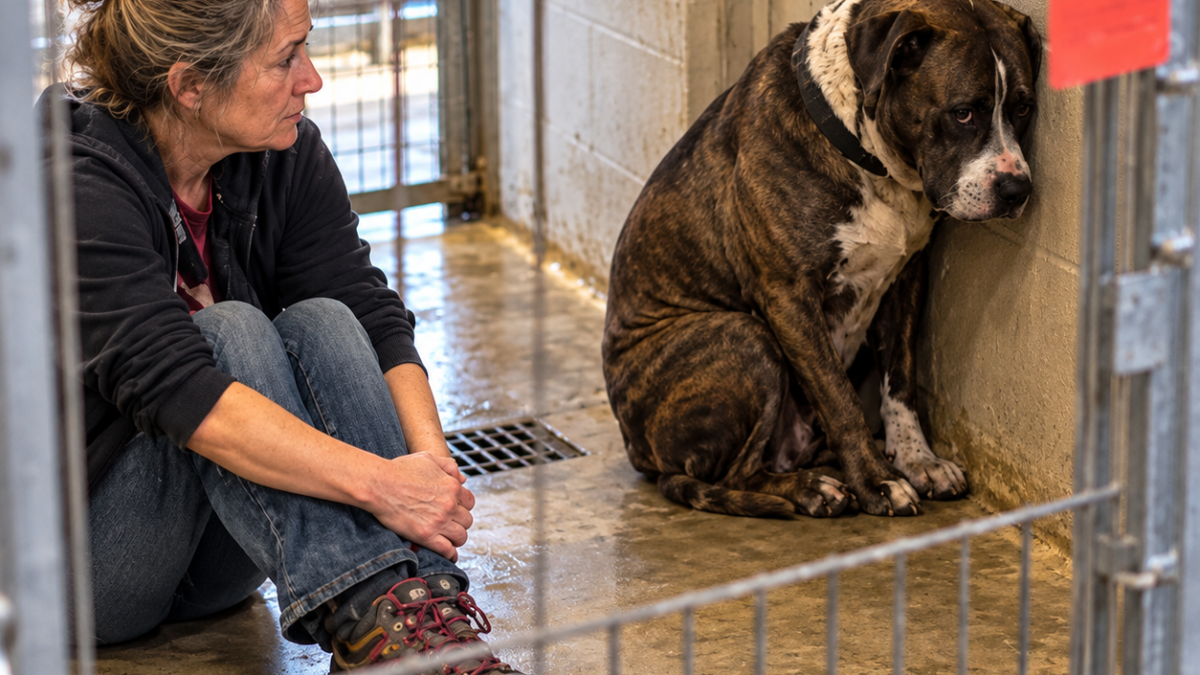
A moment earlier, the dog had been folded into the corner, trying to disappear into painted concrete.
Now he sat upright.
Back straight.
Front paws aligned.
Eyes on me.
Waiting.
I swallowed.
“Sitz,” I repeated softly.
He remained seated.
Marc was standing outside the kennel now.
“What did you do?”
“I gave him a command.”
“In German?”
“Yes.”
“Why?”
“I don’t know.”
That wasn’t completely true.
I knew why.
Because something about the way he had responded when I moved my foot had looked familiar.
Not like a stray improvising around people.
Like a dog waiting for structure.
Marc came closer to the gate.
The dog’s ears shifted toward him.
His body tightened.
I raised one hand.
“Stay there.”
Marc stopped.
I looked at the dog again.
My grandfather’s voice came back to me from childhood.
*Don’t repeat commands when the dog already understands you. Give him clarity, not noise.*
I tried another.
“Platz.”
The dog lowered himself immediately.
Chest to the floor.
Head up.
Still watching.
Marc whispered something under his breath.
I barely heard him.
“Bleib.”
Stay.
I rose slowly.
The dog remained exactly where he was.
I took two steps backward.
Nothing.
Three.
Nothing.
His eyes followed me.
I felt my heartbeat in my throat.
“Hier.”
He stood and came directly to me.
Not charging.
Not lunging.
Not pulling.
He stopped beside my left leg.
Perfect position.
I put my hand against his neck.
The muscles beneath his coat trembled again.
But he stayed.
“Good boy.”
His eyes closed for half a second.
I looked through the kennel gate at Marc.
“Get Sophie.”
Sophie Laurent was the shelter’s behavioral coordinator.
Marc didn’t move.
“Now.”
Something in my voice finally convinced him.
He left.
I knelt beside the dog.
“What happened to you?”
He looked at me.
No answer, obviously.
But suddenly Kennel 402 felt full of questions.
Where had he learned this?
Who trained him?
Why had nobody identified him?
Why was he listed only as a stray?
And most importantly:
Why had a dog who could execute obedience commands with near-perfect precision tried to lunge when someone approached his bowl?
The answer that came to me wasn’t complicated.
Fear.
That didn’t automatically make him safe.
I knew enough not to confuse sympathy with behavioral assessment.
A frightened dog this large could still injure someone.
But fear and indiscriminate aggression were not the same thing.
That distinction mattered.
Especially with thirty-five minutes left.
Sophie arrived at 4:29.
She was forty-one, short, permanently tired, and one of the calmest people I had ever met around animals.
She stopped outside the kennel.
“Marc said you have a miracle.”
“No miracle.”
I pointed toward the dog.
“Watch.”
I stepped away.
“Sitz.”
He sat.
“Platz.”
Down.
“Hier.”
He returned to heel.
Sophie’s face changed.
“Do that again.”
I did.
The dog responded every time.
She crouched outside the gate.
“Can he disengage from you?”
“What?”
“Walk away.”
I moved toward the opposite wall.
The dog watched but didn’t follow until I called.
Sophie nodded slowly.
“Any reaction to handling?”
“He let me touch his neck and shoulder.”
“Food?”
“I haven’t tested it.”
“Don’t.”
“I wasn’t going to.”
She glanced at the red card.
Then at the clock.
4:31.
“We need time.”
“I know.”
“That decision wasn’t based only on the bowl incident.”
“What else?”
“Intake notes say he stiffened during leash handling and hit the end of the kennel when a tech entered.”
“Did anyone get hurt?”
“No.”
“Then reassess him.”
Sophie rubbed her forehead.
“Claire, you know the situation.”
“Yes.”
“We have no open kennels.”
“I know.”
“We took in eleven dogs today.”
“I know.”
“And this is not a small, easy dog.”
“I know.”
“So understand what you’re asking.”
I stood.
“I’m asking you not to make a permanent decision based on a terrified dog’s worst twenty-four hours when we’ve just discovered evidence he has a completely different behavioral history.”
Sophie stared at me.
Marc returned.
Behind him came our shelter director, Isabelle Fournier.
Isabelle was in her late fifties and had spent twenty-three years in municipal animal welfare.
People who didn’t know her thought she was cold.
She wasn’t.
She was exhausted by mathematics.
Beds.
Budgets.
Staff.
Intakes.
Adoptions.
Every compassionate decision still needed physical space.
“What’s happening?” she asked.
Sophie explained.
Isabelle listened without interrupting.
Then she watched the dog respond to the commands.
Her eyes narrowed.
“Who authorized the five o’clock procedure?”
“Veterinary and behavioral,” Sophie said. “Based on intake and space.”
“Any bite history?”
“None documented.”
“Owner?”
“Unknown.”
“Chip?”
“Initial scan negative.”
Isabelle looked at the clock.
4:35.
Then at me.
“How long do you want?”
“Twenty-four hours.”
She laughed once, without humor.
“Of course you do.”
“Twelve.”
“No.”
“Until tomorrow morning.”
“Claire.”
“Please.”
She looked at the dog.
He had returned to the corner but was no longer facing the wall.
He was watching us.
Isabelle was quiet.
Then she said, “Hold until ten tomorrow morning.”
I exhaled.
Sophie immediately said, “I’ll reassess at seven.”
Isabelle pointed at both of us.
“If he gives us clear unsafe behavior, we do not romanticize it because he knows German.”
“Agreed.”
“And nobody goes in alone.”
I glanced at Marc.
“Agreed.”
Isabelle started walking away.
Then turned.
“Claire?”
“Yes?”
“You now have seventeen hours and twenty-five minutes.”
“I know.”
“Use them.”
I did.
The first thing we did was scan him again.
The shelter had two microchip scanners.
The intake tech had used the older one.
Sophie borrowed the newer scanner from the medical wing.
We passed it slowly over the dog’s shoulders.
Nothing.
Neck.
Nothing.
Chest.
No signal.
Then, near his left shoulder blade, the scanner beeped.
Everyone stopped.
Sophie moved it back.
Beep.
A number appeared.
I actually laughed.
“You have got to be kidding me.”
Marc stared.
“They missed the chip?”
“It’s migrated,” Sophie said. “Way off normal placement.”
She read the number twice and typed it into the identification database.
My excitement lasted approximately ninety seconds.
Then Sophie frowned.
“What?”
“Registration is old.”
“How old?”
“Last updated five years ago.”
“Name?”
She turned the screen slightly.
Registered dog:
**ATLAS DU VAL D’OR**
Male.
Brindle.
Crossbreed.
Date of birth six years earlier.
Owner:
**André Morel.**
Address in a village nearly forty kilometers away.
Phone number disconnected.
I looked into the kennel.
“Atlas.”
The dog’s head snapped toward me.
My entire body went cold.
I said it again.
“Atlas.”
He stood.
Tail low.
Eyes fixed on me.
Not a guess.
Not coincidence.
That was his name.
Sophie whispered, “Well.”
For the first time all afternoon, the dog’s tail moved.
Once.
A single cautious sweep.
I crouched.
“Atlas.”
Another movement.
I looked at Sophie.
“Find André Morel.”
She was already typing.
The address connected to the registration belonged to an old stone house that had been sold six months earlier.
The phone was dead.
No current email.
The municipal records office was closed for the day.
We called the veterinary clinic listed in Atlas’s old file.
Closed.
I searched the name online.
Too many results.
André Morel was not exactly rare.
We checked social media.
Nothing certain.
Then I remembered what my actual volunteer role was.
Photography.
Stories.
Getting people to stop.
I took my camera from the shelf.
Atlas stiffened when I lifted it.
I lowered it immediately.
“No.”
I sat outside his kennel.
Waited.
Then used my phone instead.
No flash.
No reaching.
One photograph.
Atlas sitting near the back wall.
Honey eyes.
White patch shaped like a crooked shield across his chest.
I wrote three sentences.
Not a dramatic plea.
Not accusations.
Just facts.
**URGENT IDENTIFICATION REQUEST: This six-year-old male was found near the eastern industrial corridor outside Lyon. Microchip identifies him as ATLAS DU VAL D’OR, previously registered to André Morel. If you know André or Atlas, please contact the shelter immediately.**
Isabelle reviewed it.
“Remove the kennel number.”
I did.
“Remove the deadline.”
I hesitated.
“Why?”
“Because I do not want fifty people storming the building or threatening staff.”
She was right.
I removed it.
The post went live at 4:58.
At exactly five o’clock, Atlas was still alive.
That should have felt like victory.
It didn’t.
It felt like borrowed time.
I stayed after my volunteer shift.
At six-thirty, the post had been shared 214 times.
At seven-fifteen, 600.
At eight, more than a thousand.
Most comments were useless.
People tagging friends.
People asking whether they could adopt him immediately.
People arguing about shelter policies without knowing anything about the case.
Then one comment appeared beneath the post:
**I think this dog belonged to my old neighbor in Saint-Romain. The man was hospitalized last winter.**
I replied privately.
The commenter, Elise, gave us an address.
Same village.
Different street.
She remembered an older man named André who walked a large brindle dog every morning.
“Do you know what happened to him?” I asked.
“He had some kind of stroke, I think.”
“And the dog?”
“I assumed family took him.”
“Family who?”
“A nephew maybe. Or son-in-law. I’m not sure.”
“Do you have contact information?”
“No.”
But she gave us one more detail.
André had worked for the railways.
Security division.
With dogs.
That explained the German commands.
I sent the message to Sophie.
Her response came immediately.
**This is real.**
Yes.
It was.
At nine-forty, another message arrived.
This one from a woman named Camille Morel.
**Please call me. Atlas belongs to my grandfather. We have been looking for him for eleven days.**
My hands started shaking.
I called.
A young woman answered before the first ring finished.
“Hello?”
“Camille?”
“Yes.”
“My name is Claire. I’m calling from the shelter.”
“Is that Atlas?”
Her voice broke on his name.
I looked toward Kennel 402.
“Yes.”
She began crying.
Not polite tears.
The kind that take breathing with them.
I waited.
Finally she said, “My grandfather thinks he’s dead.”
“What happened?”
“He was told Atlas ran away.”
“By who?”
A pause.
“My uncle.”
“What’s your uncle’s name?”
“Luc Morel.”
I wrote it down.
“Where is your grandfather?”
“At a rehabilitation center.”
“Can he travel?”
“I don’t know.”
“Can you send us recent photographs of Atlas?”
“Yes.”
“Vet records?”
“Yes.”
“Anything proving ownership.”
“I have everything.”
Her voice became urgent.
“Please don’t give him to anyone.”
“We won’t.”
That promise felt dangerous.
Not because I wanted to break it.
Because I didn’t control everything.
“We have a temporary hold,” I corrected. “Send the records tonight. We’ll review them first thing.”
“What happened to him?”
“He’s frightened.”
“Did he hurt someone?”
“No confirmed injury.”
Camille exhaled.
“He’s not dangerous.”
“I need to be careful with that statement.”
“I know.”
She swallowed.
“But Claire, Atlas worked with my grandfather.”
“In security?”
“Yes. Granddad trained dogs for the railway service. Atlas wasn’t an official police dog, but he trained him the same way. Obedience. Tracking. Property work.”
“German commands?”
“Yes.”
That confirmation sent a chill through me.
I glanced toward Atlas.
“Why was your uncle caring for him?”
“Granddad had a stroke three months ago. He couldn’t go home. Luc took over the house and Atlas temporarily.”
“Temporarily?”
“Yes.”
“What happened eleven days ago?”
“Luc said Atlas slipped his collar near the river.”
I looked at the pale band around Atlas’s neck.
“He wasn’t wearing his old collar when he arrived.”
Silence.
Camille understood the implication immediately.
“Oh God.”
“Don’t assume anything yet.”
But I was already assuming plenty.
“When can you come?”
“Tomorrow morning.”
“Bring your grandfather if medically possible.”
“He can barely walk.”
“Atlas doesn’t need him to walk.”
There was silence again.
Then Camille whispered:
“No.”
“He just needs him to be there.”
At six-fifty the next morning, I was back at the shelter.
Sophie was already working with Atlas.
We did the assessment in a quiet outdoor enclosure before most of the kennels became noisy.
She used two staff members.
Long lines.
No crowding.
No food bowl conflict at first.
Atlas obeyed cues.
Accepted leash pressure.
Allowed a muzzle to be introduced without panic, although Sophie didn’t fasten it.
Reacted strongly when a male staff member entered quickly carrying a metal bucket.
Atlas backed away, barked twice, then moved forward.
Not ideal.
But when the man stopped, Atlas stopped.
When given distance, he disengaged.
Sophie made notes.
“Fear-based.”
“That’s what I thought.”
“Don’t celebrate.”
“I’m not.”
“He’s still powerful. He still needs experienced handling.”
“I know.”
Then came the bowl assessment.
Atlas stiffened when Sophie approached while he was eating.
She stopped outside his threshold.
He froze.
No growl.
No lunge.
She tossed higher-value food from a distance and walked away.
Atlas ate.
Second attempt.
Same.
Third.
His body loosened slightly.
Sophie looked at me.
“This is resource guarding under stress, not evidence of an indiscriminately dangerous dog.”
I nearly hugged her.
She pointed her pen at me.
“Do not.”
“I wasn’t going to.”
“You absolutely were.”
At 8:12, Isabelle arrived.
She read the preliminary assessment.
Then the microchip record.
Then Camille’s documents.
Photographs filled the screen.
Atlas as a puppy beside an elderly man.
Atlas at two sitting next to a train platform in a working harness.
Atlas asleep beside a fireplace.
Atlas wearing a wide brown leather collar.
Same pale line now visible around his neck.
One photograph showed the white patch on his chest clearly.
No question.
It was him.
Isabelle removed the red card from Kennel 402.
She did it quietly.
No speech.
No applause.
She simply unclipped it.
Folded it once.
Placed it in her pocket.
I watched.
“You could have let me do that.”
“No.”
“Why?”
“Because I signed the hold yesterday.”
She looked toward Atlas.
“And because when a system almost makes a mistake, management should be the one to physically remove the paperwork.”
I never forgot that sentence.
At 9:37, Camille entered the lobby.
She was thirty-one, dark-haired, pale from lack of sleep.
Beside her was an elderly man in a wheelchair.
André Morel.
Seventy-eight.
Thin.
Left hand resting weakly on his lap.
His face carried the unevenness of someone still recovering from a stroke.
He looked exhausted.
But his eyes were sharp.
“Where?” he asked.
One word in French.
*Où?*
Where?
I knelt beside him.
“He’s safe.”
André closed his eyes.
Camille touched his shoulder.
I explained that we needed to move slowly.
Atlas had been under severe stress.
We would bring André to a quiet room.
Atlas would enter on leash with Sophie.
No sudden movements.
No crowd.
André listened impatiently.
“He knows me.”
“I believe you.”
“He knows me.”
“I believe you.”
But procedure mattered.
We prepared the visitation room.
André sat near the wall.
Camille stood behind him.
I stayed near the door.
Sophie entered with Atlas.
The dog stepped through.
Stopped.
His entire body froze.
André’s face changed.
For a moment, he looked twenty years younger.
He whispered one word.
“Atlas.”
That was it.
One word.
Atlas made a sound I had never heard from him.
Not a bark.
Not a growl.
A high, broken whine from deep in his chest.
The leash slipped loose in Sophie’s hand.
Not because she lost control.
Because she let it.
Atlas crossed the room.
Not charging.
Running.
He reached André’s wheelchair and stopped so abruptly his paws slid.
Then he pressed his entire body against the old man’s knees.
André bent forward as far as his weakened body allowed.
His good hand gripped Atlas’s neck.
“Mon garçon.”
My boy.
Atlas pushed his massive head beneath André’s arm.
André began crying.
Camille did too.
So did I.
Sophie turned away and pretended to adjust the leash.
Atlas’s tail hit the wheelchair.
Again.
Again.
Again.
The dog who had trembled facing a concrete wall less than eighteen hours earlier was now trying to climb carefully into the lap of a seventy-eight-year-old man.
André laughed through tears.
“You got fat.”
Atlas had not gotten fat.
He was actually slightly underweight.
Nobody corrected him.
For almost ten minutes, we let them exist without questions.
Then André looked up.
“What did they say he did?”
I hesitated.
Camille had already told him some of it.
“He reacted defensively around staff.”
André looked offended.
“Of course.”
I almost smiled.
“Why ‘of course’?”
He pointed to Atlas.
“This dog has slept beside me for six years.”
His speech was slow but clear.
“Then strange men take him. Metal room. Noise. No me. No home.”
He tapped his own chest.
“You expect him to sing?”
Sophie actually laughed.
“No.”
André scratched Atlas’s neck.
“He guards food?”
“Yes.”
“He never did.”
“That doesn’t mean he doesn’t now.”
André looked at her.
She continued gently.
“Stress changes behavior.”
He nodded.
“I know.”
Then his expression hardened.
“Luc.”
Camille sat beside him.
“Granddad.”
André looked at her.
“Luc did not lose him.”
The room went quiet.
“How do you know?” I asked.
André pointed toward Atlas’s neck.
“Collar.”
“What about it?”
“I made his collar.”
His voice became more forceful.
“Leather. Brass plate. My phone. Address.”
Atlas had arrived with no such collar.
Only a cheap nylon slip lead placed by animal control.
André continued.
“He cannot ‘slip’ it.”
Camille looked at me.
“That’s what I told you.”
André said something else.
“Car.”
“What car?”
He looked at his granddaughter.
“Atlas hates Luc’s van.”
“Why?”
André’s face tightened.
“Luc shouts.”
Camille closed her eyes.
This was where the story changed again.
Not from rescue to reunion.
From reunion to investigation.
André had suffered his stroke twelve weeks earlier.
During hospitalization, his nephew Luc had agreed to manage the house temporarily.
That included Atlas.
Camille lived in Grenoble and visited every weekend, but Luc handled daily logistics.
At first, everything seemed fine.
He sent photographs.
Said Atlas ate well.
Said he walked him.
Then André’s rehabilitation was extended.
Three months became potentially six.
The house needed maintenance.
Luc complained about the responsibility.
According to Camille, he began suggesting Atlas should be surrendered.
André refused.
“He said no every time,” Camille told us.
André tapped his wheelchair arm.
“My dog.”
“Yes, Granddad.”
“My home.”
“I know.”
“Not Luc’s.”
A week before Atlas disappeared, Camille received a text from Luc.
**This can’t continue. He’s too much dog for me.**
She replied:
**I’ll arrange boarding until Granddad is home. Give me two days.**
Luc answered:
**Do whatever you want.**
Two days later, before Camille could move Atlas, Luc called.
Atlas was gone.
Supposedly escaped during a walk near the river.
Camille drove down.
They searched.
Posters.
Online groups.
Veterinary clinics.
No Atlas.
Luc claimed he had lost the collar with the dog.
Now Atlas was sitting in a shelter nearly forty kilometers in the opposite direction from where Luc said he disappeared.
No collar.
Found near an industrial interchange.
Sophie contacted municipal animal control.
A formal report began.
André wanted to take Atlas immediately.
We could not allow that.
Not yet.
Not because Atlas didn’t belong to him.
Because André lived in a rehabilitation center that did not allow large dogs.
His home was still under Luc’s access.
And Atlas needed a safe transition after the shelter.
André’s face collapsed when Isabelle explained.
“You save him, then keep him?”
“No,” she said.
“We keep him safe until we can send him somewhere that is safe for both of you.”
“He is safe with me.”
“I believe that.”
She pulled a chair closer.
“But can you walk him today?”
André looked away.
“No.”
“Can you lift him if he falls?”
“No.”
“Are you living at home?”
“No.”
Isabelle’s voice softened.
“Then loving him means making a temporary plan.”
André stared at Atlas.
The dog had laid his head across the old man’s shoes.
Camille said, “He can stay with me.”
Everyone looked at her.
“My apartment allows dogs.”
I asked, “Large dogs?”
“Yes.”
“Other pets?”
“No.”
“Work schedule?”
“Remote three days. Office two.”
“Experience with Atlas?”
“I grew up with him.”
André immediately said, “Yes.”
Sophie held up a hand.
“We still do a home check.”
Camille nodded.
“Do whatever you need.”
“And behavior support.”
“Yes.”
“And no contact with Luc while the investigation is active.”
Camille’s expression hardened.
“That won’t be difficult.”
Atlas went into temporary foster with Camille two days later.
The first night, she sent me a photograph.
He was sleeping beside her apartment door.
I knew that posture.
Waiting.
Not fully believing.
I called.
“How is he?”
“Quiet.”
“Eating?”
“Only when I sit far away.”
“Don’t test him.”
“I won’t.”
“Walk?”
“He’s perfect outside until he sees a white utility van.”
I sat upright.
“What happens?”
“He freezes.”
“Every white van?”
“So far, two.”
“Tell animal control.”
“I will.”
Three days later, Atlas was sleeping beside Camille’s couch.
A week later, he accepted food while she remained in the kitchen.
Ten days later, he started carrying André’s old wool cap from room to room.
Camille sent a video.
Atlas walked into the living room.
Placed the cap on his bed.
Circled twice.
Lay down with his chin on it.
I watched it four times.
André visited every Sunday.
The rehabilitation center allowed Camille to bring Atlas into the courtyard.
The first visit was chaos.
Atlas saw André from thirty yards away and nearly pulled Camille off her feet.
Sophie had anticipated that and fitted a secure harness with a backup line.
André laughed so loudly other patients turned.
“Atlas!”
Every week after that, Atlas learned the routine.
Courtyard.
Wheelchair.
André.
Quiet time.
Then back to Camille.
At first, leaving André caused panic.
Atlas planted his body beside the wheelchair and refused to move.
André would say:
“Hier.”
Come.
Then:
“Bei Claire.”
Go with Claire.
He accidentally called his granddaughter Claire twice.
Stroke recovery did strange things to words.
Camille teased him.
Atlas eventually understood that leaving did not mean losing André again.
That mattered.
Meanwhile, the investigation into Luc deepened.
The first useful evidence came from an automatic license-plate camera at a toll road.
Luc’s white work van had traveled east on the morning Atlas disappeared.
Not west toward the river, where Luc claimed they had been walking.
The timestamp placed him fifteen kilometers from the industrial area where Atlas was later found.
Luc said he had been working.
His employer records disagreed.
He had taken the morning off.
Then a fuel-station camera appeared.
Luc’s van.
10:18 a.m.
Atlas visible through the rear window.
My stomach tightened when I saw the still image.
Camille stared at it.
“That’s him.”
No question.
Atlas wore his leather collar in the photograph.
At 11:03, another camera captured the van passing toward the industrial interchange.
At 11:47, it returned.
Atlas was no longer visible.
When municipal officers interviewed Luc again, he changed his story.
He said he had planned to take Atlas to a private boarding kennel.
The kennel had unexpectedly refused him.
Then Atlas supposedly escaped from the van during a stop.
“Where?” the investigator asked.
Luc gave a location.
No cameras there.
Convenient.
But another problem emerged.
André’s leather collar was found.
Not on Atlas.
Not near the shelter.
In Luc’s garage.
Camille called me the moment she heard.
“They found it.”
“What?”
“Granddad’s collar.”
I stood from my desk.
“Where?”
“In a toolbox.”
I closed my eyes.
There are moments when anger becomes strangely quiet.
This was one.
Luc had told his family Atlas disappeared wearing the collar.
He had kept it.
Why?
His attorney later claimed Luc removed it before transport because the brass tag had become loose.
Then forgot it in the garage.
Possible.
But increasingly difficult to believe alongside everything else.
Then investigators obtained Luc’s messages to a friend.
Most were ordinary.
Work.
Football.
Complaints about André’s house.
Then:
**Old man refuses to let go of that dog.**
The friend replied:
**Put him in boarding.**
Luc:
**Not paying for that for months.**
Two days later:
**Problem solved.**
Friend:
**What did you do?**
Luc:
**He’s somebody else’s problem now.**
That sentence became the heart of the case.
Somebody else’s problem.
When Camille showed André the message, he said nothing for nearly a minute.
Atlas lay beside his wheelchair.
André’s hand rested on the dog’s head.
Finally, he whispered:
“He was family.”
Camille crouched beside him.
“I know.”
“No.”
He looked at her.
“Luc knew.”
That was worse.
Luc was not a stranger who found Atlas inconvenient.
He was family.
He had eaten at André’s table.
Watched Atlas grow up.
Accepted responsibility.
Then turned a living bond into a logistical problem.
I became furious all over again.
André did something I didn’t expect.
He refused to publicly attack Luc.
Camille wanted to speak to a local paper.
André said no.
“Why?” she asked.
“Because Atlas needs quiet.”
“He deserves consequences.”
“Yes.”
“Then people should know.”
André looked at her.
“Court knows.”
That became the philosophy of the entire case.
Evidence, not spectacle.
Accountability, not a mob.
The shelter followed the same rule.
People online had discovered parts of the story.
Comments became angry.
Some demanded Luc’s name.
We never released it.
Isabelle posted one statement:
**Atlas has been identified, reunited with his family, and placed safely while authorities review the circumstances of his disappearance. We ask the public not to speculate or target private individuals.**
People complained that we were protecting someone.
We weren’t.
We were protecting the case.
And Atlas.
Two months after Kennel 402, André’s rehabilitation improved enough that doctors began discussing discharge.
He could walk short distances with a cane.
His left arm remained weak.
Speech was better.
His first question during the discharge-planning meeting was not about stairs.
Not medication.
Not home nursing.
“Atlas?”
Camille called me laughing.
“He asked the physiotherapist if dog walking counts as rehabilitation.”
“What did she say?”
“She said eventually.”
“And André?”
“He said eventually starts Tuesday.”
That sounded like André.
The house presented another problem.
Luc still had keys.
The family had already changed the locks.
Camille removed his belongings under legal supervision.
A neighbor repaired a broken gate.
We arranged a trainer to help Atlas transition home.
The day Atlas returned to André’s property was one of the happiest days of my life.
I went because André insisted.
Sophie came too.
Atlas jumped from Camille’s car.
Stopped.
His nose lifted.
The old stone house stood at the end of a short gravel drive.
For a moment, Atlas didn’t move.
Then his tail rose.
He ran.
Not wildly.
Purposefully.
Front door.
Rose bushes.
Side gate.
Stone wall.
Back porch.
Everywhere.
Smelling.
Checking.
Remembering.
Then André’s medical transport arrived.
Atlas heard the van before he saw it.
His body stiffened.
White vehicle.
For one second, fear returned.
Camille touched his harness.
“It’s okay.”
The door opened.
André appeared.
Atlas exploded with joy.
He ran to the ramp.
Stopped at the edge as André’s wheelchair descended.
Tail hammering the air.
André laughed.
“Wait.”
Atlas waited.
The wheelchair reached the ground.
“Hier.”
Atlas came.
He pressed against André.
The old man wrapped his arm around him.
Then looked at me.
“Home.”
One word again.
Maybe André understood how much one word could carry.
We went inside.
Atlas walked directly to the fireplace.
His old bed was gone.
Luc had thrown it away.
André had bought a new one.
Atlas smelled it.
Ignored it.
Then lay beside André’s chair.
Some things didn’t need replacement.
The legal case reached its first hearing three weeks later.
I was called as a witness because I had interacted with Atlas during the shelter hold.
I hated courtrooms.
Even administrative ones.
They make ordinary facts sound suspicious just by asking them slowly.
Luc sat across the room with an attorney.
I had never met him.
He looked ordinary.
Mid-forties.
Short hair.
Work jacket.
Tired face.
Nothing about him matched the villain my anger had invented.
That bothered me.
It is easier when people who do selfish things look obviously selfish.
They usually don’t.
The prosecutor—or rather, the attorney representing the municipal case—asked me to describe Atlas’s condition at intake.
I stayed factual.
Trembling.
Avoidance.
Resource guarding.
Defensive response to sudden approach.
No confirmed bite.
Then I explained the German commands.
Luc’s attorney asked:
“Ms. Martin, are you a certified canine behaviorist?”
“No.”
“Veterinarian?”
“No.”
“Professional dog trainer?”
“No.”
“Then you are not qualified to conclude that Atlas was safe.”
“I never concluded that.”
He paused.
“What did you conclude?”
“That his behavior needed reassessment.”
“Because he sat when you said a German word?”
“Because a dog labeled as an unidentified stray demonstrated structured training, responded to a known name once identified, showed avoidance rather than sustained offensive behavior in my interaction, and had no documented bite.”
The attorney stared at me.
I had spent seven years writing shelter biographies.
I knew how to use words.
He changed direction.
“You entered the kennel despite staff guidance?”
“Yes.”
“So you violated procedure.”
“Yes.”
Isabelle shifted behind me.
I continued.
“That was my mistake.”
The attorney seemed almost disappointed that I admitted it.
“Could Atlas have injured you?”
“Yes.”
“But he didn’t.”
“No.”
“Does that prove he wouldn’t injure someone else?”
“No.”
“Thank you.”
He sat.
I understood the strategy.
Make the shelter decision appear reasonable.
In fairness, part of it had been.
Atlas had been stressed.
Large.
Unknown.
Reactive.
Space was limited.
The issue wasn’t that every person before me had been heartless.
The issue was that our process allowed a label to become certainty too quickly.
That distinction mattered later.
Camille testified about the search.
André’s refusal to surrender Atlas.
The planned boarding arrangement.
The texts.
Then the transport footage.
Fuel station.
Toll camera.
Van.
Collar.
Messages.
Luc’s attorney argued there was no direct video showing Luc physically abandoning Atlas.
True.
No camera captured the exact moment.
But the timeline was tight.
Atlas in van.
Van near recovery location.
Atlas gone.
Collar retained.
Family falsely told he disappeared elsewhere.
“Problem solved.”
“He’s somebody else’s problem now.”
Evidence does not always need one perfect image.
Sometimes the pattern is the image.
Luc eventually testified.
His explanation was that he had become overwhelmed.
André’s house.
Medical appointments.
Bills.
Work.
Atlas.
He had intended to find temporary placement but panicked.
“I didn’t want the dog harmed,” he said.
The municipal attorney asked:
“Then why did you tell your uncle the dog escaped?”
Luc looked down.
“Because I knew he’d be angry.”
“Why keep the collar?”
“I removed it.”
“Why?”
“I don’t remember.”
“Why drive forty kilometers away?”
“I was looking for a kennel.”
“Which kennel?”
Luc named one.
The owner testified they had no appointment with him.
The attorney returned.
“Mr. Morel, did you contact any municipal shelter before Atlas was found?”
“No.”
“Any rescue?”
“No.”
“Any veterinarian?”
“No.”
“Any family member besides your friend?”
“No.”
“Did you tell Camille you needed immediate help?”
“No.”
“Did she offer boarding?”
“Yes.”
“How long before Atlas disappeared?”
Luc hesitated.
“Two days.”
The room went very quiet.
There it was.
The part I could never reconcile.
He had an option.
Not an ideal one.
But an option.
Camille had offered to solve the problem.
He acted first.
Why?
Maybe pride.
Maybe resentment.
Maybe he wanted control of André’s house without a large dog there.
Maybe he simply refused to wait forty-eight more hours.
Motives became arguments.
Actions remained facts.
The case did not end that day.
Legal cases rarely reward emotional pacing.
There were continuances.
Additional records.
Statements.
A separate issue involving property access.
Weeks became months.
Atlas didn’t care.
He had André.
His routine returned.
Morning walk with Camille or a hired walker.
Breakfast.
Time beside André.
Training exercises that doubled as rehabilitation for both of them.
André’s physical therapist turned parts of Atlas’s obedience into therapy.
“Stand.”
André stood.
“Three steps.”
He walked.
“Sitz.”
Atlas sat.
André laughed.
“Better than me.”
The therapist said, “He complains less.”
André called her a traitor.
Atlas’s fear of white vans decreased.
Not disappeared.
We used distance and counterconditioning.
No forcing.
A van at fifty yards meant chicken.
Forty yards.
Thirty.
Eventually, a parked white van became just another vehicle.
Moving vans took longer.
That was fine.
Healing was not a deadline.
Atlas also changed around food.
At first, André was heartbroken when Atlas stiffened near his bowl.
“He never did this.”
“I know,” Sophie told him.
“Then why now?”
“Because at some point he learned his food might disappear.”
André’s face changed.
“Luc?”
“We don’t know.”
That mattered.
We did not invent crimes for people because we disliked them.
There was no evidence Luc starved Atlas.
At intake Atlas was slightly thin, not severely underweight.
Stress and irregular feeding could explain much.
We worked with what we knew.
No reaching toward the bowl.
Trade games.
Food added instead of removed.
Routine.
Predictability.
Three months later, Atlas ate while André sat nearby.
Six months later, Camille could pass at a safe distance without any stiffening.
A year later, the behavior was nearly gone.
Nearly.
We still respected it.
Recovery doesn’t erase history.
Then came the unexpected consequence of Atlas’s case.
Isabelle called a staff meeting.
Volunteers were included.
She placed the folded red card from Kennel 402 on the table.
I had forgotten she kept it.
“I don’t want this meeting to become self-congratulation,” she said.
Nobody spoke.
“We did not save Atlas because our system worked.”
She looked around.
“We almost lost him because it didn’t work well enough.”
Marc shifted uncomfortably.
Isabelle continued.
“We were overloaded. The intake behavior was real. The risk was real. But our information was incomplete.”
She tapped the card.
“‘Attempted to charge an employee’ became the defining sentence.”
Marc looked down.
I wanted to defend him.
Isabelle did first.
“This is not Marc’s fault.”
He looked up.
“It is not Claire’s hero story either.”
My turn to feel uncomfortable.
“Claire violated entry procedure.”
“Thank you,” I muttered.
A few people smiled.
“She also observed something our process had not captured.”
Isabelle continued.
“We need a process that does not depend on someone taking an unauthorized chance.”
That became the **402 Protocol**.
The name was initially a joke.
Then it became official internally.
Before a high-risk end-of-stay decision involving a found adult dog with no documented bite injury, whenever operationally possible, the shelter would complete a second identification scan with a separate device.
Behavior notes would distinguish:
**forward aggression, defensive response, resource guarding, handling sensitivity, barrier frustration, shutdown, and unknown.**
Not all “aggression” would be written as one word.
Known commands would be documented.
Photos would be taken before final review if safe.
A second staff member would review the intake narrative.
And when capacity allowed, dogs displaying extreme shutdown would receive assessment in a quieter setting before irreversible conclusions.
Was the protocol perfect?
No.
Could it save every dog?
No.
Overcrowding did not disappear because we improved a form.
Some dogs still presented risks we could not safely manage.
Some medical cases remained heartbreaking.
But language improved.
Information improved.
That mattered.
Three months after rollout, a shepherd arrived labeled:
**Aggressive at gate.**
Under the old system, that phrase might have dominated everything.
Under the new form:
**Barks and lunges behind barrier. Retreats when gate opens. Social outside kennel. No bite attempt observed.**
Barrier frustration.
Not the same thing.
The shepherd went to an experienced foster.
Then a home.
Marc showed me the adoption photo.
“You going to say it?”
“Say what?”
“That you were right.”
“I’m trying to grow as a person.”
He laughed.
“You were right.”
“Thank you.”
“Once.”
I accepted the limitation.
Atlas became locally known after the legal proceedings became public.
We avoided sensational coverage.
But a regional newspaper wrote about the 402 Protocol and identification failures.
They photographed Atlas with André.
Not in the shelter.
At home.
André sat in a chair beside the fireplace.
Atlas rested at his feet.
The headline was simple:
**A SECOND LOOK**
I liked that.
No countdown.
No dramatic red card.
Just the point.
Look again.
The article brought donations.
Better scanners.
A grant for behavioral enrichment.
A local dog-training club offered volunteer hours.
People donated raised beds and sound-dampening panels.
Atlas’s story changed the shelter physically.
Kennel 402 itself was renovated during a larger project.
The wet concrete floor was replaced.
Visual barriers installed.
Noise reduction added.
When construction finished, Isabelle invited André to visit.
He came with Atlas.
The dog stopped at the entrance to the kennel wing.
His body tightened.
We did not make him continue.
André sat on a bench outside.
“Enough,” he said.
Correct.
We didn’t need Atlas to reenact his fear to prove he had overcome it.
The staff placed a small plaque near the volunteer room instead.
Not on the kennel.
It read:
**BEHAVIOR IS INFORMATION, NOT IDENTITY.
LOOK TWICE.**
No dog’s name.
No drama.
But everyone knew.
Luc’s case concluded almost eleven months after Atlas’s intake.
He accepted a legal resolution involving animal abandonment and false reporting connected to the circumstances of Atlas’s disappearance.
The court imposed fines.
Restitution for municipal costs.
A period during which Luc was prohibited from keeping animals under his sole care.
Required responsible-animal-care education.
And additional conditions regarding contact with André’s property.
The exact outcome disappointed some people online.
They wanted something harsher.
People often do when they experience a case through headlines.
André did not.
Camille asked him after the hearing:
“Is that enough?”
He thought for a long time.
Then said:
“He cannot touch Atlas.”
“No.”
“And Atlas is home.”
“Yes.”
“Then I have more important things.”
That was André.
The legal consequence mattered.
But he refused to let Luc remain the center of Atlas’s story.
I tried to learn from that.
It wasn’t always easy.
Especially when Luc approached me outside the courthouse after the final hearing.
I recognized him from across the corridor.
My body tightened automatically.
He stopped several feet away.
“Claire?”
“Yes.”
His lawyer was nowhere near him.
Camille was speaking to the municipal attorney.
I was alone.
Luc put his hands in his coat pockets.
“I wanted to say something.”
I waited.
“I know what you think of me.”
“That isn’t relevant.”
He looked surprised.
I continued.
“What you did is relevant.”
His jaw tightened.
“Everyone thinks I hated that dog.”
“Did you?”
“No.”
“Then why?”
He looked away.
“I was drowning.”
I said nothing.
“My uncle was in the hospital. I was handling the house. His bills. My own work. Atlas wouldn’t listen to me.”
“He listened to German commands.”
“I didn’t know them.”
“You could have asked André.”
“He could barely talk.”
“Camille?”
Luc exhaled.
“I was angry.”
There.
Maybe the first completely honest sentence.
“At who?”
“My uncle.”
“Why?”
“For getting sick.”
The answer shocked me enough that I almost softened.
Luc continued.
“Which is stupid.”
“Human.”
He looked at me.
“But what you did with that anger wasn’t inevitable.”
“No.”
“You had help offered.”
“I know.”
“You lied about where Atlas went.”
“I know.”
“You let André believe his dog might be dead.”
Luc closed his eyes.
“I know.”
I felt the sharp sentence I wanted to say forming.
Something about deserving what happened.
Something satisfying.
Then I remembered Atlas pressing his head against André’s knees.
I remembered the red card.
The improved scanners.
The shepherd fostered because someone described behavior more accurately.
Luc had already received consequences.
I didn’t need to build my identity around delivering more.
So I said:
“Your uncle lost control of half his body for months.”
Luc looked at me.
“Atlas lost every familiar thing in one morning.”
He swallowed.
“You were overwhelmed.”
“Yes.”
“So were they.”
Silence.
“The difference was that you had a phone.”
Luc looked down.
I walked away.
That was enough revenge for me.
Not because the sentence was brilliant.
Because I no longer needed him to hurt in order for Atlas to be okay.
Atlas had already won the only thing that mattered.
His life back.
André returned home permanently.
His recovery surprised even his doctors.
Not complete.
But substantial.
He walked with a cane indoors.
Used a wheelchair for distance.
His speech improved.
Atlas adapted.
He no longer expected André to throw balls or take long hikes.
Their companionship changed shape.
Morning coffee on the terrace.
Slow obedience sessions.
Short walks with Camille or a hired dog walker while André came along partway.
Evenings by the fireplace.
Sometimes love becomes less active without becoming smaller.
I visited every few months.
The first time I arrived at the house after Atlas had settled, he barked at the gate.
Deep.
Powerful.
I stopped.
Camille came outside.
“Atlas. Hier.”
He approached.
Smelled me.
Then his tail moved.
I crouched.
“Remember the idiot who sat on your kennel floor?”
He pushed his head against my shoulder.
Camille laughed.
“Apparently.”
André shouted from the doorway:
“He likes you more than Luc.”
“Low standard.”
Camille choked on her coffee.
André smiled.
The scars on Atlas’s muzzle remained.
We never learned how he got all of them.
Some could have come from ordinary working-dog life.
Fences.
Brush.
Old injuries.
We resisted the temptation to invent a dark past for dramatic effect.
The truth was enough.
He had been loved.
Then lost.
Then frightened.
Then misread.
Then found.
Not every scar needed a villain.
Atlas turned seven.
Camille organized a birthday gathering.
Small.
André.
Me.
Sophie.
A neighbor.
A ridiculous dog-friendly cake.
Atlas ate too quickly.
André complained.
“You have no manners.”
Atlas stared at the remaining cake.
“None.”
Camille held the plate higher.
André looked at me.
“He was never this spoiled.”
I stared at his wheelchair, where a pocket had been visibly stuffed with dog biscuits.
“Clearly.”
He pretended not to understand.
The next year, André asked me a question I wasn’t ready for.
“What happens to Atlas if I die first?”
We were sitting in the garden.
Atlas slept in the shade.
I turned toward him.
“Camille.”
“Yes.”
“She agreed?”
“Yes.”
“Then you already know.”
André looked at Atlas.
“I want paper.”
That was practical.
So we helped.
Not because the shelter controlled anything.
Because his question exposed another gap.
André had assumed family would handle everything the first time.
That had failed.
This time, he created a formal pet-care plan with a notary.
Camille named primary caregiver.
A backup person.
Veterinary instructions.
Financial provision.
Behavior notes.
German commands.
Food routine.
Medical history.
Even Atlas’s fear of white vans.
André handed me a copy.
“What am I supposed to do with this?”
“Remember.”
“I think the notary has the legally useful copy.”
“You remember.”
I kept it.
André’s planning inspired another shelter project.
Senior owners began asking for help creating emergency pet cards.
Who cares for your animal if you are hospitalized?
Who has keys?
Which vet?
Medication?
Behavior concerns?
Backups?
We called it **Stay Together Planning**.
Not Atlas Planning.
André refused.
“Dog has enough fame.”
Fair.
The program prevented problems we would never fully know about.
That is the strange thing about prevention.
Its success stories often look like nothing happened.
An eighty-year-old woman went into the hospital.
Her terrier went directly to her daughter because the plan was taped inside a kitchen cabinet.
Nothing dramatic.
A man living alone had surgery.
His two cats went to a prearranged foster for fourteen days.
Nothing dramatic.
A retired teacher entered rehabilitation unexpectedly.
Her spaniel’s emergency contact received an automated notification from the clinic.
Nothing dramatic.
Exactly.
No lost animals.
No panic.
No red cards.
Atlas’s story kept turning into systems.
I began to understand that this was a more satisfying legacy than anything dramatic we could have done to Luc.
André lived three more years.
Then his health declined.
Not suddenly.
Gradually.
Atlas aged alongside him.
The once-massive dog developed gray around his muzzle.
Arthritis in one hip.
His hearing softened.
But his obedience remained almost comically precise.
André could whisper:
“Sitz.”
Atlas sat.
“Platz.”
Down.
Then André would forget what he was doing and hand him a biscuit anyway.
The structure of training had transformed into ritual.
One winter, Camille called me.
“Granddad is back in the hospital.”
My chest tightened.
“Stroke?”
“Pneumonia.”
“How bad?”
“Bad.”
“And Atlas?”
“With me.”
“Eating?”
“Yes.”
“Searching?”
“All the time.”
I knew.
Atlas had lost André once before.
His body remembered.
He slept beside Camille’s front door.
Paced when vans stopped outside.
Refused his bed.
We brought André’s blanket from the house.
Atlas slept on it.
The hospital allowed a visit after Camille explained their history.
Not inside a crowded ward.
A private courtyard attached to rehabilitation.
André was brought out in a wheelchair with oxygen tubing.
Atlas entered slowly.
For one awful second, he didn’t recognize him.
Then André whispered:
“Atlas.”
One word.
Again.
Atlas crossed the courtyard.
No running now.
He was old too.
He placed his head in André’s lap.
André’s hand rested over his ear.
Neither moved.
I stood ten feet away with Camille.
She was crying.
“So many times,” she whispered.
“What?”
“He finds him.”
I looked at them.
“Yes.”
André died six days later.
Atlas did not understand death as a human story.
He understood absence.
He searched André’s room.
The chair.
The garden.
The front gate.
For three weeks, he waited beside the terrace at the time André used to drink coffee.
Camille sat with him.
She did not drag him inside.
Did not remove every object.
Did not pretend nothing changed.
She stayed.
Eventually, Atlas began sleeping in the living room instead of beside André’s chair.
Then one morning, he brought André’s wool cap to Camille.
Placed it in her lap.
Sat.
Camille called me sobbing.
“What does that mean?”
“I don’t know.”
“Do you think he’s giving it to me?”
“I don’t know.”
She cried harder.
I said, “Maybe you don’t need to know.”
That became enough.
Atlas moved permanently with Camille.
The legal plan worked exactly as André intended.
No confusion.
No argument.
No one deciding Atlas was inconvenient.
He had a home before he needed one.
Years earlier, paperwork had nearly helped end his story.
Now paperwork protected it.
I found symmetry in that.
Atlas lived another two years.
He became quieter.
Softer.
He never lost his preference for structure.
Camille’s husband eventually moved in.
Atlas made him earn approval.
Not aggressively.
Just skeptically.
First week, distance.
Second, accepted treats.
Third, allowed a chest scratch.
Two months later, slept beside his chair.
Camille sent me the photograph with one line:
**Promoted.**
When Atlas turned ten, the shelter invited him to a staff training day.
Not as a spectacle.
He stayed in a quiet room and met only a small group.
New employees were told the story.
Not “we almost euthanized a good dog, therefore no scared dog is dangerous.”
That would have been the wrong lesson.
The lesson was:
Incomplete information can create dangerous certainty.
Fear can look threatening.
Threatening behavior still requires respect.
Identification matters.
Context matters.
Language matters.
Second review matters.
And sometimes a dog’s behavior in a kennel says more about the kennel than his behavior in a home.
Sophie demonstrated.
A young trainer asked:
“So Atlas was never aggressive?”
Sophie shook her head.
“That is not what we know.”
The room quieted.
“We know he displayed defensive behavior under extreme stress.”
She pointed toward Atlas.
“We know he guarded food in the shelter.”
“We know he lunged during one approach.”
“We know he had no documented bite.”
“We know he later behaved safely under management.”
She looked around.
“Do not replace one simplistic label with another.”
I loved her for that.
Atlas didn’t need to be a saint for us to have nearly misjudged him.
He was a dog.
Complex.
Strong.
Afraid.
Trained.
Capable of defensive behavior.
Capable of deep trust.
All true.
That was enough.
The 402 Protocol spread to two partner shelters.
Then a third.
Not formally named that everywhere.
But the practices did.
Double scans.
Better notes.
Second-context assessment where feasible.
Behavior categories.
Identification checks.
Emergency owner tracing.
We never knew exactly how many outcomes changed because of it.
Maybe five.
Maybe fifty.
Maybe none in some years.
But information quality improved.
That alone justified it.
Atlas’s final year was gentle.
He developed heart disease.
Medication helped.
Then less.
Camille kept me updated.
One evening she called.
“He’s not eating.”
“How long?”
“Since yesterday.”
“Vet?”
“Tomorrow morning.”
I knew from her voice.
So did she.
The veterinarian adjusted medication.
Atlas rallied for two weeks.
He ate.
Walked to the garden.
Stole bread from the kitchen counter for the first time in his life.
Camille texted:
**Apparently near-death experience has destroyed his discipline.**
I replied:
**André would be proud.**
Then came the final decline.
Atlas could no longer walk comfortably.
His breathing became difficult at night.
The veterinarian said the kind thing was also the hard thing.
Camille asked me to come.
I did.
Atlas lay on a thick blanket near the fireplace in André’s old house.
Camille had moved back there after inheriting it.
The same room from the photographs.
Same stone hearth.
Different bed.
André’s framed picture sat on the mantel.
Atlas looked at me.
His tail moved once.
I knelt.
“Hi, 402.”
Camille laughed through tears.
“Don’t call him that.”
“I know.”
I touched his shoulder.
“Hi, Atlas.”
His eyes softened.
He smelled my hand.
Then rested his enormous gray head across my arm.
Just like that first afternoon.
Only this time, he wasn’t trembling.
Camille sat beside him.
Her husband on the other side.
The veterinarian gave us time.
I looked at the old dog.
“You know something?”
Atlas breathed slowly.
“You caused a lot of paperwork.”
Camille laughed again.
“That is the least poetic goodbye I’ve ever heard.”
“I’m getting there.”
I rubbed the pale fur where his collar had once sat.
The leather collar André made hung on the wall now.
Not on Atlas.
He hadn’t worn it in years because the brass had become too heavy for his old neck.
“You were almost defined by four lines on a card.”
My throat tightened.
“Male.”
I touched his ear.
“Six years.”
His eyes stayed on mine.
“Stray.”
Camille took my hand.
“Defensive.”
I stopped.
Then smiled.
“Turns out the card left out quite a lot.”
Atlas exhaled.
I thought about André saying his name.
The wheelchair.
The courtyard.
The fireplace.
One word changing the whole room.
“You had a name.”
My voice broke.
“You had a person.”
I looked at André’s photograph.
“Then you had another person.”
Camille cried silently.
“And a home.”
Atlas shifted his head toward her.
She bent close.
“You can go find Granddad now.”
None of us knew what, if anything, came after.
It didn’t matter.
The sentence was for love, not theology.
Atlas relaxed.
His final moments were peaceful.
At home.
Beside the fireplace where he had once slept as a young dog.
No metal doors.
No barking kennel.
No red card.
No countdown.
Just people who knew his name.
Afterward, Camille gave the shelter André’s old training whistle.
Not the collar.
That stayed with her.
The whistle was mounted in the volunteer room beneath the plaque:
**BEHAVIOR IS INFORMATION, NOT IDENTITY.
LOOK TWICE.**
Below it, Isabelle added one small line after Atlas died:
**402 taught us that.**
I argued.
“You said no dog’s name.”
“402 isn’t his name.”
“Technicality.”
“Management privilege.”
She won.
She usually did.
By then, Isabelle was preparing to retire.
At her farewell gathering, she handed me an envelope.
Inside was the original red card.
The one from Atlas’s kennel.
Folded.
Faded.
**Male.
Approximately six years.
Found stray.
Defensive behavior.
Attempted to charge staff member.
Scheduled: 5:00 p.m.**
I stared at it.
“You kept this all these years?”
“Yes.”
“Why?”
“So I wouldn’t forget what certainty looks like when information is missing.”
I swallowed.
“What am I supposed to do with it?”
“Whatever you want.”
I thought about framing it.
Then decided against it.
I placed it in a file with Atlas’s first photograph, André’s emergency care plan, and the newspaper article.
Not displayed.
Archived.
The red card was part of the story.
It did not deserve to become the story.
That distinction mattered.
Marc eventually became a senior kennel supervisor.
One afternoon, years after Atlas, I heard him training a new employee.
They were standing beside a frightened Rottweiler mix.
The young employee said:
“He’s aggressive.”
Marc stopped.
“Tell me what he did.”
“He barked and hit the gate.”
“Good. Write that.”
“So I shouldn’t write aggressive?”
“Not unless you can describe what you mean.”
The employee looked confused.
Marc pointed toward the dog.
“Behavior first. Label later, if ever.”
I stood around the corner smiling.
He spotted me.
“Don’t.”
“I didn’t say anything.”
“You’re thinking loudly.”
I walked away.
Atlas would have approved.
Or maybe not.
He mostly cared about biscuits.
Years later, people still occasionally message the shelter asking about “the dog saved at 4:15.”
The internet remembers countdowns.
It likes dramatic minutes.
Forty-five left.
Thirty.
Fifteen.
Five.
I understand why.
But when I think about Atlas, I don’t think about 4:15.
I think about 4:27.
The moment his head touched my shoulder.
I think about 4:31.
When Sophie realized his behavior needed another look.
I think about 4:35.
When Isabelle gave us until morning.
I think about 9:37 the next day.
When André entered in a wheelchair.
And one word filled a room.
“Atlas.”
That was the moment I understood something I had been too inexperienced to articulate before.
Names matter.
History matters.
Context matters.
A frightened animal cannot hand you a résumé.
He cannot tell you who trained him.
Whose bed he slept beside.
Which commands he knows.
Why a metal bucket scares him.
Why he guards food today when he never did yesterday.
He gives you behavior.
That is all.
Our responsibility is not to pretend behavior means nothing.
It can mean everything.
Our responsibility is to interpret it carefully enough that one moment does not become an entire identity.
Atlas did react in the shelter.
That was true.
He did frighten Marc.
True.
He did guard a bowl.
True.
He was also trained.
Loved.
Lost.
Terrified.
Recoverable.
True.
All of those facts belonged to the same dog.
The most dangerous mistake would have been believing only one of them.
People sometimes ask whether I saved Atlas.
I don’t say yes.
I sat down.
That is all I did first.
Sat on wet concrete.
Turned my back.
Stopped asking a frightened animal to prove himself on my schedule.
Then I happened to remember one German word.
But André was the one who truly changed the room.
Not because his word was magic.
Because the word carried six years of memory.
Walks.
Training.
Breakfast.
Fireplace.
Routine.
Belonging.
“Atlas.”
To us, a name.
To the dog, perhaps an entire life suddenly calling him back.
And the man who tried to make Atlas somebody else’s problem did face consequences.
The cameras told their part.
The collar told its part.
The text messages told theirs.
The court did what courts could do.
Luc lost the right to make decisions about Atlas.
He paid restitution.
Faced restrictions.
Had to answer publicly and legally for choices he had hoped would disappear.
For a while, I thought that was the satisfying ending.
It wasn’t.
The satisfying ending happened elsewhere.
It happened when Atlas went home.
When André learned to walk again with Atlas beside him.
When a frightened shepherd in another kennel received a second assessment because Atlas’s case changed a form.
When an elderly woman went to the hospital and her dog went directly to a planned caregiver instead of entering a shelter.
When Marc taught a new employee to describe behavior instead of reducing a dog to one word.
When Camille sat beside an old Atlas at the fireplace and he left the world knowing exactly where he belonged.
That was the real justice.
Luc had tried to make Atlas disappear into somebody else’s problem.
Instead, Atlas became the reason our shelter learned to look harder.
André once told me something near the end of his life.
We were sitting in the garden.
Atlas slept between us.
André’s speech was slower that day.
He pointed at the dog.
“People think training makes dog obey.”
I nodded.
“Doesn’t it?”
He shook his head.
“Training makes language.”
I looked at him.
He continued:
“When scared, language brings home.”
At the time, I thought he was talking about German commands.
Sitz.
Platz.
Hier.
Bleib.
I understand it differently now.
Language was also the sound of André’s voice.
Atlas’s name.
A routine.
A familiar expectation.
A promise repeated often enough that a dog believed it.
And perhaps that is why one word changed everything.
Not because it stopped a clock.
Not because it proved Atlas was perfect.
Not because it erased fear.
It reminded everyone in that room that the animal standing before us had existed before our paperwork.
Before Kennel 402.
Before the red marker.
Before the word “defensive.”
He had already been somebody.
Atlas.
And sometimes the difference between losing someone and saving them begins with something that small:
Knowing there is more to the story—
and caring enough to ask what his name is.







