We Brought a 15-Year-Old Shelter Cat Home on a Hospice Form Because He “Wouldn’t Get Up”—Three Weeks Later, What He Dragged Down the Hall Made Us Realize We Had Been Wrong About Him From the Start.
PART3:
You could still see the frame beneath him—the wide skull, heavy paws, long body—but age had hollowed out his hips and narrowed his back.
His face had gone silver around the muzzle.
His eyes were green beneath a milky cloud.
One ear folded slightly at the tip.
He lay on his side at the back of the kennel.
Did not stand when we approached.
Did not hide.
Did not hiss.
He opened one eye.
Looked at us.
Then closed it again.
I understood what the woman on the phone had meant.
Done.
His file hung in a plastic sleeve beside the kennel.
LOW ENERGY.
RELUCTANT TO STAND.
OWNER SURRENDER.
SENIOR.
POSSIBLE RENAL DISEASE.
Below all of it, in thick black marker:
HOSPICE FOSTER.
Clean words.
Cold words.
The kind of words people use because the messier ones hurt too much.
He might be dying.
Nobody wanted him to do it here.
Claire knelt beside the kennel.
“Hey, handsome.”
Walter opened his eye again.
Claire slipped one finger through the bars.
He did not move toward her.
But he did not turn away.
“That’s something,” she whispered.
The shelter manager, Dana, stood beside us.
“He came in five days ago.”
“Who surrendered him?” I asked.
“Family member.”
“The owner?”
Dana looked at the file.
“Her son.”
Something about that answer made me look again.
“His owner is alive?”
“As far as I know.”
“Why didn’t she bring him?”
Dana hesitated.
“The form says she entered assisted living and could no longer care for him.”
Claire looked at Walter.
“Does she know he’s here?”
Dana’s expression changed just enough that I noticed.
“The surrendering party had legal authority to handle her household belongings and pets.”
That was not an answer.
But Walter shifted before I could ask again.
His front paw moved.
Not much.
Just enough that his claws lightly scraped the blanket beneath him.
Claire looked at me.
Whatever questions we had could wait.
The old cat could not.
“We’ll take him,” she said.
Dana exhaled like she had been carrying something heavy all day.
She went through the hospice foster agreement carefully.
The shelter would cover approved medical care.
We were not expected to pursue aggressive treatment.
We would monitor appetite, hydration, breathing, bathroom habits, mobility, and pain.
If he declined significantly, we would contact them immediately.
If suffering could not be controlled, we would make the final decision with their veterinarian.
That phrase sat between us.
Final decision.
I signed anyway.
So did Claire.
Then Walter was placed gently into a carrier lined with a fleece blanket.
He did not protest.
That frightened me more than if he had fought.
On the drive home, he made one sound.
A low, tired complaint.
Then silence.
Claire rested her fingers against the carrier door.
“We’re not asking much from you,” she whispered.
Walter’s cloudy eyes opened.
“You can sleep.”
His eyes closed again.
“You can be grumpy.”
One ear twitched.
“You can hate us.”
I glanced at her.
She smiled sadly.
“You can do whatever you need to do.”
We prepared the house as if we were expecting a fragile guest whose body could bruise from ordinary life.
Rugs over the hardwood.
A low-sided litter box.
Food and water within easy reach.
An orthopedic bed beside the couch.
Another bed in our bedroom, in case he wanted company.
Night-lights along the hallway.
No loud television.
No vacuum cleaner unless absolutely necessary.
I even stopped dropping cabinet doors closed.
For the first three days, Walter barely moved.
He ate a little pâté from a plate if Claire held it close to him.
He drank.
He used the litter box.
Then he returned to bed.
He slept so deeply that the first few times I watched him, I found myself counting breaths.
One.
Two.
Three.
There.
Still breathing.
At night, he opened one eye whenever one of us left the room.
Not panic.
Not exactly.
But awareness.
If Claire got up from the couch, Walter watched her until she returned.
If I went into the kitchen, his ear turned toward the sound of my steps.
He was too tired to follow.
But he needed to know where we were.
The fourth night, I woke around two in the morning and found Claire sitting on the floor beside his bed.
She was wearing one of my old sweatshirts.
Her hair was messy.
Her hand rested near Walter’s front paw without touching him.
“What are you doing?” I whispered.
She looked up.
“Nothing.”
“You’ve been doing nothing for a while?”
“He woke up.”
Walter’s eyes were open.
Watching her.
Claire looked at him.
“He just wanted someone here.”
I sat down beside her.
For twenty minutes, the three of us stayed like that.
No talking.
No petting.
No grand rescue moment.
Just two middle-aged people sitting on the floor beside an ancient cat who did not want to wake up alone.
During the first week, Walter slept like he had been holding himself awake for months and had finally decided it was safe to stop.
That was the only way I knew how to describe it.
This was not ordinary cat sleep.
Cats usually sleep like they might need to become violent at any moment.
One ear moving.
Tail twitching.
Ready to launch off the couch because a plastic bag crinkled three rooms away.
Walter slept like a man coming home from war.
Heavy.
Complete.
Exhausted beyond dignity.
Sometimes he snored.
It was barely audible.
A little rough vibration in his chest.
Claire loved it.
“He sounds like an old refrigerator.”
“He smells better.”
“Marginally.”
On day eight, something changed.
I was making coffee at six thirty when I heard a sound behind me.
Tap.
Pause.
Tap.
I turned.
Walter stood at the kitchen entrance.
For a second, I thought I was imagining him.
He had not walked that far once since arriving.
He took two slow steps.
Stopped.
Looked at me.
Then two more.
His hind legs trembled.
His front legs did most of the work.
But he kept coming.
I crouched.
“Hey.”
His tail flicked.
Just the tip.
One tiny movement.
But it was the first gesture he had made that looked like preference rather than survival.
I reached for his breakfast.
The tail moved again.
I laughed.
Claire appeared in the hallway.
“What?”
I pointed.
Walter looked at her.
Then at the plate.
Then back at me.
Claire’s eyes filled instantly.
“Oh my God.”
“Don’t make it weird,” I whispered.
“I’m not making it weird.”
“You’re crying over breakfast.”
“I’m not crying.”
Walter gave a scratchy meow.
Claire covered her mouth.
“Okay, now I’m crying.”
By week two, he was following us.
Slowly.
Two steps.
Pause.
Three steps.
Rest.
He seemed to have memorized the shortest routes through the house.
Bed to water.
Water to kitchen.
Kitchen to sunny patch near the sliding door.
Sunny patch to Claire.
Claire to me.
Me back to bed.
We joked that he had developed an efficient senior transit system.
Then one morning, Claire dropped a piece of chicken while making sandwiches.
Walter moved faster than I had ever seen him move.
Not fast by normal-cat standards.
But fast enough that both of us gasped.
He reached the chicken.
Snatched it.
Turned away.
And ate it with his back to us like a thief protecting stolen property.
Claire stared at me.
“Did our hospice cat just rob me?”
Walter licked his lips.
I nodded.
“I think we’ve been scammed.”
Two days later came the mouse.
There was an old basket in the corner of our living room filled with toys that had once belonged to nieces, nephews, visiting kids, and Jasper.
Most were faded.
A couple were missing eyes.
One stuffed rabbit had somehow lost both ears.
We had not looked through that basket in years.
Walter wandered over while Claire was folding laundry.
He stuck his head inside.
Claire froze.
“Mark.”
I looked up from the couch.
“What?”
“He’s doing something.”
Walter rummaged.
His entire upper body disappeared into the basket.
Something fell over.
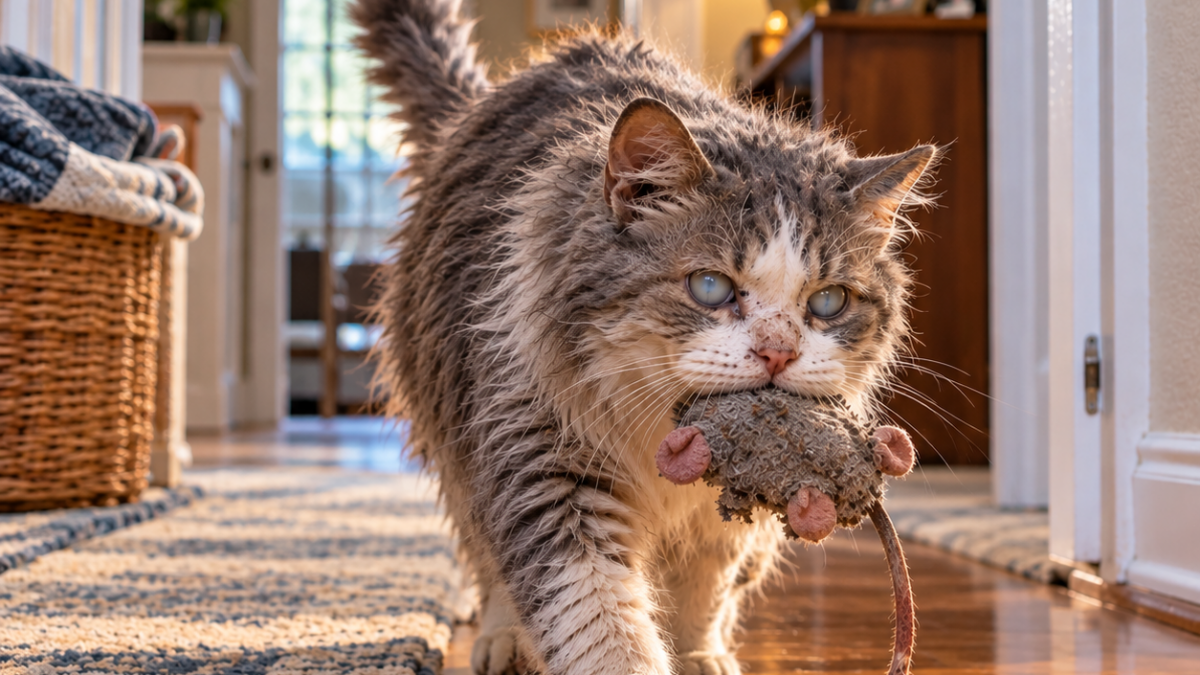
Then he backed out with a stuffed mouse in his mouth.
It was hideous.
Gray once, probably.
Now a color somewhere between dust and bad decisions.
One felt ear remained.
The other was gone.
The tail had been repaired with black thread at least once.
I vaguely remembered Jasper playing with it fifteen years earlier.
Walter stood there holding it.
His eyes looked brighter.
Claire sat down slowly.
“Where did you find that?”
Walter did not answer, shockingly.
Then he walked toward us.
Slow.
Wobbly.
Proud.
The mouse hung from his mouth.
When he reached Claire, he dropped it at her feet.
Looked up.
Waited.
She reached down.
“Is this for me?”
Walter picked it up immediately.
Apparently not.
He carried it to his bed.
That night, he slept with the mouse under his chin.
The next morning, it was beside his food.
By dinner, he had carried it into the hallway.
Three days later, Walter began doing what we called his parade.
He would appear at one end of the hall with the mouse in his mouth, walk six or seven determined steps, stop to rest, then continue until he found one of us.
Sometimes he dropped it at our feet.
Sometimes he simply stood there holding it as if expecting applause.
We always applauded.
Quietly.
He was old.
But dignity had clearly left the house.
By the end of week three, Walter had established a new morning routine.
At six o’clock, a paw touched my hand.
I would open my eyes and find him beside the bed.
A warm gray head pushed beneath my palm.
Then came the mouse.
Placed carefully beside my pillow.
The first time it happened, I stared at it.
Then at him.
Walter slow-blinked.
I’m here.
I’m hungry.
Get up.
Maybe I would like another day.
That was the moment I stopped thinking of him as dying.
Not because he was young again.
He was still fifteen.
Still arthritic.
Still thin.
Still medically fragile.
But there is a difference between an old body and a surrendered spirit.
Walter’s body had not become younger.
His spirit had started standing up.
And once you see that difference, you cannot unsee it.
I began looking differently at the notes on his shelter file.
Won’t stand much.
Low energy.
Hospice.
Maybe those observations were accurate.
But what if the conclusion had been wrong?
What if he had not been refusing to stand because he was dying?
What if he had stopped getting up because nobody he loved was on the other side of the room anymore?
That thought made me angry.
Not at the shelter.
They had seen the cat they were given.
I was angry at whatever had happened before.
The part of Walter’s story that was missing.
The next call from the shelter came on a Thursday morning.
Dana’s voice was careful.
“We need to talk about Walter’s end-of-life plan.”
I looked across the kitchen.
Walter was sitting upright on one of the rugs.
Mouse between his paws.
Claire was rinsing a mug.
Neither of them knew the words being spoken into my ear.
“What about it?”
“We had our veterinarian review his intake notes again. Because he came in as hospice, we need to make sure you’re prepared if there’s a sudden decline.”
“He’s doing better.”
“I know.”
“He’s walking.”
“I know.”
“He’s eating like a convict.”
Dana laughed softly.
“That’s good.”
“He stole chicken yesterday.”
“Very good.”
“He wakes me up at six.”
“Less good for you.”
I smiled despite myself.
Then Dana became serious again.
“Mark, better does not necessarily mean stable.”
I looked at Walter.
He had begun cleaning the remaining ear of the mouse.
“How bad are his kidneys?”
“Mild to moderate changes on the shelter labs. We don’t have enough history to know whether they’re chronic.”
“What does that mean?”
“It means we should repeat the bloodwork.”
I straightened.
“Then why are we talking about end-of-life?”
Dana exhaled.
“Because his surrender paperwork described him as declining rapidly.”
I felt something cold move through me.
“What exactly did it say?”
Silence.
“Dana.”
“I probably should let the veterinarian go over that with you.”
“What did the person who surrendered him say?”
Another pause.
“That Walter had stopped eating regularly. That he barely walked. That he spent most of the day hiding. That their veterinarian believed his quality of life was poor.”
I looked at the cat currently attempting to drag the stuffed mouse beneath our dining table.
“What veterinarian?”
“I don’t have that information in front of me.”
“Did the shelter contact them?”
“I don’t know.”
“Can you find out?”
“Yes.”
I lowered my voice.
“And can we get Walter seen again?”
“Absolutely.”
We took him the next morning.
The shelter veterinarian was Dr. Lena Patel, a woman in her fifties with silver in her black hair and the calmest hands I had ever seen.
She examined Walter slowly.
Heart.
Lungs.
Teeth.
Joints.
Eyes.
Abdomen.
She watched him walk.
Walter performed terribly because he hated clinic floors and hated being observed.
Still, he stood.
Moved.
Complained.
At one point he swatted the stethoscope.
Dr. Patel smiled.
“I appreciate feedback.”
Claire laughed nervously.
Finally, Dr. Patel sat with us.
“He is fragile.”
My stomach tightened.
“But?”
“But he is not actively dying.”
Claire burst into tears.
Immediately.
No buildup.
One second dry-eyed.
The next completely crying.
I laughed once in relief, then felt guilty about laughing while my wife was sobbing.
Dr. Patel handed her tissues.
“People have strange reactions after expecting bad news.”
“I’m sorry,” Claire said.
“Don’t be.”
Walter sat on the examination table glaring at all of us.
Dr. Patel continued.
“He has significant arthritis. He’s dehydrated more easily than I’d like. His kidney values are elevated, but not what I would expect in a cat necessarily days from death.”
“So why wouldn’t he get up at the shelter?” I asked.
“Pain could explain some of it.”
“And the rest?”
She looked at Walter.
“Stress.”
Claire wiped her cheeks.
“Can stress do that much?”
“In senior cats? Absolutely.”
Walter shifted his paws.
Dr. Patel touched his back gently.
“Older animals often stop compensating when their environment changes suddenly. Appetite drops. Activity drops. Existing pain becomes more obvious. Some withdraw.”
She looked at us.
“Sometimes what appears to be catastrophic decline is several smaller problems stacked on top of grief.”
That sentence stayed with me.
Several smaller problems stacked on top of grief.
It sounded like most humans I knew.
Dr. Patel recommended pain management, hydration support, better nutrition, repeat bloodwork, and close monitoring.
No heroic measures.
No pretending he was immortal.
Comfort.
Dignity.
Information.
Before we left, she asked, “What are you hoping for?”
I looked at Walter.
Claire answered first.
“Good days.”
Dr. Patel nodded.
“That’s the right goal.”
At home, Walter immediately found the mouse.
He carried it from the toy basket to his bed and collapsed beside it.
I looked at Claire.
“He went looking for it.”
“I saw.”
“Like he was checking.”
She nodded.
“Checking what?”
“That his life was still here.”
I knew exactly what she meant.
For the next week, Walter improved.
His appetite increased.
His coat looked better.
The pain medication helped enough that his walk became less stiff.
He even did what we called zoomies, although describing Walter’s movements as zooming was generous.
He completed two energetic circles of the living room before dramatically flopping onto his side as though he had finished the Boston Marathon.
Claire clapped.
I checked that he was still breathing.
Walter looked offended by both reactions.
Then the phone rang.
Not the shelter.
Not the veterinary clinic.
A number we did not recognize.
Claire answered.
“Hello?”
A woman’s voice said something I could not hear.
Claire looked at me.
Her face changed.
She put the phone on speaker.
The voice was elderly.
Soft.
Uncertain.
“I’m sorry,” the woman said. “I was given your number by the shelter. They said it was okay to call.”
“Yes,” Claire said cautiously.
“I’m calling about a cat.”
Walter entered the kitchen at that exact moment.
Mouse hanging from his mouth.
The woman took a breath.
“His name might be Walter now.”
I stared at the phone.
“But his name was Milo.”
Walter dropped the mouse.
Not dramatically.
It simply slipped from his mouth.
The room became very still.
The woman continued.
“My name is Evelyn Carter.”
Her voice shook.
“I think you have my cat.”
Claire found my hand.
Her fingers were cold.
Walter stared toward the phone.
Ears forward.
Evelyn continued quickly.
“I’m not calling to take him away. Please understand that. I’m not trying to cause trouble.”
She inhaled.
“I only found out yesterday that he’s alive.”
That sentence made no sense at first.
Alive.
We had never believed Walter was dead.
But Evelyn had.
She explained slowly.
Six months earlier, she had fallen in her kitchen and fractured her hip.
After rehabilitation, her doctors and family decided she could no longer safely live alone.
Her son, Andrew, had handled the move from her house into Maple Ridge Residence.
Clothes.
Furniture.
Bank paperwork.
Utilities.
Her medications.
Milo.
“How long had you had him?” Claire asked.
“Almost sixteen years.”
Evelyn laughed softly.
“He was smaller than my shoe when I found him.”
Walter remained frozen near the doorway.
“He came out of a storm drain behind the grocery store. Screaming like somebody had wronged him personally.”
I looked at Walter.
“That sounds like him.”
Evelyn laughed.
Then the sound broke.
“They told me he went somewhere good.”
Claire looked at me.
“Who told you?”
“My son.”
Evelyn swallowed.
“I kept asking where.”
Walter took one slow step toward the phone.
“He said I shouldn’t worry. He said Milo was being taken care of.”
Another step.
“I thought…”
She stopped.
When she continued, her voice was barely audible.
“I thought he meant Milo had been put down.”
Claire covered her mouth.
I felt anger rise.
“Why would you think that?”
“Because Andrew kept saying Milo was sick.”
Walter reached the kitchen table.
Evelyn continued.
“He told me Milo had stopped eating. That he could barely walk. That he was suffering.”
My eyes met Claire’s.
Those were the exact phrases from the shelter paperwork.
I asked, “Did your veterinarian tell you that?”
There was silence.
“Our veterinarian said he had arthritis.”
My pulse quickened.
“And kidney disease?”
“Mild kidney changes. They wanted to repeat tests every few months.”
“When was his last appointment?”
“About three months before I fell.”
“Was euthanasia discussed?”
“No.”
The word was immediate.
Certain.
“No. Never.”
Walter sat beside the table.
His eyes remained fixed on the phone.
Evelyn’s voice trembled.
“Is he suffering now?”
Claire knelt beside Walter.
“No.”
He looked at her.
“He’s old. He’s stiff. He has some medical problems.”
She stroked his cheek.
“But he’s eating.”
Walter sniffed the phone.
“He’s walking.”
He bumped his head against Claire’s fingers.
“And he has a stuffed mouse he carries everywhere.”
There was a tiny sound through the speaker.
A sob.
“He always did that.”
I looked at Claire.
“What?”
Evelyn was crying now.
“He always carried toys.”
Walter’s ears twitched.
“When he was little, he used to bring socks to my bed.”
She laughed through tears.
“Then mittens. Then this ugly little rabbit he stole from my granddaughter.”
Walter meowed.
A rough sound.
Evelyn stopped breathing for a second.
“Milo?”
Walter looked at the phone.
Then meowed again.
The sound that came from Evelyn was something I will never forget.
Half joy.
Half grief.
A sound made by someone hearing a voice she had already mourned.
“Oh, sweetheart.”
Walter placed one paw on Claire’s knee.
Evelyn cried openly.
“I’m sorry. I’m so sorry.”
Walter could not understand the words.
But he heard the voice.
I know he did.
His entire body had changed.
He was alert.
Listening.
Present.
After several minutes, I asked the question none of us knew how to ask.
“Do you want to see him?”
Silence.
Then Evelyn whispered, “Would it hurt him?”
Not, Can I have him?
Not, When can you bring him?
Would it hurt him?
That mattered.
“We don’t know,” I said.
“I don’t want to confuse him.”
Claire squeezed my hand.
“We’ll ask the vet.”
“Please.”
Evelyn took a shaky breath.
“If it’s bad for him, don’t bring him.”
My anger shifted.
Not disappeared.
Shifted.
Whatever had happened, this woman did not sound like someone who had discarded Walter.
She sounded like someone who had lost control of her own life and been told the losses were necessary.
After we hung up, Claire sat down on the hallway floor.
Walter followed.
Slowly.
Mouse dragging from his mouth.
He stopped in front of her.
Dropped it against her knee.
Claire cried harder.
“There you go,” she whispered.
Walter stared at her.
“You always know exactly when to bring the mouse.”
I leaned against the wall.
“How many endings can one cat survive?”
Claire looked up.
“I don’t know.”
Neither did I.
We called Dr. Patel.
She listened.
Then said, “Cats remember familiar voices and people.”
“What if seeing Evelyn upsets him?”
“It might.”
“What if it helps him?”
“It might.”
“That’s not useful.”
“I know.”
I heard sympathy in her voice.
Then she said, “The question is not who deserves him.”
I went quiet.
“The question is what helps Walter.”
That became our rule.
Not what helped us.
Not what relieved Evelyn’s guilt.
Not what made the shelter look better.
What helped the cat.
We arranged one visit.
Maple Ridge Residence was twenty-five minutes away.
The building had beige siding, flower beds near the entrance, and cheerful paintings in the hallway that looked selected by someone terrified of sadness.
Walter complained the entire drive.
Long, scratchy cries.
Claire kept one hand on the carrier.
“I know.”
Another meow.
“We’re terrible.”
Meow.
“Complain to management.”
Meow.
“That’s Mark.”
“Thanks.”
When we reached Evelyn’s room, Walter went silent.
That frightened me.
Evelyn opened the door.
She was eighty-one.
Small.
White hair cut short.
A lavender sweater.
Hands that shook slightly even while resting.
Her eyes immediately found the carrier.
“Milo?”
Walter’s head lifted.
His ears moved forward.
His body went rigid.
Not fear.
Recognition.
There is no scientific instrument in the world I needed in that moment.
The cat knew her.
Evelyn sat down quickly.
Claire opened the carrier.
Walter looked at us.
Then at Evelyn.
Two steps.
Pause.
Two more.
Pause.
Evelyn covered her mouth.
Walter kept walking.
Slowly.
Stiffly.
Directly to her.
When he reached her feet, he lifted his head.
Evelyn bent down.
Her hands cupped his face.
Walter leaned into them.
Not politely.
Not cautiously.
His whole body pressed forward.
And he purred.
The sound was enormous.
Deep.
Vibrating.
Like an engine starting after years in a garage.
Evelyn folded over him.
“Oh, Milo.”
Her shoulders shook.
“I’m sorry.”
Walter purred harder.
“I didn’t know.”
Claire began crying.
I did not.
Not yet.
I was too busy trying to understand how a cat could belong so completely to a moment that had vanished from his life.
Evelyn stroked his face.
“Your whiskers went white.”
Walter rubbed against her hands.
“So did my hair.”
He climbed onto the couch beside her.
Not gracefully.
Walter had not been graceful since the Clinton administration.
But he climbed.
Evelyn laughed.
That did it.
I cried.
For an hour, we watched them remember each other.
Walter explored the room.
He sniffed the chair.
The blanket.
A pair of slippers.
Then returned to Evelyn.
She told us stories.
How he slept inside the bathroom sink as a kitten.
How he learned to open a cabinet with one paw.
How her late husband used to pretend he hated cats while cutting pieces of roast beef specifically for Milo.
How he sat on the back of her recliner every night.
How he slept against her hip after her husband died.
Then Evelyn said something that changed everything.
“Andrew hated that mouse.”
I looked at her.
“What mouse?”
“The one you said he carries.”
Claire pulled up a photograph on her phone.
Walter asleep with the mangy gray mouse beneath his chin.
Evelyn stared.
“Oh.”
Her face went pale.
“What?”
“That was his.”
“Whose?”
“My husband’s.”
She smiled through tears.
“It came from a joke gift someone gave him years ago. Milo stole it from his desk. Carried it everywhere until it disappeared.”
I stared at the photograph.
The mouse had belonged to Walter before.
Somehow.
Years earlier.
“How did it get to our house?” Claire asked.
Then I remembered.
Jasper.
My old cat.
We had gotten the mouse from my sister after she cleaned out a box of donated pet toys from the church thrift sale almost a decade earlier.
Coincidence.
Impossible, ridiculous coincidence.
Or maybe not the same mouse.
But Evelyn swore it was.
“One ear missing?”
“Yes.”
“Black thread on the tail?”
“Yes.”
She stared at me.
“Robert repaired it.”
My skin prickled.
The world is enormous until suddenly it is not.
Walter had lost his house.
His person.
His name.
Then, in a stranger’s living room, he had found one ragged object his body remembered before any of us did.
No wonder he carried it.
No wonder joy seemed to live inside that filthy little thing.
When it was time to leave, all of us became quiet.
This was the part I feared.
Walter had found Evelyn.
What if taking him home became another abandonment?
I opened the carrier.
Walter looked at it.
Then at Evelyn.
My stomach tightened.
Evelyn stroked his head.
“You go.”
Her voice cracked.
Walter remained still.
“They’re good people.”
Claire began crying again.
Evelyn leaned closer.
“You’re safe.”
Walter looked at her.
Then at us.
Then stepped into the carrier.
On his own.
Evelyn pressed one hand against her mouth.
Walter turned around inside.
He watched her while I closed the door.
She whispered, “I love you, Milo.”
Walter slow-blinked.
I carried him into the hallway.
Claire was crying beside me.
I was holding the carrier as though it contained something made of glass.
In a way, it did.
A heart that had survived being broken in more than one direction.
At home, Walter walked straight to his bed.
Found the mouse.
Curled around it.
Slept for four hours.
We called Evelyn the next day.
Walter was fine.
Tired.
But fine.
She asked the same question she would ask every time after that.
“Was it good for him?”
Never, When can I see him again?
Always, Was it good for him?
That was why we agreed to another visit.
Then another.
Once a week, as long as Walter tolerated it.
He did more than tolerate it.
He began recognizing Maple Ridge.
By the third visit, he stopped complaining in the car five minutes before we arrived.
By the fourth, he stood in his carrier when we entered the hallway.
Evelyn would be waiting.
“Milo.”
His ears lifted.
He always went to her.
He always purred.
And when it was time to leave, he always came home with us.
It became our strange little arrangement.
Not ownership.
Not shared custody.
Love without possession.
Then Dana called.
This time, her voice sounded different.
“Mark, I found something.”
I sat down.
“What?”
“Walter’s original veterinary clinic.”
My heartbeat increased.
“How?”
“His microchip.”
I closed my eyes.
Of course.
The shelter had scanned him at intake, but the chip registration had outdated contact information.
With Evelyn’s full name and old address, Dana had tracked down the clinic listed on an earlier registration.
“They sent records with Evelyn’s permission.”
“And?”
“Dr. Patel reviewed them.”
I waited.
Dana continued.
“There’s no terminal diagnosis.”
I stared at the wall.
“None?”
“He had arthritis. Early chronic kidney disease. Dental disease. Some weight loss.”
“But no recommendation for hospice?”
“No.”
“Euthanasia?”
“No.”
My hand tightened around the phone.
“What did Andrew put on the surrender form?”
Another pause.
“He checked the box saying a veterinarian had advised the family that Walter was near end of life.”
Heat rose through my chest.
“He lied.”
“It appears he gave information inconsistent with the medical record.”
“Why?”
“We don’t know.”
I did.
Or at least I thought I did.
Convenience.
The ugliest motive because it is so ordinary.
Dana continued.
“There’s more.”
I closed my eyes.
“Of course there is.”
“When the clinic heard Evelyn had been told Milo was probably dead, their office manager checked old voicemail notes.”
I stood.
“What voicemail?”
“Andrew called them two weeks after Evelyn’s fall.”
I felt cold.
“He asked about euthanasia.”
Claire had entered the room.
I motioned for her to sit.
“What did the vet say?”
“The clinic told him they would need to examine Milo first.”
“And?”
“He never brought him.”
I looked toward Walter.
He was asleep on the rug.
Mouse tucked beneath one paw.
Dana’s voice lowered.
“According to the note, Andrew said transporting an elderly cat was becoming ‘too much trouble.’”
Too much trouble.
I heard the shelter intake phrase again.
Won’t stand.
Low energy.
Hospice.
Cold words.
Someone had turned inconvenience into a diagnosis.
“Does Evelyn know?”
“Not yet.”
“Don’t call her.”
Dana went quiet.
“What?”
“Let us tell her.”
I regretted volunteering the second I said it.
But the idea of Evelyn receiving that news from a stranger over the phone felt cruel.
Claire agreed.
So did Dr. Patel.
We visited Maple Ridge the following day without Walter.
Evelyn knew immediately something was wrong.
“Where’s Milo?”
“He’s fine.”
Her shoulders relaxed.
“Then what is it?”
We sat.
I placed copies of the veterinary records on the table.
“I’m going to tell you something difficult.”
Evelyn looked at Claire.
Then me.
“Andrew told the shelter Milo was dying.”
She nodded slowly.
“He told me that too.”
“He wasn’t.”
Her face changed.
I continued carefully.
“He was old. He had medical problems.”
I pointed to the records.
“But your veterinarian never said he was terminal.”
Evelyn stared at the paper.
Her hands began to shake.
I told her about the voicemail.
About Andrew asking whether the clinic would euthanize Milo.
About the clinic requiring an examination.
About him never returning.
She sat completely still.
Then she whispered, “He wanted him dead.”
Claire reached toward her.
Evelyn raised one hand.
“No.”
Claire stopped.
Evelyn looked at me.
“He wanted him dead.”
I answered honestly.
“I don’t know what he wanted.”
“I do.”
Her voice became stronger.
“I know my son.”
She stood.
Walked to the window.
For a long time, she looked outside.
Then she said, “He wanted the house emptied.”
I felt something shift.
“What?”
“My house.”
She turned.
“He kept pushing me to sell immediately.”
Claire and I exchanged a glance.
Evelyn continued.
“He said repairs were costing money. Taxes. Insurance.”
She wiped her cheek.
“He said Maple Ridge was expensive and I needed to be practical.”
That word.
Practical.
I had started to hate it.
“Milo scratched one of the doors,” Evelyn said. “Andrew always complained about him.”
Her mouth tightened.
“He said buyers wouldn’t want cat smell.”
Claire whispered, “Evelyn…”
“He didn’t move Milo because I couldn’t care for him.”
Her voice cracked.
“He moved Milo because Milo was inconvenient.”
I did not know what to say.
Neither did Claire.
The next thing Evelyn said changed the story again.
“I never gave Andrew permission to surrender him.”
My skin went cold.
“He had power of attorney,” I said carefully.
“For my finances.”
She turned.
“Not for giving away my cat.”
That became the beginning of the investigation.
Not police sirens.
Not detectives bursting through doors.
Paper.
Records.
Signatures.
Dates.
The adult-services advocate at Maple Ridge helped Evelyn review her power-of-attorney documents.
Andrew had financial authority while she recovered.
He could pay bills.
Manage the house.
Arrange services.
But the wording around personal property was limited.
And whether a living companion animal counted as disposable household property was not nearly as simple as Andrew had assumed.
More concerning was something else.
Evelyn discovered several checks from her account she did not recognize.
A contractor.
A moving company.
Storage fees.
Then one payment labeled “property cleanup” that was much larger than expected.
The advocate referred the matter to an attorney who specialized in elder law.
I stayed out of that part as much as possible.
It was not our money.
Not our family.
Not our battle.
But Evelyn told us pieces.
Andrew had sold several items without discussing them with her.
Furniture her husband built.
A collection of antique tools.
Jewelry she believed had been placed in storage.
Some transactions might have been legitimate attempts to handle an overwhelming move.
Others raised questions.
The cat became one piece of a much larger pattern.
Decisions made for Evelyn.
Then explained afterward.
Her life had been reduced under the banner of practicality.
One afternoon Andrew came to Maple Ridge while we were visiting.
Walter was there.
The timing was accidental.
The confrontation was not.
We heard a man speaking loudly at the nurses’ station.
Then Evelyn stiffened.
“My son.”
Walter’s ears turned toward the hallway.
Andrew appeared at the doorway.
Late forties.
Tall.
Expensive jacket.
A face red with anger.
He stopped when he saw us.
Then the cat.
“What is he doing here?”
Walter shrank slightly.
Claire’s hand went to his back.
Evelyn stood.
“Milo is visiting me.”
Andrew stared.
“You called these people?”
“Yes.”
“I told you I handled this.”
“You lied.”
His eyes moved toward us.
“This is family business.”
I stood.
“Then we can leave.”
Evelyn said, “No.”
Her voice was quiet.
But absolute.
Andrew looked at her.
“Mom.”
“No.”
The room went still.
For months, Evelyn had spoken softly about him.
Made excuses.
Said he had been stressed.
Said moving a parent was difficult.
Said maybe he panicked.
That day something had changed.
She pointed to the chair.
“Sit down.”
Andrew laughed once.
Not because anything was funny.
Because he was not used to being ordered.
“I’m not doing this in front of strangers.”
“They know more truth about my cat than you gave me.”
His jaw tightened.
“I did what had to be done.”
Walter lowered himself beside Claire.
Evelyn stared at her son.
“You told me he was dying.”
“He was barely moving.”
“He had arthritis.”
“He was miserable.”
“He was grieving.”
“You don’t know that.”
“I know him.”
Andrew looked toward Walter.
“He looks half-dead now.”
Claire stood.
I saw anger move through her entire body.
But Evelyn spoke first.
“He is fifteen.”
Andrew shrugged.
“Exactly.”
That single word said everything.
Exactly.
As if age made the rest inevitable.
As if fifteen meant disposable.
Evelyn’s voice shook.
“My doctor says I’m fragile too.”
Andrew’s expression changed.
“That’s different.”
“Why?”
“Mom—”
“Why?”
He stared at her.
She stepped closer.
“I move slowly.”
“This is ridiculous.”
“I need medicine.”
“Stop.”
“I cost money.”
“Mom.”
“I forget things.”
His face went pale.
“I said stop.”
Evelyn pointed toward Walter.
“So did he.”
No one moved.
Even Walter watched.
Evelyn continued.
“You decided his age meant his life was over because he made your work harder.”
Andrew’s face hardened.
“You have no idea what I dealt with.”
“I know you lied.”
“I was moving an entire house while you were in rehabilitation.”
“I know.”
“I was paying your bills.”
“With my money.”
“I was trying to keep things together.”
“And you lied.”
He turned toward me.
“You people have heard one side.”
I said nothing.
He pointed at Walter.
“That cat was urinating outside the litter box.”
Evelyn shook her head.
“Once. After I fell.”
“He was scratching doors.”
“He always scratched doors.”
“He had stopped eating.”
“For two days after I disappeared.”
Andrew looked away.
There it was.
Not a dying cat.
A confused old animal whose person vanished.
Evelyn stepped closer.
“You thought killing him would be easier.”
“I never killed him.”
“No.”
Her voice trembled.
“Someone else saved you from becoming the person who did.”
Andrew stared at her.
The cruelty in his face collapsed for one second.
Not remorse.
Something closer to shame.
Then he looked at Walter again.
“He was supposed to be euthanized.”
My stomach turned.
Claire whispered, “What?”
Andrew realized what he had said.
Too late.
Evelyn went perfectly still.
“What did you say?”
He closed his eyes.
“Mom.”
“You thought they would put him down?”
“I thought hospice meant—”
“You knew.”
“I thought it would be humane.”
Evelyn’s face crumpled.
“You never even asked me.”
“I was trying to protect you.”
“No.”
She shook her head.
“You were trying to protect yourself from hearing me say no.”
Andrew stepped forward.
Evelyn raised her hand.
“Leave.”
“Mom.”
“Leave.”
“You’re letting strangers turn you against your family.”
She looked at him for a long moment.
Then said, “Family does not mean you get to make me disappear while I am still alive.”
Andrew’s face changed.
He looked older.
Smaller.
For a second, I saw not a villain but a frightened middle-aged man who had become overwhelmed and then used control to hide it.
But understanding someone’s weakness does not erase the harm they cause.
He left.
The room stayed silent long after his footsteps disappeared.
Walter stood.
Slowly.
Carried his mouse to Evelyn.
Dropped it at her feet.
She bent over and cried.
Not because a cat understood elder law or betrayal.
Because he understood sadness.
And he gave her the best thing he owned.
Word about the case reached the shelter community eventually.
Not because we posted it.
We did not.
But Andrew had accused the shelter of mishandling Walter’s surrender after Evelyn challenged him.
He demanded copies of records.
Threatened legal action.
Claimed staff had “interfered with private family matters.”
That forced the shelter to review everything formally.
During a board meeting, Dana presented the timeline.
The surrender form.
Andrew’s claim that a veterinarian had advised end-of-life care.
The actual veterinary records.
The voicemail note.
Walter’s repeat exam.
Evelyn’s statement that she had never requested euthanasia or surrender.
The board changed policy immediately.
No senior animal would be labeled hospice based solely on a surrendering party’s description when veterinary records could reasonably be obtained.
Whenever an animal belonged to an elderly or incapacitated person and a third party surrendered them, staff would make reasonable efforts to verify authority and the owner’s wishes.
That mattered to me more than punishment.
Because justice is not only what happens to the person who caused harm.
Sometimes justice is making it harder for the same harm to happen to someone else.
Andrew faced consequences too.
Evelyn revoked his financial authority.
Her attorney arranged a neutral fiduciary to help manage certain accounts while the disputed transactions were reviewed.
Some belongings were recovered.
Some money was returned.
Not everything.
Real life rarely gives everything back.
Evelyn and Andrew stopped speaking for several weeks.
Then he began attending family counseling with her.
I know some people would prefer a cleaner ending.
A cruel son exposed.
Mother cuts him off forever.
Everyone applauds.
But Evelyn did not want that.
“He’s my boy,” she told me once.
Then she looked at Walter.
“So was Milo.”
Two truths.
Both painful.
She did not excuse Andrew.
She did not hand him control again.
She did not pretend the betrayal had not happened.
But eventually she allowed him to visit.
With boundaries.
With an advocate.
With no authority he had not earned.
Accountability did not require pretending love had never existed.
Walter taught us that too.
Then, one November night, he crashed.
No warning.
At six in the morning, he did not touch my hand.
No mouse.
No scratchy complaint.
Nothing.
I opened my eyes and felt the silence before I understood it.
“Claire.”
She sat up immediately.
Walter was not in his bed.
We found him on the living room rug.
His body was heavy.
Eyes half open.
Breathing shallow.
The mouse lay near his front paws.
Claire dropped to her knees.
“Walter?”
Nothing.
“Milo?”
One ear twitched.
That scared me even more.
Claire looked at me.
This is it.
Neither of us said it.
We wrapped him in a blanket and drove to the emergency clinic.
I called Evelyn from the car.
She answered on the second ring.
“Mark?”
“He’s sick.”
Silence.
“Very?”
“Yes.”
Her voice broke.
“Can I come?”
“Of course.”
At the emergency clinic, they took Walter immediately.
Fluids.
Bloodwork.
Temperature support.
Pain medication.
The veterinarian explained that senior cats with kidney disease can decompensate quickly.
It might be reversible.
It might not.
We sat in plastic chairs with bad coffee between us.
Evelyn arrived with a Maple Ridge aide.
She was wearing slippers inside winter boots.
She had dressed too fast.
Claire hugged her.
For three hours, we waited.
No one talked much.
At some point Andrew arrived.
I did not know Evelyn had called him.
He stood near the entrance, looking unsure whether he was allowed closer.
Evelyn saw him.
Their eyes met.
For several seconds, nobody moved.
Then she pointed to the empty chair across from her.
Andrew sat.
That was all.
No reconciliation.
No speech.
Just one chair.
One chance to be present without controlling what happened next.
Around four in the morning, the veterinarian came out.
He looked tired.
I stood.
“So?”
“He’s up.”
Two words.
Claire burst into tears.
Evelyn covered her face.
Andrew bowed his head.
I laughed.
Could not help it.
“He looks awful,” the vet warned.
“I don’t care.”
“He’s not out of danger.”
“I know.”
“But he responded to fluids.”
“Can we see him?”
We went back two at a time.
Claire and I first.
Walter lay in a warm kennel.
He looked terrible.
Fur messy.
Eyes dull.
IV catheter taped to one leg.
But when he saw us, he lifted his head.
And gave one scratchy meow.
Claire laughed through tears.
“Yeah, boss. We know. This place is terrible.”
He blinked.
Then lowered his head.
Evelyn went in next.
I stood outside the doorway.
She leaned over him.
“Milo.”
Walter’s eyes opened.
She stroked his forehead.
“Don’t stay for me.”
My throat tightened.
Evelyn’s hand trembled.
“You hear me?”
Walter watched her.
“If you’re tired, you can go.”
Andrew stood behind me.
Very still.
Evelyn whispered, “You already gave me sixteen years.”
Walter’s paw moved.
Barely.
Touched her finger.
She cried.
“But if you’re not done…”
A weak purr started.
“You fight.”
The next afternoon, Walter came home.
I carried him inside.
Set the carrier on the rug.
Opened the door.
Walter stepped out.
Two steps.
Pause.
Two more.
Pause.
He walked directly to the toy basket.
Claire covered her mouth.
He stuck his head inside.
Rummaged.
Pulled out the mouse.
And carried it to his bed.
Like putting on a crown after battle.
That was the day we stopped calling him our foster.
I called Dana.
“We want to adopt Walter.”
Silence.
Then she laughed softly.
“I was hoping you would.”
There was paperwork.
Of course.
But this time the word on the form was not HOSPICE.
It was ADOPTION.
I signed first.
Claire signed beneath me.
When we told Evelyn, she smiled.
“You should.”
I felt guilty.
“You’re sure?”
She looked at me like I was asking a stupid question.
“Where would he go if I died?”
I could not answer.
She continued.
“I can love him without making him move again.”
Then she reached down and touched Walter’s head.
“You have two homes now, old man.”
Walter purred.
“And one of them has better chicken.”
Claire smiled.
“That would be ours.”
“I know. I’ve seen his weight.”
The weeks became months.
Walter remained fifteen until his next birthday, when Evelyn insisted we celebrate.
We brought a small cat-safe treat to Maple Ridge.
Claire found a paper hat that Walter despised.
Evelyn laughed so hard she nearly dropped her tea.
Andrew attended.
Quietly.
He brought nothing.
That mattered to me.
No expensive gift.
No performance.
He simply came.
Walter did not approach him at first.
Andrew did not force it.
He sat across the room.
After twenty minutes, Walter walked near him.
Andrew held out one hand.
Walter sniffed.
Then walked away.
Andrew’s eyes filled.
Evelyn watched.
“Don’t rush him.”
“I know.”
“You didn’t before.”
Andrew swallowed.
“No.”
“Do better now.”
He nodded.
“I’m trying.”
Walter eventually allowed one scratch beneath the chin.
Three seconds.
Then he bit Andrew’s finger.
Not hard.
Claire nearly choked trying not to laugh.
Evelyn did not bother hiding hers.
“Good,” she said.
“Mom.”
“You earned that.”
Even Andrew laughed.
Healing is strange that way.
Sometimes the first sign of it is a room where people can finally tell the truth and still laugh.
Walter developed rituals.
Six a.m. wake-up.
Mouse delivery.
Breakfast.
Medication hidden in food.
Window inspection.
Nap.
Maple Ridge visits once a week.
More naps.
Chicken theft whenever possible.
Evening parade.
He never became young.
That was not the miracle.
His hips remained stiff.
His kidneys remained compromised.
His eyes grew cloudier.
Some mornings were harder than others.
We learned to distinguish bad days from last days.
That is a terrible skill.
A necessary one.
Dr. Patel taught us to track what she called Walter’s joys.
Food.
Mouse.
Sun.
Touch.
Evelyn.
Following us.
Window watching.
If most disappeared, we would know.
Not from one bad morning.
From a pattern.
Because love can keep an old animal alive longer.
But love can also become selfish if it refuses to recognize when the animal has finished.
We promised Walter we would not do that.
We also promised he would never be alone again.
Months later, the shelter asked us to speak at a small volunteer training.
I almost refused.
I hate public speaking.
Claire hates it more.
Dana said, “Just tell Walter’s story.”
So we did.
No dramatic slides.
No heroic language.
We told them about bringing home a cat we expected to bury.
About sleep.
Chicken theft.
The mouse.
Evelyn.
The records.
The false hospice label.
Then Dana showed the new surrender-verification policy.
Afterward, a woman in the audience raised her hand.
“My mother is entering assisted living next month,” she said.
Her voice shook.
“She has two cats.”
Everyone became quiet.
“I was planning to surrender them this weekend without telling her until afterward because I thought it would be easier.”
She looked down.
“Now I think maybe easier isn’t the same as kinder.”
I swallowed.
“No,” I said. “It usually isn’t.”
She nodded.
“What should I do?”
“Talk to her.”
Claire added, “And talk to the facility.”
The woman wiped her cheek.
“They allow one cat.”
“Then maybe start there.”
She nodded.
A month later, Dana told us one cat had moved with the woman’s mother.
The other went to the woman’s sister.
No shelter.
No surprise.
No old cat waking in a cage without understanding why.
One story changed two lives.
Maybe three.
That is enough.
Walter lived with us for fourteen months.
Longer than anyone expected.
Not forever.
Nothing gets forever.
His final decline came gently.
That was the gift.
He stopped stealing chicken first.
Then he stopped doing the evening parade.
The mouse stayed beside his bed.
He still purred for Evelyn.
Still ate.
Still looked out the window.
But each week another little joy dimmed.
Dr. Patel increased his pain medication.
Then one morning, he did not get up for breakfast.
Claire carried the plate to him.
He smelled it.
Turned his head away.
My chest tightened.
He slept through the afternoon.
That evening, I placed the mouse beside him.
Walter opened one eye.
Touched it with his paw.
But did not pick it up.
I knew.
So did Claire.
We called Evelyn.
She came the next morning.
Andrew drove her.
Walter was lying in our living room on his orthopedic bed.
Sunlight stretched across the rug.
Evelyn sat on the floor beside him.
Her knees could barely manage it.
Andrew tried to help.
She waved him off.
“I can do this.”
He let her.
That mattered.
She touched Walter’s face.
“Milo.”
His eyes opened.
A weak purr.
Barely there.
Still there.
Evelyn cried.
“You found me again.”
Walter blinked slowly.
“I thought I lost you.”
Claire sat on the other side of him.
I held the mouse.
Andrew stood near the doorway, tears running down his face.
He said, “I’m sorry.”
Evelyn looked up.
Andrew was not looking at her.
He was looking at Walter.
“I’m sorry, buddy.”
Walter did not respond.
Andrew continued.
“I was selfish.”
His voice cracked.
“I told myself I was being practical.”
He wiped his face.
“I was just trying to get everything over with because I was scared.”
No one interrupted.
“I should have taken you to the vet.”
He looked at his mother.
“I should have asked you.”
Evelyn nodded once.
Andrew knelt.
Did not touch Walter.
“I’m sorry.”
There was no cinematic forgiveness.
No paw reaching out at exactly the right moment.
Walter simply rested.
But Andrew stayed.
That was enough.
Dr. Patel came to our house that afternoon.
Walter hated clinics.
We refused to make his last hour happen in one.
She sat on the rug.
Examined him gently.
Then looked at us.
“It’s time.”
Claire broke.
Even knowing.
Even preparing.
Even promising.
She broke.
I put my arm around her.
Evelyn whispered, “Yes.”
Walter lay on the bed with the mouse beneath his chin.
Four people surrounded him.
Me.
Claire.
Evelyn.
Andrew.
More complicated than any family photograph.
More honest too.
I placed one hand on his back.
Claire touched his paw.
Evelyn stroked his face.
Andrew rested his hand on the rug.
Close.
Not touching.
Permission still mattered.
Dr. Patel gave him the first medication.
Walter relaxed.
His breathing became slow.
The purr faded.
Evelyn bent close.
“You were such a good boy.”
Claire cried silently.
I could barely see.
Walter’s eyes opened once.
Looked toward Evelyn.
Then toward me.
Maybe that is something I tell myself.
I don’t care.
He was surrounded.
That is what mattered.
No shelter cage.
No cold floor.
No strangers.
No false label.
No one rushing him.
No one deciding his old age made him inconvenient.
Dr. Patel gave the final medication.
One breath.
Then another.
Then none.
The room became impossibly quiet.
For a long time, nobody moved.
Finally, Evelyn reached for the mouse.
She held it.
Looked at me.
“Should this go with him?”
I thought about the hallway parades.
The six a.m. offerings.
The way he searched for it after every frightening trip.
Then I shook my head.
“No.”
Evelyn looked surprised.
I took the mouse gently.
“He spent his whole last year carrying this for us.”
My voice broke.
“I think we carry it now.”
Claire sobbed.
Evelyn nodded.
We had Walter cremated.
Some of his ashes came home with us.
Some went to Evelyn.
The mouse sits beside his photograph on our bookshelf.
Still ugly.
Still missing one ear.
Still repaired with black thread.
I will never wash it.
Months later, Maple Ridge created a small pet visitation room.
Evelyn helped raise money for it.
Claire helped choose washable rugs.
Dana connected the residence with local foster volunteers.
Residents could now receive visits from animals if they had left pets with family or if they simply missed having one nearby.
Andrew volunteered to drive.
Quietly.
No announcement.
No redemption campaign.
Just Saturdays.
Cats.
Dogs.
Carriers.
Old people waiting near doors.
Once, I asked him why.
We were unloading supplies.
He looked at the ground.
“Because I can’t undo what I did.”
I waited.
“But I can become the kind of person who wouldn’t do it again.”
I had heard versions of that sentence before.
It never stopped mattering.
We do not forgive people because they become useful.
We do not erase damage because someone finally feels ashamed.
But change should count for something.
Otherwise accountability becomes nothing more than revenge wearing respectable clothes.
Evelyn never gave Andrew control over her finances again.
Their relationship remained complicated.
Some weeks good.
Some weeks difficult.
But he kept visiting.
He stopped making decisions without asking.
And if he forgot, Evelyn reminded him.
Loudly.
She was not nearly as fragile as everyone had once assumed.
As for us, the house became quiet again after Walter died.
Too quiet.
The orthopedic bed remained in the living room for three weeks because neither of us could move it.
At six every morning, I woke automatically.
For several days, I reached toward the edge of the bed expecting a paw.
Nothing.
No warm head.
No mouse.
Grief is full of phantom routines.
Claire cried the first time she dropped chicken on the kitchen floor and no gray blur appeared to steal it.
I cried the first time sunlight hit the rug where Walter used to sleep.
We had known this would happen.
That did not make it hurt less.
People ask why anyone would adopt a fifteen-year-old hospice cat.
Why choose grief?
Why take home something already near the end?
I understand the question.
We spend so much of our lives trying to protect ourselves from loss.
We buy things because they last.
Build plans around stability.
Avoid attachments with expiration dates we can see.
But Walter taught me something I wish I had understood younger.
All love has an expiration date.
We simply do not know most of them.
A kitten is not a guarantee.
A marriage is not a guarantee.
A parent.
A child.
A friend.
A Tuesday morning.
Nothing comes with a contract promising enough time.
Walter’s gift was that he never let us pretend otherwise.
Every morning mattered because we knew there might not be many.
Every stolen piece of chicken became funny.
Every slow trip down the hallway became an event.
Every ridiculous mouse delivery became a ceremony.
Every visit with Evelyn became precious because the past had already stolen too much from both of them.
We thought we were bringing Walter home to die somewhere soft.
That was true.
Eventually.
But first he lived.
Really lived.
He ate.
Stole.
Complained.
Loved.
Remembered.
Forgave in whatever way cats forgive.
Trusted again.
He got his old person back.
He got new people too.
He exposed a lie no one would have discovered if he had simply died quietly under a hospice label.
He changed shelter policy.
He changed an assisted-living residence.
He changed Andrew.
He changed us.
And every so often, when someone asks whether fostering Walter was worth the heartbreak, I look at that mangy mouse on the shelf.
I remember the first week.
The old cat who barely opened his eyes.
The body that seemed too tired to stand.
Then I remember week three.
Walter coming around the corner.
Mouse in his mouth.
Tail slightly raised.
Wobbling toward us like a king returning from battle.
Look what I found.
Look what I still have.
Look what I can still carry.
And I know the answer.
We did not rescue Walter from death.
Nobody rescues anyone from that forever.
We rescued him from believing death was the only thing left.
There is a difference.
A huge one.
He did not need us to make him young.
He needed pain medication.
A warm bed.
Food.
A voice.
Someone answering when he looked up.
Someone who would not decide his life was over simply because caring for him had become inconvenient.
That is what old animals ask from us.
Not miracles.
Presence.
Patience.
Dignity.
They do not need to perform youth to earn love.
They do not need to be easy.
They do not need to promise us ten more years.
Sometimes they only need someone willing to say:
You are here today.
So today counts.
Walter was here for fourteen months.
Evelyn got fourteen months she had believed were already gone.
We got fourteen months we had never expected.
Andrew got fourteen months to learn what the word responsibility actually meant.
And Walter got fourteen months in which no one called him “too much trouble” again.
The paperwork once said HOSPICE FOSTER.
Now his framed adoption certificate hangs beside his photograph.
His name says Walter.
Underneath it, Claire added one word in pen.
Milo.
Both names.
Both lives.
Both homes.
Because love does not always erase what came before.
Sometimes the kindest thing it can do is make enough room for all of it.
And if you had seen Walter in that final year, dragging that ridiculous mouse through our hallway with all the pride his old body could carry, you would understand why I will never again hear the words “he’s too old” and mistake them for “he has nothing left.”
Old is not empty.
Fragile is not finished.
Slow is not gone.
And a creature lying still in a cage may not always be waiting for death.
Sometimes he is waiting for one reason to stand up again.
Walter found his.
Then, for as long as his old legs allowed, he carried it from room to room in his mouth.


