Thirty-One Cats Died in That House—But One Starving Cat Kept a Kitten Alive With Her Own Body.
PART3:
Meanwhile, an animal sits behind a closed door waiting.
“I’ll come.”
“You don’t have to.”
“I know.”
I hung up and called my supervisor.
Twenty-five minutes later, I was driving south with a cooler of saline, IV supplies, syringes, towels, gloves, emergency nutrition, and three empty carriers in the back of my SUV.
I remember thinking three carriers might be enough.
That thought still bothers me.
The property was at the end of a narrow county road bordered by soybeans and cornfields.
The house itself had probably once been charming.
Small white farmhouse.
Sagging porch.
Green shutters faded nearly gray.
A large maple tree leaned over the roof.
But every window had been covered.
Some with plywood.
Some with cardboard.
One with what looked like the back of an old cabinet door.
The grass had grown nearly to my knees.
Trash bags and broken furniture lined one side of the property.
Two animal control trucks were parked near the road.
A sheriff’s cruiser blocked the driveway.
Denise stood near the rear of the house wearing coveralls, gloves, a respirator, and an expression I had never seen on her before.
I got out.
She walked toward me.
“Put a mask on before you come closer.”
“I can smell it from here.”
She nodded.
“We haven’t opened the door yet.”
I stared at her.
The odor was already powerful enough to turn my stomach.
“That’s through the walls?”
“Yeah.”
A younger officer named Mason approached.
He looked pale.
“Back door is screwed shut from the inside somehow.”
“Windows?”
“Boarded.”
Denise looked at the sheriff’s deputy.
“We’re going in.”
The deputy used a pry bar.
The first board cracked.
Then another.
When the door finally broke inward, the smell hit us like physical pressure.
I stepped backward.
Mason gagged through his respirator.
The deputy turned away.
Denise didn’t move.
Later, she told me she’d wanted to.
The air pouring out of that house was hot enough to feel like someone had opened an oven.
A handheld thermometer registered 113 degrees near the doorway.
Deeper inside, it would climb higher.
There was no power.
No running water.
No air movement.
Flies clouded the doorway.
The floor was barely visible beneath newspapers, clothing, food packaging, plastic containers, broken household items, and animal waste.
Denise looked at me.
“You stay by the doorway until we know the floor is safe.”
I nodded.
She and Mason went in.
The deputy followed.
I waited.
Thirty seconds.
A minute.
Then two.
The house seemed to swallow them.
I heard nothing but the distant hum of insects and my own breathing inside the mask.
Then Mason appeared.
He wasn’t carrying anything.
He stepped into the yard.
Pulled down his respirator.
Bent over.
And vomited.
I ran toward him.
He raised one hand.
“I’m okay.”
“What did you find?”
He stared at the ground.
“Two in the kitchen.”
I understood.
Dead.
Denise appeared behind him.
“Rachel.”
Her voice had changed again.
“Yeah?”
“We’re going room by room.”
I looked at her face.
“How many?”
“So far?”
She swallowed.
“Seven.”
We had been there less than ten minutes.
The first living cat never came.
Neither did the second.
Or the fifth.
By the time officers cleared the front room, kitchen, and first bedroom, the count was seventeen.
Some bodies were near windows.
Some were beneath furniture.
One was inside a cabinet.
Several had apparently tried to reach sinks or toilets.
A black cat was found curled beside an empty water bowl.
Another had died beneath a window where a thin line of light entered around a board.
The scene told its own history.
At first, the cats had searched.
Then they’d weakened.
Then they’d stopped.
I helped move bodies.
People imagine that veterinary workers become numb.
We don’t.
We become functional.
There is a difference.
You learn to do what needs doing while your emotions wait somewhere behind you.
Later, they catch up.
By eleven that morning, twenty-eight cats had been found.
All dead.
I had used none of the emergency medical supplies I’d brought.
Not one syringe.
Not one bag of fluid.
Only body bags.
The sunlight outside felt obscene.
Bright blue Indiana sky.
Cicadas humming.
Corn moving in a faint breeze.
Normal life happening fifty feet from a house where animals had died one by one.
Denise emerged from the hallway.
She pulled her respirator away.
“There’s a bathroom door at the back.”
“Locked?”
“Stuck.”
“Any movement?”
“No.”
Her eyes shifted toward the yard where the body bags had been laid in rows.
She didn’t finish the thought.
Nobody expected anything alive.
We were at thirty-one by then.
One had been found in the hallway outside the bathroom.
Adult female tabby.
Thin.
Decomposed enough that exact timing would require examination.
Her body lay beside the closed door.
Mason tried the handle.
Nothing.
The bottom of the door was wedged against debris.
The deputy shouldered it once.
Twice.
On the third attempt, something shifted.
The door opened six inches.
Then stopped.
The smell intensified.
Mason shoved again.
A pile of towels and boxes slid across the floor.
The gap widened.
Denise shone a flashlight inside.
Then she froze.
I watched her face.
“What?”
She lifted one hand.
Everybody stopped.
She tilted her head.
“I heard something.”
Mason looked at her.
“What?”
“I don’t know.”
We waited.
Nothing.
Then Denise whispered:
“There.”
I still couldn’t hear it.
But she did.
A tiny sound.
Barely there.
She stepped into the bathroom.
Then turned so quickly she struck the doorframe with her shoulder.
“Rachel!”
I ran.
Inside the bathroom, the heat was suffocating.
There was a sink full of trash.
Empty bottles.
Mold-darkened towels.
A toilet with no water.
And a bathtub.
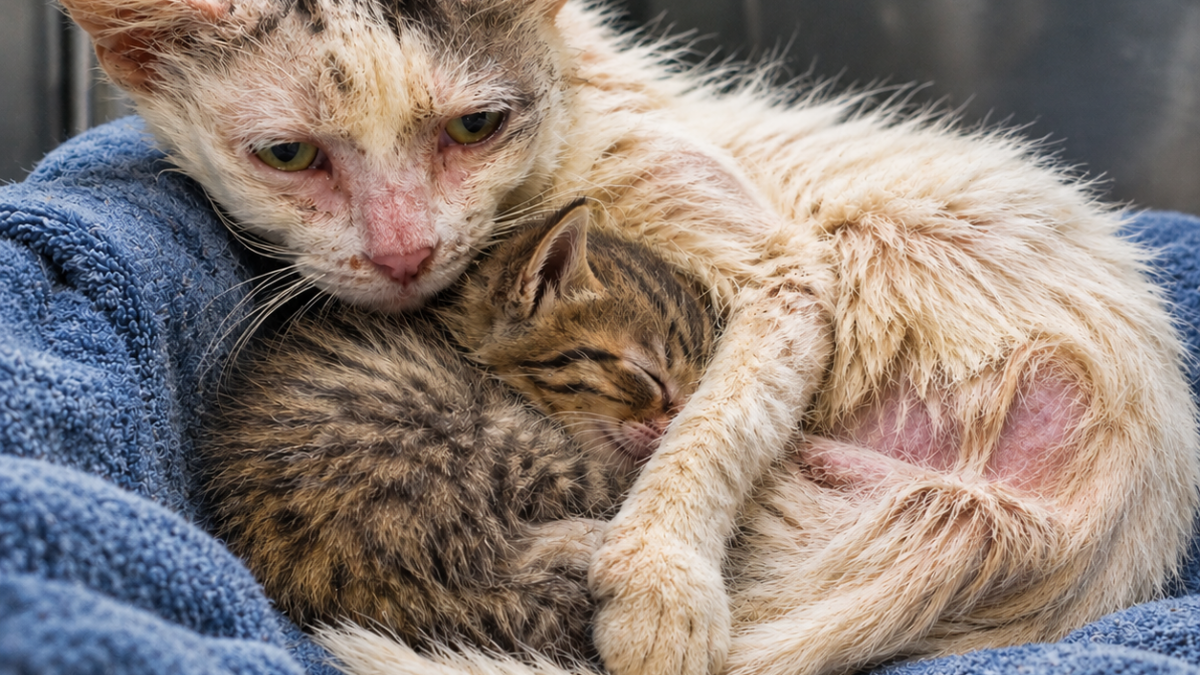
At first, I saw a white shape curled at one end.
I thought it was another dead cat.
Then one blue-gray eye opened.
I stopped breathing.
“She’s alive.”
Denise whispered it like saying it louder might kill her.
The cat was lying on her side.
Small.
White with gray patches over her head and back.
Her body was so thin I could see the shape of her spine through her fur.
Her hips looked enormous because everything around them had disappeared.
She didn’t try to run.
Didn’t lift her head.
Didn’t hiss.
She barely blinked.
Then something moved beneath her belly.
A tiny striped face.
I dropped to my knees.
“Oh my God.”
The kitten shifted.
A tabby.
Maybe four weeks.
She was tucked underneath the adult cat’s front leg, pressed against her abdomen.
The white cat tightened her body around her.
Not much.
She didn’t have the strength.
But enough for me to understand.
Protecting.
I reached toward them.
The white cat opened her mouth.
A sound came out.
Weak.
Dry.
Not really a growl.
Not really a cry.
More like an exhausted warning.
Don’t.
I stopped.
“It’s okay.”
Her eyes stayed on my hand.
“It’s okay, sweetheart.”
The kitten moved again.
She was alive.
More than alive.
Responsive.
Thin, yes.
But compared with the adult cat, remarkably stable.
That made no sense.
Not yet.
Denise crouched beside me.
“Can we move them?”
“Not separately.”
I touched the white cat’s gums.
Pale.
Tacky.
Almost dry.
Her breathing was irregular.
Heart rate too fast.
Extremely dehydrated.
I pressed gently over her abdomen.
Nothing but bone and muscle wasting.
I could barely believe she was conscious.
“Get me a towel.”
Mason handed one over.
I slid it beneath her as carefully as possible.
She cried when the fabric touched her hips.
I looked closer.
Pressure sores.
Open skin where bone had pressed against porcelain.
The kitten squeaked.
Immediately, the adult cat turned her head toward her.
That tiny movement cost her effort.
Her nose touched the kitten’s head.
Then she relaxed.
Something inside me broke.
“She’s been keeping this baby alive.”
Denise looked at the kitten.
“Her baby?”
I studied their markings.
Possible.
But something felt off.
We didn’t know yet.
“Maybe.”
I wrapped both together.
When I lifted the towel, the adult cat weighed almost nothing.
But she still curved her body around the kitten.
I carried them outside.
Everyone stopped.
The deputy removed his hat.
Mason stared.
Denise followed behind me.
Thirty-one body bags lay in the shade.
And in my arms were thirty-two and thirty-three.
Alive.
Barely.
I put them inside my SUV with the air-conditioning running.
The adult cat’s temperature was dangerously high.
We couldn’t cool her too quickly.
Shock was a serious risk.
I started fluids subcutaneously because placing an IV in the field would have wasted time and stressed her.
The kitten tried crawling toward the adult’s belly.
I gently blocked her.
“Not now, little one.”
The adult cat lifted her head.
Barely an inch.
Her eyes followed my hand.
“She’s okay.”
The cat stared.
I touched the kitten.
Then touched the adult’s shoulder.
“She’s okay.”
The cat lowered her head.
I don’t know whether she understood anything.
Probably not my words.
Maybe my tone.
Maybe nothing.
But I would spend the next several months talking to her anyway.
The drive to the clinic took thirty-eight minutes.
I made it in twenty-six.
I called ahead.
“Prepare two isolation cages. Severe dehydration, hyperthermia, starvation. Adult female maybe five or six. Kitten four weeks.”
Dr. Samuel Reed answered.
“Vitals?”
I gave them.
Then I told him the adult weighed under three pounds.
He went quiet.
“Adult?”
“Yes.”
“You’re sure?”
“I weighed her twice.”
“What about the kitten?”
“Nine ounces.”
“And responsive?”
“Yes.”
Another pause.
“Rachel, how?”
“I think the adult has been nursing her.”
Silence.
“That’s impossible.”
“I know.”
When I arrived, Sam was waiting in the treatment room.
We transferred the adult cat first.
Weight:
Two pounds, thirteen ounces.
I stared at the number.
A healthy adult of her frame should have been somewhere between seven and nine pounds.
Sam touched her abdomen.
His expression hardened.
“Muscle wasting is extreme.”
We drew blood.
Packed cell volume low.
Kidney values terrible.
Electrolytes dangerous.
Blood glucose unstable.
Severe dehydration.
Anemia.
Early organ failure.
We placed an IV catheter.
She barely reacted.
That scared me more than struggling would have.
The kitten was examined next.
Thin.
Mild dehydration.
Fleas.
Some intestinal parasites.
But alert.
Her gums were pink.
She protested when we handled her.
She tried climbing out of the towel.
Sam stared at her.
Then at the adult.
“No way.”
“What?”
“Look at the hydration difference.”
“I know.”
He palpated the adult cat’s mammary tissue.
Then looked at me.
“She’s lactating.”
I felt my throat tighten.
The tiny amount of milk production shouldn’t have been happening.
A starving body prioritizes survival.
Fat reserves disappear.
Muscle begins breaking down.
Metabolism slows.
Reproductive functions shut down.
Milk production demands calories, protein, fat, and water.
Everything this cat did not have.
Sam said quietly:
“She’s feeding herself to that kitten.”
I looked at him.
He wasn’t being dramatic.
He meant it physiologically.
Her body was consuming itself.
Muscle.
Fat.
Stored nutrients.
Whatever remained.
Converting the last resources she had into enough milk to keep the kitten alive.
I looked through the glass wall.
The kitten was crying.
The adult cat lifted her head.
Again.
Even half-conscious, she reacted.
Sam noticed.
“We have to separate them temporarily.”
“I know.”
“Nursing could kill her.”
“I know.”
“And we need controlled nutrition. Refeeding syndrome is a risk.”
“I know, Sam.”
He softened.
“Rachel.”
I looked away.
I had worked emergencies for years.
I knew the medicine.
But there are moments when knowing what you have to do doesn’t make doing it easier.
I carried the kitten into another treatment area.
The adult cat tried to stand.
She collapsed.
Then she made a sound.
It was low.
Raspy.
Broken.
I’d heard cats cry in pain.
I’d heard frightened animals scream.
This was different.
She was calling.
The kitten answered.
The adult cat dragged one front paw against the towel.
Trying to move.
I returned immediately.
“Hey.”
She looked at me.
“She’s right there.”
The kitten cried from the other table.
The adult tried rising again.
“Stop.”
I placed my palm against her chest.
“You don’t have to do that anymore.”
Her heart hammered beneath my hand.
“You kept her alive.”
I don’t know why I said it.
Maybe because someone needed to tell her.
“She’s safe now.”
She stared at me.
“You can stop.”
Her body finally went still.
I stayed beside her until she fell asleep.
We didn’t have names yet.
The intake forms said:
ADULT FEMALE #32.
JUVENILE FEMALE #33.
I hated those names immediately.
The investigation continued while we treated them.
The adult female tabby found outside the bathroom was examined.
She had been nursing recently.
Her markings strongly resembled the kitten.
She was almost certainly the biological mother.
Estimated death:
Five to seven days earlier.
That changed everything.
We reconstructed the probable sequence.
The hoarding property had been occupied by an elderly woman named Edith Warren.
According to adult protective services, Edith had been removed roughly three weeks earlier after a family member requested a welfare check.
The house was considered unsafe.
Edith was admitted for psychiatric evaluation.
The cats were left behind.
Exactly how that happened became the center of an investigation.
One agency believed animal control had been notified.
Animal control had no record of receiving the referral.
A caseworker claimed she had mentioned animals in a report.
The report was routed to another department.
Someone assumed a relative would retrieve them.
The relative said she’d been told the property was sealed and she was forbidden to enter.
Neighbors assumed authorities had taken care of the animals.
Nobody did.
Thirty-one died.
I wish I could tell you there was one villain.
Sometimes that’s easier.
One cruel person.
One decision.
One person to hate.
This was worse.
It was a chain of assumptions.
Forms.
Phone calls.
Boxes that should have been checked.
Messages not forwarded.
People overwhelmed by jobs with too many cases.
And at every link, everyone believed somebody else had handled it.
While cats died in a sealed house.
The bathroom had probably become isolated several days into the abandonment.
The biological mother died outside the door.
Inside were the white cat and kitten.
No water.
No food.
No ventilation.
Heat above 115 degrees.
A dry porcelain bathtub that held heat.
No escape.
The white cat was not the kitten’s biological mother.
Yet after the kitten’s mother disappeared, she had begun nursing her.
Maybe she’d already had kittens of her own at some point.
Maybe maternal hormones remained.
Maybe she had simply responded to the baby’s cries.
We’ll never know.
But what happened after that wasn’t speculation.
She produced milk.
The kitten consumed it.
And the white cat starved.
On the first night, I sat beside her cage until almost midnight.
Our clinic technician, Laura, came in carrying a cup of coffee.
“You going home?”
“Eventually.”
“Rachel.”
“I know.”
“You worked since seven.”
“I know.”
She looked through the cage door.
The cat was sleeping beneath a heated blanket.
The irony wasn’t lost on me.
That morning she’d nearly died of heat.
Now her damaged circulation made maintaining body temperature difficult.
Laura sat beside me.
“What are you calling her?”
“Nothing yet.”
“And the baby?”
“Nothing.”
“You always name the hard ones.”
“I know.”
Laura watched them.
We had moved the kitten into a small carrier beside the adult’s enclosure so they could see and smell each other.
Every few minutes, the adult cat opened her eyes.
Checked.
Closed them.
Laura said:
“Grace.”
I looked at her.
“For the adult.”
“Why?”
“Because I think she gave away more than she had.”
I stared at the white cat.
Grace.
It fit.
“What about the kitten?”
Laura shrugged.
“August.”
I smiled.
“That’s lazy.”
“We found them in August.”
“You found them.”
“Fine. You found them.”
I looked at the kitten.
She was asleep on her back with her tiny paws curled against her chest.
August.
Grace and August.
By midnight, their medical charts had names.
Grace nearly died the next morning.
Her blood glucose crashed.
She became unresponsive.
Sam called me from another room.
I ran.
We administered dextrose.
Adjusted fluids.
Monitored electrolytes.
Her heart rhythm became irregular.
For six minutes, I believed we were losing her.
August was in the incubator nearby.
She woke.
Started crying.
Grace’s ear twitched.
Barely.
But it moved.
I said:
“Come on, Grace.”
No response.
“Come on.”
Sam glanced at me.
“Rachel.”
“No.”
I touched her face.
“Your baby is right there.”
Not biologically.
Didn’t matter.
“She needs you.”
That wasn’t fair.
Grace had already given more than anyone could ask.
Maybe I knew that.
Maybe I didn’t.
August cried again.
Grace’s eyes opened.
Just a slit.
Sam stared at the monitor.
Heart rhythm improving.
Blood glucose climbing.
I started crying before I realized it.
Sam said:
“Don’t read too much into timing.”
I laughed through tears.
“Let me have this one.”
He nodded.
“Fine.”
By day four, August was drinking formula from a bottle.
She attacked it.
Tiny paws wrapped around the syringe.
Milk on her chin.
Her whole body vibrated with purring.
Grace couldn’t nurse anymore.
We had to shut down milk production and conserve every calorie for recovery.
That created a problem.
August wanted Grace.
Grace wanted August.
Whenever separated by more than a few feet, both became distressed.
So we arranged their cages side by side.
A small mesh divider allowed contact without nursing.
The first time we put them together that way, August pushed her face against the mesh.
Grace crawled toward her.
Painfully.
Slowly.
She pressed her nose through one square.
August pressed hers from the other side.
The entire treatment room stopped.
Laura whispered:
“That is unfairly cute.”
I wiped my eyes.
“Don’t start.”
“You started.”
“I did not.”
“You’ve been crying since Tuesday.”
“Shut up.”
August improved rapidly.
Grace did not.
Starvation recovery is not simply “feed the animal.”
Too much nutrition too quickly can kill.
Electrolytes shift.
The heart can fail.
Organs that have adapted to starvation cannot suddenly process normal feeding.
So Grace received tiny amounts.
Calculated.
Measured.
Watched.
At first, she wouldn’t eat.
We placed a feeding tube.
She hated it.
She hated medications.
She hated being handled.
She hated thermometers with a passion that reassured me because anger required energy.
On day six, she hissed at Sam.
He smiled.
“What?”
I asked.
“Best sound I’ve heard all week.”
“She hates you.”
“I’ll take it.”
Her kidneys were the biggest concern.
Damage from dehydration had been severe.
Some values improved.
Some didn’t.
We didn’t know how much function would return.
On day eight, she stood without falling.
Only for six seconds.
Then she lay down.
I cheered anyway.
On day nine, she ate half a teaspoon of recovery food on her own.
Laura took a picture of the empty dish.
On day ten, August was medically stable.
She had gained weight.
Her eyes were bright.
Her coat looked better.
She played with a cotton ball for eleven straight minutes.
She should have been ready for foster placement.
I filled out the paperwork.
Then stared at it.
Laura walked past.
“Don’t.”
I looked up.
“Don’t what?”
“Whatever you’re thinking.”
“I’m not thinking anything.”
“Rachel, you’ve been staring at the foster form for twenty minutes.”
“I need the right placement.”
“For August?”
“Yes.”
Laura leaned against the counter.
“You already know where she should go.”
I looked toward Grace.
“No.”
“Yes.”
“Grace isn’t stable.”
“Exactly.”
“August can’t live in a hospital cage indefinitely.”
“True.”
“She needs socialization.”
“True.”
“She needs a home environment.”
“True.”
I glared.
“Stop agreeing with me.”
Laura smiled.
“No.”
I looked down at the paperwork.
I lived alone.
No cats.
No dogs.
I had fostered before.
Temporary.
That was the word.
Temporary.
I signed my name.
August came home with me that night.
My house changed immediately.
A four-week-old kitten doesn’t enter your home.
She invades it.
August climbed curtains.
Attacked electrical cords.
Fell asleep inside my shoe.
Screamed at 3 a.m. because she couldn’t find me even though I was six feet away.
She had two speeds:
Chaos.
Unconscious.
But every morning before work, when I placed her carrier in the car, she went quiet.
She knew where we were going.
At the clinic, she ran to Grace.
Their reunion happened through the mesh divider.
Nose.
Paw.
Nose.
Paw.
Grace started eating better when August was nearby.
Maybe coincidence.
Maybe reduced stress.
We couldn’t prove cause.
I didn’t care.
I used it.
Breakfast became a family event.
August ate on one side.
Grace ate on the other.
I sat between cages with coffee.
On day twelve, Grace took three steps.
Day thirteen, six.
Day fourteen, she groomed her front paw.
Day fifteen, she groomed August through the mesh.
That one destroyed me.
August pushed her head against the divider.
Grace licked between the wires.
Slowly.
Weakly.
Again.
August closed her eyes.
I had to leave the room.
I went into the medication closet and cried.
Not because it was sad.
Because Grace had spent days dying for that kitten.
And after everything, the first thing she did when she regained enough strength to groom herself was groom August instead.
Denise visited that afternoon.
She stood beside Grace’s cage.
For several seconds, she didn’t speak.
Then she said:
“I keep seeing the house.”
I nodded.
“So do I.”
“I’ve been doing this twenty-two years.”
“I know.”
“I thought I’d seen everything.”
I touched her arm.
Denise looked at Grace.
“She was lying exactly like that.”
“Like what?”
“Crescent around the kitten.”
Her eyes filled.
“I thought they were both dead.”
I said nothing.
She swallowed.
“You know the worst part?”
I waited.
“When we found those bodies, I kept thinking somebody should’ve come sooner.”
She looked at me.
“Then I realized I’m somebody.”
“Denise.”
“I know we never got the referral.”
“This isn’t on you.”
“But I work ten miles away.”
“You didn’t know.”
She shook her head.
“That’s the sentence everybody is using.”
I understood.
The agencies involved had started blaming each other.
County meetings.
Internal reviews.
Email chains.
Statements.
Denise wasn’t responsible.
But guilt doesn’t always care about responsibility.
I said:
“You heard Grace.”
She looked at me.
“What?”
“Everyone else had stopped expecting anything alive.”
I pointed toward her.
“You heard her.”
Denise’s mouth trembled.
“And because you did, she’s here.”
That didn’t erase thirty-one deaths.
Nothing would.
But grief sometimes needs one place to put its hands.
Denise placed hers against the cage.
Grace sniffed her fingers.
A week later, the case became public.
The local newspaper ran the headline:
THIRTY-ONE CATS FOUND DEAD IN CONDEMNED HOME.
A television station requested photographs.
Animal welfare groups demanded answers.
People were furious.
Some aimed anger at Edith, the elderly hoarder.
I understood the reaction.
But the situation was complicated.
Edith was mentally ill.
Her home had deteriorated around her.
Her animals multiplied.
She couldn’t manage them.
By the time protective services intervened, she was malnourished herself and living without basic sanitation.
She had failed those cats.
That was true.
But she was also a vulnerable person whose illness had consumed her ability to recognize the disaster around her.
The larger failure came afterward.
Once she had been removed.
Once agencies knew the property contained animals.
Once the doors were sealed.
Those cats had been completely dependent on someone outside noticing.
No one did.
A reporter called me.
“Do you blame the owner?”
I refused the interview.
They called again.
“No.”
“You don’t blame her?”
“I said no interview.”
“But you treated the survivor.”
“Goodbye.”
I hung up.
I didn’t want Grace turned into a weapon against a sick old woman.
I wanted the system that allowed living animals to disappear inside paperwork to change.
Denise did too.
At a county review meeting, she testified.
I attended.
So did representatives from adult protective services, law enforcement, code enforcement, and public health.
The room was packed.
People wanted someone punished.
A county commissioner asked:
“Who was legally responsible for the animals after the occupant was removed?”
Silence.
That silence told the whole story.
An attorney shuffled documents.
A case manager said:
“We believed family had been informed.”
A family representative said:
“We were told not to enter the property.”
Animal control said:
“We were never notified.”
Code enforcement said:
“Our mandate concerned structural safety.”
The commissioner leaned back.
“So everybody thought somebody else had the cats.”
Nobody answered.
I felt sick.
Then Denise spoke.
“Thirty-one animals died while adults discussed jurisdiction.”
The room changed.
She continued:
“I don’t care whose form was missing.”
Someone objected.
Denise didn’t stop.
“I don’t care which department technically owned the responsibility.”
She placed photographs on the table.
Not graphic ones.
Empty bowls.
Boarded windows.
The bathroom door.
The bathtub.
Then Grace.
Skeletal.
Curled around August.
“This animal weighed two pounds and thirteen ounces when we found her.”
Several people looked away.
Denise said:
“She kept a kitten alive while our system couldn’t figure out who was supposed to open a door.”
No one interrupted her after that.
A new protocol was proposed that afternoon.
Any time adult protective services removed a person from a residence where animals were present or suspected, animal control would receive a direct mandatory notification before the property could be secured.
Not eventually.
Not in a general report.
Direct notification.
Named contact.
Documented handoff.
Someone responsible.
It sounded obvious.
Many lifesaving changes do, after the tragedy that proves why they were necessary.
Grace didn’t know any of that.
She was busy learning to walk again.
By day eighteen, she could cross her cage.
Her weight reached three pounds, five ounces.
Still terrible.
But upward.
Her pressure sores began closing.
Two circular patches on her hips would remain hairless.
The kidney values improved, then plateaued.
Sam studied the bloodwork.
I knew from his face.
“Permanent?”
“Probably.”
“How bad?”
“Manageable if she continues recovering.”
“Special diet?”
“Yes.”
“Medication?”
“Possibly later.”
“Life expectancy?”
He looked at me.
“We don’t know.”
I hated that answer.
He knew.
“I need a number.”
“No, you don’t.”
“Sam.”
“Rachel, she almost died from starvation, heat exposure, dehydration, anemia, and acute kidney injury. Predicting how long she lives after that would be theater.”
I crossed my arms.
He softened.
“Could be years.”
“Could be months?”
“Could be.”
I looked through the glass.
Grace was asleep.
August was curled beside the cage.
Sam said:
“She doesn’t need a prediction.”
“What does she need?”
“A home.”
I knew what he was doing.
“No.”
He smiled.
“You didn’t let me finish.”
“You were going to say mine.”
“Actually, I was going to say a quiet home with someone experienced in medical care, willing to manage kidney disease, able to monitor nutrition, familiar with her history, and already caring for the kitten she’s bonded to.”
“That’s manipulative.”
“Is it inaccurate?”
“Yes.”
“Which part?”
I had no answer.
He walked away.
Grace was discharged on day twenty-three.
We prepared the paperwork.
Medication.
Renal diet.
Hydration plan.
Weight checks.
Follow-up labs.
I signed as temporary medical foster.
Temporary.
Again.
Laura watched me write.
“How long are you going to keep lying to yourself?”
“I am fostering.”
“Sure.”
“I foster all the time.”
“You’re taking home the cat whose hospital cage you decorated with a blanket that matches your living room.”
“That means nothing.”
“You bought her a bed.”
“Fosters need beds.”
“You embroidered ‘Grace’ on it.”
I stared at her.
She smiled.
“Temporary.”
“Exactly.”
I carried Grace to the car.
August was already inside her carrier.
When Grace saw her, she moved forward.
August pushed her paw through the grate.
Grace touched it.
That was the moment I knew.
I just wasn’t ready to admit it yet.
At home, Grace didn’t leave the carrier for two hours.
I opened the door.
Put food nearby.
Water.
Litter box.
Then sat across the room.
August tried charging inside.
I stopped her.
“Give her time.”
August disagreed loudly.
Finally, Grace emerged.
One paw.
Pause.
Another.
She sniffed the carpet.
Looked around.
Checked the doorway.
Then went straight to August.
The kitten launched herself against her.
Grace nearly fell.
I grabbed August.
“Easy!”
Grace hissed at me.
I laughed.
“Fine. Apparently I’m the villain.”
That first night, I prepared separate sleeping areas.
Grace needed rest.
August needed containment.
At 1:30 a.m., August started crying.
At 1:33, Grace began pacing.
At 1:40, I surrendered.
I put August beside her.
The kitten immediately curled against Grace’s stomach.
Same position as the bathtub.
Grace curved around her.
Same crescent.
I sat on the floor watching.
For a second, my living room disappeared.
I saw porcelain.
Heat.
No water.
Thirty-one dead cats.
A bathroom door.
Then Grace lifted her head and looked at me.
She was safe.
I whispered:
“You don’t have to protect her tonight.”
Grace blinked.
I continued:
“I’ve got both of you.”
She lowered her head.
That was the first night we became a family.
Grace’s recovery was slow.
She gained weight in ounces.
Four pounds.
Four and a half.
Five.
Every milestone mattered.
She learned the sound of my refrigerator.
The crinkle of the treat bag.
The click of the heating vent.
She liked sunlight but initially refused to lie on tile.
That one hurt to understand.
Bathroom floors frightened her.
Bathtubs were worse.
The first time she followed me into my bathroom, she froze at the doorway.
Her whole body stiffened.
August ran inside without concern.
Grace backed away.
I sat on the hallway floor.
“It’s okay.”
She stared past me at the tub.
I didn’t touch her.
Five minutes.
Ten.
She eventually walked away.
For months, she wouldn’t enter.
Trauma doesn’t disappear because circumstances change.
Safety has to be repeated until the body believes it.
So I repeated it.
Food every morning.
Water always available.
Doors open.
Air-conditioning humming.
Soft beds.
Hands that never forced.
No hunger.
No heat.
No abandonment.
Again.
Again.
Again.
August, meanwhile, grew like somebody had put fertilizer in her food.
At three months, she was fearless.
At four, she discovered the Christmas tree.
At five, she learned how to open kitchen cabinets.
At six, she knocked a glass of water onto my laptop and cost me nine hundred dollars.
I loved her anyway.
Grace became the opposite.
Quiet.
Observant.
Slow.
She watched everything.
If August climbed somewhere dangerous, Grace appeared beneath her.
If August cried in another room, Grace went looking.
If strangers visited, Grace positioned herself between them and August.
One afternoon, Denise came over.
August jumped into her lap immediately.
Grace sat across the room.
Watching.
Denise smiled.
“Still working security?”
“Always.”
She looked at the two hairless circles on Grace’s hips.
“They healed.”
“Skin did.”
Denise nodded.
Some wounds leave proof.
I asked:
“You okay?”
She looked at me.
“Better.”
The county had implemented the new referral protocol.
Three months after Grace’s rescue, it was used for the first time.
Adult protective services removed an elderly man from a home.
The form flagged pets.
Animal control arrived that afternoon.
Two dogs.
Both alive.
Denise sent me a photograph.
The message said:
THIS IS WHY.
I cried.
Thirty-one cats couldn’t be brought back.
But sometimes justice isn’t only punishment.
Sometimes justice is changing the door that failed to open so the next animal doesn’t die behind it.
The legal investigation produced no satisfying villain.
No dramatic arrest.
No courtroom confession.
No person walked away in handcuffs while everyone applauded.
Several procedural failures were documented.
The county revised policy.
Supervisory discipline occurred internally.
A state review recommended cross-agency protocols.
The property was eventually demolished.
People online complained that wasn’t enough.
Maybe it wasn’t.
I understand wanting consequences.
I do.
But by then, my focus had narrowed.
Grace.
August.
The living.
Six months after the rescue, I received a letter.
Not email.
Paper.
Handwritten.
It came through the clinic.
The return address was a psychiatric care facility.
The sender was Edith Warren.
The woman who had owned the house.
I almost threw it away.
Then I opened it.
Her handwriting shook.
Dear Miss Mercer,
I have been told you are caring for two of my cats.
I don’t know if you hate me.
You probably should.
I have been told what happened in my house after I left.
I don’t remember everything from the days before they took me away.
The doctors say I was sick.
I know that doesn’t bring any of them back.
I stopped reading.
My hands were shaking.
I went to the kitchen.
Grace was asleep near the window.
August was attacking a paper bag.
I continued.
Edith wrote that she had started with three cats years earlier.
Then five.
Then eight.
She took in strays.
People left animals near her property because everyone knew “the cat lady” would take them.
She couldn’t afford veterinary care.
She couldn’t get them all sterilized.
Numbers grew.
She became ashamed.
Shame made her stop allowing people inside.
Then her husband died.
Her mental health deteriorated.
She stopped throwing things away.
Mail piled up.
Trash piled up.
She lost track.
She believed she was protecting the cats from shelters that might euthanize them.
She wrote:
I thought if they stayed with me, they were safe.
I understand now that I was wrong.
Then came the line that made me sit down.
There was a white and gray cat I called Angel.
She always cared for kittens.
Even ones that weren’t hers.
I looked at Grace.
Angel.
I continued reading.
Edith described her.
Small.
White.
Gray patch over one eye.
Gentle.
She had once raised two orphaned kittens after another female disappeared.
My throat tightened.
Grace hadn’t begun protecting August in the bathroom.
She had been doing it long before.
Edith wrote:
If Angel is the one you have, please tell her I am sorry.
I know cats don’t understand letters.
But please tell her anyway.
At the bottom:
I loved them.
I know love was not enough.
Edith.
I sat there for a long time.
Anger and pity can live in the same body.
People like simple emotions.
They want perpetrators to be monsters.
Victims to be pure.
Rescuers to be heroes.
Life isn’t that clean.
Edith loved those cats.
And they suffered terribly in her care.
Both were true.
Her illness explained her actions.
It did not erase the consequences.
The agencies failed after she was removed.
That did not erase what came before.
Grace suffered because many people failed her in different ways.
I took the letter to Denise.
She read it.
Then sat quietly.
“Angel.”
“Apparently.”
“You’re not changing her name?”
“No.”
“Good.”
I smiled.
“She looks like a Grace.”
Denise folded the letter.
“Are you going to answer?”
“I don’t know.”
“Would you let Edith see them?”
My first reaction was immediate.
“No.”
Then I thought of Grace.
Of fear.
Of trust.
Of what was owed.
Not to Edith.
To Grace.
“I don’t know.”
I spoke to Sam.
Then to an animal behaviorist.
Then to Edith’s clinical social worker.
Eventually, we agreed on something small.
Not a visit.
A photograph.
Grace and August sleeping together on my couch.
I wrote beneath it:
They are safe. Grace is recovering. August is healthy. They stayed together.
I didn’t write that I forgave Edith.
I wasn’t sure I did.
I didn’t write that everything was okay.
It wasn’t.
I simply told the truth.
Weeks later, another letter arrived.
It contained only four lines.
Thank you.
I had forgotten what safe looked like.
Please keep them together.
I won’t ask for anything else.
I cried after reading that.
Then I placed the letter in a drawer.
Not hidden.
Not displayed.
Just kept.
By Grace’s first rescue anniversary, she weighed six pounds, eleven ounces.
Healthy for her new frame.
Her kidneys remained damaged.
She required special food and regular blood tests.
She tired easily.
Her hips remained hairless.
She never became athletic.
If August reached the top of the cat tree in one leap, Grace climbed one level at a time.
She stopped halfway.
Rested.
Continued.
August waited above.
Every night, they slept together.
Always the same way.
August pressed against Grace’s right side.
Grace curved around her.
I bought separate beds.
Waste of money.
They used one.
On August 7, 2024, exactly one year after the rescue, Denise came to my house.
Laura came.
Sam came.
Mason came.
We didn’t call it a celebration.
That word felt wrong.
Thirty-one lives had ended that day.
Instead, we lit thirty-one small battery candles on my back porch.
No fire around cats.
We placed them in rows.
One for each animal found dead.
I didn’t know all their names.
Some had none recorded.
That hurt.
Then we placed two lights separately.
Grace.
August.
Mason stared at the candles.
He had left animal control three months after the rescue.
The house stayed with him too much.
He now worked for a wildlife rehabilitation center.
He told me:
“I used to dream about the smell.”
Denise nodded.
“Me too.”
Laura looked through the glass door.
Grace and August were asleep together.
Sam said:
“People keep calling Grace a miracle.”
I glanced at him.
“You hate that.”
“I don’t hate it.”
“You hate sloppy language.”
“That too.”
He smiled slightly.
“What she did wasn’t magic.”
“No.”
“It was biology.”
“Yes.”
“Maternal behavior. Lactation. Stress response.”
“Yes.”
He looked at me.
“And somehow explaining it doesn’t make it less extraordinary.”
I smiled.
“Now you’re learning.”
He laughed.
Later that night, after everyone left, I sat beside Grace.
She was awake.
August slept against her.
I touched the scarred patch on Grace’s hip.
She looked at me.
“Nine days.”
That was our best estimate.
Maybe fewer.
Maybe more.
Nine days from when the biological mother likely died until rescue.
Nine days trapped.
Nine days of heat.
Hunger.
Thirst.
A kitten crying.
Grace didn’t know help was coming.
That’s the part people misunderstand when they call survival heroic.
Heroes in stories know there might be an ending.
Grace didn’t.
She wasn’t holding on because she knew officers were outside.
She wasn’t sacrificing herself because cameras would arrive later.
She didn’t understand rescue statistics.
Veterinary medicine.
Public sympathy.
Adoption.
She only understood that a small creature beside her was hungry.
So she fed her.
There is something almost unbearable about kindness that expects no witness.
That was Grace.
The story spread nationally after the anniversary article.
A reporter wrote about the policy changes.
Then larger sites picked it up.
Photos traveled online.
Grace skeletal in the clinic.
Grace six months later.
August tiny.
August grown.
People sent letters.
Donations.
Cat food.
Blankets.
One school class mailed thirty-three paper cats, each with a name written underneath.
Thirty-one for those who died.
Grace.
August.
I hung them in the clinic hallway.
A little girl named Hannah visited with her mother.
She was eight.
She had read Grace’s story for a school project.
Hannah had cancer.
She’d lost her hair during treatment.
Her mother told me privately that Hannah had become extremely self-conscious.
When she saw the hairless patches on Grace’s hips, she asked:
“Does that fur grow back?”
I said:
“No.”
“Ever?”
“Probably not.”
Hannah looked at Grace.
“Does she know?”
I smiled.
“I don’t think she cares.”
Hannah thought about that.
Then she removed the knitted hat covering her head.
She sat beside Grace without it.
Grace sniffed her.
Then climbed onto her lap.
Hannah whispered:
“She has bald spots too.”
Her mother turned away to cry.
Grace fell asleep.
For twenty minutes, Hannah sat completely still because she didn’t want to wake her.
Before leaving, she asked:
“Did Grace save August?”
I considered the question.
“Yes.”
“Did August save Grace?”
I stopped.
Nobody had asked me that before.
Maybe.
Grace ate better near August.
Tried to stand when August cried.
Kept responding.
Kept engaging.
Was that “saving” medically?
Impossible to say.
Emotionally?
I looked at them.
“I think they saved each other.”
Hannah nodded as if that made perfect sense.
Children are sometimes better at complicated truths than adults.
The adoption became official three weeks later.
Yes.
It took me more than a year.
Laura brought the paperwork into treatment.
“Sign.”
“I am working.”
“Sign.”
“I have patients.”
“Your patient is currently asleep in your handbag.”
I looked down.
August’s head was sticking out of my tote.
“That’s irrelevant.”
Laura put the form on the counter.
“Rachel.”
I sighed.
The line said:
ADOPTER NAME.
I wrote:
Rachel Mercer.
ANIMAL:
Grace.
August.
Two signatures.
Done.
Laura clapped.
I glared.
“You realize nothing changes.”
“Everything changes.”
“They already live with me.”
“Now you can stop saying ‘my foster cat’ while ordering personalized Christmas stockings.”
“I hate you.”
“No, you don’t.”
She hugged me.
I let her.
That evening I brought the paperwork home.
I placed it on the table.
Grace sniffed it.
August sat on it.
Of course.
“Congratulations,” I told them.
“You are legally stuck with me.”
August knocked a pen onto the floor.
Grace went back to sleep.
Over the following year, Grace became slower.
Not dangerously.
Just noticeably.
Kidney disease takes things gradually.
Energy.
Appetite.
Muscle.
Then gives some back on good days.
We managed it.
Fluids.
Diet.
Medications.
Bloodwork.
I knew too much.
That’s one of the curses of veterinary medicine.
Every small change can become a symptom in your mind.
Grace drinks more today.
Kidneys?
Grace sleeps longer.
Disease?
Grace didn’t finish breakfast.
Nausea?
Sam finally told me:
“Stop being her nurse every minute.”
“I’m not.”
“You counted her breaths while we were talking.”
“I did not.”
“You absolutely did.”
I hated him again.
He was right.
So I practiced being Grace’s person.
Not her clinician.
When she slept, I stopped checking whether sleep looked normal.
When she ate, I stopped measuring every bite.
When she climbed onto the couch, I stopped calculating whether the jump was lower than last week.
I simply sat with her.
August helped.
August had never worried about anything in her life.
At least nothing lasting.
If Grace didn’t finish breakfast, August saw opportunity.
If Grace slept too long, August slept on top of her.
If Grace moved slowly, August circled back.
She adjusted without pity.
That mattered.
Pity can make an animal’s world smaller.
August treated Grace as Grace.
Slow?
Fine.
Then we’ll go slow.
Tired?
Fine.
Sleep.
No speeches.
No sadness.
No tragedy.
One evening during a thunderstorm, the power failed.
My house went dark.
Air-conditioning stopped.
The temperature inside began rising.
Not dangerously.
Not quickly.
But Grace changed.
Instantly.
She woke.
Her pupils widened.
She began panting.
Pacing.
Searching doors.
My heart broke.
She remembered.
Maybe not as a story.
Animals don’t necessarily recall trauma the way humans narrate memories.
But bodies remember patterns.
Heat.
Stagnant air.
Darkness.
Something inside Grace recognized danger.
I opened windows.
Started battery fans.
Then sat on the floor.
“Grace.”
She couldn’t settle.
August approached.
Grace paced faster.
I grabbed a damp cloth.
Placed it nearby.
Not on her.
Didn’t force.
“You’re safe.”
Her breathing remained rapid.
I opened the back door to the screened porch.
Cooler night air moved inside.
Grace froze.
Air.
Movement.
Exit.
She walked toward the door.
Then stopped.
August stood beside her.
Grace stepped onto the porch.
I followed.
Rain smell.
Wind.
Lightning over the trees.
Grace sat.
August pressed against her side.
Slowly, Grace’s panting eased.
I sat a few feet away.
No touching.
Just presence.
Forty minutes later, power returned.
The lights came on.
Grace looked toward the house.
Then at me.
She walked inside.
That night she slept against my leg instead of August.
Just for one night.
Maybe she needed something different.
I didn’t move for six hours.
My back hurt for two days.
Worth it.
In the spring of 2026, the county invited me and Denise to speak at statewide training for first responders and social service agencies.
I almost declined.
Then Denise sent me a message:
THIS ONE MATTERS.
So I went.
We told the story without sensational photographs.
No dead animals.
No shock tactics.
We showed the timeline.
Removal of occupant.
Property secured.
Referral failure.
Days passing.
Neighbor odor complaint.
Warrant.
Rescue.
Then Grace’s intake weight.
Two pounds, thirteen ounces.
A room of professionals became very quiet.
Denise said:
“Your paperwork doesn’t know something is alive behind a door.”
Then I spoke.
“I don’t tell Grace’s story because I want people crying about one brave cat.”
I looked around.
“I tell it because every system failure becomes physical somewhere.”
A form not sent becomes an empty water bowl.
A phone call not returned becomes another day in 115-degree heat.
An assumption becomes dehydration.
A jurisdictional argument becomes a body.
Nobody looked away.
I continued.
“And accountability isn’t only about finding a person to blame after something dies.”
“It’s about creating a process that makes the same failure harder to repeat.”
Afterward, a social worker approached me.
She looked upset.
“I think I made this mistake once.”
I waited.
She said she’d removed an elderly client from unsafe housing years earlier.
There had been cats.
She couldn’t remember who followed up.
Her face crumpled.
“What if—”
I interrupted gently.
“You can’t investigate a memory.”
“But what if nobody—”
“You can change what you do next time.”
She looked at me.
I thought of Edith.
Denise.
Myself.
Everyone carrying some version of too late.
I said:
“Guilt is only useful if it becomes action.”
She nodded.
Months later, she emailed.
Her agency had adopted an animal-status checklist for every emergency removal.
One box.
Animals present?
Yes.
No.
Unknown.
If yes or unknown, direct confirmation required.
Another door less likely to stay closed.
Grace will never know any of that.
She doesn’t know there are training slides with her picture.
She doesn’t know county policy changed.
She doesn’t know a little girl removed her hat because Grace had scars too.
She doesn’t know Edith wrote letters.
She doesn’t know people call her heroic.
She knows breakfast.
Sunlight.
My couch.
Her renal food, which she considers a personal insult.
She knows August.
Most of all, August.
August is three now.
Healthy.
Loud.
Strong.
She weighs almost twice what Grace does.
She can jump from floor to windowsill without touching the furniture.
Grace watches like an exhausted mother whose child has joined the circus.
Every night, the routine is the same.
I turn off the living-room light.
August runs toward the bedroom.
Grace walks.
Slowly.
I wait.
We go upstairs together.
August circles twice.
Grace lies down.
Then August presses herself into Grace’s side.
Always the right side.
Always where she slept in the bathtub.
Grace sometimes lifts one front leg and drapes it over her.
A crescent.
The same shape Denise saw through the bathroom door.
But everything else is different.
Cool room.
Clean blanket.
Water six feet away.
Food downstairs.
Door open.
No boarded windows.
No bodies in the hallway.
No waiting for a rescue that may never come.
Sometimes I wake in the middle of the night and see them.
August asleep with her face against Grace’s chest.
Grace breathing slowly.
Two pink hairless circles visible on her hips.
Evidence.
Not shame.
Evidence.
Proof of what happened.
And proof that what happened did not get the final word.
People ask me what the most powerful part of Grace’s story is.
They expect me to say she nursed August while starving.
That’s extraordinary.
Or that she survived temperatures above 115 degrees.
Extraordinary.
Or that she weighed less than three pounds.
Or that her body was consuming its own muscle tissue to make milk.
Or that she somehow remained alive while thirty-one cats around her died.
All extraordinary.
But that’s not the part I think about most.
I think about the moment after rescue.
At the clinic.
When we separated them.
Grace could barely lift her head.
Her organs were failing.
Her blood sugar unstable.
Every calorie mattered.
She had absolutely nothing left to prove.
And when August cried from across the room, Grace tried to stand.
She collapsed.
Then tried again.
That is Grace to me.
Not a hero because she never broke.
She broke physically in almost every way a body can break.
Not heroic because she wasn’t afraid.
I’m sure she was.
Not extraordinary because she was somehow immune to pain.
She wasn’t.
Grace is extraordinary because suffering did not convince her to stop caring about something smaller than herself.
That’s rare.
In animals.
And in people.
A year after I adopted them, I finally visited the site where the house had stood.
The building was gone.
Only an empty lot remained.
Grass had grown where the bathroom had been.
I parked by the road.
Denise came with me.
We stood beneath the maple tree.
No smell.
No boarded windows.
No body bags.
Wind moved through tall grass.
Denise pointed.
“The bathroom would’ve been about there.”
I walked toward the spot.
There was nothing.
Just earth.
I crouched.
I don’t know why.
Maybe I expected to feel something.
I didn’t.
The ground was ordinary.
That’s another difficult truth.
Places don’t always carry what happened on them.
People do.
I put thirty-one small white stones beneath the maple.
Denise helped.
We didn’t mark names because we didn’t know most of them.
At the center, we placed one striped stone and one white stone.
Not memorials.
The survivors weren’t dead.
Just a reminder.
Denise stood.
“You think Grace would care about this?”
“No.”
“August?”
“She’d probably eat the grass.”
Denise laughed.
I did too.
Then she became serious.
“Do you still think about what would’ve happened if we got there one day later?”
I looked at the two center stones.
“Yes.”
“So do I.”
I stood.
“But you didn’t.”
She looked at me.
“You got there that day.”
She nodded.
Sometimes healing means refusing to live permanently inside the alternate ending.
The one where the sound in the bathroom is too faint.
The one where Denise doesn’t hear it.
The one where Grace dies.
The one where August follows.
That ending didn’t happen.
This one did.
Tonight, as I write this, Grace is asleep beside me.
She’s older.
Slower.
Her kidneys require more support now.
She spends close to twenty hours a day sleeping.
Sometimes I have to lift her onto the couch.
She pretends to resent the help.
August is beside her.
Of course.
Three years old and still pressing herself against the same side of Grace’s body.
Every so often Grace wakes.
Checks August.
Licks her head once.
Then sleeps again.
People sometimes say Grace “gave everything.”
She almost did.
But I don’t like that phrase anymore.
Because it sounds like sacrifice means disappearing.
Grace didn’t disappear.
She survived.
Barely.
Messily.
With damaged kidneys.
Scarred hips.
Special food.
Medication.
Bad days.
Good days.
Fear during power outages.
A hatred of bathtubs.
A love of warm blankets.
She survived long enough to discover something she had probably never known before.
Being cared for.
That’s the part I want people to remember.
The rescuer needed rescue too.
For nine days, Grace gave August everything she could.
Then strangers carried her out on a towel.
Veterinary workers gave her fluids.
Technicians fed her by teaspoons.
Doctors protected her failing organs.
Denise visited.
Laura cried.
Sam pretended he didn’t.
I took her home.
August stayed.
And little by little, the world returned what Grace had spent.
Water.
Food.
Warmth.
Sleep.
Safety.
Trust.
Love.
Not as payment.
You can’t repay something like that.
Just as proof that sacrifice doesn’t always have to be the last chapter.
Thirty-one cats died in that house.
I will never soften that sentence.
They died because illness, neglect, bureaucracy, assumptions, and human failure met in one terrible place.
Their deaths mattered.
They changed policy.
They changed people.
They should be remembered.
But two cats came out alive.
One was a tiny tabby who survived because another animal refused to let her face hunger alone.
The other was a white cat with almost nothing left inside her body except instinct, pain, and a stubborn refusal to stop protecting something smaller.
Grace didn’t know the bathroom door would open.
She didn’t know officers were searching.
She didn’t know a veterinary clinic existed.
She didn’t know anyone would care whether she lived.
She had no promise that suffering would be rewarded.
No reason to expect rescue.
No audience.
No praise.
No future she could understand.
There was only a kitten beside her.
Hungry.
Hot.
Motherless.
Alive.
So Grace wrapped herself around her.
And when her body ran out of fat, it used muscle.
When it ran low on water, it gave what moisture it could.
When standing became impossible, she stayed down beside August.
When the porcelain burned beneath them, Grace placed her own body between the kitten and the tub.
When August cried, Grace fed her.
When Grace had almost nothing left, she still found something to give.
Maybe that is why, even now, August sleeps pressed against her.
Maybe she remembers the shape that meant safety before she was old enough to understand what danger was.
Maybe she doesn’t remember anything consciously.
Maybe her body does.
Either way, every night she returns to the same place.
Against Grace’s side.
Under Grace’s leg.
Close enough to feel her breathing.
And every morning, Grace wakes to discover the little life she once nearly died protecting is still there.
Healthy.
Warm.
Safe.
For nine days in that bathroom, Grace used her own body to tell August one simple thing.
You are not alone.
Now, every night in my home, August curls against the scars on Grace’s side and seems to answer.
Neither are you.


