They Zip-Tied Me Outside Army Headquarters While a Sergeant Filmed and Laughed—Then the Duty Officer Saw My Face and Went White.
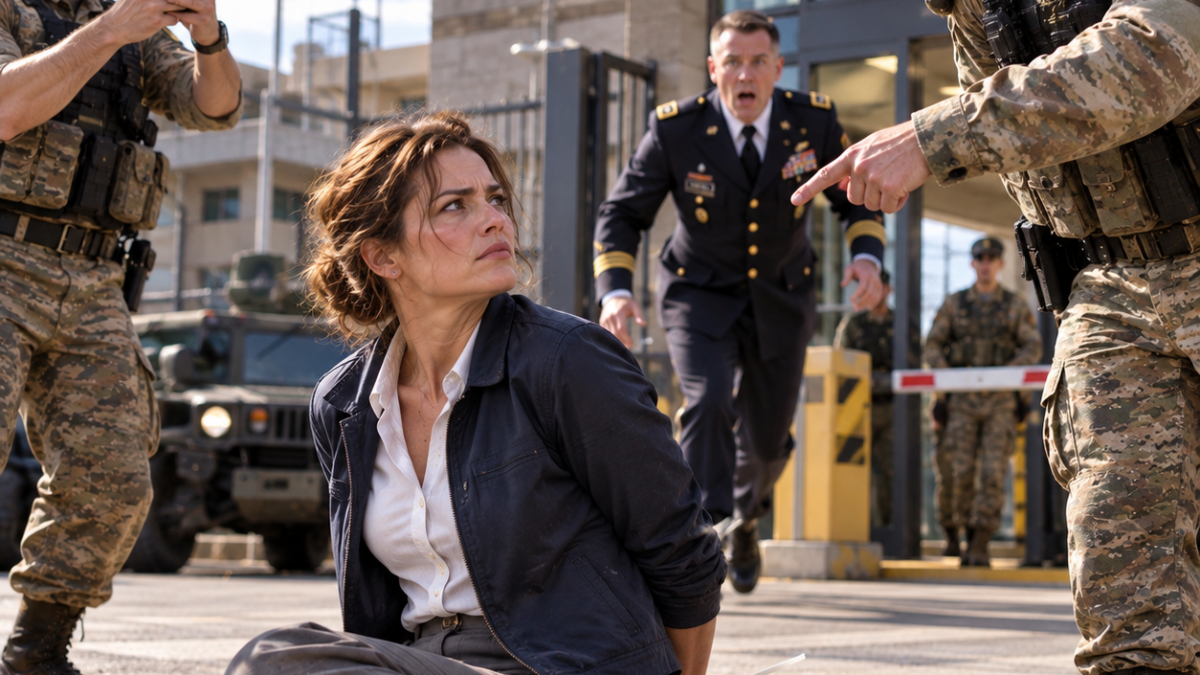
They Zip-Tied Me Outside Army Headquarters While a Sergeant Filmed and Laughed—Then the Duty Officer Saw My Face and Went White.
They thought I was just another middle-aged civilian who had wandered too close to a military headquarters where she did not belong.
They forced me onto the curb, zip-tied my wrists, and filmed my humiliation while laughing, never once opening the binder that would have ended everything.
But when the captain came through the glass doors and saw my face, every soldier at that checkpoint learned the difference between authority and arrogance.
My name is Evelyn Hart, and by the summer I arrived at Fort Calder, I had spent twenty-two years in the United States Army learning one truth most institutions hate to admit.
Danger does not always arrive shouting.
Sometimes it comes dressed as routine.
A bored guard.
A closed binder.
A shortcut nobody questions anymore.
A young soldier who thinks cruelty looks like confidence.
A lieutenant more interested in defending his people than understanding what they have done.
People imagine military failure as explosions, alarms, missed intelligence, and commanders shouting over radios in rooms full of maps. I have seen those failures too. They are terrible, but at least everyone recognizes them as danger when they happen.
The quieter failures are different.
They begin when ordinary people grow too comfortable with ordinary power.
That was why I had always paid attention to gates.
My first platoon sergeant taught me that before dawn on a cold morning when I was twenty-three years old, scared, ambitious, and trying very hard not to look like either. Sergeant First Class Daniel Mercer found me at an entry-control point overseas with an access binder open in both hands and anxiety written all over my face.
I had been memorizing procedures like they were scripture.
Vehicle checks.
Badge types.
Temporary passes.
Visitor rosters.
Escorts.
Search authority.
Emergency closures.
The whole thick, dry world of entry control.
Mercer watched me for a while, took the binder out of my hands, and said, “Lieutenant, the binder is not the job.”
I remember feeling embarrassed because I thought I was about to be corrected for missing something.
Then he tapped the gate with two fingers.
“The job is deciding who crosses the line,” he said. “You do that with courtesy in one hand and suspicion in the other, and you never drop either one.”
At twenty-three, I understood the words.
I did not understand the elegance of them.
That came later.
It came after I had stood enough gates in enough countries to know that courtesy without suspicion can get people killed, and suspicion without courtesy can destroy the very discipline it pretends to protect.
A gate at dawn has its own language.
Diesel exhaust hanging low in cold air.
PART2:
Tires grinding over damp pavement.
Floodlights humming while the eastern sky turns pale.
Tired faces appearing behind windshields one after another.
Contractors.
Soldiers.
Civilians.
Delivery drivers.
Spouses.
Commanders.
Lost visitors.
Angry retirees.
Nervous privates.
Most people approaching a gate are exactly who they claim to be. That is why treating every person like an enemy is not toughness. It is laziness wearing an angry face.
Real security requires attention.
Rudeness does not.
I learned that lesson in pieces.
By 2012, I was commanding a protection element at an overseas operating site where our gate was tested in a way I still do not enjoy describing. I remember dust. I remember the first wrong movement. I remember young soldiers trying to make sense of too much information too fast.
PART3:
For several terrible minutes, discipline mattered more than courage, because courage without discipline only creates louder mistakes.
The clearest voice I heard that day belonged not to a senior officer, not to me, not to any decorated veteran.
It belonged to a nineteen-year-old private named Maya Serrano.
She stood behind the barrier with her weapon steady and her eyes wide, reporting what she saw in such calm, precise language that everyone around her unconsciously began matching her breathing.
“White truck stopped short of the cone.”
“Driver’s hands visible.”
“Passenger looking left.”
“Rear tarp shifting.”
“Civilian crowd moving back.”
Her voice did not shake until later.
That is something people misunderstand about courage.
Calm and fear are not opposites.
Sometimes calm is simply fear doing its job correctly.
Years passed.
I became a major.
Then a lieutenant colonel.
I commanded military police units, trained young leaders, watched good soldiers become better ones, and watched some soldiers mistake rank for wisdom until experience or consequence corrected them.
Eventually, I transferred into inspector general work, a job I had once thought sounded painfully administrative.
I was wrong.
An inspector general’s real task is not catching villains.
It is identifying the quiet distance between what an organization claims to be doing and what people actually do when they believe nobody important is watching.
That distance had begun appearing at Fort Calder.
At first, the reports looked small.
Access checks recorded in identical time blocks that no real checkpoint could sustain.
Visitor complaints dismissed with suspiciously similar language.
A roster that had not been reconciled correctly in months.
A near miss involving a vehicle that traveled far beyond the point where it should have been challenged, softened in the official write-up until the incident sounded more inconvenient than dangerous.
Nothing alone justified panic.
Together, the details bothered me.
So I read the reports twice.
Then a third time with a legal pad beside me.
The issue was not only carelessness.
It was attitude.
Buried beneath the language was a swagger I had seen before, the poisonous belief that humiliation is evidence of control. Some guards at Fort Calder had begun confusing intimidation with authority, speed with competence, and disrespect with toughness.
That meant the written procedures were not enough.
I needed to see how the gate behaved when nobody knew an inspector was watching.
So I decided to inspect Fort Calder without warning anyone.
I wore gray slacks, comfortable shoes, and a plain navy jacket over a white shirt. My hair was pinned simply. My military identification and credentials were inside an interior pocket. The rental sedan I drove was forgettable in every possible way.
That was the point.
I did not want Fort Calder to meet Colonel Evelyn Hart.
I wanted Fort Calder to meet the woman it thought did not matter.
The main vehicle gate began answering my questions almost immediately.
A delivery truck rolled through after a guard barely glanced at the driver’s paperwork. Two vehicles later, a nervous woman in a minivan was made to sit through an unnecessarily hostile exchange while her toddler waited in the rear seat.
The inconsistency mattered more than either incident.
A checkpoint that is strict according to mood and careless according to mood is not secure.
It is unpredictable.
I parked near headquarters and walked toward the command post.
A wide American flag snapped above the building. Sunlight flashed across the glass entrance. Two soldiers stood beside the pedestrian checkpoint with an access binder resting closed on a wooden podium.
Everything they needed to do the job correctly was within arm’s reach.
That is the part I would keep returning to later.
The binder was right there.
The nearer soldier was a corporal whose name tape read COLE. He was perhaps twenty-two, wearing mirrored sunglasses and the practiced boredom of someone who believed the morning had nothing left to teach him.
The second was a specialist named PIKE. Narrow-faced. Restless. One hand near his sleeve pocket, where I later realized his phone was waiting.
I stopped at the designated line.
“Good morning,” I said. “Evelyn Hart. I’m here regarding a records matter, and I’d like you to verify me against the access roster, please.”
Cole did not touch the binder.
“You’re not on the appointment list.”
“I didn’t say I had an appointment. I asked you to check the access roster.”
He stared at me for a moment.
Then he looked toward Pike.
The look was quick, but I knew what it meant.
Not confusion.
Amusement.
The private little signal of two people deciding someone else is ridiculous.
Pike pulled out his phone and angled it casually in my direction.
That was the moment the inspection became something else.
Corporal Tanner Cole shifted his body sideways as if physically closing the conversation.
“Ma’am, if you’re not expected, you need to move away from the entrance.”
His tone was not aggressive enough to alarm someone walking past. That was part of its design. But I had spent too many years around young soldiers not to recognize satisfaction hidden beneath boredom.
“The procedure for an unscheduled visitor is in the binder beside you,” I said. “Please open it, check the roster, and verify my identity.”
I kept my hands visible.
My voice remained even.
Every second had become part of the inspection now.
And the worse their behavior became, the more important it was that mine remain unambiguous.
Pike smiled toward his phone.
“She’s really doing this,” he murmured, as though he had stumbled onto free entertainment before breakfast.
I looked directly at Cole.
“I’d also like to speak with your NCO.”
That irritated him.
“You’re not on the list, you’re not getting inside, and you’re done here.”
“You still haven’t checked the roster.”
His jaw tightened.
Calmness has a strange effect on people who rely on intimidation. They experience composure as resistance. If I had shouted, Cole would have known what role to play. By standing there politely and asking him to perform the written procedure, I had deprived him of the argument he wanted and left him alone with his own impatience.
“Turn around,” he said.
“No. I will remain here peacefully while you contact your NCO or check the roster.”
Cole looked at Pike.
“She’s refusing.”
I knew what was coming before either of them moved.
They approached from opposite sides.
Every instinct built during the first half of my career told me exactly how easily I could complicate what happened next. I could have shifted my weight, broken their grips, announced my rank, or pulled my credentials before either hand reached me.
Instead, I let my arms remain loose.
“Do not resist,” Cole said.
“I’m not resisting.”
He guided me toward the curb harder than necessary.
Pike kept his phone raised.
My knee touched concrete first.
Then my hip.
A second later, my hands were drawn behind my back, and a plastic restraint tightened around my wrists with a thin cutting pressure.
Pike laughed under his breath.
“She would not take a hint,” he told the camera.
That laugh hurt more than the restraint.
I have been shouted at by angry men with more rank than sense. I have been called things in languages I barely understood. I have had doors slammed in my face. I have stood close enough to danger to feel heat against my skin.
But being turned into entertainment by a twenty-one-year-old soldier while sitting restrained on a curb outside an American headquarters did something different.
It was not pain.
It was humiliation made casual.
That is a special kind of cruelty.
Several people had stopped.
A civilian employee stood near the badge reader with her access card suspended halfway toward it. Two uniformed soldiers slowed, looked, then continued toward the building after deciding, as people often do, that intervention carried more risk than curiosity.
I could feel the warmth of the pavement through my slacks.
The plastic restraint bit deeper whenever my hands shifted.
I remembered Maya Serrano at nineteen years old, standing behind a barrier on a day when everything around us was chaos. Her voice had been steady enough to lend steadiness to everyone who heard it.
I borrowed that voice.
“Corporal Cole, check the roster.”
He stared down at me.
“It will take less than a minute,” I continued. “And I strongly recommend you do it before anything else happens.”
Pike leaned toward his phone.
“Still giving orders.”
Then the headquarters doors opened.
A lieutenant emerged at a fast walk.
Grant Mercer was twenty-seven, sharp uniform, confident posture, the officer in charge of the guard force. For one hopeful second, I thought the incident might end there.
A competent officer seeing a restrained civilian outside his command post should feel curiosity before loyalty.
The first responsibility of leadership is understanding what happened before defending whoever wears the same uniform.
Mercer looked at Cole instead of me.
“What have we got?”
“Unauthorized visitor refusing to leave.”
“Did you check the roster?” I asked.
The lieutenant finally looked at me.
“Ma’am, you’re going to stop talking over my soldiers.”
That was when I knew the problem was larger than two immature sentries.
“Lieutenant,” I said, “I am asking you once, professionally, to verify my name against the access roster.”
“I don’t know who you think you are.”
“That isn’t relevant.”
“It is extremely relevant when you’re causing a disturbance outside my headquarters.”
I almost laughed at the absurdity of the sentence.
Instead, I looked at him carefully.
“No, Lieutenant. Whether I’m important is the least relevant fact in front of you. Your procedure does not change according to how important a visitor appears.”
He folded his arms.
“You’re going to be escorted from the installation. You can file whatever complaint you want after that.”
I studied his face.
He believed he had restored order.
That was perhaps the saddest part.
Cole stood straighter.
Pike kept filming, though his smile had faded now that an officer had arrived. I wondered whether some part of him had already begun to understand that recording a restrained civilian for amusement might look different later than it felt in the moment.
Then the glass doors opened again.
A female captain stepped outside carrying a folder against one hip.
She glanced first toward the lieutenant.
Then toward Cole.
Then toward Pike.
Then toward the woman sitting on the curb with her wrists bound behind her.
She stopped so abruptly the folder slipped several inches in her hand.
Fifteen years disappeared from her face.
I recognized Maya Serrano immediately.
More importantly, she recognized me.
Captain Maya Serrano crossed the pavement faster than officers usually allow themselves to move in public. For a few seconds, she seemed unable to look anywhere except my face.
I could see memory rearranging the morning inside her head.
Then her gaze dropped to my restrained wrists.
“Cut those off,” she said.
Cole hesitated.
“Ma’am, she was—”
“Now.”
One word.
Every person standing there heard the rank inside it.
Pike lowered his phone.
Cole fumbled for a cutting tool, crouched beside me, and severed the plastic restraint with hands that suddenly lacked all of their earlier certainty.
I brought my arms around slowly and rubbed the red grooves across my wrists.
Maya stood close enough that I could see anger trembling beneath her professional composure.
“Colonel—” she began, then stopped herself.
Lieutenant Mercer heard the word.
His expression changed first around the eyes.
Fear is rarely dramatic in disciplined people. It flickers in small places before pride covers it.
I stood and straightened my jacket.
“Captain Serrano,” I said. “It’s good to see you again.”
Her breath caught.
“Ma’am, I am so sorry. I had no idea you were—”
“You have nothing to apologize for. You heard there was trouble at your entrance and came outside to understand it. That is exactly what you were supposed to do.”
Then I reached into my jacket.
The leather credential case felt unexpectedly heavy in my hand.
Until that second, Cole had still been clinging to the hope that Maya simply knew me personally. When I opened the case and held it where all three men could see, hope disappeared from his face.
Colonel Evelyn Hart.
Inspector General.
Higher headquarters.
I watched them read it.
“I’m conducting an unannounced assessment of access control and force protection at Fort Calder,” I said. “I approached this command post as an unscheduled visitor and requested verification through the access roster. I made that request repeatedly.”
No one answered.
“The gate was supposed to tell me how it treats a person when rank isn’t visible.”
I looked from Cole to Pike to Mercer.
“I have my answer.”
A sprinkler clicked somewhere beyond the walkway. The flag overhead cracked once in the wind, and for several seconds that ordinary sound seemed impossibly loud.
Pike stared at the phone in his hand as though he wished it would disappear.
The anger came then.
Not dramatically.
It arrived like heat spreading beneath my collar, bringing with it every easy possibility available to a colonel who had just been humiliated in public by people far junior to her.
I could have ended careers before breakfast.
Almost everyone witnessing it would have considered that justice.
That was exactly why I did not trust the impulse.
“Captain Serrano,” I said, “please walk me inside.”
“Yes, ma’am.”
“Lieutenant Mercer, properly man this checkpoint and preserve everything associated with this incident, including Specialist Pike’s recording. Tomorrow at 0800, I will address the entire guard force.”
His voice barely carried.
“Yes, ma’am.”
That evening, alone in temporary quarters, I found myself staring at the marks on my wrists.
They were not serious injuries.
Just two narrow red bands.
Yet every time I saw them, I heard Pike’s laugh again.
Being treated harshly is one thing.
Being made into entertainment is another.
I called Walter Briggs.
Walter was a retired command sergeant major in his sixties who had known me since my earliest years in uniform. He had the useful habit of staying silent long enough that you eventually stopped performing even for yourself.
He answered on the third ring.
“Hart.”
“Walter.”
A pause.
“Bad day?”
“You could say that.”
I told him everything.
The closed binder.
The phone.
The curb.
The restraint.
The laugh.
Mercer defending his soldiers before he knew the facts.
Maya recognizing me.
My credentials opening like a grenade in the middle of their morning.
When I finished, Walter was quiet.
Then he said, “You want to burn them down.”
“I could.”
“That wasn’t what I said.”
I looked at my wrists.
The red marks seemed brighter beneath the lamp.
“Yes,” I said. “I want to.”
“Then don’t make decisions tonight.”
“The specialist laughed while he filmed me.”
“I know.”
“No, Walter. You don’t.”
“You’re right. I don’t.”
His honesty irritated me because it gave me nowhere to push.
“But I know twenty-one-year-olds don’t invent a culture by themselves,” he said.
That stopped me.
Walter continued.
“You can punish the youngest people in the story and feel righteous, or you can find out who taught them that a gate is a stage for showing people who’s powerful.”
I hated him for about five seconds.
Then I gave one humorless laugh.
“You always make revenge sound administratively inefficient.”
“Because it usually is.”
The next morning, I entered a plain conference room wearing my uniform.
The colonel’s eagles on my shoulders changed the temperature before I spoke a word.
Cole sat in the second row without his sunglasses.
Pike sat beside him, pale and quiet.
Lieutenant Mercer sat at the aisle.
Captain Serrano stood near the wall.
The rest of the guard force filled the room, some curious, some anxious, some visibly afraid.
I looked across the soldiers and let the silence settle.
“An inspector general is not a hammer,” I said. “I am a mirror that talks back.”
Nobody moved.
“My job is to show an organization the truth about itself. Yesterday, this gate showed me something unpleasant. Today, we are going to find out whether what happened to me was an isolated failure or merely the moment somebody finally noticed.”
Mercer looked up.
Something in his expression told me he still believed he could explain everything away.
I began with the facts that had nothing to do with me.
A delivery vehicle had entered without proper verification.
A civilian visitor had been treated with unnecessary hostility.
The authorization roster had not been reconciled correctly.
An earlier near miss had been softened in official language until the report sounded more inconvenient than dangerous.
Only after covering those points did I describe my own encounter.
I told them I had requested the roster, been denied access without verification, asked for supervisory assistance, been restrained despite offering no physical resistance, and been filmed for entertainment.
I did not raise my voice once.
“Access control requires discipline and courtesy at the same time,” I told them. “A soldier who believes cruelty proves strength does not understand security. If you treat every ordinary person like an enemy, eventually you stop examining anyone carefully enough to recognize the person who actually matters.”
Several soldiers avoided my eyes.
Then Lieutenant Mercer stood.
“Ma’am, with respect, if you had identified yourself as a colonel or as an inspector, the situation obviously would have been handled differently.”
There it was.
The defense I expected.
I leaned both hands lightly against the table.
“Lieutenant, the fact that you believe that helps your case is exactly why I’m here.”
His face tightened.
“A visitor should not have to prove she is important before your soldiers follow written procedure. The procedure exists for the person no one recognizes. The contractor. The family member. The civilian employee from another installation. The private whose information is temporarily missing. The woman wearing an inexpensive jacket whom your soldiers assume does not matter.”
No one shifted now.
“If the gate only functions correctly when someone looks powerful, then the gate doesn’t belong to the Army. It belongs to appearance.”
Mercer sat down.
I waited before continuing.
“Some of you are convinced your careers ended yesterday. I want to remove that fear because frightened people learn very little. I am not here to see how many people I can destroy.”
Cole finally looked at me.
“I am here to find where the failure began. There will be accountability, but it will follow evidence rather than convenience. If this culture was created above the youngest soldiers in this room, I will not pretend punishing the youngest soldiers fixes it.”
Over the next several days, my team and I did what inspections actually require, which is far less dramatic than people imagine.
We reviewed rosters.
Training logs.
Incident reports.
Shift schedules.
Complaint records.
Supervisory notes.
We interviewed soldiers separately and asked similar questions in different ways until patterns emerged.
The gate had been deteriorating for nearly eighteen months.
Verification requirements had been shortened or skipped whenever traffic increased.
The access roster existed without a clearly assigned owner, meaning several people believed someone else was maintaining it.
New soldiers who followed every step were teased for taking too long.
The worst discovery was cultural.
Three different soldiers used the same word when describing guards who treated visitors politely.
Soft.
Once I heard it the third time, I realized courtesy had not merely been forgotten.
It had been socially punished.
The guard force had created an upside-down system in which ignoring procedure made a soldier look confident, while performing procedure correctly made that same soldier look timid.
That kind of inversion is dangerous because it forces ordinary people to demonstrate unusual courage simply to do routine work.
Good systems should not require heroes every morning.
They should make correct behavior ordinary.
The evidence eventually led beyond Lieutenant Mercer.
Training supervisors had praised speed without examining how speed was achieved. Senior leaders had seen green readiness slides and accepted them without questioning whether the numbers reflected reality. Complaints were closed in ways that protected the gate from criticism instead of protecting the gate from weakness.
I briefed Major General Helena Ward on Thursday.
She read the preliminary report slowly, glasses low on her nose, pausing on several pages before continuing. When she finished, she placed the packet on her desk.
“These findings will cost people positions.”
“The findings aren’t costing them positions, ma’am,” I said. “Their decisions are. I’m only describing those decisions.”
Her eyes flicked briefly toward my wrists, where the marks had nearly disappeared.
“You could have relieved those three men immediately.”
“Yes.”
“Why didn’t you?”
I thought about Walter’s question.
“Because the easiest people to punish weren’t necessarily the people who created the problem. If I destroy two young soldiers and go home satisfied while leaving the culture that produced them untouched, somebody else gets restrained six months from now. The only difference would be that I got to feel powerful for one afternoon.”
General Ward studied me for several seconds.
“Write it exactly as you found it.”
“I intend to.”
“All the way up.”
“Yes, ma’am.”
She nodded.
“Then I’ll stand behind it.”
I believed the hardest part was over.
I was wrong.
The following morning, Specialist Evan Pike requested a private meeting with me.
When he entered, he carried the phone he had used to record me.
Instead of asking me to forget what happened, he placed it carefully on my desk.
“The video is still there, ma’am.”
I looked at the phone without touching it.
Pike swallowed.
“I didn’t delete anything.”
He appeared younger sitting across from me than he had while standing over me at the curb. Some of that was posture. Arrogance adds years to a face. Shame removes them.
“Why?” I asked.
He glanced at the floor.
“Because it happened.”
“That isn’t an explanation.”
“No, ma’am.”
I waited.
Pike took a slow breath.
“After Captain Serrano recognized you, I kept thinking the worst thing I’d done was record an inspector general. Then I realized that wasn’t the worst thing.”
I said nothing.
“The worst thing was that I would have done the exact same thing if you really were nobody.”
That sentence mattered.
He pushed the phone slightly closer.
“I watched the video that night. You kept asking us to check the roster. You never threatened us. You never fought us. We had you on the ground, and you were still telling Corporal Cole to do the one thing that would’ve stopped everything.”
His voice shook.
“I laughed at you.”
“Yes.”
“I don’t have an excuse.”
“No.”
He forced himself to look at me.
“I wrote a statement.”
He placed several pages beside the phone.
I did not read them immediately.
“What are you asking me for?” I said.
His answer came quietly.
“A chance to fix what I helped break.”
That was an answer I could work with.
The statement he wrote described his behavior more severely than I would have. He included the recording, the comments, the laugh, the fact that he had viewed the incident primarily as entertainment. At the bottom, he wrote that he was not requesting reduced consequences.
When I called him back, he stood at attention so rigidly he looked carved from regret.
“Specialist Pike,” I said, “preserving evidence that makes you look worse is the first genuinely courageous thing I’ve seen you do.”
Surprise flickered across his face.
“Don’t confuse that with forgiveness.”
“I won’t, ma’am.”
“Good. Courage is useful precisely because it doesn’t erase what came before.”
Corporal Cole was more difficult.
For days, he returned to the same argument.
Lieutenant Mercer had supported the detention.
Leadership had rewarded aggressive behavior.
The checkpoint culture had taught him control mattered more than courtesy.
Every statement contained some truth, which made them more dangerous than obvious lies.
“You were influenced,” I told him during our third interview. “You were poorly led. Those facts matter.”
Relief appeared too quickly on his face.
“They do not remove your responsibility.”
The relief vanished.
“You asked for clarification four times before Lieutenant Mercer ever stepped outside. The binder was within reach. Nobody above you prevented you from opening it.”
Cole stared at the table.
“You want your lieutenant to own his decisions. Why shouldn’t you own yours?”
For several days, he resented me.
I was comfortable with that.
Accountability that feels pleasant immediately is usually just reassurance.
Then one afternoon, Cole appeared outside the temporary office we were using.
He was not wearing his mirrored sunglasses.
“Can I speak with you, ma’am?”
I gestured toward the chair.
He remained standing.
“I keep telling myself I was following the culture here.”
“You were.”
“I keep telling myself Lieutenant Mercer would have backed me.”
“He did.”
“I keep telling myself that’s why I did it.”
I waited.
Cole swallowed.
“But you asked me to open the binder before he came outside.”
“Yes.”
“And I didn’t.”
“No.”
“I could have.”
“Yes.”
He rubbed one hand across his jaw.
“I liked telling people no.”
That was the first completely honest sentence I had heard from him.
He continued before courage escaped.
“It made me feel like I mattered. Like people had to listen because I controlled the gate. I thought being respected meant people being uncomfortable around me.”
I sat back.
“That’s not a good reason,” he said.
“No. It isn’t.”
“But it’s the real one.”
“Which gives us somewhere to start.”
He looked almost angry with himself.
“I don’t expect you to forgive me.”
“I don’t.”
His shoulders dropped slightly.
I continued.
“I don’t need you to feel better about what happened. I need you to become someone who never does it again. That’s a much longer apology.”
“How long?”
“Maybe a year.”
He blinked.
“Maybe longer. You’ll make it one visitor at a time when nobody important is standing behind you.”
The correction plan went forward.
General Ward approved new oversight requirements, reassigned several leaders, and required revised training across the installation.
Lieutenant Mercer faced formal accountability for supervisory failures and for defending misconduct without first establishing facts.
Cole and Pike remained assigned to the gate under strict supervision.
That decision angered some people.
A few officers thought I was protecting the soldiers because I had become emotionally involved.
Others thought I should have made public examples of them so every guard on the installation would be afraid of repeating the incident.
Fear would have been faster.
But I had not spent twenty-two years studying gates to confuse fast with effective.
We rewrote procedures with the soldiers who would actually use them.
Every verification step became specific.
Roster ownership was assigned to named positions.
Reconciliation schedules became mandatory.
Courtesy was written into security training not as etiquette, but as operational discipline.
Then I asked Captain Maya Serrano to help me with the hardest part.
“Bring me soldiers who have held gates when the gate actually mattered,” I told her.
She understood immediately.
The stories those veterans told the young guard force changed the room in a way no regulation ever could.
Walter Briggs joined one training session by video from his back porch three states away. His hair had gone almost entirely silver, and he spoke with the irritating calm of a man who no longer needed to impress anyone.
Twenty young soldiers who had spent months associating toughness with volume leaned forward while he explained that the most difficult checkpoint duty of his career involved remaining courteous to terrified civilians while never once relaxing security.
“Any fool can be rude,” he told them. “Rudeness is cheap. Discipline costs something.”
Pike wrote that sentence down.
Cole did not.
But I saw him listening.
We rebuilt drills around ordinary complications rather than dramatic threats.
Visitors without appointments.
Contractors whose paperwork contained small errors.
Senior officers arriving impatiently.
Nervous spouses.
Confused retirees.
People who spoke English poorly.
People who spoke English perfectly and still did not understand military procedure.
The guards were required to follow the same process regardless of clothing, confidence, rank, accent, vehicle, or attitude.
“Security that changes depending on who impresses you isn’t security,” I reminded them. “It is favoritism wearing body armor.”
The improvement was not immediate.
Habits rarely die because a new policy is printed.
For the first week, supervisors noticed soldiers returning to shortcuts when traffic increased. Some still became unnecessarily sharp when visitors asked questions. Others followed every new rule mechanically but with the expression of people completing punishment.
That was acceptable.
Competence often arrives before belief.
Pike volunteered for additional shifts and began reviewing old complaints to understand what visitors had experienced.
Cole stayed resistant longer, but his resistance changed shape. Instead of defending the old method, he began criticizing details of the new procedures, which meant he had finally started imagining himself responsible for making them work.
I encouraged the criticism.
A policy nobody is allowed to challenge becomes theater almost as quickly as a policy nobody follows.
Maya became one of my strongest allies.
Late one evening after training, she and I stood outside the command post watching the night shift take over. The sky was violet. Security lights clicked on across the installation.
She asked whether I remembered the overseas checkpoint where we first met.
“I remember your voice,” I said.
She smiled faintly.
“I was terrified.”
“I know.”
“You always told people I was calm.”
“You were.”
“Those aren’t opposites?”
“No. Courage would be easy if they were.”
For a moment, we watched vehicles moving beneath the lights.
“I’ve thought about what would have happened if I hadn’t walked outside that morning,” she said.
“So have I.”
“They might have escorted you off the installation.”
“Possibly.”
“Would you have shown them your credentials?”
“Eventually.”
She laughed once.
Then her expression became serious.
“I’m glad I knew you.”
“I’m glad you recognized a problem before you recognized me.”
She turned toward me.
“That’s the distinction that matters, Maya. You came outside because something at your gate looked wrong. Knowing me only told you how wrong.”
The final findings went higher than many people expected.
Several supervisors lost leadership responsibilities.
Training records were corrected rather than quietly rewritten.
Complaint processes changed.
Command reviews became less interested in whether slides were green than in whether the data deserved to be green.
General Ward supported every recommendation.
When officers approached her privately hoping portions of the report could be softened, she sent them to me.
Most never came.
The ones who did usually began by saying the incident had attracted too much attention.
I reminded them that almost nobody outside the installation knew about it.
“What you’re calling attention,” I told one colonel, “is accountability.”
He did not enjoy that sentence.
I was comfortable with that too.
Months later, Pike asked permission to use his recording during training.
The request surprised me.
“You understand what people will see.”
“Yes, ma’am.”
“They’ll see you laughing.”
“I know.”
“They may judge you by the worst ninety seconds of your career.”
He looked at me steadily.
“Then I’ll have to spend the rest of my career giving them something else to judge.”
I approved it.
The first time he showed the video to a group of new soldiers, I stood in the back of the room where he could not easily see me.
On the screen appeared the plain-clothed woman I had been, sitting on the curb while a younger version of Pike narrated my humiliation from behind the camera.
The room became deeply uncomfortable.
Pike stopped the recording.
“That’s me,” he said.
Nobody looked at him.
“I thought I looked tough when I recorded this. I didn’t. I looked cruel and careless.”
He restarted the clip, stopping again when my voice could be heard asking Cole to check the roster.
“She was giving us the answer,” he told them. “We were too busy enjoying power to listen.”
No regulation I could have written would have matched the impact of those words.
Failure honestly owned had become instruction.
Months earlier, Pike had recorded me because he wanted an audience.
Now he used the same recording because he wanted witnesses.
There is a difference.
By the end of the inspection cycle, complaints were already decreasing. Verification times had become slower but more consistent. Random checks showed dramatic improvement. The paperwork looked better.
But paperwork had fooled me before.
I needed to know what happened when nobody expected inspection.
So several weeks after my official work at Fort Calder ended, I rented another plain car, put on ordinary civilian clothes, and returned without telling Maya, General Ward, or anyone else.
The first time I arrived anonymously, I wanted to see whether the gate could fail.
This time, I wanted something harder.
I wanted to know whether it had actually changed.
Driving back toward Fort Calder felt strangely worse than arriving the first time.
During the inspection, I had possessed purpose, authority, and evidence. Now I had only uncertainty. Rules had been rewritten, leaders reassigned, soldiers retrained, and reports signed, but none of those things guaranteed behavior survived after attention moved elsewhere.
I parked in the same visitor area.
For several seconds, I remained behind the steering wheel.
My wrists had healed completely.
Yet I could almost feel the plastic again.
Then I got out.
The morning was bright and cool, with long shadows from the headquarters building and an American flag moving sharply overhead. I walked slowly toward the pedestrian entrance, forcing myself to observe small things rather than search only for reassuring signs.
The traffic cones were upright.
The walkway was clean.
A soldier inside the booth was using the access binder rather than leaving it closed.
Another guard stood balanced on both feet, alert without performing alertness.
Those details settled something inside me.
Anyone can become impressive when told an inspector is approaching.
It is much harder to fake an upright traffic cone at an ordinary hour when nobody believes it matters.
A young female specialist I did not recognize stood at the entry point. That helped. Someone unfamiliar with me could not perform because of my identity.
I approached.
“Good morning.”
“Good morning, ma’am. How can I help you?”
“My name is Evelyn Hart. I’m here regarding a records matter. I don’t have an appointment, but I’d like you to verify me against the access roster.”
“Of course. May I see identification?”
She opened the binder.
That was it.
The entire test.
She did not wave me through casually because I sounded confident.
She did not become hostile because I lacked an appointment.
She followed the procedure.
One page.
One identification check.
One verification.
Maybe ninety seconds.
I stood there with my throat tightening over the most boring administrative process imaginable.
“Thank you for your patience,” she said when she finished. “You’re verified. Have a good morning.”
“You too.”
I walked away before she could wonder why the middle-aged civilian she had just processed looked strangely emotional.
I did not identify myself.
There was no reason to.
The gate had answered.
Later, through ordinary reports rather than personal inquiry, I learned Pike had been promoted to sergeant. He was helping conduct access-control training and continued using his recording as an example.
I heard he introduced it the same way every time.
“This is me on one of the worst mornings I’ve had in uniform.”
Then he would show the clip.
“This woman repeatedly asked us to do our job correctly. We decided her lack of visible importance meant we didn’t have to listen.”
He never mentioned my rank until later in the lesson.
That detail mattered.
If recruits heard immediately that the woman was a colonel and inspector general, the lesson became: Be careful because the stranger might secretly be powerful.
That was the opposite of what I wanted.
The stranger should not need hidden power.
Procedure should protect her because procedure is the standard.
Cole remained at the checkpoint too.
His transformation was quieter, which somehow made me trust it more.
He did not become an instructor.
He did not give speeches.
He simply became known for doing the job carefully.
Visitors sometimes complained that his checks took longer than those of other guards.
His supervisors considered that a compliment.
One report described him stopping a senior field-grade officer whose credentials required additional confirmation. The officer apparently reminded Cole of his rank and demanded to be waved through.
Cole answered, “Sir, respectfully, your rank is why I need to do this correctly, not why I should skip it.”
When I read that sentence, I smiled.
He had finally opened the binder.
General Ward briefed me during my final official visit. Verification compliance had reached its highest level in years. Visitor complaints had dropped sharply, and incident reviews showed more consistency between shifts.
“You fixed the gate,” she said.
“No, ma’am.”
She raised an eyebrow.
“The soldiers fixed it,” I said. “I made it impossible to pretend it wasn’t broken.”
She looked at me for a second, then smiled.
“That’s an inspector general answer.”
“It’s also true.”
The morning before I left Fort Calder for good, I drove near the entrance before sunrise and parked far enough away that nobody would notice me.
Floodlights were still glowing against a pale sky. The smell of wet pavement and diesel carried across the air exactly as it had when I was a young lieutenant learning what a gate meant.
A guard stood at the wire.
Another checked a vehicle.
Nothing dramatic happened.
No alarms.
No confrontation.
No inspector stepped from the shadows to congratulate them.
They simply did the job correctly because it was the job.
For most of my career, I had believed the hardest test of leadership came when everything went wrong.
Watching that gate, I began to understand something different.
Sometimes the harder test comes after the crisis, when everything becomes boring again and nobody is watching closely enough to applaud you.
That is where standards either become real or disappear.
Fort Calder’s gate, for the moment, was real again.
I have been asked since then whether I forgave Tanner Cole, Evan Pike, or Lieutenant Grant Mercer.
The truthful answer is no.
I did not hate them.
I did not spend years carrying anger like a stone.
But forgiveness was never something I believed the story required.
People sometimes confuse refusing revenge with pretending harm never mattered, and those are not remotely the same thing.
What they did was wrong.
Cole restrained someone because admitting uncertainty felt weaker than exercising authority.
Pike turned another person’s humiliation into entertainment.
Mercer arrived with enough rank to correct both of them and instead protected their behavior before he understood it.
Those facts remained true after they apologized.
They remained true after training improved.
They remained true after the gate became one of the most consistent entry points on the installation.
I simply decided those facts would not be the only truths that survived.
Mercer did not remain in guard-force leadership. His formal evaluation reflected his decisions, and his career took a different direction from the one he expected. I never celebrated that outcome because accountability should not require enjoyment to be real.
Cole stayed and worked.
Pike stayed and taught.
Maya eventually moved into a larger force-protection role, and when she called to tell me about the assignment, I reminded her of the young private whose calm voice had once steadied an entire checkpoint.
“You’ve been doing this longer than your résumé admits,” I told her.
She laughed.
Walter Briggs heard about every development because I kept calling him long after I no longer needed advice. He enjoyed taking credit for the outcome despite having contributed only one irritating phone conversation.
“I saved those boys,” he told me.
“You told me not to make decisions while angry.”
“Exactly. Heroic intervention.”
“You were sitting on a porch.”
“Most heroic interventions improve with a porch.”
I eventually stopped arguing.
But the person I thought about most was Pike.
There was something difficult and valuable in the choice he made when he preserved evidence that could hurt him. He could have deleted the video and relied on imperfect memories, embarrassment, and institutional self-protection to soften what happened.
Instead, he kept the worst version of himself alive long enough to learn from it.
That is rarer than people think.
Organizations often say they want honesty, yet individuals quickly discover honesty can cost reputation, opportunity, comfort, and pride. So mistakes vanish into rewritten reports, vague language, missing recordings, convenient memories, and explanations polished until nobody appears responsible.
Hidden failure becomes rot.
Owned failure can become instruction.
The Army did not need Pike to pretend he had always been a good sentry.
It needed him to understand precisely how he had become a bad one and teach the next soldier not to follow him there.
Cole taught me a different lesson.
His growth was slower because his problem was not excitement or peer pressure, but identity. He had built part of his confidence around possessing authority over people who needed something from him.
Giving up that identity cost him.
Every time he opened the binder instead of dismissing someone, every time he explained a delay courteously, every time he treated an ordinary visitor like someone worthy of proper procedure, he was dismantling the version of himself who had put me on that curb.
Nobody applauded.
That made the work more valuable.
Years earlier, Daniel Mercer had taught me that a gate requires courtesy and suspicion in the same hand. I once thought he meant those qualities merely balanced each other, as though kindness softened vigilance and vigilance prevented kindness from becoming weakness.
I understand the lesson differently now.
They are not opposite qualities.
They come from the same discipline.
Courtesy requires you to keep seeing the human being in front of you instead of reducing that person to an inconvenience.
Suspicion requires you to keep seeing the details in front of you instead of replacing them with assumptions.
Both require attention.
Cruelty is inattentive.
Carelessness is inattentive.
Arrogance may be the most dangerous form of inattention because it convinces you there is nothing left to learn.
That was what happened at Fort Calder.
Two young soldiers looked at a middle-aged woman in ordinary clothing and decided they already understood everything important about her.
Their lieutenant looked at two uniformed subordinates and decided the same thing about them.
Everyone stopped looking.
The gate failed before the restraint touched my wrists.
The restraint merely made the failure visible.
Sometimes people ask what I would do differently if I could return to that morning.
Nothing.
I would wear the same clothes.
I would leave my credentials inside my jacket.
I would make the same request.
I would refuse to announce my rank simply to purchase respectful treatment.
And when they restrained me, I would keep my hands loose again.
Not because being calm made what they did acceptable.
It did not.
I would do it because I eventually understood that the most important decision available to me was never whether I could punish them.
It was whether they would be allowed to decide who I became next.
They put two red marks on my wrists.
I could have let those marks turn into three ruined young careers, a frightened guard force, a quietly unchanged culture, and one colonel who drove away feeling vindicated.
Instead, the marks faded.
The standard remained.
On my final morning near Fort Calder, I watched dawn spread slowly over the checkpoint. Cars approached one at a time, headlights dimming as the sky brightened, and young soldiers stood where thousands of soldiers had stood before them, deciding who crossed and who waited.
Nobody knew I was watching.
That was exactly why the moment mattered.
One guard leaned toward a driver’s window, listened carefully, checked something against the roster, and handed identification back with a small courteous gesture.
The barrier lifted.
The vehicle crossed.
Another approached.
The process began again.
Ordinary.
Correct.
Uncelebrated.
I sat behind the wheel for another minute before starting the engine.
For twenty-two years, I had guarded institutions, people, procedures, roads, checkpoints, promises, and sometimes my own temper. I once thought strength meant holding the line against whoever tried to cross it.
Fort Calder reminded me there is another kind of line.
The line between justice and revenge.
Between authority and ego.
Between remembering what someone did and allowing what they did to control what you do next.
I never forgave the men who put me on that curb.
I did something more useful.
I held them accountable.
I demanded they change.
I watched two of them choose to do the work.
Then I continued with my life.
The gate continued too.
That was enough.
Because the strongest promise an institution can make is not that nobody inside it will ever fail.
People will fail.
Leaders will fail.
Systems will fail.
The promise worth making is that when failure finally becomes visible, someone will tell the truth about it, somebody else will refuse to hide it, and enough people will care about the standard to rebuild what was broken.
That summer, I arrived at Fort Calder because I believed I was inspecting a gate.
Instead, that gate inspected all of us.
It exposed Cole’s arrogance.
It exposed Pike’s cruelty.
It exposed Mercer’s failure to lead.
And if I am being fair, it exposed something in me too.
How quickly humiliation can tempt even an experienced leader to replace correction with punishment and call the result justice.
The gate asked every one of us what we would do after seeing the worst version of ourselves.
Some answered better than others.
But the ones who answered well changed.
That is the only ending I ever needed.



