They Thought the Mother Cat Was Frozen Dead in the Snow—Then a Road Worker Lifted Her and Found Five Newborn Kittens Still Warm Beneath Her Body.
PART3:
Her body looked unnaturally rigid.
Ice coated the ends of her fur.
Snow had gathered along her spine.
Daniel stopped.
“Oh, honey.”
He had grown up around barn cats.
He knew what cold could do.
He crouched.
No visible breathing.
He removed one glove.
Touched the cat behind her shoulder.
Cold.
Stiff.
His stomach sank.
Marcus had followed him.
“Dead?”
Daniel nodded reluctantly.
“Looks like.”
There was something especially hard about finding an animal that had almost certainly spent its final hours alone.
Daniel slid both hands beneath her body.
He intended to lift her away from the roadside before the next plow pass.
The cat would not move.
He tried again.
Nothing.
“She’s frozen down,” Marcus said.
Daniel adjusted his grip.
“Maybe.”
Then he heard it.
So faint he almost dismissed it as wind.
A tiny sound.
Not a meow.
More like a squeak.
Daniel froze.
“Did you hear that?”
Marcus leaned closer.
“Hear what?”
Again.
Squeak.
Then another.
Daniel’s eyes widened.
“Jesus.”
He lowered himself until his cheek nearly touched the snow.
The sound came from beneath the cat.
He moved her fur carefully.
Something pink appeared.
A paw.
Smaller than his thumb.
“Marcus.”
“What?”
“Babies.”
Marcus stared.
“No.”
“Babies.”
They worked together.
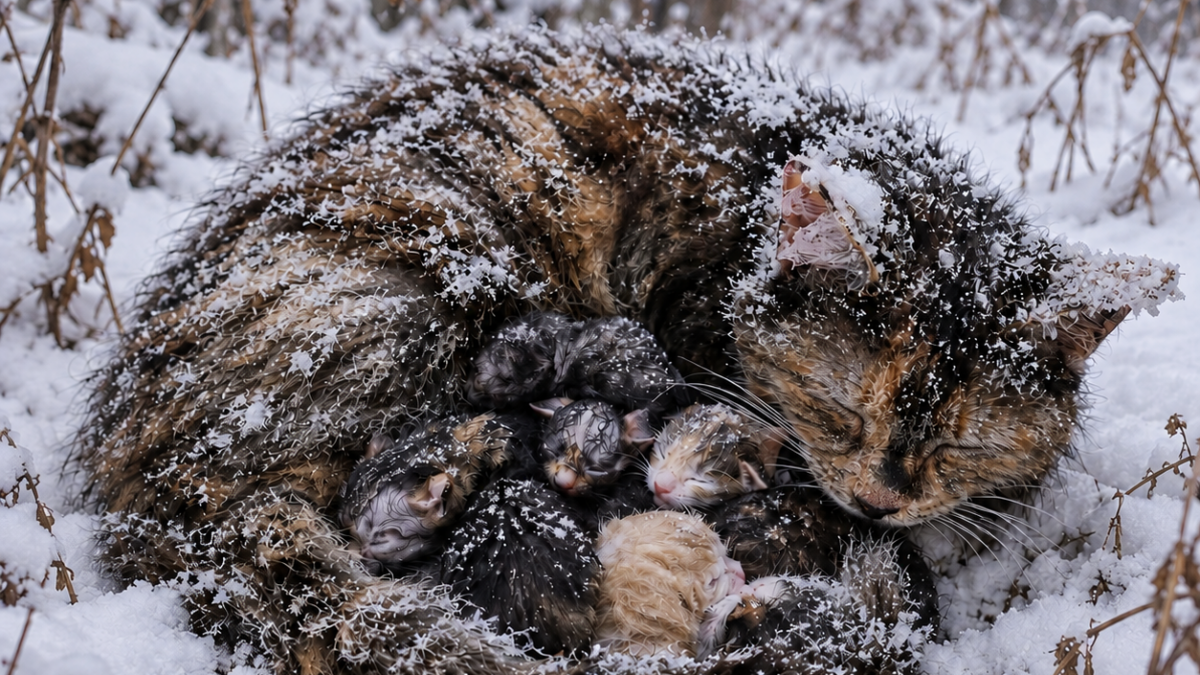
The mother cat had curled herself into a tight semicircle against the fence post.
Beneath her belly, pressed between her legs and the frozen ground, were kittens.
One.
Two.
Daniel counted again.
Three.
Four.
Five.
Newborn.
Tiny.
Eyes closed.
Their fur still had that fine unfinished look kittens carry in the first days of life.
And they were moving.
Barely.
But moving.
One rooted blindly against the mother’s belly.
Another opened its mouth and made the sound Daniel had heard.
Marcus whispered:
“How are they alive?”
Daniel touched one through his bare fingertips.
Warm.
Not healthy warm.
But far warmer than the cat above them.
The mother’s body had formed a shelter.
Her back had taken the wind.
Her fur had trapped heat.
The kittens had been packed beneath her abdomen, touching each other and the last warmth her body could produce.
Daniel placed his hand against the mother’s chest again.
This time he waited.
Five seconds.
Ten.
Then—
Movement.
Tiny.
Weak.
A breath.
“She’s alive.”
Marcus dropped to one knee.
“You sure?”
Daniel waited.
Another shallow breath.
“Yes.”
Everything changed.
Dead animal on roadside became emergency.
Daniel radioed dispatch.
“County Seven to base.”
Static.
“Go ahead, Seven.”
“We have an animal rescue situation.”
Pause.
“What kind?”
“Adult cat, severe cold exposure.”
“Five neonatal kittens.”
“All alive.”
Another pause.
Dispatch knew Daniel well enough to know he was not joking.
“Location?”
Daniel gave the mile marker.
“We need veterinary direction.”
The nearest emergency veterinary clinic was twenty-two miles away.
Normally thirty minutes.
That morning?
Maybe an hour.
Daniel did not intend to wait.
Removing the mother became the first problem.
Her outer fur had frozen into the snow and ice beneath her.
Pull too hard and they could tear skin.
Daniel ran back to the truck.
Grabbed a jug of lukewarm drinking water they kept inside the heated cab.
Not hot.
He poured small amounts around the frozen fur.
Marcus shielded the cat from wind with his body.
Slowly the ice released.
Daniel slipped his coat off.
Wrapped the mother and kittens together without separating them.
When he lifted the bundle, the mother gave a weak sound.
Not a full cry.
Just enough to tell them she knew something was happening.
“It’s okay.”
Daniel had no idea if that was true.
“You’re okay.”
He carried them to the truck.
Marcus cranked the heat.
Daniel radioed that they were leaving the route temporarily.
Dispatch sent another truck to cover them.
The kittens stayed beneath their mother.
Daniel placed the bundle on the center bench between them where warm air could circulate gradually.
He knew enough not to heat a severely hypothermic animal too rapidly.
But knowing enough to be afraid is not the same as knowing what to do.
Marcus called the veterinary clinic on speaker.
A technician answered.
Daniel explained.
Adult female cat.
Five neonates.
Extreme exposure.
Mother conscious but barely responsive.
The technician’s voice became focused immediately.
“Do not put them directly against the heater.”
“Keep gradual warmth.”
“Keep kittens together.”
“Do not feed if they’re cold.”
“We’re ready for you.”
Then:
“How long until arrival?”
Daniel looked through the windshield.
The road vanished ahead in blowing snow.
“Twenty-two miles.”
“Drive safely.”
He nearly laughed.
Easy instruction.
Hard task.
Daniel drove.
Faster than plow speed.
Slower than panic wanted.
The mother lay still.
Every few minutes Marcus placed fingers against her ribs.
“Breathing.”
Then five minutes later:
“Still breathing.”
Kittens squeaked occasionally.
The sound became the only thing either man wanted to hear.
At one point, Daniel said:
“She covered them.”
Marcus nodded.
“Looks like.”
“She could’ve moved.”
“Maybe.”
Neither knew.
They could not know what had happened before the storm.
Whether she had given birth there.
Whether she had tried moving kittens from somewhere else.
Whether she was abandoned.
Whether she had been living outdoors for months.
All they knew was what they had found.
Five kittens beneath her.
Not beside her.
Beneath.
Protected by the only thing she had.
Herself.
The clinic doors were already open when the plow truck pulled into the parking lot.
Three staff members waited.
Daniel stopped.
Before he could climb out, the team reached them.
“Mother first.”
“Keep babies with her.”
They transferred the whole bundle to a warmed carrier lined with towels.
Daniel followed inside until someone asked him to wait.
Then the doors to treatment swung shut.
And suddenly he had nothing to do.
For nearly an hour, Daniel sat in the lobby wearing only his work shirt because the cat was still wrapped partly in his coat.
Marcus bought terrible vending-machine coffee.
Neither complained.
At 8:11, a veterinary technician came out.
Her name tag read:
ELISE MARTIN, CVT.
She looked tired already.
Daniel stood.
“How are they?”
“The kittens are stable.”
Both men exhaled.
“The mother is critical.”
Elise sat across from them.
“Her rectal temperature is eighty-seven degrees.”
Daniel did not know what normal was.
Elise explained.
“Normal for a cat is around one hundred to one hundred-two.”
“Eighty-seven is severe hypothermia.”
“She has frostbite affecting both ears, all four feet, and her tail.”
“We’re also concerned about dehydration and shock.”
“Is she going to die?”
Marcus asked.
Elise hesitated.
That hesitation answered before her words did.
“She might.”
Daniel stared at the floor.
“But?”
he asked.
“But she is breathing on her own.”
“Heart rhythm is weak but stable enough right now.”
“We’ve started warmed fluids and controlled rewarming.”
“She has something going for her.”
“What?”
“She made it here.”
Elise stood.
“That matters.”
Daniel handed over his number.
“Call me.”
Elise said:
“We will.”
“Even if…”
“Yes.”
“Either way.”
Daniel and Marcus returned to their route.
Snow still needed clearing.
For the rest of the shift Daniel checked his phone every ten minutes.
No call.
By noon that terrified him.
By three he understood no call might be good.
At 6:22 that evening, Elise finally called.
“She’s still alive.”
Daniel sat down at his kitchen table.
His wife, Megan, watched his face.
“How are the kittens?”
“Good.”
“Mother?”
“Hanging on.”
Elise explained that they had placed the mother in a warming kennel.
The kittens were in a separate heated incubator nearby because the team needed to stabilize her without the babies interfering with monitoring.
They were receiving small supplemental feedings because nursing during severe maternal hypothermia could exhaust the mother further.
Daniel asked:
“Can she see them?”
“Not really.”
“Will she know they’re there?”
Elise paused.
“Probably by smell and sound.”
Then:
“We’ve kept them close.”
“Thank you.”
Daniel slept badly.
He dreamed of the dark shape beside the fence.
At 4:30 the next morning, before returning to work, he drove to the clinic.
Elise was still there.
“Did you go home?”
he asked.
“Eventually.”
She led him toward recovery.
Through a glass window, Daniel saw the cat.
Tiny.
Much smaller without snow around her.
IV line.
Blankets.
Monitoring leads.
Her ears looked dark at the tips.
Paws bandaged.
She was awake.
Barely.
The kittens were in a box nearby beneath controlled heat.
Five little bodies curled together.
Daniel counted them automatically.
One.
Two.
Three.
Four.
Five.
“What are you calling her?”
Elise asked.
Daniel looked at the tortoiseshell.
“You name clinic cats?”
“Sometimes.”
He thought.
“Storm?”
Elise smiled.
“Too obvious.”
“Vermont?”
“Worse.”
Daniel looked at the tiny mother.
Outside, wind drove snow against the window.
“Shelter.”
Elise’s expression changed.
“Shelter?”
Daniel nodded toward the kittens.
“That’s what she was.”
Elise whispered:
“Shelter.”
The name stayed.
The first twenty-four hours were dangerous.
Shelter’s temperature rose slowly.
Too fast could cause complications.
Her heart remained fragile.
She would not eat.
Every few hours, staff checked frostbite.
Some tissue remained dark.
Some pink returned.
The kittens were less than a week old.
Their eyes still sealed.
One was especially small.
A male weighing barely three ounces.
Elise marked him with a small non-toxic identifier because he was difficult to distinguish from another dark kitten.
She called him Pip.
The others became temporary clinic names.
Maple.
Juniper.
Ash.
Clover.
Nobody planned to keep the names.
That also changed.
By the second night, Shelter’s temperature approached normal.
She drank a little.
Not enough.
But something.
Her odds improved.
On the third morning, Elise entered recovery at 5:40.
The clinic was quiet.
Lights dim.
She checked Shelter’s vitals.
Heart rate stronger.
Breathing improved.
Then she heard kittens.
The babies were beginning to wake for feeding.
Shelter’s head moved.
Only an inch.
Elise stopped.
The cat lifted her head again.
Weakly.
Her eyes opened.
She did not look at Elise.
She looked toward the incubator.
Then tried to move.
Her bandaged front paws slipped.
Elise put a hand beneath her chest.
“Easy.”
Shelter ignored her.
She kept staring toward the kittens.
Elise called the veterinarian.
They made a decision.
Bring the babies closer.
Five kittens were placed on a heated pad beside Shelter.
The mother immediately changed.
It was not dramatic.
She did not leap up.
She could barely lift herself.
But the moment the first kitten squeaked, Shelter pulled forward.
One inch.
Then another.
She lowered her nose to Pip.
Sniffed.
Then Maple.
Juniper.
Ash.
Clover.
One by one.
Five touches.
Elise covered her mouth.
Another technician began crying.
Shelter then lay her head beside the kittens.
Pip crawled toward her chest.
The others followed.
Within minutes they were pressing against her.
The veterinary team watched closely.
One kitten began searching to nurse.
Shelter shifted just enough to allow it.
“She’s not ready for all five.”
the veterinarian said.
They limited nursing initially.
Supported her with nutrition and fluids.
But something had changed.
Shelter began eating that afternoon.
Not much.
Then more.
The kittens did not need her psychologically in a way anyone could measure scientifically.
But Shelter seemed to need them.
Every time they were moved for weighing, she tracked them.
Every time one cried, her ears—what remained healthy of them—turned toward the sound.
She groomed them even when she lacked strength to groom herself.
Elise stayed beside her late at night.
Not because the clinic required it.
Because she couldn’t leave.
Elise had worked veterinary medicine for eleven years.
She had seen animals protect offspring.
That was biology.
Instinct.
Hormones.
Evolution.
She disliked humanizing behavior unnecessarily.
But watching Shelter forced her to confront the emotional temptation anyway.
The cat’s choices in the snow had been primitive and simple.
Find position.
Cover kittens.
Stay.
She had no blanket.
No den.
No food.
No ability to carry all five at once through twenty-three inches of snow.
Her body became the den.
There was no need to make it mystical.
The reality was enough.
The cold damage declared itself over the following week.
Both ear tips became necrotic.
Dead tissue.
No blood supply.
They would require surgical removal.
The end of Shelter’s tail suffered similar damage.
Two front paw pads lost enough tissue that sensation might never fully return.
One rear pad ulcerated.
Her weight fell under five pounds.
Elise could feel every rib.
Still, Shelter produced milk.
The team supplemented her calories aggressively.
High-energy food.
Small frequent feedings.
Fluids.
Pain control.
Warmth.
The kittens gained weight.
That astonished everyone.
Pip remained smallest.
But he gained.
Maple opened one eye first.
Juniper screamed louder than his size suggested.
Ash slept upside down.
Clover learned to push siblings away from the best nursing position.
The clinic staff began arranging shifts around visits to the family.
Receptionists stopped by.
Veterinary assistants.
Even the clinic accountant came back.
Shelter tolerated people.
Barely.
She did not become affectionate overnight.
She had survived outside.
Human hands still made her tense.
Except Elise.
Elise could change bandages without Shelter trying to retreat.
Could place food near her.
Could touch the side of her face.
Some trust developed.
Small.
Fragile.
Elise respected it.
Daniel visited on day six.
He stood outside the kennel.
Shelter recognized nothing obvious about him.
Why would she?
He had been one set of gloved hands during the worst moment of her life.
Daniel did not care.
“She looks tiny.”
“She is.”
Elise handed him a photograph.
The original family after admission.
Mother unconscious.
Kittens clustered.
Daniel stared.
“I thought she was dead.”
“You weren’t wrong to.”
“Her condition was extremely serious.”
“She’s lucky.”
Daniel looked at the kittens.
“They’re lucky.”
Elise nodded.
“More.”
Surgery happened twelve days after rescue.
Ear tips.
Tail.
Debridement on paws.
Shelter came through anesthesia.
When she woke, she cried.
Not loudly.
One low sound.
Elise placed her hand through the kennel opening.
Shelter leaned her head against it.
First time.
Elise stayed until she fell asleep.
The kittens were weaned later than planned because Shelter continued nursing whenever allowed.
As they grew, they climbed over her.
Bit her tail stump.
Attacked bandages.
Chewed each other.
Turned the recovery kennel into chaos.
Shelter endured it.
Sometimes she lifted one paw and placed it gently on an especially obnoxious kitten.
Not striking.
Just holding it down.
Elise laughed the first time.
“Finally.”
“You’re disciplining them.”
Shelter blinked.
By six weeks, the kittens no longer looked like survivors of a storm.
They looked like kittens.
That may have been the best miracle.
They played.
Ran.
Climbed.
Fought.
Slept in piles.
People who saw them could not tell they had nearly died before seeing daylight.
Shelter carried the storm visibly.
Shortened ears.
Partial tail.
Damaged pads.
A careful way of stepping on cold surfaces.
When snow fell outside the clinic again, she stared through the window but would not approach the glass.
Elise noticed.
She moved her bed farther away.
Adoption planning began.
Five kittens.
Everyone wanted them.
Their story had spread locally.
The clinic refused to turn their adoption into spectacle.
Applications were screened normally.
No auction.
No social-media bidding.
No “famous kittens” treatment.
Three siblings—Maple, Ash, and Clover—went together to a family with two children and an older cat.
Elise worried three might be too many.
The family had experience fostering.
They sent photos within hours.
All three asleep in one basket.
Juniper and Pip went to Margaret Haines, a retired elementary-school teacher.
Margaret had lost her seventeen-year-old cat the previous year.
She originally applied for one kitten.
Then saw Pip asleep with one paw over Juniper’s neck.
“I’m not separating those two.”
So she didn’t.
The morning the last kitten left, Shelter searched.
That hurt.
She walked around the kennel.
Sniffed blankets.
Called twice.
Elise sat on the floor.
“I know.”
Shelter approached.
Sat beside her.
Not on her lap.
Not yet.
The clinic had received hundreds of offers to adopt the mother.
Some from other states.
People wanted the hero cat.
Elise disliked the phrase.
Shelter did not need a stranger who loved her story.
She needed someone who understood the cat that remained after the story ended.
A cat with damaged paws.
A cat who might dislike winter.
A cat with medical follow-up.
A cat who could be anxious.
A cat who had spent unknown months or years surviving outdoors.
Elise had known the answer for weeks.
She brought a carrier home one Friday evening.
Her husband, David, saw it.
“You did it.”
Elise looked at him.
“You knew?”
“You’ve slept at the clinic more than here for six weeks.”
He opened the carrier.
Shelter stayed inside.
David crouched several feet away.
“Hi.”
No response.
He looked at Elise.
“She likes me.”
“Obviously.”
They gave Shelter one room.
Quiet.
Warm.
No pressure.
She hid behind a chair for two days.
Ate only at night.
On the third day, she slept on the bed while Elise sat across the room reading.
Day five, she allowed David to touch her head once.
Day eight, she climbed onto the couch.
Week three, Elise woke at 2:00 A.M. and found Shelter sleeping against her legs.
She did not move for forty minutes because she did not want to disturb her.
David eventually whispered:
“You know she’ll do that again.”
“Shut up.”
Months passed.
Fur grew back.
Weight climbed.
Her ears remained rounded.
Tail short.
Paws looked better than expected.
She could walk normally on carpet and grass.
Cold surfaces bothered her.
Elise put rugs near doors.
Winter boots for cats were attempted exactly once.
Shelter’s opinion was decisive.
No boots.
Daniel visited in spring.
Not the clinic.
Elise’s house.
He wanted to see her after recovery.
Shelter sat in a sunny window.
He entered quietly.
Stopped.
“That’s her?”
Elise smiled.
“That’s her.”
Daniel had remembered a frozen bundle.
This cat looked different.
Healthy coat.
Bright eyes.
Still small.
Shelter watched him.
Daniel approached slowly.
He crouched several feet away.
“I’ve got your picture.”
Elise looked confused.
Daniel pulled out his phone.
The photograph from the morning of the rescue.
Dark cat in his coat.
Five tiny shapes underneath.
“I never deleted it.”
He looked at Shelter.
“You scared the hell out of me.”
Shelter yawned.
Daniel laughed.
“That feels about right.”
He did not touch her.
Did not need to.
Before leaving, he told Elise something he had not said publicly.
“I still remember underneath her.”
“What?”
“The kittens.”
“They weren’t warm.”
“Not really.”
“But compared with her back…”
He shook his head.
“She was ice.”
“Those babies weren’t.”
Elise nodded.
Daniel said:
“She chose that position.”
Elise was careful.
“We can’t know everything she understood.”
“I know.”
Daniel looked toward the window.
“But she could’ve been beside them.”
“She was on them.”
Elise said nothing.
Sometimes scientific caution and emotional truth can occupy the same room without fighting.
The next winter, Shelter saw snow again.
Elise worried.
The first flakes fell in December.
Shelter sat at the window.
Body low.
Eyes fixed.
As accumulation grew, she walked away.
That night she slept between Elise and David.
At 3:00 A.M., wind shook the windows.
Elise woke.
Shelter was awake too.
Her body tense.
Elise rested one hand beside her.
Did not grab.
Shelter moved closer.
By morning the yard was white.
David opened the door briefly.
Cold air entered.
Shelter disappeared down the hallway.
They laughed softly.
“No interest.”
“Smart cat.”
She never became an outdoor cat again.
That was non-negotiable.
Warm house.
Window ledge.
Blankets.
Sun.
Food arriving predictably.
The things survival had never guaranteed.
Elise kept in contact with all five kitten families.
First birthdays arrived.
She printed photographs.
Maple became huge.
Ash remained gentle.
Clover ruled her household.
Juniper developed an obsession with faucets.
Pip, once the smallest, became the heaviest of all.
Margaret sent a picture of him sprawled across a radiator.
Elise showed it to Shelter.
Shelter sniffed the phone.
Then walked away.
Elise laughed.
“Your son has become ridiculous.”
The story spread farther than anyone expected.
People repeated numbers.
Minus twenty-eight wind chill.
Twenty-three inches of snow.
Fourteen to eighteen hours.
Five kittens.
Twenty-percent survival estimate.
Some details became sharper with retelling than real life usually allows.
Daniel disliked that.
He knew what he had seen.
The rest belonged to veterinarians, weather reports, and educated estimates.
What mattered did not require exaggeration.
Mother cat found in snow.
Severe hypothermia.
Five live newborn kittens underneath.
All survived.
That was enough.
Years later, Daniel still drove County Road 14 during storms.
The fence post remained.
He passed it every route.
The first winter after Shelter’s rescue, he pulled over there once.
Marcus was with him.
“Why are we stopping?”
Daniel looked toward the fence.
“No reason.”
Marcus knew.
They sat thirty seconds.
Then drove on.
Someone later nailed a tiny wooden cat silhouette to the post.
Nobody admitted doing it.
The county did not remove it.
By then Daniel had learned something uncomfortable.
People loved the story because they wanted it to mean maternal love could defeat anything.
But it almost hadn’t.
Shelter nearly died.
Love did not make her immune to frostbite.
Love did not preserve her ears.
Love did not save her tail.
Love did not warm the storm.
What it did was make her spend what warmth she had somewhere else.
That was different.
More painful.
More beautiful.
Elise understood the same thing.
People told her:
“She sacrificed herself.”
Elise sometimes corrected them gently.
“She survived too.”
That mattered.
Shelter was not valuable only because she suffered for kittens.
She deserved saving even if no babies had been beneath her.
That became important to Elise.
Rescue stories can accidentally teach that an animal must perform heroism before humans care.
Elise rejected that.
A frightened stray with no dramatic backstory deserved warmth too.
A senior cat nobody wanted.
A kitten with medical needs.
An animal that hissed.
An animal that never learned to trust fully.
Shelter’s story opened hearts.
Elise tried to direct those hearts toward ordinary animals as well.
The clinic created a small emergency fund the following winter.
Not named after Shelter initially.
Elise resisted.
Then Daniel donated the first five hundred dollars.
His note said:
“For the next one beside the road.”
The fund paid for emergency treatment for outdoor cats, injured strays, and animals brought in by people unable to cover immediate stabilization.
Eventually the staff called it the Shelter Fund.
Not because Shelter was famous.
Because that word meant what they were trying to provide.
Protection until something vulnerable had another chance.
Margaret, who adopted Pip and Juniper, donated every month.
The family with the other three held a birthday fundraiser.
Daniel’s road crew contributed.
Even dispatch sent money one Christmas.
Shelter herself knew nothing about any of this.
Good.
She spent afternoons sleeping in sun patches.
Her favorite toy was a ridiculous stuffed fish.
She disliked vacuum cleaners.
Loved chicken.
Tolerated David.
Adored Elise.
When Elise worked overnight, Shelter waited near the bedroom door for her return.
At age estimated around four or five, she developed arthritis earlier than expected in one frostbitten paw.
Medication helped.
Ramps appeared beside furniture.
David built one carefully.
Shelter refused it for two weeks.
Then started using it only when nobody was looking.
“She has pride.”
David said.
“She’s a cat.”
Elise answered.
“Same thing.”
Daniel visited on the anniversary of the rescue.
He brought nothing.
Just himself.
Shelter was lying on a heated blanket.
He sat on the floor.
After several minutes, she walked over.
Sniffed his hand.
Then rubbed once against his knuckles.
Daniel stopped breathing.
Elise saw.
“Don’t make a big deal.”
“I’m not.”
His eyes filled.
Shelter walked away.
Daniel wiped his face.
“That little jerk.”
Elise laughed.
Daniel looked at the cat.
“I carried you twenty-two miles and that’s all I get?”
Shelter began washing a paw.
Perfect answer.
The five kittens eventually became adult cats with no memory anyone could identify of the storm.
That might have been the best outcome.
No fear.
No scars.
No missing ear tips.
They inherited none of what their mother absorbed for them.
Maple slept with a little girl every night.
Ash learned how to open cabinet doors.
Clover stole socks.
Juniper sat inside sinks.
Pip grew to thirteen pounds and was terrified of paper bags.
Ordinary lives.
Shelter’s suffering had purchased ordinary lives.
That was the point.
Not fame.
Not a story.
Normality.
Food.
Warmth.
Families.
Years later, Elise received a photograph from Margaret.
Pip and Juniper were asleep beneath a Christmas tree.
Snow visible outside the window.
Safe inside.
Elise printed it.
Placed it near Shelter’s bed.
“You did good.”
Shelter looked at her.
Slow blink.
Perhaps coincidence.
Perhaps communication.
Elise accepted either.
When Shelter reached old age, her body carried more consequences of that first winter.
Damaged paw sensation.
Joint pain.
Sensitivity to cold.
She spent more time on heated beds.
The clinic staff who had known her as a nearly frozen stray were stunned every time she visited.
“She’s still here.”
Elise always said:
“Of course.”
But underneath, she still remembered the eighty-seven-degree body temperature.
The weak irregular breathing.
The first night when nobody knew whether morning would come.
Every extra year felt borrowed.
Shelter lived long enough for Daniel to retire from the road department.
On his final shift, he drove County Road 14 once more.
He stopped by the fence post.
Snow covered the ditch.
Not a severe storm.
Gentle snow.
Daniel climbed out.
The wooden cat silhouette was still there.
Weathered now.
He brushed snow from it.
Marcus had retired the year before.
Daniel took a photograph.
Sent it to Elise.
Message:
LAST ROUTE.
Elise answered with a photograph.
Shelter asleep beneath a blanket.
STILL ON DUTY.
Daniel laughed alone beside the road.
He kept both photographs.
Shelter’s last winter came quietly.
No dramatic storm.
No emergency.
Age.
Kidneys.
Arthritis.
Decline.
Elise recognized it before tests confirmed.
She had helped hundreds of families through that decision.
Knowing does not make choosing easier.
David sat beside Shelter on the couch.
“She saved five.”
Elise shook her head.
“Don’t.”
“What?”
“Don’t make me measure her life by that.”
David understood.
“You’re right.”
Shelter had saved five kittens once.
Then she had lived for herself.
That mattered too.
Sun.
Chicken.
Fish toy.
Warm blankets.
Annoying the dog they eventually adopted.
Sleeping on Elise.
Ignoring Daniel.
Greeting Daniel.
All of it.
When the day came, Elise brought Shelter to the clinic after closing.
Same building.
Different room.
Several staff members from years earlier came.
Daniel too.
He stood near the door.
Shelter rested on Elise’s lap.
Rounded ears.
Short tail.
Old paws.
Safe.
Warm.
Elise whispered:
“You don’t have to protect anybody tonight.”
Shelter’s breathing slowed.
Then stopped.
No storm.
No freezing ground.
No babies beneath her.
Just hands that loved her.
Daniel cried openly.
Nobody minded.
They cremated Shelter.
Elise kept some ashes.
The clinic buried some beneath a maple tree beside the building.
A small stone went there.
No heroic paragraph.
No numbers.
Only:
SHELTER
SHE KEPT THEM WARM.
UNDER HER NAME:
THEN WE KEPT HER WARM.
Every February, someone places five tiny stones around the marker.
Nobody organized it.
It just began.
Five kittens.
Five lives.
All grown.
All loved.
The road worker who found them sometimes visits.
He stands for a minute.
Then leaves.
No speeches.
What would he say?
The moment that stayed with him had never been the veterinary miracle.
Not the news attention.
Not the adoptions.
Not even Shelter surviving.
It remained that first discovery.
Frozen fur beneath his glove.
A body he believed lifeless.
Then resistance when he tried to lift her.
A sound.
Five tiny kittens underneath.
He had spent sixteen winters clearing roads.
He understood snow.
Cold.
Wind.
He had seen what storms take.
That morning, for the first time, he saw what something small had managed to keep.
People often tell the story by saying Shelter chose her kittens over herself.
Maybe.
Nobody can interview a cat about motive.
No one knows exactly how much was instinct, biology, fear, attachment, or simple refusal to move away from newborns.
But there are facts Daniel never needed anyone to interpret for him.
The wind came from the west.
Shelter placed her back toward it.
The kittens were underneath her.
Her exposed fur was frozen.
Their bodies still held warmth.
She was nearly dead.
They were alive.
Whatever word people wanted to use for that—
Instinct.
Motherhood.
Sacrifice.
Love.
Daniel had no interest in arguing.
He knew what he had seen.
A small animal in weather powerful enough to shut down an entire county had possessed only one thing she could put between the storm and five helpless lives.
Her body.
So that was what she used.
She lost the tips of her ears.
Part of her tail.
Sensation in her paws.
Weight.
Blood.
Heat.
Strength.
But when she finally lifted her head three days later, she did not look for food first.
She looked toward the box where her kittens were crying.
And when they were placed beside her, she touched each one with her nose.
One.
Two.
Three.
Four.
Five.
As if counting.
As if checking.
As if the only question she had carried through the storm was finally being answered.
They were still there.
Every one.
And for the first time since the road worker found her frozen against the earth, Shelter could stop holding the whole world above them by herself.




