They Said K9 Zach Was Relieved of Duty—But One Dog Refused to Let Him Go
PART3:
He was twenty-two months old, lean, dark-faced, too intense for his own good, and already labeled difficult by two trainers who did not know the difference between stubbornness and intelligence.
The first thing he did when I met him was ignore me.
Completely.
The trainer handed me the leash and said, “Good luck.”
I said, “That bad?”
The trainer shrugged.
“Not bad. Just arrogant.”
Zach stood at the end of the leash, staring at the training field like he was evaluating whether any of us deserved to be there.
I crouched and held out my hand.
He did not sniff it.
He looked past me.
I tried a toy.
Nothing.
I tried food.
One ear flicked, but he did not move.
The trainer laughed.
“Told you. He thinks he’s smarter than people.”
I watched Zach for a while.
Then I stood, turned my back, and walked away.
The trainer called after me, “Where are you going?”
I said, “If he’s that smart, he can decide whether I’m worth following.”
Ten steps later, I heard paws behind me.
Not running.
Walking.
Measured.
Judgmental.
Zach came up beside me and bumped my left hand with his nose.
That was the beginning of us.
People always ask what the best dog training technique is.
They expect something simple.
A command.
A reward system.
A correction method.
A leash trick.
A secret only police handlers know.
But Zach taught me the truth.
The best training technique is not control.
It is clarity.
Tell the dog the truth with your body, your voice, your timing, your patience. Reward what you want. Do not poison trust with confusion. Do not ask for courage and then punish fear. Do not demand loyalty you have not earned.
Zach was never easy.
He questioned sloppy commands.
He hated repetition unless he saw the point.
He learned fast and got bored faster.
If I lied with my voice, he heard it.
If I hesitated, he knew.
That dog made me a better handler because he refused to follow a man who was only pretending to lead.
Our first real call together came in July.
A convenience store robbery.
Suspect fled on foot into a neighborhood behind the highway.
Hot pavement.
Dark yards.
Chain-link fences.
Everyone shouting different directions.
Zach hit the scent from a dropped black hoodie near the alley and dragged me into the night like he had been waiting his whole life for someone to finally let him prove himself.
We found the suspect under a porch.
Armed.
Shaking.
Zach locked onto him before I even saw the gun.
I remember his growl.
Low.
Controlled.
Not rage.
Warning.
The man froze long enough for backup to reach us.
Afterward, when it was over and everyone was slapping my shoulder, I walked Zach behind the cruiser and knelt in front of him.
He pressed his forehead against my vest.
Not for praise.
Not for comfort.
Just contact.
That became our ritual.
After every hard call, when the lights shut off and the adrenaline drained out, I would open the rear door. Zach would step down, circle once, and press his head into my chest.
One second.
Maybe two.
Then he was ready to go again.
The public saw the arrests.
They did not see that.
They did not see him sleeping with one paw against my boot while I wrote reports.
They did not see him sneeze every time someone opened a bag of barbecue chips.
They did not see him refuse to step in puddles during training, then charge through a drainage ditch like a warrior if the job required it.
They did not see him gently rest his chin on a lost child’s lap after tracking her through three acres of woods.
They did not see him wait outside my daughter’s bedroom door the week my divorce became final because somehow he knew I had cried in the hallway after everyone went to sleep.
Zach was not just brave.
Bravery can be trained.
Zach was kind.
That is harder.
In 2021, Zach found a little boy named Noah in an abandoned house after his father, high and paranoid, ran from a traffic stop and left the child hidden under a pile of coats in a back bedroom.
Noah was four.
He had been told not to make a sound or monsters would get him.
When we entered the room, he did not respond to my voice.
He did not respond to another officer.
He did not come out for a paramedic.
Then Zach lowered himself to the floor.
No command.
No dramatic moment.
He simply lay down several feet from the coats, rested his head on his paws, and waited.
Five minutes passed.
Then a tiny hand emerged.
Zach did not move.
Another minute.
Noah crawled out and touched Zach’s ear.
That dog, trained to chase armed men, stayed so still he barely breathed.
When Noah finally let me pick him up, he whispered, “Can the dog come too?”
So Zach rode with him to the ambulance.
Department policy did not mention that.
I did not ask permission.
Some rules deserve to be broken quietly.
That was Zach.
Run toward danger.
Lie still for a child.
Bite when necessary.
Be gentle when it mattered more.
Then came Milo.
Milo was not a police dog.
Not at first.
Milo was a yellow Labrador puppy found during a raid behind a warehouse outside Nashville. We were assisting another agency with a stolen vehicle operation when one of the detectives heard whining from a stack of broken crates.
Inside was a litter of puppies.
Most were too weak to stand.
One yellow male had crawled on top of the others, not because he was stronger, but because he was trying to reach the only opening where air came through.
Milo.
He was eight weeks old, ribs showing, one eye swollen, paws too big for his body, and absolutely convinced that Zach was his mother.
The moment I brought him near my cruiser, Milo stumbled toward Zach’s kennel door and pressed his nose against the bars.
Zach stared down at him.
I expected a bark.
A growl.
A warning.
Zach was working.
He did not tolerate nonsense.
Instead, he lowered his head and licked the puppy once between the eyes.
Milo fell asleep right there against the tire.
That was how the department accidentally gained a comfort dog.
At least, that was what we called him later.
In those first weeks, he was just the puppy nobody had planned for and Zach had somehow adopted without filing paperwork.
The shelter was full.
The rescue groups were overwhelmed.
Milo needed bottle feeding, medication, and constant care.
I told myself he would stay at my house for one weekend.
One weekend turned into two.
Then a month.
Then my daughter Grace bought him a collar with her allowance, and that was the end of the discussion.
Milo grew into a gentle, clumsy, golden-hearted dog who had none of Zach’s sharp suspicion and all of his devotion. He followed Zach everywhere. Zach pretended to hate it. Everyone knew he did not.
When Zach trained in the field, Milo watched from the fence.
When Zach jumped into the cruiser, Milo tried to jump after him.
When Zach barked at a suspect during a demonstration, Milo barked too, then looked startled by his own courage.
The department eventually trained Milo as a therapy and victim-support dog. He visited children after traumatic incidents, sat with families during interviews, and comforted officers after bad calls.
On paper, Milo served the community.
In truth, he served Zach.
He was the soft thing Zach protected from the hard world.
And Zach was the brave thing Milo trusted completely.
The first sign came in late September.
Small.
Easy to explain away.
Zach hesitated before jumping into the cruiser.
Just one second.
He still jumped.
Still worked.
Still ate.
Still barked at the mail cart in the station like it was a criminal enterprise.
But I saw it.
Handlers notice small things because dogs rarely complain the way humans do.
A half-second delay.
A shorter stride.
A breath held too long after training.
I took him to the vet.
X-rays showed inflammation.
Rest, they said.
Medication.
Monitor.
Zach hated rest.
He stared at me from his bed like I had betrayed the Constitution.
For two weeks, he worked desk duty, which meant he lay in the station and judged everyone.
Milo stayed beside him.
When Zach got up, Milo got up.
When Zach settled, Milo curled beside him.
When officers walked by and said, “How’s our boy?” Milo wagged as if answering for both of them.
Then Zach improved.
Or we thought he did.
He returned to light duty.
Then full duty.
Because I wanted to believe.
Because the vet cleared him carefully.
Because Zach looked at the cruiser like a man looks at home after being locked out.
Because K9s live for work, and sometimes love means letting them do the thing they were born to do, even when fear tells you to wrap them in blankets and keep them from the world.
His final patrol came on a Thursday night in January.
Cold rain.
A domestic call turned armed standoff.
A woman had escaped a house with blood on her face. Her husband remained inside with their teenage son and a rifle. He was drunk, enraged, and promising nobody would take his family.
We staged two houses down.
Negotiators tried.
The man fired once through the front window.
Then silence.
Too much silence.
The son texted his mother from inside a closet.
He’s coming upstairs.
There are moments in police work when time stops being time and becomes consequence.
We breached.
Zach went first.
He always went first.
The suspect stepped from the hallway with the rifle angled toward the stairs.
Zach hit him before he could raise it fully.
The rifle discharged into the wall.
Officers moved.
The boy survived.
The mother survived.
The suspect survived too, though Zach left him with enough stitches to remember what mercy cost.
Afterward, in the rain, Zach came back to me limping.
Not dramatically.
He placed his front paws on the cruiser step, tried to jump, and failed.
My heart knew before my mind did.
“Zach?”
He looked at me.
Then tried again.
I lifted him into the cruiser.
At the clinic, the scans told us the truth.
Cancer.
Aggressive.
Already spread.
The earlier inflammation had not been simple inflammation.
It had been the first shadow of something we could not outrun.
I remember Dr. Franklin’s face when she came into the room.
Veterinarians have one of the hardest jobs in the world. They carry truth to people who are never ready and animals who do not understand why everyone is suddenly crying.
She sat across from me.
Zach lay with his head on my boot.
Milo was pressed against the exam room door, whining softly.
“I’m sorry, Daniel,” she said.
I heard nothing after that for a while.
Treatment was possible, but not victory.
Comfort, not cure.
Weeks, maybe months.
Maybe less.
I looked down at Zach.
He looked back like we were waiting for the next command.
For five years, he had trusted me to tell him what came next.
For the first time, I did not know.
We retired him quietly at first.
No ceremony.
No speeches.
Just a paper signed by the chief, a final official work date, and Zach’s badge placed in a small wooden box.
He came home with me full-time.
Milo came too, because separating them would have been cruelty dressed as logistics.
Grace made a sign for the living room.
K9 Zach’s Retirement Castle.
She taped it above his bed.
Zach sniffed it once, sneezed, and lay down.
For three weeks, we gave him everything.
Steak.
Soft blankets.
Car rides with no calls.
Walks as short as he wanted.
Sunlight by the window.
Visits from officers who tried to be cheerful and failed badly.
Milo never left his side.
He brought toys to Zach and placed them near his paws.
He waited for Zach to eat before eating.
At night, he slept with his body curved around Zach’s back like he could hold the sickness away.
One evening, Grace lay beside them on the carpet and whispered, “Daddy, does Milo know?”
I watched the yellow dog resting his chin against Zach’s shoulder.
“Yes,” I said.
“How?”
“I don’t know.”
She wiped her face with her sleeve.
“Dogs know love stuff before people.”
I had no better explanation.
The department planned the farewell after Zach stopped eating.
I did not want it.
Not at first.
I wanted Zach’s last days to belong only to us.
But then officers began showing up at the house one by one.
The woman from the domestic call came with her son. He was taller now, quiet, wearing a hoodie and holding a handwritten letter.
Noah’s mother came too—the little boy Zach had found years earlier. Noah was seven by then and carried a stuffed German Shepherd.
“He still sleeps with the one you gave him,” his mother told me.
I had forgotten that.
Zach had received donated stuffed K9 toys after a school event. He had ignored them all. I had given one to Noah after the rescue.
People kept coming.
A retired handler whose life Zach had saved during a search.
A dispatcher who used to say Zach’s bark over the radio made her feel safer.
A paramedic who had once ridden beside him after a crash.
Children from demonstrations.
Officers from neighboring towns.
They did not come for a police dog.
They came for Zach.
That was when I understood the farewell was not for ceremony.
It was for everyone who needed one last chance to say thank you.
The morning Zach died, the house was very quiet.
Too quiet.
He had slept beside my bed because he could no longer climb onto it. Milo lay on the other side of him. Grace slept on the floor in a pile of blankets because she refused to leave.
At 5:18 a.m., Zach lifted his head.
Not far.
Just enough to look at me.
I knew.
I put my hand behind his ears.
“Hey, partner.”
His eyes softened.
Milo sat up.
Grace woke instantly, as if her heart had been listening even in sleep.
“Dad?”
I could not answer.
We were at the veterinary clinic before sunrise.
Dr. Franklin had prepared a room with blankets on the floor, not the metal table. She dimmed the lights. Someone had placed a small American flag near the door. I do not know who.
Zach rested with his head in my lap.
Grace held one paw.
Milo pressed his nose to Zach’s cheek and stayed there.
I told Zach every good thing I could remember.
His first track.
His worst bath.
The time he stole a hot dog from Chief Morales during a community picnic and refused to show remorse.
The child he found.
The officers he protected.
The nights he kept me alive when I did not want to admit I needed keeping.
My voice broke before the end.
“You were more than my partner,” I whispered. “You were my shield. You were my witness. You were my good boy.”
Zach breathed out slowly.
Milo whined once.
Then Zach was gone.
Not dramatically.
Not like movies.
One breath.
Then no next breath.
A whole life ending in the space where another breath should have been.
I do not remember much after that.
I remember Grace sobbing into my coat.
I remember Dr. Franklin crying quietly while removing her gloves.
I remember Milo refusing to move until I lifted him.
And I remember thinking that the world had no right to keep making morning light after Zach was no longer in it.
The funeral was three days later.
The department called it a memorial service.
The K9 unit called it final watch.
I called it impossible.
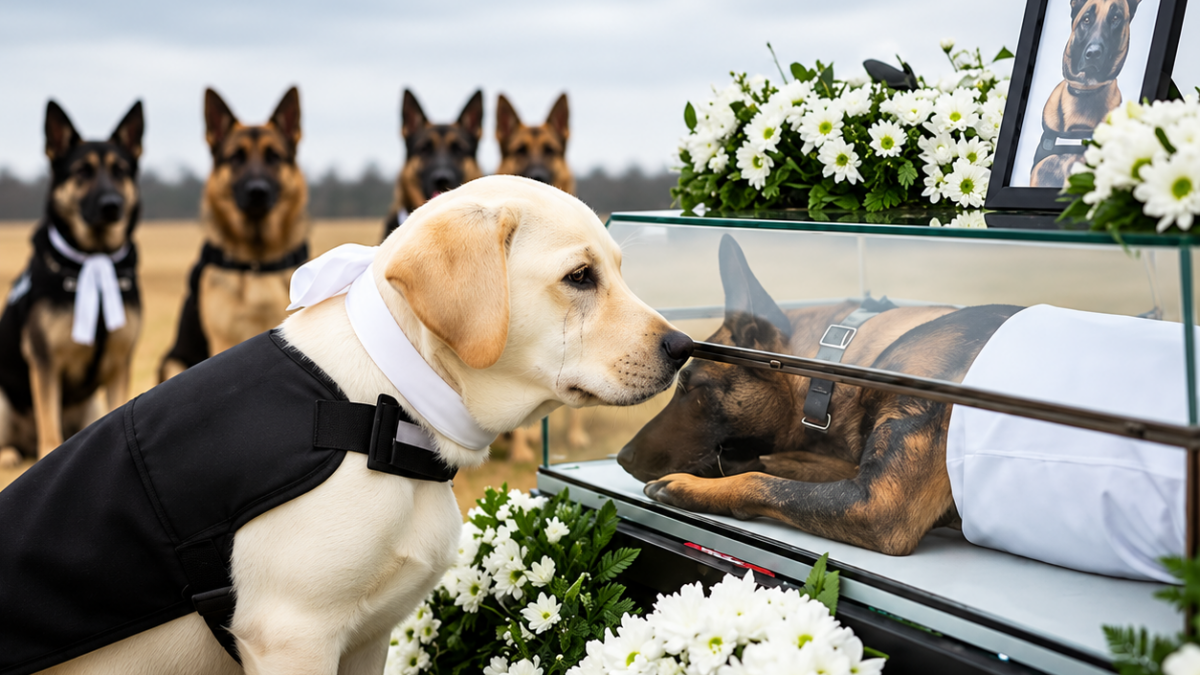
They placed Zach in a glass-covered ceremonial casket surrounded by white flowers. His body was wrapped in white. His photo stood behind him. A wreath of white roses rested near the front. The chief insisted on full honors.
I let them.
Maybe because arguing took energy I did not have.
Maybe because some part of me knew Zach had earned more than I could give alone.
The line of officers formed first.
Then handlers with their dogs.
One by one, the K9s approached.
Some sniffed the flowers.
Some stared at the casket.
Some leaned into their handlers, unsettled by the grief in the air.
The German Shepherds stood behind me like silent sentries.
Then Milo came forward.
He wore a black vest with the silver “M” Grace had stitched herself.
M for Milo.
M for memorial.
M for the dog Zach had made possible.
I held his leash because Grace could not.
She stood beside my mother, face buried in a tissue, too heartbroken to guide him.
“Milo,” I whispered. “Easy.”
He walked slowly.
Not like his usual bouncy self.
No wagging.
No sniffing.
No clumsy enthusiasm.
He knew.
He stopped at the casket.
For a second, he only looked.
Then he stepped closer and pressed his nose to the glass directly over Zach’s muzzle.
The entire courtyard went still.
Milo breathed against the glass.
A small fog appeared where his nose touched.
Then he let out a sound I had never heard from a dog.
Not a bark.
Not a whine.
Not a howl.
A broken, trembling cry that seemed to come from somewhere deeper than training, deeper than instinct, deeper than anything humans have a clean word for.
Grace collapsed against my mother.
Chief Morales turned away.
Boone County’s K9 handler, a man built like a refrigerator and known for never crying, wiped his face openly.
Milo did not move.
He pressed his nose harder against the glass as if waiting for Zach to wake up and correct him for being too close.
I knelt beside him.
My dress uniform pulled tight across my shoulders. My knees hurt against the stone. None of it mattered.
“Milo,” I whispered. “Buddy.”
He looked at me once.
His eyes were wet.
I do not care who says dogs do not cry the way people do.
I know what I saw.
Then he looked back at Zach.
The chaplain had been waiting to speak.
The chief had a folded page in his hand.
The radio operator stood nearby, ready for the final call.
But nobody interrupted Milo.
Because in that moment, every person there understood something painfully simple.
We had speeches.
Milo had grief.
And his was purer than ours.
When he finally stepped back, he did not return to the line.
He lay down beside the casket.
Front paws stretched forward.
Head low.
Guarding.
Just like Zach used to do outside Grace’s bedroom.
Just like Zach had done outside hospital rooms, interview rooms, and patrol cars.
Milo had learned the last duty from the dog he loved most.
Stay.
Watch.
Do not leave your partner alone.
The chief folded his paper and put it away.
Later, he told me there was no speech that could compete with that.
Instead, the radio call began.
Static whispered through the speaker.
“All units, stand by for final call.”
Every officer straightened.
Every handler tightened their grip.
The radio operator’s voice shook.
“K9 Zach, badge P-F-17, served with bravery and distinction from 2019 to 2024.”
A pause.
“You ran toward danger so others could run toward safety.”
Another pause.
“You were more than a partner. You were a shield, a guardian, and a faithful friend.”
I closed my eyes.
Milo remained beside the casket, unmoving.
“K9 Zach, this is your final patrol.”
The silence afterward felt endless.
Then:
“K9 Zach, you are relieved of duty.”
My knees almost gave out.
The operator’s voice broke on the final words.
“Rest easy, good boy. We have the watch from here.”
A sound moved through the crowd.
Not applause.
Not crying exactly.
A collective breaking.
Dozens of officers, hardened by things they never talked about, stood with tears on their faces because a dog had given everything without ever understanding medals, budgets, politics, or praise.
Zach had only understood the work.
The leash.
The command.
The scent.
The child hidden in the dark.
The partner beside him.
The door that needed entering first.
After the final call, I was supposed to step forward.
I was supposed to say my prepared words.
Nine words.
But Milo was still there.
Still guarding.
So I did not read from the paper.
I walked to the casket and placed one hand on the glass.
My reflection looked back at me, broken and pale, over Zach’s still face.
“Here you are, buddy,” I whispered, the same words I used every time I opened the cruiser door at the start of shift.
Then my voice failed.
I tried again.
“We’ll miss you so much.”
That was all I could manage.
It was not enough.
It was all I had.
The department retired Zach’s kennel number that day.
They placed his badge in the lobby beneath his photograph. Children from the elementary school sent drawings. Noah sent his stuffed German Shepherd for one night so it could “sit with Zach’s picture,” then asked for it back because he still needed it.
The teenage boy from Zach’s final call wrote a letter that I still keep in my locker.
Officer Hayes,
I don’t remember everything from that night. I remember being scared. I remember hearing yelling. I remember thinking nobody was coming upstairs fast enough. Then I heard barking.
I used to have nightmares about that sound.
Now when I remember it, I think that was the sound of somebody coming for me.
I’m sorry Zach died.
Thank you for sharing him with us.
Sharing him.
That phrase nearly broke me because that was exactly what every K9 handler does.
We love them privately.
Then we send them publicly into the worst moments of other people’s lives.
We ask them to protect strangers.
To track the lost.
To stand between violence and the vulnerable.
To give their courage away every day until their bodies cannot give more.
And when they are gone, we discover pieces of them living in people we barely know.
Zach lived in Noah’s stuffed dog.
In that teenager’s letter.
In the scar on a suspect’s arm that meant a rifle did not fire upstairs.
In Milo’s gentle work with children.
In Grace’s decision, two years later, to volunteer at the animal shelter because “dogs shouldn’t have to be brave all the time.”
He lived in me too.
Not in the easy ways.
Not only in memory.
Zach changed how I trained every dog after him.
He changed how I taught younger handlers.
I stopped letting them ask, “How do I make the dog obey?”
I made them ask, “How do I make the dog understand?”
There is a difference.
Control can create compliance.
Trust creates courage.
Zach had courage because he trusted me.
And that trust was the greatest honor of my life.
Milo never became Zach.
Nobody expected him to.
He did not chase suspects.
He did not bite on command.
He did not clear buildings.
He sat beside children who had seen too much. He leaned against grieving officers after fatal calls. He rested his head on hospital beds. He walked into courtrooms with victims whose hands shook too hard to hold still.
He carried Zach differently.
Softer.
But just as faithfully.
For months after the funeral, Milo slept beside Zach’s old collar.
If anyone moved it, he searched until he found it.
One evening, I found Grace sitting on the kitchen floor with Milo’s head in her lap and Zach’s collar between them.
“Do you think he misses him forever?” she asked.
I sat beside her.
“Yes.”
“Will we?”
“Yes.”
She nodded.
“Good.”
I looked at her.
“Good?”
“If we stopped missing him, that would mean he went too far away.”
I pulled her into my arms.
Children understand grief in ways adults spend years trying to remember.
A year after Zach’s final call, we held a small ceremony at the department.
No cameras.
No news.
Just handlers, family, and the people who loved him.
We planted a white dogwood tree near the K9 training field.
Milo came with me.
He was calmer now.
Older.
Still gentle.
Still carrying grief in quiet ways.
When we placed Zach’s collar in a small memory box beneath the tree, Milo sniffed the ground, circled once, and lay down beside it.
Not crying this time.
Not pressing his nose against glass.
Just resting.
As if he finally understood Zach was not trapped somewhere waiting to be awakened.
He was part of the ground now.
Part of the field.
Part of the wind that moved through the trees while young K9s learned to track, heel, search, and trust.
Chief Morales asked if I wanted to say anything.
This time, I did.
I looked at the handlers standing in a semicircle, each with a dog at their side.
“People ask what made Zach special,” I said. “They ask if it was his training, his drive, his courage, his discipline.”
Milo leaned against my leg.
“All of that mattered. But what made Zach special was that he gave his whole heart to every job and never once asked whether the person he was saving deserved it.”
I paused.
“That is what dogs do better than us. They do not protect only the easy, the grateful, the innocent, or the kind. They protect because we ask them to. They love because love is what they have. They forgive faster than we deserve. And they stay as long as they can.”
My voice shook, but it held.
“So if you are lucky enough to stand beside a dog like that, earn it. Every day. Earn the leash in your hand. Earn the eyes looking back at you. Earn the trust that makes them run into darkness because they believe you will be there when they come out.”
No one spoke for a moment.
Then Milo stood, walked to the base of the young tree, and pressed his nose against the soil.
Just once.
Then he came back to me.
That was his speech.
It was better than mine.
Years from now, people will still see Zach’s photo in the department lobby.
Some will walk past without knowing his story.
Some child will ask why there is a dog in a frame beside the officers.
Someone will say, “That was K9 Zach. He was a hero.”
And that will be true.
But it will not be the whole truth.
The whole truth is that Zach was stubborn in the morning and dramatic about baths.
He loved tennis balls more than professional dignity.
He hated puddles unless chasing someone through them became necessary.
He once stole half a sandwich from my desk and looked offended when I accused him.
He knew when my daughter cried.
He knew when I was afraid.
He knew how to become thunder at a door and silence beside a child.
He knew Milo needed saving before anyone filled out an adoption form.
He knew how to work.
He knew how to love.
And at the end, when his body was tired and the world finally asked him to rest, he left behind something no illness could take.
A department that remembered.
A handler who changed.
A little girl who learned grief means love had somewhere real to live.
And a yellow Lab in a black vest who pressed his nose to the glass and taught a courtyard full of grown men that loyalty does not end when the breathing does.
K9 Zach was relieved of duty that day.
But he was never relieved of love.
No dog like that ever is.


