They Mocked the 71-Year-Old Veteran’s “Cowboy Gun”—Then He Beat the Two-Time Champion’s Custom AR With a 57-Year-Old Lever-Action Winchester.
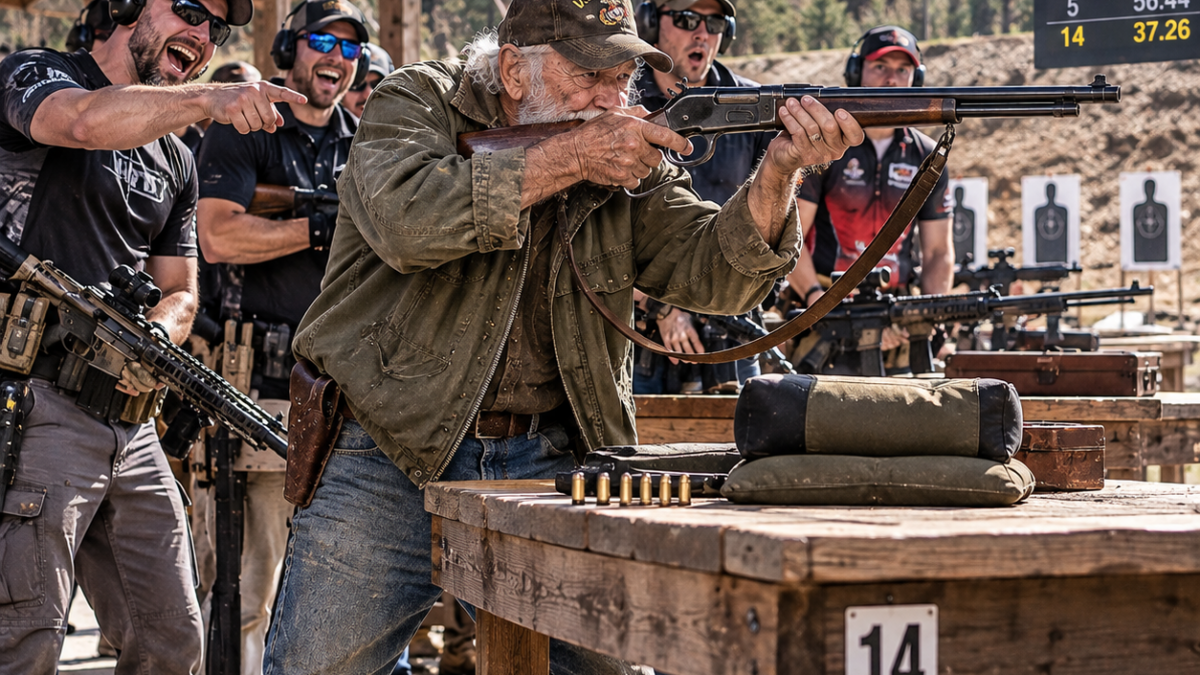
They Mocked the 71-Year-Old Veteran’s “Cowboy Gun”—Then He Beat the Two-Time Champion’s Custom AR With a 57-Year-Old Lever-Action Winchester.
They laughed when seventy-one-year-old Earl Barlow carried a battered Winchester lever-action onto a firing line crowded with race-tuned semi-automatics, red-dot optics, thirty-round magazines, and shooters young enough to be his grandsons.
By lunchtime, the old man with seven rounds, iron sights, and a rifle built on a nineteenth-century design was sitting four points behind the two-time defending champion—and nobody was laughing anymore.
Then Earl reached the final ten-plate speed stage, where everyone knew his lever-action would finally betray him, and what happened over the next six seconds forced the loudest man on the range to ask one quiet question: “Where did you learn to shoot like that?”
Seven rounds.
That was all Earl Barlow had in the rifle.
Seven rounds inside a walnut-stocked Winchester that looked more at home leaning behind the seat of an old farm truck than lying on a modern competition bench.
Around him, twenty-eight other shooters carried rifles with detachable thirty-round magazines.
Red dots.
Magnifiers.
Competition triggers.
Compensators.
Muzzle brakes.
Adjustable stocks.
Handguards covered in rails.
Some of those rifles cost more than Earl’s first car.
Nobody there thought equipment alone made a great shooter.
They were too experienced for that.
But almost everybody believed the same thing about that particular match.
Equipment mattered enough that bringing a lever-action was ridiculous.
The Cedar Ridge Sportsman’s Club Fall Invitational had not been built for nostalgia.
It was built for speed.
And everybody knew it.
The club sat outside Harrisburg, Pennsylvania, on nearly a hundred acres of rolling wooded ground that had once belonged to a dairy farm.
The original members had bought the property in the late 1990s.
They poured their own concrete.
Welded target stands.
Cut trails.
Built berms.
Raised the pavilion.
For years the club was a mixture of hunters, veterans, police officers, weekend plinkers, families teaching kids gun safety, and retirees who preferred talking about rifles almost as much as shooting them.
Then competitive shooting became the club’s biggest attraction.
Nothing wrong with that.
The matches brought money.
Sponsors.
New members.
Energy.
But the culture changed.
The younger crowd cared about split times.
Transitions.
Stage planning.
Reload efficiency.
Equipment optimization.
They watched match footage frame by frame.
Measured tenths of seconds.
Dry-fired in garages.
Spent evenings tuning triggers and debating optics.
The older members noticed.
Some adapted.
Some stopped competing.
Not because anyone formally excluded them.
PART2:
Nobody hung a sign saying OLD MEN STAY HOME.
It happened more quietly.
A joke here.
A look there.
A young shooter examining a fifty-year-old hunting rifle and saying:
“You still use that?”
Eventually, some older men decided they preferred Tuesday afternoons when the ranges were empty.
Skill had not disappeared.
Visibility had.
Tom Wyatt noticed.
Tom was sixty-three and had directed matches at Cedar Ridge for fifteen years.
He had helped build two of the ranges himself.
He liked the younger competitors.
They were serious.
Disciplined.
Talented.
But something bothered him.
The club was beginning to behave as if shooting knowledge had been invented alongside polymer magazines.
That Saturday in October, Tom would watch that assumption disappear in six seconds.
The morning began at 7:06.
Cold.
Thin cloud cover.
Thirty-eight degrees.
Wind light from the northwest.
Earl pulled into the gravel parking area in a faded red Ford Ranger.
No stickers.
No sponsor logos.
No expensive gun rack.
The truck was old enough that rust had started blooming around the rear wheel wells.
He parked away from the crowd.
Turned off the engine.
Sat for a moment.
Then reached across the bench seat.
Canvas rifle case.
Small cardboard ammunition box.
Thermos.
Paper bag lunch.
That was his equipment.
He stepped out.
Five feet ten.
Maybe 165 pounds.
White hair clipped short.
Deep lines around his eyes.
Brown work boots.
Khaki pants.
Faded olive-green field jacket.
The jacket had been washed hundreds of times.
The fabric had gone soft.
There was a pale rectangular shadow above the left breast where a name tape had once been sewn.
Another faint shape above the opposite pocket.
Most people would never notice.
Earl did not dress to be noticed.
He never had.
At the registration table, Cheryl Mason smiled.
She had volunteered at Cedar Ridge matches for eleven years.
She saw Earl approach and assumed he wanted spectator wristbands.
“Morning.”
“Morning, ma’am.”
“You here to watch somebody?”
“No, ma’am.”
Earl placed the rifle case beside his leg.
“I’m shooting.”
Cheryl paused.
“The Invitational?”
“Yes.”
She recovered quickly.
“Of course.”
She slid the form toward him.
Earl filled it out.
NAME:
Earl Barlow.
AGE:
CLUB AFFILIATION:
None.
FIREARM:
Winchester Model 1894.
CALIBER:
.30-30 Winchester.
Cheryl read the last line.
Then looked at the canvas case.
“Lever gun?”
“Yes, ma’am.”
“Today?”
He looked around.
“Seems like the right day.”
Cheryl smiled.
“I hope so.”
She handed him competitor number 14.
Earl pinned it to his jacket.
Then walked toward the pavilion.
He passed the main parking row.
That was where Kyle Hendricks was holding court.
Kyle was twenty-eight.
Six feet one.
Broad shoulders.
Short beard.
Sponsor jersey.
He had won the Fall Invitational two years in a row.
People knew him.
He deserved that recognition.
Kyle was genuinely excellent.
Fast.
Accurate.
Methodical.
He practiced.
He studied footage.
He earned his wins.
His rifle reflected that seriousness.
Custom AR-15.
Short, well-balanced barrel.
Red-dot optic.
Tuned three-pound trigger.
Compensator that kept the muzzle flat.
Kyle stood beside his black pickup explaining the trigger to three shooters.
“Three pounds exactly.”
“Reset’s almost nothing.”
“I can run doubles around twelve hundredths if I’m clean.”
One shooter saw Earl.
Nudged Kyle.
“Check this out.”
Kyle turned.
Saw the canvas case.
Old field jacket.
Cardboard ammunition box.
Earl walked past.
The shooter said loudly:
“Nice cowboy gun, Grandpa.”
Another added:
“Horse tied out front?”
Laughter.
Kyle smiled.
Not cruelly.
Not yet.
More reflex than malice.
Earl heard.
He kept walking.
He had heard worse from better men.
At 8:30, Tom Wyatt began the safety briefing.
Twenty-nine competitors stood beneath the pavilion.
Tom covered range commands.
Muzzle discipline.
Cold-range procedures.
Stage boundaries.
Penalty structure.
Then scoring.
Five stages.
Accuracy plus time.
No divisions by equipment platform that year.
Everybody competed together.
Tom pointed toward the stage map.
“You can win fast.”
“You can win clean.”
“You cannot win sloppy.”
A few shooters smiled.
Then Tom announced that a small local shooting channel would film the event.
Two-person media team.
Camera operator Ben Foster.
Interviewer Rachel Kim.
Waivers circulated.
Earl signed.
Kyle signed.
Everybody signed.
Tom moved to final instructions.
“Any equipment issues, call a range officer.”
“Any safety concern, stop.”
“No match is worth getting hurt.”
Then:
“Have fun.”
Squads separated.
Earl was assigned to Squad Three.
Their first stage was Stage Two.
Six steel plates.
Fifteen yards.
Pure speed.
The plates stood shoulder-high in a horizontal line.
Shooter started ready.
Buzzer.
One hit per plate.
Timer stopped when final steel fell.
Fast shooters lived in the low threes.
Exceptional ones could dip below.
Kyle’s previous record was 2.6 seconds.
Squad Three gathered behind the line.
Earl unzipped the canvas case.
That was the first time anyone really saw the rifle.
Winchester Model 1894.
Manufactured in the late 1960s.
Twenty-inch barrel.
Walnut stock darkened by decades of oil and handling.
Bluing worn silver around high-contact areas.
Small repaired crack near the wrist.
Original-style iron sights.
Nothing tactical.
Nothing modern.
Nothing decorative.
It looked used.
Not neglected.
There is a difference.
A young competitor named Mason Pike stared.
Twenty-five.
Good shooter.
Fast hands.
Four magazines across his belt.
“You’re actually running that?”
Earl removed the rifle.
“Yes.”
Mason laughed nervously.
“I thought maybe you brought it for a side event.”
“No.”
“This is a speed match.”
“I heard.”
“That action is, what, a hundred thirty years old?”
Earl began loading.
One cartridge.
Then another.
Smooth.
“You know how old the rifle design is?”
Mason asked.
Earl closed the lever.
“Yes.”
Then:
“I was there when they invented speed.”
Mason stopped smiling.
He couldn’t decide whether the old man was joking.
Earl’s face gave him nothing.
First shooter ran 3.4.
Clean.
Second:
Mason.
3.1.
Clean.
He lowered his AR.
Looked toward Earl.
Not smug exactly.
But pleased.
Third:
3.7.
Fourth:
3.9 plus one miss penalty.
Then competitor fourteen.
Tom had drifted over.
He told himself he was checking stage flow.
Really, he wanted to see the lever gun.
The range officer said:
“Shooter ready?”
Earl shouldered the Winchester.
Something changed.
That was the first thing Tom noticed.
Off the line, Earl looked seventy-one.
Behind the rifle, age became less obvious.
Not because he moved younger.
Because everything unnecessary disappeared.
Shoulders relaxed.
Head settled.
Feet placed.
The rifle fitted him like something worn rather than held.
“Ready.”
Buzzer.
First shot.
Steel fell.
Lever down.
Up.
Second.
Another plate.
Down-up.
Third.
Fourth.
Fifth.
Sixth.
Done.
The entire sequence sounded wrong.
People expected:
Bang.
Clack-clack.
Bang.
Clack-clack.
Something visibly mechanical.
Instead, the lever movement fit inside recoil.
The rifle rose.
Earl’s hand moved.
Action opened.
Brass left.
Action closed.
Sights returned.
Shot broke.
The mechanism became rhythm.
The timer beeped.
Range officer looked.
“Three point two.”
Silence.
Mason looked at the display.
Then Earl.
Then rifle.
“Three-two?”
Range officer nodded.
“Clean.”
One tenth slower than Mason’s custom AR.
Earl lowered the hammer safely.
Opened the action.
Then crouched and picked up his brass.
Mason cleared his throat.
“That was… pretty good.”
Earl slipped a casing into his pocket.
“Thank you.”
No grin.
No victory pose.
No comment about the cowboy joke.
That made it worse for anyone hoping to dismiss him.
News traveled.
A lever-action shooting 3.2.
Old guy.
Iron sights.
By the time Squad Three moved to the next stage, several competitors from other squads had wandered nearby.
Ben, the camera operator, followed.
Rachel whispered:
“Is he actually good?”
Ben kept filming.
“Looks like.”
Stage Three shifted from raw speed to accuracy.
Paper silhouettes at fifty and seventy-five yards.
Ten rounds total.
Sixty-second limit.
Five per target.
Scoring rings.
One hundred points possible.
Equipment advantage moved toward optics.
The better modern shooters regularly scored high eighties or low nineties while staying quick.
Earl placed the Winchester on the bench.
Loaded seven.
Set three loose cartridges beside his left hand.
Tom watched.
“You know you can use more time.”
Earl looked at him.
“How much?”
“Sixty seconds.”
“Plenty.”
Kyle arrived with another squad just as Earl prepared.
Someone whispered:
“That’s him.”
Kyle glanced.
He had heard the 3.2 story.
He did not look worried.
One stage proves nothing.
Anyone can have a fast run.
Range officer:
“Ready?”
Earl nodded.
Buzzer.
First shot.
The paper moved slightly.
Second.
Third.
Fourth.
Fifth.
He shifted to seventy-five yards.
Sixth.
Seventh.
Magazine empty.
Then something else happened.
Earl kept the rifle shouldered.
Left hand went to the bench.
Three cartridges.
Into loading gate.
One.
Two.
Three.
No fumbling.
No staring at the receiver.
His fingers already knew.
Lever.
Fire.
Fire.
Fire.
Done.
Timer:
41 seconds.
Plenty left.
Range officer walked down with scoring clipboard.
The spectators waited.
First target.
Five holes.
All center ten ring.
Two overlapping.
Second.
Five.
All ten.
The officer stared.
“Possible hundred.”
Tom came closer.
Second scorer called.
They checked.
No line cutters needed.
No debate.
“One hundred.”
Someone behind the line whispered:
“No way.”
Range officer raised the target.
“One hundred.”
The crowd reacted differently this time.
Not explosive applause.
A low murmur.
People recalculating.
The old man was no longer amusing.
He was dangerous.
Kyle heard before his own turn.
“You hear Barlow shot a hundred?”
Kyle laughed.
“On what?”
“Fifty and seventy-five.”
“With the Winchester.”
Kyle stopped.
“What did second place shoot?”
“Ninety-four.”
Kyle looked toward Earl.
The old man was sitting on a folding chair drinking coffee.
No attention to anyone.
Kyle’s expression tightened.
Not resentment.
Competition.
Good competitors recognize threats quickly.
Kyle stepped to the line later.
Shot a ninety-two.
Excellent.
Normally enough.
Today it cost him ground.
At lunch, cumulative scores showed:
Kyle Hendricks — first.
Earl Barlow — second.
Gap:
Four points.
People took photographs of the board.
Earl ignored it.
He sat at a picnic table near the tree line.
Paper-bag sandwich.
Thermos.
Apple.
Same lunch he had eaten at ranges for decades.
Rachel approached with microphone.
“Mr. Barlow?”
Earl looked up.
“We’re doing a short video about the match.”
“I noticed.”
“Can we interview you?”
“After.”
“After what?”
“Last stage.”
Rachel smiled.
“Deal.”
She left.
Kyle sat at another table with friends.
Mason joined him.
“That old guy’s for real.”
Kyle nodded.
“You see his reload?”
“Yeah.”
“Doesn’t look at the gun.”
“No.”
Kyle glanced toward Earl.
“Where does somebody learn that?”
Mason shrugged.
“Cowboys?”
Kyle didn’t laugh.
The next stage was movement.
Barricades.
Eight targets.
Varying distances.
Some steel.
Some paper.
Moving target.
Multiple positions.
This was the kind of stage younger shooters trained for weekly.
Speed.
Footwork.
Transitions.
Memory.
Target order.
Semi-automatic platforms dominated.
Earl walked the course before his turn.
No jokes.
No swagger.
He asked two questions.
“What’s the swing interval on target six?”
Range officer explained.
Then:
“Mandatory reload?”
“No.”
Earl nodded.
He stood behind the start marker.
Eyes moving.
Not across targets randomly.
He was building sequence.
Kyle noticed.
“He’s planning around seven rounds.”
Mason asked:
“What?”
“He’s counting where the rifle empties.”
Earl loaded.
Extra cartridges into left jacket pocket.
Stage began.
The younger competitors exploded from start positions.
Earl did not.
He moved quickly.
But never faster than his ability to arrive ready.
First barricade.
Rifle already mounted before his foot stopped.
Steel.
Hit.
Paper.
One clean center.
Lever.
Movement.
Next.
He did not waste rounds on reassurance.
One target.
One shot.
Second position.
Kneel.
Two steel.
Moving silhouette.
He waited half a heartbeat.
Shot when target entered his sight window.
Hit.
Magazine nearly empty.
Earl rose.
As he moved toward final position, his left hand fed cartridges.
Nobody had seen anything like it that day.
He was not performing a dramatic speed reload.
He simply used movement time.
By the time he reached position three, rifle was ready.
Remaining steel fell.
Final plate.
Forty yards.
Small.
Earl settled just enough.
Shot.
Ring.
Done.
His raw time was only fourth fastest.
But zero misses.
Zero procedural penalties.
Perfect hits where bonuses applied.
Adjusted score placed him second on that stage.
Behind Kyle.
By less than two points.
Now the pavilion board mattered.
Earl remained second overall.
Kyle first.
Four-point lead had narrowed.
Final stage would decide.
Ten steel plates.
Twenty-five yards.
No accuracy rings.
No movement.
No complicated order.
Hit all ten.
Fastest time.
Simple.
Cruel.
A lever-action’s disadvantage was obvious.
Seven-round capacity.
Earl would need to reload.
Semi-autos would not.
Kyle had thirty rounds.
If he missed, he could correct instantly.
Earl could afford almost nothing.
One extra round beyond the ten required.
Everyone understood.
By 2:30, the gallery had doubled.
Club members who weren’t competing had heard.
People gathered behind the safety line.
Phones appeared.
Tom could feel the mood.
Morning had been amusement.
Afternoon was expectation.
Nobody cared anymore that Earl’s rifle was outdated.
They wanted to see how far he could take it.
Clouds thickened.
Temperature dropped.
Earl kept the olive jacket zipped.
Kyle finally noticed the faded rectangular shadows on the chest.
He walked closer to Tom.
“Tom.”
“Yeah?”
“That jacket military?”
Tom looked.
“Looks like an old field jacket.”
“See the tape ghosts?”
Tom squinted.
Kyle said:
“Name tape.”
“Service tape.”
Tom looked toward Earl.
“Could be surplus.”
Kyle nodded.
Could be.
Earl was called second-to-last.
Top four competitors shot at the end.
Third-place shooter ran 5.4 seconds.
Excellent.
Fourth:
5.6.
Then:
“Competitor fourteen.”
The crowd quieted.
Earl stepped forward.
Opened the Winchester.
Checked chamber.
Loaded seven cartridges.
Then placed four loose rounds upright on the table.
Seven in the rifle.
Four outside.
Eleven available.
Ten targets.
One spare.
Mason whispered:
“He’s giving himself one miss.”
Kyle heard.
“Yes.”
Earl closed action.
Range officer asked:
“Shooter ready?”
Earl looked at the plates.
Ten circles of white-painted steel.
“Yes.”
Buzzer.
The first seven targets disappeared almost before anyone processed the first shot.
Bang.
Steel.
Lever.
Bang.
Steel.
The cadence tightened.
The action flashed.
Brass arced through cold air.
One casing caught sunlight.
Another bounced near Earl’s boot.
Third.
Fourth.
Fifth.
Sixth.
Seventh.
Seven plates down.
3.1 seconds.
Then silence from rifle.
Reload.
This was where everybody expected time to die.
Earl tilted the Winchester.
Left hand swept the four cartridges from the bench.
Not a panicked grab.
His fingers separated them.
First.
Second.
Third.
Fourth.
Through loading gate.
Motion compact.
Practiced.
Lever closed.
Timer kept running.
1.8 seconds.
Then Earl raised.
Target eight.
Hit.
Nine.
Hit.
Ten.
Hit.
Timer beeped.
Range officer stared.
Nobody said anything.
He looked again.
“Six flat.”
Tom stepped closer.
“What?”
“Six point zero.”
Ten plates.
One reload.
Zero misses.
The gallery exploded.
Not because it was some impossible superhuman time.
Because they had watched the disadvantage become irrelevant through mastery.
Kyle stood still.
He had to beat six.
He had no reload.
That should have been possible.
His average practice runs on similar drills lived around high fives.
He stepped forward.
The applause died.
Earl moved away.
No games.
No stare.
No psychological pressure.
He started picking up brass.
Kyle inserted a thirty-round magazine.
Closed bolt.
Red dot.
Perfect setup.
The rifle that had won him two consecutive championships.
Tom asked:
“Ready?”
Kyle exhaled.
“Yes.”
Buzzer.
He was fast.
Extremely.
First target.
Second.
Third.
Transitions smooth.
No misses.
Fourth.
Fifth.
Sixth.
Kyle’s rifle barely moved.
Seventh.
Eighth.
Ninth.
Tenth.
Timer.
Kyle knew before he looked.
Something had felt fractionally tight between plates six and seven.
Range officer checked.
“Six point three.”
Nobody mocked him.
Six-three was excellent.
But six-three was not six.
Kyle removed magazine.
Cleared rifle.
Set it down.
Then stood.
For perhaps ten seconds he looked at the plates.
Then toward Earl.
Earl was kneeling near the bench collecting a casing.
Kyle walked over.
People noticed.
Cameras pivoted.
Earl stood.
Kyle was forty-three years younger.
Taller.
Stronger.
Current champion.
He had every technical advantage a modern competitor could reasonably want.
He looked at the Winchester.
Then at Earl.
Finally:
“Where did you learn to run a lever like that?”
Earl’s expression changed.
Very little.
Enough.
He looked toward the tree line.
Then said:
“Khe Sanh.”
Kyle went still.
Nobody nearby spoke.
“1968.”
Earl’s voice remained level.
“Twenty-sixth Marines.”
Kyle glanced toward the faded jacket.
Now he understood the missing tapes.
Earl continued:
“I was nineteen.”
“We held there seventy-seven days.”
His eyes moved somewhere farther than the Cedar Ridge berms.
“The rifle I carried then wasn’t this one.”
“Different tool.”
“But you learn the same lesson.”
“What lesson?”
Kyle asked.
Earl looked at him.
“The tool needs to work when your hands don’t have time to ask what comes next.”
No one moved.
Earl looked down at the Winchester.
“I came home.”
“Bought this rifle a few years later.”
“Started shooting it.”
“Kept shooting it.”
“For what?”
Kyle asked.
Earl thought.
“Long time I didn’t know.”
The spectators had drawn closer without crossing the line.
Earl rested one hand on the canvas case.
“At first because it kept my hands busy.”
“Then because I could take something I learned in a bad place and turn it into something clean.”
Kyle’s face lost the last trace of competition.
Earl said:
“At Khe Sanh, speed had reasons I don’t like remembering.”
“Here?”
He looked toward the steel.
“Just a clock.”
“That’s better.”
Kyle extended his hand.
“It’s an honor, sir.”
Earl looked at the hand.
Then took it.
“Good run.”
Kyle laughed softly.
“You beat me.”
“Still good.”
The applause started somewhere behind them.
One person.
Then more.
Kyle did not let go immediately.
Neither did Earl.
Tom came over carrying the final sheet.
“Overall winner.”
He looked at Earl.
“Competitor fourteen.”
“Earl Barlow.”
More applause.
Tom handed him the trophy.
Small brass shooter mounted on walnut.
Earl held it awkwardly.
Rachel approached after the scoring ceremony.
“You promised.”
Earl looked at her microphone.
“I did.”
They sat on the tailgate of his Ranger.
Winchester case beside Earl.
Trophy on the other side.
Rachel asked:
“Why bring a lever-action to a match dominated by semi-automatics?”
Earl looked toward the range.
“Because that’s what I shoot.”
“You knew you’d be at a disadvantage.”
“Yes.”
“Magazine capacity.”
“Yes.”
“Iron sights.”
“Yes.”
“Slower action.”
Earl looked at her.
“Slower for who?”
Ben behind camera almost laughed.
Rachel smiled.
“Fair.”
She asked:
“Do you think equipment matters?”
“Of course.”
That answer surprised her.
“A good tool matters.”
“Better sights help.”
“Good trigger helps.”
“Reliability matters.”
“Anybody telling you equipment doesn’t matter is selling something.”
He paused.
“But equipment can’t buy familiarity.”
“What do you mean?”
Earl tapped the canvas case.
“I know this rifle.”
“I know what the sights look like when I’m tired.”
“I know how the lever feels when it’s dirty.”
“I know where the trigger breaks.”
“I know how the stock sits with three jackets on in January.”
“I know how it moves when my hands are cold.”
“I’ve worked this action tens of thousands of times.”
“You can buy a better rifle.”
“You can’t buy yesterday’s practice.”
Rachel went quiet.
That line would become the quote everybody repeated.
She asked:
“What about the younger shooters who laughed at you this morning?”
Earl looked toward Kyle.
Kyle was helping Mason pack equipment.
“They’re good shooters.”
“That’s it?”
“What do you want me to say?”
“That they underestimated you.”
“They did.”
“Does that bother you?”
“No.”
“Why?”
Earl thought.
“When you get old, people underestimate you because they’re using the only information they have.”
“They see age.”
“Old rifle.”
“Slow walk.”
“That’s normal.”
“What matters is what happens after they learn more.”
He nodded toward Kyle.
“That boy walked over and shook my hand.”
“That tells me more about him than the joke this morning.”
Rachel asked:
“So you don’t have a message for them?”
Earl smiled faintly.
“Practice.”
“That’s all?”
“What else is there?”
She laughed.
Then:
“You mentioned Khe Sanh.”
Earl’s expression closed slightly.
Rachel noticed.
“You don’t have to talk about it.”
He nodded.
Silence.
Then surprisingly:
“There were nights there when fog swallowed everything.”
Rachel waited.
Earl looked down.
“We were young.”
“That’s the part people forget.”
“You see old men at veteran events.”
“Gray hair.”
“Bellies.”
“Canes.”
“You forget those men were nineteen.”
“Twenty.”
“Twenty-one.”
He rubbed one thumb over the edge of the trophy.
“We were scared.”
“Everybody who says he wasn’t is either lying or forgot.”
“I learned speed because sometimes there wasn’t time for anything else.”
“That skill stayed after the reason changed.”
He looked toward the steel range.
“I preferred the new reason.”
Rachel asked:
“Competition?”
“Yeah.”
“Clean targets.”
“Timer.”
“Everybody goes home.”
His voice softened.
“That’s a good day.”
The video posted two weeks later.
Title:
71-YEAR-OLD MARINE BRINGS LEVER GUN TO TACTICAL MATCH.
Thumbnail:
Earl mid-cycle.
Brass in air.
Kyle watching.
The video spread.
Competitive shooting channels.
Veterans pages.
History forums.
Mainstream social feeds.
People argued about platforms.
Of course.
Some praised Earl.
Some insisted Kyle could have beaten him on another day.
Earl would have agreed.
Some complained the stages favored accuracy.
Others claimed the lever-action had hidden modifications.
It didn’t.
A few viewers wanted to know his exact loading technique.
Earl ignored all of them.
Tom called.
“Four million views.”
“What?”
“The video.”
“I don’t know what that means.”
“It means four million people watched.”
“Why?”
Tom laughed.
“Because you beat everybody with a Winchester.”
“I beat them once.”
“Still.”
“Tell people to go outside.”
Tom stopped trying.
The effect at Cedar Ridge mattered more.
Older members returned.
Not in some dramatic parade.
One Tuesday, sixty-six-year-old Walter Simms brought the bolt-action Remington he had hunted with since 1981.
He competed.
Finished near the bottom.
Had a wonderful time.
A retired police officer brought an old Mini-14.
A woman in her sixties entered with a rifle her late husband had taught her to shoot.
Nobody laughed.
The younger shooters asked questions.
The older shooters, to their credit, began asking questions too.
About optics.
Timers.
New training ideas.
The generations stopped acting like they were competing cultures.
They just competed.
Kyle bought a Henry lever-action.
Not to replace his AR.
To learn something different.
He brought it to the next club day.
Earl saw him.
Kyle opened the case proudly.
Earl looked.
“Nice.”
“I’ve been practicing.”
“Show me.”
Kyle loaded.
Ran a plate drill.
Competent.
Slow.
He turned.
Earl said:
“Reload’s terrible.”
Kyle laughed.
“I knew you were going to say that.”
“You’re fishing for cartridges.”
“How do I stop?”
“Practice enough that you don’t.”
“That’s your answer to everything.”
“Works.”
Kyle practiced.
The relationship developed.
Not mentor and disciple exactly.
Earl would have hated that language.
They became shooting friends.
Forty-three years apart.
Kyle taught Earl how to use a red-dot optic.
Earl hated it for twenty minutes.
Then admitted:
“That’s pretty good.”
Kyle almost fell over.
Earl eventually shot Kyle’s AR.
Fast.
Very fast.
Kyle grinned.
“Okay.”
“Now imagine thirty rounds.”
Earl cleared the rifle.
“Why?”
“Because you can.”
“That’s not a reason.”
Kyle laughed.
They argued constantly.
Platform.
Caliber.
Triggers.
Training.
But the arguments were respectful.
Kyle learned the thing he had missed on the first morning.
Earl was not anti-modern.
He simply did not confuse modern with automatically better.
Earl learned something too.
The younger shooters were not spoiled gadget collectors.
At least not most.
They trained hard.
They cared.
Their tools were different because their disciplines were different.
Both generations had made assumptions.
One just made theirs louder.
The trophy went home.
Earl placed it on a shelf.
Beside a folded flag.
Beside a photograph.
Seven young Marines in red dirt.
Khe Sanh behind them.
Fog around distant hills.
Earl was second from left.
Nineteen.
Skinny.
Rifle in hand.
Grinning.
Another Marine had an arm around his neck.
Tommy Wheeler.
Tommy did not come home.
Neither did Carl Benson.
Neither did Luis Ortega.
Three others in the photograph survived.
One died twenty years later.
One Earl lost contact with.
One still sent Christmas cards.
Earl never displayed medals prominently.
The photograph mattered more.
Every morning he passed it on the way to coffee.
Sometimes he looked.
Sometimes not.
He did not need the photograph to remember.
Years later, Kyle finally asked about the Winchester itself.
They were sitting behind the club range after practice.
“Why that rifle?”
Earl looked.
“What do you mean?”
“You said you bought it after Vietnam.”
“1972.”
“Why a lever gun?”
“My father.”
Kyle waited.
Earl rarely offered stories unless someone waited properly.
“My dad had one.”
“Not this one.”
“Same model family.”
“He hunted deer.”
“Taught me with it.”
“When I came home, his rifle was gone.”
“Sold?”
Earl nodded.
“Farm had a bad year.”
“He sold it while I was overseas.”
“Didn’t tell me.”
Kyle said:
“So you bought another.”
“Yep.”
“This one?”
Earl looked at the walnut.
“Gun shop outside Lancaster.”
“Used.”
“Seventy-five dollars.”
Kyle smiled.
“Best seventy-five dollars you ever spent?”
Earl shook his head.
“No.”
“My wedding license was cheaper.”
Kyle laughed.
Earl smiled.
His wife, Mary, had died six years before the match.
That was another thing people did not know.
Mary had been a nurse.
They met after Earl came home.
She tolerated gun oil on kitchen tables.
Competition weekends.
Reloading equipment.
Decades of early mornings.
Earl stopped shooting matches after her illness worsened.
For nearly eight years.
The Fall Invitational had been his first competition since before she died.
Kyle learned that slowly.
“You came back because…?”
Earl stared at the range.
“House got too quiet.”
Kyle nodded.
He understood more than Earl expected.
His own father had died the year before.
They sat in silence.
Then Kyle said:
“So you entered the hardest match you could find with a lever-action.”
Earl shrugged.
“Seemed less boring than bingo.”
Kyle laughed for almost a minute.
The following fall, Earl returned.
Competitor number fourteen again.
This time nobody laughed.
That bothered him.
Tom noticed.
“You look annoyed.”
“They’re being weird.”
“How?”
“Everybody’s watching.”
“You went viral.”
“Stupid word.”
“Accurate word.”
“I liked it better when they ignored me.”
Tom smiled.
“You complain either way.”
“Correct.”
Earl did not win the second year.
Kyle did.
By two points.
Final stage.
Earl missed one plate.
Had to re-engage.
Time cost him.
When Kyle’s name was announced, Earl clapped harder than anyone.
Kyle carried the trophy over.
“Want to check it for me?”
Earl examined it.
“Same cheap plastic.”
Kyle laughed.
“You mad?”
“About what?”
“Losing.”
Earl looked genuinely confused.
“No.”
Kyle shook his head.
“You are impossible.”
Earl pointed toward the missed plate.
“I pulled that shot.”
“That bothers me.”
“Losing doesn’t.”
That was another lesson Kyle remembered.
Compete against the task.
The standings follow.
Over the next few years, Cedar Ridge added something called the Heritage Stage to the Fall Invitational.
Not a separate old-man category.
Tom refused that.
Instead, one stage each year emphasized fundamentals over equipment advantage.
Iron-sight option.
Manual-action bonus.
Unusual positional challenge.
Everybody could enter with anything legal.
Modern equipment remained.
So did older platforms.
The point was not nostalgia.
Variety.
The club began offering skill-exchange days.
Younger competitors taught modern movement drills.
Older members taught field positions, sling use, traditional sighting methods, basic rifle maintenance.
Attendance grew.
No one called it the Earl Barlow Program.
Earl threatened to stop coming if they did.
Kyle suggested naming a trash can after him.
Earl approved.
Eventually, people stopped treating Earl as novelty.
Best outcome.
He became another competitor.
A very good one.
Some days he won stages.
Some days he didn’t.
His eyes worsened gradually.
Iron sights became harder.
At seventy-five, he finally added a small aperture sight modification.
Kyle teased him.
“Technology.”
Earl said:
“This design is older than you.”
“Still technology.”
“Go practice your reload.”
At seventy-seven, Earl stopped entering full matches.
Hip.
Shoulder.
Eyes.
He still attended.
Helped score.
Watched.
Drank coffee.
New competitors heard stories.
Some didn’t recognize him.
Earl liked those people most.
One eighteen-year-old kid showed up with a cheap, stock rifle.
Nervous.
Everyone around him had better equipment.
Earl saw the kid staring.
He sat beside him.
“You know how to run yours?”
“Yes, sir.”
“Then run yours.”
“But those guys—”
“Not your rifle.”
The kid nodded.
Earl added:
“Don’t race equipment.”
“Race your last clean run.”
The kid finished twenty-third.
Returned next month.
Then nineteenth.
Then fifteenth.
Two years later, top ten.
That pleased Earl more than the viral video.
Kyle eventually became match director after Tom retired.
At the first safety briefing he ran, Earl sat in the back.
Kyle went through rules.
Then looked at all the competitors.
“Last thing.”
He pointed toward Earl.
“This man taught me something.”
Earl groaned.
Kyle continued.
“Not that lever actions are better than ARs.”
“They’re not.”
Earl shouted:
“Careful.”
Laughter.
Kyle smiled.
“The lesson is that hardware tells you less about a shooter than you think.”
“Don’t judge the rifle before the buzzer.”
“Don’t judge the person holding it before you’ve watched him work.”
Earl said:
“Can we shoot now?”
More laughter.
Yes.
They could.
The old Winchester eventually developed another crack in the stock.
Earl could have replaced it.
Instead he brought it to a stock maker.
Repair.
Invisible reinforcement inside.
Exterior scar remained.
Kyle asked:
“Why not replace it?”
Earl rubbed the wood.
“Because it ain’t broken enough to stop being itself.”
Kyle looked at him.
“That another life lesson?”
“No.”
“Piece of wood.”
Kyle laughed.
But it was a life lesson anyway.
Earl’s granddaughter Claire came to the range one spring.
Twenty-three.
Never competitive shooter.
Graduate student.
She had heard the family stories.
Not the internet mythology.
She knew Grandpa Earl snored.
Burned toast.
Forgot birthdays unless Mary reminded him.
She did not think of him as a legend.
Good.
Earl preferred grandchildren.
They destroy mythology efficiently.
Claire watched him shoot.
Slower now.
Still smooth.
She asked:
“Is this the famous rifle?”
“Apparently.”
“Can I try?”
Earl looked at her.
“Ever shot lever?”
“No.”
“Then we start slow.”
No timer.
No audience.
He taught safety.
Position.
Sight picture.
One round.
She hit paper.
Smiled.
Lever.
Second.
Earl watched.
Not correcting too much.
Claire asked:
“How do you go so fast?”
“I don’t anymore.”
“You know what I mean.”
“Same way you get good at piano.”
“I don’t play piano.”
“Then pick something you do.”
“Research.”
“Same thing.”
“Do it badly.”
“Do it again.”
“Do it less badly.”
“Keep going until people think it came naturally.”
Claire smiled.
“That’s depressing.”
“It’s honest.”
Years after the original match, the viral video passed ten million views.
Earl still had never watched the whole thing.
Claire showed him a portion.
He watched himself at seventy-one.
Seven plates.
Reload.
Three plates.
Then Kyle’s handshake.
Earl said nothing.
Claire asked:
“What are you thinking?”
He pointed at the screen.
“My left elbow was too high.”
She stared.
“That’s what you got from this?”
“Yes.”
“Ten million people watched Grandpa become a legend.”
“Left elbow still high.”
She laughed so hard she cried.
That was Earl.
He did not hate praise.
He simply distrusted it.
Praise freezes people into a moment.
Earl knew life kept moving.
One excellent match did not erase bad ones.
One difficult war did not explain fifty years afterward.
One old rifle did not make modern rifles unnecessary.
One generation did not own skill.
Mastery was less dramatic.
It was Tuesday evenings.
Cold mornings.
Cleaning.
Reloading.
Repetition.
Missing.
Correcting.
Showing up when nobody filmed.
The famous six seconds existed because thousands of unnoticed hours came first.
That became the thing Kyle emphasized whenever reporters contacted him.
“They ask what Earl’s secret was.”
“What do you tell them?”
Tom once asked.
Kyle answered:
“He practiced longer than I’ve been alive.”
Exactly.
When Earl turned eighty, Cedar Ridge held a dinner.
He objected.
Lost.
Tom returned.
Cheryl came.
Mason.
Kyle.
Claire.
Older members.
Younger members.
On the wall hung a photograph from the original match.
Earl cycling the Winchester.
Brass in air.
But beside it, Kyle had hung another photograph.
Not Khe Sanh.
Not military.
Earl on an empty winter range.
No spectators.
Snow along the berm.
Seventy-four years old.
Practicing reloads alone.
Underneath, a small plaque:
THE PART NOBODY FILMS.
Earl stood in front of it for a long time.
Then looked at Kyle.
“That one I like.”
Kyle smiled.
“Thought you might.”
Earl died at eighty-four.
Quietly.
Home.
Chair near the window.
Claire found him.
The Winchester was in the safe.
Clean.
Oiled.
Seven dummy rounds arranged on the workbench because he had apparently been practicing loading the day before.
The trophy remained on the shelf.
Folded flag.
Khe Sanh photograph.
Mary’s photograph.
At his funeral, Kyle spoke.
He did not mention the match first.
He said:
“Earl Barlow taught me that respect after somebody proves themselves is easy.”
“The harder kind is respect before they have to.”
He looked at the people gathered.
“I wish I had known that when I first saw him.”
“I laughed.”
“Then he beat me.”
“Everybody loves that part.”
A few people smiled.
Kyle continued.
“But Earl never cared much about beating me.”
“He cared whether I learned.”
“That was harder.”
After the service, Claire approached Kyle.
“Grandpa left you something.”
Kyle looked surprised.
She handed him the canvas rifle case.
Kyle froze.
“No.”
“Yes.”
“I can’t.”
“He said you’d say that.”
Inside:
Winchester Model 1894.
Same worn walnut.
Same faded finish.
Same repaired cracks.
A folded note.
Kyle opened it.
Earl’s handwriting.
Kyle—
Rifle knows what I know.
Now you learn what it knows.
Don’t make it fancy.
Practice the reload.
—Earl
Kyle laughed and cried at the same time.
Months passed before he shot it.
He didn’t want to.
The rifle felt too much like Earl.
Then one cold October morning, he went to Cedar Ridge alone.
No cameras.
No competition.
He loaded seven.
Stood in front of six steel plates.
Took a breath.
Buzzer on his phone.
First shot.
Hit.
Lever.
Second.
Miss.
Kyle stopped.
Looked at the rifle.
He could almost hear Earl.
Race your last clean run.
Kyle reset.
Again.
Slower.
Clean.
Again.
Again.
Again.
Nobody saw.
That was the point.
The following Fall Invitational, Kyle brought two rifles.
His AR.
And the Winchester.
People gathered.
Someone asked:
“You competing with Earl’s gun?”
Kyle shook his head.
“No.”
“Then why bring it?”
He placed it on a display rack near registration.
Beside it was the old canvas case.
And a small card.
EARL BARLOW
COMPETITOR 14
Then beneath:
YOU CAN BUY A BETTER RIFLE.
YOU CAN’T BUY YESTERDAY’S PRACTICE.
No list of awards.
No mention of viral views.
No claim that lever-actions were superior.
Because Earl never believed that.
The rifle was not a symbol of old beating new.
It represented something harder.
Skill surviving fashion.
Practice surviving age.
Humility surviving victory.
Respect arriving late but staying.
That year, an eighteen-year-old competitor stood before the Winchester.
He had an inexpensive factory rifle.
Another shooter beside him carried equipment worth several thousand dollars.
The kid looked nervous.
Kyle noticed.
Walked over.
“First match?”
“Yes, sir.”
“Know your rifle?”
“Pretty well.”
Kyle nodded toward Earl’s Winchester.
“That man showed up here once with seven rounds in the tube.”
“Everybody else had thirty.”
The kid smiled.
“I know the video.”
Kyle shook his head.
“Forget the video.”
“What?”
“The six seconds weren’t the important part.”
“What was?”
Kyle looked toward the empty winter range in his memory.
“The fifty years before it.”
Then he walked away.
The kid finished seventeenth.
Came back next month.
Exactly as Earl would have wanted.
People still tell the story as:
The old veteran who beat the semi-autos with a cowboy rifle.
That version is fun.
It has everything people like.
Mockery.
Reversal.
Old man.
Young champion.
Vintage gun.
Modern gear.
Six-second finish.
Handshake.
Hidden military past.
But Earl himself would have disliked the way that version turns everything into a contest between generations.
He did not hate semi-automatics.
He did not think old technology was morally superior.
He did not believe youth lacked discipline.
Kyle was excellent.
So were many of the shooters who lost that day.
The point was never that the lever-action was better.
The point was that the lever-action’s limitations were already included inside Earl’s skill.
He knew them.
Accepted them.
Practiced around them.
The younger shooters looked at the Winchester and saw everything it lacked.
Earl looked at it and saw everything he had already learned.
That difference mattered.
Modern equipment can enlarge capability.
It cannot replace familiarity.
A thirty-round magazine gives capacity.
It does not decide where the first round goes.
A red dot simplifies sighting.
It does not control breathing.
A light trigger shortens movement.
It does not create judgment.
A compensator reduces muzzle rise.
It does not make someone patient.
Those things still belong to the shooter.
And shooters, unlike equipment, take decades to build.
Earl knew something else too.
Age takes.
Speed.
Eyesight.
Strength.
Recovery.
Eventually everything.
But age also accumulates.
Repetition.
Pattern recognition.
Economy.
Calm.
The ability to recognize which movement matters and which doesn’t.
Young Earl at Khe Sanh had been faster physically than seventy-one-year-old Earl at Cedar Ridge.
But the old man wasted less.
That was why his lever seemed invisible.
Nothing extra.
No dramatic flourish.
No fight against the rifle.
Just action.
Shot.
Action.
Shot.
Decades had sanded the movement smooth.
People called it talent.
Earl would have called it Tuesday.
That is why the image on the wall at Cedar Ridge was not the winning run.
It was Earl practicing alone in snow.
THE PART NOBODY FILMS.
Because that was where the match had actually been won.
Not when the buzzer sounded.
Long before.
In January.
In empty bays.
After work.
Before sunrise.
When nobody cared.
When no trophy existed.
When Mary sat inside the clubhouse reading while Earl fired another string.
When his fingers were cold.
When he missed.
When he started again.
The spectacular moment was simply the visible edge of invisible work.
That lesson outlived him.
Cedar Ridge changed.
Not into a museum.
The young shooters still ran modern rifles.
Stages became faster.
Timers improved.
Equipment got better.
That was fine.
But the club stopped confusing newness with superiority.
Older members returned.
Different disciplines mixed.
Questions replaced jokes.
Mostly.
Human beings never become perfect.
One new member once laughed at a man bringing a single-shot rifle to a side match.
Kyle heard.
He pointed toward Earl’s Winchester.
“Careful.”
The member looked.
“What?”
Kyle smiled.
“You might be standing inside somebody else’s story right before the interesting part.”
The man stopped laughing.
Good enough.
And somewhere in a safe at Kyle’s house, Earl’s Winchester still rests in the same old canvas case.
No red dot.
No rail.
No polished refinish.
No oversized lever.
Nothing fancy.
Kyle kept his promise.
Once a year, before the Fall Invitational, he takes it out.
Runs seven rounds.
Reload.
Three more.
Not trying to beat six seconds.
He stopped chasing Earl’s time years ago.
That time belonged to Earl.
Kyle chases clean.
He works the lever.
Listens to the old mechanical click.
Feels the walnut against his cheek.
Sometimes, for half a second, he sees an old man in a faded green jacket standing beside him.
Not smiling.
Probably criticizing the reload.
And Kyle smiles enough for both of them.
Because the morning Earl Barlow walked onto Cedar Ridge, everybody thought they were looking at an obsolete rifle carried by an obsolete man.
By sunset, they understood the mistake.
Old does not mean slow.
Modern does not mean mastered.
Expensive does not mean earned.
And something does not become useless merely because the world has invented a newer version.
Sometimes the scarred tool in the faded case has spent fifty years becoming part of the hands that carry it.
Sometimes the old man standing quietly at the back of the line has already survived the place where his skills stopped being sport and became survival.
And sometimes seven rounds are plenty.
If the man behind them has spent a lifetime learning not to waste one.




