They Left a Quiet Nurse Alone With a “Dangerous” Military K9 — Then She Hummed Four Notes, and He Remembered the Night His Handler Died
PART2:
At the far end of the hallway stood the largest German Shepherd I had seen in years.
Titan.
Almost one hundred pounds.
Black-and-tan coat.
Gray beginning around his muzzle.
Broad shoulders.
Powerful chest.
Old tear in the tip of his left ear.
Pale scar crossing the bridge of his nose.
Two military handlers stood beside him.
Neither was pulling on the leash.
That caught my attention immediately.
Experienced handlers understand that force is rarely the answer when an animal is already frightened.
Staff Sergeant Owen Blake held the main lead.
His right hand stayed near Titan’s collar.
His left remained open.
The second handler, a younger corporal, held a backup line but kept slack in it.
Titan wasn’t looking at either man.
He was staring at the closed examination-room door.
I watched for almost a minute.
His eyes never left it.
A resident beside me whispered:
“That’s the dog who bit somebody.”
An older nurse nodded.
“Two weeks ago.”
“Bad?”
“Four stitches.”
The resident looked at Titan.
“Why bring him here?”
“Retirement clearance.”
Titan growled again.
The nurse folded her arms.
“That dog isn’t thinking about retirement.”
She was right.
He looked like he was waiting.
That difference mattered.
Major Victor Harlan stepped out of the examination room.
I knew him by reputation.
Tall.
Gray mustache trimmed perfectly.
Uniform immaculate.
Voice that made almost every statement sound like a correction.
He looked at Blake.
“Get him inside.”
Blake didn’t move.
“We’ve been trying, sir.”
“Then try harder.”
Titan’s ear moved toward Harlan.
Blake noticed.
“So did I.”
Blake lowered his voice.
“Pushing him isn’t helping.”
“He has delayed this examination for four hours.”
“He’s scared.”
Harlan’s face tightened.
“He is a trained military asset.”
Blake’s jaw shifted.
“He’s also alive.”
The hallway became quieter.
I later learned Titan had been calm when he arrived.
He had walked through the lobby without reacting to carts, children, wheelchairs, strangers, or other animals.
A little boy had even touched his ear.
Titan stood still.
Everything changed on the third floor.
The instant he entered the corridor, he stopped.
Ears back.
Tail low.
Respiration increased.
Then he locked his eyes on Room 317.
They had coaxed him.
Waited.
Changed direction.
Offered food.
Used familiar commands.
Nothing.
Eventually they moved him inside.
Titan backed into the far corner.
And watched the door.
For four hours.
Dr. Patricia Chen, one of the best veterinary behavior specialists at Brooke, tried first.
Treats.
Toy.
Patience.
Nothing.
A senior K9 trainer sat on the floor for twenty minutes.
Nothing.
Blake entered.
Titan let him approach six feet.
At five feet, he growled.
Blake stopped.
Every time.
By the fourth hour, people had stopped saying nervous.
They started saying dangerous.
That word changes rooms.
Dangerous means incident reports.
Incident reports mean risk review.
Risk review means command decisions.
And command decisions, if enough people want certainty more than understanding, can eventually become a syringe.
I heard Harlan speaking quietly to another officer.
“If he cannot be safely handled after retirement, we need to consider the responsible alternative.”
Blake turned.
“No.”
“Sergeant—”
“No, sir.”
“That decision is above your authority.”
“He served six years.”
“And injured personnel.”
“He was protecting himself.”
“He bit a handler.”
“After being cornered.”
Harlan looked toward the people gathering.
“We are not conducting this discussion in a hallway.”
Titan growled again.
Everyone looked at him.
Except me.
I was still looking at the door.
Room 317.
Something about that number bothered me.
Not consciously at first.
A sensation.
A memory trying to surface.
Titan wasn’t scanning for threats.
He wasn’t tracking hands.
He wasn’t fixated on another dog.
He stared at Room 317 like someone was missing from it.
I put my chart down.
The nurse beside me looked over.
“Where are you going?”
“To see something.”
“Grace.”
“What?”
“You’re a trauma nurse.”
“I know.”
“You aren’t a dog handler.”
“I know.”
Titan turned his head.
Straight toward me.
Twenty feet of polished floor separated us.
Amber eyes.
Gray muzzle.
Scar.
For several seconds, neither of us moved.
And suddenly, inside my mind, I heard four notes.
Soft.
Simple.
No lyrics.
A lullaby my mother hummed when thunderstorms shook our windows in Missouri.
Four notes I had not used in years.
Four notes I had tried very hard not to remember.
My throat tightened.
Titan’s ears lifted.
I hummed.
Barely audible.
Four notes.
Titan froze.
Blake looked at me.
Harlan turned.
I heard somebody whisper:
“What did she just do?”
Titan’s leash went slack.
He took one step toward me.
Then another.
And the growling stopped.
Blake stared.
I did too.
He approached until he was maybe six feet away.
Then stopped.
I didn’t move.
“Mrs. Whitfield?” Blake said.
“Grace.”
“What was that?”
“I don’t know.”
That wasn’t entirely true.
I knew the tune.
I didn’t know why Titan knew it.
At least not yet.
Blake came over cautiously.
“You know this dog?”
“No.”
“You sure?”
“Yes.”
Titan looked at me.
I felt something cold move through my chest.
“Can I sit with him?”
Blake stared as if trying to determine whether I’d lost my mind.
“What experience do you have with military working dogs?”
“None.”
“Dog training?”
“No.”
“Then why?”
“Because he doesn’t look angry.”
Blake glanced toward Titan.
“He bit Corporal Ruiz.”
“I heard.”
“Four stitches.”
“I know.”
“He has growled at everyone.”
“I can see that.”
“So what are you seeing that we aren’t?”
I looked at the dog.
“He keeps watching that room.”
Blake followed my gaze.
“He has since we got here.”
“Then maybe this isn’t about you.”
He frowned.
“Two minutes.”
“What?”
“You sit near the door.”
“Don’t approach him.”
“If his expression changes, you leave.”
“Do not reach.”
“Do not stare.”
“And if I tell you out, you go.”
“Understood.”
Major Harlan started toward us.
“What exactly is happening?”
Blake answered:
“Controlled observation.”
“With a nurse?”
“Two minutes.”
Harlan shook his head.
“This is irresponsible.”
Dr. Chen appeared beside him.
“Maybe not.”
He turned.
“She produced the first de-escalation we’ve seen all morning.”
Harlan looked irritated.
“One coincidence.”
Dr. Chen nodded.
“Then two minutes will help us determine whether it was coincidence.”
Harlan disliked that answer.
Colonel Marsh, who supervised the medical clearance process, authorized it.
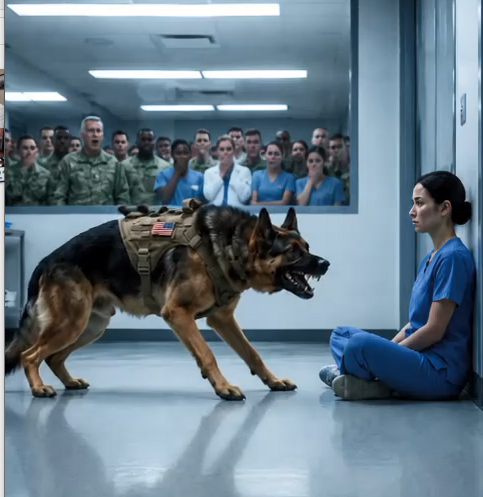
The examination-room door opened.
I walked in.
No treats.
No leash.
No protective sleeve.
Nothing.
I sat against the wall near the door.
Titan stood in the opposite corner.
I placed my hands in my lap.
Didn’t call him.
Didn’t say good boy.
Didn’t ask him to trust me.
People make that mistake all the time.
They tell frightened things:
Trust me.
As if trust is an instruction.
It isn’t.
Trust is something the frightened person—or animal—decides after observing what you do when you could have forced them.
So I sat.
Thirty seconds.
A minute.
Titan’s breathing was fast.
Ventilation hummed.
I could hear people shifting behind the observation glass.
Titan sniffed once.
Again.
Then took one step.
Stopped.
Another.
His shoulders were still rigid.
Head low.
Eyes on me.
He reached three feet.
I kept my gaze lowered.
His breath touched my fingers.
Warm.
Fast.
I still didn’t reach.
Then the four notes came again.
I hummed.
Titan’s ears rose.
Four notes.
Again.
His shoulders dropped.
Four notes.
His mouth opened.
One long breath came out.
Then Titan stepped forward and pressed his head into my shoulder.
Someone behind the glass gasped.
My heart stopped.
His fur was coarse against my cheek.
I slowly raised one hand.
Rested it against the side of his neck.
Titan did not flinch.
He exhaled.
A long trembling breath.
Not happiness.
Not exactly.
Relief.
Blake opened the door.
Stopped.
“He hasn’t let anyone touch him.”
I kept my hand still.
Titan leaned harder.
“Not like that,” Blake whispered.
I touched an old scar under his collar.
And suddenly the past opened.
A dark hospital room.
A monitor.
A soldier unable to move.
And a younger German Shepherd lying beneath the bed.
I stopped humming.
Titan lifted his head.
For one second, fear went through me.
Then he placed one paw against my knee.
My chest tightened.
“Marcus.”
I didn’t realize I had spoken aloud.
Blake stared.
“What?”
I looked at Titan.
The dog looked back.
Six years vanished.
Room 317.
Sergeant Marcus Reyes.
Twenty-nine years old.
Combat injuries.
A chest full of shrapnel.
Spinal trauma.
Two surgeries before he ever reached our floor.
Doctors had warned his family that surviving the initial blast did not mean he would survive recovery.
Marcus had been awake for almost three days when I first took his night shift.
Machines everywhere.
Lines.
Drainage tubes.
Oxygen.
Pain pump.
And beneath his bed—
Titan.
Younger.
Five years old.
No gray.
Ears slightly too large for his head.
His chin rested between his paws while he watched Marcus sleep.
I crouched.
“Hey.”
Titan’s eyes shifted toward me.
I didn’t reach.
“Are you guarding him?”
From the bed, Marcus whispered:
“Don’t ask him questions.”
I stood.
“You’re awake.”
“Unfortunately.”
“Pain?”
“Yes.”
“How bad?”
“Depends.”
“On?”
“How honest you need me to be.”
“Very.”
“Eight.”
I adjusted medication.
Marcus looked toward the floor.
“Titan okay?”
“He’s judging me.”
“He does that.”
“Does he always stay under your bed?”
“When they’ll let him.”
“He likes the dark?”
“He likes me.”
There was a trace of humor in his voice.
That became our rhythm.
For eleven weeks.
I worked many nights in Room 317.
Marcus improved.
Then didn’t.
Then improved again.
Titan stayed whenever regulations allowed.
Marcus told me stories.
Titan’s first snow.
Titan refusing to swim.
Titan detecting an explosive during a training exercise and then becoming terrified of a plastic bag in a parking lot.
“He has standards,” Marcus said.
“He sounds ridiculous.”
“He is.”
“Then why do you trust him?”
Marcus looked down.
“Because when everything goes wrong, he stays.”
That answer stayed with me.
One night Marcus woke disoriented.
Heart racing.
Eyes open but not seeing Brooke.
“I can’t hear them.”
“Who?”
“My team.”
“You’re here.”
“They’re still out there.”
“Marcus.”
Titan crawled from under bed.
Placed front paws against mattress.
Whined.
Marcus looked toward him.
Nothing I said helped.
Medication was coming, but not fast enough.
So I hummed.
Four notes.
The lullaby from childhood.
Again.
Marcus’s breathing slowed.
Titan settled.
Again.
Marcus closed his eyes.
Titan rested his head against my ankle.
I kept humming until both slept.
The next morning Marcus asked:
“What was that?”
“What?”
“That song.”
“Not really a song.”
“Titan liked it.”
“You liked it.”
“Same difference.”
A few nights later he said:
“Promise me something.”
I hated those words in hospitals.
“Don’t.”
“Grace.”
“What?”
“If something happens to me—”
“No.”
“Listen.”
I looked at him.
He was serious.
“If they move Titan, don’t let them treat him like equipment.”
“He has a unit.”
“That’s not what I mean.”
“Then what?”
Marcus looked at Titan.
“Dogs remember.”
“I know.”
“No.”
He shook his head weakly.
“People think they forget because they can’t explain.”
“They remember everything that matters.”
I tried to joke.
“That’s a large philosophical claim for somebody who refuses physical therapy.”
He ignored it.
“If he ever hears that tune again, he’ll know he’s not alone.”
I looked beneath the bed.
Titan stared at us.
“You think he remembers four notes?”
Marcus smiled.
“He remembers you.”
Marcus died eleven days later.
I was there.
His sister Elena on one side.
His mother on the other.
Chaplain near door.
Titan beneath bed.
Marcus’s breathing slowed.
I hummed.
Four notes.
His eyes opened.
Looked toward floor.
Titan crawled out.
Put his head against bed.
Marcus’s fingers moved.
I guided his hand down.
His fingertips touched Titan’s muzzle.
Marcus moved his lips.
I couldn’t hear.
But I knew.
Stay.
Then he died.
Titan refused to leave Room 317.
For almost an hour.
Handlers finally came.
He fought the leash.
Not biting.
Not attacking.
Simply planting his body beside bed.
I followed into hallway.
A young lieutenant stopped me.
“Ma’am, you can’t go farther.”
“He needs someone.”
“He has his unit.”
“He just lost his person.”
“We have procedures.”
“He isn’t equipment.”
“No one said he was.”
“Then give him five minutes.”
The lieutenant’s face closed.
“Step back.”
I did.
And Titan looked over his shoulder while they led him away.
His eyes found mine.
I did nothing.
That’s the part that stayed.
Not because I had authority.
I didn’t.
But I told myself I couldn’t follow.
Couldn’t ask.
Couldn’t interfere.
The truth was uglier.
I couldn’t bear one more loss.
I transferred to trauma care.
Stopped walking near the wounded warrior wing.
Stopped humming.
Put Marcus’s photograph in a box.
And never asked where Titan went.
For six years, I told myself the military took him away.
The truth was that I also walked away.
Now the same dog stood against me.
Older.
Scarred.
Still waiting.
When I left the examination room, rumors spread by lunch.
Grace trained Titan.
Grace knew Titan as a puppy.
Grace worked K9 overseas.
Grace had some mystical ability.
All nonsense.
The truth was both simpler and more painful.
Titan remembered a safety cue from the worst night of his life.
And apparently, he remembered me.
Colonel Marsh called a meeting that afternoon.
Dr. Chen.
Blake.
Major Harlan.
Corporal Ruiz—the handler Titan had bitten.
Me.
Harlan opened Titan’s risk file.
Red label.
AGGRESSIVE BEHAVIOR.
EXTREME CAUTION.
He spoke first.
“One calm encounter cannot erase a documented bite.”
Dr. Chen nodded.
“No one says it does.”
“Then humane disposition remains an option.”
Blake leaned forward.
“Stop calling it that.”
Harlan looked at him.
“You prefer euthanasia?”
“Yes.”
Blake’s voice hardened.
“If that’s what you mean, say it.”
Colonel Marsh raised hand.
“What happened during bite incident?”
Harlan said:
“Titan attacked Corporal Ruiz during examination.”
Ruiz spoke.
“He didn’t attack me.”
Everyone turned.
Harlan looked annoyed.
“You required four stitches.”
“Yes, sir.”
“Then what would you call it?”
“A bite.”
Harlan stared.
Ruiz continued.
“He was favoring his paw.”
“I reached.”
“He pulled away.”
“I tried again.”
“He backed toward wall.”
“I grabbed leash because I thought he’d bolt.”
“Then I grabbed paw.”
“He bit once.”
“Released when Blake called.”
Dr. Chen asked:
“Was Titan already pacing?”
“Yes.”
“Other dogs barking?”
“Yes.”
“Pain?”
“Probably.”
Harlan said:
“A bite remains a bite.”
Ruiz looked at him.
“Yes, sir.”
“But unprovoked isn’t accurate.”
Silence.
Blake said quietly:
“That’s what I’ve been saying.”
Harlan’s jaw tightened.
Then he looked at me.
“Mrs. Whitfield, you entered restricted room without animal-handling qualifications.”
“With authorization.”
“You had no reason to believe it was safe.”
“I didn’t say it was safe.”
“So why?”
“Because he looked afraid.”
“He is a military dog.”
“Yes.”
“That does not make him a grieving child.”
“No.”
I looked at him.
“But fear doesn’t become less real because the frightened thing has teeth.”
Dr. Chen looked down, hiding something that might have been approval.
Harlan said:
“Compassion is not evidence.”
“No.”
I held his gaze.
“Neither is fear.”
Colonel Marsh ended the meeting by postponing disposition review forty-eight hours.
Dr. Chen would assess Titan.
Blake primary handler.
No forced contact.
No euthanasia paperwork unless behavior review supported it.
Harlan objected.
Marsh overruled him.
The next morning Blake found me in the break room.
He carried a thick file.
“I found Titan’s original service record.”
I stopped drinking coffee.
“What did you find?”
He opened it.
Deployment reports.
Training evaluations.
Commendations.
Medical notes.
Then:
“First handler: Sergeant Marcus Reyes.”
I closed my eyes.
Blake watched.
“You knew?”
“Yes.”
He showed me a hospital attachment.
ROOM 317.
WOUNDED WARRIOR RECOVERY.
CANINE PERMITTED UNDER COMPASSIONATE CARE EXCEPTION.
Then I saw my name.
GRACE WHITFIELD — NIGHT NURSING OBSERVATION.
Below:
Canine displays distress when separated from patient.
Patient calmer when canine present.
Canine settles during low vocalization from Nurse Whitfield.
I touched page.
“He remembered.”
“The tune?”
“Yes.”
I told Blake everything.
Marcus.
Eleven weeks.
The song.
The night he died.
Titan refusing to leave.
When I finished, Blake said:
“So he wasn’t reacting to us.”
“He was reacting to this place.”
“Room 317.”
“Yes.”
Dr. Chen reviewed security footage.
Titan calm in lobby.
Calm in elevator.
Calm around child.
Distress began exactly thirty-two seconds after entering third floor.
She paused video.
Titan staring down corridor.
“Associative memory,” she said.
“Smell.”
“Location.”
“Sound.”
“Emotional state.”
“Can dogs remember people for six years?”
“Yes.”
“Songs?”
“Patterns.”
“Four notes associated with safety during repeated high-emotion events?”
“Absolutely possible.”
“Can you prove that is what happened?”
“No.”
I appreciated honesty.
“But the response is consistent.”
She showed me Titan turning toward Room 317.
“He may not understand Marcus is dead the way you do.”
“But he may remember this as the place his handler disappeared.”
That sentence broke something inside me.
Not because Titan had forgotten.
Because he hadn’t.
That afternoon Harlan held another emergency review.
He presented the bite.
Photos.
Risk language.
Unpredictable.
Escalating.
Dangerous.
He did not mention injured paw.
Barking dogs.
Corner.
Repeated reaching.
Blake objected.
Ruiz corrected him.
Dr. Chen insisted context mattered.
Then Blake placed old hospital file on table.
Harlan’s expression changed.
Only slightly.
Colonel Marsh noticed.
“Major, have you seen this?”
“Old nursing notes.”
“Were they included when Titan was reassigned after Sergeant Reyes died?”
“No.”
“Why?”
“Not operationally relevant.”
Blake said:
“They describe separation distress.”
“He returned to duty.”
“That doesn’t answer question.”
Harlan became defensive.
“Six years ago, the dog was fit for reassignment.”
“Who decided?”
“My office processed transfer.”
That mattered.
Harlan had been the lieutenant who stopped me in hallway.
The one who said:
He has a unit.
I stared at him.
“You.”
He looked at me.
“What?”
“You took him.”
His face hardened.
“I processed a transfer.”
“You were there.”
“Yes.”
“You knew he wouldn’t leave Room 317.”
“He was a military working dog assigned to active unit.”
“You knew he was distressed.”
“Temporary.”
“You read my notes?”
Silence.
Colonel Marsh looked at him.
“Major?”
Harlan answered carefully.
“I reviewed hospital attachment.”
“Then why wasn’t it included?”
“It was comfort-care information.”
Dr. Chen spoke.
“It included behavioral recommendations.”
Harlan turned.
“Not from certified behaviorist.”
“From eleven weeks of direct observation.”
“Operational decisions cannot be based on emotional impressions.”
Blake opened another page.
“Recommendation: gradual transition and familiar-caregiver presence after handler loss.”
Signed.
My handwriting.
Reviewed beneath by Lieutenant Victor Harlan.
His note:
NOT OPERATIONALLY REQUIRED.
PROCEED WITH TRANSFER.
Colonel Marsh read twice.
“Why?”
Harlan said:
“Unit needed dog.”
Blake put another report down.
“Unit was undergoing readiness evaluation that quarter.”
Harlan’s face changed.
“Be careful, Sergeant.”
“Titan counted as active asset.”
“Behavioral hold would have reduced readiness rating.”
“You weren’t there.”
“No.”
Blake looked at documents.
“But records were.”
The door opened.
Evelyn Shaw from archives entered carrying an old box.
Seventy-something.
Civilian employee.
She had been at Brooke longer than almost anyone.
“I was there,” she said.
She remembered Marcus.
Titan.
Me.
The transfer.
And Harlan.
“Lieutenant Harlan came before family had left.”
She looked at him.
“I told you Titan needed time.”
Harlan shook his head.
“You told me a dog was grieving.”
“Yes.”
“That was not a recognized disposition category.”
“You said the dog’s emotions were not part of the transfer schedule.”
“I said unit procedures—”
“You said he belonged to Army.”
Harlan looked toward Colonel Marsh.
“This is memory from six years ago.”
Evelyn opened box.
“No.”
She pulled handwritten note.
“This is mine.”
Titan refusing separation.
Nurse Whitfield requests familiar transition.
Recommend delay.
Below:
LT. HARLAN — DENIED. RETURN TO UNIT PER READINESS REQUIREMENT.
The room went silent.
Colonel Marsh asked:
“Did you deliberately exclude this from operational file?”
Harlan answered:
“I consolidated records.”
Blake:
“You removed it.”
“I made an administrative judgment.”
“A judgment that made later handlers believe he had no separation history.”
“He performed successfully for years.”
Dr. Chen nodded.
“That doesn’t make omission harmless.”
Harlan stood.
“Are we seriously suggesting I caused a bite six years later?”
“No,” Dr. Chen said.
“We’re saying you erased context that would have helped us understand it.”
That was the difference.
Nobody claimed Titan spent six years broken.
He served.
Worked.
Bonded with new handlers.
Performed well.
But grief had not disappeared.
It had been packed beneath training.
Then retirement physical returned him to Room 317.
Same corridor.
Same smells.
Same door.
His body remembered before anyone else knew what they were looking at.
Colonel Marsh ordered full review.
Titan would not be euthanized while evidence suggested situational trauma rather than generalized aggression.
Harlan protested.
Marsh ended meeting.
“Major, we do not destroy a decorated working dog because our paperwork failed to remember what he survived.”
That sentence spread through hospital faster than any rumor about me.
The next forty-eight hours changed everything.
Dr. Chen created controlled assessment.
Different rooms.
Different hallways.
Different people.
Titan relaxed almost everywhere except third-floor corridor and old Room 317.
Pain exam found chronic arthritis and inflammation in the same paw Ruiz had tried to lift.
Treatment began.
Under low-stress handling, Titan allowed examination.
No bite.
No growl.
Blake could approach normally outside that corridor.
Inside?
Titan became hypervigilant.
With me seated nearby and four-note tune?
His breathing slowed.
Not magic.
Conditioning.
Association.
Memory.
Something measurable enough to matter.
Harlan hated the word trauma.
Dr. Chen didn’t.
“He is not dangerous in every environment,” she explained.
“He has specific triggers.”
“Pain.”
“Confinement.”
“Hospital cues.”
“Forceful handling.”
“That creates risk.”
“Yes.”
“But manageable risk is different from unmanageable aggression.”
That distinction saved Titan.
The retirement disposition changed.
No euthanasia recommendation.
No standard civilian placement.
Titan would transition to an experienced handler under structured rehabilitation.
Blake volunteered.
Nobody was surprised.
He had worked with Titan eight months.
Already loved him.
Harlan said personal attachment compromised judgment.
Colonel Marsh responded:
“Attachment is not automatically incompetence.”
I nearly smiled.
Then Blake asked me something I didn’t expect.
“Would you be part of transition?”
I froze.
“How?”
“Visits.”
“Familiar cue.”
“Help us separate Room 317 from loss.”
“I’m a nurse.”
“I know.”
“I don’t know dogs.”
“You know this dog.”
That terrified me.
Because six years earlier I had walked away.
It would be easier to tell myself Titan belonged to Blake now.
Not my responsibility.
But Marcus’s voice returned.
If something happens, don’t let them think he’s just equipment.
I said yes.
Not as handler.
Not as owner.
As memory.
We began outside.
Courtyard.
Titan walked with Blake.
I sat on bench.
Four notes only when he showed stress.
Then less.
Then none.
Goal wasn’t to make him dependent on me.
Dr. Chen was clear.
Safety cues can help recovery, but recovery means expanding safety.
Blake.
Routine.
Outdoor environments.
Medical handling.
Choice.
Pain control.
Titan learned.
Or relearned.
He let technicians touch paws after slow introduction.
He entered new clinic without panic.
He tolerated closed doors.
Room 317 remained hardest.
One day Dr. Chen asked:
“Do you want to try?”
I knew what she meant.
Return.
Titan stood at corridor entrance.
Stopped.
I knelt beside him.
Not touching.
Blake on other side.
Door open.
No equipment.
No restraints.
I hummed once.
Four notes.
Titan looked at me.
Then at door.
He stepped.
One.
Two.
Stopped.
I didn’t pull.
Blake didn’t command.
Another step.
Inside Room 317.
Titan froze.
I could feel my own heart pounding.
The room had changed.
New paint.
Different equipment.
But same shape.
Same window.
Same corner.
For me too.
I saw Marcus’s bed where examination table now stood.
I saw his mother.
Elena.
Chaplain.
His fingers touching Titan’s muzzle.
I almost left.
Then Titan walked to the exact spot beneath where Marcus’s bed had once been.
Lay down.
Put his head on his paws.
And waited.
I sat beside him.
No one spoke.
Dr. Chen stayed in doorway.
Blake leaned against wall.
I finally whispered:
“He isn’t coming back.”
My voice broke.
“You know that, don’t you?”
Titan lifted his head.
I don’t believe dogs understand sentences the way we want them to.
But they understand tone.
Presence.
Change.
I touched his neck.
“Marcus didn’t leave you.”
“He died.”
The words nearly destroyed me.
Because I had never said them there.
Not to Titan.
Not to myself.
“You stayed.”
I started humming.
Four notes.
Titan moved closer.
Placed his head in my lap.
I cried into his fur.
Not quietly.
Not professionally.
Six years late.
“He loved you.”
Titan exhaled.
“You did enough.”
That sentence was for both of us.
For dog who could not save handler.
For nurse who couldn’t save patient.
Blake looked away to give me privacy.
When we left Room 317, Titan did not look back.
That didn’t mean trauma disappeared.
He still disliked corridor.
But next time he entered, no growl.
Then one more.
Eventually Dr. Chen signed behavioral clearance.
Structured retirement.
Blake adopted Titan.
It took paperwork.
Home inspection.
Medical transition.
The kind of administrative process Harlan once insisted made emotion irrelevant.
This time paperwork protected him.
Funny how same systems can harm or help depending on whether people include truth.
Major Harlan faced administrative review over record handling.
He wasn’t arrested.
He hadn’t forged anything.
He had made decisions accepted by system at time.
But review found he had excluded clinically relevant behavioral transition recommendations to maintain readiness classification.
He was removed from oversight of working-dog disposition pending reassignment.
Some staff wanted dramatic punishment.
I didn’t.
What mattered was policy.
After Titan, Brooke and associated K9 commands changed transition documentation.
Handler death.
Separation distress.
Known safety cues.
Medical triggers.
Familiar caregivers.
All required in retirement and reassignment records.
No more deciding nursing observations weren’t “operationally relevant” when they described behavior.
No more clean files created by deleting messy truth.
Marcus mattered there too.
His death changed policy six years late.
Titan made sure.
Corporal Ruiz visited Titan after discharge.
He stood in Blake’s yard.
Bandage gone.
Scar on forearm.
“Think he hates me?”
Blake said:
“No.”
Ruiz looked at me.
“You sure?”
“No.”
He laughed nervously.
Titan approached.
Ruiz did not reach.
Good.
He waited.
Titan sniffed.
Then walked away.
Ruiz exhaled.
“I’ll take that.”
“Probably wise.”
Ruiz later became one of loudest advocates for contextual bite reporting.
He told new handlers:
“If a dog pulls away and you keep grabbing, don’t write ‘no warning’ when he finally uses teeth.”
That mattered.
Pain matters.
Context matters.
A warning you ignore does not become no warning.
Titan settled into Blake’s home.
He had a fenced yard.
Orthopedic bed.
Too many toys.
Blake’s wife spoiled him immediately.
He ignored most toys except one faded tennis ball.
Marcus had been right.
Exact throw mattered.
Titan was particular.
Retirement changed him.
Gray muzzle expanded.
He slept more.
He discovered squirrels.
He hated sprinklers.
Loved grilled chicken.
Would sit beside Blake’s kitchen door every morning at 5:30 even after Blake stopped waking that early.
Years of military schedules don’t disappear because someone says retirement.
I visited every few weeks.
Sometimes more.
I never became his owner.
People wanted neat ending.
Nurse saves dog, adopts dog.
Life isn’t obligated to produce sentimental geometry.
Titan belonged with Blake.
They had built trust.
My role was different.
I was bridge.
One day Blake called:
“He’s waiting.”
“For what?”
“You.”
“How do you know?”
“He’s sitting by gate at the time you usually come.”
I laughed.
“That’s ridiculous.”
Then drove over.
Titan was at gate.
He saw my car.
Tail moved.
Not wildly.
Titan was too dignified.
One slow sweep.
I got out.
Four notes.
His ears lifted.
Eventually I stopped humming when I arrived.
He didn’t need it.
That was success.
The song became memory instead of medicine.
I saw Elena Reyes again because of Titan.
Marcus’s sister.
Blake found her through family records.
I had not spoken to her since funeral.
She arrived carrying a framed photograph.
Marcus kneeling beside young Titan.
Both staring at camera.
Titan saw her.
Stopped.
Walked slowly.
Elena crouched.
“Oh my God.”
Titan sniffed her hair.
Then her hands.
Then leaned his forehead against her chest.
Elena broke.
So did I.
She whispered:
“You old man.”
His tail moved.
She looked at me.
“You disappeared.”
I had no defense.
“I know.”
“We tried to find you.”
“What?”
“Mom wanted to thank you.”
“I transferred.”
“We called.”
“I changed units.”
“You never answered Marcus’s letter.”
I froze.
“What letter?”
Elena stared.
“He wrote you one before he died.”
I couldn’t breathe.
“What?”
“He gave it to Harlan.”
The room became cold.
Blake looked at me.
Elena continued.
“Marcus couldn’t write much.”
“He dictated to me.”
“Asked lieutenant to make sure you got it.”
“I never did.”
We requested archives.
Three weeks later, envelope surfaced in Marcus’s administrative packet.
Never delivered.
Not conspiracy.
Not secret suppression.
Clerical.
Transferred with records.
Another thing lost because system valued categories more than people.
Inside:
Grace,
If you get this, things probably went badly, which is irritating because I hate being right.
Thank you for not lying to me.
Thank you for staying when nights got ugly.
If Titan gets confused, hum that ridiculous little song.
He trusts you.
So do I.
Tell my mother I ate when she asks.
Tell Elena she still owes me twenty bucks.
And don’t let anybody turn him into a story about a hero dog.
He’s just Titan.
That’s enough.
—Marcus
I read it twice.
Then again.
The line that hurt most wasn’t about Titan.
He trusts you.
So do I.
Six years I thought I failed.
Maybe I did in some ways.
I left.
Didn’t search.
But Marcus had never asked me to save Titan forever.
He asked me not to forget he was alive inside uniform and training.
Eventually I remembered.
Late isn’t same as never.
I keep letter in drawer now.
Not hidden box.
Drawer I open.
That’s progress.
Titan lived four more years after retirement.
Good years.
His arthritis worsened.
Hearing faded.
He stopped running.
Still lifted his head whenever I arrived.
One winter evening Blake called.
“Grace.”
I knew.
You learn tones.
“Is it time?”
“Yes.”
I drove.
Rain streaked windows.
Titan lay on bed.
Breathing calm.
Blake sat on floor.
His wife crying in kitchen because she didn’t want Titan to see.
Dogs don’t understand theatrical bravery, but humans do strange things.
I brought Marcus’s framed photograph.
Placed it on shelf.
Titan stood with effort.
Walked over.
Sniffed frame.
Then lay beneath it.
Exactly as he had once lain beneath Room 317’s bed.
Watching over his person.
My eyes filled.
I sat beside him.
“I’m sorry.”
Titan opened one eye.
“I stopped coming.”
Tail tapped blanket.
“I thought you forgot.”
His eye closed.
“I didn’t know you remembered.”
Blake stood in doorway.
“For what it’s worth, I don’t think he remembered just you.”
I looked up.
“He remembered the room.”
“The song.”
“Marcus.”
“The way you stayed.”
I put my hand on Titan’s silver muzzle.
Maybe that was true.
Maybe memory is not one thing.
Maybe it is layers.
Smell.
Voice.
Touch.
Loss.
Safety.
A door.
A song.
A person sitting on floor who didn’t ask you to do anything.
The veterinarian arrived.
No hospital this time.
That mattered.
Home.
Soft bed.
People he knew.
No corridor.
No restraints.
Titan’s head rested against my leg.
Blake’s hand stayed on his shoulder.
I began humming.
Four notes.
Again.
His breathing slowed.
Again.
Blake whispered:
“Good dog.”
I said:
“You did a good job.”
Titan opened his eyes.
Looked at us.
Then closed them.
The veterinarian gave medication.
He relaxed before his heart stopped.
Quiet.
No growl.
No panic.
No waiting at door.
Afterward, Blake asked whether I wanted the photograph.
“No.”
“Why?”
“It belongs with him.”
We buried Titan’s ashes beside a tree behind Blake’s house.
Not military cemetery.
Not ceremony.
Marcus’s family came.
Colonel Marsh came in civilian clothes.
Dr. Chen.
Ruiz.
Evelyn Shaw.
Even Harlan sent letter.
I almost didn’t read it.
Then did.
Mrs. Whitfield,
I spent many years believing good procedure required removing emotion from decisions.
Titan taught me that context is not emotion and that refusing to document grief does not make grief disappear.
I was wrong about him.
I was wrong to dismiss your observations six years earlier.
I am sorry.
Victor Harlan.
No excuses.
I appreciated that.
People are allowed to learn late too.
At Titan’s memorial, Elena placed Marcus’s old unit patch beside urn.
Blake placed retired K9 tag.
I had nothing.
Then remembered song.
So I hummed.
Four notes.
No one laughed.
Nobody thought it mystical.
It was simply sound that had once meant safety to a frightened soldier and his dog.
After Titan, I began helping Brooke develop trauma-informed handling guidance for working animals in medical settings.
Not as behaviorist.
I never pretended.
As nurse who understood environmental triggers.
Dogs and people aren’t same.
Important.
But nervous systems recognize patterns.
A smell associated with pain.
A hallway associated with death.
A sound associated with safety.
Humans call it trauma when patient wakes sweating because monitor beep resembles battlefield.
We should not be shocked when animals form associations too.
Titan’s case became training example.
No names publicly.
No romantic language.
Case notes:
Senior MWD presenting situational defensive behavior during retirement examination.
History of handler death in same medical corridor.
Pain-related trigger.
Conditioned calming cue.
Successful transition following environmental modification, pain treatment, gradual exposure, and familiar-handler support.
Clinical.
Boring.
I loved it.
Because boring documentation means next Titan might be understood before somebody whispers “put him down.”
That’s legacy I trust.
Not viral stories.
Policies.
Records.
Someone reading old note and asking one more question.
Years later, a young nurse asked me why I always pause when I hear dogs barking near third floor.
I told her:
“Because once there was a dog who waited six years outside a door.”
She smiled, thinking metaphor.
It wasn’t.
Room 317 no longer exists under that number.
Renovation changed numbering.
Sometimes I walk past old doorway.
I don’t avoid it now.
Marcus isn’t there.
Titan isn’t there.
That’s okay.
Grief isn’t loyalty measured by how long you refuse to leave a room.
Sometimes leaving is what proves you finally understand nobody asked you to remain trapped.
I learned that from Titan.
He spent six years carrying memory back to Brooke.
Then one day he walked into Room 317.
Lay where Marcus had been.
Listened to four notes.
And walked out.
After that, he began going home.
So did I.
People still call what happened extraordinary.
The dangerous war dog recognized nurse from six years ago.
Maybe.
But I think that description misses point.
Titan wasn’t dangerous because he growled.
He growled because danger was what his body expected.
He wasn’t unpredictable because he bit Ruiz.
He had pulled away first.
He had been in pain.
He had been cornered.
He wasn’t broken because he froze outside Room 317.
He had lost the person he trusted most there.
Behavior is not always character.
Sometimes it is history speaking through body.
That is true for soldiers.
For nurses.
For dogs.
For anyone carrying something they cannot explain quickly enough to satisfy a form.
The morning I first sat with Titan, I thought I was helping keep him alive.
Maybe I was.
But he returned something to me too.
He forced me to remember Marcus as more than patient who died.
Marcus laughed.
Complained about food.
Loved his sister.
Owed somebody twenty dollars.
Made terrible jokes.
Trusted a difficult German Shepherd.
Asked nurse to hum when nights got bad.
Death had reduced him in my memory to final hour.
Titan gave me back eleven weeks.
That’s no small gift.
When I think about Titan now, I don’t remember growl first.
I remember him beneath Marcus’s bed.
Young.
Too-large ears.
Watching.
Then older.
Gray muzzle.
Head on my shoulder.
Then ancient.
Sleeping beneath Marcus’s photograph.
Same dog.
Three lives inside one body.
War dog.
Grieving dog.
Retired dog.
None erased others.
All true.
And if there is one thing I would tell anyone who hears this story, it isn’t that compassion always saves dangerous animals.
It doesn’t.
Some animals are unsafe.
Some situations require hard decisions.
Pretending otherwise is not kindness.
What I would say is simpler.
Before you decide what a living thing has become, ask what happened to it.
Before you call a reaction unprovoked, look for warning you missed.
Before you erase old notes because they don’t fit operational categories, understand that somebody later may need them.
Before you call fear aggression, check whether something hurts.
And before you decide someone—or some dog—is beyond reach, make sure you aren’t confusing silence with absence.
Titan remembered.
Not perfectly.
Not magically.
But enough.
Enough to recognize four notes.
Enough to find the nurse who had once sat beside his handler.
Enough to show us the file was wrong.
Enough to live four more years without being treated like a liability that needed removing.
On the last afternoon I saw him, rain moved down the window in thin silver lines.
Titan lay beneath Marcus’s photograph.
I rested my hand against his muzzle.
“You did a good job,” I whispered.
His eyes opened.
For one moment, he looked directly at me.
Then settled.
Blake watched from doorway.
“Some dogs don’t forget,” he said.
I looked at Titan.
“No.”
I started humming those four notes one final time.
“They just wait.”
And sometimes, when the right person finally comes back, the waiting becomes a way home.



