They Humiliated the Quiet Rookie Nurse in the ER—Then a Combat K9 Charged Straight to Her and a Navy SEAL Saluted
PART3:
Isla pressed both palms against her thighs.
The trembling increased.
Hargreave smiled.
“There. Look.”
A resident snorted.
Someone behind Isla whispered, “Poor thing.”
She heard that too.
She heard everything.
That was part of the problem.
Isla had spent eight years training herself to hear what other people missed.
Breathing changes.
Metallic clicks.
The difference between a helicopter landing normally and one coming down wrong.
Boots in gravel.
A safety coming off a rifle.
The distant change in rotor pitch that meant a medevac had less time than everyone thought.
Coral Bluff believed she was timid.
What they were actually seeing was restraint.
But restraint looks like weakness to people who have never needed it.
Hargreave handed the clipboard back.
“Try not to drop it.”
Isla accepted it.
“Yes, doctor.”
That answer disappointed him.
He preferred people who fought back.
Resistance gave him something to defeat.
Isla gave him nothing.
Not because she was afraid of him.
Not exactly.
She was afraid of herself.
A metal tray crashed to the floor behind her.
Every person near the desk flinched.
Isla did not.
Her body changed before thought reached it.
Left foot back.
Weight balanced.
Chin lifted.
Eyes moving.
Door.
Window.
Corridor.
Hands.
Threat.
Exit.
Then she saw the embarrassed technician kneeling beside fallen instruments.
The moment ended.
Isla lowered her eyes again.
No one noticed.
Except Bonnie.
For a second, Bonnie stared at her.
Isla caught the look.
Bonnie looked away first.
Hargreave pointed toward the supply corridor.
“Rookie, why don’t you go stand somewhere harmless until we need a blood pressure taken?”
A few people laughed again.
Isla walked away.
At the far end of the nurses’ station, she slid her left thumb beneath the band of her watch.
There was a small black star tattooed on the inside of her wrist.
Five points.
No words.
No date.
Nothing anyone at Coral Bluff would understand.
Her thumb rested over it.
Breathe.
That was what Commander Elias Kane used to tell her.
Breathe before you decide.
Decide before you move.
Move once.
She closed her eyes.
Eight years.
She had been out eight years.
Sometimes it felt like eight days.
Sometimes eighty years.
Her legal name was Isla Catherine Marrow.
Her hospital résumé said nursing degree, trauma certification, emergency care experience at several small facilities, gap in employment for family reasons.
All technically true.
What it did not say was that before Coral Bluff, before oversized scrubs and lowered eyes, before she learned how useful invisibility could be, she had been Lieutenant Commander Isla Marrow, United States Navy Nurse Corps.
Call sign Valkyrie.
Forward surgical trauma specialist.
Attached repeatedly to special operations units in Afghanistan.
Three commendations.
One Purple Heart.
One Bronze Star with Valor.
Twenty-one documented combat evacuations.
Six men who had been pronounced unsalvageable by someone else and were still alive because she refused to accept the calculation.
And one military working dog named Sarge whose blood had once covered both of her arms while mortars struck less than three hundred yards away.
She had hidden all of it.
On purpose.
She had spent years becoming a person no one would salute.
Quiet was safer.
Quiet required nothing.
Then the overhead speaker clicked.
“Coral Bluff ER, Medic Nine inbound.”
The room changed.
Every nurse looked up.
“Tanker collision at Port Corpus. Multiple casualties. Possible industrial chemical exposure. Six patients confirmed. Additional patients may follow. ETA four minutes.”
Hargreave straightened.
The jokes vanished.
He pointed.
“Trauma one and two. Bonnie, assign decon support. Mason, call respiratory. Somebody find out what chemical we’re dealing with.”
He looked at Isla.
“Rookie.”
She turned.
“Stay out of the way.”
Something cold moved through her.
Not anger.
Recognition.
Four minutes later, ambulance doors slammed.
The first patient came through screaming.
He was a dockworker named Luis Ortega.
Forty-three.
Two children.
Thick through the shoulders.
Usually the kind of man people described as impossible to frighten.
Now both hands were clamped over his face.
“It burns!”
His shirt was wet.
The front of his neck was blotched angry red.
“I can’t see!”
Two paramedics pushed the stretcher toward Trauma One.
“What was the substance?” Hargreave demanded.
“Unknown,” the lead medic said. “Tanker placard was damaged.”
“Acid?”
“Unknown.”
“Alkali?”
“Unknown.”
Hargreave swore.
“Do nothing until hazmat identifies it.”
Isla’s head snapped up.
A nurse beside Luis said, “Doctor, his eyes—”
“I said wait.”
“He’s in agony.”
“And if you neutralize the wrong substance with the wrong treatment, you make it worse.”
Hargreave pointed at Mason.
“Get the port manifest.”
Luis screamed again.
Isla stopped hearing the emergency department.
For one heartbeat, she heard sand.
Rotor wash.
A Marine named Connor Reeves screaming inside a canvas surgical shelter outside Kandahar.
Chemical exposure from an improvised laboratory.
No clean documentation.
No certainty.
Just tissue continuing to burn while people argued.
She heard Commander Kane beside her.
What do we know, Valkyrie?
That it is still on him.
Then remove it.
The trembling in Isla’s hands stopped.
Instantly.
Bonnie saw it.
Years later, Bonnie would tell an investigator that it was the moment she understood she had never actually met Isla Marrow.
The shy nurse crossed the room.
Hargreave noticed.
“Rookie.”
Isla kept walking.
“Move, please.”
Two nurses moved without thinking.
Something in her voice made obedience feel natural.
She reached Luis.
He was thrashing.
“Luis.”
He kept screaming.
She placed one hand on his shoulder.
“Luis Ortega, listen to me.”
His body went still for half a second.
“You are in a hospital. My name is Isla. I am going to help you.”
“My eyes.”
“I know.”
“I can’t see.”
“I know.”
She turned toward the eyewash station.
“Bonnie, open it.”
Hargreave stepped forward.
“No.”
Isla looked at him.
“We irrigate now.”
“We identify the chemical first.”
“No.”
The entire room seemed to hear the word.
Hargreave stared at her.
It was the first time she had refused him.
“Excuse me?”
“Whatever is on him is still contacting his eyes and skin.”
“Which is why we follow protocol.”
“Immediate decontamination is protocol.”
“Do not lecture me.”
“I’m not.”
Her voice remained quiet.
“I’m preventing permanent injury.”
Hargreave’s face darkened.
“You are three weeks into employment in my department.”
Isla looked at Luis.
Then back at him.
“And he has already spent almost four minutes with a chemical burning his corneas.”
Silence.
“Move.”
Hargreave actually stepped back.
Maybe it was shock.
Maybe something older in Isla’s voice reached a part of him that understood command.
She pulled Luis toward the eyewash station.
“Lukewarm water.”
Bonnie turned it on.
Isla positioned him.
“Luis, I’m going to hold your eyelids open.”
“No, no—”
“You need to let me.”
“It hurts.”
“I know.”
“I can’t.”
“Yes, you can.”
Her voice softened.
“You do not have to be brave. You only have to stay still.”
He stopped fighting.
Water began flowing.
Isla angled his head so runoff moved away rather than across the opposite eye.
“Gentle stream. Keep it continuous.”
She looked at Bonnie.
“Start the clock.”
Bonnie glanced toward Hargreave.
Then back at Isla.
“Clock started.”
Isla cut away contaminated fabric.
“Gloves.”
A nurse handed them over.
“Bag the clothing.”
Mason approached.
“Should we neutralize?”
“No.”
Isla didn’t even look up.
“No chemical neutralizers unless directed by toxicology. Water. Remove contaminated material. Keep rinsing.”
Luis groaned.
Isla held his lids open.
“Stay with me.”
“I can’t see.”
“What can you see?”
“Nothing.”
“Keep breathing.”
A minute.
Then another.
Luis stopped screaming.
By the third minute, his breathing slowed.
“Something’s changing.”
“What?”
“Light.”
Isla leaned closer.
“You see light?”
His mouth trembled.
“Yes.”
Bonnie stared at Isla.
Luis laughed weakly.
“I can see the damn light.”
The nurses around them went silent.
Hargreave did not.
“You contaminated half my treatment bay.”
Isla kept irrigating.
“We can clean a floor.”
“You disregarded an attending order.”
“We can discuss that afterward.”
“I will discuss it with administration.”
“Then write it down.”
The room froze again.
Isla looked at Bonnie.
“Keep the flush going.”
She moved to the next patient.
The second ambulance arrived.
Then the third.
Three dockworkers.
A tanker driver.
A security worker.
A mechanic.
Eyes.
Hands.
Forearms.
Neck.
Exposure patterns.
Hargreave tried to reassert control.
But something had shifted.
Bonnie began irrigation on Patient Three without waiting for him.
Mason removed contaminated clothing from Patient Four.
Another nurse called poison control while the water ran.
The emergency department reorganized around the thing Isla had done first.
Remove exposure.
Flush.
Protect.
Assess.
Hargreave stood in the center of his own department while the room obeyed someone who officially ranked below nearly everyone present.
His humiliation was just beginning.
At 7:02 a.m., the main entrance erupted.
Not opened.
Erupted.
The automatic doors spread apart.
A steel chain struck tile.
Claws scraped.
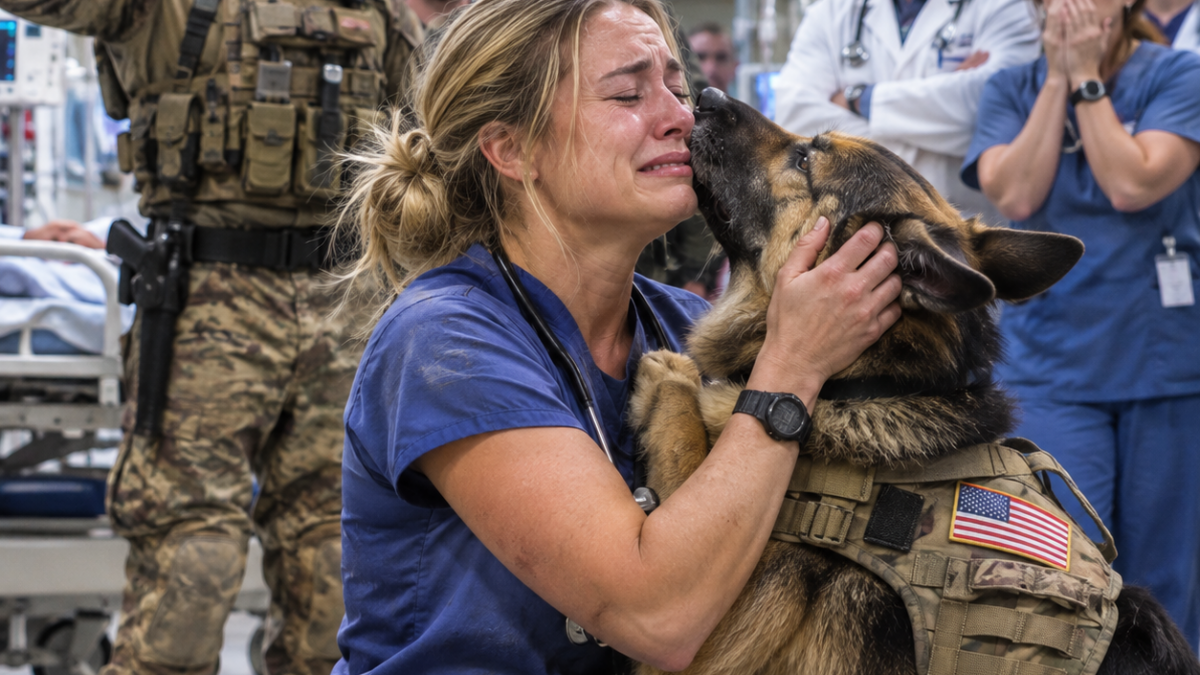
A German Shepherd came through at full speed.
Patients shouted.
Security moved.
The dog was large.
Black and tan.
Heavy chest.
Old scars.
A notch in his left ear.
Tactical harness.
Small American flag patch.
Broken restraint chain whipping behind him.
A security officer reached toward him.
The shepherd changed direction without slowing.
Past reception.
Past two residents.
Past Hargreave.
“Get that animal out!” Hargreave shouted.
The dog ignored him.
His nose lifted.
His ears came forward.
His eyes fixed across the emergency department.
On Isla.
She turned.
For the first time that morning, fear appeared on her face.
Not fear of the animal.
Fear of recognition.
“Sarge?”
The dog ran harder.
He hit her just below the shoulders.
Isla stumbled backward.
Sarge rose onto his hind legs and planted both front paws against her chest.
Then the sound came.
A high, broken whine.
Nothing like aggression.
Nothing like training.
Grief.
Recognition.
Years collapsing into one moment.
“Sarge.”
Isla’s hands went around his neck.
Her face broke open.
Every careful expression disappeared.
She laughed.
Cried.
Pressed her cheek into his fur.
“Hey, big man.”
Sarge licked her chin.
Her eyes.
Her cheek.
“You remember me?”
His whole body shook.
“You remember me.”
The ER went silent.
This was not a dog greeting a stranger.
This was reunion.
Then boots struck tile.
Four men entered behind a stretcher.
Desert camouflage.
Tactical gear.
One broad, bearded man at the front.
Senior Chief Nathan Pryor.
Call sign Breaker.
He had aged since Isla last saw him.
Gray in his beard now.
A scar along his jaw she did not remember.
But she knew the way he moved.
Breaker stopped.
Saw Sarge.
Saw Isla.
Everything in his face emptied.
“No.”
Isla stood slowly.
“Breaker.”
One of the younger operators whispered, “That’s her?”
Breaker’s eyes dropped to Isla’s left wrist.
Her sleeve had pulled up while holding Sarge.
The watchband shifted.
Black star visible.
Breaker’s face tightened.
Then he raised his hand.
Perfect salute.
The other three men followed.
One had tears in his eyes.
Nobody at Coral Bluff understood.
Breaker spoke.
“Lieutenant Commander.”
Hargreave gave a short, incredulous laugh.
“What exactly is happening?”
Breaker never turned toward him.
“Not your moment, doctor.”
On the stretcher between the operators lay Petty Officer Reed Sullivan.
Call sign Cobalt.
His forearms were red.
Neck blistering.
Eyes squeezed shut.
Chemical residue coated portions of his gear.
He thrashed against the straps.
“Valkyrie!”
Isla went pale.
“Where is Valkyrie?”
Hargreave stared at her.
Cobalt twisted violently.
“Valkyrie!”
Isla stepped forward.
For eight years she had refused that name.
Refused invitations.
Reunions.
Ceremonies.
Calls.
She had sent medals to a box in her sister’s attic.
She had ignored emails from men whose lives she had saved because hearing their gratitude made survival feel like guilt.
Now one of them was screaming for her in the middle of Coral Bluff.
Isla bent over the stretcher.
“Cobalt.”
He froze.
Her mouth moved close to his ear.
“It’s Valkyrie.”
His chest hitched.
“I’ve got you.”
The struggling stopped.
Completely.
Cobalt let out a sound between a sob and a laugh.
“Lieutenant.”
“I’m here.”
“You’re late.”
Her eyes filled.
“I’m right on time.”
Hargreave stepped closer.
“I am the attending physician responsible for this department.”
Isla straightened.
He expected lowered eyes.
Instead he met the woman who had once commanded casualty care under mortar fire.
“Then act like one.”
Hargreave’s mouth opened.
Breaker almost smiled.
Isla continued.
“His contaminated gear comes off immediately. Everyone touching him gowns and gloves. Irrigation starts now.”
“We do not know the substance.”
“We know it is still on him.”
“I will not allow a nurse to dictate—”
“Doctor.”
Her voice became quieter.
That made it stronger.
“Every minute you spend protecting your authority is another minute his tissue stays exposed.”
She pointed toward the decontamination room.
“Step aside.”
Breaker moved first.
Then the other operators.
Not threatening.
Not dramatic.
They simply positioned themselves around the stretcher.
A wall.
Hargreave saw four men waiting for Isla’s command.
He stepped aside.
“Bonnie,” Isla said.
“Yes?”
“Clear decon.”
“Done.”
“Mason, gowns, gloves, saline, irrigation tubing.”
Mason ran.
“Breaker, keep his head steady.”
“Yes, ma’am.”
“Cobalt.”
The wounded operator grunted.
“I am cutting your gear off.”
“Do it.”
“You may feel water before you can see anything.”
“Copy.”
“Do not fight us.”
“If it’s you, I won’t.”
That sentence silenced half the room.
Sarge lay across the decon doorway.
His chin rested on his paws.
His eyes never left Isla.
Fifteen minutes passed.
Then twenty.
Cobalt stopped clenching his jaw.
Isla talked him through every movement.
“Water coming.”
“Left eye.”
“Good.”
“Turn your head.”
“You’re doing fine.”
“No rubbing.”
“Keep breathing.”
He whispered, “Still bossy.”
“Still alive.”
“Because of you.”
“Not today.”
“Always.”
She ignored the last word.
Breaker stood nearby.
Finally he said, “Eight years.”
Isla did not look up.
“Don’t.”
“Every memorial.”
“Breaker.”
“We left a chair.”
“I asked you not to.”
“You asked us not to contact you.”
“That’s right.”
“You never asked us not to miss you.”
Isla’s hands paused.
Only for a fraction of a second.
Then continued.
Cobalt’s right eye opened a sliver.
He winced.
“I see something.”
Isla leaned closer.
“What?”
“Shapes.”
Breaker exhaled.
Cobalt squinted.
“Ugly beard.”
Breaker laughed.
“Vision’s perfect.”
Cobalt tried to smile.
Then the administrator arrived.
Gordon Fisk came through the doors with two hospital security officers.
Gray suit.
Crooked tie.
Expression already angry.
Hargreave followed him.
That told Isla everything.
Fisk approached.
“Nurse Marrow.”
Isla turned.
“Administrator Fisk.”
“I have been informed that you repeatedly disregarded physician orders during a hazardous materials event.”
Breaker stared at him.
Fisk continued.
“You operated outside your role, disrupted department command, and exposed the hospital to significant liability.”
Isla said nothing.
“You are suspended effective immediately.”
Bonnie whispered, “Mr. Fisk—”
“Not now.”
Fisk held out his hand.
“Badge.”
The room watched.
Isla looked at Hargreave.
He stood behind Fisk.
A faint smile at the edge of his mouth.
Not happiness.
Vindication.
He thought the hierarchy had repaired itself.
Isla unclipped her badge.
She held it out.
Breaker stepped forward.
“Sir.”
Fisk turned.
“I would recommend being very careful about the next thing you do.”
“This is a civilian medical facility.”
“Yes.”
“You are a guest.”
Breaker’s jaw tightened.
“And that woman just prevented your physician from costing at least two men their eyesight.”
Hargreave snapped, “You have no authority here.”
Breaker looked at him.
“Neither does ego.”
Fisk took Isla’s badge.
“Security will escort you after the incident is stabilized.”
Then someone in the waiting room coughed.
One cough.
Then another.
Sarge’s head lifted.
His ears moved forward.
A low growl started in his chest.
Isla turned.
The smell reached her a second later.
Sweet.
Sharp.
Industrial.
Wrong.
She knew immediately.
“Everyone stop.”
Hargreave said, “What now?”
Isla walked toward the ambulance corridor.
The exterior doors had been left partially open.
Contaminated gear sat bagged near the ambulance bay.
Two stretchers had not been fully decontaminated.
Above the loading area, an air intake fed the eastern ventilation system.
Isla stared upward.
“Oh no.”
A woman screamed from the waiting room.
“My throat!”
Another patient began coughing.
Then a child.
Isla turned toward Fisk.
“The building is pulling contaminated air through the east intake.”
Hargreave shook his head.
“That’s impossible.”
“Listen.”
The ventilation hum was loud.
Air moving.
Carrying vapor inward.
Bonnie’s face went pale.
“There are thirty people in the front waiting room.”
“Thirty-four,” a clerk said.
Isla grabbed her badge back from Fisk’s hand.
He was too stunned to resist.
“You can fire me after they’re outside.”
Then she changed.
Nobody who saw it ever forgot.
Her shoulders straightened.
Her chin came up.
Her voice stopped belonging to the shy nurse entirely.
“Bonnie.”
“Yes.”
“Get every ambulatory patient out through the east service corridor into the garden.”
“Got it.”
“Mason, call facilities. Shut down east air intake immediately.”
Mason ran.
“Breaker, split your men. Children and elderly first. Nonambulatory patients get wheelchairs.”
“Copy.”
“Hargreave.”
He stared.
She stepped closer.
“You take the waiting room entrance.”
“Why me?”
“Because they know your white coat.”
“What?”
“You are going to stand there and speak calmly.”
He looked almost offended.
“You want me to—”
“People panic when leadership panics.”
She held his eyes.
“So don’t.”
Something inside him shifted.
For once, no sarcasm.
No superiority.
“Yes.”
Then quieter.
“Yes, nurse.”
Isla turned.
“Go.”
The emergency department moved.
People coughed.
Nurses pushed chairs.
Operators lifted elderly patients.
A respiratory therapist carried a toddler.
Bonnie organized blankets.
Security blocked the contaminated hallway.
Facilities killed the ventilation intake.
The mechanical hum stopped.
But the waiting room still contained residual fumes.
“Keep moving!”
Isla directed patients toward fresh air.
“No running.”
A mother screamed.
“Emma?”
No answer.
“Emma!”
Isla turned.
“What happened?”
“My daughter was beside me.”
“How old?”
“Four.”
“When did you last see her?”
“The bathroom. She said she needed—”
Sarge stood.
Nose lifted.
Isla looked at him.
“Sarge.”
His ears came forward.
“Find her.”
The dog moved.
Fast but controlled.
Nose low.
Across the waiting room.
Down the hall.
Stopped outside the women’s restroom.
Scratched.
A faint cry came from inside.
“Mommy?”
The mother lunged forward.
Isla blocked her.
“No.”
“That’s my baby.”
“I’m bringing her.”
“She needs me!”
“And she needs you breathing when she comes out.”
Isla grabbed a wet cloth.
Covered her nose and mouth.
Bonnie caught her arm.
“Isla, wait for respiratory gear.”
“No time.”
“That is not proper protection.”
“I know.”
“Then don’t.”
Isla looked through the doorway.
A child coughed.
She went in.
The air burned her throat.
“Emma?”
A little girl crouched near the sinks.
Isla stayed low.
“Hey.”
Emma looked up.
Tears streamed from her eyes.
“I can’t find Mommy.”
“I know exactly where she is.”
“You do?”
“Yes.”
Isla wrapped the wet cloth loosely over Emma’s nose and mouth.
“I’m Isla.”
“I want Mommy.”
“You’re going to get her.”
Emma coughed.
Isla lifted her.
“Close your eyes.”
“Why?”
“Because I’m ugly.”
The little girl gave a frightened laugh.
Good.
Still responsive.
Isla carried her out.
Sarge waited at the door.
Emma saw him.
“Doggy.”
“He found you.”
Sarge walked beside them all the way outside.
The mother collapsed around her daughter.
“You found her.”
Isla shook her head.
“He did.”
The mother grabbed Isla’s hand.
“Thank you.”
Isla pulled away gently.
“Rinse her eyes and face. Clean water. Slow and steady.”
Outside, Coral Bluff’s garden became a field hospital.
Blankets spread across grass.
Patients lined benches.
Saline.
Portable oxygen.
Water.
Medics.
Operators.
Nurses.
No one asked who was in charge anymore.
Everyone knew.
Fisk stood near the garden entrance holding the suspension paperwork.
It had become absurd in his hand.
At 7:48, the final patient cleared the contaminated lobby.
No deaths.
No cardiac arrests.
No children unconscious.
Forty-one people evaluated.
Nine required extended observation.
Cobalt went upstairs to ophthalmology.
Luis too.
Isla sat alone on a concrete bench behind the garden.
Her hands had started trembling again.
Harder now.
She stared at them.
Sarge approached.
He placed his head in her lap.
She whispered, “Don’t.”
He stayed.
“I’m fine.”
He stayed.
“Traitor.”
His tail moved once.
Breaker came around the corner.
He stopped several feet away.
“Still hate being watched?”
Isla looked down.
“Yes.”
He sat beside her.
For a moment neither spoke.
Then Breaker said, “Why Coral Bluff?”
“Needed work.”
“Bull.”
She smiled faintly.
“Still subtle.”
“You disappeared for eight years.”
“I didn’t disappear.”
“You changed your number.”
“I paid the bill.”
“You returned mail.”
“Very responsible.”
“You skipped Kane’s funeral.”
That landed.
Isla’s face closed.
Breaker saw it.
“Sorry.”
“No.”
Her voice changed.
“You’re not.”
“No.”
He was right.
Commander Elias Kane had died three years after Isla left the Navy.
Cancer.
Not combat.
Not dramatic.
A man who survived Afghanistan only to die slowly in a hospital room in Virginia.
He had asked for Isla twice near the end.
She never went.
Breaker had never forgiven her.
Maybe he shouldn’t have.
“He asked for you,” Breaker said.
“I know.”
“You know?”
“His wife called.”
“And you didn’t go.”
“I couldn’t.”
“You could.”
“No.”
Breaker looked at her.
“You mean you wouldn’t.”
Isla’s eyes sharpened.
“Do you want to do this here?”
“Yes.”
“Fine.”
She stood.
“So say it.”
Breaker stood too.
“You abandoned us.”
She laughed once.
Ugly sound.
“Interesting choice of words.”
“We looked for you.”
“I asked you not to.”
“Because you thought disappearing was somehow noble?”
“Because every time one of you called, I saw them.”
“Who?”
“You know who.”
Breaker’s anger faded slightly.
“Isla.”
She stepped back.
“No.”
“Say it.”
“Don’t.”
“Say their names.”
Her face twisted.
Breaker had learned this from Kane.
Never let trauma hide behind pronouns.
Them.
Those guys.
The casualties.
The dead.
Names force memory into shape.
Isla whispered, “Reeves.”
Breaker said nothing.
“Martinez.”
Her voice cracked.
“Cho.”
She looked away.
“Dawson.”
Sarge pressed against her leg.
“And Eli Kane.”
Breaker exhaled.
“Kane died years after the deployment.”
“I know.”
“That wasn’t your fault.”
“I know.”
“Then why?”
Isla turned toward him.
“Because his wife said he wanted the person who never left anyone behind.”
Her eyes filled.
“And I had already spent five years doing exactly that.”
Breaker became quiet.
Isla wiped at her face angrily.
“I couldn’t walk into that room and pretend I was still Valkyrie.”
“No one asked you to.”
“You did.”
“No.”
He stepped closer.
“We asked you to be Isla.”
She shook her head.
“I didn’t know how.”
For eight years, that had been the truth.
Not hiding medals.
Not avoiding publicity.
Not trauma alone.
Identity.
In war, everybody needed her.
Afterward, nobody did.
And she had mistaken being needed for being alive.
So she became small.
Worked short contracts.
Changed cities.
Avoided anyone who might know.
When Coral Bluff hired her, she intentionally omitted much of her military leadership history after human resources told her only civilian qualifications were required.
She wanted the lowest rung.
No command.
No expectation.
No one shouting Valkyrie across a room.
Breaker looked through the glass toward the ER.
“They humiliated you.”
“I allowed it.”
“Why?”
“It was easier.”
“Easier than what?”
She looked at him.
“Being somebody again.”
Neither heard Hargreave approaching.
He stopped several feet away.
For once, he looked uncertain.
“Ms. Marrow.”
Breaker’s face hardened.
Isla turned.
Hargreave had removed his white coat.
His shirt sleeves were rolled up.
There was dirt on one knee from helping move patients outside.
“I wanted to tell you Cobalt’s eye examination is complete.”
Isla froze.
“And?”
“Ophthalmology expects him to retain useful vision in both eyes.”
Her shoulders dropped.
“Luis?”
“Corneal injury, but prognosis is favorable.”
She closed her eyes.
Hargreave continued.
“The ophthalmologist said…”
He stopped.
Words were difficult for him when they lowered rather than elevated him.
“She said the immediate irrigation likely prevented catastrophic damage.”
Isla nodded.
“Good.”
Hargreave looked at her trembling hands.
Then said, “I owe you an apology.”
Breaker folded his arms.
Isla said nothing.
Hargreave swallowed.
“What I did this morning was unprofessional.”
“That narrows it down poorly.”
Breaker almost laughed.
Hargreave accepted the hit.
“I mocked you.”
“Yes.”
“In front of the department.”
“Yes.”
“I belittled your competence without knowing anything about your experience.”
“Yes.”
He looked down.
“I enjoyed it.”
That admission surprised her.
Hargreave continued.
“I tell myself I push new staff because emergency medicine requires confidence.”
He gave a humorless smile.
“That’s the respectable explanation.”
“And the real one?”
“I like being the smartest person in a room.”
He looked through the doors.
“Today I wasn’t.”
Isla studied him.
“You think this is about intelligence?”
“No.”
“Good.”
Her voice remained calm.
“Because you knew more pharmacology than I did this morning.”
Hargreave blinked.
“You knew more about Coral Bluff’s systems.”
He waited.
“You may be a better diagnostician than I am.”
Breaker glanced at her.
She continued.
“But when Luis arrived, you made uncertainty about the chemical more important than certainty about the exposure.”
Hargreave nodded slowly.
“I froze.”
“No.”
Isla looked him in the eye.
“You controlled.”
The word hurt him.
“Those are different.”
Hargreave swallowed.
“You needed everybody to wait for your permission.”
She gestured toward the hospital.
“Emergency medicine cannot belong to one ego.”
He nodded.
“I understand.”
“Do you?”
“I’m trying.”
That was better than another apology.
Before Isla could answer, Bonnie appeared.
Her face was red from crying.
“Isla?”
“Yes?”
Bonnie stopped.
“I laughed.”
Isla’s expression softened.
“At what?”
“You know what.”
Bonnie stepped closer.
“When he took your clipboard.”
“Bonnie—”
“I laughed.”
Her voice cracked.
“I knew it was wrong.”
Hargreave looked away.
Bonnie continued.
“I did it because I didn’t want him turning on me.”
Isla said nothing.
“That’s cowardly.”
“Yes.”
Bonnie flinched.
Isla continued gently.
“It was.”
Bonnie nodded through tears.
“I’m sorry.”
Isla took a breath.
“Then next time don’t laugh.”
Bonnie stared.
“That’s it?”
“No.”
Isla looked toward the emergency department.
“Next time somebody lower in the hierarchy says something important, listen before you decide what they’re worth.”
Bonnie nodded.
“I will.”
“Then make that apology useful.”
At 10:15, Gordon Fisk convened an emergency administrative meeting.
By noon, Coral Bluff’s legal counsel had arrived.
By one, the hospital board chair was on video conference.
By two, Isla learned the story was worse than Hargreave humiliating a rookie.
The ventilation failure should never have happened.
The east intake had been flagged seven months earlier.
An engineering review recommended a shutoff isolation upgrade near the ambulance bay because fumes from vehicle exhaust and external hazardous materials could enter the waiting area during certain wind conditions.
The upgrade cost $186,000.
Fisk postponed it.
Twice.
He had redirected capital funds toward renovation of executive offices and a new donor reception area.
Now forty-one people had been exposed.
Isla sat in the conference room.
Still in scrubs.
Sarge beneath her chair.
Breaker beside the wall.
Fisk looked smaller than he had that morning.
Hospital counsel, a woman named Evelyn Hart, placed a document on the table.
“Mr. Fisk, did you sign this deferral?”
He stared.
“Yes.”
“Were you aware the recommendation involved hazardous-air isolation?”
“It was categorized as a low-probability event.”
“Not what I asked.”
“Yes.”
Hargreave sat opposite him.
Isla watched Fisk glance toward her.
Then he said, “None of this would have become an issue if contaminated equipment had been handled according to protocol.”
Hargreave looked up.
There it was.
The instinct to move blame downward.
Fisk continued.
“The nursing response created a chaotic environment.”
Bonnie’s mouth opened.
Isla remained silent.
Evelyn Hart asked, “Are you suggesting Nurse Marrow caused the contamination?”
“I am saying there are multiple contributing factors.”
Breaker’s jaw tightened.
Fisk looked at Isla.
“She disregarded chain of command.”
Hargreave spoke.
“No.”
Everyone turned.
Fisk stared.
“Excuse me?”
Hargreave sat straighter.
“The contaminated gear was left near the ambulance doors under my authority.”
Fisk’s face changed.
Hargreave continued.
“I was focused on clinical intake and failed to ensure the bay had been cleared.”
“That is not—”
“It is exactly what happened.”
Isla watched him.
This cost Hargreave something.
Status.
Protection.
Maybe career.
He continued anyway.
“And Nurse Marrow identified the airborne threat before any of us.”
Fisk’s voice sharpened.
“Philip.”
“You asked.”
“No, I didn’t.”
Hargreave gave a tired smile.
“That may be part of our problem.”
The board placed Fisk on administrative leave that afternoon.
Hargreave voluntarily stepped down from his department-chief role pending review.
Isla was not suspended.
The suspension paperwork was voided.
But the hospital’s problems were only beginning.
Reporters gathered outside.
Someone had filmed Sarge running through the ER.
The video spread.
A combat K9 charging through hospital doors.
A group of military operators saluting a nurse.
Luis Ortega’s family talking publicly about how quickly irrigation had begun.
By evening, people wanted to know who Isla Marrow was.
She hated it.
At 6:00 p.m., she sat in an empty staff locker room staring at her phone.
Forty-three missed calls.
Military contacts.
Reporters.
Numbers she did not recognize.
One message from a name that made her stop.
Miriam Kane.
Commander Kane’s widow.
Isla stared for nearly a minute.
Then opened it.
Three words.
He’d be proud.
Isla put the phone down.
Her hands began shaking.
Sarge was not supposed to be inside the locker room.
Nobody bothered enforcing that anymore.
He placed his head against her knee.
She whispered, “I failed him.”
Sarge looked up.
“He called.”
She covered her face.
“I didn’t go.”
The locker-room door opened.
Breaker.
Isla didn’t bother wiping her eyes.
“Miriam texted.”
“I know.”
“You talked to her?”
“Yes.”
“Of course you did.”
Breaker sat.
“She never blamed you.”
“That doesn’t help.”
“I know.”
“What did Kane say at the end?”
Breaker hesitated.
Isla looked at him.
“Tell me.”
“He said if we found you, not to drag you back.”
Her breath caught.
“What?”
“He said you spent your whole career running toward people who needed you.”
Breaker looked at Sarge.
“He said maybe somebody should let you run away for once.”
Isla stared.
“And you never told me?”
“You wouldn’t answer.”
“Email.”
“You blocked us.”
“Letter.”
“You returned them.”
She almost smiled.
“Fair.”
Breaker continued.
“He also said you’d come back when somebody needed you badly enough.”
Isla looked toward the hospital corridor.
“He knew me too well.”
“Yes.”
Silence.
Then Breaker said, “Come home.”
Her shoulders tightened.
“No.”
“I don’t mean the Navy.”
She looked at him.
“I mean stop treating everybody who loved you like an enemy.”
That was harder.
He knew it.
“Start with one call.”
“To who?”
“Miriam.”
Isla stared at the phone.
Sarge nudged her hand.
“Manipulative dog.”
Breaker smiled.
“He learned from you.”
She called.
Miriam answered before the second ring.
Neither woman spoke at first.
Then Miriam said, “Isla?”
Her voice sounded older.
Isla closed her eyes.
“I’m sorry.”
Miriam began crying.
“So am I.”
“I should have come.”
“Yes.”
The honesty hurt.
Miriam continued.
“But he loved you anyway.”
Isla couldn’t breathe.
“He asked for me.”
“He did.”
“I abandoned him.”
“No.”
“Miriam—”
“You were drowning.”
“That doesn’t excuse it.”
“No.”
Isla opened her eyes.
Miriam’s voice softened.
“But explanations aren’t always excuses.”
Silence.
Then Miriam said, “He kept your chair.”
“What?”
“At the house.”
Isla laughed through tears.
“That ugly leather one?”
“The ugliest chair ever manufactured.”
“He loved that thing.”
“He said it was yours when you finally stopped being stubborn.”
Isla wiped her face.
“I may still be stubborn.”
“So was he.”
They talked for forty-seven minutes.
Not about war.
Not mostly.
About Kane’s tomatoes.
His ridiculous fishing hat.
His final months.
The fact that he watched baseball with the television muted because commentators annoyed him.
Normal things.
Human things.
By the time Isla hung up, something inside her had not healed.
Healing is not that fast.
But it had moved.
That mattered.
The hospital investigation lasted six weeks.
Gordon Fisk resigned before the board could terminate him.
Records showed the ventilation upgrade had been delayed despite two written warnings from facilities.
He later faced civil litigation related to the exposure event.
Hargreave received formal disciplinary action.
He was required to undergo leadership remediation and surrendered his chief position permanently.
Several board members expected him to leave.
He didn’t.
That surprised Isla.
He returned as an ordinary attending.
No private chief office.
No administrative authority.
His first shift back, he found Isla beside the nurses’ station.
“Good morning.”
She looked up.
“Doctor.”
He handed her a clipboard.
She stared at it.
He said, “I believe this belongs to you.”
Her mouth twitched.
“Careful. My hands shake.”
He looked ashamed.
“I deserved that.”
“Yes.”
He nodded.
Then walked away.
No joke.
No defense.
That was the beginning.
Not forgiveness.
Something more useful.
Change.
Hargreave stopped humiliating residents.
At first, everyone noticed because the absence of cruelty was strange.
Then he began asking questions.
“What do you see?”
“What concerns you?”
“What am I missing?”
The first few weeks sounded mechanical.
Like phrases learned in a seminar.
Months later, they sounded natural.
Bonnie changed too.
When a senior surgeon mocked a nursing student for incorrectly pronouncing a medication, Bonnie interrupted.
“Correct her. Don’t humiliate her.”
The surgeon stared.
Bonnie did not look away.
Isla heard about it afterward.
“Good,” she said.
Bonnie smiled.
“Useful apology?”
“Getting there.”
Isla stayed at Coral Bluff.
Not because Fisk asked.
Not because Breaker wanted her to.
Because Luis Ortega came back.
Three weeks after the incident, Luis walked into the ER wearing sunglasses.
His wife and two daughters came with him.
He waited until Isla finished with a patient.
“Nurse Marrow?”
She turned.
Luis removed his glasses.
His eyes were still red.
But open.
He smiled.
“My doctor says I’m going to keep most of my vision.”
Isla smiled back.
“Good.”
His younger daughter, maybe nine, held out a paper bag.
“What’s this?”
“Cookies.”
Luis said, “She made them.”
The girl whispered, “Mom helped.”
Her mother laughed.
Luis became serious.
“I heard what happened.”
“With what?”
“With the Navy people.”
Isla’s expression changed.
He continued.
“I don’t care.”
That surprised her.
“Okay.”
“I don’t care who you used to be.”
He touched his chest.
“I care who was standing there when I couldn’t see.”
Isla looked down.
Luis said, “Thank you.”
She accepted the cookies.
“You’re welcome.”
As he turned away, he stopped.
“One more thing.”
“Yes?”
“Dr. Hargreave called me.”
Her eyebrows rose.
“He apologized.”
Isla almost laughed.
“You sure it was him?”
Luis smiled.
“Sounded painful.”
“Probably was.”
“He said he should have started irrigation sooner.”
Isla nodded.
“Good.”
Luis left.
That afternoon Isla took the black star bracelet from beneath her watch.
For years she had hidden the tattoo.
Not anymore.
She didn’t advertise it.
She just stopped covering it.
Coral Bluff created a new hazardous exposure training program.
The formal name was Immediate Irrigation and Decontamination Response Protocol.
Nobody called it that.
The staff called it Rinse Fifteen.
The phrase appeared beside eyewash stations.
In annual training.
In port safety partnerships.
At schools.
Industrial facilities.
The goal was simple.
When an appropriate chemical exposure occurs, don’t waste critical early time arguing about labels while contaminant remains on tissue.
Begin appropriate decontamination while emergency guidance and identification are pursued.
Isla insisted on one condition.
“No hero branding.”
The public relations department had wanted photographs.
Her photograph.
Sarge.
Maybe some military backstory.
She refused.
“This is not about Valkyrie.”
The communications director said, “Your story could increase participation.”
“No.”
“You saved—”
“Stop.”
The woman went silent.
Isla pointed toward the training materials.
“If people remember my face instead of the response steps, we failed.”
So the posters showed water.
Eyewash stations.
Simple diagrams.
No Isla.
No Sarge.
No medals.
That was exactly how she wanted it.
Sarge stayed in Texas longer than planned.
Cobalt needed several follow-up procedures, and the team remained nearby.
The dog spent afternoons at Coral Bluff when permitted.
Mostly under Isla’s desk.
Nobody questioned it.
One evening Hargreave walked into the training room.
Sarge was lying near the front.
The dog lifted his head.
Hargreave stopped.
“You still hate me?”
Sarge stared.
Isla said, “He has standards.”
Hargreave sighed.
“Fair.”
He sat in the front row.
Every Rinse Fifteen class.
Front row.
Took notes.
Asked questions.
Never introduced Isla by rank.
Never told her military stories without permission.
That mattered.
Six months after the incident, Coral Bluff held a private recognition ceremony.
Isla refused three times.
Bonnie finally said, “This is not for the press.”
“No.”
“No uniforms.”
“No.”
“No medals.”
“No.”
“No speech.”
Isla hesitated.
Bonnie smiled.
“Got you.”
So Isla attended.
Just staff.
Luis came.
Emma’s mother came with Emma.
Cobalt arrived in civilian clothes.
Breaker too.
Sarge wore no tactical harness.
Only a plain black collar.
Hargreave stood near the back.
The hospital board chair spoke briefly.
Then Breaker unexpectedly stepped forward.
Isla glared at him.
“You promised.”
“No speech.”
“This looks like a speech.”
“It’s a sentence.”
He turned toward the staff.
“When you met Isla, you thought she was quiet because she had nothing to say.”
Isla crossed her arms.
Breaker continued.
“She was quiet because she had already spent years learning exactly which things were worth saying.”
He looked at her.
“That’s it.”
Isla narrowed her eyes.
“That was two sentences.”
Cobalt said, “Arrest him.”
People laughed.
Isla did too.
That was the moment everyone remembered.
Not the salute.
Not the revelation.
Her laugh.
Because it sounded free.
Afterward, Emma approached holding a stuffed German Shepherd.
“Is Sarge a superhero?”
Isla crouched.
“No.”
Emma looked disappointed.
“He’s a dog.”
“But he found me.”
“Yes.”
“Superhero dog.”
Isla considered.
“Fine.”
Emma smiled.
“Are you a superhero?”
“No.”
“Mom says you saved everybody.”
Isla looked across the room.
Hargreave helping Luis with a chair.
Bonnie talking with Cobalt.
Breaker scratching Sarge’s ears.
“No one person saved everybody.”
Emma frowned.
“That’s complicated.”
“It usually is.”
The child handed Isla a drawing.
Crayon.
Hospital.
Big dog.
Blue stick-figure nurse.
Above them, in uneven letters:
THE DOG KNEW HER.
Isla stared.
Emma asked, “Do you like it?”
“Yes.”
“Why are you crying?”
“I have allergies.”
“To crayons?”
“Very serious.”
Emma nodded solemnly.
“Mom has pollen.”
“Similar.”
The drawing went into Isla’s locker.
Years later, it remained there.
Not the medals.
Those stayed boxed.
Not because Isla was ashamed anymore.
Because she did not need to display proof.
She returned to Virginia once.
Miriam Kane met her at the airport.
No dramatic speech.
They hugged.
Miriam drove her to Kane’s grave.
Isla stood there for nearly an hour.
Finally she said, “I’m sorry I didn’t come.”
Wind moved through the trees.
Nothing answered.
She continued.
“I thought you needed Valkyrie.”
Her voice cracked.
“I didn’t know how to be her anymore.”
She touched the stone.
“I should have understood you wanted me.”
That was the first time she had said it aloud.
Not needed.
Wanted.
There is a difference.
When she returned to Texas, Breaker texted.
How’d it go?
Isla replied:
Awful.
He wrote:
Good.
She sent:
Idiot.
His answer:
Welcome back.
Cobalt recovered enough vision to return to administrative duty, though he eventually chose medical retirement.
He visited Coral Bluff once a year.
Luis became one of the volunteer instructors for industrial workers.
Bonnie postponed retirement.
“Apparently I’m having personal growth,” she complained.
Hargreave never became chief again.
Strangely, he became a better physician afterward.
Without the need to dominate every room, he listened.
Residents began requesting his shifts.
One afternoon a new nurse froze during a complicated trauma.
Everyone saw her hands shake.
Hargreave stood beside her.
The old version of him might have mocked.
Instead he said, “Hands can shake. Your brain still works.”
Across the room, Isla heard him.
Their eyes met.
He nodded.
She nodded back.
That was forgiveness.
Not forgetting.
Not pretending.
A different pattern built over time.
Coral Bluff changed slowly.
Hospitals always do.
Policies were rewritten.
Anonymous safety reporting expanded.
Staff could pause a hazardous procedure without fear of retaliation.
The board funded the ventilation upgrade.
Then funded a backup system.
They created interdisciplinary emergency drills where nurses were sometimes placed in command positions and doctors had to follow.
Hargreave complained during the first drill.
Isla raised an eyebrow.
He corrected himself.
“Historical reflex.”
“Dangerous condition.”
“Working on it.”
Sarge retired the following year.
Breaker called Isla.
“He needs somewhere.”
“No.”
“He’s eleven.”
“No.”
“He likes Texas.”
“No.”
“He likes you.”
“No.”
“You have a yard.”
“How do you know?”
“I researched.”
“That is creepy.”
“National security.”
“Absolutely not.”
Sarge arrived twelve days later.
Isla opened her front door.
Breaker stood beside the shepherd with two bags of food, medication, bedding, and a red rubber ball.
“You’re dead to me.”
Breaker handed over the leash.
“He already lives here emotionally.”
Sarge walked inside without waiting.
He found the couch.
Jumped up.
Lay down.
Isla stared.
“Traitor.”
Breaker smiled.
“He remembers.”
“Yes.”
Isla’s voice softened.
“He always did.”
That first night, Sarge slept beside her bedroom door.
At 3:14 a.m., Isla woke from a nightmare.
Afghanistan.
Dust.
Blood.
Kane shouting.
Reeves not breathing.
She sat upright.
Hands shaking.
Sarge entered.
No command.
He put his head on the mattress.
Isla placed one hand on him.
Slowly, her breathing matched his.
For years, she thought Sarge had found her in the ER because of scent.
Technically, he probably had.
But that explanation never captured what the moment meant.
Everyone else at Coral Bluff had been looking at Isla.
Sarge had recognized her.
Those are not the same thing.
The doctors saw a rookie.
Hargreave saw an easy target.
Fisk saw liability.
The nurses saw awkwardness.
Sarge smelled through all of it.
Fear.
Years.
Memory.
Home.
The next morning, Isla came to work in normal-size scrubs.
Bonnie noticed.
“They fit.”
“Yes.”
“You finally bought clothes your size.”
“Yes.”
“Should I alert the media?”
“Only if you want to die.”
Bonnie laughed.
Isla did too.
Her shoulders were back.
Eyes up.
Hands?
Still trembling sometimes.
That never completely stopped.
And she stopped trying to hide it.
One Saturday during Rinse Fifteen training, a teenage student pointed.
“Your hands shake.”
The room became awkward.
Isla looked down at them.
“Yes.”
“Are you nervous?”
“Sometimes.”
“But you were in the military.”
“Yes.”
“I thought soldiers weren’t scared.”
Isla smiled.
“That’s marketing.”
The class laughed.
Then she became serious.
“Courage is not having steady hands.”
She held them up.
A slight tremor visible.
“Courage is knowing what matters while they shake.”
Hargreave sat in the front row.
He wrote the sentence down.
After class, Isla noticed.
“You planning to steal that?”
“I prefer ‘document.’”
“Thief.”
“I’ve improved.”
“A little.”
Sarge slept beneath the desk with the red ball beside his paw.
Sunlight came through the training-room windows.
Outside, Corpus Christi traffic moved.
Inside, nurses, teachers, dockworkers, parents, and students practiced eyewash positioning.
No dramatic music.
No salutes.
No secret identities.
Just people learning something that might help another person on the worst day of their life.
That was enough for Isla.
More than enough.
One evening, nearly two years after the morning everything changed, Hargreave and Isla were the last two people at the nurses’ station.
The ER was unusually quiet.
He finished charting.
Then said, “Can I ask you something?”
“You usually do.”
“Why did you let me treat you that way?”
Isla looked at him.
He continued.
“I’ve thought about it.”
“That sounds dangerous.”
“I’m serious.”
She closed the chart in front of her.
“So am I.”
Hargreave waited.
Isla said, “Because I wanted confirmation.”
“Of what?”
“That I could disappear.”
He frowned.
She leaned back.
“If someone like you could look directly at me every day and see nothing worth respecting, then maybe I had finally become invisible enough.”
Hargreave looked ashamed.
“You should have stopped me.”
“No.”
He glanced up.
“I should have stopped me.”
Isla studied him.
“Yes.”
The honesty hung between them.
Hargreave said, “I’m sorry it took a dog.”
Isla smiled.
“He’s persuasive.”
A bark came faintly from outside where Sarge waited with a volunteer.
Hargreave laughed.
Then his expression changed.
“Do you miss it?”
“The Navy?”
“Yes.”
Isla considered.
“I miss people.”
“Not the work?”
“Sometimes.”
“The command?”
“Less than people think.”
Hargreave nodded.
“What do you like about this?”
She looked down the corridor.
A nurse adjusting a blanket.
A janitor polishing tile.
Bonnie arguing with pharmacy.
Mason, now a senior resident, listening carefully while a nursing student gave report.
“People come through those doors scared.”
She looked back.
“I know what scared people sound like.”
Hargreave smiled faintly.
“I suppose that makes sense.”
“No.”
“What?”
“Nothing about me makes sense.”
“That also makes sense.”
She laughed.
At 6:00 the next morning, Isla arrived for shift.
Sarge was home.
Breaker was back with his team.
Cobalt was rebuilding a different life.
Luis was seeing his daughters grow.
Emma had started kindergarten.
Kane was still gone.
Some wounds remain.
The emergency department lights buzzed.
Coffee burned.
Ambulance radios crackled.
A new nurse named Tessa Nguyen stood by the station, looking terrified.
First week.
Hargreave approached.
Isla watched.
Tessa dropped a pen.
Her hands shook as she picked it up.
Hargreave saw.
For one brief second, Isla saw the old habit move across his face.
A joke waiting.
He stopped himself.
Then bent down.
Picked up the pen.
Handed it to Tessa.
“First weeks are hard.”
Tessa nodded.
“Yes, doctor.”
“If you see something I miss, tell me.”
She looked surprised.
“Okay.”
“I mean it.”
He walked away.
Isla smiled.
Bonnie stood beside her.
“That was weird.”
“Very.”
“Growth is disturbing.”
“Terrifying.”
They laughed.
Then the ambulance radio sounded.
“Inbound trauma. Two minutes.”
Everyone moved.
Isla grabbed her gloves.
Her hands trembled once.
Then settled.
Not because she had become Valkyrie again.
She had finally understood she did not need to.
Valkyrie had never been a separate person.
Neither was the frightened nurse.
Neither was the woman who disappeared.
They were all Isla.
The woman who had run toward wounded men.
The woman who had run away afterward.
The woman who had hidden.
The woman a dog crossed an entire emergency department to find.
Years earlier, she believed strength meant never leaving anyone behind.
Later, she believed peace meant leaving everything behind.
Both were wrong.
Strength was knowing when to stay.
When to leave.
When to return.
And when somebody else stood trembling in front of you, strength was making sure they did not have to become small just to survive the room.
The ambulance doors opened.
Isla stepped forward.
A frightened young paramedic began speaking too quickly.
She held up one hand.
“Slow down.”
He breathed.
Started again.
Isla listened.
That was the first thing she did now.
Listen.
Because the lesson Coral Bluff learned that morning had never really been about rank.
Or medals.
Or a German Shepherd.
It was about what arrogance prevents us from seeing.
A shaking hand may still know exactly what to do.
A quiet voice may carry command.
A frightened person may have survived things you cannot imagine.
And the human being you are mocking today may be the person you depend on tomorrow.
Sarge had understood something before anyone else in the building.
He did not care about Isla’s oversized scrubs.
Her lowered eyes.
Her hospital badge.
Her job title.
He remembered who she was when everything around them had been loud, bloody, chaotic, and terrifying.
He remembered the hands.
The voice.
The woman who had stayed.
So when he entered Coral Bluff that morning, he did not hesitate.
He ran past doctors.
Past administrators.
Past security.
Past every symbol people used to decide who mattered.
And he went straight to her.
Maybe that was why Isla kept Emma’s drawing inside her locker long after the paper faded.
The hospital.
The blue nurse.
The ridiculous oversized dog.
And those uneven words above them.
THE DOG KNEW HER.
He did.
Long before everyone else.
And in the end, that was not the extraordinary part.
The extraordinary part was that Isla finally learned to know herself again too.


