They Humiliated the Quiet Rookie Nurse in Front of the ER—Then a Rescue K9 Ran Straight to Her and a Wounded Commander Called Her “Valkyrie.”
PART3:
Someone laughed again.
Then a metal instrument tray crashed behind me.
A technician had clipped the edge of a cart.
Steel hit tile.
The waiting room jumped.
One woman gasped.
Dr. Cole flinched.
I didn’t.
My body reacted before thought.
Left foot shifted.
Weight centered.
Eyes to source.
Then exits.
Main entrance.
Ambulance corridor.
Fire door.
Oxygen shutoff.
Crash cart.
Ceiling sprinkler heads.
Security officer location.
Nearest place a panicked crowd could bottleneck.
All in less than a second.
Then I remembered where I was.
St. Matthew’s.
Not a collapsed hotel.
Not a snow canyon.
Not Silver Creek.
Hospital.
Safe.
Mostly.
I lowered my head again.
Nobody noticed except an elderly man sitting near reception.
He watched me closely.
Dr. Cole handed me the chart.
“Go.”
I went.
Inside the supply room I shut door.
My hands began shaking.
They always waited until danger was over.
That was the part people misunderstood.
They assumed shaking meant fear before action.
Mine usually came afterward.
Five years earlier, those same hands had inserted IV lines in freezing rain.
Held pressure on an arterial bleed while a helicopter spun above a ridge.
Splinted a child’s leg beneath a collapsed stairwell.
Crawled through concrete dust carrying medical bags.
Cut clothing off hypothermic climbers.
Performed chest compressions inside a vehicle wedged against a mountain guardrail.
People had trusted my hands.
Now I couldn’t remove a medication vial from an automated cabinet without checking the label six times.
I leaned against wall.
Breathed.
Four counts in.
Six out.
Again.
There was a locker in supply room that didn’t technically belong to me.
Melissa had let me use it because employee lockers downstairs were full.
Inside were spare socks.
Protein bar.
Hair ties.
A folded fleece jacket.
And one photograph.
I took it out.
The photograph was six years old.
A younger version of me stood in snow beneath a row of black spruce.
I looked different.
Not physically much.
Same brown hair.
Same eyes.
But posture.
I stood straight.
Certain.
Beside me was a black-and-tan German Shepherd wearing a red search-and-rescue harness.
Atlas.
His ears were up.
One front paw rested on my boot.
The two of us were covered in snow.
On the back, someone had written:
TOGETHER, WE BRING THEM HOME.
Nathan’s handwriting.
My little brother.
I ran my thumb across the words.
“Not tonight.”
I whispered.
I didn’t know who I was talking to.
Atlas.
Nathan.
Myself.
Maybe all three.
I had spent five years constructing an ordinary life.
That sounds strange.
Most people don’t have to construct ordinary.
They inherit it.
Wake up.
Work.
Grocery store.
Traffic.
Laundry.
Friends.
Maybe kids.
Maybe dog.
Sleep.
I wanted ordinary the way some people want fame.
After Silver Creek, ordinary looked like paradise.
No radios.
No avalanche warnings.
No unstable structures.
No search grids.
No casualty counts.
No families waiting behind yellow tape.
No commander asking:
“Can you go back in?”
No voice inside rubble saying my name.
I left the Alpine Disaster Response Unit six months after Silver Creek.
I didn’t resign in disgrace.
Nobody asked me to.
That made it worse.
They wanted me to stay.
Daniel Brooks came to my apartment three times.
On the third, he left his coffee outside my door and said through wood:
“You don’t have to be done forever just because you need to stop now.”
I waited until elevator closed before bringing cup inside.
I never called him.
I went back to school.
Completed nursing degree.
Moved two cities away.
Cut my hair.
Stopped answering rescue-unit group messages.
Changed phone number.
Then changed it again.
I followed Atlas from a distance through photographs other handlers posted.
He continued working.
That hurt and comforted me.
I couldn’t take him.
He belonged to unit.
More importantly, he needed work.
Search dogs aren’t sentimental objects.
They are trained professionals.
Atlas loved me.
I knew that.
But he also loved the moment harness went on and somebody said:
“Find.”
I couldn’t ask him to spend his best years lying beside my trauma because I was afraid to go outside it.
So I disappeared.
I told St. Matthew’s almost nothing.
My résumé listed previous emergency-response experience.
Not details.
There was a five-year-old recommendation letter in my personnel file from a former emergency physician.
I assumed nobody read it.
Apparently they didn’t.
I wanted to start at bottom.
New nurse.
Learn hospital.
Be corrected.
Make small mistakes.
Become competent slowly.
Be somebody whose worst night was a double shift and a difficult family.
I wanted people to underestimate me.
Then I discovered being underestimated hurts even when you ask for anonymity.
I put photograph back.
Washed my face.
Restocked trauma room.
At 10:31, emergency doors opened.
Not exploded.
That’s how people later told it.
A dramatic story grows each time.
The doors slid normally.
But what came through made them seem explosive.
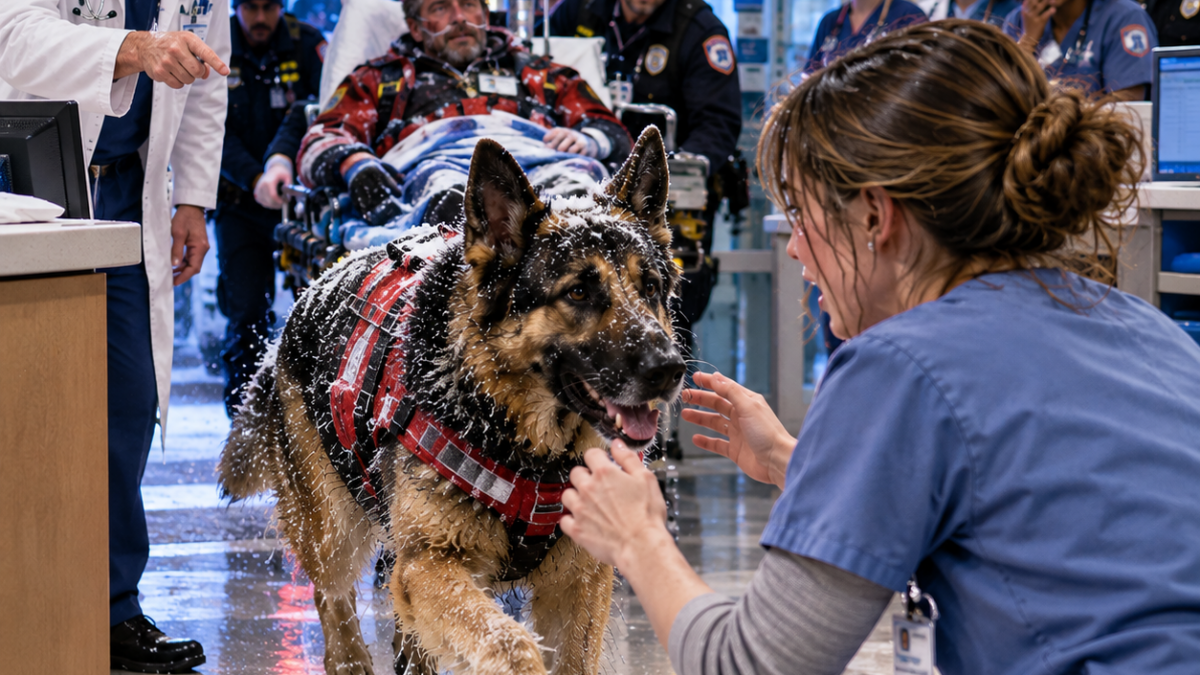
A German Shepherd.
Black and tan.
Snow soaked into fur.
Red rescue harness.
One strap torn.
Broken lead dragging.
A small streak of blood above right forepaw.
Security guard reached.
“Hey!”
The dog dodged.
A wheelchair blocked half corridor.
He slipped between chair and wall.
Dr. Cole shouted:
“Stop that animal!”
The dog ignored him.
He ran past registration.
Past two EMTs.
Past a respiratory therapist.
Then stopped.
Because he saw me.
I was carrying trauma packs.
The packs hit floor.
My brain refused image.
Five years.
Different city.
Different hospital.
Different life.
Atlas stood twenty feet away.
Older.
Gray around muzzle.
Scar near right ear I didn’t remember.
But Atlas.
His ears went forward.
His entire body changed.
I whispered:
“No.”
His tail moved once.
Then he ran.
“Atlas.”
I barely got name out.
He hit me hard enough to make me stagger.
He rose on hind legs and placed both front paws on shoulders.
The old trained greeting he’d never been allowed to use while working.
His muzzle pushed against cheek.
He whined.
Not barked.
Whined.
A desperate, broken sound.
I dropped to knees.
“Atlas.”
He shoved his head beneath my chin.
I wrapped arms around him.
The hospital disappeared.
He smelled like snow, wet fur, pine, and diesel.
The same smell of rescue trucks.
My face buried in his neck.
“Oh my God.”
Atlas trembled.
“You’re alive.”
Of course he was alive.
I’d seen photographs.
But trauma doesn’t care about logic.
Some piece of me had left him frozen in 2019 too.
Alive on a screen was different from breathing against my face.
He licked my cheek.
His tail hammered floor.
I started crying.
Not gently.
Dr. Cole approached.
“What is this ridiculous spectacle?”
Atlas turned.
A low growl rolled out.
Every person nearby stepped back.
I put my palm against his chest.
“Easy.”
Growl stopped instantly.
That silence did something to room.
Dr. Cole stared.
“You know this dog?”
“Yes.”
“Then control him.”
“He is controlled.”
“He charged into my department.”
I looked down at broken lead.
“No.”
“Something happened.”
Atlas went rigid.
Emergency doors opened again.
Three rescue personnel entered around a stretcher.
A man lay on it.
Mountain-rescue jacket torn.
Left arm immobilized.
Blood across sleeve.
Skin pale.
Oxygen mask.
One rescuer called:
“We need trauma team.”
Dr. Cole snapped into doctor mode.
Whatever his flaws, Richard Cole was a good emergency physician when somebody was actually dying.
“Trauma Two.”
“Let’s move.”
Atlas pulled away from me.
Ran to stretcher.
Sniffed injured man’s glove.
Barked once.
Then ran back.
He gently caught fabric at lower edge of my scrub top.
Pulled.
I stopped breathing.
That behavior.
Not random.
Atlas had done it during training.
Return-to-handler alert.
Come.
Information.
He pulled again.
His eyes went to stretcher.
Then entrance.
Then me.
“Atlas.”
I crouched.
“What?”
He whined.
The injured man’s oxygen mask shifted.
His eyes opened.
He saw me.
Everything inside him went still.
He whispered:
“Valkyrie?”
My spine locked.
No one had called me that in five years.
The stretcher stopped.
I stood slowly.
The injured man pulled mask aside.
“Commander Carter?”
It was Daniel.
Older.
Gray at temples.
Blood on face.
But Daniel Brooks.
The man who had commanded the Alpine Disaster Response Unit through fires, collapses, winter rescues, missing children, and one night neither of us survived intact.
“Daniel.”
His eyes filled.
“You’re here.”
Dr. Cole looked between us.
“What did you call her?”
Daniel tried to sit.
Pain folded him.
“Don’t.”
I moved automatically.
Hand to shoulder.
“Stay flat.”
Daniel actually smiled.
“There she is.”
“Don’t do that.”
“Do what?”
“Make this something.”
“Emily.”
“Don’t.”
Atlas pressed against my leg.
A rescuer spoke.
“Daniel was hurt on Mount Kerwin access road.”
Another continued:
“We’re still missing a sixteen-year-old.”
My attention snapped.
“What happened?”
Dr. Cole said:
“Emily, step back.”
I didn’t hear him.
“Where?”
The rescuer looked surprised.
“Eastern maintenance tunnel.”
“What collapse?”
“Roadbed failed during search.”
“Snowmelt undercut retaining wall.”
“Who is missing?”
“Noah Bennett.”
“Age?”
“Sixteen.”
“Conscious last contact?”
“We don’t know.”
“Phone?”
“Yes.”
“Signal?”
“Intermittent.”
Dr. Cole’s voice sharpened.
“Emily.”
Daniel looked at rescuer.
“Give her map.”
“Daniel.”
“Give her the map.”
Dr. Cole stepped between.
“She is a probationary nurse.”
Daniel stared.
“What?”
“She works under my department.”
Daniel’s expression was almost comical despite pain.
Then:
“That woman ran field medical coordination for Alpine Disaster Response.”
Silence.
I wanted to disappear.
Dr. Cole scoffed.
“She told HR she had some emergency-response background.”
Daniel coughed.
“Some?”
I closed eyes.
“Daniel, stop.”
He didn’t.
“Emily Carter was our lead medical specialist and K9 medical handler.”
A nurse dropped a pen.
Daniel continued.
“Call sign Valkyrie.”
Someone whispered it.
I hated that.
The name moved.
Valkyrie.
I had earned it after a winter rescue where a newspaper reporter described me carrying blood supplies through rotor wash like something out of mythology.
The unit turned it into a joke.
Then it stuck.
I hated it even then.
After Silver Creek, it felt obscene.
Dr. Cole asked:
“Why would a disaster-response specialist be working here as a rookie?”
I finally looked at him.
“Because I am a rookie here.”
That stopped him.
Different systems.
Different skills.
A person can be extraordinary somewhere and inexperienced somewhere else.
I needed St. Matthew’s.
I needed to learn hospital nursing.
My past did not automatically make me excellent at this job.
But neither did being new erase what I knew.
Daniel’s stretcher moved toward Trauma Two.
He grabbed rail.
“Emily.”
“What?”
“Noah.”
I looked at Atlas.
He stared back.
His entire body alert.
“What happened to Atlas?”
“He was on search team.”
Daniel winced.
“When second collapse hit, lead broke.”
“We lost visual.”
“He must have followed service road down.”
“How far?”
“Seven miles.”
I looked at dog.
Seven miles in snow.
He had not come to hospital randomly.
He followed rescue vehicles.
Scent.
Daniel.
And perhaps memory.
Me.
I hated thinking that last part because it felt too sentimental to trust.
But there he was.
Dr. Cole said:
“Get Daniel stabilized first.”
Correct.
I nodded.
“Absolutely.”
Daniel was transferred.
Vitals.
Imaging.
Pain control.
Fractured forearm.
Three cracked ribs.
Concussion.
No major internal hemorrhage.
Lucky.
While trauma team worked, one rescue officer placed radio and laminated terrain map on counter.
“Field commander asked us to keep hospital line open.”
I looked.
Then stepped away.
Not mine.
Old instinct doesn’t equal authority.
The officer said:
“Commander Brooks told us to ask you.”
Dr. Cole overheard.
“No.”
The officer blinked.
Cole said:
“This hospital will not become your command center.”
I answered:
“It shouldn’t.”
He looked surprised.
“I can assist with map interpretation.”
“The field commander remains in charge.”
“Good.”
“I am not directing field operations without authorization.”
The radio crackled.
“Hospital liaison, this is Kerwin Search Command.”
Rescue officer picked up.
“Go ahead.”
“We need Brooks if conscious.”
Daniel couldn’t safely coordinate.
The officer looked at me.
I shook head.
“Tell them his condition.”
He did.
Static.
Then:
“Understood.”
Pause.
“Is Carter there?”
My stomach dropped.
The officer looked.
Dr. Cole looked.
Everybody looked.
I picked up radio.
“This is Emily Carter.”
The voice changed.
“Commander Carter?”
“Emily.”
Pause.
“Emily.”
“We’ve got unstable eastern tunnel.”
“Possible tapping beneath lower section.”
“Last confirmed Noah location approximately sixty meters inside.”
I stared at map.
Old tunnel.
I knew this kind of structure.
Maintenance bore beneath former mountain road.
Drainage culvert parallel to lower wall.
“What is structural team saying?”
“Primary entrance unsafe.”
“Any secondary outlet?”
“Western drainage.”
“Partially buried.”
“Has anyone entered?”
“Not yet.”
“Good.”
Dr. Cole stared at me.
I continued:
“Keep it that way until structural clears.”
“Can you send second team to western outlet?”
“Already moving.”
“Thermal?”
“Yes.”
“Acoustic?”
“Limited.”
“Phone?”
“No answer.”
I studied contours.
“Have his father call once more.”
“Why?”
“Not for him to answer.”
“Have western team listen.”
Static.
Then:
“Copy.”
I put radio down.
My hands shook again.
Atlas pushed nose into them.
I scratched behind ear.
“Old tricks.”
He leaned.
Dr. Cole said:
“You are overstepping.”
I looked up.
“I suggested listening for a ringtone.”
“You identified yourself as commander.”
“No.”
“They called me that.”
“You allowed it.”
“What would you like me to say while a sixteen-year-old is under a mountain?”
His face hardened.
“Your assignment is this hospital.”
“Then use me here.”
“What?”
“If field team calls, I can help interpret.”
“I won’t leave.”
“I won’t take command.”
“I won’t enter anything.”
“But pretending I don’t know what that map means won’t make anyone safer.”
The room became quiet.
For nineteen shifts, I’d answered him softly.
Apologetically.
That was first time I held his eyes.
Daniel spoke from trauma bed.
“She is right.”
Cole turned.
Daniel said:
“Richard.”
They knew each other?
Later I learned they’d met at regional emergency-planning conferences.
Daniel continued:
“You can dislike how this arrived.”
“But don’t waste resource because your pride is involved.”
Dr. Cole’s face flushed.
“You’re a patient.”
“I’m still capable of recognizing stupid.”
“Daniel.”
I almost laughed.
Then radio crackled.
“Hospital, western team.”
I picked up only after rescue officer nodded.
“Go.”
“We’re at outlet.”
“Snow, timber, concrete.”
“No visual.”
“Call Noah’s phone.”
“Stand by.”
The father had been located in command vehicle.
He called.
For fifteen seconds, radio was only static.
Then something faint.
Not ringtone.
Three taps.
Pause.
Three taps.
Everybody leaned.
“Repeat.”
Again.
Tap tap tap.
Pause.
Tap tap tap.
Atlas’s ears snapped forward.
He approached speaker.
Touched radio with nose.
My chest tightened.
During low-visibility drills, we’d trained simple acoustic indication patterns with him.
Not because dogs understand radio code.
Because consistent sound meant locate.
Three taps had been one of Nathan’s stupid ideas.
“If you’re trapped,” he’d said, “three is international language for get me out of here.”
I had laughed.
Now:
“Ask western team direction.”
The response came.
“Below main slab.”
I traced map.
The western drainage channel ran lower than maintenance tunnel.
If road collapsed, Noah might have moved down.
Or fallen through break.
“Do not widen opening yet.”
“Structural first.”
“Copy.”
Dr. Cole said nothing.
Then sound disappeared.
Radio:
“Possible secondary movement.”
“We’re withdrawing.”
My chest closed.
Dust.
Concrete.
Nathan.
Silver Creek returned so fast I nearly fell.
Five years vanished.
I could smell pulverized concrete.
Cold metal.
Blood.
Generator exhaust.
Nathan on radio.
Em, I’m stuck.
My brother was twenty-six.
Search technician.
Not reckless.
Funny.
Annoyingly optimistic.
He had joined unit two years after me.
I tried to talk him out.
He said:
“You don’t own rescuing.”
Silver Creek was hotel collapse after an avalanche-triggered slope failure.
We extracted twelve alive.
Nathan became thirteenth target.
A concrete transfer beam fell during aftershock.
Pinned him behind inaccessible void.
I heard him for forty-three minutes.
I promised:
“We’re coming.”
We tried.
Structural team ordered withdrawal.
I went back.
Against order.
Atlas followed.
Daniel physically pulled me out after another slab moved.
Nathan stopped answering two minutes later.
His body was recovered next day.
I spent years believing if I had gone ten feet farther, lifted one thing differently, argued harder, been braver, been smarter—
He would live.
Atlas pressed his head against chest.
Present.
Hospital.
Not mountain.
Daniel’s voice:
“Emily.”
I couldn’t answer.
“Look at me.”
I did.
“You’re here.”
I nodded.
“Atlas is here.”
“Yes.”
“Noah isn’t Nathan.”
My eyes filled.
“I know.”
“This isn’t Silver Creek.”
“I know.”
“You have a field team.”
“Yes.”
“You are not alone.”
That one hurt.
I breathed.
Four in.
Six out.
Again.
Then radio.
“We’ve stabilized western opening enough for camera.”
I picked up.
“Proceed only under structural lead.”
“Copy.”
A minute.
Two.
Then:
“We have visual.”
Everyone froze.
“Say again.”
“We have visual.”
“Male.”
“Conscious.”
“He’s trapped behind timber.”
My knees weakened.
“Can he hear you?”
“Yes.”
“Any major bleeding visible?”
“No.”
“Leg pinned.”
“Cold.”
“Shaking.”
“Keep talking.”
“What should we tell him?”
“The truth.”
Pause.
“Tell him they’re staying.”
“Don’t give extraction time you can’t guarantee.”
“Keep him oriented.”
Field commander:
“Copy.”
Then faint voice came through open comm.
“Is somebody at hospital?”
The officer looked at me.
I pressed radio.
“Yes.”
“Who?”
“Emily.”
“Are you doctor?”
Despite everything I smiled.
“No.”
“I’m a nurse.”
“Am I going to die?”
Every lie a frightened person can hear formed in my mouth.
No.
Of course not.
You’re fine.
You’re coming home.
I swallowed them.
“I don’t know exactly how long it will take.”
“But the team can see you.”
“They’re working.”
“They aren’t leaving you.”
Silence.
Then:
“My dad there?”
“Yes.”
“He’s waiting.”
Noah breathed.
“Okay.”
“That’s all you have to do.”
“One minute at a time.”
“Okay.”
The line closed.
Dr. Cole was watching me.
Not hostile now.
Something else.
Recognition maybe.
At 11:26, fire alarm sounded.
The timing was almost absurd.
A power-line fault near service wing had caused electrical-room smoke.
Lights flickered.
Backup system engaged.
One monitor rebooted.
Then another.
Staff moved.
This was St. Matthew’s problem.
My actual job.
I set radio down.
Melissa looked at me.
“Emily?”
“Portable monitors.”
She nodded.
“Trauma patients first.”
“Respiratory equipment battery check.”
A nurse asked:
“Should we move?”
“Not until incident command or fire team says.”
Dr. Cole heard.
“Correct.”
I looked at him.
He continued:
“Prepare.”
“Do not evacuate yet.”
That was the right call.
We moved quickly.
Not because I was suddenly in charge.
I wasn’t.
Charge nurse Melissa coordinated nursing.
Cole coordinated medical decisions.
Facilities handled power.
Security controlled corridors.
Fire department assessed electrical room.
I did what good emergency teams do.
Stayed in my lane while using every skill inside it.
Then a mother screamed:
“My daughter!”
Everybody stopped.
Her little girl Sophie, six, had been in pediatric observation.
During alarm she followed staff movement and disappeared near rear corridor.
Security began search.
Atlas’s head lifted.
He caught scent.
Moved toward service hall.
I said:
“Atlas, stay.”
He stopped.
Perfect.
No heroic dog charging into smoke.
No nurse running into fire.
We told fire team.
They checked corridor.
Cleared limited route near storage alcove.
Security officer and I followed under their direction.
Atlas waited at safe threshold until firefighter allowed him forward on lead.
He sniffed.
Turned.
Pulled toward supply cart.
Sophie crouched behind it.
Crying.
I knelt.
“Hey.”
She looked.
“Doggy.”
Atlas lowered himself.
I smiled.
“His name’s Atlas.”
“Is he nice?”
“The nicest.”
She reached.
Atlas let her grip neck fur.
“Can we go find your mom?”
Sophie nodded.
I carried her.
Atlas walked beside.
Her mother collapsed around her.
“Thank you.”
I said:
“Fire team made it safe.”
She didn’t care about credit.
Neither did I.
Back in ER, power stabilized.
No full evacuation required.
I returned to radio.
Dr. Cole followed.
“Emily.”
I waited.
He looked like he wanted to say something.
Instead:
“Continue liaison.”
Two words.
Not apology.
But a choice.
I nodded.
At 11:44, field team began controlled shoring.
Noah’s leg pinned beneath timber and fractured concrete.
Temperature dropping.
They slid thermal blanket.
Medic reached enough to assess circulation.
No catastrophic bleed.
Possible fracture.
Good.
Structural team needed relieve load.
Slow.
Everything slow.
Rescue is mostly resisting urge to hurry.
At 11:52, Noah started panicking.
His breathing came over radio.
Fast.
“I can’t.”
“I can’t.”
“It’s moving.”
Field rescuer kept talking.
I listened.
Then heard Nathan in my head.
Not again.
Atlas leaned.
I keyed radio.
“Noah.”
“What?”
“This is Emily.”
“They’re still with you.”
“I can’t feel my foot.”
“Medic knows.”
“Does that mean—”
“It means they need to move carefully.”
“Listen to person beside you.”
“Can you tell me five things you see?”
“What?”
“Five.”
He sniffed.
“Light.”
“Good.”
“Orange glove.”
“Good.”
“Rock.”
“Good.”
“Blanket.”
“Good.”
“Dog sticker on helmet.”
Field rescuer laughed softly.
“That’s five.”
“Four things you can feel.”
He continued.
Grounding.
Something nurses use every day with panic.
Nothing heroic.
No mountain-rescue secret.
Just care.
His breathing slowed.
At midnight, Dr. Cole brought me coffee.
That nearly shocked me more than Atlas.
He set cup down.
No speech.
I said:
“Thanks.”
He nodded.
12:07 a.m.
Radio:
“We have load relieved.”
I stood.
“Leg?”
“Free.”
“Repeat.”
“Noah is free.”
The ER applauded.
Spontaneous.
Melissa covered mouth.
Daniel cried openly from bed.
Atlas barked once.
I dropped to knees.
Held his neck.
“We did it.”
Then corrected myself.
“They did it.”
Daniel called:
“Emily.”
I looked.
He smiled.
“We brought him home.”
The words on photograph.
Together, we bring them home.
I cried into Atlas’s fur.
But something inside grief changed.
Not disappeared.
Nathan did not become less dead because Noah lived.
One rescue cannot balance another.
That is cruel mathematics survivors invent.
Noah was not repayment.
He was Noah.
Nathan was Nathan.
For the first time, I understood I did not need to save enough people to justify surviving my brother.
I only needed to help the person in front of me.
At 12:32, ambulance arrived.
Noah Bennett.
Pale.
Cold.
Exhausted.
Leg immobilized.
Conscious.
His father followed.
I stayed back.
St. Matthew’s trauma team took him.
Cole led.
Melissa.
Orthopedics paged.
Imaging.
Fluids.
Warming.
This was their expertise now.
I was a rookie nurse again.
And that was okay.
Noah’s father found me later.
“Emily?”
“Yes?”
“You spoke to him?”
“Yes.”
He grabbed my hand with both of his.
“He said someone kept talking when he thought nobody could hear.”
My throat tightened.
“I’m glad.”
“He thought he was going to die.”
“I know.”
“You told him they weren’t leaving.”
“Yes.”
He cried.
“Thank you.”
Atlas sat beside.
The father looked down.
“Is that the dog?”
“One of them.”
“One?”
“Whole team.”
He nodded.
Correct answer.
Hospital administrator Margaret Ellis arrived around one.
She had been called because electrical incident and unusual rescue coordination.
Dr. Cole met her.
I saw them talking.
My stomach dropped.
Old habit:
Assume authority means punishment.
Cole approached.
“Emily.”
“Yes?”
“Margaret wants conference.”
“Now?”
“Yes.”
Daniel said from bed:
“Me too.”
Cole looked tired.
“Of course.”
We moved to small consult room.
Margaret Ellis was sixty.
Calm.
Gray suit.
No nonsense.
Senior physician Dr. Patel joined.
Melissa stood by door.
Rescue officer with Daniel.
Atlas outside with handler who had finally arrived from field staging.
The room felt like disciplinary hearing.
Margaret opened:
“Emily, I understand tonight involved several departures from ordinary workflow.”
“Yes.”
“Dr. Cole?”
He cleared throat.
I waited.
This was where he could bury me.
Unauthorized radio.
Role confusion.
Patient safety.
All technically discussable.
Instead he said:
“I need to separate two issues.”
Margaret looked.
“The first is whether Nurse Carter acted outside hospital scope.”
“She assisted an external rescue team at request of its commander while remaining on site.”
“She did not independently deploy staff.”
“She did not abandon assigned hospital emergency.”
“She followed fire-direction during electrical incident.”
He paused.
“The second issue is my conduct toward her before that.”
I looked up.
Cole continued.
“I publicly humiliated her.”
Margaret’s expression sharpened.
“In front of patients?”
“Yes.”
“Why?”
He looked at me.
Then down.
“Because I mistook hesitation for incompetence.”
Silence.
He swallowed.
“And because embarrassing junior staff had become a habit I justified as teaching.”
That was not the apology I expected.
It was better because it named behavior.
Margaret turned to me.
“Emily?”
I said:
“I am new.”
Everyone waited.
“I make mistakes.”
“I need correction.”
“But I don’t learn more because people laugh.”
Melissa looked down.
I continued:
“I didn’t tell hospital about full rescue history because I didn’t want special treatment.”
“I’m here to learn hospital nursing.”
“That remains true.”
Dr. Patel asked:
“What exactly is your background?”
I breathed.
No running.
Not tonight.
“I was a field medic and medical operations lead with the Alpine Disaster Response Unit for seven years.”
“K9 cross-trained handler.”
“Atlas and I worked together.”
“Silver Creek?”
He knew.
I hated that.
“Yes.”
Daniel spoke gently.
“Emily coordinated treatment and evacuation during Silver Creek collapse.”
“She helped extract twelve survivors.”
“She lost her younger brother in secondary collapse.”
Margaret looked at me.
Not pity.
Thank God.
Understanding.
“Why leave?”
“Because I couldn’t separate work from him.”
“What changed tonight?”
I looked through glass at Atlas.
“I don’t know yet.”
That was true.
Then Melissa said:
“I owe her an apology too.”
I turned.
She looked directly.
“I saw Cole humiliating you.”
“I looked away.”
“I told myself he was difficult with everyone.”
“I told myself you could handle it.”
“That was cowardly.”
“I’m sorry.”
One resident who had laughed wasn’t in room.
Later he apologized privately.
Another didn’t.
Not everyone transforms because dramatic night happened.
Reality doesn’t reorganize that neatly.
But enough changed.
Margaret said:
“We will review departmental conduct separately.”
“Tonight, we need to discuss emergency coordination.”
Then she looked at me.
“Would you be willing to help?”
“With what?”
“Hospital disaster-readiness training.”
“I don’t want to lead.”
“Fine.”
“Advise.”
I hesitated.
That was still close to old life.
Daniel said nothing.
Good.
He knew pressure would make me run.
Margaret waited.
I said:
“Maybe.”
She smiled.
“Maybe is enough tonight.”
Dr. Cole removed badge clip from pocket.
Turned it in his hand.
Then:
“Emily.”
“Yes?”
“I was wrong.”
I waited.
“I used your newness to make myself look sharper.”
“That’s not teaching.”
“No.”
“I’m sorry.”
I believed him.
Not because apology sounded good.
Because he didn’t ask forgiveness.
I said:
“I don’t need you ashamed forever.”
He looked.
“Then what?”
“Next new nurse.”
“What about them?”
“Don’t do this.”
He nodded.
“I won’t.”
That promise mattered more.
At two-fifteen, Daniel was admitted.
Noah stable.
Electrical fault contained.
The department settled.
Atlas finally allowed vet tech to examine paw.
Minor cut.
No fracture.
His original handler, Maya Ruiz, arrived.
She hugged me.
Hard.
Then slapped my shoulder.
“You disappeared.”
“I know.”
“You changed number.”
“I know.”
“You didn’t answer Christmas cards.”
“I know.”
“You suck.”
“I know.”
Then she cried.
I cried.
Atlas leaned against both of us like tired diplomat.
Maya told me how he found hospital.
When collapse happened, Atlas had been searching near Daniel.
Daniel injured.
Atlas’s leash snapped when debris shifted.
He circled team.
Then followed ambulance trail down service road.
A county maintenance worker saw dog running near highway and tried to stop him.
Couldn’t.
Atlas reached St. Matthew’s shortly before rescue vehicle.
Seven miles.
Not impossible for conditioned working dog.
Dangerous.
Stubborn.
Atlas.
“Why here?”
I asked.
Maya looked at me.
“Daniel’s scent.”
“Ambulance.”
“Maybe.”
Then she smiled.
“And maybe you.”
“Don’t.”
“I’m serious.”
“He hasn’t seen me five years.”
“Dogs remember.”
I knew.
I just wasn’t ready to accept what remembering meant.
“Is he still working?”
“Semi-retired.”
“Ten now.”
My chest hurt.
Ten.
When we worked together he was five.
“What’s next?”
Maya sighed.
“We’ve been discussing full retirement.”
“Where?”
She looked at me.
“No.”
“What?”
“You know exactly where.”
“Maya.”
“He would choose you.”
“He doesn’t get to choose.”
“He just ran seven miles and tackled you in emergency department.”
“Seems like vote.”
I laughed for first time.
Three months later, Atlas slept beside my couch.
Retired.
Officially.
Maya remained his legal handler during transition and rescue unit handled paperwork properly.
No dramatic handoff in parking lot.
Working dogs deserve better than sentimental spontaneity.
We did veterinary assessment.
Home inspection.
Retirement plan.
He had mild hip arthritis.
Needed weight management.
No stairs if possible.
My small house had one floor.
Fenced yard.
Garden.
And one absurdly expensive orthopedic dog bed he ignored for first week because he preferred rug beside my bedroom door.
Atlas came home on Saturday.
He walked every room.
Sniffed corners.
Found photograph of Nathan on living-room shelf.
Obviously he didn’t understand photograph the way people do.
But he sniffed.
Then sat.
I cried anyway.
That night I woke at 2:13.
Nightmare.
Silver Creek.
Nathan.
Concrete.
I sat up.
Atlas’s head appeared beside bed.
He didn’t climb up.
Just put chin on mattress.
“I’m okay.”
His tail tapped floor once.
“No, I’m not.”
Tap.
“Working on it.”
That became our arrangement.
St. Matthew’s changed slower than stories make it sound.
There wasn’t one meeting where cruelty evaporated.
Hospitals are systems.
Systems change through policy, habits, accountability.
Margaret ordered review of workplace behavior complaints.
Turned out I wasn’t first person Dr. Cole had humiliated.
A respiratory therapist had transferred units partly because of him.
Two residents described public ridicule.
A former nurse documented similar behavior.
Cole received formal corrective action.
Required leadership coaching.
Not fired.
Some people thought he should be.
I wasn’t sure.
I cared about change.
Over next year, he changed.
Not perfectly.
He still had sharp tongue.
But he stopped using people as audience props.
When a new nurse made medication-charting error, I watched him call her aside privately.
They spoke.
She returned not crying.
He caught me looking.
“Better?”
“Much.”
He nodded.
That was enough.
Melissa changed too.
She became quicker to interrupt mockery.
Not dramatic.
“That’s enough.”
“Take this private.”
“Teach, don’t perform.”
Small sentences.
Culture is built from small sentences.
I joined disaster-readiness committee.
At first once a month.
Then helped build training.
Mass casualty communication.
Power failures.
External rescue coordination.
Evacuation principles.
Stress responses.
K9 interactions.
Most importantly:
role clarity.
Because the lesson from that night wasn’t that secret elite person should take over.
It was opposite.
Expertise matters most when people know how to use it without confusing authority.
I trained nurses to say:
“This is what I know.”
“This is what I don’t.”
“This is who has command.”
“This is when to escalate.”
No heroic freelancing.
No running into smoke because you’re brave.
No ignoring structural team.
We emphasized that courage without coordination creates casualties.
I needed that lesson as much as students.
Because Silver Creek had been my private mythology of failure.
For five years I told myself:
I should’ve gone farther.
Stayed longer.
Ignored withdrawal.
Saved Nathan.
Therapy had challenged it.
I quit three therapists.
Fourth one, Dr. Lena Ortiz, refused to let me turn guilt into virtue.
“You believe suffering honors your brother.”
I hated her.
“No.”
“Yes.”
“You think if you stop punishing yourself, you’re leaving him.”
I didn’t return for six weeks.
Then did.
She was right.
Atlas’s return helped because he represented old life without demanding I become old self.
He didn’t care if I wore rescue harness.
He wanted breakfast.
Walk.
Sofa proximity.
My existence.
One spring morning I held photograph.
Younger me beside Atlas.
I said:
“I thought I had to become her again.”
Atlas slept.
“You don’t care, do you?”
Ear twitched.
“She was annoying.”
Tail moved.
“I’m better at naps now.”
He opened one eye.
Progress.
Noah Bennett recovered.
Leg fracture.
Nerve compression resolved mostly.
Physical therapy.
He visited hospital six months later.
Walking with slight limp.
His father came.
Noah carried something under arm.
Framed photo.
Field rescue team around stretcher after extraction.
He handed me.
“Everyone signed.”
I looked.
On bottom:
THANK YOU FOR STAYING ON THE LINE.
I swallowed.
“You didn’t need to do this.”
“I wanted to.”
He looked at Atlas beside me.
“Is that him?”
“Yes.”
“Can I?”
“Ask him.”
Noah held hand.
Atlas sniffed.
Leaned.
Noah scratched neck.
“I don’t remember much.”
“That’s okay.”
“I remember your voice.”
My chest tightened.
“I thought there wasn’t anybody.”
“There were a lot of people.”
“I know.”
“But I couldn’t see them.”
He looked at me.
“Your voice made them real.”
That sentence changed how I thought about nursing.
Hospital care is full of moments like that.
Patient cannot see team.
Doesn’t understand machines.
Doesn’t know what happens next.
Sometimes your job isn’t fixing problem.
It’s making presence real.
A frightened person needs to know:
Someone is here.
That became the nurse I wanted to be.
Not Valkyrie.
Not disaster legend.
Emily.
I got better.
Slowly.
I learned charting.
Medication systems.
Hospital politics.
Which physician needed direct question.
Which family needed silence before explanation.
How to position a frail patient without hurting skin.
How to notice early sepsis.
How to call rapid response before anybody else believed something was wrong.
How to hand off clearly.
How to say:
“I don’t know, but I will find out.”
My shaking decreased.
Didn’t vanish.
Sometimes before high-acuity trauma I felt Silver Creek pressing at edges.
I learned to ground.
Five things see.
Four feel.
Breathe.
Team.
Present.
I stopped apologizing for everything.
Melissa noticed.
One night she said:
“You haven’t said sorry in six hours.”
“Sorry.”
She glared.
I laughed.
Atlas visited hospital only under approved therapy/training program.
He became celebrity.
I hated that.
He loved attention.
Children especially.
He would lie down beside pediatric patients and become motionless.
One boy decorated his harness with stickers.
We didn’t tell Maya until after.
She pretended angry.
Atlas retired completely at eleven.
No more demonstrations.
His hips worsened.
He spent days in garden shade.
I shortened walks.
Built ramp.
He hated ramp.
Used it anyway when treats involved.
Daniel visited sometimes.
First visit to my house was awkward.
Five years of silence between us.
He brought beer.
I don’t drink much.
We sat outside.
Atlas between.
Daniel said:
“You know I was angry.”
“I know.”
“You vanished.”
“I know.”
“We lost Nathan too.”
That hurt.
I had treated grief like private property.
Daniel continued:
“You were his sister.”
“Your loss was different.”
“But we loved him.”
“I know.”
“No.”
He looked at me.
“I don’t think you did.”
I started to argue.
Then stopped.
He was right.
I had disappeared without allowing team to grieve with me.
“I’m sorry.”
“That’s Cole’s favorite word, apparently.”
I laughed.
Then cried.
Daniel did too.
We talked about Nathan.
Not death first.
Life.
His terrible cooking.
How he stole everyone’s gloves.
The time he taught Atlas to open Daniel’s office door without permission.
His obsession with peanut M&Ms.
The way he sang Springsteen badly.
For years my brother existed in memory only beneath concrete.
Daniel gave him back.
Alive.
That was another rescue.
Two years after Atlas returned, Dr. Cole asked me to help a new nurse.
Her name was Jenna.
Twenty-four.
First week.
Medication scanner issue.
Chart error caught before administration.
No patient harm.
She was crying beside station.
Cole approached.
I watched from corridor.
Old Richard might have made example.
Instead he said:
“Jenna, come with me.”
Private office.
Ten minutes.
She came out calmer.
Cole saw me.
“I handled it.”
I smiled.
“Gold star.”
“Don’t patronize me.”
“Growth is difficult.”
He rolled eyes.
Then:
“She knows what happened.”
“Good.”
“She won’t repeat.”
“Probably not.”
He hesitated.
“Emily.”
“Yes?”
“I still think about that first night.”
“So do I.”
“I was cruel.”
“Yes.”
He winced.
“You could soften that.”
“You asked.”
He nodded.
“Fair.”
Then:
“Thank you for not making worst thing I did the only thing I am.”
That stopped me.
Because wasn’t that what I had done to myself?
Silver Creek.
Worst day.
Entire identity.
I said:
“Then keep proving it wasn’t.”
He did.
Mostly.
Years later, Richard became department chair.
Some staff were skeptical.
I was too.
He surprised us.
He created mentorship program for new nurses and residents.
No public shaming policy.
Anonymous escalation for bullying.
I helped write parts.
Irony isn’t always punishment.
Sometimes it’s growth.
Atlas reached thirteen.
Old for German Shepherd.
Muzzle nearly white.
Hips bad.
Hearing fading.
Still knew when I opened cheese.
Still followed me room to room.
One November morning he couldn’t get up.
I found him beside bed.
Eyes alert.
Rear legs refusing.
Veterinarian came to house.
We adjusted meds.
He rallied for weeks.
Then stopped eating.
People who work medicine know too much and not enough at end.
I knew signs.
I still bargained.
One more day.
Another drug.
Maybe appetite stimulant.
Maybe fluids.
Dr. Ortiz said gently:
“Emily.”
I knew.
Atlas had spent life finding people who couldn’t get home.
My final job was not making him stay because I couldn’t lose another piece of past.
Maya came.
Daniel came.
We sat garden.
Atlas’s head in lap.
I whispered:
“You’ve already done enough rescuing for one lifetime.”
His tail moved once.
The same sentence I’d said when leaving for hospital years before.
The vet helped him die peacefully at home.
I cried until face hurt.
For Atlas.
For Nathan.
For everyone connected to both.
But grief was different this time.
I did not turn loss into punishment.
I took bereavement days.
Let people bring food.
Let Melissa sit without talking.
Let Daniel tell stories.
Let Maya cry.
I didn’t disappear.
That was how I knew I had healed some.
Not because grief hurt less.
Because I stayed connected while it hurt.
A month later, St. Matthew’s installed photograph in training room.
Not heroic portrait.
Atlas lying beside simulation mannequin during emergency drill.
Plaque:
ATLAS
SEARCH AND RESCUE K9
“TOGETHER, WE BRING THEM HOME.”
I didn’t know they were doing it.
When I saw Nathan’s words, I had to leave room.
Then came back.
That’s important.
I came back.
Eventually I became charge nurse.
Then educator.
I never returned full-time to mountain rescue.
People assumed I would.
That’s how redemption stories are supposed to end.
Hero reclaims old cape.
I didn’t want cape.
I volunteered occasionally in planning and medical training.
No unstable structures.
No need to prove anything.
My life at St. Matthew’s was enough.
More than enough.
I learned courage doesn’t require returning to exact place you broke.
Sometimes courage is building something different afterward.
Years later, I was standing at nurses’ station when metal tray fell behind me.
Crash.
Everybody jumped.
I turned.
Automatically checked source.
Then laughed.
Jenna—no longer rookie—said:
“You okay?”
“Yes.”
“Didn’t even flinch.”
“I’ve had practice.”
She smiled.
A new nurse named Kayla stood nearby.
Her face pale.
She had made documentation mistake earlier.
Nothing harmful.
But she looked like I once did.
Shoulders curled.
Apology ready before anyone spoke.
I walked over.
“Hi.”
“I’m sorry.”
I smiled.
“Then we’ll look at what happened.”
She blinked.
“Am I in trouble?”
“We’re going to correct it.”
“Learn.”
“Figure out why.”
“You don’t need to be perfect to become good.”
She looked up.
“Really?”
“Really.”
Then:
“Being new doesn’t mean you have nothing to offer.”
My own words from years before.
Or maybe words I had needed someone else to say first.
Later that night, I passed Trauma Two.
The room where Daniel had been treated.
Where Atlas pulled at scrubs.
Where Noah’s rescue came through radio.
I stopped.
Not because haunted.
Because grateful.
At 10:17 p.m. years earlier, Dr. Richard Cole had held my chart over his head and made me feel smaller than I already did.
Fourteen minutes later, a German Shepherd ran through automatic doors and reminded everyone who I had been.
But that isn’t really why Atlas saved me.
He didn’t save me by exposing secret résumé.
He didn’t save me by making coworkers respect me.
Respect based on heroic past can become another prison.
Atlas saved me because he recognized me when I no longer recognized myself.
Not Valkyrie.
Not commander.
Not failure.
Me.
The person he’d trusted.
The person Nathan loved.
The person who still knew how to kneel beside frightened child.
The person who could be scared and useful at same time.
I used to believe bravery meant not shaking.
Then I learned hands can shake while doing exactly what needs doing.
I thought competence meant never needing help.
Then I learned the best teams survive because people ask for it early.
I thought grief meant I had failed to save someone.
Then Noah taught me being present matters even when outcome is uncertain.
I thought being a rookie erased everything that came before.
Then St. Matthew’s taught me you can be experienced and new at same time.
Both true.
Human beings hate mixed truths.
We want labels.
Brave or afraid.
Expert or beginner.
Strong or broken.
Hero or failure.
Life doesn’t work like that.
I was a frightened rookie nurse.
I was also a former disaster medic.
I was grieving sister.
I was also good at helping scared people breathe.
I had failed to bring my brother home.
I had also helped bring twelve others home.
One truth did not cancel another.
That was what Atlas gave me back.
Complexity.
Permission to be more than worst day.
People still tell the story wrong sometimes.
They say:
“The nurses mocked this helpless rookie until a K9 revealed she was secretly an elite rescue commander.”
That’s entertaining.
But incomplete.
I wasn’t helpless.
And I wasn’t secretly superhuman.
I was someone carrying trauma badly.
Dr. Cole wasn’t monster.
He was talented doctor who had turned humiliation into leadership habit.
Melissa wasn’t coward forever.
She was tired nurse who looked away once and later learned to speak.
Daniel wasn’t fearless commander.
He got hurt going back for a missing boy.
Atlas wasn’t magical.
He was trained dog doing what training, scent, memory, and loyalty taught him to do.
Noah wasn’t symbol.
He was sixteen-year-old kid who wanted his father.
Real stories improve when you stop making people into roles.
That’s something medicine teaches every day.
The angry patient may be terrified.
The quiet nurse may be overwhelmed.
The confident physician may be insecure.
The person apologizing constantly may have survived environments where taking blame kept conflict small.
You rarely know whole story at first glance.
That does not mean competence shouldn’t be evaluated.
It should.
Patient safety requires it.
But evaluation and humiliation are not same.
Correction and cruelty are not same.
Leadership that depends on making someone smaller is not leadership.
I learned that from being victim.
Cole learned from being perpetrator.
We both changed.
On anniversary of Atlas’s death, I still take photograph out.
The old one.
Young me.
Mountains.
Red harness.
Nathan’s handwriting.
Together, we bring them home.
For years I thought “them” meant victims.
People trapped.
Missing.
Injured.
Now I think sometimes rescuer is part of them.
Sometimes the person everyone assumes is safe is barely hanging on.
Sometimes the person who knows how to guide everyone else out can’t find her own exit.
And sometimes rescue doesn’t arrive as helicopter.
It arrives as an old German Shepherd running across polished hospital floor with broken leash behind him.
He sees the woman hiding inside blue scrubs.
He remembers her.
He refuses to let her disappear.
Atlas didn’t bring me back to mountains.
He did something better.
He brought me back to myself.
And after that, I finally understood what Nathan had written all those years ago.
Together, we bring them home.
Sometimes “home” isn’t a place.
Sometimes it’s the moment you stop treating survival like a crime.
Sometimes it’s allowing people to know your pain without turning it into your identity.
Sometimes it’s standing beside a new nurse who whispers, “I’m sorry,” and saying:
“You don’t have to be perfect to become good.”
Sometimes it’s admitting you are afraid.
Then helping anyway.
The night Atlas charged into St. Matthew’s, everyone thought the dog had revealed my secret.
He hadn’t.
My past was only information.
The real secret was something I hadn’t understood myself.
I had spent five years believing courage died with my brother beneath Silver Creek.
Atlas knew better.
Courage had been there the whole time.
Quiet.
Shaking.
Wearing oversized blue scrubs.
Waiting for somebody who remembered me to come through the door.





