They Humiliated the Quiet New Nurse in Front of the ER—Then a K9 Walked In Carrying a Navy SEAL Trident
PART3:
Trevor Ashford was the kind of physician who entered every room as if someone had announced him.
Fifty-one.
Chief of emergency medicine.
Silver beginning at his temples.
Expensive watch.
Perfect posture.
The calm confidence of a man who had spent twenty years being told he was the smartest person present.
Trevor was genuinely good at medicine.
That was part of the problem.
Competence had slowly hardened into certainty.
Certainty had become arrogance.
And arrogance had taught him that embarrassment was an acceptable teaching method as long as the person being embarrassed held less authority than he did.
Residents feared him.
Nurses tolerated him.
Administrators praised his numbers.
Patients loved him when he turned on the charm.
Paige had been at Cedar Harbor five days before she became his newest target.
It started with a chart.
Room nine.
Petty Officer Second Class Marcus Delaney had come in complaining of dizziness, abdominal pain, and weakness.
His electronic chart listed a recent diagnosis of viral gastroenteritis.
Ashford had ordered fluids, anti-nausea medication, and reassessment.
Paige entered the room.
She looked at Delaney.
Then at his chart.
Then back at him.
Something was wrong.
His skin was pale.
Not simply tired pale.
Gray around the mouth.
His pulse was faster than the chart suggested.
His abdomen appeared more rigid.
And there was a bruise just below his ribs that had not been documented.
Paige asked him quietly:
“Did you fall recently?”
Delaney shook his head.
Then hesitated.
“Training accident three days ago.”
“What kind?”
“Hit the side of a vehicle.”
“Was anyone told?”
He shrugged.
“I felt fine.”
Paige checked his blood pressure again.
Lower.
She walked to the physician station.
Dr. Ashford was speaking to three residents.
“Excuse me, Doctor.”
He didn’t look up.
“One moment.”
Paige waited.
He finished his explanation.
Then turned.
“Yes, Nurse Sutton?”
“Petty Officer Delaney’s chart says viral gastroenteritis, but he has left upper abdominal rigidity, bruising, tachycardia, and his pressure has dropped since triage. I think we should reconsider internal injury.”
One resident looked toward room nine.
Ashford didn’t.
Instead, he smiled.
Not warmly.
“How long have you worked here, Nurse Sutton?”
“Five days.”
“And how long have I worked in emergency medicine?”
Paige’s shoulders stiffened slightly.
“I don’t know, sir.”
“Twenty-three years.”
“I understand.”
“Do you?”
She said nothing.
People nearby began listening.
Ashford noticed.
He always noticed an audience.
He rose.
“Our newest nurse has discovered a fascinating thing.”
Paige looked at him.
“What?”
“Apparently charts can be questioned.”
A few people smiled uncertainly.
Ashford turned toward the residents.
“Everyone gather around.”
Paige’s face changed.
Not much.
But enough.
“Doctor, that isn’t necessary.”
“Oh, I think it is.”
Lorraine Keating, the charge nurse, approached carrying coffee.
Lorraine had worked at Cedar Harbor almost eighteen years.
She was efficient, sharp, and had learned that staying on Ashford’s good side made life easier.
She leaned against the counter.
Ashford held out the tablet.
“Nurse Sutton believes Petty Officer Delaney has an internal injury because she noticed a bruise.”
Paige replied softly:
“Not because of the bruise alone.”
Ashford raised a finger.
“Let me teach.”
Paige’s mouth closed.
“Emergency medicine requires confidence. Judgment. Speed. You don’t stop every treatment plan because something makes you nervous.”
“I’m not nervous about the chart.”
“You’re nervous about everything.”
The laughter was small.
But it happened.
Paige heard it.
Her hands trembled harder.
Ashford saw.
That encouraged him.
He stepped closer.
“Look at you.”
Paige’s eyes dropped.
“You shake when someone speaks to you.”
Her jaw tightened.
“You hide behind your hair.”
She said nothing.
“In my emergency department, hesitation can kill people.”
Paige looked toward room nine.
“I only want to make sure he is safe.”
Ashford laughed once.
“A real nurse reads a chart. A tourist questions one because she wants to feel useful.”
A resident looked uncomfortable.
Lorraine hid a smile behind her coffee.
Paige’s face went pale.
Ashford continued.
“Maybe you need a simpler assignment.”
He looked toward the housekeeping cart near the end of the hall.
Then walked toward it.
People watched.
He removed a mop.
Carried it back.
Held it out.
Paige stared at him.
“Take it.”
Nobody laughed now.
The joke had become cruel.
Paige didn’t move.
Ashford lowered his voice.
“I said take it.”
She reached out.
Her fingers closed around the wooden handle.
And for one second, the shaking stopped.
Nobody noticed.
Ashford did not know what it meant when Paige Sutton’s hands stopped trembling.
He only knew what it looked like when they shook.
“I do not need a nurse who looks at the floor,” he said. “I need a nurse who looks at the patient.”
Paige’s eyes lifted.
Ashford smiled.
“Since you love the floor so much, you can have it.”
This time, several people laughed because powerful men often make people laugh at things they don’t actually find funny.
Paige lowered her head.
Then began mopping.
Lorraine looked away.
A young resident named Aaron Bell didn’t laugh.
He had been at Cedar Harbor three months.
Twenty-seven years old.
Still young enough to remember what public humiliation felt like.
He approached Paige after Ashford left.
“I’m sorry.”
Paige kept working.
“You don’t have to say that.”
“He was out of line.”
“No.”
Aaron frowned.
“No?”
“He was in character.”
Aaron almost smiled.
Then Paige nodded toward room nine.
“Check Delaney again.”
“What?”
“Check his pressure. Look at his abdomen.”
Aaron hesitated.
“If Ashford—”
Paige looked directly into his eyes.
For the first time.
“Check him.”
Something in her expression made Aaron move.
Five minutes later, Delaney was in imaging.
Ten minutes after that, a radiologist confirmed internal bleeding from a splenic injury.
Ashford never apologized.
He simply changed the orders and told everyone they had “caught it early.”
Paige said nothing.
She continued cleaning the floor.
But as she worked, her eyes moved.
North exit.
Seven steps.
Supply closet.
Door opens inward.
Emergency oxygen.
Crash cart thirty feet away.
AED mounted near ambulance bay.
Fire extinguisher.
Loose electrical cable.
Crack in the north window.
Elevator door delayed by approximately two seconds.
People thought she looked down because she was timid.
They didn’t understand that Paige had spent years learning to see rooms from the ground up.
Exits.
Cover.
Equipment.
Obstacles.
Weak points.
People who might panic.
People who might freeze.
People who might become dangerous.
Her eyes were lowered.
They were never blind.
The first thunder shook the windows at 8:17.
Paige stopped the mop.
For half a second, her body became completely still.
Not afraid.
Listening.
Then she returned to work.
A nurse passing her said:
“Storm bothering you?”
Paige shook her head.
“No.”
“You looked like you jumped.”
“I didn’t.”
The nurse walked away.
Paige stared at the rain.
Six years.
Still thunder sounded too much like something else.
Not identical.
Nothing ever was.
But close enough for memory.
She pushed it away.
Then another sound came from the front entrance.
Claws.
Fast.
Hard.
Scraping over wet tile.
A security guard shouted.
People turned.
The glass doors slid open.
A German Shepherd came through the storm.
Alone.
He was large.
Black and tan.
Soaked completely through.
Water streamed from his coat and pooled beneath his paws.
A torn tactical harness hung across his chest.
One strap dragged behind him.
His sides heaved.
His paws left dark wet prints across the polished floor.
And between his jaws was something gold.
For one second, nobody moved.
Then a security officer stepped forward.
“Easy, buddy.”
The dog ignored him.
Dr. Ashford emerged from room nine.
“What the hell is that?”
The dog continued.
Ashford pointed.
“Security. Get that animal out of my emergency department.”
Two guards moved in.
The German Shepherd didn’t growl.
Didn’t retreat.
Didn’t look at them.
His amber eyes were fixed on one person.
Paige.
The mop stopped moving.
Her face drained of color.
The dog walked straight through the center of the hall.
Past Ashford.
Past Lorraine.
Past the residents.
Past patients staring from chairs.
He stopped three feet from Paige.
She whispered:
“No.”
The word came out almost soundless.
The Shepherd stepped closer.
Paige dropped the mop.
It hit the floor.
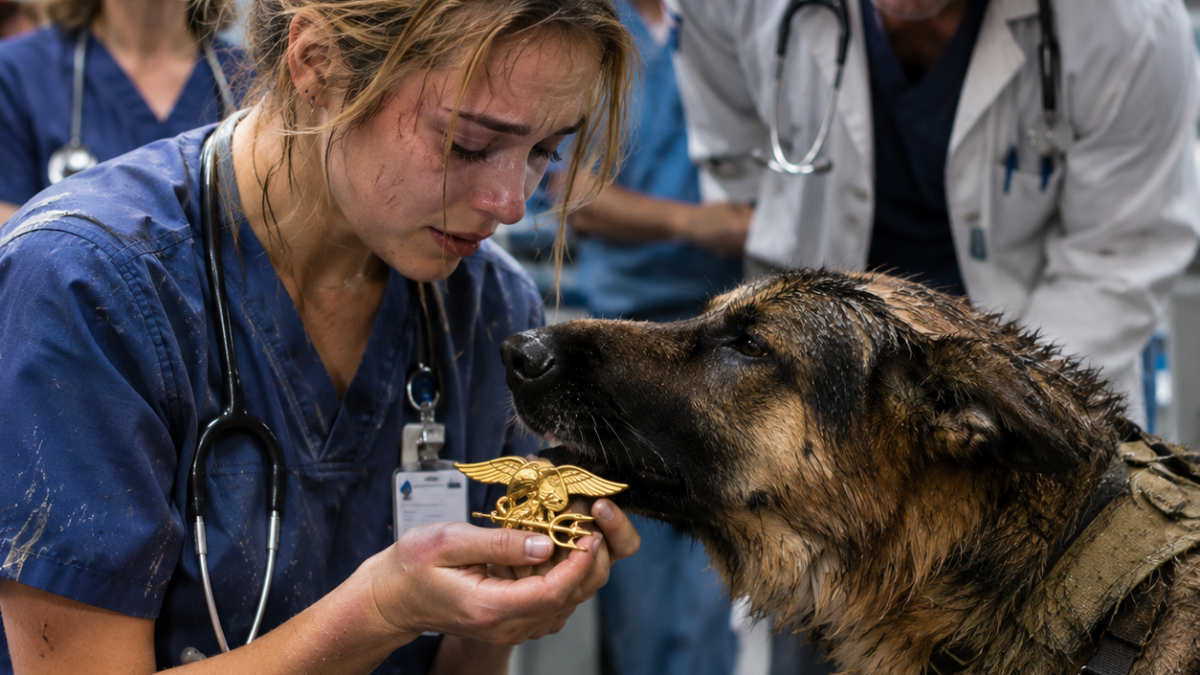
The dog opened his mouth.
A gold insignia fell gently into Paige’s palm.
An eagle.
Anchor.
Trident.
Flintlock pistol.
The Naval Special Warfare insignia.
The SEAL trident.
Paige stared down at it.
Everything around her disappeared.
The emergency department.
Ashford.
The storm.
The laughter.
Gone.
She saw a hillside.
Black night.
Dust.
Red light.
A man bleeding beneath her hands.
A dog whining beside him.
Rotor wash somewhere far away.
A voice saying:
Don’t let him stay here.
Paige’s fingers closed over the insignia.
The German Shepherd sat.
His whole body trembled.
Paige lowered herself.
“Koda?”
The dog lunged forward.
Not attacking.
He pressed his head into her chest.
Paige’s breath disappeared.
“Oh my God.”
She touched his ears.
His face.
The scar near his left shoulder.
“Koda.”
No one had told her the dog’s name.
Aaron Bell stared.
Lorraine whispered:
“How does she know him?”
Ashford stepped forward.
“Apparently the janitor has a friend.”
Paige didn’t look at him.
She turned the trident over.
Scratched into the back were two initials.
E.M.
Below them, three words.
HOLD THE LINE.
Her knees nearly gave out.
Koda whined.
Then suddenly grabbed her sleeve.
Paige looked at him.
He pulled.
Hard.
Toward the ambulance entrance.
“Koda?”
Pull.
Release.
Turn.
Look back.
Whine.
Pull again.
Paige’s entire posture changed.
The tremor disappeared.
Her shoulders came back.
Eyes sharpened.
She knew that behavior.
Not play.
Not greeting.
Not panic.
Report.
Somebody was down.
She stood.
“Koda, show me.”
The Shepherd ran.
Paige ran after him.
Ashford shouted:
“Nurse Sutton!”
She didn’t stop.
“Nurse Sutton, get back here!”
The ambulance doors burst open.
Wind slammed into Paige.
Rain struck her face.
Outside, chaos was moving toward the hospital.
An ambulance stood crooked near the ramp.
A paramedic was pulling a stretcher alone.
On it lay a large man in a torn black wetsuit.
Water streamed from his clothes.
His lips were blue-gray.
His face was pale.
Beside the stretcher was another man.
Huge.
Bearded.
Soaked tactical jacket.
He held the stretcher rail with one hand and shouted toward the hospital.
“We need a doctor now!”
Koda reached the stretcher.
Jumped beside it.
The bearded man’s eyes widened.
“Koda!”
Paige was already there.
“What happened?”
The paramedic gasped:
“Training boat flipped near the old pier. Two men in the water. This one was under several minutes. Pulse weak. Not breathing adequately.”
Paige looked at the patient’s chest.
No effective rise.
Neck pulse.
Faint.
Slow.
Failing.
Name tape.
HAYES.
Ashford came through the doors holding an umbrella.
“Trauma bay one. Airway team. Respiratory. Get—”
“How long?”
Paige asked.
The paramedic answered:
“Maybe four minutes submerged. We got him out. He had some breathing, then stopped.”
Ashford snapped:
“Sutton, step away.”
Paige ignored him.
She opened Hayes’s airway.
Checked.
No obstruction she could see.
Then began assisted rescue breathing.
One breath.
Chest rise.
Another.
The bearded man watched.
Ashford stepped closer.
“I said step away.”
Paige checked the carotid pulse again.
Weak.
“His pulse is deteriorating.”
“I am the attending physician.”
“Then help me.”
Ashford froze.
Nobody talked to him that way.
Paige gave another breath.
The pulse under her fingers stumbled.
Then vanished.
“He’s pulseless.”
Her hands moved instantly.
Heel of palm to center of chest.
Second hand over first.
Arms locked.
Compression.
Release.
Compression.
Release.
Hard.
Fast.
Controlled.
Her body settled into a rhythm so practiced it looked frightening.
Ashford stared.
“Nurse Sutton—”
“Get the AED.”
Ashford’s face hardened.
“What did you say?”
Paige didn’t look up.
“I said get me the AED.”
Aaron Bell had followed outside.
He ran.
Paige kept compressing.
“One, two, three…”
Koda paced beside the stretcher.
The bearded man crouched.
“Come on, Hayes.”
Paige finished the cycle.
Back to breaths.
Chest rose.
Then compressions.
Aaron returned with the AED.
Paige pointed.
“Pads.”
Aaron obeyed.
His hands shook.
Paige noticed.
“Look at me.”
Aaron did.
“You’re okay.”
“I’m—”
“You’re okay. Put the right pad below the collarbone. Other one left side. Good.”
He did.
The device analyzed.
No shock advised.
Paige resumed CPR immediately.
Ashford stood beneath his umbrella.
His polished shoes soaked in water.
His authority disappearing by the second.
“You’re outside your scope.”
Paige didn’t stop.
“If you want to discuss my license, keep him alive long enough for the meeting.”
Ashford’s face reddened.
“You’re going to fracture his ribs.”
Paige looked up once.
“Then we’ll fix his ribs after he has a pulse.”
The bearded man stared at her.
Not at her face.
Her hands.
The way she shifted positions.
The way she gave orders.
The way she never wasted motion.
Something about her bothered him.
A memory without a name.
Paige moved back to ventilation.
Then Hayes convulsed.
Water and stomach contents came from his mouth.
Paige rolled him immediately.
“Side.”
Aaron helped.
“Clear.”
She swept visible material from his mouth.
Hayes coughed.
Nothing.
Again.
Then suddenly inhaled.
A raw, ragged, ugly breath.
The most beautiful sound on the ramp.
The paramedic started crying.
Hayes coughed again.
Paige supported him.
“Easy.”
Another breath.
Weak.
Another.
Pulse returning.
Paige checked.
“There.”
Aaron laughed from pure relief.
The bearded man shut his eyes.
Koda pressed against the stretcher.
Paige said:
“Hayes. Open your eyes.”
His eyelids fluttered.
“You’re at Cedar Harbor.”
Cough.
“You’re safe.”
The last word cracked.
And only then, after the man had started breathing, Paige’s hands began to shake.
Violently.
She pulled them away.
The bearded man saw.
Not during.
After.
He stared at her.
Paige stood.
“Monitored bed. Watch for respiratory decline, aspiration complications, hypothermia. He needs continued physician evaluation.”
Ashford found his voice.
“I know how to treat a drowning patient.”
Paige looked at him.
“Then treat him.”
The bearded man almost smiled.
Ashford pointed at her.
“You performed an unauthorized intervention after being explicitly ordered to stop.”
The bearded man rose.
He was at least six-three.
Maybe six-four.
Shoulders like a doorway.
He faced Ashford.
“Doctor.”
Ashford looked at him.
“I don’t know who you are, but—”
“Senior Chief Erik Lindgren.”
That changed Ashford’s expression.
“Lindgren?”
“Naval Special Warfare.”
Ashford glanced at the insignia still in Paige’s hand.
Then back.
Bear Lindgren continued:
“A nurse follows protocol.”
Paige stiffened.
Bear looked at her.
“What I just watched was someone who has done CPR while people were trying to kill her.”
Nobody spoke.
Paige’s eyes moved to him.
Bear studied her face.
“You familiar with combat medicine, Nurse Sutton?”
“Some.”
“Some.”
His tone made the word sound absurd.
Paige turned away.
Then lightning struck somewhere close enough to turn the entire sky white.
A fraction of a second later came thunder.
The hospital lights went out.
Everything.
Ambulance bay.
Hall.
Monitors.
Ceiling lights.
Parking lot.
Darkness.
For two seconds, nobody reacted.
Then emergency lighting flickered.
Failed.
The generator tried to start.
Coughed.
Stopped.
Inside the hospital, alarms sounded on battery systems.
Patients shouted.
Someone screamed.
Ashford turned.
“Generator!”
A maintenance worker yelled from inside:
“Transfer fault! We’re working it!”
Then another ambulance came toward the hospital.
Slow.
Headlights cutting through the rain.
It stopped at the bottom of the ramp.
Floodwater had risen over the lower access lane.
A medic opened the window.
“Second casualty from the boat!”
Bear turned.
“Who?”
“Petty Officer Nolan Pierce!”
The rear doors opened.
A young sailor lay under foil blankets.
Conscious.
Barely.
Shivering violently.
The medic shouted:
“Possible hypothermia, shoulder injury, altered mental status. We can’t roll the stretcher up. Ramp is flooding.”
Staff gathered beneath the awning.
Nobody moved.
The front access route was becoming dangerous.
Water rushed along the curb.
Ashford looked toward the dark hospital.
“We need facilities to—”
Paige stepped forward.
“Stop.”
Nobody knew she was speaking to them.
Then she said louder:
“Everyone stop.”
They did.
Her voice was different.
Not loud.
Not angry.
Command voice.
Bear turned slowly.
Paige pointed.
“Phone lights. Every person who has one.”
Lights appeared.
“Senior Chief.”
Bear straightened instinctively.
“Four men on the stretcher.”
He didn’t ask how she knew he had men nearby.
She had already counted them.
“Rest of your team makes a human line up the ramp. Nobody moves through water without contact.”
Bear nodded.
“You heard her.”
Four SEALs moved from the ambulance.
Ashford stepped forward.
“Wait. We aren’t moving patients through—”
Paige pointed toward the east side of the building.
“Linen corridor.”
Lorraine stared.
“What?”
“Service entrance on the east wall. The corridor runs beneath the main hall. No stairs. Higher than the ambulance ramp. Dry entrance.”
Lorraine said:
“How do you know that?”
Paige looked at her.
“I walked it Monday.”
“Why?”
“Because it was there.”
Bear almost laughed.
Ashford raised his voice.
“I am chief of emergency medicine. Nobody moves a trauma patient through an unapproved—”
Bear turned.
“Doctor.”
Ashford stopped.
“Step aside.”
“Excuse me?”
“She’s running this.”
Ashford stared at him.
Bear’s expression did not change.
“Unless you have a better route.”
Ashford looked toward the floodwater.
Then toward the dark hospital.
He had none.
Paige descended the ramp.
Water reached above her ankles.
“Watch the drain.”
She pointed.
“Deep spot right side. Go left.”
The SEALs lifted the stretcher.
Paige walked backward.
“Slow.”
Pierce shivered beneath the blankets.
“I’m cold.”
Paige moved beside him.
“I know.”
“Where’s Hayes?”
“Alive.”
Pierce’s eyes opened wider.
“Alive?”
“Yes.”
The young sailor almost smiled.
“Good.”
His teeth chattered.
Paige checked him as they moved.
Mental status.
Breathing.
Pulse.
Skin.
She gave simple instructions.
“Stay awake.”
“I’m trying.”
“Tell me your full name.”
“Nolan Pierce.”
“Rank?”
“Petty Officer Second Class.”
“Where are you?”
He looked around at darkness and rain.
“Hell?”
One SEAL laughed.
Paige said:
“Acceptable.”
Even Bear smiled.
They reached the linen corridor.
Black.
Concrete floor.
Shelving.
Laundry carts.
Paige held her phone light forward.
“Single line.”
People moved.
“Hand on shoulder in front of you.”
Nurses guided patients.
Wheelchairs.
Gurneys.
Children.
A woman carrying an infant.
Orderlies moved oxygen cylinders.
No one shouted now.
Because Paige did not.
She gave one instruction at a time.
Simple.
Specific.
Actionable.
Bear watched her.
Every few seconds, he became more certain.
Not of her identity.
Not yet.
Of her world.
She had operated in darkness before.
She had moved casualties when equipment failed.
She understood fear as a logistical problem.
Give frightened people one task.
Then the next.
Then the next.
Panic shrinks when hands have work.
In trauma bay two, emergency lanterns came on.
Pierce’s wet clothing was removed.
Warm blankets.
Warmed fluids ordered.
Paige assigned staff.
“You monitor temperature.”
Point.
“You check glucose.”
Point.
“Get dry sheets.”
Point.
“Respiratory, stay with Hayes.”
The staff obeyed.
Lorraine watched from the doorway.
This was the woman she had smiled at while Ashford handed her a mop.
Paige noticed Lorraine.
“Charge nurse.”
Lorraine straightened.
“Yes.”
“We need every portable battery monitor available. Triage by instability, not arrival time.”
Lorraine nodded.
“Right.”
She ran.
Ashford entered.
His hair was wet.
His coat ruined.
He looked around his own emergency department.
Everyone was following Paige.
“Enough.”
Paige turned.
“The generator isn’t stable yet.”
“I said enough.”
The room quieted.
Ashford pointed toward Paige.
“You are a probationary employee.”
Paige said nothing.
“You have ignored multiple direct orders.”
Nothing.
“You have exceeded your authority.”
Bear stepped forward.
Paige lifted a hand slightly.
He stopped.
She looked at Ashford.
“You want authority?”
Ashford’s jaw tightened.
“I want order.”
Paige’s eyes moved around the trauma bay.
Patients monitored.
Lights organized.
Teams functioning.
Pierce warming.
Hayes breathing.
Then back to him.
“This is order.”
Ashford’s face changed.
Before he could answer, lights flickered.
Then returned.
One row.
Second row.
Monitors rebooted.
The generator finally caught.
A low mechanical hum moved through the building.
Everyone exhaled.
Paige stepped backward.
And almost immediately, her transformation disappeared.
Shoulders lowered.
Hands began shaking.
Eyes dropped.
Bear saw the transition.
From command to concealment.
He knew soldiers who did that.
Men and women who could function perfectly in disaster but collapsed when the danger ended.
Koda entered the trauma bay.
He had refused to leave Hayes.
Now he walked directly to Paige.
Laid down.
Chin across her boot.
Paige looked down.
Then slowly sat on the floor beside him.
She ran one hand over his wet coat.
“You got old.”
Koda closed his eyes.
“So did I.”
Bear heard.
Paige opened her hand.
The gold trident.
E.M.
HOLD THE LINE.
She touched the engraving.
Koda’s nose moved toward it.
“You carried this all this time?”
Bear’s entire body went still.
“What did you say?”
Paige looked up.
Bear pointed.
“That insignia.”
Paige closed her hand.
“What about it?”
“Where did you get it?”
Koda raised his head.
Paige looked toward Hayes.
“From a hillside.”
Bear stopped breathing.
Paige continued:
“Six years ago.”
Bear stared at her.
A hillside.
Six years.
Koda.
The trident.
E.M.
Something in memory shifted.
A voice on a radio.
A name.
A medic nobody had called by her real name.
Small.
Fast.
Always moving.
Sparrow.
Bear took one step toward Paige.
She stood immediately.
“Don’t.”
“Who are you?”
“Paige Sutton.”
“That’s not what I asked.”
Her eyes hardened.
Bear whispered:
“Sparrow?”
Paige’s face emptied.
Koda stood.
Bear knew.
“Oh, God.”
Paige looked away.
Bear said nothing else.
Not there.
Not in front of everyone.
He turned and walked out.
For the first time that night, the senior chief needed somewhere private to breathe.
By sunrise, the storm had moved east.
Lake Michigan was still rough.
But the sky behind the hospital had turned pale gold.
Hayes was stable.
Pierce was improving.
No patient had died during the outage.
No staff member had been seriously injured.
The emergency department looked exhausted.
Wet blankets.
Cups.
Discarded wrappers.
Equipment everywhere.
Paige stood in the staff locker room changing into dry scrubs when Lorraine entered.
Paige didn’t turn.
Lorraine stopped.
“I owe you an apology.”
Paige continued folding her wet top.
“You don’t owe me anything.”
“I laughed.”
Paige’s hands paused.
Lorraine swallowed.
“When Dr. Ashford gave you the mop.”
“I remember.”
“I shouldn’t have.”
“No.”
Lorraine waited.
Paige closed the locker.
Then looked at her.
“If you think something is cruel and laugh because the person doing it outranks you, you still helped.”
Lorraine’s face tightened.
“I know.”
Paige nodded.
That was all.
No absolution.
No speech.
Lorraine walked out carrying the lesson herself.
At 7:40, Captain Neil Ferrante ordered the principal staff involved in the storm response to the main conference room.
Paige arrived last.
Same oversized blue scrubs.
Hair still damp.
Koda waited outside with Bear.
Ashford was already seated.
So was Lorraine.
Aaron Bell.
Two administrators.
Hospital legal counsel.
Captain Ferrante.
Ashford had a thick folder in front of him.
When Paige entered, he opened it.
“Captain, before we turn last night into some heroic myth, we need to discuss serious violations.”
Ferrante rubbed tired eyes.
“Proceed.”
Ashford looked at Paige.
“She ignored physician orders.”
Paige remained standing.
“She initiated airway interventions.”
Ferrante said:
“On a pulseless drowning patient?”
“Yes.”
“Who survived?”
Ashford’s jaw moved.
“That does not erase scope concerns.”
Ferrante nodded.
“Continue.”
“She assumed command during an electrical failure.”
Ferrante looked at Aaron.
“Did her actions contribute to patient harm?”
Aaron answered:
“No, sir.”
“Did they prevent harm?”
Aaron swallowed.
“Yes, sir.”
Ashford snapped:
“That’s not the issue.”
Ferrante looked at him.
“It is one of them.”
Ashford pushed the folder forward.
“Then explain her personnel record.”
Ferrante looked at Paige.
Ashford continued:
“Six years with almost no verifiable civilian work history.”
Paige’s face remained still.
“References routed through Department of Defense channels. Certifications with restricted confirmation numbers. Previous supervisors nobody can contact directly.”
Ferrante frowned.
“I reviewed her clearance before hiring.”
Ashford shook his head.
“You reviewed a redacted file.”
Paige finally spoke.
“Yes.”
Everyone looked at her.
Ashford smiled coldly.
“Thank you.”
Paige continued:
“Because the unredacted portions aren’t available to you.”
Ashford leaned back.
“Convenient.”
Paige’s hands began trembling.
She put them behind her back.
Ashford saw.
He regained confidence.
“Captain, we have a nurse who presents as anxious, refuses to discuss previous employment, has questionable documentation, and last night acted as though she was commanding a field hospital.”
Paige looked at the floor.
Ashford turned toward Ferrante.
“I want her suspended pending investigation.”
Silence.
Then the conference room door opened.
Bear Lindgren entered.
Dry uniform.
Clean boots.
Koda at his left side.
Four SEALs followed.
No one spoke.
Bear faced Ferrante.
“Captain. Permission to address the room.”
“Granted.”
Bear turned toward Paige.
She shook her head once.
Very small.
Don’t.
Bear saw.
He ignored it.
“Chief Sutton.”
Ashford laughed.
“She’s a nurse.”
Bear’s eyes moved toward him.
“Yes.”
Then Bear came to attention.
And saluted Paige.
Paige closed her eyes.
Every person in the room stopped breathing.
Bear held the salute.
“Chief Hospital Corpsman Paige Sutton.”
Paige whispered:
“Bear.”
He lowered his hand.
“Call sign Sparrow.”
Aaron stared.
Lorraine covered her mouth.
Ashford looked confused.
Bear turned toward them.
“She served eleven years in Naval Special Warfare medical support.”
Paige’s eyes remained closed.
“Multiple combat deployments.”
Ferrante slowly stood.
Bear continued.
“Much of her operational record remains classified.”
Ashford’s face drained.
“She wasn’t a SEAL.”
Paige opened her eyes.
Bear looked at him.
“No.”
He stepped closer.
“She was the person SEALs screamed for when we were dying.”
Nobody moved.
Bear’s voice lowered.
“Twenty-three men came home because of her direct actions.”
Paige looked at him sharply.
“Don’t.”
Bear’s jaw tightened.
“Somebody needs to.”
Paige shook her head.
“I don’t want this.”
“I know.”
That was the tragedy.
She had never wanted the room.
She had wanted a nursing job.
Quiet.
Useful.
Normal.
Bear turned toward Koda.
“This dog belonged to Senior Chief Eli Marsh.”
Paige’s face broke.
Barely.
But it broke.
Bear continued:
“Eli and I served together fourteen years.”
He pointed toward the gold insignia Paige carried.
“That was his trident.”
Nobody spoke.
Bear looked at Paige.
“Six years ago, our team was hit during an operation overseas.”
Paige’s gaze went somewhere far beyond the room.
Bear’s voice became slower.
“Three casualties immediately.”
Paige could smell dirt again.
Diesel.
Blood.
Burning metal.
Eli screaming once.
Then not again.
Bear said:
“Chief Sutton was our senior medic.”
The conference room disappeared for Paige.
She was back on the hillside.
Koda had been younger.
Bleeding from a shoulder wound.
Eli Marsh lay against broken stone.
Paige’s hands inside his vest.
Too much blood.
She knew.
Eli knew too.
“Paige.”
“Don’t talk.”
“Listen.”
“Shut up, Eli.”
“Take Koda.”
“You’re taking him.”
“Paige.”
She pressed harder.
“No.”
“Look at me.”
She didn’t.
“Look at me.”
She did.
Eli smiled.
Unbelievably.
Dying.
Still smiling.
“Hold the line, Sparrow.”
Her throat closed.
“Shut up.”
“Take him home.”
“No.”
“Promise.”
Paige’s hands were red to the wrists.
She screamed for evacuation.
Aircraft still minutes away.
Too long.
Eli reached toward his chest.
His fingers couldn’t work.
Paige helped.
He touched the gold trident.
Then Koda’s harness.
“Home.”
His hand fell.
Paige kept working.
Even after she knew.
Bear’s voice brought her back.
“Eli died holding her hand.”
Paige’s breathing changed.
Bear continued:
“Before medevac arrived, she removed his trident.”
Paige stared at Koda.
“She attached it to Koda’s harness.”
Bear’s voice broke now.
“And told the dog to take him home.”
Paige whispered:
“Enough.”
Bear shook his head.
“No.”
She looked at him.
He had tears in his eyes.
“You disappeared after that deployment.”
Paige looked away.
“I transferred.”
“You vanished.”
“I needed to.”
Bear nodded.
“I know.”
He faced the room again.
“Koda retired after his injuries.”
He rubbed the Shepherd’s head.
“I took him.”
Paige stared.
Bear said:
“For six years, that trident stayed on his harness.”
The room remained completely silent.
“Last night, during the storm, Koda got loose near the lake after our boat accident.”
Bear looked toward Paige.
“He ran nearly a mile.”
“Past the operations building.”
“Past security.”
“Past another medical entrance.”
“Straight into this hospital.”
He nodded toward the door.
“And put Eli Marsh’s trident in her hand.”
Paige’s eyes filled.
Bear said:
“I don’t know how that dog knew she was here.”
His voice softened.
“But I know something.”
He looked at Ashford.
“He didn’t choose the loudest person in the room.”
Ashford lowered his eyes.
“He chose the one he trusted.”
Ferrante looked at Paige.
“Chief Sutton.”
Paige shook her head.
“Captain, I am not here as a chief.”
“You retain the rank.”
“On paper.”
“You earned it.”
She swallowed.
“I’m here as a nurse.”
Ferrante nodded slowly.
“Then Nurse Sutton.”
She looked at him.
“Why did you hide this?”
Paige’s answer was almost a whisper.
“I didn’t hide it.”
Ferrante waited.
“I stopped explaining it.”
Her hands trembled again.
“People hear combat medicine and they want stories.”
“Stories about what?”
Paige laughed once.
No humor.
“Blood.”
Nobody moved.
She continued.
“They want to know who died.”
“Who lived.”
“What it felt like.”
“If I was scared.”
“If I killed anyone.”
“If I watched someone die.”
Her eyes went to Koda.
“I got tired of being the worst night of my life whenever somebody wanted an interesting conversation.”
Bear looked down.
Paige wiped one tear angrily.
“I wanted to be a nurse.”
She looked around the room.
“Just a nurse.”
Aaron said quietly:
“You are.”
Paige looked at him.
He continued:
“You were before we knew any of this.”
That almost broke her more than the salute.
Captain Ferrante closed the personnel file.
Then he turned toward Ashford.
“Doctor.”
Ashford straightened.
Ferrante spoke carefully.
“You publicly humiliated a probationary nurse.”
Ashford opened his mouth.
Ferrante raised a hand.
“You assigned her housekeeping work as punishment for raising a legitimate patient-safety concern.”
Ashford looked toward the table.
“That concern led to identification of a splenic injury.”
No answer.
“You ordered her away from a drowning patient during a deteriorating emergency.”
Ashford finally said:
“I was following chain of command.”
Ferrante stared.
“Leadership is not a chain you wrap around everyone below you.”
Ashford’s face hardened.
Ferrante continued:
“During a power outage, you repeatedly attempted to stop a functioning emergency response while offering no alternative plan.”
“Captain—”
“And now your defense is that you did not know who she was.”
Ashford looked at Paige.
“I didn’t.”
Ferrante nodded.
“Exactly.”
Ashford frowned.
Ferrante leaned forward.
“You believe the mistake was failing to recognize an extraordinary résumé.”
He pointed toward Paige.
“The mistake was believing she needed an extraordinary résumé before you treated her with dignity.”
No one moved.
Ashford’s expression changed.
There was no defense against that.
Ferrante said:
“Effective immediately, you are relieved as chief of emergency medicine pending administrative review.”
Ashford went pale.
“Neil.”
“Captain.”
Ashford swallowed.
“Captain, I’ve run this department for eleven years.”
“And today you are not.”
Lorraine’s coffee slipped.
The cup struck the floor.
Shattered.
Everyone looked.
For one second, Paige saw the mop.
The laughter.
Her own reflection on the polished tile.
She knelt.
Lorraine hurried.
“I’ll get housekeeping.”
Paige stopped.
Then smiled slightly.
“No.”
She began picking up the pieces.
Lorraine stared.
Paige said:
“We clean our own messes.”
Lorraine’s eyes filled.
She knelt beside her.
Together they gathered the broken cup.
Later that morning, Ashford found Paige near room nine.
Petty Officer Delaney had gone to surgery.
He was stable.
Paige was reviewing medication.
Ashford stopped several feet away.
She looked up.
For the first time since she’d arrived at Cedar Harbor, he seemed smaller.
Not because he’d lost authority.
Because he had lost certainty.
“Nurse Sutton.”
Paige waited.
“I owe you an apology.”
Several staff members heard.
Ashford knew they heard.
That mattered.
He could have apologized privately.
He didn’t.
“I humiliated you publicly.”
Paige said nothing.
“I should apologize publicly.”
He stepped into the central hall.
People turned.
Ashford swallowed.
“Nurse Sutton.”
Paige slowly approached.
Forty people had watched him give her the mop.
Not exactly the same forty.
Enough.
Ashford looked at her.
“I was wrong.”
The words seemed physically difficult.
“I mistook quietness for weakness.”
He glanced toward Aaron.
“And uncertainty for incompetence.”
Then back.
“I used my position to embarrass you.”
Paige’s expression didn’t change.
“I’m sorry.”
Nobody applauded.
Nobody laughed.
Paige looked at him for a long moment.
Then said:
“Don’t do it to the next person.”
Ashford nodded.
“I won’t.”
“That’s more useful than being sorry.”
He accepted that.
Then stepped away.
Aaron found Paige twenty minutes later near the supply closet.
“Can I ask you something?”
Paige looked suspicious.
“If it’s about classified operations, no.”
He almost smiled.
“No.”
“Okay.”
He looked at his hands.
“I froze last night.”
Paige waited.
“When Hayes arrested.”
“You got the AED.”
“Because you told me.”
“That’s how teams work.”
“But before you spoke, I froze.”
Paige leaned against the wall.
“So?”
Aaron looked confused.
“So I shouldn’t.”
“Who told you that?”
“I don’t know.”
Paige studied him.
“Fear isn’t the part you control.”
He listened.
“Movement is.”
She tapped two fingers against his chest.
“You can be terrified and useful at the same time.”
Aaron nodded slowly.
“Will you teach me?”
“What?”
“How you stayed calm.”
Paige almost laughed.
“I wasn’t calm.”
“You looked calm.”
“That’s different.”
“Then teach me that.”
She considered him.
Then nodded.
“Tomorrow. Six a.m.”
His face fell.
“Six?”
“You want secrets?”
“Yes.”
“Secret one is getting up early.”
He laughed.
For the first time, Paige laughed too.
Hayes woke shortly after noon.
Koda was beside the bed.
Exactly where everyone expected him to be.
Paige entered to check his monitor.
Hayes opened one eye.
His voice was rough.
“Sparrow.”
Paige stopped.
“Senior Chief talks too much.”
Hayes smiled weakly.
“He told stories.”
“Most of them are lies.”
“He said you once kept a guy alive for six hours during an extraction.”
“Definitely a lie.”
“He said four.”
“Still a lie.”
Hayes laughed.
Then coughed.
Paige leaned forward.
“Easy.”
He looked at her.
“I thought you were a legend.”
Paige adjusted his IV line.
“I’m a nurse.”
“Apparently a terrifying one.”
“Drink some water.”
He smiled.
“Yes, Chief.”
Paige gave him a look.
“Nurse.”
“Yes, Nurse.”
Koda sighed.
Hayes scratched behind his ear.
The dog closed his eyes.
Paige stared at him.
Six years.
She had wondered.
Not every day.
That would have destroyed her.
But sometimes.
Was Koda alive?
Had he recovered?
Who took him?
Did anyone know the trident belonged to Eli?
Did somebody remove it?
Had the dog forgotten her?
The answer lay beside Hayes.
Old now.
Gray near the muzzle.
Scarred shoulder.
Still loyal.
Still carrying something that belonged to the dead.
That afternoon, Paige left the emergency department through the main hall.
Staff stood along both sides.
Not intentionally at first.
Then one person stopped.
Another.
Another.
Nobody clapped.
Bear had told them she would hate that.
They simply moved aside.
Made room.
Paige slowed.
Her instinct told her to lower her eyes.
She almost did.
Then remembered Ashford’s words.
I don’t need a nurse who looks at the floor.
Cruel words.
But words can change meaning depending on who carries them.
Paige lifted her head.
One person at a time.
Aaron.
Lorraine.
Respiratory therapist.
Security guard.
Housekeeper.
Resident.
Patient.
She looked at them.
Not as witnesses.
People.
At the end of the hall stood Bear.
And Koda.
Bear said:
“Walk?”
Paige looked toward the exit.
“Where?”
“The pier.”
She stiffened.
“Not today.”
Bear nodded.
“Okay.”
Two days later, she changed her mind.
The storm had passed completely.
Lake Michigan lay almost flat beneath the sunrise.
The old training pier extended into water turned gold by morning light.
At the far end stood a small memorial stone.
SENIOR CHIEF ELI MARSH
Paige stopped twenty feet away.
Bear waited.
Hayes sat in a wheelchair nearby, still recovering.
Koda walked beside Paige.
No leash.
He didn’t need one.
Paige approached the stone.
Her hands shook.
She hated them for it.
Bear noticed.
“Still happens?”
“Every day.”
“Nobody knew.”
“That was the point.”
Bear nodded.
Paige crouched.
Took the trident from her pocket.
The gold had scratches.
Wear.
Six years on a working dog’s harness.
She ran her thumb across the engraving.
E.M.
HOLD THE LINE.
Bear said:
“He made me promise something too.”
Paige looked up.
“What?”
“That if you made it home, somebody would keep you from turning yourself into a ghost.”
Paige looked away.
“He knew you.”
“He knew everyone.”
“Not like you.”
Paige’s eyes filled.
“I left because every hallway had him in it.”
Bear said nothing.
“Every dog bark.”
Nothing.
“Every helicopter.”
She looked at the lake.
“I would close my eyes and see his face.”
Bear swallowed.
“I know.”
“No, you don’t.”
Bear nodded.
“You’re right.”
She looked at him.
“I don’t.”
That was enough.
No competition.
No argument over who hurt more.
Paige turned toward Koda.
The Shepherd stood beside her.
She held the trident.
For six years, it had connected a dead man to a living dog.
Then the dog had carried it back to her.
She opened Koda’s new harness.
Bear watched.
Paige attached the insignia over his chest.
Koda looked down.
Sniffed it.
Then looked at Paige.
She touched his face.
“He earned it.”
Bear’s jaw moved.
“He did.”
Paige put her forehead against Koda’s.
“I kept my promise, Eli.”
Her voice broke.
“I got him home.”
Bear looked away toward the water.
Hayes wiped his eyes and pretended he hadn’t.
Paige stood.
Bear said:
“There’s still a place for you with us.”
She shook her head.
“Sparrow belongs to another life.”
“Does she?”
Paige thought.
Then answered:
“Maybe.”
Bear waited.
“But she doesn’t need to deploy again.”
He smiled faintly.
“No.”
Paige looked toward the hospital behind them.
“If somebody comes through those doors drowning, bleeding, scared, alone…”
She touched Koda once more.
“I’ll be there.”
Bear nodded.
“Mission enough.”
“Mission enough.”
The next morning, Paige returned to Cedar Harbor.
Same blue scrubs.
Still too large.
Same hair.
Same quiet walk.
But something had changed.
Not everyone else’s opinion.
Hers.
A frightened patient in room four reached for her hand.
Paige let him take it.
He was an older veteran facing emergency surgery.
“I hate hospitals.”
“Most people do.”
“I’m scared.”
Paige looked directly into his eyes.
“So am I sometimes.”
He blinked.
“You?”
“Yes.”
“You don’t look scared.”
Paige smiled.
“That’s because I’ve practiced.”
He squeezed her hand.
“Does it go away?”
“No.”
She squeezed back.
“You just learn what to do while it’s there.”
Outside the room, Aaron waited.
Six a.m. training had begun that morning.
Airway skills.
CPR review.
Disaster triage.
Low-light movement.
How to communicate when everyone else is yelling.
Paige never told war stories.
When residents asked why she taught something a certain way, she said:
“Because it works.”
That became enough.
Lorraine changed too.
Not instantly.
People rarely do.
But she stopped laughing when Ashford humiliated residents.
Even after Ashford returned months later as an attending physician without his chief title, Lorraine challenged him twice when his tone crossed into cruelty.
The second time, Paige heard.
She didn’t say anything.
Just smiled.
Ashford noticed.
He rolled his eyes.
Then corrected himself.
He changed more slowly.
But he changed.
The biggest shift happened one afternoon when a nervous nursing student misread an order.
Ashford started to say something sharp.
Everyone felt it coming.
Then he stopped.
The student looked terrified.
Ashford took a breath.
Pulled up a chair.
“Let’s look at it again.”
Paige heard.
She turned away before he could see her smile.
That was enough justice for her.
Not destruction.
Correction.
Consequences mattered.
So did becoming better.
Koda became a regular visitor.
Officially, he came for Hayes during rehabilitation.
Unofficially, everyone knew who he was looking for.
The automatic doors opened.
Koda entered.
He ignored registration.
Ignored security.
Ignored Bear.
Straight to Paige.
Every time.
Someone eventually placed a small bowl behind the nurses’ station labeled KODA.
Paige pretended she didn’t know who bought it.
It was Lorraine.
The gold trident stayed on Koda’s harness.
Staff noticed.
Nobody touched it.
One afternoon, a young corpsman asked Paige:
“Why does he carry a SEAL insignia?”
Paige looked at the dog.
Then answered:
“Because some things belong with the one who carried them home.”
The corpsman didn’t fully understand.
That was okay.
Not every story needs to be explained to everyone.
Months later, Cedar Harbor created a new emergency preparedness program.
Captain Ferrante asked Paige to lead it.
She refused.
He asked again.
She refused.
Third time, he changed the title.
“Clinical readiness coordinator.”
Paige stared.
“That’s the same job.”
“No.”
“How?”
“Different words.”
She almost laughed.
Ferrante leaned forward.
“Paige.”
She waited.
“People trust you.”
Her eyes dropped automatically.
Ferrante said:
“Look at me.”
She did.
“Not because they know your record.”
Pause.
“Because when things went dark, you showed them where to put their hands.”
Paige swallowed.
Ferrante continued:
“You don’t have to become who you were.”
“Good.”
“But maybe who you were knows things who you are can use.”
That landed differently.
Paige accepted.
Under one condition.
“No public speeches.”
Ferrante agreed.
Then violated that agreement six months later by asking her to speak at a hospital training day.
Paige stood behind a podium.
Two hundred staff.
Her hands shook.
More than they had while Hayes was dying.
She gripped the sides.
People waited.
Koda lay near the front row beside Bear.
Paige looked at him.
Then began.
“My name is Paige Sutton.”
Pause.
“I used to think courage meant not shaking.”
She lifted one hand.
Everyone could see the tremor.
“I was wrong.”
The room stayed quiet.
“Courage is doing the work while you shake.”
She told no combat stories.
No classified missions.
No names of the dead except Eli.
Instead, she talked about what Cedar Harbor taught her.
“On my fifth day here, someone handed me a mop because he thought fear made me useless.”
Ashford was sitting in the back.
He didn’t leave.
Paige continued:
“He was wrong about me.”
Pause.
“But I was wrong too.”
People shifted.
“I thought if nobody knew who I’d been, nobody could expect anything from me.”
She looked down.
“I thought disappearing was the same as healing.”
Bear watched.
Paige looked up again.
“It isn’t.”
She spoke about patients.
Residents.
Nurses.
The way confidence can become cruelty if never questioned.
The way quiet people are often mistaken for empty ones.
The way fear changes posture but not necessarily ability.
Then she said:
“Do not wait until someone has a medal, rank, title, classified record, famous name, or heroic dog before you decide they deserve respect.”
Ashford looked down.
Paige’s voice stayed calm.
“Respect them before you know the reveal.”
Silence.
“Because most people do not have one.”
That became the sentence Cedar Harbor remembered.
Not Sparrow.
Not the trident.
Not the drowning rescue.
Respect them before you know the reveal.
Years later, Aaron Bell would become an emergency physician.
He kept a handwritten copy of that sentence inside his locker.
Lorraine kept another behind the charge desk.
Even Ashford had one.
Paige never knew that.
Or pretended not to.
She remained at Cedar Harbor.
She never returned to active combat operations.
She never stopped missing Eli.
Some mornings were worse.
Thunder remained difficult.
Helicopters sometimes pulled her somewhere she did not want to go.
Her hands continued shaking after certain emergencies.
She stopped apologizing for that.
Koda aged.
His back legs became stiff.
His muzzle turned almost completely gray.
Bear started bringing him less often because long hospital floors tired him.
On one sunny afternoon, Paige walked outside after shift and found him waiting near the sliding doors.
Koda rose slowly.
The trident shone against his chest.
Paige crouched.
“Hey, buddy.”
He leaned into her.
The way he’d done the night he found her.
She hugged him.
Not long.
Dogs have dignity.
Then she sat on the bench beside the doors.
Koda lay at her feet.
People came and went.
Patients.
Families.
Doctors.
Housekeeping.
Security.
Nobody paid much attention.
Paige liked that.
Normal afternoon.
Normal hospital.
Normal nurse.
Koda’s head rested on her shoe.
Paige looked through the glass toward the hallway where Ashford had once handed her a mop.
She could almost see the younger version of herself.
Eyes down.
Hands shaking.
Trying to disappear.
She wished she could tell that woman something.
Not that everyone would eventually learn who she was.
That part didn’t matter as much anymore.
She would tell her:
You don’t need them to know.
You only need to remember.
The rank.
The deployments.
The people saved.
Those weren’t the source of her worth.
Neither was the dramatic rescue.
Or Bear’s salute.
Or the gold insignia.
Those things only forced other people to notice what they should have noticed without proof.
Paige Sutton had deserved dignity when she was holding the mop.
Before Koda.
Before Hayes.
Before Sparrow.
Before anyone knew.
That was the real lesson.
A year after the storm, Cedar Harbor installed a framed photograph near the emergency department.
Paige hated it.
The photograph showed the ambulance ramp during the blackout.
Phone lights everywhere.
SEALs carrying the stretcher.
Nurses forming a line.
Water rising.
And in the center, barely visible, Paige walking backward and guiding them.
The caption did not mention Chief Sutton.
Did not mention Sparrow.
Did not mention classified service.
It read:
WHEN THE LIGHTS FAIL, BE THE PERSON WHO HELPS OTHERS FIND THE WAY.
Paige stood in front of it one morning.
Aaron walked beside her.
“Still hate it?”
“Yes.”
“Why?”
“My hair looks terrible.”
He laughed.
“You were in a storm.”
“No excuse.”
They continued down the hall.
Koda was visiting that day.
The old Shepherd followed slowly.
Gold trident still on his harness.
A newly hired nurse stood near the supply station.
Young.
Nervous.
Holding a chart.
She watched Dr. Ashford approach.
He had returned to emergency medicine after months of review and leadership training.
No chief title.
Different demeanor.
The nurse said:
“Doctor, I think this order might be wrong.”
Paige stopped walking.
Aaron did too.
Ashford looked at the chart.
Then at the nurse.
For one second, Paige remembered herself.
Five days.
Mop.
Laughter.
Ashford said:
“Show me what you’re seeing.”
The young nurse explained.
Ashford listened.
No joke.
No audience.
No humiliation.
When she finished, he nodded.
“Good catch.”
Paige looked at Aaron.
Aaron smiled.
Ashford noticed Paige down the hall.
Their eyes met.
He gave one small nod.
Paige returned it.
Then kept walking.
Koda beside her.
Aaron on the other side.
No music.
No applause.
No dramatic reveal.
Just work.
That suited her.
Because the greatest thing Paige Sutton learned after Cedar Harbor was that being seen and being known were not the same.
For years, she believed she had two choices.
Be Sparrow forever.
Or disappear completely.
Cedar Harbor gave her a third.
She could be Paige.
A nurse.
A woman who shook.
A woman who remembered.
A woman who had once carried dying men through darkness and now carried frightened patients through ordinary nights.
She didn’t lose her rank.
She didn’t hide it either.
She simply stopped needing it to enter the room before she did.
And every so often, when Cedar Harbor’s glass doors opened on a sunny afternoon, an old German Shepherd would walk slowly into the emergency department wearing a weathered golden trident over his heart.
He would pass the doctors.
Pass the administrators.
Pass security.
Pass every loud person in the building.
Then he would find the quiet nurse.
And sit beside her.
Because six years earlier, on a dark hillside, Paige Sutton had promised a dying man that she would get his dog home.
She had believed she’d failed.
Koda had spent six years carrying proof that she hadn’t.
And on the stormiest night Cedar Harbor had seen in years, the dog had returned one final message to the woman who once told him to hold the line.
You are still here.
You still know what to do.
Now look up.


