They Framed a Quiet Nurse—Until Her K9 Led a Federal Agent to Expose the Hospital’s Biggest Lie
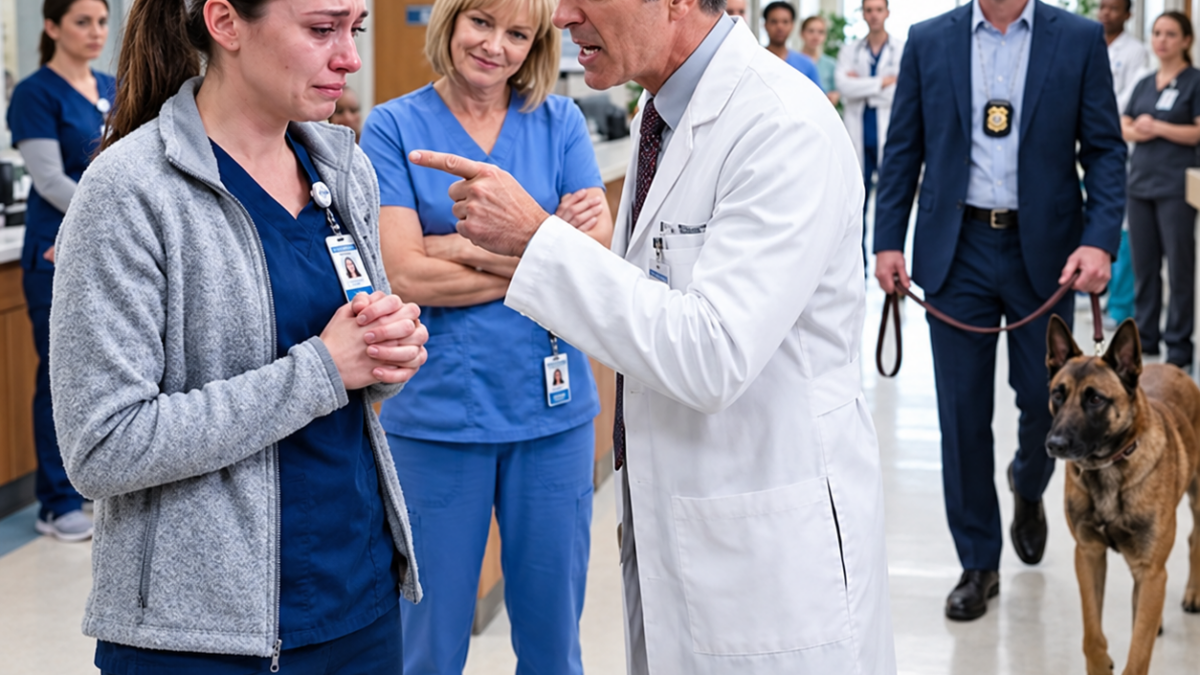
PART3:
Checked the chart again.
The fentanyl administration was documented correctly.
The vial had come from the Pyxis medication station twenty minutes earlier.
She had drawn it herself.
She had administered it herself.
She remembered discarding the empty vial into the sharps container.
And that was exactly why her stomach began to twist.
Something was wrong.
“William, look at me,” she said, lowering her voice. “I’m going to get this under control.”
His hand shot out and caught her sleeve.
“Don’t let me die,” he whispered.
“You’re not dying on my shift.”
The promise came out before she could stop it.
Then she turned and walked to the sharps container.
Another nurse might have assumed tolerance.
Or charting error.
Or breakthrough pain.
Another nurse might have called the physician first, waited for orders, lost minutes trying to make the situation fit the chart.
Meline did not trust charts more than bodies.
She put on heavy gloves, took a pair of forceps, and carefully fished the small glass vial from the disposal container.
Under the fluorescent light, it looked normal.
At first.
Fentanyl.
Oakhaven pharmacy label.
Cap intact.
Lot number clean.
But Meline had handled thousands of controlled-substance vials. She knew how a tamper-evident seal should look after being popped. She knew the tiny violence of opening sterile packaging. She knew the clean break of a legitimate cap.
This cap looked too perfect.
That was what bothered her.
Too smooth.
Too careful.
She turned the vial slowly.
There.
A faint yellowish residue around the aluminum crimp.
So thin most people would miss it.
Adhesive.
Her pulse went cold.
Someone had removed the cap, drained the narcotic, refilled the vial with saline, and glued it back together.
William Henderson had not received fentanyl.
He had received nothing.
Meline looked back into room 14, where William was shaking under the lights, his freshly opened chest screaming through his entire body.
For one second, fury burned through her so hot she could hardly breathe.
Then training took over.
She stabilized him using an alternative pain protocol from a fresh, verified batch. She documented everything. She called the on-call physician without naming the suspicion over an open line. She stayed at William’s bedside until his heart rate began to drop, until his grip on the rails loosened, until his breathing stopped sounding like a man being tortured inside his own skin.
By 4:00 a.m., William was stable.
By 4:17, Meline was standing outside the nurse manager’s office with the vial sealed in an evidence bag.
Brenda Walsh opened the door wearing a gray blazer over navy scrubs, her posture rigid, her short blond hair immaculate despite the hour.
Brenda always looked like she had been ironed.
Behind her sat Dr. Simon Keller, chief of critical care, one ankle crossed over the other, a silver watch catching the light as if it wanted attention too.
Keller was everything hospital donors loved.
Charismatic.
Brilliant.
Well dressed.
Comfortable in front of cameras.
He brought millions in grants to Oakhaven, spoke at conferences about innovation, and had a gift for making administrators feel that his presence made the entire hospital more prestigious.
He also had a way of making nurses feel small without raising his voice.
“Meline,” Brenda said smoothly. “Is something wrong?”
Meline stepped inside and placed the evidence bag on the desk.
“Yes.”
She explained William’s pain crisis.
The vial.
The residue.
The likelihood of tampering.
The possibility of narcotics diversion through the Pyxis system.
She kept her voice as steady as she could, but her hands trembled slightly when she said, “Someone is swapping fentanyl with saline.”
For a moment, neither Brenda nor Keller spoke.
Then Keller picked up the vial.
He tilted it under the desk lamp.
His eyebrows drew together in a perfect mask of concern.
“Meline,” he said gently, “that is an extremely serious accusation.”
“I know.”
“You’re certain you aren’t exhausted? We have been understaffed all month.”
The words sounded kind.
The implication did not.
Meline’s spine stiffened.
“I know what I saw.”
Brenda’s gaze moved quickly to Keller.
Too quickly.
It lasted less than a second.
But Meline saw it.
Keller set the vial down.
“What exactly are you suggesting?”
“I’m suggesting we lock down the Pyxis med station, audit controlled-substance withdrawals, call pharmacy leadership, notify compliance, and contact the state pharmacy board. If tampered vials are reaching post-op patients, this is already a patient-safety emergency.”
Brenda folded her hands on the desk.
“Let’s slow down.”
“William Henderson went into traumatic pain because his medication was replaced with saline.”
“And you stabilized him,” Brenda said. “Which is excellent nursing.”
“That’s not the point.”
“No,” Keller said softly. “The point is we need facts before we create panic.”
Meline stared at him.
“Facts are in that bag.”
Brenda’s face cooled by one careful degree.
“Leave the vial with us. Dr. Keller and I will begin a quiet internal investigation.”
“Quiet?”
“We don’t want to alert whoever may be responsible,” Brenda said. “And we certainly do not want law enforcement storming into the ICU based on one nurse’s interpretation of residue on a cap.”
One nurse.
There it was.
The first small cut.
Meline looked at Keller.
He smiled, not warmly.
Professionally.
“You did the right thing bringing this to us,” he said. “Now let us handle it.”
Her instincts screamed.
But hierarchy is powerful in hospitals. It is built into every hallway, every title, every badge color, every signature line. Meline had spent years being praised for following chain of command.
So she nodded.
She left the vial on Brenda’s desk.
And walked out of that office completely unaware she had just handed evidence to the people who needed her destroyed.
Three days later, her shift ended at 7:00 a.m.
The rain had stopped, but the world still looked washed-out and gray through the ICU windows. Meline had been awake for almost twenty hours. Her feet hurt. Her shoulders ached. William Henderson had improved enough to make one weak joke about hospital pudding, which had been the first good moment of her week.
She wanted nothing except a shower, silence, and Ranger’s heavy head on her lap.
Ranger was waiting at home.
That thought kept her moving as she entered the staff locker room.
Then she stopped.
Two uniformed Seattle police officers stood in front of her locker.
Beside them were two hospital security guards.
And Brenda Walsh.
The locker door had been pried open.
For one frozen moment, Meline’s mind refused to understand the picture in front of her.
Then one officer turned.
“Melina Hayes?”
Her name sounded wrong in his mouth.
“Yes,” she said, though her voice barely worked.
“We received an anonymous tip regarding theft of Schedule II narcotics from this facility.”
Every nurse in the locker room stopped moving.
Someone’s coffee cup hit the bench.
Brenda stepped forward, her face arranged into theatrical disappointment.
“Meline,” she said softly, loudly enough for everyone to hear, “I can’t believe this.”
Meline stared at her.
“What are you talking about?”
The officer reached into her open locker and pulled out her navy gym bag.
“No,” Meline said immediately.
She knew before he opened it.
Not what was inside.
But that whatever was about to happen had already been staged.
The officer unzipped the bag and dumped its contents onto the central bench.
Gym clothes.
A water bottle.
A protein bar.
Her spare socks.
And four sealed hospital pharmacy boxes.
The locker room erupted in whispers.
The officer opened one box.
Inside were rows of fentanyl vials.
Hospital-grade.
Oakhaven labels.
Beside them, a thick stack of hundred-dollar bills wrapped in a rubber band.
Meline’s knees nearly buckled.
“That’s not mine.”
Her voice sounded too small.
Too predictable.
The second officer looked at her with the bored distrust of someone who had heard those words too often.
“That’s not mine,” she said again, louder. “I didn’t put that there.”
Brenda shook her head slowly, performing sorrow like a woman accepting applause.
“After you came to me trying to throw suspicion off yourself.”
Meline looked at her.
The room tilted.
“You knew.”
Brenda’s eyes hardened for half a second.
Then Keller appeared in the doorway.
Not surprised.
Not concerned.
Watching.
That was the part Meline would remember later.
Not the vials.
Not the money.
Not the gasps of nurses who had worked beside her for years.
Keller’s face.
Mild.
Calculated.
Almost bored.
The officer stepped forward.
“Turn around.”
“No,” Meline whispered.
“Meline Hayes, you are under arrest.”
The handcuffs clicked around her wrists.
That sound traveled through the room like a gunshot.
Some nurses looked away.
Some stared.
One covered her mouth.
Nobody spoke for her.
Not one person.
As they marched her out of the locker room, through the corridor, past the nurse’s station, past patient rooms where families looked out with startled faces, Meline kept her eyes forward.
Her badge swung from her scrub top.
Senior ICU Nurse.
Eleven years.
Thousands of hours.
Hundreds of patients.
One planted bag.
By noon, she was terminated.
By evening, her nursing license was suspended.
By the next morning, her name was on local news sites beneath phrases like narcotics theft, trafficking investigation, and trusted nurse accused.
By Monday, she was facing state and federal charges that could put her in prison for twenty years.
They had chosen well.
A quiet nurse.
No powerful family.
No expensive attorney.
No loud social circle.
No habit of defending herself in public.
They thought silence meant weakness.
They were wrong.
For three weeks, Meline lived inside the slow collapse of her own life.
Her parents mortgaged their house to secure her bail.
Her neighbors stopped waving.
A woman at the grocery store recognized her and moved to another checkout lane.
Online commenters called her a drug dealer, an addict, a disgrace to nursing, a murderer who just hadn’t killed anyone yet.
Meline stopped reading after the first night.
She barely slept.
When she did, she dreamed of William Henderson begging her to make it stop while Brenda smiled behind glass.
The only thing that kept her anchored was Ranger.
To the neighborhood, Ranger was a large, intimidating Belgian Malinois with a limp and a stare that made delivery drivers place packages gently on the porch and retreat.
To Meline, he was home.
She had adopted him a year earlier after he retired from the DEA.
For five years, Ranger had worked border interdiction in Texas, trained to detect narcotics hidden in tires, fuel tanks, false compartments, backpacks, shipping crates, and places no human nose could imagine.
He had retired after a cartel shootout left his hind leg shattered.
The agency classified him as medically retired.
Meline called him brave.
She had spent months helping him heal after adoption. Slow walks. Joint supplements. Range-of-motion exercises. Patience when pain made him irritable. Warm towels on bad mornings. Quiet praise when he made it to the end of the block without dragging his paw.
Ranger returned the favor by becoming her shadow.
During those three weeks after her arrest, he followed her from room to room. When she cried on the kitchen floor, he pressed his scarred body against her side. When reporters knocked, he stood between her and the door. When she woke shaking from nightmares, he put one paw on the bed until she touched him.
He could not understand indictments.
Or suspended licenses.
Or media humiliation.
But he understood fear.
And he refused to let Meline sit in it alone.
On a gray Thursday afternoon, someone knocked hard enough to rattle the front door.
Ranger lifted his head.
Meline froze.
Another knock.
“Meline Hayes,” a male voice called. “Federal agent. Open the door.”
Her stomach turned cold.
She looked through the peephole.
A tall, broad-shouldered man stood on her porch in a dark suit, rain beading on his coat. He held up a gold badge.
“Special Agent Harrison Miller,” he said. “DEA Diversion Control Division.”
Meline opened the door with trembling fingers.
Agent Miller walked in like he had already decided the house belonged to the investigation.
His eyes moved across the room.
Small kitchen.
Half-dead plant near the window.
Stack of legal papers on the table.
Mug of untouched tea.
Dog bed in the corner.
No luxury.
No evidence of drug money.
No life that matched fifty stolen fentanyl vials and a stack of cash.
But Miller did not soften.
He sat at her kitchen table without asking and opened a thick manila folder.
Photographs slid across the wood.
Her gym bag.
The vials.
The money.
Her locker.
Her own face captured by hospital security as officers walked her out in handcuffs.
“I’m going to make this simple,” Miller said.
His voice was low, controlled, and heavy with practiced pressure.
“You are looking at twenty years in federal prison. You’re a nurse. You know exactly what the street value of hospital-grade fentanyl is.”
Meline sat across from him, hands clasped so tightly her knuckles hurt.
“I didn’t steal it.”
Miller ignored that.
“I know you’re not the mastermind.”
Her eyes lifted.
“You don’t have the clearance to manipulate Pyxis master logs. You don’t have the distribution network. You don’t have the logistical sophistication. You’re a mule.”
“I am innocent.”
“Every mule says that.”
“I reported the tampered vials.”
Miller leaned back.
“Convenient.”
“Brenda Walsh and Dr. Keller set me up.”
His eyes turned flat.
“That’s a big accusation.”
“It’s the truth.”
“You expect me to believe the chief of critical care and the nurse manager built a cartel operation inside one of Seattle’s largest hospitals, then framed a quiet ICU nurse because she noticed?”
“Yes.”
For the first time, her voice did not shake.
Miller studied her.
Then he said, “Give me the names of your buyers. Tell me how you bypassed the pharmacy audits. Tell me who you passed product to after shift. I can talk to the U.S. Attorney about cooperation. Maybe keep you out of general population.”
The words hit like slaps.
Meline stood so fast the chair scraped backward.
“I didn’t do it.”
Miller’s expression hardened.
“Sit down.”
“No.”
The word surprised both of them.
Meline’s chest rose and fell.
“I have spent eleven years keeping people alive in that ICU. I caught their tampered vial because they hurt a patient. They planted those drugs because I reported it. And now every person who knows me is acting like silence is confession.”
Tears burned her eyes.
She hated them.
“I don’t know buyers. I don’t know routes. I don’t know accounts. What I know is William Henderson almost went into shock because someone replaced his fentanyl with saline, and the two people I told are the same two people who watched me get dragged out like a criminal.”
Miller closed the folder.
“Then there’s nothing more to discuss.”
He stood.
“Get your affairs in order, Miss Hayes. The grand jury indicts Monday.”
He began packing the photographs.
That was when Ranger entered the room.
The click of his nails sounded sharp against the hardwood.
Miller froze.
Not because he feared dogs.
Because he recognized working dogs.
Real ones.
Ranger moved with the focused, economical confidence of an animal that had been trained for serious work. Even with the limp, even retired, he carried himself like an agent entering a search zone.
Miller’s hand drifted instinctively near his holster.
“Where did you get that dog?”
Meline wiped her face quickly.
“I adopted him.”
“What kind of adoption?”
“He’s retired DEA. Border interdiction in Texas.”
Miller looked at Ranger again.
Something like respect flickered across his face.
“Name?”
“Ranger.”
The dog ignored him.
He was not interested in Miller.
His nose was working.
Ranger moved past the kitchen table, nostrils pulsing, scenting the room in short, precise pulls. His body changed as he moved.
Meline saw it immediately.
She had seen him relaxed, sleepy, playful, sore, protective.
This was different.
This was work.
“Ranger?” she whispered.
He went to the hallway coat rack.
Hanging there was a heavy black North Face winter jacket.
Oversized.
Expensive.
Not hers.
On the morning Meline was arrested, hospital security had ordered her to grab her coat and leave. She had been shaking, blinded by tears, wrists bruised from cuffs, humiliation roaring in her ears. In the chaos, she grabbed the wrong black jacket from the break-room hook.
She realized only when she got home.
It belonged to Dr. Simon Keller.
She had been too terrified to return it.
For three weeks, it had hung near her front door like a piece of the nightmare she did not know how to touch.
Ranger stopped in front of it.
He sniffed the right pocket.
Once.
Deep.
Then he sat.
Rigid.
Perfect.
Eyes locked on the jacket.
No bark.
No pawing.
No whining.
Just the unmistakable passive alert of a trained narcotics K9.
Miller stopped packing.
The air changed.
“Meline,” he said slowly.
She could barely breathe.
“Yes?”
“Whose jacket is that?”
“It’s not mine.”
“I know it’s not yours.”
She looked from Ranger to the coat.
“It’s Dr. Keller’s. I grabbed it by accident the day they arrested me.”
Miller’s face transformed.
The skepticism did not vanish gently.
It broke.
He walked toward the coat rack, eyes never leaving Ranger.
The dog held the alert perfectly.
Miller pulled black nitrile gloves from his pocket and snapped them on.
“Back away.”
Meline stepped back.
Miller patted down the exterior.
Nothing.
He unzipped the jacket.
Checked the outer pockets.
Nothing.
Then his fingers slipped into the interior breast pocket.
He stopped.
Slowly, he pulled out a small encrypted USB drive taped to an unmarked amber glass vial.
Meline covered her mouth.
Miller stared at the items in his gloved hand.
He unscrewed the vial just enough to waft the scent carefully.
His eyes widened.
“Methyl methacrylate.”
“What is that?”
“Industrial medical solvent. Cartel labs use it to weaken tamper-evident seals on pharmaceutical shipments without obvious damage.”
Meline’s voice came out as a whisper.
“The residue on the vial.”
Miller looked at her.
Then at Ranger, still sitting at attention, waiting for a reward from a life he had supposedly retired from.
In that moment, Agent Harrison Miller realized the terrified nurse in front of him was not a mule.
She was a whistleblower buried alive by her own bosses.
And by pure accident, in the chaos of her public destruction, she had walked out of Oakhaven Ridge Medical Center with the mastermind’s digital ledger and the chemical proof of the crime.
Miller took out his phone.
His voice changed completely.
“Miss Hayes.”
Meline stared at him.
“I need you to put on your shoes.”
“What?”
“We’re going back to the hospital.”
He looked down at Ranger.
“And we’re bringing the dog.”
The drive to Oakhaven Ridge was a blur of rain, sirens not yet used, and silence too tense to break.
Meline sat in the passenger seat of Miller’s unmarked black SUV, gripping the door handle so hard her fingers ached.
Ranger sat tall in the back seat, ears forward, eyes reflecting passing streetlights.
He knew.
Somehow, he knew he was back on the job.
Miller drove with one hand on the wheel and the other occasionally answering calls from cyber division, evidence intake, and federal supervisors who became very interested when he said the words encrypted ledger, hospital diversion, and DEA K9 alert.
“The USB is being mirrored now,” he said. “If it contains what I think it contains, this is bigger than your case.”
Meline swallowed.
“How big?”
“We’ve been tracking a massive surge of pharmaceutical-grade fentanyl across the Pacific Northwest. Clean product. Hospital packaging. Consistent supply. We called it the Oakhaven anomaly because too many road seizures traced back to this region, but we could never pin the source.”
“Dr. Keller.”
“Maybe Keller. Maybe Keller plus others.”
“Brenda Walsh falsified the Pyxis logs,” Meline said.
Miller glanced at her.
“As nurse manager, she has master overrides. She can create ghost patients, approve maximum controlled-substance withdrawals, print labels, and make discrepancies look like charting errors. Keller had the authority, the access, and the ego. Brenda had the system knowledge.”
Miller nodded slowly.
“They needed a fall guy.”
“Fall girl,” Meline said.
A new steel entered her voice.
“They chose the wrong nurse.”
Ranger leaned forward and pressed his nose briefly against her shoulder.
Meline reached back and scratched behind his ear.
For the first time in weeks, the weight crushing her chest shifted.
Not gone.
But movable.
They arrived at Oakhaven at 8:45 p.m.
Miller parked directly in the ambulance bay, ignoring the security guard shouting that he could not leave the vehicle there.
He stepped out, clipped his DEA badge to his belt, and opened the back door.
Ranger hopped down carefully, favoring the old injured leg for one step before squaring himself.
Miller handed Meline the leash.
“Keep him close.”
“You trust me with him?”
“He trusts you.”
That was answer enough.
They walked through the sliding glass doors.
The emergency department was busy, but not chaotic. Nurses moved between rooms. A paramedic restocked supplies. A child cried somewhere behind a curtain.
Then people recognized Meline.
The whispers began instantly.
“That’s her.”
“Isn’t that the nurse?”
“What is she doing here?”
“Is that DEA?”
Meline’s face burned.
Three weeks earlier, she had been dragged through these halls in handcuffs.
Now she walked back in beside a federal agent and a retired narcotics dog with his head high.
She did not look down.
Not once.
They bypassed triage and went straight to the elevators.
On the ride up, Meline watched the floor numbers glow.
Two.
Three.
Four.
Administration.
The doors opened onto plush carpet, frosted glass, expensive art, and the kind of quiet hospitals reserve for executives far from alarms.
At the end of the hall, light spilled from the boardroom.
Voices murmured inside.
Miller’s phone buzzed.
He read the message.
A cold smile spread across his face.
“Bingo.”
Meline’s pulse jumped.
“They cracked it?”
“Enough. Offshore account. Cayman routing. Fifty thousand a week. Ghost patients matched to Brenda Walsh’s login credentials. Keller’s name all over distribution scheduling.”
Meline closed her eyes for one second.
Not relief.
Not yet.
Miller looked at Ranger.
“But we’re not done.”
He pulled Dr. Keller’s jacket from an evidence bag, let Ranger scent it, then gave the command.
“Find it.”
Ranger changed.
One moment he was Meline’s retired dog.
The next, he was an apex instrument of federal law.
His head lowered.
His nose hovered above the carpet.
His body pulled forward.
He ignored the boardroom.
Ignored Keller’s office.
Ignored Brenda’s suite.
Instead, he moved down a narrow secondary hallway toward archival storage.
Meline’s skin prickled.
Nobody went there at night.
The door at the end had an electronic keypad.
Ranger stopped in front of it and sat.
The passive alert.
Miller drew his weapon and held it low.
A maintenance worker appeared at the far end of the hall, saw the badge, the gun, the dog, and nearly dropped his keys.
“Open this door,” Miller said.
“I—I’m not authorized—”
“DEA. Now.”
The worker swiped his master card with shaking hands.
The lock clicked green.
Miller pushed the door open.
The room should have contained dusty boxes, old files, and forgotten administrative junk.
Instead, the center had been cleared.
Four massive commercial-grade Pelican cases sat on rolling carts.
Miller holstered his weapon, snapped on fresh gloves, and opened the nearest case.
Meline gasped.
Inside, arranged in custom foam inserts, were thousands of vials.
Fentanyl.
Hydromorphone.
Oxycodone.
Oakhaven Ridge labels.
Beside them were amber vials of solvent, adhesive tools, replacement caps, label rolls, and a small machine designed to reseal tampered packaging.
Miller stared.
“This is a staging area.”
His voice was quiet now, which made it more frightening.
“They aren’t skimming for local resale. They’re preparing bulk shipments.”
Meline looked at the rows of drugs.
Each vial represented a patient somewhere left in pain.
A patient like William Henderson.
A patient whose chart said comfort while their body endured agony.
Footsteps sounded behind them.
A sharp male voice cut through the room.
“Who authorized you to be in here?”
Meline turned.
Dr. Simon Keller stood in the doorway wearing a charcoal suit and the irritated expression of a man accustomed to obedience.
Behind him was Brenda Walsh.
For one second, Keller saw only Meline.
His lip curled.
Then his eyes moved.
Federal agent.
Open cases.
Ranger.
Evidence.
The color drained from his face so fast he looked suddenly ill.
Brenda made a small choking sound and stepped backward.
“Don’t,” Miller barked.
She froze.
“Dr. Simon Keller. Brenda Walsh. You are under arrest for theft, diversion, and trafficking of Schedule II narcotics, conspiracy to commit medical fraud, obstruction, and reckless endangerment of human life.”
“This is insane,” Keller stammered. “I’m the chief of critical care.”
“You’re also under arrest.”
“I have no idea what those cases are doing here.”
Miller stepped closer.
“That’s your defense?”
“This is a setup. She planted this.”
He pointed at Meline.
For the first time, she did not flinch.
Miller’s eyebrows lifted.
“Meline Hayes planted millions of dollars in pharmaceutical narcotics inside a locked archival room she had no key card access to?”
Keller’s mouth opened.
Nothing came out.
“Fascinating theory,” Miller continued. “Did she also plant the encrypted USB drive in the breast pocket of your winter coat? The one containing offshore routing numbers and shipment schedules?”
Keller’s eyes snapped to the black jacket sealed inside the evidence bag in Miller’s hand.
And there it was.
Recognition.
Defeat.
He had forgotten the drive.
On the morning he helped destroy Meline Hayes, he had left his ledger inside his coat.
And in the chaos of her humiliation, she had walked out with the only piece of evidence that could destroy him.
Miller turned toward Brenda.
“And did she also plant the ghost patient logs my cyber division just matched to your personal administrative override?”
Brenda began to cry.
Not softly.
Openly.
Her rigid posture collapsed.
“He made me do it,” she sobbed.
Keller turned on her.
“Shut up.”
“He said no one would get hurt. He said the patients would still be managed somehow. He said the hospital needed funding. He said if I didn’t help, he would ruin me.”
“Brenda,” Keller snapped, “shut your mouth.”
Ranger growled.
Low.
Deep.
Chest-rattling.
Keller froze.
Miller pulled out handcuffs.
“Turn around, doctor.”
For one wild second, Keller’s eyes darted toward the hallway.
Ranger rose from his sit.
He did not lunge.
He did not need to.
Keller lifted both hands.
Within minutes, the administrative floor filled with federal agents and local police.
The boardroom emptied.
Executives stood pale and useless against the walls.
Nurses from the night shift gathered downstairs as word spread like fire through oxygen.
Meline stood near the nurse’s station holding Ranger’s leash as Keller and Brenda were walked through the main lobby in handcuffs.
The same lobby she had been marched through three weeks earlier.
This time, nobody whispered accusations.
Nobody looked away.
They watched Keller’s polished shoes stumble on the tile.
They watched Brenda sob as cameras from local news crews outside caught the moment through the glass.
They watched Meline Hayes stand silently beside the dog who had found what every administrator had ignored.
One nurse began crying.
Another whispered, “Meline, I’m sorry.”
Meline heard it.
She did not answer.
Not yet.
Some apologies arrive after the damage is done and expect to be treated like repair.
She was not ready to give anyone that mercy.
William Henderson’s wife found her before dawn.
Linda Henderson had seen the news alert from the waiting room television. She came down to the lobby in a cardigan and slippers, her face pale with shock.
“Meline?”
Meline turned.
Linda crossed the lobby and took both her hands.
“They said you stole his medicine.”
Meline swallowed.
“I didn’t.”
“I know that now.”
Linda began to cry.
“My husband kept saying you saved him. He said you were the only one who believed his pain.”
Meline’s face crumpled for the first time that night.
“I’m so sorry he suffered.”
Linda squeezed her hands harder.
“You came back.”
Meline looked at Ranger.
Then at Miller.
Then back at the lobby where everyone had watched her fall and now watched her stand.
“Yes,” she said softly. “I did.”
The fallout from the Oakhaven anomaly was massive.
Federal investigators dismantled one of the largest hospital narcotics diversion rings in the Pacific Northwest. Offshore accounts were seized. Cartel connections were exposed. Pharmacy audits expanded across three states. Hospital executives resigned. The board claimed shock, ignorance, and commitment to reform in statements written by expensive attorneys.
Dr. Simon Keller was indicted on dozens of federal charges.
At trial, his defense team tried to paint him as a brilliant doctor crushed by financial pressure, a man caught in a broken system, a healer who made terrible mistakes for the sake of hospital survival.
Then prosecutors played the evidence.
The ledger.
The ghost patients.
The tampered vials.
The solvent.
The archival storage room.
William Henderson’s testimony.
Brenda Walsh’s plea agreement.
And the body-camera footage of Ranger’s alert on Keller’s jacket.
Keller stopped looking brilliant by day two.
He looked exactly like what he was.
A greedy man who let patients scream so he could move product.
He was sentenced to forty-five years in federal prison.
Brenda received fifteen for her role, her testimony reducing what might have been worse.
Meline watched both sentencings from the back of the courtroom.
She did not celebrate.
Justice, she learned, does not return sleep immediately.
It does not erase the sound of handcuffs.
It does not make colleagues unsee you as guilty.
It does not refund the weeks your parents spent fearing prison visits.
But it does put the lie on record.
That mattered.
The state nursing board issued a formal public apology and reinstated her license.
Oakhaven Ridge offered a settlement so large Meline had to read the number three times.
They also offered her the position of director of critical care operations.
Full authority.
Public restoration.
A chance to rebuild the department.
She declined.
Not because she was afraid.
Because not every place that breaks you deserves to witness your healing.
She accepted the settlement.
Paid off her parents’ mortgage in one afternoon.
Set aside enough to never again feel powerless because of money.
Then, two months after Keller’s conviction, Meline sat in a bright federal office in downtown Seattle across from Agent Harrison Miller.
Ranger slept on the floor between them with a rawhide bone between his paws.
Miller slid a thick file folder across the desk.
“The DEA Diversion Control Division is expanding its medical oversight task force,” he said. “We have badges, warrants, analysts, agents, and dogs.”
Meline lifted one eyebrow.
“But?”
“But we do not have enough people who understand how critical-care pharmacy systems are supposed to work. Or how corrupt insiders manipulate them.”
Meline opened the folder.
On top was an official federal contractor badge with her name printed in bold black letters.
MELINE HAYES
MEDICAL DIVERSION CONSULTANT
Her throat tightened.
Miller leaned forward.
“It’s demanding. Hospitals across the West Coast. Audits. Interviews. Protocol review. You will walk into places that do not want you there. You will make powerful people uncomfortable.”
Meline looked down at Ranger.
He opened one eye, as if checking whether the humans were finally catching up.
She thought of William Henderson gripping bed rails in agony.
She thought of Keller’s face when the Pelican cases opened.
She thought of Brenda’s fake disappointment.
She thought of the locker room.
The handcuffs.
The silence of people who knew her and still said nothing.
Then she picked up the badge.
For the first time in months, Meline Hayes smiled like herself.
Not the quiet smile of a nurse trying not to take up space.
A real one.
“I think I’ve been quiet long enough, Agent Miller.”
She clipped the badge to her jacket.
“When do we start?”
Miller smiled.
Ranger thumped his tail once against the floor.
The perfect scapegoat had become their worst nightmare.
And the quiet nurse was finally ready to make some serious noise.


