They Found an Old Cat Frozen Across a Vent After a −35°C Night—But When Rescuers Looked Inside the House, They Realized His Final Hours Had Meant Something No One Expected
PART3:
When my second child arrived three years later, Bear accepted the screaming baby with the exhausted resignation of an elderly uncle.
When my youngest was born, Bear was already twelve.
He moved slower.
Slept more.
But if one of the children cried outside, Bear came.
Every time.
My kids learned to walk while grabbing handfuls of his coat.
They fed him pieces of cereal.
Put plastic necklaces around his neck.
Once my five-year-old tried painting one paw with washable blue paint.
Bear tolerated all of it.
He had claws.
He simply never used them on the children.
By February 2023, I was thirty-six years old and raising all three kids alone.
Their father lived two counties away and saw them when he could, which was not often.
I do not say that with bitterness.
Life had simply become complicated.
Child support arrived inconsistently.
My job at a small medical billing office covered rent, groceries, electricity if I was careful, and very little after that.
The house we rented sat along a county road surrounded by fields.
Small.
Old.
Poorly insulated.
Two bedrooms.
One bathroom.
Electric heat.
No fireplace.
No generator.
No backup heating system of any kind.
I knew that was a problem during winter.
What I did not know was how quickly a house could become dangerous when power disappeared completely.
The cold arrived on a Tuesday.
Everyone knew it was coming.
Weather alerts started Sunday night.
By Monday, schools announced closure.
Temperatures were predicted to fall dramatically after sunset Tuesday.
The weather service warned about extreme wind chill.
People were told to avoid travel.
Charge phones.
Protect pipes.
Stay indoors.
At six Tuesday evening, an emergency alert appeared on my phone.
REMAIN SHELTERED. LIFE-THREATENING COLD EXPECTED OVERNIGHT.
Outside temperature had already fallen below zero Fahrenheit.
By late night, forecasts showed around minus thirty-one degrees Fahrenheit—about minus thirty-five Celsius—with wind chill near minus fifty-one Fahrenheit.
I had never experienced anything like it.
None of us had.
Bear had.
That matters.
He had survived thirteen winters on porches, barns, sheds, under decks, beneath vehicles, inside his little plywood shelter.
He knew wind.
He knew snow.
He knew where cold moved.
I did not.
At seven that evening, I brought extra straw to his shelter.
His house sat on the sheltered side of the porch.
Plywood.
Raised several inches.
Insulated roughly with foam board between the walls.
I had built it myself years before.
There was a small entrance just big enough for Bear.
Inside were thick layers of straw.
I placed warm water beside him, although I knew it would freeze quickly.
“Tonight you stay in there.”
Bear looked at me.
“I mean it.”
He blinked.
“Don’t wander.”
Nothing.
I touched his head.
His coat was already cold at the tips.
“I’ll check you later.”
Then I went inside.
The children had built a blanket fort in the living room.
To them, the storm was exciting.
School canceled.
Hot chocolate.
Flashlights ready.
My oldest, eight, kept checking the temperature on my phone.
“It says minus eighteen.”
“Stop looking.”
“Why?”
“Because I don’t want to know.”
My five-year-old laughed.
“Can people freeze?”
My hand stopped stirring cocoa.
“Yes.”
He stared.
I immediately softened it.
“But we’re inside.”
That answer would haunt me by midnight.
At 8:47 p.m., the lights flickered.
Once.
Twice.
Then came back.
I looked toward the window.
Wind pressed snow across the yard horizontally.
Not falling.
Moving.
The porch light illuminated Bear’s shelter.
I could barely see the opening.
At 9:03 p.m., everything went black.
My five-year-old screamed.
The toddler started crying because his brother screamed.
My oldest said:
“Mom?”
“It’s okay.”
I stood still.
In darkness, ordinary houses become unfamiliar immediately.
I found the flashlight on the table.
Turned it on.
“Just the power.”
“Will it come back?”
“Yes.”
I believed that.
Power outages happened.
Twenty minutes.
Maybe an hour.
I called the utility company.
Automated recording.
Widespread outage.
Crews responding when conditions permitted.
No estimated restoration.
I texted our landlord.
No reply.
I texted a neighbor.
POWER OUT HERE TOO.
Another message followed.
WHOLE ROAD.
I checked Bear.
Opening the back door was like opening an aircraft door in the sky.
Wind hit hard enough to push me backward.
Bear stood near his shelter.
“Inside.”
For once, I tried pulling him into the house.
He fought.
Not viciously.
Desperately.
He twisted out of my arms and ran back toward his plywood shelter.
“Bear!”
He disappeared inside.
I could not keep the door open.
Snow blasted across the kitchen floor.
I shut it.
At 9:30, the house still felt normal.
At ten, it didn’t.
Without electric heat, the temperature dropped faster than I expected.
Old windows.
Drafty doors.
Poor insulation.
Wind finding every weakness.
I dressed the children in layers.
Pajamas.
Sweatshirts.
Winter coats.
Two pairs of socks.
Hats.
My youngest hated the hat and pulled it off twice.
I put it back.
We moved into the smallest bedroom.
That room belonged to my oldest.
It had one exterior window.
Smaller volume.
I thought we could trap heat there.
I brought every blanket.
Every comforter.
Sleeping bags.
Towels.
I pushed one towel beneath the door.
Another along the window sill.
I covered part of the window with a spare comforter.
My phone battery showed seventy-three percent.
At 10:18, indoor temperature read forty-two degrees Fahrenheit.
At 10:47, thirty-eight.
At 11:12, thirty-five.
My oldest looked at the little digital thermometer.
“That’s cold.”
“Yes.”
“How cold is too cold?”
“Don’t worry about numbers.”
He looked at me.
Children know when adults are lying even if they cannot explain how.
I gathered them beneath blankets.
The toddler went in the middle.
Five-year-old on one side.
Eight-year-old on the other.
I wrapped myself partly around all three.
“Pretend we’re camping.”
My middle son said:
“Camping has fire.”
I almost laughed.
“Luxury camping doesn’t.”
“That doesn’t make sense.”
“No.”
It did not.
Nothing did.
At 11:20, I called emergency services.
Busy.
Not voicemail.
Not an operator.
Just the overwhelmed system.
I called again.
Again.
The third attempt rang, then disconnected.
I tried the sheriff’s non-emergency number.
No answer.
Fire district.
Recording.
Road conditions extreme.
Emergency calls prioritized.
At 11:41, a neighbor texted:
YOU OKAY?
I answered:
HOUSE GETTING COLD. THREE KIDS. NO HEAT.
He responded:
SAME. TRIED GETTING TRUCK STARTED. WON’T.
He lived nearly half a mile away.
Walking was impossible.
Visibility near zero.
Wind approaching thirty-five miles per hour.
Going outside with three small children could kill us faster than staying inside.
At midnight, ice began forming on the inside of the bedroom window.
That was when fear changed.
Before that, I was managing a problem.
After that, I understood we might be trapped in something I could not manage.
FULL STORY CONTINUATION 👇👇
I called 911 again.
Busy.
Again.
Disconnected.
Again.
Nothing.
Eleven calls total over the next three hours.
I know because the call history remained on my phone afterward.
11:20.
11:31.
11:52.
12:07.
12:29.
12:44.
1:03.
1:27.
1:51.
2:18.
2:46.
Eleven attempts.
No conversation.
No voice telling me help was coming.
No dispatcher asking our address.
Nothing.
My phone battery dropped.
Sixty-one percent.
Fifty-four.
I turned brightness down.
Closed applications.
Stopped checking weather.
Outside, Bear was somewhere beneath the porch roof.
I thought about him.
Of course I did.
But by then I had three children turning colder against me.
I could not think about the cat.
Not really.
That truth made me feel guilty later.
But survival narrows love.
You do not stop caring.
You simply have no room left to care equally about everything.
At 12:30, the bedroom temperature reached thirty-one degrees Fahrenheit.
Below freezing.
Inside.
My youngest became sleepy.
Too sleepy.
I knew just enough about hypothermia to be terrified of that.
“No sleeping.”
He cried.
“Tired.”
“I know, baby.”
He buried his face against me.
I rubbed his arms.
My oldest tried helping.
“Hey, look at me.”
The toddler did not.
My oldest touched his cheek.
“Mom, he’s really cold.”
“I know.”
“What do we do?”
That question.
What do we do?
Children ask it as if mothers contain an answer to every emergency.
I did not.
“Move.”
“What?”
“Everybody move.”
I pulled blankets back.
“Jump.”
My five-year-old stared.
“Jump?”
“Ten jumps.”
I stood the toddler as best I could.
We jumped.
Inside the tiny bedroom.
Wrapped in coats.
Socks sliding on the floor.
My oldest counted.
“One! Two! Three!”
My middle boy laughed once.
That sound nearly made me cry.
We rubbed hands.
Moved feet.
Then back beneath blankets.
I repeated it every twenty or thirty minutes.
Movement.
Huddle.
Move.
Huddle.
I was afraid sweating would make things worse, so we did not exercise hard.
Only enough to keep circulation.
I do not know if I did it correctly.
I did what I could.
At one in the morning, I heard something beneath the floor.
A faint scratching or vibration.
I assumed pipes.
The house creaked constantly in extreme cold.
Later, I would wonder whether it was Bear.
Maybe it was.
Maybe not.
That is one of the things I will never know.
The bedroom had an air register in the floor near the outside wall.
Since the electric furnace was dead, it produced no heat.
I covered it with a folded blanket.
But cold seemed to rise around it anyway.
I did not understand why.
The house had ductwork running beneath the floor.
Under the back porch was an exterior intake or vent opening connected to that crawlspace system.
I knew there was a metal grate beneath the deck.
I had seen it while mowing.
I had never once considered that in a power outage, wind could push freezing outside air directly through the duct space beneath the bedroom.
But that was exactly what was happening.
Every gust forced more cold below us.
The floor felt like ice.
Even through socks.
Even through blankets.
My children’s body heat was being stolen from below faster than we could trap it above.
Outside, Bear knew the house differently.
He had lived on that porch fourteen years.
He knew every smell.
Every draft.
Every place mice entered.
Every warm spot above a pipe.
Every hole where wind came through.
I have spent countless nights since asking myself what happened in his head.
Did he understand the children were inside?
Did he hear us moving?
Did he feel warm air disappearing from the duct before the furnace shut down and then notice cold rushing inward?
Did he simply find the vent because wind was blasting through it and decide to lie somewhere sheltered?
People want a clear answer.
I do too.
But I cannot give one.
I can only tell you what we found.
At some point after midnight, Bear left his insulated shelter.
He crossed the porch.
Crawled into the narrow space beneath the rear deck.
Found the vent.
And lay down on top of it.
He covered almost the entire metal grate with his body.
Bear weighed just over twenty-two pounds.
Ten kilograms.
He was enormous for a cat.
His winter coat was several inches thick across the chest and belly.
When he pressed himself against that opening, his fur became insulation.
His body blocked the wind.
Not perfectly.
But enough.
We know because investigators later checked the duct system.
The strongest cold-air path into the bedroom ran directly from that vent.
We also know where Bear lay because his body froze there.
The pattern of his chest remained on the grate.
At the time, inside that bedroom, I noticed only one thing.
The floor stopped getting colder as quickly.
I did not understand why.
At around 1:30, the digital thermometer showed twenty-eight degrees Fahrenheit.
About minus two Celsius.
Terrible.
But then, for hours, it hovered around the same level instead of continuing to plunge at the rate it had before.
Twenty-eight.
Twenty-seven.
Twenty-eight.
The rest of the house dropped below twenty.
The little bedroom stayed several degrees warmer.
Those few degrees may have saved us.
They may have been the difference between severe hypothermia and death.
I did not know that.
I thought the towels were working.
I thought the blankets were working.
I thought our bodies were enough.
Mostly, I thought we were losing.
At two, my five-year-old started crying.
“I want Dad.”
I closed my eyes.
“I know.”
“Can he come?”
“No roads.”
“He has a truck.”
“The truck can’t come.”
“Why?”
“Because the storm is too bad.”
My oldest said quietly:
“Stop asking.”
“Don’t.”
I looked at him.
“He’s scared.”
“So am I.”
That was the first time my oldest admitted it.
I reached across the blankets and touched his face.
His skin felt painfully cold.
“I am too.”
Children do not always need adults to pretend.
Sometimes they need the truth sized small enough to carry.
“We are cold.”
I kept my voice steady.
“We are stuck.”
They watched.
“But we’re together.”
My middle son sniffed.
“And people know we live here.”
That part was not entirely true.
But someone knew.
Our neighbor knew.
The landlord knew our address.
The school district had records.
The road crews would eventually come.
I repeated it until I believed it enough to say again.
“Morning will come.”
My oldest asked:
“When?”
“Few hours.”
“How many?”
I looked at my phone.
2:14.
“Four.”
He groaned.
“Four is a lot.”
“Yes.”
It was.
Every minute became visible.
We sang songs.
Not because we were cheerful.
Because silence made sleep too easy.
My youngest knew half the words to “You Are My Sunshine.”
My five-year-old invented the rest.
My oldest told him the words were wrong.
I told my oldest to let him sing.
At some point, we all started laughing because the five-year-old replaced “sunshine” with “pancake.”
My little pancake.
My only pancake.
I laughed until I cried.
The children thought I cried from laughing.
I let them.
By three, my fingers hurt constantly.
My toes were numb.
I had put my winter coat over the children instead of wearing it fully.
My sweatshirt felt useless.
The toddler’s lips looked pale.
I tried calling again.
Nothing.
I texted the neighbor:
KIDS VERY COLD. PLEASE IF ANYONE GETS OUT TELL THEM.
No immediate answer.
Twenty-three minutes later:
I WILL. ROAD CREW SUPPOSED TO CHECK MAIN ROAD AROUND MORNING.
Morning.
Everything depended on morning.
Outside, Bear remained on the vent.
The veterinarian later estimated six to eight hours based on the degree of frost injury and how deeply his fur had frozen to the steel.
Imagine that.
A fourteen-year-old cat.
Wind chill around minus fifty-one Fahrenheit.
Thirty-five-mile-per-hour gusts.
Lying chest-first on metal.
He could have left.
His plywood shelter remained less than twenty feet away.
Straw.
Wind protection.
A place that had kept him alive through winter after winter.
He left it.
Why?
I will never know exactly.
But he stayed on that vent.
Minute after minute.
His body losing heat.
Blood vessels narrowing.
Paws freezing.
Ear tissue dying.
Old damaged tail losing circulation again.
The fur beneath his chest becoming damp from condensation near the opening, then freezing to the grille.
At some point, getting up may have become physically impossible.
Maybe by then his muscles no longer worked.
That is the part people rarely include when they call what he did heroic.
Heroism sounds clean.
It was not.
It was slow.
Painful.
Physical.
Bear did not lie there glowing beneath some noble light.
He froze.
At four in the morning, my toddler stopped complaining.
That frightened me more than crying.
“Open your eyes.”
He did.
Slowly.
“What?”
“Say your name.”
He gave me the look only toddlers give adults when adults become ridiculous.
I nearly cried from relief.
“Tell me your name.”
He said it.
I kissed his forehead.
Cold.
My five-year-old said:
“Ask mine.”
“What’s your name?”
He answered loudly.
My eight-year-old rolled his eyes.
“You know ours.”
“I’m checking.”
He understood.
He let me.
I checked them repeatedly after that.
Names.
Ages.
Favorite animals.
Favorite food.
My middle child kept answering pizza even though pizza had never been his favorite food before that night.
At five, the wind sounded different.
Still strong.
But less violent.
My phone showed eleven percent battery.
I turned it off for twenty minutes at a time, then back on to check messages.
No power.
No emergency response.
No road crew yet.
My oldest whispered:
“Is Bear okay?”
I froze.
Until then, none of the children had mentioned him.
“I hope so.”
“He’s outside.”
“I know.”
“Can we bring him in?”
My throat closed.
“No.”
“Why?”
“Opening the door would let more cold in.”
Silence.
My son knew.
That was the first time I consciously thought Bear might already be dead.
I pictured his shelter buried in drifting snow.
I pictured him curled inside.
Maybe alive.
Maybe not.
“I should’ve brought him in before.”
My oldest answered:
“He doesn’t like inside.”
“I should’ve made him.”
“You tried.”
That eight-year-old boy gave me more mercy than I could give myself.
At six, darkness began changing.
Not light exactly.
The blackness outside the window softened toward dark blue.
Morning.
I had promised morning.
There it was.
But nothing changed immediately.
No electricity.
No rescue.
No vehicle.
The children looked terrible.
My toddler shook less than before.
That scared me.
Shivering is the body fighting.
When shivering decreases in severe cold, it can mean the body is losing the fight.
I knew that much.
I rubbed him.
Moved his arms.
My oldest helped with his brother’s legs.
“Come on.”
He spoke like an adult.
“Wake up.”
“I’m awake.”
“Then yell at me.”
The toddler muttered something.
My oldest smiled.
“Good.”
At 6:42, I heard an engine.
At first I thought I imagined it.
Then again.
Low.
Heavy.
Somewhere beyond the house.
I stood too quickly.
My legs nearly failed.
“Stay.”
I went to the front room.
The windows were frosted inside so heavily I could not see.
I scraped a small circle with the edge of a spoon.
Nothing.
Then headlights.
Far.
Road.
I screamed.
Not words.
Just sound.
I banged on the window.
No reaction.
Vehicle disappeared.
I almost collapsed.
Probably plow.
Road crew.
Too far away.
My neighbor had said he would stop someone.
I returned to the bedroom.
“We heard a truck.”
My oldest sat up.
“They’re coming?”
“Maybe.”
That word almost destroyed me.
At 7:31, there was pounding on the front door.
My oldest started crying.
I did too.
“HELLO?”
A man shouted from outside.
“ANYBODY INSIDE?”
“Yes!”
My voice barely worked.
“THREE KIDS!”
The door would not open.
Ice had formed around part of the frame.
They pushed from outside while I pulled.
Finally it gave.
Cold rushed in, but behind it came two men in heavy road-service gear.
One was younger.
One older, perhaps early sixties.
His name was Frank Daley.
I would later learn he had worked rural rescue and road maintenance for more than thirty years.
At that moment, he was simply a man with frost on his beard who looked at me and said:
“Where are the kids?”
“Bedroom.”
They moved fast.
Another worker came.
Blankets.
Heated truck running outside.
Radio.
Actual radio communication.
Someone finally knew where we were.
My toddler’s temperature was thirty-five point four Celsius.
About ninety-five point seven Fahrenheit.
Hypothermic.
But responsive.
The older boys were cold, shaking, exhausted, but in better condition.
The crew wrapped them in warmed blankets.
No rubbing limbs aggressively.
No sudden heat directly against extremities.
Frank knew what he was doing.
I did not want to release the toddler.
A paramedic later told me I kept repeating:
“He’s two.”
As though his age were relevant to the instructions.
“He’s two.”
“I know.”
“He’s two.”
“We have him.”
My oldest grabbed my sleeve.
“Bear.”
I turned.
I had forgotten again.
For perhaps ten minutes while they handled the children, Bear had disappeared from my mind.
My oldest said:
“We need Bear.”
Frank looked at me.
“Cat?”
“Back porch.”
One of the workers went around.
Less than a minute later, he shouted something.
I could not hear.
Frank followed.
I wanted to go.
They told me to stay.
I didn’t.
I stepped into the kitchen.
The back door stood open.
Cold blasted in.
Through the doorway I saw Frank beneath the edge of the porch.
Bent over.
Then kneeling.
He removed his gloves.
The other man said:
“He’s frozen.”
My hand gripped the doorframe.
“No.”
Nobody answered.
I stepped closer.
And saw Bear.
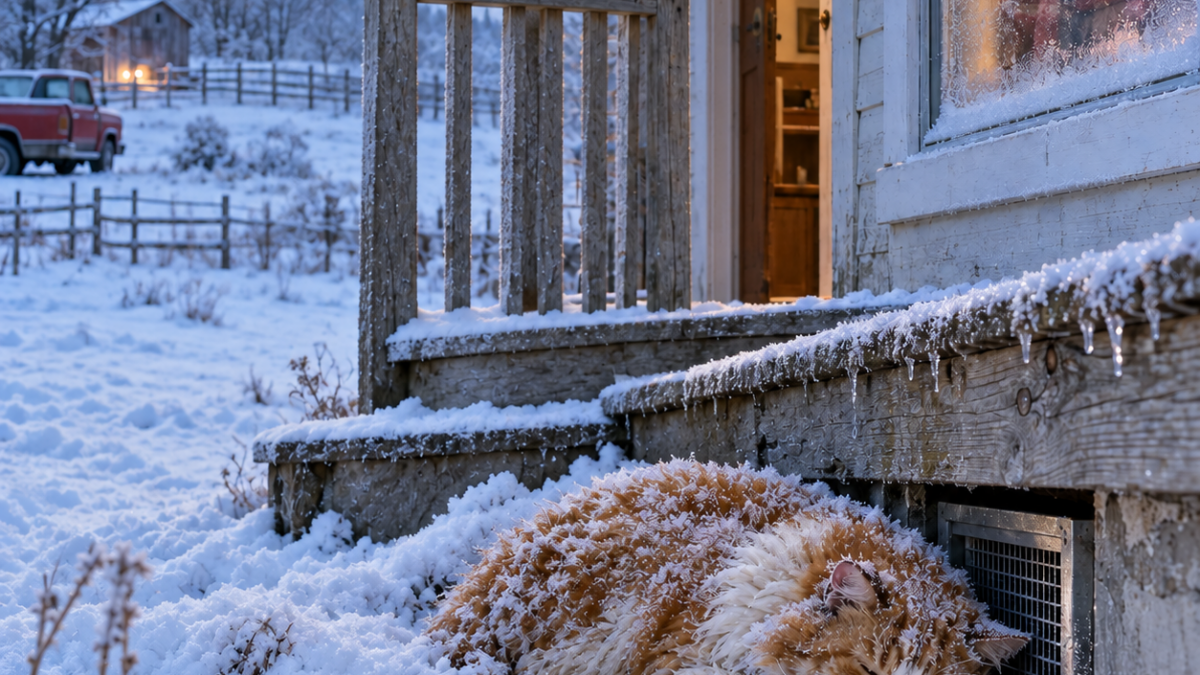
Orange-and-white body flattened against the vent.
Snow crusted across his back.
Ears stiff.
Tail curled unnaturally beneath him.
Eyes closed.
He looked carved.
Not sleeping.
Not like Bear.
Something else.
Frank touched him.
“He’s stuck to it.”
I made a sound.
I do not remember what.
They worked carefully.
Warm water would have risked tissue injury and was not immediately available anyway.
They loosened ice gradually.
Some fur tore.
Skin beneath his chest had frozen directly against the grille.
When they finally lifted him, strands of orange-and-white hair remained attached to the metal.
His legs did not bend.
Frank pressed fingers near Bear’s chest.
Nothing obvious.
The second worker shook his head.
“I’m sorry.”
My oldest was behind me.
I did not know he had followed.
He screamed:
“BEAR!”
That sound still lives inside me.
Frank looked at my son.
Then at the cat.
I think that is why he did what he did.
Or maybe he would have done it anyway.
He removed his heavy insulated jacket.
Wrapped Bear completely.
Picked him up.
“Truck.”
The other worker said:
“Frank—”
“I know.”
“You think—”
“No.”
Frank carried Bear toward the road vehicle.
Later, he told me he had no rational reason.
Bear appeared dead.
Rigid.
Unresponsive.
No visible breathing.
But Frank had spent decades in winter rescue.
He had seen people who looked dead from hypothermia and weren’t.
There is a phrase rescuers use.
Not dead until warm and dead.
He had mostly heard it about humans.
That morning, apparently, he decided an old cat deserved the same argument.
He climbed into the heated cab.
Held Bear beneath the open front of his own thermal overalls.
Pressed him against his chest.
The heater ran full blast.
Not direct scalding heat.
Warm cabin.
Body heat.
Gradual warming.
Our children were loaded into another vehicle.
I had to choose.
Bear or children.
There was no choice.
I went with my kids.
Before leaving, I looked through the open door of Frank’s truck.
He held Bear.
The cat looked dead.
I whispered:
“Please.”
Frank said:
“I’ll try.”
That word again.
Try.
I had no idea that nineteen minutes later, Bear would inhale.
Frank later described it to me.
At first he thought he imagined movement.
A tiny release beneath the jacket.
Then Bear’s mouth opened.
One weak breath.
Long pause.
Another.
Frank shouted so loudly the driver nearly swerved.
The road crew radioed ahead to the closest veterinary clinic operating on emergency power.
Bear was alive.
Barely.
I did not hear that until we reached the hospital.
My children were in emergency care.
Warm fluids.
Slow rewarming.
Monitoring.
My youngest sleepy but responsive.
Five-year-old asking for food.
Eight-year-old insisting he was fine because he wanted to know about Bear.
I had not changed clothes.
My socks were wet.
My hands shook even after warming.
A nurse brought coffee.
I could not hold the cup.
Then my phone rang.
Unknown number.
I nearly ignored it.
“Hello?”
“Is this Bear’s owner?”
Everything inside me stopped.
“Yes.”
“My name is Dr. Elena Marsh. I’m the veterinarian who has him.”
I could not speak.
“He’s alive.”
I sat down.
Actually fell into the chair.
“What?”
“He is alive.”
I started sobbing.
In the hospital corridor.
Loudly.
A nurse came toward me.
I waved her away.
Dr. Marsh continued.
“His condition is extremely critical.”
“I understand.”
“No.”
Her voice was kind but firm.
“I need you to understand how critical.”
I tried breathing.
“His core temperature when he arrived was thirty point seven Celsius.”
I knew nothing about feline normal temperature.
She explained.
Normal cat temperature was roughly one hundred to one hundred two and a half Fahrenheit.
Bear was around eighty-seven.
Severe hypothermia.
Potentially fatal.
Heart rhythm unstable.
Frostbite extensive.
Kidney injury possible.
Muscle damage.
Skin damage.
Respiratory complications.
“He may still die.”
Those words hurt.
But not like finding him frozen.
Alive created hope again.
Hope is dangerous.
I took it anyway.
“Do whatever you can.”
“We are.”
My oldest stood near me.
“Bear?”
I covered the phone.
“He’s alive.”
My son made a sound between a laugh and a cry.
The hospital kept my children twenty-four hours.
Then another day for the toddler.
All three recovered.
No permanent injuries.
No neurological damage.
No lost fingers or toes.
No respiratory problems.
Nothing.
Doctors told me how fortunate we were.
I knew.
What I did not understand until later was how close it had been.
My youngest’s temperature had fallen to thirty-five point four Celsius.
Had the bedroom continued cooling at the earlier rate, another few hours could have changed everything.
When investigators and utility workers inspected the house afterward, they found the vent path beneath the bedroom.
They showed me.
The exterior grille under the porch.
The duct.
The floor register.
Then the imprint.
Bear’s fur and blood still marked the metal.
He had sealed almost the entire opening.
One technician stood there quietly.
“That cat blocked your draft.”
I stared.
“You’re sure?”
“The cold air path ran straight through here.”
He pointed.
“When his body covered it, airflow would’ve dropped drastically.”
I looked at the bedroom above us.
Three children.
One vent.
One old cat.
Dr. Marsh called that afternoon.
Bear had survived the first twelve hours.
But damage was unfolding.
Frostbite is cruel because the full injury does not always show immediately.
The ear tips darkened.
Then blackened.
Two toes on the left front paw showed no viable blood flow.
One toe on the right rear.
His already damaged tail was worse.
Circulation stopped beyond the midpoint.
Skin across his chest and abdomen blistered.
Where he had frozen to the metal, tissue began dying.
The shape matched the grille.
Rectangular lines.
Parallel bars.
A burn without heat.
A cold brand.
I visited as soon as the children were discharged.
Bear lay in a heated enclosure.
IV line.
Blankets.
Bandages.
He looked very small.
That shocked me.
Outside, with his coat puffed against winter, Bear had always looked enormous.
In the hospital, shaved in places, wet fur cleaned away, he looked old.
Fourteen.
Maybe older.
His eyes opened when I approached.
“Hey.”
One ear moved.
I knelt.
“You idiot.”
His eyes remained on me.
“You absolute idiot.”
My voice broke.
I pushed two fingers near his cheek.
Bear leaned into them.
That destroyed me.
“I’m sorry.”
Dr. Marsh stood behind me.
“For what?”
I looked at her.
“I left him outside.”
“He lived outside.”
“I should’ve forced him in.”
“Would he have stayed?”
“No.”
“Then stop rewriting the night with choices you did not have.”
I looked back at Bear.
“He almost died.”
“Yes.”
“For us.”
Dr. Marsh hesitated.
“We don’t know intent.”
I understood what she meant.
She was a doctor.
Not a storyteller.
She refused to assign human reasoning to an animal without evidence.
I respected that.
Then she added:
“But we know where he chose to lie.”
That was enough.
Surgery happened three days later.
Both ear tips amputated.
Three toes removed.
Chest tissue debrided.
Later, tail amputated from the midpoint.
Bear survived anesthesia.
Then infection risk.
Then kidney stress.
Then another week.
When he finally came home, he was no longer an outdoor cat.
That decision was over.
I moved his plywood shelter into the garage, then eventually threw it away.
Bear protested indoor life for approximately forty-eight hours.
He sat beside the back door.
Meowed.
Looked at me with betrayal.
“No.”
He meowed again.
“You nearly froze to death.”
Complaint.
“You’re retired.”
Complaint.
My five-year-old said:
“He wants outside.”
“I know.”
“Are you going to let him?”
“No.”
Bear stared at us.
My son whispered:
“He looks mad.”
“He can be mad.”
For the first time in fourteen years, Bear became an indoor cat.
He adjusted faster than expected.
Maybe because he was tired.
His back legs never regained full strength.
He walked carefully.
Slight uneven step.
Missing toes changed his balance.
Without most of his tail, turning required more effort.
He could no longer jump onto counters.
That was probably the only advantage.
We put pet stairs beside the couch.
He ignored them.
Then used them at night when he thought we were not watching.
His chest healed slowly.
When fur grew back, one large area remained hairless.
Pink.
Thickened.
Scar tissue.
The pattern of the vent remained visible.
Almost perfect lines.
My children called it Bear’s shield.
I hated that at first.
It sounded too heroic.
Too simple.
But children needed a name.
So Bear’s shield it became.
After the storm, reporters started calling.
I did not know how they found us.
Small communities leak stories.
Road workers talk.
Hospital staff talk.
Someone posted about the cat.
Within days, a local reporter came.
I almost refused.
Then thought of the veterinary bill.
Bear’s care cost more than I could manage.
The community had already started collecting donations.
So I agreed.
The reporter sat in our living room.
Bear slept beside the heater.
She asked about the storm.
Children.
Emergency calls.
Then:
“What do you think Bear was doing?”
I looked at the scar across his chest.
There were many answers I could have given.
Instinct.
Seeking shelter.
Following warmth.
Responding to airflow.
Maybe protecting territory.
Maybe nothing we could translate.
Instead, I said the only thing I knew.
“He knew.”
The reporter waited.
“He lived on that porch fourteen years.”
My throat tightened.
“He knew where the cold came from.”
I looked at Bear.
“So he went and stopped it.”
That quote followed us everywhere.
People sent letters.
Drawings.
Cat food.
Blankets.
Money.
A second-grade class mailed a poster covered with orange paw prints.
Someone knitted him a sweater.
Bear hated the sweater.
A veteran from Montana sent a tiny medal.
I put it in a drawer because Bear did not need medals.
What he needed was kidney monitoring.
That became the next problem.
The hypothermia had injured more than paws and ears.
His kidneys never fully recovered.
At first, blood values improved.
Then plateaued.
Dr. Marsh warned me.
“We may see chronic decline.”
“How fast?”
“No way to know.”
I had learned to hate that phrase.
No way to know.
But it was honest.
February became March.
Bear ate.
Slept.
Walked.
Followed the kids.
My toddler, who had been the coldest, became Bear’s constant companion.
They slept together on the couch.
The child would place one small hand against the scarred pink area on Bear’s chest.
I tried stopping him the first time.
Dr. Marsh had said the healed skin was sensitive.
Bear did not move away.
He actually rolled slightly toward him.
So I stopped interfering.
At bedtime, the children began asking:
“Is Bear coming?”
Usually, yes.
He slept first in one room, then another.
An old cat making rounds.
Checking.
My oldest believed Bear was guarding them.
Maybe.
Or maybe the beds were warm.
Again, I stopped needing every answer.
April arrived.
Snow melted.
The vent beneath the porch remained.
I could not look at it.
Eventually our landlord replaced and sealed the ducting.
Installed insulated covers.
Then, after the publicity, a local contractor donated a backup propane heater rated for indoor emergency use.
Another family gave us a small generator.
I cried when they delivered it.
Not gratitude alone.
Anger too.
Why did safety so often arrive after disaster proved you needed it?
I had spent months before the storm choosing which bills could wait.
A generator had felt impossible.
Then one night nearly killed us.
Afterward, people gave us two.
That is how poverty works sometimes.
You can know exactly what would make life safer and still not be able to purchase it until something terrible happens.
I do not say that to sound ungrateful.
I was grateful.
Deeply.
But gratitude and frustration can coexist.
May.
Bear started drinking more.
I noticed.
Because after fourteen years, you know what normal looks like.
Water bowl empty faster.
More urine.
Weight dropping beneath the fur.
Dr. Marsh ran tests.
Kidney values worse.
We changed food.
Added fluids.
Medication.
Bear hated subcutaneous fluids.
He tolerated them anyway.
I would sit on the kitchen floor.
Hang the fluid bag from a cabinet handle.
Insert the needle beneath his skin.
My oldest kept time.
My middle child fed treats afterward.
The toddler petted Bear’s head.
Family medical procedure.
Bear endured it with the patience of someone who had already survived worse.
June.
He stopped climbing the couch stairs some days.
We lifted him.
He weighed less now.
Seventeen pounds.
Then sixteen.
His coat remained thick but loose over his spine.
I began understanding what Dr. Marsh meant.
His body had survived the night.
It had not escaped it.
July.
One afternoon, I found Bear sitting at the back door.
Sunlight across the floor.
He stared outside.
The porch.
His porch.
I sat beside him.
“You miss it?”
Bear blinked.
I opened the door but kept the screen closed.
Warm summer air entered.
Bear lifted his nose.
Smelled.
For ten minutes, we sat.
I wondered whether memory works in cats.
Did he remember freezing?
Did he know the vent?
Did places carry fear for animals the way they do for people?
I did not know.
Eventually, Bear lay down.
His scar pressed against the floor.
I touched his back.
“You can stay here.”
The words were for both of us.
August.
The children returned to school.
For the first time since the storm, I spent mornings alone with Bear.
He followed me room to room.
Slowly.
If I washed dishes, he lay beneath the table.
Laundry, hallway.
Bathroom, door.
I joked that fourteen years outside had apparently convinced him indoor life was acceptable only if I remained visible.
One morning, he stopped eating breakfast.
I stared at the untouched food.
“No.”
He looked at me.
“Bear.”
Nothing.
I opened a can of tuna.
Favorite.
He sniffed.
Turned away.
My stomach dropped.
I called Dr. Marsh.
Blood tests.
Kidneys much worse.
She spoke carefully.
“We can hospitalize.”
“Will it help?”
“Possibly temporarily.”
“How temporarily?”
“I don’t know.”
There it was.
I looked at Bear.
He sat on the table.
Scar.
Missing ears.
Half tail.
Old paws.
Fourteen winters.
That night.
Seven months since.
“What would you do?”
Dr. Marsh’s expression softened.
“If he were mine?”
“Yes.”
“I’d give him a short trial of fluids.”
“And if he doesn’t respond?”
She waited.
I nodded.
We both knew.
Bear stayed in the clinic overnight.
I hated leaving him.
The last time he had been away from us was after freezing.
I returned first thing.
He had eaten three bites.
Enough for hope.
We brought him home.
For two weeks, he improved slightly.
Then declined again.
September.
He turned fifteen.
We did not know his exact birthday, so the children chose September first years earlier.
They made him a cardboard crown.
Bear tolerated it for six seconds.
We gave him chicken.
He ate a little.
My oldest said:
“Fifteen is really old.”
“Yes.”
“Is he going to die?”
I wanted to lie.
After the storm, I had stopped lying to my children about things their bodies already understood.
“Yes.”
My middle son cried immediately.
My toddler said:
“No.”
That word.
No.
“I know.”
“No.”
“I know.”
He hugged Bear.
The cat stayed.
That night, I sat with all three children.
We talked about February.
Not the dramatic version from newspapers.
Their memories.
My oldest remembered counting jumps.
My middle remembered singing pancake.
The toddler remembered nothing.
Thank God.
Then my oldest asked:
“Did Bear know we were there?”
“I think so.”
“How?”
“He knew the house.”
“That’s not what I mean.”
I looked at him.
He looked older than eight now.
Trauma does that.
“Did he know he was saving us?”
I took time.
“I don’t know.”
He frowned.
“But you said he knew.”
“I think he knew the cold was coming through that vent.”
I touched his hand.
“I think he knew you were inside.”
“But did he know he would freeze?”
That question broke me.
“I don’t know.”
My son cried silently.
Then said:
“If he knew, he should’ve moved.”
I pulled him close.
“Yes.”
That surprised him.
“Yes?”
“Yes.”
I held him.
“I wish he had moved.”
People expected me to call Bear a hero.
I did.
But love does not mean being grateful for suffering.
If I could rewrite that night and make Bear leave the vent after one hour, I would.
If the children still survived, I would choose Bear warm in his shelter.
Every time.
I did not want his sacrifice.
We needed it.
Those are different truths.
September nineteenth, Bear could no longer stand without help.
Dr. Marsh came to our house.
I requested that.
Bear hated the clinic now.
Home was kinder.
We placed his favorite blanket beside the back door.
The children sat around him.
I gave them the choice to leave.
None did.
My toddler, now three, lay with his face near Bear’s.
My five-year-old—six by then—held one enormous paw.
My oldest sat behind me.
Dr. Marsh listened to Bear’s heart.
“He’s tired.”
I nodded.
“So am I.”
She smiled sadly.
We had already discussed the process.
Sedative.
Then final injection.
Peaceful.
No pain.
I looked at the children.
“Anybody want to say something?”
My middle son said:
“Thank you.”
My oldest cried.
The toddler whispered:
“Good Bear.”
I bent down.
Bear’s remaining ear tips were rounded from surgery.
I kissed between them.
“You did enough.”
His eyes opened slightly.
“For fourteen years.”
My voice broke.
“You did enough.”
I touched the scar across his chest.
“You don’t have to do anything else.”
Dr. Marsh gave the sedative.
Bear relaxed.
His breathing slowed.
I had never seen him that loose.
Not even sleeping.
Years of outdoor alertness disappeared.
He looked like a kitten.
For just a moment.
The children touched him.
Then Dr. Marsh gave the final medication.
Bear took three breaths.
Then stopped.
Silence.
No wind.
No storm.
No metal vent.
Warm September afternoon.
His family around him.
That was the death I wished he had been allowed all along.
Gentle.
Ordinary.
Loved.
We buried Bear behind the porch.
People asked why there.
I had options.
A tree near the edge of the property.
A sunny corner.
The garden.
But none felt right.
The vent had been permanently sealed.
The metal grille removed.
Beneath that spot, we dug.
The children helped.
My oldest used a shovel.
Middle son gathered stones.
Toddler carried flowers and dropped most of them before reaching the hole.
We wrapped Bear in the old blanket he had slept on inside after the storm.
No collar.
Bear never wore one consistently.
No medal.
No newspaper clippings.
Just Bear.
Before covering him, I placed one thing beside him.
A piece of straw from his old shelter.
Fourteen years outside.
One last piece of home.
Then we filled the grave.
My oldest made a wooden sign.
BEAR
OUR GOOD BOY
He misspelled nothing.
That made me cry more.
Months later, winter came again.
First hard freeze.
The generator sat ready.
Backup heater tested.
Extra fuel.
Emergency supplies.
Thermal blankets.
Phones charged.
Neighbors organized a call tree.
Nobody in our road community wanted another February.
The first night temperature dropped below zero, my youngest asked:
“Bear cold?”
I looked toward the grave beyond the porch.
“No.”
“You sure?”
“Yes.”
For once, yes.
He was not cold.
That knowledge mattered.
I still wake during outages.
Even short ones.
If lights flicker, my chest tightens.
I count children.
Check batteries.
Touch radiators.
Listen to wind.
Trauma teaches the body faster than reason teaches it back.
My oldest hates sleeping in that small bedroom during winter.
We changed rooms.
My middle son refuses to wear the hat he wore that night.
I threw it away.
The toddler has no memory but becomes anxious when we lose electricity.
Maybe children remember with bodies too.
And all three still talk about Bear.
Not constantly.
That would worry me.
But sometimes.
A school assignment.
“What is something brave?”
Bear.
A drawing.
Orange cat on a porch.
A question from another child.
“Did your cat really save you?”
My oldest answers:
“Yes.”
I do not correct him.
Scientists might ask for a more cautious statement.
That is fine.
I know what happened inside our house.
I know the cold was coming through that vent.
I know Bear covered it.
I know the rate of cooling changed.
I know three children survived.
I know Bear almost did not.
That is enough evidence for a mother.
Frank Daley still visits sometimes.
The road worker who wrapped Bear in his coat.
He insists he did nothing special.
I disagree.
Without him, Bear dies on that vent.
No seven months.
No children sleeping beside him.
No final summer in sunlight.
No peaceful September.
One Christmas, I gave Frank a framed photo of Bear.
Not from after the storm.
Before.
Huge orange cat sitting on the porch railing.
Both ear tips damaged but still there.
Tail crooked.
Eyes half closed in sunlight.
Frank stared at it.
“That him?”
“That’s him.”
He swallowed.
“He was heavy.”
I laughed.
“Twenty-two pounds.”
“I thought my back was going out carrying him.”
We both laughed.
Then Frank wiped his eyes.
“I really thought he was gone.”
“So did I.”
“I don’t know why I picked him up.”
“Yes, you do.”
He looked at me.
“You couldn’t leave him there.”
Frank nodded.
“That’s about it.”
Maybe Bear and Frank had something in common.
Neither could leave somebody in the cold.
The story spread farther than our town.
Online posts simplified everything.
OLD CAT SACRIFICES HIMSELF TO SAVE THREE CHILDREN.
Some said Bear died that morning.
Wrong.
Some said he dragged blankets over the vent.
No.
Some claimed he scratched until rescuers arrived.
No.
Truth is powerful enough.
He lay there.
That was all.
He put his body between the cold and the house.
Stayed.
Nearly died.
Breathed again.
Lost pieces of himself.
Came home.
Lived seven more months.
Died loved.
No embellishment needed.
Sometimes people messaged me:
“Animals are angels.”
I never knew how to answer.
Bear was not an angel.
He stole food.
Killed birds.
Once urinated in a contractor’s toolbox because the man left it on Bear’s porch.
He disappeared for days when younger.
Fought other cats.
Hated being brushed.
Bit me once during a bath.
Bear was an animal.
A real one.
That makes what happened more meaningful to me, not less.
He was not created to save children.
He had instincts.
Preferences.
Fear.
Pain.
Yet on the worst night of our lives, he ended up exactly where the cold entered.
And he stayed.
One year after the storm, we gathered near his grave.
No ceremony planned.
Just us.
The children had changed.
My youngest taller.
Middle boy missing a front tooth.
Oldest almost ten.
I brought a small stone.
On it, someone local had engraved:
HE KNEW WHERE THE COLD CAME FROM.
I had resisted the idea initially.
Too dramatic.
Then accepted.
We placed it near the grave.
My oldest said:
“Mom?”
“Yes?”
“If Bear didn’t block it, would we have died?”
There are questions parents want to avoid forever.
This was one.
I looked toward the sealed vent.
“I don’t know.”
“But maybe.”
“Yes.”
He stared.
“Does that mean we owe him?”
I thought about that.
“No.”
He looked surprised.
“No?”
“No.”
I put my arm around him.
“Love isn’t debt.”
I had learned that after Bear.
“We remember him.”
“We’re grateful.”
“We loved him.”
“But you don’t spend your life owing somebody for keeping you alive.”
My son looked toward the stone.
“What do we do then?”
“Live.”
Simple.
Hard.
Live.
Bear had not saved my children so they could spend childhood carrying the weight of his suffering.
At least, that was how I chose to see it.
So we lived.
Birthday parties.
School.
Arguments about homework.
Soccer.
Broken dishes.
Flu.
Christmas.
Ordinary things.
The greatest gift after nearly losing life is eventually becoming annoyed by normal life again.
One morning my children were fighting over cereal.
I shouted:
“Can everybody stop yelling for five minutes?”
Then froze.
Remembered the night when I would have given anything to hear all three of them yelling safely in a warm kitchen.
I started laughing.
The children stared.
“What?”
“Nothing.”
They thought I had lost my mind.
Maybe I had gained perspective.
Not permanent perspective.
I still complain.
Still get angry.
Still worry about bills.
Near-death experiences do not transform you into a saint.
They simply leave certain doors open inside you.
Cold air moves through sometimes.
So does gratitude.
I kept Bear’s medical records.
Every page.
His admission temperature.
30.7°C.
Frostbite assessment.
Amputation notes.
Kidney values.
Weight changes.
The first page where Dr. Marsh wrote:
SPONTANEOUS RESPIRATIONS RETURNED DURING PASSIVE REWARMING.
That sentence.
Spontaneous respirations returned.
Nineteen minutes after they thought him dead.
I sometimes imagine that first breath.
Frank’s coat around him.
Engine heater running.
Old orange body rigid.
Then movement.
One breath.
Bear chose nothing consciously in that moment.
His body simply refused to finish dying.
That is almost more astonishing.
The same body that had spent hours against frozen metal still had enough left to breathe.
One more.
Then another.
I think about the phrase “he gave everything.”
It sounds final.
Bear did not give everything that night.
He kept something.
Seven months.
Seven months of sunlight.
Chicken.
Children.
Indoor heat.
Annoyance.
Sleep.
Summer air through the screen.
His fifteenth birthday.
Time.
Time mattered.
If Frank had left him there because he looked dead, none of that exists.
That is why I tell Frank he saved Bear.
And why he tells me Bear saved my children.
Maybe some stories do not have one hero.
Maybe survival is a chain.
Bear blocks vent.
Neighbor stops road crew.
Frank enters house.
Children get warmed.
Frank lifts Bear.
Vet treats Bear.
Community helps us.
One action holds the next.
We like individual heroes because they make stories simple.
Life is usually not simple.
Still, when I close my eyes, the image that returns is Bear alone beneath the porch.
Because nobody put him there.
Nobody called him.
Nobody trained him.
Nobody even knew the vent was a danger.
He found it.
I want to believe he heard us.
Perhaps he heard my children singing through the floor.
Maybe their feet jumping.
Maybe my voice.
Cats hear things humans cannot.
I imagine him leaving the straw.
Walking through blowing snow.
Crawling beneath the deck.
Cold pouring through the grille.
He stops.
Sniffs.
Feels air.
Then lies down.
That is my imagined version.
It may be wrong.
But the ending is not.
Morning.
Frozen fur.
Three children alive.
Sometimes truth gives imagination permission because the facts are already extraordinary.
My youngest recently asked what Bear looked like before his ears were amputated.
He was too young to remember clearly.
I showed him photographs.
“His ears were bigger.”
“Yes.”
“And tail.”
“Yes.”
“He lost them for us?”
I took a breath.
“He lost them because he froze.”
“But because of us?”
I did not want guilt entering him.
“He was trying to keep the cold from coming through.”
The child thought.
Then:
“He was strong.”
“Yes.”
He smiled.
“Even with no tail.”
“Especially with no tail.”
He laughed.
That is how Bear exists now.
Not frozen.
Not dead.
Not only brave.
Funny.
Huge.
Stubborn.
Orange.
Old.
He remains part of family vocabulary.
When somebody refuses to come inside:
“Don’t be Bear.”
When someone steals food:
“Bear behavior.”
When my oldest sits directly in front of the heater:
“Bear would approve.”
Memory becomes ordinary when grief heals enough.
I like that.
The scar in our lives remains.
But fur grows around some parts.
Not all.
Bear’s chest never grew fur over the grille scar.
Maybe ours never will either.
There are still grid lines in my memory.
Minus thirty-one Fahrenheit.
Eleven failed emergency calls.
Three children beneath blankets.
One old cat.
Nineteen minutes.
30.7°C.
Three toes.
Two ears.
Half a tail.
Seven months.
Numbers.
Trauma loves numbers because numbers feel controllable.
I remind myself of other numbers.
Fourteen years on our porch.
Fifteen years alive.
Three children who grew older.
Hundreds of ordinary mornings.
Thousands of times Bear came when one of them cried.
Count those too.
One evening, long after Bear died, electricity went out during a spring storm.
Not cold.
Seventy degrees outside.
No danger.
Still, every child came into my room.
My body reacted before my mind.
Flashlights.
Phones.
Battery.
Generator.
I was halfway to the garage when my oldest said:
“Mom.”
“What?”
“We’re okay.”
I stopped.
He smiled.
“It’s warm.”
I looked around.
It was.
I sat.
The children climbed onto my bed.
Not because they needed warmth.
Because memory had called us into one room.
We stayed until the lights returned.
My middle child whispered:
“Bear would hate being inside.”
I laughed.
“He got used to it.”
“He liked the couch.”
“Yes.”
“Do you think he liked us?”
I stared at him.
“What?”
“He was always grumpy.”
I laughed so hard I woke the toddler.
“Yes.”
Bear liked you.
Loved you?
That word belongs to humans, some scientists might say.
I am comfortable using it.
Bear loved them in whatever way a cat loves.
He slept beneath their windows.
Followed them.
Tolerated crowns.
Came when they cried.
And one terrible night, he stayed where staying hurt.
If that is not love, it lived close enough beside love that I cannot tell the difference.
Years from now, my children may remember the story differently.
My oldest remembers most.
Middle child remembers pieces.
Youngest remembers what we tell him.
Their children may hear it someday.
Stories change.
I hope one part never does.
Bear was old.
He had already given us fourteen years.
He did not owe us one more thing.
That matters to me.
Because sacrifice feels different when it comes from someone who has already given enough.
Bear had survived cold before.
Frostbite before.
Fights.
Age.
Outdoor winters.
He deserved the warmth of his straw shelter.
Instead, on the coldest night we ever knew, his final great act was leaving it.
He traded shelter for exposure.
Warmth for wind.
His body for a barrier.
Then somehow survived long enough to come back to us for seven months.
I sometimes sit behind the porch near his grave after the children are asleep.
Not often.
Maybe once every few months.
The sealed vent is still visible in the wall.
The new cover is insulated and weatherproof.
Nothing enters now.
I sit there.
Imagine Bear’s weight.
Twenty-two pounds.
Not much compared with a house.
Not much compared with winter.
But enough.
That is another lesson I carry.
Sometimes enough looks very small.
A towel beneath a door.
One more emergency call.
A neighbor stopping a truck.
An old man’s coat.
One breath.
Twenty-two pounds over a metal grate.
Enough.
We tend to believe saving people requires something enormous.
It often does not.
Sometimes the difference between tragedy and morning is something barely sufficient.
Bear was barely sufficient.
So were we.
We reached morning anyway.
If I could speak to him now, I would not thank him first.
I think people expect that.
I would apologize.
Not because his death was my fault.
I know that logically.
But love carries irrational apologies.
I would say:
I’m sorry you were cold.
I’m sorry nobody knew.
I’m sorry you had to stay there.
Then:
Thank you.
Then:
You can go inside now.
That sounds ridiculous.
Maybe.
But even after death, part of me imagines Bear still outside.
Still watching the porch.
Still choosing the weather.
I want him somewhere warm.
My oldest says if heaven exists, Bear probably refuses to enter the house.
He says there would have to be a heated porch.
That sounds right.
A porch.
Sun.
Straw.
Food bowl.
No winter.
Three children occasionally coming outside to bother him.
Bear pretending annoyance.
That is where I place him in my mind.
Not on the vent.
I refuse to leave him there forever.
The vent is where he saved us.
It is not where his story ends.
His story ends seven months later, on a warm blanket, surrounded by the people whose breaths he helped protect.
It ends after summer.
After sunlight.
After becoming an indoor cat.
After learning the couch.
After chicken on his fifteenth birthday.
After my toddler pressed his palm against that scar and Bear leaned closer instead of away.
It ends after enough time for us to understand what he had done.
Enough time for us to say thank you while he was still alive.
That matters.
Bear never understood newspaper articles.
He never understood donations.
He never knew strangers called him brave.
He did not care.
He knew our house.
Our footsteps.
The children’s voices.
Food bowls.
The porch.
Cold.
Warmth.
Maybe that was everything he needed.
And maybe that is why the simplest explanation remains the one I believe.
He knew.
He lived on that porch for fourteen years.
He knew every place wind could enter.
That night the house went dark.
The cold began moving beneath the floor where my children were sleeping.
Bear found where it came from.
Then the old cat who had already survived more winters than anyone had a right to ask of him laid down his body and stopped it.
Thirty-one degrees below zero.
Wind chill near fifty-one below.
Six, maybe eight hours.
An animal fourteen years old.
Frozen ears.
Frozen paws.
A damaged tail.
A scar pressed permanently into his chest.
Three children breathing above him.
And when morning came, they found him stuck to the steel.
They thought he was dead.
Maybe by every reasonable measure, he should have been.
Then an old rescue worker refused to leave him in the cold.
Nineteen minutes later, Bear breathed.
Once.
Then again.
He came home missing pieces.
But he came home.
And for seven more months, every night before I went to bed, I walked through the house and counted.
One child.
Two.
Three.
Then Bear.
All four breathing.
For seven months, that was enough.
More than enough.
And when Bear finally died, I buried him beside the place where the cold had entered.
Not because I wanted to remember his suffering.
Because that piece of ground marks the place where an old cat looked at a winter bigger than himself and, somehow, decided:
No farther.
Not into this house.
Not tonight.
There are people who will tell you animals do not think in those words.
They are probably right.
Bear did not need the words.
His body said them for him.
And my children are alive to remember.


